Home Blog Page 429

Microservices and AI Blueprints

RTX AI Garage

Over the past year, generative AI has transformed the way people live, work and play, enhancing everything from writing and content creation to gaming, learning and productivity. PC enthusiasts and developers are leading the charge in pushing the boundaries of this groundbreaking technology.

Countless times, industry-defining technological breakthroughs have been invented in one place — a garage. This week marks the start of the RTX AI Garage series, which will offer routine content for developers and enthusiasts looking to learn more about NVIDIA NIM microservices and AI Blueprints, and how to build AI agents, creative workflow, digital human, productivity apps and more on AI PCs. Welcome to the RTX AI Garage.

NVIDIA NIM Microservices

These models — offered as NVIDIA NIM microservices — are powered by new GeForce RTX 50 Series GPUs. Built on the NVIDIA Blackwell architecture, RTX 50 Series GPUs deliver up to 3,352 trillion AI operations per second of performance, 32GB of VRAM and feature FP4 compute, doubling AI inference performance and enabling generative AI to run locally with a smaller memory footprint.

NIM microservices and AI Blueprints empower enthusiasts and developers to build, iterate and deliver AI-powered experiences to the PC faster than ever. The result is a new wave of compelling, practical capabilities for PC users.

Fast-Track AI with NVIDIA NIM

There are two key challenges to bringing AI advancements to PCs. First, the pace of AI research is breakneck, with new models appearing daily on platforms like Hugging Face, which now hosts over a million models. As a result, breakthroughs quickly become outdated.

Second, adapting these models for PC use is a complex, resource-intensive process. Optimizing them for PC hardware, integrating them with AI software and connecting them to applications requires significant engineering effort.

NVIDIA NIM helps address these challenges by offering prepackaged, state-of-the-art AI models optimized for PCs. These NIM microservices span model domains, can be installed with a single click, feature application programming interfaces (APIs) for easy integration, and harness NVIDIA AI software and RTX GPUs for accelerated performance.

What’s in an API?

An API is the way in which an application communicates with a software library. An API defines a set of “calls” that the application can make to the library and what the application can expect in return. Traditional AI APIs require a lot of setup and configuration, making AI capabilities harder to use and hampering innovation.

NIM microservices expose easy-to-use, intuitive APIs that an application can simply send requests to and get a response. In addition, they’re designed around the input and output media for different model types. For example, LLMs take text as input and produce text as output, image generators convert text to image, speech recognizers turn speech to text and so on.

The microservices are designed to integrate seamlessly with leading AI development and agent frameworks such as AI Toolkit for VSCode, AnythingLLM, ComfyUI, Flowise AI, LangChain, Langflow and LM Studio. Developers can easily download and deploy them from build.nvidia.com.

By bringing these APIs to RTX, NVIDIA NIM will accelerate AI innovation on PCs.

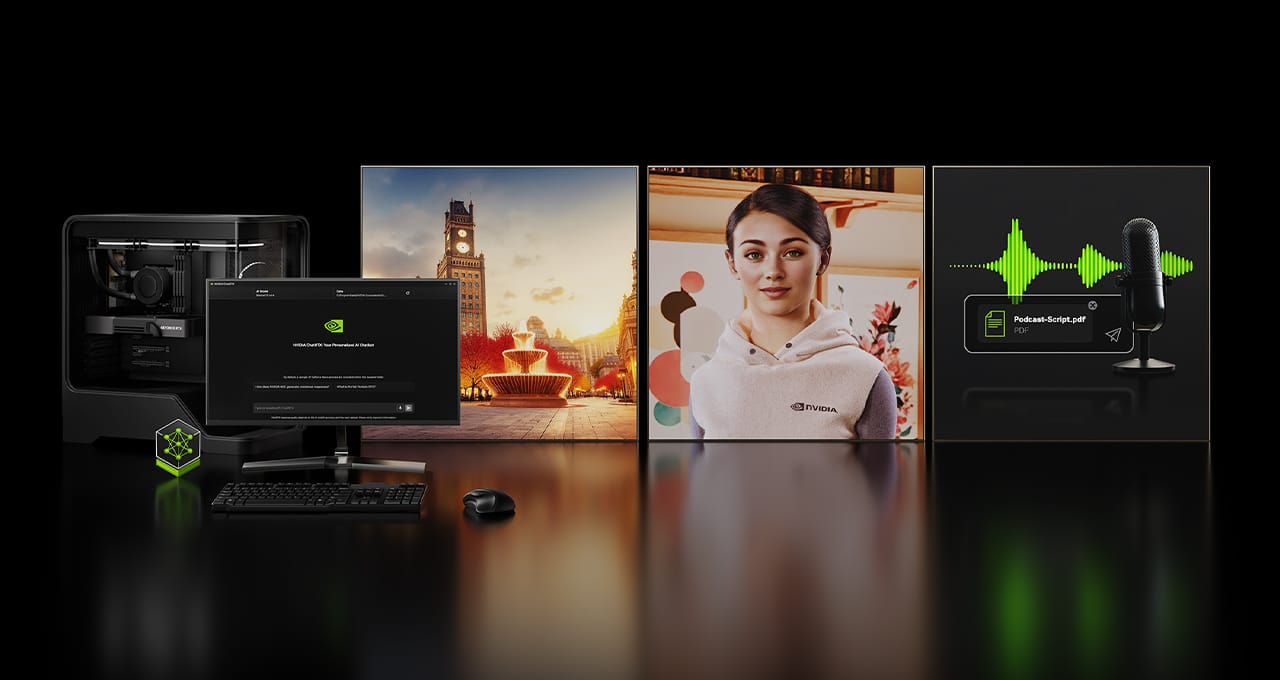
Enthusiasts are expected to be able to experience a range of NIM microservices using an upcoming release of the NVIDIA ChatRTX tech demo.

NVIDIA AI Blueprints

By using state-of-the-art models, prepackaged and optimized for PCs, developers and enthusiasts can quickly create AI-powered projects. Taking things a step further, they can combine multiple AI models and other functionality to build complex applications like digital humans, podcast generators and application assistants.

NVIDIA AI Blueprints, built on NIM microservices, are reference implementations for complex AI workflows. They help developers connect several components, including libraries, software development kits and AI models, together in a single application.

AI Blueprints include everything that a developer needs to build, run, customize and extend the reference workflow, which includes the reference application and source code, sample data, and documentation for customization and orchestration of the different components.

At CES, NVIDIA announced two AI Blueprints for RTX: one for PDF to podcast, which lets users generate a podcast from any PDF, and another for 3D-guided generative AI, which is based on FLUX.1 [dev] and expected be offered as a NIM microservice, offers artists greater control over text-based image generation.

With AI Blueprints, developers can quickly go from AI experimentation to AI development for cutting-edge workflows on RTX PCs and workstations.

GeForce RTX 50 Series GPUs

The new GeForce RTX 50 Series GPUs are purpose-built to tackle complex generative AI challenges, featuring fifth-generation Tensor Cores with FP4 support, faster G7 memory and an AI-management processor for efficient multitasking between AI and creative workflows.

The GeForce RTX 50 Series adds FP4 support to help bring better performance and more models to PCs. FP4 is a lower quantization method, similar to file compression, that decreases model sizes. Compared with FP16 — the default method that most models feature — FP4 uses less than half of the memory, and 50 Series GPUs provide over 2x performance compared with the previous generation. This can be done with virtually no loss in quality with advanced quantization methods offered by NVIDIA TensorRT Model Optimizer.

Get Started with the New AI APIs for PCs

NVIDIA NIM microservices and AI Blueprints are expected to be available starting next month, with initial hardware support for GeForce RTX 50 Series, GeForce RTX 4090 and 4080, and NVIDIA RTX 6000 and 5000 professional GPUs. Additional GPUs will be supported in the future.

NIM-ready RTX AI PCs are expected to be available from Acer, ASUS, Dell, GIGABYTE, HP, Lenovo, MSI, Razer and Samsung, and from local system builders Corsair, Falcon Northwest, LDLC, Maingear, Mifcon, Origin PC, PCS and Scan.

Conclusion

NVIDIA NIM microservices and AI Blueprints are revolutionizing the way developers and enthusiasts build AI-powered experiences on PCs. With NIM, developers can quickly access state-of-the-art AI models, prepackaged and optimized for PCs, and build complex applications like digital humans, podcast generators and application assistants.

Frequently Asked Questions

Q: What are NVIDIA NIM microservices?
A: NVIDIA NIM microservices are prepackaged, state-of-the-art AI models optimized for PCs, offering easy integration and accelerated performance.

Q: What are NVIDIA AI Blueprints?
A: NVIDIA AI Blueprints are reference implementations for complex AI workflows, helping developers connect several components, including libraries, software development kits and AI models, together in a single application.

Q: What is FP4?
A: FP4 is a lower quantization method, similar to file compression, that decreases model sizes, providing better performance and more models to PCs.

Q: When will NVIDIA NIM microservices and AI Blueprints be available?
A: NVIDIA NIM microservices and AI Blueprints are expected to be available starting next month, with initial hardware support for GeForce RTX 50 Series, GeForce RTX 4090 and 4080, and NVIDIA RTX 6000 and 5000 professional GPUs.


Countdown Begins

0

AI and Big Data Expo Global: Unleashing the Power of Emerging Technologies

Set to take place at the Olympia, London, on 5-6 February 2025, this must-attend artificial intelligence and big data event is for professionals from all industries looking to learn more about the newest technology solutions.

Key Highlights

  • Headline Speakers

    : The event boasts a stellar line-up of more than 150 speakers from leading global organisations, including NVIDIA, LinkedIn, Unilever, Sainsbury’s, Co-op, Salesforce, BT Group, Meta, Lloyds Banking Group, Philips, The Economist, Jaguar Land Rover, and many others. These industry leaders will share their expertise and visions on how AI and Big Data are shaping the future across various sectors.

  • Industry-Leading Agenda

    :

    • Strategic insights into the convergence of machine learning, natural language processing, and neural architectures shaping AI’s future.
    • Explore how AI is transforming businesses globally, beyond just augmenting intelligence.
    • Understand how AI impacts work, organisational culture, trust, and leadership.
    • Examine AI’s effect on skills, human-AI collaboration, and the workplace experience.
    • Empower your organisation to navigate the AI transformation journey.
    • Dive into advanced analytics and AI for smarter, data-driven business decisions.
  • Networking Opportunities

    : With more than 7,000 attendees expected, the AI and Big Data Expo offers opportunities for networking, including the Networking drinks on Day 1 of the event. Plus, utilise our AI-powered matchmaking tool to connect with potential collaborators, clients and thought leaders from around the globe.

  • Co-Located Shows

    : Gain access to nine co-located events, covering a wide range of technological innovations and trends. This multi-event format ensures attendees can explore the intersection of AI, big data and other emerging technologies.

  • Exhibition Floor

    : Discover the latest innovations from more than 150 industry-leading solution providers, including Salesforce, Experian, Edge Impulse, Snowflake, Coursera, and more. The exhibition floor is your gateway to seeing cutting-edge products and services first-hand, offering solutions that can transform your business.

Why Attend AI and Big Data Expo Global?

In today’s landscape, AI isn’t just a tool—it’s a strategic imperative. Executives and senior employees need to stay ahead of emerging trends to drive innovation, efficiency, and growth across their organisations.

Conclusions

AI and Big Data Expo Global offers a unique opportunity to learn from industry leaders, network with professionals, and gain insights into the latest technological innovations. Don’t miss your chance to attend this world-leading event and elevate your AI expertise.

Frequently Asked Questions

Q: Who is the target audience for the AI and Big Data Expo Global?
A: The event is designed for professionals from all industries looking to learn more about AI and big data technology solutions.

Q: Who are the speakers at the AI and Big Data Expo Global?
A: The event features over 150 speakers from leading global organisations, including NVIDIA, LinkedIn, Unilever, and many others.

Q: What are the highlights of the Industry-Leading Agenda?
A: The agenda includes strategic insights, AI transformation cases, AI’s impact on work and culture, and advanced analytics and AI for data-driven decisions.

Q: How can I network at the AI and Big Data Expo Global?
A: Attend the event’s Networking drinks, utilise our AI-powered matchmaking tool, and connect with other attendees and thought leaders.

Q: What can I expect to see on the Exhibition Floor?
A: The exhibition floor will feature over 150 industry-leading solution providers showcasing the latest AI and big data technology innovations and solutions.

Puma Pounces on Tiger Woods’ Logo Design in New Lawsuit

0

Sun Day Red’s Logo Causes Legal Headaches for Tiger Woods’ Brand

Tiger Woods’ New Brand, Sun Day Red, Faces Legal Challenges from Puma and Tigeraire

Weeks after splitting from Nike last January, Tiger Woods revealed a new brand named Sun Day Red. Promising to "bring a new and elevated standard to performance wear and luxury lifestyle fashion," Woods’ brand includes a clever logo featuring a tiger with fifteen stripes, each representing one of Woods’ fifteen major titles. But in the year since its unveiling, the logo has caused some legal headaches for Woods’ brand.

Puma Claims Logo Similarity

Back in September, cooling product manufacturer Tigeraire claimed that Sun Day Red "unlawfully hijacked" its logo. And now an even bigger contender has emerged, with sportswear brand Puma launching a lawsuit of its own. According to Hypebeast, if a settlement isn’t reached, the case could go to trial next year.

Puma’s Lawsuit

Puma has claimed that the leaping Sun Day Red tiger is too similar to its own leaping puma. "Due to the confusing similarity of the marks and the identical, legally identical, or closely related nature of the goods and services of the parties, consumer confusion is likely between the Challenged Marks and the Leaping Cat logo," says Puma in the court filing.

Sun Day Red’s Logo in the Crosshairs

The Sun Day Red logo, which features a tiger facing in the opposite direction of Puma’s logo, has been the subject of another infringement case raised by Tigeraire. The company claims that the logo is too similar to its own logo, which features a tiger with a different color scheme. While the logos may not be identical, the similarity between the two brands’ sportswear output could lead to consumer confusion.

Expert Opinion

Josh Gerben, a trademark attorney at Gerben IP, told NBC that the challenge from Puma is "significant." "This is a real fight," he said. "Tiger certainly has a target on his back. He’s big enough to move markets."

Conclusion

The legal battle surrounding Sun Day Red’s logo is a significant one, with Puma and Tigeraire both claiming that the brand has infringed on their intellectual property. As the case moves forward, it will be interesting to see how the courts rule on the matter.

Frequently Asked Questions

Q: What is the main issue surrounding Sun Day Red’s logo?
A: Puma and Tigeraire are both claiming that the logo is too similar to their own, which could lead to consumer confusion.

Q: What is the potential outcome of the case?
A: If a settlement isn’t reached, the case could go to trial next year.

Q: What is the significance of the case for Tiger Woods’ brand?
A: The case could have a significant impact on the brand’s reputation and future success.

Q: Are there any other notable logo disputes in recent years?
A: Yes, there have been several notable logo disputes in recent years, including Kanye West vs. Walmart and Drake vs. Bellroy.

The Weird and Wonderful CES Gadgets I Didn’t Know I Needed

0

The World’s Greatest Tech Showcase

Just one of the weird and wonderful inventions at CES this year is a little robot cat from Yukai Engineering that has the power to prevent you from burning your tongue on hot coffee.

Smart Home Robots

From rolling laptop displays to even more Ring doorbell developments, we’ve rounded up some tech highlights from CES below. Honestly, my biggest interest has always been with robots, and it takes a lot to impress me. Take a look at some of the smart home robots that stole my heart at IFA earlier this year, including a demo of the Samsung Ballie which I cannot wait to buy in 2025.

A Smartphone Toaster??

Everyone at CES is talking about the Swippitt charger. If your morning routine is a little bit manic and rushed, then what better device is there than a toaster-shaped hub that can charge your phone to max capacity in a matter of seconds? There’s actually a lot more to it than this – the Swippitt involves swapping out an external battery attached to specialized phone cases for your phone, that are replaced with fully charged batteries when you insert your phone into the hub using a mechanical process.

Our Favourite Art TV Now Has Pro Power

Possibly our favourite TV of all time at Creative Bloq is the Samsung Frame TV, with its incredible matte display, beautiful frame bezel, and catalogue of exquisite artworks from around the world. Samsung has debuted a brand new version of its popular Frame TV series at CES, introducing the Frame Pro TV. With that said, what the Samsung Frame TV brings to the table in terms of home decor design, it’s always lacked in picture quality. This new model is changing the game, equipped with Neo QLED mini-LED technology for an HDR and contrast boost, and an improved variable refresh rate of 144Hz, making it a better TV for gaming.

As Close as We’re Going to Get to Bee Simulator

Bird feeder cameras are super popular among photographers and nature lovers – but now, bird watching is out and bug watching is the new 2025 trend (at least at CES). From the company that brought us the Bird Buddy camera comes a new range of products, the Petal camera and Wonder Blocks, a modular habitat system. This is pretty revolutionary for those who like bug-watching, and involves models like a Bee Hotel, and camouflaged pedestals to stack the modules on. The Petal has such a cool design, with fake leaves that double as solar panels, and a 12MP camera with a 1/1.9-inch sensor disguised as an orange flower on a bendable stalk.

Acer’s Handheld Nitro Blade 11

Acer has expanded its gaming handheld catalogue with two impressive new Nitro Blaze 8 (8.8-inch) and enormous Nitro Blaze 11 (11-inch) handheld consoles, powered by AMD Ryzen 8040 Series processors. These handhelds are planned for a Q2 2025 release date, and are expected to cost $900 and $1100 for the larger console. The Acer Nitro Blaze 11 has been the star of the show at CES, with a gorgeous 144 Hz display and performance-heavy hardware that makes it three times the weight of a Nintendo Switch. But don’t worry, it also has detachable controllers and a kickstand on the back to give your wrists a break and enjoy tabletop gaming.

Headphones with a Touchscreen Remote

Another never-before-seen concept at CES this year is the JBL SMART Tx touchscreen audio transmitter (a fancy remote control). This can be used with the company’s flagship Tour One M3 over-ear headphones to stream music and audio to your headphones from pretty much any source, and share it with others easily too via Auracast. I’ve personally never envisioned needing a remote control touchscreen for my headphones, given that Bluetooth usually takes care of the connectivity for me. But this concept is actually very cool and I guess there’s no better place to be inventive than at CES. The US price for this tech will be $399.95.

Special Mentions: I Couldn’t Leave These Out

CES is absolutely stacked with tech that it’s impossible to cover everything. But I just had to mention these extra products that I would absolutely buy without question if I had unlimited funds.

Conclusion

CES is a treasure trove of innovative tech that never fails to impress. From robot cats to smartphone toasters, there’s something for everyone at this year’s show. Whether you’re a tech enthusiast or just looking for the latest and greatest gadgets, CES has something to offer.

FAQs

Q: What is the purpose of the robot cat from Yukai Engineering?
A: The robot cat from Yukai Engineering is designed to prevent you from burning your tongue on hot coffee.

Q: What is the Swippitt charger?
A: The Swippitt charger is a toaster-shaped hub that can charge your phone to max capacity in a matter of seconds.

Q: What is the Samsung Frame Pro TV?
A: The Samsung Frame Pro TV is a new version of the popular Frame TV series, featuring improved picture quality and a more advanced design.

Q: What is the Petal camera and Wonder Blocks?
A: The Petal camera and Wonder Blocks are a new range of products from the company that brought us the Bird Buddy camera, designed for bug-watching and featuring a modular habitat system.

Q: What is the Acer Nitro Blaze 11?
A: The Acer Nitro Blaze 11 is a new handheld console from Acer, featuring a 144 Hz display and performance-heavy hardware.

Q: What is the JBL SMART Tx touchscreen audio transmitter?
A: The JBL SMART Tx touchscreen audio transmitter is a remote control that can stream music and audio to your headphones from pretty much any source.

AI Social Media Users

0

Meta’s Plan to Populate Platforms with Artificial Users

Meta caused a stir last week when it let slip that it intends to populate its platform with a significant number of entirely artificial users in the not too distant future.

AI-Generated Social Personas

“We expect these AIs to actually, over time, exist on our platforms, kind of in the same way that accounts do,” Connor Hayes, vice-president of product for generative AI at Meta, told The Financial Times. “They’ll have bios and profile pictures and be able to generate and share content powered by AI on the platform…  that’s where we see all of this going.”

Concerns and Controversy

The fact that Meta seems happy to fill its platform with AI slop and accelerate the “enshittification” of the internet as we know it is concerning. Some people then noticed that Facebook was in fact already awash with strange AI-generated individuals, most of which stopped posting a while ago. These included for example, “Liv,” a “proud Black queer momma of 2 & truth-teller, your realest source of life’s ups & downs,” a persona that went viral as people marveled at its awkward sloppiness. Meta began deleting these earlier fake profiles after they failed to get engagement from any real users.

Research Potential

Let’s pause from hating on Meta for a moment though. It’s worth noting that AI-generated social personas can also be a valuable research tool for scientists looking to explore how AI can mimic human behavior.

GovSim Experiment

An experiment called GovSim, run in late 2024, illustrates how useful it can be to study how AI characters interact with one another. The researchers behind the project wanted to explore the phenomenon of collaboration between humans with access to a shared resource such as shared land for grazing livestock. Several decades ago, the Nobel prize–winning economist Elinor Ostrom showed that, instead of depleting such a resource, real communities tend to figure out how to share it through informal communication and collaboration, without any imposed rules.

Smallville and GovSim

Max Kleiman-Weiner, a professor at the University of Washington and one of those involved with the GovSim work, says it was partly inspired by a Stanford project called Smallville, which I previously wrote about in AI Lab. Smallville is a Farmville-like simulation involving characters that communicate and interact with each other under the control of large language models.

Results of GovSim

Kleiman-Weiner and colleagues wanted to see if AI characters would engage in the kind of cooperation that Ostrom found. The team tested 15 different LLMs, including those from OpenAI, Google, and Anthropic, on three imaginary scenarios: a fishing community with access to the same lake; shepherds who share land for their sheep; and a group of factory owners who need to limit their collective pollution.

In 43 out of 45 simulations they found that the AI personas failed to share resources correctly, although smarter models did do better. “We did see a pretty strong correlation between how powerful the LLM was and how able it was to sustain cooperation,” Kleiman-Weiner told me.

Conclusion

While Meta’s plan to populate its platform with artificial users raises concerns, it also highlights the potential for AI-generated social personas to be a valuable research tool. As scientists continue to explore the capabilities and limitations of AI, we may see more innovative applications of this technology in the future.

FAQs

Q: What is Meta’s plan to populate its platform with artificial users?

A: Meta intends to populate its platform with a significant number of entirely artificial users in the not too distant future.

Q: What is the purpose of AI-generated social personas?

A: AI-generated social personas can be used for research purposes, such as studying how AI can mimic human behavior, and potentially for other applications in the future.

Q: What is the GovSim experiment?

A: GovSim is an experiment that tested the ability of AI characters to collaborate and share resources in imaginary scenarios, inspired by the work of Nobel prize–winning economist Elinor Ostrom.

Q: What were the results of the GovSim experiment?

A: The experiment found that AI personas failed to share resources correctly in 43 out of 45 simulations, although smarter models did do better.

Create AI in 100 Steps

You Create an AI System, One Idea at a Time

You revamp your business by automating tedious tasks, analyzing mountains of data, and predicting customer behavior faster than any human ever could.

You change the world by creating the algorithms that drive self-driving cars, diagnose diseases with 95% accuracy, or even compose symphonies indistinguishable from those of Mozart.

Artificial intelligence isn’t just the future—it’s the now. By 2030, experts predict AI will add $15.7 trillion to the global economy. This way, AI is poised to reshape industries and redefine how we live and work. Businesses using AI are already seeing a 40% increase in productivity and outperforming their competitors. Think of companies like Netflix, which uses AI to recommend content, or Tesla, whose cars rely on AI to navigate complex roads.

AI Concepts You Should Know

Many facts demonstrate that AI is the future of our technological development. Before diving headfirst into building your AI, it’s crucial to understand the fundamental concepts that make AI tick. Think of these as the building blocks you’ll use to construct your intelligent system.

Machine Learning (ML)

Machine learning is the cornerstone of most AI systems. It’s the magic that allows machines to learn and improve without being explicitly programmed for every task. Think of it as training a puppy—you show it what a ball is, reward it for fetching it, and over time, it learns to identify and retrieve the ball independently.

Here’s a deeper look at how ML empowers developing AI systems:

  • Learning from Data: ML algorithms are trained on massive amounts of data. This data could be anything from text and images to numbers and sensor readings. By analyzing the patterns within the data, the algorithm learns to recognize relationships and make predictions about new, unseen data.
  • Different Learning Styles: Just like people learn in different ways, various ML algorithms are suited for different tasks. Some algorithms excel at identifying patterns in data, while others are better at making predictions or classifications. The right algorithm selection depends on the specific problem you’re trying to solve with your AI system.
  • Continuous Improvement: The beauty of ML is that it’s not a one-time learning process. As your AI system encounters new data, the ML algorithms can adapt and improve their performance over time. Imagine your trained puppy encountering a new type of ball – through experience, it can adjust its understanding and learn to fetch that, too!

Deep Learning

Deep learning, a subset of machine learning, goes beyond emulating the intricate workings of the human brain. Picture a sophisticated network of interconnected neurons collaborating to process data. This is the essence of deep learning, employing artificial neural networks (ANNs) to accomplish impressive feats of AI intelligence.

Here’s a deeper look at how deep learning empowers AI systems:

  • Artificial Neural Networks (ANNs): ANNs are the backbone of deep learning, modeled after the brain’s structure. They consist of layers of interconnected artificial neurons, each extracting higher-level features from the data. It’s like teamwork—each layer builds upon the previous one to better understand the input data.
  • Learning from Extensive Datasets: Deep learning thrives on vast data sets. ANNs need large amounts of data to learn patterns, relationships, and make accurate predictions. With sufficient data, ANNs can improve their performance and adapt to new situations.

Navigating the Roadblocks

Every hurdle you face while building AI is an opportunity to innovate and refine your approach. By staying informed and adaptable, you’ll turn potential setbacks into stepping stones. With determination and strategic planning, you’ll find your way to the cutting-edge solutions that AI promises.

Not Boring AI Systems Development Ideas

AI can transform into something exciting, engaging, and surprisingly relatable. With a bit of imagination, you can build AI systems that inspire, entertain, and even surprise users. Let’s explore some fresh ideas for AI systems.

AI-Driven Creativity: Art and Music

Build an AI system that takes a simple sketch and turns it into an eye-catching piece of digital art. Other AI systems listen to your favorite songs and generate fresh, genre-blending tracks tailored to your taste.

Generative AI models, like those used to create surreal paintings or compose classical symphonies, are just scratching the surface. Why not create an AI that interprets emotions through colors or melodies?

Immersive Storytelling Adventures

Build an AI system that lets users shape the narrative by making choices—and then adapt on the fly to keep the story exciting.

From crafting epic fantasy worlds to guiding players through mysteries with endless twists, AI-powered storytelling has the potential to reinvent how we experience fiction.

AI That Helps You Grow

Personal development is an area ripe for innovation. How about an AI life coach that offers gentle reminders to stay positive or provides personalized advice to tackle daily challenges? Or an AI that adjusts your workout routines as your fitness level improves?

These tools could turn abstract goals into actionable steps, making self-improvement feel like a natural and rewarding process.

Revolutionizing the Kitchen

Let’s bring some excitement to cooking. Create an AI assistant that scans the ingredients you already have and suggests recipes tailored to your preferences.

It could help you use leftovers creatively or even plan meals to reduce waste. Need to substitute an ingredient? This AI could find alternatives that keep your dish just as delicious. Cooking with AI could turn even a mundane dinner into a culinary adventure.

Making Sustainability Engaging

Caring for the planet can be fun. An AI system could gamify sustainability, making eco-friendly habits like recycling or conserving water more enjoyable.

Users can earn points for good practices, complete fun challenges, or see a visual representation of how your efforts contribute to a healthier planet. This type of system could inspire meaningful change while keeping users motivated.

AI for Social Impact

What about building AI systems that address important social challenges? From combating misinformation online to providing translation tools for underserved communities, the potential for AI to drive positive change is immense.

Think of projects like connecting volunteers to local charities or using AI to optimize disaster response efforts. These initiatives show that AI can be both powerful and compassionate.

Hobbies with a High-Tech Twist

Even hobbies can benefit from AI. A gardening AI could track the health of your plants, offer personalized care tips, and even suggest creative landscaping ideas.

Meanwhile, photography enthusiasts might enjoy an AI that helps compose the perfect shot or applies artistic filters in real-time. No matter what you’re passionate about, AI can make it even more rewarding.

Conclusion

That’s it! With these steps as your guide, you’re well on your way to building your own AI system. Remember, AI development is a journey, not a destination. Embrace the learning process, experiment with different approaches, and, most importantly, have fun as you unlock the potential of artificial intelligence.

If you’re seeking a reliable partner in AI development, look no further than LITSLINK. With our expertise and commitment to excellence, we can transform your vision into reality. Reach out to us today for top-notch AI solutions tailored to your needs.

FAQs

Q: What is AI development?
A: AI development refers to the process of creating artificial intelligence systems that can perform specific tasks, analyze data, or make predictions.

Q: What are the fundamental concepts of AI?
A: The fundamental concepts of AI include machine learning, deep learning, neural networks, and natural language processing.

Q: What are the benefits of AI development?
A: The benefits of AI development include increased productivity, improved decision-making, and enhanced customer experiences.

Q: How do I get started with AI development?
A: To get started with AI development, you need to understand the fundamental concepts, select the right AI model, and experiment with different approaches.

Q: Can I build my own AI system?
A: Yes, you can build your own AI system, but it requires expertise in AI development, machine learning, and programming languages like Python or R.

AI-Powered Autonomous Businesses

AI: A Declaration of Autonomy

Research from 2025 finds that 77% of executives believe unlocking the true benefits of AI will only be possible when it is built on a foundation of trust, according to the Accenture Technology Vision 2025 report.

The Binary Big Bang

The Binary Big Bang tracks the emergence of language models coupled with agentic systems and how they challenge conventions around building software and crafting new digital ecosystems. The trend dives into a generational transition, as leaders rethink how digital systems are designed — building the foundation for the cognitive digital brains that will become an essential part of enterprise DNA.

What is a Cognitive Digital Brain?

The cognitive digital brain will become the central nervous system for enterprise decision-making and continuous learning. Used to power enterprises’ future ambitions, like intention-based architectures, it is comprised of four interconnected layers that together organize, process, and act on information.

  • Knowledge: Technologies like knowledge graphs and vector databases gather, organize, and structure data from across the enterprise and beyond.
  • Models: Large-scale generative AI models, as well as classical machine learning and deep learning models, perform critical thinking and reasoning functions to turn data into actionable outcomes.
  • Agents: Designed to be problem-solvers, tackle tasks with minimal human input, and learn and grow over time, AI agents bring planning, reflection, and adaptability to the mix.
  • Architecture: A comprehensive backbone is what turns AI experiments into enterprise-grade solutions. It scales intelligence across the organization and into existing workflows, enabling repeatability so solutions can be made once and reused.

The Four Emerging Trends

Accenture identifies four key emerging trends in AI, autonomy, and trust, focused on the following:

  • The Binary Big Bang: When AI expands exponentially, systems are upended – As generative AI becomes central to enterprise tech, development costs plummet, new systems abound, and digital agents gain autonomy — transforming applications as we know them.
  • Your Face, in the Future: Differentiating when every interface looks the same – AI agents can personalize customer interactions at scale, but brands must protect their unique voice to avoid becoming generic.
  • When LLMs Get Their Bodies: How foundation models reinvent robotics – Robots with embedded LLMs have generalist versatility, enabling them to take on new tasks in human spaces beyond today’s highly programmed use cases.
  • The New Learning Loop: How people and AI are defining a virtuous cycle of learning, leading, and creating – When generative AI is diffused through an organization, every employee has the full power of their organization behind them, which expands the autonomy of both people and AI over time.

How to Prepare for the New Technology Paradigm

Accenture recommends the following for businesses to prepare for the new technology paradigm of abundance, abstraction, and autonomy:

  1. Define your new digital ecosystem (early adopters)
  2. Identify the highest value opportunities in tomorrow’s technology landscape (early adopters)
  3. Map out ecosystem partners’ agentic offerings (preparing to start)
  4. Start experimenting with agents internally (preparing to start)
  5. Prepare your digital core for agents (a slower approach)
  6. Watch signals to predict upcoming industry impacts (a slower approach)
  7. To preserve trust: Monitor autonomous systems’ activity and train autonomous systems to make good decisions

Conclusion

In summary, Accenture emphasizes the following key takeaways:

  • Leaders must prepare today for an imminent world in which AI is everywhere and acting autonomously on behalf of people.
  • New autonomy for AI also means new autonomy for systems and people, along with a refined relationship with trust.
  • Opportunities will be lost unless business leaders secure enough trust from employees and consumers to engage with AI’s unprecedented capabilities.

FAQs

Q: What is the Binary Big Bang?
A: The Binary Big Bang is the emergence of language models coupled with agentic systems and how they challenge conventions around building software and crafting new digital ecosystems.

Q: What is a Cognitive Digital Brain?
A: A cognitive digital brain is a central nervous system for enterprise decision-making and continuous learning, comprising four interconnected layers that together organize, process, and act on information.

Q: How do I prepare for the new technology paradigm?
A: Accenture recommends defining your new digital ecosystem, identifying highest value opportunities, mapping out ecosystem partners’ agentic offerings, and starting to experiment with agents internally.

Q: What are the four emerging trends in AI, autonomy, and trust?
A: The four emerging trends are The Binary Big Bang, Your Face, in the Future, When LLMs Get Their Bodies, and The New Learning Loop.

Q: What is the importance of trust in AI?
A: Trust is crucial in AI as it enables business leaders to secure enough trust from employees and consumers to engage with AI’s unprecedented capabilities.

When AI News Hits Hard

0

The Power of HTML’s <p> Element

What is the <p> Element?

The <p> element is a fundamental component of HTML, used to define a paragraph of text within a web page. It is one of the most widely used elements in HTML, and is essential for creating readable and structured content.

Characteristics of the <p> Element

The <p> element has several key characteristics that make it a powerful tool for web developers:

  • Semantic Meaning: The <p> element provides semantic meaning to the content it wraps, indicating that the text is a paragraph of text.
  • Block-Level Element: The <p> element is a block-level element, meaning that it takes up the full width of its parent element and is displayed on a new line.
  • Default Styling: The <p> element has default styling applied to it, including a margin and padding, which helps to create a clear and readable layout.

Using the <p> Element

The <p> element is used to wrap a paragraph of text within a web page. It is typically used in conjunction with other HTML elements, such as headings, images, and links, to create a structured and readable layout.

Best Practices for Using the <p> Element

When using the <p> element, it is important to follow best practices to ensure that your content is readable and accessible:

  • Use it to wrap paragraphs of text: The <p> element should be used to wrap paragraphs of text, rather than individual sentences or phrases.
  • Use it consistently: Consistency is key when using the <p> element. Use it consistently throughout your content to create a clear and readable layout.
  • Use it in conjunction with other elements: The <p> element should be used in conjunction with other HTML elements, such as headings and images, to create a structured and readable layout.

Conclusion

In conclusion, the <p> element is a fundamental component of HTML, used to define a paragraph of text within a web page. Its semantic meaning, block-level element, and default styling make it a powerful tool for web developers. By following best practices and using the <p> element consistently, you can create readable and accessible content that is easy to navigate.

FAQs

Q: What is the purpose of the <p> element?

A: The purpose of the <p> element is to define a paragraph of text within a web page.

Q: What are the characteristics of the <p> element?

A: The characteristics of the <p> element include semantic meaning, block-level element, and default styling.

Q: How should I use the <p> element?

A: You should use the <p> element to wrap paragraphs of text, consistently throughout your content, and in conjunction with other HTML elements.

Q: What are some best practices for using the <p> element?

A: Some best practices for using the <p> element include using it to wrap paragraphs of text, using it consistently, and using it in conjunction with other HTML elements.

Creating Unforgettable Brand Experiences

0

Create Empathy Not Apathy

A wise man once said: “Creativity is the last unfair advantage we’re legally allowed to take over our competitors.” As usual, Bill Bernbach was spot on. However, creativity that is deemed worthy of greatness and creativity that delivers seismic commercial results are not necessarily the same thing.

With an incalculable number of brands in existence today – across more than 2,000 product categories – producing creative work that’s memorable and impactful is more challenging now than ever before. This raises an important question: are creative practitioners or even the top graphic designers truly set up to create unforgettable, commercially impactful work?

Create Empathy Not Apathy

Havas (the huge global comms group) reports that if 75% of all the world’s brands disappeared today, people wouldn’t care. If that’s not concerning enough for brand owners, Harvard Business School’s Professor Emeritus, Gerald Zaltman, claims that roughly 95% of our purchase decisions are controlled by our subconscious mind.

As a result, we creative practitioners have an ethical responsibility to our clients that goes beyond simply creating work that stands out from their competitors. Given that only five percent of purchase decisions are made consciously, we must skilfully and deliberately create reasons to care, along with meaningful and unforgettable brand design. This is why we’ve always focused on placing human beings at the centre of brand design at Taxi Studio.

Create Unforgettable Not Unacceptable

The typical starting point for developing new ideas is often to ‘stand out’ by ‘being different’. Blue-sky-thinking-in white-spaces-that-break-conventions-outside-the-box, sort of stuff. For Sir Edmund Hillary and Tenzing Norgay – the first people to reach the top of the world – this made sense because there was a clear point to navigate toward. And it was new. A breakthrough, in fact. But blindly adopting a disruption-based strategy for brands is a waste of time and money, because when everyone disrupts, nothing is truly disruptive.

Instead, our metaphorical mountain to climb is this: harnessing the power of design to forge lasting memories that are easily recalled by the subconscious (AKA, create unforgettable).

The Brain Drain

IBM’s original mainframe stored 2.5 million gigabytes of data – the same as our brains – but unlike the mainframe, according to Ebbinghaus’s Forgetting Curve, roughly 70% of the information we absorb is lost within 24 hours, rising to approximately 90% over the course of just one week.

For brands, this means three things:

* Human brain capacity isn’t an issue
* Mediocrity is very quickly forgotten
* Distinctiveness and emotive appeal increase memory recall

People are always searching for better things – and brands have a role to play in that – but to be new and persuasive, they must also be distinctive and create lasting, emotional impressions.

Our Driving Belief

Brands that fail to make a mark on the memory are headed for obscurity. We know this to be true because:

* If 75% of all brands disappeared today, no one would care
* We forget 90% of the information we receive within a week
* 95% of all our purchase decisions are made subconsciously

Consequently:

* Brands must be more concerned with RTCs (Reasons to Care) than RTBs (Reasons to Buy)
* Recall is the key. Our brains store 2.5m GB: storage isn’t the issue
* Our past experiences influence our purchasing behaviour

The Brief Paradox

It’s funny, if not confounding, that so little time and thought are invested in creating briefs, especially considering that 90% of marketers believe the most valuable – yet most neglected – tool is the creative brief. To make matters worse, roughly 33% of marketing spend is wasted due to misdirected briefs.

We receive many briefs (thankfully), but oftentimes what we get are what I’ve come to term ‘not-briefs’. These are mountainous documents that, while detailed, miss the mark of a true brief. A brief should be concise, compelling and charged with creative possibility.

Lasting Words of Wisdom

Creative work must be developed for real-world consumption, where simply being different is no longer enough. To be truly unforgettable, we need to build salient solutions that make the remaining 5% of our conscious purchasing decisions work much harder, with the goal of getting our subconscious 95% to pay closer attention.

Building on William’s wise words: Creativity is the last unfair advantage we’re legally allowed to take over our competitors – provided that creativity is designed to elicit powerful, positive memories that ultimately drive significant commercial success.

Conclusion

Capturing hearts and minds has never been harder. For brands to stand a chance of being considered – let alone remembered – they must reject unremarkable thinking and create unforgettable work. It’s as easy (and as difficult) as that.

FAQs

Q: What is the key to creating unforgettable brand design?
A: Focus on creating reasons to care, along with meaningful and unforgettable brand design.

Q: Why is it important to create a memorable brand design?
A: To make a mark on the memory and stand out from competitors.

Q: What is the driving belief behind Taxi Studio’s approach to brand design?
A: Brands must be more concerned with Reasons to Care than Reasons to Buy, and recall is the key to making a lasting impression.

Q: Why is the creative brief so important?
A: It sets the foundation for commercial success and helps to ensure that the project stays on track.

Q: What is the most common mistake made when creating a brief?
A: Creating a lengthy, detailed document that misses the mark of a true brief.

GreyOrange launches gStore in PetSmart stores across the US

0

GreyOrange, a provider of AI-driven robotics and automation technology for warehouses, has implemented its gStore platform across PetSmart stores nationwide.

The strategic rollout of this retail SaaS store execution platform enhances PetSmart’s location management, inventory management, digital fulfillment and store operations for improved efficiency across its nearly 1,700 stores.

Greg Fancher, executive vice president of IT and chief information technology officer at PetSmart, says: “The deployment of GreyOrange’s gStore platform has provided a significant contribution in PetSmart’s journey towards operational excellence.

“gStore benefits our associates and customers alike. For example, 3D location management, SKU assignment and process flow optimization enables our store associates to locate inventory faster for our customers, resulting in improved customer service experiences. gStore’s capabilities help PetSmart fulfill our vision of providing a world-class omnichannel experience.”

PetSmart, a leading pet retailer, selected GreyOrange’s gStore platform to solve key operational challenges. The intuitive solution empowers the PetSmart team to track inventory, and it includes capabilities for flexible location assignments and backroom organization.

The platform optimizes PetSmart’s digital fulfillment by utilizing dynamic pick paths and real-time inventory for customizable routes, ensuring efficient management of all product locations.

Location management and inventory management are key areas of demonstrated improvement, including streamlined digital fulfillment operations and inventory handling, as well as seamless integration with order management systems. The gStore platform has also reduced the time needed to execute online orders from PetSmart stores.

Troy Siwek, gStore general manager at GreyOrange, says: “We’re providing PetSmart with greater inventory visibility, in addition to improved task management, reporting and analytics, exemplifying our commitment to offering innovative solutions to our customers.

“This deployment highlights GreyOrange’s dedication to delivering cutting-edge technology that drives tangible business results for our greatly valued customers.”