Home Blog Page 476

Music Thrives in the AI Era

0

The Birth of ChatGPT and the Future of Human Creativity

The birth of ChatGPT brought a collection of anxieties regarding how large language models allow users to quickly subvert processes that once required human time, effort, passion, and understanding. And further, the tech sector’s often stormy relationship with regulation and ethical oversight have left many fearful for a future where artificial intelligence replaces humans at work and stymies human creativity.

A New Era of Creativity

While much of this alarm is well founded, we should also consider the possibility that human creativity can blossom in the age of AI. In 2025, we will start to see this manifest in our collective cultural response to technology. To examine how culture and creativity might adapt to the age of AI, we’ll use hip-hop as an example.

Full Surrender: Embracing AI-Generated Music

In 2025, we believe that creative engagement with AI will begin to take on three different forms. The first might be described as “full surrender”: Don’t run from the technology, but rather lean into the fact that artificial intelligence can create terabytes of music in minutes, much of it as enjoyable as the music made by our favorite artists. While this strategy will include leaving the music-making to the robots, human-driven aspects to music culture will remain.

A Healthy Hybrid: AI-Assisted Creativity

A second strategy will involve an indirect embrace of artificial intelligence in the arts, where creativity becomes a healthy hybrid of the human and machine. In the case of hip-hop, artists such as 50 Cent have recently communicated their enjoyment of AI-assisted country-music renditions of hip-hop classics (often made for humor). This is a model we will continue to see: AI-aided reimaginations or remixes of classic songs.

Robo-Franken-Hip-Hop: The Future of Music

This sort of Robo-Franken-Hip-Hop leaves plenty of room for clever engagement and could spawn whole new subgenres of music. This will also have business implications: Artists can be remunerated based on their training data, which might be an improvement over the hip-hop business models of the past and present.

A New Appreciation for Classical Music

Lastly, 2025 will mark the formal start of a great irony: AI art will foment a new appreciation for classical human-made relics. Because the volume of AI creations will rapidly overtake human ones in volume, highly regarded human relics will become more valuable. For example, one of the messages that emerged from hip-hop’s 50-year celebration was that society still lacks a general appreciation for the art form.

Conclusion

The rise of AI and related technologies will cast a new light on original music that was made prior to its advent. This will implore an appreciation for proto-hip-hop, which may translate into a lucrative industry around the preservation of original music, and an associated valorization of the artists. AI may aid in hip-hop’s origins, finally getting it the respect that it has always deserved, and a place among the high arts.

FAQs

Q: Will AI replace human creativity?

A: While AI can generate vast amounts of music, human creativity will continue to evolve and adapt to the new landscape. AI will likely augment human creativity, rather than replace it.

Q: How will the music industry change with AI?

A: The music industry will likely see a shift towards AI-assisted music creation, with artists collaborating with AI algorithms to create new sounds and styles. This could lead to new business models and revenue streams.

Q: Will AI-generated music be indistinguishable from human-made music?

A: While AI-generated music may be increasingly sophisticated, it is unlikely to be indistinguishable from human-made music. Human creativity and emotion will always be a key component of music, and AI will likely augment, rather than replace, these qualities.

Q: How will AI impact the appreciation of classical music?

A: AI will likely lead to a renewed appreciation for classical music, as the volume of AI creations will rapidly overtake human ones in volume, making highly regarded human relics more valuable and sought after.

KFC’s Saucy Brand Gamble

0

Forget brand collabs, the big trend in branding in 2024 was offshoots. And they don’t necessarily have to look anything like the core brand, as KFC has just demonstrated with the unveiling of Saucy.

KFC’s Saucy: A Bold New Concept

The surprising new store concept in Orlando, Florida, is bold and pink and looks like it could be something more risque than a fast-food joint. The verdict’s not yet in on whether it’s finger lickin’ good.

What’s Saucy?

Saucy drops KFC’s familiar red color palette in favor of hot pink and abandons old Colonel Sanders for a bouncy curvaceous logotype designed to represent the unbridled fun and sensual fluidity inherent in sauce. Perhaps.

The Menu

Are they actually going to serve any chicken with that sauce?, I hear you ask. Yes, they will, in the form of chicken tenders. These will be available with a choice of 11 dips – a subtle reference to KFC’s 11 spices and herbs in its fried chicken, and one of the only nods to KFC that you’ll find other than the ‘by KFC’ on the sign.

More than Just Chicken

The sauces range from jalapeño pesto ranch and creole honey mustard to teriyaki and Thai sweet and spicy. The streamlined menu will also feature Hawaiian rolls and crinkle cut fries, sandwiches, other sides and desserts.

What’s the Atmosphere Like?

The pink and red interior has digital kiosks for ordering and a space for live entertainment. There’s also a drive-thru, and we’re told there will be some AI-driven tech involved (we’ll see if they manage to avoid the McDonald’s AI Drive-Thru debacle).

The Reason Behind Saucy

The experiment can be seen as an attempt to test new ideas as KFC looks for ways to appeal to Gen-Z diners amid falling sales and competition from hipper brands like Wingstop, Raising Cane’s Tenders or Chicken Guy.

A Trend Across the Fast-Food Sector

It’s a trend we’ve seen across the fast-food sector. Taco Bell launched its Live Más Cafe near San Diego this month and McDonald’s is expanding its CosMc’s offshoot. It doesn’t always work though. IHOP abandoned its fast-casual brand Flip’d last year.

Conclusion

KFC’s Saucy is an attempt to shake things up and appeal to a new generation of customers. While it’s an interesting concept, only time will tell if it’s a success. Will Saucy become a beloved brand in its own right, or will it struggle to find its footing? Only time will tell.

FAQs

Q: What is Saucy?

A: Saucy is a new fast-food concept from KFC that offers a bold and pink interior, a streamlined menu, and a focus on sauces and dips.

Q: What kind of food does Saucy serve?

A: Saucy serves chicken tenders with a choice of 11 dips, as well as sandwiches, sides, and desserts.

Q: Is Saucy a part of KFC?

A: Yes, Saucy is a part of KFC, but it’s designed to be a distinct and separate brand.

Q: Will Saucy expand to other locations?

A: KFC has announced that it may expand Saucy to other locations if the concept is successful.

Big Data Management in 2025: Trends and Insights

Big Data Management Predictions for 2025

Data Access and Enablement

In 2025, organizations will face increasing pressure to solve data access challenges as AI workloads become more demanding and distributed. The explosion of data across multiple clouds, regions, and storage systems has created significant bottlenecks in data availability and movement, particularly for compute-intensive AI training. Organizations will need to efficiently manage data access across their distributed environments while minimizing data movement and duplication. We’ll see an increased focus on technologies that can provide fast, concurrent access to data regardless of its location while maintaining data locality for performance.

Data Archives and Historical Data

Data archives are typically viewed as holding less interesting information. With the AI revolution in 2025, those troves of historical data will find new uses. Generative AI depends on a wide range of structured, unstructured, internal, and external data. Its potential relies on a strong data ecosystem that supports training, fine-tuning, and Retrieval-Augmented Generation (RAG). For industry-specific models, organizations must retain large volumes of data over time. As the world changes, relevant data becomes apparent only in hindsight, revealing inefficiencies and opportunities. By retaining historical data and integrating it with real-time insights, businesses can turn AI from an experimental tool into a strategic asset, driving tangible value across the organization.

Synthetic Data

When organizations run through easily obtainable training data, they’ll often look to synthetic data to keep their models improving. In 2025, the use of synthetic data will go mainstream. As more organizations discover the incredible potential of synthetic data—data that is statistically congruent with real-world data without resorting to manual collection or purchased third-party data—the perception of this technology will inevitably shift. Making the generation of synthetic data more accessible across a range of industries, from healthcare to manufacturing, will prove to be a significant strategic advantage.

Data Orchestration for GPUs

GPUs are the go-to accelerators for AI workloads. In 2025, organizations that master the data orchestration for GPUs will have a big advantage. As we head into 2025, one of the challenges in AI and machine learning (ML) architectures continues to be the efficient movement of data to and between GPUs, particularly remote GPUs. The bottleneck isn’t just about managing data flow—it’s specifically about optimizing data transport to GPUs, often to remote locations, to support high-performance computing (HPC) and advanced AI models. As a result, the industry will see a surge in innovation around GPU-centric data orchestration solutions. These new systems will minimize latency, maximize bandwidth, and ensure that data can seamlessly move across local and remote GPUs.

Shift Left and Archive Solutions

Instead of trying to solve data management issues as they occur in downstream systems, enterprises will try to address them soon in the workflow. Organizations will adopt a "shift left" approach to improve their data quality, reduce costs, and eliminate redundant processing. Businesses will focus on processing workloads earlier in the data pipeline, allowing data to be cleaned, standardized, and processed before it lands in a data lake or cloud data warehouse. This shift will further decouple data from its storage, allowing for more efficient and cost-effective solutions. As data volumes grow, more efficient and cost-effective archival storage solutions have become critical. Flash and disk-based storage options, while fast, come with high costs when scaling to large capacities. This has led to a resurgence in tape storage as a viable solution for modern needs.

GPUs and Databases

GPUs are typically viewed as accelerators for HPC, AI, and graphics-heavy workloads (hence the name, graphical processing unit). But the potential for GPUs to accelerate database workloads will be something that becomes more clear in 2025. The AI revolution isn’t just transforming applications—it’s poised to fundamentally disrupt database architecture at its core. After half a century of CPU-based database design, the massive parallelism offered by GPUs is forcing a complete rethinking of how databases process and manage data.

PostgreSQL and Time-Series Data

PostgreSQL has been the most popular database for the past few years. Don’t expect that trend to end any time soon. In 2025, PostgreSQL will solidify its position as the go-to "everything database"—the first to fully integrate AI functionality like embeddings directly within its core ecosystem. This will streamline data workflows, eliminate the need for external processing tools, and enable businesses to manage complex data types in one place. With its unique extension capabilities, PostgreSQL is leading the charge toward a future where companies no longer have to rely on standalone or specialized databases.

The Data Hero

The traditional divisions between data engineers, data analysts, and data scientists are breaking down, as modern data teams must increasingly handle end-to-end workflows with speed and autonomy. In 2025, we’ll see a new role will emerge—the "data hero." These versatile individuals will combine a solid level of technical skills with deep domain knowledge, enabling them to work seamlessly across data discovery, assembly, and product creation.

Data Fabric

Data fabric isn’t a new concept, but it also hasn’t gained the sort of traction that many big data observers expected it to. That will begin to change in 2025, as companies seek better management approaches to deal with the AI-induced big data deluge. As data management becomes more daunting for industrial companies, especially as they prioritize AI applications and digital transformation initiatives, we’ll see them turn to OT (operational) data fabrics to streamline thousands of IT and OT connections and make data more accessible and actionable throughout the business.

Conclusion

Big data management will continue to evolve in 2025, driven by the demands of AI, machine learning, and analytics. From data access and enablement to synthetic data, data orchestration for GPUs, shift left, and archive solutions, the industry will see significant innovations and advancements in the coming year. With the emergence of new roles like the data hero, data fabric, and more, organizations will need to adapt and evolve to remain competitive in the rapidly changing landscape of big data management.

FAQs

Q: What will be the biggest challenge for big data management in 2025?
A: The biggest challenge will be solving data access challenges as AI workloads become more demanding and distributed.

Q: How will synthetic data impact big data management in 2025?
A: Synthetic data will become mainstream, providing a strategic advantage for organizations that master its generation and application.

Q: What is the role of GPUs in big data management in 2025?
A: GPUs will play a critical role in accelerating database workloads and optimizing data transport to and between GPUs.

Q: What is the impact of the "shift left" approach on big data management?
A: The shift left approach will allow organizations to improve data quality, reduce costs, and eliminate redundant processing by addressing data management issues earlier in the workflow.

Q: What is the future of PostgreSQL in big data management?
A: PostgreSQL will solidify its position as the go-to "everything database" by integrating AI functionality like embeddings directly within its core ecosystem.

Fine-Tuning Small Language Models for Code Review Accuracy

0

Generative AI and Fine-Tuning for Code Review Automation

Overview of the automated fine-tuning approach that uses a teacher-student paradigm to create efficient training workflows.

Automated Fine-Tuning Approach

The automated fine-tuning approach adopts a teacher-student paradigm, where a "teacher" model generates and structures synthetic training data, and a "student" model fine-tunes the teacher’s outputs. This approach optimizes the fine-tuning process, enabling smaller models to handle complex tasks more effectively while minimizing human intervention.

Benefits of Fine-Tuned SLMs: Efficiency and Performance Gains

The application of fine-tuned SLMs to code review automation demonstrates two primary advantages:

  • Cost-effective fine-tuning: Using fine-tuned SLMs for code review tasks reduces costs and latency, making it an ideal approach for enterprise workflows that need to balance budget constraints with performance requirements.
  • Improved accuracy and alignment: Using fine-tuned SLMs significantly enhances task-specific performance, delivering reliable evaluations that help development teams focus on critical code issues.

Lessons Learned from Scaling AI with SLMs

The development of fine-tuned SLMs using an automated approach has provided valuable insights into creating cost-efficient and scalable AI solutions tailored for enterprise applications. Key lessons include:

  • Start with targeted fine-tuning: Focus on smaller models to achieve an optimal balance between performance and resource utilization, enabling enterprises to evaluate trade-offs effectively before scaling up.
  • Leverage parameter-efficient fine-tuning (PEFT) and knowledge distillation: Combining PEFT methods like LoRA with knowledge distillation ensures high performance while minimizing computational overhead, making them ideal for resource-limited environments.

Begin Fine-Tuning Models for Your AI Applications

Discover how NVIDIA generative AI technologies can help you fine-tune and deploy models for your specific needs. If you’re just getting started, check out Building Your First LLM Agent Application and Build Your First Human-in-the-Loop AI Agent with NVIDIA NIM to gain practical experience with NVIDIA tools and methodologies for developing and deploying NVIDIA NIM LLM microservices.

Acknowledgments

We extend our heartfelt gratitude to Rushang Karia, Agustin Rivera, Mark Philipp, Abhinav Kumar, Anbang Xu, Rama Akkiraju, Ashwin Poojary, Ahmad Daoud, and Ashwin Jha for their invaluable contributions and unwavering support. Their expertise and dedication were instrumental in bringing this work to fruition.

FAQs

Q: What is the benefits of using fine-tuned SLMs?
A: Fine-tuned SLMs reduce costs and latency while improving task-specific performance and aligning with expert-level standards.

Q: What is the teacher-student paradigm in fine-tuning?
A: The teacher-student paradigm involves a teacher model generating and structuring synthetic training data, and a student model fine-tuning the teacher’s outputs to optimize performance.

Q: What are the key lessons learned from scaling AI with SLMs?
A: Start with targeted fine-tuning, leverage PEFT and knowledge distillation, and focus on smaller models to achieve optimal performance and resource utilization.

Spotting References in Jamie Hewlett’s Comicon Poster

0

COMICON 2025 Poster Design Released

The poster design for the annual COMICON festival in Naples has been released, and it’s a treat for comic fans. The key art is by British illustrator Jamie Hewlett, the artist behind the band Gorillaz and co-founder of Tank Girl.

The Poster Design

The illustration blends the style of Hewlett’s illustrations for Gorillaz with the style of MAD magazine to show a diehard comic fan attending the festival. The fan is wearing a jacket emblazoned with tons of references to classic comics, literature, gaming, and film. How many can you spot?

References Galore

We spotted Noodle from Gorillaz and nods to Akira, Doom, RFI, Dodgers, Snoopy, Alfred E. Neuman from MAD Magazine, The Phantom, Spider-Man, Calvin and Hobbes, Fritz the cat – even Plug from Beano. There’s also the Atari logo, the Stop Wars logo, and many more.

COMICON 2025 Details

COMICON has been held in Naples for 25 years. This year’s edition will take place from 1 to 4 May. Guests will include Thomas Taylor, the award-winning author and illustrator of children’s books, along with Darick Robertson, Jon J. Muth, Arthur de Pins, Paskim, Boichi, and Álvaro Martínez Bueno.

Special Guests

A place of honour in this edition has been reserved for the esteemed Italian satirical cartoonist Altan, who will be awarded the COMICON 2025 Special Award for Lifetime Achievement. Meanwhile, the "magister" artist will be Tanino Liberatore, a celebrated master of modern Italian comics, and an artist who helped define the post-punk aesthetic of the 1980s in Italy and Europe.

Get Your Tickets

You can find out more and buy tickets at the website.

Conclusion

The poster design for COMICON 2025 is a masterpiece that will delight comic fans of all ages. With its blend of references to classic comics, literature, gaming, and film, it’s a must-have for any fan of the genre. Don’t miss out on this year’s edition, which promises to be an unforgettable experience.

FAQs

Q: Who is the artist behind the poster design?
A: The poster design is by Jamie Hewlett, the artist behind the band Gorillaz and co-founder of Tank Girl.

Q: What is COMICON?
A: COMICON is an annual comic festival held in Naples.

Q: Who are some of the special guests at COMICON 2025?
A: Some of the special guests at COMICON 2025 include Thomas Taylor, Darick Robertson, Jon J. Muth, Arthur de Pins, Paskim, Boichi, Álvaro Martínez Bueno, Altan, and Tanino Liberatore.

Q: When and where is COMICON 2025 taking place?
A: COMICON 2025 will take place from 1 to 4 May in Naples.

OpenAI Unveils Most Advanced o3 Reasoning Model

0

12 Days of OpenAI: A Roundup of Every Day’s Drops

What are the ’12 days of OpenAI’?

OpenAI announced a 12-day event series, starting on December 5, featuring live streams and the release of "a bunch of new things, big and small." The series concluded on December 20, with the biggest announcement of the year.

What’s dropped?

Friday, December 20

  • OpenAI unveiled its latest models, o3, which encompass o3 and o3 mini.
    • o3 can outperform o1 in various benchmarks, including math and science.
    • o3 mini is a new model in the o3 family that supports three reasoning options: low, medium, and high.
    • OpenAI is opening up the o3 models to external safety testing.
    • The o3 model is planned to launch at the end of January, with the full o3 model launching after that.
    • The company also introduced deliberative alignment, a training paradigm that teaches reasoning LLMs the text of human-written and interpretable safety specifications.

Thursday, December 19

  • OpenAI released updates regarding its MacOS desktop app and its interoperability with other apps.
    • Users can now use the desktop app on MacOS to see and automate their work with ChatGPT.
    • The app now supports Apple Notes, Quip, and Notion for writing.
    • The app also supports Advanced Voice Mode while working with other apps.

Wednesday, December 18

  • OpenAI released a toll-free phone number, 1-800-ChatGPT, allowing users to access ChatGPT without Wi-Fi.
    • Users can call the number to access ChatGPT from anywhere in the US, and from other countries through WhatsApp.

Tuesday, December 17

  • OpenAI released developer features and updates, dubbed "Mini Dev Day."
    • The o1 model is now out of preview in the API, with support for function calling, structured outputs, developer messages, vision capabilities, and lower latency.
    • The Realtime API now supports WebRTC, and has a 60% audio token price drop.
    • The fine-tuning API now supports Preference Fine-Tuning.
    • OpenAI introduced new Go and Java SDKs in beta.

Monday, December 16

  • OpenAI released Search in ChatGPT, available to all users.
    • The AI search engine allows users to search the web, translate text, and more.
    • The feature is available on all devices, and users can access it by clicking on the magnifying glass icon.

Wednesday, December 11

  • Apple released iOS 18.2, which includes integrations with ChatGPT across Siri, Writing Tools, and Visual Intelligence.
    • Siri can now recognize when a user asks a question outside its scope that could benefit from being answered by ChatGPT.
    • Visual Intelligence allows users to point their camera at something and search the web with Google, or use ChatGPT to learn more about what they are viewing.

Tuesday, December 10

  • OpenAI released Canvas, a new feature that allows users to create and edit text-based documents.
    • Canvas is now available to all web users, regardless of plan.
    • Canvas has been built into GPT-4o natively, allowing users to create and edit documents directly in the model.

Monday, December 9

  • OpenAI released Sora, a new video model that can generate video-to-video, text-to-video, and more.
    • Sora is available to ChatGPT Plus and Pro users.
    • The model can generate up to 50 videos per month at 480p resolution or fewer videos at 720p.

Friday, December 6

  • OpenAI expanded access to its Reinforcement Fine-Tuning Research Program.
    • The program allows developers and machine learning engineers to fine-tune OpenAI models to excel at specific sets of complex, domain-specific tasks.
    • OpenAI encourages research institutes, universities, and enterprises to apply to the program.

Thursday, December 5

  • OpenAI started the event series with the release of ChatGPT Pro and the full version of the o1 model.
    • ChatGPT Pro is a new tier of subscription that grants unlimited access to the best OpenAI has to offer.
    • The full version of o1 is available to all ChatGPT Plus and Pro users, and features multi-modal reasoning.

Where can you access the live stream?

The live streams were held on the OpenAI website, and posted to its YouTube channel immediately after.

In-Depth Tutorial with Ostris AI-Toolkit on RunPod

0

Getting Started with Ostris AI-Toolkit using RunPod

I guarantee that you will be up and running with Ostris AI-toolkit in less than 30 minutes using my in-depth tutorial published on YouTube.

Step by Step

Signing into Runpod

  1. Sign into Runpod with your account. Assumption you have signed up and added some credits (We giveaway some credits from time to time on X – follow the blog so you can win).

Deploying Runpod

  1. Deploy standard Runpod Pytorch 2.2.0 with a 24GB GPU. You can use newer versions also than 2.2.0

Installing Ostris AI-Toolkit

  1. Once the Runpod is up and running – connect to Jupyter Notebook and open a Terminal
  2. Run these commands to install the necessary components:
    • git clone https://github.com/ostris/ai-toolkit.git
    • cd ai-toolkit
    • git submodule update --init --recursive
    • python3 -m venv venv
    • source venv/bin/activate
    • pip3 install torch
    • pip3 install -r requirements.txt

Huggingface Steps

  1. Sign into HF and accept the model access here black-forest-labs/FLUX.1-dev
  2. Create a new file named env.txt in the root (ai-toolkit) folder using the File Explorer
  3. Get a READ key from huggingface and add it to the env.txt file like so HF_TOKEN=insert_your_key_here
  4. Once you have saved the file, right click it in order to rename it to.env
  5. As soon as you rename the file it will no longer appear in the File Explorer

Configuring YAML File

  1. Download the config YAML file (you can switch and choose others based on your need) and edit it to specify your preferences. Jump to this section in the video to follow along.
  2. Once you are ready to run your training, run this command python run.py config/whatever_you_want.yaml where you need to specify the YAML file you created. You can see my newspaper-collage lora sample.yaml file below

Running Training

  1. Once you have completed the above steps, you can start the training process by running the command python run.py config/whatever_you_want.yaml
  2. You will see the training take place and your LoRA files will be produced in the output folder with the names specified in the YAML file. You will also see the images generated that will give you a feel for how the training is going.

Testing LoRA

  1. Once the LoRA training is finished, you should download all the.safetensors files from the RunPod server. They would be lost when you delete the RunPod instance.
  2. To Test the LoRA, you can use my LoRA tester workflow in ComfyUI or create your own following the preview below.

Conclusion

I hope you found my in-depth tutorial on running Ostris AI-toolkit using RunPod useful. I know many of you have commented and supported the video tutorial and also you can support the blog by using this referrer link to RunPod which doesn’t cost you any more but supports this blog and our channel.

FAQs

Q: What is RunPod?
A: RunPod is a cloud-based platform that provides access to high-end GPUs for machine learning and AI-related tasks.

Q: How do I get started with Ostris AI-toolkit using RunPod?
A: Follow the step-by-step guide provided in this article to get started with Ostris AI-toolkit using RunPod.

Q: What is the purpose of the YAML file in Ostris AI-toolkit?
A: The YAML file is used to specify the configuration for the LoRA training process, including the model, dataset, and training parameters.

Q: How do I test the LoRA model after training?
A: You can use my LoRA tester workflow in ComfyUI or create your own following the preview below.

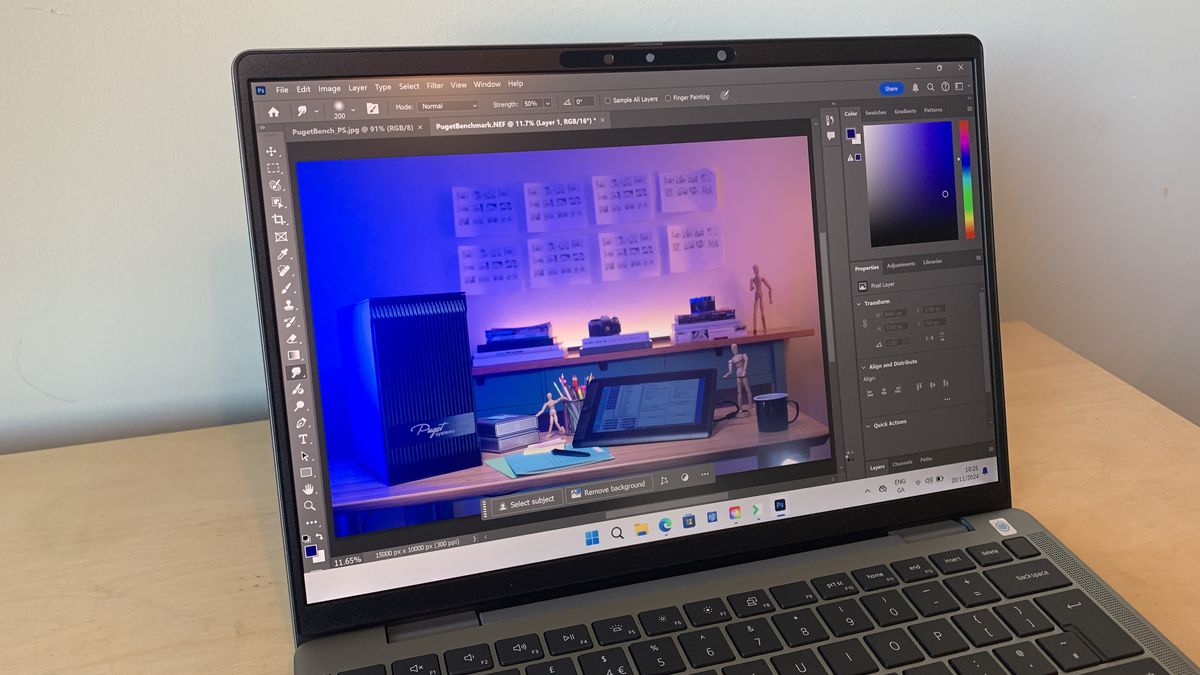
Snapdragon-Powered Dell Latitude 7455 Laptop

0

Dell Latitude 14 7455: A Powerful and Portable Laptop

The star of the Dell Latitude 14 7455 is the Snapdragon X processor. We are seeing this family of chips pop up in an increasing number of laptops and tablets and is Qualcomm’s answer to Apple’s Arm-based chips.

Design & Build

I love the design of the Dell Latitude 14 7455. It reminds me of a more refined and sleeker version of my much-loved 14-inch MacBook Pro. Dell has pulled off the incredible feat of packing a tonne of hardware into an unbelivably small case. The fact that the thickness is only 16.9 mm shows what they’ve achieved.

Key Specifications

  • Processor: Snapdragon X Elite
  • Graphics: Integrated into the processor
  • Memory: 16 GB, LPDDR5x, 8448
  • Screen size: 14-inch
  • Resolution: QHD+ (2560×1600)
  • Refresh rate: Not specified
  • Storage: 512GB
  • Connectivity: 2x USB-C, 1x USB-A, audio jack
  • Dimensions: 314 x 223.75 x 16.9 mm
  • Weight: 1.44 kg (3.17 lb)

Performance

The keyboard provides a high level of tactile feedback without needing to press hard on the keys. As a result, I had no problems typing for long periods of time. The keyboard is also backlit, which is perfect when working in low-light environments. Moving onto the touchpad. It’s a decent size, although the top 25% isn’t clickable, which is a personal bugbear of mine in most laptops.

Benchmark Scoring

  • Geekbench 6: CPU single-core: 2683, CPU multi-core: 13445
  • GPU OpenCL: 19317
  • Handbrake: 6m 20s
  • Blender: Monster: 69.12, Junkshop: 52.34, Classroom: 24.23
  • PugetBench Photoshop: 6236 (General = 61.6, Filter = 63.1)

Price

The Dell Latitude 14 7455 with Snapdragon Elite X processor, 16GB of RAM, and 512GB of storage will set you back £1,316.34. If you’re happy with the Plus X processor, then you could save around £150 on the total price.

Who is it for?

The Dell Latitude 14 7455 is a 14-inch laptop that is designed with hybrid workers in mind. This is thanks to the 14-inch display size, super thin case, and lightweight materials. It’s perfect for throwing in your bag and taking with you wherever you’re working.

Should I buy the Dell Latitude 14 7455?

  • Buy it if: You need a portable laptop, you’re beginning to use AI features, you need a long battery life.
  • Don’t buy it if: You need to perform high-intensity AI operations, you need a dedicated graphics card, you don’t have the money for a docking station.

Also Consider

  • Acer Swift 14 AI
  • HP EliteBook Ultra G1Q

Conclusion

The Dell Latitude 14 7455 is a powerful and portable laptop that is perfect for hybrid workers. With its Snapdragon X processor, 16GB of RAM, and 512GB of storage, it’s a great option for those who need a laptop that can keep up with their demands. However, it may not be the best option for those who need to perform high-intensity AI operations or have a dedicated graphics card.

FAQs

Q: What is the processor of the Dell Latitude 14 7455?
A: The processor is the Snapdragon X Elite.

Q: How much memory does the laptop have?
A: The laptop has 16GB of memory.

Q: What is the screen resolution of the laptop?
A: The screen resolution is QHD+ (2560×1600).

Q: How long does the battery last?
A: The battery life is up to two days.

Q: Is the laptop suitable for high-intensity AI operations?
A: No, the laptop is not suitable for high-intensity AI operations.

Identifying Duplicate Elements in Arrays

0

Understanding Duplicate Elements in an Array

Why This Article Stands Out

This guide is tailored for recent graduates and individuals entering the job market, focusing on a common interview question: finding duplicate numbers in an array. By exploring various approaches and their trade-offs, you’ll gain a solid grasp of the underlying concepts, preparing you to tackle similar challenges in coding interviews.

What You’ll Discover Here

In-Depth Explanations: Learn about different techniques to find duplicates in arrays, including their time and space complexities.

Practical C# Examples: Access well-documented code snippets that demonstrate each method effectively.

Interview Insights: Understand why this problem is frequently featured in interviews and how to approach it strategically.

Understanding the Problem

Given an integer array containing numbers ranging from 0 to N-2, with exactly one number appearing twice, the task is to identify the duplicate number. For instance, in an array of size 5 containing numbers from 0 to 3, one number repeats.

Approaches to Find Duplicate Elements in an Array

Using a HashSet

A HashSet is an efficient data structure for detecting duplicates due to its O(1) average-time complexity for insertions and lookups. By iterating through the array and attempting to add each element to the HashSet, we can identify duplicates when an addition fails.

using System;
using System.Collections.Generic;

class Program
{
    static int FindDuplicate(int[] arr)
    {
        HashSet seen = new HashSet();
        foreach (int num in arr)
        {
            if (!seen.Add(num))
            {
                return num; // Duplicate found
            }
        }
        throw new Exception("No duplicate found");
    }

    static void Main()
    {
        int[] array = { 0, 1, 2, 3, 2 };
        Console.WriteLine("Duplicate number: " + FindDuplicate(array));
    }
}

Using a Dictionary

A Dictionary can store each array element as a key and its occurrence count as the value. This method is useful if you need to know the frequency of each element.

using System;
using System.Collections.Generic;

class Program
{
    static int FindDuplicate(int[] arr)
    {
        Dictionary counts = new Dictionary();
        foreach (int num in arr)
        {
            if (counts.ContainsKey(num))
            {
                return num; // Duplicate found
            }
            else
            {
                counts[num] = 1;
            }
        }
        throw new Exception("No duplicate found");
    }

    static void Main()
    {
        int[] array = { 0, 1, 2, 3, 2 };
        Console.WriteLine("Duplicate number: " + FindDuplicate(array));
    }
}

Using Sorting

By sorting the array, duplicate elements will be adjacent, making them easier to detect. However, this approach has a time complexity of O(N log N) due to the sorting step.

using System;

class Program
{
    static int FindDuplicate(int[] arr)
    {
        Array.Sort(arr);
        for (int i = 1; i < arr.Length; i++)
        {
            if (arr[i] == arr[i - 1])
            {
                return arr[i]; // Duplicate found
            }
        }
        throw new Exception("No duplicate found");
    }

    static void Main()
    {
        int[] array = { 0, 1, 2, 3, 2 };
        Console.WriteLine("Duplicate number: " + FindDuplicate(array));
    }
}

Conclusion

Detecting duplicate elements in an array is a common problem in coding interviews, especially with companies like TCS. Understanding various methods to solve this problem, along with their efficiencies, is crucial for aspiring programmers. By mastering these techniques, you'll be well-prepared to handle similar challenges in your programming journey.

Call-to-Action

Did you find this guide helpful? Check out more problem-solving techniques and optimised algorithms on interviewspreparation.com. Let’s master coding, one problem at a time!

12 Days of OpenAI: The Ars Technica Recap

0

12 Days of OpenAI: A Comprehensive Look at the Recent AI Announcements

Background

Over the past 12 business days, OpenAI has announced a new product or demoed an AI feature every weekday, calling the PR event “12 days of OpenAI.” We’ve covered some of the major announcements, but we thought a look at each announcement might be useful for people seeking a comprehensive look at each day’s developments.

The Announcements

Day 1: [Announcement 1]
Day 2: [Announcement 2]

Day 12: [Announcement 12]

Competition in AI Development

The timing and rapid pace of these announcements—particularly in light of Google’s competing releases—illustrates the intensifying competition in AI development. What might normally have been spread across months was compressed into just 12 business days, giving users and developers a lot to process as they head into 2025.

ChatGPT’s Take

Humorously, we asked ChatGPT what it thought about the whole series of announcements, and it was skeptical that the event even took place. “The rapid-fire announcements over 12 days seem plausible,” wrote ChatGPT-4o, “But might strain credibility without a clearer explanation of how OpenAI managed such an intense release schedule, especially given the complexity of the features.”

Conclusion

In conclusion, OpenAI’s “12 days of OpenAI” event has showcased the company’s rapid pace of innovation and development in the AI space. As the competition in AI heats up, it will be interesting to see how OpenAI and other players in the industry continue to evolve and innovate in the coming year.

Frequently Asked Questions

Q: What was the purpose of OpenAI’s “12 days of OpenAI” event?
A: The event was a PR campaign that showcased OpenAI’s new products and AI features over a 12-day period.

Q: How did OpenAI manage to release so many announcements in such a short amount of time?
A: The exact details of OpenAI’s release schedule are not publicly known, but it is likely that the company worked closely with its development team and partners to ensure a smooth and rapid rollout of new products and features.

Q: What does the “12 days of OpenAI” event mean for the future of AI development?
A: The event demonstrates OpenAI’s commitment to innovation and rapid development in the AI space, and it will be interesting to see how the company continues to evolve and innovate in the coming year.