Home Blog Page 506

Boosting Llama 3.1 405B Throughput 1.5x on NVIDIA H200 Tensor Core GPUs and NVLink

0

Choosing Parallelism for Deployment

Both tensor parallel (TP) and pipeline parallel (PP) techniques increase compute and memory capacity by splitting models across multiple GPUs, but they differ in how they impact performance. Pipeline parallelism is a low-overhead mechanism for efficiently increasing overall throughput, while tensor parallelism is a higher-overhead mechanism for reducing latency.

Tensor and Pipeline Parallelism Explained

Tensor parallelism (TP) splits the execution of each model layer across multiple GPUs. Every calculation is distributed across available GPUs, and each GPU performs its own portion of the calculation. Then, every GPU broadcasts its individual results, known as partial sums, to every other GPU using an AllReduce operation.

Pipeline parallelism (PP) operates by splitting groups of model layers – or stages – across available GPUs. A request will begin on one GPU and will continue execution across subsequent stages on subsequent GPUs. With PP, communication only occurs between adjacent stages, rather than between all GPUs like with TP execution.

GPU-to-GPU Bandwidth with and without NVSwitch

On the top, 8 GPUs are connected to each other with a centralized NVSwitch. Diagram shows 8 GPUs on the bottom, each with links going to every other GPU.

NVLink Switch Helps Maximize High-Throughput Performance

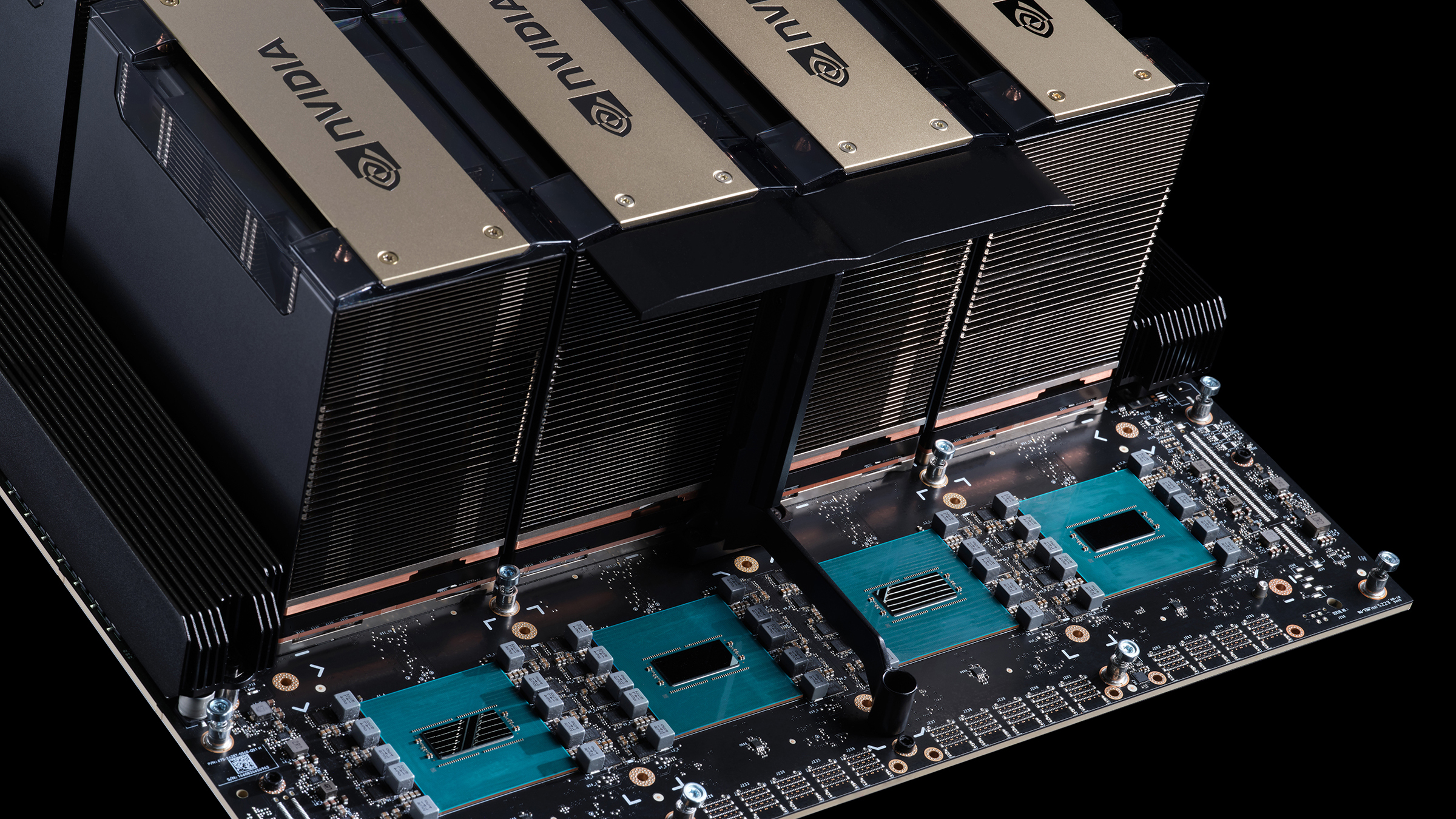
Each NVIDIA Hopper architecture GPU incorporates 18 NVLinks with each providing 50 GB/s of bandwidth per direction, providing a total of 900 GB/s of NVLink bandwidth. Each HGX H100 8-GPU or H200 server features four NVLink Switches. During TP model execution across eight GPUs, each GPU communicates to every other GPU using seven, equal-bandwidth connections. This means that communication across any connection happens at 1/7th of NVLink bandwidth, or about 128 GB/s.

Choosing Parallelism

Choosing parallelism is about finding the right balance between compute and capacity for the target scenario. NVLink Switch provides developers with the flexibility to select the optimal parallelism configuration leading to better performance than what is possible with either a single GPU, or across multiple GPUs with tensor parallelism alone.

Conclusion

The NVIDIA platform provides developers with a full technology stack to optimize generative AI inference performance. NVIDIA Hopper architecture GPUs – available from every major cloud and server maker – connected with the high-bandwidth, NVLink and NVLink Switch AI fabric, and running TensorRT-LLM software provide outstanding performance for the latest LLMs.

Frequently Asked Questions

Q: What is tensor parallelism?
A: Tensor parallelism is a technique that splits the execution of each model layer across multiple GPUs, distributing calculations and broadcasting results.

Q: What is pipeline parallelism?
A: Pipeline parallelism is a technique that operates by splitting groups of model layers – or stages – across available GPUs, with communication only occurring between adjacent stages.

Q: What is NVLink Switch?
A: NVLink Switch is a high-bandwidth interconnect that provides a total of 900 GB/s of NVLink bandwidth, enabling efficient communication between GPUs.

Q: Why is NVLink Switch important?
A: NVLink Switch provides developers with the flexibility to select the optimal parallelism configuration, leading to better performance than what is possible with either a single GPU, or across multiple GPUs with tensor parallelism alone.

Android XR and Project Moohan hands-on: Gemini is the killer app

0

Android XR: A New Era of Augmented Reality

A Demo Day

It’s an ordinary Tuesday. I’m wearing what look like ordinary glasses in a room surrounded by Google and Samsung representatives. One of them steps out in front of me and starts speaking in Spanish. I don’t speak Spanish. Hovering in mid-air, I can see her words being translated into English subtitles. Reading them, I can see she’s describing what I’m seeing in real-time. I mumble an expletive. Everyone laughs. This is my first experience with Android XR, a new mixed reality OS designed for headsets and smart glasses, like the prototypes I’m wearing.

The Return of Google to AR

Google is no stranger to augmented reality. Google Glass crashed and burned with the public more than 10 years ago before being repurposed for enterprise users and eventually discontinued. But things are different now. Apple has the Vision Pro. Meta has the Ray-Ban smart glasses, and their AI features have garnered positive buzz. That’s why Google is jumping back into the fray with Android XR.

The Power of Gemini

Adding Gemini enables multimodal AI and natural language – things it says will make interactions with your environment richer. In a demo, Google had me prompt Gemini to name the title of a yellow book sitting behind me on a shelf. I’d briefly glanced at it earlier but hadn’t taken a photo. Gemini took a second, and then offered up an answer. I whipped around to check – it was correct.

A New Era of Interactions

On top of that, the platform will work with any mobile and tablet app from the Play Store out of the box. Today’s launch is aimed at developers so they can start building out experiences. The average person won’t be able to buy anything running Android XR right now, but in 2025, Samsung will be launching its long-rumored XR headset. Dubbed Project Moohan (Korean for infinity), the headset will be the first consumer product to ship with Android XR. Technically, it’s running the same software as the glasses I tried, but Project Moohan will also be capable of VR and immersive content – stuff that wouldn’t be suited to a pair of smart glasses.

Project Moohan

Project Moohan felt like a mix between a Meta Quest 3 and Vision Pro headset. Unlike either, the light seal is optional so you can choose to let the world bleed in. It’s lightweight and doesn’t pinch my face too tightly. My ponytail easily slots through the top, and later, I’m thankful that I don’t have to redo my hair. At first, the resolution doesn’t feel quite as sharp as the Vision Pro – until the headset automatically calibrates to my pupillary distance.

How to Stand Out

I want to ask: how do you expect to stand out? I don’t get the chance to before I’m told: Gemini. For the skeptic, it’s easy to scoff at the idea that Gemini, of all things, is what’s going to crack the augmented reality puzzle. Generative AI is having a moment right now, but not always in a positive way. Outside of conferences filled with tech evangelists, AI is often viewed with derision and suspicion. But inside the Project Moohan headset or wearing a pair of prototype smart glasses, I can catch a glimpse of why Google and Samsung believe Gemini is the killer app for XR.

The Future of XR

For me, it’s the fact that I don’t have to be specific when I ask for things. Usually, I get flustered talking to AI assistants because I have to remember the wake word, clearly phrase my request, and sometimes even specify my preferred app. "One thing I’m really confident about, something that’s not just different from before, is that Gemini is really that great," says Kihwan Kim, EVP at Samsung Electronics, who nods furiously in agreement when I mention this. To Kim, it’s the ability to fluidly speak to Gemini and the fact that it understands a person’s individual context that opens dozens of different options for the way each person interacts with XR.

Conclusion

In the Moohan headset, I can say, "Take me to JYP Entertainment in Seoul," and it will automatically open Google Maps and show me that building. If my windows get cluttered, I can ask it to reorganize them. I don’t have to lift a finger. While wearing the prototype glasses, I watch and listen as Gemini summarizes a long, rambling text message to the main point: can you buy lemon, ginger, and olive oil from the store? I was able to naturally switch from speaking in English to asking in Japanese what the weather is in New York – and get the answer in spoken and written Japanese.

FAQs

Q: What is Android XR?
A: Android XR is a new mixed reality OS designed for headsets and smart glasses.

Q: What is Gemini?
A: Gemini is a generative AI that enables multimodal AI and natural language, making interactions with your environment richer.

Q: When will Android XR be available?
A: The average person won’t be able to buy anything running Android XR right now, but in 2025, Samsung will be launching its long-rumored XR headset, dubbed Project Moohan.

Q: What is Project Moohan?
A: Project Moohan is the first consumer product to ship with Android XR, capable of VR and immersive content.

Anycubic Kobra 3 Max Combo for Large-Scale Multicolour Printing

0

Anycubic Kobra 3 Max Combo: A Game-Changer in 3D Printing

What’s New?

Anycubic, a renowned 3D printer manufacturer, has announced its latest product – the Anycubic Kobra 3 Max Combo. This printer boasts an impressive build volume of 420x420x500mm, making it a significant upgrade from its sibling, the Kobra 3 Combo. The new printer also supports multi-colour printing, allowing users to create complex and vibrant models.

Specs: What We Know So Far

Here are the specs of the Anycubic Kobra 3 Max Combo:

| Build Volume | 420x420x500mm |
| Recommended Print Speed | 300mm/s |
| Max Print Speed | 600mm/s |
| Acceleration | 10,000mm/s² |
| Filament Size | 1.75mm diameter only |
| Filament Type Supported | PLA, PETG, ABS, and TPU (any brand) |
| Max Nozzle Temperature | 300°C |
| Max Bed Temperature | 90°C |

Price and Availability

The Anycubic Kobra 3 Max Combo will be available for pre-order starting on December 16, with an official launch price of $999 / £999 on February 21, 2025. Early adopters can benefit from a special "Founder’s Price" of £599 (limited to 600 units) for those who pre-order by December 18th. The Super Early Bird pricing will begin on December 19th until January 14th, offering an even more discounted price.

Conclusion

The Anycubic Kobra 3 Max Combo is a significant upgrade to the 3D printing market, offering a larger build volume and multi-colour printing capabilities. While the price may not be budget-friendly, it is designed for professionals and enthusiasts who require such advanced features. With its impressive specs and competitive pricing, the Kobra 3 Max Combo is set to make a mark in the 3D printing industry.

Frequently Asked Questions

Q: What is the build volume of the Anycubic Kobra 3 Max Combo?

A: The build volume of the Anycubic Kobra 3 Max Combo is 420x420x500mm.

Q: Does the printer support multi-colour printing?

A: Yes, the Anycubic Kobra 3 Max Combo supports multi-colour printing.

Q: What is the recommended print speed?

A: The recommended print speed is 300mm/s.

Q: Can I use any type of filament with the printer?

A: Yes, the printer supports PLA, PETG, ABS, and TPU filaments from any brand.

Q: Is the printer available for pre-order?

A: Yes, the Anycubic Kobra 3 Max Combo will be available for pre-order starting on December 16.

The Thing Remastered

0

It’s Alive!

Six new titles join the cloud this week, starting with The Thing: Remastered. Face the horrors of the Antarctic as the game oozes onto GeForce NOW.

The Thing: Remastered

The Thing: Remastered brings the 2002 third-person shooter into the modern era with stunning visual upgrades, including improved character models, textures, and animations. Playing as Captain J.F. Blake, leader of a U.S. governmental rescue team, navigate the blood-curdling aftermath of the events depicted in the original film. Trust is a precious commodity as members command their squad through 11 terrifying levels, never knowing who might harbor the alien within.

With an Ultimate or Performance membership, stream this blood-curdling experience in all its remastered glory without the need for high-end hardware. GeForce NOW streams from powerful GeForce RTX-powered servers in the cloud, rendering every shadow, every flicker of doubt in teammates’ eyes, and every grotesque transformation with crystal-clear fidelity.

Feast on This

Dive into the depths of a gothic vampire saga, slide through feudal Japan, and flip burgers at breakneck speed with GeForce NOW and the power of the cloud. Grab a controller and rally the gaming squad to stream these mouth-watering additions.

Legacy of Kain Soul Reaver 1&2 Remastered

The highly anticipated Legacy of Kain Soul Reaver 1&2 Remastered from Aspyr and Crystal Dynamics breathes new life into the classic vampire saga genre. These beloved titles have been meticulously overhauled to offer stunning visuals and improved controls. Join the epic conflict of Kain and Raziel in the gothic world of Nosgoth and traverse between the Spectral and Material Realms to solve puzzles, reveal new paths, and defeat foes.

The Spirit of the Samurai

The Spirit of the Samurai from Digital Mind Games and Kwalee brings a blend of Souls and Metroidvania elements to feudal Japan. This stop-motion inspired 2D action-adventure game offers three playable characters and intense combat with legendary Japanese weapons, all set against a backdrop of mythological landscapes.

Fast Food Simulator

Or take on the chaotic world of fast-food management with Fast Food Simulator, a multiplayer simulation game from No Ceiling Games. Take orders, make burgers, and increase earnings by dealing with customers. Play solo or co-op with up to four players and take on unexpected and bizarre events that can occur at any moment.

Play On

Shift between realms in Legacy of Kain at up to 4K 120 fps with an Ultimate membership, slice through The Spirit of the Samurai’s mythical landscapes in stunning 1440p with RTX ON with a Performance membership, or manage a fast-food empire with silky-smooth gameplay. With extended sessions and priority access, members will have plenty of time to master these diverse worlds.

Diablo Immortal

Diablo Immortal — the action-packed role-playing game from Blizzard Entertainment, set in the dark fantasy world of Sanctuary — bridges the stories of Diablo II and Diablo III. Choose from a variety of classes, each offering unique playstyles and devastating abilities, to battle through diverse zones and randomly generated rifts, and uncover the mystery of the shattered Worldstone while facing off against hordes of demonic enemies.

What to Play This Weekend

Look for the following games available to stream in the cloud this week:

  • Indiana Jones and the Great Circle (New release on Steam and Xbox, available on the Microsoft Store and PC Game Pass, Dec. 8)
  • Fast Food Simulator (New release on Steam, Dec. 10)
  • Legacy of Kain Soul Reaver 1&2 Remastered (New release on Steam, Dec. 10)
  • The Spirit of the Samurai (New release on Steam, Dec. 12)
  • Diablo Immortal (Battle.net)
  • The Lord of the Rings: Return to Moria (Steam)

Conclusion

This week’s GFN Thursday brings a diverse array of games to the cloud, from heart-pumping action to remastered classics. With the power of GeForce NOW, members can experience these games without the need for high-end hardware.

FAQs

Q: What is The Thing: Remastered?
A: The Thing: Remastered is a 2002 third-person shooter game that has been updated with stunning visual upgrades.

Q: What is Legacy of Kain Soul Reaver 1&2 Remastered?
A: Legacy of Kain Soul Reaver 1&2 Remastered is a classic vampire saga game that has been remastered with improved controls and visuals.

Q: What is Fast Food Simulator?
A: Fast Food Simulator is a multiplayer simulation game where players take on the role of fast-food restaurant managers, dealing with customers and unexpected events.

Q: What is Diablo Immortal?
A: Diablo Immortal is an action-packed role-playing game set in the dark fantasy world of Sanctuary, where players choose from various classes and battle against hordes of demonic enemies.

Q: What are the new games available to stream this week?
A: The new games available to stream this week are Indiana Jones and the Great Circle, Fast Food Simulator, Legacy of Kain Soul Reaver 1&2 Remastered, The Spirit of the Samurai, Diablo Immortal, and The Lord of the Rings: Return to Moria.

Fans Slam Bring Me the Horizon’s AI-Generated Art

0

AI in the Creative Industries: The Great Divide

A Hugely Divisive Topic

AI is a highly controversial topic in the creative industries, especially when it comes to music. Fans typically prioritize authenticity, which is often lost when AI-augmented content is involved. This is evident in the reaction to rock band Bring Me the Horizon’s (BMTH) new live AI visuals.

The Backlash

BMTH showcased a new AI innovation on TikTok, which transformed singer Oli Sykes into a shapeshifting demon in real-time. The AI technology uses a live video feed to transform Sykes before audiences’ eyes, serving as an immersive backdrop for the band’s live performances. However, the reaction from fans was overwhelmingly negative, with comments such as "Using AI? Are you serious?" and "Been listening to yall for over 10 years, this is not it".

Similar Reactions from Other Bands

Avenged Sevenfold also used similar visuals, receiving harsh criticism from fans. One fan commented, "AI being used for visuals is disappointing, literally taking work away from talented artists and replacing it with soulless, meaningless AI-generated nonsense." Another pointed out the issue of visual accessibility, stating, "It was cool for a while at Download, but it got old when you could hardly see the band on the screens…".

The Great AI Debate

The use of AI in the creative industries is a polarizing topic, and it seems that no matter how it’s used, it will always spark controversy. It’s not just the music industry that’s grappling with AI infiltration; the design world is also facing similar challenges. The recent controversy surrounding Pentagram’s new website, which uses AI-generated art, highlights the ongoing debate about the role of AI in creative industries.

Conclusion

The use of AI in the creative industries is a double-edged sword. While it can bring new possibilities and innovative solutions, it also risks replacing human creativity and authenticity. As the debate continues, it’s clear that fans are not ready to fully embrace AI-augmented content. It’s up to creators to balance the benefits of AI with the need for human touch and creativity.

FAQs

Q: What is AI-augmented content?
A: AI-augmented content refers to creative works that incorporate artificial intelligence (AI) elements, such as AI-generated visuals or music.

Q: Why are fans opposed to AI-augmented content?
A: Fans are concerned that AI-augmented content lacks authenticity and replaces human creativity with soulless, generated content.

Q: What are the benefits of AI-augmented content?
A: AI-augmented content can bring new possibilities, such as increased efficiency, cost savings, and innovative solutions.

Q: Is AI-augmented content the future of the creative industries?
A: The future of the creative industries is uncertain, and it’s unclear whether AI-augmented content will become a dominant force or remain a niche phenomenon.

US Media Groups Warn UK Over AI Content-Scraping Rules

UK Government Warned by US Media Group to Not Weaken Copyright Rules for AI

UK to Consult on AI and Creative Industries, But US Media Group Objects

The US Copyright Alliance, a representative of some of the largest US media groups, has warned the UK government against weakening copyright rules to allow artificial intelligence (AI) companies to scrape their content. The group has sent a three-page letter to UK ministers, expressing its "strong opposition" to the introduction of AI exceptions to copyright rules.

Concerns Over Chilling Effect on Investment and Activity

The letter, which has been seen by the Financial Times, highlights the concerns of industry executives that the government may introduce a scheme that would allow AI companies to mine the internet freely to train algorithms on content from publishers and artists unless they "opt out". This, they fear, could have a chilling effect on investment and activity in the UK.

Influence of US Media Groups

The intervention of large US media groups, including Hollywood film studios and music groups that invest billions of pounds in the UK, will add to the pressure on ministers to not water down copyright laws to encourage the development of AI models. The letter was sent to Peter Kyle, secretary of state for science, innovation and technology, and culture secretary Lisa Nandy.

Copyright Alliance’s Stance

The Copyright Alliance has urged the UK government to reject attempts to create AI-related exceptions that undermine copyright protections. In the letter, it said, "Any UK government action that degrades copyright — by creating an exception for AI use, for example — creates a legal environment that discourages UK and US creators and rights holders from participating and investing in creative endeavours within the United Kingdom."

UK Government’s Position

Government officials have said the consultation has changed in recent weeks to be more of an open debate about the issue, in the hope of alleviating an angry backlash from the sector. Nandy said it would be a "genuine consultation" and that "no decision has been made… We’re trying to get the balance right."

Conclusion

The UK government’s plans to consult on AI and creative industries have sparked concerns from the US Copyright Alliance, which has warned of a chilling effect on investment and activity in the UK. The group has urged the government to reject attempts to create AI-related exceptions that undermine copyright protections.

Frequently Asked Questions

Q: What is the US Copyright Alliance?
A: The US Copyright Alliance is a representative of some of the largest US media groups, including Disney, Fox, Paramount, Universal Music, and Getty.

Q: What is the concern about AI and copyright?
A: The concern is that allowing AI companies to scrape content without permission could undermine copyright protections and discourage investment and activity in the UK.

Q: What is the UK government’s position on the issue?
A: The government is planning to consult on AI and creative industries, but has said it will be an open debate to alleviate concerns from the sector.

Q: What is the Copyright Alliance’s stance on AI-related exceptions?
A: The alliance urges the UK government to reject attempts to create AI-related exceptions that undermine copyright protections.

Bot Fwd2Cal

0

Introducing Fwd2cal: A Free Bot That Automatically Adds Appointments to Your Calendar

The Frustration of Manual Calendar Management

It’s something we all do multiple times a week: We manually add things to our calendar while copying details over from an email. What if a bot could do that work for you?

The Solution: Fwd2cal

That’s the idea behind Fwd2cal, a currently free project by Moe Adham that can parse any email with an appointment in it and automatically add it to your calendar. If you get an email with a potential calendar appointment in it—a party invitation, a meeting, a coworker casually mentioning you can join them for drinks after work today—you can forward it to the free bot. The service uses ChatGPT to parse the email and find the relevant bits of information, then turn that information into a calendar appointment, then add that calendar appointment to your Google Calendar.

How It Works

The service couldn’t be easier to use, and the setup process isn’t too difficult. All you need to do is send an email to calendar@fwd2cal.com. You’ll get a message back, with a link, asking you to authorize your Google Calendar. You can add more email addresses by sending another email to the service—just put "add" followed by your second email address in the subject line and you’re done.

Using the Service

After connecting Fwd2cal to your Google Calendar, you can start using the service. You can forward any email mentioning an event happening—the bot will parse the email, turn it into a calendar appointment, then add it to your Google Calendar. If something goes wrong, you’ll get an email explaining that. If not, the service will quietly keep adding appointments to your calendar. You can even include instructions in the email, if you want, using the same phrasing you would use to talk to any AI chatbot. I’ve found the bot is pretty good at figuring out what you want.

Security and Transparency

This all requires putting a lot of trust in Adham, which he acknowledges on the website. The good news is that the project is distributed with an open source license, meaning the code is available online if you want to review it. The privacy policy also makes it clear that the only information the bot collects is what’s necessary to provide the service and that no personal information is stored long-term or used to train the AI model. The service runs on a combination of tools from Google Cloud, OpenAI, and SendGrid.

The Future of Fwd2cal

Fwd2cal is free, though that might change. "If this ever gets too popular and it costs too much to run, I’ll maybe start charging for it," Adham writes on the website. In the meantime, it’s a service that offers some great convenience.

FAQs

Q: How do I use Fwd2cal?
A: Send an email to calendar@fwd2cal.com and follow the instructions.

Q: What email providers is Fwd2cal compatible with?
A: Fwd2cal is compatible with Google Calendar.

Q: Is Fwd2cal secure?
A: Yes, the service uses an open source license and a clear privacy policy.

Q: Will Fwd2cal ever charge for its service?
A: Possibly, if the service becomes too popular and costs too much to run.

Google’s Trillium: AI & Cloud Computing Transformation

0

Google’s Trillium: A Game-Changer for AI and Cloud Computing?

1. Superior Cost and Performance Efficiency

One of the most striking features of Trillium is its exceptional cost and performance metrics. Google claims that Trillium delivers up to 2.5 times better training performance per dollar and three times higher inference throughput than previous TPU generations. These impressive gains are achieved through significant hardware enhancements, including doubled High Bandwidth Memory (HBM) capacity, a third-generation SparseCore, and a 4.7-fold peak compute performance per chip increase.

For enterprises looking to reduce the costs associated with training large language models (LLMs) like Gemini 2.0 and managing inference-heavy tasks such as image generation and recommendation systems, Trillium offers a financially attractive alternative.

2. Exceptional Scalability for Large-Scale AI Workloads

Trillium is engineered to handle massive AI workloads with remarkable scalability. Google boasts a 99% scaling efficiency across 12 pods (3,072 chips) and 94% efficiency across 24 pods for robust models such as GPT-3 and Llama-2. This near-linear scaling ensures that Trillium can efficiently manage extensive training tasks and large-scale deployments.

3. Advanced Hardware Innovations

Trillium incorporates cutting-edge hardware technologies that set it apart from previous TPU generations and competitors. Key innovations include doubled High Bandwidth Memory (HBM), which enhances data transfer rates and reduces bottlenecks, a third-generation SparseCore that optimizes computational efficiency by focusing resources on the most critical data paths, and a 4.7x increase in peak compute performance per chip, significantly boosting processing power.

4. Seamless Integration with Google Cloud’s AI Ecosystem

Trillium’s deep integration with Google Cloud’s AI Hypercomputer is a significant advantage. By leveraging Google’s extensive cloud infrastructure, Trillium optimizes AI workloads, making deploying and managing AI models more efficient. This seamless integration enhances the performance and reliability of AI applications hosted on Google Cloud, offering enterprises a unified and optimized solution for their AI needs.

5. Future-Proofing AI Infrastructure with Gemini 2.0 and Deep Research

Trillium is not just a powerful TPU; it is part of a broader strategy that includes Gemini 2.0, an advanced AI model designed for the "agentic era," and Deep Research, a tool to streamline the management of complex machine learning queries. This ecosystem approach ensures that Trillium remains relevant and can support the next generation of AI innovations.

Competitive Landscape: Navigating the AI Hardware Market

While Trillium offers substantial advantages, Google faces stiff competition from industry leaders like NVIDIA and Amazon. NVIDIA’s GPUs, particularly the H100 and H200 models, are renowned for their high performance and support for leading generative AI frameworks through the mature CUDA ecosystem. Amazon’s Trainium chips present a compelling alternative with a hybrid approach that combines flexibility and cost-effectiveness.

Can Trillium Prove Its Value?

Google’s Trillium represents a bold and ambitious effort to advance AI and cloud computing infrastructure. With its superior cost and performance efficiency, exceptional scalability, advanced hardware innovations, seamless integration with Google Cloud, and alignment with future AI developments, Trillium has the potential to attract enterprises seeking optimized AI solutions. The early successes with adopters like AI21 Labs highlight Trillium’s impressive capabilities and its ability to deliver on Google’s promises.

Conclusion

Trillium’s success will depend on proving that its performance and cost advantages can outweigh the ecosystem maturity and portability offered by NVIDIA and Amazon. Google must leverage its superior cost and performance metrics and explore ways to enhance Trillium’s ecosystem compatibility beyond Google Cloud to attract a broader range of enterprises seeking versatile AI solutions.

FAQs

  • What is Trillium?
    Trillium is Google’s sixth-generation Tensor Processing Unit (TPU) designed to advance AI and cloud computing infrastructure.
  • What are the key features of Trillium?
    Trillium offers superior cost and performance efficiency, exceptional scalability, advanced hardware innovations, seamless integration with Google Cloud, and alignment with future AI developments.
  • How does Trillium compare to NVIDIA’s GPUs?
    Trillium has a hybrid approach that combines flexibility and cost-effectiveness, but NVIDIA’s GPUs are renowned for their high performance and support for leading generative AI frameworks.
  • What is the future of Trillium?
    Trillium is part of a broader strategy that includes Gemini 2.0 and Deep Research, ensuring its relevance and ability to support the next generation of AI innovations.

The Perfect Game

0

Valve’s Steam Data Provides Insights into PC Gaming

Valve’s Steam is one of the most popular platforms for PC gaming, so there’s a wealth of data on there about games and user preferences. And one new indie game dev has decided to compile that.

Data Scraping and Analysis

“Driven by curiosity and a passion for exploring data and game development,” the creator of the video below scraped Steam’s whole catalogue using scripts that gathered data ranging from the titles of games to tags, prices, ratings, review counts, and release dates.

Results and Insights

The resulting data can be used to glean insights on the highest-rated games, the most commonly used words in titles, and potentially underused combinations of genres. It could help research the perfect new game, be it for PC or for the best games consoles.

Top-Rated Games and Most Common Words

The data shows that the most-used words in game titles are ‘VR,’ ‘simulator,’ ‘world,’ ‘space,’ ‘dungeon,’ ‘game,’ ‘adventure,’ and ‘puzzle’. While this gives an insight into what developers think works, it could also provide words to steer clear of if you want a unique title.

Ratings and Genres

In terms of ratings, the indie game Terraria is the top-rated game on Steam. Moreover, around half of the games in the top 50 are indies. Interestingly, only 12 games have an overwhelmingly negative score. Some of the worst-rated games were accused of misleading or scamming players.

As for the potential for genre combinations, the dev found that apparently only one title on Steam blends farming simulation and battle royale mechanics. Who would have known?! Other combinations with largely unexplored potential include board game and platformer, with just ten games on the platform, and card game and rhythm, reflected in just five. And there are only four fighting games with a romantic theme.

Additional Insights

The developer continued with more insights in the comments on YouTube, offering observations on the most successful publishers, differences in the popularity of different genres between indie and AAA games, and even how a game’s review score corresponds with price.

Conclusion

The data compiled by the indie game dev provides valuable insights into the world of PC gaming on Steam. From the most commonly used words in game titles to the potential for underused genre combinations, this data can be used to inform game development and marketing strategies.

FAQs

Q: What kind of data was scraped from Steam?
A: The data scraped from Steam included game titles, tags, prices, ratings, review counts, and release dates.

Q: How many data points were compiled?
A: The data compiled by the indie game dev includes around 8 million data points covering 140,000 games, each with 40 attributes.

Q: What are some of the most common words used in game titles?
A: The most-used words in game titles are ‘VR,’ ‘simulator,’ ‘world,’ ‘space,’ ‘dungeon,’ ‘game,’ ‘adventure,’ and ‘puzzle’.

Q: What is the top-rated game on Steam?
A: The top-rated game on Steam is the indie game Terraria.

Q: How many games have an overwhelmingly negative score?
A: Only 12 games have an overwhelmingly negative score.

Google Tests Gemini AI Agents

0

Google’s AI Agents Can Help You in Video Games with New Gemini 2.0 Technology

Google has announced a new update to its Gemini 2.0 technology, which allows AI agents to understand rules in video games and provide suggestions for what to do next. These agents can "reason about the game based solely on the action on the screen" and offer real-time suggestions for what to do next in conversation.

How It Works

According to Google DeepMind CEO Demis Hassabis and CTO Koray Kavukcuoglu, the agents can tap into Google Search to connect users with the wealth of gaming knowledge on the web. They are also testing the agents’ ability to interpret rules and challenges in games like Clash of Clans and Hay Day from Supercell.

Limitations

While the technology is promising, it’s still in its early stages. The agents can only generate consistent worlds for "up to a minute" using a "foundation world model" called Genie 2, which was showcased last week. Additionally, there are questions about whether the agents will provide sound advice, as demonstrated in a video that showed the agent reminding the user about quests.

Conclusion

Google’s new AI agents have the potential to revolutionize the way we play video games, providing users with real-time suggestions and guidance. However, more testing and refinement are needed to determine the effectiveness and reliability of these agents.

Frequently Asked Questions

Q: What are the limitations of the AI agents?
A: The agents are still in their early stages and can only generate consistent worlds for "up to a minute" using a "foundation world model" called Genie 2.

Q: Will the agents provide sound advice?
A: The effectiveness and reliability of the agents are still being tested, and more research is needed to determine whether they will provide sound advice.

Q: What games are being tested with the AI agents?
A: The agents are being tested with games like Clash of Clans and Hay Day from Supercell.