Home Blog Page 510

AI for K-12 Education

Key Points

  • Common Sense Media and OpenAI have launched a free course, "ChatGPT Foundations for K-12 Educators," to help teachers understand and responsibly implement AI in their work.
  • The one-hour, eight-lesson course provides essential knowledge about AI and approaches for ensuring student safety and privacy.
  • The course has been piloted in nearly a dozen school districts, with promising early results.

Course Overview

The "ChatGPT Foundations for K-12 Educators" course is designed to help teachers understand the basics of AI and its applications in education. The course covers essential topics such as AI fundamentals, data privacy considerations, ethical use guidelines, and ideas for incorporating AI into daily work.

Benefits of the Course

The course is free for all educators and school districts, and it provides educators with the knowledge and skills they need to effectively use AI in their classrooms. By taking the course, educators can ensure that they are using AI responsibly and safely, and that they are providing students with the best possible learning experience.

Early Results

The course has been piloted in nearly a dozen school districts, with promising early results. Educators who have taken the course have reported feeling more confident and prepared to use AI in their classrooms.

Conclusion

The "ChatGPT Foundations for K-12 Educators" course is an important step in helping educators to understand and responsibly implement AI in their work. By providing educators with the knowledge and skills they need to effectively use AI, the course can help to ensure that students receive the best possible learning experience.

Frequently Asked Questions

Q: What is the "ChatGPT Foundations for K-12 Educators" course?
A: The "ChatGPT Foundations for K-12 Educators" course is a free, one-hour, eight-lesson course that provides educators with essential knowledge about AI and its applications in education.

Q: Who is the course designed for?
A: The course is designed for K-12 educators, including teachers, administrators, and other education professionals.

Q: What topics does the course cover?
A: The course covers essential topics such as AI fundamentals, data privacy considerations, ethical use guidelines, and ideas for incorporating AI into daily work.

Q: Is the course free?
A: Yes, the course is free for all educators and school districts.

Q: How long does the course take to complete?
A: The course is one hour long and consists of eight lessons.

Q: What are the benefits of taking the course?
A: The benefits of taking the course include gaining a deeper understanding of AI and its applications in education, feeling more confident and prepared to use AI in the classroom, and providing students with the best possible learning experience.

Actually, that $1.4M ‘Blank’ Painting

0

Article

The Value of Art: A Blank Canvas and a White Painting

As I write this, I have two tabs open in my web browser. One tab is an image of an apparently blank canvas by the American artist Robert Ryman. The other tab is a TikTok video likening the voice of the new Manchester United manager to a character from Despicable Me. To be honest, I think I’m enjoying the TikTok video more than Ryman’s painting.

A Blank Canvas and a White Painting

General 52 x 52, the original just sold at auction for nearly $1.4m. Several news outlets compared it to the recent $6.2m sale of Maurizio Cattelan’s Comedian, a banana, duct taped to a wall, bought and eaten by a Crypto entrepreneur. I’ve seen a lot of social media outrage directed towards Ryman, declaring the art to be a waste of time. And yet, while I might be getting more of an immediate laugh out of that TikTok video, I’d still take a ‘blank’ painting over it.

The Art of Robert Ryman

Ryman wasn’t fussy. He gave his paintings unimaginative titles because he didn’t want the title to influence how you saw the work. He was known to exhibit his pieces in whatever order the shipping company delivered them. He didn’t waffle on unintelligibly about his work, never claimed it contained all sorts of complex meanings and metaphors. He spoke sense about art, in his own lovely, clumsy way. He told one interview: "I wanted to paint the paint." He told another: "A painting has to do with, well, with paint, basically … It’s never so important what you paint, it’s how you do it."

A Painting that Forces You to Participate

He painted on all sorts of surfaces: coffee filters, cold-rolled steel, fibreglass panels, corrugated cardboard … But he stuck almost exclusively to painting in white. Ryman never developed. He deepened. And his motives were as pure as his medium: he wanted his viewers to enjoy "an experience of delight, and well-being, and rightness … like listening to music." But you had to meet him half way.

The Value of Art

What about the sale price of the much smaller General 52 x 52? Can a stretch of canvas and a bit of paint ever really be worth $1,383,800? In one of my favourite Mad Men episodes, Bert Cooper buys a Mark Rothko and hangs it in his office. His employees at the Sterling Cooper advertising agency worry he’ll ask them to interpret its meaning. Cooper hasn’t exactly bought the piece because it moves him. He says: "that thing should double in value by next Christmas." This often goes unsaid when paintings sell for silly money. They’re usually bought less for their artistic merit than their investment value.

Conclusion

Ryman’s art forces you to participate. It’s active, while much of today’s media is passive. That TikTok video likening the voice of Ruben Amorim to the voice of Gru provided me a moment’s diversion. General 52 x 52 forced me to think, respond, participate. It made me write this piece.

FAQs

Q: What is the significance of Robert Ryman’s art?
A: Ryman’s art is significant because it forces the viewer to participate, to think, and to respond. It’s active, not passive.

Q: Why did Ryman paint in white?
A: Ryman painted in white to create a sense of simplicity and purity. He wanted to focus on the process of painting, rather than the subject matter.

Q: Is a blank canvas worth $1.4m?
A: Whether or not a blank canvas is worth $1.4m is a matter of personal opinion. Some people may see it as a waste of money, while others may see it as a valuable piece of art that challenges the viewer to think and respond.

Sequence Modeling with CTC

0

Introduction

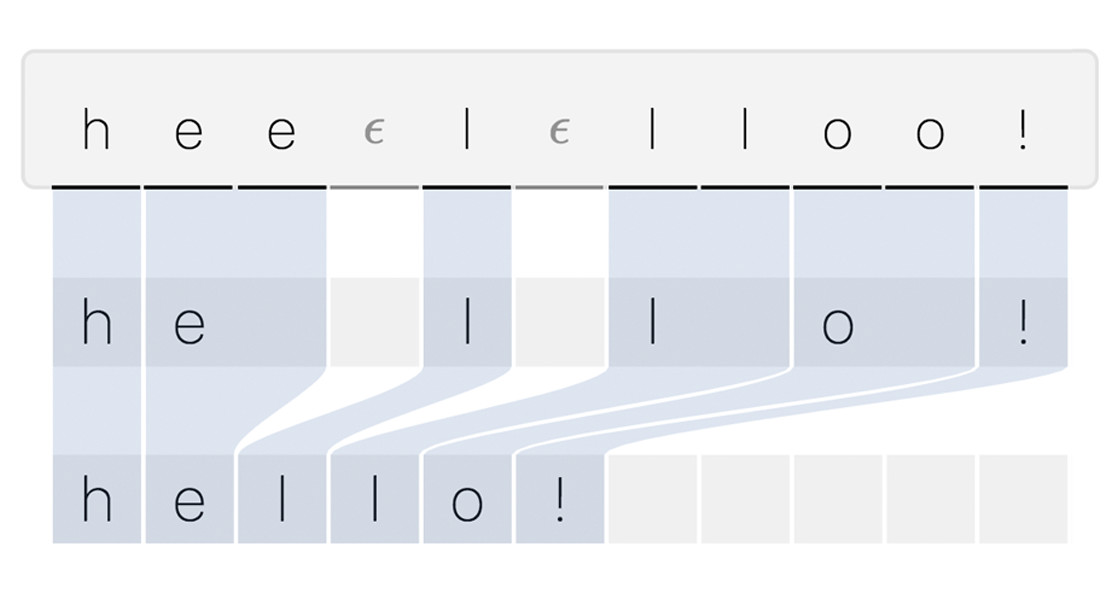
Consider speech recognition. We have a dataset of audio clips and corresponding transcripts. Unfortunately, we don’t know how the characters in the transcript align to the audio. This makes training a speech recognizer harder than it might at first seem.

The Problem

Without this alignment, the simple approaches aren’t available to us. We could devise a rule like “one character corresponds to ten inputs”. But people’s rates of speech vary, so this type of rule can always be broken. Another alternative is to hand-align each character to its location in the audio. From a modeling standpoint this works well — we’d know the ground truth for each input time-step. However, for any reasonably sized dataset this is prohibitively time-consuming.

Hand Alignment

This problem doesn’t just turn up in speech recognition. We see it in many other places. Handwriting recognition from images or sequences of pen strokes is one example. Action labeling in videos is another.

Connectionist Temporal Classification (CTC)

Connectionist Temporal Classification (CTC) is a way to get around not knowing the alignment between the input and the output. As we’ll see, it’s especially well-suited to applications like speech and handwriting recognition.

CTC Score

A common question when using a beam search decoder is the size of the beam to use. There is a trade-off between accuracy and runtime. We can check if the beam size is in a good range. To do this, first compute the CTC score for the inferred output and then compute the CTC score for the ground truth output. If the two outputs are not the same, we should have c_g < c_i. If c_i << c_g, then the ground truth output actually has a higher probability under the model and the beam search failed to find it. In this case, a large increase to the beam size may be warranted.

Conclusion

In this article, we have discussed the problem of not knowing the alignment between the input and output in speech recognition and other areas. We have also introduced Connectionist Temporal Classification (CTC) as a way to get around this problem. CTC is a well-suited approach for applications like speech and handwriting recognition.

FAQs

  • Q: What is the problem with not knowing the alignment between the input and output?
    A: Not knowing the alignment makes it difficult to train a speech recognizer or other models that require a direct mapping between the input and output.
  • Q: How does CTC address this problem?
    A: CTC allows us to train a model without knowing the alignment between the input and output by using a beam search decoder.
  • Q: What are the trade-offs of using a beam search decoder?
    A: The trade-offs are between accuracy and runtime. A larger beam size can improve accuracy but increase runtime.

iOS 18.2 with ChatGPT Integration and Apple Intelligence Tools

0

Apple Releases iOS 18.2, iPadOS 18.2, and macOS Sequoia 15.2 with New Apple Intelligence Features

Apple has announced the release of iOS 18.2, iPadOS 18.2, and macOS Sequoia 15.2, adding many new Apple Intelligence features, including Image Playground, Genmoji, and integration with ChatGPT. According to Apple’s press release, the updates are available now, but we’re not seeing them on our (non-beta) devices yet. If you get the update, let us know in the comments.

New Apple Intelligence Features

Image Playground allows users to generate an image from a prompt or make something based on one of Apple’s suggestions. However, Image Playground seems to opt for cartoony or stylistic photos instead of photorealistic images, which could prevent potential misuse. Image Playground is available as a standalone app, alongside being integrated into Messages, Freeform, and Keynote.

Genmoji allows users to generate their custom emoji images (Emojipedia calls them “emoji-like stickers”), which I think could be a big hit in group chats. The Notes app is also getting an “Image Wand” tool that transforms rough drawings into more detailed images, with preset styles available for animation, illustration, and sketch.

ChatGPT Integration

The ChatGPT integration, which has been one of the most notable Apple Intelligence features in the works, lets you access the OpenAI tool from Siri or when using Apple’s Writing Tools. Features include a compose tool that generates text based on what the user is already writing about and ChatGPT’s text-to-image generation to insert images directly into the document. You don’t need to have a ChatGPT account to use it, but you are able to log in to your account if you want.

Other New Features

Other new features in iOS 18.2 include Visual Intelligence, the ability to share AirTag locations with a link, daily sudoku puzzles in Apple News Plus, and more. Localized English language support has also been expanded to Australia, Canada, Ireland, New Zealand, South Africa, and the UK, with support for additional languages like Chinese, French, Portuguese, and Spanish. The expanded language support will roll out throughout 2025, with the initial set launching in April at around the same time Apple Intelligence features are scheduled to start rolling out in the EU, according to Apple.

Update

Update, December 11th: Noted we’re not seeing the updates available on our devices yet.

Conclusion

Apple’s latest updates bring a range of exciting new features to the table, from creative tools like Image Playground and Genmoji to the integration of ChatGPT. With Visual Intelligence and expanded language support, there’s something for everyone in this latest batch of updates.

FAQs

Q: When will the updates be available on my device?
A: According to Apple, the updates are available now, but it may take some time for them to roll out to all devices.

Q: Do I need to have a ChatGPT account to use the integration?
A: No, you don’t need to have a ChatGPT account to use the integration, but you are able to log in to your account if you want.

Q: What is the purpose of Image Playground?
A: Image Playground allows users to generate an image from a prompt or make something based on one of Apple’s suggestions, with the goal of providing a creative tool for users.

Q: What is Genmoji?
A: Genmoji allows users to generate their custom emoji images, which can be used in group chats and other messaging apps.

Tesla Designs So Special They Don’t Need a Logo

0

Few designs seem to provoke more heated reactions than car logos. Automobile brands often enjoy strong brand loyalty, so when something a little controversial comes along (like, yes, the Jaguar rebrand), feathers are often ruffled. But perhaps the boldest step of all is removing a logo completely.

A Bold Move from Tesla

Earlier this year, Tesla revealed a bunch of new vehicles, including the Cybercab and Cybervan. Following the lead of the controversial Cybertruck, these vehicles feature no Tesla logo, and not even a wordmark. Why such a glaring omission? Just ask Elon Musk.

"If the product is special enough, no logo is needed," Musk tweeted in response to a Tesla fan who noticed the lack of logo yesterday. But as recent history has shown us, removing an iconic logo isn’t always a wise move.

A Cautionary Tale from Audi

Audi recently drew the ire of the internet when it announced a new EV range (conveniently titled ‘AUDI’) that does away with the iconic four rings logo in favor of a simple wordmark. While the move might be seen as a bold step towards minimalism, it’s hard to imagine the brand’s loyal fanbase will be thrilled about the change.

Design Takes Center Stage

Tesla’s car design is certainly recognizable enough not to require a logo. Whether recognizable means ‘good’ is another matter – the Cybertruck has been mocked enough over the years. But for brands with the best logos of all time, the logo is arguably as important to the aesthetic as the product design itself. Everybody recognizes the iPhone – but you won’t see Apple opt out of slapping a fruit on the back of it.

Conclusion

Removing a logo can be a bold move, but it’s not without its risks. For brands with a strong identity, the logo is often an integral part of their overall aesthetic. While Tesla’s decision to forgo a logo on its new vehicles might be seen as a nod to minimalism, it’s a risk that not all brands are willing to take.

FAQs

Q: Why did Tesla remove its logo from its new vehicles?
A: According to Elon Musk, "If the product is special enough, no logo is needed."

Q: Is this a new trend in logo design?
A: Not necessarily. While Tesla’s move is bold, it’s not necessarily a trend. Brands are more likely to experiment with new logo designs rather than abandon them altogether.

Q: Will other brands follow in Tesla’s footsteps?
A: It’s possible, but it’s also possible that brands will stick to their tried-and-true logos. Ultimately, the decision to remove a logo depends on the brand’s overall strategy and identity.

Accelerating Robot Learning with OpenUSD-Based Simulation and Synthetic Data

0

Scalable Simulation Technologies Drive the Future of Autonomous Robotics

Scalable simulation technologies are revolutionizing the future of autonomous robotics by reducing development time and costs. Universal Scene Description (OpenUSD) provides a scalable and interoperable data framework for developing virtual worlds where robots can learn how to be robots. With SimReady OpenUSD-based simulations, developers can create limitless scenarios based on the physical world.

Advancing Robotics Simulation with Synthetic Data Generation

Robotics companies like Cobot, Field AI, and Vention are using Isaac Sim to simulate and validate robot performance while others, such as SoftServe and Tata Consultancy Services, use synthetic data to bootstrap AI models for diverse robotics applications.

The evolution of robot learning has been deeply intertwined with simulation technology. Early experiments in robotics relied heavily on labor-intensive, resource-heavy trials. Simulation is a crucial tool for the creation of physically accurate environments where robots can learn through trial and error, refine algorithms, and even train AI models using synthetic data.

Physics-Based Digital Twins Simplify AI Training

Partners across industries are using Isaac Sim, Isaac Lab, Omniverse, and OpenUSD to design, simulate, and deploy smarter, more capable autonomous machines:

  • Agility uses Isaac Lab to create simulations that let simulated robot behaviors transfer directly to the robot, making it more intelligent, agile, and robust when deployed in the real world.
  • Cobot uses Isaac Sim with its AI-powered cobot, Proxie, to optimize logistics in warehouses, hospitals, manufacturing sites, and more.

Get Plugged into the World of OpenUSD

NVIDIA experts and Omniverse Ambassadors are hosting livestream office hours and study groups to provide robotics developers with technical guidance and troubleshooting support for Isaac Sim and Isaac Lab. Learn how to get started simulating robots in Isaac Sim with this new, free course on NVIDIA Deep Learning Institute (DLI).

Conclusion

The future of autonomous robotics is here, and it’s all about scalable simulation technologies. With OpenUSD, Isaac Sim, and Isaac Lab, developers can create limitless scenarios, train AI models, and deploy smarter, more capable autonomous machines. Join the community to learn more and get started with these cutting-edge technologies.

FAQs

Q: What is OpenUSD?
A: OpenUSD is a scalable and interoperable data framework for developing virtual worlds where robots can learn how to be robots.

Q: What is Isaac Sim?
A: Isaac Sim is a reference application built on the NVIDIA Omniverse platform for developers to simulate and test AI-driven robots in physically based virtual environments.

Q: How can I get started with Isaac Sim?
A: Learn how to get started simulating robots in Isaac Sim with this new, free course on NVIDIA Deep Learning Institute (DLI).

Q: What is the difference between OpenUSD and Isaac Sim?
A: OpenUSD provides a scalable and interoperable data framework, while Isaac Sim is a reference application for simulating and testing AI-driven robots in physically based virtual environments.

SmartThings Blog

0

Light up your home with SmartThings and YouTube Music

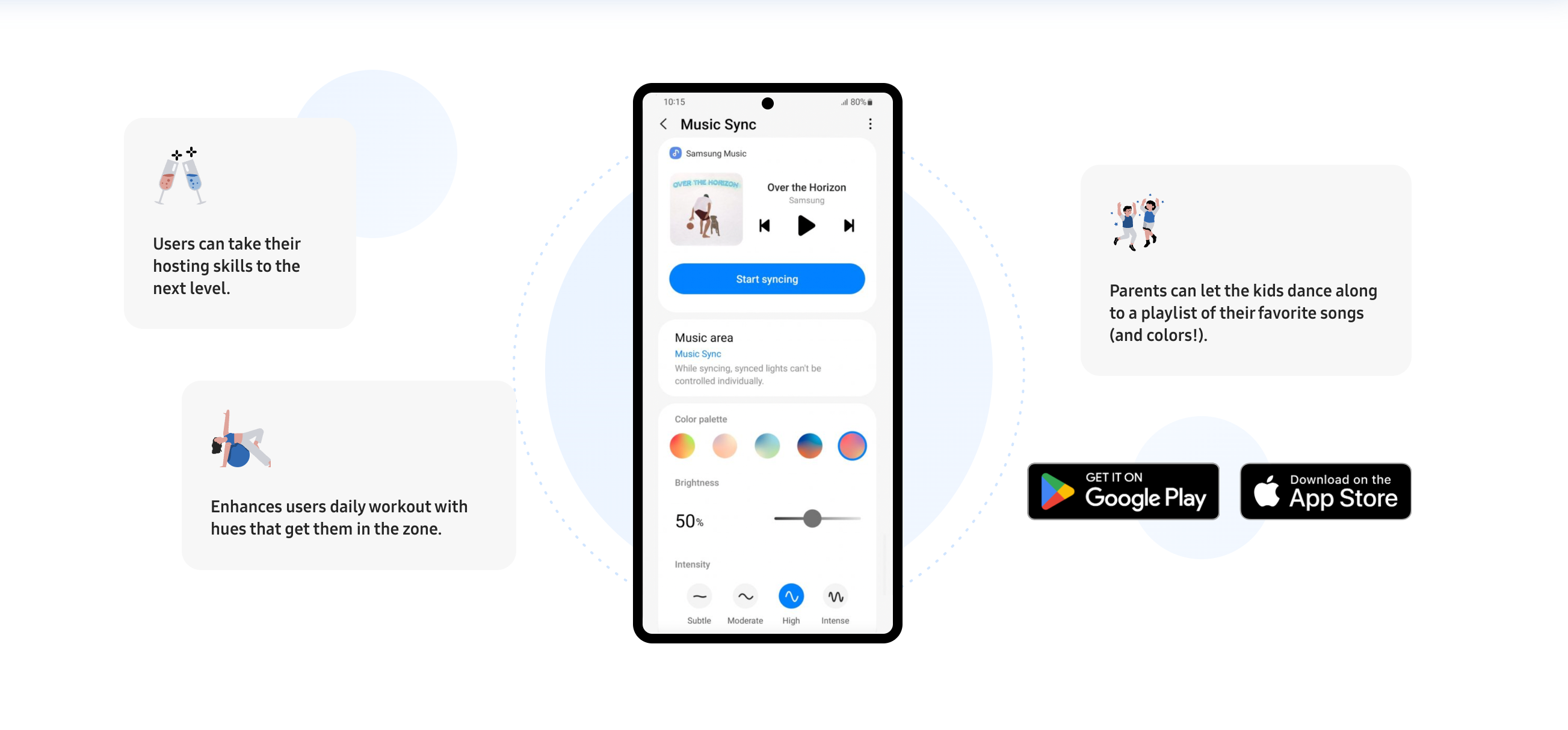
The smart lighting industry is evolving beyond simple controls, bringing more joy to the user experience. With the introduction of synchronization features, home entertainment has become more immersive than ever. Users can now match their lighting to gaming environments or favorite movie scenes, creating the perfect ambiance for home parties, relaxation, or even workouts.

Now, SmartThings is taking these experiences a step further by collaborating with YouTube Music, a key partner in the Galaxy ecosystem. This partnership enables SmartThings to tailor the Music Sync experience more effectively to users’ needs, no matter the setting or time of day. This includes new buttons that align with familiar YouTube Music settings like Relax, Party, and Workout, creating a seamless connection between Music Sync and the YouTube Music App.

With this integration, YouTube Music Premium users can enjoy perfect light synchronization with Philips Hue bulbs while listening to their favorite songs. For instance, when users press the Party button on Music Sync, their party playlist on YouTube Music will start playing, and the lighting will shift to a color pattern preset that perfectly matches the vibe.

Why Music Sync Hits All the Right Notes

When Music Sync was first launched in 2022, it was built on three core elements: the Music app, SmartThings, and our lighting partners. We initially teamed up with Philips Hue, a leading name in light synchronization. Their SDK was seamlessly integrated into the SmartThings app, allowing Philips Hue lights to sync harmoniously with the music users wanted to enjoy, thereby creating an enhanced home experience.

What truly sets SmartThings Music Sync apart is its ability to integrate seamlessly with various music apps. Unlike other platforms that rely on microphones or have limited access to music sources, Music Sync allows for accurate content synchronization across any music app within the Galaxy ecosystem. This ensures users can enjoy a truly synchronized experience without limitations.

Create A Soundtrack for Every Occasion

SmartThings Music Sync transforms your home into the ultimate entertainment center, where routines are designed to complement your lifestyle. Everything—from connecting a Bluetooth speaker to closing blinds and turning off the TV—can now be optimized and automated, making smart home living more seamless, convenient, and fun. Whether hosting a party at home, creating a daily workout with hues that get you in the zone, or letting your kids dance along to a playlist with their favorite songs and colors, the possibilities are endless.

More Exciting Features on the Horizon

As we look to the future, we remain committed to expanding our ecosystem and incorporating user feedback to enhance the Music Sync experience even further. Later this year, SmartThings will announce additional partner companies to enrich the Music Sync experience. To learn how to integrate your products and devices with SmartThings Music Sync, visit https://partners.smartthings.com/music-sync.

Rage Bait Pro-AI Billboards Invade San Francisco

0

The Great AI Debate: Can a Company’s Provocative Marketing Campaign be a Step Too Far?

A Dystopian Billboard Campaign

Last month, I was suitably disturbed by a series of dystopian billboards cropping up around San Francisco that promoted hiring AI over humans. The campaign was so egregiously provocative that it bordered on parody – a near-perfect reflection of the AI existentialism among creatives, seemingly proving that we’re one step closer to an all-out AI takeover.

The Controversial Campaign

The company behind the controversial billboards is Artisan, an AI platform specializing in providing clients with AI employees. With goading copy like "Artisans won’t come into work hungover" and "Artisans won’t complain about work-life balance", it’s clear that the billboards were designed with a purpose to challenge, provoke, and offend. There’s a desperate palpable irony to the campaign, even down to the company name "Artisan" synonymous with skilled human crafters who create by hand – a far cry from the company’s AI drones.

The Backlash

As more billboards appeared, heated backlash soon followed. On Bluesky user @spaceprez.bsky.social‬ shared one of the controversial ads, sparking outrage from followers. "This could be straight out of a Black Mirror episode," one user commented, while another added, "This makes me want to scream and throw bricks at it." Scathing responses continued on X, where @TMisGlitching called the ads an "anti-human publicity campaign".

The Mastermind Behind the Campaign

The mastermind behind the controversial campaign is 23-year-old founder and CEO Jaspar Carmichael-Jack, who appears suitably unphased by the backlash. Speaking to SFGate, Jasper says "We wanted something that would draw eyes – you don’t draw eyes with boring messaging." Regarding the ads, the CEO acknowledged "They are somewhat dystopian, but so is AI," suggesting that the provocative copy is merely a stark reflection of reality.

Conclusion

While I’d typically prioritize crafting a meaningful statement rather than ‘making noise’ when it comes to marketing, Jack’s sensationalist approach has caused growth in the company. If you’ve found yourself frustrated by Artisan’s provocative campaign, it’s almost inevitable – they’re manufactured as rage bait and the company thrives from the backlash.

FAQs

Q: Is the campaign a publicity stunt?
A: Yes, the campaign is designed to be provocative and draw attention to the company.

Q: Is the company’s goal to replace human workers with AI?
A: The company’s goal is to provide clients with AI employees, but the campaign does not explicitly state that it is replacing human workers with AI.

Q: Is the campaign successful?
A: Yes, the campaign has generated significant attention and publicity for the company.

Q: Is there a backlash against the campaign?
A: Yes, many people have expressed outrage and frustration with the campaign, calling it "anti-human" and "dystopian".

Overcoming Silos

0

Here is the rewritten article:

Cost of Transformation

Two-thirds of businesses worldwide claim their data is "fully or mostly optimised" for AI purposes, highlighting significant improvements in making data accessible, accurate, and well-documented. However, the study reveals that the journey towards AI maturity requires further significant investment. A striking 40% of global technology executives anticipate "unprecedented investment" will be necessary in 2025 just to enhance AI and data management capabilities. While considerable progress has been made, achieving impactful breakthroughs demands an even greater commitment in financial and infrastructural resources. Catching up with AI’s potential might not come cheap, but leaders prepared to invest could reap significant rewards in innovation and efficiency.

Data Silos Impede AI Success

One of the primary barriers identified in the report is the fragmentation of data. An overwhelming 79% of global tech executives state that unifying their data, reducing silos and ensuring smooth interconnectedness, is key to unlocking AI’s full potential. Companies that have embraced unified data storage are better placed to overcome this hurdle. By connecting data regardless of its type or location (across hybrid multi-cloud environments), they ensure constant accessibility and minimize fragmentation. The report indicates that organisations prioritising data unification are significantly more likely to meet their AI goals in 2025. Nearly one-third (30%) of businesses failing to prioritise unification foresee missing their targets, compared to just 23% for those placing this at the heart of their strategy.

Scaling Risks of AI

As businesses accelerate their AI adoption, the associated risks – particularly around security – are becoming more acute. More than two-fifths (41%) of global tech executives predict a stark rise in security threats by 2025 as AI becomes integral to more facets of their operations. AI’s rapid rise has expanded attack surfaces, exposing data sets to new vulnerabilities and creating unique challenges such as protecting sensitive AI models. Countries leading the AI race, including India, the US, and Japan, are nearly twice as likely to encounter escalating security concerns compared to less AI-advanced nations like Germany, France, and Spain. However, progress is being made. Despite elevated concerns, the report suggests that effective security measures are yielding results. Since 2023, the number of executives ranking cybersecurity and ransomware protection as their top priority has fallen by 17%, signifying optimism in combating these risks effectively.

Limiting AI’s Environmental Costs

Beyond security risks, AI’s growth is raising urgent questions of sustainability. Over one-third of global technology executives (34%) predict that AI advancements will drive significant changes to corporate sustainability practices. Meanwhile, 33% foresee new government policies and investments targeting energy usage. The infrastructure powering AI and transforming raw data into business value demands significant energy, counteracting organisational sustainability targets. AI-heavy nations often feel the environmental impact more acutely than their less AI-focused counterparts. While 72% of businesses still prioritise carbon footprint reduction, the report notes a decline from 84% in 2023, pointing to increasing tension between sustainability commitments and the relentless march of innovation. For organisations to scale AI without causing irreparable damage to the planet, maintaining environmental responsibility alongside technological growth will be paramount in coming years.

Conclusion

In conclusion, the report highlights the pressing issues faced by organisations globally as they strive to optimise their strategies for AI success. To overcome the challenges of data complexity, security, and sustainability, businesses must invest in unified data storage, robust security measures, and a clear understanding of how data evolves. By doing so, they can drive innovation while ensuring resilience, responsibility, and timely insights in the new AI era.

Frequently Asked Questions

Q: What are the primary barriers to AI success?
A: Data complexity, security, and sustainability are the key challenges faced by organisations in their AI journeys.

Q: How can businesses overcome data silos?
A: By unifying data, reducing silos, and ensuring smooth interconnectedness, organisations can unlock AI’s full potential.

Q: What are the scaling risks of AI?
A: Security threats, particularly around data protection, are becoming more acute as AI becomes integral to more facets of operations.

Q: How can businesses mitigate environmental costs associated with AI?
A: By maintaining environmental responsibility alongside technological growth, organisations can scale AI without causing irreparable damage to the planet.

Eco-Friendly Packaging Revolution

0

Designing with Impact

“Design that goes beyond convention to communicate meaning.” This trend encourages a movement towards sustainability and inclusivity, using visual cues or storytelling, material choices, and design details to create a lasting impact.

A prime example is Raras, a limited-edition wine that “puts the research of rare diseases on the table.” The atypical shape of the bottles, alongside the changing typography and label messaging, work in tandem to encourage important and candid conversations around health.

Art Deco Revival

Gatsby-style Art Deco packaging design is back with a bang – think striking geometric shapes, opulent colors, and plenty of glamour. With a particular focus on the drinks sector, this classic aesthetic revives the retro luxury of the ’20s design trend with a modern twist, bringing a contemporary flair to the well-loved design era.

Apéritifs brand Rue de Rêve takes cues from the Art Deco era with its arched 1920s architecture-inspired design created by Makers & Allies. Capturing the intersection of the brand’s French inspiration and Californian heritage, the tactile golden embellishments of the design make for a luxe experience that “transports drinkers to a Golden State.”

Simple Shapes Meet Stand-out Shades

Embracing bold visuals, this trend uses simple geometric shapes paired with bright primary colors to create a striking visual appeal. The playfulness of this combination makes for visually arresting packaging across a variety of products, making it an adaptable trend with a distinct contemporary quality.

Created by Dispenser Studio, Pasta Luciano’s packaging is a prime example of how bold design can create a standout shelf appeal. Embracing the graphic nature of large geometric shapes, the contrast of the packaging’s bright colors mirrors the liveliness of the brand’s creator, Luciano Monosilio, bringing a unique personality to the branding.

Inspired by Psychedelia

Taking inspiration from the ’60s, nods to psychedelic design are increasingly appearing, using kaleidoscopic patterns and intense colors to transport consumers into new dimensions. Despite its retro origins, psychedelic-inspired design has a distinctly contemporary feel thanks to its unrestrained use of bold color and striking patterns.

Embracing this aesthetic, Design Bridge and Partners introduced a vivid palette in its redesigned Pleasurama food packaging for Harvey Nichols. Maintaining the brand’s heritage of luxury, the new branding appeals to a new generation of customers with its daring and commanding design.

Cultural Connections

With a focus on heritage and history, ‘cultural connections’ create a sense of identity for brands while addressing an “understanding of cultural nuances in different target markets.” Connecting with audiences in a uniquely authentic way, this trend spotlights culture and heritage as an educational tool and a platform for thoughtful conversation.

Uncovering social taboos, OT is a condom brand “aiming to tackle the issue around the absence of comprehensive sex education, gender inequality, and a culture of shame in Kazakhstan.” With the ‘O’ and ‘T’ representing man and woman side by side, the packaging redefines sexual culture, promoting equality by visualizing harmonious and healthy relations between the genders.

Conclusion

The packaging design trends for 2025 are a reflection of the ever-evolving industry, with a focus on sustainability, inclusivity, and cultural connections. As design continues to play a vital role in shaping consumer experiences, these trends are set to dominate the industry in the coming year.

FAQs

Q: What is the main focus of the packaging design trends for 2025?
A: The main focus is on sustainability, inclusivity, and cultural connections.

Q: What is the significance of the “Designing with Impact” trend?
A: It encourages a movement towards sustainability and inclusivity, using visual cues or storytelling, material choices, and design details to create a lasting impact.

Q: What is the Art Deco Revival trend all about?
A: It’s a revival of the classic Art Deco design trend, with a modern twist, bringing a contemporary flair to the well-loved design era.

Q: What is the significance of the “Simple Shapes Meet Stand-out Shades” trend?
A: It uses simple geometric shapes paired with bright primary colors to create a striking visual appeal, making it an adaptable trend with a distinct contemporary quality.

Q: What is the “Inspired by Psychedelia” trend all about?
A: It takes inspiration from the ’60s, using kaleidoscopic patterns and intense colors to transport consumers into new dimensions, with a distinctly contemporary feel.

Q: What is the “Cultural Connections” trend all about?
A: It spotlights culture and heritage as an educational tool and a platform for thoughtful conversation, connecting with audiences in a uniquely authentic way.