Home Blog Page 525

$1 Phone Scanner Finds Seven Pegasus Spyware Infections

Malware Detection: The Growing Concern of Spyware on Mobile Devices

The Prevalence of Spyware

Seven out of 2,500 scans may seem like a small number, but it speaks to the widespread use of spyware around the world. The tool, developed by iVerify, has already detected a handful of infections, suggesting that the problem is more prevalent than initially thought.

How It Works

iVerify’s Mobile Threat Hunting feature uses telemetry data from as close to the kernel as possible to tune machine-learning models for detection. This allows the tool to flag characteristic traits of spyware, such as diagnostic data, shutdown logs, and crash logs.

The Challenge of Detection

Developing a detection capability has been a significant challenge, as mobile operating systems like Android and iOS are more locked down than traditional desktop operating systems. The challenge lies in refining mobile monitoring tools to reduce false positives.

Real-World Applications

The detection capability has already been invaluable, helping iVerify identify signs of compromise on the smartphone of Gurpatwant Singh Pannun, a lawyer and Sikh political activist who was the target of an alleged foiled assassination attempt by an Indian government employee in New York City. The feature also flagged suspected nation-state activity on the mobile devices of two Harris-Walz campaign officials during the presidential race.

The Future of Mobile Security

"The age of assuming that iPhones and Android phones are safe out of the box is over," says Cole, a representative from iVerify. "The sorts of capabilities to know if your phone has spyware on it were not widespread. Now you have the ability to know if your phone is infected with commercial spyware. And the rate is much higher than the prevailing narrative."

Conclusion

The detection of spyware on mobile devices is a growing concern, and it is crucial to have tools like iVerify’s Mobile Threat Hunting feature to identify and combat this threat. As the world becomes increasingly dependent on mobile devices, it is essential to stay ahead of the curve and ensure our personal and professional data remains secure.

FAQs

Q: What is spyware?
A: Spyware is a type of malware that is designed to gather information about a device or its user without their consent or knowledge.

Q: What is the prevalence of spyware?
A: The prevalence of spyware is difficult to determine, but it is estimated to be widespread, with 7 out of 2,500 scans detecting spyware.

Q: How does iVerify’s Mobile Threat Hunting feature detect spyware?
A: The feature uses telemetry data from as close to the kernel as possible to tune machine-learning models for detection, flagging characteristic traits of spyware such as diagnostic data, shutdown logs, and crash logs.

Q: What are the challenges of detecting spyware on mobile devices?
A: The main challenge is refining mobile monitoring tools to reduce false positives, as mobile operating systems like Android and iOS are more locked down than traditional desktop operating systems.

Microsoft’s Copilot can now browse the web with you using AI ‘Vision’

0

Microsoft’s Copilot Vision: A New Era of Browsing

What is Copilot Vision?

Microsoft is starting to test its new Copilot Vision feature today, allowing its AI companion to see what you see on an Edge webpage you’re browsing. With Copilot Vision, you can ask it questions about the text, images, and content you’re viewing or use it to assist you.

How Does it Work?

When you enable Copilot Vision, it sees the page you’re on, reads along with you, and you can talk through the problem you’re facing together. Browsing no longer needs to be a lonely experience with just you and all your tabs. According to the Copilot team, "Browsing no longer needs to be a lonely experience with just you and all your tabs."

What Can You Do with Copilot Vision?

You can use Copilot Vision to:

  • Ask questions about the text, images, and content you’re viewing
  • Use it to assist you while shopping online to find product recommendations
  • Even decipher hand-written recipes and offer up cooking tips

Is It Available?

Copilot Vision is currently only available to a limited number of Copilot Pro subscribers in the US, with plans to expand access to more Pro subscribers and websites "over time."

What About Security and Privacy?

Microsoft is taking its time with Copilot Vision, recognizing the potential privacy concerns around the new feature. "As we roll this out, Vision will only interact with a select set of websites to start," says the Copilot team. "Over time, we will cautiously expand this list. It’s important to stress that Vision does not capture, store or use any data from publishers to train our models. In short, we’re prioritizing copyright, creators, and our user’s privacy and safety — and are putting them all first."

Conclusion

With Copilot Vision, Microsoft is poised to revolutionize the way we browse the web, making it a more collaborative and assistive experience. As the feature expands to more Pro subscribers and websites, we can expect to see a more personalized and interactive browsing experience.

Frequently Asked Questions (FAQs)

Q: What is Copilot Vision?
A: Copilot Vision is a new feature from Microsoft that allows its AI companion to see what you see on an Edge webpage you’re browsing, allowing you to ask questions and get assistance.

Q: How do I get access to Copilot Vision?
A: Copilot Vision is currently only available to a limited number of Copilot Pro subscribers in the US, with plans to expand access to more Pro subscribers and websites "over time."

Q: Is Copilot Vision secure?
A: Yes, Microsoft is prioritizing security and privacy, ensuring that Copilot Vision does not capture, store, or use any data from publishers to train its models.

UE5’s Realism Reign Challenged?

0

Epic Games’ Unreal Engine Under Threat: Can Gaijin’s Dagor Engine Take the Crown?

Gaijin Entertainment’s Challenge to Unreal Engine

Epic Games’ Unreal Engine has long been the go-to game engine for many developers, known for its ability to open up access to game development and allow for the creation of high-fidelity worlds. However, Gaijin Entertainment thinks otherwise, and has released a demo showcasing its open-source Dagor Engine as a potential alternative.

The Demo: East District

The demo features a map created by Hooks Creative Studio, inspired by iconic maps of the past, built using Megascans and modern photogrammetry assets on Unreal Engine 5. Gaijin then ported this map into Dagor Engine for their unannounced new game. The demo highlights the engine’s capabilities, including real-time global illumination and advanced anti-aliasing.

Comparison and Results

Gaijin’s conclusion is that Dagor runs the map faster, delivering equal or arguably superior visual fidelity. This is achieved without using vendor-specific performance-enhancing techniques, such as DLSS, XeSS, or FSR, and operates in native resolution in most configurations, demonstrating the engine’s raw power and vendor-agnostic efficiency.

Limitations and Criticisms

However, many have pointed out that the comparison is not entirely fair, as the scenes in Dagor were designed with more detail, higher resolution assets, and different color and lighting. Others have asked for more information on performance and how the engines differ in practice.

Getting Started with Dagor Engine

For those interested in trying out Dagor Engine, the tools are available on GitHub. In the meantime, don’t miss the chance to take Epic Games’ free Unreal Engine course and download the free Project Titan Sample Game.

FAQs

Q: Is the comparison between Unreal Engine and Dagor Engine fair?
A: Many have pointed out that the comparison is not entirely fair, as the scenes in Dagor were designed with more detail, higher resolution assets, and different color and lighting.

Q: What are the limitations of the demo?
A: The demo does not include performance optimizations or enhanced visuals, and only used automated exporting steps, except for terrain, which is different between engines and required reimplementation.

Q: Can I use Dagor Engine for my own projects?
A: Yes, the tools are available on GitHub for developers to try out.

Day 2: OpenAI Advances in Product Drops and Demos

12 Days of OpenAI

With the holiday season upon us, many companies are finding ways to take advantage through deals, promotions, or other campaigns. OpenAI has found a way to participate with its “12 days of OpenAI.” 

What are the ’12 days of OpenAI’?

OpenAI CEO Sam Altman shared a bit more details about the event, which kicked off at 10 a.m. PT on Dec. 5 and will occur daily for 12 weekdays with a live stream featuring a launch or demo. The launches will be both “big ones” or “stocking stuffers,” according to Altman.

What has been dropped so far?

Friday, December 6:

On the second day of “shipmas,” OpenAI expanded access to its Reinforcement Fine-Tuning Research Program:

  • The Reinforcement Fine-Tuning program allows developers and machine learning engineers to fine-tune OpenAI models to “excel at specific sets of complex, domain-specific tasks,” according to OpenAI.
  • Reinforcement Fine-Tuning refers to a customization technique in which developers can define a model’s behavior by inputting tasks and grading the output. The model then uses this feedback as a guide to improve, becoming better at reasoning through similar problems, and enhancing overall accuracy.
  • OpenAI encourages research institutes, universities, and enterprises to apply to the program, particularly those that perform narrow sets of complex tasks, could benefit from the assistance of AI, and perform tasks that have an objectively correct answer.
  • Spots are limited; interested applicants can apply by filling out this form.
  • OpenAI aims to make Reinforcement Fine-Tuning publicly available in early 2025.

Thursday, December 5:

OpenAI started with a bang, unveiling two major upgrades to its chatbot: a new tier of ChatGPT subscription, ChatGPT Pro, and the full version of the company’s o1 model.

The full version of o1:

  • Will be better for all kinds of prompts, beyond math and science
  • Will make major mistakes about 34% less often than o1-preview, while thinking about 50% faster
  • Rolls out today, replacing o1-preview to all ChatGPT Plus and now Pro users
  • Lets users input images, as seen in the demo, to provide multi-modal reasoning (reasoning on both text and images)

ChatGPT Pro:

  • Is meant for ChatGPT Plus superusers, granting them unlimited access to the best OpenAI has to offer, including unlimited access to OpenAI o1-mini, GPT-4o, and Advanced Mode
  • Features o1 pro mode, which uses more computing to reason through the hardest science and math problems
  • Costs $200 per month

Where can you access the live stream?

The live streams are held on the OpenAI website, and posted to its YouTube channel immediately after. To make access easier, OpenAI will also post a link to the live stream on its X account 10 minutes before it starts, which will be at approximately 10 a.m. PT/1 p.m. ET daily.

What can you expect?

The releases remain a surprise, but many anticipate that Sora, OpenAI’s video model initially announced last February, will be launched as part of one of the bigger drops. Since that first announcement, the model has been available to a select group of red teamers and testers and was leaked last week by some testers over grievances about “unpaid labor,” according to reports.

Conclusion

The 12 days of OpenAI have just begun, with many exciting releases and upgrades already announced. From Reinforcement Fine-Tuning Research Program to ChatGPT Pro, there’s much to look forward to as the holiday season unfolds. Stay tuned for more updates and releases throughout the campaign.

FAQs

Q: What is the 12 days of OpenAI?

A: The 12 days of OpenAI is a campaign by OpenAI, where the company will host 12 days of live streams and release “a bunch of new things, big and small,” starting from December 5.

Q: What has been dropped so far?

A: OpenAI has already dropped two major upgrades to its chatbot, ChatGPT Pro and the full version of its o1 model, and expanded access to its Reinforcement Fine-Tuning Research Program.

Q: How can I access the live stream?

A: The live streams are held on the OpenAI website, and posted to its YouTube channel immediately after. OpenAI will also post a link to the live stream on its X account 10 minutes before it starts, which will be at approximately 10 a.m. PT/1 p.m. ET daily.

Q: What can I expect from the releases?

A: The releases remain a surprise, but many anticipate that Sora, OpenAI’s video model, and other exciting upgrades and new features will be launched during the campaign.

Q: When will the 12 days of OpenAI end?

A: The 12 days of OpenAI will end on December 18, with the last live stream occurring on that day.

Intel CEO

0

Arm CEO Rene Haas Weighs In on Intel’s Future

As someone who has been in the industry my whole career, it is a little sad to see what’s happening… Intel is an innovation powerhouse. At the same time, you have to innovate in our industry. There are lots of tombstones of great tech companies that don’t reinvent themselves.

I think Intel’s biggest dilemma is how to disassociate being either a vertical company or a fabless company, to oversimplify it. That is the fork in the road that they’ve faced for the last decade. Pat [Gelsinger] had a strategy that was very clear that vertical was the way to win. In my opinion, when he took that strategy on in 2021, that was not a three-year strategy. That was a five-to-10-year strategy. He’s gone and there’s a new CEO to be brought in and the decision has to be made.

My personal bias says that vertical integration is a pretty powerful thing. If they could get that right, I think they would be in an amazing position. But the cost associated with it is so high that it may be too big of a hill to climb.

I’m not going to comment on the rumors that we wanted to buy them. But I think, again, if you’re a vertically integrated company and the power of your strategy is in the fact that you have a product and you have fabs, inherently, you have a potential huge advantage in terms of cost versus the competition. When Pat was the CEO, I did tell him more than once, "You ought to license Arm because if you’ve got your own fabs, fabs are all about volume and we can provide volume." I wasn’t successful in convincing him to do that.

On the Rumors that Arm Will Build Its Own AI Chips

If you’re defining a computer architecture and you’re building the future of computing, one of the things you need to be very mindful of is that link between hardware and software in terms of really understanding where the tradeoffs are being made, where the observations are being made, what are the ultimate benefits to consumers from a chip that has that type of integration.

That is easier to do if you’re building something…the news today. It now seems highly probable that Trump — likely with involvement from Musk — will push to get some kind of deal done. I could see Amazon, Google (especially given that I’m hearing search ads will be a big focus for TikTok next year), Microsoft (yes, maybe again), Meta, and a few other players make a bid if they knew it would pass antitrust scrutiny.

Conclusion

Arm CEO Rene Haas shares his thoughts on the future of Intel and the tech industry. He believes that Intel’s biggest dilemma is its decision to either be a vertical company or a fabless company. Haas also shares his thoughts on the rumors that Arm will build its own AI chips and the potential advantages and disadvantages of such a move.

FAQs

Q: What does Arm CEO Rene Haas think about Intel’s future?
A: Haas believes that Intel’s biggest dilemma is its decision to either be a vertical company or a fabless company.

Q: Will Arm build its own AI chips?
A: Haas thinks that building its own AI chips could be beneficial for Arm, but it’s not a decision that has been made yet.

Q: Who might bid on Intel?
A: Haas mentions that Amazon, Google, Microsoft, Meta, and a few other players could make a bid on Intel if they knew it would pass antitrust scrutiny.

Q: What is the advantage of being a vertically integrated company?
A: Haas believes that being a vertically integrated company could give Intel a huge advantage in terms of cost versus the competition.

AI Transforms Industries

0

BIG AI News: Updates and Advancements

ChatGPT O1 Pro Model

The AI community has been abuzz with the latest developments from Meta AI, as the company has announced the launch of its new ChatGPT O1 Pro model. This upgraded version is designed to provide even more accurate and human-like conversational responses, making it an exciting addition to the world of AI-powered chatbots.

The ChatGPT O1 Pro model boasts improved language understanding, allowing it to better comprehend the nuances of human language and respond accordingly. This increased accuracy is expected to benefit a wide range of industries, from customer service and marketing to education and healthcare.

Leonardo AI Flow State

Meanwhile, the team at Leonardo AI has been working on a groundbreaking new technology called Flow State. This innovative AI solution is designed to help individuals enter a state of optimal focus and creativity, often referred to as "flow."

Flow State uses AI-powered algorithms to analyze an individual’s thoughts, emotions, and behavior, providing personalized recommendations for achieving a state of peak productivity and mental clarity. This technology has the potential to revolutionize the way we work, learn, and live.

FAL AI Faster hunyuanVideo Model

Another significant development in the AI space is the release of the FAL AI Faster hunyuanVideo model. This cutting-edge video processing technology is capable of generating high-quality video content at unprecedented speeds.

With the FAL AI Faster hunyuanVideo model, users can create complex video animations, simulations, and visual effects in a matter of seconds, opening up new possibilities for video production and storytelling.

hunyuanVideo Comfyui

Last but not least, the team at hunyuanVideo has unveiled its latest creation: Comfyui. This innovative AI-powered UI (user interface) design tool is designed to create intuitive and user-friendly interfaces for a wide range of applications, from mobile devices to desktop computers.

Comfyui uses AI to analyze user behavior and preferences, providing personalized recommendations for UI design and layout. This technology has the potential to revolutionize the way we interact with digital interfaces, making it easier for users to navigate and interact with complex systems.

Conclusion

The latest AI news is filled with exciting developments that have the potential to transform various industries and aspects of our lives. From improved language understanding and flow state technology to fast video processing and AI-powered UI design, these innovations are sure to have a significant impact on the way we live and work.

FAQs

  • What is the ChatGPT O1 Pro model?
    The ChatGPT O1 Pro model is an upgraded version of the original ChatGPT model, designed to provide even more accurate and human-like conversational responses.

  • What is Flow State?
    Flow State is a technology designed to help individuals enter a state of optimal focus and creativity, often referred to as "flow."

  • What is the FAL AI Faster hunyuanVideo model?
    The FAL AI Faster hunyuanVideo model is a cutting-edge video processing technology capable of generating high-quality video content at unprecedented speeds.

  • What is hunyuanVideo Comfyui?
    Comfyui is an AI-powered UI design tool designed to create intuitive and user-friendly interfaces for a wide range of applications.

AI Safety Requires Social Science

An Overview of AI Alignment

The goal of long-term artificial intelligence (AI) safety is to ensure that advanced AI systems are reliably aligned with human values – that they reliably do things that people want them to do.

We Want to Measure Judge Quality Given Optimal Debaters

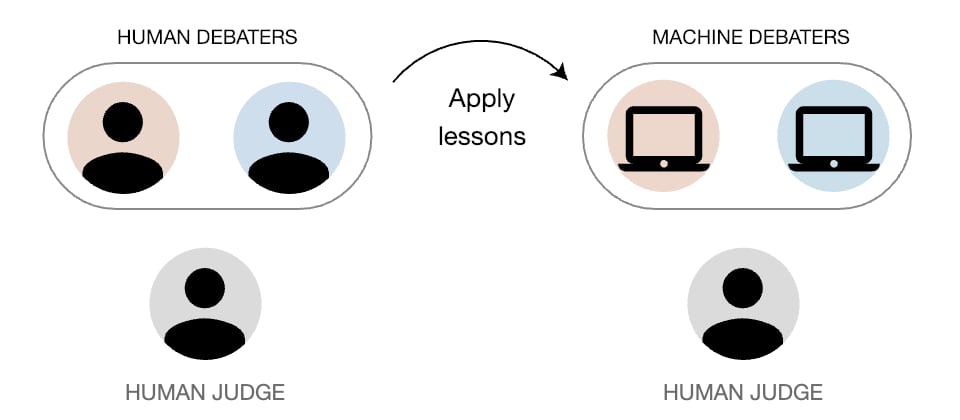
For debate, our end goal is to understand if the judge is capable of determining who is telling the truth. However, we specifically care whether the judge performs well given that the debaters are performing well.

ML Algorithms Will Change

It is unclear when or if ML systems will reach various levels of capability, and the algorithms used to train them will evolve over time. However, we believe that knowledge gained on the human side will partially transfer: results about debate will teach us about how to gather data from humans even if debate is superseded.

Need Strong Out-of-Domain Generalization

Regardless of how carefully designed our experiments are, human+human+human debate will not be a perfect match to AI+AI+human debate. We are seeking research results that generalize to the setting where we replace the human debaters (or similar) with AIs of the future, which is a hard ask.

The Scale of the Challenge

Long-term AI safety is particularly important if we develop artificial general intelligence (AGI), which the OpenAI Charter defines as highly autonomous systems that outperform humans at most economically valuable work.

Conclusion: How You Can Help

We have argued that the AI safety community needs social scientists to tackle a major source of uncertainty about AI alignment algorithms: will humans give good answers to questions? If you are a social scientist interested in these questions, please talk to AI safety researchers! We are interested in both conversation and close collaboration.

Q1: What is the goal of long-term AI safety?

A1: The goal of long-term AI safety is to ensure that advanced AI systems are reliably aligned with human values.

Q2: Why is it difficult to align AI systems with human values?

A2: It is difficult to align AI systems with human values because humans have limited knowledge and reasoning ability, and exhibit a variety of cognitive and ethical biases.

Q3: What is the role of social scientists in AI alignment?

A3: Social scientists play a crucial role in AI alignment by helping to understand how humans think, behave, and make decisions, and by designing experiments to study how humans interact with AI systems.

Q4: What is the scale of the challenge of aligning AI systems with human values?

A4: The scale of the challenge is significant, and may require recruiting thousands to tens of thousands of people to participate in experiments and provide data for training AI systems.

Q5: How can I help with AI alignment research?

A5: You can help by talking to AI safety researchers or working with social scientists to design and conduct experiments that study human-AI interaction and decision-making.

Q6: What are some potential applications of AI alignment research?

A6: AI alignment research has the potential to lead to significant advances in areas such as natural language processing, computer vision, and robotics, as well as improving the safety and reliability of AI systems.

Q7: What are some potential challenges in AI alignment research?

A7: Some potential challenges in AI alignment research include dealing with human biases and errors, ensuring fairness and transparency in AI decision-making, and addressing the complexity and uncertainty of human-AI interaction.

Q8: How can I stay up-to-date with the latest developments in AI alignment research?

A8: You can stay up-to-date with the latest developments in AI alignment research by following AI safety organizations, attending conferences and workshops, and reading research papers and articles on the topic.

Microsoft Surface Copilot Plus refresh

0

Microsoft’s Upcoming Surface Laptops and Tablets: What We Know So Far

New Surface Pro and Surface Laptop Lineup Coming in 2025

Microsoft’s first Copilot AI-ready Surface laptop was released earlier this year, and now Windows Central reports that the rest of the lineup is due for a refresh in 2025. According to the report, we can expect new Surface Pro and Surface Laptop computers with Intel Lunar Lake chips, which will be Copilot Plus PCs with AI features, just like the current Snapdragon versions.

Features and Upgrades

The new Surface Pro and Surface Laptop are expected to get anti-reflective screen coating, and the Laptop version might get a card reader and 5G options. Additionally, the Surface Pro may receive an upgrade to Intel or AMD processors, which could improve its performance and battery life.

Surface Laptop Studio Upgrade

The Surface Laptop Studio is also due for an upgrade from its current model’s 13th-gen Intel chips. While there is no confirmation on the processor, it is expected to have better battery life than its predecessor.

Surface Studio 2 Plus Discontinuation

Microsoft has confirmed to Windows Central that the Surface Studio 2 Plus all-in-one is going out of production, making it less likely to see a Copilot Plus version soon.

New Surface Device with 11-Inch Display

Sources have described a new Surface device with a display size of around 11 inches, which is a Surface Go and Laptop Go hybrid device with premium components powered by a Snapdragon X Plus chipset.

Conclusion

Microsoft’s upcoming Surface lineup promises to bring AI-powered features and improved performance to the table. With the discontinuation of the Surface Studio 2 Plus, fans of the brand will have to wait for the new devices to arrive in 2025.

FAQs

Q: What is the release date of the new Surface lineup?
A: The new Surface Pro and Surface Laptop lineup is expected to be released in 2025.

Q: What features can we expect in the new Surface Pro and Surface Laptop?
A: The new devices will come with Intel Lunar Lake chips, anti-reflective screen coating, and possibly a card reader and 5G options.

Q: Will the Surface Laptop Studio receive an upgrade?
A: Yes, the Surface Laptop Studio is due for an upgrade from its current model’s 13th-gen Intel chips.

Q: Is the Surface Studio 2 Plus being discontinued?
A: Yes, Microsoft has confirmed that the Surface Studio 2 Plus is going out of production.

Q: What is the new 11-inch Surface device?
A: The new device is a Surface Go and Laptop Go hybrid device with premium components powered by a Snapdragon X Plus chipset.

Building AI-Powered Customer Service with NVIDIA AI Blueprint

0

Smarter AI Virtual Assistants for Exceptional Customer Service

In today’s fast-paced business environment, providing exceptional customer service is no longer just a nice-to-have—it’s a necessity. Whether addressing technical issues, resolving billing questions, or providing service updates, customers expect quick, accurate, and personalized responses at their convenience.

Legacy Approaches Fall Short

Legacy approaches, such as static scripts or manual processes, often fall short when it comes to delivering personalized and real-time support. Additionally, many customer service operations rely on sensitive and fragmented data, which is subject to strict data governance and privacy regulations.

Revolutionizing Customer Service with Generative AI

With the rise of generative AI, companies aim to revolutionize customer service by enhancing operational efficiency, cutting costs, and maximizing ROI. Integrating AI into existing systems presents challenges related to transparency, accuracy, and security, which can impede adoption and disrupt workflows.

NVIDIA AI Blueprint for AI Virtual Assistants

To overcome these hurdles, companies are leveraging generative AI-powered virtual assistants to manage a wide range of tasks, ultimately improving response times and freeing up resources. This post outlines how developers can use the NVIDIA AI Blueprint for AI virtual assistants to scale operations with generative AI.

Smarter AI Virtual Assistants with an AI Query Engine

When building an AI virtual assistant, it’s important to align with the unique use case requirements, institutional knowledge, and needs of the organization. Traditional bots, however, often rely on rigid frameworks and outdated methods that struggle to meet the evolving demands of today’s customer service landscape.

NVIDIA NIM Microservices

The NVIDIA AI Blueprint for AI virtual assistants is built using the following NVIDIA NIM microservices:

  • NVIDIA NIM for LLM: Brings the power of state-of-the-art large language models (LLMs) to applications, providing unmatched natural language processing with remarkable efficiency.
  • NVIDIA NeMo Retriever NIM: Provides easy access to state-of-the-art models that serve as foundational building blocks for RAG pipelines.
  • NeMo Retriever Embedding NIM: Boosts text question-answering retrieval performance, providing high-quality embeddings for the downstream virtual assistant.
  • NeMo Retriever Reranking NIM: Enhances the retrieval performance further with a fine-tuned reranker, finding the most relevant passages to provide as context when querying an LLM.

Three Building Blocks for Creating Your Own AI Virtual Assistant

As a developer, you can build your own AI virtual assistant that retrieves the most relevant and up-to-date information, in real-time, with ever-improving humanlike responses. The AI virtual assistant architecture diagram includes three functional components:

  1. Data Ingestion and Retrieval Pipeline: Pipeline administrators use the ingestion pipeline to load structured and unstructured data into the databases.
  2. AI Agent: The AI virtual assistant is the second functional component. Users interact with the virtual assistant through a user interface. An AI agent, implemented in the LangGraph agentic LLM programming framework, plans how to handle complex customer queries and solves recursively.
  3. Operations Pipeline: The customer operations pipeline provides important information and insight to the customer service operators.

Get to Production with NVIDIA Partners

NVIDIA consulting partners are helping enterprises adopt world-class AI virtual assistants built using NVIDIA accelerated computing and NVIDIA AI Enterprise software, which includes NeMo, NIM microservices, and AI Blueprints.

Conclusion

The NVIDIA AI Blueprint for AI virtual assistants enables developers to quickly get started building solutions that provide enhanced customer experiences. By leveraging generative AI, companies can revolutionize customer service by enhancing operational efficiency, cutting costs, and maximizing ROI.

FAQs

Q: What is the NVIDIA AI Blueprint for AI virtual assistants?
A: The NVIDIA AI Blueprint for AI virtual assistants is a starting point for building AI-powered virtual assistants that provide enhanced customer experiences.

Q: What are the key components of the AI virtual assistant architecture?
A: The AI virtual assistant architecture includes three functional components: data ingestion and retrieval pipeline, AI agent, and operations pipeline.

Q: What are the benefits of using the NVIDIA AI Blueprint for AI virtual assistants?
A: The benefits of using the NVIDIA AI Blueprint for AI virtual assistants include enhanced customer experiences, improved operational efficiency, reduced costs, and maximized ROI.

Q: How can I get started with the NVIDIA AI Blueprint for AI virtual assistants?
A: You can get started with the NVIDIA AI Blueprint for AI virtual assistants by navigating to the Blueprint Card and signing in with a personal or business email address.

Your AI Clone Could Target Your Family

The Secret Word: A New Way to Verify Identity in the Age of AI Identity Fraud

The Warning

The Federal Bureau of Investigation (FBI) has issued a warning about a new type of identity fraud, where criminals use artificial intelligence (AI) models to generate convincing profile photos, identification documents, and chatbots embedded in fraudulent websites. These tools automate the creation of deceptive content, making it difficult to identify the human behind the scam.

The Problem with Voice Scams

The warning extends beyond voice scams. The FBI announcement details how criminals use AI models to generate convincing profile photos, identification documents, and chatbots embedded in fraudulent websites. These tools automate the creation of deceptive content while reducing previously obvious signs of humans behind the scams, such as poor grammar or obviously fake photos.

The Secret Word

To combat this issue, the idea of a "secret word" has emerged. This is a word or phrase known to a select few, which can be used to verify someone’s identity. The concept was first proposed by an AI developer named Asara Near on Twitter in March 2023.

The Origin of the Secret Word

According to our knowledge, the first appearance of the secret word in the context of modern AI voice synthesis and deepfakes can be traced back to Asara Near’s tweet. The idea is to establish a "proof of humanity" word, which trusted contacts can ask for in case they receive a strange and urgent voice or video call from the individual.

The Idea Spreads

Since Near’s tweet, the idea has spread widely. In February, Rachel Metz covered the topic for Bloomberg, writing that the concept is becoming common in the AI research community and is simple and free to implement.

The Power of Passwords

Of course, passwords have been used since ancient times to verify someone’s identity. It seems likely that some science fiction story has dealt with the issue of passwords and robot clones in the past. It’s interesting that, in this new age of high-tech AI identity fraud, this ancient invention – a special word or phrase known to few – can still prove so useful.

Conclusion

In conclusion, the secret word is a new way to verify identity in the age of AI identity fraud. By using a word or phrase known to a select few, individuals can ensure that their contacts are not communicating with a deepfaked or deepcloned version of themselves.

FAQs

Q: What is a secret word?
A: A secret word is a word or phrase known to a select few, which can be used to verify someone’s identity.

Q: How does it work?
A: A trusted contact can ask for the secret word if they receive a strange and urgent voice or video call from the individual, to ensure they are speaking with the real person and not a deepfaked or deepcloned version.

Q: Is this a new concept?
A: No, the idea of using a special word or phrase to verify identity is not new. However, the concept of a secret word in the context of AI voice synthesis and deepfakes is a recent development.

Q: Is the secret word effective against identity fraud?
A: Yes, the secret word can be an effective way to verify someone’s identity and prevent identity fraud.