Home Blog Page 542

Samsung Galaxy S25: Out of this World Camera!

0

Samsung Galaxy S25 Ultra Rumors: What to Expect

As we edge closer to the new year, Android fans are eagerly awaiting the latest Samsung S series of flagship smartphones. For me, this has the potential to be as exciting as Christmas day – since I’m a huge advocate of Samsung tech and a proud owner of the Galaxy S24 Ultra model, which is, in my opinion, one of the best camera phones of 2024.

Rumors and Speculations

Rumour has it that the Samsung S25 Ultra could be bestowed with a plethora of upgraded specs, from a new 50MP ultra-wide camera to a larger 6.9-inch display with boosted RAM and a new Snapdragon 8 Elite chipset. All of these speculations seem reasonable and realistic, but other rumours are outright wacky – with one leak suggesting that the S25 model will have a built-in drone (at least that’s according to our sister site, Digital Camera World).

Debunking the Rumors

Whether or not I decide to upgrade my S24 Ultra to the S25 Ultra will depend on a few things, most importantly the specs of the upcoming S25 series and how different they are from my current smartphone, as well as any trade-in deals that Samsung will no doubt be offering at the time for those looking to save.

New Features and Design

Leaks suggest that there may also be an S25 Slim model added into the lineup next year, with a thinner design and a “stronger” camera than the base models, and comparable to the Vivo X200 Pro mini. That’s according to well-known tipster @UniverseIce via X.

The Flying Drone Camera

The most absurd rumour floating around about the S25 Ultra however is that it will have the power of flight, thanks to YouTuber ‘AR Technology’, who has put together a render for a ‘Galaxy flying camera phone’. This might be an admittedly awesome concept, but it wouldn’t come cheap, and I wonder how drone permits might be enforced on smartphones given the sheer number of people who own them.

Samsung Galaxy S25 Ultra – Flying Drone Camera – YouTube

Watch On

Conclusion

Other leaks that I reported on back in September suggested that the phone will have rounded corners, as opposed to the current rectangular edges of the S24 Ultra model, but that’s as exciting as it might get with many believing the new flagship will sport a lot of the same design features and internal specs as its predecessor. On the other side of the coin, GalaxyClub commentators believe that the Samsung S25 Ultra could be a paradigm shift with big upgrades, thanks to its given codename.

I guess we’ll have to wait until January for an official Unpacked announcement from Samsung with all of the details on its anticipated S25 series. I’m super excited, I just hope that the new handset is a worthy upgrade from my S24 Ultra, and is priced reasonably enough for me to justify jumping ship.

FAQs

Q: What are the rumored specs of the Samsung S25 Ultra?

A: Rumors suggest that the Samsung S25 Ultra could have a new 50MP ultra-wide camera, a larger 6.9-inch display, boosted RAM, and a new Snapdragon 8 Elite chipset.

Q: Is the Samsung S25 Ultra going to have a built-in drone?

A: One leak suggests that the S25 model will have a built-in drone, but this rumor is yet to be confirmed.

Q: Will the Samsung S25 Ultra have a flying camera?

A: A YouTuber has put together a render for a ‘Galaxy flying camera phone’, but this is an absurd rumor and not likely to be true.

Q: When can we expect the Samsung S25 series to be announced?

A: Samsung is expected to announce the S25 series in January, with an official Unpacked event.

What is Performance Management? Building a Strategic Performance Management Process

0

It’s a universal desire for everyone—employees, managers, and leaders—to see employees succeed. Employee performance is a cornerstone of a thriving culture and a successful business. Yet, traditional performance management methods fall short in inspiring employees to do their best work. They lack the clarity, connection, and coaching that today’s workforce seeks. 

An optimal performance management program goes beyond evaluation. It humanizes employee contribution, transforms managers into coaches, and integrates employee engagement into daily operations to drive growth. But how do you build processes and tools that help you get here? 
 

Check out our Performance Pathways for ready-made, customizable frameworks to help you hit the ground running on performance management

 
The journey to inspire employee performance hinges on two pivotal factors: your performance management approach and the technology you embrace. But research says organizations aren’t hitting the mark on either of these factors. 

  • Less than half of employees say their organization’s approach to performance management is effective, efficient, or engaging.
  • Two-thirds of employees thinking about leaving their job express dissatisfaction with performance management technology and tools.

This guide will help clarify performance management by outlining its significance for your business and providing a blueprint for developing a robust strategy. 


What is performance management?

Performance management is an organization’s systematic approach to defining goals, tracking progress, and delivering feedback to boost employee and organizational performance. Effective performance management ensures employee contributions align with important organizational goals.


Understanding the performance management cycle

Your performance management cycle needs to be simple, clear, and valuable for everyone involved. It should help you: 

  • Drive alignment and connection 
  • Strengthen engagement and retention 
  • Empower, celebrate, and motivate employees 
  • Build managers who are strong performance coaches 
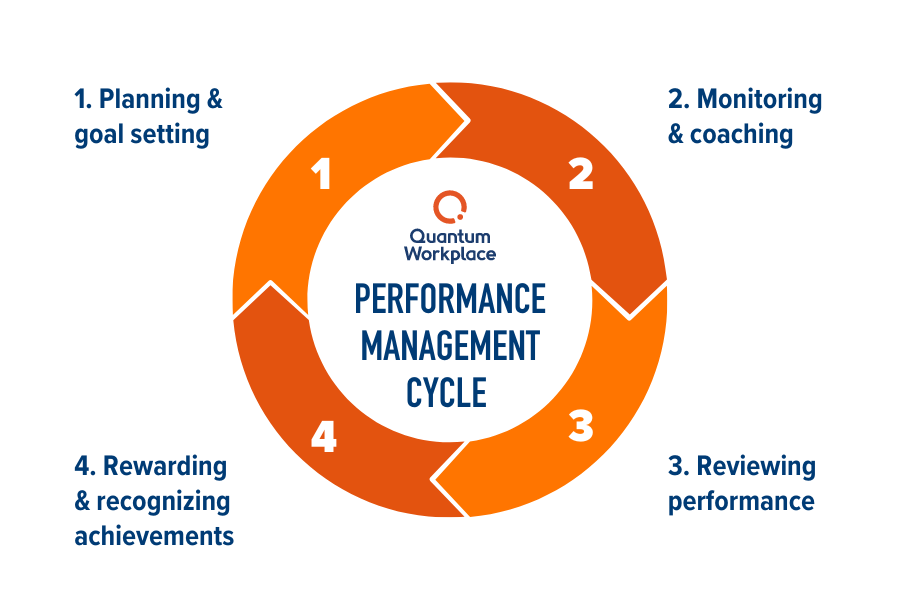
Performance Management Framework


Organizations often view a performance management cycle in separate stages, but the most impactful programs incorporate a web of integrated activities that work together to boost employee and business success. The key components include: 

  • Planning and goal setting 
  • Monitoring and coaching 
  • Reviewing performance 
  • Rewarding and recognizing achievements 


How does performance management differ from performance appraisals?

Performance management and performance appraisals are distinct yet related concepts. A performance appraisal is an annual evaluation, typically focused on past performance. It often feels static and retrospective, and therefore ineffective. 

Conversely, performance management is a continuous, dynamic process. Rather than a once-a-year event, it involves regular dialogue between employees and managers, facilitating real-time feedback and ongoing development. 

The right performance management system creates a more engaging and interactive process that empowers employees to take charge of their own performance—and giving managers resources to support their team effectively. 


Why is performance management important?

A study by Harvard Business Review Analytic Services found more than half of business leaders chose productivity as a primary business goal for their organization’s investments in performance management, employee engagement, and development. Yet only 31% say they have improved productivity as a direct result. This is where performance management comes in. 

Performance management is crucial for several reasons, including: 

  • Employee engagement: Regular feedback and clear expectations increase employee involvement and commitment.
  • Productivity: Continuous performance dialogue helps individuals align their efforts with company goals, leading to higher productivity.
  • Professional development: Employees have clear pathways for growth and development, improving their skills and career prospects.
  • Trust: Ongoing communication and alignment builds trust and understanding between staff and management.
  • Organizational success: A well-implemented performance management system aligns individual performance with important company objectives.
  • Training priorities: Consistent assessments can reveal gaps in skills, guiding where to focus training efforts.
  • Retention: A culture that fosters growth and values contributions can help retain top performers.
  • Compensation and promotions: Performance management provides a basis for making informed decisions about pay raises and advancement.
  • Customer satisfaction: Ongoing coaching and development keeps employees aligned, motivated, and equipped to meet customer needs effectively and consistently. 


Purpose of performance management

It’s clear that performance management is an essential part of business success. There are many reasons for performance management. When designed and implemented correctly, your performance management program has the power to: 

  • Clarify and reinforce expectations and accountabilities 
  • Align goals under the organization’s vision and mission 
  • Engage and retain top performers 
  • Develop and grow employees, personally and professionally 
  • Encourage critical thinking, agility, and creativity 
  • Motivate employees toward success

It impacts employee success 

Your employees have unique responsibilities, strengths, contributions, and experiences that help (and sometimes hinder) performance. How they go about achieving their goals might look a little different. Performance management impacts employee performance by ensuring employees have: 

  • Clear goals and priorities 
  • An understanding of performance expectations 
  • Insights into how they’re performing 
  • Frequent feedback and coaching from managers


It impacts team success

Many businesses have shifted from rigid organizational hierarchies to more effective and agile team-based models and cultures. Performance management increases accountability and ownership with transparent and aligned goals. It helps leaders build positive relationships between team members, create a culture of feedback, and develop high-performing teams.


It impacts organizational success 

Workplaces need to bring people, processes, and systems together to get work done. When individuals and teams understand how and why their contributions impact business results, they’ll be more likely to continue contributing to business success. Performance management impacts business performance by helping businesses promote transparency, alignment, and collaboration so that all employees and teams are working together to reach a common goal.

History of performance management

Performance management has taken many shapes over the years and eventually went on to shape what we now categorize as the “traditional performance appraisal approach”. This looked at an employee’s individual performance by: 

  • Setting goals at the beginning of the year 
  • Working on those goals throughout the year 
  • Reviewing performance against those goals at the end of the year 
  • Determining compensation and bonuses based on the review of these goals

Historically, employees were categorized as high, middle, or low performance workers, and contributions were measured by output versus outcomes. 
 
Given that the original performance management systems were built to suit workplaces at the turn of the 20th century when work environments were much different, they’ve received an upgrade over the years.  

As theories on employee motivation and satisfaction have been more widely understood, more participative and developmental forms of assessment have been introduced. The rise of technology and data analytics drove this shift, enabling more frequent, detailed, and personalized feedback throughout the year. 


The shift to continuous performance management

As businesses have evolved over time, so has performance management. Today, organizations are leveraging their talent as a competitive advantage and prioritizing innovation and critical thinking over execution. This evolution has inspired a shift from annual appraisals and goal management to continuous performance conversations and feedback.  

Implementing a continuous performance management approach allows leaders to capture real-time data and coach toward ongoing progress. 

Peter Cappelli, Director of the Center for Human Resources at The Wharton School of Business at the University of Pennsylvania, outlines three reasons for adopting a continuous performance management approach: 

1.) employees want more ownership over their development and advancement 

2.) managers want high performing teams with a unified purpose 

3.) businesses need systems that help them be more agile and collaborative 


What does a continuous performance management approach look like?
 

continuous-performance-coaching_performance-pathways_shadow


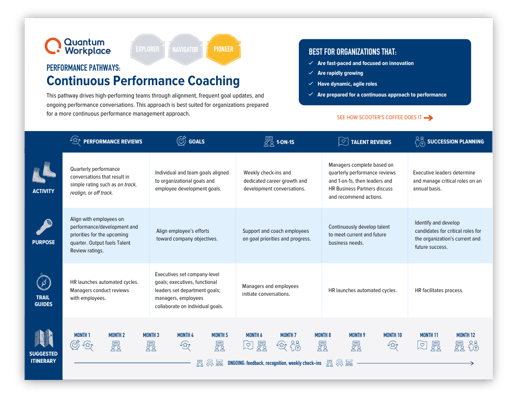
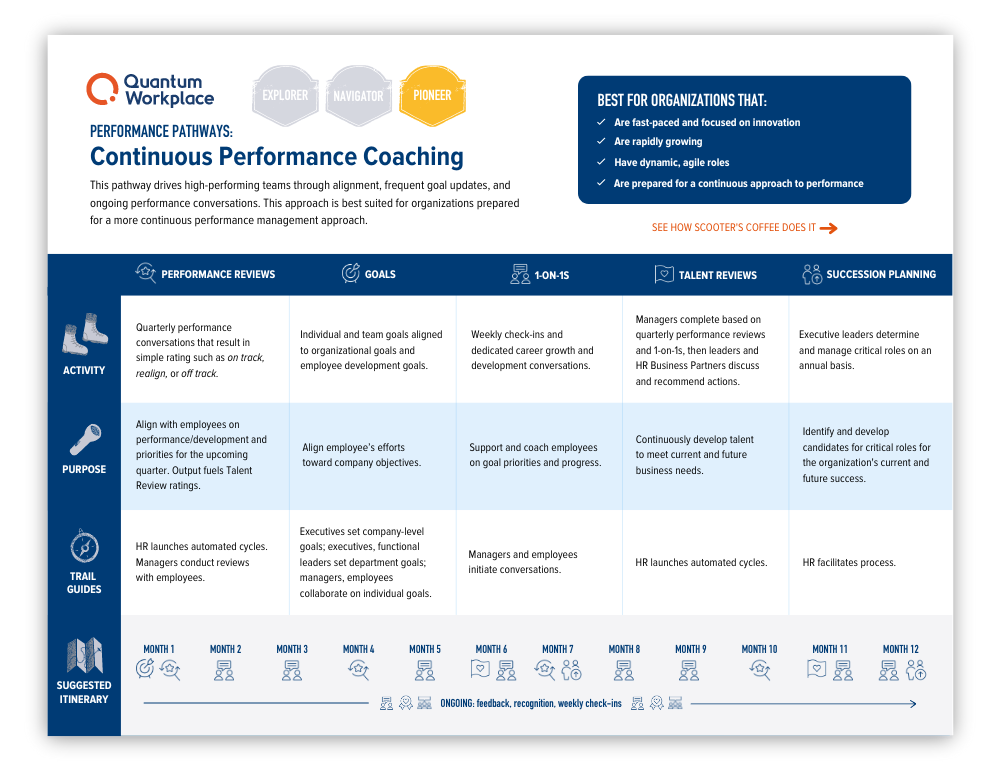
To sum up everything we’ve discussed above, continuous performance management drives high performing teams through alignment, frequent goal updates, and ongoing performance conversations. It involves: 

  • Performance reviews: quarterly performance conversations focused on performance and development. 
  • Goals: individual and team goals roll up into organizational goals, and individualized employee development goals. 
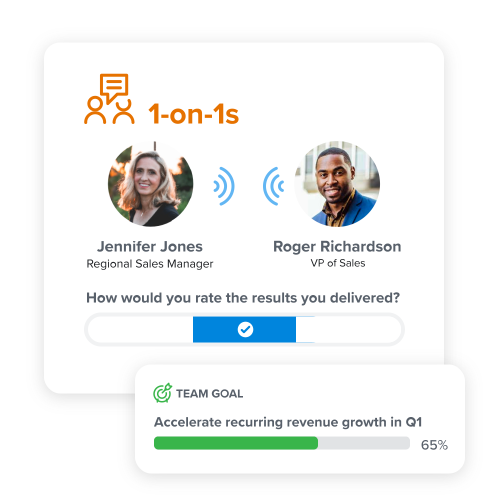
  • 1-on-1s: weekly check-ins between managers and employees and dedicated career growth and development conversations throughout the year.
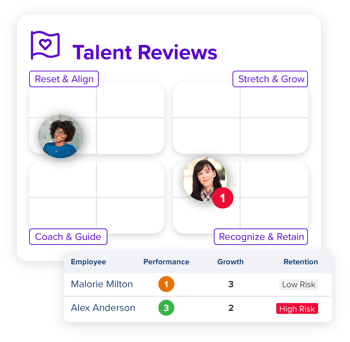
  • Talent reviews: manager feedback on employee impact, growth trajectory, and retention risk based on quarterly performance conversations. 
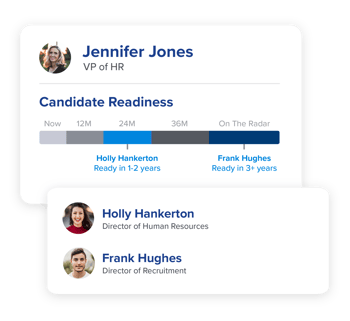
  • Succession planning: leaders identify and develop candidates for critical roles for the organization’s current and future success. 

Transitioning from traditional to continuous performance management doesn’t have to happen overnight. Organizations need to recognize that there are various approaches between these two extremes. Finding the middle ground is an important evolution that can help you make progress. 
 
Download our Performance Pathways eBook to help design your performance management approach


How to reevaluate your performance management approach


Knowing when to reevaluate your performance management approach is crucial to maintaining a productive and engaged workforce. If your current system isn’t yielding the desired results, it might be time for a change. 
 

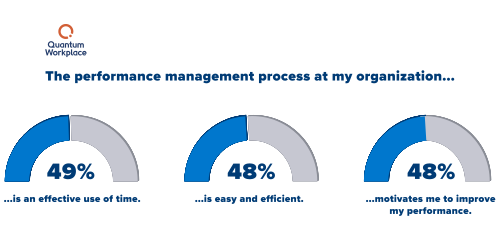
Quantum Workplace research shows less than half of employees say their organization’s current performance management process is a good use of their time. And less than half say it’s easy and efficient. 
Trends-Report_PerformanceImpact_Updates_performance-management-process-3

Signs your performance management process needs improvement 

A few key signs can point to the need for changes in your performance management process. These are a few red flags to look out for: 

  • Stagnant employee growth: If you notice that employees are not developing their skills or advancing in their roles, your performance management process may lack the necessary support for their growth.
  • Low morale and engagement: A drop in team morale or a lack of enthusiasm for work can indicate that your performance strategy isn’t providing the motivation or recognition that employees need.
  • Ineffective or lack of feedback: When feedback is infrequent, not constructive, or one-sided, employees miss out on valuable insights that could drive their performance.
  • Unclear objectives: If employees are unclear about what is expected of them, it’s a sign that goals and benchmarks are not effectively communicated within your current system.
  • High turnover rates: An increase in staff turnover might suggest that your performance management is not meeting employee needs for career development and satisfaction.
  • Lack of alignment with business goals: Performance management should be tightly aligned with the overarching goals of your business. A disconnect here could mean your approach needs realignment.
  • Ineffective or ill-equipped managers: As we highlighted earlier, managers play a key role in performance management, and if they aren’t properly trained to coach and provide feedback, the whole system suffers.

If any of these signs resonate with your current situation, it’s time to take a closer look at your performance management approach. A successful revamp can create a more dynamic and supportive environment that empowers employees to do their best work and help the organization achieve more. 
 
Ready to evolve your performance management approach? Download our eBook for tips on how to navigate the change


3 steps to improve your performance management process

If you are recognizing the need to revamp your performance management process based on what you read above, three steps can help get you started.  


1. Conduct an audit of your current performance management process.

To design a successful performance management program for the future, you need to assess your past and current experience. HR leaders must review and update these practices frequently to keep up with industry, marketplace, and workplace trends, as performance management is a continuous process. 

Ask yourself: 

  • Do our processes and systems align with the pace of our business? 
  • How does our current process help us achieve our org-wide goals? 
  • What gaps or blind spots do we have with our current process or system? 


2. Make sure to involve employees.

Rather than performance management happening to employees, they should be a critical part of the process through shared goal setting, multidirectional feedback, and continuous conversations. 

In a survey, 81% of respondents strongly agree that highly engaged employees perform better. And organizations have been capitalizing on improving employee engagement for years.  

Ask yourself: 

  • Do our employees have what they need to perform at their highest level? 
  • How are we helping coach employees to leverage their strengths? 
  • What other support or training do they need to own their performance?


3. Create an agile approach.

Annual goals can become quickly dated if organizational changes occur. Keep your biggest business objectives and key results top of mind and updated. Build a process that gives you a detailed view of real-time employee performance—so managers can actively retain and develop their team. 

Ask yourself: 

  • Do our managers have what they need to be successful performance coaches? 
  • Are we using the right tools to help us adapt and adjust organization-wide performance goals? 
  • Do employees understand how their goals align with business outcomes? 


How Fossil Transformed Their Performance Management Process

Fossil Group saw immediate progress when it evolved its company-wide performance approach—however upon further analysis it found that 35% of individual goals were misaligned or lacked impact on strategic priorities. 

Here’s how they adapted for business success: 

They moved to continuous performance conversations and feedback by implementing informal “check-ins” that could be launched and customized by any employee, at any time. 

They built intuitive goal conversation templates to organically include opportunities to discuss and collaborate on setting clear, aligned, and motivating goals. 

They brought performance conversations full circle by building recognition toolkits for managers and launching an online peer-to-peer recognition program to keep the conversation going.


How to build an effective and thriving performance management program

After you’ve evaluated the current state of your performance management process, it’s time to start building your new program.  

Set performance management goals

Before you can determine the “what” of your performance management programs and tools, take the time to ask your leaders and HR team about the “why.”

What do you want performance management to do for the organization? How will you know if the program you build is successful?  

Effective performance management is more than just a box to check. It’s the driving force behind employee and business success. Your performance management system should serve as the framework that organizes all the critical components of your process—informed by the unique priorities and goals of your organization.


Performance management best practices 

You’ll want to follow a few key performance management best practices to maximize the success of your approach.

1. Shared ownership 

Like other workplace initiatives, performance management is not solely an HR function. Performance management programs require ownership and involvement of all employees to be effective. Buy-in should start with senior leadership, but that’s not where it ends. Make sure you explain the unique benefits and components of the program to employees, managers, and leaders. 


2. Fair performance evaluation 

Leaders need to prioritize honest, inclusive, and ongoing feedback to make the experience feel fair and engaging to employees. Don’t save all your feedback for an annual performance review. Instead, align, assess and adjust throughout the year. 
 

3. Frequent performance conversations 

Solely relying on annual employee performance reviews can be subject to bias due to depending on memories and recollection of past performance and behavior. By supplementing with more flexible, two-way conversations (or check-ins) you’ll enable employees and people managers to shape a shared agenda and discussion. 

One-on-one meetings should happen at least monthly to allow managers and employees to discuss performance and other important topics frequently. These meetings can cover a variety of topics and should always be: 

  • Developmental and future-focused 
  • Transparent and timely 
  • Inclusive of the employee voice 
  • Aligned with employee aspirations 

4. Collaborative goal setting 

When managers and employees set goals collaboratively—and frequently—employee engagement increases. Managers should work with employees to set individual goals that align with team and organizational goals. This helps employees see how their work is contributing to the success of the organization. 


5. Frequent, multi-sourced feedback 

Whether feedback is positive or corrective, it shouldn’t have to wait until the end of the year. In fact, 71% of employees prefer immediate feedback and 72% said their performance would improve if their managers provided corrective feedback. 

Be sure to add peer feedback to help paint a broader, clearer picture of employee performance. Managers don’t always have a direct line of sight into their employees’ performance or developmental needs—360 feedback helps! 
  

6. Opportunities for development and training 

68% of millennials who feel they’ve had development opportunities at work in the past year plan to stay at their organization for at least another year. But employee growth and development are not one-size-fits-all initiatives. Make sure your managers are in tune with employee needs and desires by making growth and development conversations a central pillar of your program. 
  

7. Recognition and appreciation alongside compensation 

Traditional performance management approaches offer compensation (or pay-for-performance) to reward high performers. But today’s workforce isn’t motivated by monetary benefits alone. 

While compensation conversations are still important, organizations are separating pay from performance and emphasizing positive feedback and recognition to increase engagement and motivate performance. Recognition should go beyond employees’ individual contributions and celebrate the behaviors that support and reinforce your organization’s mission, vision, and values. 


8. Digital tools that make it easy for everyone 

Organizations are employing workers of all types: remote, temp, hourly, and salaried. No matter the makeup of your organization, you need HR technology that links teams and their performance. With the right digital tools: 

  • Employees can set goals, schedule check-ins, provide feedback and recognition, and stay connected between check-ins.
  • Managers will have greater visibility and transparency on goal progress and performance, employee recognition, and feedback.
  • Organizations won’t be dependent on “seeing” employees to understand their performance and how it does (or doesn’t) impact business.


Frameworks for building your performance management program

When it comes to performance management, not just any old shoes will fit. Building the right program for your unique organization is a journey. But you don’t need to start from scratch. To transition to a more continuous approach organizations should: 

  • Take one small step. That can be increasing feedback frequency or starting a regular 1-on-1 cadence. 
  • Get employee input. Gain their buy-in by getting their feedback on the change. 
  • Help managers. Managers need training to transition from evaluators to coaches. 
  • Use tech. Our research shows that managers and employees need robust technology to integrate performance management into their daily workflows. 
  • Communicate. The entire organization needs to understand the approach and benefits. 
  • Analyze and act. Take the feedback you receive on the new process and adjust to make the process better.  

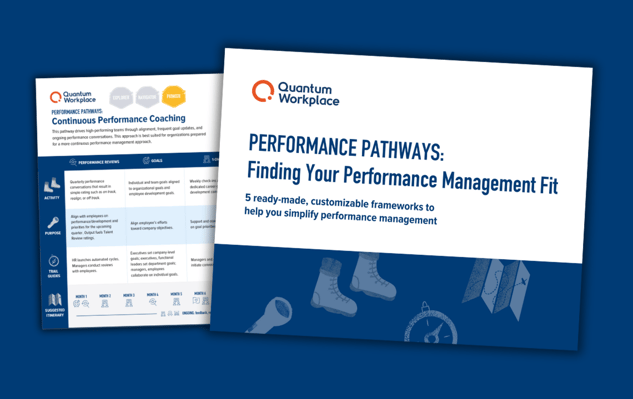
Quantum Workplace offers ready-made, customizable frameworks to help you hit the ground running on your next performance management evolution.  

Learn more about our Performance Pathways
performance pathways ebook


How to identify effective digital performance management tools 


Choosing the right performance management tool to fit your workplace culture is essential to the success of your strategy. When looking for the right tech, you need a solution that brings elements of an effective system together. 

Look for a provider that isn’t limited to standalone systems or tools. Instead search for one that supports and propels organizational growth. 


Key tools you need in performance management software 


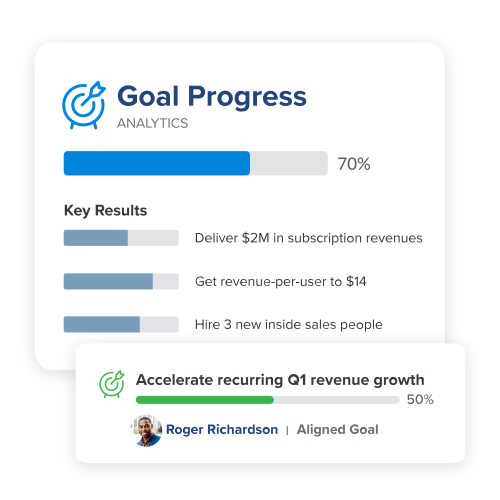
Goal-2

Move your teams forward with clear and aligned goals. 

Setting clear and aligned goals is paramount to the success of high performing teams. Quantum Workplace empowers your teams to set, monitor, and accomplish important goals with:  

  • Cascading goals: align organizational, team, and employee goals 
  • AI-powered goal assistant: help employees write better goals 
  • Collaborative tools: share goal progress and ownership across teams 
  • Interactive newsfeed: celebrate success and stay aligned on progress 
  • Flexible formatting: choose from OKRs, SMART goals, or something else 

Learn more about Quantum Workplace Goals


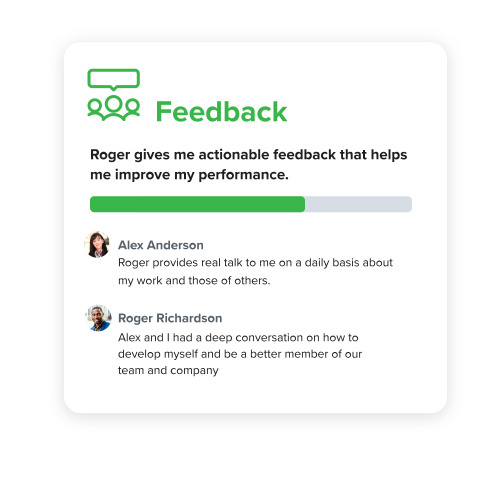
Feedback-1

Boost trust and employee performance with employee feedback. 

Quantum Workplace’s 360, peer, and upward feedback help boost employee performance, growth, and development. Support a culture of continuous feedback within your teams with:  

  • Flexible frameworks: collect any type of feedback with configure it the way you need 
  • Easy access: empower anyone to request or give feedback in minutes 
  • AI-powered writing assistant: help managers and employees write better feedback 
  • Automated cycles: initiate feedback based on calendar dates or employee milestones 
  • Actionable analytics: identify and act on development opportunities 
  • Curated templates: get best practice guidance and collect consistent analytics across the organization  

Learn more about Quantum Workplace feedback


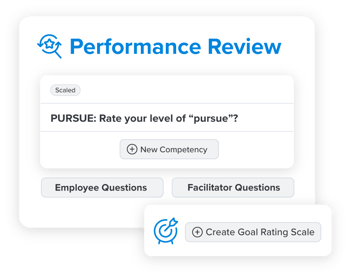
4_performance-reviews_product-imagery


Keep managers and employees on the same page with performance reviews.  

Performance reviews are still a staple of most performance management programs—but you need them to be more effective, efficient, and engaging to improve performance. Make performance conversations simple and effective with:  

  • Customizable templates: tailor reviews to fit your culture and empower managers 
  • Automated cycles: build healthy habits with HR-prompted workflows and alerts 
  • Performance integrations: easily embed goals or feedback for meaningful context 
  • Real-time analytics: drive accountability with real-time response rates and notifications 
  • Talent dashboard: see all your talent data in a simple 9-box or 4-quadrant visual 

Learn more about Quantum Workplace performance reviews


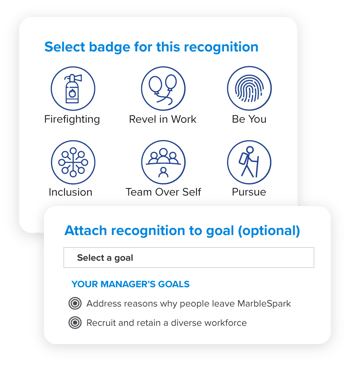
Recognition_ToolPage_Badges_Goals


Celebrate success and help team members feel valued with real-time recognition. 

Motivate employees and celebrate success with real-time recognition. Easily share stories of success and help employees across your organization feel valued with: 

  • Peer-to-peer recognition: allow any employee to easily celebrate another 
  • Automated milestones: always remember work anniversaries 
  • Customized badges: tie recognition to cultural values that matter 
  • Social newsfeed: create a public and fun celebration space 
  • Integrated notifications: amplify success stories to Slack and Teams 

Learn more about Quantum Workplace recognition


1on1s-1

Increase clarity and connection with performance reviews and 1-on-1 meetings. 

Empower meaningful conversations at every level, across any department. Increase communication, clarity, and engagement with:  

  • Digital conversation tools: collaborate on and track any 1-on-1 
  • Performance integrations: easily see progress by pulling in goals or feedback 
  • Curated templates: help managers have effective conversations 
  • Automated cycles: build healthy habits with HR-prompted workflows and alerts 
  • Mobile access: take meeting agendas and notes with you wherever you go 

Learn more about Quantum Workplace 1-on-1s


TalentReviews_ToolPage_UnderstandYourTalentPool@2x


Identify and develop top talent with talent reviews. 

Objectively assess performance to identify rising stars and talent risk. Make strategic talent decisions with:  

  • Reliable performance feedback: collect actionable, objective ratings from managers 
  • 9-box or 4-quadrant: quickly see talent risk and opportunities to promote or develop 
  • Calibration settings: allow multiple raters and easily filter data for calibration sessions 
  • Collaboration tools: comment and add talent insights over time 
  • Integrated succession planning: seek successor nominations and pull ratings into plans 

Learn more about Quantum Workplace talent reviews


Sustain high performance with succession planning. 

Succession-Planning_Succession-Planning-8


Sustain high performance with succession planning. 

Proactively identify gaps and create development plans to prepare for the future. Ensure the right successors are identified and developed with: 

  • Collaborative nomination process: request nominations and performance details from any leader or manager 
  • Readiness tracking: track candidate readiness by 12-month increments so you can easily see progress over time 
  • Integrated performance: see candidate performance ratings and development goals 
  • Diversity visibility: align success plans with diversity goals 
  • Personalized, board-ready insights: share real-time insights with stakeholders 

Learn more about Quantum Workplace succession planning  


Other performance management platform must-have features


1. Integrates with your HRIS. 

Make sure your new performance management system integrates with not only your existing Human Resource Information System (HRIS), but other systems and databases to remove the administrative burden of getting started.  

You want information to flow seamlessly, providing HR professionals, managers, and employees with current and precise data. Avoid isolated data pools and minimize the need for manual entry, thereby improving operational efficiency. 
 

2. Customized to fit your culture. 

For a performance management program to be welcomed and adapted by your employees, it must feel like a natural part of your organizational culture. That means your performance management software should be customizable to fit the needs of your organization so that it becomes ingrained and integrated with other processes and traditions. 


3. In-tool nudges and alerts. 

Busy schedules are a big obstacle when it comes to effective and continuous performance management processes. Look for software with in-tool and email notifications that notify and surface important insights and actions to managers. 


4. Mobile app or access. 

Help employees of every level track and motivate performance no matter where they work (and when). Make sure your performance management software can be accessed from computers, tablets, and mobile devices. 


5. Access to integrated performance tools. 

The best performance management software allows you to integrate all your performance tools in one place—including goals, 1:1s, recognition, feedback, and talent reviews. Find software that allows users to access them all with one, simple login to decrease hassle and increase usage. 


6. Reliable service and support. 

A user-friendly performance management system is great, but if your software partner isn’t accessible, responsive, and friendly when you (or your employees) have questions, then it’s not the system for you. Look for a vendor that includes a dedicated support team, provides resources and templates, and keeps you informed on the latest trends and research. 


7. Integrates with engagement tools. 

For your performance management software to be truly effective, it should be integrated with engagement tools. This integration allows you to see the effectiveness of your performance management strategies and pinpoint what drives engagement and retention among top performers.


The state of performance management is always evolving—and will likely be at the top of many business leaders and HR agendas for the foreseeable future. To continuously achieve business success, organizations will need to adapt and adjust their approach to attract and retain high-performing employees. 

Changing focus from annual performance reviews to a continuous approach and creating a process that drives employee engagement, employee and team performance, and business success will help: 

  • Employees understand why their contributions matter and how to make a bigger impact
  • Managers coach successful teams by providing continuous feedback and building aligned goals
  • Leaders tie performance metrics to business outcomes to build a competitive workforce

See how Quantum Workplace’s performance management software can help you build more effective managers and teams! Get your custom demo today. 

Alibaba Cloud Overhauls AI Partner Initiative

0

Alibaba Cloud Overhauls AI Partner Ecosystem with "Partner Rainforest Plan"

Alibaba Cloud, the cloud division of the Chinese tech giant, has unveiled the "Partner Rainforest Plan" during its annual Partner Summit 2024. The plan aims to strengthen its position in the market by outlining several new initiatives, including an AI partner accelerator programme, enhanced incentives, and a refreshed global strategy for service partners.

New Initiatives

The company’s new AI Alliance Accelerator Programme aims to establish partnerships with 50 AI technology providers and 50 channel partners by 2025. Selected technology partners will receive enhanced technical support, expanded distribution channels, and dedicated AI consulting services, while channel partners will benefit from increased financial incentives for AI-related initiatives.

Alibaba Cloud has also introduced its Revitalised Service Partner Programme, designed to upskill existing partners and cultivate new ones through AI training and empowerment. The programme includes the joint development of Managed Large Language Model Services with service partners, leveraging the company’s generative AI capabilities.

Strategic Partnerships

The cloud provider has committed to extending strategic partnerships with 18 service partners, including prominent names such as Deloitte, Accenture, and Cognizant Worldwide, from its existing pool of 50 global standard service partners.

In various regional developments, Alibaba Cloud has established strategic partnerships across Asia:

  • Indonesia: The company has partnered with Telkom Indonesia to deliver AI-supported cloud solutions and develop digital talent.
  • Japan: Information security firm Securai will localise Alibaba Cloud’s Zstack service for the Japanese market.
  • Thailand: A memorandum of understanding with Yell Group aims to address growing demand for generative AI in the creative media industry.

Synergistic Incentive Programme

The company has introduced a Synergistic Incentive Programme to foster collaboration between its global technology and channel partners.

Conclusion

With its revamped global partner ecosystem, Alibaba Cloud is committed to supporting its global partners to jointly reap the benefits of the AI era and meet the diverse business demands of global customers.

FAQs

Q: What is the "Partner Rainforest Plan"?
A: The "Partner Rainforest Plan" is a new initiative by Alibaba Cloud to strengthen its position in the market by outlining several new initiatives, including an AI partner accelerator programme, enhanced incentives, and a refreshed global strategy for service partners.

Q: What is the AI Alliance Accelerator Programme?
A: The AI Alliance Accelerator Programme aims to establish partnerships with 50 AI technology providers and 50 channel partners by 2025, providing enhanced technical support, expanded distribution channels, and dedicated AI consulting services.

Q: What is the Revitalised Service Partner Programme?
A: The Revitalised Service Partner Programme is designed to upskill existing partners and cultivate new ones through AI training and empowerment, including the joint development of Managed Large Language Model Services with service partners.

Tech Takes the Helm

Technology Takes Centre Stage in Sports Officiating

When US sprinter Noah Lyles pipped his Jamaican rival Kishane Thompson to the 100 metres gold medal in Paris this summer, five thousandths of a second separated the two men. The race was the closest in Olympic history — yet the outcome was known almost instantly, thanks to new cameras able to capture and process 40,000 images a second.

A New Era in Officiating

And this is just one of the many advances that have been made in determining outcomes in sport. Although referees, umpires and judges have always been the ultimate arbiters of the sporting rule book, technology has long had a part to play. The London Olympics in 1948 featured the first use of photo finish cameras while, at the Mexico City games 20 years later, electronic timekeeping became standard across all Olympic sports.

Automation on the Rise

In recent years, advances in both software and hardware have brought increased automation into officiating. In football, goal-line technology, which instantly determines whether a goal has been scored, made its debut during the 2012 Club World Cup, while semi-automated offsides were rolled out during the group stages of the Uefa Champions League a decade later.

Now, many in the industry believe a new technological revolution in sport is under way that will lead to more on-field decisions being made or informed by automated systems, rather than human beings alone.

Breakthroughs in Visual Data-Collection and Processing

At the Paris Olympics, Swiss Timing — which, through its sister company Omega, has links to the games going back to its role as timekeeper in Los Angeles, 1932 — introduced a new system for diving. It was able to track the distance between a high diver’s head and the diving board — information that judges could use to determine whether a jump had been executed safely, or whether to impose a points penalty.

Alain Zobrist, chief executive of Swiss Timing, says breakthroughs in visual data-collection and processing speed have opened up a world of new possibilities.

“We can track both athletes’ performance or body movement in a very, very accurate way, something that we couldn’t do before,” he says. “There’s a potential in some sports where technology — automated technology — could be the decision maker.”

Wimbledon Ditches Human Line Judges

In a further sign of the changing times, at next summer’s Wimbledon tennis championships line judges will no longer appear courtside. The oldest of the four tennis Grand Slams has made the decision to replace its human line judges with a fully automated ball tracking system, marking the end of an era that had lasted for more than a century.

Hawk-Eye, which developed the electronic line call system, has been providing officiating technology to Wimbledon since 2007. The UK-based company is owned by Sony Sports, and now works with 23 of the top 25 sports leagues in the world. It recently announced a joint venture with Fifa, football’s global governing body, to build a technology centre to explore how algorithms can help improve on-field decision making by referees.

Conclusion

As technology continues to advance, it is likely that we will see more and more automation in sports officiating. While some may be concerned about the role of human officials, it is clear that technology has the potential to improve the accuracy and speed of decision-making in sports.

FAQs

Q: What is the current state of technology in sports officiating?
A: Technology has been used in sports officiating for many years, with advances in areas such as photo finish cameras, electronic timekeeping, and goal-line technology.

Q: What are the benefits of automated officiating?
A: Automated officiating can improve the accuracy and speed of decision-making in sports, reducing the potential for human error and controversy.

Q: How will automation affect the role of human officials?
A: While automation will likely lead to a reduction in the number of human officials required, it is unlikely to replace them entirely. Human officials will still be needed to oversee and interpret the technology, and to make decisions in situations where technology is not able to.

Q: What are the potential applications of automated officiating?
A: Automated officiating has the potential to be used in a wide range of sports and situations, from tracking player movements and biometric data to determining whether a ball is in play or not.

Q: What are the challenges facing the development of automated officiating?
A: One of the main challenges facing the development of automated officiating is ensuring that the technology is accurate and reliable, and that it is able to handle complex and dynamic situations. Additionally, there may be concerns about the impact of automation on the role of human officials and the sport itself.

Unified Whole-Body Control for Physically Simulated Humanoids

0

Overcoming Task-Specific Control

Traditional approaches to humanoid control are inherently limited by their task-specific nature. A controller specialized in path following cannot handle teleoperation tasks requiring head and hand coordinate tracking. Similarly, a controller trained for tracking a demonstrator’s full-body motion is incapable of adapting to scenarios that require tracking a subset of keypoints.

Motion Inpainting Provides a Unified Solution

Recent advances in generative AI have demonstrated remarkable success using inpainting across multiple domains, such as text, image, and even animation. These methods share a common and powerful concept in that they learn by training to reconstruct complete data from masked (incomplete) or partial views. MaskedMimic adapts this powerful paradigm to the task of full-body humanoid control.

How MaskedMimic Works

Training MaskedMimic is achieved in a two-stage pipeline that leverages a large dataset of human motions, their textual descriptions, and scene information. The first stage involves training a reinforcement learning agent on the task of full-body motion tracking. This model observes the robot’s proprioception, surrounding terrain, and what motion it should perform in the near future. It then predicts the motor actuations required to reconstruct the demonstrated motion.

Motion Reconstruction

Viewing control and motion generation as an inpainting problem opens a wide range of capabilities. For example, MaskedMimic can reconstruct a user’s demonstration within a simulated virtual world.

Interactive Control

This same control scheme can be reused to generate novel motions from user inputs. A single unified MaskedMimic policy is able to solve a wide range of tasks, a problem that prior works tackled by training multiple distinct specialized controllers.

Benefits of the MaskedMimic Unified System

MaskedMimic offers two significant advantages: superior performance and zero-shot generalization.

Summary and Future Work

MaskedMimic represents a significant advance in versatile humanoid control, unifying different control modalities through motion inpainting while maintaining physical realism. This research can be extended in several exciting directions, as detailed below.

FAQs

Q: What is the main advantage of MaskedMimic?
A: MaskedMimic offers superior performance and zero-shot generalization, making it a unified solution for humanoid control.

Q: How does MaskedMimic work?
A: MaskedMimic is trained using a two-stage pipeline that involves reinforcement learning and online teacher-student distillation.

Q: What are the potential applications of MaskedMimic?
A: MaskedMimic can be used in various applications, including robotics, animation, and gaming, where versatile humanoid control is required.

Q: What are the future directions for MaskedMimic?
A: The future directions for MaskedMimic include extending its capabilities to real robotics, enhancing interaction capabilities, and improving technical improvements such as inference speed and recovery from failure.

Gen AI: A Venture Capital Conundrum

Enterprise Investment in Artificial Intelligence (AI) Nears $14 Billion

This year, there’s been a huge enterprise investment in artificial intelligence (AI), nearing $14 billion. However, a significant proportion of companies are unsure what they’re doing with the technology, according to a survey of businesses by venture capital firm Menlo Ventures.

Uncertainty Around Generative AI

More than a third of our survey respondents do not have a clear vision for how generative AI will be implemented across their organizations, write the authors of the report, Menlo Ventures partners Tim Tully and Joff Redfern, and investor Derek Xiao, who used the help of Anthropic’s Claude Sonnet 3.5 large language model (LLM) to compile the report.

AI Spending Reaches New Heights

The report is the latest output from Tully, Redfern, and Xiao, who also offered a perspective on AI agents in September. The authors suggest the uncertainty around generative AI (Gen AI) indicates that "we’re still in the early stages of a large-scale transformation".

Foundation Models Dominate Spending

Indeed, the lack of clarity on AI strategy is just one element of an otherwise very positive piece. Leaving aside spending on AI chips from Nvidia and others, spending on "foundation models, model training + deployment, AI-specific data infrastructure, and new generative AI applications" totaled $13.8 billion in 2024, the authors relate, more than six times as much as 2023’s total ($2.3bn).

Application Layer Heats Up

The biggest single category of AI spending is foundation models. The application category is "heating up", the researchers write. "While foundation model investments still dominate enterprise generative AI spend, the application layer is now growing faster," they write, "benefiting from coalescing design patterns at the infrastructure level. Companies are creating substantial value by using these tools to optimize workflows across sectors, paving the way for broader innovation."

Use Cases and Dominant Categories

The dominant use cases, by prominence, include code generation via code copilots, including Microsoft’s GitHub Copilot, currently on course to reach $300 million in annual revenue. Next are support chatbots, followed by enterprise search and retrieval, and automatically generated meeting summaries.

Anthropic Gains Ground

Menlo has a direct financial interest in AI spending, as the firm backs many startups in the area, including Anthropic and vector database maker Pinecone. In fact, Anthropic is gaining ground against OpenAI, the authors relate, winning converts from GPT to Claude.

Modern AI Stack

The most forward-looking part of the report covers what Tully, Redfern, and Xiao refer to as the "Modern AI Stack", layers of infrastructure technology used to build applications. The researchers report that "enterprises [are] coalescing around the core building blocks that comprise the runtime architectures of most production AI systems".

Predictions for the Year Ahead

The report offers three predictions for the year ahead. First, AI agents are poised to "disrupt" the $400bn enterprise software market, led by platforms such as Clay and Forge, "tackling complex, multi-step tasks that go beyond the capabilities of current systems focused on content generation and knowledge retrieval".

Conclusion

The report offers a comprehensive overview of the current state of generative AI in the enterprise and provides insights into the trends and predictions for the future. While there may be uncertainty around AI strategy, the report suggests that companies are creating substantial value by using these tools to optimize workflows across sectors, paving the way for broader innovation.

FAQs

Q: What is the current state of generative AI in the enterprise?
A: According to Menlo Ventures, more than a third of companies do not have a clear vision for how generative AI will be implemented across their organizations.

Q: What is the biggest single category of AI spending?
A: The biggest single category of AI spending is foundation models.

Q: What are the dominant use cases for AI?
A: The dominant use cases, by prominence, include code generation via code copilots, support chatbots, enterprise search and retrieval, and automatically generated meeting summaries.

Q: What are the predictions for the year ahead?
A: The report offers three predictions for the year ahead, including the disruption of the $400bn enterprise software market, the emergence of AI-native challengers, and a massive talent drought.

Apple’s Rumoured iPhone 17 Pro Design Makes No Sense

0

iPhone 17 Pro May Ditch Titanium for Aluminum

By now, the iPhone release formula is extremely familiar. Every September, Apple launches a new line up featuring a standard model, and a ‘Pro’ version featuring the latest and greatest camera and internals, as well as a more premium build quality. But if new rumours are to be believed, the latter detail might not hold true in 2025.

Rumors Suggest Aluminum Chassis for iPhone 17 Pro

A recent report suggests Apple will ditch titanium (which placed stainless steel last year) on the Pro model, with the entire iPhone 17 line up featuring an aluminium chassis. Which, as plenty of fans have already suggested, would seem like a baffling backwards step. Indeed, that super strong titanium design is one of the features that makes the iPhone 16 Pro one of the best camera phones around.

Design Changes Expected

According to The Information, the iPhone "will undergo significant design changes next year. For instance, they’ll all switch to aluminium frames from stainless steel and titanium." The report adds that "the back of the Pro and Pro Max models will feature a new part-aluminium, part-glass design. The top of the back will comprise a larger rectangular camera bump made of aluminium rather than traditional 3D glass. The bottom half will remain glass to accommodate wireless charging."

Fan Reaction

It’s no surprise that this rumour is being met with some scepticism from fans. "I don’t see why they would ever do this. One of the main draws to them being a premium phone is that you get premium materials that are different to the standard lineup," one Redditor adds, while another chimes in, "Uh, pretty wild. How would this be marketed when they’ve been jerking off titanium for 2 years now? Wonder if they’ll ignore the swap or come in with new messaging to say aluminium is objectively better or something."

Conclusion

It’s hard to imagine Apple downgrading the Pro in such an obvious way. But as other Redditors point out, such a move wouldn’t be a first for the company. Time will tell what Apple has planned for the iPhone 17. But in the meantime, take a look at our iPhone 16 Pro review to find out what makes it such a best for photographers.

FAQs

Q: Why would Apple ditch titanium for aluminum?
A: The reason is unclear, but it’s possible that Apple is looking to change the design direction of the iPhone Pro series.

Q: Will the iPhone 17 Pro still be a premium phone?
A: It’s unclear how Apple will market the iPhone 17 Pro with an aluminum chassis, but it’s possible that they will emphasize other features, such as improved camera performance or a new design.

Q: Will the price of the iPhone 17 Pro change?
A: It’s unlikely that the price of the iPhone 17 Pro will change significantly, even if the material used in the chassis is downgraded.

Q: What’s the benefit of using aluminum instead of titanium?
A: Aluminum is a lighter and more affordable material than titanium, which could lead to cost savings for Apple. However, it may not offer the same level of durability and premium feel as titanium.

How to Craft an Effective Performance Management Framework

0

A well-designed performance management framework is the backbone of any successful organization. Performance management is not just about evaluating past performance; it’s about setting the stage for future growth, engagement, and success.   

When your performance management system is aligned with your company’s goals and culture, it can transform disjointed efforts into a cohesive strategy that drives both individual and organizational achievement.  

In this post, we’ll:

  • Dive into the essential components of an effective performance management framework
  • Explore how to tailor it to your unique organizational needs
  • Offer best practices for implementing a system that empowers your employees to excel  

Whether you’re refining your existing process or building a new framework from scratch, this guide will help you create a performance management approach that fosters continuous improvement and drives meaningful results. 


Understanding performance management frameworks 

A strong performance management framework acts like a guide. It helps your organization move from chaotic, disjointed performance activities to a cohesive and connected system that drives employee, team, and business success. It aligns, connects, and motivates everyone to do their best work. 

Performance management frameworks help everyone understand their role and they are expected to contribute to the bigger organizational picture. 

Your performance management model sets the stage for how you will: 

  • Set and track important organizational, team, and individual goals 
  • Encourage feedback that drives performance, growth, and development 
  • Deploy performance conversations to keep teams connected and aligned 
  • Motivate and celebrate great work 
  • Objectively assess performance across your teams and departments 
  • Identify and develop successors for key roles

 
The purpose and importance of a solid framework 

Many organizations have recently changed their performance management approach, but Quantum Workplace research hints that most are still missing the mark. 

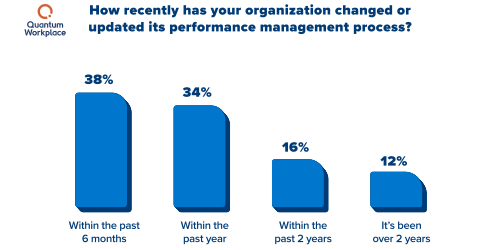
While 75% of employees say their organization has made changes to performance management processes in the last year, less than half say those processes are effective, efficient, or motivating.

Your managers and employees are busier than ever. They don’t have time for clunky tools and extensive paperwork. An effective performance management program should focus on simplifying and standardizing your organization’s performance processes to make each step as easy as possible.  

A performance management framework also ensures that all the pieces are working together to create a transparent, two-way process where employees feel valued and heard. It’s important that your program is aimed at improving employee engagement—engaged employees perform better.  

In the end, a strong framework helps employees take charge of their performance. This leads to higher engagement, more motivation, and greater job satisfaction. As a result, companies see better productivity, lower employee turnover, and a stronger workplace culture.


Core components of an effective framework 

An effective performance management framework includes important parts that work together during the performance management cycle.

  • Goals: individual and team goals roll up into organizational goals, and individualized employee development goals.
  • Feedback: 360, peer, upward, and ad hoc feedback help boost employee performance, growth, and development. 
  • Performance reviews: formal reviews help managers and employees stay aligned, reflecting on past performance and discussing future aspirations. 
  • Recognition: peer recognition allows any employee to celebrate another’s great work, motivating employees and sharing stories of success
  • 1-on-1s: regular check-ins keep managers and employees connected on progress, engagement, career growth, and development.
  • Talent reviews: managers provide feedback on employee impact, growth trajectory, and retention risk based on quarterly performance conversations. 
  • Succession planning: leaders identify and develop candidates for critical roles for the organization’s current and future success. 

Designing your performance management framework

When it comes to performance management, not just any old shoes will fit. If you’ve ever had an HR technology vendor try to force you into a one-size-fits-all performance management approach, you know how painful it can be. You need to build something that fits the uniqueness of your organization. 

Creating a good performance management framework takes careful planning. You need to think about what your organization needs and wants. Start by looking at your current performance management process. Find any gaps or areas that need fixing. 

Talk to people involved, like employees and managers. Get their feedback to make sure the new framework meets their expectations. Working together in the design process helps everyone feel involved and ready. This will help with a smoother implementation later.


performance-management-framework_questions-for-assessment


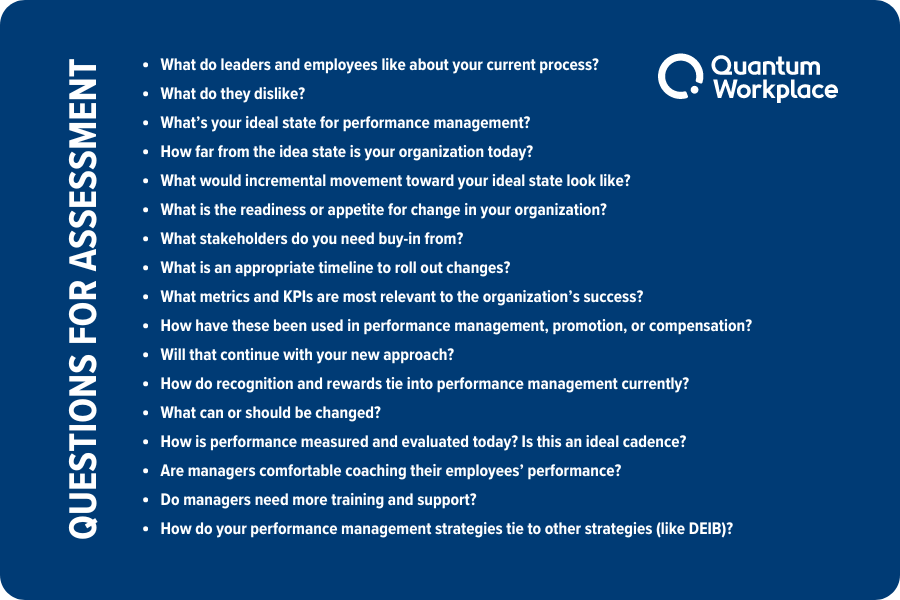
Questions for Assessment 

By asking some key questions, you can get information about how well your current system works—and how you want to evolve it. Think honestly about these questions when looking at your performance management process.  

  • What do leaders and employees like about your current process?  
  • What do they dislike? 
  • What’s your ideal state for performance management? 
  • How far from the idea state is your organization today?  
  • What would incremental movement toward your ideal state look like? 
  • What is the readiness or appetite for change in your organization? 
  • What stakeholders do you need buy-in from? 
  • What is an appropriate timeline to roll out changes? 
  • What metrics and KPIs are most relevant to the organization’s success? 
  • How have these been used in performance management, promotion, or compensation? 
  • Will that continue with your new approach? 
  • How do recognition and rewards tie into performance management currently? 
  • What can or should be changed? 
  • How is performance measured and evaluated today? Is this an ideal cadence? 
  • Are managers comfortable coaching their employees’ performance? 
  • Do managers need more training and support?  
  • How do your performance management strategies tie to other strategies (like DEIB)?  


Connecting to Your Culture 

A performance management framework needs to fit your company’s culture to be effective. It should show your values, beliefs, and how you work. 

For example, if your culture focuses on teamwork and collaboration, your framework should include feedback from peers and goals for the team. On the other hand, if you value innovation and personal initiative, the system should support creativity and risk-taking. 

When you blend the framework with your unique culture, it boosts employee performance. This approach helps team members feel included and builds a stronger, more connected work environment. 


Quantum Workplace’s Performance Pathways

Quantum Workplace knows that using the same performance management method for every organization usually doesn’t work well. Each company has its own culture, values, and ways of working, which is why a custom approach is important. 

This is why we created Performance Pathways. These performance management frameworks help organizations create and use their own performance management systems. Here’s how they help:

  • They help you move from chaos to clarity. Performance Pathways simplify the complexity of performance management with clear, structured approaches to program design.
  • They’re customizable to fit your needs. Performance management isn’t one-size-fits-all. Tailor any Performance Pathway to fit the unique needs of your organization.
  • They’re easy to implement. You can’t redo your entire performance management program overnight. Start where you are and drive incremental change for minimal disruption.
  • They put your managers in the driver’s seat. Empower your managers for effective coaching and decision making—each Performance Pathway is designed with managers at the center.
  • They’re rooted in engagement. There’s an inextricable link between performance and engagement—a topic we’ve researched deeply over the past 20 years. Each Performance Pathway is meant to further align, motivate, engage, and retain your top performers.
  • They’re created by experts. Performance Pathways were created by our People Insights team who work with customers like you every day. Don’t start from scratch—rely on our proven frameworks.

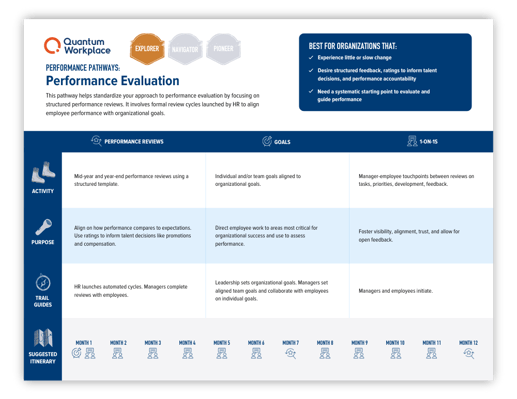
Pathway #1: Performance Evaluation  

This pathway helps standardize your approach to performance evaluation by focusing on structured performance reviews. It involves formal review cycles launched by HR to align employee performance with organizational goals.   

Best for Organizations That:   

  • Experience little or slow change 
  • Desire structured feedback, ratings to inform talent decisions, and performance accountability 
  • Need a systematic starting point to evaluate and guide performance 


performance-evaluation_performance-pathways_shadow
Get the pathways >>>


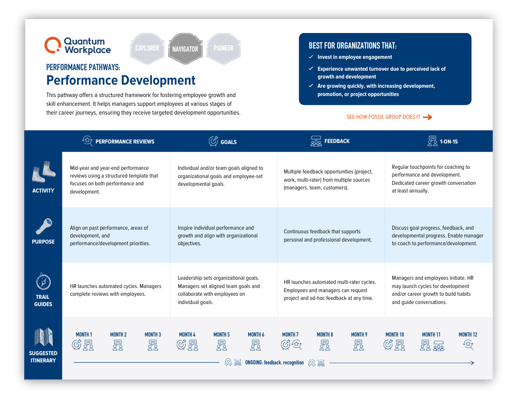
Pathway #2: Performance Development 

This pathway offers a structured framework for fostering employee growth and skill enhancement. It helps managers support employees at various stages of their career journeys, ensuring they receive targeted development opportunities. 

Best for Organizations That:   

  • Invest in employee engagement 
  • Experience unwanted turnover due to perceived lack of growth and development 
  • Are growing quickly, with increasing development, promotion, or project opportunities 

Performance management case study: Fossil Group


performance-development_performance-pathways_shadow
Get the pathways >>>


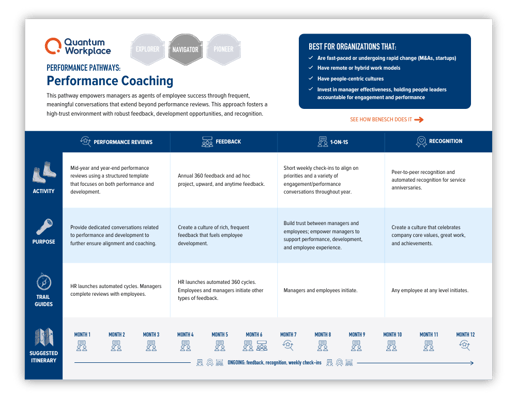
Pathway #3: Performance Coaching 

This pathway empowers managers as agents of employee success through frequent, meaningful conversations that extend beyond performance reviews. This approach fosters a high-trust environment with robust feedback, development opportunities, and recognition. 

Best for Organizations That:   

  • Are fast-paced or undergoing rapid change (M&As, startups) 
  • Have remote or hybrid work models 
  • Have people-centric cultures
  • Invest in manager effectiveness, holding people leaders accountable for engagement and performance  

Performance management case study: Benesch


performance-coaching_performance-pathways_shadow
Get the pathways >>>


Pathway #4: Collaborative Performance Coaching

This pathway leverages a systematic approach to employee feedback, closely tying performance management to business outcomes and career progression. This model is ideal for data-oriented organizations, matrixed environments, and those with structured hierarchies, ensuring alignment between employee contributions and strategic goals. 

Best for Organizations That:   

  • Use data for workforce management (vs talent development) 
  • Are matrixed, where manager is reliant on other feedback sources 
  • Deploy mentors or coaches to handle performance, development, and career coaching 
  • Have highly structured role levels or hierarchies that may create obstacles for talent growth 
  • Use business performance to influence most workforce/talent decisions 

Performance management case study: FORVIS


performance-coaching_performance-pathways_shadow
Get the pathways >>>


Pathway #5: Continuous Performance Coaching 

This pathway drives high-performing teams through alignment, frequent goal updates, and ongoing performance conversations. This approach is best suited for organizations prepared for a more continuous performance management approach. 

Best for Organizations That:   

  • Are fast-paced and focused on innovation 
  • Are rapidly growing 
  • Have dynamic, agile roles 
  • Are prepared for a continuous approach to performance 

Performance management case study: Scooter’s Coffee

continuous-performance-coaching_performance-pathways_shadow
Get the pathways >>>


Best practices for implementing your performance management framework 

Implementing a new performance management system can feel like a daunting task, but remember, you don’t need to revolutionize your entire approach overnight. Success lies in gradual progress and mindful change management. 

Prioritize 

Start by identifying your organization’s most pressing needs. Prioritize them and focus on your top priority first. Define the desired behaviors, set goals, and leverage platform features to lay the foundation. 

Scale 

As you achieve your initial goals, expand your efforts to incorporate deeper capabilities. Gather feedback from users to optimize your strategies. The aim is to solidify the behaviors you’ve set out to establish. 

Progress 

Don’t stop at your initial priorities if you’re meeting your goals. Move on to the next item on your list and repeat the process. As you add features and capabilities, consider how to leverage the wealth of data at your disposal for insightful analysis. 

How to communicate with transparent change management

Define your “why”

Ensure everyone is clear and aligned on the purpose behind the changes. Communicate the reasons and expected benefits of the new performance management system.

Engage stakeholders

Maintain communication with stakeholders before, during, and after the launch. Keep them informed and involved in the process.

Offer training and support

Partner with your chosen platform to provide adequate training and support for users. A supportive partner can make the transition smoother.

Align with mission, values, culture

Connect the changes back to your organization’s mission, values, culture, and strategic priorities. Reinforce how these changes align with your broader goals.

Encourage flexibility

Emphasize adaptability and flexibility in your approach. Acknowledge that not everything will go perfectly, but the ability to adapt is key to success.

Collect feedback

Establish mechanisms for collecting feedback from users. Use this feedback to fine-tune your approach and address any issues promptly.

Adapt and evolve

Be prepared to evolve your strategy as needed. The journey towards a successful performance management system is an ongoing one, and adjustments will likely be necessary

Evaluating and enhancing your performance management model 

It is important to check how well your performance management framework works. This will help it stay useful and effective. You should look at more than just if the framework is being used. You need to see how it affects the overall performance of the organization. 

Collect data on key performance indicators. This includes employee engagement scores, how well goals are met, and results from employee development. Analyze this data to find trends, strengths, and areas that need improvement. You can also use employee feedback surveys and focus groups. This will help you learn about their experiences with the framework. 

Review these metrics regularly and look for trends. Are engagement scores going up since you started using the framework? Are employees hitting their goals more often? Answers to these questions can help you improve the effectiveness of your framework. 

Continuous performance management is a journey, not a destination. You should regularly check your framework. Get feedback from stakeholders and find areas for improvement. 

Also, think about giving ongoing training and support to both managers and employees. Offer refresher courses on how to give and receive feedback. Teach them about having good performance talks and making useful development plans. 

By creating a culture of constant learning and growth, you keep your performance management framework effective. This way, it stays relevant to the changing needs of your organization and your employees. 


Integrating Performance Management Software 

Choosing the right performance management tool to fit your workplace culture is essential to the success of your strategy. When looking for the right tech, you need a solution that brings elements of an effective system together. 

Look for a provider that isn’t limited to standalone systems or tools. Instead search for one that supports and propels organizational growth.


Move your teams forward with clear and aligned goals. 

Goal-2

Setting clear and aligned goals is paramount to the success of high performing teams. Quantum Workplace empowers your teams to set, monitor, and accomplish important goals. 

Learn more about Quantum Workplace Goals


Boost trust and employee performance with employee feedback. 

Feedback-1

Quantum Workplace’s 360, peer, and upward feedback help boost employee performance, growth, and development. Support a culture of continuous feedback within your teams.  

Learn more about Quantum Workplace feedback


Keep managers and employees on the same page with performance reviews.  

4_performance-reviews_product-imagery


Performance reviews are still a staple of most performance management programs—but you need them to be more effective, efficient, and engaging to improve performance. Make performance conversations simple and effective. 

Learn more about Quantum Workplace performance reviews


Celebrate success and help team members feel valued with real-time recognition. 

Increase clarity and connection with performance reviews and 1-on-1 meetings. 


Identify and develop top talent with talent reviews. 


Sustain high performance with succession planning. 


Conclusion

In conclusion, creating a good performance management system is very important for success in any organization. When you know the purpose, main parts, and best practices, you can boost employee engagement and improve performance. Begin your journey to better performance management now. Get our Performance Pathways.  

Ready to build your ideal program with flexible, intuitive, and engaging tools you can trust? Get a custom demo of Quantum Workplace’s performance management software 


The Cancelled Lego Bond Video Game

0

A Lego James Bond Game That Never Was: A Pitch That Could Have Been

A 50-second video has been making the rounds on social media, showcasing a pitch for a Lego James Bond game that never saw the light of day. The video, which has been deleted from various platforms due to copyright claims, shows Lego James Bond reenacting iconic scenes from various Bond movies, including the famous crocodile gauntlet from Live and Let Die.

A Pitch that Never Got Approval

According to LEGOGameMuseum, a mod of the legogaming subreddit, the video was made as a pitch to get approval for a full Lego James Bond game. However, it seems that the pitch never got the green light. The reason for this is unclear, but some speculate that it may be due to the violence and sexual innuendo present in the James Bond franchise, making it unsuitable for a kid-friendly Lego game.

A Game That Could Have Been

The idea of a Lego James Bond game is an exciting one, and many fans are now wondering why it never came to fruition. Fans of the franchise and gamers alike would have likely played the game, and it’s hard not to imagine the possibilities of Lego versions of iconic Bond characters like James Bond, Q, and M, as well as the villains like Blofeld and Scaramanga.

A glimmer of Hope

Although the game never got made, fans still hold out hope that it could be revisited in the future. The LEGOGameMuseum notes that Traveller’s Tales, the developers of the LEGO game series, have been willing to try new things, and it’s possible that they could revisit the idea in the future. The biggest barrier to this would be Warner Bros.’ insistence on sticking to their owned IP.

FAQs

Q: Why was the Lego James Bond game pitch rejected?
A: The reason for the rejection is unclear, but some speculate that it may be due to the violence and sexual innuendo present in the James Bond franchise, making it unsuitable for a kid-friendly Lego game.

Q: Is there any hope for a Lego James Bond game in the future?
A: Yes, although the game never got made, fans still hold out hope that it could be revisited in the future. The LEGOGameMuseum notes that Traveller’s Tales has been willing to try new things, and it’s possible that they could revisit the idea in the future, pending Warner Bros.’ approval.

Q: Can I still play Lego James Bond games?
A: Unfortunately, the pitch video has been deleted from various platforms, and there is no official Lego James Bond game available to play. However, fans can still play other Lego games, including the popular Lego Dimensions series, which featured characters from various IPs, including DC Comics and The Lord of the Rings.

Essential Performance Management Statistics HR Needs to Know

0

Performance management is one of the most important strategies your company has. By defining goals, evaluating progress, and coaching employees, you can unlock engagement, define your workplace culture, and drive business success. 

Your continuous performance management strategy is more than just a schedule for performance reviews. It truly connects employees to how they have an impact in the organization.  

How can you be successful with your approach to performance management in a constantly changing workplace? Take note of trending performance management statistics. Let performance management research guide your best practices. 

For over 20 years, Quantum Workplace has collected and studied employee experience data and partnered with thousands of organizations who know what it takes to inspire performance. Our research has measured over 1 million voices from the most successful companies in the U.S. through the Best Places to Work contest. 

You can use the performance management research below to create a successful strategy that will drive high-performing teams and help you meet your organizational goals. 


Key Highlights

  • Why is performance management important? 
  • 10 vital performance management statistics every HR leader should know 
  • Common performance management challenges 
  • Performance management trends 
  • FAQs 

Why is performance management important?

Your performance management strategy is an essential part of business success. It helps measure, develop, and motivate employees to do their best work. Employees want to contribute toward the organization’s goals. Through performance management, you can show them how their work helps meet company goals. It helps unify teams behind a purpose.  

Performance management should be woven into the fabric of who you are as an organization. Here are all of the things your performance management strategy helps you accomplish: 

Connect employee work to organizational goals 

Through clear, aligned goals and conversations about performance, employees understand how their everyday work impacts the organization. Their work has meaning and purpose.  

Address obstacles and identify opportunities through feedback and 1-on-1s 

Your performance management system should help you track progress and guide team members. Managers coach employees in performance and development. By identifying employee strengths, you can harness their potential and align it with organizational priorities. 


Grow and develop employees 

Lack of career growth is one of the main reasons employees leave. Your performance management system can help you outline growth opportunities, showing employees they’re valued and have a place in the future of your organization. 


Recognize great work 

Employees want to feel valued for their contributions. You also want to show employees what great work looks like. Employee recognition solidifies your performance management approach by connecting work back to core values and showing employees that their work matters. 


Retain top performers 

When you recognize employees for their work, they feel invested in. When they see growth and development opportunities and experience a magnetic workplace culture, they’re more likely to stay at their organization.  

All of these aspects are part of a robust performance management framework that engages employees and drives impact. This is a key part of the employee success equation. You want your performance management to connect to your holistic talent management strategy.

Performance management also must be engaging for employees. And it should contribute towards creating a magnetic culture employees want to be a part of. Performance management is an element of employee success. And when employees are successful, it leads to positive results for your organization. 

10 vital performance management statistics every HR leader should know 

You don’t want to create your performance management strategy on a whim. Here are the most important performance management statistics you need to know before you craft your performance management approach. 


1. Less than half of employees say their organization’s current performance management approach is a good use of their time. 


Employees say that the current state of performance management isn’t a good use of time. With a concentration on efficiency and effectiveness, we also want the performance management process to be efficient and effective. And employees are saying it’s not. 

So what can we do to make performance management better? How do we make sure employees feel performance management is valuable? 


2. 46% of employees—at all levelswant more feedback. 


Impact_who-wants-more-feedback V2 V2


Many employees want more feedback from their managers. Performance management statistics tell us that it’s not just individual contributors, everyone wants feedback. They want it more often. And when they get it, they’re more engaged. 

We tend to focus on feedback for individual contributors. But managers and leaders need performance feedback as well. And managers and leaders say they’re not receiving enough feedback about their performance. That might be because we’re providing more feedback on day-to-day work instead of performance as a manager or leader. 

Everyone needs feedback on how they can improve their performance. Every employee at every level. 


3. Frequent performance activity increases engagement. 


Trends-Report_PerformanceImpact_Updates_performance-activity-frequency

The more employees set goals, get manager feedback, and are measured for their performance, the more engaged they are. Performance and engagement are intrinsically linked. There shouldn’t be a pendulum swinging back and forth between engagement and performance efforts. They should feed each other to create an environment of employee success.  

This data also verifies another key factor. Managers are front and center in these activities. We don’t forget the role they play. The problem is that we often fail to support them. We can do more to help our managers drive performance in an engaging way. 


4. More than two-thirds of employees say manager feedback is necessary to improve their performance. 


Trends-Report_PerformanceImpact_Updates_effectiveness-of-performance-management

Managers are the key to improving performance, according to employees. All of the aspects employees say are effective at improving their performance involve managers. Or should involve managers. Employees want and need feedback from their manager to improve performance. 1-on-1 conversations with their manager and performance ratings round out effective performance management components. 

Processes are important too. Formal review processes and goal setting processes help employees understand how they’re being measured and what success looks like. Employees also say that performance management tools and software are helpful in improving their performance. 


5. 1 in 10 employees use performance management tools weekly. 


Trends-Report_PerformanceImpact_Updates_how-often-you-use-performance-tools

We already know from performance management statistics that employees want frequent feedback and like to have weekly 1-on-1s with their managers. But managers and employees aren’t using performance management tools at that cadence. Software usage should align with the frequent performance conversations employees want.  

Performance management software can help document the performance management conversations and system and make it more effective. 


6. More than half of managers say technology makes them better. 


Trends-Report_PerformanceImpact_Updates_manager-technology-effectiveness-2


When managers say they use performance management technology, they say they’re better managers. Tools help managers be more effective and efficient.  

Technology can help managers have better performance conversations, align individual goals to team and organizational goals, and recognize employees in a meaningful way.

Software also gives managers the power to dive deep into their team’s engagement. That may seem to be on the engagement side of the spectrum. But engagement and performance are linked. The best approach to performance is a process employees should find engaging. If your approach to performance isn’t engaging, you’ll see that reflected when you measure engagement. 


7. Clarity, training, time, and recognition are what managers need to be effective in performance management efforts. 


Trends-Report_PerformanceImpact_Updates_what-managers-need


Aside from performance management tools, managers say we can make them more effective by supporting them in four things.  

  • They need to understand how their own performance is measured. Managers need to understand what is expected of them and the metrics that matter. 
  • They need time to effectively manage their teams. That might be difficult if we’re asking them to act as a player-coach. Managers still need time to have 1-on-1s with their team members and coach them to success. 
  • They want to be recognized for their accomplishments as a manager. Recognizing managers helps them feel valued for their contributions and understand what high performance looks like across the organization.  
  • They’re also asking for more training. 39% of managers haven’t received the training they need to be effective managers. And only 1 in 3 managers has received training on how to manage remote and hybrid employees. Managers aren’t all innately skilled as managers. Organizations can do more to set them up for success as a manager with training and development. 


8. 1 in 3 employees say receiving actionable advice is the most effective part of their performance reviews. 


Trends-Report_PerformanceImpact_Updates_last-performance-review-2


What makes a performance review effective? Actionable advice. And employees say there’s a big gap between what they need and what they’re getting. Employees are telling us that they need feedback they can act on during their performance reviews. That makes sense. To improve, you need to know what to improve. However, most organizations’ performance management process is more traditional rather than continuous.

2 in 3 employees receive annual performance reviews instead of more frequent conversations (monthly or quarterly). If employees only get the feedback they need to improve their performance once a year, that’s not enough to make corrections and maximize potential growth and impact on the business.


9. Employees improve performance when their performance reviews are forward-focused development-centered. 


Trends-Report_PerformanceImpact_Updates_last-performance-review-3_1


What part of performance reviews helps employees improve performance? Employees want a review that is forward-focused and development-centered. What makes a performance review look forward instead of back? A continuous approach to performance management that includes actionable advice and career growth discussions. These are the conversations employees say they need to make improvements to their performance. 

Regular performance conversations are also connected with engagement. Engaging performance reviews inspire employee impact. Employees also say that these elements (rather than receiving a rating) help performance reviews feel fair. 


10. Employees want more recognition for their work. 


Impact_employees-want-recognition V2 V2


Just like with feedback, most employees say they want more recognition for their work. They want recognition more frequently. And more recognition is tied to engagement. 

What do employee want recognition for? The most preferred reason is their performance or accomplishments in their role.   

All of these performance management statistics should help you shape your performance management strategy and address challenges along the way. 

How does performance management research help with common performance challenges? 

Performance management isn’t a set it and forget it process. Your organization should be constantly making changes to the process to emphasize employee impact. And those changes should be backed by performance management research.  

Before you make changes, it’s helpful to evaluate the common challenges organizations face when shaping their performance strategies. And think about the vital performance management statistics that should influence your approach. 


It helps keep trust in tact. 

Without trust between employees, managers, and leaders, we can’t maximize performance. When it comes to performance management, organizations need to do more to build trust. Part of that is building trust in the process. 

Most employees don’t join an organization to do poor work. Employees want to be successful. Leaders want employees to be successful because that’s how the organization reaches its goals. To build trust in the performance management process, be transparent and communicate clearly. Make sure employees understand what their goals are, how they contribute to the organization’s objectives, and how employee performance will be measured. 


It links with engagement efforts. 

Performance management impacts engagement. But not traditional components like ratings or  pay-for-performance.  

Quantum Workplace research shows that the top performance drivers that impact engagement are recognition, fairness, alignment, feedback, and empowerment. When you’re making sure employees find your approach to performance management engaging, start here. 


performance-management-best-practices-02


It connects the aspects of a magnetic culture. 

The way you approach performance management shapes your organizational culture. Half of employees say their organization’s approach to performance management is how they feel the company culture. And a much higher factor than the physical workspace. 

Company culture is how your organization gets work done. And your performance management strategy shows your organization what that looks like.


performance-management-best-practices-01


More traditional, less continuous approach to performance 

There is not a one-size-fits-all approach to performance management. Every organization is different and has their own unique path to performance. But one important performance management statistic emphasizes that employees want a more continuous approach rather than a once-a-year performance appraisal. 

Before the panic sets in, you don’t have to change your performance management overnight. You can take one step at a time and find the middle ground of performance management. How? 

  • Identify where you are on the performance management spectrum. How do you currently conduct performance reviews, coaching, and development?
  • Take one incremental transition to a continuous approach. What is one small thing you can do to increase feedback frequency or 1-on-1s? 
  • Support your team with technology. What tools does your organization need to better align goals, recognize great performance, and track performance conversations? 


Leaving employees and managers out of the performance process 

Employees and managers want to be part of the performance management conversation. They want to contribute, rather than let performance management happen to them. So make them part of the process.  

Get feedback from employees and managers about your current program. Use that feedback to improve your performance practices. And then let employees know you listened by attributing the changes back to their feedback. 


Unclear objectives and misalignment 

There are fewer confusing things than not understanding what your goal is and why it matters. Employees need to see how their everyday work impacts the organization. That’s why connecting the dots for them is important. It motivates high performance. 

 Employees are 3.2X more likely to be engaged when their performance goals align with the organization’s goals. And the more they set goals, the more likely they’ll be engaged. 


Lack of fairness in performance conversations 

Employees often feel like performance reviews are not a fair way to evaluate their performance. But there’s a solution. When managers can have a human conversation backed with data, the performance review feels objective and fair. And when the cadence of those conversations is more frequent, employees feel like they have time and support to make performance improvements.  

Equip your managers to have more meaningful conversations instead of backward analyzing reviews. Your performance appraisals need a sense of fairness. Make sure these conversations are looking forward with actionable advice and pair that with growth opportunities. 


Not valued for contributions 

Recognition is a form of feedback too. Feedback doesn’t always have to be critical. Meaningful feedback can reinforce the performance you want to see. 

Show employees that their contributions matter. When you’re recognizing excellence, be specific. Relay what is working and why.  


Inefficient and ineffective performance management tools and analytics 

Quantum Workplace research shows that managers feel they’re more impactful when they have performance management software that helps them do their job. And we know that managers are an important part of the performance management process. 

Make sure your managers receive training in how to use your performance management platform. Show them how it can make them more effective and efficient. Help them increase usage to be more aligned with the frequent feedback and 1-on-1 frequency employees crave for improved performance.  

These frequent issues in performance management can help you shape your new strategy. Review the performance management statistics outlined above. Analyze your current approach and follow best practices backed by research to make meaningful adjustments. 

Trends Backed by Performance Management Statistics 

Performance management is hard to get right. But that doesn’t mean all is lost. In recent years, organizations have made changes to their talent management processes. Employees are noticing those changes. All of the influential performance management statistics above show that organizations have continued to improve this process.  


Employees say there’s room for improvement with performance management 

Almost 75% of employees saw changes to their performance management processes in the last year. Change sounds scary. But this is good news! Performance management often changes over time to a more effective and efficient process. 


Trends-Report_PerformanceImpact_Updates_performance-management-process-1


And while changes are happening, employees say they don’t feel like it’s a problem. Almost half of employees say that their organization’s performance management processes aren’t disrupting their work. 


Trends-Report_PerformanceImpact_Updates_performance-management-process-2


Employees are saying they’re getting more frequent coaching from their managers and setting goals more often. But the work isn’t done. Employees still want a better process.  

Organizations can get there by: 

  • Getting feedback from employees about the state of their performance management process. 
  • Making a small change to improve the approach to performance. 
  • Communicating goals and expectations across the organization. 
  • Helping managers transition from the critic to the coach. 
  • Investing in technology to integrate performance management into daily workflows. 
  • Remember, performance management is an evolution. Organizations need to constantly build on their process and reinforce successful approaches. 


Employees want more continuous performance coaching 

Many organizations are stuck in a traditional approach to performance management, with performance reviews occurring annually. But this goes against what employees say they need to improve performance. They need more continuous feedback and performance conversations so they can quickly act upon their manager’s advice and make improvements.

What should be part of an effective performance review? 

  • Actionable advice 
  • Performance data 
  • Recognition 
  • Growth opportunities 

The content of performance reviews is important. But don’t overlook the frequency of performance conversations when it comes making meaningful improvements. 

Employees want to drive organizational success 

When employees have the tools they need to be successful, they are motivated to perform. 

Employees want to see the impact of their work. They want to get frequent feedback that’s helpful in improving their performance. They want to understand how their performance is being measured. And employees want to see how their contributions influence business success. It’s all about reinforcing employee efforts with the big picture. 

How do you create high-performing teams? 

  • Align individual goals with organizational goals 
  • Coach employees using a frequent cadence 
  • Celebrate and recognize employe contributions 


Conclusion 

Performance management statistics show that employees want to contribute to the organization’s success. Leaders want the organization to be successful. The way organizations fuse these components together is through their approach to performance management. 

By having an intentional strategy backed by research, organizations can harness the full potential of performance management.