Employee engagement is a key indicator of business success. It impacts key areas like profitability, customer satisfaction, employee retention, and team dynamics. Leading companies recognize their workforce is their greatest asset.
Research shows that 92% of business leaders believe engaged employees perform better, driving team success and enhancing overall organizational outcomes. When employees are motivated and engaged, they unlock their full potential, boosting productivity and contributing to sustainable business growth.
Developing a strong employee engagement strategy is critical for organizations of any size. And it all starts with selecting the right employee engagement software to:
- Ask the right questions
- Gain valuable insights
- Take meaningful action
However, implementing an effective engagement strategy goes beyond just choosing software. You need a reliable, expert partner who supports you on your journey. They should help lay the foundation for your engagement program, providing the tools and insights you need to track progress and address the most critical issues impacting engagement and performance.
This guide will prepare you to find the right employee engagement software by covering:
✔️ Essential elements of employee engagement software
✔️ Who benefits from employee engagement software
✔️ Must-have tools and features in an employee engagement platform
✔️ Questions to consider when choosing an employee engagement vendor
✔️ How different employee engagement solutions compare
✔️ Top employee engagement survey tools for 2025
✔️ Employee engagement trends and best practices
Essential elements of the best employee engagement software
Employee engagement software should do more than measure engagement. It should enable you to truly listen to your employees. When selecting engagement software, look for solutions that:
Elevate the voice of the employee.
When employee engagement goes up, so does performance and productivity. Employee engagement software allows organizations to:
- take stock of employee feedback
- note themes or patterns that emerge
- put those themes into context
Our research shows that doing an employee survey once a year isn’t enough to create real change or build trust. Too much happens in a year for that to be effective. You should look for solutions that offer annual engagement, pulse, and lifecycle surveys. These tools help you understand key moments in an employee’s journey. They allow you to enhance employee experience and keep employees engaged at every stage.
Provides a proven model for employee engagement.
It’s crucial to design your employee engagement survey with a reliable, validated model. You don’t want your efforts to lack direction or be misguided. A trusted framework from an experienced partner makes it easy to pinpoint what matters most. It helps you uncover key insights and enact meaningful change—without wasting resources on the wrong solutions.
Drives workplace decisions with data and insights.
To boost employee engagement, it’s essential to understand your people. That’s why strong people analytics tools are crucial. They allow you to explore your engagement data deeply and provide insights into talent risk.
Look for solutions that offer best-in-class comparisons and benchmarking. You should be able to see how your organization measures up to similar organizations. For the best outcomes, share your employee engagement survey data with all employees. This empowers every employee to do their part in improving engagement.
Helps you act on employee feedback.
Our research shows that 35% of employees feel their organization fails at acting on survey results. However, employees who see their feedback lead to action are 12 times more likely to be engaged.
Taking action is critical. But it’s often seen as time-consuming, complex, and hard to follow through. The ideal employee engagement survey software offers a straightforward and purposeful action planning framework. Look for a tool that offers AI-powered, personalized recommendations that enable leaders to easily convert survey insights into effective actions that drive engagement.
Helps managers have meaningful 1-on-1 conversations.
Conducting 1-on-1 meetings allows managers to discuss important, engagement-centric topics with employees. In fact, our research shows that employees with more frequent 1-on-1s are 2.4X more engaged. Look for engagement software that streamlines this process with simple, best-practice templates to easily start and track ongoing, meaningful conversations.
Improves employee retention.
Regardless of the job market, retaining top talent is essential for your business’s success. Engagement provides stability in all circumstances. Failing to strategically manage retention and turnover puts your business at risk.
The good news is that much of unwanted turnover is avoidable. Our research shows one in three employees who leave say their departure could have been prevented. The right engagement tools can reveal why your best employees are leaving. They’ll help you foresee a potential turnover crisis, allowing you to act before it’s too late.
Empowers everyone to own engagement.
HR shouldn’t be the only ones using the software you select. Employee success is a shared responsibility among all employees. Choose employee engagement software that engages the entire organization, empowering leaders, HR professionals, and employees to enhance the employee experience. The best solutions will integrate smoothly into existing workflows with minimal training. Look for features like manager templates, best practices, and adoption tips.
Offers reliable support and expertise.
As with any software, you should expect top-notch support when you need it most. You need more than help desk assistance. The software should empower your employees at every step with subject matter expertise, coaching, and responsive tech support for all users.
Empowers teams with AI-powered technology.
AI is revolutionizing HR and people management through machine learning. According to Gartner, 76% of HR executives are actively looking to leverage AI technology to help amplify organizational success. And 52% believe it can be used to help improve the employee experience. Seek engagement software with secure, advanced tools that simplify talent management tasks, helping you save time and resources.
Integrates with other systems and data.
Administrative information about your employees should integrate seamlessly with your employee engagement software. Make sure the software you select has an HRIS integration. This will save your employees significant time by not having to enter data manually. It will also allow for accurate data on reporting structure changes and organizational shifts.
Who benefits from employee engagement tools?
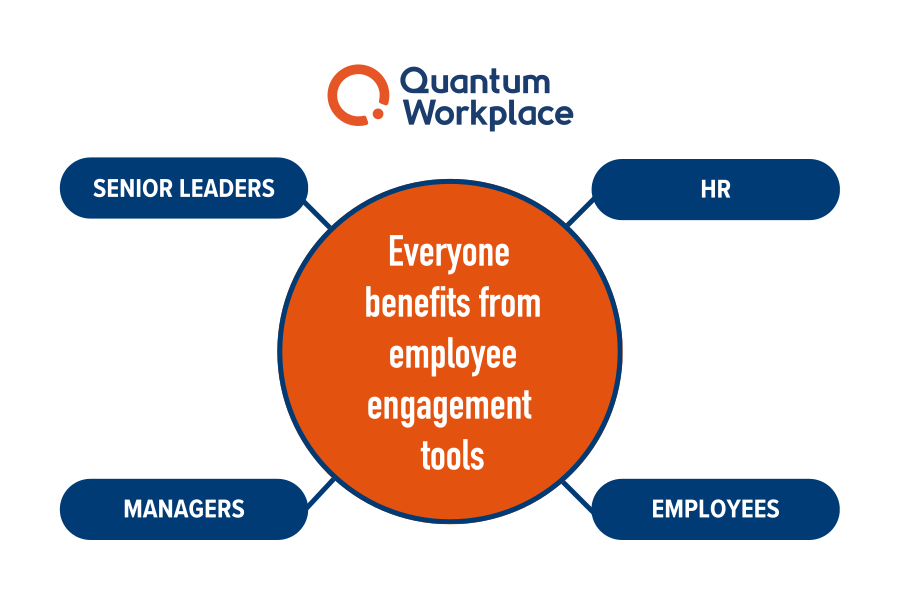
Employee success drives business success because employees shape business outcomes every day. Because your employees drive your business forward, employee engagement software should support everyone in your organization.
Senior Leaders
Organizational leaders are the biggest supporters of employee engagement. They’re the driving force behind building an engaged culture, and having their backing is crucial for making it happen. The right solution should enable them to:
- Gain visibility into critical talent data
- Align teams with business goals
- Understand the link between employee and business outcomes
- Gather feedback throughout organizational changes
- Build a culture that attracts and retains top talent
- Improve business metrics like revenue, profitability, and customer satisfaction
HR
HR teams are key players in getting everyone—leaders, managers, and employees—on the same page when it comes to employee engagement. They turn strategy into action and figure out how to make it work. The right solution should enable them to:
- Scale and execute talent strategies effectively
- Shift focus from administrative tasks to strategic work
- Demonstrate the value of talent initiatives to leadership
- Access talent trends tied to business outcomes
- Enhance engagement, performance, and employee morale
Managers
Managers have the most day-to-day contact with employees. It’s up to them to foster a space where everyone can excel, all while promoting the organization’s success. When it comes to an employee engagement solution, it should help managers:
- Strengthen communication with employees
- Drive high performing teams
- Get actionable insights on employee perceptions
- Keep teams focused on priorities
- Improve team engagement, performance, and productivity
Employees
Individual contributors are the organization’s frontline voices. They’re your best insight into the employee experience. The right engagement survey software helps to enhance engagement, empowering employees to:
- Enjoy a better daily work experience and work environment
- Feel connected to their work, team, and organization
- Build stronger workplace relationships
- See clear paths forward for growth and development
- Feel heard and valued
- Gain confidence in their role and contribution to success
The impact of employee engagement software is broad, driving success at every level. Despite the unique challenges each industry faces, employee needs are often similar. The benefits of the software should resonate across all roles – no matter the industry.
Must-have tools and features in an employee engagement platform
A great employee experience is essential for building a culture of employee success. To achieve this, you need key insights into what drives or hinders engagement. The right employee engagement software helps you:
- gather feedback
- reveal valuable insights
- take focused action to move your business forward
Here are key features to look for when choosing employee engagement software:
Employee Engagement Survey Tools
|
|
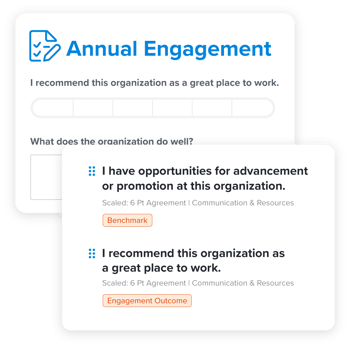
Discover what drives or hinders employee engagement. With employee engagement survey software, you can effortlessly measure engagement and take swift, strategic action to improve it. These surveys help you collect anonymous feedback, conduct a thorough sentiment analysis, understand high level trends, and drill down into critical areas.
- Scientifically validated engagement model
- Research-backed survey questions and customizable survey templates
- 6-point agreement scale
- Simple, open-ended survey questions
- Automated survey invites and reminders
- User-friendly, accessible interface
- ✨AI-powered survey analysis and action planning
|
Employee Pulse Surveys
|
|
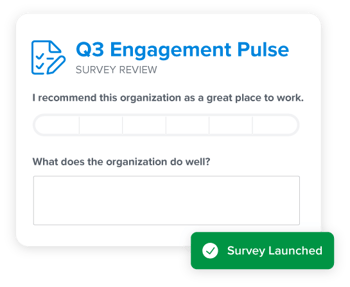
Don’t wait for the annual engagement survey to gauge employee sentiment. Stay in tune with how your team feels at any moment. Use pulse surveys to quickly gather feedback on any topic, anytime. Look for features like:
- Simple, step-by-step survey creation guidance
- Smart segmentation
- Best practice templates on popular workplace topics
- Saved question library
- Flexible settings for attributed, confidential, or anonymous feedback
- User-friendly and accessible technology
- ✨AI-powered survey analysis and action planning
|
Employee Lifecycle Surveys
|
|
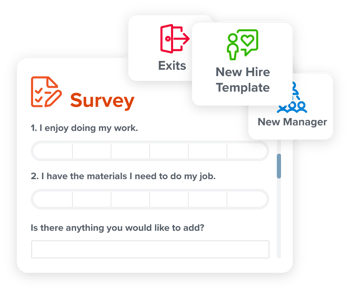
Enhance every stage of the employee journey with lifecycle surveys. Gain insights at key moments and milestones. And act before it’s too late. Look for features like:
- Automated, event- or time-triggered surveys synced with your HRIS
- Always on surveys with trends over time
- Best practice survey templates for key employee milestones
- Automated survey invites and reminders
- User-friendly and accessible interface
- ✨AI-powered survey analysis and action planning
|
Employee Engagement Action Planning
|
|
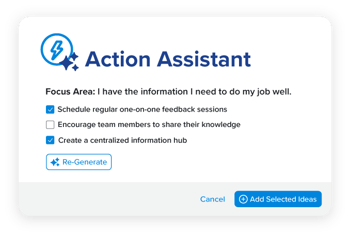
Ensure transparency and accountability in post-survey actions. Speed up time-to-action and amplify impact with AI-powered, personalized recommendations relevant to team needs. Look for features such as:
- Team report & walkthrough for managers
- Preset, organization-wide focus areas
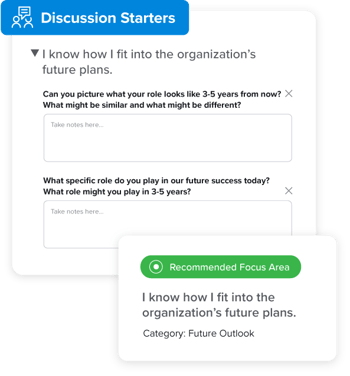
- ✨AI-powered engagement discussion starters
- ✨AI-powered action ideas
- Recommended and custom focus areas for each team
- Best practice action library
- Action plan tracking & nudging to encourage progress
|
Reporting & Analytics
|
|
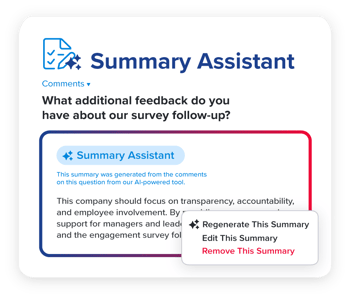
Gain a clear understanding of the state of engagement levels and drive action with on-demand insights. Quickly interpret your complex people data using powerful employee engagement analytics and reporting tools.
- Robust, organization-wide analytics
- ✨AI-powered narrative insights to analyze survey comments quickly
- Team and individual engagement reports
- Turnover analytics
- Flight risk predictive analytics
- Business impact dashboards
|
Employee Engagement Benchmarks
|
|
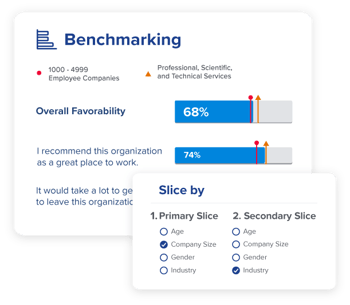
When comparing your employee engagement to similar organizations, having access to a robust database of quality benchmarks is crucial for understanding how you measure up. Look for features like:
- A large employee engagement database
- Best-in-class comparisons
- Relevant benchmark updates to keep up with evolving workplaces
- Ability to reference benchmarking in analysis and action planning
- Key comparisons by industry, company size, and region
- Key comparisons by employee demographics, like race and gender
|
1-on-1 Meetings
|
|
Don’t let engagement be a once-a-year event. Encourage regular, meaningful 1-on-1 conversations between managers and employees to boost clarity, accountability, and engagement throughout the year. Look for 1-on-1 features like:
- In-tool prompts to remind managers
- Convenient scheduling
- Automated recurrences
- Transparent agenda
- HR visibility into activity
|
Questions to consider when choosing employee survey vendors
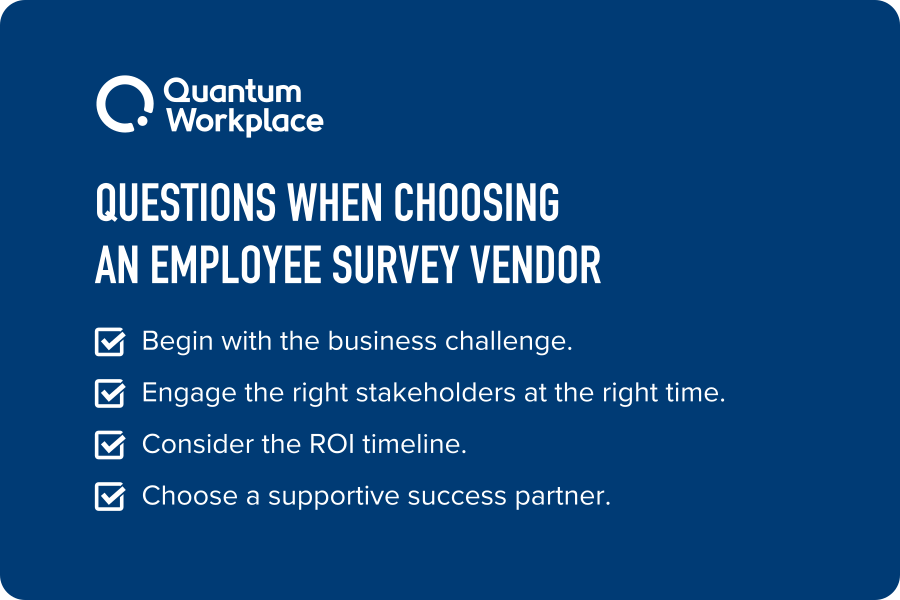
It’s tempting to simply Google ‘best employee engagement software’ and pick the one that looks the shiniest. But to truly get the most out of your software investment, you must first decide on your organization’s needs and then find a platform that fits you best. Doing the work of finding the right partner will save you time and money in the long run.
What are your key business challenges?
Before investing in employee engagement software, ensure you clearly understand the business challenges you want to address. Your technology should align with your core HR strategies, which in turn should support your overall business goals.
What stakeholders do you need to engage, and when?
Rolling out an employee engagement platform is a significant shift. It can be hard work if you go it alone. Simplify the transition by involving key stakeholders early in the process. Consider who has a stake in the issue you’re trying to address, who will influence the success or failure of the program, and who will support or resist the change.
How long will it take to show ROI?
Investing in employee engagement software requires time, money, and effort. Your leadership team will expect a solid business case, so it’s important to plan for that upfront. Clearly define your goals and connect them to measurable business outcomes.
What level of support do you need from a partner?
While software is important, the team behind it is crucial. Look for an engagement software provider that values your feedback, listens to your needs, and helps you maximize the tool’s potential. A strong partner will help you interpret your survey data, ensure your team can act on the insights, and work alongside you to turn those actions into reality.
Comparing employee engagement solutions
Employee success is the foundation of your organization’s overall success. But how do you select the right type of tool? Compare these different types of employee success solutions to make an informed choice.
HRIS solutions
These are ideal for broad HR needs. But these tools have limited engagement-specific features. They are useful for companies needing a one-stop-shop for HR functions. But they’re not focused on driving engagement.
Point solutions
Point solutions (like Quantum Workplace) are best for organizations where employee engagement and performance are a priority. They offer a comprehensive product suite with deep insights, advanced tools, and customizable options that support and enable a holistic employee listening strategy.
Basic survey tools
Basic tools like Survey Monkey work for simple survey needs. But they lack the comprehensive features, automation, and analytics of more robust engagement platforms. It’s quick, but insufficient for long-term engagement strategies.
Manual spreadsheets
These are low-cost but time-consuming. They are not scalable for tracking employee engagement over time. They’re also prone to human error and make it difficult to uncover actionable insights.
Best employee survey platforms for 2025
Quantum Workplace
 Quantum Workplace is an employee success platform designed to make work better every day. It empowers organizations to enhance employee experience, inspire employee impact, and create a magnetic culture that attracts and retains top talent. Its integrated platform drives engagement and performance through continuous insight and action.
This comprehensive employee engagement suite helps organizations develop a holistic employee listening strategy, meeting them wherever they are on their journey. It helps organizations identify and address gaps in the employee experience. Most notably, it helps HR empower teams to move to action quickly, getting a better return on results.
Quantum Workplace has been in the employee engagement space for more than 20 years and is the survey engine behind Best Places to Work. The company has some of the happiest customers in the HR tech space, with an above average NPS score and an average response rate of less than one hour, providing support for all users. The software’s reviewers appreciate:
- User-friendly interface
- Deep insights
- Customization capabilities
- AI-assisted feedback features that save time
However, some users have encountered challenges with navigation and a need for more administrative control than is currently available.
 Culture Amp is a platform that helps collect and analyze employee feedback to improve workplace culture and engagement. Users appreciate its customizable survey tools, advanced analytics, actionable feedback, and easy integration, along with its user-friendly design and strong customer support. However, some users note limitations in customization, issues with translation, and a steep learning curve for new users due to the platform’s many features.
Lattice
 Lattice is an AI-powered people platform that helps HR teams enhance manager effectiveness, streamline operations, and use workforce insights to drive business success. Users appreciate its user-friendly interface, easy navigation, and Slack integration for reminders. However, some have encountered challenges with updating performance goals, a lack of notifications, mobile app issues, and difficulty finding certain features and information.
Leapsome
 Leapsome is a people enablement platform used to connect performance management, employee engagement, and learning. It offers tools for goals and OKRs management, performance reviews, employee development, engagement surveys, feedback, compensation, and more. Users appreciate its user-friendly interface, ability to set development goals, and integration with tools like Slack and Google Calendar. However, some have noted a steep learning curve, navigation challenges, slow loading times, and a need for a more visually appealing interface.
Qualtrics
 Qualtrics Employee Experience is a leading platform that provides AI-driven insights to enhance engagement, streamline HR processes, and boost retention. The platform offers tools for performance management, employee well-being, DEI initiatives, and more, integrating seamlessly with existing workplace systems. While praised for its comprehensive features, some users have noted challenges with the learning curve and navigation. Qualtrics empowers organizations to take strategic actions based on real-time data, driving productivity and employee satisfaction.
Workday Peakon Employee Voice
 Workday Peakon Employee Voice is a platform that continuously gathers real-time employee feedback, turning it into actionable insights to improve business performance. It handles complex organizational structures and supports over 60 languages, making it suitable for large, global companies. Many users appreciate that Workday Peakon Employee Voice is easy to set up, provides valuable insights, and is user-friendly for both employees and managers. However, some users feel that Workday Peakon Employee Voice is overly complex, costly, and lacks features like raw data export, requiring constant attention to fully realize its benefits.
Eletive
 Eletive is an intuitive platform that combines employee engagement surveys, performance management, OKR goal-setting, 360-feedback, and 1:1s in one place. It automates administrative tasks, allowing HR and managers to focus on improving employee performance and business goals. Users appreciate its ease of use, adaptability, and strong customer support. However, some users have faced challenges with generating consistent historical reports due to employee changes and found limitations in segment reporting and question customization.
Microsoft Viva Glint
 Microsoft Viva Glint is a People Success Platform focused on improving workplace happiness. It helps organizations engage and develop their talent by collecting frequent feedback through surveys and pulses, then using advanced analytics to provide personalized insights and AI-driven recommendations. Additionally, Microsoft Teams integration allows for seamless communication and collaboration within the organization. However, some users feel that Viva Glint can be slightly inefficient and would benefit from more personalization options. Glint offers real-time visibility into organizational health, insights tailored to employee engagement, and guided actions for leaders at all levels.
15Five
 15Five’s performance management platform helps businesses and employees thrive by combining generative AI, custom analytics, and human-centered principles. It enables HR leaders to boost engagement, performance, and retention through tools like 360° performance reviews, engagement surveys, goal tracking, manager development, and regular feedback via guided 1-on-1s and check-ins. However, some users fell that 15Five’s customer support could be more responsive and that the platform can be overwhelming to set up due to its many features.
Employee engagement trends and best practices
Amid constant change, the challenges organizations encounter can seem overwhelming. Yet, it remains essential to focus on what truly matters—ensuring employee success. Drawing insights from one million voices in the Best Places to Work contest, we’ve highlighted the most important issues impacting employees today.
Keep reading to discover the key trends that will shape the future of employee engagement and help you drive meaningful change within your organization.
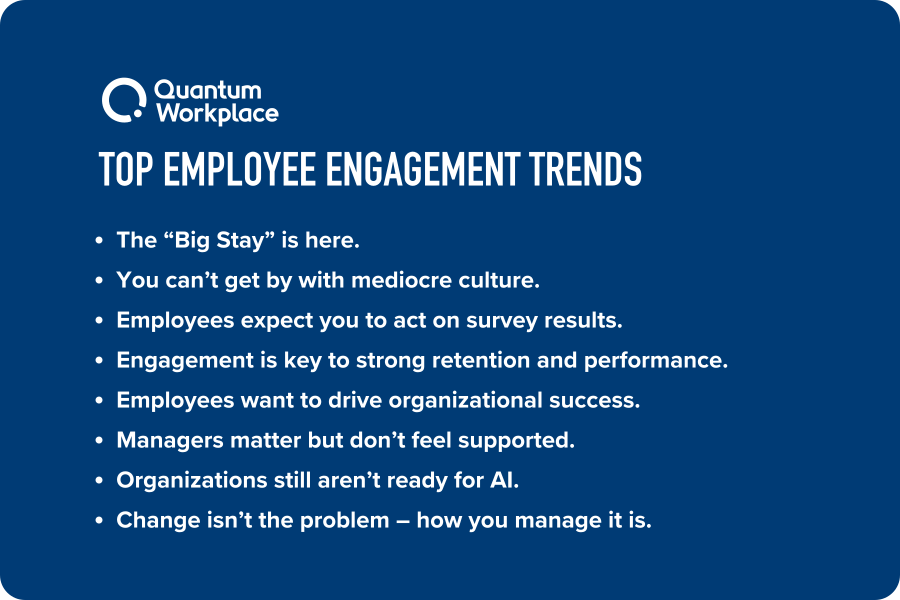
The “Big Stay” is here.
Employee engagement declined for the first time in a decade, returning to pre-pandemic levels. While quit rates have fallen, employee engagement has also dropped, making retention a top priority this year. Retention strategies should go beyond addressing immediate turnover; they must also prevent future attrition. In any job market, prioritizing employee retention is crucial for keeping your top talent over the long term.
You can’t get by with mediocre culture.
Two-thirds of employees say their workplace culture positively impacts them. A strong company culture is key to attracting and keeping top talent. Whether you shape it or not, culture affects how employees feel and perform. People want to be connected to their team, recognized for their work, and given feedback that helps them grow.
Employees expect you to act on survey results.
Less than half of employees report that their organization regularly acts on survey results. Organizations often ask for employee feedback but fall short of action. This missing step is crucial for effective engagement strategies. Without action, insights won’t improve engagement, performance, or culture.
Engagement is key to strong retention and performance.
Executives and business leaders recognize the impact of engagement efforts, noting that engagement directly influences individual, team, and overall business performance. Engagement isn’t about perks like free snacks or game rooms. Real engagement is about the connection employees feel to their work, team, and organization. To drive engagement, you need to understand the underlying issues of disengagement.
Employees want to drive organizational success.
Over half of all employees, particularly managers, want more recognition for their work. Employees are more motivated when they see how their work contributes to organizational goals. This requires clear connections to those goals, recognition for their efforts, and constructive feedback for improvement.
Managers matter but don’t feel supported.
Nearly 70% of employees who get feedback only twice a year or less express a desire for more frequent feedback. Not everyone is naturally skilled at management, but managers are crucial for boosting engagement and performance by coaching employees and giving useful feedback. The best way organizations can ensure success is by supporting managers in this role.
Organizations still aren’t ready for AI.
Just 21% of employees have used AI at work in the past week. Artificial intelligence can greatly influence the workplace, making it essential for your organization to have an AI strategy. Embracing AI’s opportunities now is crucial, rather than waiting for it to affect your business.
Change isn’t the problem – how you manage it is.
When organizations frequently communicate changes, 79% of employees report being highly engaged. Change is inevitable and will always affect the workplace. However, it’s not the change itself that impacts employees the most—it’s how you manage it.
As you set goals for your organization, these trends and best practices can help you stay focused. Embrace change, aim for continuous improvement, and most importantly, let data guide your decisions to ensure you make the right choices when they matter most.
Employee Engagement Software Case Study

As Seacoast Bank experienced rapid growth through acquisitions, maintaining a highly engaged workforce became increasingly challenging. They recognized the need to enhance their employee listening framework, which relied heavily on an annual engagement survey.
To ensure continued engagement and alignment, they sought additional mechanisms for employee feedback and greater involvement from managers and teams throughout the entire process—before, during, and after the survey.
Quantum Workplace supported Seacoast Bank in addressing their engagement challenge. Our employee success platform enabled them to go beyond annual engagement surveys and implement a continuous listening strategy.
By equipping their HR team with powerful tools to capture feedback through various surveys and 1-on-1s, we empowered managers and teams to take ownership of engagement. Our platform’s easy-to-use reporting features enabled Seacoast’s leaders to identify actionable insights and foster a collaborative culture focused on driving meaningful change.
As a result, Seacoast saw increased survey participation, improved employee engagement, and positive impacts on business outcomes like turnover and promotion rates.
Seacoast Bank was able to leverage Quantum Workplace to:
- Implement a continuous listening strategy to measure and act on what matters most.
- Empower managers and teams with simplified reporting to understand and utilize engagement data.
- Mobilize teams to create an engaging employee experience through collaborative action planning and engagement-focused 1-on-1 conversations.
Quantum Workplace’s employee engagement survey software
If you’re looking for employee engagement software that not only provides technology, but also expertise that supports your employee listening strategy, Quantum Workplace just might be the perfect match. When you partner with us, we help you build a culture of employee success by:
- Uncovering meaning. Our expertise, analytics and benchmarking help you make sense of feedback and gain a deeper understand of its true meaning
- Making action easy. You can rely on our solutions to uncover critical insights for your leaders, streamline processes for HR, and seamlessly integrate into team workflows.
- Being a partner you can rely on. Experience the support of a strategic partner by your side, providing guidance and focus to help you improve work every day.
Check out this guide to learn how to drive your employee listening strategy forward and improve engagement at your organization.
To see how our employee engagement software can make a difference, schedule a demo. This will allow you to ask questions, explore its benefits, and see how it will enable you to ask the right questions, gain valuable insights, and take meaningful action.
Employee Engagement Software FAQs
How do you implement employee engagement software?
This outlines the key steps and a recommended timeline to ensure a successful launch within your organization.
Pre-Launch (4-6 Weeks Before Launch)
Define Survey Goals and Objectives
- Clearly identify what you want to achieve with the survey.
- Establish key metrics and outcomes to measure success.
Assemble Your Survey Team
- Gather a team responsible for survey planning, execution, and follow-up.
- Assign roles such as project lead, data analyst, and communication lead.
Plan Your Communication Strategy
- Develop a communication plan to inform employees about the upcoming survey.
- Prepare key messages, FAQs, and leadership endorsements to build awareness.
Review and Finalize Survey Content
- Collaborate with stakeholders to finalize survey questions.
- Ensure the questions align with your objectives and are relevant to your employees.
Configure Your Survey Platform
- Set up the survey platform according to your organization’s requirements.
- Customize demographics, visibility settings, and any required integrations.
Launch Phase (Survey Day – 2 Weeks)
Final Pre-Launch Checklist
- Ensure all communications are ready to go.
- Confirm that the survey platform is fully configured and tested.
- Launch the Survey
- Send out the survey to all selected participants.
- Monitor initial response rates and address any technical issues promptly.
Ongoing Communication
- Send reminders to employees who haven’t completed the survey.
- Continue promoting the survey through internal channels.
Post-Survey (1-2 Weeks After Survey Closes)
Data Analysis
- Collect and analyze survey data to identify key insights and trends.
- Work with your survey team to interpret results and identify areas for improvement.
Share Results with Leadership
- Present the findings to senior leadership and discuss potential actions.
- Use the data to support strategic decision-making.
Communicate Results to Employees
- Prepare a summary of the survey results and share it with employees.
- Be transparent about what the organization plans to do in response to the feedback.
Action Planning
- Develop an action plan based on survey insights.
- Assign responsibilities and timelines to ensure follow-through.
Continuous Feedback Loop
- Establish a process for ongoing feedback and follow-up surveys.
- Regularly review progress on action items and adjust as needed.
How do I make the business case for employee engagement software?
Investing in employee engagement software impacts many individuals. Gaining each stakeholder group’s support is crucial for success. While brainstorming on your own is helpful, it’s equally important to interview key stakeholders to gather diverse perspectives. This approach allows you to identify potential challenges early, ensuring you’re prepared before finalizing the purchase. For most organizations, the managers are the central users of an employee engagement tool. If that’s the case for your organization, make sure you are looking for a tool that:
- Seamlessly integrates into a manager’s daily tasks.
- Simplifies coaching by removing uncertainty.
- Enhances visibility across teams.
- Fosters continuous improvement for building high-performing teams.
- Offers insights and resources to support manager development.
- Ensures consistent people practices across all teams.
Involving key stakeholders and managers early can guide you in making well-informed, strategic choices, ensuring that the employee engagement software you select aligns with and supports your organization’s objectives.
How are other organizations leveraging employee survey software?
Grant Thornton, one of America’s leading providers of audit, assurance, tax, and advisory services, set out to become an employer of choice and improve employee satisfaction by enhancing how they gathered and used feedback. They partnered with Quantum Workplace to implement a data-driven strategy, using pulse surveys to regularly collect real-time employee insights. These insights helped the firm make timely improvements and focus on what mattered most to employees, such as impactful work and growth opportunities. By using analytics and action plans, Grant Thornton turned feedback into clear strategies, resulting in higher engagement, reduced turnover, and a stronger reputation as a top employer in the accounting industry.
Scooter’s, a rapidly-growing specialty coffee franchise, faced the challenge of maintaining its close-knit, family-oriented culture while expanding rapidly and adapting to a hybrid work model during the pandemic. The Great Resignation and a highly competitive job market added pressure to attract and retain top talent, all while keeping employees engaged and developing remote team members. To address these challenges, Scooter’s Coffee turned to Quantum Workplace’s suite of tools. Quantum Workplace’s Engagement and Pulse Surveys helped the company gather valuable feedback, identify at-risk employees, and take immediate action to prevent burnout and turnover. These tools helped Scooter’s Coffee promote engagement, maintain culture, and drive growth in a hybrid workforce.
Benesch, a leading engineering firm, faced the challenge of maintaining employee engagement and unity during rapid growth and a shift to a hybrid work model. To address this, they partnered with Quantum Workplace to implement engagement surveys, performance management tools, and 1-on-1s, which helped them gather and act on employee feedback. This allowed Benesch to enhance diversity, inclusion, pay equity, and development efforts, while empowering managers to set actionable goals. By aligning individual and company-wide objectives, Benesch improved retention, increased engagement, and strengthened its culture despite a dispersed workforce.
Explore other case studies to see how organizations are successfully utilizing employee engagement software.
How do ensure adoption & usage of employee survey tools?
Here are some tips for increasing adoption and usage of your survey platform:
1. Get Leaders Involved
Leaders need to be part of the conversations using the new tools. If they don’t engage, it might seem like the tools aren’t important. Leaders should set a weekly reminder to recognize good work, showing their support and setting a good example.
2. Identify Enthusiastic Team Members
Find employees who are excited about the new tools and encourage them to share their enthusiasm with others. Their positive attitude can help motivate the rest of the team and provide helpful feedback
3. Highlight Great Work Regularly
Leaders should regularly recognize and share examples of excellent work or contributions made using the new tools. This could be done in team meetings or through emails. The goal is to celebrate different types of contributions, which encourages everyone to use the tools and stay engaged.