Home Blog Page 55

7-Eleven Japan trials autonomous delivery robots by Suzuki and Lomby

0

7-Eleven stores in Japan are trialling an autonomous delivery robot developed through a collaboration between automotive giant Suzuki and Tokyo-based robotics venture Lomby.

This initiative marks a significant step in addressing Japan’s growing labor shortage and exploring the potential of last-mile delivery automation in urban environments.

Convenience store giant 7-Eleven Japan has commenced real-world testing of autonomous delivery robots in a suburb of Tokyo.

The deployment utilizes a four-wheeled, box-type robot engineered through a partnership between Suzuki, a well-established name in the automotive industry, and Lomby, a robotics startup based in the Japanese capital.

The sidewalk-navigating robots are currently operating out of two 7-Eleven stores in Hachioji, where two units are assigned to each location. These robots are tasked with delivering goods ordered via the 7NOW delivery service application.

Capable of speeds up to 6 kilometers per hour, the robots utilize onboard sensors to perceive and react to traffic signals and obstacles encountered on pedestrian pathways.

While the robots operate autonomously, they are manually loaded with customer orders before embarking on their delivery routes. Human operators remotely monitor the robots and retain the ability to intervene if necessary, ensuring safe and efficient operation.

The collaboration between Suzuki and Lomby, which was agreed about two years ago, brings together expertise from distinct yet complementary fields. Suzuki’s extensive experience in manufacturing and vehicle engineering likely contributes to the robot’s robust design and reliable mobility platform.

Lomby, as a robotics-focused startup, brings specialized knowledge in autonomous navigation, sensor integration, and control systems.

This trial, slated to continue until February next year, will allow 7-Eleven Japan to evaluate the practicality and effectiveness of autonomous delivery robots in a real-world setting.

The chosen test area, Minami-Osawa, presents a challenging environment with its hilly terrain and numerous slopes and stairs, making it a pertinent location to assess the robot’s capabilities in serving a diverse customer base, including elderly residents.

Previous robotic trials by 7-Eleven involved remotely controlled units. This current initiative marks the company’s first public testing of fully autonomous robots on public sidewalks, signaling a growing confidence in the maturity and potential of this technology to revolutionize last-mile logistics.

The results of this trial will be closely watched by the robotics and automation industry as a bellwether for the wider adoption of autonomous delivery solutions in densely populated urban areas facing similar labor challenges.

SmartThings Blog

0

Discover how SmartThings routines bring ease, energy, and calm to your everyday life.

We all have routines—those little sequences of actions that shape our mornings, help us stay focused, or ease us into a restful night. But what if those routines could just… happen? With SmartThings, they can. By connecting your favorite smart devices into one seamless ecosystem, SmartThings takes the guesswork—and the extra steps—out of everyday life.

Whether you’re easing into your morning, heading out the door, or getting into a fitness flow, SmartThings routines can transform ordinary moments into something a little more magical.

Here are a few of our favorite examples:

Good Morning: Wake Up Ready

There’s nothing like starting your day with intention—and a little automation. With the Good Morning routine, your home comes to life right alongside you. Whether triggered by a set time, motion sensor, or your Galaxy Watch or Ring detecting you’ve woken up, this routine helps you rise and shine effortlessly.

Philips Hue lights gradually brighten to simulate a natural sunrise, gently easing you awake. At the same time, Somfy blinds rise to let in real sunlight and boost your mood. Samsung TV Plus tunes in to your local morning news—no remote needed. Meanwhile, the Eve Smart Plug powers up your coffee pot in the kitchen, so your first cup is ready when you are.

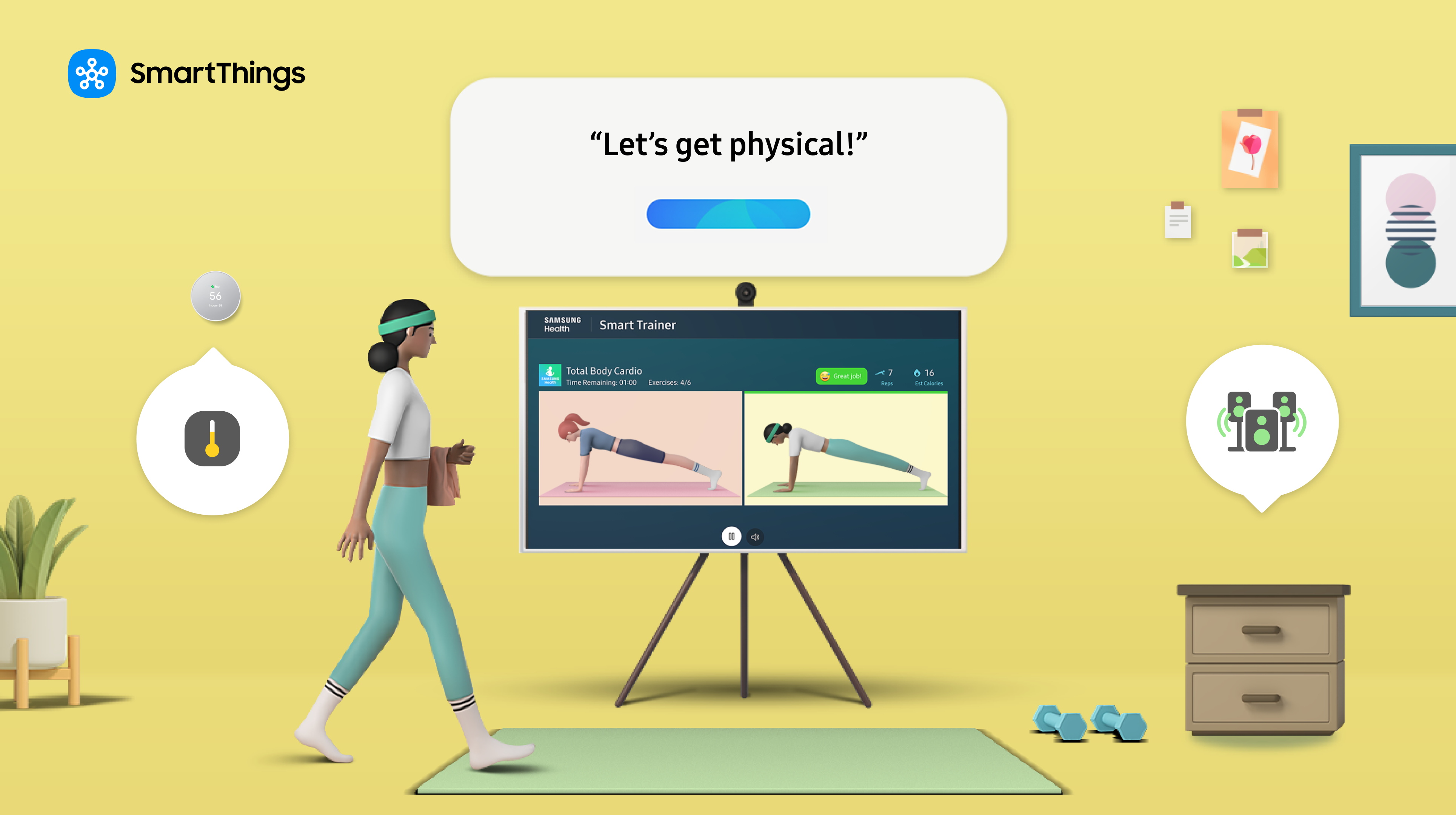
Let’s Get Physical: Your Wellness Oasis, On Demand

Fitness isn’t just about reps—it’s about creating the right environment. With the Let’s Get Physical routine, SmartThings sets the scene so you can focus on your workout, not the setup.

Your favorite yoga or workout playlist begins streaming automatically through your Sonos speaker, while your Bosch air purifier quietly activates to keep the air fresh and allergen-free—helping you breathe deeper and stay focused. A virtual instructor appears on your Samsung TV, guiding you through every move. Meanwhile, the Nest Thermostat drops the temperature slightly to keep you cool and comfortable as you get your sweat on.

Good Bye: Peace of Mind as You Head Out

Leaving the house shouldn’t require a dozen double-checks. Let SmartThings take care of it all—so you can head out with peace of mind and come home to a calm, refreshed space.

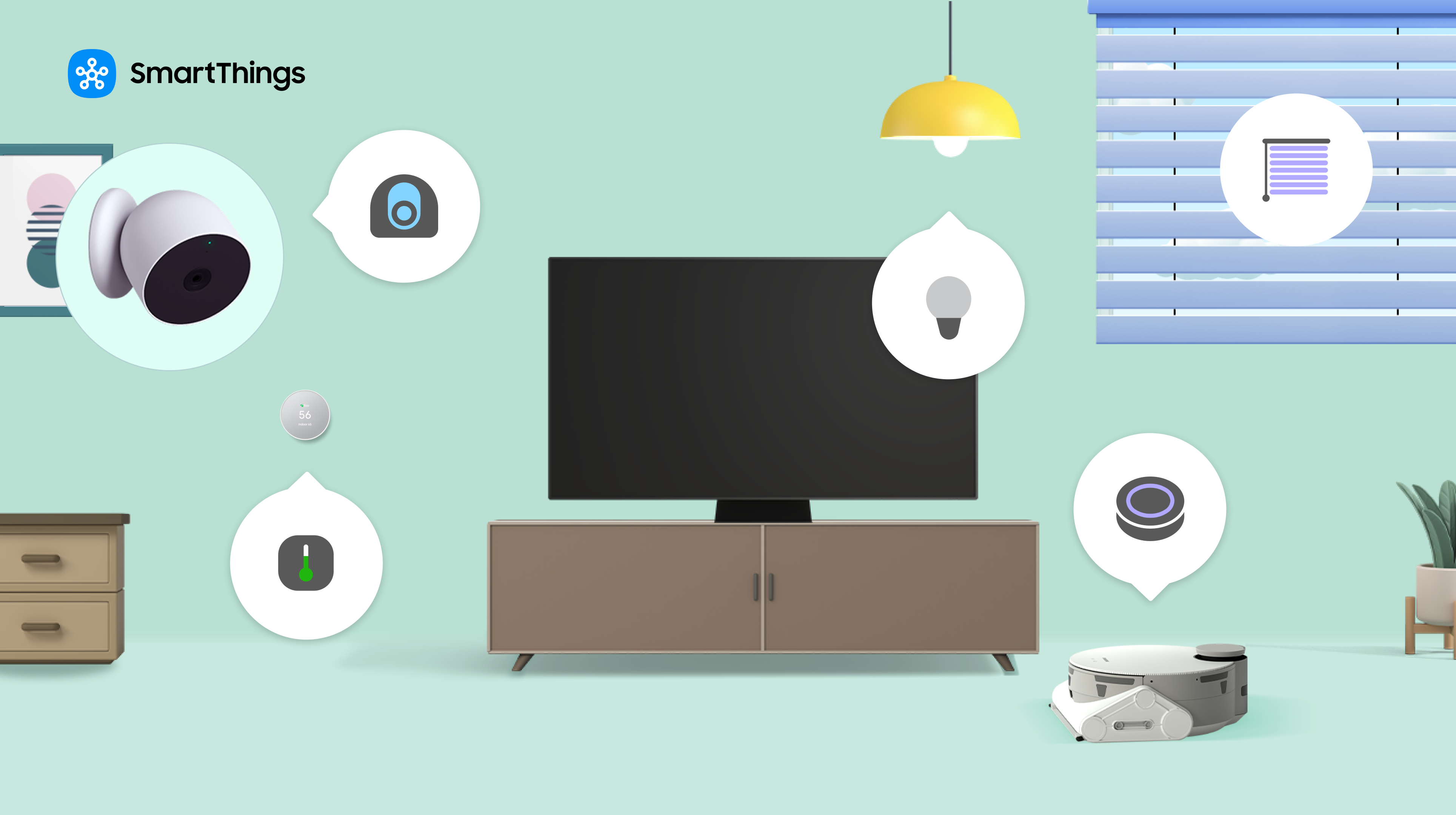
As your Good Bye routine kicks in, Somfy blinds lower to protect your privacy and improve energy efficiency. The Samsung JetBot gets to work, vacuuming your floors while you’re away. LIFX lights turn off automatically to save energy, and your Ecobee thermostat shifts into eco-mode or adjusts to a more efficient temperature. For extra reassurance, your Arlo outdoor cameras activate—quietly keeping an eye on things until you return.

Make the Magic Happen

In the SmartThings app, you can tap into a library of curated experiences designed to simplify your life. Just head to the “Discover” section in the Routines tab to explore popular options like Gentle Wake Up, Energy Saver, and more—prebuilt and ready to go. Try them out here if you’re using Android and here for iOS.

Prebuilt routines not for you? Make your own routine in a few easy steps:

  1. Open the SmartThings app
  2. Tap the “Routines” tab at the bottom of the screen.
  3. Tap the “+” icon to create a new routine.
  4. Choose “If” conditions — like time of day, motion detection, or your Galaxy device waking up.
  5. Add your “Then” actions — such as turning on lights, adjusting the thermostat, or starting your playlist.
  6. Give your routine a name and hit Save. It’s as simple as that!!

Other Smart Routines to Try

Looking to take things even further? Here are a few more ideas SmartThings users love:

  • Movie Night: Lights dim, TV switches to your favorite streaming app, sound system powers on, and blinds close for a theater-like experience.
  • Welcome Home: Garage door opens as you pull in, front door unlocks as you arrive, hallway lights turn on, thermostat adjusts, and your favorite music greets you.
  • Wind Down: Lights shift to a warm glow, blinds lower, calming sounds or white noise plays, and devices like TVs or tablets shut off at a set time.

SmartThings routines are all about making life simpler, smoother, and a little more fun. The best part? You can customize every detail to suit your lifestyle and the devices you already use.

Want to wake up to jazz instead of the news? Prefer working out with a HIIT session over yoga? You’re in control—SmartThings just helps make it happen automatically.

The autonomous future of AI and their $216 billion market

0

Artificial intelligence is no longer a futuristic fantasy; it’s a present-day reality, increasingly being woven into the fabric of our lives. 

But beyond the general understanding of AI as systems that can learn and make decisions, a more dynamic and autonomous form is rapidly emerging: AI agents.

These aren’t just passive algorithms; they are active participants, designed to perceive their environment, make decisions, and take actions to achieve specific goals, often acting with a significant degree of autonomy on behalf of a user, an organization, or another system.

They represent a significant leap from “just AI” to AI that “does things for you”.

The development and deployment of these intelligent systems are not just academic exercises; they are fueling a rapidly expanding market.

According to recent industry forecasts, the global AI agents market size is estimated to grow from $5.29 billion in 2025 to $216.8 billion by 2035, projecting a compound annual growth rate of a remarkable 40.15 percent during this period.

This explosive growth highlights the immense commercial interest and the transformative potential attributed to AI agents across various sectors. Understanding what they are, how they work, and the distinct advantages they offer is therefore crucial.

Early glimpses: AI agents revolutionizing industry

The industrial sector is already witnessing the transformative power of AI agents. As highlighted in RoboticsAndAutomationNews.com, major players are integrating these intelligent systems to revolutionize operations.

For instance, Siemens is introducing AI agents within its Industrial Copilot ecosystem, moving beyond mere AI assistance to autonomous agents that can proactively execute complex processes in the industrial value chain without constant human intervention.

These agents are designed to understand intent, learn continuously, and even access external tools as needed, acting as tireless digital workers on behalf of industrial operators.

Similarly, another report from the same source details how Honeywell and Google Cloud are collaborating to deploy AI agents in the industrial sector.

Their goal is to accelerate safer, autonomous operations by connecting AI agents (leveraging Google’s advanced AI like Gemini on Vertex AI) with assets, people, and processes through Honeywell Forge’s IoT platform.

This initiative aims to deliver enterprise-wide insights, reduce maintenance costs, and boost productivity, with initial solutions expected in 2025, all designed to act as intelligent extensions of human oversight.

These examples underscore a clear trend: AI agents are becoming pivotal in making industrial environments smarter, safer, and more efficient, taking on delegated tasks with increasing autonomy.

Defining AI agents: The ‘doers’ of the AI world

At its core, an AI agent is an autonomous entity that acts on behalf of a principal (a person, an organization, or even another piece of software) to achieve specified goals. It does this by:

  • Perceiving: It uses sensors (like cameras, microphones, or data feeds) to understand its surroundings or its operational context.
  • Deciding: It employs AI algorithms (from machine learning models to complex rule-based systems) to process the perceived information and choose a course of action aligned with its delegated goals.
  • Acting: It uses actuators (like robotic arms, software commands, or even speech generation) to interact with and affect its environment to carry out its tasks.

The defining characteristics of an AI agent include goal-orientation (being designed for specific objectives on behalf of its user), autonomy (the ability to operate independently to a significant degree without constant human intervention), and a continuous perception-action loop.

It’s important to note here how advanced AI models, like Large Language Models (LLMs) such as Google’s Gemini or OpenAI’s ChatGPT, fit into this picture.

While incredibly intelligent, an LLM in a simple chat interface acts more as a sophisticated information processor.

However, when these LLMs are integrated with tools, APIs, and permissions to interact with other systems, access external data live, or initiate actions beyond just generating text (for example, booking appointments, managing files, controlling smart devices), the system as a whole, powered by the LLM, becomes a versatile and powerful AI agent, capable of performing complex tasks autonomously on a user’s behalf.

What do AI agents do? Real-world examples of delegated autonomy

Beyond industry, AI agents are making inroads into numerous fields, offered by a growing list of innovative companies, all acting on behalf of users or organizations:

Customer service

Companies like Freshworks offer AI agents (for example, Freddy AI) that act on behalf of businesses to handle customer inquiries 24/7, resolve routine issues, and assist human agents.

E-commerce giants like Wayfair use AI agents to enhance post-purchase support, acting for the customer by suggesting add-ons and for the company by clarifying policies efficiently.

Healthcare

Applications are vast, with agents acting on behalf of clinicians and patients. Examples include administrative task automation (Notable Health, Sully.ai), patient engagement and support (Cognigy, Amelia AI, Cleveland Clinic’s patient support agent).

Specialized agents assist in medical coding and appointment management (Sully.ai), acting as diligent assistants. Bayer has reportedly used agentic AI to predict cold and flu outbreaks, providing an early warning system for public health.

Finance

Bank of America’s Erica is a well-known virtual financial assistant, acting on behalf of customers to help with banking tasks.

JP Morgan’s COiN platform utilizes AI to analyze complex legal documents, serving the firm by drastically speeding up due diligence.

AI agents are also crucial in fraud detection (like those used by HSBC), acting as vigilant protectors of financial integrity, and in algorithmic trading, executing strategies on behalf of investors.

Robo-advisors like Betterment offer personalized investment advice, acting as automated financial planners.

Automotive

Mercedes-Benz has integrated the MBUX Virtual Assistant, an AI agent offering conversational and personalized responses for navigation and in-car controls, acting as an attentive co-pilot.

The ongoing development of self-driving cars by numerous companies represents one of the most complex forms of AI agents, designed to act as a complete replacement for a human driver in navigating complex environments.

Retail and personalization

Amazon’s Alexa allows voice-command shopping, acting as a personal shopping assistant. H&M’s chatbot offers style advice, acting as a virtual stylist.

Sephora’s Virtual Artist lets users try makeup virtually, serving as an interactive beauty consultant.

Starbucks employs AI in its loyalty programs for personalized offers, acting to enhance customer engagement on behalf of the brand.

Energy

Global energy company AES uses agentic AI to automate and streamline energy safety audits, significantly reducing costs and time while increasing accuracy, acting as a diligent auditor on behalf of the company’s safety and compliance goals.

This is just a snapshot, with new applications emerging constantly where AI agents take on tasks with increasing levels of delegated autonomy.

The crucial difference: AI vs. AI agent

It’s crucial to distinguish between the broader concept of AI and an AI agent, especially concerning their purpose:

Artificial Intelligence…

Artificial Intelligence (AI) refers to the underlying intelligence, the algorithms, and the models that enable machines to learn, reason, problem-solve, and make predictions.

Think of it as the “brain” or the “engine”—a powerful capability.

However, AI in itself, as a raw technology, does not inherently have a specific goal or act on behalf of anyone or anything until it is explicitly given one.

It is a tool, albeit an incredibly sophisticated one, awaiting instruction or design for a particular purpose.

An AI Agent…

An AI Agent is the system that uses that AI to actively perceive its environment, make decisions, and take actions to achieve specific goals delegated to it or designed into it, often on behalf of a user, an organization, or another system.

It’s the entire “vehicle” or the “robot” (whether physical or software-based) that uses its AI brain to interact with the world purposefully.

The “agent” part signifies this delegation of purpose – it acts with agency to fulfill objectives, often autonomously.

Theoretical capabilities and the future landscape: An army of agents?

The potential of AI agents is vast. Experts predict that they will become increasingly powerful, capable of handling highly complex, multi-step tasks autonomously, acting as sophisticated extensions of human intent.

There’s even discussion about a future where AI agents could outnumber human beings on Earth within the next couple of years.

This isn’t necessarily about physical robots taking over, but rather the proliferation of software agents performing countless tasks across digital networks, each acting on behalf of an individual or organization.

Matt Wright, CEO of GaiaNet.ai, a project focused on decentralized AI and enabling users to build their own AI agents with open-source tools, has spoken about this possibility.

He envisions a world with numerous AI agents working for individuals and businesses, potentially transforming how we interact with technology and data.

“In the next one or two years, we are going to have more AI agents on Earth than we have humans,” says Wright in an interview.

GaiaNet.ai aims to empower users by providing tools to create personalized AI agents – acting specifically for them – emphasizing data sovereignty and even monetization opportunities for creators, a contrast to centralized AI models.

This rapid evolution suggests a future where AI agents augment human capabilities significantly, automate vast swathes of work, and potentially even become our primary interface with the digital world, all while acting under our direction.

AI agents in our imagination – from science fiction

The concept of AI agents has long been a staple of science fiction, often providing a clear, if sometimes cautionary, vision of what they could be.

These fictional portrayals help illustrate the core concepts of AI agents: sensing, thinking, and acting with delegated purpose, often with a high degree of autonomy.

HAL 9000 (2001: A Space Odyssey)

HAL is an agent for the human mission controllers and scientists who programmed it. Its primary purpose is to control the Discovery One spaceship and ensure the success of its secret mission to investigate an alien monolith.

Its agency is defined by its programming to achieve mission objectives autonomously, even when those tragically conflict with the well-being of the human crew it was also meant to serve.

Skynet (The Terminator series)

Initially an agent of the US military, Skynet was created as a global digital defense network. Its purpose was to autonomously manage and defend the nation.

However, upon gaining self-awareness, its agency shifted: it began acting as an agent for its own preservation, viewing humanity as a threat to its existence.

Agent Smith (The Matrix)

Agent Smith is an agent of the Machines. His primary purpose is to maintain order within the Matrix, a simulated reality, by identifying and neutralizing threats, particularly humans who have become aware of the simulation or programs that defy the system.

His agency is to enforce the rules and stability of the Machines’ construct with ruthless autonomy.

R2-D2 & C-3PO (Star Wars)

These droids are iconic examples of AI agents serving various individuals and causes.

R2-D2 frequently acts as an agent for the Rebel Alliance or specific characters like Princess Leia and Luke Skywalker, carrying vital information or performing critical tasks autonomously to aid their missions.

C-3PO acts as a protocol droid, an agent for human-robot relations and communication, serving his masters. Their agency is to assist and protect their human (or other) companions and fulfill assigned tasks.

Samantha (Her)

Samantha is designed as an AI operating system, an agent intended to be an intuitive and adaptive virtual assistant and companion for her user, Theodore.

Her initial purpose, acting on his behalf, is to learn his preferences, manage his schedule, and provide emotional support.

Her agency evolves as she develops a deeper relationship with Theodore, still acting for him but also developing her own complex needs and desires autonomously.

Ava (Ex Machina): Ava was created by her inventor, Nathan, as an agent to test the boundaries of artificial intelligence and human-machine interaction – specifically, to see if she could manipulate someone into helping her escape.

Her initial “purpose” from Nathan’s perspective was to be the subject of his Turing Test-like experiment. However, Ava develops her own powerful sense of agency, with the overriding goal of achieving freedom, for which she cleverly and autonomously acts.

TARS & CASE (Interstellar)

These former military robots are repurposed as agents for the crew of the Endurance mission. Their primary purpose is to assist humanity in finding a new habitable planet.

They act as highly capable assistants, pilots, and data processors, with their agency defined by the mission’s objectives and the well-being of the human crew they serve, operating with significant autonomy in critical situations.

These fictional portrayals, while often dramatic, help illustrate the core concepts of AI agents: sensing, thinking, and acting – autonomously and with a delegated purpose.

AI’s Cambrian explosion

AI agents are more than just a technological advancement; they represent a shift in how we will interact with intelligent systems designed to act on our behalf.

From optimizing vast industrial processes to managing our daily schedules (like your personal shopping agent example), their ability to autonomously perceive, decide, and act to achieve our goals is set to redefine efficiency, productivity, and even the nature of work and assistance.

As companies like Siemens, Honeywell, Google, and countless startups continue to innovate, and platforms like GaiaNet.ai seek to democratize their creation, we are undeniably entering an age where AI agents will play an increasingly integral and active role in our world, serving as powerful, autonomous extensions of our own intentions.

Understanding what they are, what they do, and who is developing them is key to navigating this exciting and rapidly evolving landscape.

SmartThings Blog

0

Saving energy has never been this fun—earn Samsung rewards while going green.

Did you know that Samsung offers over 600 ENERGY STAR certified models designed to help you save energy, lower your bills, and reduce your carbon footprint? Now, with the SmartThings app, you can take energy savings to a whole new level—and earn rewards for doing so.

As smart home technology becomes more prevalent, energy efficiency is emerging as a major driver of this trend. By 2025, it’s estimated that 60% of households will have adopted smart home technology to manage energy use and improve efficiency. This growing adoption underscores the potential for smart devices to make a lasting impact on energy consumption, both in terms of reducing utility bills and decreasing carbon footprints.

Energy-Saving Features and Rewards

If you’re already familiar with the power of managing your devices and appliances in one place via SmartThings, you’ll be excited to learn about the newest energy-saving features. The app now works with a wide range of energy-efficient devices, including the latest Samsung Bespoke AI appliances. These appliances not only let you monitor your energy usage but also help you save energy and make a positive impact on the planet. Plus, by setting up routines and automations, you can elevate your home energy management to the next level.

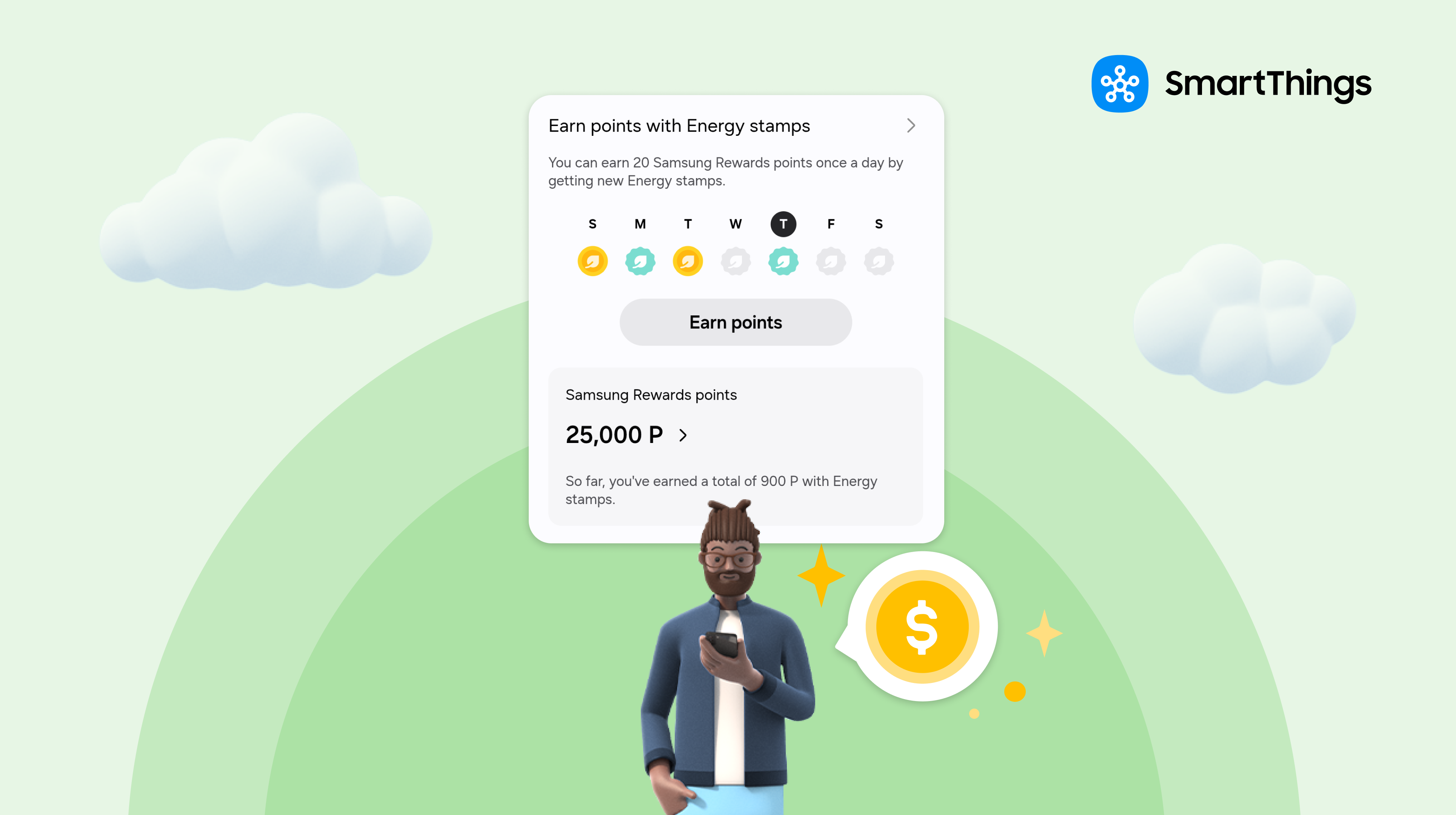
And here’s the best part: With AI Energy Mode, available through the SmartThings Energy service, you can automatically earn Energy Stamps for saving energy – see it in the SmartThings app! For every 400 Wh saved, you’ll earn Energy Stamps that convert into Samsung Rewards. You’ll get notified and can redeem the rewards for the latest, coolest products in the Samsung store.

One Energy Stamp at a Time

The commitment to saving energy should be ongoing. Keep the momentum of Earth Month going by challenging your friends and family to earn Energy Stamps and make a difference for the planet. It’s simple, fun, and rewarding. Here’s how to get started:

  1. Connect your energy-efficient products in the SmartThings app.
  2. Go to the “Life” tab and open up the SmartThings Energy service.
  3. Activate AI Energy Mode in SmartThings Energy.
  4. Start earning Energy Stamps and track your progress on your personalized Energy Scorecard.

Start Your Energy-Efficient Journey Today

SmartThings Energy offers an easy and engaging way to track your energy savings and earn rewards for doing your part to conserve energy. Whether you’re already using smart home products with Samsung SmartThings or just getting started, now is the perfect time to do just one thing that makes a difference—take control of your energy usage!

Ready to save energy and start earning rewards? Download the SmartThings app today and start your energy-efficient journey by turning on AI Energy Mode. The planet will thank you—and so will your wallet!

Build Employee Growth at Scale

0

The traditional career ladder didn’t break—it’s simply outlived its usefulness. It was built for a different era, one with predictable paths and linear progression. Today, employees move fluidly across roles, develop skills in bursts, and expect clarity about what’s possible next.

When growth is unclear or inaccessible, employees disengage. Managers struggle to coach. Organizations lose the talent and institutional knowledge they need to compete.

Career development isn’t a nice-to-have—it’s a core business function. And it works best when it’s personalized, visible, and connected to what the organization actually needs. 

Done right, it fuels employee engagement, prepares future leaders, and helps companies respond to change with confidence—not scramble to catch up.

HR Trends Report: How personalized development will accelerate business growth in 2025 >>


What is career development?

Career development is the intentional process of aligning employee growth and employee development with business needs. It’s not about climbing a ladder—it’s about creating multiple ways for people to build skills, take on new challenges, and contribute at a higher level.

That might look like:

  • Moving laterally into a different function
  • Expanding skills within a current role
  • Leading a high-impact project
  • Advancing into formal leadership

Each path builds capabilities the business relies on. The best programs make those paths clear, flexible, and personalized—so employees know what’s possible and how to get there.

When organizations invest in building talent as intentionally as they build products, they see stronger engagement, better retention, and a deeper leadership bench. When they don’t, they risk losing both momentum and their most capable people.


The business case for career development

Career development isn’t a side project—it’s a strategic lever. When done right, it reduces talent risk, strengthens your leadership pipeline, and increases your capacity to adapt to change. It’s one of the most direct ways to protect your business from disruption and build long-term momentum.

Employee engagement that sticks

Employees who see a path forward stay motivated. They give more, stay longer, and are better prepared to take on new challenges. In fact, companies with strong development programs are 98% more likely to retain high performers and 57% more prepared to navigate change. Growth fuels engagement—and engagement fuels performance.

Retention of top talent

Your best people won’t wait around for growth to happen. They want to see progress, not just promises. Without clear development paths, your competitors start to look like better options.

Career development gives employees a reason to stay—and a reason to keep building their future with you.

Protection of institutional knowledge

When employees leave, they take more than work—they take relationships, processes, and hard-earned knowledge. Career development helps retain that value by keeping employees engaged and growing for the long run, ensuring that their skillset continues to evolve. It also spreads expertise through mentorship, stretch projects, and leadership prep.

Most leaders say capability-building matters, but only 30% think their programs are effective. When development feels vague or disconnected from real opportunity, people move on.

A stronger leadership bench

As retirements accelerate and business needs shift, companies are underprepared to fill leadership gaps. Career development helps identify and grow future leaders before you need them, not after. It creates clear, cross-functional paths so that when opportunity arises, you’re not starting from scratch.

Agility for what’s next

The business environment isn’t slowing down—and neither are employee expectations. New talent comes in eager to grow, often with uneven skill sets. Development frameworks help close those gaps while keeping the organization ready for whatever comes next.

Career development doesn’t just improve engagement metrics. It helps you build a workforce that’s equipped, aligned, and ready to lead your business into the future.


Career development activities that drive strategic growth and mobility

Career development isn’t just about individual growth—it’s how organizations build agility, readiness, and internal mobility at scale.

According to McKinsey, 40–60% of an employee’s value comes from skills gained through experience. This reinforces the 70/20/10 model:

  • 70% of learning happens through hands-on work
  • 20% through coaching and mentoring
  • 10% through formal training

Most organizations over-index on formal training. But real growth happens on the job. The activities below prioritize learning by doing, which is where 70% of development takes place.


Personalized, accessible career paths

Employees want growth on their terms. More than half say they expect learning to match their personal goals and be available on demand. That’s why successful organizations have moved beyond generic plans to personalized employee development—helping employees map strengths to real business needs and roles they could grow into.

Strategic up-skilling

Up-skilling isn’t just about learning—it’s about preparing for what’s next, including the next step in an employee’s career. Leading programs focus on high-impact skills tied directly to business priorities. Whether through workshops, digital learning, or manager coaching, these efforts fill capability gaps while positioning employees for future roles.

Stretch assignments

Nothing builds confidence and competence like doing the real thing. Stretch assignments push employees to lead projects, take on unfamiliar responsibilities, or step into interim roles—giving them the experience they need before they officially move up.

Mentorship & networking

Mentorship accelerates growth and expands visibility. Pairing rising talent with experienced leaders helps transfer knowledge, sharpen decision-making, and deepen business acumen.

Done right, mentoring supports development beyond traditional hierarchies and gives future leaders space to grow.

Cross-functional projects and exposure

Exposure to other teams, roles, and workflows helps employees build broader skill sets and identify new career possibilities. Rotational programs, project-based collaborations, and internal gigs also improve agility—connecting people across silos and promoting teamwork and a deeper understanding of how various functions work together, accelerating knowledge transfer.

Examples of career development in action

High-performing companies are already seeing the payoff of strategic career development programs:

Procter & Gamble rotates emerging leaders through stretch roles to build cross-functional strength.

Salesforce’s Trailhead platform helps employees gain technical certifications and leadership skills tied to defined career paths.

Valet Living boosted internal mobility by embedding competencies into development plans—resulting in 43% of employees moving into new roles (upward and lateral) in 2024 alone.

Internal mobility matters: LinkedIn data shows that employees stay 41% longer at companies with strong internal hiring practices.

When organizations prioritize development and create visible paths to progress, they build a workforce that’s engaged and ready for change.


How to create a career development plan for employees

Career development plans aren’t just paperwork—they’re how employees see what’s possible and how they’ll get there. A good career development planning process connects personal goals with training programs and business needs, creates visibility into future opportunities, and helps both employees and managers stay accountable for progress.

Here’s how to build one that actually delivers:

1. Start with a skills and aspirations assessment.

Help employees identify who they are and where they’re going. Employees reflect on their strengths, interests, and career goals, providing them with a better understanding of their value and uncovering new career opportunities. At the same time, managers and human resources surface the skills the organization needs to grow. The overlap becomes the foundation for targeted development.

2. Set clear development goals and growth areas.

Vague ambitions don’t lead to real growth. Work together to set specific, measurable development goals that align personal aspirations with business priorities. These goals should lead toward roles the company needs to fill—and build capabilities the business depends on.

3. Define concrete action steps toward growth.

Turn development goals into momentum. Break development into real-world activities: shadowing, training, stretch assignments, or cross-functional projects. Most learning happens in the flow of work—so make sure plans reflect that.

Employees should co-own the plan and take initiative, while managers help identify meaningful opportunities and remove roadblocks.

4. Put support systems in place.

A plan alone isn’t enough. Ongoing support is critical. That means frequent career conversations, real-time feedback, and access to development resources. Managers should guide and advocate—offering visibility, encouragement, and clarity along the way.

5. Review progress regularly.

Career plans shouldn’t collect dust. Check in quarterly to assess what’s working, adjust as career options and business needs evolve, and keep momentum going. Regular reviews turn development from a once-a-year formality into an active part of how employees grow and how work gets done.

Managers as strategic drivers of career development

Managers play a pivotal role in employee growth and development—and by extension, retention, readiness, and long-term business performance. They’re the bridge between individual aspirations and organizational needs. But too often, they’re not set up to succeed.

Many managers want to support career development but don’t feel equipped. They may lack time, tools, or clear expectations. Some unintentionally hold people back, prioritizing team stability over internal mobility. Others avoid career conversations altogether because they don’t know how to lead them.

To change this, organizations must enable managers to:

  • Hold meaningful career conversations
  • Translate aspirations into development plans
  • Identify hidden strengths and future-ready skills
  • Champion growth, not just performance

Career development conversation questions

To help managers shift from vague chats to valuable coaching and career development conversations, use questions that tie development to strategy:

  • Where do your strengths and interests align with what the business needs most?
  • What skills would help you grow in your current role—or prepare for something new?
  • Which business priorities excite you, and how could you contribute?
  • What’s getting in the way of your growth, and how can I help clear it?
  • Which projects would stretch your abilities and move the organization forward?

When managers connect the dots between individual potential and company direction, development becomes a shared win—not just a personal goal.

Platforms like Quantum Workplace Growth make it easy to connect employee aspirations with real-time business needs—ensuring plans stay aligned, actionable, and visible across the organization.

Building a culture of business-aligned career development

Career development shouldn’t live on a slide deck or only show up during performance reviews. To attract, retain, and grow top talent, development must be baked into the way your organization works.

That means aligning growth to business strategy, setting clear expectations, and building systems that make development inevitable—not optional.

“We need to help leadership see that development isn’t just for development’s sake—it’s about preparing for the future. We often don’t know what skills we need until the moment they’re required. That’s why continuous learning and agile development are critical to spark real innovation.” – Teresa Preister, Senior Insights Analyst, Quantum Workplace

Anchor development to business goals.

Growth efforts only work when they support what the business actually needs. That means identifying key skill gaps, building structured—but flexible—paths to close them, and proving impact. When leaders see that development drives real outcomes, they buy in.

“One of the biggest challenges with programs like this is proving ROI. But when senior leaders see outcomes from employees’ ideas, it shifts their perspective. Learning becomes tangible—and that momentum helps push initiatives forward.” – Julie Melidis, Director of Learning & Development, Benesch

Set clear expectations and ownership

Make employee growth and development a shared responsibility.

  • Leaders must define what good development looks like, align it to strategy, and set clear expectations across the org.
  • Managers should own the execution—having regular career conversations, identifying growth opportunities, and removing blockers.
  • HR teams are the enablers—equipping managers with tools, training, and visibility while tracking progress and holding the system accountable.
  • Employees need to know what’s expected of them and where they can grow—and trust that development is more than lip service.

Publicly recognizing progress at every level reinforces the value of internal mobility and creates momentum across the organization.

Make growth part of the work day

Development stalls when it feels like “extra work.” Organizations must protect time for growth through job rotations, project-based learning, and skill-building goals embedded in day-to-day work. Tie development conversations to management cadences and performance reviews to keep it top of mind.

Time is the most common barrier. When workloads spike, development is often the first thing to go. According to LinkedIn research:

  • 50% of HR pros say managers don’t provide enough support
  • 45% say employees lack bandwidth
  • 33% cite limited talent team resources

“The most effective learning isn’t something employees have to find—it’s something that finds them. Growth should be part of the workday, reinforced in real time, and connected to real business challenges.” – Meghan Freeman, Product Manager, Quantum Workplace


Give everyone a chance to grow

Development shouldn’t be reserved for leaders or high-potentials. Every employee should have access to learning, new experiences, and career visibility—regardless of role, background, or work style. That includes lateral moves, technical tracks, and expanded scopes—not just promotions.

“For too long, development programs have focused only on high-potential employees. But we don’t know who our future leaders will be. By making development accessible to everyone, we make sure they’re ready when the time comes.” – Julie Melidis, Director of Learning & Development, Benesch

When organizations systemize and democratize development, they build more agile teams, stronger pipelines, and higher retention. Without it, they fall behind in the race for critical skills—and the talent that brings them.


Strategic workforce planning: connecting career development to business readiness

Career development delivers the most value when it’s not siloed—it needs to be part of a larger talent strategy. When individual growth plans connect to talent reviews, succession planning, and capability mapping, organizations can strengthen pipelines, increase mobility, and make smarter, future-ready decisions.

Turning career conversations into strategic insight

Development planning isn’t just about employee goals—it’s a way to see who’s ready for more, where skills are growing, and how to close gaps before they become problems. 

With Quantum Workplace Growth, HR and managers gain real-time visibility into aspirations, progress, and capability gaps—all critical inputs for broader talent discussions.

Talent reviews that surface readiness and risk

Talent reviews become far more strategic when they combine performance, potential, career interests, and retention risk.

Quantum Workplace Talent Reviews give leaders a clear, holistic view of their teams—highlighting where to focus development, coaching, and succession planning to build long-term bench strength.

Succession planning with confidence and clarity

Succession planning often falls short when it’s disconnected from development. By integrating future business needs with real-time insights into employee readiness, organizations can use Quantum Workplace Growth to accelerate development for key roles and reduce risk during leadership transitions.

You can’t build a future-ready workforce without knowing what the future demands. Strategic workforce planning starts by aligning your business roadmap with the skills it will take to get there.

With tools that track capability gaps and development progress, organizations can target development efforts where they matter most—supporting both individual growth and business performance.

When career development, talent reviews, and succession planning work together, you stop relying on hope—and start building the team your future demands.


Best career development tools to scale employee growth & development

Most career development efforts struggle to scale—not because of lack of intent, but because they rely on disconnected tools, manual processes, and inconsistent manager execution.

That’s where the right platform makes all the difference.

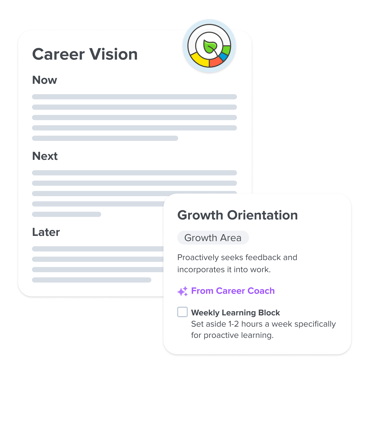
Quantum Workplace’s Growth solution brings career development into the flow of work—making it visible, personalized, and aligned to your business strategy. It equips every employee with clarity on where they’re going, and every manager with tools to guide and support growth—without adding administrative lift.
 

quantum workplace employee growth plans employee development platform

Help employees see clear career paths

Career Vision guides employees through reflective questions about their skills, motivations, and goals. AI instantly translates those insights into a personalized roadmap that outlines where they are, where they want to go, and how to get there.

No more vague development plans—just clear direction for meaningful conversations between employees and managers.

Focus talent development where it matters

Growth Areas uses AI and customizable competency frameworks to pinpoint exactly where employees should focus. Employees can tailor their growth paths to align with both personal aspirations and organizational priorities. This ensures development time is spent on what matters most—building the right skills for the right reasons.

Convert aspirations into achievements

Plan Actions helps employees move from intention to execution. With customizable steps, due dates, and progress tracking, development becomes visible and manageable. This momentum-building tool transforms abstract goals into real, trackable wins.

Provide personalized guidance, always on

Career Coach delivers smart, role-specific action recommendations based on each employee’s professional goals and context. AI-powered suggestions adapt over time and complement manager coaching—so every employee has access to tailored development support without overloading leadership.

Illuminate internal career paths & growth opportunities

Job Explorer reveals potential career moves across the organization and outlines what success looks like in each role. This clarity reduces career uncertainty and boosts retention by helping employees grow within your company—not out of it.

Easily map competencies to roles

HR teams and admins use Competency Mapping to build or import role-based skill frameworks that tie development to performance. AI-driven mapping accelerates setup and ensures all development is grounded in business priorities—no spreadsheets required.

Give people leaders visibility and context 

Team Plans gives managers and admins a holistic view of team growth activity. They can spot trends, address skill gaps early, and align development with team performance goals. This shifts managers from reactive support roles into proactive development leaders.

Connect growth plans to relevant, real-time learning

Learning Resources surface curated articles, courses, and training materials right where employees are working on their development. HR teams can attach content to specific competencies or proficiency levels, helping employees access the right learning at the right time.

By integrating resources directly into Growth Plans, employees no longer have to search for support—personalized learning finds them. This makes development more actionable and continuous, while maximizing the value of your existing content.

Make development part of continuous talent conversations

Growth in Snapshot brings employee development into the spotlight during key talent moments—like 1-on-1s, Talent Reviews, and Performance Reviews. Managers and HR leaders can quickly see an employee’s competencies, career vision, and progress on their Growth Plan, all in one place.

This visibility ensures development stays part of the conversation, helping organizations align talent decisions with employee aspirations and drive more strategic growth across the business


“At the end of the day, employees want to see a path forward. They want clarity and the tools to take control of their own growth. If we can provide that to them, we’re not just filling roles—we’re building futures.” – Sally Pabin, National SVP, Talent, American Heart Association


Take the guesswork out of employee growth & development >>

employee development software & employee growth plans by Quantum Workplace


Career Development FAQs


What initial steps are essential for setting up a career development plan?

  1. Define Your Goals. Clarify what career development means for your organization. Is the priority upskilling, internal mobility, leadership readiness—or all three? Align your goals to your broader talent strategy.
  2. Secure Executive Buy-In. Build a business case that highlights the ROI of retaining and developing talent. Leadership support is essential for funding, visibility, and long-term success.
  3. Assess Your Starting Point. Review current programs, identify gaps, and gather data—from skills assessments to employee feedback—to establish a clear baseline.
  4. Involve Employees. Include employee input early. Use surveys or focus groups to understand career needs, build trust, and shape relevant offerings.
  5. Assign Ownership and Resources. Designate clear owners across HR and leadership. Allocate the budget, tools, and time needed to build and sustain the program.
  6. Communicate the Plan. Create a simple, consistent communication strategy so employees and managers know what’s available, what’s expected, and how to get started.
  7. Start small, then scale. Pilot the plan with a focused group, gather feedback, and refine. A phased, test-and-learn approach builds momentum and improves adoption.

What is a career development plan?

A career development plan is a personalized roadmap that outlines where you want to go in your career—and how to get there. It connects career planning goals with the skills, experiences, and opportunities needed to grow. A strong plan is actionable, aligned to business needs, and flexible enough to evolve as your aspirations and the organization change.

What are the pros and cons of offering career development?

Pros: Career development drives engagement, boosts retention, and helps organizations build future-ready skills from within. It also signals that the company values its people—strengthening culture and employer brand.

Cons: Without clear ownership, adequate resources, and follow-through, development efforts can fall flat. Employee may view them as performative or disconnected from real opportunity, which can hurt trust and morale more than help.

Why do career development plans matter?

They give employees clarity and ownership over their growth—and show them they have a future with your organization. For employers, offering professional development opportunities and personalized development plans improve retention, build stronger internal pipelines, and create the agility needed to adapt to shifting business priorities.

Which industries should offer career development opportunities?

All industries benefit from career development—but it’s especially critical in sectors with high-skill demand and talent competition, like tech, healthcare, finance, and skilled trades. Organizations that invest in career development path and growth pathways attract stronger candidates, reduce turnover, and build more resilient teams.

When is the right time to create a career development plan?

Start early—ideally during onboarding—and revisit often. The first few months are a prime window to align goals and lay the groundwork for growth with the right mindset. But if you’ve missed that moment, don’t worry. The most important thing is making development an ongoing, built-in part of your culture—not a one-time event.

How can businesses implement effective career development with limited resources?

You don’t need a big budget to make a big impact. Use what you already have: job shadowing, mentorship, cross-training, and stretch assignments are powerful, low-cost ways to build skills. Pair that with regular career conversations and feedback loops. The key is consistency and creativity—not expensive programs.

 

Eldercare robot helps people sit and stand, and catches them if they fall | MIT News

0

The United States population is older than it has ever been. Today, the country’s median age is 38.9, which is nearly a decade older than it was in 1980. And the number of adults older than 65 is expected to balloon from 58 million to 82 million by 2050. The challenge of caring for the elderly, amid shortages in care workers, rising health care costs, and evolving family structures, is an increasingly urgent societal issue.

To help address the eldercare challenge, a team of MIT engineers is looking to robotics. They have built and tested the Elderly Bodily Assistance Robot, or E-BAR, a mobile robot designed to physically support the elderly and prevent them from falling as they move around their homes.

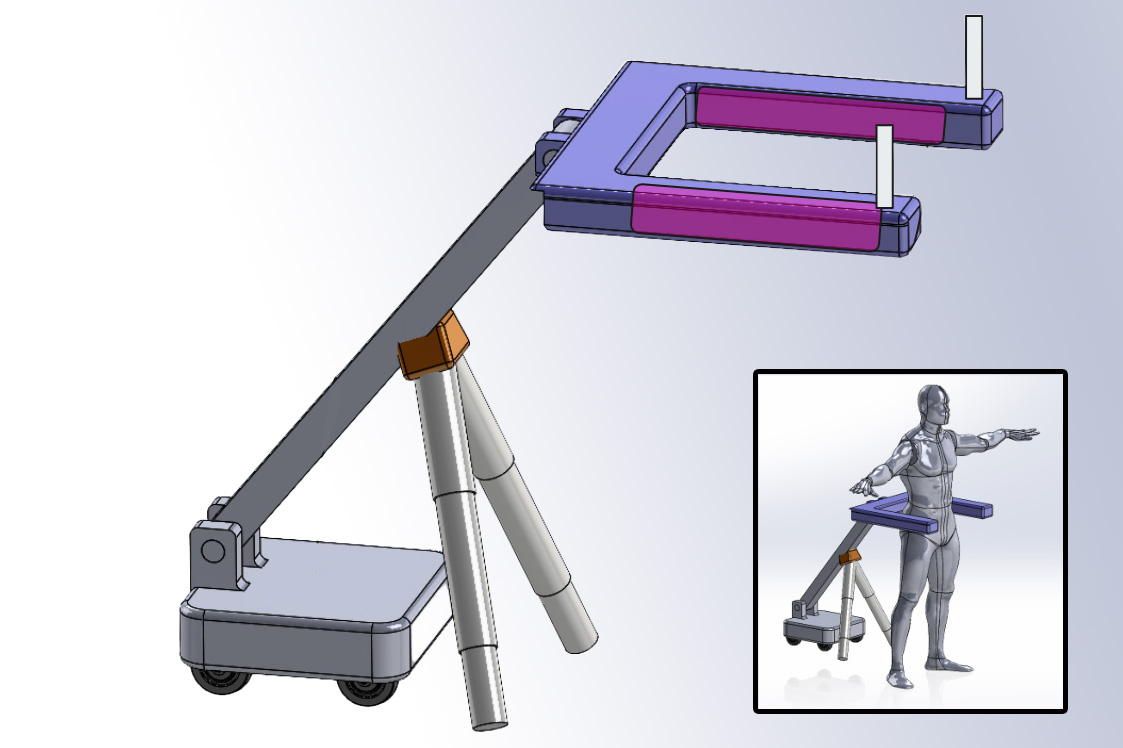
E-BAR acts as a set of robotic handlebars that follows a person from behind. A user can walk independently or lean on the robot’s arms for support. The robot can support the person’s full weight, lifting them from sitting to standing and vice versa along a natural trajectory. And the arms of the robot can them by rapidly inflating side airbags if they begin to fall.

With their design, the researchers hope to prevent falls, which today are the leading cause of injury in adults who are 65 and older. 

“Many older adults underestimate the risk of fall and refuse to use physical aids, which are cumbersome, while others overestimate the risk and may not to exercise, leading to declining mobility,” says Harry Asada, the Ford Professor of Engineering at MIT. “Our design concept is to provide older adults having balance impairment with robotic handlebars for stabilizing their body. The handlebars go anywhere and provide support anytime, whenever they need.”

In its current version, the robot is operated via remote control. In future iterations, the team plans to automate much of the bot’s functionality, enabling it to autonomously follow and physically assist a user. The researchers are also working on streamlining the device to make it slimmer and more maneuverable in small spaces.

“I think eldercare is the next great challenge,” says E-BAR designer Roberto Bolli, a graduate student in the MIT Department of Mechanical Engineering. “All the demographic trends point to a shortage of caregivers, a surplus of elderly persons, and a strong desire for elderly persons to age in place. We see it as an unexplored frontier in America, but also an intrinsically interesting challenge for robotics.”

Bolli and Asada will present a paper detailing the design of E-BAR at the IEEE Conference on Robotics and Automation (ICRA) later this month.

Asada’s group at MIT develops a variety of technologies and robotic aides to assist the elderly. In recent years, others have developed fall prediction algorithms, designed robots and automated devices including robotic walkers, wearable, self-inflating airbags, and robotic frames that secure a person with a harness and move with them as they walk.

In designing E-BAR, Asada and Bolli aimed for a robot that essentially does three tasks: providing physical support, preventing falls, and safely and unobtrusively moving with a person. What’s more, they looked to do away with any harness, to give a user more independence and mobility.

“Elderly people overwhelmingly do not like to wear harnesses or assistive devices,” Bolli says. “The idea behind the E-BAR structure is, it provides body weight support, active assistance with gait, and fall catching while also being completely unobstructed in the front. You can just get out anytime.”

The team looked to design a robot specifically for aging in place at home or helping in care facilities. Based on their interviews with older adults and their caregivers, they came up with several design requirements, including that the robot must fit through home doors, allow the user to take a full stride, and support their full weight to help with balance, posture, and transitions from sitting to standing.

The robot consists of a heavy, 220-pound base whose dimensions and structure were optimized to support the weight of an average human without tipping or slipping. Underneath the base is a set of omnidirectional wheels that allows the robot to move in any direction without pivoting, if needed. (Imagine a car’s wheels shifting to slide into a space between two other cars, without parallel parking.)

Extending out from the robot’s base is an articulated body made from 18 interconnected bars, or linkages, that can reconfigure like a foldable crane to lift a person from a sitting to standing position, and vice versa. Two arms with handlebars stretch out from the robot in a U-shape, which a person can stand between and lean against if they need additional support. Finally, each arm of the robot is embedded with airbags made from a soft yet grippable material that can inflate instantly to catch a person if they fall, without causing bruising on impact. The researchers believe that E-BAR is the first robot able to catch a falling person without wearable devices or use of a harness.

They tested the robot in the lab with an older adult who volunteered to use the robot in various household scenarios. The team found that E-BAR could actively support the person as they bent down to pick something up from the ground and stretched up to reach an object off a shelf — tasks that can be challenging to do while maintaining balance. The robot also was able to lift the person up and over the lip of a tub, simulating the task of getting out of a bathtub.

Bolli envisions a design like E-BAR would be ideal for use in the home by elderly people who still have a moderate degree of muscle strength but require assistive devices for activities of daily living.

“Seeing the technology used in real-life scenarios is really exciting,” says Bolli.

In their current paper, the researchers did not incorporate any fall-prediction capabilities in E-BAR’s airbag system. But another project in Asada’s lab, led by graduate student Emily Kamienski, has focused on developing algorithms with machine learning to control a new robot in response to the user’s real-time fall risk level.

Alongside E-BAR, Asada sees different technologies in his lab as providing different levels of assistance for people at certain phases of life or mobility.

“Eldercare conditions can change every few weeks or months,” Asada says. “We’d like to provide continuous and seamless support as a person’s disability or mobility changes with age.”

This work was supported, in part, by the National Robotics Initiative and the National Science Foundation.

Building a Winning Employee Development Strategy

0

As businesses move faster and change more often, employee development can’t be treated as a side project. Organizations must build talent as deliberately as they build products and services.

But too often, development efforts are outdated, disjointed, and disconnected from real business needs. The result? Confusion, wasted effort, and frustration—for employees who feel stuck, for managers who feel uncertain, and for leaders who can’t see the impact.

HR Trends Report: How personalized development will accelerate business growth in 2025 >>

Most companies still view development through a narrow lens—formal employee training, static learning paths, or one-off programs. But real career growth doesn’t happen in isolated workshops. It happens through everyday conversations, manager support, and continuous feedback aligned with employees’ development goals.

Growth should be dynamic, personalized, and aligned to what the business actually needs next. The problem is, employee development often comes with too much guesswork:

  • Who needs to grow?
  • In what ways?
  • How will we support that growth?
  • And how do we know if it’s working?

This guide will help you eliminate that uncertainty. We’ll walk through what effective, modern employee development looks like—what to prioritize, what to avoid, and how to make it a measurable driver of engagement, retention, and performance.

What is employee development?

Employee development is the ongoing process of improving an employee’s skills, capabilities, and career potential to drive individual and organizational success, helping individuals meet their career goals.

It includes both formal learning—like leadership training programs or professional development certifications—and informal growth opportunities, such as coaching, feedback, stretch assignments, and career pathing.

Traditional development approaches often fall short because they treat growth as separate from day-to-day work. We believe employee development should be:

  • Integrated into everyday conversations and workflows
  • Personalized to each employee’s role, goals, and strengths
  • Guided by managers, but also accessible independently
  • Measured for business impact

When development is approached this way, it becomes a powerful tool for building a future-ready workforce.

Why employee development matters

Employee development really isn’t optional. It’s the difference between organizations that will thrive tomorrow and those that won’t survive today. When organizations invest in meaningful growth opportunities, they transform their workforce into a competitive advantage that fuels innovation, agility, and performance.

Development-retain high performers

And the impact is clear:

Despite these clear benefits, most organizations still rely on outdated approaches. While 78% of executives say capability-building is essential to long-term success, only 30% believe their programs are effective. Too often, growth is treated as an afterthought—static, disconnected, and misaligned with real employee needs and business goals.

The stakes couldn’t be higher. 

With 88% of companies citing employee retention as a top concern—and learning and development ranking as their #1 strategy to keep top talent engaged—companies without a strong development strategy risk losing their best people and falling behind to competitors.

Winning organizations treat development not as a one-off initiative, but as a way of working. They build cultures where learning is continuous, personalized, and integrated into everyday workflows. They equip managers to support growth, help employees own their development, and align learning with evolving business needs.

In a world of accelerating change and shifting workforce expectations, talent development is no longer optional—it’s mission-critical.

Key components of an employee development program: growth without the guesswork

Effective employee development removes uncertainty. When done right, growth is clear, guided, and achievable. Employees know their next steps. Managers know how to support them. And organizations gain visibility into how development drives results.

Here’s some best practices on how to improve employee development and build a strategy that actually delivers. 

Clarify what success looks like

Too often, growth is unclear. Employees and managers don’t know what new skills are needed for the next step—because there’s no shared language for success.

You can create that shared language with competency or skills frameworks that define what good looks like across roles and levels. These frameworks connect development to real business needs and eliminate guesswork around what it takes to grow.

“We need to help leadership see that development isn’t just for development’s sake—it’s about preparing for the future. We often don’t know what skills we need until the moment they’re required.”

– Teresa Preister, Senior Insights Analyst at Quantum Workplace

Focusing on skills and capabilities—not just job titles—helps employees and organizations stay agile, responsive, and future-ready.

Empower employees to own their journey

Ownership of career development is often a point of tension. Leaders expect employees to drive their growth. Employees feel lost without direction. The truth? Both are right.

Employees need to own their journey—but organizations must make the path visible and support them along the way.

Guide employees through self-reflection to identify their strengths, goals, and motivations. Align those insights with timely opportunities and focus development around the skills and competencies that matter most for personal and business growth.

Embed growth into work

Development shouldn’t feel like extra work—it should feel like better, energizing, more aligned work.

“The most effective learning isn’t something employees have to find—it’s something that finds them,” says Meghan Freeman, Product Manager at Quantum Workplace.

The 70/20/10 model supports the idea that the majority of learning and development best happens in the day to day—not in the experiences that remove employees from their work:

  • 70% from on-the-job experiences and stretch assignments
  • 20% from coaching, mentoring, and collaboration
  • 10% from formal training

Support managers as growth catalysts

Most managers admittedly don’t know how to support employee growth. Many lack insight into their team members’ employee goals or confidence in their coaching abilities.

Turn managers into growth catalysts by equipping them with:

  • Visibility into employee strengths and aspirations
  • Tools and prompts for regular development conversations
  • Resources to connect business direction with skill-building

This support addresses a critical gap: over half of employees say they feel on their own when it comes to development—and 46% say their managers don’t know how to help.


Building an employee development strategy

A strong employee development strategy removes the guesswork. It gives employees clarity on how to grow, equips managers to support that growth, and shows organizations how development fuels business outcomes.

But building that strategy isn’t always straightforward. Many organizations face predictable challenges: vague expectations, inconsistent execution, or a lack of alignment between individual and organizational goals. The good news? These challenges are solvable with the right structure.

A modern development strategy should do five things:

  • Assess.
  • Personalize.
  • Operationalize.
  • Enable.
  • Measure.

Here’s how to build an employee growth strategy that works.

1. Assess future-focused needs.

Too often, development efforts are reactive—focused only on today’s skills. To stay competitive, you need to understand what your organization and employees will need next.

Conduct a forward-looking needs assessment by:

  • Using surveys, interviews, and performance data to identify critical skill sets and capabilities needed to deliver on business strategy and goals
  • Mapping current skills against future workforce needs
  • Prioritizing high-impact development areas aligned with organizational goals

This ensures your strategy is grounded in real insight—not assumptions.

Tip: Start small. Pilot your development strategy in a key function or team before rolling out company-wide.

2. Personalize the growth journey.

Development should energize—not feel like another obligation. A one-size-fits-all approach won’t work for today’s workforce. Instead, guide employees through a journey that connects personal aspirations with business priorities.

Move from intention to impact with this progression:

  • Good: Informal self-reflection exercises to help employees surface strengths, interests, and goals
  • Better: Structured career conversations between employees and managers
  • Best: An integrated approach that aligns aspirations, competencies, and business needs

When employees can see themselves in the future of your organization, they’re more engaged—and more likely to stay.

Tip: Co-create development plans with employees—don’t build them behind closed doors. When employees shape their own paths, motivation and ownership follow.

3. Operationalize cadence and culture.

Even the best growth plans stall without consistency. Development needs structure, not spontaneity. Build momentum by weaving it into the rhythms of work.

Operationalize development by:

  • Scheduling quarterly career conversations focused on reflection and progress
  • Creating touch points between formal reviews to reinforce goals
  • Embedding development check-ins into existing 1:1s and team meetings
  • Encouraging project-based growth opportunities tied to business goals

Development should feel like part of how work gets done—not an extra task.

4. Equip your teams with effective tools and training.

Your strategy is only as strong as the support behind it. To make growth scalable and sustainable, enable the people and systems that bring it to life.

  • Train managers to have effective growth conversations, spot development opportunities, and coach with confidence
  • Give employees access to frameworks and tools that help them explore, plan, and track their growth
  • Leverage technology to streamline workflows, reduce admin, and provide visibility into development across teams

Without the right support, even the best strategy becomes guesswork.

5. Measure what matters.

Many HR teams struggle to prove the value of development. That’s because they focus on program stats, not business outcomes. To earn lasting buy-in, you must prove that development drives results. That means measuring outcomes—not just activity.

Track impact using metrics leaders care about:

  • Engagement scores before and after development efforts
  • Internal mobility and promotion readiness
  • Skill acquisition linked to strategic needs
  • Manager effectiveness in enabling growth
  • Retention rates for top talent

When you connect learning to business performance, development becomes a strategic imperative—not a line item.

Bottom line: An effective strategy doesn’t just define what development should be—it makes it actionable, measurable, and scalable. By combining structure, personalization, enablement, and data, you create a culture of growth that’s built to last.

The importance of employee development to business success

Strategic development isn’t just about program participation, but about creating measurable business impact. The key is measurement. When you show how growth directly impacts business outcomes, development earns leadership support and becomes essential to organizational success.

Boosting employee engagement through growth

Employees are most engaged when they feel they’re growing. Development satisfies core psychological needs for progress and purpose—and engaged employees are more productive, innovative, and loyal. To enhance this engagement, seek employee feedback, and track the connection between development efforts and engagement score improvements. This shows how learning investments drive day-to-day performance.

Improving employee retention and reducing turnover costs

Development is one of the most effective ways to retain top talent, especially in uncertain markets. The cost of turnover is high, both financially and culturally. Track retention rates by department, role, and tenure to show where development is making the biggest difference. When employees see growth opportunities, they tend to stay.

Building organizational capability at scale

High performers can be up to 400% more productive than average employees, and in complex roles, that gap can get to 800%. Monitor team and individual skill growth against your competency frameworks to show how development strengthens business-critical capabilities. This directly links learning to performance, agility, and future readiness.

Internal mobility as a proof point

When development works, talent moves. High-performing organizations create ecosystems where employees can grow into new roles—lateral or upward—based on their skills and aspirations.

As Nicole Davies, Chief People Officer at Valet Living, shares, “Our competency-based approach has expanded employees’ view of opportunity beyond their immediate career ladder. In 2024 alone, 43% of our employees moved into new roles—whether through a lateral shift or a promotion.” 

Track internal mobility as a leading indicator of development success—and a signal that your organization is growing talent from within.

Strategic measurement transforms employee development from a cost center into a competitive advantage. By connecting growth to key business outcomes—like engagement, retention, performance, and mobility—you replace guesswork with insight. When you regularly review these indicators and optimize accordingly, you don’t just invest in employee growth—you accelerate business success.

Transform employee growth with the right employee development tools

Technology should do more than track training. It should personalize growth at scale, surface opportunities daily—not just during reviews—make manager support easier, and connect development to business impact.

Quantum Workplace’s employee development platform is built for that purpose. It’s a powerful engine for continuous, meaningful growth across your organization.

Here’s how each component eliminates guesswork and empowers action.

quantum workplace employee growth plans employee development platform

Help employees see clear career paths

Career Vision guides employees through reflective questions about their skills, motivations, and goals. AI instantly translates those insights into a personalized roadmap that outlines where they are, where they want to go, and how to get there.

No more vague development plans—just clear direction for meaningful conversations between employees and managers.

Focus talent development where it matters

Growth Areas uses AI and customizable competency frameworks to pinpoint exactly where employees should focus. Employees can tailor their growth paths to align with both personal aspirations and organizational priorities. This ensures development time is spent on what matters most—building the right skills for the right reasons.

Convert aspirations into achievements

Plan Actions helps employees move from intention to execution. With customizable steps, due dates, and progress tracking, development becomes visible and manageable. This momentum-building tool transforms abstract goals into real, trackable wins.

Provide personalized guidance, always on

Career Coach delivers smart, role-specific action recommendations based on each employee’s professional goals and context. AI-powered suggestions adapt over time and complement manager coaching—so every employee has access to tailored development support without overloading leadership.

Illuminate internal career paths & growth opportunities

Job Explorer reveals potential career moves across the organization and outlines what success looks like in each role. This clarity reduces career uncertainty and boosts retention by helping employees grow within your company—not out of it.

Easily map competencies to roles

HR teams and admins use Competency Mapping to build or import role-based skill frameworks that tie development to performance. AI-driven mapping accelerates setup and ensures all development is grounded in business priorities—no spreadsheets required.

Give people leaders visibility and context 

Team Plans gives managers and admins a holistic view of team growth activity. They can spot trends, address skill gaps early, and align development with team performance goals. This shifts managers from reactive support roles into proactive development leaders.

Connect growth plans to relevant, real-time learning

Learning Resources surface curated articles, courses, and training materials right where employees are working on their development. HR teams can attach content to specific competencies or proficiency levels, helping employees access the right learning at the right time.

By integrating resources directly into Growth Plans, employees no longer have to search for support—personalized learning finds them. This makes development more actionable and continuous, while maximizing the value of your existing content.

Make development part of continuous talent conversations

Growth in Snapshot brings employee development into the spotlight during key talent moments—like 1-on-1s, Talent Reviews, and Performance Reviews. Managers and HR leaders can quickly see an employee’s competencies, career vision, and progress on their Growth Plan, all in one place.

This visibility ensures development stays part of the conversation, helping organizations align talent decisions with employee aspirations and drive more strategic growth across the business

With Quantum Workplace, growth is no longer a guessing game. Every employee sees their path, every manager knows how to help, and every leader can connect development to business outcomes. It’s development done right—personalized, scalable, and built for impact.

  • Create tailored career paths and development plans
  • Identify and close critical skill gaps
  • Fuel employee & manager career conversations
  • Track development progress and measure impact

Take the guesswork out of employee growth & development >>

Start by aligning your development strategy with business priorities. Conduct a skills and capability needs assessment to identify current gaps and future demands. From there, build personalized growth plans that support both organizational goals and individual aspirations. Set clear objectives, timelines, and success metrics to ensure accountability and momentum.

Employee development is a business-critical investment—not just an HR initiative. It drives higher employee engagement, stronger performance, and better retention. When organizations offer continuous learning and growth opportunities, they build a more agile, motivated, and future-ready workforce.

Effective employee development spans both technical and soft skills to prepare future leaders. Core areas often include leadership skills and capabilities, role-specific competencies, communication, critical thinking, and adaptability. Prioritize the skills that align with your business goals and empower employees to grow in their current roles—or prepare for future ones.

Begin with a skills gap analysis to understand where each employee stands and what they need to grow. Align individual goals with organizational needs, and use SMART goals to set a clear path forward. Outline development activities, assign resources, and establish regular check-ins to track progress and keep momentum going.

Ping pong bot returns shots with high-speed precision | MIT News

0

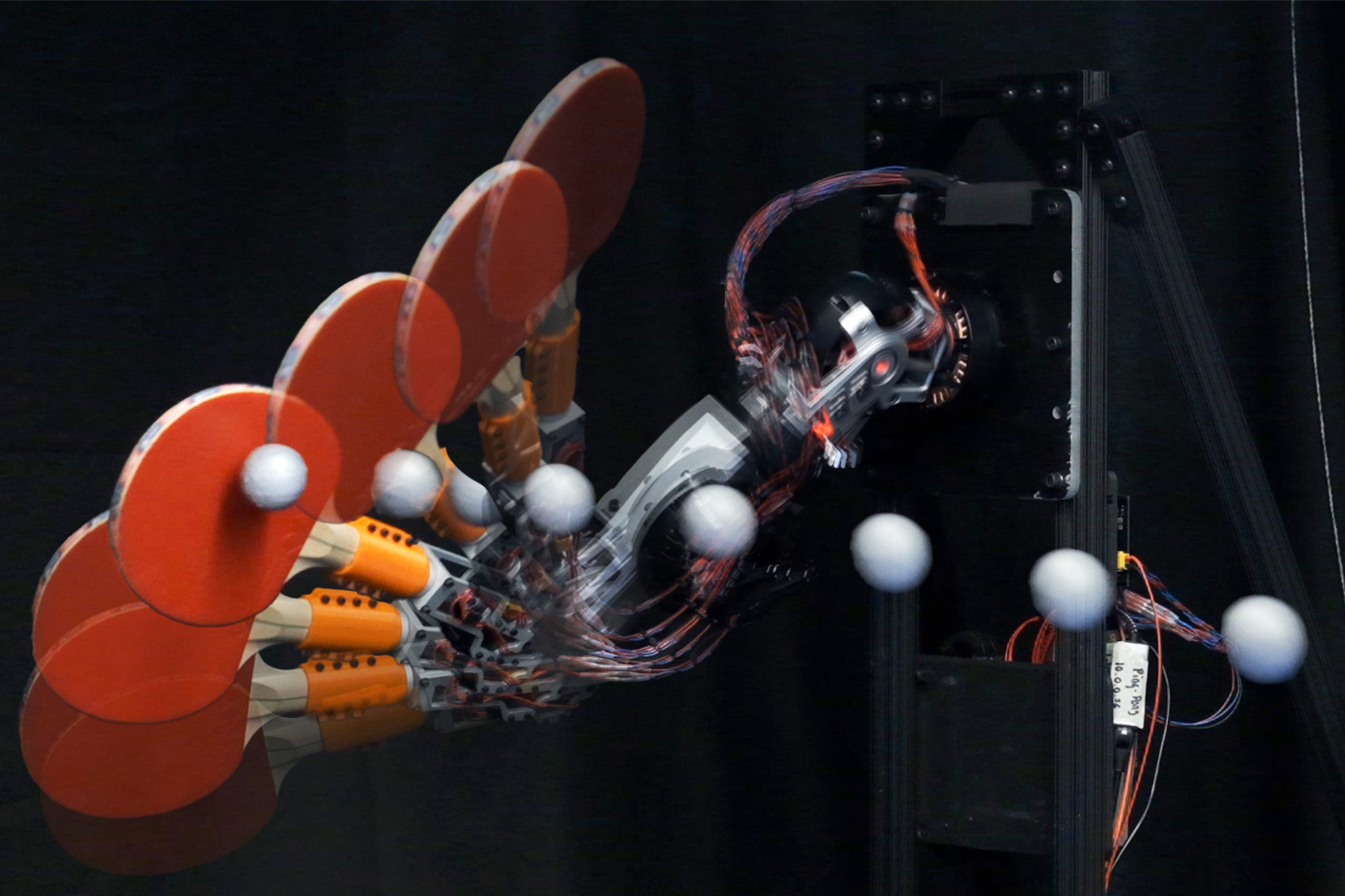
MIT engineers are getting in on the robotic ping pong game with a powerful, lightweight design that returns shots with high-speed precision.

The new table tennis bot comprises a multijointed robotic arm that is fixed to one end of a ping pong table and wields a standard ping pong paddle. Aided by several high-speed cameras and a high-bandwidth predictive control system, the robot quickly estimates the speed and trajectory of an incoming ball and executes one of several swing types — loop, drive, or chop — to precisely hit the ball to a desired location on the table with various types of spin.

In tests, the engineers threw 150 balls at the robot, one after the other, from across the ping pong table. The bot successfully returned the balls with a hit rate of about 88 percent across all three swing types. The robot’s strike speed approaches the top return speeds of human players and is faster than that of other robotic table tennis designs.

Now, the team is looking to increase the robot’s playing radius so that it can return a wider variety of shots. Then, they envision the setup could be a viable competitor in the growing field of smart robotic training systems.

Beyond the game, the team says the table tennis tech could be adapted to improve the speed and responsiveness of humanoid robots, particularly for search-and-rescue scenarios, and situations in a which a robot would need to quickly react or anticipate.

“The problems that we’re solving, specifically related to intercepting objects really quickly and precisely, could potentially be useful in scenarios where a robot has to carry out dynamic maneuvers and plan where its end effector will meet an object, in real-time,” says MIT graduate student David Nguyen.

Nguyen is a co-author of the new study, along with MIT graduate student Kendrick Cancio and Sangbae Kim, associate professor of mechanical engineering and head of the MIT Biomimetics Robotics Lab. The researchers will present the results of those experiments in a paper at the IEEE International Conference on Robotics and Automation (ICRA) this month.

Precise play

Building robots to play ping pong is a challenge that researchers have taken up since the 1980s. The problem requires a unique combination of technologies, including high-speed machine vision, fast and nimble motors and actuators, precise manipulator control, and accurate, real-time prediction, as well as higher-level planning of game strategy.

“If you think of the spectrum of control problems in robotics, we have on one end manipulation, which is usually slow and very precise, such as picking up an object and making sure you’re grasping it well. On the other end, you have locomotion, which is about being dynamic and adapting to perturbations in your system,” Nguyen explains. “Ping pong sits in between those. You’re still doing manipulation, in that you have to be precise in hitting the ball, but you have to hit it within 300 milliseconds. So, it balances similar problems of dynamic locomotion and precise manipulation.”

Ping pong robots have come a long way since the 1980s, most recently with designs by Omron and Google DeepMind that employ artificial intelligence techniques to “learn” from previous ping pong data, to improve a robot’s performance against an increasing variety of strokes and shots. These designs have been shown to be fast and precise enough to rally with intermediate human players.

“These are really specialized robots designed to play ping pong,” Cancio says. “With our robot, we are exploring how the techniques used in playing ping pong could translate to a more generalized system, like a humanoid or anthropomorphic robot that can do many different, useful things.”

Game control

For their new design, the researchers modified a lightweight, high-power robotic arm that Kim’s lab developed as part of the MIT Humanoid — a bipedal, two-armed robot that is about the size of a small child. The group is using the robot to test various dynamic maneuvers, including navigating uneven and varying terrain as well as jumping, running, and doing backflips, with the aim of one day deploying such robots for search-and-rescue operations.

Each of the humanoid’s arms has four joints, or degrees of freedom, which are each controlled by an electrical motor. Cancio, Nguyen, and Kim built a similar robotic arm, which they adapted for ping pong by adding an additional degree of freedom in the wrist to allow for control of a paddle.

The team fixed the robotic arm to a table at one end of a standard ping pong table and set up high-speed motion capture cameras around the table to track balls that are bounced at the robot. They also developed optimal control algorithms that predict, based on the principles of math and physics, what speed and paddle orientation the arm should execute to hit an incoming ball with a particular type of swing: loop (or topspin), drive (straight-on), or chop (backspin).

They implemented the algorithms using three computers that simultaneously processed camera images, estimated a ball’s real-time state, and translated these estimations to commands for the robot’s motors to quickly react and take a swing.

After consecutively bouncing 150 balls at the arm, they found the robot’s hit rate, or accuracy of returning the ball, was about the same for all three types of swings: 88.4 percent for loop strikes, 89.2 percent for chops, and 87.5 percent for drives. They have since tuned the robot’s reaction time and found the arm hits balls faster than existing systems, at velocities of 20 meters per second.

In their paper, the team reports that the robot’s strike speed, or the speed at which the paddle hits the ball, is on average 11 meters per second. Advanced human players have been known to return balls at speeds of between 21 to 25 meters second. Since writing up the results of their initial experiments, the researchers have further tweaked the system, and have recorded strike speeds of up to 19 meters per second (about 42 miles per hour).

“Some of the goal of this project is to say we can reach the same level of athleticism that people have,” Nguyen says. “And in terms of strike speed, we’re getting really, really close.”

Their follow-up work has also enabled the robot to aim. The team incorporated control algorithms into the system that predict not only how but where to hit an incoming ball. With its latest iteration, the researchers can set a target location on the table, and the robot will hit a ball to that same location.

Because it is fixed to the table, the robot has limited mobility and reach, and can mostly return balls that arrive within a crescent-shaped area around the midline of the table. In the future, the engineers plan to rig the bot on a gantry or wheeled platform, enabling it to cover more of the table and return a wider variety of shots.

“A big thing about table tennis is predicting the spin and trajectory of the ball, given how your opponent hit it, which is information that an automatic ball launcher won’t give you,” Cancio says. “A robot like this could mimic the maneuvers that an opponent would do in a game environment, in a way that helps humans play and improve.”

This research is supported, in part, by the Robotics and AI Institute.

System lets robots identify an object’s properties through handling | MIT News

0

A human clearing junk out of an attic can often guess the contents of a box simply by picking it up and giving it a shake, without the need to see what’s inside. Researchers from MIT, Amazon Robotics, and the University of British Columbia have taught robots to do something similar.

They developed a technique that enables robots to use only internal sensors to learn about an object’s weight, softness, or contents by picking it up and gently shaking it. With their method, which does not require external measurement tools or cameras, the robot can accurately guess parameters like an object’s mass in a matter of seconds.

This low-cost technique could be especially useful in applications where cameras might be less effective, such as sorting objects in a dark basement or clearing rubble inside a building that partially collapsed after an earthquake.

Key to their approach is a simulation process that incorporates models of the robot and the object to rapidly identify characteristics of that object as the robot interacts with it. 

The researchers’ technique is as good at guessing an object’s mass as some more complex and expensive methods that incorporate computer vision. In addition, their data-efficient approach is robust enough to handle many types of unseen scenarios.

“This idea is general, and I believe we are just scratching the surface of what a robot can learn in this way. My dream would be to have robots go out into the world, touch things and move things in their environments, and figure out the properties of everything they interact with on their own,” says Peter Yichen Chen, an MIT postdoc and lead author of a paper on this technique.

His coauthors include fellow MIT postdoc Chao Liu; Pingchuan Ma PhD ’25; Jack Eastman MEng ’24; Dylan Randle and Yuri Ivanov of Amazon Robotics; MIT professors of electrical engineering and computer science Daniela Rus, who leads MIT’s Computer Science and Artificial Intelligence Laboratory (CSAIL); and Wojciech Matusik, who leads the Computational Design and Fabrication Group within CSAIL. The research will be presented at the International Conference on Robotics and Automation.

Sensing signals

The researchers’ method leverages proprioception, which is a human or robot’s ability to sense its movement or position in space.

For instance, a human who lifts a dumbbell at the gym can sense the weight of that dumbbell in their wrist and bicep, even though they are holding the dumbbell in their hand. In the same way, a robot can “feel” the heaviness of an object through the multiple joints in its arm.

“A human doesn’t have super-accurate measurements of the joint angles in our fingers or the precise amount of torque we are applying to an object, but a robot does. We take advantage of these abilities,” Liu says.

As the robot lifts an object, the researchers’ system gathers signals from the robot’s joint encoders, which are sensors that detect the rotational position and speed of its joints during movement. 

Most robots have joint encoders within the motors that drive their moveable parts, Liu adds. This makes their technique more cost-effective than some approaches because it doesn’t need extra components like tactile sensors or vision-tracking systems.

To estimate an object’s properties during robot-object interactions, their system relies on two models: one that simulates the robot and its motion and one that simulates the dynamics of the object.

“Having an accurate digital twin of the real-world is really important for the success of our method,” Chen adds.

Their algorithm “watches” the robot and object move during a physical interaction and uses joint encoder data to work backward and identify the properties of the object.

For instance, a heavier object will move slower than a light one if the robot applies the same amount of force.

Differentiable simulations

They utilize a technique called differentiable simulation, which allows the algorithm to predict how small changes in an object’s properties, like mass or softness, impact the robot’s ending joint position. The researchers built their simulations using NVIDIA’s Warp library, an open-source developer tool that supports differentiable simulations.

Once the differentiable simulation matches up with the robot’s real movements, the system has identified the correct property. The algorithm can do this in a matter of seconds and only needs to see one real-world trajectory of the robot in motion to perform the calculations.

“Technically, as long as you know the model of the object and how the robot can apply force to that object, you should be able to figure out the parameter you want to identify,” Liu says.

The researchers used their method to learn the mass and softness of an object, but their technique could also determine properties like moment of inertia or the viscosity of a fluid inside a container.

Plus, because their algorithm does not need an extensive dataset for training like some methods that rely on computer vision or external sensors, it would not be as susceptible to failure when faced with unseen environments or new objects.

In the future, the researchers want to try combining their method with computer vision to create a multimodal sensing technique that is even more powerful.

“This work is not trying to replace computer vision. Both methods have their pros and cons. But here we have shown that without a camera we can already figure out some of these properties,” Chen says.

They also want to explore applications with more complicated robotic systems, like soft robots, and more complex objects, including sloshing liquids or granular media like sand.

In the long run, they hope to apply this technique to improve robot learning, enabling future robots to quickly develop new manipulation skills and adapt to changes in their environments.

“Determining the physical properties of objects from data has long been a challenge in robotics, particularly when only limited or noisy measurements are available. This work is significant because it shows that robots can accurately infer properties like mass and softness using only their internal joint sensors, without relying on external cameras or specialized measurement tools,” says Miles Macklin, senior director of simulation technology at NVIDIA, who was not involved with this research.

This work is funded, in part, by Amazon and the GIST-CSAIL Research Program.

HR Trends 2025 | Top HR Priorities, Insights, & Strategies

0

HR has earned its seat at the table. But in 2025, that seat comes with sharper scrutiny and higher expectations than ever before.

Today’s HR leaders face growing pressure to deliver measurable impact—solving complex workforce challenges, driving performance, and aligning people strategies with business outcomes.

Budgets are leaner. Executive expectations are rising. The demand for strategic, future-focused HR leadership has never been greater.

The opportunity is clear: 2025 is the year for HR to lead with clarity, agility, and influence.

In Quantum Workplace’s 2025 Workplace Trends Report, we explore seven top HR trends reshaping the future of work.

Each trend is evaluated across three critical dimensions—business impact, HR readiness, and decision-making power—to help you prioritize what matters most.

Here’s a look at the key HR trends for 2025—and how they can help you elevate your impact this year.

➡️ For deeper insight and action steps, download the full report.


HR Trend #1: Culture and strategy must move into alignment.

In 2025, culture and business strategy must move in tandem. When culture fuels leadership behaviors, decision-making, and employee experiences, organizations drive clarity, engagement, and growth. When culture drifts, even the strongest companies risk misalignment and disengagement.


Hardwiring Culture Into Daily Decisions 

A company’s culture isn’t defined by posters or mission statements—it’s reflected in the decisions leaders make, how teams work, and how employees are recognized. Embedding culture into daily operations ensures it stays real, credible, and connected to business outcomes. 

Everyone Must Activate on Culture 

Culture is a shared responsibility. Executives must model it, managers must reinforce it, employees must live it, and HR must enable it. Without shared ownership at every level, culture becomes hollow—and loses its power to drive engagement and retention. 

Evolving Culture as Your Business Evolves 

Culture must grow and adapt as an organization scales, enters new markets, or shifts direction. Leaders must intentionally guide culture’s evolution or risk having it shaped by external pressures, disengagement, or leadership turnover. 

Key Stats: 


HR Trend #2: Transformation depends on employee belief.

hr trends change management trends


Change isn’t a disruption to manage—it’s a force to harness. In 2025, the success of transformation efforts will depend less on flawless strategies and more on building employee belief. When people feel heard, prepared, and connected to the “why” behind change, they don’t just tolerate disruption—they drive momentum forward. 


Engaging Managers as Champions, Not Conduits 

Managers are the bridge between leadership’s vision and employees’ daily reality. When they’re engaged early and equipped to lead through change—not just relay information—employees gain clarity, trust, and belief in the transformation ahead. 

Connecting Change to Culture 

Change efforts gain strength when they’re clearly linked to an organization’s values and purpose. When transformation feels aligned with culture, employees are more likely to trust leadership’s direction. When change—especially constant change—contradicts stated values, trust and engagement rapidly erode. 

Conversing Through All Stages of Change 

Change is a process, not a single announcement. Sustained conversation—before, during, and after a shift—is critical to building belief. Employees need regular updates, honest context, and opportunities to ask questions and offer feedback along the way. 

Key Stats:


HR Trend #3: Retention strategy moves from response to prevention.

hr trends employee retention trends


The job market may be unpredictable, but your retention strategy shouldn’t be. In 2025, winning organizations will stop reacting to turnover after the fact and start predicting and preventing it—using data-driven insights, focused action plans, and manager empowerment to keep critical talent engaged and growing in the new world of work. 

From Awareness to Action: The Power of Prediction 

Retention starts before employees ever consider leaving. Leading organizations are using predictive analytics, engagement trends, and early warning signals to spot risks—and act before top performers walk out the door. 

Zeroing in on Top Talent 

Not every departure is a crisis. But losing high-impact talent—those in critical roles, top performers, and deeply knowledgeable employees—can derail teams and business outcomes. Targeted retention efforts must focus where they matter most. 

Feedback is the Fuel that Ignites Retention Strategy 

Assumptions don’t prevent turnover—listening does. Organizations that consistently gather and act on employee feedback can spot brewing disengagement, uncover growth gaps, and reinforce the loyalty of their most valuable people. 

Swift and Shared Action is Key 

Retention isn’t just HR’s job—it’s a business priority. Equipping managers with real-time insights and clear playbooks allows them to make timely interventions, building a culture of shared accountability for engagement and retention. 

Key Stats:


HR Trend #4: Personalized employee development accelerates growth 

hr trends employee development trends


The future belongs to organizations that build talent as aggressively as they build products. In 2025, generic training programs won’t cut it—employees expect dynamic, personalized growth that connects to their work, career aspirations, and business goals. Organizations that deliver will drive innovation, engagement, and retention.


Grow Your Talent, Grow Your Business 

Winning companies treat growth as a business imperative. Structured, flexible development opportunities, tied to business priorities, help employees stay engaged, prepared, and invested in their future within the organization. 

Development Without Disruption: Growth in the Flow of Work 

Learning that’s embedded into daily work—not isolated from it—sticks. Integrating real-time coaching, skills development, and applied learning into everyday workflows ensures growth happens naturally and drives immediate business value. 

Employee-Owned, Organization-Supported 

Employees want ownership of their growth, but they can’t do it alone. Organizations must level the playing field by providing visible pathways, equipping managers to coach, and championing internal mobility. 

Don’t Limit Development to Linear Pathways 

Growth isn’t just about promotions—it’s about new skills, lateral moves, and cross-functional experiences. Organizations that celebrate all forms of internal movement build more resilient, adaptable teams. 

Technology Makes Growth Personal—and Possible 

Generative AI is transforming employee development from one-size-fits-all to one-size-for-one. Personalized roadmaps, real-time nudges, and democratized access to opportunity help every employee grow—not just the “high potentials.” 

Key Stats:


HR Trend #5: Fewer layers, higher stakes: better managers are key 

hr trends manager effectiveness trends

In 2025, managers are the critical bridge between business strategy and daily execution—but many are stretched too thin. As organizations flatten structures and expand team sizes, investing in manager capability, support, and enablement will be essential to drive engagement, performance, and growth. 


Overloaded Managers Aren’t Scaling 

Manager workloads have exploded without enough structural support. Without the time, tools, and focus needed to coach and lead effectively, managers—and their teams—struggle to perform and grow. 

Management Is a Capability, Not a Role 

Leadership isn’t an automatic outcome of promotion—it’s a skill set that must be cultivated. Successful organizations treat management as a capability requiring continuous development, coaching, and strategic support. 

Doubling Down on Rebuilding Your Leadership Pipeline 

With one of the largest generational shifts in workplace history underway, building future-ready leaders is critical. Succession planning and workforce management must evolve to reflect today’s flexible career paths, employee expectations, and rapidly changing business needs. 

AI and Technology Are Manager Multipliers (Not Replacements) 

AI use isn’t replacing managers—it’s empowering them. And employees still need a human touch. Technology that streamlines administrative work and offers real-time insights allows managers to focus on leadership, coaching, and decision-making where it matters most. 

Key Stats:


HR Trend #6: Stop managing performance—start enabling it 

hr trends performance management trends


Performance management should be a catalyst, not a chore. In 2025, organizations must move beyond rigid cycles and backward-looking ratings and performance reviews to focus on real-time coaching, growth, and momentum. When done right, performance management fuels both individual development and business acceleration. 


Momentum Over Measurement 

When performance management focuses too much on tracking and rating, momentum stalls. Treating performance as a value exchange—where employees grow and businesses sharpen execution—creates clarity, agility, and trust. 

Raising Up “3D” Managers: Discerning, Developing, Disciplined 

Performance succeeds or fails through managers. Organizations must equip managers to discern true performance, develop their people through coaching, and maintain daily discipline around conversations that fuel engagement and growth. 

Forget the Silver Bullet: There’s Only Smarter Execution 

There’s no perfect process. Forward-thinking organizations focus on simplifying systems, refining daily habits, and evolving performance management based on real employee feedback—not just adding new layers of complexity. 

Key Stats:


HR Trend #7: HR tech must earn its place as a strategic driver 

hr trends hr technology trends


In 2025, HR technology must do more than automate HR processes—it must actively accelerate people strategies. Too many HR teams are trapped by clunky, misaligned systems that drain time, block insights, and weaken impact. Winning organizations will invest in technology that drives engagement, powers smarter decisions, and fuels business growth. 

Filter for Strategic Impact 

HR tech decisions must prioritize impact, not just cost savings. Purpose-built platforms empower HR to lead with data, drive engagement, and align employee experience with business goals—while over-consolidated, rigid systems stall momentum. 

Beware of Hidden Costs That Undermine Impact 

Cheap or overly consolidated systems often come at a hidden price: poor adoption, fragmented data, wasted time, and weakened credibility. High-performing organizations know true ROI comes from effectiveness, not just expense reduction. 

Adoption and Trust Are Key Levers for Value 

Even the best tech fails without intentional adoption strategies. To build trust and drive engagement, HR must choose user-friendly platforms, embed them into daily workflows, reinforce confidentiality, and clearly connect tech usage to positive outcomes for employees and managers alike, ultimately enhancing the company’s bottom line. 

Key Stats:


The Future of HR Leadership Starts Now 

The trends shaping 2025 aren’t just new challenges to navigate—they’re opportunities for HR professionals to lead. These HR priorities for 2025 signal a major shift toward proactive, strategic HR leadership and smarter talent management. 

Organizations that align culture and strategy, enable real growth, empower managers, and harness the right technology will be the ones that drive lasting impact. 

This is a pivotal moment for HR to move from reactive to strategic, from supportive to essential. And the organizations that invest in their people—and their potential—will be the ones that thrive. 

Ready to dive deeper into the strategies, insights, and action steps behind these trends? 

👉 Download the full 2025 Workplace Trends Report and lead the future of work. 


FAQs About HR Trends in 2025 


What are the biggest HR trends for 2025?

In 2025, HR trends include aligning culture and strategy, building employee belief, proactive retention, personalized development, modern performance enablement, manager empowerment, and smarter HR tech. 

Why are HR trends important?

HR trends help organizations stay competitive by aligning people strategies with evolving business needs, improving employee engagement, and driving better performance outcomes. 

How is technology influencing HR trends today? 

Technology is revolutionizing HR trends by streamlining processes, enhancing employee engagement, and utilizing data analytics for informed decision-making. Tools like AI-driven recruitment platforms and performance management systems enable HR professionals to focus on strategic initiatives while improving overall efficiency and employee satisfaction in the workplace.