Home Blog Page 56

Tips for Easy & Effective Action

0

Creating a thriving workplace where employees are engaged, motivated, and committed is a top priority for most organizations. But you can’t improve employee engagement through surveys alone.

Real employee engagement is built through action: meaningful conversations, visible improvements, and a culture where feedback fuels growth. Surveys are only the starting line.

In this comprehensive guide, we explore the art and science of easy (and effective) employee engagement action planning.

You’ll learn how to turn employee survey insights into impactful changes, engage your team in meaningful discussions, and leverage advanced tools to drive success. Because when organizations move from measuring engagement to improving it, they build workplaces where people and performance thrive together.

What is an employee engagement action plan?

An employee engagement action plan is a strategic framework that outlines specific steps and initiatives an organization intends to take based on the results of employee engagement surveys. It aims to enhance employee engagement by addressing key areas impacting engagement at your organization.

Action plans are designed to improve the overall employee experience and boost organizational performance by translating employee feedback into actionable changes.

At its core, an employee engagement action plan helps you move from insight to impact — quickly, clearly, and with accountability.

Key components of an effective employee engagement action plan include:

  • Clear priorities. Focus on the most critical areas for improvement based on survey data and organizational goals.
  • Targeted actions. Develop concrete strategies that address root causes, not just symptoms.
  • Assigned ownership. Define exactly who is responsible for driving each action forward.
  • Realistic timelines. Set deadlines that are ambitious enough to build momentum — and achievable enough to maintain it.
  • Progress tracking. Use simple tools to monitor implementation, measure results, and adjust as needed.
  • Communication plan. Share progress early and often to increase transparency, build trust, and keep engagement top of mind.

What are the benefits of an employee engagement action plan?

Implementing an employee engagement action plan isn’t just best practice — it’s a strategic advantage. Organizations that take visible, consistent action on employee feedback are stronger, more resilient, and more attractive to top talent. Here’s why action planning matters:

1. Action planning improves employee engagement.

Action, not measurement, is what moves the needle. Our research shows employees are 12X more likely to be highly engaged when they see their feedback turn into meaningful change — yet two-thirds believe their organizations fall short in following through. A clear action plan bridges that gap and shows employees their voices matter.

2. Action planning builds trust and credibility.

Surveys without action erode trust. But when organizations act visibly and consistently, they send a powerful message: feedback leads to change. Over time, this reinforces a culture where employees feel heard, valued, and invested — strengthening credibility across all levels.

3. Action planning enhances organizational culture.

Feedback isn’t just about fixing problems — it’s a window into how culture is lived (or not lived) across the organization. Action plans help leaders reinforce values, close culture gaps, and evolve the employee experience in ways that align with business goals.

4. Action planning increases employee retention.

When organizations act on what matters — career growth, communication, pay and benefits — they earn employee loyalty. Employees who see action are more likely to stay, driving down costly turnover and preserving institutional knowledge.

5. Action planning empowers data-driven decision making.

An engagement action plan is a blueprint for smarter leadership. It helps organizations translate feedback into clear priorities, allocate resources effectively, and measure progress — connecting people strategies directly to business outcomes.

6. Action planning enhances communication.

One of the biggest barriers to post-survey success is communication breakdown. Action planning forces organizations to prioritize transparency: sharing what’s being done, why it matters, and how employees can be part of the solution — keeping momentum alive.

7. Action planning holds leaders accountable.

Engagement isn’t an HR initiative — it’s a leadership responsibility. Organizations with involved, accountable leaders see stronger results after surveys. Action planning gives leaders a clear framework for investing in their people and demonstrating that engagement is a business priority, not a side project.


Who is responsible for employee engagement action planning?

Everyone plays a role in employee engagement—that includes providing feedback, generating ideas for improvement, and taking action. While senior leaders and HR leaders set the strategic direction, managers and employees at all levels actively participate in the process. 

By working together, your team can ensure survey feedback is translated into meaningful actions that enhance engagement and contribute to a thriving workplace culture. Buy-in is critical, as lack of time, resource, and prioritization represents the largest barrier to taking effective action on surveys at 21%.

Let’s break down the roles in more detail.

The role of senior leaders in action planning

Senior leaders are primarily responsible for setting the tone and direction of engagement initiatives. According to our research, 76% of employees believe that senior leaders are solely responsible for taking action on surveys

And while it’s true that leaders should champion engagement efforts, allocate resources, and communicate the importance of engagement to the entire organization, the responsibility has to fall on more than their shoulders.

Effective leadership involvement means:  

  • Sharing why engagement action planning matters  
  • Jumping into results reviews and prioritization sessions  
  • Being a visible supporter and champion for improvement efforts  
  • Keeping everyone in the loop with regular progress updates

The role of HR Leaders in action planning

Human Resources (HR) leaders are integral to the action planning process. And that’s no surprise! The HR department is the ideal team to initiate and oversee engagement surveys, collect and analyze data, and play a central role in the design and execution of action plans. 

HR leaders also communicate the survey results, action plan progress, and the rationale behind specific actions to employees.

Key HR functions include:  

  • Designing effective surveys that capture quality insight
  • Analyzing results to uncover key themes and insights that matter  
  • Creating a clear action planning process that everyone can follow  
  • Encouraging collaboration and alignment across different teams  
  • Providing managers with tools and resources to help teams thrive

The role of managers in action planning

No employee engagement plan is complete without buy in from your management team. Managers and supervisors are essential for translating engagement initiatives into actionable steps at the team level. They are responsible for conducting team discussions about survey results, involving team members in action planning, and tracking progress. Engaging managers actively review, discuss, and act on team results to drive improvement.

Managers play a key role in:

  • Connecting team-level work to the big picture.
  • Encouraging open conversations about engagement & results.
  • Crafting and implementing tailored team action plans.
  • Keeping a close eye on progress and maintaining momentum.

The role of employees in action planning

Any plan that is for employees should involve your employees. And your engagement action plan is no different! Employees can (and should) have a voice in the action planning process. Yet…

Only 1 in 3 employees say they are involved in planning and taking action on engagement.

Employees want to feel ownership in helping to improve the employee experience. And that’s not all. Action planning that involves employees in decision-making enhances engagement and fosters a sense of ownership in improving the employee experience.

Here are some ways to make that happen:  

  • Share how valuable employee-driven engagement is.  
  • Set up easy ways for continuous employee input.  
  • Offer tools and resources that encourage self-driven engagement.  
  • Celebrate employee contributions toward improving the workplace. 


The AFTER Framework for Employee Engagement Action Planning

At Quantum Workplace, we know that measuring engagement isn’t enough — action is what moves the needle.

That’s why we created the AFTER Framework: a proven, structured approach that turns employee feedback into visible, measurable improvements.

It was born from a critical insight in our research: two-thirds of employees don’t believe their companies act on survey feedback. The AFTER Framework was designed to fix that — and to give leaders a clear, repeatable way to drive meaningful change.

Each step builds momentum, moving organizations from insights to impact — and making employee voices a catalyst for a better workplace.

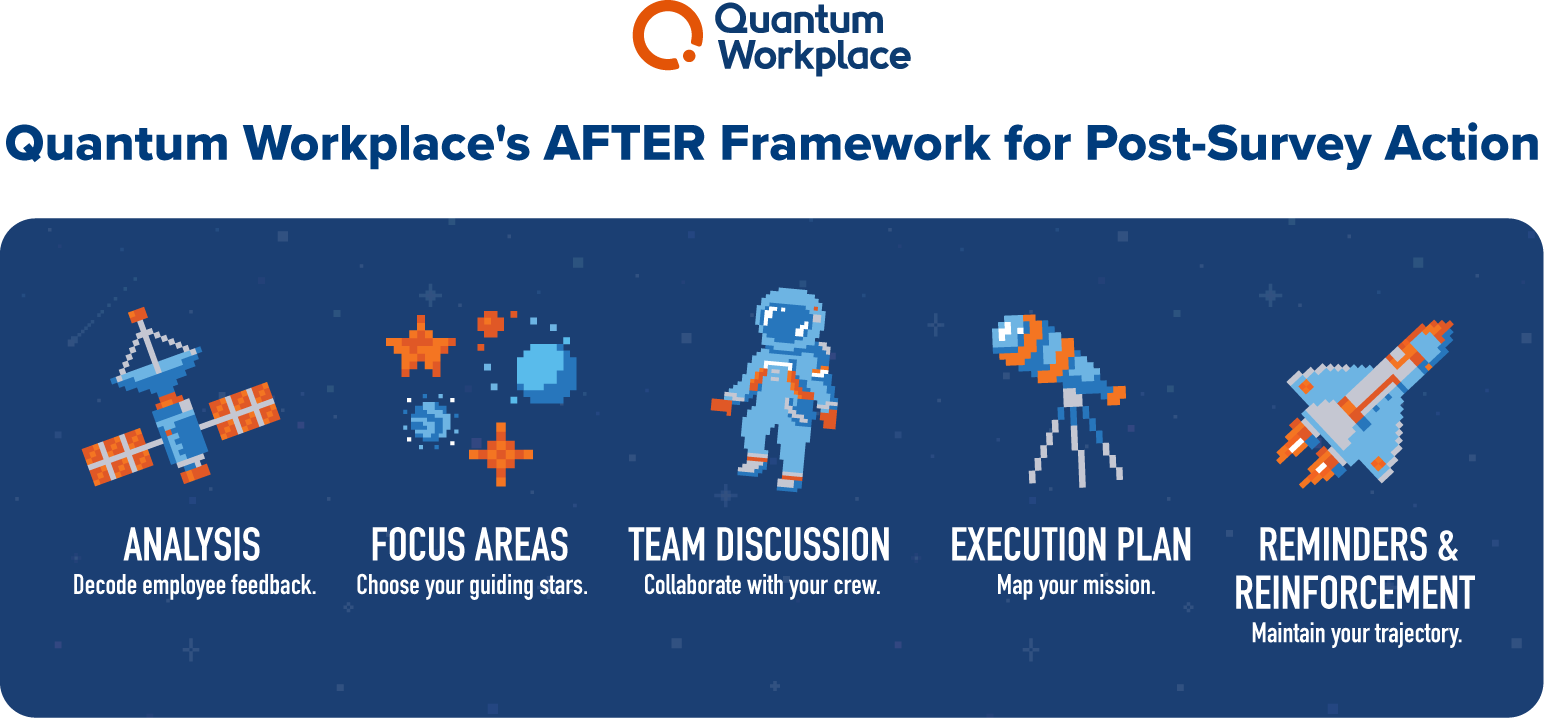
Overview of the AFTER Framework
AFTER-graphic_dark-background-version_medium


Step 1: Analysis

Dive deep into employee engagement survey data to uncover critical themes, strengths, and opportunities — looking beyond scores to the real story inside qualitative feedback.

Step 2: Focus Areas

Prioritize 2–3 high-impact areas where action will make the biggest difference, using data-driven criteria and a realistic, strategic lens.

Step 3: Team Discussions 

Engage employees in inclusive, psychologically safe conversations to co-create solutions — bringing diverse voices into the action planning process.

Step 4: Execution Plan

Build a clear action plan: define specific, measurable initiatives with assigned owners, deadlines, and built-in accountability.

Step 5: Reminders and Reinforcement

Keep improvement efforts alive with consistent communication, visible progress updates, and celebrations of wins — embedding growth into the culture.

Continuous improvement & a structured approach

The AFTER Framework doesn’t just guide a single round of action planning — it builds an ongoing cycle of feedback, action, and progress.
It gives leaders clarity on what to do next after getting survey data, helping them focus resources where they’ll have the biggest impact.

It also strengthens trust: when employees see consistent follow-through, credibility grows — and so does engagement.

By embedding AFTER into your listening strategy, you transform surveys from a compliance exercise into a powerful tool for continuous growth and organizational success.


Putting the AFTER Framework into action for employee engagement action plans

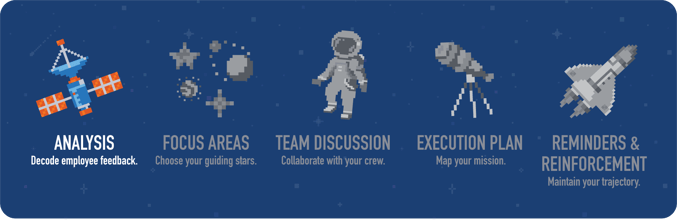
1. Analysis: dive deep into survey insights
AFTER-graphic_ANALYSIS_short_rgb


Go beyond surface-level scores when measuring employee engagement. A powerful action plan starts by uncovering the story behind your engagement survey results.

  • Look for patterns across themes, departments, and demographics

  • Explore open-ended comments to capture the nuance and emotion behind the numbers

  • Compare results against past surveys and external benchmarks

  • Visualize findings clearly using tools like Quantum Workplace’s Team Report or Retention Radar

Stay curious. A thoughtful, structured analysis reveals not just what’s working — but what matters most to employees today.

Best Practice: Involve a cross-functional team to enrich your analysis with diverse perspectives.

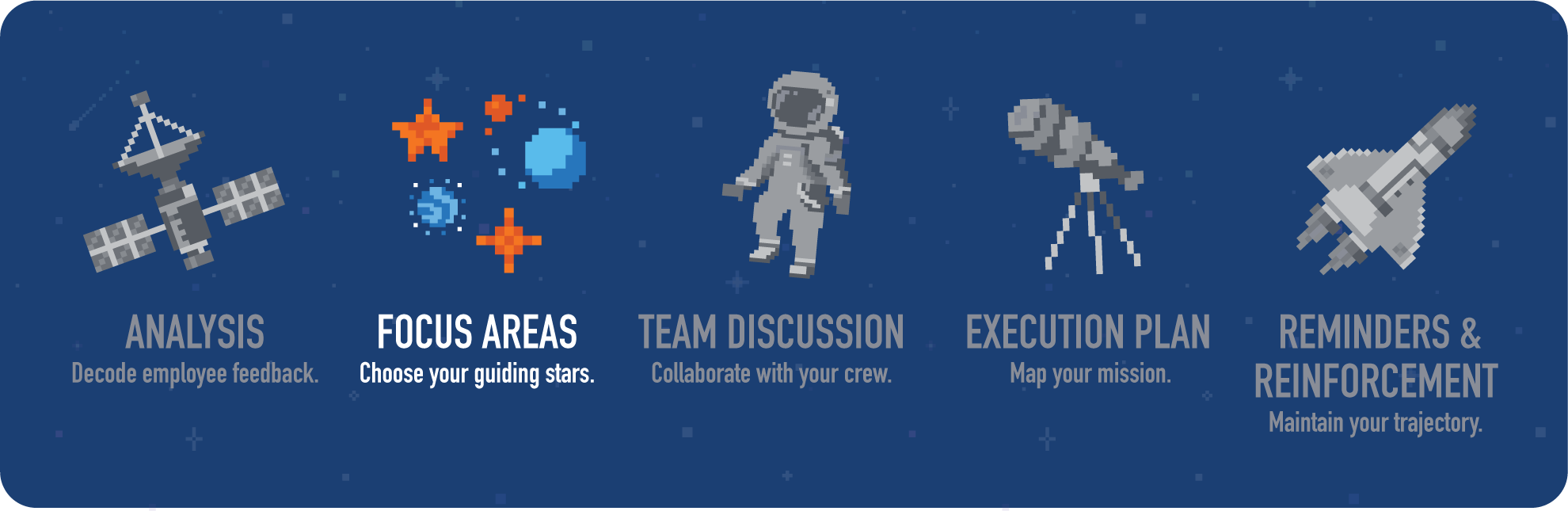
2. Focus areas: strategically prioritizing action areas
AFTER-graphic_FOCUS-AREAS_short_rgb

You can’t fix everything at once — and you shouldn’t try. Narrow your focus to 2–3 high-impact areas where action will make the biggest difference. Ask yourself?

  • Where can we create meaningful change with reasonable effort?

  • Which challenges have the greatest impact on engagement?

  • How can we group related issues around common themes?

Balance quick wins that build momentum with longer-term initiatives that drive lasting change. Prioritize strategically and transparently.

Best Practice: Tie your focus areas to your organization’s strategic objectives — and clearly share them with employees.

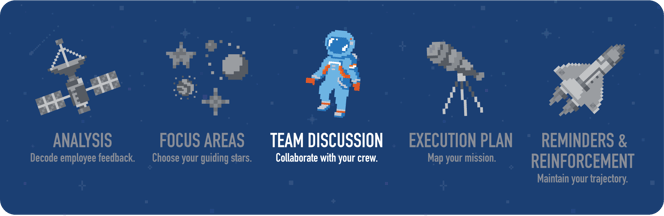
3. Team discussions: collaborating on solutions
AFTER-graphic_TEAM-DISCUSSION_short_rgb

Numbers tell you where to focus — conversations tell you why. Bring teams together in inclusive, psychologically safe discussions to unpack the root causes behind your focus areas.

Use questions like:

  • Where are we struggling in this area?

  • What helps or hurts this outcome?

  • What does success look like?

Leverage AI-powered survey tools to surface potential solutions and guide brainstorming. Use design thinking principles to encourage creativity and diverse thinking.

Best Practice: Train facilitators to drive productive conversations and document key ideas clearly, using methods like affinity mapping.

4. Execution plan: committing to concrete action
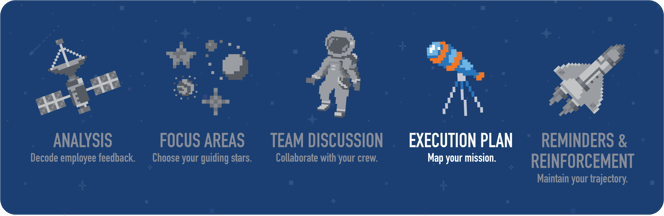
AFTER-graphic_EXECUTION-PLAN_short_rgb

An action plan only works if it’s clear, specific, and accountable.

Document:

  • Actions: Specific steps tied to each focus area.

  • Ownership: Who is responsible for each action.

  • Timelines: Clear deadlines that drive urgency.

  • Success Metrics: How progress will be measured.

  • Check-Ins: When and how updates will be reported.

Without this structure, good intentions fade. Clear accountability keeps progress visible and momentum alive.

Best Practice: Build action plan reviews into existing leadership rhythms to maintain visibility.


5. Reminders & reinforcement: staying on track 
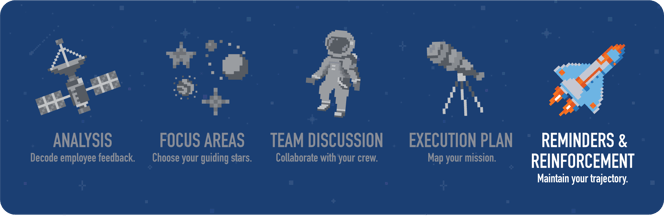
AFTER-graphic_REMINDERS-AND-REINFORCEMENTS_short_rgb

Sustained engagement requires consistent reinforcement.

  • Communicate: Share survey results, focus areas, and action plans widely.

  • Celebrate: Recognize progress and quick wins publicly.

  • Pulse Check: Use follow-up surveys to track improvements and recalibrate if needed.

  • Connect: Keep engagement top of mind through team meetings, town halls, and 1:1s.

Remember: Action planning is a cycle, not a one-and-done event. The best organizations make improvement part of their everyday conversations — not just a post-survey project.

Best Practice: Make success visible — show employees how their feedback drives real change.


Employee engagement action plan examples

Turning survey insights into action is where real culture change happens. These example employee engagement ideas show how organizations can move from feedback to focused improvements, using Quantum Workplace’s e9 model. Each case highlights:

Career Growth & Development

  • Insight from survey: Low scores on “I see professional growth opportunities at this organization.”
  • Comment analysis reveals: Employees feel career paths are unclear and development support is inconsistent.
  • Team discussion confirms: Most managers aren’t initiating meaningful career growth conversations.
  • Action focus: Launch a structured career pathing framework and implement quarterly development check-ins.

Workload & Resources

  • Insight from survey: Low scores on “I have the resources I need to do my job effectively.”
  • Comment analysis reveals: Employees describe feeling stretched too thin, with conflicting priorities and outdated tools — despite support from their direct managers.
  • Team discussion confirms: Managers agree that teams are overburdened but lack the authority to reprioritize or secure additional resources.
  • Action focus: Launch a cross-functional task force to evaluate workloads, clarify organizational priorities, streamline low-value work, and invest in upgraded tools.

Trust in Leadership

  • Insight from survey: Declining scores on “Senior leaders communicate openly and honestly.”
  • Comment analysis reveals: Employees cite lack of transparency around company decisions and future direction.
  • Team discussion confirms: Communication breakdowns are happening at the mid-manager level, preventing information from reaching employees effectively.
  • Action focus: Implement a company-wide communication plan, including quarterly town halls, leadership Q&A sessions, and improved manager cascades.


Getting Started with Post-Survey Action

Taking action after your engagement survey shouldn’t feel overwhelming — but it should feel intentional. Use this 90-day roadmap to build momentum, create visible progress, and embed employee feedback into everyday work.

First 30 Days: Digest & Distribute

Objective: Build awareness, accountability, and readiness to act.

Interpret and share results.

Analyze survey results at the organizational, department, and team levels. Identify key strengths, patterns, and focus areas. Prepare tailored summaries and presentations for leaders and managers.

Communicate early and often.

Share high-level findings with all employees to show transparency and commitment. Equip managers to hold team meetings where they review their results together, invite input, and set the stage for action.


Days 31-60: Prioritize & Plan

Objective: Translate insights into actionable, team-level plans.

Empower teams to own action.

Provide managers with action planning templates, coaching, and sample plans. Host open office hours to troubleshoot questions. Encourage managers to collaborate with their teams to identify 1–2 key focus areas and document action steps. Collect plans centrally to stay aligned and accountable.

Create accountability.

Set up a simple tracking system — like a dashboard or shared document — to monitor submitted plans. Start gathering examples of early wins. Build progress discussions into regular 1:1s and team meetings to keep engagement alive.


Days 61-90: Activate & Adjust

Objective: Drive visible progress, celebrate wins, and build the muscle for continuous improvement.

Put action in motion.
Managers should begin executing their action items while checking in informally with their teams to gather feedback and gauge momentum. Employees should be active participants — offering feedback, surfacing barriers, and celebrating what’s working.

Spotlight wins & recalibrate where needed.

Highlight success stories in internal communications to sustain energy. Identify teams that may be stuck and offer additional support. Consider running a quick pulse survey to check progress. Double down on manager coaching based on challenges surfaced in the first 90 days.

Pro Tip: The best employee engagement programs are dynamic, not static. Keep adjusting based on feedback, progress, and changing needs — and you’ll keep engagement alive year-round.


Overcoming common employee engagement action planning challenges

Building a strong action planning process isn’t just about knowing what to do — it’s about navigating the real-world hurdles that can stall progress. Limited resources, leadership hesitation, competing priorities, and communication gaps are common barriers. But with the right mindset and strategy, they’re fully surmountable.

Here’s how to get ahead of the most common pitfalls:
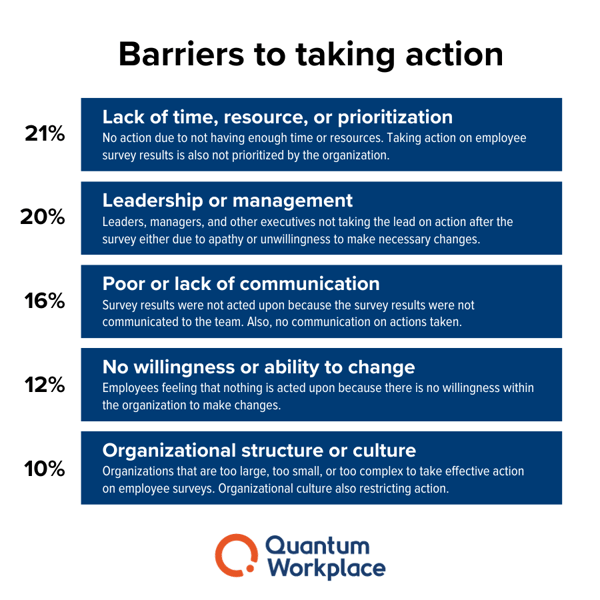
Blog - Employee Engagement Action Plan-barriers-1

Resource constraints & prioritization challenges

Time, resources, and competing priorities are real obstacles. It’s easy for action planning to feel like “one more thing” rather than an urgent priority.

But here’s the reality: failing to act on employee feedback erodes trust, dampens engagement, and damages retention — costing far more time and resources in the long run.

Reframe action planning as a growth opportunity, not extra work.

By addressing the root causes of disengagement, you unlock productivity, innovation, and loyalty.

Here are some practical strategies to consider:

  • Get leadership buy-in early to secure time and resources.

  •  

    Use technology to streamline analysis, planning, and tracking.

  • Spot and celebrate quick wins to build momentum.

  • Embed action planning into existing workflows — not separate from them.

Leadership engagement & manager buy-in

Effective post-survey action cannot live within HR alone. Leaders and managers must be full participants — interpreting results, collaborating with teams, and championing action.

Leadership’s visible commitment breathes life into the process. Manager participation ensures action planning sticks beyond the kickoff.

Best practices for leadership and manager alignment:

  • Clearly link action planning to business success.

  • Involve leaders from the very start.

  • Set clear expectations and accountability measures.

  • Spotlight leadership involvement and early wins publicly.

Equipping managers with training, templates, and coaching removes barriers and builds confidence to lead local conversations and action plans.

Communication Gaps

Clear, consistent communication is essential — before, during, and after your survey.

Set expectations early: explain how feedback will be used, what the action planning process will look like, and how employees will stay involved.

Transparency builds trust. Silence breaks it.

Throughout action planning, leaders and managers should keep teams informed:

Ongoing communication keeps energy high and keeps engagement efforts connected to day-to-day work.


Missteps in your employee survey strategy

Many organizations attempt to solve action planning challenges by changing how they survey. But often, these fixes target the wrong problem.

Deprioritizing the annual survey

Moving to frequent pulse surveys doesn’t eliminate the need for action — it increases it. Smaller surveys = faster follow-up. Otherwise, you risk “feedback fatigue” — not because you asked too much, but because you acted too little.

Surveying too infrequently

Biennial surveys slow momentum. The longer the delay between feedback and action, the harder it is to maintain credibility and energy.

Skipping surveys altogether

Passive listening is a powerful supplemental strategy — but it doesn’t replace direct feedback. Surveys signal that you care about employee voice and give you clear targets for action. No survey = no clear map for improvement.

Bottom line: You don’t need fewer surveys. You need simpler, smarter action planning. Employee feedback is only as powerful as what you do with it. Focus on building a system where listening naturally leads to action — and action naturally leads to growth.


Employee engagement action planning tools

The right tools don’t just make action planning easier — they make it smarter, faster, and more impactful.

With Quantum Workplace, you can turn survey insights into structured team conversations, real commitments, and visible progress — without overwhelming your leaders or losing momentum.

Here’s how we simplify and supercharge the action planning journey:


1. Team engagement reports made for managers
Team Reports - Engagement for Teams - LP Graphic

Understanding survey results shouldn’t require a PhD in analytics.
Our Team Report & Walkthrough guides managers straight to the insights that matter most — no guesswork required.

Key features:

  • A clear summary of team engagement results

  • Side-by-side comparisons to organizational benchmarks

  • High-impact drivers of engagement flagged for attention

  • Tailored recommendations for team discussion and action

Why it matters: Managers get instant clarity on where to focus conversations and efforts — boosting engagement without overwhelming them with data.

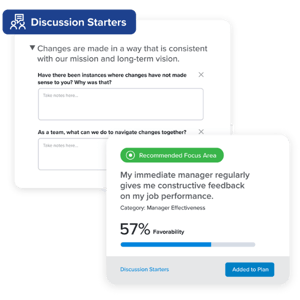
2. Recommended focus areas and discussion starters
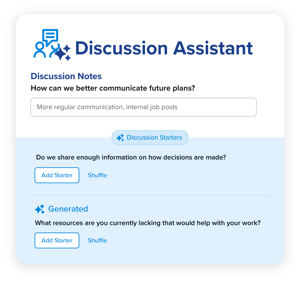
discussion-assistant_product-imagery

Your managers aren’t data analysts — and they shouldn’t have to be.
We equip them with curated discussion starters that spark meaningful conversations and uncover real solutions.

Features include:

Why it matters: High-quality team discussions drive more targeted actions — and build trust and ownership along the way.


3. AI-powered, tailored action ideas
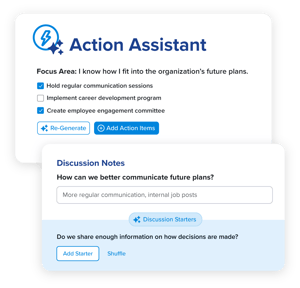
action-assistant_product-imagery

Blank-page syndrome? Solved. Our expert-informed, AI-powered action ideas deliver personalized, strategic recommendations based on each team’s engagement results.

Features include:

Why it matters: Managers move from insights to action faster — reducing delays, boosting confidence, and driving real behavior change.

4. Track progress and hold leaders accountable
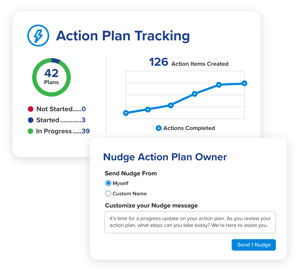
4_action-planning_product-imagery@2x


Are you ready to elevate engagement with easier, more effective action planning? Get a demo today >>

Email Header Action Planning (1)


Employee Engagement Action Planning FAQs

What is an employee engagement action plan?

An employee engagement action plan is a strategic roadmap that translates employee feedback into clear, targeted actions. It helps organizations address key engagement challenges and drive meaningful change, moving from insights to visible impact.

Why is creating an employee engagement action plan important?

An action plan shows employees that their feedback matters — building trust, credibility, and a culture of continuous improvement. It also ensures organizations prioritize efforts strategically, allocate resources wisely, and hold leaders accountable for real progress.

How long should an employee engagement action plan be?

There’s no universal length. Most effective plans span 12 to 18 months, with defined milestones and check-in points to maintain momentum. Plan timelines should flex based on organizational needs, focus areas, and available resources.

How often should we update our employee engagement plan?

Action plans should be treated as living documents. Review and refresh your plan at least quarterly or when major changes or new feedback occur. Regular updates ensure actions stay relevant, responsive, and connected to employee needs.

What are some examples of successful employee engagement action plans?

Strong action plans often focus on areas like career development, manager effectiveness, leadership transparency, work-life balance, and recognition. Examples include:

  • Launching career pathing frameworks and growth conversations.

  • Redesigning manager 1:1s to drive more meaningful connections.

  • Hosting leadership town halls to boost transparency.

  • Reinforcing recognition programs that highlight employee impact.

What are examples of action plans for improving communication in the workplace?

Effective communication action plans might include:

  • Hosting regular company-wide town halls and Q&A sessions.

  • Establishing clear communication channels and response expectations.

  • Providing communication training for leaders and managers.

  • Launching internal newsletters or centralized communication hubs.

  • Enhancing leadership visibility across the organization.

What are some creative employee engagement action plan ideas?

Creative ideas to boost engagement include:

  • Launching cross-training or job rotation programs.

  • Building employee-led task forces and innovation councils.

  • Hosting gamified learning challenges and competitions.

  • Creating employee resource groups (ERGs) to build community.

  • Offering mentorship and reverse mentorship programs.

How can we implement an employee engagement action plan with limited resources?

Focus first on low-cost, high-impact actions like improving communication, facilitating team discussions, and supporting managers. Use available tech tools to streamline collaboration and prioritize initiatives that align tightly with organizational goals.

What role should AI play in our employee engagement action plan?

AI can simplify and accelerate action planning by:

  • Analyzing engagement data for key insights and trends.

  • Recommending tailored action ideas based on survey results.

  • Guiding managers through structured team conversations.

  • Tracking progress automatically and reinforcing accountability.

What should an employee engagement action plan template include?

An effective employee engagement action plan template should include:

  • Key focus areas based on survey insights
  • Specific, measurable actions for each focus area
  • Assigned ownership and accountability
  • Timelines and milestones
  • Resources required (budget, personnel, etc.)
  • Progress tracking mechanisms
  • Communication and reinforcement strategies
  • Success metrics and evaluation criteria

What tools can help us create and implement our employee engagement action plan?

Key tools include:

  • Employee engagement survey platforms (like Quantum Workplace)

  • AI-powered action planning and analytics tools

  • Project management and collaboration software

  • Internal communication platforms

  • Action tracking dashboards and reporting too

How can we measure the success of our employee engagement action plan?

Success is measured through:

  • Improvements in overall and focus area engagement scores

  • Completion and tracking of specific action milestones

  • Qualitative employee feedback and sentiment shifts

  • Related business KPIs (retention, productivity, customer satisfaction)

  • ROI analysis on engagement initiatives

Ongoing pulse surveys, progress conversations, and real-time feedback loops help ensure your action plan remains effective and responsive.

Merging design and computer science in creative ways | MIT News

0

The speed with which new technologies hit the market is nothing compared to the speed with which talented researchers find creative ways to use them, train them, even turn them into things we can’t live without. One such researcher is MIT MAD Fellow Alexander Htet Kyaw, a graduate student pursuing dual master’s degrees in architectural studies in computation and in electrical engineering and computer science.

Kyaw takes technologies like artificial intelligence, augmented reality, and robotics, and combines them with gesture, speech, and object recognition to create human-AI workflows that have the potential to interact with our built environment, change how we shop, design complex structures, and make physical things.

One of his latest innovations is Curator AI, for which he and his MIT graduate student partners took first prize — $26,000 in OpenAI products and cash — at the MIT AI Conference’s AI Build: Generative Voice AI Solutions, a weeklong hackathon at MIT with final presentations held last fall in New York City. Working with Kyaw were Richa Gupta (architecture) and Bradley Bunch, Nidhish Sagar, and Michael Won — all from the MIT Department of Electrical Engineering and Computer Science (EECS).

Curator AI is designed to streamline online furniture shopping by providing context-aware product recommendations using AI and AR. The platform uses AR to take the dimensions of a room with locations of windows, doors, and existing furniture. Users can then speak to the software to describe what new furnishings they want, and the system will use a vision-language AI model to search for and display various options that match both the user’s prompts and the room’s visual characteristics.

“Shoppers can choose from the suggested options, visualize products in AR, and use natural language to ask for modifications to the search, making the furniture selection process more intuitive, efficient, and personalized,” Kyaw says. “The problem we’re trying to solve is that most people don’t know where to start when furnishing a room, so we developed Curator AI to provide smart, contextual recommendations based on what your room looks like.” Although Curator AI was developed for furniture shopping, it could be expanded for use in other markets.

Another example of Kyaw’s work is Estimate, a product that he and three other graduate students created during the MIT Sloan Product Tech Conference’s hackathon in March 2024. The focus of that competition was to help small businesses; Kyaw and team decided to base their work on a painting company in Cambridge that employs 10 people. Estimate uses AR and an object-recognition AI technology to take the exact measurements of a room and generate a detailed cost estimate for a renovation and/or paint job. It also leverages generative AI to display images of the room or rooms as they might look like after painting or renovating, and generates an invoice once the project is complete.

The team won that hackathon and $5,000 in cash. Kyaw’s teammates were Guillaume Allegre, May Khine, and Anna Mathy, all of whom graduated from MIT in 2024 with master’s degrees in business analytics.

In April, Kyaw will give a TedX talk at his alma mater, Cornell University, in which he’ll describe Curator AI, Estimate, and other projects that use AI, AR, and robotics to design and build things.

One of these projects is Unlog, for which Kyaw connected AR with gesture recognition to build a software that takes input from the touch of a fingertip on the surface of a material, or even in the air, to map the dimensions of building components. That’s how Unlog — a towering art sculpture made from ash logs that stands on the Cornell campus — came about.

Play video

Gesture Recognition for Feedback-Based Mixed Reality and Robotic Fabrication of the Unlog Tower
Video: Alexander Htet Kyaw

Unlog represents the possibility that structures can be built directly from a whole log, rather than having the log travel to a lumber mill to be turned into planks or two-by-fours, then shipped to a wholesaler or retailer. It’s a good representation of Kyaw’s desire to use building materials in a more sustainable way. A paper on this work, “Gestural Recognition for Feedback-Based Mixed Reality Fabrication a Case Study of the UnLog Tower,” was published by Kyaw, Leslie Lok, Lawson Spencer, and Sasa Zivkovic in the Proceedings of the 5th International Conference on Computational Design and Robotic Fabrication, January 2024.

Another system Kyaw developed integrates physics simulation, gesture recognition, and AR to design active bending structures built with bamboo poles. Gesture recognition allows users to manipulate digital bamboo modules in AR, and the physics simulation is integrated to visualize how the bamboo bends and where to attach the bamboo poles in ways that create a stable structure. This work appeared in the Proceedings of the 41st Education and Research in Computer Aided Architectural Design in Europe, August 2023, as “Active Bending in Physics-Based Mixed Reality: The Design and Fabrication of a Reconfigurable Modular Bamboo System.”

Kyaw pitched a similar idea using bamboo modules to create deployable structures last year to MITdesignX, an MIT MAD program that selects promising startups and provides coaching and funding to launch them. Kyaw has since founded BendShelters to build the prefabricated, modular bamboo shelters and community spaces for refugees and displaced persons in Myanmar, his home country.

“Where I grew up, in Myanmar, I’ve seen a lot of day-to-day effects of climate change and extreme poverty,” Kyaw says. “There’s a huge refugee crisis in the country, and I want to think about how I can contribute back to my community.”

His work with BendShelters has been recognized by MIT Sandbox, PKG Social Innovation Challenge, and the Amazon Robotics’ Prize for Social Good.

At MIT, Kyaw is collaborating with Professor Neil Gershenfeld, director of the Center for Bits and Atoms, and PhD student Miana Smith to use speech recognition, 3D generative AI, and robotic arms to create a workflow that can build objects in an accessible, on-demand, and sustainable way. Kyaw holds bachelor’s degrees in architecture and computer science from Cornell. Last year, he was awarded an SJA Fellowship from the Steve Jobs Archive, which provides funding for projects at the intersection of technology and the arts. 

“I enjoy exploring different kinds of technologies to design and make things,” Kyaw says. “Being part of MAD has made me think about how all my work connects, and helped clarify my intentions. My research vision is to design and develop systems and products that enable natural interactions between humans, machines, and the world around us.” 

SmartThings Blog

0

Smart and Simple Features Available on iOS and Android

You walk into the living room, and it’s total chaos—pillows and cushions everywhere, your partner on the floor searching under the couch. They look up. 

“Have you seen the remote?”

“Have you checked your pockets?” you ask.

They stand up, pat themselves down, and sigh, “Not this time.”

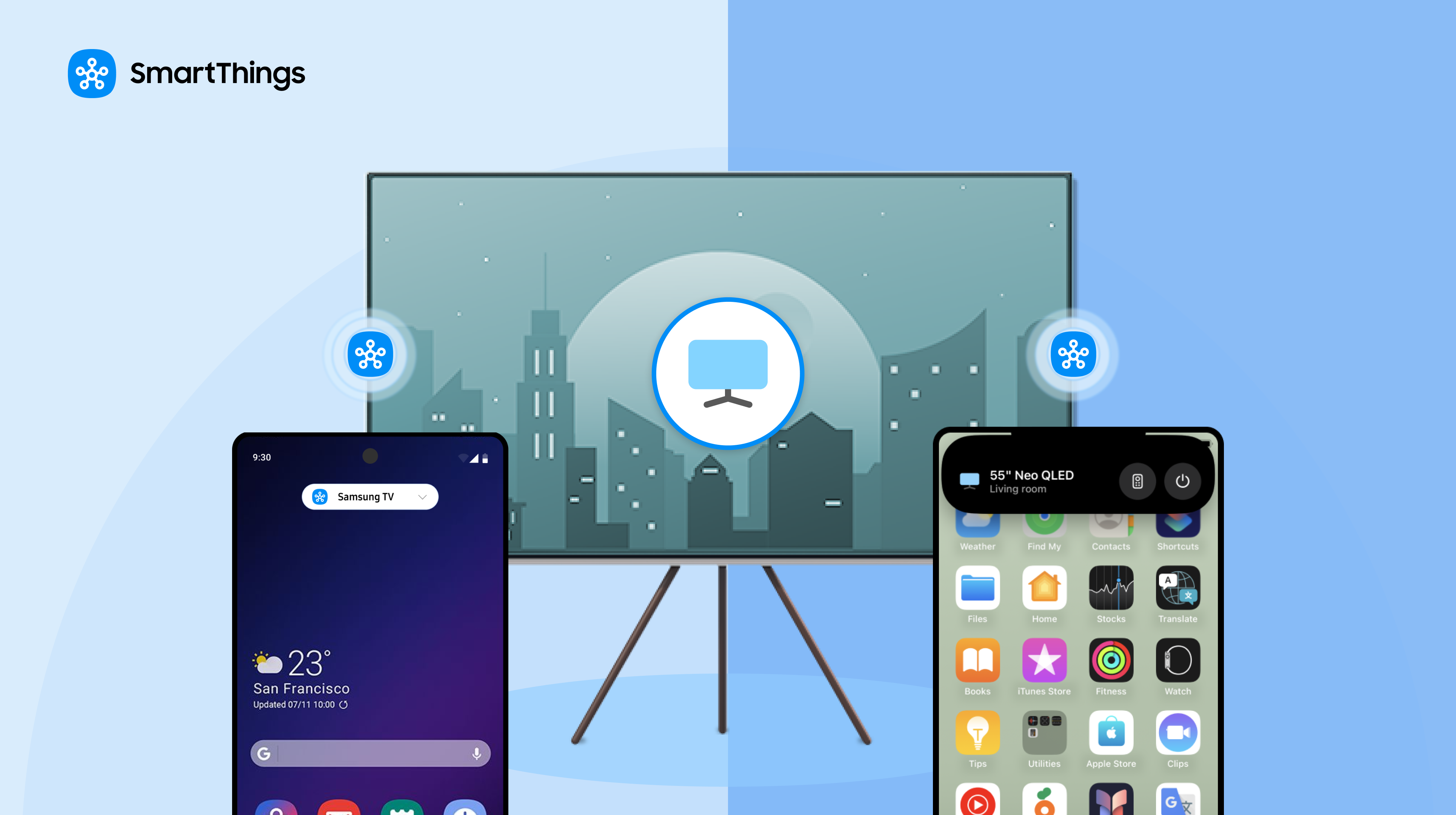
No need to panic. With SmartThings, your phone can step in as the ultimate remote – no digging under the couch required. 

SmartThings transforms everyday hassles, no matter how small, into effortless experiences. Your home transforms into the sanctuary of ease and comfort it’s meant to be, giving you the freedom to embrace a flexible, connected life.

And since we all have our phones on us at all times, why not use them to solve the problem? With the SmartThings app, your phone can become the ultimate Samsung TV remote. 

Turn Your Phone into a Remote

First, download the SmartThings app and make sure everyone in your house has access to the TV. Then, follow these steps to connect it: 

  1. Open the SmartThings app (available for iOS and Android) downloaded on your phone and tap the ‘+’ button in the top right corner.
  2. Select Add device under Samsung devices, and tap TV.
  3. Ensure your Samsung TV is on and near your phone or tablet.
  4. Select your Samsung TV and enter the PIN displayed on your screen.

Now, you’re ready to control your Samsung TV with your phone. Here’s how: 

  1. Open the SmartThings app and tap on your TV tile. Make sure your TV is turned on.

SmartThings Home Screen

2. In the bottom panel, you’ll see Home, Ambient Mode, Featured, and Menu. Tap Remote on the bottom right to open the remote.

Using SmartThings as a Remote

3. Swipe left or right in the middle panel to navigate different remote buttons. For example, to adjust the volume, use your phone’s volume up/down buttons.

Using SmartThings as a Remote

Need quick access to your remote? Don’t worry, you can access the remote simply from the notification screen on a Galaxy device or either the Notification Center or the Dynamic Island on iOS devices. 

SmartThings Quick Remote

Once you’ve set up your phone as  a remote, why stop there? If your family or guests also want access, SmartThings makes it easy to share control – without handing over your phone.

With SmartThings Together, anyone in your home can scan a custom QR code to access specific devices  in your home and even set up their own routines—no complicated setup required.

Sharing QR Code with SmartThings

To share a QR code for specific devices with others, here’s what to do: 

  1. Open the SmartThings app and tap the location drop-down menu to select your desired location.
  2. Tap the QR code sharing button on the top left corner of your screen.
  3. (Optional) You can tap the “Access level” to choose whether to grant full access or select specific devices to control for specific duration.
  4. The invitee can scan the QR code with their phone to join.

*Note that each QR code is available to only one person at a time and expires after five minutes for added security.

With SmartThings, your home adapts to you—not the other way around. Whether you’re replacing a lost remote or sharing device access with family, the SmartThings app brings convenience to your fingertips.

Download the SmartThings app in the Google Play, Galaxy Store or Apple Store today to unlock a new level of flexibility and accessibility for your smart home. 

SmartThings Blog

0

Saving energy has never been this fun—earn Samsung rewards while going green.

Did you know that Samsung offers over 600 ENERGY STAR certified models designed to help you save energy, lower your bills, and reduce your carbon footprint? Now, with the SmartThings app, you can take energy savings to a whole new level—and earn rewards for doing so.

As smart home technology becomes more prevalent, energy efficiency is emerging as a major driver of this trend. By 2025, it’s estimated that 60% of households will have adopted smart home technology to manage energy use and improve efficiency. This growing adoption underscores the potential for smart devices to make a lasting impact on energy consumption, both in terms of reducing utility bills and decreasing carbon footprints.

Energy-Saving Features and Rewards

If you’re already familiar with the power of managing your devices and appliances in one place via SmartThings, you’ll be excited to learn about the newest energy-saving features. The app now works with a wide range of energy-efficient devices, including the latest Samsung Bespoke AI appliances. These appliances not only let you monitor your energy usage but also help you save energy and make a positive impact on the planet. Plus, by setting up routines and automations, you can elevate your home energy management to the next level.

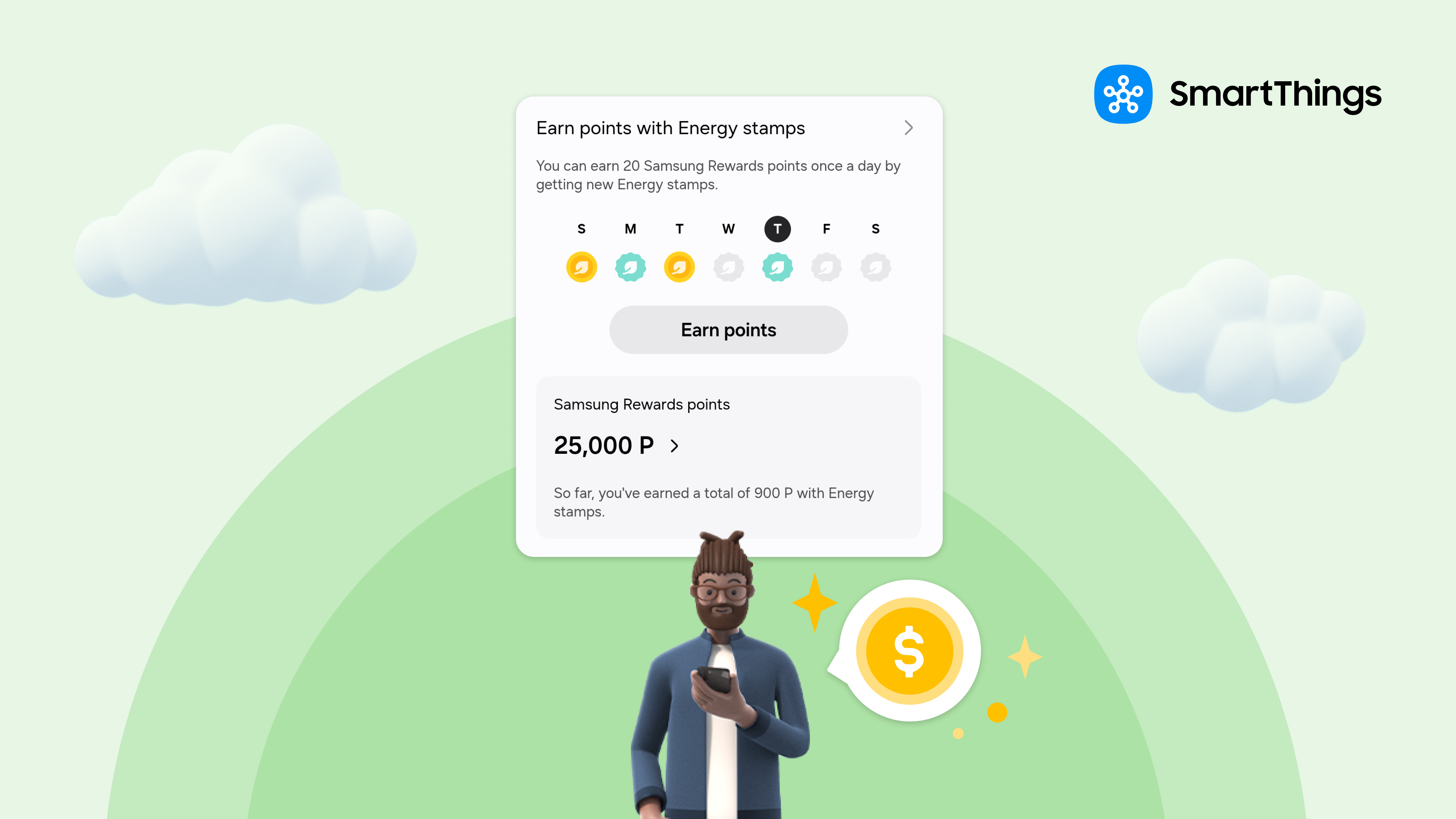
And here’s the best part: With AI Energy Mode, available through the SmartThings Energy service, you can automatically earn Energy Stamps for saving energy – see it in the SmartThings app! For every 400 Wh saved, you’ll earn Energy Stamps that convert into Samsung Rewards. You’ll get notified and can redeem the rewards for the latest, coolest products in the Samsung store.

One Energy Stamp at a Time

This Earth Month, challenge your friends to earn Energy Stamps and make a difference for the planet. It’s simple and fun—here’s how to get started:

  1. Connect your energy-efficient products in the SmartThings app.
  2. Go to the “Life” tab and open up the SmartThings Energy service.
  3. Activate AI Energy Mode in SmartThings Energy.
  4. Start earning Energy Stamps and track your progress on your personalized Energy Scorecard.

Start Your Energy-Efficient Journey Today

SmartThings Energy offers an easy and engaging way to track your energy savings and earn rewards for doing your part to conserve energy. Whether you’re already using smart home products with Samsung SmartThings or just getting started, now is the perfect time to do just one thing that makes a difference—take control of your energy usage!

Ready to save energy and start earning rewards? Download the SmartThings app today and start your energy-efficient journey by turning on AI Energy Mode. The planet will thank you—and so will your wallet!

15 Benefits of Employee Engagement Surveys

0

An effective employee engagement survey captures valuable insights about how employee perceptions. It acts as a powerful diagnostic tool, helping organizations understand how connected, engaged, and aligned their workforce is.

At its heart, an employee engagement survey includes a set of thoughtfully crafted questions aimed at uncovering the main drivers of engagement within an organization. These might cover topics like work-life balance, leadership effectiveness, career development opportunities, and organizational culture. Each question is designed to encourage honest and insightful responses, shedding light on strengths and areas that might need a little improvement.

Engagement surveys serve multiple purposes. First and foremost, they measure the overall level of engagement in an organization, which is key to boosting productivity, retention, and overall success. They also help pinpoint specific areas where employees might feel disengaged or unhappy, paving the way for targeted changes and improvements that can make a difference.

Looking for the right employee engagement survey partner? Check out our guide to best software providers in 2025 >>

Effective employee engagement surveys help:

Identify engagement drivers. To improve employee engagement, you need to understand what’s driving it first. While common factors exist across organizations, you’ll make the most progress when specifically understanding engagement drivers in your organization in any given timeframe. Identifying these unique drivers helps you understand what levers you can pull to further engage and retain key talent.

Uncover retention risks. Your engagement survey data is packed with insight, including key context around who might leave the organization and why. Leverage your engagement survey analytics to spot potential flight risks and take action.

Foster continuous improvement. Gathering actionable employee feedback shapes strategies that enhance the employee experience, strengthen workplace culture, and boost engagement, performance, and retention. 

Make data-backed decisions. Engagement surveys turn employee sentiment into clear, strategic insight. When you pair real-time data with historical trends, you can confidently prioritize initiatives, allocate resources, and demonstrate the ROI of your people strategies. Instead of guessing what matters most to employees, you’re equipped to act on what’s proven to move the needle.

Who benefits from employee engagement surveys

When done well, engagement surveys create a ripple effect of positive change that benefits not just employees, but also managers, HR teams, and senior leaders. Here’s how each group gains value from a strong engagement survey strategy.

Employees

Employee engagement surveys give team members a powerful voice in shaping their workplace. They create a safe space for sharing honest feedback about what’s working well, and what needs improvement.

When organizations act on this feedback, employees experience more job satisfaction, better work relationships, and a stronger sense of belonging. This leads to greater career fulfillment and personal growth opportunities as organizations address their specific needs and concerns.

Managers

Managers gain invaluable insights into their team’s dynamics, challenges, and motivations. Survey data helps them understand what drives their team’s engagement and where they can improve their leadership approach. Armed with this information, they can make targeted improvements to communication, recognition practices, and development opportunities. This creates stronger teams, improves performance, and builds more trusting relationships with direct reports. 

HR teams

For HR teams, engagement surveys provide complete data to inform strategic people initiatives. They reveal organization-wide patterns, highlight potential retention risks, and identify opportunities to strengthen company culture.

This information powers more effective talent management strategies. HR professionals can measure the impact of their initiatives and demonstrate their value to their organization through improved engagement metrics. 

Senior leadership

Senior leadership benefits from a clearer understanding of organizational health and employee sentiment. Survey data reveals how well business strategies resonate with employees and identifies potential blind spots in leadership approaches.

This information helps leaders make better-informed decisions about resource allocation, organizational structure, and strategic priorities. By addressing engagement drivers, they create higher-performing organizations with stronger financial outcomes and greater competitive advantage. 

15 employee engagement survey benefits

Regularly conducting employee engagement surveys can spark remarkable positive changes in an organization. These surveys open up a direct line of communication, letting employees share their thoughts and have their concerns addressed. The perks of an effective employee engagement survey strategy are extensive, leading to significant improvements in many business areas.

1. Amplifying employee voice.

Employee engagement surveys offer a safe and anonymous space for team members to share their thoughts, feelings, and opinions freely, without fear of negative consequences. This open communication creates a sense of empowerment and inclusion, helping everyone feel valued and know their voices matter.

2. Keeping top talent engaged.

Skilled and valuable employees are always in high demand, so keeping them on board is crucial. Engagement surveys help pinpoint areas where people might feel dissatisfied or at risk of leaving. Addressing these concerns proactively makes it possible to keep top talent engaged and satisfied in their roles.

3. Boosting productivity.

When employees feel engaged, they tend to be more motivated, committed, and productive. Knowing what sparks engagement in the workplace can help in crafting strategies that lift morale, enhance job satisfaction, and crank up productivity levels. Create an environment where everyone feels excited to contribute.

4. Building (and evolving) culture.

Creating a positive and inclusive company culture is key to attracting and keeping top talent. Engagement surveys offer valuable insights into cultural strengths and weaknesses, enabling informed decisions that help build a culture aligned with the organization’s values and goals.

5. Leveling up leadership.

Great leadership makes a difference in boosting employee engagement and helping organizations thrive. Leaders can use engagement surveys to discover what they’re doing well and where there’s room to grow. This feedback opens the door to focused development and coaching for managers, strengthening and connecting the whole team.

6. Improving employee well-being.

Employee well-being includes many important areas like physical, mental, and emotional health. Engagement surveys can illuminate what might be causing stress, burnout, or dissatisfaction. This way, the focus can shift to rolling out initiatives that create a healthier and more supportive workplace for everyone.

7. Creating stronger team dynamics.

Engaged teams collaborate better, feel more connected, and get things done efficiently. Engagement surveys offer valuable insights into team dynamics, communication, and relationships, helping to strengthen bonds and enhance teamwork.

8. Planning for the future.

Making data-based decisions is key for planning and setting goals. Engagement survey results offer a treasure trove of actionable insights that can guide an organization’s future. By tapping into this information, strategies can better match what employees need and expect from their workplace.

9. Standing out from competition.

In today’s competitive job market, having a strong employer brand and a solid reputation can help in attracting and keeping top talent. By showing a real commitment to employee engagement and well-being through surveys, organizations can stand out and become the go-to choice for potential employees.

10. Driving business growth.

Engaged employees drive company success. By creating a space where everyone feels involved and valued, their full potential can shine. This leads to more productivity, sparks innovation, boosts customer satisfaction, and fuels overall business growth.

11. Identifying key engagement drivers.

While common factors exist across organizations, you’ll make the most progress when you understand what specifically drives engagement at your organization. Surveys reveal these unique factors so you can focus your efforts where they’ll have the biggest impact. 

12. Focusing action & investment.

Great data only shines when there’s a solid plan to put it into action. Surveys establish a clear process for reviewing results, prioritizing initiatives, and ensuring accountability. When HR shares team-level data with managers, teams can collaborate on established solutions that drive real change. 

13. Establishing continuous dialogue.

Employee engagement surveys spark an ongoing conversation between your organization and its employees. Regular surveys, with follow-up actions and open communication, create a continuous feedback loop that builds trust, transparency, and a sense of shared ownership in your organization’s success. 

14. Mitigating organizational risk.

Surveys serve as an early warning system, helping you identify potential issues before they escalate. From flight risks among critical talent to cultural misalignment, management capability gaps, and barriers to performance, surveys help you spot and address problems proactively. 

15. Benchmarking progress.

Survey data allows you to compare your organization against industry standards, best practices, and peer organizations. This helps you see how you stack up in important areas like retention, workplace culture, management effectiveness, and the overall employee experience. 


Tackling common employee engagement survey hurdles

Employee engagement surveys are powerful tools for gathering valuable insights, but they come with common bumps along the way. Think survey fatigue, low response rates, the tricky task of crafting action plans, and the struggle to follow through. Tackling these challenges can transform the experience and maximize the benefits of an engagement survey.

Survey fatigue

Employees can become disengaged from surveys if they feel bombarded with too many or don’t see tangible changes resulting from their feedback.

To combat this, balance collecting enough data and not overwhelming employees. Implement a strategic survey cadence, communicate the purpose and impact, and ensure leadership acts on findings. Our research shows the ideal frequency is four to eight times per year. This typically looks like an annual engagement survey and complementary lifecycle and pulse surveys. Too many surveys isn’t usually the issue. Instead, it’s the lack of action on the feedback received.

Low survey response rates

Low survey response rates can throw off the data and lessen the survey’s impact. To boost participation, spread the word through various channels. Highlighting confidentiality and ensuring the survey is mobile-friendly, can make a big difference in increasing response rates.

Most importantly, showing that previous feedback has been taken to heart helps build trust and demonstrates that every opinion truly matters.

Lack of action planning 

Great data only shines when there’s a solid plan to put it into action. Before diving into a survey, set up an engaging process for reviewing the results, figuring out what’s most important, crafting action plans, and ensuring everyone knows their roles. It’s essential that HR share team-level data with managers so they can bring their teams in to help understand results and develop action plans. Leaders and employees alike must be actively involved to ensure accountability and drive meaningful change. 

Poor execution

Many surveys struggle because organizations don’t always follow through with their action plans. It’s important to share those plans openly, monitor progress toward goals, and celebrate achievements. When there’s consistent follow-through, it nurtures trust and shows that the organization truly values employees.
By tackling these challenges head-on, organizations can enhance employee engagement efforts and create meaningful, lasting impact.

Measuring employee engagement with surveys

Starting an employee engagement survey is only the beginning. To tap into the power of this data, it’s important to focus on measuring what matters most. Keep an eye on key metrics like response rates, engagement scores, trend analysis, and benchmark comparisons to understand the engagement landscape.

Survey response rates

Getting a high survey response rate can make a world of difference when gathering accurate insights and representing a diverse group. If the response rate is low, it can mess with the data and lead to some poor decisions.

Shoot for a response rate between 70-80% for larger organizations (more than 500 employees) or 80-90% for smaller organizations.

Employee engagement scores

Employee engagement scores (or employee engagement favorability) offer a clear glimpse into how people feel at work, allowing organizations to keep an eye on overall engagement trends. It’s important to remember, though, that these scores come to life when paired with the context of job roles, tenure, and demographics.

Trends over time

Keeping an eye on engagement trends over time helps spot areas that need a boost or might be slipping. You can see how changes in the organization, like shifts in leadership or changes in culture, affect how engaged employees feel.

Benchmark comparisons

By benchmarking engagement data against industry standards or peer organizations, organizations gain valuable insights. This process reveals how you compare to competitors and highlights areas of strength and opportunities for improvement.

Employee engagement survey software guide

Understanding what matters simplifies your choice of an employee engagement survey vendor. By carefully evaluating these factors, you will gather the information needed to choose an employee survey vendor that aligns with your organization’s goals, supports your employee listening strategy, and delivers a strong return on investment. 

✔️ Survey Customization

Evaluate a vendor’s ability to customize surveys to meet your organization’s requirements. Consider aspects such as question types, branding, and language translations. Identify what makes your organization unique and express how you want that uniqueness to appear in your surveys.

✔️ Scalability

Evaluate the vendor’s capability to grow alongside your organization. As your needs increase, whether it’s accommodating higher survey volumes or a more significant number of employees being surveyed, the vendor must align with your current and future requirements.

✔️ Reporting & Analytics

Evaluate the vendor’s reporting and analytics capabilities for depth and quality. Ensure they provide actionable insights into employee feedback. This functionality allows employees to manage the surveys, saving time and effort.

✔️ Integration Capabilities

Can the vendors you evaluate seamlessly integrate with your existing HR systems and tools? Although this functionality may initially seem minor, proper integration streamlines data flow and processes.

✔️ Security & Compliance

Ensure the vendor adheres to industry-standard security protocols and relevant data privacy regulations. You may encounter other data considerations based on your organization’s specific needs. Speak up and ask if you have any questions!

✔️ User Experience

Prioritize a user-friendly platform that has historically engaged many clients. The platform should encourage high participation rates and reduce employee survey fatigue.

✔️ Multi-lingual Support

If your organization operates globally, select a vendor to accommodate this need. Also, seek vendors with multilingual survey capabilities for your diverse employee population.

✔️ Mobile Compatibility

A mobile interface is crucial, and mobile compatibility is more critical than ever. Optimize the platform for mobile devices so employees can conveniently provide feedback from anywhere.

✔️ Automation & Scheduling

Choose a platform that automates survey scheduling and distribution to streamline the process and reduce manual efforts.  

✔️ Employee Engagement Benchmarks

What does great look like? Industry-specific benchmarking helps a great vendor answer that question. Gain the context needed to elevate your employee survey efforts from good to great. 

✔️ Dedicated Support Team

Assess a vendor’s support accessibility. Determine if they are committed to providing dedicated support resources. Ensure that support goes beyond simply onboarding and remains continuous.

✔️ User Training & Onboarding

Your organization should choose a vendor that provides thorough training and onboarding. This process will prepare your team for success and equip you to leverage the platform effectively.

✔️ Change Management Resources

Evaluate how the vendor manages change. Do they offer guidance? Are they using best practices to encourage adoption and maintain engagement?


Level up your employee survey strategy with Quantum Workplace

Experience the power of Quantum Workplace’s employee engagement software in helping you understand and improve employee experience.

Our comprehensive suite of employee survey tools includes:

Schedule a personalized demo to discover how our platform can transform your employee listening strategy. Take the first step toward building a more engaged, productive, resilient workforce. 

BOOK A DEMO WITH A SURVEY EXPERT >>


Employee engagement survey FAQs

Are employee engagement surveys effective?

Yes. Employee engagement surveys help gather valuable insights and spot areas you can improve. By letting employees share their thoughts and perspectives, these surveys highlight critical issues, celebrate strengths, and lay a roadmap for enhancing the overall employee experience.

Why are employee engagement surveys effective in the workplace?

Employee engagement surveys show how mentally and emotionally connected employees are to their work, team, and the company as a whole. Employees who are fully engaged are more productive and tend to stick around longer. That’s why fostering engagement is such a powerful ingredient for business success.

Why are employee engagement surveys important for modern businesses?

Employee engagement surveys play a vital role in helping businesses attract and keep top talent. They also help build a positive company culture and spark innovation. By putting employee feedback first and acting on those insights, companies can create an environment where everyone feels valued, motivated, and empowered to give their best.

What is the primary purpose of an employee engagement survey?

An employee engagement survey serves as a helpful tool to understand how engaged everyone is within the organization. It highlights specific areas affecting motivation, satisfaction, and commitment. With this valuable data, companies can create targeted strategies that boost engagement, enhance retention, and improve overall performance, making the workplace better for everyone.

How often should we conduct employee engagement surveys?

Employee engagement surveys can happen at different frequencies based on an organization’s needs and aims to achieve. Many companies go for a big annual survey and then sprinkle in quick pulse surveys throughout the year. This strategy helps everyone take a regular temperature check and tackle any issues quickly.

What makes an employee engagement survey effective?

An excellent employee engagement survey is thoughtful and includes straightforward, relevant questions. It’s essential to ensure that responses are anonymous so everyone feels comfortable sharing honest feedback. After the survey, sharing visible action plans and keeping the lines of communication open shows that employee input truly matters and is taken seriously.

How can we ensure honest feedback from employees?

Creating a culture of trust and transparency makes it easier for employees to share their thoughts freely. When everyone feels comfortable speaking up without worrying about backlash, honest feedback flourishes. Highlighting that the survey is anonymous and showing a genuine willingness to act on the input can encourage open and engaging responses.

What should we do with employee engagement survey results?

Analyzing employee survey results is vital to spot key strengths and areas that need attention. With these insights, organizations can create and share action plans that tackle issues while celebrating successes. Keeping everyone updated on progress and inviting employees into the conversation helps maintain the momentum and nurtures a culture of continuous improvement.

How can we measure the ROI of employee engagement surveys?

To measure the ROI of employee engagement surveys, correlate the survey data with key business metrics like productivity, retention rates, customer satisfaction, and profitability. By monitoring these metrics over time and investigating how engagement initiatives make a difference, organizations can see the financial perks of investing in employee engagement.

What are the advantages and disadvantages of employee engagement surveys?

Employee surveys come with some great perks. They help uncover valuable insights, spotlight areas that could use extra love, build a culture where open conversations thrive, and spark positive change. On the flip side, there are a few downsides to remember, like survey fatigue, potential biases creeping in, and the possibility of results sitting on a shelf if not acted upon.

How can we prevent employee survey fatigue?

To help avoid survey fatigue, balancing gathering valuable feedback and not overwhelming employees with too many surveys is key. Sharing the purpose and value of each survey makes them feel more meaningful. Keep surveys concise and relevant, and update how previous feedback has led to positive changes. This way, everyone stays engaged and feels heard.

What platform should we use for employee engagement surveys?

Check out the many employee survey platforms out there, including Quantum Workplace. When selecting a platform, think about how easy it is to use, the customization options available, the quality of reporting and analytics, how well it integrates with current systems, and the measures it takes for data security and privacy.

How do employee engagement surveys affect company culture?

Employee engagement surveys have a tangible impact on company culture. By encouraging employees to share their thoughts and genuinely acting on their feedback, organizations can create a nurturing atmosphere brimming with trust, transparency, and a drive for continuous improvement. This approach boosts engagement and motivation, fostering a warm, shared sense of community among all team members.

What is the connection between employee engagement surveys and employee retention?

Employee engagement surveys help companies keep their best talent around. When employees feel engaged, they’re generally happier and more committed to the organization, which means a lower turnover rate. These surveys uncover what makes employees smile at work, like job satisfaction, a healthy work-life balance, chances for career growth, and an upbeat company culture.


SmartThings Blog

0

Samsung SmartThings puts smart home hubs right where you need them—built into the devices you already own.

Not long ago, setting up a smart home meant buying a separate hub, plugging it in, and hoping it would work with all your devices. Hubs were the essential link, helping smart lights, locks, thermostats, and more to communicate seamlessly. They were also often a separate device you needed to choose and buy, find a spare power and network cable for, and set up and maintain. Today, thanks to Samsung’s Hub Everywhere strategy, hubs aren’t just little boxes anymore—they’re built right into the devices you already use every day.

Your Smart Home Hub Might Already Be Here

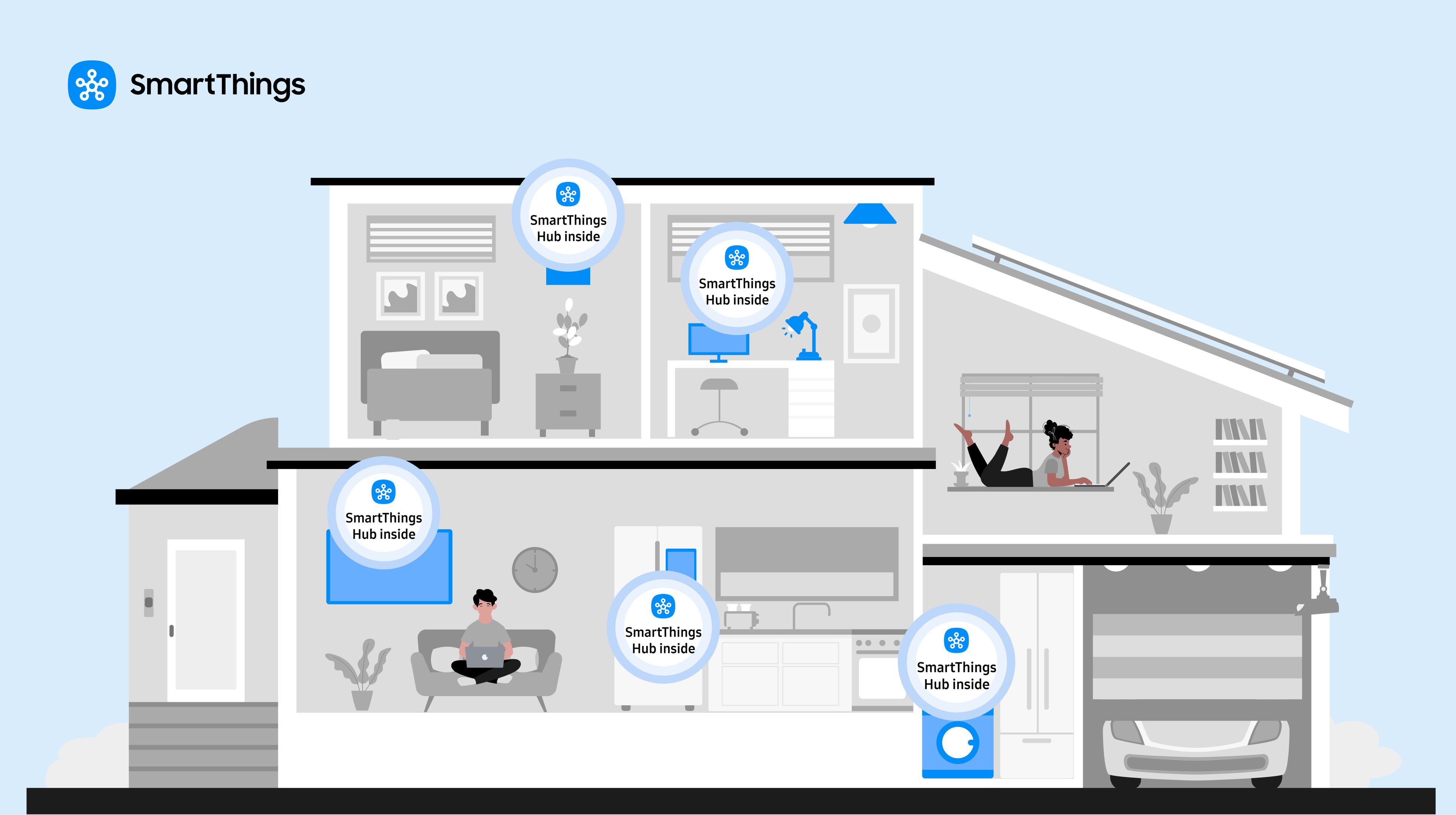
Samsung makes starting and growing your smart home easier by building smart home hubs directly into many of its products. That means your Samsung TV, Smart Monitor, Family Hub refrigerator, or Sound Bar could already be a smart home hub—ready to connect and control devices without the need to buy and set up another device.

For those who prefer a standalone hub, SmartThings Hubs are still available. But for many, Samsung’s Hub Everywhere strategy is making smart home adoption more seamless than ever.

What is a Smart Home Hub, and Why Does It Matter?

A smart home hub acts as the translator and coordinator for your smart devices. Different smart home products use different communication methods—such as Zigbee, Z-Wave, Thread, Matter, Wi-Fi, or Bluetooth. A hub allows them to work together, enabling automations, remote control, and a more cohesive smart home experience.

Think of a hub as the conductor of your smart home orchestra, keeping things coordinated so your lights dim, doors lock, and thermostat adjusts exactly when and how you want—without you needing to manage each device separately.

And as the smart home industry moves toward Matter, the universal smart home standard, compatibility between brands and products will only get better—making built-in hubs even more valuable.

Setting up Hubs in the SmartThings App

A Smarter Approach to Smart Homes

In the early days, standalone hubs were the only option. But now, with hubs integrated into your Samsung devices, this means:

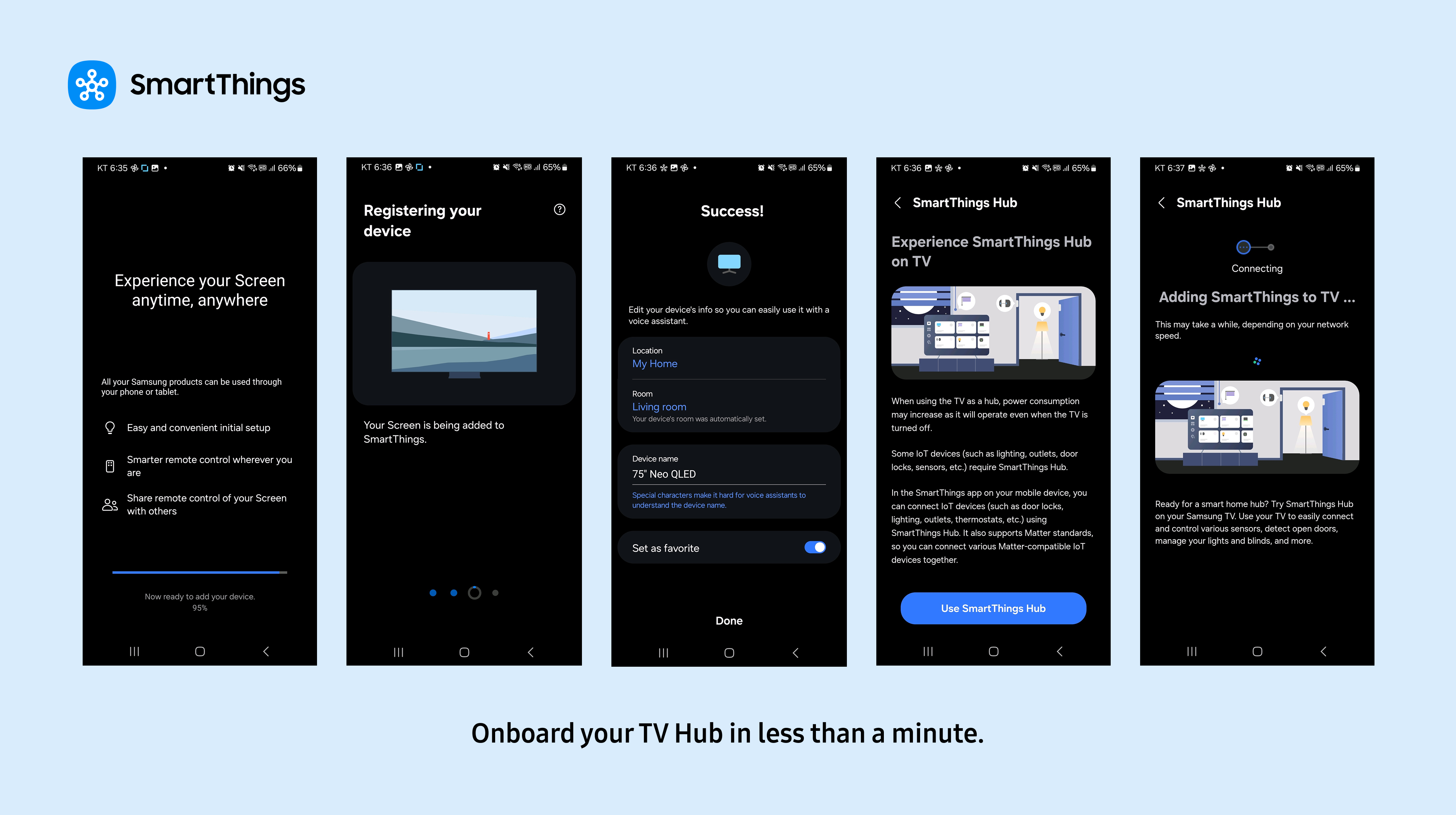
  • No extra setup – Your smart home hub is already built into your TV, fridge, or monitor, no extra cables or power required. When a hub is available in a Samsung TV, the option to enable will instantly pop up to set up through the SmartThings App. 
  • Onboard your TV Hub in less than a minute: Walk through the easy steps to onboard the built in hub on your new TV from the first time you power it on.
  • No added cost – You don’t need to buy a separate device to connect your smart home.
  • Easier to start your smart home – More people can experience a fully connected home without the hassle of additional hardware.

Do You Already Have a Smart Home Hub?

If you’ve purchased a Samsung TV, monitor, or appliance in the past few years, there’s a good chance you already have a built-in SmartThings hub. In fact you might have multiple hubs, which can improve coverage and performance in larger homes. Learn more about how multiple hubs can work together here.

Not sure if your Samsung device has a Hub built in? Check out our handy guide below to find your model number!

Get started with your SmartThings hub by adding it to your SmartThings app today!

Samsung TV

QN900B, QN800B, QN700B, QN100B, QN95B, S95B, QN90B, QN85B, Q80B, Q70B, LS01B, LS03B, LS05B, Q60B, BU8000, LS03BB, MAMS1A, UB8500, UB8100, UB8070, UB8000, S95, S91, S90D, S90, QX3B, QNB88, QNB85, QNB83, QN9xB, QN90BD, QN87B, QN85BD, QN850B, QN83B, QN7xB, QN75B, QB85, QB80, QB67, QB65, QB60, Q8XB, Q8DB, Q83B, Q82B, Q80BD, Q7xB, Q77B, Q6xB, Q67B, Q65B, Q62B, Q60BD, Q60B, BU8570, BU8510, BU8500, BU8200, BU8100, BU8000, QN900C, QN800C, QN700C, QN95C, S95C, S90C, QN90C, QN85C, Q80C, Q70C, Q60C, CU8000, CU7000, UE70A, UC8070, UC8000, UC7200, UC7100, UC7050, UC7000, S9xC, S95CD, S90CD, QNC88, QNC850, QNC85, QNC83, QNC800, QN9xC, QN95CD, QN90CD, QN85CD, QN850C, QC65, QC60, Q8xC, Q80CD, Q7xC, Q70CD, Q6xC, Q67C, Q65C, Q63C, Q61C, Q60CD, CU8510, CU8500, CU8200, CU8100, CU8080, CU800D, CU7700, CU7500, CU700D, LS03CBQN900D, QN800D, QN95D, S95D, QN90D, S90D, QN87D, S85D, QN85D, Q80D, Q70D, Q60D, DU9000, DU8000, DU7000, LS03D, LS01D, The Sero, LST9D, LST7DQN990F, QN900F, S95F, QN90F, S90F, QN85F, S85F, QN80F, QN70F, Q80F, Q70F, U8000F, LS03FW, LS03F

Samsung Projector / Freestyle

LPU9DS, LPU7DS, LPF5DSLSP3B, LPS9C, LFF3C, LFF5C

Samsung Monitor

M90F, M80F, M70F, M50F, M80D, M70D, M50D, G95SD, G97NC, M80B, M70B, M50B, M80C, M70C, M50C, G85SB, G70B, G65B, G95SC, G85NC, S90PC, G75NC, G70NC, G97NB

Samsung Soundbar

HW-Q990C, HW-Q990D, LS60D, HW-Q990F 

Samsung Music Frame

HW-LS60D

Family Hub Fridge

RF85M, RF95M, RF10M, RH81M, RF85N, RF10N, RF85R, RF10R, RF85T, RF85A, RF85B, RF28M, RF22M, RF23M, RF265B, RF22N, RF28N, RF28N, RF22N, RF28R, RF22R, RS22T, RS27T, RF262B, RF27T, RF29A, RF23A, RF29B, RF30B, RF23B, RF24BRF23D, RF29D, RF71D, RF85D, RF90F, RF90H, RM90F, RM90H, RF27C, RF32C, RF59A, RF65D, RS22A, RS58T, RS62T, RS64T, RS6HA, RS6HD, RS70F, RS7HC

9-inch LCD Fridge

RB90F, RI90F, RM60F, RM70H, RM80F, RS90F

Hubs

Samsung SmartThings Wi-Fi

2015 “V2” SmartThings Hub (STH-ETH & others)

2018 “V3” SmartThings Hub (IM6001-V3P01)

Aeotec “V3” SmartThings Hub

SmartThings Station

Comau enters into a binding agreement to acquire Automha

0

Comau has signed a binding agreement for the acquisition of Automha, an Italian company operating in the warehousing and intralogistics automation industry, owned by Trasma.

The closing of the transaction is subject to the satisfaction of customary conditions precedent in transactions of this type, including necessary regulatory approvals, and is expected to occur in the second quarter of 2025.

Under the terms of the agreement Comau will acquire 100 percent of Automha shares, paving the way for new opportunities within the rapidly growing warehousing and logistics sector and establishing a further step toward the creation of a forward-focused Italian industrial automation hub able to innovate and compete in multiple markets.

To ensure business continuity, Automha will continue to operate with the same structure, management and strategic vision, keeping people, quality and innovation at its core.

Franco Togni will retain his position as CEO while Gianni Togni and Roberta Togni, in addition to continuing in their current roles, will join the Comau Executive Committee to contribute to the ongoing development of both companies.

This binding agreement is coherent with the strategy behind the recent change in Comau’s shareholder structure – whose majority share is now held by One Equity Partners, an international private equity firm – which has allowed Comau to become a standalone company.

With this acquisition Comau reconfirms and strengthens its Italian roots and operations, while enhancing its global offer and international presence.

In parallel, Automha will be able to scale-up and further develop its business by leveraging an enhanced geographical footprint and in-house technology competencies.

Furthermore, given that Comau and Automha are fully complementary, the relationship will strengthen the mutual portfolio of projects.

Pietro Gorlier, CEO of Comau, says: “Expanding our reach, know-how and technology portfolio through the acquisition of innovative companies such as Automha is a crucial step in Comau’s growth strategy, as defined when we became a stand-alone company and implemented immediately after the closing phase.

“In addition to capitalizing on the strong growth potential of warehousing and intralogistics markets, the integration of Automha within Comau will allow us to leverage our combined expertise and resources, to accelerate innovation and growth across a wide range of global industrial sectors.”

Ante Kusurin, partner at One Equity Partners, says: “When we invested in Comau, we saw a clear path forward to help the company expand strategically and gain scale.

“M&A is a main driver for this, and we identified warehouse, logistics and handling automation systems as a significant opportunity for this business.

“The acquisition of Automha is a move toward diversification of Comau’s operations and further taps the company into industrial automation trends improving productivity across many industries.

“We are excited for the opportunity ahead of us as these two complementary companies join forces.”

Franco Togni, founder of Automha, says: “In Comau we have found a partner who shares our values of quality, innovation, and commitment to customer success.

“This new chapter represents not only a moment of growth for Automha but also a continuation of the journey that began in 1979.

“I look forward to the future that lies ahead, knowing that together with Comau, we will continue to build excellence, expand our global impact and to reach a proper size to keep a leading position in a market that is increasing competitiveness and project dimensions.”

Special subject invites first-year students to get their feet wet working with underwater vehicles | MIT News

0

When Michael Benjamin, principal research scientist in the MIT Center for Ocean Engineering, arrived at MIT 25 years ago, only professors and postdocs were allowed to touch the department’s underwater vehicles. The vehicles were expensive, he explains, and required extensive training to operate.

“People were scared to death about losing or damaging them, [and] there was no education pipeline to teach students,” he says, adding that the introduction of class 2.680 (Marine Autonomy, Sensing, and Communication) changed this a lot, by creating a class where undergraduate and graduate students could learn to write autonomy code, and run their software on robots on the Charles River. The addition of class 2.S01 (Introduction to Autonomous Underwater Vehicles) last year took the hands-on learning opportunities even further.

“2.S01 is a return to our roots: underwater vehicles. We wanted to create a learning environment where every student handles a robot, and no one is afraid about losing one,” he says. Each student is sent home with an electronics kit, which Benjamin calls the heart of the robot. “They can experiment all they want in their dorm room, and we’ll give them another kit if they break it.”

The AUVs and student test kits in 2.S01 were designed and built by Supun Randeni, a research scientist in mechanical engineering and the primary lecturer and content creator of 2.S01, and Captain Michael Sacarny from MIT Sea Grant. “Dr. Randeni and Captain Sacarny are the geniuses behind the class,” says Benjamin. Together, Randeni and Sacarny run the hands-on lab instruction.

The goal is to expand education and research opportunities to include a larger and younger group of students. “It’s the exact opposite of 25 years ago, when only a privileged few people were allowed to get inside the robot,” says Benjamin. “Student growth and interest is directly related to the degree they have ‘ownership’ of their robot. Physical possession, but also responsibility for its safe operation and return.”

2.S01 provides students with an in-depth insight into autonomous underwater vehicles (AUVs), by introducing theoretical and practical aspects of the AUV design process. This includes fundamentals of naval architecture, electrical systems design, mechanical design, and software design. Students assemble their own AUVs by using a kit of parts and guidance from instructors, beginning with core electronics and building out a full vehicle for deployment in the Charles River on the MIT campus in the final weeks.

Among the activities, students engage in waterproofing vacuum tests, pre-launch sub-system tests, and dockside tests for ballasting, all followed by in-water low-level control tuning runs. Students also construct autonomy missions — first in simulation, followed by in-water autonomous missions to conduct an environmental survey in the Charles River. The course’s final labs include group competitions involving in-water challenges. For the second iteration of the course, which starts in late March, the instructors plan to add more labs that allow the students to explore the intricacies of the electronic, more simulations options, and more water time.

Adowyn Bryne, a second-year mechanical engineering (MechE) student, took the course last year as a member of the first cohort, but this wasn’t her first experience with underwater vehicles. She’d participated in a SeaPerch program in high school. “I chose 2.S01 because I wanted to learn about more complex underwater vehicles,” says Bryne. “I didn’t find out until later in the semester that SeaPerch was actually started at MIT Sea Grant!”

Benjamin says he hopes there are a few things that first-year students take away from participating in 2.S01: first, an understanding that marine robotics is a very cross-disciplinary effort, involving mechanical engineering, electrical engineering, control theory, computer science and ocean science; and, second, the opportunity to view the effort as a gateway to exploring and understanding the ocean. Students says it’s that, and so much more.

Isabella Yeung, a third-year Course 12 student, took the class during her sophomore year after participating in an MIT Undergraduate Research Opportunities Program (UROP) in the MIT Sea Grant Bio Lab with Carolina Bastidas. Bastidas is a research scientist in MIT Sea Grant’s Marine Advisory Services group.

“While UROP-ing, I’d seen many AUVs and other projects being developed at MIT Sea Grant,” Yeung says. “I was curious to learn more and have a deeper insight into what they were doing. This class was a prime opportunity to jump into the world of marine robotics without having any background in Course 2.”

She called the course “easily one of the most hands-on (and downright fun) classes” she’s ever taken, adding that she appreciated having the opportunity to assemble and deploy the AUV.

“As someone who enjoys tinkering, I appreciated the opportunity to get my hands dirty — quite literally, with grease and Charles [River] water,” says Yeung. “I looked forward to all of the classes, especially the deployment sessions. Nothing quite matched the sheer rush of launching our program, rushing to drop the AUV into the Charles, and engaging in a boat chase, hoping it hadn’t gone rogue.”

Bryne advises students considering the course to not worry too much if the class lines up with a particular career path they’re considering. “Your first year is about exploring. If you’re interested in the class, take it! You might find a new area of interest. Regardless of whether you want to keep learning about AUVs, you’ll get valuable transferable skills and have a lot of fun.”

Bryne, herself, says the experience is helping to set the stage for exploring future interests and opportunities. “Every time I’ve gotten to do something with robots, I’ve loved it,” she says, “but I’m also very passionate about women’s health. I want to design medical technology specifically for women, but I definitely think there’s room to incorporate robotics into that. It’s great that MechE is such a broad field, and that the curriculum at MIT allows me to explore so many potential areas of study.”

Enhancing Robotics with Remote Desktop Interfaces: A Leap Towards Future Automation

0

The history of robotics is deep-rooted in the goal of developing intelligent machines that can aid humans in diverse environments and tasks. The rise of robotics as a multidisciplinary field has encouraged businesses to invest heavily in remote work solutions, enabling smarter operations from afar. Top-tier companies have been utilizing the right strategies to manage […]

Meta Trains AI Models with EU User Data

0

Meta Plans to Use EU Users’ Content to Train AI Models

Meta has confirmed plans to utilize content shared by its adult users in the EU to train its AI models. The announcement follows the recent launch of Meta AI features in Europe and aims to enhance the capabilities and cultural relevance of its AI systems for the region’s diverse population.

Meta’s Plans

In a statement, Meta wrote: "Today, we’re announcing our plans to train AI at Meta using public content – like public posts and comments – shared by adults on our products in the EU. People’s interactions with Meta AI – like questions and queries – will also be used to train and improve our models." Starting this week, users of Meta’s platforms (including Facebook, Instagram, WhatsApp, and Messenger) within the EU will receive notifications explaining the data usage. These notifications will detail the types of public data involved and link to an objection form.

Data Exclusions

Meta explicitly clarified that certain data types remain off-limits for AI training purposes. The company says it will not "use people’s private messages with friends and family" to train its generative AI models. Furthermore, public data associated with accounts belonging to users under the age of 18 in the EU will not be included in the training datasets.

Broader Concerns

While Meta presents its approach in the EU as transparent and compliant, the practice of using vast swathes of public user data from social media platforms to train large language models (LLMs) and generative AI continues to raise significant concerns among privacy advocates.

Concerns Over Data Use

Firstly, the definition of "public" data can be contentious. Content shared publicly on platforms like Facebook or Instagram may not have been posted with the expectation that it would become raw material for training commercial AI systems capable of generating entirely new content or insights. Users might share personal anecdotes, opinions, or creative works publicly within their perceived community, without envisaging its large-scale, automated analysis and repurposing by the platform owner.

Secondly, the effectiveness and fairness of an "opt-out" system versus an "opt-in" system remain debatable. Placing the onus on users to actively object, often after receiving notifications buried amongst countless others, raises questions about informed consent. Many users may not see, understand, or act upon the notification, potentially leading to their data being used by default rather than explicit permission.

Conclusion

The approach taken by Meta in the EU underscores the immense value technology giants place on user-generated content as fuel for the burgeoning AI economy. As these practices become more widespread, the debate surrounding data privacy, informed consent, algorithmic bias, and the ethical responsibilities of AI developers will undoubtedly intensify across Europe and beyond.

FAQs

Q: What types of public data will be used to train Meta’s AI models?
A: Meta will use public posts and comments shared by adults on its products in the EU to train its AI models.

Q: Will Meta use private messages or data associated with users under 18 to train its AI models?
A: No, Meta will not use private messages or data associated with users under 18 to train its AI models.

Q: Can users object to the use of their public data for AI training?
A: Yes, users will receive notifications explaining the data usage and will have the option to object to the use of their public data for AI training.

Q: Is Meta’s approach unique?
A: No, other companies like Google and OpenAI have also used data from European users to train their AI models. However, Meta claims its approach is more transparent than many of its industry counterparts.