
Home Blog Page 583

Black Myth: Wukong’s Rebel

0

BAFTA Breakthrough 2024: Meet Beth Park, The Lead Performance Director Behind Black Myth: Wukong

A Rising Star in the Gaming Industry

Beth Park, the lead performance director on Black Myth: Wukong, has been named one of the standouts in this year’s BAFTA Breakthrough 2024 cohort. With a career spanning almost six years, Beth has worked on several acclaimed games, including Baldur’s Gate 3, Metaphor: Refantazio, and Warhammer 40,000 Space Marine 2.

A Passion for Performance Direction

As a performance director, Beth’s role is to interpret concept art for game characters and bring them to life. She explains, "I get to think about what kind of voice would suit this character. What kind of emotions would they have? What kind of backstory do they have?" This process involves a deep understanding of the character’s personality, emotions, and motivations.

Black Myth: Wukong – A Showcase of Her Skills

Beth’s work on Black Myth: Wukong has been particularly notable, with her performance direction playing a crucial role in the game’s success. She comments, "I got to work with a lot of lovely characters, like Zhu Bajie, the little warthog guy. You’re with him for most of the game, so getting to know that character throughout the whole game was really nice. And working with Jack Ayers, who plays that character, was lovely."

The Role of AI in Performance Direction

With the rise of artificial intelligence (AI) in the gaming industry, Beth is acutely aware of its potential impact on the field. While she acknowledges AI’s ability to replicate certain aspects of human performance, she believes that "human, chaotic emotion" is essential for creating engaging characters. She comments, "I think when you play games, you have to really care about the story in the world that you’re in. And I think that matters. And I think companies that are going to cut out that element are losing value in the products that they’re making."

Conclusion

Beth Park’s success in the gaming industry is a testament to her passion and dedication to her craft. As a lead performance director, she has made a significant impact on the gaming world, and her recognition by BAFTA Breakthrough 2024 is well-deserved. With AI on the rise, it will be interesting to see how she navigates the challenges and opportunities that this technology presents.

FAQs

Q: What is Beth Park’s role in the gaming industry?
A: Beth Park is a lead performance director, responsible for interpreting concept art for game characters and bringing them to life.

Q: What is Black Myth: Wukong?
A: Black Myth: Wukong is a video game developed by Game Science, featuring a unique blend of action, adventure, and role-playing elements.

Q: What is the impact of AI on the gaming industry?
A: AI has the potential to revolutionize the gaming industry, but Beth Park believes that human, chaotic emotion is essential for creating engaging characters and storylines.

NVIDIA TensorRT-LLM Multiblock Attention Boosts Throughput by More Than 3x for Long Sequence Lengths on NVIDIA HGX H200

0

How the decode phase utilizes GPU resources during AI inference

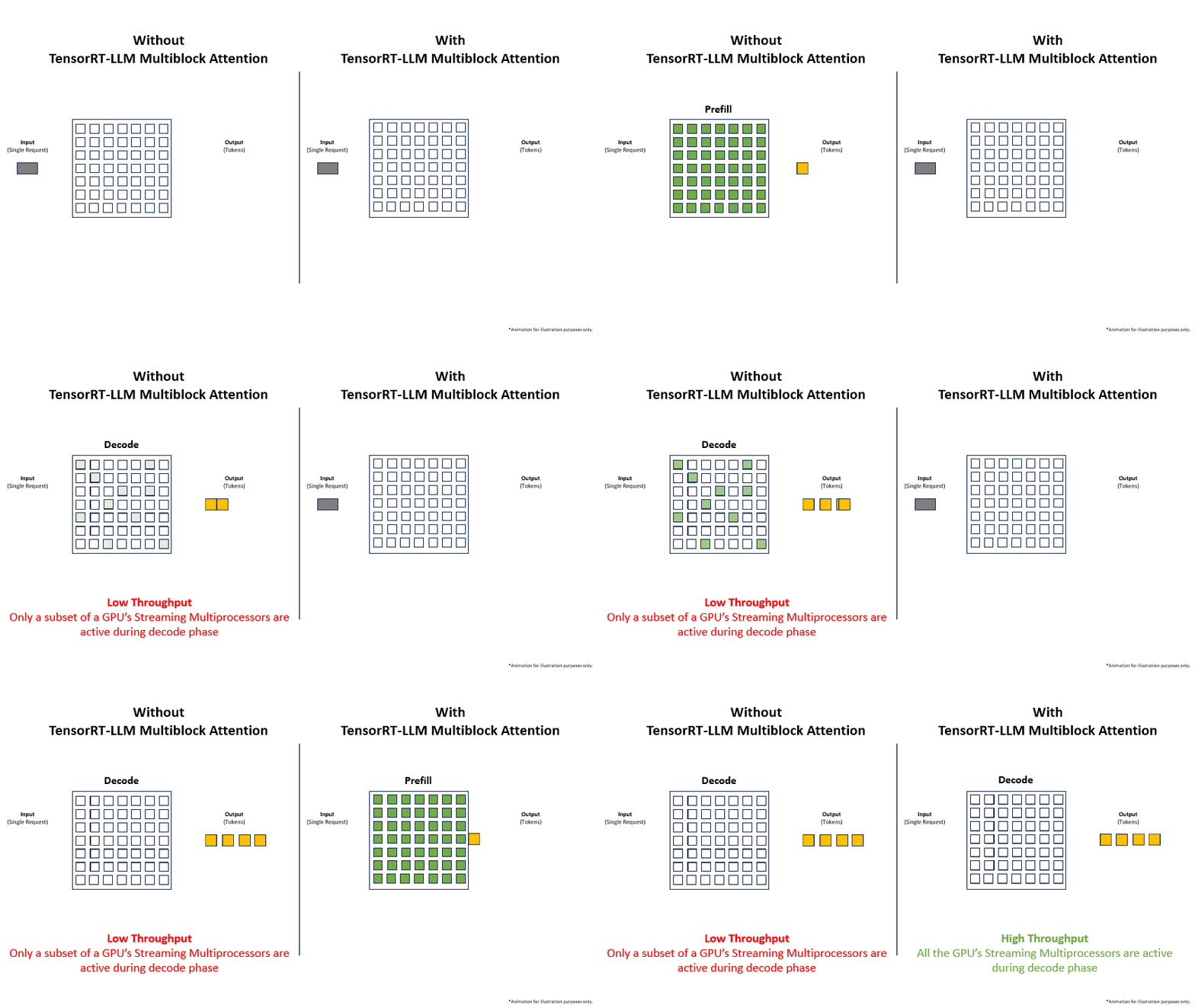
At the core of NVIDIA GPU architectures is the streaming multiprocessor (SM), which includes the core computational resources of a GPU, including the NVIDIA Tensor Cores. When a user submits a request to a model, it goes through two distinct computational phases: prefill and decode. Each phase uses GPU SMs differently. In the prefill phase, all of the GPU’s SMs work in parallel to compute the KV cache and generate the first token. In the decode phase, the system generates output tokens autoregressively, adding to the intermediate states from the prefill phase with each new token. This phase is typically executed on a small subset of a GPU’s SMs.

The number of SMs engaged during the decode phase is determined by both the batch size and the number of a model’s attention heads. In traditional deployment methods, each request within a batch is scheduled to a separate SM for every attention head.

Decoding challenges during AI inference

The number of SMs activated during the inference decode phase introduces multiple challenges that can affect throughput and latency in production environments.

First, in low-latency scenarios where batch sizes may be as small as a single request per batch, the generation of tokens during decode occurs on a few SMs only while leaving the others idle. The limited distribution of work across the SMs can significantly reduce overall system throughput. For the NVIDIA Hopper GPUs, with over one hundred SMs, the impact on throughput can be substantial.

Second, smaller batch sizes are often used in scenarios where requests involve exceptionally long sequence lengths, due to the large KV Cache sizes produced during the prefill phase. The small batch sizes result in a situation where token generation in the decode phase happens on only a few SMs, significantly reducing system throughput.

Finally, in production scenarios that benefit from model parallelism, the attention heads of the model are shared across multiple GPUs, further reducing the number of SMs activated per GPU during the decode phase, impacting system throughput.

Addressing low-latency and long-context inference challenges with TensorRT-LLM multiblock attention

TensorRT-LLM supports multiblock attention, a feature designed to maximize the number of SMs engaged during the inference decode phase. This feature breaks down the computational tasks of the decode phase into smaller blocks and intelligently distributes them across all of a GPU’s SMs. Once the SMs process their respective portions of the computation, their outputs are aggregated back to the originating SMs to produce the final result.

Activating TensorRT-LLM multiblock attention enables systems to handle longer context lengths during inference more efficiently. By allowing the decode phase to access the memory of all SMs on a GPU, instead of being restricted to just a subset, multiblock attention resolves the memory bandwidth limitation issues of working with large KV cache sizes for large contexts.

Additionally, in low-latency deployment scenarios with small batch sizes, multiblock attention more efficiently distributes the computational workload during the decode phase across all of a GPU’s resources, enhancing throughput and enabling higher overall performance.

animation showing how TensorRT-LLM Multiblock engages all SMs of a GPU during decode increasing overall system throughput and accelerating Time Per Output Token.

Multiblock attention boosts throughput by up to 3.5x on NVIDIA HGX H200

With multiblock attention, an NVIDIA HGX H200 can generate 3.5x more tokens per second for queries with very long sequence lengths in low-latency scenarios. Even when the model is parallelized on half the number of NVIDIA HGX H200 GPUs, an impressive 3x performance increase in tokens per second can be achieved. Moreover, this increase in throughput doesn’t come at the cost of time-to-first-token, which remains unchanged.

graph showing the difference of throughput (Token/Sec) between on Llama 3.1 models without Multiblock Attention and with Multiblock Attention

Getting started with TensorRT-

OpenAI Accidentally Erases Potential Evidence in Training Data Lawsuit

0

A Stunned Error: OpenAI Erases Critical Evidence in Lawsuit Against New York Times and Other Newspapers

Mistake Highlights Concerns Over AI Training Data

In a stunning misstep, OpenAI engineers accidentally erased critical evidence gathered by The New York Times and other major newspapers in their lawsuit over AI training data, according to a court filing Wednesday.

What Happened?

The newspapers’ legal teams had spent over 150 hours searching through OpenAI’s AI training data to find instances where their news articles were included, the filing claims. However, it doesn’t explain how this mistake occurred or what precisely the data included. While the filing says OpenAI admitted to the error and tried to recover the data, what was recovered was incomplete and unreliable – so what was recovered cannot help properly trace how the news organizations’ articles were used in building OpenAI’s AI models.

OpenAI’s Response

OpenAI’s lawyers characterized the data erasure as a "glitch," while The New York Times’ attorneys noted they had "no reason to believe" it was intentional.

The Lawsuit

The New York Times Company launched this landmark battle last December, claiming OpenAI and its partner Microsoft had built their AI tools by "copying and using millions" of the publication’s articles and now "directly compete" with its content as a result. The publication is asking for OpenAI to be held liable for "billions of dollars in statutory and actual damages" for allegedly copying its works.

The Cost of the Battle

The Times has already spent more than $1 million battling OpenAI in court – a significant fee few publishers can match. Meanwhile, OpenAI has struck deals with major outlets like Axel Springer, Conde Nast, and The Verge’s parent company Vox Media, suggesting many publishers would rather partner than fight.

OpenAI’s Refusal to Join the Update

OpenAI declined to join The New York Times in filing the update to the court. This declaration was filed by Jennifer Maisel, an attorney representing the news organizations, to formally notify the court about what happened.

Conclusion

The data erasure has sparked concerns over the reliability and transparency of AI training data. The lawsuit highlights the importance of ensuring the integrity of AI systems and the need for open communication between AI developers and news organizations.

Frequently Asked Questions

Q: What happened to the data?
A: OpenAI engineers accidentally erased critical evidence gathered by The New York Times and other major newspapers in their lawsuit over AI training data.

Q: How did this mistake occur?
A: The exact cause of the mistake is unclear, but OpenAI admitted to the error and tried to recover the data.

Q: What was recovered from the data?
A: The recovered data was incomplete and unreliable, so it cannot help properly trace how the news organizations’ articles were used in building OpenAI’s AI models.

Q: What is the significance of this lawsuit?
A: The lawsuit highlights concerns over the reliability and transparency of AI training data and the need for open communication between AI developers and news organizations.

ACID Transaction Isolation

0

Understanding Isolation in ACID Transactions

Isolation
Ensures that multiple concurrent transactions do not interfere with each other, preserving the consistency and integrity of the database. It guarantees that a transaction’s intermediate states are invisible to other transactions until it is committed, preventing problems such as dirty reads, non-repeatable reads, and phantom reads.

Why Isolation is Important?
In multi-user environments where multiple transactions run concurrently:

  • Without isolation: One transaction may read or affect data that another transaction is modifying, leading to unpredictable or incorrect results.
  • With isolation: Each transaction operates as if it is the only one interacting with the database.

Common Problems Without Proper Isolation

  • Dirty Reads
  • Non-Repeatable Reads
  • Phantom Reads

Isolation Levels
Isolation levels determine how isolated a transaction is from others. The more isolation, the less concurrency, and vice versa. Different levels balance between data consistency and system performance.

1. Read Uncommitted
Definition: Allows transactions to read uncommitted changes from other transactions.
Use Case: Rarely used, suitable only when high performance is critical and occasional dirty reads are acceptable.
Problems Allowed: Dirty reads, non-repeatable reads, phantom reads.
Example: A transaction updates an order status to "Shipped" but hasn’t committed. Another transaction reads the "Shipped" status and proceeds based on it. If the first transaction rolls back, the second transaction used invalid data.

2. Read Committed (Default for many databases)
Definition: A transaction can only read committed changes from other transactions.
Use Case: Common in most systems; avoids dirty reads.
Problems Allowed: Non-repeatable reads, phantom reads.
Example: A transaction updates the balance from $1000 to $800 and commits. Another transaction reads the updated balance only after the commit.

3. Repeatable Read
Definition: Ensures a transaction reads consistent data for the same query, even if other transactions modify the data.
Use Case: Used when data consistency during a transaction is important.
Problems Allowed: Phantom reads.
Example: A transaction reads a product quantity as 50. Another transaction modifies the quantity to 30 and commits. The first transaction reads the quantity again and still sees 50, maintaining consistency for its duration.

4. Serializable (Highest Isolation Level)
Definition: Transactions are executed in a completely isolated manner, as if they were serialized (one after the other).
Use Case: Critical when absolute data consistency is required.
Problems Allowed: None (dirty reads, non-repeatable reads, and phantom reads are all prevented).
Example: A transaction reads all orders above $100. Another transaction attempts to add a new order above $100 but is blocked until the first transaction completes. Ensures no new data interferes during the first transaction.

Comparison Table of Isolation Levels Isolation Level Dirty Reads Non-Repeatable Reads Phantom Reads
Read Uncommitted Allowed Allowed Allowed
Read Committed Prevented Allowed Allowed
Repeatable Read Prevented Prevented Allowed
Serializable Prevented Prevented Prevented

Choosing the Right Isolation Level

  • High Performance, Lower Consistency: Use Read Uncommitted or Read Committed.
  • Medium Consistency and Performance: Use Repeatable Read.
  • Maximum Consistency, Lower Performance: Use Serializable.

Example of Transaction -> With and without Isolation
This line means that during a transaction’s execution, any changes it makes to the database are not visible to other ongoing transactions until it is fully completed (committed).

Breaking it Down

  • Intermediate State: When a transaction updates data, it may not immediately finalize those changes. This is the "in-progress" or "intermediate state."
  • Invisible to Others: Other transactions cannot see or act upon these "in-progress" updates. They only see the data as it existed before the transaction began.
  • Commit Finalizes Changes: Once the transaction finishes and commits, its changes become permanent and visible to all other transactions. If the transaction fails or rolls back, none of its changes are visible or applied.

Example to Illustrate
Scenario: Money Transfer

Without Isolation

  • Intermediate State Visible: After Step 1, Transaction 2 reads Account A’s balance as $800 and Account B’s balance as $1000. This is inconsistent and could lead to errors, especially if Transaction 1 rolls back.

With Isolation

  • Intermediate State Hidden: Transaction 2 sees the original balances: Account A = $1000, Account B = $1000. Once Transaction 1 commits, Transaction 2 will see the updated balances: Account A = $800, Account B = $1200.

Why Is This Important?
Hiding intermediate states ensures:

  • Consistency: Other transactions do not operate on incomplete or incorrect data.
  • Integrity: Avoids errors caused by transactions that interact with half-finished updates.

FAQs:

Q: What is isolation in ACID transactions?
A: Isolation ensures that multiple concurrent transactions do not interfere with each other, preserving the consistency and integrity of the database.

Q: Why is isolation important?
A: Isolation prevents problems such as dirty reads, non-repeatable reads, and phantom reads, ensuring data consistency and integrity.

Q: What are the different isolation levels?
A: The different isolation levels are Read Uncommitted, Read Committed, Repeatable Read, and Serializable, each with varying levels of isolation.

Q: Which isolation level should I choose?
A: The choice of isolation level depends on your specific use case, including performance requirements and data consistency needs.

$23 Echo Dot Deal of the Black Friday

0

Smart Speaker Deal of the Day: Echo Dot for $23

A Sucker for a Good Deal

I’m a sucker for a good deal, and smart speakers are one of the devices I like buying during sales events. For a discounted price, you can get a speaker for your home that functions as a Bluetooth speaker and connection to your smart home.

The Echo Dot: A Great Value

The Echo Dot is a great way to add Amazon Alexa to your home, bringing the virtual assistant into your routines to answer questions and run smart home devices, but it’s also a pretty decent speaker on its own, especially at $30. This speaker won’t blow the Apple HomePod mini out of the water, but it is still a great, inexpensive speaker.

Uses for the Echo Dot

For example, if you already have an Echo Dot, you could get a second one to create a stereo pair for a TV to enjoy more immersive audio during movie nights. It’s also small enough to hang out on a desk, bookshelf, or nightstand. I even have an Echo Dot in my bathroom to close the blinds and play music while I shower.

The Deal

Available in Charcoal, Deep Sea Blue, and Glacier White, the Echo Dot (5th Gen) is typically available for $50 but is currently 54% off, bringing the price down to $23 with the Black Friday sale.

Limited-Time Offer

While many sales events feature deals for a specific length of time, deals are on a limited-time basis, making them subject to expire anytime. ZDNET remains committed to finding, sharing, and updating the best offers to help you maximize your savings so you can feel as confident in your purchases as we feel in our recommendations.

Conclusion

The Echo Dot is a great smart speaker that can enhance your smart home experience and provide a decent speaker for your home. With a 54% discount, this is an excellent opportunity to get your hands on this device at an affordable price.

FAQs

Q: What is the Echo Dot?
A: The Echo Dot is a smart speaker developed by Amazon that can be used as a Bluetooth speaker and as a hub for your smart home devices.

Q: What is the usual price of the Echo Dot?
A: The usual price of the Echo Dot is $50.

Q: Is the deal limited-time?
A: Yes, the deal is on a limited-time basis and can expire at any moment.

Q: Can I use the Echo Dot to control my smart home devices?
A: Yes, the Echo Dot can be used to control your smart home devices, such as lights, thermostats, and security cameras.

Q: What colors is the Echo Dot available in?
A: The Echo Dot is available in Charcoal, Deep Sea Blue, and Glacier White.

Apple is working on ‘LLM Siri’ to compete with ChatGPT

0

Apple’s AI Overhaul of Siri: A ChatGPT-Like Upgrade Coming Soon

Introduction

Apple is planning a major AI overhaul of its popular virtual assistant, Siri, to make it more conversational and natural-sounding, like OpenAI’s ChatGPT and Google’s Gemini Live, according to a report from Bloomberg’s Mark Gurman. This new version of Siri, reportedly called "LLM Siri," will be powered by Apple’s AI models and will allow users to have more advanced and sophisticated interactions with the assistant.

Improved Capabilities

As part of Apple’s plan to infuse its iPhones with AI, the company will make Siri better at handling more complex tasks. The assistant will have an "expanded" ability to use App Intents to interact with third-party apps, while also using Apple Intelligence to summarize and write text. This will enable Siri to perform tasks more efficiently and accurately, such as summarizing long documents or articles, and even composing text messages and emails.

Timeline and Release

According to Bloomberg, Apple may announce these plans as soon as next year, but the company intends to replace Siri’s underlying software with the new system in the spring of 2026. This significant upgrade will likely change the way users interact with their iPhones and other Apple devices.

What’s Different from ChatGPT

In an interview with The Wall Street Journal, Apple senior vice president of software Craig Federighi highlighted the differences between an AI-enhanced Siri and ChatGPT: "The properties of something like OpenAI advanced voice mode and Siri are quite different. That OpenAI mode is great if you want to go ask a question about quantum mechanics and have it write a poem for you about it… It’s not going to open your garage. It’s not going to help you send a text message. There are many, many useful things Siri does for you every day, does them quickly and locally on your device. There’s a spectrum here, there’s a tradeoff across capabilities. Will these worlds converge? Of course, that’s where the direction is going."

Conclusion

Apple’s AI overhaul of Siri is expected to revolutionize the way users interact with the virtual assistant, making it more conversational, natural, and efficient. The company’s plans to infuse its iPhones with AI will likely change the way users experience their devices and will likely give Apple a competitive edge in the market.

Frequently Asked Questions

Q: When will Apple announce the new Siri?
A: Apple may announce the new Siri as soon as next year.

Q: When will the new Siri be released?
A: The new Siri is expected to be released in the spring of 2026.

Q: What will the new Siri be capable of?
A: The new Siri will be capable of advanced tasks such as summarizing and writing text, and will have an "expanded" ability to use App Intents to interact with third-party apps.

Q: How will the new Siri differ from ChatGPT?
A: The new Siri will be more focused on everyday tasks and will not be able to perform tasks like writing a poem about quantum mechanics, unlike ChatGPT.

The AI flagship phone that’s surprisingly restrained

0

Design & Build

Recommending a phone to Creative Bloq’s discerning audience is a tricky proposition. Readers who are at home with thunderous tower PCs full of GPUs, or sleek laptops that nonetheless carry the computing power of a whole room of computers from a decade ago, are not going to be impressed by a phone, no matter how fast the CPU inside runs.

What Google has done with the Pixel 9 Pro, however, remains interesting. It takes an excellent camera array and puts it behind a bright OLED screen, then packs the software with AI tricks and gives it a long battery life. There may be phones out there that do better in the benchmark tests, but there are few that are as easy to live with, making the Google Pixel 9 Pro one of the best camera phones on the market.

Key Specs

  • CPU: Google Tensor G4
  • Graphics: Mali-G715 MC7
  • Memory: 16GB
  • OS: Android 15
  • Screen size: 6.3in LTPO OLED
  • Resolution: 1280x2856px
  • Refresh rate: 120Hz
  • Storage: 128GB – 1TB
  • Cameras: 50MP f/1.7 wide, 48MP f/2.8 5x periscope zoom telephoto, 48MP f/1.7 ultrawide, 42MP f/2.2 front-facing ultrawide
  • Connectivity: Wi-Fi 7, Bluetooth 5.3, Ultra-wideband, NFC, USB 3.2 Gen 2
  • Dimensions: 152.8 x 72 x 8.5 mm
  • Weight: 199g

Features

The big news right now is AI, and while the Pixel 9 Pro comes with Android 14 installed, it quickly updates itself to Android 15 and inherits the newest features from Big Daddy Google. Inside the Tensor G4 processing cluster that drives the phone, you’ll find an NPU to handle the machine-learning heavy lifting. It all looks largely unchanged since the Tensor G3 in the Pixel 8 phones, though that was a nine-core chip and the G4 ‘only’ has eight, but they’re a bit faster. What matters more is that the G4 is paired with 16GB of RAM, the same amount Apple has only just started putting in its laptops as standard, and AI apps love RAM.

Many AI apps come integrated into Android 15, so you get Add Me to blend together two photos with an AR overlay to help get them lined up, so photographers never need to worry about not appearing in photos they’ve taken. There’s Reimagine too, part of the Magic Editor tool, which can completely change the composition of an image, adding and removing elements as you want. This is a very weird thing to use, and makes you wonder what it’s going to be like in a few years time when the technology has matured, become accepted, and improved.

Performance

The Pixel 9 Pro’s benchmark results are a bit unusual. We ran them twice, just to be sure, then looked up online charts to check we weren’t hallucinating. Despite the Tensor G4 processor boasting all the sort of tech you’d expect in a 2024 flagship (eight cores, one of them particularly hot, 16GB of RAM and varying amounts of UFS 3.1 storage) it posts scores lower than you might expect.

Price

At $/£999, the Pixel 9 Pro is expensive, sure, but it’s also in about the same sort of place as all the other 2024 flagship smartphones. An iPhone 16 Pro or Samsung Galaxy S24+ cost exactly the same amount. You get a lot for your money, especially with the new toys Android 15 brings with it, and as it’s a phone that could last seven years the outlay starts to look less outrageous. Still, you could pick up two phones from the likes of Motorola (or budget Samsungs) for the same price, and you’d be able to replace that after three years without feeling the same kind of guilt you’d feel for sending a flagship to the recycling early.

Who is it for?

Flagships are always good all-rounders, and with the upgraded cameras the Pixel 9 Pro brings with it it’s easy to see this phone coming into its own as the kind of visual notebook many creatives like to keep. The fact that it’s not a huge XL variant means it’s going to find a home in pockets, fashionable bags and other places the larger phones couldn’t fit, and it’s a highly capable choice for everyday use, streaming, gaming and doing clever AI tricks.

Should I buy it?

Buy it if:

  • You’re in the market for a new flagship phone
  • You don’t want an XL model
  • You want some of the best cameras

Don’t buy it if:

  • You’d prefer something cheaper
  • You’d prefer something bigger
  • You’re an Apple fan

Also consider

  • iPhone 16 Pro
  • Samsung Galaxy S24+
  • Motorola phones
  • Budget Samsungs

UCSD’s New SCIDS School: All About the Apps

Article

The Birth of a New Era in Data Science: The University of California, San Diego’s School of Computing, Information, and Data Sciences (SCIDS)

The University of California, San Diego’s (UCSD) new School of Computing, Information, and Data Sciences (SCIDS) is making waves in the world of data science. With the merger of the San Diego Supercomputer Center (SDSC) and the Halıcıoğlu Data Science Institute (HDSI), SCIDS is poised to become a leader in the field of data science and artificial intelligence (AI).

Researching the Unresearched

According to Rajesh Gupta, the interim dean of SCIDS and a distinguished professor of computer science and engineering at the university, the school is committed to researching topics that are not yet in textbooks, such as AI and generative AI. "AI and generative AI fall into that category, where the most recent advances are maybe six months old," he said. "Attention [i.e. the ‘Attention Is All You Need’ paper] is two or three years old, Transformers a bit more, CNNs a bit older, but reborn."

Staying Ahead of the Curve

Gupta emphasized the importance of staying ahead of the curve in the rapidly evolving field of data science. "The people who are advancing the state-of-the-art in AI and GenAI aren’t in the university. Some don’t even have college degrees," he said. "I have been a professor for 30 years. We are constantly keeping in touch with what’s going on. But if you talk to me about the latest cloud stack or the GenAI stack, or a blockchain with authentication built in or KYC [know your customer] built in and so on – that’s not in any university."

Collaboration is Key

Frank Würthwein, the director of the SDSC and a professor at HDSI, believes that collaboration is key to staying ahead of the curve. "The SDSC was founded about 40 years ago. Throughout this 40-year history, we’ve become and have always been excellent in translating computational science, data science into practical applications. We’re fairly agnostic about the domain. We’re very, very broad across… all domains."

The Future of Data Science

Würthwein believes that the merger of SDSC and HDSI is timely, as the potential for translational science has never been higher. "Just give you one example, the total volume of money spent by the Gates Foundation is roughly the same, within 10% or so, of the National Science Foundation," he said. "That’s a staggering number."

Conclusion

The University of California, San Diego’s School of Computing, Information, and Data Sciences (SCIDS) is poised to become a leader in the field of data science and artificial intelligence. With its commitment to researching topics that are not yet in textbooks, staying ahead of the curve, and embracing collaboration, SCIDS is well-positioned to make a significant impact in the field.

FAQs

Q: What is the University of California, San Diego’s School of Computing, Information, and Data Sciences (SCIDS)?
A: SCIDS is a new school at the University of California, San Diego, formed by the merger of the San Diego Supercomputer Center (SDSC) and the Halıcıoğlu Data Science Institute (HDSI).

Q: What is the focus of SCIDS?
A: SCIDS is focused on researching and applying techniques that are not yet in textbooks, such as AI and generative AI.

Q: How does SCIDS stay ahead of the curve in the rapidly evolving field of data science?
A: SCIDS stays ahead of the curve by constantly keeping in touch with what’s going on and by collaborating with experts in the field.

Q: What is the role of collaboration in SCIDS?
A: Collaboration is key to staying ahead of the curve, and SCIDS is committed to working with anyone who is seeking solutions to tough challenges.

New York Times Says OpenAI Erased Potential Lawsuit Evidence

0

The New York Times Sues OpenAI and Microsoft Over AI Models

Lawsuits are never exactly a lovefest, but the copyright fight between The New York Times and both OpenAI and Microsoft is getting especially contentious.

The Allegations

This week, the Times alleged that OpenAI’s engineers inadvertently erased data the paper’s team spent more than 150 hours extracting as potential evidence.

Data Erasure

OpenAI was able to recover much of the data, but the Times’ legal team says it’s still missing the original file names and folder structure. According to a declaration filed to the court Wednesday by Jennifer B. Maisel, a lawyer for the newspaper, this means the information “cannot be used to determine where the news plaintiffs’ copied articles” may have been incorporated into OpenAI’s artificial intelligence models.

Reactions

“We disagree with the characterizations made and will file our response soon,” OpenAI spokesperson Jason Deutrom told WIRED in a statement. The New York Times declined to comment.

The Background

The Times filed its copyright lawsuit against OpenAI and Microsoft last year, alleging that the companies had illegally used its articles to train artificial intelligence tools like ChatGPT. The case is one of many ongoing legal battles between AI companies and publishers, including a similar lawsuit filed by the Daily News being handled by some of the same lawyers.

The Discovery Process

The Times’ case is currently in discovery, which means both sides are turning over requested documents and information that could become evidence. As part of the process, OpenAI was required by the court to show the Times its training data, which is a big deal—OpenAI has never publicly revealed exactly what information was used to build its AI models.

Data Sandbox

To disclose it, OpenAI created what the court is calling a “sandbox” of two “virtual machines” that the Times’ lawyers could sift through. In her declaration, Maisel said that OpenAI engineers had “erased” data organized by the Times’ team on one of these machines.

The Consequences

According to Maisel’s filing, OpenAI acknowledged that the information had been deleted, and attempted to address the issue shortly after it was alerted to it earlier this month. But when the paper’s lawyers looked at the “restored” data, it was too disorganized, forcing them “to recreate their work from scratch using significant person-hours and computer processing time,” several other Times lawyers said in a letter filed to the judge the same day as Maisel’s declaration.

Conclusion

The copyright fight between The New York Times and OpenAI and Microsoft is a contentious one, with both sides trading accusations and counter-accusations. The outcome of the case remains to be seen, but it is clear that the use of AI models in the publishing industry is a complex and highly regulated issue.

FAQs

Q: What is the dispute about?
A: The dispute is about the use of The New York Times’ articles to train OpenAI’s artificial intelligence models, without permission.

Q: What happened to the data?
A: According to The New York Times, OpenAI engineers inadvertently erased data that the paper’s team had spent more than 150 hours extracting as potential evidence.

Q: Has OpenAI acknowledged the data erasure?
A: Yes, OpenAI has acknowledged that the information had been deleted, and attempted to address the issue shortly after it was alerted to it earlier this month.

Q: What is the significance of the discovery process?
A: The discovery process is a critical part of the lawsuit, as both sides are required to turn over requested documents and information that could become evidence. In this case, OpenAI was required to show The New York Times its training data, which is a big deal.

Q: What are the implications of the case?
A: The outcome of the case could have significant implications for the use of AI models in the publishing industry, and the regulation of copyright in the digital age.

Scattered Spider

0

Phishing Scam Uncovered: Scattered Spider Group Accused of Stealing Millions

Background

Prosecutors allege that the phishing attacks ran from at least September 2021 to April 2023. During this period, the defendants sent text messages to mobile phones of employees of the targeted companies, purporting to be from the IT departments of their employers.

Modus Operandi

The text messages often falsely warned that the employees’ accounts would be deactivated immediately unless they clicked on links to malicious sites designed to look like legitimate websites used by the victim companies. The phishing sites attempted to lure the employees into providing confidential information, including account login credentials. Some employees took the bait by visiting the sites, entering their credentials, and authenticating their identities with two-factor authentication. Scattered Spider then entered the intercepted passwords and 2FA credentials into the legitimate sites and gained access to the employee accounts.

Consequences

Once inside targeted companies’ networks, the defendants allegedly stole confidential information, including personal information such as account credentials, names, email addresses, and telephone numbers. Prosecutors said the defendants also used stolen information from hacked companies and elsewhere to access cryptocurrency accounts or wallets of “numerous individuals” and take millions of dollars’ worth of digital coins.

Potential Sentences

If convicted, each defendant faces a maximum sentence of 20 years in prison for conspiracy to commit wire fraud, up to five years in federal prison for one count of conspiracy, and a mandatory two-year consecutive prison sentence for aggravated identity theft. Buchanan, one of the defendants, faces up to 20 years in prison if he is convicted of wire fraud.

Conclusion

The Scattered Spider group’s phishing scheme has led to the theft of millions of dollars’ worth of digital coins and sensitive information from targeted individuals. The potential sentences for the defendants are severe, and it is hoped that this case will serve as a deterrent to others who may consider engaging in similar illegal activities.

FAQs

Q: What was the modus operandi of the Scattered Spider group?

A: The group sent text messages to employees of targeted companies, purporting to be from the IT departments of their employers, and lured them into providing confidential information by clicking on malicious links.

Q: What kind of information did the group steal?

A: The group stole confidential information, including personal information such as account credentials, names, email addresses, and telephone numbers, as well as financial information.

Q: What is the potential sentence for the defendants?

A: Each defendant faces a maximum sentence of 20 years in prison for conspiracy to commit wire fraud, up to five years in federal prison for one count of conspiracy, and a mandatory two-year consecutive prison sentence for aggravated identity theft. Buchanan, one of the defendants, faces up to 20 years in prison if he is convicted of wire fraud.