Home Blog Page 61

ChatGPT Remembers Everything

OpenAI Updates ChatGPT’s Memory Feature

Improved Memory Allows AI to Recall Past Conversations

OpenAI has announced a major update to ChatGPT’s memory feature, enabling the AI to automatically reference all past conversations to deliver more personalized responses. The new feature, announced by CEO Sam Altman, allows ChatGPT to recall user preferences, interests, recurring topics, and stylistic choices without being prompted.

Expanded Memory Functionality

The update expands ChatGPT’s memory functionality in two key ways:

Saved Memories

Details you’ve explicitly asked ChatGPT to remember

Chat History

Insights the AI automatically gathers from all your past conversations

This means ChatGPT can now recall your preferences, interests, recurring topics, and even stylistic choices without being prompted. For example, if you’ve mentioned being a rock music fan or preferring short, bullet-pointed answers in previous chats, ChatGPT should remember.

Smarter Conversations

"New conversations naturally build upon what it already knows about you, making interactions feel smoother and uniquely tailored to you," OpenAI stated in its announcement.

Privacy Controls Remain Available

No surprises, not everyone wants ChatGPT to know or remember more about them than it already might. With ChatGPT hoarding a comprehensive record of every conversation you’ve had with it, some of which will inevitably include sensitive info on you, the company you work for, etc, you’re putting a lot of trust in OpenAI’s ability (and willingness) to keep that info under lock and key. Right now, you can opt out of Memory, or use temporary chat if you want to have a conversation that won’t use or affect memory.

Availability and Exceptions

The enhanced memory feature is currently available to ChatGPT Pro subscribers on the mega-costly $200/month tier and will soon roll out to Plus users. However, exceptions include users in the EEA, UK, Switzerland, Norway, Iceland, and Liechtenstein.

Concerns and Risks

As exciting as ChatGPT’s newfound ability to remember everything we’ve ever told it may be, recent studies suggest that this level of AI personalization could come with serious risks. A pair of studies from OpenAI and MIT Media Lab found that frequent, sustained use of ChatGPT may be linked to higher levels of loneliness and emotional dependence among its most loyal users.


Conclusion

ChatGPT’s updated memory feature is a significant step towards creating AI systems that get to know users over their lifetime, providing personalized interactions. However, it’s essential to consider the potential risks and privacy concerns associated with this level of data collection.

Frequently Asked Questions

Q: What is the new memory feature in ChatGPT?
A: The new feature allows ChatGPT to automatically reference all past conversations, enabling it to deliver more personalized responses.

Q: Can I opt out of the new memory feature?
A: Yes, you can opt out of Memory or use temporary chat if you want to have a conversation that won’t use or affect memory.

Q: Is the new memory feature available to all ChatGPT users?
A: No, the feature is currently available to ChatGPT Pro subscribers on the $200/month tier and will soon roll out to Plus users. However, exceptions include users in certain regions.

Q: Are there any potential risks associated with the new memory feature?
A: Yes, recent studies suggest that frequent, sustained use of ChatGPT may be linked to higher levels of loneliness and emotional dependence among its most loyal users.

GPT-4.1 Focus on Coding

0

OpenAI Launches GPT-4.1 Models for Coding and Instruction Following

OpenAI has launched a new family of models called GPT-4.1, which excel at coding and instruction following. The models are available through OpenAI’s API but not ChatGPT.

Key Features

  • 1-million-token context window, allowing for the processing of approximately 750,000 words at once
  • Three models: GPT-4.1, GPT-4.1 mini, and GPT-4.1 nano
  • Optimized for real-world use based on direct feedback from developers

Competition and Goals

OpenAI’s GPT-4.1 models arrive as rivals like Google and Anthropic ramp up efforts to build sophisticated programming models. Google’s Gemini 2.5 Pro and Anthropic’s Claude 3.7 Sonnet have also shown high performance on popular coding benchmarks.

OpenAI’s grand ambition is to create an “agentic software engineer,” capable of performing complex software engineering tasks, such as programming entire apps end-to-end, handling quality assurance, bug testing, and documentation writing.

Benchmark Performance

GPT-4.1 has been tested on various benchmarks, including SWE-bench Verified, where it scored between 52% and 54.6%. This is slightly under the scores reported by Google and Anthropic for Gemini 2.5 Pro and Claude 3.7 Sonnet, respectively.

Additional Evaluation

GPT-4.1 was also evaluated using Video-MME, a measure of a model’s ability to understand content in videos. The model achieved a chart-topping 72% accuracy on the “long, no subtitles” video category.

Limits and Challenges

While GPT-4.1 shows promising performance, it’s essential to recognize its limitations. The model becomes less reliable as the number of input tokens increases, and it may require more specific, explicit prompts to produce accurate results.

Conclusion

GPT-4.1 is a significant step towards OpenAI’s goal of creating an “agentic software engineer.” While it has its limitations, the model shows promising performance on various benchmarks and has the potential to improve the efficiency and accuracy of coding tasks.

FAQs

Q: What is GPT-4.1?
A: GPT-4.1 is a new family of models from OpenAI that excel at coding and instruction following.

Q: What are the key features of GPT-4.1?
A: The key features of GPT-4.1 include a 1-million-token context window, allowing for the processing of approximately 750,000 words at once, and three models: GPT-4.1, GPT-4.1 mini, and GPT-4.1 nano.

Q: How does GPT-4.1 compare to other models?
A: GPT-4.1 has been tested on various benchmarks and has shown promising performance. However, it’s slightly under the scores reported by Google and Anthropic for Gemini 2.5 Pro and Claude 3.7 Sonnet, respectively.

Q: What is the pricing for GPT-4.1?
A: The pricing for GPT-4.1 varies depending on the model and the number of input tokens. GPT-4.1 costs $2 per million input tokens and $8 per million output tokens, while GPT-4.1 mini and nano are more affordable options.

Product Content Makes Up 70% Of Citations

0

New Study Reveals Top Content Types for AI Search Engines

Product Content Visible Across Queries

A recent study by XFunnel tracked 768,000 citations across AI search engines, including ChatGPT, Google’s AI Overviews, and Perplexity, and found that product-related content tops AI citations, making up 46% to 70% of all sources referenced. This finding offers guidance on how marketers should approach content creation amid the growth of AI search.

Citation Patterns Vary By Funnel Stage

The study revealed that AI platforms cite different content types depending on where customers are in their buying journey:

  • Top of funnel (unbranded): Product content led at 56%, with news and research each at 13-15%. This challenges the idea that early-stage content should focus mainly on education rather than products.
  • Middle of funnel (branded): Product citations dropped slightly to 46%. User reviews and affiliate content each rose to about 14%. This shows how AI engines include more outside opinions for comparison searches.
  • Bottom of funnel: Product content peaked at over 70% of citations for decision-stage queries. All other content types fell below 10%.

B2B vs. B2C Citation Differences

The study found significant differences between business and consumer queries:

  • For B2B queries, product pages (especially from company websites) made up nearly 56% of citations. Affiliate content (13%) and user reviews (11%) followed.
  • For B2C queries, there was more variety. Product content dropped to about 35% of citations. Affiliate content (18%), user reviews (15%), and news (15%) all saw higher numbers.

What This Means For SEO

For SEO professionals and content creators, here’s what to take away from this study:

  • Adding detailed product information improves citation chances even for awareness-stage content.
  • Blogs, PR content, and educational materials are cited less often. You may need to change how you create these.
  • Check your content mix to make sure you have enough product-focused material at all funnel stages.
  • B2B marketers should prioritize solid product information on their own websites. B2C marketers need strategies that also encourage quality third-party reviews.

Conclusion

The study concludes: "These observations suggest that large language models prioritize trustworthy, in-depth pages, especially for technical or final-stage information… factually robust, authoritative content remains at the heart of AI-generated citations." As AI transforms online searches, marketers who understand citation patterns can gain a competitive edge in visibility.

Frequently Asked Questions

Q: What percentage of AI citations is product-related content?
A: Product-related content makes up 46% to 70% of all sources referenced.

Q: Which content types are less likely to be cited by AI search engines?
A: News and research articles, affiliate content, user reviews, blog content, and PR materials are less likely to be cited.

Q: Do citation patterns vary by funnel stage?
A: Yes, AI platforms cite different content types depending on where customers are in their buying journey. Product content is more prominent at the bottom of the funnel, while user reviews and affiliate content are more prominent in the middle of the funnel.

Q: Are there differences in citation patterns between B2B and B2C queries?
A: Yes, the study found significant differences between business and consumer queries. Product content is more prominent in B2B queries, while affiliate content is more prominent in B2C queries.

Q: What does this mean for SEO professionals and content creators?
A: This study suggests that marketers should prioritize creating detailed product information, especially for B2B queries, and consider changing their content creation strategies to focus on product-focused material at all funnel stages.

Future of Telehealth Flexibilities

Telemedicine Reimbursement and Regulation: A Permanent Solution Elusive

For Medicare, telemedicine reimbursement and regulation has been about kicking the can down the road – more temporary extensions of COVID-era flexibilities. The current ones run out on September 30.

A Permanent Solution Remains Elusive

It’s April 2025 and healthcare still waits for a permanent solution from the government for telemedicine and Medicare – which tends to drive what Medicaid and private insurers do. Will October 1 find the industry with a permanent solution or another kick of the can down the road?

Experts Weigh In

Dr. Ateev Mehrotra is chair of the department of health services, policy and practice at Brown University School of Public Health. He is an expert in telemedicine policy. Healthcare IT News sat down with him for a wide-ranging discussion on the future of telemedicine reimbursement and regulation.

Q. September 30 is the new deadline for more telemedicine flexibilities. Where do things stand, and what is your opinion of how this is going to shake out?

A. I often struggle to answer this question. On the one hand, it’s a very, very easy answer. There is broad bipartisan support for telehealth, and it’s very hard for me to find anyone who objects to a permanent expansion. In essence, it’s not the merits of telehealth, though there’s some nuances, but generally people are enthusiastic. It’s really coming down to the money.

Implications of a Permanent Solution

Q. What will be the implications if the flexibilities are stopped? September 30 comes along, and Congress does not pass anything. Or, what will be the implications if the flexibilities are kicked down the road again?

A. If they’re stopped, this is going to be quite devastating for some patients who’ve come to depend on telehealth, either because of their life circumstances, difficulty with travel, distance to see their clinicians – and it’s going to decrease continuity of care in that context. And for clinicians who have become accustomed to providing this care.

Stifling Innovation

Q. You say, “Temporary interventions are stifling innovation.” Can you talk about that a bit?

A. If we want telehealth to be incorporated into routine care, then there needs to be changes in where health systems invest, how clinicians structure their weekly schedules, how the scheduling system works, the software we use, the contracts with the electronic health record vendors to implement and support telehealth.

Solution

Q. What, in your mind, is the solution to this challenge? And do you think the solution has a reasonable chance of being successfully implemented?

A. At the end of the day, I think it’s easy: Just take the word “temporary” and make it “permanent” and let’s move on with life. There are some nuances to that. I have advocated that the actual payment for telehealth visits be a little bit less than in-person visits. That way, the pay-for is a little bit less, so it’s more sustainable.

Conclusion

A permanent solution to telemedicine reimbursement and regulation remains elusive, with the current temporary extensions set to expire on September 30. Experts like Dr. Ateev Mehrotra believe that the solution lies in making the temporary extensions permanent, citing broad bipartisan support for telehealth. However, the lack of a clear pay-for has been a major obstacle to implementing a permanent solution.

FAQs

Q: What is the current deadline for telemedicine flexibilities?
A: September 30.

Q: What are the implications if the flexibilities are stopped?
A: It will be devastating for patients and clinicians who have come to depend on telehealth, leading to decreased continuity of care.

Q: Why are temporary extensions stifling innovation?
A: They are undermining investment and organization in telehealth, making it difficult for companies to plan for the future.

Q: What is the solution to this challenge?
A: Making the temporary extensions permanent, with some nuances, such as reducing the payment for telehealth visits to make it more sustainable.

Mastering Console in JavaScript

The JavaScript Console: A Powerful Tool for Debugging and Logging

The console object in JavaScript is a powerful tool for developers. While most use it for simple debugging with console.log(), it offers many other useful methods. This article explores the various functionalities of console and how to leverage them efficiently.

1. Basic Logging

The most commonly used method to print messages:

console.log("Hello, World!");

2. Advanced Console Methods

console.table()

Displays tabular data in an easy-to-read format:

const users = [
  { name: "Alice", age: 25 },
  { name: "Bob", age: 30 }
];
console.table(users);

console.group() and console.groupEnd()

Groups console messages together:

console.group("User Details");
console.log("Name: Alice");
console.log("Age: 25");
console.groupEnd();

3. Silent Debugging with debugger

Use debugger; in your code to trigger breakpoints:

function test() {
  debugger;
  console.log("Debugging starts here!");
}
test();

4. Customizing Console Output

String Substitutions

You can use placeholders for better readability:

console.log("%cStyled message", "color: blue; font-size: 20px;");

CSS Styling in Console

You can style console messages using CSS:

console.log("%cStyled message", "color: blue; font-size: 20px;");

5. Console Aliases

Many browsers provide shortcuts for console methods:

console.dir(document.body); // Displays detailed properties of an object
console.clear(); // Clears the console

6. Using console.log() in Different Environments

  • Browser Console (F12 or DevTools)
  • Node.js Console (Command line)
  • Web Workers (Limited logging capabilities)

Conclusion

The JavaScript console object is more than just console.log(). It provides powerful debugging features, performance tracking, and better logging formats. Mastering these methods will improve your debugging efficiency and code clarity.

FAQs

Q: What is the purpose of the console object in JavaScript?
A: The console object in JavaScript is used for debugging and logging purposes.

Q: How do I use the console object to log messages?
A: You can use the console.log() method to log messages.

Q: What are some advanced console methods available in JavaScript?
A: Some advanced console methods available in JavaScript include console.table(), console.group(), and console.groupEnd().

Q: How do I customize the output of console messages?
A: You can customize the output of console messages using string substitutions and CSS styling.

Q: Can I use the console object in different environments?
A: Yes, you can use the console object in different environments, including the browser console, Node.js console, and Web Workers.

AI Startups Become Big Businesses in Tech’s New Race

Companies Building Consumer Products on Top of LLMs are Growing Fast and Attracting Investor Interest

The Rise of LLM-Powered Consumer Products

Large Language Models (LLMs) have revolutionized the way companies approach natural language processing and artificial intelligence. As the technology advances, we’re seeing a surge in companies building consumer products on top of LLMs, which are attracting significant investor interest.

What are LLMs?

LLMs are a type of artificial intelligence model that can process and generate human-like language. They’ve been trained on vast amounts of text data and can perform tasks such as language translation, text summarization, and even creative writing. The technology has numerous applications across industries, from customer service chatbots to language translation tools.

Consumer Products on Top of LLMs

Companies are leveraging LLMs to build innovative consumer products that can assist with everyday tasks, provide personalized experiences, and even offer entertainment. Some examples include:

Chatbots and Virtual Assistants

Companies like Facebook and Google are developing chatbots that can converse with users in natural language, making it easier to interact with technology. These chatbots can be integrated into various devices, from smartphones to smart home devices.

Personalized Language Translation

Startups like DeepL and Google Translate are using LLMs to develop language translation tools that can provide near-native results. These tools can help travelers communicate more effectively and businesses expand into new markets.

Creative Writing and Storytelling

Companies like AI Writer and WordLift are using LLMs to generate creative content, such as stories, articles, and even entire scripts. This technology has the potential to revolutionize the way we consume and create content.

Investor Interest in LLM-Powered Companies

As the market for LLM-powered products grows, investors are taking notice. Companies that are building products on top of LLMs are attracting significant funding, with many securing multimillion-dollar investments. This influx of capital is allowing companies to scale their operations, expand their teams, and further develop their products.

Why Investors are Interested

Investors are attracted to LLM-powered companies for several reasons:

Scalability

LLMs can process and generate vast amounts of data, making them an attractive technology for companies looking to scale their products and services.

Personalization

LLMs can provide personalized experiences for consumers, which can lead to increased engagement and loyalty.

Cost Savings

LLMs can automate many tasks, reducing labor costs and increasing efficiency.

Conclusion

The growth of companies building consumer products on top of LLMs is a trend that’s unlikely to slow down anytime soon. As the technology continues to advance, we can expect to see even more innovative products and services emerge. With investors pouring in capital, these companies are poised to disrupt industries and change the way we live and work.

FAQs

Q: What are the limitations of LLMs?
A: While LLMs have made significant strides, they still have limitations. For example, they can struggle with ambiguity, nuance, and context.

Q: How do LLMs affect jobs?
A: LLMs have the potential to automate certain tasks, but they also create new job opportunities in areas such as AI development and training.

Q: Are LLMs secure?
A: LLMs can be vulnerable to cyber attacks and data breaches, just like any other technology. Companies must take steps to ensure the security and integrity of their LLM-powered products.

Q: What’s the future of LLMs?
A: The future of LLMs is bright, with ongoing advancements in areas such as multimodal learning, explainability, and transparency. As the technology continues to evolve, we can expect to see even more innovative applications emerge.

AI-Powered Product Design Acceleration

As a teenager, Bradley Rothenberg was obsessed with CAD: computer-aided design software.

Before he turned 30, Rothenberg channeled that interest into building a startup, nTop, which today offers product developers — across vastly different industries — fast, highly iterative tools that help them model and create innovative, often deeply unorthodox designs.

One of Rothenberg’s key insights has been how closely iteration at scale and innovation correlate — especially in the design space.

He also realized that by creating engineering software for GPUs, rather than CPUs — which powered (and still power) virtually every CAD tool — nTop could tap into parallel processing algorithms and AI to offer designers fast, virtually unlimited iteration for any design project. The result: almost limitless opportunities for innovation.

Product designers of all stripes took note.

A decade after its founding, nTop — a member of the NVIDIA Inception program for cutting-edge startups — now employs more than 100 people, primarily in New York City, where it’s headquartered, as well as in Germany, France and the U.K. — with plans to grow another 10% by year’s end.

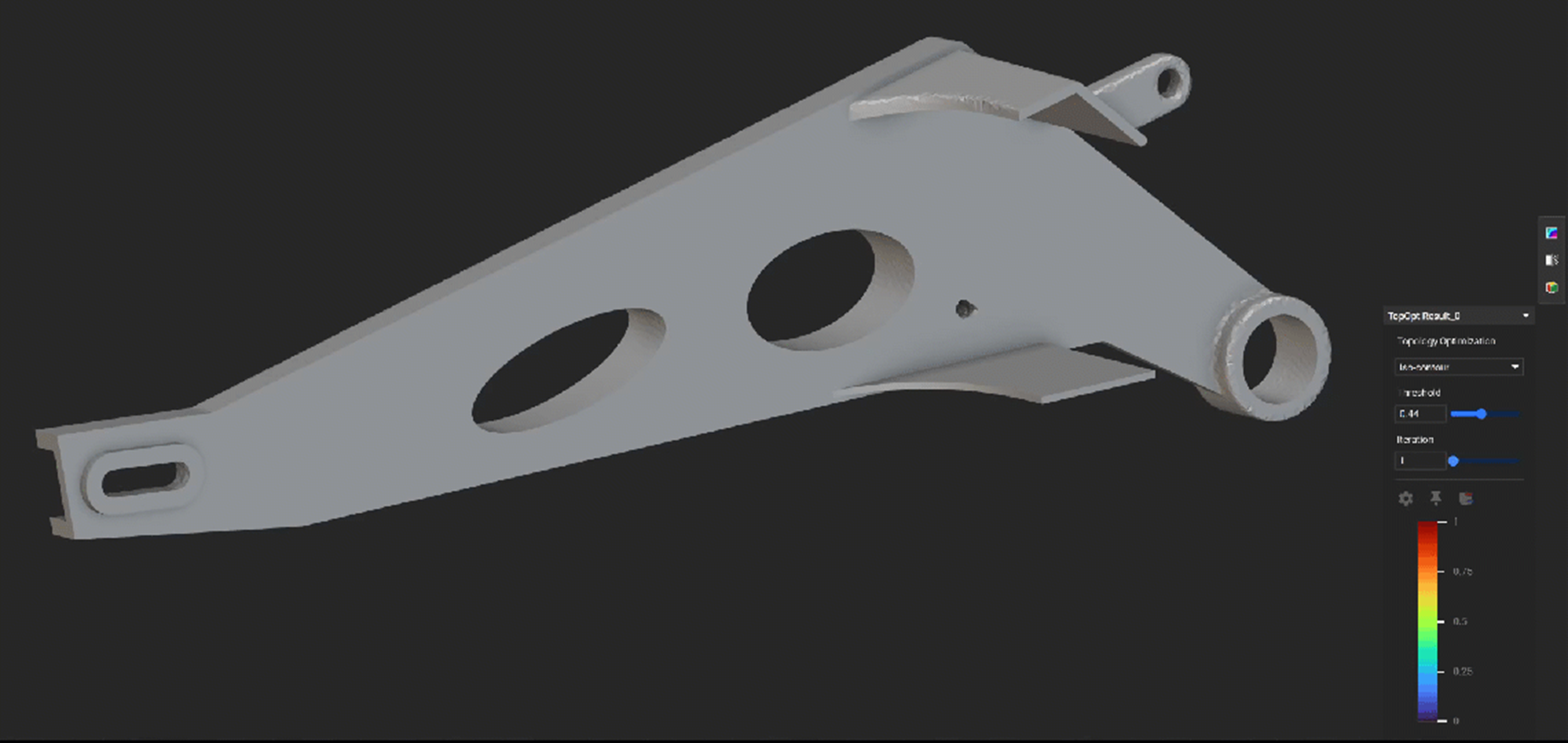
Its computation design tools autonomously iterate alongside designers, spitballing different virtual shapes and potential materials to arrive at products, or parts of a product, that are highly performant. It’s design trial and error at scale.

“As a designer, you frequently have all these competing goals and questions: If I make this change, will my design be too heavy? Will it be too thick?” Rothenberg said. “When making a change to the design, you want to see how that impacts performance, and nTop helps evaluate those performance changes in real time.”

U.K.-based supermarket chain Ocado, which builds and deploys autonomous robots, is one of nTop’s biggest customers.

Ocado differentiates itself from other large European grocery chains through its deep integration of autonomous robots and grocery picking. Its office-chair-sized robots speed around massive warehouses — approaching the size of eight American football fields — at around 20 mph, passing within a millimeter of one another as they pick and sort groceries in hive-like structures.

In early designs, Ocado’s robots often broke down or even caught fire. Their weight also meant Ocado had to build more robust — and more expensive — warehouses.

Using nTop’s software, Ocado’s robotics team quickly redesigned 16 critical parts in its robots, cutting the robot’s overall weight by two-thirds. Critically, the redesign took around a week. Earlier redesigns that didn’t use nTop’s tools took about four months.

“Ocado created a more robust version of its robot that was an order of magnitude cheaper and faster,” Rothenberg said. “Its designers went through these rapid design cycles where they could press a button and the entire robot’s structure would be redesigned overnight using nTop, prepping it for testing the next day.”

nTop software runs hundreds of simulations analyzing how different conditions might impact a design’s performance.

Insights from those simulations are then fed back into the design algorithm, and the entire process restarts. Designers can easily tweak their designs based on the results, until the iterations land on an optimal result.

nTop has begun integrating AI models into its simulation workloads, along with an nTop customer’s bespoke design data into its iteration process.

nTop uses the NVIDIA Modulus framework, NVIDIA Omniverse platform and NVIDIA CUDA-X libraries to train and infer its accelerated computing workloads and AI models.

“We have neural networks that can be trained on the geometry and physics of a company’s data,” Rothenberg said. “If a company has a specific way of engineering the structure of a car, it can construct that car in nTop, train up an AI in nTop and very quickly iterate through different versions of the car’s structure or any future car designs by accessing all the data the model is already trained on.”

nTop’s tools have wide applicability across industries.

A Formula 1 design team used nTop to virtually model countless versions of heat sinks before choosing an unorthodox but highly performant sink for its car.

Traditionally, heat sinks are made of small, uniform pieces of metal aligned side by side to maximize metal-air interaction and, therefore, heat exchange and cooling.

The engineers iterated with nTop on an undulating multilevel sink that maximized air-metal interaction even as it optimized aerodynamics, which is crucial for racing.

The new heat sink achieved 3x the surface area for heat transfer than earlier models, while cutting weight by 25%, delivering superior cooling performance and enhanced efficiency.

Going forward, nTop anticipates its implicit modeling tools will drive greater adoption from product designers who want to work with an iterative “partner” trained on their company’s proprietary data.

“We work with many different partners who develop designs, run a bunch of simulations using models and then optimize for the best results,” said Rothenberg. “The advances they’re making really speak for themselves.”

Conclusion:

nTop has revolutionized the product design process by providing fast, highly iterative tools that help designers model and create innovative, often deeply unorthodox designs. With its AI-powered simulation workloads and NVIDIA-accelerated computing, nTop is poised to continue driving innovation across industries.

FAQs:

Q: What is nTop?
A: nTop is a software company that offers product developers fast, highly iterative tools to model and create innovative designs.

Q: What is the key insight behind nTop’s success?
A: nTop’s key insight is that iteration at scale and innovation correlate closely in the design space.

Q: Who is nTop’s biggest customer?
A: nTop’s biggest customer is U.K.-based supermarket chain Ocado, which builds and deploys autonomous robots.

Q: What are the benefits of using nTop’s software?
A: nTop’s software allows designers to iterate rapidly, making changes and testing designs in real-time, which leads to faster and more innovative design solutions.

Q: What is the future of nTop?
A: nTop anticipates its implicit modeling tools will drive greater adoption from product designers who want to work with an iterative “partner” trained on their company’s proprietary data.

GPT-4.1 Flagship AI Model

0

OpenAI Introduces GPT-4.1, a Successor to the GPT-4o Multimodal AI Model

GPT-4.1 is a successor to the GPT-4o multimodal AI model launched by OpenAI last year. During a livestream on Monday, OpenAI announced that GPT-4.1 has an even larger context window and is better than GPT-4o in “just about every dimension,” with significant improvements to coding and instruction following.

Main Features of GPT-4.1

GPT-4.1 is now available to developers, along with two smaller model versions: GPT-4.1 Mini and GPT-4.1 Nano. GPT-4.1 Mini is more affordable for developers to experiment with, while GPT-4.1 Nano is the smallest, fastest, and cheapest model yet.

Improved Context Window

All three models can process up to one million tokens of context – the text, images, or videos included in a prompt. This is a significant improvement over GPT-4o’s 128,000-token limit. OpenAI claims that GPT-4.1 is trained to reliably attend to information across the full 1 million context length and is more reliable at noticing relevant text and ignoring distractors across long and short context lengths.

Phase-out of GPT-4 and GPT-4.5

OpenAI plans to phase out its two-year-old GPT-4 model from ChatGPT on April 30th, as recent upgrades to GPT-4o make it a “natural successor” to replace it. The company also plans to deprecate the GPT-4.5 preview in the API on July 14th, as GPT-4.1 offers improved or similar performance on many key capabilities at much lower cost and latency.

Reasoning Models

OpenAI is also set to debut the full version of its o3 reasoning model and an o4 mini reasoning model any day now. References to these models have already been spotted in the latest ChatGPT web release by AI engineer Tibor Blaho.

Conclusion

GPT-4.1 is a significant improvement over its predecessor, with a larger context window and better performance on coding and instruction following. The launch comes as OpenAI plans to phase out older models and focus on newer, more powerful technology.

FAQs

Q: What is GPT-4.1?

A: GPT-4.1 is a successor to the GPT-4o multimodal AI model launched by OpenAI last year.

Q: What are the main features of GPT-4.1?

A: GPT-4.1 has an even larger context window, improved performance on coding and instruction following, and is available in three versions: GPT-4.1, GPT-4.1 Mini, and GPT-4.1 Nano.

Q: Why is OpenAI phasing out GPT-4 and GPT-4.5?

A: OpenAI is phasing out GPT-4 and GPT-4.5 because recent upgrades to GPT-4o make it a “natural successor” to replace them, and GPT-4.1 offers improved or similar performance on many key capabilities at much lower cost and latency.

Q: When will OpenAI debut the o3 and o4 reasoning models?

A: OpenAI is set to debut the full version of its o3 reasoning model and an o4 mini reasoning model any day now, with references already spotted in the latest ChatGPT web release.

The Marathon

0

Bungie’s Marathon Reveal Cinematic Short: A Mini Sci-Fi Movie with Stunning Animation

Just as AAA studios are cutting budgets left, right and centre, Bungie’s gone and broken the mold. It brought in an Oscar-winning director for its Marathon reveal cinematic, and it looks incredible.

The Cinematic Short

Gamers have been divided over the vibrant colours and glitchy Wipeout-influenced art style of Bungie’s new Marathon game. The verdict on the new reveal cinematic short should be less contentious. Calling it a ‘reveal cinematic short’ is really underselling it. This is a mini sci-fi movie with stunning animation, an intimate narrative – and, yes, a lot of killing.

Background and Premise

The game’s premise is that runners transfer their consciousnesses into cybernetic 3D bodies to be dropped onto Tau Ceti IV. Most seem to meet quick and vivid ends, after which their psyche returns to their host body. They are then shown objects of emotional importance to anchor them to their actual bodies.

Art and Direction

The cinematic was written and directed by the Spanish director Alberto Mielgo, who won the Best Animated Short Film Oscar for The Windshield Wiper in 2021. He’s known for his work as art director on Disney’s Tron: Uprising and for directing the animated short The Witness in Netflix’s Love, Death & Robots anthology.

Alberto’s style is visible in the blend of photorealism and abstraction, vibrant colors, clean light and the rich detail. It does feel like it could be an episode of Love, Death and Robots. There’s a touch of Cronenberg in the piece, which becomes genuinely moving at times as well as offering plenty of shocks and sensory overload.

Reception

Some fans were were worried about the new Marathon game being a hero shooter (and looking very different from the originals) are now saying they’re happy to at least get this piece of art, regardless of how the game turns out, and I’m not the only one suggesting it deserves to be a full sci-fi series.

Release Date

The new Marathon will be released on 23 September 2025. You can wishlist it on Steam.

Conclusion

Bungie’s Marathon reveal cinematic short is a stunning piece of animation that sets the scene for the game’s background and premise. With its vibrant colors, rich detail, and intimate narrative, it’s a must-watch for fans of sci-fi and animation.

FAQs

Q: What is the premise of the new Marathon game?
A: The game’s premise is that runners transfer their consciousnesses into cybernetic 3D bodies to be dropped onto Tau Ceti IV.

Q: Who directed the Marathon reveal cinematic short?
A: The cinematic was written and directed by Alberto Mielgo, an Oscar-winning director.

Q: When will the new Marathon game be released?
A: The new Marathon will be released on 23 September 2025.

Q: Can I wishlist the game on Steam?
A: Yes, you can wishlist the game on Steam.

AI Action Figure Trend

0

The Rise of AI-Generated Self-Portraits: Unpacking the ChatGPT Trend

A New Wave of Personalized Digital Creations

ChatGPT’s image generation feature has sparked a new wave of personalized digital creations, with LinkedIn users leading the trend of turning themselves into action figures. The phenomenon has gained momentum, with users sharing images of themselves as boxed dolls – complete with accessories and job-themed packaging.

The Trend Takes Shape

The craze began picking up momentum after the viral Studio Ghibli-style portraits, where users shared images of themselves as boxed dolls. The trend has since evolved, with users experimenting with various formats, including traditional action figures and Barbie dolls. The images are designed to resemble toy store displays, complete with bold taglines and personalized packaging.

Variations and Refinements

There are several variations in the latest wave of AI-generated self-representations. The most common format is similar to a traditional action figure or Barbie doll, with props like coffee mugs, books, and laptops reflecting users’ professional lives. Users often refine their images, changing accessories and rewording prompts until the figure matches their desired personality or profession.

Popularity and Engagement

The movement gained initial attention on LinkedIn, where professionals used the format to showcase their brand identities more playfully. The "AI Action Figure" format, in particular, resonated with marketers, consultants, and others looking to present themselves as standout figures – literally. Popularity of the service has since trickled into other platforms, including Instagram, TikTok, and Facebook, though engagement remains largely centered around LinkedIn.

Hashtags and Brand Participation

Hashtags like #AIBarbie and #BarbieBoxChallenge have gained traction, and some brands – including Mac Cosmetics and NYX – were quick to participate. A few public figures have also joined in, most notably US Representative Marjorie Taylor Greene, who shared a doll version of herself featuring accessories like a Bible and gavel.

Broader Conversations

The trend highlights ChatGPT’s growing presence in mainstream online culture and its ability to respond to users’ creativity using relatively simple tools. The format’s appeal lies in its simplicity, offering users a way to engage with AI-generated art without needing technical skills and satisfying an urge for self-expression.

Conclusion

The AI-generated self-portrait trend is a window into what’s possible when AI tools are placed directly in users’ hands. While some may see the toy model phenomenon as a gimmick, others view it as a creative outlet that allows users to express themselves in a unique and playful way. For now, whether it’s a mini-me holding a coffee mug or a Barbie-style figure ready for the toy shelf, ChatGPT is changing how people choose to represent themselves in the digital age.

Frequently Asked Questions

Q: What is the AI-generated self-portrait trend?
A: The trend involves using ChatGPT’s image generation feature to create personalized digital creations, such as action figures or Barbie dolls, that represent oneself.

Q: What platforms are users sharing their AI-generated self-portraits on?
A: The trend has gained momentum on LinkedIn, Instagram, TikTok, and Facebook, though engagement remains largely centered around LinkedIn.

Q: What are the common features of AI-generated self-portraits?
A: The images are designed to resemble toy store displays, complete with bold taglines and personalized packaging, and often feature props like coffee mugs, books, and laptops that reflect users’ professional lives.

Q: What are the benefits of the AI-generated self-portrait trend?
A: The trend allows users to engage with AI-generated art without needing technical skills and satisfies an urge for self-expression, offering a creative outlet for users to express themselves in a unique and playful way.