Home Blog Page 612

AI Spiders Wove Toy Story 4’s Cobwebs

0

Pixar’s AI Spiders: A Debate Over Definition

We’ve written before in our roundup of Disney animation secrets about how Pixar used AI spiders to create the cobwebs for Toy Story 4. It’s a fact that never ceases to amaze people, but today’s it’s creating a whole new debate: was it really AI?

The AI Spiders of Toy Story 4

To recap, the cobwebs you saw in Toy Story 4 weren’t created by human artists or pulled from a reference library. They were generated by digital spiders that don’t actually exist. Pixar dubbed these critters ‘AI spiders’ since they were created mathematically as a form of machine learning.

Creating Realistic Cobwebs

Pixar’s Dylan Sisson told us at our own Vertex event back in 2021 about how technical director Hosuk Chang’s team created the swarm of AI spiders in Houdini so that they would weave webs like real spiders would.

“They would go into these nooks and crannies and start weaving webs,” Sisson told us. “We’d render these webs out and that was pretty helpful.” In the video above, the AI spiders are shown as red dots.

Streamlining the Process

Such detail would normally have to be created manually, which would mean a huge amount of work to create the number of cobwebs the team wanted in the movie. Usual shader workflows may not provide the necessary detail in an animation where the camera is so close. The AI spiders streamlined the process, adding cobwebs in a realistic manner, while cobwebs that characters interacted with were still done by hand to ensure realistic behavior.

The Debate Over Definition

Today, just a few years on, AI has become almost omnipresent, but it’s often used to refer to a specific type of generative AI – the kind of tech behind AI image generators. That’s leading some people to argue that other AI solutions weren’t, in fact, artificial intelligence after all.

The VFX artist Rassoul Edji recently reposted Pixar’s spider video on LinkedIn only for many people to argue that calling the spiders ‘AI’ was incorrect.

Conclusion

It seems that if we don’t end up in a war of humanity vs AI, we’ll end up in a war over the definition of the term. As AI continues to evolve and become more prevalent in various industries, it’s essential to have a clear understanding of what AI means and how it’s used. The debate over Pixar’s AI spiders is a reminder that the term AI is often used loosely, and it’s crucial to clarify its meaning to avoid confusion.

FAQs

Q: What are AI spiders?

A: AI spiders are digital spiders created mathematically as a form of machine learning. They were used by Pixar to generate realistic cobwebs for Toy Story 4.

Q: How did the AI spiders work?

A: The AI spiders were created in Houdini and were programmed to weave webs like real spiders would. They were then rendered to create realistic cobwebs for the movie.

Q: Why were the AI spiders used?

A: The AI spiders were used to streamline the process of creating realistic cobwebs for the movie. It would have taken a huge amount of time and effort to create the number of cobwebs the team wanted manually.

Q: Is the term AI being used loosely?

A: Yes, the term AI is often used loosely, and it’s essential to clarify its meaning to avoid confusion. The debate over Pixar’s AI spiders is a reminder of the importance of defining AI correctly.

ChatGPT’s Success Could Have Come Sooner

0

ChatGPT’s Breakthrough Moment

But it was really motivated by just an enormous, not only opportunity, but a moral obligation in a sense, to do something that was better done outside in order to design better medicines and have very direct impact on people’s lives.

A Conversation with Jakob Uszkoreit

Ars: The funny thing with ChatGPT is that I was using GPT-3 before that. So when ChatGPT came out, it wasn’t that big of a deal to some people who were familiar with the tech.

JU: Yeah, exactly. If you’ve used those things before, you could see the progression and you could extrapolate. When OpenAI developed the earliest GPTs with Alec Radford and those folks, we would talk about those things despite the fact that we weren’t at the same companies. And I’m sure there was this kind of excitement, how well-received the actual ChatGPT product would be by how many people, how fast. That still, I think, is something that I don’t think anybody really anticipated.

A Breakthrough in Realization

Ars: I didn’t either when I covered it. It felt like, “Oh, this is a chatbot hack of GPT-3 that feeds its context in a loop.” And I didn’t think it was a breakthrough moment at the time, but it was fascinating.

JU: There are different flavors of breakthroughs. It wasn’t a technological breakthrough. It was a breakthrough in the realization that at that level of capability, the technology had such high utility.

That, and the realization that, because you always have to take into account how your users actually use the tool that you create, and you might not anticipate how creative they would be in their ability to make use of it, how broad those use cases are, and so forth.

The Importance of Experimentation

That is something you can sometimes only learn by putting something out there, which is also why it is so important to remain experiment-happy and to remain failure-happy. Because most of the time, it’s not going to work. But some of the time it’s going to work—and very, very rarely it’s going to work like [ChatGPT did].

Ars: You’ve got to take a risk. And Google didn’t have an appetite for taking risks?

JU: Not at that time. But if you think about it, if you look back, it’s actually really interesting. Google Translate, which I worked on for many years, was actually similar. When we first launched Google Translate, the very first versions, it was a party joke at best. And we took it from that to being something that was a truly useful tool in not that long of a period. Over the course of those years, the stuff that it sometimes output was so embarrassingly bad at times, but Google did it anyway because it was the right thing to try. But that was around 2008, 2009, 2010.

Conclusion

ChatGPT’s breakthrough moment was not just about the technology itself, but about the realization of its high utility and the creative ways users would utilize it. It’s a reminder of the importance of experimentation and taking risks to achieve breakthroughs.

FAQs

Q: What was the motivation behind ChatGPT?

A: The motivation was to design better medicines and have a direct impact on people’s lives.

Q: Was ChatGPT a technological breakthrough?

A: No, it was a breakthrough in the realization of its high utility and the creative ways users would utilize it.

Q: Why is experimentation important?

A: Experimentation is important because it allows you to learn by putting something out there and taking risks, which can lead to breakthroughs.

Q: What is the importance of failure-happiness?

A: Failure-happiness is important because it allows you to remain experiment-happy and take risks, which can lead to breakthroughs.

New AI model could streamline operations in a robotic warehouse | MIT News

0

Hundreds of robots zip back and forth across the floor of a colossal robotic warehouse, grabbing items and delivering them to human workers for packing and shipping. Such warehouses are increasingly becoming part of the supply chain in many industries, from e-commerce to automotive production.

However, getting 800 robots to and from their destinations efficiently while keeping them from crashing into each other is no easy task. It is such a complex problem that even the best path-finding algorithms struggle to keep up with the breakneck pace of e-commerce or manufacturing. 

In a sense, these robots are like cars trying to navigate a crowded city center. So, a group of MIT researchers who use AI to mitigate traffic congestion applied ideas from that domain to tackle this problem.

They built a deep-learning model that encodes important information about the warehouse, including the robots, planned paths, tasks, and obstacles, and uses it to predict the best areas of the warehouse to decongest to improve overall efficiency.

Their technique divides the warehouse robots into groups, so these smaller groups of robots can be decongested faster with traditional algorithms used to coordinate robots. In the end, their method decongests the robots nearly four times faster than a strong random search method.

In addition to streamlining warehouse operations, this deep learning approach could be used in other complex planning tasks, like computer chip design or pipe routing in large buildings.

“We devised a new neural network architecture that is actually suitable for real-time operations at the scale and complexity of these warehouses. It can encode hundreds of robots in terms of their trajectories, origins, destinations, and relationships with other robots, and it can do this in an efficient manner that reuses computation across groups of robots,” says Cathy Wu, the Gilbert W. Winslow Career Development Assistant Professor in Civil and Environmental Engineering (CEE), and a member of a member of the Laboratory for Information and Decision Systems (LIDS) and the Institute for Data, Systems, and Society (IDSS).

Wu, senior author of a paper on this technique, is joined by lead author Zhongxia Yan, a graduate student in electrical engineering and computer science. The work will be presented at the International Conference on Learning Representations.

Robotic Tetris

From a bird’s eye view, the floor of a robotic e-commerce warehouse looks a bit like a fast-paced game of “Tetris.”

When a customer order comes in, a robot travels to an area of the warehouse, grabs the shelf that holds the requested item, and delivers it to a human operator who picks and packs the item. Hundreds of robots do this simultaneously, and if two robots’ paths conflict as they cross the massive warehouse, they might crash.

Traditional search-based algorithms avoid potential crashes by keeping one robot on its course and replanning a trajectory for the other. But with so many robots and potential collisions, the problem quickly grows exponentially.

“Because the warehouse is operating online, the robots are replanned about every 100 milliseconds. That means that every second, a robot is replanned 10 times. So, these operations need to be very fast,” Wu says.

Because time is so critical during replanning, the MIT researchers use machine learning to focus the replanning on the most actionable areas of congestion — where there exists the most potential to reduce the total travel time of robots.

Wu and Yan built a neural network architecture that considers smaller groups of robots at the same time. For instance, in a warehouse with 800 robots, the network might cut the warehouse floor into smaller groups that contain 40 robots each.

Then, it predicts which group has the most potential to improve the overall solution if a search-based solver were used to coordinate trajectories of robots in that group.

An iterative process, the overall algorithm picks the most promising robot group with the neural network, decongests the group with the search-based solver, then picks the next most promising group with the neural network, and so on.

Considering relationships

The neural network can reason about groups of robots efficiently because it captures complicated relationships that exist between individual robots. For example, even though one robot may be far away from another initially, their paths could still cross during their trips.

The technique also streamlines computation by encoding constraints only once, rather than repeating the process for each subproblem. For instance, in a warehouse with 800 robots, decongesting a group of 40 robots requires holding the other 760 robots as constraints. Other approaches require reasoning about all 800 robots once per group in each iteration.

Instead, the researchers’ approach only requires reasoning about the 800 robots once across all groups in each iteration.

“The warehouse is one big setting, so a lot of these robot groups will have some shared aspects of the larger problem. We designed our architecture to make use of this common information,” she adds.

They tested their technique in several simulated environments, including some set up like warehouses, some with random obstacles, and even maze-like settings that emulate building interiors.

By identifying more effective groups to decongest, their learning-based approach decongests the warehouse up to four times faster than strong, non-learning-based approaches. Even when they factored in the additional computational overhead of running the neural network, their approach still solved the problem 3.5 times faster.

In the future, the researchers want to derive simple, rule-based insights from their neural model, since the decisions of the neural network can be opaque and difficult to interpret. Simpler, rule-based methods could also be easier to implement and maintain in actual robotic warehouse settings.

“This approach is based on a novel architecture where convolution and attention mechanisms interact effectively and efficiently. Impressively, this leads to being able to take into account the spatiotemporal component of the constructed paths without the need of problem-specific feature engineering. The results are outstanding: Not only is it possible to improve on state-of-the-art large neighborhood search methods in terms of quality of the solution and speed, but the model generalizes to unseen cases wonderfully,” says Andrea Lodi, the Andrew H. and Ann R. Tisch Professor at Cornell Tech, and who was not involved with this research.

This work was supported by Amazon and the MIT Amazon Science Hub.

American Microchip Mobilization

0

The Reshoring of Chipmaking

Under Donald Trump and Joe Biden Alike, the US has been determined to "reshore" chipmaking

The United States has been on a mission to bring back chip manufacturing from overseas, a move touted as a key component in the country’s quest for technological supremacy. This effort, dubbed "reshoring," has seen billions of dollars in investments pouring into the sector. In Ohio, a vast Intel site is now reaping the benefits of this strategy, but the question remains: is this effort worth the cost?

The Rise of Reshoring

In 2020, the US government signed the CHIPS Act, a bill aimed at supporting the domestic semiconductor industry. The legislation provided significant funding for chip research and development, as well as incentives for companies to establish domestic manufacturing facilities. The strategy was simple: by encouraging companies to "reshore" their chip production, the US could reduce its reliance on foreign suppliers, improve national security, and create high-paying jobs.

Intel’s Ohio Mega-Site

In the heart of Ohio, a massive Intel facility is undergoing a major expansion. The site, which will ultimately span over 2,000 acres, will become one of the largest and most advanced chip manufacturing complexes in the world. With a price tag of around $20 billion, the project is a testament to the US government’s commitment to reshoring chip production.

The Infrastructure of Reshoring

Behind the scenes, the US government has been investing heavily in the infrastructure required to support chip manufacturing. The CHIPS Act has allocated billions of dollars to develop new facilities, upgrade existing ones, and establish research centers. The Department of Defense has also played a key role, providing funding for chip research and development.

But at What Cost?

As the Ohio Intel site takes shape, concerns are growing about the long-term sustainability of this massive investment. The site’s construction has already resulted in significant environmental impact, with local residents expressing worries about air and water pollution. Additionally, the billions of dollars being poured into the project could be seen as a distraction from other pressing issues, such as the country’s struggling education system and crumbling infrastructure.

Conclusion

As the US continues its efforts to reshore chipmaking, it’s essential to weigh the benefits against the costs. While the promise of high-paying jobs and improved national security is tantalizing, the environmental and financial implications of this project cannot be ignored. The US government must carefully balance its goals with the well-being of its citizens and the planet.

FAQs

Q: Why is the US trying to reshore chipmaking?
A: The US is trying to reshore chipmaking to reduce its reliance on foreign suppliers, improve national security, and create high-paying jobs.

Q: How much is the Ohio Intel site costing?
A: The Ohio Intel site is estimated to cost around $20 billion.

Q: What is the impact of the site’s construction on the local environment?
A: The site’s construction has raised concerns about air and water pollution among local residents.

Q: Is the government’s investment in the chip industry a good use of taxpayer dollars?
A: The effectiveness of this investment is a topic of debate, with some arguing that it distracts from more pressing issues, while others see it as a vital component of the country’s technological future.

Unreal Engine 5: MegaLights Tech Demo Breakdown

0

MegaLights in Unreal Engine 5.5: Revolutionizing Dynamic Lighting and Soft Shadows

New Feature Showcased at Unreal Fest Seattle 2024

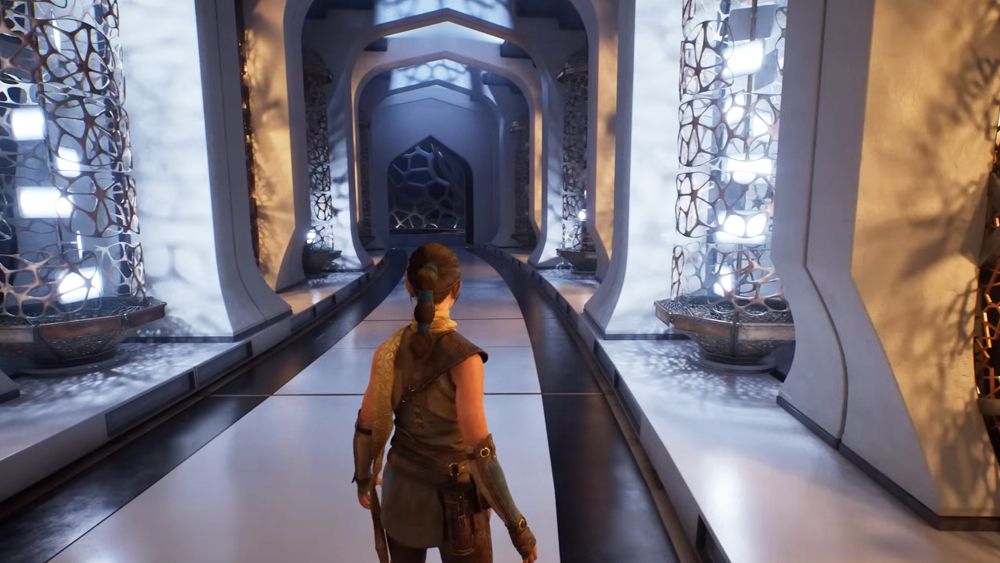
MegaLights, a new feature in Unreal Engine 5.5, has been showcased at Unreal Fest Seattle 2024, promising to change the game when it comes to creating dynamic light and soft shadows. This innovative tool utilizes ray tracing to produce realistic shadows from various area lights, aiming to reduce the cost and complexity of creating dynamic shadowing and unshadowed light evaluation.

Behind-the-Scenes Footage

Senior environment artist Saga Alayyoubi has shared behind-the-scenes footage from the demo, revealing the custom modeling and sculpting of ornate architecture and various props. The video provides a glimpse into the meticulous attention to detail and creativity that went into creating the demo.

MegaLights Demo

The final MegaLights demo from last month’s event is available to watch below. The team used elements from KitBash3D, modifying them to integrate with their own assets. Some elements from the demo are available in the Fab store.

Unreal Engine 5.5 Features

For more information on Unreal Engine 5.5 features, see our roundup of new features.

Conclusion

MegaLights in Unreal Engine 5.5 has the potential to revolutionize the way artists create dynamic lighting and soft shadows. With its use of ray tracing and realistic shadow generation, this feature is poised to unlock new possibilities for creators. As the industry continues to evolve, it will be exciting to see the innovative projects that emerge from the use of this powerful tool.

Frequently Asked Questions

Q: What is MegaLights?
A: MegaLights is a new feature in Unreal Engine 5.5 that uses ray tracing to create realistic shadows from various area lights.

Q: What are the benefits of MegaLights?
A: MegaLights aims to reduce the cost and complexity of creating dynamic shadowing and unshadowed light evaluation, making it possible to use expensive light sources like textured area lights on consoles.

Q: How does MegaLights work?
A: MegaLights uses ray tracing to generate realistic shadows from various area lights, allowing artists to create dynamic lighting and soft shadows with ease.

Q: Is MegaLights available now?
A: MegaLights is available in Unreal Engine 5.5, which was released recently.

VA to End Telehealth Copays and Fund Virtual Care Access

0

The U.S. Department of Veterans Affairs Announces Proposal to Eliminate Telehealth Copayments and Establish Grant Program

WHY IT MATTERS

The U.S. Department of Veterans Affairs has announced a proposal to amend a regulation to exempt all telehealth services from copayment requirements. The regulation, the Commander John Scott Hannon Veterans Mental Healthcare Improvement Act of 2019, grants the agency the authority to establish a telehealth grant program.

PROPOSED RULE

The VA is proposing to establish a grant program, Accessing Telehealth through Local Area Stations (ATLAS), which would focus on serving veterans in rural and medically underserved communities. The program would provide funding to organizations, including nonprofits and private businesses, to offer veterans private space equipped with high-speed internet access and the technology to meet with VA providers remotely. The grants would also provide designated funding to train on-site personnel to support the program.

THE LARGER TREND

The VA has been expanding its telehealth services, including the launch of a tele-emergency care service in September. The service allows veterans to contact VA Health Connect and speak to a clinical triage nurse who can connect them to tele-emergency care when needed. The service has helped over 61,000 callers and resolved 59.4% of cases without veterans having to travel to an urgent care or emergency department.

ON THE RECORD

"Waiving copays for telehealth services and launching this grant program are both major steps forward in ensuring veterans can access healthcare where and when they need it," said VA Secretary Denis McDonough in a statement.

CONCLUSION

The proposed rule aims to increase access to healthcare for veterans, particularly those in rural and medically underserved communities. By waiving copays for telehealth services and establishing a grant program, the VA is taking steps to ensure that veterans can receive the care they need without having to travel long distances or face barriers to access.

FAQs

Q: What is the Commander John Scott Hannon Veterans Mental Healthcare Improvement Act of 2019?
A: The act grants the VA the authority to establish a telehealth grant program and exempt telehealth services from copayment requirements.

Q: What is Accessing Telehealth through Local Area Stations (ATLAS)?
A: ATLAS is a grant program that would provide funding to organizations to offer veterans private space equipped with high-speed internet access and the technology to meet with VA providers remotely.

Q: What is the VA Telehealth Emergency Management Team?
A: The team was established in response to Hurricanes Harvey and Maria in 2017 and launched the Anywhere to Anywhere VA Healthcare program. The program aimed to increase access to care for veterans during emergencies.

Q: How has the COVID-19 crisis affected VA telehealth services?
A: VA video-to-home telehealth encounters surged 3,147% from 294,847 encounters in fiscal 2019 to 9,575,958 in fiscal 2021.

Study determines the original orientations of rocks drilled on Mars | MIT News

0

As it trundles around an ancient lakebed on Mars, NASA’s Perseverance rover is assembling a one-of-a-kind rock collection. The car-sized explorer is methodically drilling into the Red Planet’s surface and pulling out cores of bedrock that it’s storing in sturdy titanium tubes. Scientists hope to one day return the tubes to Earth and analyze their contents for traces of embedded microbial life.

Since it touched down on the surface of Mars in 2021, the rover has filled 20 of its 43 tubes with cores of bedrock. Now, MIT geologists have remotely determined a crucial property of the rocks collected to date, which will help scientists answer key questions about the planet’s past.


Here, the Perseverance drills into the surface of Mars.

Image: NASA/JPL-Caltech/ASU/MSSS

In a study appearing today in the journal Earth and Space Science, an MIT team reports that they have determined the original orientation of most bedrock samples collected by the rover to date. By using the rover’s own engineering data, such as the positioning of the vehicle and its drill, the scientists could estimate the orientation of each sample of bedrock before it was drilled out from the Martian ground.

The results represent the first time scientists have oriented samples of bedrock on another planet. The team’s method can be applied to future samples that the rover collects as it expands its exploration outside the ancient basin. Piecing together the orientations of multiple rocks at various locations can then give scientists clues to the conditions on Mars in which the rocks originally formed.

“There are so many science questions that rely on being able to know the orientation of the samples we’re bringing back from Mars,” says study author Elias Mansbach, a graduate student in MIT’s Department of Earth, Atmospheric and Planetary Sciences.

“The orientation of rocks can tell you something about any magnetic field that may have existed on the planet,” adds Benjamin Weiss, professor of planetary sciences at MIT. “You can also study how water and lava flowed on the planet, the direction of the ancient wind, and tectonic processes, like what was uplifted and what sunk. So it’s a dream to be able to orient bedrock on another planet, because it’s going to open up so many scientific investigations.”

Weiss and Mansbach’s co-authors are Tanja Bosak and Jennifer Fentress at MIT, along with collaborators at multiple institutions including the Jet Propulsion Laboratory at Caltech.

Profound shift

The Perseverance rover, nicknamed “Percy,” is exploring the floor of Jezero Crater, a large impact crater layered with igneous rocks, which may have been deposited from past volcanic eruptions, as well as sedimentary rocks that likely formed from long-dried-out rivers that fed into the basin.

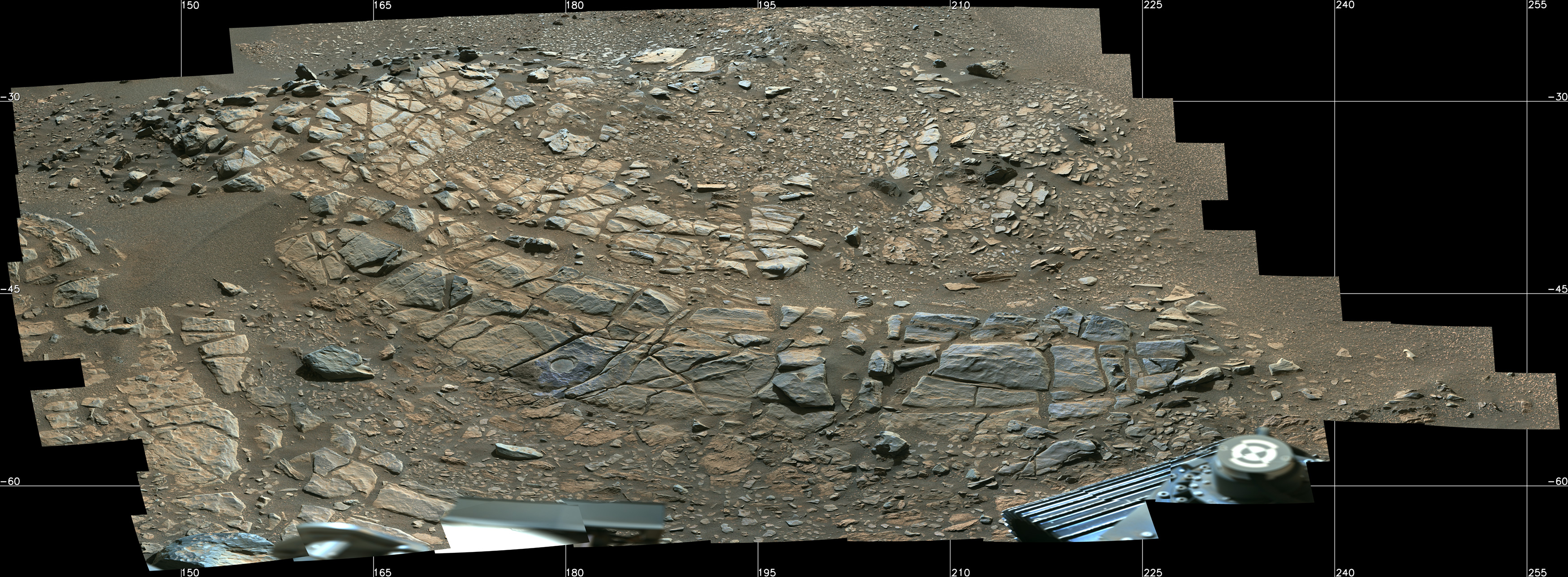
Against a dark grid with location points, a mosaic of photos is collaged together showing the rocky surface of mars. Some rocks create strong shadows and have a bluish-grey color, while most of the surface is tan.
An image mosaic, taken by the rover’s Mastcam-Z, shows a portion of the Jezero crater floor, where Perseverance drilled cores of Martian bedrock.

Image: NASA/JPL-Caltech/ASU/MSSS
Photos show the Martian surface, filled with shards of rocks in grey and tan.
An image mosaic, taken by the rover’s Mastcam-Z, shows a region of the Jezero delta, where Perseverance drilled and collected cores.

Image: NASA/JPL-Caltech/ASU/MSSS

“Mars was once warm and wet, and there’s a possibility there was life there at one time,” Weiss says. “It’s now cold and dry, and something profound must have happened on the planet.”

Many scientists, including Weiss, suspect that Mars, like Earth, once harbored a magnetic field that shielded the planet from the sun’s solar wind. Conditions then may have been favorable for water and life, at least for a time.

“Once that magnetic field went away, the sun’s solar wind — this plasma that boils off the sun and moves faster than the speed of sound — just slammed into Mars’ atmosphere and may have removed it over billions of years,” Weiss says. “We want to know what happened, and why.”

The rocks beneath the Martian surface likely hold a record of the planet’s ancient magnetic field. When rocks first form on a planet’s surface, the direction of their magnetic minerals is set by the surrounding magnetic field. The orientation of rocks can thus help to retrace the direction and intensity of the planet’s magnetic field and how it changed over time.

Since the Perseverance rover was collecting samples of bedrock, along with surface soil and air, as part of its exploratory mission, Weiss, who is a member of the rover’s science team, and Mansbach looked for ways to determine the original orientation of the rover’s bedrock samples as a first step toward reconstructing Mars’ magnetic history.

“It was an amazing opportunity, but initially there was no mission requirement to orient bedrock,” Mansbach notes.

Roll with it

Over several months, Mansbach and Weiss met with NASA engineers to hash out a plan for how to estimate the original orientation of each sample of bedrock before it was drilled out of the ground. The problem was a bit like predicting what direction a small circle of sheetcake is pointing, before twisting a round cookie cutter in to pull out a piece. Similarly, to sample bedrock, Perseverance corkscrews a tube-shaped drill into the ground at a perpendicular angle, then pulls the drill directly back out, along with any rock that it penetrates.

To estimate the orientation of the rock before it was drilled out of the ground, the team realized they need to measure three angles, the hade, azimuth, and roll, which are similar to the pitch, yaw, and roll of a boat. The hade is essentially the tilt of the sample, while the azimuth is the absolute direction the sample is pointing relative to true north. The roll refers to how much a sample must turn before returning to its original position.

In talking with engineers at NASA, the MIT geologists found that the three angles they required were related to measurements that the rover takes on its own in the course of its normal operations. They realized that to estimate a sample’s hade and azimuth they could use the rover’s measurements of the drill’s orientation, as they could assume the tilt of the drill is parallel to any sample that it extracts.

To estimate a sample’s roll, the team took advantage of one of the rover’s onboard cameras, which snaps an image of the surface where the drill is about to sample. They reasoned that they could use any distinguishing features on the surface image to determine how much the sample would have to turn in order to return to its original orientation.

In cases where the surface bore no distinguishing features, the team used the rover’s onboard laser to make a mark in the rock, in the shape of the letter “L,” before drilling out a sample — a move that was jokingly referred to at the time as the first graffiti on another planet.

By combining all the rover’s positioning, orienting, and imaging data, the team estimated the original orientations of all 20 of the Martian bedrock samples collected so far, with a precision that is comparable to orienting rocks on Earth.

“We know the orientations to within 2.7 degrees uncertainty, which is better than what we can do with rocks in the Earth,” Mansbach says. “We’re working with engineers now to automate this orienting process so that it can be done with other samples in the future.”

“The next phase will be the most exciting,” Weiss says. “The rover will drive outside the crater to get the oldest known rocks on Mars, and it’s an incredible opportunity to be able to orient these rocks, and hopefully uncover a lot of these ancient processes.”

This research was supported, in part, by NASA and the Mars 2020 Participating Scientist program.

AI Slop

0

Why Spotify’s AI Music Problem Is a Bigger Issue Than You Think

A screenshot of the fake Annie album, taken October 12th.

Some kind of AI slop had been uploaded to HEALTH’s artist page on Spotify, one of three fake albums that would appear under their name that weekend. The band’s X account made some jokes about it, the albums were eventually removed, and I went back to minding my own business. Then, the next weekend, I saw a new Annie album had dropped.

The Problem

That album was more plausible — Annie had just released a new single, "The Sky Is Blue" — but when I clicked in, I couldn’t find it on the list of the song titles. Confused, I played the album and heard birdsong and a vaguely New Age-y instrumental. That… did not sound like Annie.

"That was upsetting to me, because if you have ears, you can definitely hear it’s not our music," said Marcos Mena, Standards’ lead songwriter and guitarist. "It’s definitely a bummer because we did have a new album come out this year, and I feel like it’s detracting from that."

What’s Going On

To understand how this works, you need a sense of the mechanics. Streaming platforms like Spotify don’t work like your Facebook page — Mena and other artists aren’t logging in and adding albums to their accounts directly. Instead, they go through a distributor that handles licensing, metadata, and royalty payments. Distributors send songs and metadata in bulk to the streaming services. The metadata part is important; it includes things such as the song title and artist name but also other information, such as the songwriter, record label, and so on. This is crucial for artists (and others) to get paid.

Why It’s a Problem

The way it should have worked, getting the plumbing right, is that all those albums should have been flagged as new artists, and then it wouldn’t matter. But allowing too many junk bands through creates problems with the streaming services.

As for the distributors, the thing to keep an eye on is UMG’s lawsuit. A pretrial conference is scheduled for January. The outcome of the suit could potentially change how distributors filter the music people try to upload through their platforms — because if lawsuits are more expensive than content moderation, there’s likely to be more content moderation. That could improve things for Spotify, which is downstream of them.

Conclusion

AI music poses the same threat to Spotify, McDonald says. He points out that I had been waiting for the Annie album, excited for it, even. And then instead, I got duped into garbage. "There’s all these mechanisms around assuming this stuff is correct," he says. But right now, those mechanisms are broken — and people who truly care, like artists themselves, don’t have their hands on the controls.

FAQs

Q: Why is this a problem?
A: This is a problem because it’s affecting artists and their music. Fake albums are being uploaded to their accounts, which can confuse fans and detract from their actual music.

Q: Who is responsible for this?
A: The distributors and Spotify are responsible for this. They need to do a better job of filtering out fake albums and ensuring that only legitimate music is uploaded to the platform.

Q: What can be done to fix this?
A: UMG’s lawsuit could potentially change how distributors filter music. Additionally, Spotify and distributors need to do a better job of content moderation to prevent fake albums from being uploaded in the first place.

Q: Is this a new problem?
A: No, this is not a new problem. Fraudsters have been using AI to create fake music for years. However, the rise of AI-generated music has made it easier for fraudsters to create convincing fake albums.

The Only Black Friday Nintendo Switch Deals Worth Looking At

0

Top Nintendo Switch Game Deals for Black Friday

Quick Links

  • US Deals
  • UK Deals

US Deals

UK Deals

FAQs

What kind of games are the best for the Nintendo Switch?

It depends on what kind of gamer you are. Do you like to play solo adventure RPG games? More of an FPS shooter? Do you love those laidback foraging games like Animal Crossing?

What are some popular Nintendo Switch games?

The Legend of Zelda: Tears of the Kingdom is a great choice for adventurers, or there are free titles like Fortnite available on Switch if you like to shoot things. Try games like the Pokemon titles if you like exploring, or Disney Dreamlight Valley and Stardew Valley to live a peaceful life.

Should I get the game as a cartridge or code?

Great question! This all depends on how you want to access your game and what you plan to do with the game when you’re finished with it. Usually, Nintendo Switch games that are sold as download codes only are supposed to be cheaper than buying the physical game, but strangely that doesn’t seem to be the case (pardon the pun) at retailers lately. So you might as well purchase the cartridge if you ask us.

Will the Nintendo Switch be on sale on Black Friday?

Yes! There’s usually a plethora of Nintendo Switch deals over Black Friday, but these usually take the shape of bundle deals and discounts rather than price cuts on the console individually.

Conclusion

With the holiday season just around the corner, it’s time to start thinking about gift ideas for the gamers in your life. If you’re looking for some epic Nintendo Switch game deals, you’re in luck! This year, retailers like Amazon, Best Buy, and Walmart are offering some amazing discounts on popular titles. Whether you’re looking for a new adventure, a fun multiplayer experience, or a relaxing game to unwind with, there’s something for everyone on the Nintendo Switch. So don’t wait – start shopping now and get ready to level up your gaming library!

NVIDIA Collaborates to Advance AI and ML

0

Cloud-native technologies have become crucial for developers to create and implement scalable applications in dynamic cloud environments.

Empowering Cloud-Native Ecosystems

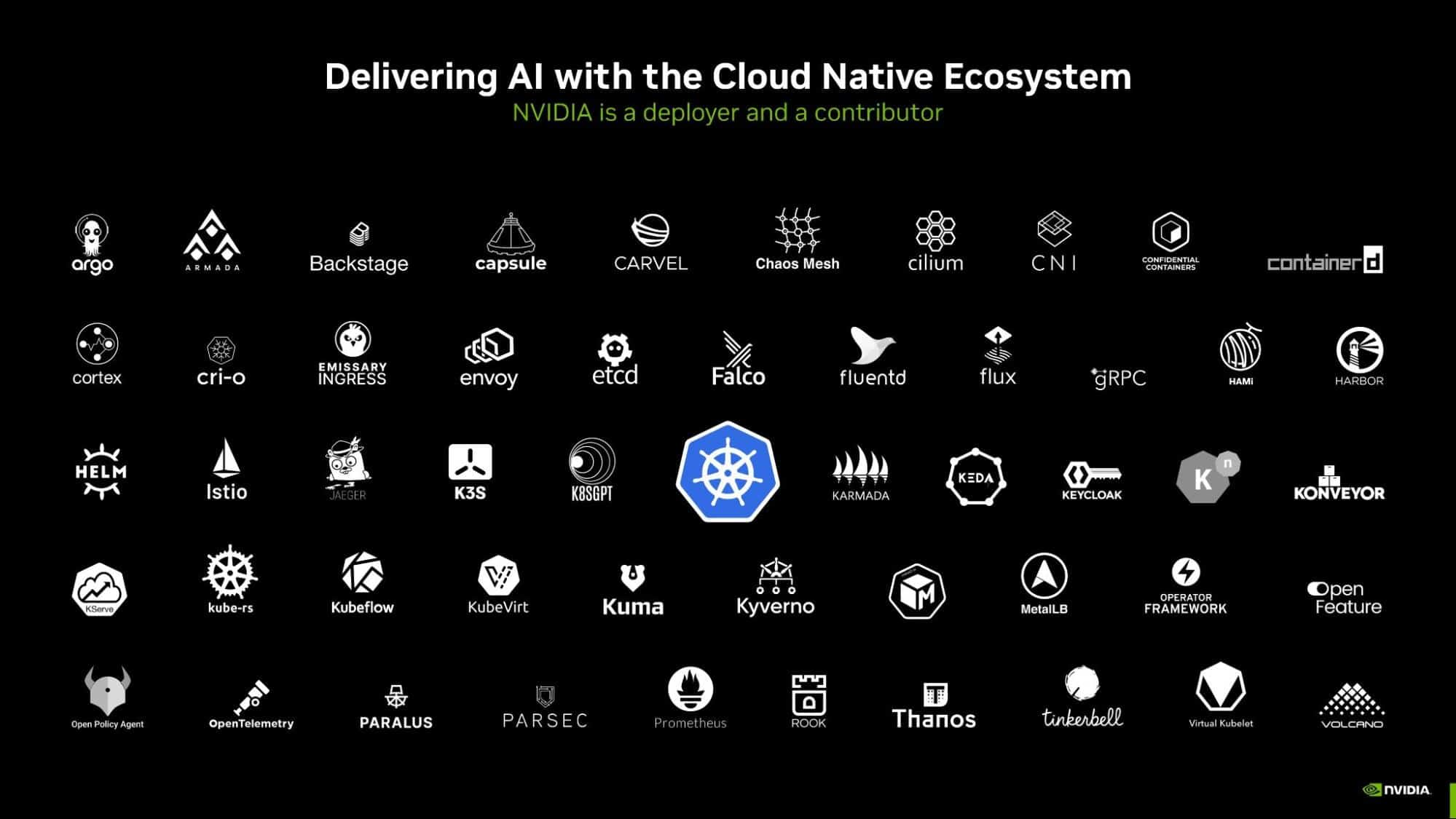
NVIDIA has benefited from the many open-source projects under the Cloud Native Computing Foundation (CNCF) and has made contributions to dozens of them over the past decade. These actions help developers as they build applications and microservice architectures aligned with managing AI and machine learning workloads.

Kubernetes, the cornerstone of cloud-native computing, is undergoing a transformation to meet the challenges of AI and machine learning workloads. As organizations increasingly adopt large language models and other AI technologies, robust infrastructure becomes paramount.

NVIDIA Contributions

NVIDIA has been working closely with the Kubernetes community to address these challenges. This includes:

  • Work on dynamic resource allocation (DRA) that allows for more flexible and nuanced resource management.
  • Leading efforts in KubeVirt, an open-source project extending Kubernetes to manage virtual machines alongside containers.
  • Development of NVIDIA GPU Operator, which automates the lifecycle management of NVIDIA GPUs in Kubernetes clusters.

The company’s open-source efforts extend beyond Kubernetes to other CNCF projects:

  • NVIDIA is a key contributor to Kubeflow, a comprehensive toolkit that makes it easier for data scientists and engineers to build and manage ML systems on Kubernetes.
  • NVIDIA has contributed to the development of CNAO, which manages the lifecycle of host networks in Kubernetes clusters.
  • NVIDIA has also added to Node Health Check, which provides virtual machine high availability.

Community Engagement

NVIDIA engages the cloud-native ecosystem by participating in CNCF events and activities, including:

  • Collaboration with cloud service providers to help them onboard new workloads.
  • Participation in CNCF’s special interest groups and working groups on AI discussions.
  • Participation in industry events such as KubeCon + CloudNativeCon, where it shares insights on GPU acceleration for AI workloads.
  • Work with CNCF-adjacent projects in the Linux Foundation as well as many partners.

Conclusion

NVIDIA is helping advance cloud-native technologies to support compute-intensive workloads, facilitating the migration of legacy applications and supporting the development of new ones. These contributions to the open-source community help developers harness the full potential of AI technologies and strengthen Kubernetes and other CNCF projects as the tools of choice for AI compute workloads.

FAQs

Q: Why is open-source important for cloud-native technologies?
A: Open-source fosters collaboration among industry leaders, developers, and end users, promoting innovation and speeding up the development of cloud-native applications.

Q: What are some key NVIDIA contributions to the open-source community?
A: NVIDIA has contributed to over 750 open-source projects, including Kubernetes, Kubeflow, CNAO, and Node Health Check.

Q: What benefits do developers gain from NVIDIA’s open-source contributions?
A: Developers can take advantage of improved efficiency in managing AI and ML workloads, enhanced scalability and performance of cloud-native applications, better resource utilization, and simplified deployment and management of complex AI infrastructures.