Home Blog Page 622

Helping robots grasp the unpredictable | MIT News

0

When robots come across unfamiliar objects, they struggle to account for a simple truth: Appearances aren’t everything. They may attempt to grasp a block, only to find out it’s a literal piece of cake. The misleading appearance of that object could lead the robot to miscalculate physical properties like the object’s weight and center of mass, using the wrong grasp and applying more force than needed.

To see through this illusion, MIT Computer Science and Artificial Intelligence Laboratory (CSAIL) researchers designed the Grasping Neural Process, a predictive physics model capable of inferring these hidden traits in real time for more intelligent robotic grasping. Based on limited interaction data, their deep-learning system can assist robots in domains like warehouses and households at a fraction of the computational cost of previous algorithmic and statistical models.

The Grasping Neural Process is trained to infer invisible physical properties from a history of attempted grasps, and uses the inferred properties to guess which grasps would work well in the future. Prior models often only identified robot grasps from visual data alone.

Typically, methods that infer physical properties build on traditional statistical methods that require many known grasps and a great amount of computation time to work well. The Grasping Neural Process enables these machines to execute good grasps more efficiently by using far less interaction data and finishes its computation in less than a tenth of a second, as opposed seconds (or minutes) required by traditional methods.

The researchers note that the Grasping Neural Process thrives in unstructured environments like homes and warehouses, since both house a plethora of unpredictable objects. For example, a robot powered by the MIT model could quickly learn how to handle tightly packed boxes with different food quantities without seeing the inside of the box, and then place them where needed. At a fulfillment center, objects with different physical properties and geometries would be placed in the corresponding box to be shipped out to customers.

Trained on 1,000 unique geometries and 5,000 objects, the Grasping Neural Process achieved stable grasps in simulation for novel 3D objects generated in the ShapeNet repository. Then, the CSAIL-led group tested their model in the physical world via two weighted blocks, where their work outperformed a baseline that only considered object geometries. Limited to 10 experimental grasps beforehand, the robotic arm successfully picked up the boxes on 18 and 19 out of 20 attempts apiece, while the machine only yielded eight and 15 stable grasps when unprepared.

While less theatrical than an actor, robots that complete inference tasks also have a three-part act to follow: training, adaptation, and testing. During the training step, robots practice on a fixed set of objects and learn how to infer physical properties from a history of successful (or unsuccessful) grasps. The new CSAIL model amortizes the inference of the objects’ physics, meaning it trains a neural network to learn to predict the output of an otherwise expensive statistical algorithm. Only a single pass through a neural network with limited interaction data is needed to simulate and predict which grasps work best on different objects.

Then, the robot is introduced to an unfamiliar object during the adaptation phase. During this step, the Grasping Neural Process helps a robot experiment and update its position accordingly, understanding which grips would work best. This tinkering phase prepares the machine for the final step: testing, where the robot formally executes a task on an item with a new understanding of its properties.

“As an engineer, it’s unwise to assume a robot knows all the necessary information it needs to grasp successfully,” says lead author Michael Noseworthy, an MIT PhD student in electrical engineering and computer science (EECS) and CSAIL affiliate. “Without humans labeling the properties of an object, robots have traditionally needed to use a costly inference process.” According to fellow lead author, EECS PhD student, and CSAIL affiliate Seiji Shaw, their Grasping Neural Process could be a streamlined alternative: “Our model helps robots do this much more efficiently, enabling the robot to imagine which grasps will inform the best result.” 

“To get robots out of controlled spaces like the lab or warehouse and into the real world, they must be better at dealing with the unknown and less likely to fail at the slightest variation from their programming. This work is a critical step toward realizing the full transformative potential of robotics,” says Chad Kessens, an autonomous robotics researcher at the U.S. Army’s DEVCOM Army Research Laboratory, which sponsored the work.

While their model can help a robot infer hidden static properties efficiently, the researchers would like to augment the system to adjust grasps in real time for multiple tasks and objects with dynamic traits. They envision their work eventually assisting with several tasks in a long-horizon plan, like picking up a carrot and chopping it. Moreover, their model could adapt to changes in mass distributions in less static objects, like when you fill up an empty bottle.

Joining the researchers on the paper is Nicholas Roy, MIT professor of aeronautics and astronautics and CSAIL member, who is a senior author. The group recently presented this work at the IEEE International Conference on Robotics and Automation.


Rework Your Headshot for Free with Facepoke

0

Discover More: Explore AI Tools & News

The Future of AI is Here

The world of Artificial Intelligence (AI) is rapidly evolving, and it’s exciting to see the latest developments and innovations in this field. As AI becomes more integrated into our daily lives, it’s essential to stay up-to-date with the latest news, tools, and trends. In this article, we’ll explore some of the most significant advancements in AI and what they mean for the future.

AI Tools for Businesses

For businesses, AI offers a range of tools and solutions that can help streamline operations, improve efficiency, and increase productivity. Some of the most popular AI tools for businesses include:

* Chatbots: AI-powered chatbots can help provide 24/7 customer support, freeing up human customer service representatives to focus on more complex issues.
* Predictive Analytics: AI-powered predictive analytics can help businesses make data-driven decisions, identifying trends and patterns that can inform future strategies.
* Automation: AI-powered automation can help automate repetitive tasks, freeing up human workers to focus on more creative and strategic tasks.

AI in Healthcare

AI is also making significant advancements in the healthcare industry, with applications including:

* Medical Diagnosis: AI-powered medical diagnosis tools can help doctors quickly and accurately diagnose diseases, improving patient outcomes and reducing costs.
* Personalized Medicine: AI-powered personalized medicine can help tailor treatment plans to individual patients, improving treatment efficacy and reducing side effects.
* Medical Imaging: AI-powered medical imaging tools can help improve the accuracy of medical diagnoses, reducing the need for invasive procedures.

AI in Education

AI is also transforming the education sector, with applications including:

* Adaptive Learning: AI-powered adaptive learning tools can help tailor educational content to individual students, improving learning outcomes and reducing the need for remedial education.
* Virtual Assistants: AI-powered virtual assistants can help students with homework, providing real-time support and feedback.
* Personalized Learning: AI-powered personalized learning tools can help tailor educational content to individual students, improving learning outcomes and reducing the need for remedial education.

Conclusion

AI is revolutionizing the way we live and work, and it’s essential to stay up-to-date with the latest developments and innovations in this field. From AI tools for businesses to AI in healthcare and education, the potential applications of AI are vast and exciting. Whether you’re a business leader, healthcare professional, or educator, understanding the latest advancements in AI can help you stay ahead of the curve and take advantage of the many benefits that AI has to offer.

FAQs

Q: What are some of the most significant advancements in AI?

A: Some of the most significant advancements in AI include the development of deep learning algorithms, the rise of cloud-based AI platforms, and the increasing use of AI in industries such as healthcare and education.

Q: What are some of the benefits of AI for businesses?

A: Some of the benefits of AI for businesses include increased efficiency, improved customer service, and improved decision-making.

Q: What are some of the potential applications of AI in healthcare?

A: Some of the potential applications of AI in healthcare include medical diagnosis, personalized medicine, and medical imaging.

Q: What are some of the potential applications of AI in education?

A: Some of the potential applications of AI in education include adaptive learning, virtual assistants, and personalized learning.

SmartThings Blog

0

Latest SmartThings Hub updates include a new hub manager, backup capabilities, and hub group support

As the smart home becomes an integral part of modern living – just as essential as utilities like power and water – its reliability must be equally paramount. At SmartThings, we’ve always believed local connectivity is the key to reliability in connected living. Our hub-based platform was designed so users could connect, control, and automate devices locally, reliably, and securely. Our Hub Everywhere strategy has empowered more users to establish and expand their local smart home infrastructure. Now, we’re excited to introduce new ways for users to harness these hubs to further enhance the performance and reliability of their smart devices.

Expanding Smart Living with New SmartThings Hub Features

Last year, we introduced two significant features: Hub Groups and Hub Replace. Hub Groups enable users to extend their Thread and Zigbee networks across multiple SmartThings hubs, creating a more robust mesh network. Hub Replace allows users to upgrade their hubs seamlessly without the need to individually add each device again, ensuring their smart living infrastructure can evolve with their needs.

Now, we’re thrilled to announce the extension and enhancement of our smart living capabilities with two new features in the SmartThings app – Hub Manager and Hub Backup. 

Introducing Hub Manager, Hub Backup, and Expanded Hub Group Support

The new Hub Manager is a central management interface designed to streamline the configuration of smart home infrastructures. Users can now create, edit, and delete Hub Groups to better organize their network. This enhances the ability to manage multiple hubs, including the SmartThings 2018 (V3) hub, Aeotec Smart Home Hub (V3), SmartThings Station, Samsung Smart TV, Smart Monitor, Family Hub refrigerator, and Samsung soundbar hubs. They can also easily manage their Hub Groups by editing existing ones or deleting them as needed. 

Hub Backup increases resiliency by allowing secondary hubs to act as backups if the primary hub goes offline. In such cases, users receive a notification about the disconnection and assistance with diagnosing the issue. If reconnection is not possible, users can select another hub within their Hub Group to become the new primary hub. The Hub Manager then guides users through the process of transferring all devices and routines to the new primary hub, ensuring seamless continuity. If a user does not take action within ten minutes of the primary hub going offline, transfer to an available secondary hub will happen automatically. 

How to Create a SmartThings Hub Group

A Hub Group is made up of a primary hub and one or more secondary hubs working together to extend the range of Zigbee and Thread networks. If you have a Hub Group, devices that are far away from the primary hub can still connect to its network via a nearby secondary hub.  Routines will also work faster without needing an internet connection when devices are connected to the same Hub Group.

When you add a new eligible hub to a location with one or more existing eligible hub(s), a new Hub Group will be automatically created if none exist. If a Hub Group already exists, the new hub will be automatically added to the Hub Group as a secondary hub1. 

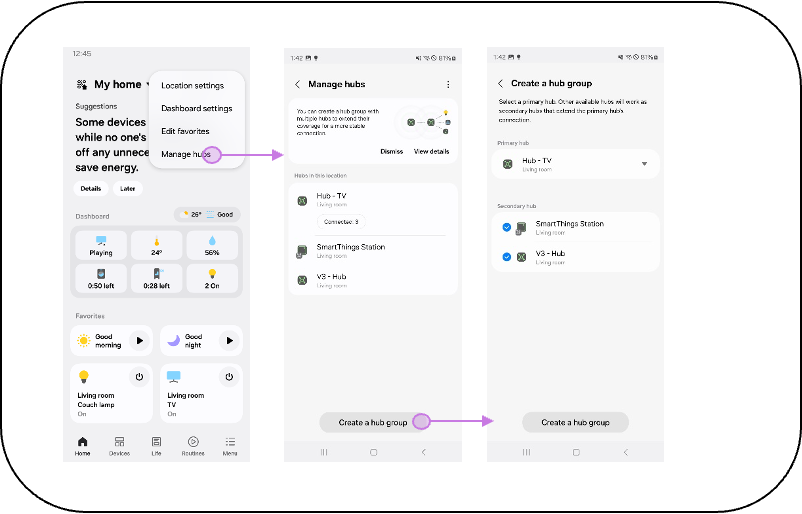
You can also manually create and manage a Hub Group. When you create a new Hub Group, there must be at least one hub that has no devices connected to it. There are two ways to create a new Hub Group: 

  • Starting in the “Favorites” page, select (⋮) More Options and tap “Manage Hubs”. If a Hub Group is eligible to be formed, there will be a button titled “Create a Hub Group”. 
  • You can also click on one of your hub icons from the favorites screen or the devices screen where the hub is located. The hub’s device card will open, and if a Hub Group is eligible to be formed, there will be a “Hub Group” section with a button titled “Create a Hub Group”. 

Note: If you have a hub that supports Z-Wave devices (such as the SmartThings V3 hub), it’s recommended that you set it as the primary hub in your Hub Group. Z-Wave devices cannot connect to a Hub Group if the primary hub doesn’t support Z-Wave.

How to Edit SmartThings Hub Groups

In Hub Manager you can also change the primary hub for a Hub Group, and add or remove secondary hubs from a Hub Group. There are several ways to access the Hub Manager when a Hub Group already exists: 

  • Select (⋮) More Options in the “Favorites” page and select “Manage Hubs”. Then select (⋮) More Options again and tap “Edit a Hub Group”. 
  • You can also click on one of the hub icons from the favorites screen or the devices screen where the hub is located. The hub’s device card will open, and there will be a “Hub Group” section showing all of the hubs in the current Hub Group. Click the Settings wheel in the upper right corner of this section to open the Hub Manager.

In the Hub Manager, you can change a secondary hub to a primary hub, remove a selected secondary hub from a Hub Group, or add another secondary hub. 

How to Enable Hub Backup and Set Preferred Hub

The Hub Backup feature is enabled by default when a Hub Group is created, in “Auto Hub Backup” mode, and does not need to be enabled by the user:

  • When a primary hub goes offline, the user will receive a notification that the hub is offline, and will be able to perform diagnostics. 
  • If the primary hub is still offline after ten minutes, and a secondary “backup” hub is online, devices and automations will automatically move to a “backup” hub with no intervention needed from the user. 

A user can disable Auto Hub Backup if they do not want devices and automations to automatically move to a backup hub when their primary hub is offline for more than ten minutes. If Auto Hub Backup is disabled, Hub Backup becomes “user-guided”, and the user has the ability to accept or reject the transfer to the secondary hub when they are notified. Users can do this from the Hub Manager: 

  • Select (⋮) More Options from the “Manage Hubs” screen. Then select “Auto Hub Backup” and toggle to “Off”. This will make Hub Backup user-guided. 

The “preferred hub” is the hub that will become the primary hub anytime it comes online and “Auto Hub Backup” is enabled, such as after a secondary hub has taken over primary hub duty. A user can change their preferred hub by first manually changing their primary hub, and making sure that “Preferred hub” is enabled in Hub Manager. To select “Preferred Hub”:

  •   Select (⋮) More Options from the “Manage Hubs” screen. Then select “Preferred hub”. 

Note: the Hub Backup feature refers to transferring devices and routines to backup hubs and does not refer to the process of periodically backing up hub and device data to the SmartThings Cloud. Periodically backing up hub and device data to the SmartThings cloud occurs automatically and does not require that a hub be part of a Hub Group. 

How to Permanently Replace A Hub

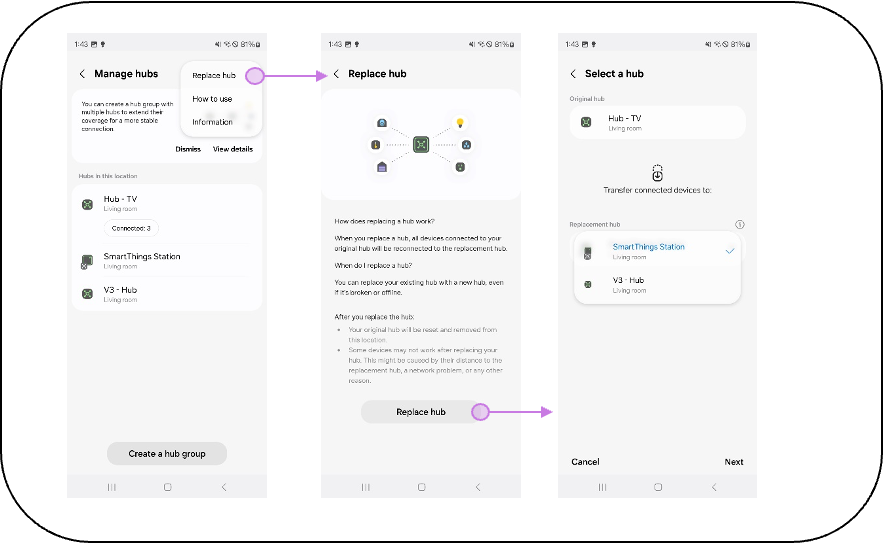
  • Announced in 2023, the Hub Replace feature allows you to replace or upgrade your existing hub with another hub. When you replace a hub, all devices and routines on your original hub will be transferred to the replacement hub. The Hub Replace feature is similar to changing primary and secondary hubs with the Hub Backup feature, but there are some differences. Hub Replace removes the original hub from the location after replacement, and if possible, factory resets the original hub. 
  • Hub Replace is separate from Hub Groups and Hub Backup and cannot be used with hubs that are part of a Hub Group. To replace a hub that is in a Hub Group, the original and destination hubs should be removed from the Hub Group. 
  • Hub Replace provides an upgrade path for some older hubs that are not supported by Hub Groups, such as Samsung Connect Home, SmartThings Wi-Fi, and Samsung SmartThings Hub 2015 (Hub v2). 

Hub Replace can be initiated a couple of ways. To replace a hub, you need another hub in the same location that has no devices connected to it and is not part of a Hub Group.

  1. From the Manage Hubs screen, select (⋮) More Options and tap “Replace Hub”. 
  2. You can also click on one of the hub icons from the favorites screen or the devices screen where the hub is located. The hub’s device card will open. select (⋮) More Options and tap “Replace Hub”. 

Building for the Future

At SmartThings, we are committed to continually enhancing our platform’s key features, providing users with greater reliability, performance, and confidence in their smart home systems. Our goal is to support users in starting, growing, and enjoying their smart homes from day one and well into the future.

Ready to take your smart home to the next level and unlock the full potential of your SmartThings ecosystem? Thanks to Hub Everywhere, you can start creating your Hub Group today. 

For more information, read SmartThings Hub Groups and Hub Backup FAQs here. 

YouTube is testing AI music remixes

0

YouTube Tests AI-Powered “Restyling” of Licensed Songs for Shorts

A New Feature for Creators

YouTube is testing a new feature that will allow creators to use AI to “restyle” licensed songs for their shorts. A small group of creators with access can enter a prompt to change up different elements in a song, such as its mood or genre, and the expansion of YouTube’s Dream Track AI feature will generate a reworked 30-second soundtrack.

How It Works

If you’re a creator in the experiment group, you can select an eligible song, describe how you want to restyle it, and then generate a unique 30-second soundtrack to use in your Short.

Attribution and Transparency

These restyled soundtracks will have clear attribution to the original song through the Short itself and the Shorts audio pivot page. Additionally, they will clearly indicate that the track was restyled with AI.

What Does This Mean for Creators?

YouTube has not yet announced when this feature will be widely available, but it could be a game-changer for creators who want to add a unique touch to their shorts without having to create an entirely new soundtrack.

Conclusion

YouTube’s new AI-powered restyling feature has the potential to revolutionize the way creators approach music in their shorts. By giving creators the ability to modify licensed songs, YouTube is providing a new level of flexibility and creativity. As this feature continues to evolve, it will be interesting to see how creators use it to enhance their content.

FAQs

Q: Who is eligible for the experiment?

A: A small group of creators has been selected to participate in the experiment.

Q: How do I access the restyling feature?

A: Creators who are part of the experiment group can access the feature by selecting an eligible song, describing how they want to restyle it, and then generating a unique 30-second soundtrack.

Q: Will the restyled soundtracks be attributed to the original song?

A: Yes, the restyled soundtracks will have clear attribution to the original song through the Short itself and the Shorts audio pivot page.

Q: Will the AI restyling feature be widely available soon?

A: YouTube has not yet announced when this feature will be widely available.

Unlocking the Power of ChatGPT

0

Concerns about AI Chatbots Replacing Human Intelligence

The Rise of AI Chatbots

People have expressed concerns about AI chatbots replacing or atrophying human intelligence. For example, chatbots can write an entire essay in seconds, raising concerns about students cheating and not learning how to write properly. These fears even led some school districts to block access when ChatGPT initially launched.

The Evolution of AI in Education

Now, not only have many of those schools decided to unblock the technology, but some higher education institutions have been catering their academic offerings to AI-related coursework.

The Role of AI in Education

Generative AI can be the Academic Assistant an Underserved Student Needs

Another concern with AI chatbots is the possible spread of misinformation. ChatGPT says: "My responses are not intended to be taken as fact, and I always encourage people to verify any information they receive from me or any other source." OpenAI also notes that ChatGPT sometimes writes "plausible-sounding but incorrect or nonsensical answers."

Ethical and Privacy Concerns

Lastly, there are ethical and privacy concerns regarding the information ChatGPT was trained on. OpenAI scraped the internet to train the chatbot without asking content owners for permission to use their content, which brings up many copyright and intellectual property concerns.

Data Privacy and Security

There are also privacy concerns regarding generative AI companies using your data to fine-tune their models further, which has become a common practice. OpenAI lets you turn off training in ChatGPT’s settings.

Is ChatGPT Safe?

So, is ChatGPT safe? If your main concern is privacy, OpenAI has implemented several options to give users peace of mind that their data will not be used to train models. The company even allows you to turn off your chat history. If you are concerned about the moral and ethical problems, those are still being hotly debated.

Conclusion

While AI chatbots like ChatGPT have raised concerns about replacing human intelligence, they also have the potential to assist and augment human capabilities. As the technology continues to evolve, it is essential to address the ethical and privacy concerns surrounding its use.

FAQs

Q: Is ChatGPT safe?
A: ChatGPT is safe in terms of privacy, as OpenAI has implemented several options to give users peace of mind that their data will not be used to train models.

Q: Can I turn off my chat history in ChatGPT?
A: Yes, OpenAI allows you to turn off your chat history in ChatGPT’s settings.

Q: Is ChatGPT replacing human intelligence?
A: While ChatGPT can perform tasks quickly and efficiently, it is not replacing human intelligence. Instead, it is augmenting human capabilities and assisting with tasks.

Q: Are there ethical concerns surrounding ChatGPT?
A: Yes, there are ethical concerns surrounding ChatGPT, including the potential spread of misinformation and the use of personal data to fine-tune models.

Resistance is Not Futile: A Case for AI Opposition

The Unwelcome Guest: Why Creative Writing Belongs Elsewhere

The Academic Discipline of Creative Writing

Maybe the professionalization of creative writing as an academic discipline was always a bad idea. Do we belong in English departments? When I was a graduate student, the director of rhetoric and composition delighted in the university’s three-year M.F.A. program. Fledgling teachers in front of first-year writers was a winning combination of us winging it by throwing creativity at the wall and students appreciating our authentic advice that writing isn’t really something you learn or teach—it’s something you practice.

The Rise of Generative AI

Until writing studies adopted generative artificial intelligence as sound pedagogy, I always felt at home among my fellow word nerds in rhet comp and literary studies. These days, I identify with the buzzkill parents of Ray Bradbury’s short story "The Veldt." Are my students, Peter and Wendy, furrowing their brows with disapproval at my old-school AI skepticism? Will they gleefully throw me to the virtual reality lions?

The Case Against AI in Writing Studies

Such musings tempt me to join the Gen X teaching exodus. Get out of the new road if you can’t lend your hand; isn’t that what our boomer parents sang? Perhaps creative writers are in the academy at precisely this moment for more subversive reasons than boosting enrollments for English departments. Maybe our departments can learn to welcome a more robust skepticism of the ill-fitting marriage of AI to writing studies.

The Ethics of AI in Writing Studies

If you are tired of the drumbeat of inevitability that insists English faculty adopt AI into our teaching practices, I am here to tell you that you are allowed to object. Using an understanding of human writing as a means to allow for-profit technology companies to dismantle the imaginative practice of human writing is abhorrent and unethical. Writing faculty have both the agency and the academic freedom to examine generative AI’s dishonest training origins and conclude: There is no path to ethically teach AI skills. Not only are we allowed to say no, we ought to think deeply about the why of that no.

The Resistance

Feeling a little sweaty about the huge energy suckage AI draws from the grid and the monopolistic maneuvers of a handful of software companies? We are allowed to object based on the values of environmental stewardship, condemnation of rogue capitalism and disdain for the mustache-twirling villainy of big tech’s global politics.

Conclusion

Resistance is not anti-progress, and pedagogies that challenge the status quo are often the most experiential, progressive, and diverse in a world of increasingly rote, Standard English, oat milk sameness. "Burn it down" is a call to action as much as it is a plea to have some fun. The robot revolution came so quickly on the heels of the pandemic that I think a lot of us forgot that teaching can be a profoundly joyful act.

FAQs

Q: Why are you against AI in writing studies?
A: I believe that AI is being used to dismantle the imaginative practice of human writing and that it is not ethical to teach AI skills.

Q: What is the alternative to AI in writing studies?
A: I propose that we focus on teaching students how to write creatively and critically, using human feedback and guidance.

Q: Are you against technology in general?
A: No, I am not against technology. I believe that technology can be a powerful tool for learning and creativity, but it should be used responsibly and ethically.

Q: What is the role of the humanities in this debate?
A: The humanities have a crucial role to play in this debate. We must challenge the dominant narratives and power structures that are driving the adoption of AI in writing studies, and we must advocate for a more human-centered approach to education.

Q: What can students do to resist AI in writing studies?
A: Students can resist AI in writing studies by refusing to use AI-generated content, by demanding human feedback and guidance, and by advocating for a more human-centered approach to education.

Dataloop Accelerates Multimodal Data Preparation with NVIDIA NIM

0

Transforming Data Preparation for AI

The integration of NVIDIA NIM microservices with Dataloop’s platform marks a significant leap forward in optimizing data preparation workflows for large language models (LLMs). This collaboration enables enterprises to efficiently handle large, unstructured datasets, streamlining preparation for AI-driven processes and LLM training.

Overcoming Key Challenges

Until now, AI teams faced two primary obstacles in preparing data for LLMs:

  • Handling multimodal datasets: The diversity of data types, including video, image, audio, and text, each with unique processing requirements, made it challenging to create a cohesive preparation pipeline.
  • Ensuring data quality: Unstructured datasets often lack the consistency and metadata required for AI models to interpret content accurately. This leads to data quality issues that demand extensive manual intervention and data preparation techniques, such as deduplication and quality filtering, for proper labeling and organization.

Dataloop is the Framework that Makes it Happen

At the heart of this solution lies a structured framework that seamlessly combines Dataloop’s platform with NVIDIA NIM inferencing power. This integration enables enterprises to process large, unstructured, multimodal datasets with unprecedented ease.

What is NVIDIA NIM?

NVIDIA NIM microservices are a set of intuitive microservices designed to speed up generative AI deployment on any cloud or data center. Supporting a wide range of AI models, including NVIDIA AI foundation, community, and custom models, NIM ensures seamless, scalable AI inferencing, on-premises or in the cloud, while using industry-standard APIs.

How Does Dataloop Make it Work?

The text workflow starts with the LlaMA 3.1 NIM microservice, which uses tool-calling capabilities to extract named entities. This enables the precise identification of key entities such as company names, dates, and locations. Following this, the NVIDIA EmbedQA-Mistral-7bv2 model creates semantic embeddings that capture the deeper meaning and context of the text. Finally, the Upload-to-Audio node makes sure that all the processed text data is correctly indexed, bringing the process full circle.

Managing Enriched Data within Dataloop

After structuring the data, enriched datasets are stored in Dataloop’s data management section, which makes data handling both intuitive and efficient. You can visualize, explore, and make real-time data-driven decisions on every file, no matter its type, right from the dataset browser.

Conclusion

The integration of NVIDIA NIM in Dataloop’s platform offers enterprises a multitude of advantages, including streamlined deployment, accelerated iteration capabilities, high-performance data processing, and seamless incorporation of industry-leading models. As the solution evolves and scales, we aim to continue enhancing its multimodal capabilities and expand into more complex data types.

FAQs

Q: What is the main advantage of NVIDIA NIM microservices with Dataloop?
A: The integration enables efficient handling of large, unstructured datasets, streamlining preparation for AI-driven processes and LLM training.

Q: What are the two primary obstacles in preparing data for LLMs?
A: Handling multimodal datasets and ensuring data quality.

Q: How does Dataloop simplify data management?
A: Dataloop provides a structured framework that seamlessly combines with NVIDIA NIM inferencing power, enabling intuitive and efficient data handling.

Q: What is NVIDIA NIM?
A: NVIDIA NIM microservices are a set of intuitive microservices designed to speed up generative AI deployment on any cloud or data center.

Virtual-First Care: Improving Outcomes and Affordability

0

The Virtual-First Approach to Healthcare

Greater Accessibility

A virtual-first approach to healthcare helps hospitals and health systems enable greater accessibility to care by removing geographical and socioeconomic barriers. Leveraging telehealth and telemedicine technologies, patients can receive primary care or specialized consultations virtually, regardless of location.

This is invaluable for everyone in the U.S., primarily for people living in rural regions of the country, who often suffer from chronic conditions like hypertension, diabetes, and heart disease at higher rates than their urban counterparts. They no longer need to travel long distances for essential care. Additionally, this approach increases access to mental health resources and counseling for individuals who might not typically seek or have access to such services, broadening the reach of crucial healthcare support.

Data Integrity and Consistency

A virtual-first approach enhances data integrity and consistency by seamlessly integrating patient data across all points of care. In the current fragmented healthcare ecosystem, slow information exchanges lead to duplicated diagnoses, redundant testing, and delayed treatments. Virtual-first "payviders" – companies that act as both payer and provider – eliminate these data silos.

They ensure accurate and consistent patient data collection, from telehealth consultations and online check-ups to lab results and insurance claims. Maintaining data integrity is crucial for effective patient management, enabling better treatment plans, precise health monitoring, and informed decision-making. It also reduces errors in the patient journey that can escalate costs, thereby improving care quality and affordability.

Improved Health Outcomes

A virtual-first approach improves health outcomes by providing holistic care and ensuring continuity of care. Traditional telehealth models often address only one short-term illness per visit and cannot adequately manage patients with multiple interconnected conditions like diabetes and high blood pressure.

In contrast, virtual-first payviders assign dedicated primary care physicians to patients, simultaneously facilitating managing multiple conditions. This continuity fosters stronger patient-provider relationships, increasing the likelihood of treatment adherence. Furthermore, enhanced data integrity and consistency allow for early identification of risk factors, enabling proactive rather than reactive treatment. This proactive care helps patients stay ahead of their medical conditions, reducing the likelihood of hospitalizations and expensive surgeries.

Greater Affordability

By offering proactive and efficient care, a virtual-first approach leads to greater affordability in healthcare. Virtual-first payviders can offer more affordable premiums to their members due to cost savings achieved through reduced hospital visits and medical bills.

Proactive care – supported by real-time data collection and consistent data integrity – enables patients to avoid costly treatments by managing conditions early. Additionally, this approach helps members make timely and cost-conscious healthcare decisions, such as preventing unnecessary out-of-pocket expenses through appropriate referrals. By simultaneously reducing the overall burden on the healthcare system and empowering patients with cost-effective choices, the virtual-first model makes healthcare more affordable for everyone involved.

Conclusion

A virtual-first approach to healthcare offers numerous benefits, including greater accessibility, data integrity and consistency, improved health outcomes, and greater affordability. By leveraging telehealth and telemedicine technologies, payviders can provide holistic care and ensure continuity of care, leading to better patient outcomes and reduced healthcare costs.

FAQs

Q: How does a virtual-first approach to healthcare help hospitals and health systems enable greater accessibility to care?
A: A virtual-first approach removes geographical and socioeconomic barriers, allowing patients to receive primary care or specialized consultations virtually, regardless of location.

Q: How does a virtual-first approach to healthcare enhance data integrity and consistency?
A: A virtual-first approach ensures accurate and consistent patient data collection, from telehealth consultations and online check-ups to lab results and insurance claims, eliminating data silos and reducing errors in the patient journey.

Q: How exactly can a virtual-first approach improve health outcomes?
A: A virtual-first approach provides holistic care and ensures continuity of care, assigning dedicated primary care physicians to patients and enabling proactive rather than reactive treatment.

Q: How exactly can a virtual-first approach lead to greater affordability of healthcare?
A: A virtual-first approach offers proactive and efficient care, reducing hospital visits and medical bills, and empowering patients with cost-effective choices.

Walmart Black Friday Gaming Deals Unwrapped

0

Black Friday Walmart Deals: Gaming Tech Steals the Show

There’s no waiting around for Black Friday this year, as most major retailers have already kicked off their official Black Friday sales, and Walmart is no exception. I’ve spent the last hour trawling through some of the top Black Friday Walmart deals on gaming tech, including some of the best laptops for game development, and I’m shocked at how big some of these savings are.

MSI Katana Deal: A Game-Changer

For example, I’ve found a top deal on the MSI Katana (fitted with an NVIDIA GeForce RTX 4050 GPU) for $305 off right now at Walmart. This brings the price down to $894 from the original price of $1,199, which is seriously tempting. Pair this with a Samsung monitor and an ergonomic gaming chair and what more do you need?

More Ways to Win at Black Friday

If you’re looking for more ways to win at Black Friday, take a look at our helpful hacks, and if you’re specifically looking for laptop deals, see our dedicated hub focussing on the the best Black Friday laptop deals.

Conclusion

In conclusion, if you’re in the market for some top-notch gaming tech, Walmart’s Black Friday deals are definitely worth checking out. With significant savings on some of the best laptops for game development, you can’t go wrong. Happy shopping!

Frequently Asked Questions

Q: When is Black Friday? A: Black Friday typically takes place on the day after Thanksgiving in the United States, but many retailers have already started their sales.

Q: How do I find the best Black Friday deals? A: Check online retailers like Walmart, Best Buy, and Amazon, and look for deals on specific products you’re interested in. You can also sign up for newsletters and follow social media accounts for exclusive offers.

Q: Are Black Friday deals really worth it? A: Yes! Many Black Friday deals are significantly discounted, making it a great time to purchase gifts or upgrade your tech.

A Guide for Tech Investors – Robotics & Automation News

0

The robotics and automation sector is exploding with potential. Industries everywhere – from manufacturing to healthcare – are embracing robots and automation to streamline processes, cut costs, and boost productivity.

For investors, this wave of tech-driven change means opportunities to tap into growth.

But with so many options, finding the right stocks can be a challenge.

Let’s break down some of the top robotics and automation stocks to watch in 2024, highlighting key companies, trends, and options for tech investors.

Major Market Trends Shaping Robotics and Automation Stocks

Several big trends are fueling the growth of robotics and automation, giving this sector a boost that could last for years.

One of the biggest drivers is artificial intelligence (AI). AI technologies make robots smarter and more efficient, enabling them to perform complex tasks faster than ever. As AI improves, the capabilities of robots do too, and this combination creates a perfect storm for growth.

Labor shortages and rising wages are also pushing companies to automate. With fewer people available for manual work, industries are turning to automation to keep things moving.

For instance, warehouses and logistics companies are bringing in robots to pick, pack, and sort items – tasks that would typically need dozens of workers. This trend is likely to keep growing, especially in regions where the workforce is shrinking.

There’s also a focus on building resilient supply chains.

Many industries are still dealing with supply chain disruptions from recent global events. Robotics and automation can help by making these systems faster and more reliable.

Plus, with technologies like machine learning, companies can make real-time decisions to keep operations smooth even when the unexpected happens.

Top Large-Cap Robotics and Automation Stocks to Consider

For those looking for stability, large-cap stocks in the robotics sector offer a good balance of growth and reliability.

These companies are often leaders in their fields, with established market positions that help them weather economic ups and downs.

Intuitive Surgical (ISRG) is one of the biggest players in healthcare robotics. Its robotic-assisted surgical devices have transformed operating rooms around the world.

Intuitive Surgical continues to grow as hospitals adopt robotics to improve precision in surgery. With a strong product line and demand from the medical sector, ISRG is a solid choice for those interested in healthcare automation.

NVIDIA (NVDA) isn’t a traditional robotics company, but its graphics processing units (GPUs) are essential to AI and machine learning. NVIDIA’s technology is the backbone of many AI-powered robots, making it a top pick for investors who see AI as key to robotics growth.

Beyond robotics, NVIDIA’s chips are also used in everything from video games to autonomous vehicles, which makes it a versatile choice.

ABB Ltd. (ABB) has been a staple in industrial automation for years. ABB’s robots and automation solutions are used in manufacturing, energy, and even transportation. Its global reach and expertise in heavy-duty robotics make it a stable option.

ABB’s ongoing expansion into software solutions is also worth watching, as it gives the company a stronger foothold in digital automation.

Fanuc Corporation (FANUY) is a Japanese company with a stronghold in industrial robotics.

Fanuc’s robots are found in factories worldwide, from car assembly lines to electronics manufacturing. Its reputation for reliable, efficient robots has helped it dominate the industry for decades.

For investors interested in automation, Fanuc’s established position and consistent growth make it a reliable large-cap option.

Emerging Robotics and Automation Stocks with High Growth Potential

Investors looking for bigger gains might be interested in emerging or mid-cap companies in robotics and automation. Many investors keep an eye on TSMC stock price as an indicator of trends in tech hardware, which also impacts the robotics space.

These companies may not have the same stability as large caps, but their growth potential is substantial.

UiPath (PATH) specializes in robotic process automation (RPA), which is a fast-growing segment of automation. RPA software automates repetitive digital tasks, allowing businesses to streamline operations and reduce manual labor.

UiPath’s software is used in finance, healthcare, and retail, and it’s one of the leaders in the RPA space. As companies invest more in automation, UiPath could see significant growth.

Teradyne Inc. (TER) is known for its testing equipment used in robotics and automation systems. Teradyne also has a stake in industrial automation through its subsidiary Universal Robots, which produces collaborative robots (cobots) that can work alongside humans.

Teradyne’s mix of testing solutions and robotics gives it an interesting position in the market, especially as demand for cobots grows.

iRobot Corporation (IRBT), the maker of the popular Roomba vacuum, has been a pioneer in consumer robotics. While known for its home-cleaning robots, iRobot has plans to expand into other smart home devices.

Home automation is on the rise, and iRobot’s established brand gives it an edge. The stock has been volatile, but for investors interested in consumer tech, iRobot is a potential high-growth option.

Cognex Corporation (CGNX) is a leader in machine vision systems, which are essential for automated quality control in manufacturing. Cognex’s systems help machines “see” and make real-time adjustments.

Its technology is especially valuable in sectors like electronics and automotive, where precision is key. As more companies adopt machine vision for quality control, Cognex could be well-positioned to grow.

Robotics and Automation ETFs for Diversified Exposure

For investors who prefer a diversified approach, robotics and automation ETFs can offer exposure to a range of companies in one go.

ETFs spread risk across multiple stocks, making them a great choice for those who want a piece of the robotics boom without betting on individual companies.

Global X Robotics & Artificial Intelligence ETF (BOTZ) is a popular choice, with a portfolio of robotics and AI companies from around the world.

BOTZ includes both large-cap names and smaller, high-growth companies, giving investors exposure to various aspects of robotics and AI. For those who want to track industry leaders, BOTZ is a good option.

iShares Robotics and Artificial Intelligence ETF (IRBO) also offers a mix of established and emerging companies. This ETF has a broader range of companies than BOTZ, covering industries from manufacturing to healthcare.

For investors looking to balance growth potential with stability, IRBO’s diverse holdings can make it a solid choice.

ROBO Global Robotics and Automation Index ETF (ROBO) focuses on companies involved in both industrial and non-industrial applications.

ROBO includes robotics for medical, logistics, and even agriculture, making it a good pick for investors who want exposure to various sectors. With the robotics industry growing across different fields, ROBO provides a well-rounded option.

Key Factors to Evaluate When Investing in Robotics and Automation Stocks

Before diving into robotics and automation stocks, investors should know what to look for.

Revenue growth is a key indicator, as it shows whether a company’s products are in demand.

Steady revenue growth usually signals a strong market position, especially in a high-tech field like robotics.

Profit margins matter too. High-profit margins indicate that a company isn’t just growing; it’s doing so efficiently. In a competitive field, companies with good margins tend to stay ahead.

This is especially relevant for companies like TSMC, whose stock price has grown as they maintain profitability while leading in advanced chip production for AI and robotics.

Research and Development (R&D) investment is another important factor. In robotics and automation, companies that spend heavily on R&D are better prepared for future technology shifts.

For instance, companies investing in AI development are more likely to create innovative, adaptive robots.

Industry partnerships and acquisitions can also give a company an edge. Partnerships can speed up tech integration, while acquisitions bring in valuable expertise or market share.

Investors should watch for companies that are actively expanding their capabilities or markets.

Risks and Considerations for Robotics and Automation Investments

While robotics and automation stocks offer exciting opportunities, they come with risks. One big risk is volatility.

Robotics stocks can fluctuate sharply, especially during periods of tech disruption or economic uncertainty.

Competition is intense in this sector. New players are always emerging, and existing companies must constantly innovate to stay relevant. High competition can impact profit margins and market share, so it’s something to keep in mind.

Regulatory concerns are another factor. As AI and automation spread, governments are scrutinizing their impact on jobs and privacy.

Any changes in regulation could affect companies’ operations and profitability.

The sector’s reliance on a stable economy also presents a risk. When the economy slows down, companies tend to delay automation projects, which can hurt robotics stocks.

Investors should be prepared for potential downturns and think about whether they’re comfortable with these fluctuations.

Choosing the Right Robotics and Automation Stocks for 2024

The robotics and automation sector is full of possibilities for investors in 2024. For those who want stability, large-cap stocks like Intuitive Surgical or NVIDIA offer solid growth potential.

If growth is the priority, emerging players like UiPath or Cognex might be a better fit. For a mix of both, ETFs like BOTZ and ROBO provide diversified exposure to the sector.

With a bit of research and a clear idea of their investment goals, investors can find opportunities in the fast-growing world of robotics and automation.

Whether through individual stocks or ETFs, the right investments could provide a front-row seat to the next wave of tech-driven growth.

Editor’s note: This is a contributed article and opinions are those of the contributor. Please remember that RoboticsAndAutomationNews.com is not a financial advice website and does not offer any financial advice of any kind. 

Print Friendly, PDF & Email