Home Blog Page 627

Streamlining Supply Chain Automation with Integration Platforms – Robotics & Automation News

0

Supply chain management has evolved in complexity in today’s fast changing technology environment. The need for flawless integration of several systems has grown as businesses try to meet the demand for faster, more effective procedures.

Here is where Integration Platform as a Service (iPaaS) plays a transformative role. iPaaS helps companies to automate their supply chain operations by connecting robotic systems, ERP software, and logistics platforms, thus improving efficiency and lowering operational expenses.

The Growing Complexity of Modern Supply Chains

Modern supply chains are more complex than ever since companies depend on several technologies and systems to control everything from distribution to inventories.

Real-time supply chain visibility across these systems is difficult, though, since many of them run in silos. Delays, mistakes, and more expenses can all result from this fragmentation.

Companies using iPaaS solutions to close the gaps between their different platforms are addressing these issues. Using iPaaS helps companies to easily combine their ERP systems, robotic automation systems, and logistics management systems, thus facilitating better data flow and more effective processes.

Leveraging iPaaS to Connect Robotic Systems and ERP Software

One of the primary advantages of iPaaS is the ability to integrate robotic systems with enterprise resource planning (ERP) software. In a highly automated warehouse, for instance, commodities are picked, packed, and transported using robots.

These robotic operations might lack the required synchronizing ability to maximize inventory levels, order processing, and fulfillment without appropriate integration with the ERP system, though.

Companies can link their robotics gear straight with their ERP systems via iPaaS, therefore enabling real-time data interchange.

Based on current inventory levels, client orders, and manufacturing schedules, this integration helps robots receive immediate instructions. Businesses can thus maximize general supply chain efficiency, minimize stockouts, and fulfill orders faster.

Enhancing Logistics Platforms for Real-Time Visibility

Logistics management is also absolutely vital for supply chain automation. Coordinating transportation, tracking cargo, and optimizing delivery routes all depend on logistics platforms.

To provide end-to-end visibility, these technologies must, however, also interact effortlessly with other systems including ERP systems and warehouse management tools.

By automating the data flow between their logistics systems and other systems using iPaaS, businesses can reduce errors and save human data entry.

The logistics platform can, for example, immediately update the ERP system with tracking data, inventory levels, and delivery schedules when a shipment leaves the warehouse. Real-time visibility lets companies better predict delays, streamline delivery routes, and base decisions on accurate data.

Automating Data Flow Across the Supply Chain

Supply chain data has historically been compartmentalized into several systems, which makes it challenging for companies to have an overall view of their activities. Using iPaaS helps businesses to unify their data sources, therefore supporting automated processes and more effective supply chain management.

iPaaS, for instance, helps IoT devices used in smart warehouses integrate with one another.

Real-time data collection on inventory levels, equipment performance, and environmental variables among these devices allows for When coupled with an ERP system via iPaaS, this data may be examined to optimize stock levels, forecast maintenance requirements, and reduce waste.

The outcome is a more flexible and responsive supply chain capable of rapidly adjusting to changes in demand and supply.

The Future of Supply Chain Automation

Advanced integration solutions like iPaaS will only become more necessary as supply chains evolve. Companies trying to stay competitive in a world becoming more and more digital will rely critically on the capacity to link and automate many systems.

Using iPaaS can help companies improve their agility, streamline their processes, and have a more resilient supply chain.

iPaaS has demonstrated its ability to revolutionize the automation of the supply chain. iPaaS lets companies maximize their operations, lower costs, and stay ahead of the competition by allowing flawless integration between robotic systems, ERP software, and logistics platforms.

Supply chain efficiency and automation should develop much further as more businesses embrace this technology.

Google Learn About Takes AI Chatbot Answers a Step Further

0

Google Launches Experimental AI Tool Called Learn About

Google has launched an experimental new AI tool called Learn About, which is different from the chatbots we’re used to, like Gemini and ChatGPT. It’s built on the LearnLM AI model that Google introduced this spring, saying it’s “grounded in educational research and tailored to how people learn.” The answers it provides have more visual and interactive elements with educational formatting.

Testing Learn About and Google Gemini

We tested Learn About and Google Gemini with a simple prompt: “How big is the universe?” Both answered that “the observable universe” is “about 93 billion light-years in diameter.”

Differences in Responses

However, while Gemini opted to show a Wikipedia-provided diagram of the universe and a two-paragraph summary with links to sources, Learn About emphasized an image from the educational site Physics Forums and added related content that was similarly focused more on learning than simply offering facts and definitions.

Learn About’s Visual and Interactive Elements

Learn About’s response also created textbook-style boxes that give you additional context like “why it matters” and ones that help you “Build your vocab” with word definitions. In the sidebar, additional topics appear to continue exploring using the tool.

More Than Just Facts and Definitions

We also asked Learn About “What’s the best kind of glue to put on a pizza?” (Google’s AI search overviews have struggled with this one in the past), and it managed to get that one right, even if the “common misconception” sticker makes us wonder how many times this question has been asked.

Conclusion

Learn About is an experimental AI tool that offers more than just facts and definitions. Its educational approach and visual and interactive elements make it a unique tool for learning. While it’s still in its experimental stages, it’s an interesting development in the field of AI and education.

FAQs

Q: What is Learn About?
A: Learn About is an experimental AI tool built on the LearnLM AI model that Google introduced this spring.

Q: How is Learn About different from other chatbots like Gemini and ChatGPT?
A: Learn About is focused on educational research and tailored to how people learn, offering more visual and interactive elements with educational formatting.

Q: What kind of responses can I expect from Learn About?
A: Learn About provides answers with educational formatting, including textbook-style boxes with additional context and word definitions, and a sidebar with additional topics to continue exploring.

Q: Is Learn About available to the public?
A: No, Learn About is currently only available for testing and experimentation.

Branch Specialization

0

Here is the rewritten article:

Introduction

If we think of interpretability as a kind of “anatomy of neural networks,” most of the circuits thread has involved studying tiny little veins – looking at the small-scale, at individual neurons and how they connect. However, there are many natural questions that the small-scale approach doesn’t address.

In contrast, the most prominent abstractions in biological anatomy involve larger-scale structures: individual organs like the heart, or entire organ systems like the respiratory system. And so we wonder: is there a “respiratory system” or “heart” or “brain region” of an artificial neural network? Do neural networks have any emergent structures that we could study that are larger-scale than circuits?

This article describes branch specialization, one of three larger “structural phenomena” we’ve been able observe in neural networks. (The other two, equivariance and weight banding, have separate dedicated articles.) Branch specialization occurs when neural network layers are split up into branches. The neurons and circuits tend to self-organize, clumping related functions into each branch and forming larger functional units – a kind of “neural network brain region.” We find evidence that these structures implicitly exist in neural networks without branches, and that branches are simply reifying structures that otherwise exist.

What is a branch?

Many neural network architectures have branches, sequences of layers which temporarily don’t have access to “parallel” information which is still passed to later layers.

Branch Specialization

The earliest example of branch specialization that we’re aware of comes from AlexNet. AlexNet is famous as a jump in computer vision, arguably starting the deep learning revolution, but buried in the paper is a fascinating, rarely-discussed detail.

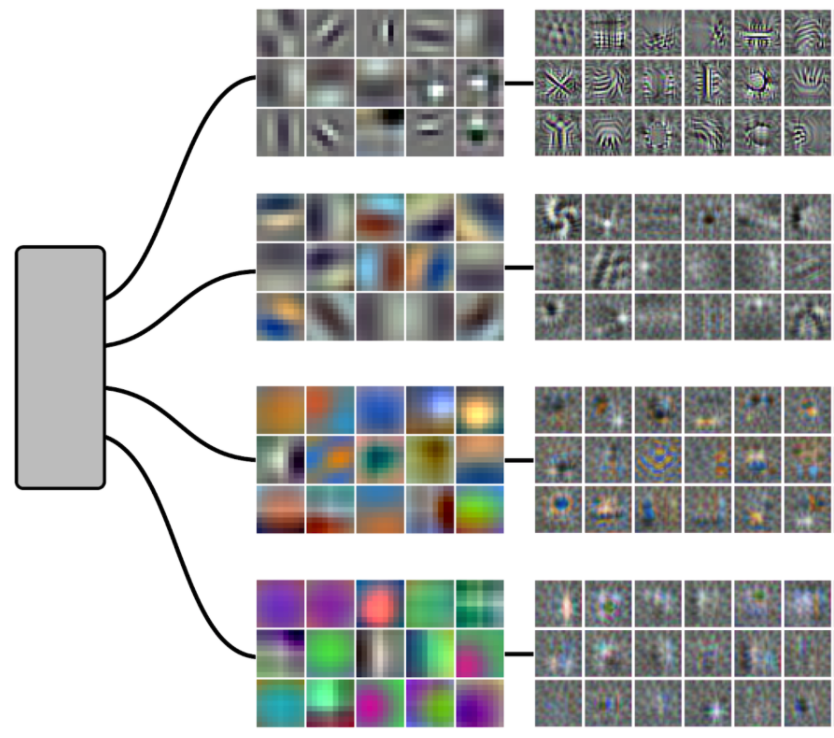
The first two layers of AlexNet are split into two branches which can’t communicate until they rejoin after the second layer. This structure was used to maximize the efficiency of training the model on two GPUs, but the authors noticed something very curious happened as a result. The neurons in the first layer organized themselves into two groups: black-and-white Gabor filters formed on one branch and low-frequency color detectors formed on the other branch.

1. Branch specialization in the first two layers of AlexNet. Krizhevsky et al. observed the phenomenon we call branch specialization in the first layer of AlexNet by visualizing their weights to RGB channels; here, we use feature visualization to show how this phenomenon extends to the second layer of each branch.

Although the first layer of AlexNet is the only example of branch specialization we’re aware of being discussed in the literature, it seems to be a common phenomenon. We find that branch specialization happens in later hidden layers, not just the first layer. It occurs in both low-level and high-level features. It occurs in a wide range of models, including places you might not expect it – for example, residual blocks in resnets can functionally be branches and specialize. Finally, branch specialization appears to surface as a structural phenomenon in plain convolutional nets, even without any particular structure causing it.

Conclusion

Is there a large-scale structure to how neural networks operate? How are features and circuits organized within the model? Does network architecture influence the features and circuits that form? Branch specialization hints at an exciting story related to all of these questions.

Author Contributions

As with many scientific collaborations, the contributions are difficult to separate because it was a collaborative effort that we wrote together.

Acknowledgments

We are grateful to Brice Ménard for pushing us to investigate whether we can find larger-scale structures such as the one investigated here.

References

  1. Imagenet classification with deep convolutional neural networks
    Krizhevsky, A., Sutskever, I. and Hinton, G.E., 2012. Advances in neural information processing systems, Vol 25, pp. 1097–1105.
  2. Visualizing higher-layer features of a deep network[PDF]
    Erhan, D., Bengio, Y., Courville, A. and Vincent, P., 2009. University of Montreal, Vol 1341, pp. 3.
  3. Deep inside convolutional networks: Visualising image classification models and saliency maps
    Simonyan, K., Vedaldi, A. and Zisserman, A., 2013. arXiv preprint arXiv:1312.6034.
  4. Multifaceted feature visualization: Uncovering the different types of features learned by each neuron in deep neural networks[PDF]
    Nguyen, A., Yosinski, J. and Clune, J., 2016. arXiv preprint arXiv:1602.03616.
  5. Feature Visualization  https://distill.pub/2020/circuits/branch-specialization
    Olah, C., Mordvintsev, A. and Schubert, L., 2017. Distill. DOI: 10.23915/distill.00007
  6. Going deeper with convolutions
    Szegedy, C., Liu, W., Jia, Y., Sermanet, P., Reed, S., Anguelov, D., Erhan, D., Vanhoucke, V. and Rabinovich, A., 2015. Proceedings of the IEEE conference on computer vision and pattern recognition, pp. 1–9.
  7. Neural architecture search with reinforcement learning
    Zoph, B. and Le, Q.V., 2016. arXiv preprint arXiv:1611.01578.
  8. Neural networks are surprisingly modular
    Filan, D., Hod, S., Wild, C., Critch, A. and Russell, S., 2020. arXiv preprint arXiv:2003.04881.
  9. Are Neural Nets Modular? Inspecting Functional Modularity Through Differentiable Weight Masks
    Csordás, R., Steenkiste, S.v. and Schmidhuber, J., 2020.
  10. Segregation of form, color, and stereopsis in primate area 18https://distill.pub/2020/circuits/branch-specialization
    Hubel, D. and Livingstone, M., 1987. Journal of Neuroscience, Vol 7(11), pp. 3378–3415. Society for Neuroscience. DOI: 10.1523/JNEUROSCI.07-11-03378.1987
  11. Representation of Angles Embedded within Contour Stimuli in Area V2 of Macaque Monkeyshttps://distill.pub/2020/circuits/branch-specialization
    Ito, M. and Komatsu, H., 2004. Journal of Neuroscience, Vol 24(13), pp. 3313–332

Unlocking Seamless Healthcare Data Interoperability on AWS Cloud

0

What is Healthcare Data Interoperability?

Healthcare data interoperability is the ability to exchange and understand the data, providing a syntactic and semantic understanding as it moves across the healthcare domain. The fast-growing healthcare industry requires patient’s records to be readily available, discoverable, and understandable. HL7 (Health Level Seven International) has developed an interoperability specification for the exchange of healthcare information electronically, known as FHIR (Fast Healthcare Interoperability Resources). It enables data to be shared across healthcare IT systems in a readable and usable manner.

How is Healthcare Data Interoperability implemented on AWS Cloud?

AWS Cloud helps create an ecosystem for the healthcare industry by providing a platform for robust exchange of data. This platform helps to load patient’s historical records called as observations using API that easily registers as a bundle resource. It supports multiple interactions such as posting, searching, and updating bundles.

Reference Architecture

The reference architecture below depicts a model for Healthcare Data Interoperability on AWS Cloud.

  1. User requests are authenticated and authorized using Amazon Cognito.
  2. Once authenticated and authorized, request is further routed to Amazon Route53 for DNS resolution of the elastic load balancer.
  3. The request is load balanced using AWS Elastic Load Balancer for the respective healthcare experience APIs.
  4. Initially the request is validated by the experience services deployed in Amazon EKS.
  5. Once validated, request is further routed to Healthcare Core Business Services for further processing. Amazon Aurora stores the static configuration data required for request processing and the dynamic response generated for every request. Logs generated by core services can further be analyzed using Amazon Elasticsearch.
  6. Static healthcare reports are served through Amazon S3 and can be cached with Amazon CloudFront for faster delivery.
  7. AWS CloudTrail, AWS KMS, and Amazon CloudWatch are used for API auditing, Data Encryption, and observability purpose, respectively.

What are the benefits of Healthcare Data Interoperability on AWS Cloud?

• Consistent and easy to implement approach for exchanging data between healthcare systems.
• Improved healthcare services delivery by making data readily accessible.
• Standardized and structured data for automated clinical support and other machine-based processing.
• Elimination of manual exchange of information by feeding directly into workflows.
• 24×7 healthcare on demand data availability across geographic locations.
• Managed infrastructure for ever-growing and huge volume of data.
• Statistical analysis on bulk data to analyze medical trends with AI/ML capabilities.

Conclusion

Healthcare Data Interoperability aids in breaking the silos and facilitates unified integration of information across healthcare institutions. Collaboration, communication, and co-execution are extremely critical in the post-pandemic new world order where Healthcare Data Interoperability on AWS Cloud will make on-time quality care available for a lower possible cost.

FAQs

Q: What is Healthcare Data Interoperability?
A: Healthcare data interoperability is the ability to exchange and understand the data, providing a syntactic and semantic understanding as it moves across the healthcare domain.

Q: How is Healthcare Data Interoperability implemented on AWS Cloud?
A: AWS Cloud helps create an ecosystem for the healthcare industry by providing a platform for robust exchange of data.

Q: What are the benefits of Healthcare Data Interoperability on AWS Cloud?
A: The benefits include consistent and easy implementation, improved healthcare services delivery, standardized and structured data, elimination of manual exchange, 24×7 data availability, managed infrastructure, and statistical analysis.

Complicated AI Faculty Shortage

AI Experts Remain Interested in Academic Careers, Despite Industry Incentives

When the ride-hailing company Uber sought to establish a new facility in Pittsburgh in 2015 focused on self-driving cars, it looked to the researchers and scientists at the nearby Carnegie Mellon University robotics center. Soon after, the company lured away 40 of the center’s employees, including the director, with doubled salaries and bonuses in the hundreds of thousands.

A Contrary Narrative

High-profile stories like these have contributed to a prevailing narrative that artificial intelligence experts leave academe for industry in droves. But the dearth of AI professors at U.S. universities is not the result of a distorted job market, according to a report issued this month from the Center for Security and Emerging Technology. Rather, AI experts remain interested in academic careers, but university hiring of AI faculty has not kept pace with student demand.

A Historical Perspective

Historically, academe has delivered a steady stream of developers, engineers, and entrepreneurs that has fueled an AI innovation ecosystem. This stream has been directly correlated with AI faculty teaching capacity. But while student enrollment in computer science programs has skyrocketed in the past decade, universities have not hired enough computer science faculty to meet that demand.

Industry’s Response

In an apparent response to increased student demand, universities have restricted access to AI programs by limiting enrollment in high-demand classes, reducing the number of small-enrollment classes, and tightening computer science admission requirements, according to Jack Corrigan, one of the report’s authors. At the same time, burgeoning numbers of computer science Ph.D. recipients have expressed interest in academic careers, but universities have not responded with a commensurate increase in faculty positions.

Technology Companies as Alternative Pathways

Technology companies, for their part, have stepped in to pick up some of the student demand by offering alternative pathways to AI education and training. Google, for example, does not always require prospective employees to have earned bachelor of science degrees. “The excitement is no longer coming from the universities, but from innovative companies driving transformation like SpaceX, Amazon, Apple, OpenAI, and other for-profit businesses that are leaving a traditional education model in the dust,” said John Nosta, Google Health Advisory Board member and World Health Organization founding member of the digital health expert roster.

Conclusion

The report suggests that AI experts remain interested in academic careers, but university hiring of AI faculty has not kept pace with student demand. While industry has a role to play in developing AI talent, it is essential to consider the incentives that are driving the behaviors of each actor. Universities must think critically about their role in developing the tech workforce in an equitable, just, and socially optimal way.

FAQs

Q: Why are AI experts leaving academe for industry?
A: The report suggests that AI experts are not leaving academe for industry in droves. Instead, university hiring of AI faculty has not kept pace with student demand.

Q: What is the role of technology companies in developing AI talent?
A: Technology companies are offering alternative pathways to AI education and training, but it is essential to consider the incentives that are driving their behaviors.

Q: What is the incentive structure for universities?
A: The incentive structure for universities is different from that of private companies. Universities are driven by a desire to educate and conduct research, whereas private companies are driven by profit.

Q: What is the solution to the AI workforce shortage?
A: The solution lies in universities thinking critically about their role in developing the tech workforce in an equitable, just, and socially optimal way. This may involve new programs in K-12 and high school/precollege educational programs.

Fine-tuning Meta Llama 3.2 Models with Amazon SageMaker JumpStart

0

Fine-Tuning Meta Llama 3.2 Text Generation Models using Amazon SageMaker JumpStart

Meta’s newly launched Llama 3.2 series sets a new benchmark in generative AI with its advanced multimodal capabilities and optimized performance across diverse hardware platforms. To address the gaps in niche or domain-specific tasks, fine-tuning with domain-specific data is essential to boost accuracy and relevance.

Solution Overview

SageMaker JumpStart is a robust feature within the SageMaker machine learning (ML) environment, offering practitioners a comprehensive hub of publicly available and proprietary foundation models (FMs). This managed service accelerates the ML development process by providing access to a growing list of cutting-edge models from leading model hubs and providers.

Prerequisites

To try out this solution using SageMaker JumpStart, you’ll need the following prerequisites:

  • Fine-tune Meta Llama 3.2 text generation models

No-Code Fine-Tuning using the SageMaker Studio UI

SageMaker JumpStart provides access to publicly available and proprietary FMs from third-party and proprietary providers. Data scientists and developers can quickly prototype and experiment with various ML use cases, accelerating the development and deployment of ML applications.

To start using the Meta Llama 3.2 models, follow these steps:

  1. Access SageMaker JumpStart in the SageMaker Studio UI.
  2. Choose the Meta provider.
  3. Select the Meta Llama 3.2 1B Instruct model.
  4. Configure deployment configuration, hyperparameters, and security settings for fine-tuning.
  5. Choose Submit to start the training job on a SageMaker ML instance.
  6. Accept the Llama 3.2 Community License Agreement to initiate the fine-tuning process.

Deploy the Model

After the model is fine-tuned, you can deploy it using the model page on SageMaker JumpStart. The option to deploy the fine-tuned model will appear when fine-tuning is finished.

Fine-Tuning using the SageMaker Python SDK

You can also fine-tune Meta Llama 3.2 models using the SageMaker Python SDK. A sample notebook with the full instructions can be found on GitHub.

Dataset Formatting

We currently offer two types of fine-tuning: instruction fine-tuning and domain adaption fine-tuning. You can switch to one of the training methods by specifying the parameter instruction_tuned as True or False.

Domain Adaption Format

The text generation model can be fine-tuned on any domain-specific dataset to incorporate domain-specific knowledge and language patterns. After fine-tuning on the domain-specific dataset, the model is expected to generate more relevant and accurate text within that domain.

Instruction Fine-Tuning

The text generation model can be instruction-tuned on any text data provided that the data is in the expected format. The instruction-tuned model can be further deployed for inference.

Conclusion

Fine-tuning Meta Llama 3.2 text generation models using Amazon SageMaker JumpStart enables practitioners to tailor the models for their unique use cases, bridging the gap between general AI capabilities and domain-specific expertise. By leveraging the robust training and deployment capabilities available in SageMaker, you can customize and scale models to meet diverse ML requirements efficiently.

FAQs

Q: What is SageMaker JumpStart?
A: SageMaker JumpStart is a managed service that provides access to a growing list of cutting-edge models from leading model hubs and providers.

Q: How do I fine-tune Meta Llama 3.2 text generation models using SageMaker JumpStart?
A: You can fine-tune the models using the SageMaker Studio UI or the SageMaker Python SDK.

Q: What are the prerequisites for fine-tuning Meta Llama 3.2 text generation models?
A: You’ll need to have a SageMaker account and access to the Meta Llama 3.2 models through SageMaker JumpStart.

Q: What is the format of the dataset for fine-tuning?
A: The dataset can be in CSV, JSON, or TXT format, depending on the type of fine-tuning (domain adaption or instruction fine-tuning).

25 Best Black Friday Robot Vacuum Deals

0

As we wait for Black Friday and Cyber Monday to roll around, deals on different devices are already appearing everywhere. Robot vacuums are just one category seeing major pricing discounts in preparation for the year’s biggest shopping event. ZDNET is gathering the best and most legitimate deals available right now, so you don’t have to worry about wading through the madness that is deal hunting.

Our favorite early robot vacuum deals for Black Friday 2024

  • iRobot Roomba Vac Essential robot vacuum: $225 (save $25 at Amazon): This Roomba is ZDNET’s pick for the best budget-friendly iRobot vacuum available.
  • iRobot Roomba j7+ robot vacuum: $356 (save $444 at Amazon): This discount on a self-emptying Roomba powered by RobotOS is a deal you can’t miss. You can also get the Roomba Combo j7+ variation, with a fully retractable mop pad, at 18% off for $899.
  • Roborock Q7 Max+ robot vacuum and mop: $360 (save $510 at Amazon): Besides a Q7 robot vacuum and mop, the Max model includes a self-emptying dock that you don’t have to worry about for up to seven weeks.
  • Dreame X30 Ultra robot vacuum and mop: $1,000 (save $400 at Amazon): The Dreame X30 Ultra was ZDNET’s top pick for the best 2-in-1 robot vacuum and mop, dethroned only by its successor, the X40 Ultra.
  • Yeedi M12 Pro+ robot vacuum and mop: $570 (save $430 at Amazon): Have you ever heard the phrase “high-end features for a mid-range price?” This hands-free robot vacuum and mop does all the work for you, with flagship features like an extending mop pad to reach corners and under cabinets and 11,000Pa of suction.
  • iRobot Roomba Essential Combo robot vacuum and mop: $160 (save $115 at Amazon): This essential robot vacuum is an entry-level Roomba that combines powerful suction with mopping action.
  • Ecovacs Deebot X2 Combo complete robot vacuum and mop: $1,110 (save $590 at Amazon): I rely on the Deebot X2 Combo Complete robot vacuum and mop, especially because of its side-mounted cordless vacuum that empties automatically.
  • Roborock S8 Pro Ultra robot vacuum and mop: $1,100 (save $400 at Amazon): The all-in-one S8 Pro Ultra features 6,000Pa of suction power, a self-emptying dustbin, and self-washing mop pads.
  • OKP Life K2 robot vacuum: $90 (save $110 at Amazon): One of our favorite inexpensive options, the OKP Life K2 is a great entry-level, no-frills robot vacuum—especially for the price.
  • Dreame X40 Ultra robot vacuum and mop: $1,400 (save $500 at Amazon): This is my favorite robot vacuum and mop combination that I’ve tested, with excellent obstacle avoidance and strong suction.

Best early Black Friday iRobot robot vacuum deals

Best early Black Friday Roborock robot vacuum deals

FAQs

When is Black Friday?

Black Friday is a big shopping event that occurs each year on the day after Thanksgiving. This year, it falls on Nov. 29.

When is Cyber Monday?

Cyber Monday happens on the Monday following the Thanksgiving holiday. This year, Cyber Monday falls on Dec. 2.

Are robot vacuum deals really better on Black Friday?

Robot vacuums are cheaper during big shopping events like Black Friday, Cyber Monday, and Amazon Prime Day. The fact that Black Friday is one of the last major shopping events of the year results in some retailers giving big discounts on the current product stock in preparation for new devices launching in the new year.

What’s the difference between Black Friday and Cyber Monday?

Though there are many online deals, Black Friday has been historically a mostly in-person shopping event where people visit a brick-and-mortar store. With most big box stores featuring an online store, Black Friday online shopping has become as common as Amazon Prime Day shopping. Cyber Monday began and remains an online shopping event for online stores to capitalize on customers who may have missed a Black Friday deal and can shop from home or work on Monday.

How did we choose these Black Friday deals?

As a robot vacuum tester at ZDNET, I’ve become familiar with these devices’ unique features and tested different models in every price range. This experience has made me realize that the robot vacuum market is saturated with competition. It also helps me discern which robot vacuums are worth their retail price and when a discount is a good deal.

Where can you shop the best Black Friday and Cyber Monday deals? 

While retailers hold store-specific shopping events throughout the year, like Amazon with Prime Day, you can expect Black Friday and Cyber Monday deals to appear everywhere. This includes your local businesses and big box stores. Black Friday is a huge shopping event, both in-person and online, with stores like Walmart, Best Buy, Amazon, Target, Costco, and more offering eye-popping discounts on different products.

Precision home robots learn with real-to-sim-to-real | MIT News

0

At the top of many automation wish lists is a particularly time-consuming task: chores. 

The moonshot of many roboticists is cooking up the proper hardware and software combination so that a machine can learn “generalist” policies (the rules and strategies that guide robot behavior) that work everywhere, under all conditions. Realistically, though, if you have a home robot, you probably don’t care much about it working for your neighbors. MIT Computer Science and Artificial Intelligence Laboratory (CSAIL) researchers decided, with that in mind, to attempt to find a solution to easily train robust robot policies for very specific environments.

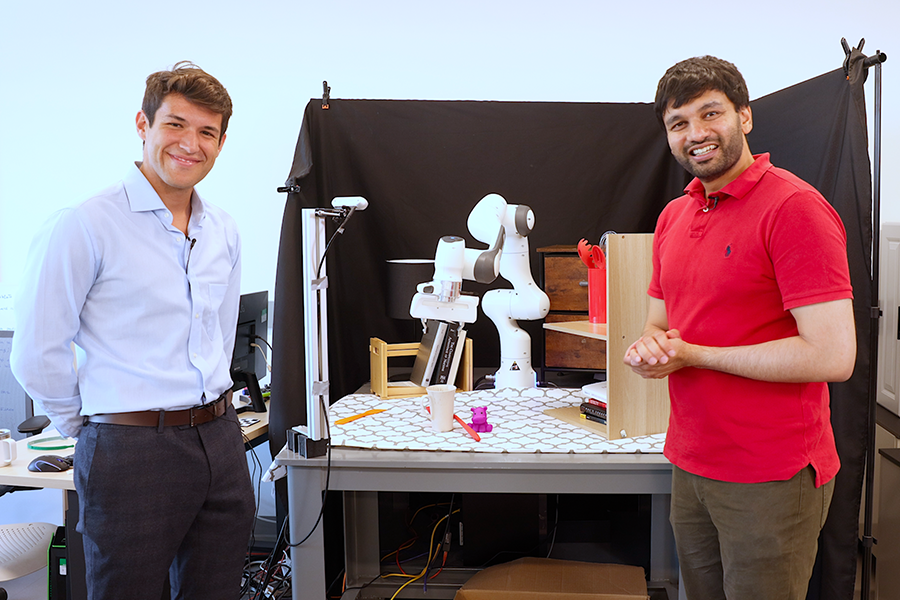
“We aim for robots to perform exceptionally well under disturbances, distractions, varying lighting conditions, and changes in object poses, all within a single environment,” says Marcel Torne Villasevil, MIT CSAIL research assistant in the Improbable AI lab and lead author on a recent paper about the work. “We propose a method to create digital twins on the fly using the latest advances in computer vision. With just their phones, anyone can capture a digital replica of the real world, and the robots can train in a simulated environment much faster than the real world, thanks to GPU parallelization. Our approach eliminates the need for extensive reward engineering by leveraging a few real-world demonstrations to jump-start the training process.”

Taking your robot home

RialTo, of course, is a little more complicated than just a simple wave of a phone and (boom!) home bot at your service. It begins by using your device to scan the target environment using tools like NeRFStudio, ARCode, or Polycam. Once the scene is reconstructed, users can upload it to RialTo’s interface to make detailed adjustments, add necessary joints to the robots, and more.

The refined scene is exported and brought into the simulator. Here, the aim is to develop a policy based on real-world actions and observations, such as one for grabbing a cup on a counter. These real-world demonstrations are replicated in the simulation, providing some valuable data for reinforcement learning. “This helps in creating a strong policy that works well in both the simulation and the real world. An enhanced algorithm using reinforcement learning helps guide this process, to ensure the policy is effective when applied outside of the simulator,” says Torne.

Testing showed that RialTo created strong policies for a variety of tasks, whether in controlled lab settings or more unpredictable real-world environments, improving 67 percent over imitation learning with the same number of demonstrations. The tasks involved opening a toaster, placing a book on a shelf, putting a plate on a rack, placing a mug on a shelf, opening a drawer, and opening a cabinet. For each task, the researchers tested the system’s performance under three increasing levels of difficulty: randomizing object poses, adding visual distractors, and applying physical disturbances during task executions. When paired with real-world data, the system outperformed traditional imitation-learning methods, especially in situations with lots of visual distractions or physical disruptions.

“These experiments show that if we care about being very robust to one particular environment, the best idea is to leverage digital twins instead of trying to obtain robustness with large-scale data collection in diverse environments,” says Pulkit Agrawal, director of Improbable AI Lab, MIT electrical engineering and computer science (EECS) associate professor, MIT CSAIL principal investigator, and senior author on the work.

As far as limitations, RialTo currently takes three days to be fully trained. To speed this up, the team mentions improving the underlying algorithms and using foundation models. Training in simulation also has its limitations, and currently it’s difficult to do effortless sim-to-real transfer and simulate deformable objects or liquids.

The next level

So what’s next for RialTo’s journey? Building on previous efforts, the scientists are working on preserving robustness against various disturbances while improving the model’s adaptability to new environments. “Our next endeavor is this approach to using pre-trained models, accelerating the learning process, minimizing human input, and achieving broader generalization capabilities,” says Torne.

“We’re incredibly enthusiastic about our ‘on-the-fly’ robot programming concept, where robots can autonomously scan their environment and learn how to solve specific tasks in simulation. While our current method has limitations — such as requiring a few initial demonstrations by a human and significant compute time for training these policies (up to three days) — we see it as a significant step towards achieving ‘on-the-fly’ robot learning and deployment,” says Torne. “This approach moves us closer to a future where robots won’t need a preexisting policy that covers every scenario. Instead, they can rapidly learn new tasks without extensive real-world interaction. In my view, this advancement could expedite the practical application of robotics far sooner than relying solely on a universal, all-encompassing policy.”

“To deploy robots in the real world, researchers have traditionally relied on methods such as imitation learning from expert data, which can be expensive, or reinforcement learning, which can be unsafe,” says Zoey Chen, a computer science PhD student at the University of Washington who wasn’t involved in the paper. “RialTo directly addresses both the safety constraints of real-world RL [robot learning], and efficient data constraints for data-driven learning methods, with its novel real-to-sim-to-real pipeline. This novel pipeline not only ensures safe and robust training in simulation before real-world deployment, but also significantly improves the efficiency of data collection. RialTo has the potential to significantly scale up robot learning and allows robots to adapt to complex real-world scenarios much more effectively.”

“Simulation has shown impressive capabilities on real robots by providing inexpensive, possibly infinite data for policy learning,” adds Marius Memmel, a computer science PhD student at the University of Washington who wasn’t involved in the work. “However, these methods are limited to a few specific scenarios, and constructing the corresponding simulations is expensive and laborious. RialTo provides an easy-to-use tool to reconstruct real-world environments in minutes instead of hours. Furthermore, it makes extensive use of collected demonstrations during policy learning, minimizing the burden on the operator and reducing the sim2real gap. RialTo demonstrates robustness to object poses and disturbances, showing incredible real-world performance without requiring extensive simulator construction and data collection.”

Torne wrote this paper alongside senior authors Abhishek Gupta, assistant professor at the University of Washington, and Agrawal. Four other CSAIL members are also credited: EECS PhD student Anthony Simeonov SM ’22, research assistant Zechu Li, undergraduate student April Chan, and Tao Chen PhD ’24. Improbable AI Lab and WEIRD Lab members also contributed valuable feedback and support in developing this project. 

This work was supported, in part, by the Sony Research Award, the U.S. government, and Hyundai Motor Co., with assistance from the WEIRD (Washington Embodied Intelligence and Robotics Development) Lab. The researchers presented their work at the Robotics Science and Systems (RSS) conference earlier this month.

Key Features of Effective Certification Schemes

Lesson Four: Existing Effective Certification Schemes are Transparent, Adaptable, and Interoperable

The previous lessons raise significant challenges that certification must address in order to be effective. We identified some common principles which could help. In the range of sectors we explored, three common characteristics of effective certification schemes were: transparency, adaptability, and interoperability.

Credible Schemes are Transparent

Credible schemes are transparent. The AI sector can learn from other sectors about how transparency can help to empower diverse groups of stakeholders to participate in, improve, and hold systems to account. Transparency is central in many schemes – in sustainability it is often considered a fundamental principle, underpinning the overall credibility of a certification scheme.

Existing Sectors Provide Examples

In the sustainability sector for example, schemes focus on providing important information in appropriate detail, and making this easily accessible to all stakeholders – including information about the goals of a scheme, definitions, how assessments are carried out, and open communication of results and significance. Transparency may also involve public scrutiny, for example, public transparency of adverse event reporting can help drive impact.

Lesson Five: Meaningful Impact Requires a Broad Range of Stakeholder Views

Certification systems must take into account a broad range of perspectives in order to be effective. Assurance service providers, professional bodies, organisations developing and deploying products or services, and affected users all have different needs and incentives.

Different Parts of the Market May Respond to Different Incentives

Different parts of the market may respond to different incentives to seek certification. While some actors may be motivated to work within specific norms and seek certification due to values or brand differentiation, it can be more difficult to incentivise moderately-engaged actors (the “middle” of the market) to participate in a certification scheme.

Lesson Six: Continual Monitoring and Evaluation Can Manage Complexity

Certification is inherently complex, and will be particularly so for AI and AI assurance. To be effective, certification schemes must ensure that complexities are managed appropriately. Fortunately, other sectors provide clues for how we may begin to manage these complexities in our own context, and show that continual monitoring and evaluation can help address and manage these challenges.

Conclusion

In these six lessons, we have identified key enabling conditions and common features across existing schemes that can help certification play an effective role in broader governance. These surface further questions and challenges in our own domain, including how to monitor and improve the enabling conditions for effective certification, how schemes might be designed with the necessary features to succeed, and, crucially, who should be involved in efforts to resolve these challenges.

FAQs

  • Q: What are the common characteristics of effective certification schemes?
    A: The common characteristics of effective certification schemes are transparency, adaptability, and interoperability.

  • Q: What is the importance of transparency in certification schemes?
    A: Transparency is central in many schemes, and can help to empower diverse groups of stakeholders to participate in, improve, and hold systems to account.

  • Q: How can certification schemes be designed to ensure meaningful impact?
    A: Certification systems must take into account a broad range of perspectives in order to be effective. Assurance service providers, professional bodies, organisations developing and deploying products or services, and affected users all have different needs and incentives.

  • Q: What is the role of continual monitoring and evaluation in managing complexity in certification schemes?
    A: Continual monitoring and evaluation can help address and manage the complexities in certification schemes, by ensuring that complexities are managed appropriately and that schemes are designed with the necessary features to succeed.

PuppyGraph Secures $5 Million for Zero-ETL Graph Querying

Businesses Leveraging Graph Technology to Uncover Hidden Patterns

Businesses are using AI, predictive analytics, and other advanced tools to gather more data than ever before with the hopes of gathering a deeper understanding of their environment, identifying patterns, and making more informed strategic decisions. However, companies often rely on traditional relational databases to store and manage their data. These systems often lack the scalability and flexibility required for modern analytics. In response to these challenges, many organizations have turned to graph technology to better map the intricate connections in their data.

Introducing PuppyGraph

PuppyGraph, a San Francisco-based startup founded by former engineers from Google and LinkedIn, has developed a zero-ETL engine that allows users to query their relational data as a unified graph, removing the need for a separate graph database and the time-consuming extract, transform, and load (ETL) processes.

The Need for Graph Technology

Traditional SQL operations are well suited for handling structured data in tables, but they struggle to manage complex and interconnected data. Users may have to rely on complicated JOIN operations across tables and ETL pipelines, which can significantly reduce the efficiency of querying and analyzing complex data sets.

PuppyGraph’s Solution

PuppyGraph aims to address this with its zero-ETL engine by enabling businesses to work with their existing SQL infrastructure while accessing the advanced capabilities of graph analytics. It does this by integrating the power of both relational and graph databases.

Key Features

  • Zero-ETL engine allows users to query relational data as a unified graph
  • Removes the need for a separate graph database and ETL processes
  • Enables businesses to work with their existing SQL infrastructure
  • Integrates with popular data lakes and warehouses such as Snowflake, DuckDB, and AWS Redshift
  • Scalable and capable of handling petabytes of data and executing complex queries in seconds

Feedback from Customers

Eric Sun, Sr. Manager of Data Platform at Coinbase, commented on the impact of PuppyGraph at the Data+AI Summit 2024: "PuppyGraph is a very interesting graph query engine. It doesn’t require us to load or ETL any data into a specialized or proprietary database storage layer for graphs. We can simply query everything directly on our data lake—whether it’s Delta, Iceberg, or just plain Parquet files. PuppyGraph can integrate this data into a graph model and another distributed computation engine to render all the results."

Competitive Landscape

The graph database market is expected to grow to $3.2 billion by 2025, expanding at a compound annual growth rate (CAGR) of 28.1%. PuppyGraph faces stiff competition from the likes of Tigergraph, AWS Neptune, Neo4j, ArrangoDB, and Aerospike. With its new capital, PuppyGraph plans to expand its team, accelerate product development, and increase its global presence.

Conclusion

PuppyGraph’s innovative zero-ETL engine has the potential to revolutionize the way businesses analyze and make decisions. By integrating graph technology with relational databases, PuppyGraph has created a powerful tool that can help organizations uncover hidden patterns and make more informed strategic decisions.

Frequently Asked Questions

Q: What is PuppyGraph?
A: PuppyGraph is a zero-ETL engine that allows users to query their relational data as a unified graph.

Q: What are the benefits of using PuppyGraph?
A: PuppyGraph removes the need for a separate graph database and ETL processes, enabling businesses to work with their existing SQL infrastructure and access the advanced capabilities of graph analytics.

Q: How does PuppyGraph integrate with other data systems?
A: PuppyGraph integrates with popular data lakes and warehouses such as Snowflake, DuckDB, and AWS Redshift.

Q: What is the competitive landscape for graph databases?
A: The graph database market is expected to grow to $3.2 billion by 2025, expanding at a compound annual growth rate (CAGR) of 28.1%.