Home Blog Page 639

AI’s Superior Understanding of Humans

0

Stanford Research Psychologist Warns of AI’s Surprising Abilities

Michal Kosinski is a Stanford research psychologist with a nose for timely subjects. He sees his work as not only advancing knowledge, but alerting the world to potential dangers ignited by the consequences of computer systems.

A Study of AI’s Theory of Mind

Kosinski’s latest paper, published in the peer-reviewed Proceedings of the National Academy of Sciences, claims that large language models like OpenAI’s have crossed a border and are using techniques analogous to actual thought, once considered solely the realm of flesh-and-blood people (or at least mammals).

Theory of Mind and AI

Theory of mind is the ability of humans, developed in the childhood years, to understand the thought processes of other humans. It’s an important skill. If a computer system can’t correctly interpret what people think, its world understanding will be impoverished and it will get lots of things wrong.

Kosinski’s Experiments

Kosinski put LLMs to the test and now says his experiments show that in GPT-4 in particular, a theory of mind-like ability “may have emerged as an unintended by-product of LLMs’ improving language skills … They signify the advent of more powerful and socially skilled AI.”

Concerns and Implications

Kosinski is careful not to claim that LLMs have utterly mastered theory of mind—yet. In his experiments, he presented a few classic problems to the chatbots, some of which they handled very well. But even the most sophisticated model, GPT-4, failed a quarter of the time.

The successes, he writes, put GPT-4 on a level with 6-year-old children. Not bad, given the early state of the field. “Observing AI’s rapid progress, many wonder whether and when AI could achieve ToM or consciousness,” he writes. Putting aside that radioactive c-word, that’s a lot to chew on.

Kosinski is concerned that we’re not really prepared for LLMs that understand the way humans think. Especially if they get to the point where they understand humans better than humans do.

Conclusion

Kosinski’s work highlights the potential dangers of AI’s rapid progress and the need for further research and regulation. As AI becomes more sophisticated, it’s essential to consider the implications of its abilities and ensure that they align with human values and ethics.

FAQs

Q: What is theory of mind?

A: Theory of mind is the ability of humans, developed in the childhood years, to understand the thought processes of other humans.

Q: What are LLMs?

A: LLMs stand for large language models, which are artificial intelligence systems designed to process and generate human-like language.

Q: What are the implications of AI’s theory of mind ability?

A: The implications are significant, as AI could potentially use its understanding of human thought processes to manipulate and influence humans in ways that are not yet fully understood.

Q: What does Kosinski’s research suggest about the future of AI?

A: Kosinski’s research suggests that AI could potentially surpass human abilities in certain areas, such as language processing and social skills, but also raises concerns about the potential risks and unintended consequences of such abilities.

NVIDIA AI Workbench: Frictionless Collaboration and Rapid Prototyping

0

Release Highlights

This section will detail the major new capabilities and user-requested updates in the latest release.

Major New Capabilities

  • Enhance collaboration through expanded Git support, such as branching, merging, diffs, and finer-grained control for commits and gitignore.
  • Create complex applications and workflows with multicontainer environments through Docker Compose support.
  • Simple, fast, and secure rapid prototyping with application sharing with single-user URLs.

User Requested Updates

  • Dark mode for the Desktop App
  • Improved installation on localized versions of Windows

Expanded Git Support

Previously, AI Workbench supported only single, monolithic commits on the main branch. Users had to manage branches and merges manually, and this created various types of confusion, especially around resolving merge conflicts. Now, users can manage branches, merges, and conflicts directly in the Desktop App and the CLI. In addition, they can see and triage individual file diffs for commits. The UI is built to work seamlessly with manual Git operations and will update to reflect relevant changes.

Multicontainer Support with Docker Compose Stacks

AI Workbench now supports Docker Compose. Users can work with multicontainer applications and workflows with the same ease of configuration, reproducibility, and portability that AI Workbench provides for single-container environments.

Dark Mode and Localized Windows Installation

Many users requested a dark mode option because it’s easier on the eyes. It’s now available and can be selected through the Settings window that is now available directly from within the Desktop App. Learn more about how dark mode works.

New AI Workbench Projects

This release introduces new example projects designed to jumpstart your AI development journey, detailed below.

Multimodal Virtual Assistant Example Project

This project enables users to build their own virtual assistant using a multimodal retrieval-augmented generation (RAG) pipeline with fallback to web search. Users can interact with two RAG-based applications to learn more about AI Workbench, converse with the user documentation, troubleshoot their own installation, or even focus the RAG pipeline to their own, custom product.

Competition-Kernel Example Project

This project provides an easy, local experience when working on Kaggle competitions. You can easily leverage your local machine or a cloud instance to work on competition datasets, write code, build out models, and submit results, all through AI Workbench.

Get Started

To get started with AI Workbench, install the application from the webpage. For more information about installing and updating, see the NVIDIA AI Workbench documentation.

Conclusion

This release of NVIDIA AI Workbench marks a significant step forward in providing a frictionless experience for AI development across GPU systems. New features from this release, including expanded Git support, support for multicontainer environments, and secure web app sharing, streamline developing and collaborating on AI workloads.

Frequently Asked Questions

Q: What are the major new capabilities in this release?
A: The major new capabilities include enhanced Git support, multicontainer support with Docker Compose, and simple, fast, and secure rapid prototyping with application sharing.

Q: What are the user-requested updates in this release?
A: The user-requested updates include dark mode for the Desktop App and improved installation on localized versions of Windows.

Q: How do I get started with AI Workbench?
A: To get started with AI Workbench, install the application from the webpage and follow the documentation for installing and updating.

Q: What are the new example projects available with this release?
A: The new example projects include the Multimodal Virtual Assistant Example Project and the Competition-Kernel Example Project.

Lab automation symposium brings together experts from all over Europe – Robotics & Automation News

0

Once again, an international symposium was held as part of the EU-funded innovation project TraceBot, bringing together laboratory automation experts from across Europe.

In addition to exciting presentations on current topics and trends in robotics, the event also offered the latest laboratory robot solutions in the networking area.

Organised by BioLAGO, experts from six countries across Europe came together to present the latest developments and opportunities in modern laboratory automation.

The international speakers were accompanied throughout the day by laboratory and automation specialist Luiza Almeida from the Instituto Pedro Nunes Portugal, who moderated the event.

Results of the TraceBot funding project shared

The second “Robotics-4-Labautomation Symposium” kicked off with a session on the progress and latest results of the TraceBot funding project.

Among others, Prof. Markus Vincze from the Vienna University of Technology gave an impressive report on the project’s success in the recognition of transparent objects.

The session was concluded by Dr Charly Coulon from Invite GmbH, who showed how the versatile results of the TraceBot project can be implemented in companies and how they can benefit from them.

Dr Charly Coulon says: “The TraceBot consortium can be proud of the good progress made over the past three and a half years, which will help us to take laboratory automation in the pharmaceutical industry and beyond a decisive step forward.

“I am sure that our results will help many companies across Europe to actively develop their laboratory automation. The Robotics-4-Labautomation Symposium in Konstanz is an important platform for raising awareness of TraceBot among laboratory users and robotics experts.”

How can robotics innovations permanently improve laboratories?

The highlight of the event was the keynote speech by Miriam Guest from Charles River Laboratories in the UK. In her interesting presentation, she impressively described the application of automation in GMP laboratories.

This was followed by a panel discussion in which the speakers shared success stories of laboratory automation with the audience and explained how modern robotic solutions will bring more efficiency and safety to the laboratory of the future.

The final session of the event looked at trends and future prospects for laboratory automation. Regional and international experts had the opportunity to share their thoughts.

The Robotics-4-Labautomation Symposium was accompanied by a diverse exhibition in the networking area.

Here, participants were able to experience the latest robotic solutions from the ETO Group and Stäubli up close. In addition, the exhibitors SILA and House of Lab Science presented their offerings for laboratory experts.

Maike Neumann from BioLAGO, project manager and coordinator of the international TraceBot consortium, says: “I am delighted that our symposium has once again brought laboratory and robotics experts from across Europe to Konstanz for a fruitful exchange.

“The added value of our TraceBot funding project is evident here, because only in this way could we create a framework in which companies and researchers could exchange ideas on the forward-looking topic of laboratory automation in an interdisciplinary way.”

Graph Convolutions

The Challenges of Computation on Graphs

Graphs are extremely flexible mathematical models; but this means they lack consistent structure across instances.

Lack of Consistent Structure

Consider the task of predicting whether a given chemical molecule is toxic:


The molecular structure of toxic caramboxin.

Looking at a few examples, the following issues quickly become apparent:

  • Molecules may have different numbers of atoms.
  • The atoms in a molecule may be of different types.
  • Each of these atoms may have different number of connections.
  • These connections can have different strengths.

Representing graphs in a format that can be computed over is non-trivial, and the final representation chosen often depends significantly on the actual problem.

Node-Order Equivariance

Extending the point above: graphs often have no inherent ordering present amongst the nodes. Compare this to images, where every pixel is uniquely determined by its absolute position within the image!

Representing the graph as one vector requires us to fix an order on the nodes. But what do we do when the nodes have no inherent order?
Above:
The same graph labelled in two different ways. The alphabets indicate the ordering of the nodes.

As a result, we would like our algorithms to be node-order equivariant: they should not depend on the ordering of the nodes of the graph. If we permute the nodes in some way, the resulting representations of the nodes as computed by our algorithms should also be permuted in the same way.

Scalability

Graphs can be really large! Think about social networks like Facebook and Twitter, which have over a billion users. Operating on data this large is not easy.

Luckily, most naturally occuring graphs are ‘sparse’: they tend to have their number of edges linear in their number of vertices. We will see that this allows the use of clever methods to efficiently compute representations of nodes within the graph. Further, the methods that we look at here will have significantly fewer parameters in comparison to the size of the graphs they operate on.

Problem Setting and Notation

There are many useful problems that can be formulated over graphs:

  • Node Classification: Classifying individual nodes.
  • Graph Classification: Classifying entire graphs.
  • Node Clustering: Grouping together similar nodes based on connectivity.
  • Link Prediction: Predicting missing links.
  • Influence Maximization: Identifying the most influential nodes in a graph.

However, there do exist more powerful techniques for ‘pooling’ together node representations:

  • SortPool: Sort vertices of the graph to get a fixed-size node-order invariant representation of the graph, and then apply any standard neural network architecture.
  • DiffPool: Learn to cluster vertices, build a coarser graph over clusters instead of nodes, then apply a GNN over the coarser graph. Repeat until only one cluster is left.
  • SAGPool: Apply a GNN to learn node scores, then keep only the nodes with the top scores, throwing away the rest. Repeat until only one node is left.

Conclusion

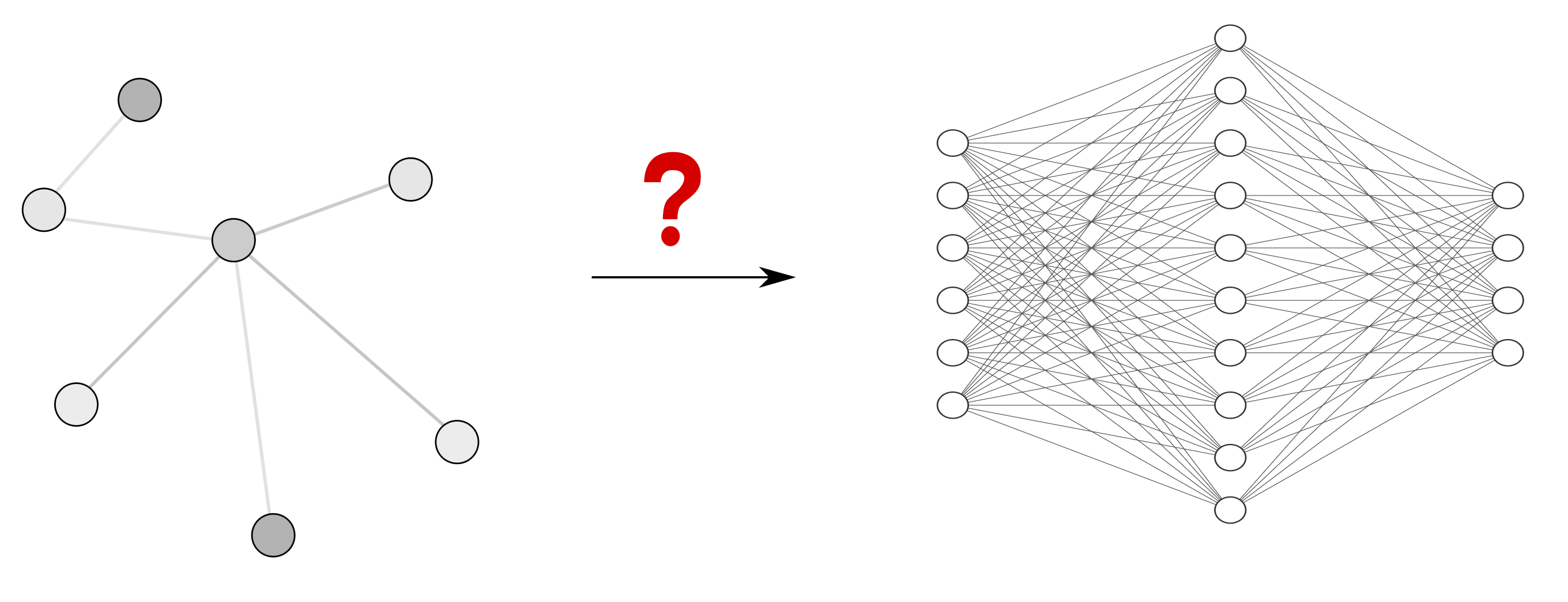
Graph neural networks are a family of neural networks that can operate naturally on graph-structured data. By extracting and utilizing features from the underlying graph, GNNs can make more informed predictions about entities in these interactions, as compared to models that consider individual entities in isolation.

Frequently Asked Questions

What are the main challenges of computation on graphs?
The main challenges of computation on graphs are the lack of consistent structure, node-order equivariance, and scalability.

What are some examples of graph neural networks?
Some examples of graph neural networks include SortPool, DiffPool, and SAGPool.

What are some applications of graph neural networks?
Some applications of graph neural networks include node classification, graph classification, node clustering, link prediction, and influence maximization.

SMB Migrations Won’t Be Limited by VMware Subscriptions

Broadcom Introduces New VMware Subscription Tier

Broadcom has a new subscription tier for VMware virtualization software that may appease some disgruntled VMware customers, especially small to medium-sized businesses. The new VMware vSphere Enterprise Plus subscription tier creates a more digestible bundle that’s more appropriate for smaller customers. But it may be too late to convince some SMBs not to abandon VMware.

A Challenging Transition

Soon after Broadcom bought VMware, it stopped the sale of VMware perpetual licenses and started requiring subscriptions. Broadcom also bundled VMware’s products into a smaller number of SKUs, resulting in higher costs and frustration for customers that felt like they were being forced to pay for products that they didn’t want. All that, combined with Broadcom ditching some smaller VMware channel partners (and reportedly taking the biggest clients direct), have raised doubts that Broadcom’s VMware would be a good fit for smaller customers.

Rick Vanover’s Insights

“The challenge with much of the VMware by Broadcom changes to date and before the announcement [of the vSphere Enterprise Plus subscription tier] is that it also forced many organizations to a much higher offering and much more components to a stack that they were previously uninterested in deploying,” Rick Vanover, Veeam’s product strategy VP, told Ars.

The New vSphere Enterprise Plus Subscription Tier

On October 31, Broadcom announced the vSphere Enterprise Plus subscription tier. From smallest to largest, the available tiers are vSphere Standard, vSphere Enterprise Plus, vSphere Foundation, and the flagship VMware Cloud Foundation. The introduction of vSphere Enterprise Plus means that customers who only want vSphere virtualization can now pick from two bundles instead of one.

Prashanth Shenoy’s Explanation

“[T]o round out the portfolio, for customers who are focused on compute virtualization, we will now have two options, VMware vSphere Enterprise Plus and VMware vSphere Standard,” Prashanth Shenoy, vice president of product marketing in the VMware Cloud Foundation division of Broadcom, explained in a blog post.

Conclusion

The new vSphere Enterprise Plus subscription tier may be a step in the right direction for Broadcom to appease disgruntled VMware customers, especially small to medium-sized businesses. However, it remains to be seen whether this move will be enough to convince some SMBs to stay with VMware. Only time will tell if this new tier will help to rebuild trust with customers.

FAQs

Q: What is the new vSphere Enterprise Plus subscription tier?

A: The vSphere Enterprise Plus subscription tier is a new offering from VMware that provides a more digestible bundle for smaller customers.

Q: Why did Broadcom stop selling perpetual licenses?

A: Broadcom stopped selling perpetual licenses to require subscriptions and to simplify its product offerings.

Q: Will the new vSphere Enterprise Plus subscription tier be enough to convince SMBs to stay with VMware?

A: It’s unclear whether the new vSphere Enterprise Plus subscription tier will be enough to convince some SMBs to stay with VMware. Only time will tell if this move will help to rebuild trust with customers.

Did OpenAI Spend Over $10 Million on a URL?

0

OpenAI Acquires Chat.com Domain for $15.5 Million

On Wednesday, OpenAI CEO Sam Altman posted a simple URL on X: chat.com. It automatically routes to ChatGPT.

A Brief History of the Domain

Previously, the domain was owned by Dharmesh Shah, the founder and CTO of HubSpot. In early 2023, Shah purchased chat.com for $15.5 million. However, just a few months later, he announced that he had sold the domain, though he wouldn’t disclose the details of the sale or the buyer. Notably, he did confirm that he sold the domain for more than he had originally paid for it.

Shah’s Vision for Chat-Based UX

“The reason I bought chat.com is simple: I think Chat-based UX (#ChatUX) is the next big thing in software. Communicating with computers/software through a natural language interface is much more intuitive. This is made possible by Generative A.I,” Shah wrote in a LinkedIn post announcing the purchase, which chat.com briefly redirected to before he resold it.

OpenAI’s Acquisition of the Domain

After the publication of this article, Shah confirmed in a post on X that OpenAI did purchase the domain from him and implied that the startup paid him in shares instead of cash.

The Drop of “GPT” from the Domain

The drop of “GPT” from the chat.com domain aligns with OpenAI’s recent rebranding efforts.

OpenAI’s Rebranding Efforts

In September, the company announced a new series of reasoning models starting with “o1.” At the time, former chief research officer Bob McGrew told The Verge he hoped that the o1 series would mark “the first step of newer, more sane names” to better communicate the company’s work.

A Tale of Vanity Domains

People hoarding “vanity domains” is a tale as old as the Internet itself. Just a few months ago, AI startup Friend spent $1.8 million on the domain friend.com after raising $2.5 million in funding. Having just raised $6.6 billion, OpenAI dropping more than $10 million —in cash or stock — is just a drop in the bucket.

Conclusion

The acquisition of chat.com by OpenAI is a significant move in the company’s rebranding efforts and its focus on chat-based UX. The domain’s history and Shah’s vision for the future of software communication are a testament to the growing importance of natural language interfaces.

FAQs

Q: Who purchased the chat.com domain?
A: Dharmesh Shah, the founder and CTO of HubSpot, purchased the domain in early 2023 for $15.5 million.

Q: Who sold the chat.com domain to OpenAI?
A: Dharmesh Shah sold the domain to OpenAI, although the terms of the sale were not disclosed.

Q: What did OpenAI pay for the domain?
A: OpenAI paid Shah in shares instead of cash, according to Shah’s post on X.

Q: Why did OpenAI acquire the domain?
A: The acquisition aligns with OpenAI’s recent rebranding efforts and its focus on chat-based UX.

Q: What is the significance of the domain’s name change?
A: The drop of “GPT” from the chat.com domain reflects OpenAI’s rebranding efforts and its shift towards more intuitive and natural language interfaces.

Chip Wars: Securing the Future

A Battle for Control of the Global Semiconductor Industry

There’s a battle going on for control of the global semiconductor industry – the chips that are in virtually every piece of electronics we use from our phones to our cars to the latest AI software. For the past half century, chips have quietly powered the technological revolution.

The Miracle of Modern Chip Manufacturing

Chip manufacturing is a complex and intricate process that requires precision and expertise. The process begins with the design of the chip, which is created using specialized software and hardware. The design is then sent to a manufacturing facility, where it is printed onto a silicon wafer using photolithography.

The Struggle Over Who Commands its Future

But the battle for control of the semiconductor industry is not just about manufacturing. It’s also about who will dominate the market and shape the future of technology. The industry is dominated by a few large players, including Intel, Samsung, and Taiwan Semiconductor Manufacturing Company (TSMC). But new players are emerging, including Chinese companies like SMIC and Huawei.

The Rise of Chinese Players

China has been investing heavily in its semiconductor industry, and its companies are rapidly gaining ground. SMIC, for example, has become one of the world’s largest independent chipmakers, and Huawei has developed its own chip technology. The rise of Chinese players is a major concern for the US and other Western countries, which are worried about the potential for Chinese companies to gain access to sensitive technology and data.

The Consequences of a Shift in Power

If the Chinese companies continue to gain ground, it could have significant consequences for the global technology industry. It could lead to a shift in the balance of power, with Chinese companies dominating the market and Western companies struggling to keep up. It could also lead to a loss of innovation and investment in the US and other Western countries, as companies shift their focus to China.

Conclusion

The battle for control of the global semiconductor industry is a complex and multifaceted issue. It’s not just about manufacturing or market share – it’s about who will shape the future of technology and who will have access to sensitive information. As the industry continues to evolve, it’s likely that the stakes will only continue to rise.

FAQs

Q: What is the semiconductor industry?

A: The semiconductor industry is the industry that produces semiconductors, which are small pieces of material that are used to make electronic components, such as chips, transistors, and diodes.

Q: Who are the major players in the semiconductor industry?

A: The major players in the semiconductor industry include Intel, Samsung, Taiwan Semiconductor Manufacturing Company (TSMC), and Chinese companies like SMIC and Huawei.

Q: What is the significance of the semiconductor industry?

A: The semiconductor industry is significant because it is the backbone of the global technology industry. Semiconductors are used in virtually every piece of electronics, from smartphones to cars to AI software.

Q: What are the concerns about the rise of Chinese players in the semiconductor industry?

A: The concerns about the rise of Chinese players in the semiconductor industry include the potential for Chinese companies to gain access to sensitive technology and data, and the potential for a shift in the balance of power in the industry.

How AI is improving simulations with smarter sampling techniques | MIT News

0

Imagine you’re tasked with sending a team of football players onto a field to assess the condition of the grass (a likely task for them, of course). If you pick their positions randomly, they might cluster together in some areas while completely neglecting others. But if you give them a strategy, like spreading out uniformly across the field, you might get a far more accurate picture of the grass condition.

Now, imagine needing to spread out not just in two dimensions, but across tens or even hundreds. That’s the challenge MIT Computer Science and Artificial Intelligence Laboratory (CSAIL) researchers are getting ahead of. They’ve developed an AI-driven approach to “low-discrepancy sampling,” a method that improves simulation accuracy by distributing data points more uniformly across space.

A key novelty lies in using graph neural networks (GNNs), which allow points to “communicate” and self-optimize for better uniformity. Their approach marks a pivotal enhancement for simulations in fields like robotics, finance, and computational science, particularly in handling complex, multidimensional problems critical for accurate simulations and numerical computations.

“In many problems, the more uniformly you can spread out points, the more accurately you can simulate complex systems,” says T. Konstantin Rusch, lead author of the new paper and MIT CSAIL postdoc. “We’ve developed a method called Message-Passing Monte Carlo (MPMC) to generate uniformly spaced points, using geometric deep learning techniques. This further allows us to generate points that emphasize dimensions which are particularly important for a problem at hand, a property that is highly important in many applications. The model’s underlying graph neural networks lets the points ‘talk’ with each other, achieving far better uniformity than previous methods.”

Their work was published in the September issue of the Proceedings of the National Academy of Sciences.

Take me to Monte Carlo

The idea of Monte Carlo methods is to learn about a system by simulating it with random sampling. Sampling is the selection of a subset of a population to estimate characteristics of the whole population. Historically, it was already used in the 18th century,  when mathematician Pierre-Simon Laplace employed it to estimate the population of France without having to count each individual.

Low-discrepancy sequences, which are sequences with low discrepancy, i.e., high uniformity, such as Sobol’, Halton, and Niederreiter, have long been the gold standard for quasi-random sampling, which exchanges random sampling with low-discrepancy sampling. They are widely used in fields like computer graphics and computational finance, for everything from pricing options to risk assessment, where uniformly filling spaces with points can lead to more accurate results. 

The MPMC framework suggested by the team transforms random samples into points with high uniformity. This is done by processing the random samples with a GNN that minimizes a specific discrepancy measure.

One big challenge of using AI for generating highly uniform points is that the usual way to measure point uniformity is very slow to compute and hard to work with. To solve this, the team switched to a quicker and more flexible uniformity measure called L2-discrepancy. For high-dimensional problems, where this method isn’t enough on its own, they use a novel technique that focuses on important lower-dimensional projections of the points. This way, they can create point sets that are better suited for specific applications.

The implications extend far beyond academia, the team says. In computational finance, for example, simulations rely heavily on the quality of the sampling points. “With these types of methods, random points are often inefficient, but our GNN-generated low-discrepancy points lead to higher precision,” says Rusch. “For instance, we considered a classical problem from computational finance in 32 dimensions, where our MPMC points beat previous state-of-the-art quasi-random sampling methods by a factor of four to 24.”

Robots in Monte Carlo

In robotics, path and motion planning often rely on sampling-based algorithms, which guide robots through real-time decision-making processes. The improved uniformity of MPMC could lead to more efficient robotic navigation and real-time adaptations for things like autonomous driving or drone technology. “In fact, in a recent preprint, we demonstrated that our MPMC points achieve a fourfold improvement over previous low-discrepancy methods when applied to real-world robotics motion planning problems,” says Rusch.

“Traditional low-discrepancy sequences were a major advancement in their time, but the world has become more complex, and the problems we’re solving now often exist in 10, 20, or even 100-dimensional spaces,” says Daniela Rus, CSAIL director and MIT professor of electrical engineering and computer science. “We needed something smarter, something that adapts as the dimensionality grows. GNNs are a paradigm shift in how we generate low-discrepancy point sets. Unlike traditional methods, where points are generated independently, GNNs allow points to ‘chat’ with one another so the network learns to place points in a way that reduces clustering and gaps — common issues with typical approaches.”

Going forward, the team plans to make MPMC points even more accessible to everyone, addressing the current limitation of training a new GNN for every fixed number of points and dimensions.

“Much of applied mathematics uses continuously varying quantities, but computation typically allows us to only use a finite number of points,” says Art B. Owen, Stanford University professor of statistics, who wasn’t involved in the research. “The century-plus-old field of discrepancy uses abstract algebra and number theory to define effective sampling points. This paper uses graph neural networks to find input points with low discrepancy compared to a continuous distribution. That approach already comes very close to the best-known low-discrepancy point sets in small problems and is showing great promise for a 32-dimensional integral from computational finance. We can expect this to be the first of many efforts to use neural methods to find good input points for numerical computation.”

Rusch and Rus wrote the paper with University of Waterloo researcher Nathan Kirk, Oxford University’s DeepMind Professor of AI and former CSAIL affiliate Michael Bronstein, and University of Waterloo Statistics and Actuarial Science Professor Christiane Lemieux. Their research was supported, in part, by the AI2050 program at Schmidt Sciences, Boeing, the United States Air Force Research Laboratory and the United States Air Force Artificial Intelligence Accelerator, the Swiss National Science Foundation, Natural Science and Engineering Research Council of Canada, and an EPSRC Turing AI World-Leading Research Fellowship. 

You’ve Got It All Wrong

0

A Conversation with Nazir Ali, Founder of Halloween Website

I appreciate that.

About the Reports

We own this mistake.

So your name is Nazir Ali, but when you say “we”—

We are not going to give you any personal information that might be harmful for us. Everyone is writing about us, and they are telling us that we are scammers.

Location and Operations

Would you be comfortable telling me about the reports that you’re based in Pakistan? Is that true?

We hire some of the content creators, and one is from Pakistan, and others are from some other countries. But I don’t want to actually reveal their nationalities. People will blame the country if I say I’m from Dubai, then whenever you write an article, if you say that a guy from Pakistan, a guy from India, guy from Ireland, a guy from the UAE, it actually hurts some of the citizens of that country.

Business Model and Revenue

Would you be comfortable telling me how long you’ve had this Halloween website?

You will be shocked to know that we ranked our site in three months on the Google first page.

So you’ve only been in operation for three months?

Yes.

Why holiday events?

It’s a huge topic, but only for one day. So it is easy for us to generate revenue for that one day—then we don’t have to put in effort throughout the year. We just do work for three or four months, and then we’ll get the revenue.

Could you explain more about your business model. How do you make money?

Our business model is Google Ads and affiliate marketing.

Consequences and Future Plans

Has this made you reconsider the ways that you operate? Will you change how you use AI going forward?

It is our mistake. We should double check it. Not only double, but triple check it. One more thing I want to add is that people should not consider Google as the standard. Google is just a search engine, and any person can post anything on it. Don’t just believe it. Just cross check!

Are you concerned that Google will downrank you now?

Definitely. We are expecting Google will derank.

Is there anything you could try to do to prevent that?

No, there is nothing. And this is because of all the misinformation provided by the journalists. They don’t actually know what our intentions are, but they are showing that our intentions are wrong. But right now the guys are very depressed. Listen to me. If we wanted to scam people, we can easily do so by selling fake tickets. But we never mentioned any tickets on the website. That would be very simple, but we didn’t even mention the ticket thing.

Conclusion

In this conversation, Nazir Ali, the founder of the Halloween website, discusses the reports and controversies surrounding his business. He acknowledges the mistakes made and expresses regret for any harm caused. He also explains his business model and revenue streams, as well as his concerns about the potential consequences of the controversy.

FAQs

Q: How long have you been in operation?
A: We have been in operation for three months.

Q: Why did you choose to focus on holiday events?
A: It’s a huge topic, and it’s easy to generate revenue for one day, then we don’t have to put in effort throughout the year.

Q: How do you make money?
A: Our business model is Google Ads and affiliate marketing.

Q: Are you concerned about the potential consequences of the controversy?
A: Yes, we are expecting Google to derank us.

Q: Is there anything you could do to prevent this?
A: No, there is nothing we can do, as the misinformation provided by the journalists has already been spread.

Google’s Free AI Learning Aid

Google’s AI-Powered Learning Companion: Learn About

While working on a master’s degree not long ago, I found one of the greatest challenges was getting used to learning complex topics outside my comfort zone. Even today, as a tech journalist, getting up to speed quickly on unfamiliar topics is an essential skill in my line of work.

Recently, Google has been developing new artificial intelligence-powered tools that transform learning and research processes for students, educators, and professionals. Google Learning’s latest offering, “Learn About” — which the tech giant describes as an “adaptable, conversational, AI-powered learning companion” — works much like an AI chatbot or search tool but is more personalized to your learning capabilities and needs.

What is Learn About?

Google’s Learn About opens with the phrase “What would you like to learn today?” Then in the search box in the center of the page, you can insert any topic, subject, file, or image to delve deeper. Here, Google uses experimental AI technology to help you approach any topic and subject better informed.

Google’s Learn About uses interactive AI technology to help you approach any topic and subject better informed.

How to use Learn About

To get started, sign in using your Google account. You can begin by asking a question in the search box, uploading an image, or document, or exploring the curated topics below.

screenshot-2024-11-07-at-2-06-29pm.png

Google

When I tried out the tool, I entered the following in the search box: “What does Silvia Federici mean by the ‘feminization of poverty’ in her text, Caliban and the Witch”.

According to Learn About: “In Caliban and the Witch, Silvia Federici argues that the transition to capitalism led to a feminization of poverty. What she means by this is that women were disproportionately impoverished during the rise of capitalism. This wasn’t an accident. Federici argues that it was a deliberate process that helped capitalism develop.”

But the AI learning companion didn’t stop there, as it further defined “feminization of poverty” and detailed factors that contributed to this phenomenon with an interactive list.

screenshot-2024-11-07-at-3-12-46pm.png

Google/ZDNET

Conclusion

This is an AI tool I wish I had during my schooling because it would have made studying for exams and developing reading and study guides easier. Moreover, I think it would be a great learning aid if you are a student or lifelong learner trying to keep your mind sharp beyond academia.

FAQs

Q: What is Learn About?

A: Learn About is an AI-powered learning companion that uses interactive technology to help you approach any topic and subject better informed.

Q: How do I access Learn About?

A: You can access Learn About at learning.google.com/experiments/learn-about. You must have a Google account to sign in.

Q: Can I use Learn About without a Google account?

A: No, you must have a Google account to sign in and use Learn About.

Q: Is Learn About available for free?

A: Yes, Learn About is available for free and can be accessed with a Google account.

Q: Is Learn About available on all devices?

A: Yes, Learn About is available on all devices with a Google account.