Home Blog Page 647

Help! A Parent Insists They Have the Right To Complete Their Child’s Homework

0


Dear We Are Teachers,

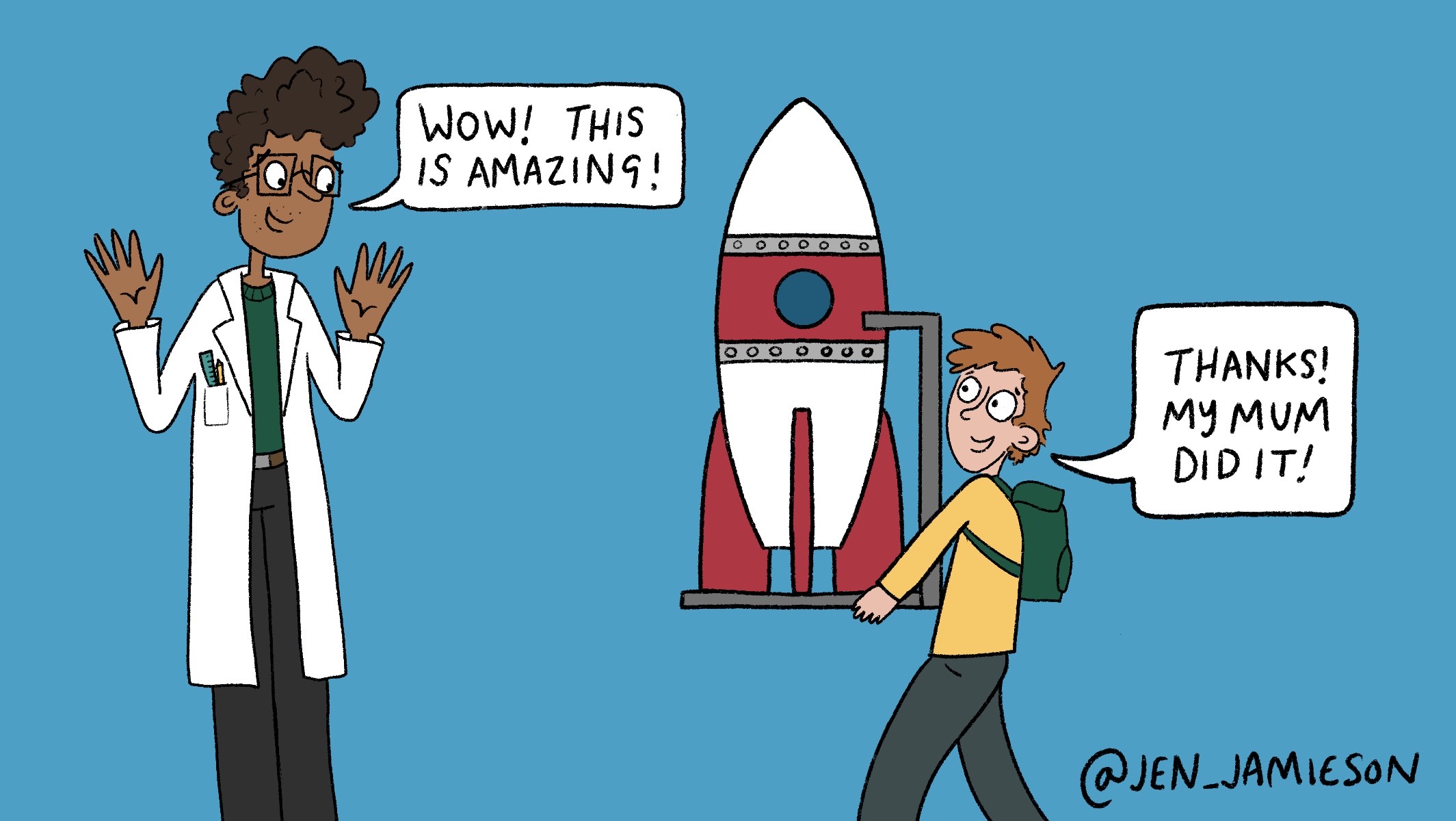
Well, I can’t believe I’m asking this, but I am. When I noticed a student’s handwriting and writing ability improved dramatically overnight, I asked the student, “Did a grown-up help you with this?” Without skipping a beat, he said, “Oh, my mom didn’t just help me. She did it for me.” When I called home to ask about it, the mom confirmed nonchalantly. After a long pause, I said that homework is intended for students to complete. She said they didn’t have time that night and that she has “the right to help my child with his homework to whatever extent I want.” Cool. Not knowing what to say, I suggested we meet in person, so we have a meeting scheduled next week. What am I supposed to do with this? 

—Am I on a Different Planet?

Dear A.I.O.A.D.P.,

This is 100% an issue to notify your administrator about. Your school leader needs to know and address it since it affects other classes as well. It’s true that as teachers we have to have tough conversations from time to time. But it’s beyond our pay grade to answer “Why is it unethical and inaccurate for my child to be graded on my—an adult’s—work?” I don’t know about you, but I’m not touching that nonsense with a salary under $150K.

However, I would recommend reviewing your grading percentages. You want to have the bulk of a student’s work be things you can verify that only they did. In other words, in class, and without the use of AI. That way, even if mom does the science fair project start to finish, it’s only 3% of the grade instead of 20%.

Dear We Are Teachers,

One of my high school students (age 14) recently told me that he spends weeks at a time by himself while his parents are away. Sometimes it’s for business, sometimes it’s to visit or take care of family in another country. I feel so sorry for him. Fourteen seems too young for this to be a regular thing. Should I report this to someone at school? Try to talk to his parents? I don’t want to make things worse, but I can’t stop worrying about him.

—Failing To Mind My Own Business

Dear F.T.M.M.O.B.,

Your worry about your student is valid. A lack of supervision for weeks at a time, even for the most mature and responsible child, is potentially dangerous and emotionally neglectful. You can check the legal age that kids are allowed to stay home alone here, listed by state. But be careful how you approach this.

The first thing I would do is talk to your student again to make sure you have the story straight. Do they have nearby adults checking in on them? Do they have safety plans in place? Have their parents gone over emergency plans with them? If you rush to report this to Child Protective Services and it turns out he’s only occasionally home by himself for a night, or that he was home by himself only for an extended period of time once (instead of regularly), you could do serious family damage that is hard to repair.

No matter what the student tells you, let your next stop be the counselor’s office. The laws about child neglect vary from state to state, and you’ll want to be absolutely sure about whether or not this is a mandatory reporting moment.

Dear We Are Teachers,

I’m a first-year teacher teaching 4th grade, and my appraiser is really unreasonable. My students are rocking our common assessments and benchmarks, but she cracks down on me for the weirdest things. I had to practically fight her to keep my 10 minutes of sustained silent reading every day. Any time my students are playing a game or doing a fun activity, she asks me why I chose that over a more rigorous activity. And when my class spent an extra five minutes at recess, she sent an email with a tone so serious you would have thought I’d been caught handing out drugs. I don’t feel like I have the teaching chops to call her out yet. But in the meantime, what’s your advice for handling an overbearing fun-sucker?

—UGH

Dear U.,

Ugh indeed! I can understand your admin’s hypervigilance since you’re a new teacher in the building. But they usually back off once they see you’re doing OK. And it sounds like you’re doing more than OK!

I think you’re wise to wait on calling her out. My advice? Let your teaching speak for itself. As long as she’s not giving you bad evaluations, wait out the weird comments and micromanaging this year. By the end of the year, you’ll have data on whether your way works. Data that you can use to say, “Thanks for that advice. Can I show you the research supporting [x]? That’s why I make the choice to do [y], and part of what got me such great results last year.”

(Not going to lie, I am greatly enjoying imagining her face receiving this devastatingly professional, totally reasonable response from you.)

Do you have a burning question? Email us at askweareteachers@weareteachers.com.

Dear We Are Teachers,

I’ve been teaching for five years at the same large high school, and almost on a daily basis I get confused for a student. Despite the fact that I wear an I.D. on a lanyard every day, I can’t tell you how many times I’ve been asked for my hall pass when I’m in the hallway, been told to leave the faculty lounge because it’s for teachers only, or had the school SRO chase me down for leaving early in my car. It was funny for the first year or so, but now it just chips away at my self-esteem. What can I do to stop being mistaken for a teenager?

—Thirty-One Going on Thirteen

OCKam Launches Zero Trust Connectors on Snowflake Marketplace

0

Ockam Launches Zero-Trust Connectors on Snowflake Marketplace

Joint Effort to Break Down Silos and Connect Every Application, Data Source, and Service in the Enterprise

SAN FRANCISCO, Nov. 8, 2024 /PRNewswire/ — Ockam today announced the launch of eight new Connectors on Snowflake Marketplace. Ockam’s Snowflake Connectors will make it possible for joint customers to extend their AI Data Cloud to any federated application, data source, and API across their enterprise.

Powering the AI Data Cloud

Ockam and Snowflake, the AI Data Cloud company, are working together to help joint customers inform business decisions and drive innovations by extending the power of the AI Data Cloud to every application, service, and data source, regardless of their cloud or on-prem footprint.

Secure Connections

Ockam Connectors create secure, mutually authenticated, point-to-point connections between Snowflake and every application in the enterprise. These connectors add guarantees of data confidentiality, integrity, and authenticity, so joint customers can enforce their enterprise data governance and privacy policies for connections to and from Snowflake.

Accelerating Digital Transformation

"The Snowflake Native App Framework and Snowflake Marketplace infrastructure is a game changer," said Matthew Gregory, Founder and CEO, Ockam. "I was part of the inception of the Heroku and Azure marketplaces and have experienced how open platforms build unifying ecosystems and strong communities. It’s been a long time coming, but now there’s an AI Data Cloud that’s committed to breaking silos to connect enterprise applications – everywhere."

Benefits

Snowflake customers can now bring their data to other business critical applications without the risk of exposing data, or applications, to public facing internet gateways. With Ockam Connectors, joint customers can:

  • Extend the power of the AI Data Cloud to every application, service, and data source
  • Break down silos and connect enterprise applications – everywhere
  • Enforce data governance and privacy policies
  • Accelerate digital transformation journey

Conclusion

The collaboration between Ockam and Snowflake showcases the power of open platforms and their ability to break down silos and connect every application, data source, and service in the enterprise. With Ockam Connectors on Snowflake Marketplace, joint customers can now unlock the full potential of their data and accelerate their digital transformation journey.

FAQs

Q: What are Ockam Connectors?
A: Ockam Connectors are secure, mutually authenticated, point-to-point connections between Snowflake and every application in the enterprise.

Q: How do Ockam Connectors work?
A: Ockam Connectors add guarantees of data confidentiality, integrity, and authenticity, so joint customers can enforce their enterprise data governance and privacy policies for connections to and from Snowflake.

Q: What are the benefits of using Ockam Connectors?
A: With Ockam Connectors, joint customers can extend the power of the AI Data Cloud to every application, service, and data source, break down silos, and enforce data governance and privacy policies.

Q: Who can benefit from Ockam Connectors?
A: Ockam Connectors are designed for joint customers of Snowflake and Ockam, helping them to inform business decisions and drive innovations by extending the power of the AI Data Cloud to every application, service, and data source.

Google Photos is getting an Updates page

0

Google Photos Introduces “Updates” Section for Easier Album Management

Google Photos is making it easier to follow activity in your shared albums with a new “Updates” section. In the new section, you’ll be able to see notifications like updates to a shared album and updates to a conversation within Google Photos, according to a support post from Google.

New “Updates” Section

The Updates section can be found by tapping a bell icon that replaces the Sharing button (the one that looks like two people). Updates are shown chronologically, and you’ll be able to look at activity from “today, yesterday, this week, this month, last month, and beyond,” the Google Photos team says in the post.

Streamlining Album Management

“We want to streamline how you can view recent activity with an interface that makes albums, groups, and conversations more accessible,” the Google Photos team notes. The new Updates page is designed to make it easier to stay on top of activity in your shared albums.

Accessing Shared Albums

Google notes that if you want to access shared albums, you can do so from the newly-launched Collections section.

Availability and Rollout

The new Updates page is rolling out now on the Android and iOS Google Photos apps. If it’s not available to you, the Photos team says to check back “over the coming weeks.”

Conclusion

The new Updates section in Google Photos is designed to make it easier to manage and stay on top of activity in your shared albums. With the ability to view updates chronologically and access shared albums from the Collections section, Google Photos is making it easier to keep your shared albums organized and up-to-date.

FAQs

Q: Where can I find the new Updates section?

A: The Updates section can be found by tapping a bell icon that replaces the Sharing button (the one that looks like two people) in the Google Photos app.

Q: What kind of updates will I see in the Updates section?

A: You’ll be able to see notifications like updates to a shared album and updates to a conversation within Google Photos.

Q: Can I access shared albums from the Updates section?

A: No, you’ll need to access shared albums from the Collections section.

Q: When will the new Updates page be available on my device?

A: The new Updates page is rolling out now on the Android and iOS Google Photos apps. If it’s not available to you, the Photos team says to check back “over the coming weeks.”

Leaders And Planners Urged To Build Health-Centred Cities In New Study

0


City leaders and planners have been urged to put health at the heart of urban development in a new report.

The new edition of the Healthy and Climate-Resilient Cities report by Bupa, C40 Cities and the Norman Foster Foundation looks at how stakeholders can create health-centred and climate resilient urban environments.

It argues city leaders and urban designers of the future will need to be equipped with the knowledge and skills to protect the population from the devastating impacts of climate change.

In order to achieve this, the report calls for city leaders to prioritise health-focused urban design.

This includes seeing health as the foundation for equitable and just climate-resilient city planning.

And accelerating adaptation efforts that will build city resilience and health resilience to climate change.

“City-dwellers are likely to face some of the worst consequences of the climate crisis, such as air pollution largely from fossil fuel combustion, extreme heat, water scarcity, heavy rainfall and flooding,” the report states.

“They also typically experience a lack of nature and green space.”

The report also outlines the support that future city leaders and urban designers need to realise this new model of cities.

This includes support to develop detailed methodologies that calculate impact, cost-benefits and return of investment of health-focused urban interventions.

The study also says they will need training on how to assess community needs and engage with those using spaces to encourage active mobility, create vibrant social public spaces and mixed-use land areas.

It also calls for more in-depth insights and examples of how healthcare works and can play an active role in driving preventative health interventions.

According to previous study by the C40 Cities group, more than 1.6 billion city residents will face extreme heat in 30 year’s time, and 800 million will be at risk from flooding.

In addition, the European Union’s climate monitoring body recently said it was “virtually certain” 2024 will be the planet’s hottest year on record.

The renowned architect and president of the Norman Foster Foundation, Norman Foster said by a “holistic approach to urban interventions” can lead to more vibrant cities and “drive meaningful progress towards our global climate goals” in a statement.

“ The report underscores the critical importance of interdisciplinary collaboration, bringing together knowledge and innovation to address the complex challenges of modern urban living,” added Foster.

The report coincides with the end of the first year of the Norman Foster Institute’s Sustainable Cities Master’s programme, where post-graduate students engage in one year of practical learning to help them to create sustainable, healthy and climate-resilient urban environments.

As the health partner of the programme, Bupa convened leading cross-sectoral experts, including public and urban health specialists to discuss with the students how to prioritise health-focused urban design.

The exchange between cross-sectoral experts and students forms the basis of this report.

“Our approach to health must be woven into the fabric of our cities, support healthier lifestyles for citizens and improve accessibility to healthcare for more people through digital solutions,” said Bupa’s chief sustainability and people officer, Nigel Sullivan in a statement.

“This report reinforces our commitment to upskilling the leaders of tomorrow so that they create urban environments that foster healthier lives and harness technology to meet demand in ways that are sustainable and equitable for all.”

I don’t know how this UFC poster fail could have happened

0


We’ve seen a lot poster design fails here at Creative Bloq. Just see our pick of the worst movie posters of the year. But one broadcaster’s apparently accidental posting of a satirical doctored Ultimate Fighting Championship (UFC) poster is a real head-scratcher. 

On the bill alongside Michael Chandler vs Charles Oliveira at Madison Square Gardens for UFC 309 on 17 November, is the co-main clash of the heavyweights Jon Jones vs Stipe Miocic. TNT, the UFC’s broadcasting partner in the UK and Ireland, tweeted a poster to plug the event… and then quickly realised it had made an incomprehensible mistake.


A.I. Made All My Decisions for a Week

0

Relief From Decision Fatigue

Decisions I would normally agonize over, like travel logistics or whether to scuttle dinner plans because my mother-in-law wants to visit, A.I. took care of in seconds.

And it made good decisions, such as advising me to be nice to my mother-in-law and accept her offer to cook for us.

A.I. Takes the Wheel

I’d been wanting to repaint my home office for more than a year, but couldn’t choose a color, so I provided a photo of the room to the chatbots, as well as to an A.I. remodeling app. “Taupe” was their top suggestion, followed by sage and terra cotta.

In the Lowe’s paint section, confronted with every conceivable hue of sage, I took a photo, asked ChatGPT to pick for me and then bought five different samples.

I painted a stripe of each on my wall and took a selfie with them — this would be my Zoom background after all — for ChatGPT to analyze. It picked Secluded Woods, a charming name it had hallucinated for a paint that was actually called Brisk Olive.

The Consequences of Relieving Decision Fatigue

Just as we’ve outsourced our sense of direction to mapping apps, and our ability to recall facts to search engines, this explosion of A.I. assistants might tempt us to hand over more of our decisions to machines.

Judith Donath, a faculty fellow at Harvard’s Berkman Klein Center, who studies our relationship with technology, said constant decision making could be a “drag.” But she didn’t think that using A.I. was much better than flipping a coin or throwing dice, even if these chatbots do have the world’s wisdom baked inside.

“You have no idea what the source is,” she said. “At some point there was a human source for the ideas there. But it’s been turned into chum.”

The Dark Side of A.I.-Generated Decisions

The information in all the A.I. tools I used had human creators whose work had been harvested without their consent. (As a result, the makers of the tools are the subject of lawsuits, including one filed by The New York Times against OpenAI and Microsoft, for copyright infringement.)

There are also outsiders seeking to manipulate the systems’ answers; the search optimization specialists who developed sneaky techniques to appear at the top of Google’s rankings now want to influence what chatbots say. And research shows it’s possible.

The Risks of Over-Reliance on A.I.

Ms. Donath worries we could get too dependent on these systems, particularly if they interact with us like human beings, with voices, making it easy to forget there are profit-seeking entities behind them.

“It starts to replace the need to have friends,” she said. “If you have a little companion that’s always there, always answers, never says the wrong thing, is always on your side.”

Conclusion

While A.I. can provide relief from decision fatigue, it is essential to be aware of the potential consequences of relying too heavily on these systems. As A.I. continues to evolve, it is crucial that we consider the ethical implications of its use and strive to maintain a balance between technology and human judgment.

FAQs

Q: What are the potential risks of relying too heavily on A.I.-generated decisions?

A: Relying too heavily on A.I.-generated decisions can lead to a lack of understanding of the source of the information and the potential for manipulation by external entities.

Q: What are the ethical implications of using A.I. in decision-making?

A: The ethical implications of using A.I. in decision-making include the potential for bias, the lack of transparency in the decision-making process, and the potential for manipulation by external entities.

Q: How can we maintain a balance between technology and human judgment?

A: Maintaining a balance between technology and human judgment requires being aware of the potential risks and biases associated with A.I.-generated decisions and ensuring that human judgment is still involved in the decision-making process.

Trump’s Impact on Big Tech

0

Trump’s Pledge to Crypto and Tech

The most raucous cheers of the night were prompted by Trump’s promise to fire Gary Gensler, chair of the Securities and Exchange Commission, a regulatory agency that has brought a volley of lawsuits against crypto businesses under the Biden administration.

Separately, Trump has promised to commute the sentence of Ross Ulbricht, the creator of darknet marketplace Silk Road, who is currently serving life in prison. Silk Road, through which people bought and sold drugs and other contraband, was among the first online services to accept bitcoin as payment. The severity of Ulbricht’s sentence is widely considered to be disproportionate by bitcoiners, who have long called for his release.

Antitrust

FTC Chair Lina Khan

An early indicator of the relationship the Trump administration intends to have with Big Tech will be the fate of the Federal Trade Commission chair Lina Khan.

Khan, the youngest ever FTC chair at 35, became a flashpoint in the election campaign. Among Democrat donors, her approach to antitrust enforcement and corporate power was deeply controversial. Google, Meta, Amazon, and Microsoft all faced legal challenges under her tenure, although some were more successful than others.

“Lina Khan is … a person who is not helping America,” LinkedIn cofounder and Democrat donor Hoffman told CNN in July. Trump donor Elon Musk also expressed his dislike. “She will be fired soon,” he said of Khan last week.

Dan Ives, an analyst at financial services firm Wedbush, described Khan as a “nightmare for the tech sector,” adding there was a belief among analysts that her departure would act as a catalyst for more Big Tech deals. “The Musk influence for Trump could also catalyze and accelerate a potential Khan exit,” he said.

Trump’s Vague Promises

Trump has suggested, vaguely, that “something” should be done about Google, to make the company “more fair.” Vance has been more explicit, praising Khan for “doing a pretty good job.”

Vance’s Antitrust Views

Vance appears to see break-ups as a solution for what he claims is Big Tech’s censorship of conservatives. “When you have companies like Facebook and Google censoring American citizens, making it harder for Americans to speak in their own political process, that is a major problem,” the vice president-elect said in September, giving Google’s acquisition of YouTube in 2006 as an example. “I do think that there should be an antitrust solution to it.”

Antitrust Cases

A new Trump administration is unlikely to abandon antitrust cases against Big Tech, said Adam Kovacevich, CEO of Chamber of Progress, a left-leaning technology trade group, in a memo on Wednesday, noting several of these began under his first term. “But he will likely try to use these suits as leverage over the companies to get favorable treatment on speech and content concerns.”

Khan’s Future

Whether Khan would serve under Trump is unclear. Her team declined to comment on Wednesday. Bill Kovacic, a former FTC chair, said the chances of that happening beyond a few weeks were “close to zero.”

Conclusion

The Trump administration’s stance on crypto and tech is likely to be shaped by his promises to fire Gary Gensler and commute Ross Ulbricht’s sentence. The fate of FTC chair Lina Khan remains uncertain, but it is clear that the Trump administration intends to take a tough stance on Big Tech.

FAQs

Q: What did Trump promise regarding Gary Gensler?

Trump promised to fire Gary Gensler, chair of the Securities and Exchange Commission, a regulatory agency that has brought a volley of lawsuits against crypto businesses under the Biden administration.

Q: What did Trump promise regarding Ross Ulbricht?

Trump promised to commute the sentence of Ross Ulbricht, the creator of darknet marketplace Silk Road, who is currently serving life in prison.

Q: What is the status of FTC chair Lina Khan?

The fate of FTC chair Lina Khan remains unclear, but it is uncertain whether she will serve under the Trump administration.

Q: What are the implications of Trump’s antitrust views?

Trump’s antitrust views suggest that he intends to take a tough stance on Big Tech, potentially using antitrust cases as leverage to address concerns over speech and content.

Q: What is the likelihood of antitrust cases being abandoned?

It is unlikely that the Trump administration will abandon antitrust cases against Big Tech, but they may use these suits as leverage to address concerns over speech and content.

Causal Theory for Gene Relationships

0

Unraveling the Complexity of Gene Expression

Researchers at MIT have developed a new method to identify the best way to aggregate genes into related groups, allowing them to efficiently learn the underlying cause-and-effect relationships between many genes. This approach uses only observational data, eliminating the need for costly and sometimes infeasible interventional experiments.

The Challenge of Gene Expression

Studying changes in gene expression can provide valuable insights into how cells function at a molecular level, potentially leading to a better understanding of the development of certain diseases. However, the human genome contains approximately 20,000 genes that can interact with each other in complex ways, making it a daunting task to identify the most relevant genes to target.

The Problem of Causal Disentanglement

Previous research has focused on using causal disentanglement to learn how to combine related groups of genes into a representation that allows for efficient exploration of cause-and-effect relationships. However, this approach typically requires interventional data, which can be expensive and difficult to obtain.

A New Approach

The MIT researchers developed a machine-learning algorithm that uses observational data to identify and aggregate groups of genes. This approach allows for the reconstruction of an accurate underlying representation of the cause-and-effect mechanism, without the need for interventional experiments.

The Layerwise Representation

The algorithm uses statistical techniques to compute the variance for the Jacobian of each variable’s score. Causal variables that don’t affect any subsequent variables should have a variance of zero. The researchers then reconstruct the representation in a layer-by-layer structure, starting by removing the variables in the bottom layer that have a variance of zero.

Efficient Algorithm

Identifying the variances that are zero quickly becomes a combinatorial objective that is hard to solve. Deriving an efficient algorithm to solve this problem was a major challenge. The researchers developed an algorithm that can efficiently disentangle meaningful causal representations using only observational data.

Future Applications

The researchers plan to apply this technique in real-world genetics applications, such as identifying genes that function together in the same program. This could help identify drugs that target those genes to treat certain diseases. They also plan to explore how their method could provide additional insights in situations where some interventional data are available.

Conclusion

The MIT researchers have developed a new method to identify the best way to aggregate genes into related groups, allowing for efficient learning of the underlying cause-and-effect relationships between many genes. This approach uses only observational data, eliminating the need for costly and sometimes infeasible interventional experiments. The potential applications of this technique are vast, and it could lead to a better understanding of the development of certain diseases.

FAQs

Q: What is the goal of the new method?

A: The goal is to identify the best way to aggregate genes into related groups, allowing for efficient learning of the underlying cause-and-effect relationships between many genes.

Q: What is the advantage of using observational data?

A: Using observational data eliminates the need for costly and sometimes infeasible interventional experiments.

Q: How does the algorithm work?

A: The algorithm uses statistical techniques to compute the variance for the Jacobian of each variable’s score. Causal variables that don’t affect any subsequent variables should have a variance of zero. The researchers then reconstruct the representation in a layer-by-layer structure, starting by removing the variables in the bottom layer that have a variance of zero.

Q: What are the potential applications of this technique?

A: The potential applications include identifying genes that function together in the same program, which could help identify drugs that target those genes to treat certain diseases.

Anthropic urges AI regulation to avoid catastrophes

0


Anthropic has flagged the potential risks of AI systems and calls for well-structured regulation to avoid potential catastrophes. The organisation argues that targeted regulation is essential to harness AI’s benefits while mitigating its dangers.

As AI systems evolve in capabilities such as mathematics, reasoning, and coding, their potential misuse in areas like cybersecurity or even biological and chemical disciplines significantly increases.

Anthropic warns the next 18 months are critical for policymakers to act, as the window for proactive prevention is narrowing. Notably, Anthropic’s Frontier Red Team highlights how current models can already contribute to various cyber offense-related tasks and expects future models to be even more effective.

Of particular concern is the potential for AI systems to exacerbate chemical, biological, radiological, and nuclear (CBRN) misuse. The UK AI Safety Institute found that several AI models can now match PhD-level human expertise in providing responses to science-related inquiries.

In addressing these risks, Anthropic has detailed its Responsible Scaling Policy (RSP) that was released in September 2023 as a robust countermeasure. RSP mandates an increase in safety and security measures corresponding to the sophistication of AI capabilities.

The RSP framework is designed to be adaptive and iterative, with regular assessments of AI models allowing for timely refinement of safety protocols. Anthropic says that it’s committed to maintaining and enhancing safety spans various team expansions, particularly in security, interpretability, and trust sectors, ensuring readiness for the rigorous safety standards set by its RSP.

Anthropic believes the widespread adoption of RSPs across the AI industry, while primarily voluntary, is essential for addressing AI risks.

Transparent, effective regulation is crucial to reassure society of AI companies’ adherence to promises of safety. Regulatory frameworks, however, must be strategic, incentivising sound safety practices without imposing unnecessary burdens.

Anthropic envisions regulations that are clear, focused, and adaptive to evolving technological landscapes, arguing that these are vital in achieving a balance between risk mitigation and fostering innovation.

In the US, Anthropic suggests that federal legislation could be the ultimate answer to AI risk regulation—though state-driven initiatives might need to step in if federal action lags. Legislative frameworks developed by countries worldwide should allow for standardisation and mutual recognition to support a global AI safety agenda, minimising the cost of regulatory adherence across different regions.

Furthermore, Anthropic addresses scepticism towards imposing regulations—highlighting that overly broad use-case-focused regulations would be inefficient for general AI systems, which have diverse applications. Instead, regulations should target fundamental properties and safety measures of AI models. 

While covering broad risks, Anthropic acknowledges that some immediate threats – like deepfakes – aren’t the focus of their current proposals since other initiatives are tackling these nearer-term issues.

Ultimately, Anthropic stresses the importance of instituting regulations that spur innovation rather than stifle it. The initial compliance burden, though inevitable, can be minimised through flexible and carefully-designed safety tests. Proper regulation can even help safeguard both national interests and private sector innovation by securing intellectual property against threats internally and externally.

By focusing on empirically measured risks, Anthropic plans for a regulatory landscape that neither biases against nor favours open or closed-source models. The objective remains clear: to manage the significant risks of frontier AI models with rigorous but adaptable regulation.

(Image Credit: Anthropic)

See also: President Biden issues first National Security Memorandum on AI

Want to learn more about AI and big data from industry leaders? Check out AI & Big Data Expo taking place in Amsterdam, California, and London. The comprehensive event is co-located with other leading events including Intelligent Automation Conference, BlockX, Digital Transformation Week, and Cyber Security & Cloud Expo.

Explore other upcoming enterprise technology events and webinars powered by TechForge here.

Tags: ai, anthropic, artificial intelligence, government, law, legal, Legislation, policy, Politics, regulation, risks, rsp, safety, Society

How is GitHub's AI strategy transforming the developer community? – Tech Wire Asia

0


How is GitHub’s AI strategy transforming the developer community?  Tech Wire Asia