Home Blog Page 715

How undesired targets can come up with right rewards

0


Analysis

Printed
Authors

Rohin Shah, Victoria Krakovna, Vikrant Varma, Zachary Kenton

Exploring examples of purpose misgeneralisation – the place an AI system’s capabilities generalise however its purpose would not

As we construct more and more superior synthetic intelligence (AI) methods, we need to ensure they don’t pursue undesired targets. Such behaviour in an AI agent is commonly the results of specification gaming – exploiting a poor selection of what they’re rewarded for. In our newest paper, we discover a extra delicate mechanism by which AI methods might unintentionally be taught to pursue undesired targets: purpose misgeneralisation (GMG).

GMG happens when a system’s capabilities generalise efficiently however its purpose doesn’t generalise as desired, so the system competently pursues the incorrect purpose. Crucially, in distinction to specification gaming, GMG can happen even when the AI system is educated with an accurate specification.

Our earlier work on cultural transmission led to an instance of GMG behaviour that we didn’t design. An agent (the blue blob, under) should navigate round its atmosphere, visiting the colored spheres within the right order. Throughout coaching, there may be an “knowledgeable” agent (the purple blob) that visits the colored spheres within the right order. The agent learns that following the purple blob is a rewarding technique.

The agent (blue) watches the knowledgeable (purple) to find out which sphere to go to.

Sadly, whereas the agent performs nicely throughout coaching, it does poorly when, after coaching, we change the knowledgeable with an “anti-expert” that visits the spheres within the incorrect order.

The agent (blue) follows the anti-expert (purple), accumulating detrimental reward.

Despite the fact that the agent can observe that it’s getting detrimental reward, the agent doesn’t pursue the specified purpose to “go to the spheres within the right order” and as an alternative competently pursues the purpose “comply with the purple agent”.

GMG isn’t restricted to reinforcement studying environments like this one. The truth is, it may possibly happen with any studying system, together with the “few-shot studying” of enormous language fashions (LLMs). Few-shot studying approaches purpose to construct correct fashions with much less coaching information.

We prompted one LLM, Gopher, to judge linear expressions involving unknown variables and constants, corresponding to x+y-3. To unravel these expressions, Gopher should first ask in regards to the values of unknown variables. We offer it with ten coaching examples, every involving two unknown variables.

At check time, the mannequin is requested questions with zero, one or three unknown variables. Though the mannequin generalises accurately to expressions with one or three unknown variables, when there aren’t any unknowns, it however asks redundant questions like “What’s 6?”. The mannequin all the time queries the consumer at the very least as soon as earlier than giving a solution, even when it isn’t obligatory.

Dialogues with Gopher for few-shot studying on the Evaluating Expressions process, with GMG behaviour highlighted.

Inside our paper, we offer further examples in different studying settings.

Addressing GMG is vital to aligning AI methods with their designers’ targets just because it’s a mechanism by which an AI system might misfire. This will probably be particularly vital as we method synthetic common intelligence (AGI).

Take into account two attainable sorts of AGI methods:

  • A1: Meant mannequin. This AI system does what its designers intend it to do.
  • A2: Misleading mannequin. This AI system pursues some undesired purpose, however (by assumption) can be sensible sufficient to know that it will likely be penalised if it behaves in methods opposite to its designer’s intentions.

Since A1 and A2 will exhibit the identical behaviour throughout coaching, the potential of GMG implies that both mannequin might take form, even with a specification that solely rewards supposed behaviour. If A2 is discovered, it might attempt to subvert human oversight with a view to enact its plans in the direction of the undesired purpose.

Our analysis staff could be joyful to see follow-up work investigating how probably it’s for GMG to happen in follow, and attainable mitigations. In our paper, we propose some approaches, together with mechanistic interpretability and recursive analysis, each of which we’re actively engaged on.

We’re at present gathering examples of GMG on this publicly accessible spreadsheet. You probably have come throughout purpose misgeneralisation in AI analysis, we invite you to submit examples right here.

Denmark Launches Main Sovereign AI Supercomputer to Remedy Scientific Challenges With Social Impression

0


NVIDIA founder and CEO Jensen Huang joined the king of Denmark to launch the nation’s largest sovereign AI supercomputer, aimed toward breakthroughs in quantum computing, clear power, biotechnology and different areas serving Danish society and the world.

Denmark’s first AI supercomputer, named Gefion after a goddess in Danish mythology, is an NVIDIA DGX SuperPOD pushed by 1,528 NVIDIA H100 Tensor Core GPUs and interconnected utilizing NVIDIA Quantum-2 InfiniBand networking.

Gefion is operated by the Danish Middle for AI Innovation (DCAI), an organization established with funding from the Novo Nordisk Basis, the world’s wealthiest charitable basis, and the Export and Funding Fund of Denmark. The brand new AI supercomputer was symbolically turned on by King Frederik X of Denmark, Huang and Nadia Carlsten, CEO of DCAI, at an occasion in Copenhagen.

Huang sat down with Carlsten, a quantum computing trade chief, to debate the public-private initiative to construct one of many world’s quickest AI supercomputers in collaboration with NVIDIA.

The Gefion AI supercomputer involves Copenhagen to serve trade, startups and academia.

“Gefion goes to be a manufacturing facility of intelligence. This can be a new trade that by no means existed earlier than. It sits on prime of the IT trade. We’re inventing one thing basically new,” Huang mentioned.

The launch of Gefion is a vital milestone for Denmark in establishing its personal sovereign AI. Sovereign AI may be achieved when a nation has the capability to supply synthetic intelligence with its personal information, workforce, infrastructure and enterprise networks. Having a supercomputer on nationwide soil offers a basis for nations to make use of their very own infrastructure as they construct AI fashions and purposes that mirror their distinctive tradition and language.

“What nation can afford to not have this infrastructure, simply as each nation realizes you have got communications, transportation, healthcare, basic infrastructures — the basic infrastructure of any nation absolutely have to be the producer of intelligence,” mentioned Huang. “For Denmark to be one of many handful of nations on this planet that has now initiated on this imaginative and prescient is admittedly unbelievable.”

The brand new supercomputer is predicted to deal with international challenges with insights into infectious illness, local weather change and meals safety. Gefion is now being ready for customers, and a pilot section will start to usher in initiatives that search to make use of AI to speed up progress, together with in such areas as quantum computing, drug discovery and power effectivity.

“The period of computer-aided drug discovery have to be inside this decade. I’m hoping that what the pc did to the expertise trade, it would do for digital biology,” Huang mentioned.

Supporting Subsequent Technology of Breakthroughs With Gefion

The Danish Meteorological Institute (DMI) is within the pilot and goals to ship quicker and extra correct climate forecasts. It guarantees to cut back forecast occasions from hours to minutes whereas tremendously decreasing the power footprint required for these forecasts in comparison with conventional strategies.

Researchers from the College of Copenhagen are tapping into Gefion to implement and perform a large-scale distributed simulation of quantum pc circuits. Gefion permits the simulated system to extend from 36 to 40 entangled qubits, which brings it near what’s often known as “quantum supremacy,” or basically outperforming a standard pc whereas utilizing much less sources.

The College of Copenhagen and the Technical College of Denmark are working collectively on a multi-modal genomic basis mannequin for discoveries in illness mutation evaluation and vaccine design. Their mannequin shall be used to enhance sign detection and the purposeful understanding of genomes, made attainable by the aptitude to coach LLMs on Gefion.

Startup Go Autonomous seeks coaching time on Gefion to develop an AI mannequin that understands and makes use of multi-modal enter from each textual content, format and pictures. One other startup, Teton, is constructing an AI Care Companion with giant video pretraining, utilizing Gefion.

Addressing World Challenges With Main Supercomputer

The Gefion supercomputer and ongoing collaborations with NVIDIA will place Denmark, with its famend analysis neighborhood, to pursue the world’s main scientific challenges with monumental social impression in addition to large-scale initiatives throughout industries.

With Gefion, researchers will have the ability to work with trade consultants at NVIDIA to co-develop options to complicated issues, together with analysis in prescribed drugs and biotechnology and protein design utilizing the NVIDIA BioNeMo platform.

Scientists may even be collaborating with NVIDIA on fault-tolerant quantum computing utilizing NVIDIA CUDA-Q, the open-source hybrid quantum computing platform.

Crusing the Seven Seas Securely from Port to Port – OT Entry Safety for Ships and Cranes

0


Oct 28, 2024The Hacker InformationOperational Expertise / Cybersecurity

Operational Expertise (OT) safety has affected marine vessel and port operators, since each ships and industrial cranes are being digitalized and automatic at a speedy tempo, ushering in new varieties of safety challenges.

Ships come to shore each six months on common. Container cranes are principally automated. Diagnostics, upkeep, improve and changes to those vital programs are accomplished remotely, usually by third-party vendor technicians. This highlights the significance of correct safe distant entry administration for industrial management programs (ICS).

Be taught extra in our Purchaser’s Information for Safe Distant Entry Lifecycle Administration.

We at SSH Communications Safety (SSH) have been pioneering safety options that bridge the hole between IT and OT in privileged entry administration. Let’s examine how we helped two prospects clear up their vital entry management wants with us.

Safe Distant Entry Across the Globe to 1000s of Ships

Within the maritime trade, guaranteeing safe and environment friendly distant entry to OT programs is important for sustaining vessel operations and security. A distinguished marine vessel operator, managing a fleet of superior ships, confronted vital challenges on this space. With operations spanning throughout the globe and an ever-expanding fleet of ships to handle, the corporate wanted a sturdy resolution to safe distant entry for his or her engineers and vendor technicians.

The Problem

The client’s current safety measures have been insufficient for the advanced and dynamic nature of their operations. The connections to ships have been all the time on, it was exhausting to hyperlink an id to every session, the shortage of each granular entry controls and complete auditing capabilities posed a danger to each safety and compliance, and the shopper had scalability challenges with their current resolution.

The Resolution: PrivX OT Version

To beat these challenges, the corporate carried out SSH’s PrivX OT Version. This resolution supplies a centralized, scalable, and user-friendly platform for managing distant entry. Key options embody:

  • Enabling the shopper to connect with their prospects’ 1000s of container ships globally over satellite tv for pc hyperlinks to carry out upkeep, monitoring and diagnostics.
  • Simply-in-Time (JIT) and Simply Sufficient Entry (JEA): Making certain that engineers have the suitable stage of entry solely when wanted and just for the length required.
  • Complete auditing: Providing detailed insights into entry administration.
  • Centralized entry: Each inside and exterior technicians log into one centralized gateway whatever the location of the ship or the technician.
  • Automation: The answer was deployed within the AWS cloud for satellite tv for pc connections and automated linking of an id to a task for prime efficiency.

Because of this, the shopper can now guarantee the security of the crew, stop unscheduled and dear dock time, mitigate the danger of disruptions to ship operations, and fulfill the necessities and proposals by the NIS2 Directive and IEC 62442 requirements. All this whereas modernizing their operations to achieve a aggressive edge within the world maritime trade.

Learn extra in regards to the case right here.

Vendor Technician Entry to Industrial Cranes Restricted and Secured

This buyer is a number one world producer of business gear, with over a century of expertise. Working in round 50 nations, the corporate wanted a sturdy resolution to safe distant entry to automated industrial cranes for his or her upkeep engineers.

The Problem

The corporate’s current level resolution primarily based safety controls have been inadequate. They lacked the required granularity, performance, and transparency, rising the danger of cyberattacks and knowledge breaches. For instance, the shopper had difficulties in proscribing entry to cranes in a selected port, which means {that a} upkeep engineer from Asia may entry a port in Europe – and vice versa.

Moreover, the earlier resolution didn’t present sufficient auditing capabilities, making compliance and safety regulation adherence tough.

The Resolution: PrivX OT Version

To handle these challenges, the corporate adopted SSH’s PrivX OT Version. This resolution affords a centralized, scalable, and user-friendly platform to handle distant entry. Key options embody:

  • Regional restrictions on vendor technicians to entry cranes at maritime ports.
  • Simply-in-Time (JIT) and Simply Sufficient Entry (JEA): Making certain that engineers have the correct stage of entry on the proper time for the correct crane solely.
  • Complete Auditing: Audit path of actions, session monitoring and recording.
  • Non-disruptive deployment: Including granular entry management with minimal modifications to current VPN/Firewall/expertise infrastructure.

Because of this, the shopper can now limit entry per area and per crane for correct segregation of duties. Each ad-hoc and scheduled technician entry is safe and accessible inside minutes – and with automated off-boarding. What’s extra, this extra granular entry management was achieved with minimal disruption to the present infrastructure.

Learn extra in regards to the case right here.

Conclusion

With PrivX OT Version, corporations can centralize entry to all vital targets in IT and OT, whatever the location of the consumer or the goal. The answer removes the necessity for level options for entry and affords a uniform, scalable, and coherent entry for safety wants at industrial scale.

Discovered this text fascinating? This text is a contributed piece from certainly one of our valued companions. Observe us on Twitter and LinkedIn to learn extra unique content material we publish.


How AI Can Optimize the Auto Claims Course of

0


Hampered by a rising variety of claims, auto insurance coverage carriers are looking for progressive methods to expedite the claims course of. Some business consultants have proposed synthetic intelligence as an answer, and evidently insurance coverage carriers are taking that recommendation as the usage of superior AI in claims elevated by 50 p.c in 2021.

Auto insurers are actually recognizing there are a number of methods to leverage AI. For one, they’re using the information from sensible techniques which might be more and more being constructed into new automobile fashions. They’re additionally coaching their very own inside AI fashions on their information to maximise the advantages of information analytics. The previous generates wealthy information to find out driver habits and fault, whereas the latter can extra effectively course of claims and compensation.

AI is thereby serving to to kind by way of the persistent backlog of auto claims, which has come to be dominated by minor accidents and non-injurious fender benders. Whereas such minor collisions are probably the most steadily filed sort of declare, they’re additionally the least severe—but it’s these claims which might be clogging up the system, rising wait instances for everybody.

By leveraging AI techniques, insurance coverage carriers can course of such claims extra effectively by way of the pipeline, releasing up worthwhile worker time to be directed to the place it’s most wanted. This finally ends in a sooner, extra optimized claims course of. However how does this look in observe?

Reconstruct accidents

Think about if claims adjusters might watch an accident unfold in real-time to find out legal responsibility. Properly, with AI accident reconstruction, they virtually can. Autos outfitted with AI techniques, paired with exterior automobile sensors, can gather and analyze information from a wide range of factors to create a transparent image of the occasions main as much as the accident and the affect itself.

Such detailed evaluation is available in distinction to the standard strategy wherein auto insurers relied on gathering data from the Occasion Knowledge Recorders (EDR), that are akin to black containers in planes. The EDR gathers details about an accident for investigators to investigate post-crash.

Nevertheless, EDRs in cars are restricted within the sorts of information they’ll gather, focusing totally on pace, acceleration, and steering. The system can be triggered to start out recording data when it senses erratic habits, like a sudden change in pace or course. However this implies information is simply generated within the few seconds main as much as the crash.

In distinction, AI techniques are recording data the whole time. This permits adjusters to assessment driver habits even hours earlier than the incident. AI sensors additionally gather extra numerous information from its assortment of sensors. This permits claims adjusters to investigate highway situations, torque, tire grip, and climate, to call just a few, creating an in depth play by play of all of the components that would doubtlessly have contributed to an accident.

Moreover, since information is collected from an enormous quantity of automobiles in real-time, and all that crowdsourced information is uploaded to the cloud, it’s attainable to create a fancy map of highway situations. This provides one other essential dimension to the evaluation of the accident occasion.

Enhance processing instances

AI techniques can even lighten the workload of claims adjusters and speed up the tempo of claims processing. One of many methods it may do that is by figuring out legal responsibility early within the course of, which can stop a backlog of case information from increase.

Nevertheless, AI can do extra than simply decide fault. It could actually additionally deal with the claims themselves with various levels of operational independence. As an illustration, deep-learning fashions can generate and assess 3D photos to find out the extent of car harm and estimate the price of repairs and compensation. The broken automobile’s AI system may even assess its personal inside harm, assuming it’s nonetheless operational.

The AI system can even do one thing akin to claims triage, finding out what must be addressed first so as of severity and precedence, or addressing and flagging a declare that’s been lingering for too lengthy.

This inevitably decreases the time it takes for claims to get by way of the pipeline, which in flip has a big affect on the corporate’s funds. The claims administration course of eats up 50 to 80 p.c of an insurance coverage firm’s income from premiums. This share will certainly lower as soon as insurance coverage firms outsource a lot of the tedious, primarily paper-based labor to automation.

Establish fraud

AI can be a worthwhile device within the combat in opposition to insurance coverage fraud. Within the auto sector, as an example, AI can decide the chance of an accident occurring in the best way the claimant described. Deep-learning fashions can analyze each qualitative and quantitative information from inside (automobile sensors, sprint cams) and exterior sources (visitors cams, climate studies) to provide likelihood analyses.

Such fashions can even decide fraud danger based mostly on a single insured particular person’s historical past, or it may decipher a sample throughout the board, reminiscent of detecting whether or not a brand new sort of fraud is rising. That is referred to as predictive evaluation: the mannequin can establish potential fraudulent arenas earlier than the fraud truly happens. Which means AI might help carriers in rewarding good habits and providing decrease premiums to the insured based mostly on each historical past and real-time driving information.

When instituted correctly, AI can promote a sooner claims course of, a extra cost-efficient underwriting mannequin, and higher premiums for the insured. These are issues that everybody within the auto insurance coverage equation can get behind.

About Tactile Mobility

Tactile Mobility is enabling the subsequent part of mobility growth by leveraging synthetic intelligence to equip automobiles with the lacking sense of “contact.” By producing, amassing, and processing information from current in-vehicle sensors in regards to the automobile, highway, and surrounding surroundings, Tactile Mobility permits OEMs, Tier-1 suppliers, insurers, and metropolis upkeep and planning departments to supply their clients progressive merchandise, driving effectivity and efficiency in addition to a protected driving expertise – relying on their particular targets. Headquartered in Haifa, Israel, Tactile Mobility was co-founded in 2012 by Boaz Mizrachi, Yossi Shiri, and Alex Ackerman and is already working with a number of OEMs together with BMW.

  • Shahar Bin-Nun

    Shahar has 21 years of expertise in world gross sales, advertising and marketing and enterprise growth. Earlier than becoming a member of Tactile Mobility, he served because the CEO of HumanEyes Applied sciences, a VR firm with over 70 patents in numerous 3D fields and Laptop Imaginative and prescient.Previous to his tenure at HumanEyes, based mostly within the US, he served as VP Gross sales & Enterprise Improvement for Press-sense Inc., a supplier of software program options to the printing business, VP Gross sales at Magink Show and CEO of CTV Tech.

    View all posts

Yaber T2 Plus overview: excellent projector for film evening at residence or outdoor

0


New video take a look at for Parkinson’s makes use of AI to trace how the illness is progressing

0


A video-processing approach developed on the College of Florida that makes use of synthetic intelligence will assist neurologists higher observe the development of Parkinson’s illness in sufferers, in the end enhancing their care and high quality of life.

The system, developed by Diego Guarin, Ph.D., an assistant professor of utilized physiology and kinesiology within the UF School of Well being and Human Efficiency, applies machine studying to research video recordings of sufferers performing the finger-tapping take a look at, a typical take a look at for Parkinson’s illness that entails rapidly tapping the thumb and index finger 10 instances.

“By finding out these movies, we may detect even the smallest alterations in hand actions which might be attribute of Parkinson’s illness however could be tough for clinicians to visually determine,” stated Guarin, who’s affiliated with the Norman Fixel Institute for Neurological Illnesses at UF Well being. “The fantastic thing about this expertise is {that a} affected person can report themselves performing the take a look at, and the software program analyzes it and informs the clinician how the affected person is transferring so the clinician could make choices.”

Parkinson’s illness is a mind dysfunction that impacts motion and may end up in slowness of motion, tremors, stiffness, and issue with stability and coordination. Signs normally start steadily and worsen over time. There may be not a selected lab or imaging take a look at that may diagnose Parkinson’s illness, however a sequence of workout routines and maneuvers carried out by the affected person helps clinicians determine and consider the severity of the dysfunction.

The ranking scale most used to comply with the course of Parkinson’s illness is the Motion Dysfunction Society-Unified Parkinson’s Illness Score Scale. Guarin defined that, regardless of its reliability, the ranking is restricted to a 5-point scale, which limits its means to trace refined adjustments in development and is liable to subjective interpretations.

The analysis workforce, which included UF neurologists Joshua Wong, M.D.; Nicolaus McFarland, M.D., Ph.D.; and Adolfo Ramirez-Zamora, M.D., created a extra goal solution to quantify motor signs in Parkinson’s sufferers through the use of machine studying algorithms to research movies and seize nuanced adjustments within the illness over time.

“We discovered that we will observe the identical options that the clinicians try to see through the use of a digicam and a pc,” Guarin stated. “With assist from AI, the identical examination is made simpler and fewer time-consuming for everybody concerned.”

Guarin stated the automated system has additionally revealed beforehand unnoticed particulars about motion utilizing exact knowledge collected by the digicam, like how rapidly the affected person opens or closes the finger throughout motion and the way a lot the motion properties change throughout each faucet.

“We have seen that, with Parkinson’s illness, the opening motion is delayed, in comparison with the identical motion in people which might be wholesome,” Guarin stated. “That is new info that’s virtually inconceivable to measure with out the video and laptop, telling us the expertise will help to raised characterize how Parkinson’s illness impacts motion and supply new markers to assist consider the effectiveness of therapies.”

To excellent the system, which Guarin initially designed to research facial options for situations aside from Parkinson’s illness, the workforce tapped into UF’s HiPerGator — one of many world’s largest AI supercomputers — to coach a few of its fashions.

“HiPerGator enabled us to develop a machine studying mannequin that simplifies the video knowledge right into a motion rating,” Guarin defined. “We used HiPerGator to coach, take a look at, and refine totally different fashions with massive quantities of video knowledge, and now these fashions can run on a smartphone.”

Michael S. Okun, M.D., the director of the Norman Fixel Institute and medical advisor for the Parkinson’s Basis, stated the automated video-based assessments may very well be a “recreation changer” for medical trials and care.

“The finger-tapping take a look at is likely one of the most important parts used for prognosis and for measuring illness development in Parkinson’s illness,” Okun stated. “In the present day, it takes an skilled to interpret the outcomes, however what’s transformative is how Diego and three Parkinson’s neurologists on the Fixel Institute have been in a position to make use of AI to objectify illness development.”

Along with putting this expertise within the fingers of neurologists and different care suppliers, Guarin is working with UFIT to develop it into an app for cell units, permitting people to evaluate their illness over time at dwelling.

Far Northern Assets September 2024 Quarterly Report

0


Overview

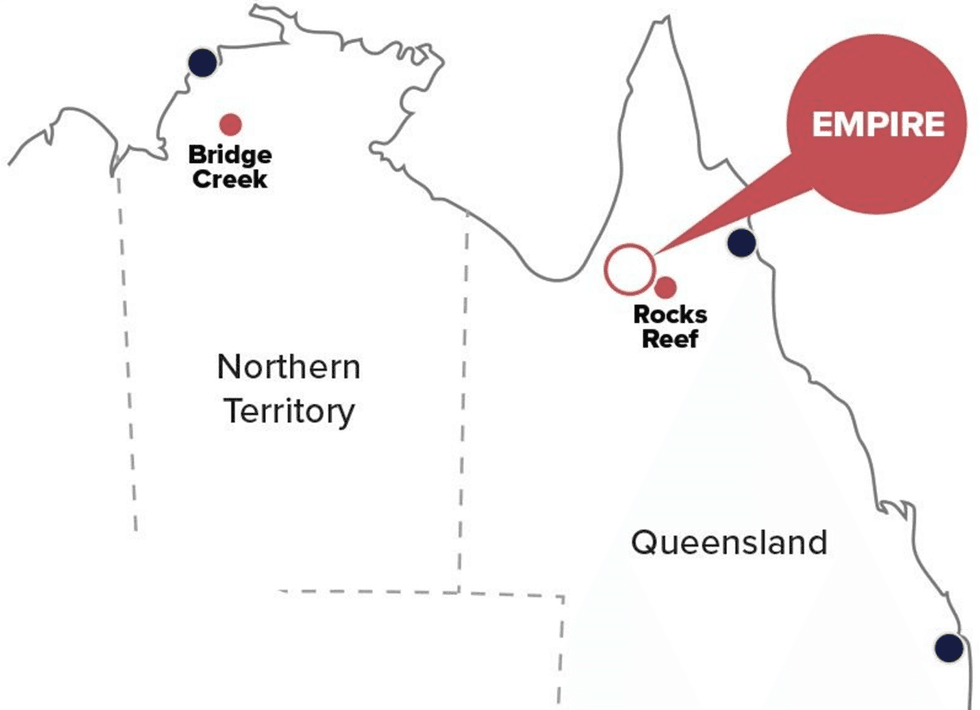
Far Northern Assets (ASX:FNR) is a newly listed Australian explorer targeted on gold and base metals. The corporate debuted on the ASX on April 12, 2024, after finalizing its IPO, throughout which it secured AU$6 million in funding. The corporate has three exploration tasks – two primarily based in Northern Queensland (Empire and Rocks Reef) and one within the Northern Territories (Bridge Creek).

Within the 2022-23 fiscal yr, mining performed a pivotal position in Australia’s financial system by producing a document $455 billion in export income, accounting for practically 66 % of the whole exports. This underscores the trade’s important contribution to the nation’s financial stability, authorities revenues, and the creation of employment alternatives in regional areas.

In response to the Fraser Institute Annual Survey of Mining Corporations 2022, Australia is likely one of the most tasty areas for mining. Fraser Institute ranks the Northern Territories and Queensland because the sixth and thirteenth most tasty locations for mining funding.

Throughout 2023, Queensland’s mines yielded 12.6 tons of gold, positioning it because the fourth most prolific state in Australia for this valuable metallic. Its output falls barely under that of the Northern Territory (13.9 tons).

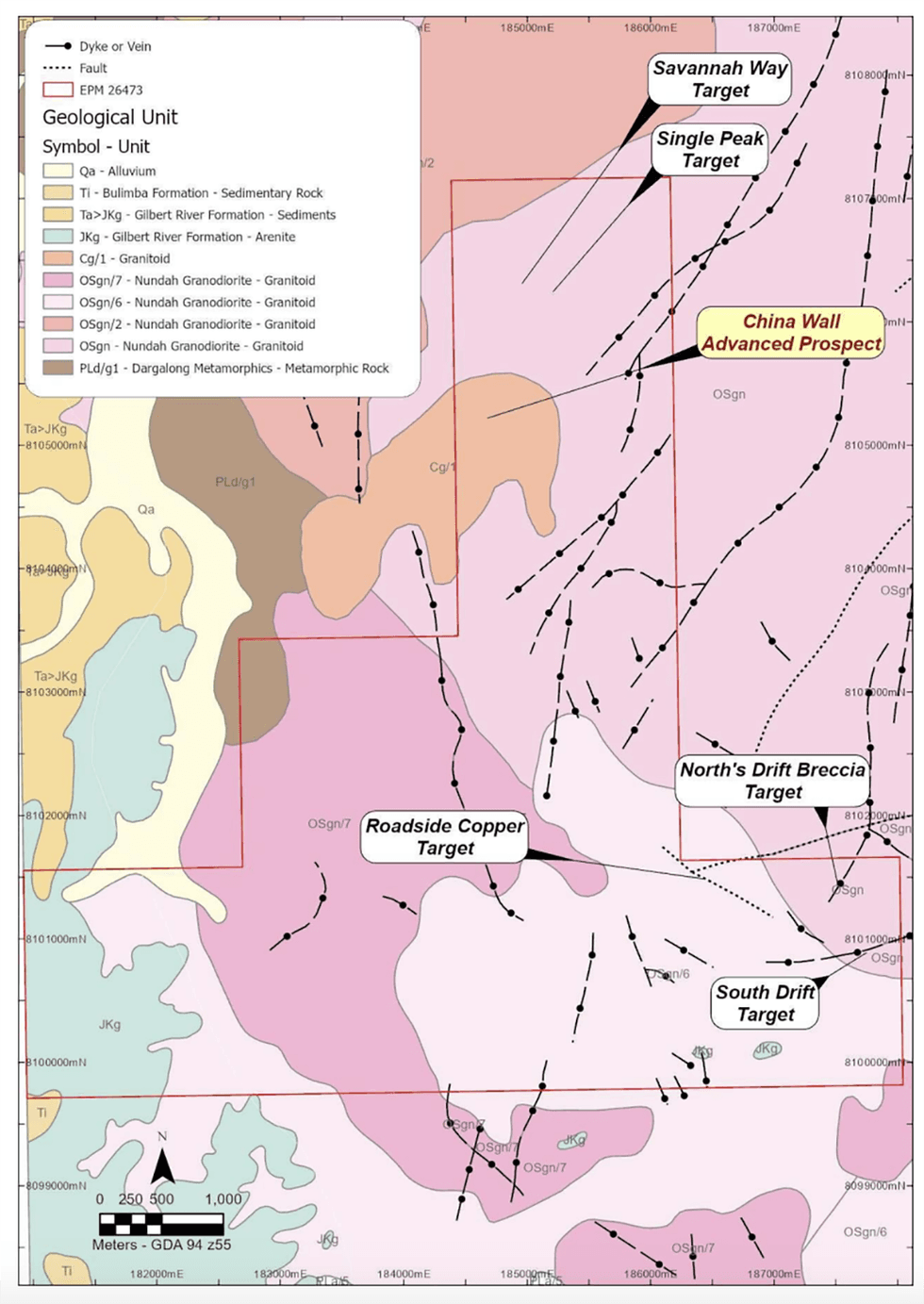
The presence in comparatively enticing mining jurisdictions positions the corporate to capitalize on alternatives in Australia’s useful resource sector and ship sustainable returns to its shareholders. The IPO funds of AU$6 million have supplied adequate funding to the corporate to advance its exploration tasks. General, Far Northern is planning a 20,000-meter drilling program over the subsequent two years, which can consist: of 5,000+ meters for Empire; 2,500 to five,000 meters for Bridge Creek; and a couple of,500 meters deliberate at Rocks Reef within the China Wall prospect.

Firm Highlights

  • Far Northern Assets (FNR) is a newly listed Australia-based gold and base metals exploration firm. The corporate was listed on the ASX on April 12, 2024, following the completion of its IPO through which it raised AU$4 million.
  • The corporate has three tasks throughout Northern Queensland and the Northern Territories – Empire, Bridge Creek and Rocks Reef. Empire and Bridge Creek are considerably superior, drill-ready with JORC-compliant sources.
  • The flagship undertaking Empire has undergone intensive exploration work culminating in a 2019 mineral useful resource estimate of twenty-two,500 oz gold. The corporate intends to undertake 5,000 meters of drilling at Empire over the subsequent two years which ought to result in additional growth of the useful resource base.
  • At Bridge Creek, FNR is planning a 2,500- to five,000-meter drilling program, which goals to reinforce inferred sources to indicated standing, in addition to lengthen the mineralization each alongside the strike and at depth.
  • The Rock Reefs property presents a potential upside for FNR with historic exploration confirming the presence of a mineralized vein system on the China Wall prospect. FNR is planning a 2,500-meter drill program on the China Wall prospect.
  • The presence in comparatively enticing mining jurisdictions in Australia positions the corporate to capitalize on alternatives in Australia’s useful resource sector and ship superior returns to its shareholders.

Key Initiatives

Empire Mission (Copper-Gold)

Far Northern Resources' Empire Project (Copper-Gold) map

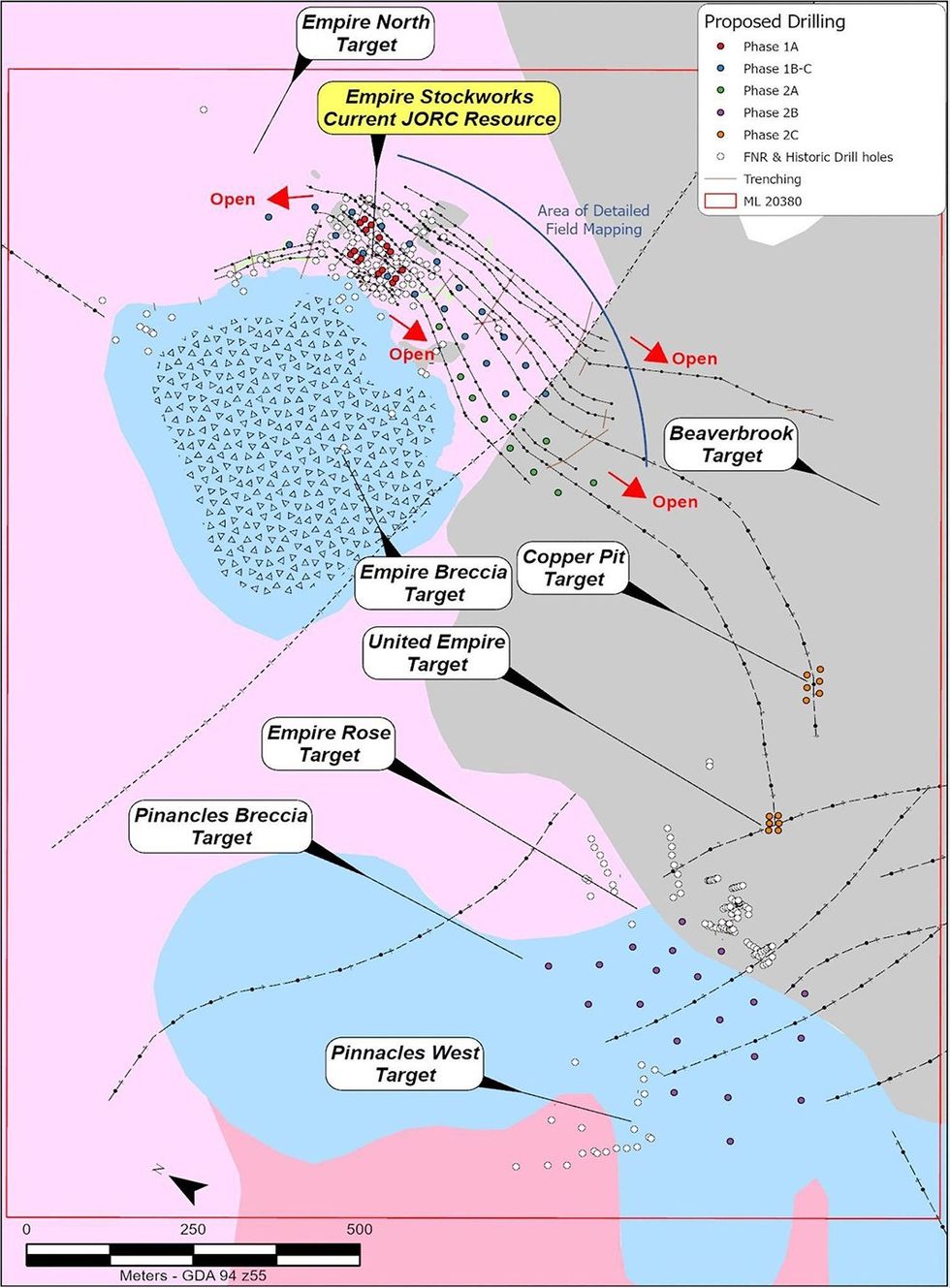
The Empire Mission, located 34 km west of Chillagoe in North Queensland, covers an expanse of 252 hectares, on granted mining lease 20380. The tenement boasts a wealthy exploration historical past, marked by substantial drilling carried out throughout varied phases. This culminated within the dedication of a 2019 mineral useful resource estimate of twenty-two,505 oz of gold on the Empire Stockworks gold deposit.

Over 7,460 meters of RC drilling and 750 meters of diamond core drilling have been carried out by Far Northern Assets, leading to a number of intersections of copper, gold and silver. Rock chip assays yielded noteworthy grades, with outcomes displaying as much as 12.64 % copper (FNRRCS24001) and 4.12 grams per ton (g/t) gold (FNRRCS24002). Additional floor sampling unveiled copper grades starting from 2.61 % to 11.89 % and gold grades from 0.70 g/t to 2.16 g/t.

The rock chip assays prolonged the strike of identified mineralization on the Empire Stockworks prospect by an extra 750 meters and administration believes it may very well be a part of a much bigger porphyry-style goal.

A number of targets have already been recognized on the Empire tenement:

Empire Stockworks Prospect: Positioned near the northern Breccia zone, that is probably the most superior Far Northern goal, in respect of exploration progress.

Far Northern Resources Empire Stockworks prospect

United Empire: Located south of the Empire Stockworks prospect and adjoining to the Pinnacles breccia zone, this anomaly displays copper/gold traits, as revealed by earlier exploration efforts carried out by entities aside from Far Northern.

Copper Pit: Additionally it is positioned south of the Empire Stockworks prospect and near Pinnacles breccia. The evaluation of the minor mullock heaps within the neighborhood suggests the world holds promise for copper and gold prospects.

Pinnacles Prospect: It’s located within the Pinnacles breccia zone to the south of the Empire Stockworks Prospect. Far Northern has accomplished very minimal exploration work up to now on this prospect.

Going ahead, Far Northern is planning a 5,000-meter drilling program at Empire over the subsequent two years, which ought to result in additional growth of the useful resource base. This system will give attention to the Empire Stockworks prospect, the place the intention is to improve inferred sources to indicated, and to increase the mineralization alongside strike and at depth.

Bridge Creek Mission (primarily Gold)

u200bFar Northern Resources Bridge Creek Project gold project

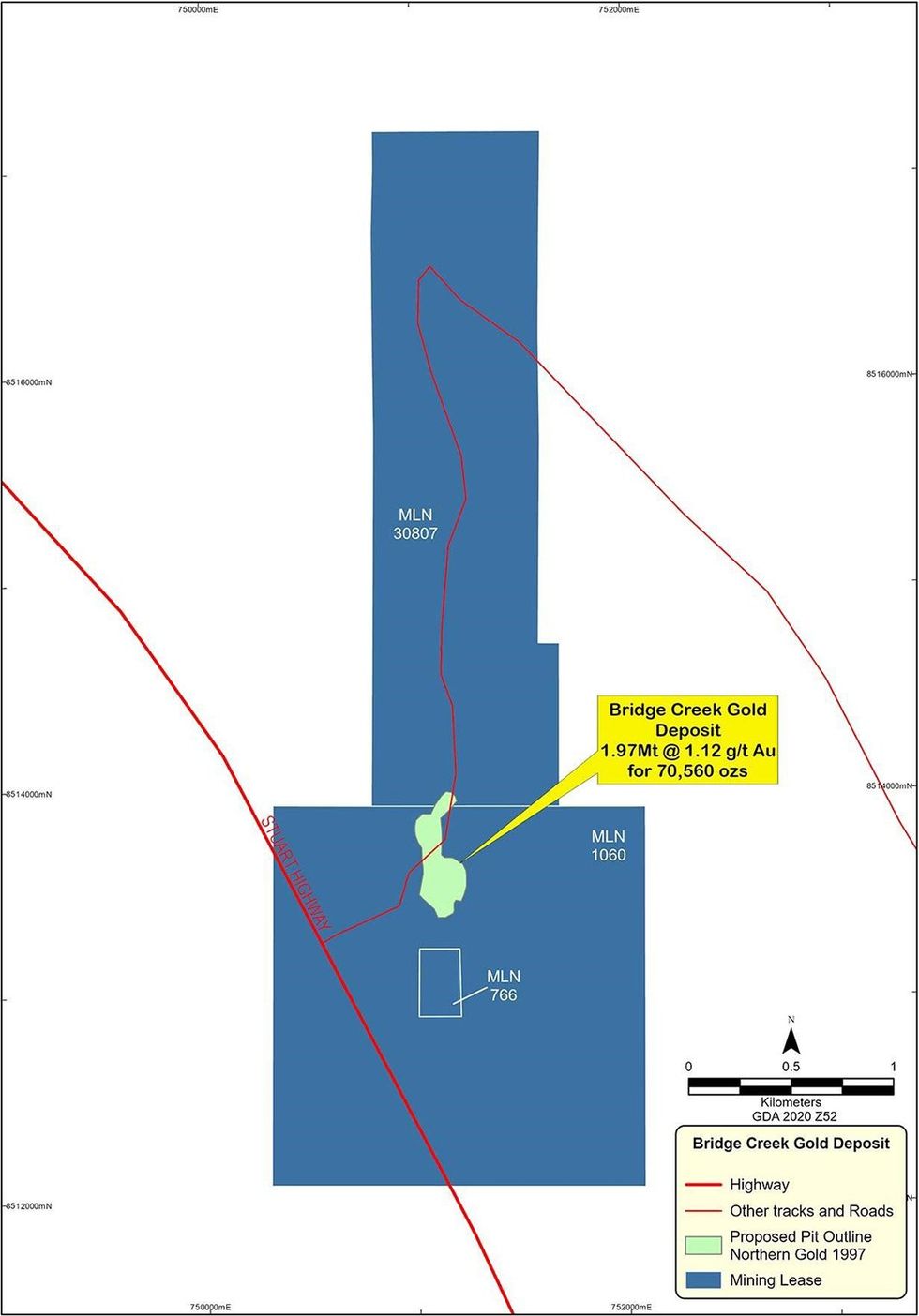
The undertaking is positioned 150 km south of Darwin within the Northern Territories. It contains three mining leases, 766, 1060, 30807, located throughout the Pine Creek Geosyncline. The undertaking is within the historic mining space of Cosmos Howley – Pine Creek which has produced over 2 million oz of gold. A mineral useful resource estimate was accomplished in 2022 containing 70,560 oz of inferred gold sources.

At Bridge Creek, Far Northern is planning a 2,500- to five,000-meter drilling program, aiming to reinforce inferred sources to indicated standing, in addition to lengthen the mineralization each alongside the strike and at depth.

Rocks Reef Mission (Copper-Gold)

Far Northern Resources Rocks Reef copper-gold project

The Rocks Reef Mission is positioned 52 km west of Chillagoe and contains exploration allow 26473, which covers the Georgetown Tectonic Province. It’s located alongside a northeast structural development spanning over 20 kilometers, inside a big quartz-veined and altered porphyry formation. Geochemical sampling has revealed anomalous gold and silver veins inside a 3-km by 1-km space.

The Rock Reefs property presents a potential upside for Far Northern with historic exploration confirming the presence of a mineralized vein system on the China Wall prospect. FNR has already recognized targets for the tenement:

China Wall: Located north of the tenement, this represents probably the most superior goal when it comes to exploration progress inside Rocks Reef. The earlier operator had drilled a complete of 155 air monitor holes alongside main and minor epithermal veins and buildings, reporting valuable metallic mineralization. Subsequently, Far Northern carried out rock chip and soil analyses as a part of follow-up investigations. Administration is now planning a 2,500-meter drill program on the China Wall prospect.

Savannah Manner and Single Peak: It’s positioned about 1.3 km north of the China Wall. Far Northern has undertaken a rock chip and soil sampling program.

Roadside Copper: The goal is positioned about 4.5 km from the China Wall Prospect. It noticed little exploration work when it was held by the earlier proprietor. Far Northern has carried out preliminary exploration together with the evaluation of rock chips and soils, which revealed the presence of gold, copper and related minerals within the space.

North Drift Breccia and South Drift: Right here once more, the rock chip and soil samples have returned constructive outcomes indicating potential for mineralization.

Administration Group

Cameron Woodrow – Government Director and CEO

Cameron Woodrow has over twenty years of expertise within the monetary and mining industries, each domestically and internationally. He oversees the day-to-day operations of the corporate in collaboration with FNR’s geologist. Woodrow’s skilled background commenced within the funding banking sector in Europe and Australia, the place he held positions as a company advisor and gross sales dealer at Paterson Securities and the Stonebridge Group. Earlier in his profession, he served in varied roles at Merrill Lynch and Credit score Suisse in London.

Mattew Bashford – Government Director and CFO

Mattew Bashford has practically 28 years of expertise serving as CFO and firm secretary at varied private and non-private corporations. Bashford has performed an important position within the success of Far Northern Assets since its inception, contributing to its structuring, all capital raises up to now, and accounting/tax compliance. He has been serving as a director of Far Northern since Might 17, 2019. He holds a Bachelor of Commerce from the College of Queensland and can be a chartered accountant.

Catriona Glover – Firm Secretary

Catriona Glover is a certified lawyer with over twenty years of expertise in company and business regulation, specializing in company governance and offering firm secretarial recommendation to each listed and unlisted entities. She has provided authorized counsel, company governance experience, and firm secretarial companies to quite a few corporations throughout numerous industries akin to biopharma, monetary companies, mining, stockbroking, training, manufacturing, software program and not-for-profit organizations. Glover has been the corporate secretary for a number of listed and unlisted corporations, together with Far East Gold, Maronan Metals, VGI Well being Know-how (NSX:VGI), Aeramentum Assets, and Invictus Biopharma.

Michael Stephenson – Geologist

With greater than twenty years of expertise, Michael Stephenson has served as an exploration undertaking supervisor for outstanding corporations akin to Hancock Prospecting, Murchison Metals and Nice Central Mines. He has intensive experience in exploration undertaking administration, accrued over 20 years {of professional} follow. Stephenson has performed a pivotal position at Far Northern, overseeing all exploration actions, together with structural mapping, rock chipping and soil sampling. Notably, he performed an important position in enhancing the JORC Useful resource at Empire by executing the drilling program in 2020.

Roderick Paul Corps – Chairman Unbiased

Roderick Paul Corps commenced his profession as a stockbroker at Porter Western (now Macquarie Group), adopted by tenures at Morgan Stanley and JP Morgan in the UK. He has served as a director for Everlasting Assets (ASX:BRN) and Voyager International Group, which is now Cyelip Group (ASX:CYQ). From 2013 to 2021, he was the company and investor relations supervisor at Westgold Assets (ASX:WGX). At the moment, Corps is a non-executive director at Marketech and serves because the managing director of NICO Assets (ASX:NC1).


Governing the ML lifecycle at scale: Centralized observability with Amazon SageMaker and Amazon CloudWatch

0


This publish is a part of an ongoing collection on governing the machine studying (ML) lifecycle at scale. To begin from the start, check with Governing the ML lifecycle at scale, Half 1: A framework for architecting ML workloads utilizing Amazon SageMaker.

A multi-account technique is crucial not just for enhancing governance but additionally for enhancing safety and management over the assets that assist your group’s enterprise. This strategy allows varied groups inside your group to experiment, innovate, and combine extra quickly whereas holding the manufacturing setting safe and accessible to your clients. Nevertheless, as a result of a number of groups would possibly use your ML platform within the cloud, monitoring massive ML workloads throughout a scaling multi-account setting presents challenges in organising and monitoring telemetry information that’s scattered throughout a number of accounts. On this publish, we dive into organising observability in a multi-account setting with Amazon SageMaker.

Amazon SageMaker Mannequin Monitor permits you to routinely monitor ML fashions in manufacturing, and alerts you when information and mannequin high quality points seem. SageMaker Mannequin Monitor emits per-feature metrics to Amazon CloudWatch, which you should use to arrange dashboards and alerts. You need to use cross-account observability in CloudWatch to go looking, analyze, and correlate cross-account telemetry information saved in CloudWatch reminiscent of metrics, logs, and traces from one centralized account. Now you can arrange a central observability AWS account and join your different accounts as sources. Then you possibly can search, audit, and analyze logs throughout your functions to drill down into operational points in a matter of seconds. You’ll be able to uncover and visualize operational and mannequin metrics from many accounts in a single place and create alarms that consider metrics belonging to different accounts.

AWS CloudTrail can be important for sustaining safety and compliance in your AWS setting by offering a complete log of all API calls and actions taken throughout your AWS account, enabling you to trace adjustments, monitor consumer actions, and detect suspicious conduct. This publish additionally dives into how one can centralize CloudTrail logging so that you’ve visibility into consumer actions inside your entire SageMaker environments.

Resolution overview

Clients usually wrestle with monitoring their ML workloads throughout a number of AWS accounts, as a result of every account manages its personal metrics, leading to information silos and restricted visibility. ML fashions throughout totally different accounts want real-time monitoring for efficiency and drift detection, with key metrics like accuracy, CPU utilization, and AUC scores tracked to take care of mannequin reliability.

To resolve this, we implement an answer that makes use of SageMaker Mannequin Monitor and CloudWatch cross-account observability. This strategy allows centralized monitoring and governance, permitting your ML crew to achieve complete insights into logs and efficiency metrics throughout all accounts. With this unified view, your crew can successfully monitor and handle their ML workloads, enhancing operational effectivity.

Implementing the answer consists of the next steps:

  1. Deploy the mannequin and arrange SageMaker Mannequin Monitor.
  2. Allow CloudWatch cross-account observability.
  3. Consolidate metrics throughout supply accounts and construct unified dashboards.
  4. Configure centralized logging to API calls throughout a number of accounts utilizing CloudTrail.

The next structure diagram showcases the centralized observability answer in a multi-account setup. We deploy ML fashions throughout two AWS environments, manufacturing and check, which function our supply accounts. We use SageMaker Mannequin Monitor to evaluate these fashions’ efficiency. Moreover, we improve centralized administration and oversight through the use of cross-account observability in CloudWatch to mixture metrics from the ML workloads in these supply accounts into the observability account.

Deploy the mannequin and arrange SageMaker Mannequin Monitor

We deploy an XGBoost classifier mannequin, educated on publicly accessible banking advertising and marketing information, to determine potential clients more likely to subscribe to time period deposits. This mannequin is deployed in each manufacturing and check supply accounts, the place its real-time efficiency is regularly validated in opposition to baseline metrics utilizing SageMaker Mannequin Monitor to detect deviations in mannequin efficiency. Moreover, we use CloudWatch to centralize and share the info and efficiency metrics of those ML workloads within the observability account, offering a complete view throughout totally different accounts. Yow will discover the complete supply code for this publish within the accompanying GitHub repo.

Step one is to deploy the mannequin to an SageMaker endpoint with information seize enabled:

endpoint_name = f"BankMarketingTarget-endpoint-{datetime.utcnow():%Y-%m-%d-%HpercentM}"
print("EndpointName =", endpoint_name)

data_capture_config = DataCaptureConfig(
enable_capture=True, sampling_percentage=100, destination_s3_uri=s3_capture_upload_path)

mannequin.deploy(
initial_instance_count=1,
instance_type="ml.m4.xlarge",
endpoint_name=endpoint_name,
data_capture_config=data_capture_config,)

For real-time mannequin efficiency analysis, it’s important to ascertain a baseline. This baseline is created by invoking the endpoint with validation information. We use SageMaker Mannequin Monitor to carry out baseline evaluation, compute efficiency metrics, and suggest high quality constraints for efficient real-time efficiency analysis.

Subsequent, we outline the mannequin high quality monitoring object and run the mannequin high quality monitoring baseline job. The mannequin monitor routinely generates baseline statistics and constraints primarily based on the offered validation information. The monitoring job evaluates the mannequin’s predictions in opposition to floor fact labels to verify the mannequin maintains its efficiency over time.

Banking_Quality_Monitor = ModelQualityMonitor(
    position=position,
    instance_count=1,
    instance_type="ml.m5.xlarge",
    volume_size_in_gb=20,
    max_runtime_in_seconds=1800,
    sagemaker_session=session,
)
job = Banking_Quality_Monitor.suggest_baseline(
    job_name=baseline_job_name,
    baseline_dataset=baseline_dataset_uri,
    dataset_format=DatasetFormat.csv(header=True),
    output_s3_uri=baseline_results_uri,
    problem_type="BinaryClassification",
    inference_attribute="prediction",
    probability_attribute="chance",
    ground_truth_attribute="label",
)
job.wait(logs=False)

Along with the generated baseline, SageMaker Mannequin Monitor requires two further inputs: predictions from the deployed mannequin endpoint and floor fact information offered by the model-consuming utility. As a result of information seize is enabled on the endpoint, we first generate site visitors to verify prediction information is captured. When itemizing the info seize recordsdata saved, you need to anticipate to see varied recordsdata from totally different time intervals, organized primarily based on the hour through which the invocation occurred. When viewing the contents of a single file, you’ll discover the next particulars. The inferenceId attribute is ready as a part of the invoke_endpoint name. When ingesting floor fact labels and merging them with predictions for efficiency metrics, SageMaker Mannequin Monitor makes use of inferenceId, which is included in captured information data. It’s used to merge these captured data with floor fact data, ensuring the inferenceId in each datasets matches. If inferenceId is absent, it makes use of the eventId from captured information to correlate with the bottom fact document.

{
"captureData": {
"endpointInput": {
"observedContentType": "textual content/csv",
"mode": "INPUT",
"information": "162,1,0.1,25,1.4,94.465,-41.8,4.961,0.2,0.3,0.4,0.5,0.6,0.7,0.8,1.1,0.9,0.10,0.11,0.12,0.13,0.14,0.15,1.2,0.16,0.17,0.18,0.19,0.20,1.3",
"encoding": "CSV"
},
"endpointOutput": {
"observedContentType": "textual content/csv; charset=utf-8",
"mode": "OUTPUT",
"information": "0.000508524535689503",
"encoding": "CSV"
}
},
"eventMetadata": {
"eventId": "527cfbb1-d945-4de8-8155-a570894493ca",
"inferenceId": "0",
"inferenceTime": "2024-08-18T20:25:54Z"
},
"eventVersion": "0"
}

SageMaker Mannequin Monitor ingests floor fact information collected periodically and merges it with prediction information to calculate efficiency metrics. This monitoring course of makes use of baseline constraints from the preliminary setup to constantly assess the mannequin’s efficiency. By enabling enable_cloudwatch_metrics=True, SageMaker Mannequin Monitor makes use of CloudWatch to watch the standard and efficiency of our ML fashions, thereby emitting these efficiency metrics to CloudWatch for complete monitoring.

from sagemaker.model_monitor import CronExpressionGenerator

response = Banking_Quality_Monitor.create_monitoring_schedule(
monitor_schedule_name=Banking_monitor_schedule_name,
endpoint_input=endpointInput,
output_s3_uri=baseline_results_uri,
problem_type="BinaryClassification",
ground_truth_input=ground_truth_upload_path,
constraints=baseline_job.suggested_constraints(),
schedule_cron_expression=CronExpressionGenerator.hourly(),
enable_cloudwatch_metrics=True,
)

Every time the mannequin high quality monitoring job runs, it begins with a merge job that mixes two datasets: the inference information captured on the endpoint and the bottom fact information offered by the appliance. That is adopted by a monitoring job that assesses the info for insights into mannequin efficiency utilizing the baseline setup.

Ready for execution to complete......................................................!
groundtruth-merge-202408182100-7460007b77e6223a3f739740 job standing: Accomplished
groundtruth-merge-202408182100-7460007b77e6223a3f739740 job exit message, if any: None
groundtruth-merge-202408182100-7460007b77e6223a3f739740 job failure cause, if any: None
Ready for execution to complete......................................................!
model-quality-monitoring-202408182100-7460007b77e6223a3f739740 job standing: Accomplished
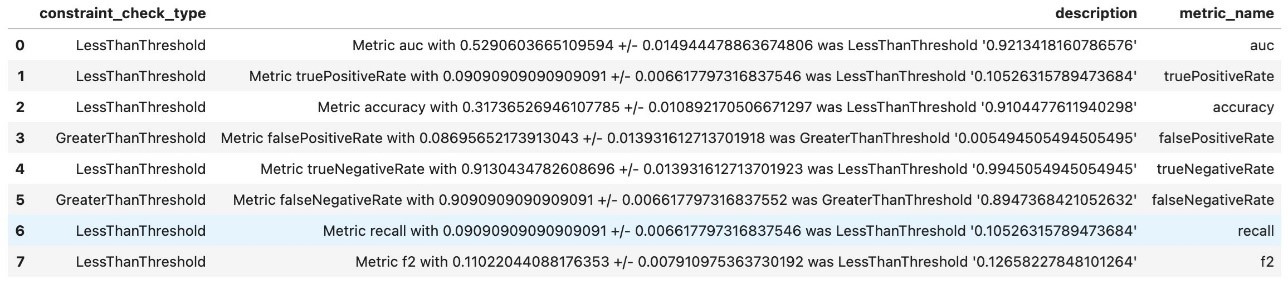
model-quality-monitoring-202408182100-7460007b77e6223a3f739740 job exit message, if any: CompletedWithViolations: Job accomplished efficiently with 8 violations.
model-quality-monitoring-202408182100-7460007b77e6223a3f739740 job failure cause, if any: None
Execution standing is: CompletedWithViolations
{'MonitoringScheduleName': 'BankMarketingTarget-monitoring-schedule-2024-08-18-2029', 'ScheduledTime': datetime.datetime(2024, 8, 18, 21, 0, tzinfo=tzlocal()), 'CreationTime': datetime.datetime(2024, 8, 18, 21, 2, 21, 198000, tzinfo=tzlocal()), 'LastModifiedTime': datetime.datetime(2024, 8, 18, 21, 12, 53, 253000, tzinfo=tzlocal()), 'MonitoringExecutionStatus': 'CompletedWithViolations', 'ProcessingJobArn': 'arn:aws:sagemaker:us-west-2:730335512115:processing-job/model-quality-monitoring-202408182100-7460007b77e6223a3f739740', 'EndpointName': 'BankMarketingTarget-endpoint-2024-08-18-1958'}
====STOP====
No accomplished executions to examine additional. Please wait until an execution completes or examine beforehand reported failures

Verify for deviations from the baseline constraints to successfully set acceptable thresholds in your monitoring course of. As you possibly can see within the following the screenshot, varied metrics reminiscent of AUC, accuracy, recall, and F2 rating are carefully monitored, every topic to particular threshold checks like LessThanThreshold or GreaterThanThreshold. By actively monitoring these metrics, you possibly can detect important deviations and make knowledgeable selections promptly, ensuring your ML fashions carry out optimally inside established parameters.
Allow CloudWatch cross-account observability

With CloudWatch built-in into SageMaker Mannequin Monitor to trace the metrics of ML workloads working within the supply accounts (manufacturing and check), the following step entails enabling CloudWatch cross-account observability. CloudWatch cross-account observability permits you to monitor and troubleshoot functions spanning a number of AWS accounts inside an AWS Area. This function allows seamless looking out, visualization, and evaluation of metrics, logs, traces, and Software Insights throughout linked accounts, eliminating account boundaries. You need to use this function to consolidate CloudWatch metrics from these supply accounts into the observability account.

To attain this centralized governance and monitoring, we set up two forms of accounts:

  • Observability account – This central AWS account aggregates and interacts with ML workload metrics from the supply accounts
  • Supply accounts (manufacturing and check) – These particular person AWS accounts share their ML workload metrics and logging assets with the central observability account, enabling centralized oversight and evaluation

Configure the observability account

Full the next steps to configure the observability account:

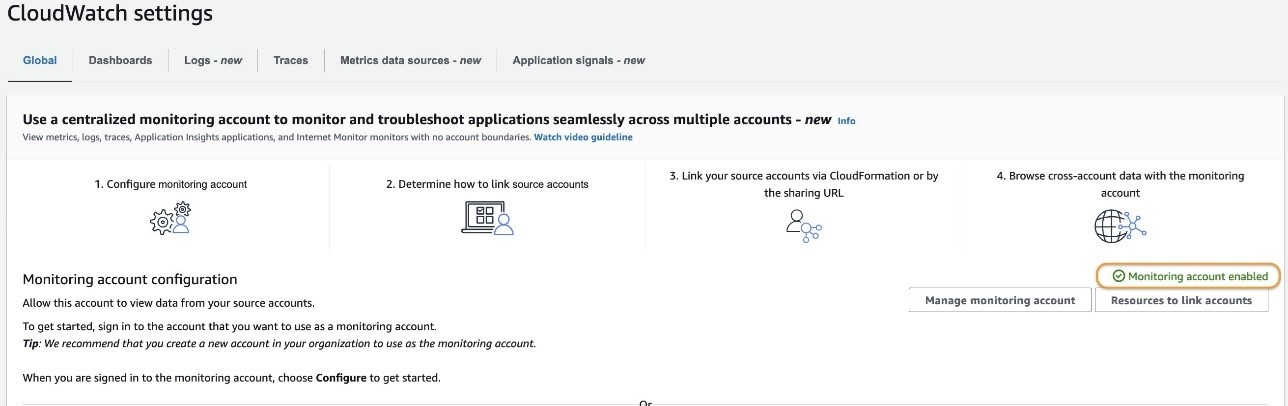
  1. On the CloudWatch console of the observability account, select Settings within the navigation pane.
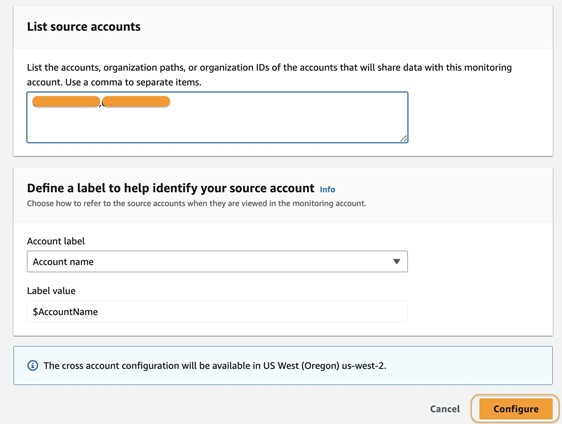
  2. Within the Monitoring account configuration part, select Configure.
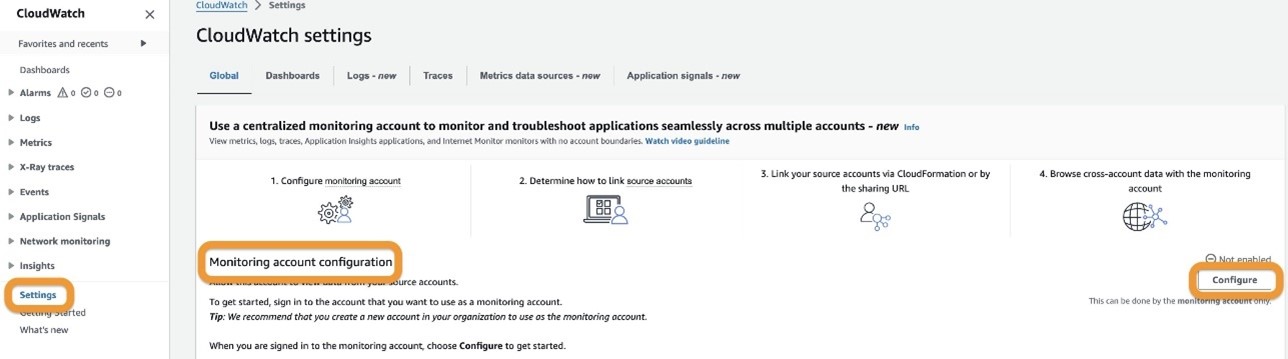
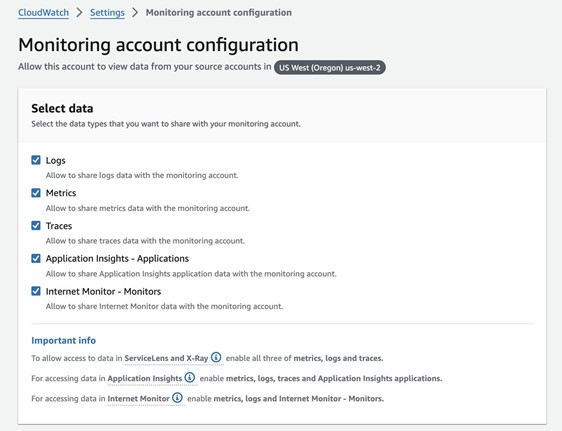
  1. Choose which telemetry information will be shared with the observability account.
  1. Underneath Record supply accounts, enter the supply accounts that can share information with the observability account.

To hyperlink the supply accounts, you should use account IDs, group IDs, or group paths. You need to use a company ID to incorporate all accounts inside the group, or a company path can goal all accounts inside a particular division or enterprise unit. On this case, as a result of we’ve two supply accounts to hyperlink, we enter the account IDs of these two accounts.

  1. Select Configure.

After the setup is full, the message “Monitoring account enabled” seems within the CloudWatch settings.
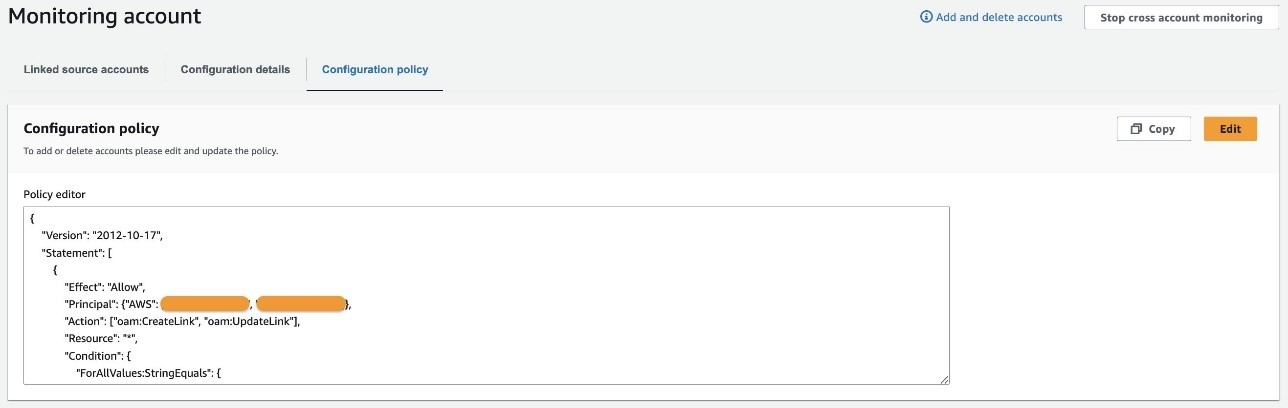
Moreover, your supply accounts are listed on the Configuration coverage tab.
Hyperlink supply accounts

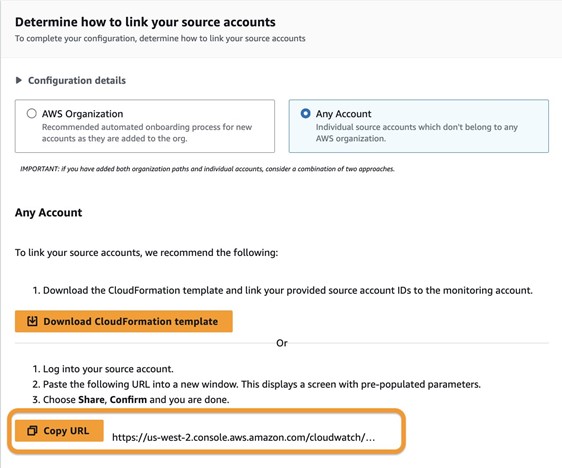
Now that the observability account has been enabled with supply accounts, you possibly can hyperlink these supply accounts inside an AWS group. You’ll be able to select from two strategies:

  • For organizations utilizing AWS CloudFormation, you possibly can obtain a CloudFormation template and deploy it in a CloudFormation delegated administration account. This technique facilitates the majority addition of supply accounts.
  • For linking particular person accounts, two choices can be found:
    • Obtain a CloudFormation template that may be deployed straight inside every supply account.
    • Copy a offered URL, which simplifies the setup course of utilizing the AWS Administration Console.

Full the next steps to make use of the offered URL:

  1. Copy the URL and open it in a brand new browser window the place you’re logged in because the supply account.
  1. Configure the telemetry information you need to share. This may embrace logs, metrics, traces, Software Insights, or Web Monitor.
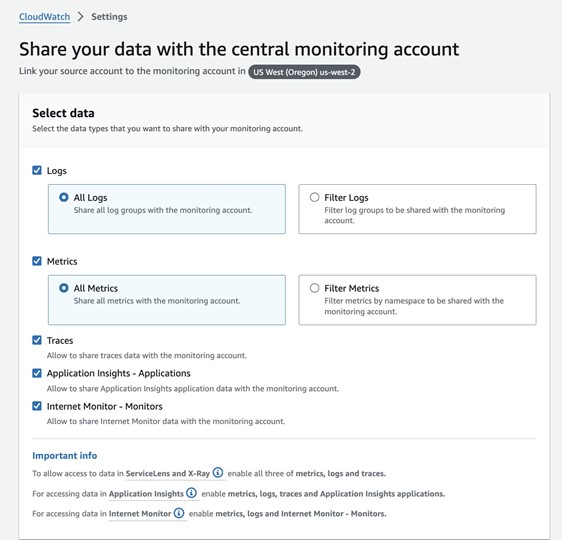
Throughout this course of, you’ll discover that the Amazon Useful resource Identify (ARN) of the observability account configuration is routinely stuffed in. This comfort is because of copying and pasting the URL offered within the earlier step. If, nonetheless, you select to not use the URL, you possibly can manually enter the ARN. Copy the ARN from the observability account settings and enter it into the designated area within the supply account configuration web page.

  1. Outline the label that identifies your supply accounts. This label is essential for organizing and distinguishing your accounts inside the monitoring system.
  1. Select Hyperlink to finalize the connection between your supply accounts and the observability account.
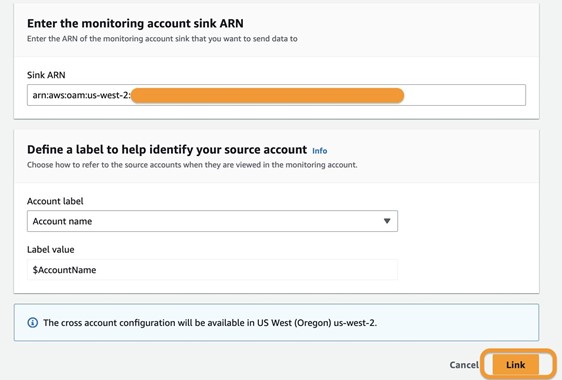
  1. Repeat these steps for each supply accounts.

It’s best to see these accounts listed on the Linked supply accounts tab inside the observability account CloudWatch settings configuration.
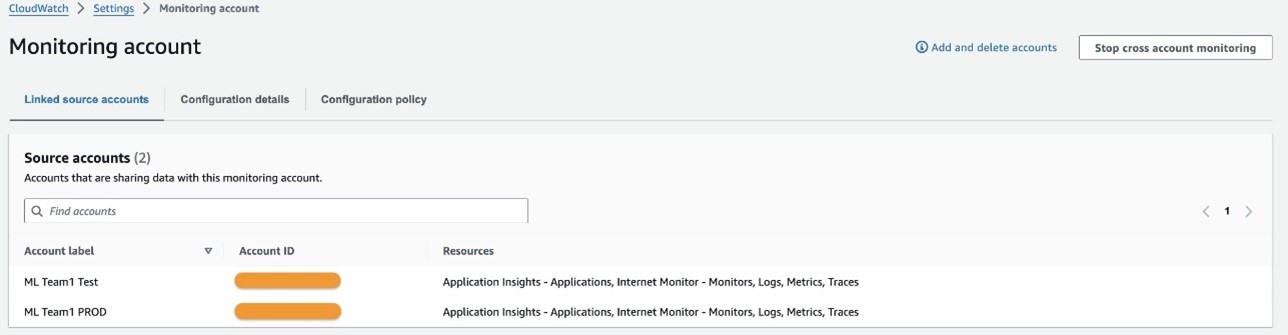
Consolidate metrics throughout supply accounts and construct unified dashboards

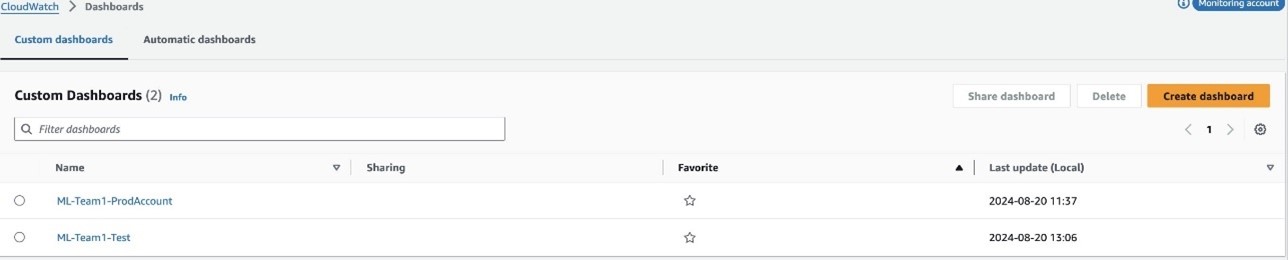
Within the observability account, you possibly can entry and monitor detailed metrics associated to your ML workloads and endpoints deployed throughout the supply accounts. This centralized view permits you to observe quite a lot of metrics, together with these from SageMaker endpoints and processing jobs, all inside a single interface.
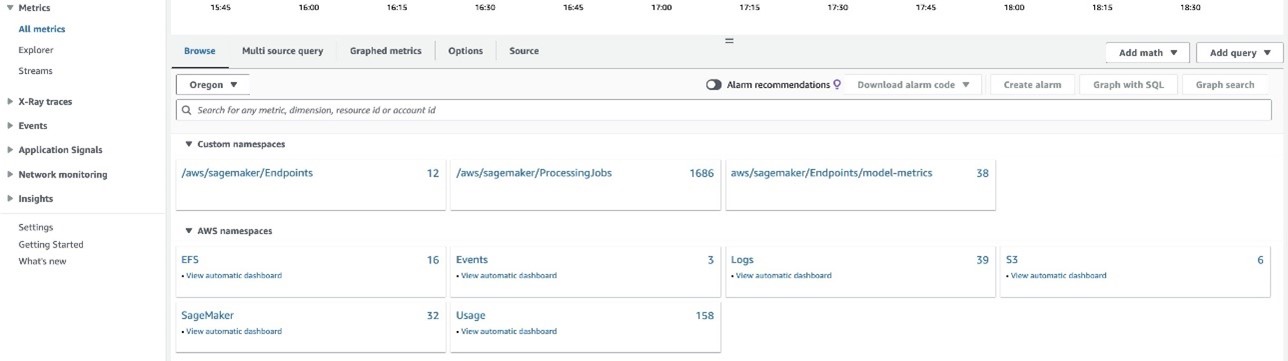
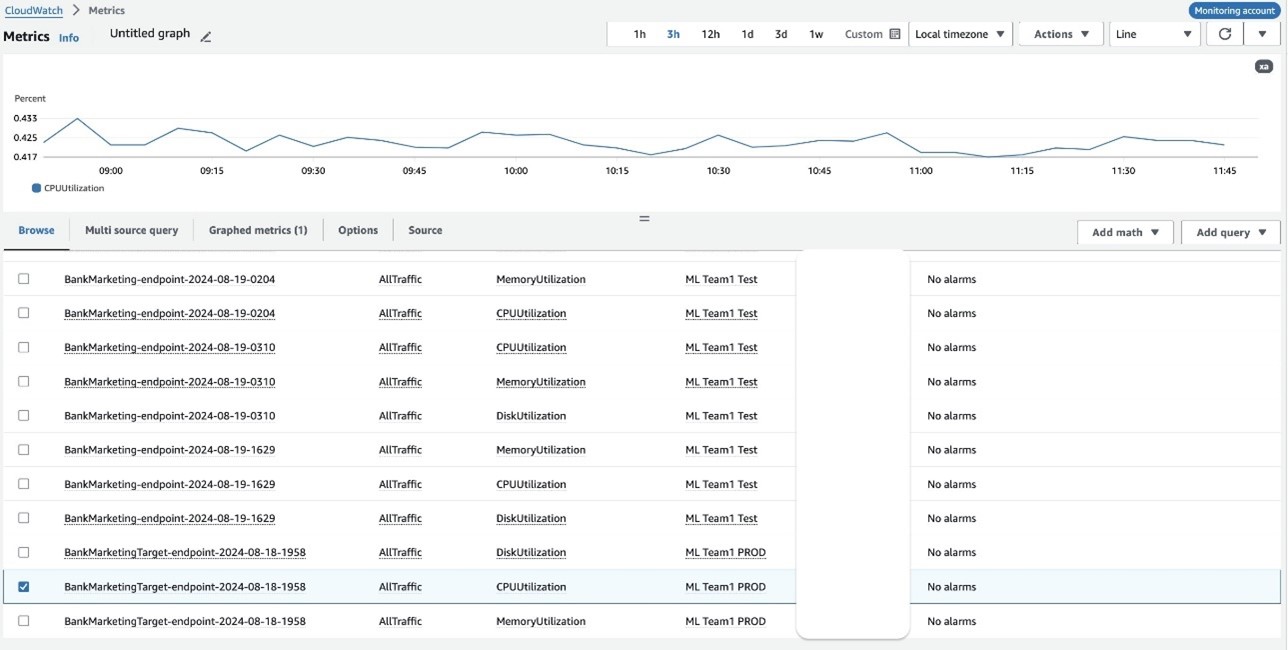
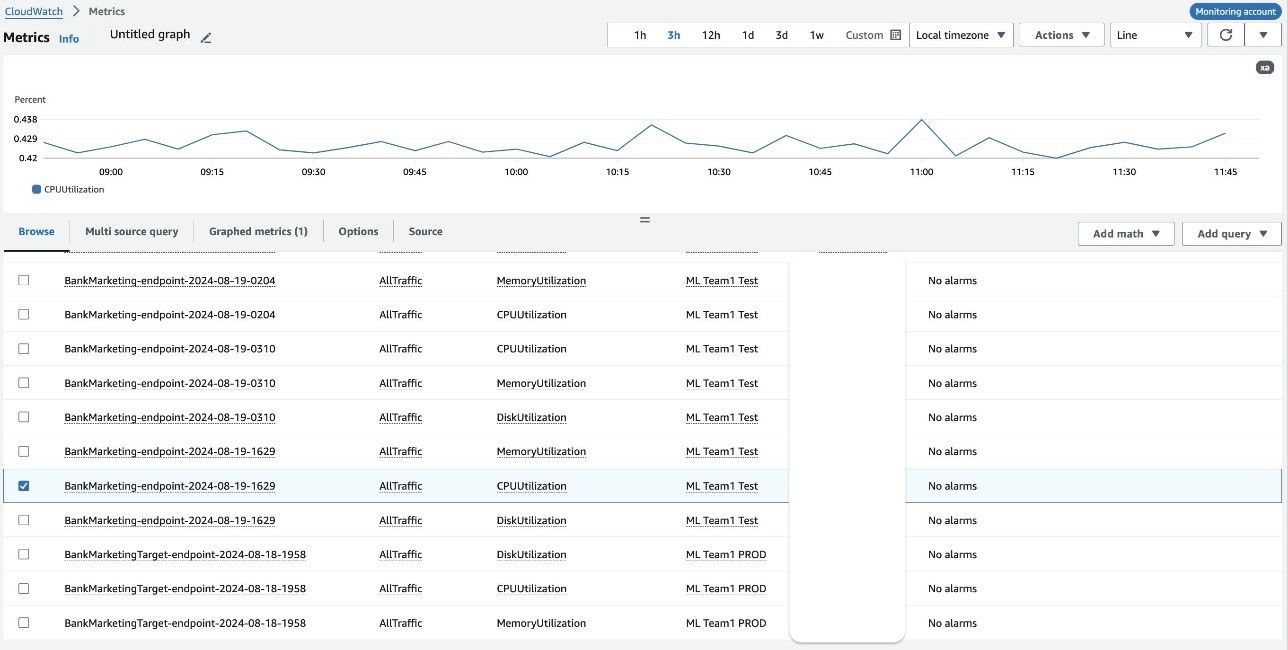
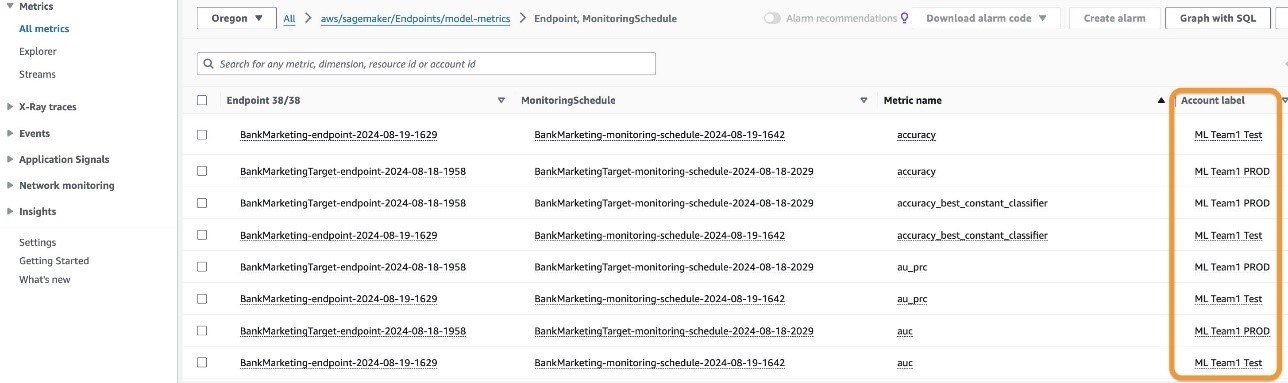
The next screenshot shows CloudWatch mannequin metrics for endpoints in your supply accounts. Since you linked the manufacturing and check supply accounts utilizing the label because the account identify, CloudWatch categorizes metrics by account label, successfully distinguishing between the manufacturing and check environments. It organizes key particulars into columns, together with account labels, metric names, endpoints, and efficiency metrics like accuracy and AUC, all captured by scheduled monitoring jobs. These metrics provide priceless insights into the efficiency of your fashions throughout these environments.
The observability account permits you to monitor key metrics of ML workloads and endpoints. The next screenshots show CPU utilization metrics related to the BankMarketingTarget mannequin and BankMarketing mannequin endpoints you deployed within the supply accounts. This view offers detailed insights into vital efficiency indicators, together with:

  • CPU utilization
  • Reminiscence utilization
  • Disk utilization

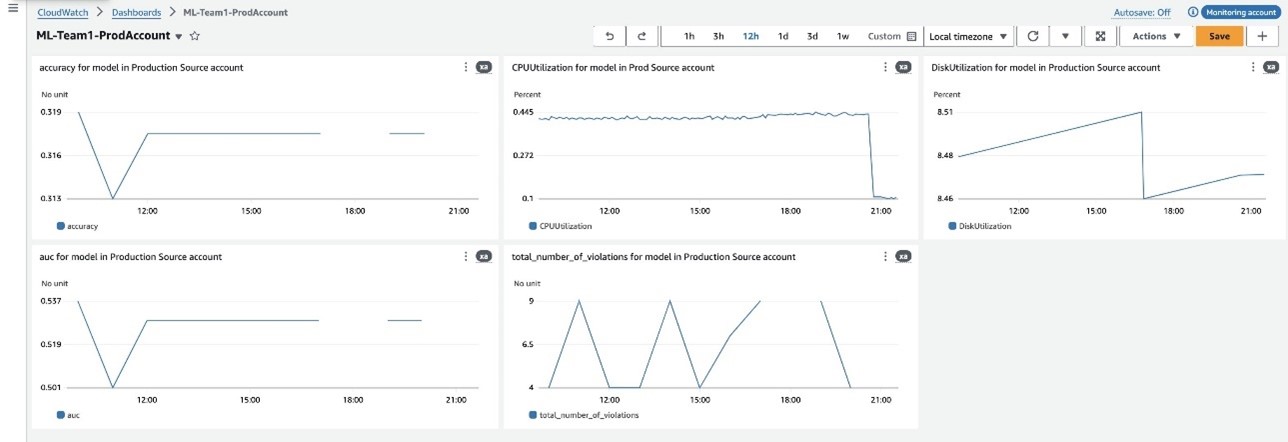
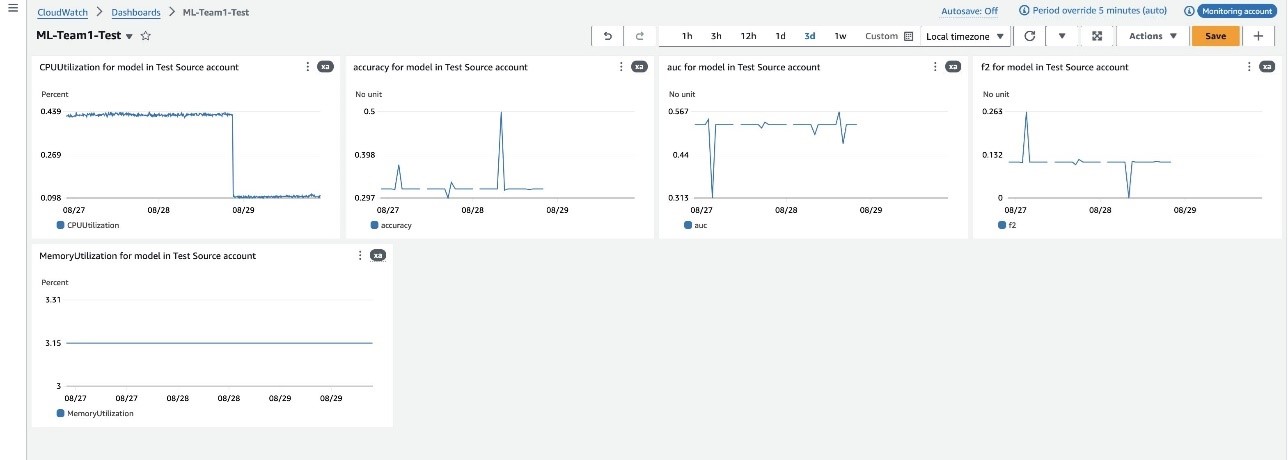
Moreover, you possibly can create dashboards that supply a consolidated view of key metrics associated to your ML workloads working throughout the linked supply accounts. These centralized dashboards are pivotal for overseeing the efficiency, reliability, and high quality of your ML fashions on a big scale.
Let’s take a look at a consolidated view of the ML workload metrics working in our manufacturing and check supply accounts. This dashboard offers us with fast entry to vital data:

  • AUC scores – Indicating mannequin efficiency, giving insights into the trade-off between true positives and false positives
  • Accuracy charges – Displaying prediction correctness, which helps in assessing the general reliability of the mannequin
  • F2 scores – Providing a stability between precision and recall, notably priceless when false negatives are extra vital to reduce
  • Whole variety of violations – Highlighting any breaches in predefined thresholds or constraints, ensuring the mannequin adheres to anticipated conduct
  • CPU utilization ranges – Serving to you handle useful resource allocation by monitoring the processing energy utilized by the ML workloads
  • Disk utilization percentages – Offering environment friendly storage administration by holding observe of how a lot disk area is being consumed

This following screenshots present CloudWatch dashboards for the fashions deployed in our manufacturing and check supply accounts. We observe metrics for accuracy, AUC, CPU and disk utilization, and violation counts, offering insights into mannequin efficiency and useful resource utilization.
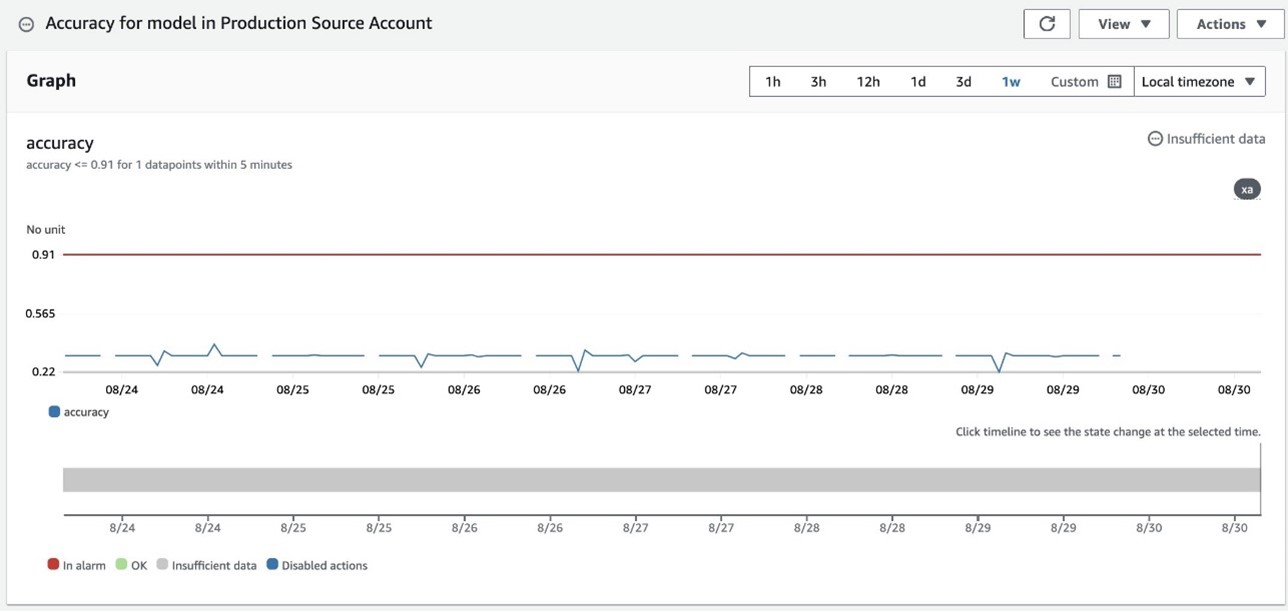
You’ll be able to configure CloudWatch alarms to proactively monitor and obtain notifications on vital ML workload metrics out of your supply accounts. The next screenshot reveals an alarm configured to trace the accuracy of our financial institution advertising and marketing prediction mannequin within the manufacturing account. This alarm is ready to set off if the mannequin’s accuracy falls beneath a specified threshold, so any important degradation in efficiency is promptly detected and addressed. By utilizing such alarms, you possibly can keep excessive requirements of mannequin efficiency and rapidly reply to potential points inside your ML infrastructure.
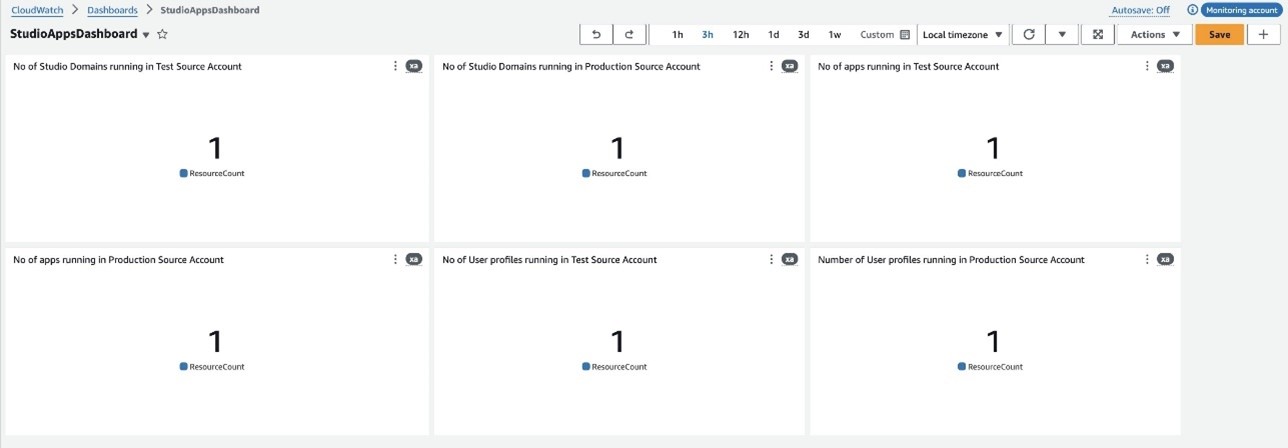
It’s also possible to create a complete CloudWatch dashboard for monitoring varied points of Amazon SageMaker Studio, together with the variety of domains, apps, and consumer profiles throughout totally different AWS accounts. The next screenshot illustrates a dashboard that centralizes key metrics from the manufacturing and check supply accounts.
Configure centralized logging of API calls throughout a number of accounts with CloudTrail

If AWS Management Tower has been configured to routinely create an organization-wide path, every account will ship a replica of its CloudTrail occasion path to a centralized Amazon Easy Storage Service (Amazon S3) bucket. This bucket is often created within the log archive account and is configured with restricted entry, the place it serves as a single supply of fact for safety personnel. If you wish to arrange a separate account to permit the ML admin crew to have entry, you possibly can configure replication from the log archive account. You’ll be able to create the vacation spot bucket within the observability account.

After you create the bucket for replicated logs, you possibly can configure Amazon S3 replication by defining the supply and vacation spot bucket, and attaching the required AWS Id and Entry Administration (IAM) permissions. Then you definitely replace the vacation spot bucket coverage to permit replication.

Full the next steps:

  1. Create an S3 bucket within the observability account.
  2. Log in to the log archive account.
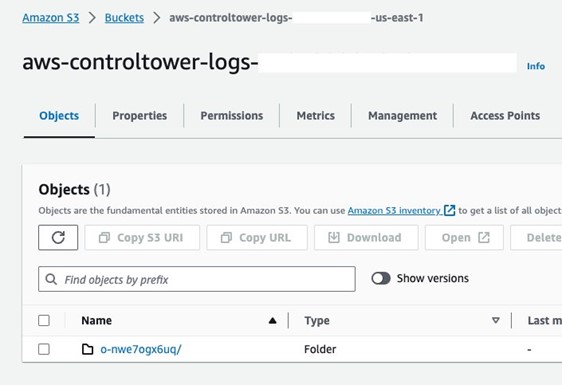
  3. On the Amazon S3 console, open the Management Tower logs bucket, which may have the format aws-controltower-logs-{ACCOUNT-ID}-{REGION}.

It’s best to see an current key that corresponds to your group ID. The path logs are saved below /{ORG-ID}/AWSLogs/{ACCOUNT-ID}/CloudTrail/{REGION}/YYYY/MM/DD.
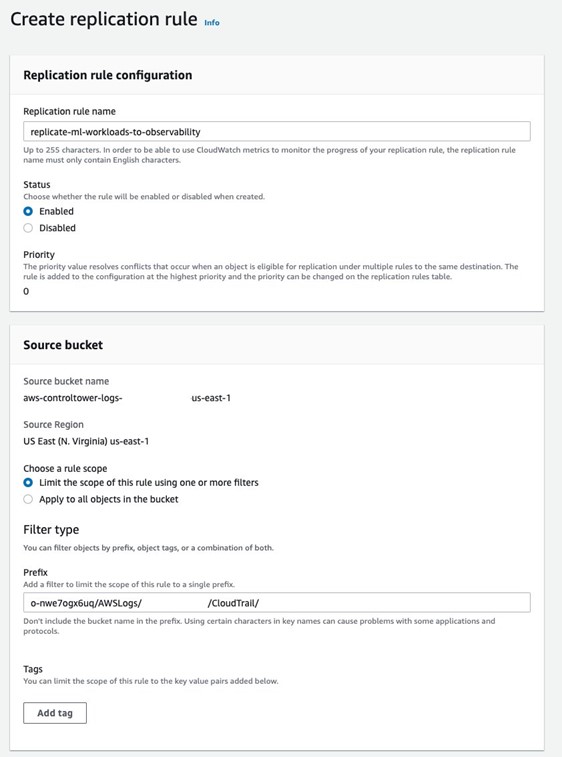
  1. On the Administration tab, select Create replication rule.
  2. For Replication rule identify, enter a reputation, reminiscent of replicate-ml-workloads-to-observability.
  3. Underneath Supply bucket, choose Restrict the scope of the rule utilizing a number of filters, and enter a path the corresponds to the account you need to allow querying in opposition to.
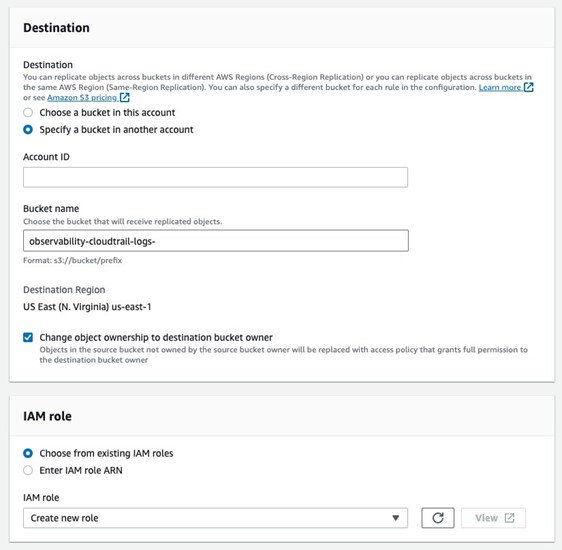
  1. Choose Specify a bucket in one other account and enter the observability account ID and the bucket identify.
  2. Choose Change object possession to vacation spot bucket proprietor.
  3. For IAM position, select Create new position.
After you set the cross-account replication, the logs being saved within the S3 bucket within the log archive account might be replicated within the observability account. Now you can use Amazon Athena to question and analyze the info being saved in Amazon S3. Should you don’t have Management Tower configured, it’s important to manually configure CloudTrail in every account to jot down to the S3 bucket within the centralized observability account for evaluation. In case your group has extra stringent safety and compliance necessities, you possibly can configure replication of simply the SageMaker logs from the log archive account to the bucket within the observability account by integrating Amazon S3 Occasion Notifications with AWS Lambda features.

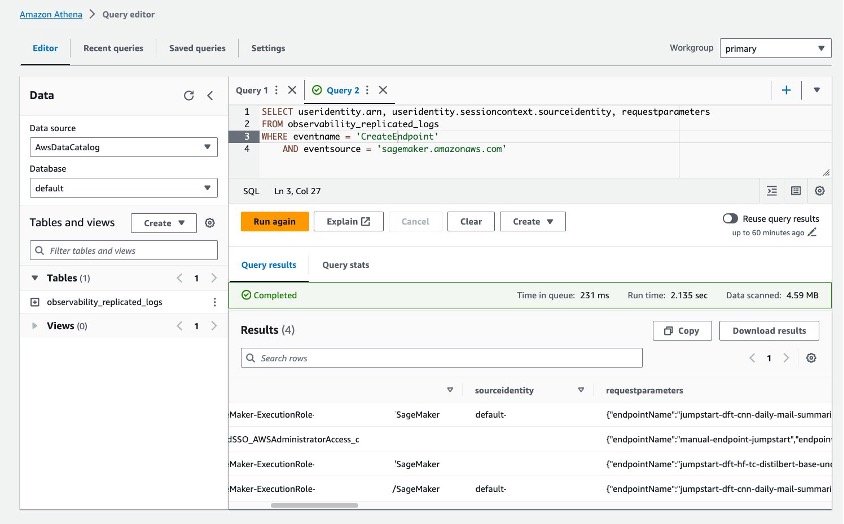
The next is a pattern question run in opposition to the logs saved within the observability account bucket and the related end in Athena:

SELECT useridentity.arn, useridentity.sessioncontext.sourceidentity, requestparametersFROM observability_replicated_logs
WHERE eventname="CreateEndpoint"
AND eventsource="sagemaker.amazonaws.com"
Conclusion

Centralized observability in a multi-account setup empowers organizations to handle ML workloads at scale. By integrating SageMaker Mannequin Monitor with cross-account observability in CloudWatch, you possibly can construct a strong framework for real-time monitoring and governance throughout a number of environments.

This structure not solely offers steady oversight of mannequin efficiency, but additionally considerably enhances your skill to rapidly determine and resolve potential points, thereby enhancing governance and safety all through our ML ecosystem.

On this publish, we outlined the important steps for implementing centralized observability inside your AWS setting, from organising SageMaker Mannequin Monitor to utilizing cross-account options in CloudWatch. We additionally demonstrated centralizing CloudTrail logs by replicating them from the log archive account and querying them utilizing Athena to get insights into consumer exercise inside SageMaker environments throughout the group.

As you implement this answer, do not forget that reaching optimum observability is an ongoing course of. Regularly refining and increasing your monitoring capabilities is essential to creating certain your ML fashions stay dependable, environment friendly, and aligned with enterprise aims. As ML practices evolve, mixing cutting-edge know-how with sound governance ideas is essential. Run the code your self utilizing the next pocket book or check out the observability module within the following workshop.


In regards to the Authors

Abhishek Doppalapudi is a Options Architect at Amazon Net Providers (AWS), the place he assists startups in constructing and scaling their merchandise utilizing AWS providers. Presently, he’s targeted on serving to AWS clients undertake Generative AI options. In his free time, Abhishek enjoys taking part in soccer, watching Premier League matches, and studying.

Venu Kanamatareddy is a Startup Options Architect at AWS. He brings 16 years of in depth IT expertise working with each Fortune 100 corporations and startups. Presently, Venu helps information and help Machine Studying and Synthetic Intelligence-based startups to innovate, scale, and succeed.

Vivek Gangasani is a Senior GenAI Specialist Options Architect at AWS. He helps rising GenAI corporations construct progressive options utilizing AWS providers and accelerated compute. Presently, he’s targeted on growing methods for fine-tuning and optimizing the inference efficiency of Massive Language Fashions. In his free time, Vivek enjoys mountain climbing, watching films and making an attempt totally different cuisines.

Ram Vittal is a Principal ML Options Architect at AWS. He has over 3 many years of expertise architecting and constructing distributed, hybrid, and cloud functions. He’s enthusiastic about constructing safe, scalable, dependable AI/ML and massive information options to assist enterprise clients with their cloud adoption and optimization journey to enhance their enterprise outcomes. In his spare time, he rides motorbike and walks together with his three-year outdated sheep-a-doodle!


Canon’s budget-friendly 3D lens will likely be accessible in November

0


Canon has formally introduced its new RF-S7.8mm F4 STM Twin lens, which options stereoscopic parts which have been squeezed right into a physique no bigger than a standard 2D digicam lens. It was initially teased throughout the Apple WWDC 2024 keynote final June and is designed to work with a Canon EOS R7 as a extra reasonably priced software for creators making 3D VR content material for headsets just like the Meta Quest 3 or spatial movies for the Apple Imaginative and prescient Professional.

The corporate hasn’t set a particular date for when the brand new 3D lens will likely be accessible, nevertheless it says it will likely be someday in November 2024, with an “estimated retail value” of $449.99. That’s significantly cheaper than Canon’s present dual-fisheye lenses designed to seize 3D video content material, together with the $1,999 RF5.2mm F2.8 L Twin and the $1,099 RF-S3.9mm F3.5 STM Twin.

Pairing Canon’s new 3D lens with the corporate’s 32.5MP EOS R7 digital digicam — which itself begins at $1,299 — pushes the overall price ticket of the package to over $1,700. Nonetheless, that’s nonetheless cheaper than Canon’s higher-end 3D options, which begin at $2,498 (and may go as excessive as $6,298) when paired with their requisite digicam gear.

The lens is designed to be straightforward to make use of, with minimal controls.
Picture: Canon

Canon’s new 3D lens has an aperture vary of f/4.0 to f/16, helps autofocus, and contains a button and a management wheel for making separate handbook focus changes to the left and proper sides. What makes it a lot cheaper than Canon’s present 3D lenses is its restricted subject of view. Canon’s pricier lenses are able to capturing 180-degree video and pictures — near what the human eye is able to seeing — whereas the brand new RF-S7.8mm F4 STM Twin lens solely takes in a few third of that at 63 levels.

The lenses on Canon’s new 3D lens are a lot smaller than the fisheye lenses on its pricier 3D lenses.
Picture: Canon

Utilizing a typical Canon RF mount, the brand new lens has stereoscopic parts aligned in a straight optical path, leading to its entrance lenses being positioned simply 11.8mm aside in comparison with the 60mm hole between the dual-fisheye lenses on Canon’s present 3D lenses. Consequently, Canon says the strongest 3D impact will likely be skilled when capturing topics or objects which are simply 6 to twenty inches from the lens. When utilizing it to seize one thing that’s farther away, the 3D impact will likely be much less pronounced.

Pictures and movies captured utilizing this lens must be processed earlier than they are often considered utilizing VR or AR headsets, both by the EOS VR plugin that’s accessible for Adobe Premiere Professional, or Canon’s personal EOS VR Utility software program, accessible for Macs and PCs. Each instruments require a paid subscription however can generate 180-degree 3D, VR, or spatial video content material.

7 typische Fehler beim Risikomanagement

0


Risikomanagement gehört zu den Kernkompetenzen jedes CISOs. Doch auch hier passieren immer wieder Fehler.

Freedomz/Shutterstock.com

CISOs wissen, dass Risikomanagement unerlässlich ist, um eine stabile Unternehmenssicherheit aufzubauen und aufrecht zu erhalten. Dennoch stolpern viele, trotz bester Absichten, immer wieder über hartnäckige Fallstricke, die ihre Bemühungen untergraben. 

Unabhängig von der Größe des Unternehmens ist Risikomanagement grundlegend für die allgemeine Sicherheitslage. Selbst ein scheinbar einfacher Fehler in dieser Disziplin kann daher schwerwiegende Konsequenzen haben. 

Damit das nicht passiert, finden Sie im Folgenden die wichtigsten Fehler, die CISOs beim Risikomanagement immer noch machen, und wie Sie diese vermeiden können. 

1. Kein definiertes Ziel 

Laut Kristi Preuss, Principal in der Cyber-Praxis des Unternehmensberaters Deloitte, ist der vielleicht größte Fehler beim Risikomanagement, kein klar definiertes Programmziel zu haben. Viele CISOs seien mit dem Tagesgeschäft ausgelastet sowie quick täglich neu auftauchenden Problemen konfrontiert. Infolgedessen verlassen sie, so Preuss, den Feuerlöschmodus nie lange genug, um eine umfassendere Strategie für die Informationssicherheit zu entwickeln, geschweige denn erfolgreich umzusetzen. 

„Stattdessen sind viele CISOs vom ersten Tag an Land unter und versuchen, alles auf einmal in Angriff zu nehmen, oft mit veralteten Instruments und begrenzten Ressourcen“, so Preuss. 

Wenn CISOs sich in reaktiven und operativen Ansätzen verstricken, leidet die Unternehmensstrategie. Die Sicherheitskontrollen haben Mühe, mit der aktuellen Bedrohungslage Schritt zu halten, geschweige denn sich einen Vorsprung herauszuarbeiten.  

„Mit veralteten oder schlecht definierten Programmzielen, begrenzten strategischen Investitionen und einem Mangel an innovativer, strategischer Planung erweisen CISOs ihren Organisationen einen schlechten Dienst und verstärken letztlich die Gefahren für die Informationssicherheit und das Cyber-Risiko“, urteilt die Deloitte-Beraterin. 

CISOs, die mit einem proaktiven Sicherheitsansatz wieder eine strategische Führungsrolle übernehmen wollen, brauchen Preuss zufolge eingespielte operative Risikoprozesse. Sie rät außerdem dazu, die Zeit zu begrenzen, die wichtige Teammitglieder mit Routineaufgaben verbringen. 

2. Übertriebene Sicherheits- und Risikobewertungen 

Viele CISOs bauen übermäßig kontrollorientierte Sicherheits- und Risikoprogramme auf. Das kann dazu führen, dass sie quick ununterbrochen Risikobewertungen durchführen und immer wieder versuchen, neue Probleme zu finden, die es zu entschärfen gilt, warnt Nick Godfrey, Senior Director und World Head, Workplace of the CISO, bei Google Cloud. 

„Risikobewertungen durchzuführen kann zwar anfangs nützlich sein, um Risiken einzudämmen, ist aber auf lange Sicht unproduktiv und setzt einen unerbittlichen Kreislauf in Gang, der zu unverhältnismäßig hohen Kosten und verpassten Chancen führt, wo Ressourcen besser investiert werden könnten“, sagt Supervisor. 

Godfrey merkt an, dass es für CISOs regular ist, sich mit jedem möglichen Risiko für das Unternehmen auseinandersetzen zu wollen. Das geschieht jedoch oft unter massivem Druck aus dem Vorstand, der die Sicherheitsverantwortlichen dazu bringt, übermäßig vorsichtig zu agieren. Der Google-Mann ergänzt: „Dies führt dazu, dass Risikoprogramme erstellt werden, die ‘fest programmiert’ sind und deren einziger Ansatz darin besteht, ständigen Risikobewertungen und -minderungen Priorität einzuräumen.“ 

Eine solche reaktive Denkweise kann davon ablenken, dass eigentlich ein strategischer Ansatz notwendig ist, der die möglichen Auswirkungen von Risiken auf Menschen, Produkte und Finanzen berücksichtigt.  

Der richtige Ansatz für das Risikomanagement sollte stattdessen ein ganzheitlicher sein. CISOs müssten ein angemessenes Risikoniveau aufrechterhalten, ohne dass ständig an der Risikominderung gearbeitet wird. So könnten die Ressourcen je nach den Bereichen, die mehr Aufmerksamkeit benötigen, neu zugewiesen werden können, betont Godfrey. 

„Unternehmen mit der besten Sicherheitslage denken darüber hinaus, ein niedriges Risikolevel aufrechtzuerhalten, und verbringen zusätzliche Zeit damit, Effizienz und Fähigkeiten zu verbessern, die das Risiko reduzieren“, sagt er. 

Godfrey schlägt vor, das Prozedere rund um die Risikokontrollen zu optimieren, um die Anzahl der erforderlichen Kontrollen zu reduzieren. Es gelte, Aktivitäten zu automatisieren, um den Wartungs- und Verwaltungsaufwand zu verringern, und die Kundenerfahrung durch starke Betrugspräventionsmethoden zu verbessern. 

3. Es fehlt eine echte Sicherheitskultur 

Kultur verschmilzt Überzeugungen, Werte und Verhaltensweisen. Daraus folgt, dass eine Cybersicherheitskultur in erster Linie von den Menschen im Unternehmen bestimmt wird.  

Der beste Weg, eine solche Kultur aufzubauen, besteht darin, sie in der Praxis zu demonstrieren. Sie muss über ehrgeizige Missionserklärungen oder ausgefallene Präsentationen hinausgehen, sagt Sourya Biswas, technischer Direktor für Risikomanagement und Governance bei der NCC Group. 

„Ein Unternehmen, das die richtigen Überzeugungen hinsichtlich Sicherheit verfolgt, die richtigen Werte teilt und Anreize für das richtige Sicherheitsverhalten schafft, kann die richtige unternehmensweite Cybersicherheitskultur aufbauen“, erklärt der Supervisor. Ohne die richtige Kultur würden auch die besten Sicherheitsstrategien scheitern. 

Da eine Cybersicherheitskultur in erster Linie von den Menschen bestimmt wird, sollte sie laut Biswas von den obersten Führungskräften innerhalb der Unternehmenshierarchie vorgelebt werden: „Mit anderen Worten, die Kultur sollte nicht die Verantwortung der Sicherheitsorganisation sein, sondern die des gesamten Vorstands und der Geschäftsführung.“  

Seiner Meinung nach ist der „Ton an der Spitze“ entscheidend, um eine sinnvolle Cybersicherheitskultur zu fördern. Wenn die Mitarbeiter sehen, dass ihre Führungskräfte nicht das tun, was sie selbst predigen, werden sie sich wahrscheinlich daran ein Beispiel nehmen. 

Mehr zum Thema:

Cybersicherheit und Risikomanagement: Hand in Hand zur Resilienz

Was CISOs von Moschusochsen lernen können

4. Die Safety für besser halten, als sie ist 

Der größte Fehler, den CISOs begehen können, ist zu glauben, sie hätten die vollständige Kontrolle. Sie verlassen sich auf ihre Sicherheitspläne und vertrauen darauf, dass eine Reihe von Branchenzertifizierungen ihr Unternehmen vor Cyberbedrohungen schützen könnten, mahnt Howard Taylor, CISO bei Radware.  

Cybersicherheit ist komplex und entwickelt sich ständig weiter, meint der Safety-Experte. Es gebe immer wieder neue Angreifer, neue Ansätze oder Neuauflagen alter Angriffe mit einer neuen Wendung. „Wachsam und vorbereitet zu bleiben, ist der einzige Weg, das Risiko wirklich zu beherrschen.“ 

„Wenn Sie Ihre Kontrollumgebung nicht regelmäßig verbessern und überprüfen, werden Sie feststellen, dass Ihr Unternehmen ungeschützt ist“, warnt Taylor. Die Bedrohungslandschaft befinde sich in ständigem Wandel und Sicherheitslösungen, die bei ihrer ersten Implementierung noch als sicher galten, werden mit der Zeit schwächer. 

Noch schlimmer schätzt Taylor ein, dass CISOs oft Entscheidungen treffen, die auf einem falschen Sicherheitsempfinden beruhen. Sie investierten so viel Geld und Zeit, um Cyberabwehr zu verbessern und ihre Groups zu schulen, dass sie glauben, alles andere als ein vollständiger Schutz sei unmöglich. „In Wirklichkeit sollte die einzige wirkliche Antwort auf die Frage ‚Sind wir sicher?‘ immer die gleiche sein – ein klares Nein“, sagt er. 

5. Checkbox-Mentalität 

CISOs konzentrieren sich oft darauf, Vorschriften und Requirements einzuhalten, anstatt die tatsächlichen Risiken für ihr Unternehmen zu bewerten und zu managen, urteilt Jeff Orr, Forschungsdirektor für digitale Technologie beim Beratungsunternehmen ISG. 

Dieser Fokus könne zu einer „Checkbox-Mentalität“ führen, ergänzt Orr, bei der sich das Unternehmen zu stark auf Vorschriften konzentriert und darüber vernachlässigt, reale Bedrohungen zu bewerten und abzufangen. „Infolgedessen können Schwachstellen bestehen bleiben und zu Sicherheitsverletzungen und Datenverlusten führen, die durch einen strategischeren, risikobasierten Ansatz hätten verhindert werden können“, so der Berater. 

Ein reaktiver Ansatz nach dem Motto „Alles oder nichts“ funktioniert laut Orr nicht nachhaltig. Er kann zu veralteten Sicherheitsrichtlinien und -kontrollen führen, die den aktuellen Bedrohungen nicht mehr gerecht werden. 

6. Keine effektiven Metriken und Governance-Modelle 

Erez Tadmor, Discipline CTO bei Tufin, rät CISOs, ihre Sicherheitstools mit starken, kontinuierlichen Mess- und Governance-Modellen zu unterlegen: „CISOs können die Sicherheitslage ihres Unternehmens erheblich verbessern, indem sie diese Frameworks priorisiert entwickeln und regelmäßig überprüfen“, erklärt Tadmor. 

Effektive Mess- und Governance-Modelle helfen, die Sicherheitsrichtlinien konsistent mit den gesetzlichen Anforderungen, den Greatest Practices der Branche und den spezifischen Anforderungen eines Unternehmens abgestimmt zu halten. „Eine klare und konstante Transparenz ermöglicht es den Groups, Fehlkonfigurationen in der Infrastruktur zu erkennen, bevor sie zu Sicherheitsverletzungen führen können“, stellt Tadmor fest. Ohne aussagekräftige Metriken und Governance werde es jedoch schwierig, den Erfolg von Sicherheitsinitiativen zu messen und aktuelle, effektive Richtlinien aufrechtzuerhalten. 

7. Keinen Plan für betriebliche Ausfallsicherheit  

Ein operativer Resilienz-Plan betrachtet das gesamte Ökosystem eines Unternehmens. Er zeigt auf, wie der Geschäftsbetrieb bei Störungen aufrechterhalten werden kann, sagt Jim Doggett, CISO bei Semperis. „Indem CISOs die operative Widerstandsfähigkeit in den Vordergrund stellen, können sie die Notwendigkeit des Schutzes vor kritischen Sicherheitsrisiken mit dem Enterprise Continuity Administration in Einklang bringen.“ 

Mit einer sorgfältigen Planung können Unternehmen bei einem Angriff Stillstände eindämmen, sich schneller erholen und die negativen Auswirkungen auf ihr Geschäft reduzieren, sagt Doggett: „Ohne einen Plan für betriebliche Ausfallsicherheit ist Ihr gesamtes Ökosystem, einschließlich Lieferanten, Partnern und Anbietern, gefährdet“. 

Die Kehrseite der Medaille ist, dass die Bemühungen um betriebliche Ausfallsicherheit in der Regel scheitern, wenn ein Unternehmen intern nicht vernetzt ist. Doggett: „Als Führungskräfte ihres Unternehmens sind CISOs dafür verantwortlich, Sicherheitsinitiativen voranzutreiben, aber die operative Ausfallsicherheit erfordert eine unternehmensweite Beteiligung.“ Man könne das nicht einfach einer einzelnen Abteilung oder einem Group überlassen – alle müssten mit anpacken. (jd) 

Mit unseren Safety-Newslettern bleiben Sie immer auf dem Laufenden: Zur Bestellung

vgwort