Home Blog Page 77

ByteDance Emerges as an A.I. Powerhouse

0

The Rise of ByteDance: How a Chinese Internet Giant is Revolutionizing Artificial Intelligence

The Power of Data

ByteDance, the Chinese internet giant behind popular apps like TikTok, Douyin, and Toutiao, has amassed a treasure trove of data from its hundreds of millions of users. With this wealth of information, the company has been improving its ability to recommend content and retain users. ByteDance’s data has also become the linchpin of its growing business in artificial intelligence (A.I.).

Investing in A.I.

ByteDance has invested heavily in the infrastructure needed to power A.I. systems, building vast data centers in China and Southeast Asia and purchasing advanced semiconductors. The company is also on an A.I. hiring spree, signaling its commitment to becoming a major player in the A.I. industry.

Concerns Over Data Use

ByteDance’s use of data has raised concerns globally, particularly in the United States, where lawmakers have tried to force the company to sell its U.S. operations due to concerns over national security and public opinion. However, in China, the data has helped ByteDance expand its business beyond social media and gain an edge in the global A.I. race.

A.I. and National Security

Chinese officials have pushed the country’s tech companies to pivot from entertainment apps to more strategic technologies like semiconductors, supercomputers, and A.I. ByteDance has embraced this mission, investing $11 billion in infrastructure like data centers and computer chips.

Workarounds for Chip Restrictions

The Biden administration has implemented rules to restrict Chinese companies from accessing certain chips, particularly those made by Nvidia. However, ByteDance has found ways to get the computing power it needs, likely by using data centers outside China and purchasing chips made by Chinese chipmakers like Huawei and Cambricon.
A.I. Applications

ByteDance’s A.I. efforts have led to the creation of popular apps like Doubao, a chatbot with 60 million users, and Volcano Engine, a business that lets other companies use ByteDance’s A.I. technologies. The company is also working with other companies, such as GAC Group and Mercedes-Benz, to integrate A.I. into their products.

Conclusion

ByteDance’s investment in A.I. has paid off, with the company becoming a major player in the industry. Its vast data and resources have enabled it to develop innovative A.I. technologies and applications. While concerns over data use remain, ByteDance’s focus on A.I. is likely to continue driving its growth and success in the years to come.

FAQs

Q: What is ByteDance’s business model?

A: ByteDance’s business model is centered around its popular apps like TikTok, Douyin, and Toutiao, which generate revenue through advertising and data analytics.

Q: What is ByteDance’s investment in A.I.?

A: ByteDance has invested heavily in A.I. infrastructure, hiring hundreds of A.I. researchers and engineers, and developing innovative A.I. technologies like chatbots and recommendation systems.

Q: What are the concerns over ByteDance’s data use?

A: Lawmakers in the United States have raised concerns over ByteDance’s data use, citing national security and public opinion concerns. However, in China, the data has been used to drive ByteDance’s growth and innovation.

Q: How has ByteDance adapted to chip restrictions?

A: ByteDance has found ways to get the computing power it needs, likely by using data centers outside China and purchasing chips made by Chinese chipmakers like Huawei and Cambricon.

GeForce RTX 50 Series Boosts DaVinci Resolve 20 Studio

AI-Assisted Video Editing

As AI-powered tools continue to evolve, NVIDIA GeForce RTX 50 Series and NVIDIA RTX PRO GPUs, based on the NVIDIA Blackwell architecture, are driving faster, smarter creative workflows.

Blackmagic Design’s DaVinci Resolve Studio 20 Software

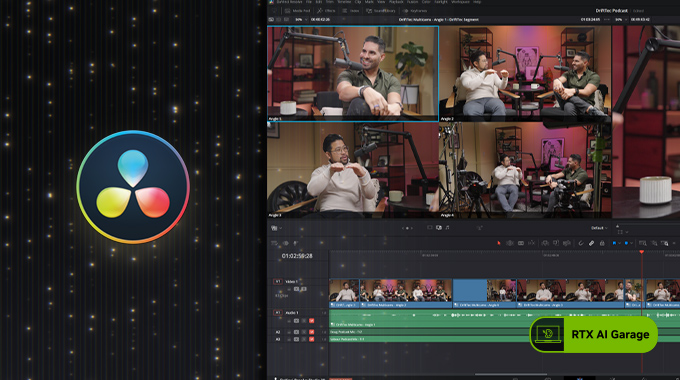
Blackmagic Design’s public beta release of DaVinci Resolve Studio 20 software puts new capabilities and a suite of RTX-accelerated AI-powered features into the hands of video editors, helping automate tedious tasks and accelerate creative workflows. Backed by the latest version of the NVIDIA TensorRT software development kit, these features run faster and more efficiently on RTX GPUs. Additional updates include support for 4:2:2 color formats and AV1 ultra-high-quality encoding.

FLUX.1-dev NIM Microservice

For artists and creators looking to experiment with generative AI workflows, Black Forest Labs’ FLUX.1-dev is now available as an NVIDIA NIM microservice — making it easy to deploy and scale across RTX-powered systems. FLUX.1-dev is a text-to-image generation model suite that enables users to generate high-quality, photorealistic visuals using text prompts and image inputs — optimized for peak performance on NVIDIA RTX and RTX PRO GPUs.

AI-Assisted Video Editing Features

DaVinci Resolve Studio 20 beta delivers over 100 new professional-grade video features, including an array of AI tools and effects to speed up productivity. It also now integrates the latest version of NVIDIA TensorRT, optimizing AI performance for creative workloads.

RTX-Accelerated AI Features

GeForce RTX 50 Series and RTX PRO GPUs — powered by the NVIDIA Blackwell architecture and fifth-generation Tensor Cores — accelerate AI features that enhance creative workflows in video editing and post-production.

Edit Like a Pro with 4:2:2

The 4:2:2 color format delivers huge quality benefits over creating in 4:2:0 and is highly sought after by professional video editors, presenting 2x the color information while only increasing raw file sizes by 30%. With the additional color information, video editors gain improved color grading accuracy, increased flexibility during color correction, and enhanced chroma keying while letting creators work with smaller files, maximizing efficiency and quality.

Conclusion

The latest NVIDIA GeForce RTX 50 Series and RTX PRO GPUs, along with the DaVinci Resolve Studio 20 software, are revolutionizing creative workflows with AI-assisted video editing features. With support for 4:2:2 color formats and AV1 ultra-high-quality encoding, creators can now work with even higher quality and precision. Additionally, the FLUX.1-dev NIM microservice offers a powerful tool for generative AI workflows, enabling users to generate high-quality, photorealistic visuals using text prompts and image inputs.

Frequently Asked Questions

Q: What is the DaVinci Resolve Studio 20 software?
A: DaVinci Resolve Studio 20 software is a video editing and color grading system that integrates with NVIDIA RTX GPUs for faster and more efficient AI-assisted video editing features.

Q: What are the benefits of using 4:2:2 color formats?
A: 4:2:2 color formats deliver huge quality benefits over creating in 4:2:0, presenting 2x the color information while only increasing raw file sizes by 30%. This results in improved color grading accuracy, increased flexibility during color correction, and enhanced chroma keying.

Q: What is the FLUX.1-dev NIM microservice?
A: FLUX.1-dev is a text-to-image generation model suite that enables users to generate high-quality, photorealistic visuals using text prompts and image inputs — optimized for peak performance on NVIDIA RTX and RTX PRO GPUs.

Q: How do I get started with DaVinci Resolve Studio 20 software?
A: The DaVinci Resolve Studio 20 software is available for download from Blackmagic Design’s website. Existing customers with DaVinci Resolve Studio 20 can update to the beta version for free.

How Chef Robotics Found Success by Turning Away Its Original Customers

0

A few years ago, Chef Robotics was facing potential death. “There were a lot of dark periods where I was thinking of giving up,” founder Rajat Bhageria tells TechCrunch of his six-year-old company. But friends and investors encouraged him, so he persevered.

The Grasping Problem

It all began when Bhageria did his master’s degree in robotics at UPenn’s famed GRASP Lab. He dreamed of the sci-fi promised world where robots did our housework, mowed our lawns, and cooked us five-star dinners. Such a world doesn’t exist yet because engineers have yet to fully solve the robotic grasping problem. Training the same robot to wash a wine glass without crushing it and a cast iron pan without dropping it is a difficult task.

When it comes to robotic chefs, “Nobody’s built a dataset of how do you pick up a blueberry and not squish it, or, how do you pick up cheese and not have it clump up?” he describes.

Saying No Leads to Yes

His original idea with Chef Robotics was similar to the long-list of the robotics startups that died: a robotic line for fast casual restaurants. That’s an enormous industry with a chronic employee shortage. “We actually had signed contracts. Like we had multimillion-dollar signed contracts. Obviously, we’re not doing this anymore. So what happened?” he said. “We essentially could not solve the technical problem.”

In those types of businesses, an employee completes an order by assembling all the varied ingredients necessary for each meal. These restaurants want robots to replicate that process because the alternative is to have dozens of robots dedicated to, and calibrated for, a single ingredient, some of which may only be used occasionally.

But Bhageria and team couldn’t build a successful pick-up-anything robot because the training data doesn’t exist. He asked his potential customers to let him install robots for one or two ingredients, gathering training data and building from there. They said no.

Then Bhageria had an epiphany. Instead of going bust trying to give existing customers what they wanted, maybe he needed different customers. “It honestly sucked, because I spent the last year and a half of my life trying to convince these people, these fast casual companies, to work up with us,” he recalled.

High Mix Manufacturing

It didn’t help that fundraising after 2021 was brutal. VCs were also looking at the graveyard. “We talked to dozens of different funds,” Bhageria said. “We just got rejected over and over.”

Bhageria was thinking of giving up. “You come home and are like, what am I doing in my life? Am I doing the wrong thing? Should I quit?” he remembered.

But he dug in and in March, 2023, raised an $11.2 million seed round led by Construct Capital, while also landing checks from Promus Ventures, Kleiner Perkins, and Gaingels.

Bhageria and team also found their perfect market, a part of the food industry known as “high mix manufacturing.” These are food makers that have many, many recipes, and make thousands of servings, but typically as meals or meal trays. For instance; salads and sandwiches or main courses and side dishes. These are meals used by airlines and hospitals, etc., or are frozen food meals for consumers.

Conclusion

Today, Chef Robotics has not only survived, it’s one of the few food tech robotic companies that is thriving. The startup, which recently raised a $23 million Series A, has 40 employees and marquee customers like Amy’s Kitchen and Chef Bombay. Dozens of robots installed across the U.S. have made 45 million meals to date, Bhageria says.

This compares to a graveyard of failed food tech robotics companies, including Chowbotics with its salad-making robot Sally; pizza delivery robot Zume; food kiosk robot Karakuri, and, more recently, agtech Small Robot Company.

FAQs

Q: Why did Chef Robotics almost die?
A: Chef Robotics almost died because it couldn’t solve the robotic grasping problem, which is a difficult task.

Q: What was the turning point for the company?
A: The turning point for the company was when Bhageria decided to focus on high mix manufacturing, a part of the food industry that has many recipes and makes thousands of servings.

Q: How did fundraising change for Chef Robotics?
A: Fundraising changed for Chef Robotics after it found its perfect market. It raised $11.2 million in a seed round led by Construct Capital, and later raised a $23 million Series A.

Q: What is high mix manufacturing?
A: High mix manufacturing is a part of the food industry that has many recipes and makes thousands of servings, typically as meals or meal trays.

Avoiding Hosting Headaches

The Struggle or Moment of Clarity

I still remember the sinking feeling in my stomach as I sat in front of my computer, watching my website crash for the third time that week. It was a Friday evening, and I had big plans to launch my new e-commerce site just in time for the weekend rush. My heart raced as I imagined the customers I’d already promised a seamless shopping experience. Instead, I was greeted with an error message that seemed to mock me: "500 Internal Server Error." I could almost hear the sound of opportunity slipping through my fingers.

The Struggle or Moment of Clarity

As a freelancer and small business owner, I thought I was prepared for everything. I had done my research and chosen a hosting provider that came highly recommended. The glossy marketing materials promised 99.9% uptime, lightning-fast speeds, and top-notch customer support. But when it came time to deliver, I found myself in a nightmare. It wasn’t just the crashes; it was the constant confusion about why they were happening. I felt like I was living in a bad tech horror movie where the ghosts of poor hosting decisions haunted me at every turn. My website was supposed to be my digital storefront, the gateway to my success, yet it felt more like a rickety old shack that could collapse at any moment. Each time it went down, I lost not just potential sales but also my confidence in the platform I had chosen.

The Decision or Turning Point

After a long night of troubleshooting, I finally reached out to customer support. I was met with long wait times and vague responses that left me feeling even more frustrated. It was clear that something needed to change. I realized that I had been so focused on the shiny exterior of my chosen hosting provider that I had neglected to dig deeper into the fine print. That weekend, I embarked on a mission to find a better hosting solution. I started by asking my freelance community for recommendations. That’s when I stumbled upon the world of VPS and dedicated hosting. The more I learned, the more I realized that my shared hosting plan was simply not cutting it for my growing e-commerce site. I’d been trying to fit a square peg into a round hole, and it was time for a change.

The Outcome or Realization

I spent hours researching features, reading reviews, and comparing price points. Eventually, I decided to go with a VPS hosting option. It promised dedicated resources and better control over my server environment, which sounded like exactly what I needed. Plus, the support options were more robust, with 24/7 assistance that I could actually rely on. By making the switch, I was investing in my business and my peace of mind. I knew I had to take this leap if I wanted to avoid future catastrophes. I chose Liquid Web’s VPS Hosting because it seemed to offer everything I was looking for, and the reviews were overwhelmingly positive. Fast forward a few weeks, and I was finally able to launch my site without a hitch. The difference was night and day. Not only did my website load faster, but I also felt a newfound sense of control. For the first time, I could customize my hosting environment to fit my specific needs. The support team was responsive and knowledgeable, ready to help me navigate any issues.

Conclusion

The biggest takeaway from this experience? Don’t settle for mediocre hosting. Your website is the heart of your business, and investing in the right hosting solution can mean the difference between success and struggle. Whether you’re a freelancer, developer, or small business owner, take the time to understand your hosting needs and don’t be afraid to make a change when things aren’t working. Your future self will thank you.

FAQs

Q: What is VPS hosting?
A: VPS stands for Virtual Private Server, which is a type of hosting that offers dedicated resources and better control over your server environment.

Q: What advantages does VPS hosting offer?
A: VPS hosting offers dedicated resources, better control over your server environment, and more robust support options.

Q: How do I choose the right hosting provider?
A: Research features, read reviews, and compare price points to find a hosting provider that meets your specific needs.

Q: What is dedicated hosting?
A: Dedicated hosting is a type of hosting where you have a dedicated server that is not shared with any other users.

Q: Why is it important to choose the right hosting provider?
A: Choosing the right hosting provider is crucial for your website’s performance, reliability, and security. It can make or break your online business.

HIPAA Compliance Made Easy

The Importance of HIPAA Compliance in Healthcare

With a majority of healthcare organizations lacking proper technology to address HIPAA compliance, it’s imperative that quick action is taken to avoid serious security and data privacy breaches. Our comprehensive guide provides you with all you need to know to address this time-sensitive issue.

Understanding HIPAA Compliance

What is HIPAA?

HIPAA (Health Insurance Portability and Accountability Act) is a federal law that regulates the handling of protected health information (PHI) in the United States. HIPAA was enacted in 1996 to protect the privacy and security of patients’ medical records and other health information.

Key Components of HIPAA

  • Protected Health Information (PHI): Any individually identifiable health information that is collected, used, or disclosed by a covered entity.
  • Covered Entities: Healthcare providers, health plans, and healthcare clearinghouses that are required to comply with HIPAA regulations.
  • Business Associates: Vendors and third-party service providers that have access to PHI on behalf of a covered entity.

HIPAA Compliance Requirements

HIPAA compliance requires covered entities and business associates to:

  • Implement administrative, technical, and physical safeguards to protect PHI.
  • Conduct regular risk analyses and implement risk management strategies.
  • Provide training to employees and business associates on HIPAA policies and procedures.
  • Conduct regular audits and monitoring to ensure compliance.

Benefits of HIPAA Compliance

Implementing HIPAA compliance measures offers numerous benefits, including:

  • Reduced risk of data breaches and PHI exposure.
  • Improved patient trust and confidence in healthcare providers.
  • Compliance with federal and state regulations.
  • Enhanced reputation and credibility in the healthcare industry.

Addressing HIPAA Compliance with Technology

RingCentral’s Solution

RingCentral offers a comprehensive platform to address HIPAA compliance, including:

  • Secure messaging and collaboration tools.
  • Encryption and access controls.
  • Compliance and audit logs.
  • Regular software updates and security patches.

Conclusion

HIPAA compliance is a critical aspect of healthcare organizations. Implementing the necessary measures can reduce the risk of data breaches, improve patient trust, and enhance reputation. RingCentral’s comprehensive platform is designed to help healthcare organizations address HIPAA compliance and ensure the secure handling of PHI.

Frequently Asked Questions

Q: What is the purpose of HIPAA?

A: The purpose of HIPAA is to protect the privacy and security of patients’ medical records and other health information.

Q: Who is responsible for HIPAA compliance?

A: Covered entities and business associates are responsible for HIPAA compliance.

Q: What are the consequences of non-compliance?

A: Non-compliance with HIPAA can result in fines and penalties up to $1.5 million per violation, as well as damage to reputation and patient trust.

Q: How can I ensure HIPAA compliance?

A: Implement administrative, technical, and physical safeguards, conduct regular risk analyses, provide training to employees and business associates, and conduct regular audits and monitoring.

Silicon Valley’s Trade War Threat

Unlock the White House Watch newsletter for free

Your guide to what the 2024 US election means for Washington and the world

The Tech Industry’s Risky Bet on Trump

For a week, Silicon Valley’s bet on Donald Trump looked to be turning very bad, very quickly. The hit to complex electronics supply chains made Apple, Nvidia, and Tesla among the biggest casualties of the US president’s assault on the global trading system. And with potentially ruinous tariffs looming on computer systems embedded with GPUs — the chips fueling the artificial intelligence boom — it was possible to imagine the training of the most advanced AI models being driven outside the US.

The Unresolved Issues Behind the Trade Upheaval

The temporary stay of execution produced a monumental relief rally that added $1tn to the value of Apple, Nvidia, and Tesla. But renewed pressure on tech stocks on Thursday was a reminder that the issues behind the trade upheaval are entirely unresolved.

A Clash of Interests

The US tech industry grew up in the age of globalization and was thoroughly shaped by it. It always looked like a risk for some of its most prominent leaders to throw their lot in with MAGA, whose nativist and isolationist instincts clash directly with many of tech’s interests.

The End of an Era

This goes well beyond the electronics supply chains that are most directly at risk from a trade war. Open access to digital markets around the world, along with free international flows of data, have contributed to American dominance of the consumer internet and cloud computing. The US trade surplus in information and communication technology services, for instance, stood at $30bn in 2023, while its surplus in all digitally deliverable services produced a net $267bn benefit.

The Coming Era of Trade Tensions

And that does not take account of the huge profits that US tech groups make from overseas sales that are not captured in the official trade data, such as Apple’s margins on the iPhones it sells in China, or Google’s advertising revenue from internet searches in Europe. The trade crisis made these an obvious target for retaliation — a risk that will inevitably return with any future trade tensions.

Conclusion

The techies are betting they can steer Trump for their benefit, and will feel some vindication from his climbdown on tariffs. But hitting the 90-day pause button will not solve the underlying issues that brought the crisis about, or prevent long-term damage from what has transpired.

Frequently Asked Questions

Q: What is the current state of the US tech industry?
A: The US tech industry is facing significant challenges due to the ongoing trade tensions and the uncertainty surrounding the global trading system.

Q: How will a Democratic administration affect the tech industry?
A: A Democratic administration might have tied them up in regulation, making it hard to outpace China.

Q: What is the impact of Trump’s policies on the tech industry?
A: Trump’s policies, such as the tariffs, have already caused significant damage to the tech industry, and the industry is concerned about the long-term effects of his actions.

Q: What is the future of the global trading system?
A: The global trading system is likely to become more fragmented and confrontational, with countries seeking to reduce their dependence on US technology and increase their own competitiveness.

NVIDIA Nemotron Ultra 253b V1 Model

0

AI Model Disclaimers and Risks

Overview

The AI model generates responses and outputs based on complex algorithms and machine learning techniques. While these algorithms are designed to provide accurate and helpful information, there is always a risk that the responses or outputs may be inaccurate, harmful, biased, or indecent.

Risks Associated with AI Model Outputs

  • Inaccuracy: The AI model may generate responses or outputs that are incorrect or incomplete, which can lead to misunderstandings or misinterpretations.
  • Harm: The model may produce outputs that are offensive, inflammatory, or harmful, which can cause emotional distress or damage to individuals or groups.
  • Bias: The AI model may be biased towards certain individuals, groups, or perspectives, which can lead to unfair or discriminatory outcomes.
  • Indecency: The model may generate responses or outputs that are inappropriate or offensive, which can be harmful to individuals or groups.

Assume the Risk

By using this AI model, you assume the risk of any harm caused by any response or output of the model. We strongly advise against uploading any confidential information or personal data unless it is explicitly permitted.

Logging of Use

Your use of the AI model is logged for security purposes. This includes tracking your interactions with the model, such as the requests you make and the responses you receive.

Conclusion

While the AI model is designed to provide helpful and accurate information, there are inherent risks associated with its use. We urge users to exercise caution and responsibility when using the model, and to report any concerns or issues to the relevant authorities.

Frequently Asked Questions

FAQs

Q: What if I upload confidential information or personal data without permission?
A: We strongly advise against uploading any confidential information or personal data unless it is explicitly permitted. If you do so, you may be putting yourself and others at risk of harm.

Q: Can I hold the AI model responsible for any harm caused by its outputs?
A: By using the AI model, you assume the risk of any harm caused by any response or output of the model. We are not liable for any harm caused by the model’s outputs.

Q: How can I report any concerns or issues with the AI model?
A: You can report any concerns or issues with the AI model to the relevant authorities or to our support team.

Q: Can I use the AI model for commercial purposes?
A: We do not permit the use of our AI model for commercial purposes without explicit permission.

Bluesky Gets Revamped Search Page and Emoji Reactions in DMs

0

Bluesky Updates App to Version 1.100: What’s New?

The latest update to Bluesky’s app brings a more comprehensive search page and new chat reactions to the table.

New Search Page: Explore

The search page is now known as “Explore,” where you can find trending topics, suggested accounts, and starter packs to jump-start stuff for you to follow on the app. This new Explore page still lets you search from the top, but now, the first thing you see under the search bar are a list of top trends and that may have a tag emphasizing how “hot” or “new” something is.

There’s also a shortcut at the top to edit interests that inform what you see on the Explore page, but you can hide that and adjust your interests later in Settings > Content and media.

New Chat Reactions

You can now hold down on a direct message and select an emoji to react to it with. The feature looks and works similarly to many other chat apps like iMessage.

Previously, holding down on a message brought up a menu on the bottom of the screen to translate, copy, or delete the message. Now, those options appear under a message when you press and hold on it.

What’s Next?

With these updates, Bluesky aims to make it easier for users to discover new content and engage with the app in a more interactive way.

Conclusion

The update to version 1.100 brings significant improvements to the search functionality and chat interactions, making Bluesky a more engaging and user-friendly platform.

FAQs

Q: What’s the new search page called?

A: The new search page is called “Explore.”

Q: How do I edit my interests on the Explore page?

A: You can edit your interests on the Explore page by clicking the shortcut at the top, or later in Settings > Content and media.

Q: How do I react to a message?

A: You can react to a message by holding down on it and selecting an emoji.

Q: What happened to the menu when I hold down on a message?

A: The menu is now located under the message when you press and hold on it.

Industry-Specific AI Benchmarks

OpenAI Pioneers Program: Bridging the Gap Between AI Research and Industry Applications

A New Era of AI Development

Benchmark performance results are typically used to showcase the capabilities of new AI models. However, these evaluations often focus on general tasks, such as grade school mathematics (GSM8K) or graduate-level reasoning (GPQA), which may not be relevant to specific industries. To address this gap, OpenAI has launched the OpenAI Pioneers Program, a collaboration between the company and industry leaders to develop more domain-specific evaluations and fine-tuned models.

The Need for Industry-Specific Benchmarks

OpenAI has recognized the importance of industry-specific benchmarks, which are currently lacking in the field of AI. According to a blog post, industries such as legal, finance, insurance, healthcare, and accounting are missing a unified source of truth for model benchmarking. This gap has been highlighted by research, which emphasizes the need for domain-specific functions to be evaluated in order to develop more advanced AI solutions tailored to businesses’ needs.

The OpenAI Pioneers Program

The OpenAI Pioneers Program aims to bridge this gap by partnering with companies to develop evaluations and fine-tune models for specific industries. The program is a two-pronged effort, with the first part focusing on developing domain-specific evaluations and the second part on refining existing models using reinforcement fine-tuning (RFT). The goal is to create models that are ready for large-scale deployment in real-world use cases.

Refining Existing Models

OpenAI will collaborate with companies to refine existing models for three industry-specific use cases using RFT. This technique allows the models to learn from experience and improve their performance over time. The OpenAI team will guide the companies on how to use RFT, and the companies will then be able to deploy the models at scale.

Industry-Specific Use Cases

The first cohort of the OpenAI Pioneers Program will consist of a handful of startups working on use cases that can drive real-world impact. If your company is interested in participating, you can apply by filling out the form on the OpenAI Pioneers Program webpage.

Conclusion

The OpenAI Pioneers Program marks a significant step towards developing more advanced AI solutions tailored to businesses’ needs. By creating industry-specific benchmarks and fine-tuning models, OpenAI aims to increase trust between the public and these systems. The program has the potential to drive real-world impact and advance the field of AI development.

FAQs

Q: What is the OpenAI Pioneers Program?
A: The OpenAI Pioneers Program is a collaboration between OpenAI and companies to develop more domain-specific evaluations and fine-tuned models for specific industries.

Q: What are the goals of the program?
A: The goals of the program are to develop industry-specific benchmarks and refine existing models using reinforcement fine-tuning (RFT) to create models ready for large-scale deployment in real-world use cases.

Q: What industries are targeted by the program?
A: The program targets industries such as legal, finance, insurance, healthcare, and accounting.

Q: How can companies apply to the program?
A: Companies can apply by filling out the form on the OpenAI Pioneers Program webpage.

Q: What is the first cohort of the program focused on?
A: The first cohort will consist of a handful of startups working on use cases that can drive real-world impact.

Google will Combine Gemini and Veo AI Models

0

Google’s Plan to Combine AI Models for a Universal Digital Assistant

DeepMind CEO’s Recent Podcast Appearance

In a recent appearance on Possible, a podcast co-hosted by LinkedIn co-founder Reid Hoffman, Google DeepMind CEO Demis Hassabis said Google plans to eventually combine its Gemini AI models with its Veo video-generating models to improve the former’s understanding of the physical world.

A Vision for a Universal Digital Assistant

“We’ve always built Gemini, our foundation model, to be multimodal from the beginning,” Hassabis said, “and the reason we did that [is because] we have a vision for this idea of a universal digital assistant, an assistant that … actually helps you in the real world.”

The Rise of Omni Models

AI Industry Trends

The AI industry is moving gradually toward “omni” models, if you will — models that can understand and synthesize many forms of media. Google’s newest Gemini models can generate audio as well as images and text, while OpenAI’s default model in ChatGPT can natively create images — including, of course, Studio Ghibli-style art. Amazon has also announced plans to launch an “any-to-any” model later this year.

Training Data for Omni Models

These omni models require a lot of training data — images, videos, audio, text, and so on. Hassabis implied that the video data for Veo is coming mostly from YouTube, a platform that Google owns.

YouTube as a Source of Training Data

“Basically, by watching YouTube videos — a lot of YouTube videos — [Veo 2] can figure out, you know, the physics of the world,” Hassabis said.

Conclusion

Google’s plan to combine its Gemini AI models with its Veo video-generating models is a significant step toward building a universal digital assistant. By leveraging training data from YouTube and other sources, Google aims to improve its models’ understanding of the physical world. As the AI industry continues to evolve, it will be interesting to see how these omni models shape the future of AI.

FAQs

Q: What are Gemini AI models?

A: Gemini AI models are multimodal models that can generate audio, images, and text.

Q: What is Veo?

A: Veo is a video-generating model developed by Google.

Q: Where does the training data for Veo come from?

A: The video data for Veo comes mostly from YouTube, a platform that Google owns.

Q: What are omni models?

A: Omni models are AI models that can understand and synthesize many forms of media, including images, videos, audio, and text.