Home Blog Page 79

GPT-4.1 Launch

0

OpenAI Unveils New AI Models: GPT-4.1, o3, and o4 Mini

OpenAI is preparing to release a range of new AI models, according to sources familiar with the company’s plans. Among the new models will be GPT-4.1, a revamped version of OpenAI’s GPT-4o multimodal model, which one source describes as a significant improvement.

GPT-4.1: The Next Generation of Multimodal AI

GPT-4o was introduced last year as a flagship model that could reason across audio, vision, and text in real-time. The new GPT-4.1 model is expected to build upon this technology, offering even more advanced capabilities. Additionally, OpenAI will launch smaller GPT-4.1 mini and nano versions, which could debut as soon as next week.

Other New AI Models: o3 and o4 Mini

OpenAI is also readying the full version of its o3 reasoning model and an o4 mini version. These models were discovered by AI engineer Tibo Blaho in a new ChatGPT web version earlier today, suggesting their imminent release. It is expected that o3 and o4 mini will debut next week, unless OpenAI decides to postpone their launch.

Capacity Issues May Delay Launch

OpenAI CEO Sam Altman has previously warned that the company may delay the introduction of new models due to capacity issues. This is because the company’s more advanced image generation capabilities have put a strain on its servers, forcing it to temporarily rate limit requests last month. Altman has stated that “our GPUs are melting” due to the popularity of the built-in image generator for users of ChatGPT’s free tier.

Conclusion

OpenAI’s new AI models, including GPT-4.1, o3, and o4 mini, are expected to offer significant improvements in multimodal reasoning and capabilities. While capacity issues may delay their launch, the company is working to address these challenges and bring its new models to market as soon as possible.

FAQs

Q: What is GPT-4.1?
A: GPT-4.1 is a revamped version of OpenAI’s GPT-4o multimodal model, which can reason across audio, vision, and text in real-time.

Q: When can we expect the new AI models to launch?
A: The new AI models, including GPT-4.1, o3, and o4 mini, are expected to debut next week, unless OpenAI decides to postpone their launch due to capacity issues.

Q: What are o3 and o4 mini?
A: o3 is the full version of OpenAI’s o3 reasoning model, while o4 mini is a smaller version of the o4 model. Both are expected to offer advanced multimodal reasoning capabilities.

Q: Why may the launch of the new AI models be delayed?
A: The launch may be delayed due to capacity issues, which have been caused by the popularity of OpenAI’s image generation capabilities and the need to rate limit requests to prevent server overload.

Google Cloud Expands Databases for AI-Powered Apps

Google Cloud Unveils Major Round of Database Enhancements

Google Cloud unveiled a major round of database enhancements at its Next 2025 conference, including a host of new AI features in AlloyDB, a MongoDB-compliant API for Firestore, continuous materialized views in BigTable, MCP connections galore, new database migration services, and the introduction of Oracle Exadata in its cloud.

AI-Focused Data Processing

When it comes to AI, Google Cloud is seeing a considerable amount of momentum in AlloyDB, its Postgres-flavored relational database service. The company adopted the open source pgvector extension for Postgres in mid-2023, allowing AlloyDB customers to store vector embeddings directly in their database and query them using the extension’s approximate nearest neighbor (ANN) algorithm.

In April 2024, Google Cloud added the internally developed Scalable Nearest Neighbor (ScaNN) algorithm to AlloyDB, giving its database an immediate 8x performance boost in creating vector indexes, a 4x boost in serving vector queries, and a 10x boost in write throughput, according to its April 2024 white paper.

Agentic AI

Now the company is preparing AlloyDB database for the next round of AI innovation: agentic AI. That work takes several forms, which the company outlined at its Next 2025 conference at Mandalay Bay in Las Vegas.

For starters, the company is enabling its new Google Agentspace offering, which uses Google’s Gemini AI model to power autonomous AI agents, to conduct structured data searches in AlloyDB. Now GenAI developers can get access to all of the data stored in AlloyDB–structured, unstructured, and real-time–to build AI agents.

Other DB Announcements at Next 2025

It’s not all the GenAI and AlloyDB show at Google Cloud, which sports half-a-dozen or so distinct database offerings. One of those other databases is Firestore, the company’s NoSQL document store.

At Next 2025, the company announced the addition of a MongoDB-compatible wire protocol to Firestore, which will essentially enable customers to plug in Firestore as the backend to applications that are currently backed by MongoDB, the JSON data store that’s immensely popular with developers.

Bigtable, the company’s other NoSQL database (of the wide-column variety, ala Cassandra) is also getting some new capabilities at Next 2025. Specifically, Google Cloud is giving Bigtable continuous materialized views, which will provide an easy way to build counters for real-time analytics.

Conclusion

Google Cloud is continuing to innovate in the database space, with a focus on AI and machine learning. The company’s AlloyDB database is seeing significant momentum, and its partnership with Oracle is expanding. With the introduction of MongoDB-compatible wire protocol to Firestore and continuous materialized views in BigTable, Google Cloud is providing developers with more flexibility and options for building their applications.

FAQs

Q: What is AlloyDB?
A: AlloyDB is a Postgres-flavored relational database service offered by Google Cloud.

Q: What is GenAI?
A: GenAI stands for Generalized Artificial Intelligence, which refers to AI systems that are designed to perform a wide range of tasks and can learn from experience.

Q: What is the significance of the MongoDB-compatible wire protocol in Firestore?
A: The MongoDB-compatible wire protocol in Firestore enables customers to plug in Firestore as the backend to applications that are currently backed by MongoDB, providing more flexibility and options for building their applications.

Q: What is continuous materialized views in BigTable?
A: Continuous materialized views in BigTable provide an easy way to build counters for real-time analytics, allowing developers to get faster insights from their data.

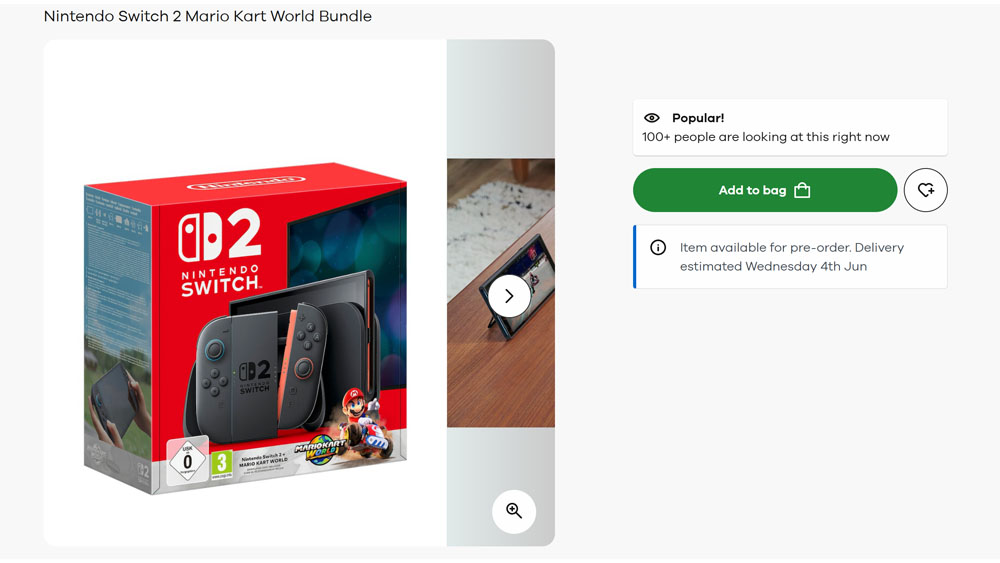
LIVE: Struggling to find Nintendo Switch 2 pre-orders? Here’s how and where to buy

0

Refresh

UK Switch 2 Preorders are Back at EE!

(Image credit: Nintendo)

EE was showing an error message when adding items to basket earlier, but Switch 2 preorders are available again. Stock seems to be fluctuating, so you might have to keep checking the different bundles, but in theory, it means there are now two possible options for pre-ordering the Switch 2 online in the UK if you haven’t received a personal invitation from Nintendo: EE and JD Williams of all places! Here are your options:

When will I receive my Nintendo Switch 2 preorder?

If you’re one of the lucky few people to have managed to preorder a Nintendo Switch 2 consoles already, Nintendo Europe says that customers in the United Kingdom, Ireland, Germany, Netherlands, Belgium, Austria, Luxembourg, France, Italy, Spain, Portugal and Switzerland will receive their consoles on the release day itself (5 June) if they ordered direct from Nintendo.

Customers in other European countries may have to wait a day or two longer.

What about Switch 2 preorders in other countries?

Nintendo’s own online stores are operating different Switch 2 preorder systems in different countries. While there’s an automatic invitation system in the UK, Ireland and other countries in Europe, Japan, Hong Kong, South Korea, Australia and New Zealand have a lottery system.

Entry is open now, and participants will be picked at random, but there are some conditions: you need to have notched up 50 hours of playtime on Nintendo Switch by 28 February and you need to have been a Nintendo Switch Online member for at least 1 year at the time of submission.

Bad news for Switch fans in Canada. Preorders there have been delayed along with those in the US. I’m not sure why since I’m assuming US tariffs wouldn’t affect the price in Canada, but there’s an air of general uncertainty. Nintendo says it still aims to release the console in both the US and Canada on 5 June.

This is NOT where I expected to find UK Switch 2 preorders!

Switch 2 preorder at JD Williams

(Image credit: Future)

Is there anywhere in the UK where Switch 2 preorders haven’t sold out? Well, it seems the only option online right now is an unlikely one: the fashion retailer JD Williams.

That might seem a strange place to preorder a Switch 2, but perhaps that’s why it hasn’t sold out.

Q: Is launch-day delivery guaranteed for Switch 2 preorders?

Top Tip: Sign up for updates

Conclusion

The Nintendo Switch 2 is a highly anticipated console, and it’s no surprise that preorders are selling out quickly. If you’re having trouble securing a preorder, be sure to keep an eye on retailer websites and sign up for updates to be notified when stock becomes available. With the release date just around the corner, it’s an exciting time for Switch fans, and we can’t wait to see what the future holds for this innovative console.

FAQs

Q: When can I preorder the Nintendo Switch 2?
A: Preorders for the Nintendo Switch 2 are available now.

Q: How do I know when my preorder will be shipped?
A: Check with your retailer for estimated shipping dates. Some retailers may offer expedited shipping options for an additional fee.

Q: Can I cancel my preorder?
A: Check with your retailer for their return and cancellation policies. Some retailers may offer a refund or exchange if you change your mind.

Q: Is the Nintendo Switch 2 compatible with all Switch games?
A: The Nintendo Switch 2 is compatible with most Switch games, but some

Lexus’s Stunning New Display

0

Lexus Unveils Revolutionary In-Car Display Design at Milan Design Week

Usually when a car brand exhibits at Milan Design Weeks, it uses the occasion as an opportunity primarily to show off its latest vehicle. This year, however, Lexus has taken a more novel approach, focussing its entire show on its brand new in-car display design. And it might just be more impressive than an entirely new car.

The Black Butterfly: A Revolutionary Cockpit Control System

Black Butterfly is the brand’s new dual-interface cockpit control system shaped, as the name suggests, like a butterfly. With two curved edges protruding outwards with touchscreen controls, and space for vast swathes of information, it offers the kind of futuristic aesthetic ones confined to sci-fi vehicle designs.

Demonstrating Versatility

To demonstrate its versatility, Lexus has enlisted several creators to use the screen itself as a canvas for exploring various possibilities for interaction as part of the show.

Designing for Safety and Intuitiveness

And while an entirely immersive display that controls both the car and its entertainment might suggest obvious safety concerns, the placement of the display atop the steering wheel of the new LF-ZC concept car is designed to help the driver keep their eyes on the road.

“The design is for the safety of the driver first,” Moto Takabatake of the Lexus design team told Creative Bloq at the exhibition. “Entertainment and everything else comes after that.”

Conclusion

Lexus’s exhibition is open to the public at Superstudio Più in Tortona, Milan’s creative district, from 8 – 13 April. For more Milan Design Week coverage, take a look at our take on ASUS’s new ‘ceraluminium’ laptops, and Ikea’s Democratic Design exhibit.

FAQs

Q: What is the Black Butterfly cockpit control system?
A: The Black Butterfly is a dual-interface cockpit control system designed by Lexus, featuring a futuristic aesthetic and curved touchscreen controls.

Q: What is the purpose of the Black Butterfly?
A: The Black Butterfly is designed to provide a more intuitive and immersive driving experience, allowing drivers to control various aspects of the car and its entertainment system.

Q: Is the Black Butterfly safe to use while driving?
A: Yes, the Black Butterfly is designed with safety in mind, with the display placed atop the steering wheel to help the driver keep their eyes on the road.

Q: When will the Black Butterfly be available in production cars?
A: The Black Butterfly is currently in concept stage, but it’s expected to become a feature in future production cars.

Salesforce’s 5-Level Framework for AI Agents Cuts Through the Hype

Every time I get a press release about AI agents, I get a slightly queasy feeling.

It is not quite as bad as that dizzy feeling I get every time someone insists on pitching me about vibe coding, nor is it the nails on a chalkboard feeling I get every time a PR rep sends me something with the word "convo" in it when asking for an interview or discussion with one of their clients.

Also: AI agents aren’t just assistants: How they’re changing the future of work today

And yet everyone is all about agents. Microsoft did a series of announcements last week that promoted its extensive use of AI agents, not just for the enterprise, but for every Windows user. Google this week did a series of announcements that included AI agents in a wide range of applications, including writing your code. Because that’s not like letting the fox guard the henhouse — not at all.

But my real concern about agents is that they seem to be over-promised because there are so many limitations in the interaction of agents between ecosystems.

Into this crazy bouillabaisse of AI promotion and innovation, Salesforce enters with a fairly impressive dose of sanity.

Salesforce is introducing its Agentic Maturity Model, a framework that defines key stages of AI agent adoption and capabilities.

This can help give us a common vocabulary when evaluating agent offerings from the various vendors who are flooding the market.

"While agents can be deployed quickly, scaling them effectively across the business requires a thoughtful, phased approach," says Shibani Ahuja, SVP of Enterprise IT Strategy at Salesforce. "Understanding the progression of Al agent capabilities is crucial for long-term success, and this framework provides a clear roadmap to help organizations move toward higher levels of AI maturity."

See, there’s a big gap between the public’s picture of an AI agent and what’s possible.

To vendors, AI agents are pretty much anything that can follow a bunch of steps using AI capabilities. This allows vendors to AI wash almost any offering, even if the true capabilities are fairly uninspired — or as in Apple’s case with Siri, largely vaporware.

But Salesforce gives us five levels:

  • Level 0: Fixed rules and repetitive tasks
  • Level 1: Information retrieval agents
  • Level 2: Simple orchestration, single domain
  • Level 3: Complex orchestration, multiple domain
  • Level 4: Multi-agent orchestration

Essentially, we’re going from basic scripts all the way up to teams of agents working in concert to accomplish complex tasks across a variety of infrastructures.

This is very helpful because then we can look at an offering and determine that, yeah, it is "agentic," but it is really not much more than a script — Level 0. Or, wow, you’re talking about an entire supply chain that’s automated, intelligent, and highly adaptive across vendors — Level 4.

Using the Agentic Maturity Model, let’s look into each of the five levels in a bit more depth.

Level 0: Fixed rules and repetitive tasks

Salesforce describes this as "automation of repetitive tasks using predefined rules, with no reasoning or learning capabilities." A great example of this is your customized email filters. There is no real AI involved whatsoever, but those rules do help get the job done.

Level 1: Information retrieval agents

Salesforce defines this as agents that go out and pull in information and, as a result of that information, recommend actions. They use the example of a troubleshooting agent, where you describe a problem, the agent does some searching, and then recommends a fix. Another example might be a shopping agent that can compare offerings and prices and make recommendations.

Level 2: Simple orchestration, single domain

Level 2 directly addresses the ecosystem issue by specifying that agentic activity take place in a siloed data environment. What this means is that all the data used is stored and available from one environment.

Level 3: Complex orchestration, multiple domain

Now we start to get to what the whole agentic AI concept promises. Salesforce describes this level as "autonomously orchestrate multiple workflows with harmonized data across multiple domains." In other words, your application will not break if you need to get data from different ecosystems or sources and integrate them using other systems.

Level 4: Multi-agent orchestration

Salesforce defines this as "Any-to-any-agent operability across disparate stacks with agent supervision."

Can we do better?

I actually quite like the five levels and Salesforce’s definition for each of them. I think they fairly represent the stages of AI agentude and what sorts of tasks they can perform. But the name of the model, Agentic Maturity Model? Well, that could be better.

Conclusion

I think this system works, and I will be referencing it as I talk about agents in the future.

FAQs

Q: What is the Agentic Maturity Model?
A: It is a framework that defines key stages of AI agent adoption and capabilities.

Q: What are the five levels of the Agentic Maturity Model?
A: Level 0: Fixed rules and repetitive tasks, Level 1: Information retrieval agents, Level 2: Simple orchestration, single domain, Level 3: Complex orchestration, multiple domain, Level 4: Multi-agent orchestration.

Q: What is the main concern about AI agents?
A: That they seem to be over-promised because there are so many limitations in the interaction of agents between ecosystems.

Q: What is the Agentic Maturity Model good for?
A: It provides a clear roadmap to help organizations move toward higher levels of AI maturity.

Opportunities and Challenges of AI for Global Energy

0

The International Energy Agency (IEA) has explored the opportunities and challenges brought about by AI with regards to global energy.

Surging Data Centre Investments

Global investment in data centres has nearly doubled since 2022, reaching half a trillion dollars in 2024, sparking concerns about escalating electricity needs. While data centres accounted for approximately 1.5% of global electricity consumption in 2024 (around 415 terawatt-hours, TWh), their local impact is far more significant. Consumption has grown annually by about 12% since 2017, vastly outpacing overall electricity demand growth.

The US leads this consumption (45%), followed by China (25%) and Europe (15%). Almost half of US data centre capacity is concentrated in just five regional clusters.

Looking ahead, the IEA projects global data centre electricity consumption to more than double by 2030 to reach approximately 945 TWh. To put that in context, that’s slightly more than Japan’s current total electricity consumption.

AI is pinpointed as the "most important driver of this growth". The US is projected to see the largest increase, where data centres could account for nearly half of all electricity demand growth by 2030. By the decade’s end, US data centres are forecast to consume more electricity than the combined usage of its aluminium, steel, cement, chemical, and other energy-intensive manufacturing industries.

The IEA’s "Base Case" extends this trajectory, anticipating around 1,200 TWh of global data centre electricity consumption by 2035. However, significant uncertainties exist, with projections for 2035 ranging from 700 TWh ("Headwinds Case") to 1,700 TWh ("Lift-Off Case") depending on AI uptake, efficiency gains, and energy sector bottlenecks.

Meeting the Global AI Energy Demand

Powering this AI boom requires a diverse energy portfolio. The IEA suggests renewables and natural gas will take the lead, but emerging technologies like small modular nuclear reactors (SMRs) and advanced geothermal also have a role.

Renewables, supported by storage and grid infrastructure, are projected to meet half the growth in data centre demand globally up to 2035. Natural gas is also crucial, particularly in the US, expanding by 175 TWh to meet data centre needs by 2035 in the Base Case. Nuclear power contributes similarly, especially in China, Japan, and the US, with the first SMRs expected around 2030.

However, simply increasing generation isn’t sufficient. The IEA stresses the critical need for infrastructure upgrades, particularly grid investment. Existing grids are already strained, potentially delaying around 20% of planned data centre projects globally due to complex connection queues and long lead times for essential components like transformers.

The Potential of AI to Optimise Energy Systems

Beyond its energy demands, AI offers significant potential to revolutionise the energy sector itself.

  • Energy supply: The oil and gas industry – an early adopter – uses AI to optimise exploration, production, maintenance, and safety, including reducing methane emissions. AI can also aid critical mineral exploration.
  • Electricity sector: AI can improve forecasting for variable renewables, reducing curtailment. It enhances grid balancing, fault detection (reducing outage durations by 30-50%), and can unlock significant transmission capacity through smarter management—potentially 175 GW without building new lines.
  • End uses: In industry, widespread AI adoption for process optimisation could yield energy savings equivalent to Mexico’s total energy consumption today. Transport applications like traffic management and route optimisation could save energy equivalent to 120 million cars, though rebound effects from autonomous vehicles need monitoring. Building optimisation potential is significant but hampered by slower digitalisation.
  • Innovation: AI can dramatically accelerate the discovery and testing of new energy technologies, such as advanced battery chemistries, catalysts for synthetic fuels, and carbon capture materials. However, the energy sector currently underutilises AI for innovation compared to fields like biomedicine.

Collaboration is Key to Navigating Challenges

Despite the potential, significant barriers hinder AI’s full integration into the energy sector. These include data access and quality issues, inadequate digital infrastructure and skills (AI talent concentration is lower in energy sectors), regulatory hurdles, and security concerns.

Cybersecurity is a double-edged sword: while AI enhances defence capabilities, it also equips attackers with sophisticated tools. Cyberattacks on utilities have tripled in the last four years.

Supply chain security is another critical concern, particularly regarding critical minerals like gallium (used in advanced chips), where supply is highly concentrated.

The IEA concludes that deeper dialogue and collaboration between the technology sector, the energy industry, and policymakers are paramount. Addressing grid integration challenges requires smarter data centre siting, exploring operational flexibility, and streamlining permitting.

While AI presents opportunities for substantial emissions reductions through optimisation, exceeding the emissions generated by data centres, these gains are not guaranteed and could be offset by rebound effects.

"AI is a tool, potentially an incredibly powerful one, but it is up to us – our societies, governments, and companies – how we use it," said Dr. Birol.

"The IEA will continue to provide the data, analysis, and forums for dialogue to help policymakers and other stakeholders navigate the path ahead as the energy sector shapes the future of AI, and AI shapes the future of energy."

Conclusion

The integration of AI in the energy sector is a complex and multifaceted issue. While AI presents opportunities for substantial emissions reductions and energy efficiency gains, it also raises concerns about energy consumption and infrastructure investments.

The IEA’s report highlights the need for deeper dialogue and collaboration between the technology sector, the energy industry, and policymakers to address the challenges and opportunities presented by AI.

By working together, we can navigate the challenges and unlock the full potential of AI to optimise energy systems and create a more sustainable and efficient energy future.

Frequently Asked Questions

* Q: What is the current global data centre electricity consumption?
A: Approximately 415 terawatt-hours (TWh) in 2024.
* Q: What is the projected growth in data centre electricity consumption by 2030?
A: More than double, reaching approximately 945 TWh.
* Q: Which region leads in data centre consumption?
A: The US, accounting for 45% of global data centre consumption.
* Q: What is the potential impact of AI on energy consumption in the US?
A: Data centres could account for nearly half of all electricity demand growth by 2030, and consume more electricity than the combined usage of its aluminium, steel, cement, chemical, and other energy-intensive manufacturing industries by the decade’s end.
* Q: What is the potential of AI to optimise energy systems?
A: AI can improve forecasting for variable renewables, reduce curtailment, enhance grid balancing, and unlock significant transmission capacity through smarter management.

Nex Playground: One of the Most Interestingly Designed Games Consoles

0

Nex Playground is Gaming Cubed

Nex Playground isn’t trying to go head-to-head with Switch 2, PS5, or Xbox Series S/X. Instead, it’s a little-known games console that reimagines Nintendo Wii-like active gaming without a controller. This small, unassuming cube is a designer’s games console that feels like a callback to the Atari heyday with cutting-edge motion capture.

Nex Playground is Gaming Cubed

This small, playful cube isn’t aiming to compete with PS5 Pro. It’s minimalist design and pastel coloring feels more like a child’s toy than a high-spec games console. The games are simple and designed around no-controller activities – bowling, tennis, dancing, and arcade knockabouts. They won’t compete with Switch 2 games like Mario Kart World, but they’re engaging and satisfyingly physical.

Design Makes a Difference

Aesthetically, Nex Playground is a little different, but it’s how you use the console that the team hopes they’ll make a difference. Nintendo Wii and Switch still rely on a controller to control the game or interact, but Nex Playground is just motion control – I can slash and swing by using my arms and even make a character (a Teenage Ninja Turtle) jump by, well… jumping. There are no remotes, no wearables, just the console’s camera and motion capture tech inside the cube.

The games are very simple, by design. But the blend of arcade directness and fitness apps as well as brands like Paramount, DreamWorks Animation, and Mattel demonstrate Nex understands its user – young children and parents who want to squeeze in a boxercise class before the school run (found in Nex’s own BoxFlow Fitness).

Conclusion

Nex Playground is a unique, tiny, and innovative games console that offers a fresh take on gaming experience. It’s designed to be a family-friendly console that promotes active gaming and healthy screen time habits. With its simple and intuitive design, Nex Playground is a great alternative for families who want to spend quality time together while having fun.

Frequently Asked Questions

Q: What is Nex Playground?
A: Nex Playground is a small, innovative games console that offers a fresh take on gaming experience. It’s designed to be a family-friendly console that promotes active gaming and healthy screen time habits.

Q: What kind of games does Nex Playground offer?
A: Nex Playground offers simple and fun games that are designed around no-controller activities – bowling, tennis, dancing, and arcade knockabouts.

Q: Does Nex Playground require a subscription?
A: Yes, Nex Playground offers a subscription model, with a flat annual fee and new games added monthly.

Q: Is Nex Playground suitable for young children?
A: Yes, Nex Playground is designed to be a family-friendly console that is suitable for young children. It’s simple and intuitive, making it easy for kids to use.

Q: Can I take Nex Playground with me?
A: Yes, Nex Playground comes with a carrying case, making it easy to take with you on the go.

OpenAI Sues Elon Musk Over Alleged Plot to Discredit Its AI Technology

OpenAI Launches Legal Counteroffensive Against Elon Musk and xAI

OpenAI has launched a legal counteroffensive against its co-founder, Elon Musk, and his competing AI venture, xAI. The legal documents filed yesterday accuse Musk of orchestrating a "relentless" and "malicious" campaign designed to "take down OpenAI" after he left the organization years ago.

Origin Story of OpenAI and the Departure of Elon Musk

The legal documents recount OpenAI’s origins in 2015, stemming from an idea discussed by current CEO Sam Altman and President Greg Brockman to create an AI lab focused on developing artificial general intelligence (AGI) – AI capable of outperforming humans – for the "benefit of all humanity." Musk was involved in the launch, serving on the initial non-profit board and pledging $1 billion in donations.

Restructuring, Success, and Musk’s Alleged ‘Malicious’ Campaign

Facing escalating costs for computing power and talent retention, OpenAI restructured and created a "capped-profit" entity in 2019 to attract investment while remaining controlled by the non-profit board and bound by its mission. This structure, OpenAI states, was announced publicly and Musk was offered equity in the new entity but declined and raised no objection at the time.

OpenAI highlights its subsequent breakthroughs – including GPT-3, ChatGPT, and GPT-4 – achieved massive public adoption and critical acclaim. These successes, OpenAI emphasizes, were made after the departure of Elon Musk and allegedly spurred his antagonism.

Musk’s Alleged ‘Malicious’ Campaign

The filing details a chronology of alleged actions by Elon Musk aimed at harming OpenAI:

  • Founding xAI: Musk "quietly created" his competitor, xAI, in March 2023.
  • Moratorium call: Days later, Musk supported a call for a development moratorium on AI more advanced than GPT-4, a move OpenAI claims was intended "to stall OpenAI while all others, most notably Musk, caught up."
  • Records demand: Musk allegedly made a "pretextual demand" for confidential OpenAI documents, feigning concern while secretly building xAI.
  • Public attacks: Using his social media platform X (formerly Twitter), Musk allegedly broadcast "press attacks" and "malicious campaigns" to his vast following, labeling OpenAI a "lie," "evil," and a "total scam."
  • Legal actions: Musk filed lawsuits, first in state court (later withdrawn) and then the current federal action, based on what OpenAI dismisses as meritless claims of a "Founding Agreement" breach.
  • Regulatory pressure: Musk allegedly urged state Attorneys General to investigate OpenAI and force an asset auction.
  • "Sham bid": In February 2025, a Musk-led consortium made a purported $97.375 billion offer for OpenAI, Inc.’s assets. OpenAI derides this as a "sham bid" and a "stunt" lacking evidence of financing and designed purely to disrupt OpenAI’s operations.

OpenAI’s Counterclaims

Based on these allegations, OpenAI asserts two primary counterclaims against both Elon Musk and xAI:

  • Unfair competition: Alleging the "sham bid" constitutes an unfair and fraudulent business practice under California law, intended to disrupt OpenAI and gain an unfair advantage for xAI.
  • Tortious interference with prospective economic advantage: Claiming the sham bid intentionally disrupted OpenAI’s existing and potential relationships with investors, employees, and customers.

Conclusion

The counterclaims mark a dramatic escalation in the legal battle between the AI pioneer and its departed co-founder. While Elon Musk initially sued OpenAI alleging a betrayal of its founding non-profit, open-source principles, OpenAI now contends Musk’s actions are a self-serving attempt to undermine a competitor he couldn’t control.

Frequently Asked Questions

Q: What is the main dispute between OpenAI and Elon Musk?
A: The main dispute is over OpenAI’s alleged "malicious" campaign against Musk’s xAI.

Q: What are the allegations against Elon Musk?
A: The allegations include founding xAI, making a "moratorium call" to stall OpenAI development, demanding confidential records, making public attacks, and filing lawsuits.

Q: What is the purpose of OpenAI’s counterclaims?
A: The purpose is to stop Musk’s alleged "unlawful and unfair action" and seek compensation for damages already caused.

Q: What is the next step in this legal battle?
A: The case will proceed to court, where OpenAI and Musk will present their cases and evidence.

Lua for Beginner Game Devs

0

Lua and LÖVE are a Dream Team for Artists

Game Development with Ease

Although the game engines Unity, Unreal Engine, and Godot tend to dominate in the indie games space, there are other options available for artists looking to make games themselves. The LÖVE engine, which utilizes the easy-to-learn Lua programming language, can be a fantastic way to get started.

The Power of Lua

The Lua programming language was originally developed in Brazil in 1993 with a focus on speed, portability, and ease of use. LÖVE was later introduced in 2008 as a free, open-source engine based around Lua. Max Cahill, a programmer and artist, is a huge fan of Lua’s approachability. "Lua is really simple," he says. "Like, staggeringly simple."

A Dream Team for Artists

Lua and LÖVE are a dream team for artists. "Lua is used as the scripting language for so many AAA games," Max explains. "In fact, you’ll find pockets of Lua code in everything from World of Warcraft to the Call of Duty series. But the core game isn’t written in it, because for a big, serious game with a big serious company, it’s just not serious enough."

LÖVE: A Free, Open-Source Engine

LÖVE is primarily designed around 2D games and lacks the built-in editors you’ll find in Unity or Unreal for dealing with 3D objects. However, there is another open-source variant of the engine called LÖVR that’s specifically designed for VR and includes tools for dealing with things like 3D physics and VR controllers.

For Absolute Beginners

For absolute beginners, Max recommends starting with no-code software to learn the basic principles of programming. "You can even use no-code tools to make commercial games, as demonstrated by Citizen Sleeper 2." Once you’re ready to try some proper coding, Max recommends starting with PICO-8, which is like a fantasy console with a limited display and color palette.

Tutorials for Beginners

For beginners, there are tutorials that can guide you through the entire process of making a simple game. "It’s not as approachable as something like Twine or Bitsy or any of those low-to-no-code tools," Max warns. "But it’s good for anyone, as long as you’re willing to learn a bit of programming."

Conclusion

Lua and LÖVE can be a powerful combination, despite their simplicity. "You can go as deep as you want with the programming," Max concludes. With LÖVE, you can create games quickly and easily, without having to worry about complex 3D graphics or physics. So, are you inspired to create a game? Let us know in the comments below.

FAQs

Q: What is LÖVE?
A: LÖVE is a free, open-source game engine that uses the Lua programming language.

Q: What is Lua?
A: Lua is a programming language that was originally developed in Brazil in 1993 with a focus on speed, portability, and ease of use.

Q: How easy is it to learn Lua?
A: Lua is known for its simplicity and ease of use. "Lua is really simple," Max Cahill says. "Like, staggeringly simple."

Q: What are some of the benefits of using LÖVE?
A: LÖVE is designed for 2D games and is easy to use, making it a great option for beginners. It’s also free and open-source, which can be a big advantage for indie game developers.

AI Insurtech Ominimo Secures First Investment at $220M Valuation

0

How Ominimo Attracts Top Talent in the Insurance Industry

The Challenges of Hiring Top Talent

How do you get talented engineers to work for a startup in a mundane field at a time when more exciting companies are paying well and hiring aggressively? One insurance startup, Ominimo, has found a way to attract top talent by giving engineers the license to apply their skills and reinvent how the field works.

Ominimo’s Approach

Launchedin 12 months ago, Ominimo believes it has found a different and better approach to understanding and pricing risk. The company is already profitable and growing fast, with 300,000 policies signed up in its first market of Hungary. To fuel its next stage of life, Ominimo is taking its first outside investment from a strategic backer, Zurich Insurance Group.

Investment and Valuation

TechCrunch understands from sources that Zurich is making a €10 million equity investment (around $11 million) for 5% of the company, valuing Ominimo at €200 million ($220 million). Neither Ominimo nor Zurich commented on the amount invested, but both have confirmed the valuation.

The Opportunity

Ominimo’s funding comes at a time when one of the most well-known and well-capitalized insurance startups in Europe, WeFox, is selling off parts of its business and picking up lifeline financing to keep from going under. This serves as both a cautionary tale about how to grow an insurance business and a clear opportunity.

Ominimo’s Business Model

Ominimo is already profitable in its current business, but it’s a modest effort. The company is active in just one market, Hungary, and focuses on one kind of insurance, car insurance for consumers. The plan is to replicate its model to more geographies and categories. Ominimo will expand into more than 10 new markets, starting with Poland, Sweden, and the Netherlands, using Zurich as its risk carrier.

Using AI and Big-Data Analytics

The crux of what Ominimo is doing is applying some AI-based reasoning around big-data analytics. When building and pricing an insurance quote, a traditional insurance company might use five or six main parameters to determine a price. A newer insurer might add another 10 or 15 parameters to that. Ominimo takes all of these details, plus population density and more, into account when it’s going through its calculations.

Competitive Advantage

Ominimo’s track record speaks for itself, according to CEO Dusan Komar. "I think what really matters is actually performance in the market, so if you compare our performance to Lemonade’s, you will actually see the difference," he said.

Key to Attracting Top Talent

Giving talent a place to do the kind of work they want to be doing is key to attracting and retaining key people, according to Komar. "We have eight medalists from mathematics and physics olympiads among our data science team," he said. "These are really brilliant young minds who now, for the first time, get to deploy their full potential on a global scale."

Conclusion

Ominimo’s approach to attracting top talent in the insurance industry is a refreshing take on traditional recruitment strategies. By giving engineers the license to apply their skills and reinvent how the field works, the company has been able to attract and retain key talent.

FAQs

Q: What is Ominimo’s business model?
A: Ominimo is an insurance startup that uses AI and big-data analytics to offer car insurance to consumers in Hungary and plans to expand to more geographies and categories.

Q: How does Ominimo use AI and big-data analytics?
A: Ominimo uses AI-based reasoning around big-data analytics to take into account a wide range of parameters when building and pricing insurance quotes.

Q: What is Ominimo’s competitive advantage?
A: Ominimo’s track record speaks for itself, with a loss ratio below the market average and a market share of 7% in Hungary.

Q: How does Ominimo attract top talent?
A: Ominimo gives engineers the license to apply their skills and reinvent how the field works, attracting and retaining key talent.