Home Blog Page 10

Generate single title from this title Data Science • AI • Advanced Analytics in 100 -150 characters. And it must return only title i dont want any extra information or introductory text with title e.g: ” Here is a single title:”

Write an article about

The AI boom is creating winners beyond chip manufacturers and cloud providers. One of the biggest winners may be an industry few expected: utilities. As developers pour hundreds of billions of dollars into AI data centers, the companies that generate and deliver electricity are suddenly in high demand. This is driving an unprecedented wave of mergers and acquisitions across the power sector.

It’s easy to see why. A single hyperscale AI campus can consume as much electricity as a small city. However, utilities need years (not months) to build the generation and transmission capacity to support that kind of meteoric growth. 

The scramble for power assets has already helped drive more than $200B in utility mergers and acquisitions. Companies and infrastructure investors are racing to secure the capacity needed to support the next generation of AI facilities.

Utilities weren’t exactly seen as growth stocks. Not until now. Yes, they generated steady cash flows and also paid dependable dividends, but they rarely found themselves at the center of Wall Street’s attention. However, AI is changing that. 

(HappyEva/Shutterstock)

For the first time in decades, many utilities are looking at a sustained new source of electricity demand – and investors have noticed. There is little doubt left that AI will reshape the power sector. The more interesting question is which companies can deliver the power AI data centers need – and turn that demand into years of stronger earnings. 

Could the next Nvidia be a power generation company? Probably not. But the comparison isn’t as far-fetched as it once seemed. But what has really changed the equation? AI didn’t invent electricity demand. However, it dramatically changed the scale and the urgency.

Utilities that once expected predictable (and often slow) growth are now fielding requests for capacity that would have seemed unrealistic just a couple of years ago. However, there is a catch. 

Adding more generation and securing all the regulatory approvals can take years. This is exactly what is making existing power assets far more valuable because they can meet demand today. 

The urgency is reflected in spending. Some of the biggest players in the tech industry, such as Amazon, Microsoft, Alphabet and Meta are expected to spend more than $400B this year on AI infrastructure. It should not be surprising that much of the capital is being allocated for expanding data center capacity. 

The surge in utility dealmaking is already reshaping the industry’s record books. According to Deloitte, utility mergers and acquisitions reached $203.6B during the first five months of 2026. That figure already exceeds the total value of deals announced in all of 2025. 

One of the biggest transactions was NextEra Energy’s proposed acquisition of Dominion Energy – a $66.8B deal that reflects how rapidly AI has become intertwined with the power sector.

(Shutterstock AI Image)

The strategic logic is hard to miss. Dominion serves Northern Virginia, home to the world’s largest concentration of data centers and one of the fastest-growing electricity markets anywhere on the globe. The utility has nearly 51 gigawatts of contracted data center capacity, with customers that include Alphabet, Amazon, Microsoft, Meta, Equinix, CoreWeave and CyrusOne. 

For NextEra, the acquisition goes beyond just adding customers. It provides access to one of the most important markets in the AI economy while dramatically expanding its ability to serve future data center growth.

We see the same trend in other regions around the globe. Global Infrastructure Partners, now owned by BlackRock, and Swedish investment firm EQT agreed to acquire AES in a deal valued at roughly $33B. This underscores growing investor appetite for power generation assets as electricity demand accelerates. 

There are several other examples of the M&A boom in the utilities market. Just yesterday, it was announced that Brookfield Asset Management expanded its financing partnership with Bloom Energy from $5B to $25B to help deploy power systems for AI infrastructure projects.

Admittedly, none of these transactions can be attributed solely to AI. Electrification, manufacturing growth and grid modernization are also driving investment. But AI has been the real catalyst behind the growth in demand. It has changed how companies value power generation and long-term growth opportunities.

Time has also emerged as a critical element to this investment cycle. Tech companies are racing to bring AI capacity online now –  not just in the future. Utilities measure new generation projects in years rather than months. That mismatch has transformed existing power assets into strategic assets. 

Utilities with available generation capacity and access to fast-growing data center markets suddenly find themselves in an enviable position. This has given investors another reason to pursue acquisitions now rather than wait for new infrastructure to be built. After all, without enough electricity, even the world’s most powerful AI chips are just expensive pieces of silicon.

.Organize the content with appropriate headings and subheadings ( h2, h3, h4, h5, h6). Include conclusion section and FAQs section with Proper questions and answers at the end. do not include the title. it must return only article i dont want any extra information or introductory text with article e.g: ” Here is rewritten article:” or “Here is the rewritten content:”

MIT student teams win top honors in NASA competition | MIT News

0

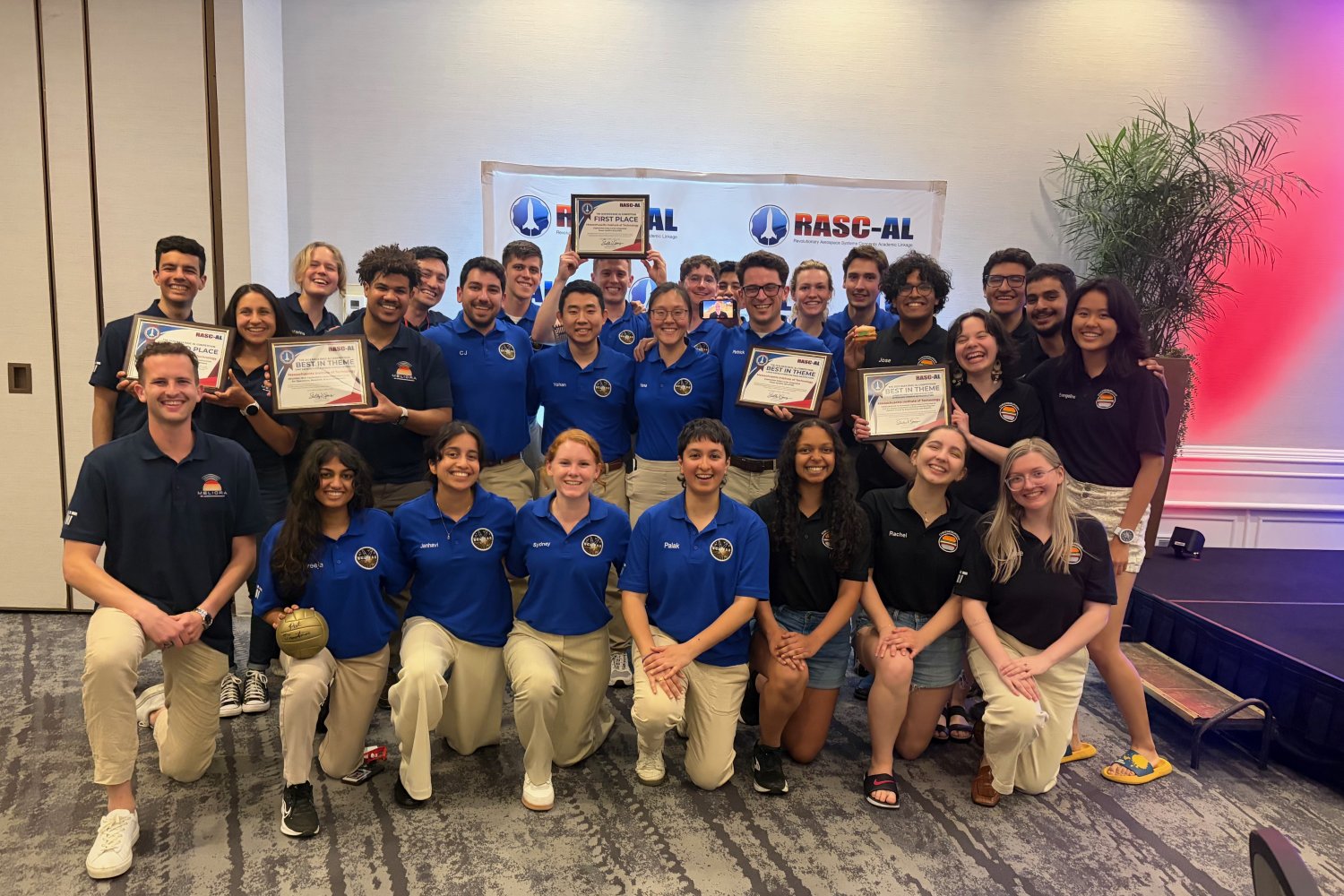
Three teams comprising 35 students across eight different MIT departments and Wellesley College have been at work since fall 2025, designing critical early infrastructure elements that a moon base would require. This June, their designs were recognized with five awards at NASA’s 2026 Revolutionary Aerospace Systems Concepts — Academic Linkage (RASC-AL) Forum. 

Among 75 submissions and 14 finalists, the MIT teams earned first and second place in the competition, as well as three best-in-theme awards. The Exploration-Class Lunar Integrated Power SystEm (ECLIPSE) team won first place overall and first in its theme category, lunar surface power. The communications and navigation constellation team, MELIORA, won second place overall and first in its theme category on Mars communications, position navigation and timing, which included a strategy for proving the design at the moon. And CHEESEBURGER, a campaign to mine and process lunar regolith into oxygen, metals, and bricks, won first in its theme category, lunar technology demonstrations. 

“NASA spent the spring telling the world what critical early infrastructure their upcoming permanent moon base will need,” says George Lordos, a research scientist and lecturer in the Department of Aeronautics and Astronautics (AeroAstro) and in System Design and Management (SDM), who co-advised all three teams. “Over 30 MIT students spent this academic year designing much of the moon base — systems for generating, storing, and distributing power; robust systems for positioning, navigating, and communicating; and early experiments with essential technologies to live sustainably off the moon’s own dirt.”

A power grid for surviving lunar night and winter

The hardest constraint on NASA’s moon base is staying powered, because a failure in life-support power would doom the crew within hours. ECLIPSE is a reference design for a lunar grid engineered to stay up for more than 99.995 percent of the time — fewer than 27 minutes of downtime a year in the worst-case scenario, the standard demanded of the most critical data centers on Earth. It pairs two power sources that fail in different ways: banks of 20-meter solar masts in the sunlit highlands near the south pole, and, for the roughly 18-day stretch each year when the sun drops below the horizon, a pair of buried 20 kilowatt microreactors the team named CARROT, (Compact Autonomous Regolith-shielded Reactor Operating for Ten years). The CARROT reactor, a novel design developed independently by the ECLIPSE team, ended up being similar in design to NASA’s SR-1 reactor for the 2028 mission to Mars, both aiming to maximize speed-to-deployment. 

“Burying each reactor 1.3 meters down shrinks the keep-out zone from kilometers to meters, so crews can work nearby, and it saves tons on required shielding mass,” says Taylor Hampson, a PhD student in the Department of Nuclear Science and Engineering and ECLIPSE team co-lead.

The full design delivers an initial 120 kilowatts using a grid of buried aluminum cables and shielded direct-current power equipment. Laser-equipped rovers provide “Frontier Power” capability, beaming up to 10 kilowatts to sites beyond any cable, from a shadowed crater to a new outpost before its own grid exists. Patrick Riley, a graduate student in the Department of AeroAstro and ECLIPSE team co-lead, says the design’s point is to put reliability ahead of mass: “We sized it so the most likely failures never reach the moon base inhabitants, and so it scales from a first crew of six up to industrial demand without interrupting a commercial lunar economy.”

A network for exploring the moon and Mars, and calling home

MELIORA acts as the base’s relay and GPS. Although RASC-AL framed the communications, positioning, navigation, and timing competition sub-theme around Mars, the team also proposed a plan to validate their design in lunar geometry first, in step with the agency’s strategy to prove technology on the moon before extending it to Mars. To find the best design, the team ran a trade study across 5,764 candidate constellation geometries. The result grows from an initial three satellites to 23, returns more than 100 megabits per second to Earth-orbiting data networks over free-space optical links, and pins a user’s position to within 10 meters. For the Mars design, four relay satellites parked at gravitationally stable Lagrange points keep the link alive even during solar conjunction, the weeks when the sun sits between the two worlds and ordinarily cuts communication. On the surface, a user needs only a portable radio terminal and a chip-scale atomic clock — a timekeeper the size of a matchbox. 

“You should never have to think about whether the network is there — it just is, the way you don’t think about a cell tower,” says Ekaterina Tiukhtikova, an undergraduate studying both AeroAstro and electrical engineering and computer science (EECS), and a MELIORA team co-lead. “We put almost all the complexity up in orbit, so everything on the surface stays portable and simple,” adds Clayton Lieberman, a graduate of the SDM program and team co-lead who wrote his thesis on MELIORA.

Making oxygen, metal, and bricks from lunar dirt

After power and communications, the third essential pillar of a lunar base is living off the land. The moon’s own regolith can supply oxygen to breathe and burn, metal to build with, and shielding to hide behind for protection from deadly radiation. CHEESEBURGER is a campaign of five robotic payloads that prove the supply chain one link at a time, followed by integration of the five into the first end-to-end lunar industry. 

The payloads carry a kitchen’s worth of names: SWISS prospects for the richest ore, BRIOCHES digs and sorts the regolith, BACON casts it into bricks, GRILLED MEAT melts it electrically to pull out metal and oxygen, and AVOCADO is the robotic builder that stacks the products into structures, including interlocking Moon BRICCSS that shield a habitat from radiation. The food theme was born during a January team outing at Sandwich, Massachusetts. “Naming the prospector SWISS and the metal extractor GRILLED MEAT turned a wall of acronyms into something the whole team could enjoy,” says Cesar Meza, a graduate student in AeroAstro and CHEESEBURGER co-lead. “It sounds like a joke until you see that each acronym clearly describes a serious piece of hardware doing one job in the pipeline.”

Thirty students, eight departments, and three teams for one moon base

More than 30 students contributed across the teams, from AeroAstro, SDM, Nuclear Science and Engineering (NSE), EECS, Mechanical Engineering (MechE), the Technology and Policy Program, the MIT Sloan School of Management, and Earth, Atmospheric and Planetary Sciences (EAPS), along with a student from Wellesley College. Several student mentors and faculty advisors worked across more than one team, which is why ECLIPSE’s grid is sized to power CHEESEBURGER’s processing, CHEESEBURGER’s regolith handling is used to bury and shield ECLIPSE’s grid, and all three projects are designed to translate moon base lessons for a future mission to Mars. The teams were advised by Olivier de Weck, the Apollo Program Professor of Astronautics and Engineering Systems and interim department head of AeroAstro, who led ECLIPSE; Kerri Cahoy, the Sheila Evans Widnall Professor of Aerospace Engineering, who led MELIORA; Jeffrey Hoffman, professor of the practice in AeroAstro and a former NASA astronaut, who led CHEESEBURGER; Koroush Shirvan, Atlantic Richfield Career Development Professor in Energy Studies in Nuclear Science and Engineering, who co-advised ECLIPSE; and Lordos, who co-advised all three. Much of the day-to-day mentorship work is led by PhD student volunteers and runs through the MIT Space Resources Workshop, which Lordos founded in 2019.

“The winning teams demonstrated how academic innovation can support Artemis mission goals,” says Daniel Mazanek, RASC-AL program sponsor and senior space systems engineer at NASA’s Langley Research Center, in NASA’s announcement of the awards. “Their work highlights the important role student research plays in shaping future space exploration.”

NASA expects astronauts living on the lunar surface for months at a time by the early 2030s — the window ECLIPSE, MELIORA, and CHEESEBURGER were designed for. The picture the three teams had worked toward is unified: a crew at the lunar south pole, the lights on through the winter night, the network always up, and the first oxygen and bricks coming out of the ground beneath them. 

“A permanent base is no longer a slide in a strategy deck; NASA begins landing the first elements in 2027,” says de Weck. “Studies like these three let the agency see, before the concrete sets, how its power, communications, and resource choices depend on one another. That is precisely when independent, integrated architecture work has the most influence on the real plan.”

RASC-AL is administered by the National Institute of Aerospace on behalf of NASA. MIT has a long record in NASA’s student design competitions, with recent winning teams including the  HYDRATION Mars water production system, the Pale Red Dot Mars homesteading architecture, the deployable lunar tower MELLTT, the MARTEMIS lunar Mars analog campaign, the MAPLE autonomous lunar robot pathfinding system, the CERBERUZ lunar recycling project, and the THERMOS cryogenic fluid management system. This work was supported in part by NASA, the Massachusetts Space Grant, MIT AeroAstro, and the MIT Space Resources Workshop. One student was supported by a NASA Space Technology Graduate Research Opportunity Fellowship.

The full teams:

ECLIPSE — Team leads: Taylor Hampson (graduate student, Nuclear Science and Engineering) and Patrick Riley (graduate student, AeroAstro). Reactor team: Liliana Arias, Sydney Menne, Julian Rocher and Pavel Shilenko (graduate students, NSE). Power management and distribution team: Evrard Constant and Mary Foxen (graduate students, AeroAstro), Janhavi Joglekar and Asma Patel (undergraduate students, AeroAstro). Solar and architecture team: Zachary Dawson (graduate student, System Design and Management), Sreeja Akula and Ian Jimenez (undergraduate students, AeroAstro; EAPS), Yohan Lim (graduate student, AeroAstro/Technology and Policy Program), CJ Taglienti (graduate student, AeroAstro/MBA). Student co-advisors: Yana Charoenboonvivat, Lanie McKinney (AeroAstro), Palak Patel (MechE). Industry mentor: Sully Marigliano-Crevecoeur (Technetics). Faculty: Olivier de Weck (lead) and Jeffrey Hoffman (AeroAstro), George Lordos (AeroAstro and SDM), and Koroush Shirvan (NSE).

MELIORA — Team leads: Clayton Lieberman and Katiyayni Balachandran (System Design and Management), Ekaterina Tiukhtikova (undergraduate, AeroAstro and EECS), Celvi Lisy (AeroAstro). Team members: Thomas Harrington and Zachary T. Barnes (SDM), Asael Acosta (undergraduate, AeroAstro). Student co-advisor: Lanie McKinnery (AeroAstro). Faculty: Kerri Cahoy (lead), Jeffrey Hoffman and Olivier de Weck (AeroAstro), and George Lordos (AeroAstro and SDM).

CHEESEBURGER — Team leads: Cesar Meza (graduate student, AeroAstro) and Elizabeth Romero (undergraduate, AeroAstro). Team members: Rachel Dunphy, Shreya Kothnur, Hailey Polson (undergraduates, AeroAstro), Christopher Kwon, Jose Soto, Lanie McKinney (graduate students, AeroAstro), Marvin Martinez (undergraduate, MechE), Ananda Santos Figueiredo (graduate student, Technology and Policy Program), Evangeline Haiqi Wang (undergraduate, Computer Science and Psychology, Wellesley College). Faculty: Jeffrey Hoffman (lead) and Olivier de Weck (AeroAstro), and George Lordos (AeroAstro and SDM).

5 Design Considerations for Effective Employee Recognition Programs

0

Most employee recognition programs start with good intentions—but quietly fail to deliver. Not because leadership doesn’t care, but because recognition gets designed in ways that slow it down, limit who can participate, or make it feel generic.

Before we dive in, I want you to sit with something for a second.

Think about a time you worked really hard on something. Maybe you made significant progress on a challenging project, or maybe it was your service anniversary. Something happened and it went unnoticed. Maybe it even caused you to leave an organization because you felt like your work was consistently being ignored?

That experience is more common than we’d like to admit. According to our research, lack of recognition is a top three reason employees leave their jobs. Two in three employees wants more recognition for the great work they do. And employees who feel recognized are 2.7x more likely to be highly engaged. Organizations know recognition matters—but they’re not set up to do it well.

The good news: these are design problems. And design problems have solutions.

Why most employee recognition programs fall short  

At Quantum Workplace, most organizations we work with understand that employees need to feel valued, and they want their employees to feel valued. The intent is always there.

But when we look at how employee recognition actually shows up in the day-to-day, there are often gaps—and these gaps aren’t necessarily due to one big failure. It’s a series of small design problems that add up to having far less impact than we want to see.

Recognition coming too late is one of the most common. Someone did really great work at the beginning of January, but they don’t hear about the impact until a quarterly review in April. That moment is already gone. Manager-only recognition limits who and what gets seen. Recognition without context—without describing the impact, without explaining why it mattered—just doesn’t land.

Because of all of this, sometimes we start designing employee recognition programs in ways that end up unintentionally holding it back. The program gets slow, infrequent, and over-controlled.

The 5 design considerations that transform employee recognition  

When we study the organizations that are really turning recognition from a program into a culture, they’re making very deliberate design choices. Here’s what those choices look like.

1. Recognize what matters most

This is probably the most foundational one. The first design choice is: what do we actually want recognized inside our workplace?

Recognition doesn’t just make people feel good—that’s part of it. But it also teaches people what matters. Every time we recognize someone, we send a signal to the entire organization: this is what great work looks like, these are the behaviors we want to see repeated.

We recommend anchoring your recognition program to your organization’s core values. This brings what’s important to life and illustrates what good looks like. Along with meaningful milestones: service anniversaries, goal completions, moments in the employee lifecycle that deserve to be marked.

But here’s what I also want to call out: this isn’t just about what we’re recognizing. It’s also the why. The context, the story behind the recognition—that’s equally important. “Thanks for doing great work” doesn’t tell me anything as an employee. I need to understand what the work was and what impact it had.

That’s the barrier I hear most often. People want to give recognition, but they have a hard time finding the words. The good news is that well-designed employee recognition software can make that much easier.

The practical application:

  • Highlight specific behaviors and outcomes.
  • Pair everyday recognition with meaningful milestones or experiences in the employee lifecycle.
  • Always include specific written context explaining the behavior and why it matters.


2. Make recognition meaningful and specific to the person

As organizations grow, processes naturally get more standardized. That’s necessary. But when it happens with recognition—where individual preferences vary so much—recognition can start to feel generic. And generic doesn’t feel meaningful.

I knew an organization where the only reward available to give employees was a Starbucks gift card. Imagine someone who’s not a coffee drinker just quietly collecting those—”oh great, I suppose this is recognition.” It misses the mark. The employee recognition program was designed for convenience, not for people.

When designing for scale, you also need to design for individuality. Allow employees to opt in or opt out of certain types of recognition. Some people love being celebrated on their birthday. Others are genuinely horrified. Let them choose.

For global organizations especially, small details matter. If there’s a point currency in your recognition software, avoid naming it “bucks” or “dollars.” Something that doesn’t resonate for your international employees quietly signals that the program wasn’t really designed with them in mind.

The practical application:

  • Offer real reward choice.
  • Write messages that feel personal—not templated.
  • Name your reward currency in a way that actually fits your culture, and plan for your full employee population.


3. Make recognition easy, frequent, and in the flow of work

If we get those first two points right, something shifts. We actually want more recognition, because frequent recognition means we’re consistently recognizing great work and making it feel meaningful. That creates a new challenge: how do we get more of it happening?

The answer is removing friction.

Budgets that refresh monthly help a lot. If I can give recognition without mentally calculating whether I’ll have enough left for October, recognition flows more naturally. Integrating recognition into Slack and Teams—where work already happens—removes an extra step that most people won’t bother with. And automated reminders for anniversaries and milestones mean managers don’t have to track these things separately.

Pairing employee recognition with rewards also increases frequency. We consistently see more recognition happening when both are in play. And if we’ve already designed for meaningful, personal recognition—that momentum is a good thing.

The practical application:

  • Set a budget built for frequency and allocate by role.
  • Use AI and automation to prompt the right moments.
  • Pair recognition with rewards to build momentum and reinforce the behaviors that matter.


4. Allow your recognition to scale visibly across the organization

We want employee recognition to be part of how we operate—not a program we run. And for that to happen, everyone needs to feel ownership of it.

That means recognition can’t just come from managers. When it only flows top-down, we’ve eliminated most of the organization from participating in building this culture. Managers set the tone—and the previous design considerations matter a lot for that. But everyone needs a role.

What I also want people to hear: recognition isn’t just something the individual receiving it feels. Others see it. They learn from it. They start to understand what great work looks like across the organization, not just in their own team.

That visibility is what transforms recognition from an instance into a daily norm.

The practical application:

  • Open recognition to everyone, not just managers. Make it public and easy to see.
  • Have leaders model recognition visibly and consistently—that signals it as a cultural expectation, not a nice-to-have.
  • Let others boost or comment on recognition when the impact was bigger than one moment.


5. Design recognition as a leadership signal

This is where employee recognition moves beyond something we do and becomes leadership intelligence and insight.

Recognition can tell us:

  • Where is great work happening most often?
  • Who is consistently contributing in meaningful ways?
  • Where might recognition be missing altogether?

That last question matters—because absence of recognition doesn’t necessarily mean absence of great work. It might mean teams aren’t being seen.

When managers have access to these patterns, they make better decisions in coaching conversations, development planning, and talent reviews. Recognition stops being a cultural add-on and starts actively informing how leaders lead.

The practical application:

  • Give leaders access to recognition trends—density, gaps, emerging contributors.
  • Reveal high-impact contributions across teams.
  • Nudge managers to recognize meaningful contributions based on signals across performance, development, and engagement data.


From recognition program to a thriving culture 

What I keep coming back to: we need to shift from building a program to building a culture of recognition.

Recognition is a top driver of employee retention and engagement. Feeling valued is one of the four conditions teams need to thrive—alongside feeling aligned, empowered, and growing. There’s a real gap between what HR intends for recognition and what it actually delivers day-to-day. The right design closes it.

A employee recognition program is something HR manages periodically. A culture is something everyone owns every day. One produces data. The other produces connection—and connection is what keeps your best people engaged, performing, and committed to the work.

Quantum Workplace’s employee recognition software is built around these principles. From peer-to-peer recognition and meaningful rewards to automated milestones and real-time analytics, it gives leaders the tools to make recognition consistent, visible, and connected to the work that drives results. Because when employees feel genuinely valued, great teams don’t just perform—they stay.


Agibot reaches new milestone as its 15,000th humanoid robot rolls off production line

0

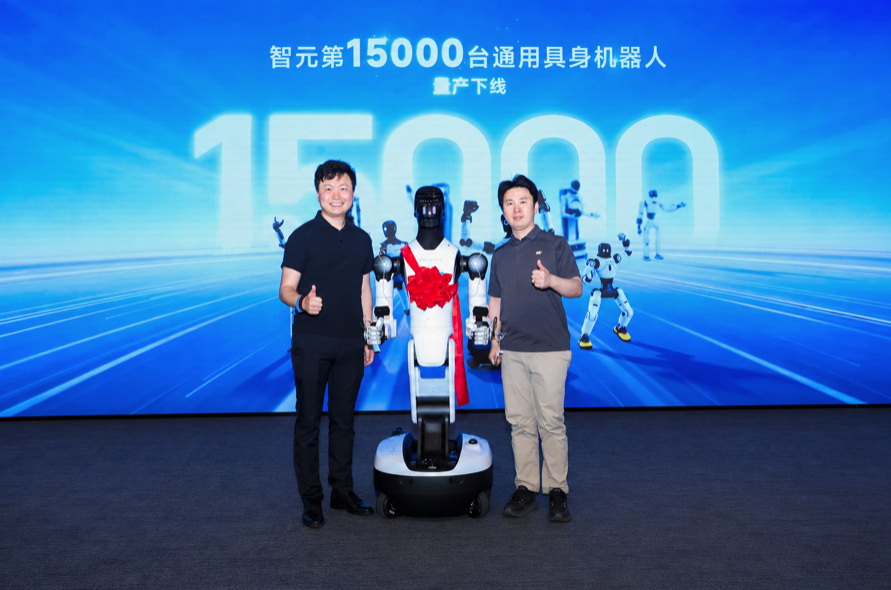
Agibot, a global leader in embodied AI and robotics, has announced that its 15,000th robot has officially rolled off the production line. The milestone unit is the Agibot G2, an industrial-grade embodied task robot designed for industrial and real-world operational scenarios. Following the rollout of its 5,000th and 10,000th robots, this latest milestone marks another […]

How AI Navigation is Improving the Performance of Robotic Pool Cleaners

0

Robotic pool cleaners used to be judged mostly by suction, brushes, and how much debris they could collect. Those things still matter, but they are no longer the whole performance story. The bigger shift is navigation. A pool robot that moves randomly may clean some areas well and miss others. It may repeat the same […]

Generate single title from this title SAP aligns commerce data for AI personalisation in 100 -150 characters. And it must return only title i dont want any extra information or introductory text with title e.g: ” Here is a single title:”

Write an article about

SAP aligns fragmented commerce data structures to enable operational AI personalisation at the execution layer.

Enterprise leadership routinely establishes objectives to anticipate customer requirements and deliver relevant interactions across digital touchpoints. However, the actual infrastructure running inside these enterprises fails to support systematic execution at the required volume.

Recommendation engines display generic product listings because the underlying behavioural data remains isolated. Marketing departments dispatch email communications based on rigid calendar schedules rather than adapting to individual user habits. Corporate loyalty programs issue rewards based entirely on financial transactions while ignoring broader relationship metrics.

The technical ambition exists, yet the foundational architecture remains incomplete. Clean data resides in disconnected repositories. AI capabilities sit dormant within the technology stack. Organisations lack the operational discipline required to execute continuous experimentation. SAP engineered the ‘Advanced Success Plan’ for SAP Customer Experience solutions to resolve these deployment failures.

Three layers of advanced AI personalisation

System architects cannot activate advanced personalisation through standard configuration switches. Enterprise implementations require systematic construction across three connected operational layers encompassing data, decisioning, and delivery.

Data serves as the required baseline architecture. Enterprise systems must aggregate unified, real-time customer profiles while maintaining strict consent awareness. These profiles consolidate information from completed commerce transactions, historical engagement records, active browsing behaviour, customer service tickets, and ongoing loyalty activity. AI models require these complete behavioural data points to function; without this aggregated data, the algorithms operate on defective inputs.

The decisioning layer processes these behavioural data points into executable directives. AI algorithms evaluate the incoming data streams to determine the optimal next product to display, select the exact promotional offer to present, and calculate the precise moment to initiate contact. This layer demands rigorous governance frameworks. System administrators must define operational parameters dictating when the automated algorithm controls the output and when human operators override the machine logic.

The delivery layer executes the personalised experience and presents it to the customer. The system transmits these tailored interactions through the digital storefront, directly into email inboxes, via mobile push notifications, and across loyalty program interfaces. Enterprise architecture requires precise orchestration across these channels to ensure the outgoing communication matches the customer’s live context.

The Advanced Success Plan targets these three layers simultaneously, deploying expert technical guidance and governance structures to transition organisations away from disconnected point solutions toward an integrated operating model.

SAP Commerce Cloud storefront execution mechanics

SAP Commerce Cloud operates as the storefront execution engine for large-scale personalisation. The software features an AI-assisted product recommendation system that displays relevant inventory to individual visitors at precise moments during their shopping sequence. The engine surfaces trending merchandise, related catalogue items, and complimentary accessories designed to drive cross-selling and upselling metrics.

The system bypasses static manual merchandising configurations to evaluate real-time behavioural inputs. This automated evaluation improves conversion performance and increases product discovery at a volume that human merchandising teams cannot manually replicate.

Administrators running SAP Commerce Cloud often fail to activate these advanced features due to predictable technical barriers. Deficient data quality degrades the accuracy of the recommendation models. Integration complexities sever the data connections between the storefront application and the upstream customer profile databases. Marketing departments lack the internal testing frameworks necessary to tune and optimise the algorithms.

The Advanced Success Plan deploys targeted technical interventions to clear these blockages. Technical teams execute data readiness assessments to measure baseline information quality and map the integration pathways required to transmit clean behavioural data into the personalisation engine. Adoption accelerators install structured testing workflows, allowing marketing operators to define hypotheses, execute A/B tests, and write successful modifications into permanent platform configurations.

The result is that the digital storefront evolves into an adaptive system that learns from incoming data rather than operating on static initial settings.

Automating customer lifecycles via SAP Engagement Cloud

SAP Engagement Cloud, powered by the SAP Emarsys platform, pushes this personalisation framework past the digital storefront and across the complete customer lifecycle. The system ingests transactional data from SAP Commerce Cloud and merges it with historical engagement records to generate cross-channel communications targeting individual users rather than broad audience segments.

The AI-assisted send time optimisation feature executes this individualised approach. The algorithm abandons fixed transmission schedules to analyse the unique behavioural patterns of every single contact. The system ignores standard time zone, language, and regional constraints to dispatch messages at the exact second the individual user demonstrates the highest statistical probability of engagement. This process automates personalised communication into a scalable operational workflow.

Marketing departments pair this optimisation tool with the SAP Emarsys AI-assisted campaign translator and omnichannel orchestration systems to abandon static campaign creation. Teams orchestrate dynamic automated journeys where the software continuously evaluates which user actions should activate specific communications. The system modifies these interactions based entirely on response metrics.

The native technical integration connecting SAP Commerce Cloud and SAP Engagement Cloud accelerates the deployment timeline. Merging commerce activity with external engagement data increases overall conversion rates, elevates purchase frequency, and expands the average order value. Independent, disconnected systems cannot achieve these financial metrics.

The Advanced Success Plan secures this joint platform value by coordinating the integration architecture, establishing data governance protocols, and tracking adoption milestones across both environments.

Implementing outcome-based governance models

Teams routinely misclassify personalisation initiatives as single-phase software implementations. The SAP framework restructures these deployments into continuous improvement operations. 

SAP’s plan enforces outcome-based governance by establishing target KPIs. Stakeholders track conversion rate lift, track repeat purchase volume, monitor engagement open rates, and calculate average order values. Project managers build dedicated work streams designed to advance those metrics.

Implementation specialists follow prescriptive adoption patterns organised into structured playbooks. These manuals provide the technical steps required to activate AI-assisted recommendations, configure send time optimisation logic, and deploy next-best action algorithms through quantified gates. The program delivers continuous role-based enablement and coaching directly to data engineers, product owners, and campaign managers. This targeted training closes internal skills gaps that typically cause personalisation operations to stall or regress.

Proactive telemetry systems keep tabs on the live deployment. Automated adoption checks scan the platform to identify underperforming configurations. AI-guided best practice alerts inform system administrators about necessary tuning adjustments before poor configuration impacts enterprise revenue.

The financial justification for these system upgrades relies entirely on verifiable operational data. SAP Commerce Cloud administrators track the value of operationalised hyper-personalisation through direct storefront metrics. Upgraded systems report higher transaction conversions generated by AI-surfaced recommendations, increased average order values secured through automated cross-selling, and improved product discovery rates that lower site abandonment.

SAP Engagement Cloud operators measure system value through communication quality metrics. Upgraded systems record higher open and click-through rates driven by individual user relevance. Automated delivery timing improves overall campaign return on investment. Loyalty programs generate deeper interaction metrics based on relationship strength rather than simple transaction volume.

The integration of unified data and automated decisioning restructures hyper-personalisation from a static proof-of-concept into an automated financial growth mechanism that measurably improves over time.

See also: Omio scales travel product development using OpenAI models

Want to learn more about AI and big data from industry leaders? Check out AI & Big Data Expo taking place in Amsterdam, California, and London. The comprehensive event is part of TechEx and is co-located with other leading technology events including the Cyber Security & Cloud Expo. Click here for more information.

AI News is powered by TechForge Media. Explore other upcoming enterprise technology events and webinars here.

.Organize the content with appropriate headings and subheadings ( h2, h3, h4, h5, h6). Include conclusion section and FAQs section with Proper questions and answers at the end. do not include the title. it must return only article i dont want any extra information or introductory text with article e.g: ” Here is rewritten article:” or “Here is the rewritten content:”

Goodwood Festival of Speed unveils Future Lab lineup for 2026

0

The Goodwood Festival of Speed has announced the exhibitor lineup for its 2026 Future Lab exhibition, bringing together companies and research organizations working in robotics, AI, quantum computing, healthcare, space exploration and digital technologies. Located at the centre of the Festival of Speed, Future Lab is expected to attract more than 90,000 visitors over the […]

Generate single title from this title Build an AI-Powered Equipment Repair Assistant Using Amazon Bedrock AgentCore in 100 -150 characters. And it must return only title i dont want any extra information or introductory text with title e.g: ” Here is a single title:”

0

Write an article about

Managing equipment repairs for heavy farm machinery often requires technicians to diagnose issues without the right parts, leading to multiple site visits, extended downtime, and substantial financial losses, especially during harvest season.

In this post, you build an AI-powered equipment repair assistant using Amazon Bedrock AgentCore that helps farmers and field technicians diagnose equipment problems, identify required parts, and access manufacturer-approved repair procedures through natural language. The solution uses AgentCore Runtime with the Strands Agents SDK, Amazon Nova 2 Lite as the foundation model, Amazon Bedrock Knowledge Base for retrieval-augmented generation (RAG), and AgentCore Memory for conversation persistence.

Solution overview

This solution combines a web frontend with an AgentCore-hosted agent that answers equipment diagnostic questions using indexed manufacturer documentation.

Amazon Cognito manages user authentication, and AWS Amplify hosts the web application. The equipment repair agent runs on AgentCore Runtime, built with the Strands Agents SDK. It queries a Bedrock Knowledge Base containing indexed equipment manuals, parts catalogs, and repair documentation. AgentCore Memory maintains conversation history across sessions so technicians can ask follow-up questions without repeating context.

The following diagram shows how these components work together.

The architecture contains the following key sections:

Section AAuthentication and Frontend: The CloudFormation stack deploys Amazon Cognito (User Pool, Identity Pool) for authentication and AWS Amplify for hosting the React web application. Users authenticate through Cognito, and the frontend communicates directly with the AgentCore Runtime endpoint.

Section BAgentCore Runtime: The AgentCore Runtime hosts the Strands-based agent and exposes the /invocations endpoint. The frontend calls this endpoint directly using a Cognito Bearer token. The agent’s invoke() entrypoint routes requests internally based on the path field in the payload (/chat for AI queries, /issues for CRUD operations), providing a single entry point for backend operations with built-in session management and health checks.

Section CAI Processing: The Strands Agent uses a custom search_equipment_knowledge tool that calls the Bedrock Knowledge Base via the retrieve_and_generate API. The Knowledge Base indexes equipment documentation stored in Amazon S3 using Amazon OpenSearch Serverless for vector search and Amazon Titan Embeddings for semantic matching.

The following code snippet shows how the agent’s Knowledge Base retrieval tool queries manufacturer documentation:

@tool
def search_equipment_knowledge(query: str) -> str:
“””Search equipment manuals, parts catalogs, and repair docs.”””
response = bedrock_agent_runtime.retrieve_and_generate(
input={“text”: query},
retrieveAndGenerateConfiguration={
“type”: “KNOWLEDGE_BASE”,
“knowledgeBaseConfiguration”: {
“knowledgeBaseId”: KNOWLEDGE_BASE_ID,
“modelArn”: f”arn:aws:bedrock:{REGION}::foundation-model/{MODEL_ID}”,
},
},
)
return response.get(“output”, {}).get(“text”, “No results found.”)

Section DData and Memory: Amazon DynamoDB stores equipment service tickets (issue CRUD operations). AgentCore Memory provides short-term memory for within-session context and long-term memory for cross-session fact persistence. Amazon CloudWatch and AWS X-Ray provide automatic observability.

The following steps describe the request flow when a technician asks a question:

  1. The technician opens the web application and authenticates through Amazon Cognito.
  2. The technician submits a question through the chat interface.
  3. The frontend sends the query to the AgentCore Runtime /invocations endpoint with a Cognito Bearer token.
  4. AgentCore validates the token, routes the request to the agent, and retrieves the relevant context from previous conversations.
  5. The Strands Agent sends the query to Amazon Nova 2 Lite for inference.
  6. The model invokes the search_equipment_knowledge tool, which queries the Bedrock Knowledge Base.
  7. The Knowledge Base searches indexed equipment manuals and returns relevant documentation with source citations.
  8. The model synthesizes a diagnostic response with repair procedures and parts recommendations.
  9. The response is returned to the technician with source attribution for verification.

Prerequisites

Before you begin, verify that you have:

  • An AWS account with appropriate permissions to deploy AgentCore agents. For required IAM permissions, see IAM Permissions for AgentCore Runtime.
  • Amazon Bedrock model access for Amazon Nova 2 Lite in your deployment AWS Region. You can use a different supported model of your choice. For current model availability, see Model support by AWS Region.
  • The AWS Command Line Interface (AWS CLI) v2.0 or later installed and configured with appropriate credentials.
  • Python 3.10 or newer installed.
  • Terminal or command prompt access.

Cost estimate: For testing, the primary costs are Amazon Bedrock model invocations (Amazon Nova 2 Lite at $0.30/$2.50 per million input/output tokens) and the Bedrock Knowledge Base (OpenSearch Serverless at approximately $0.24/hour while active). Other services (AgentCore Runtime, Amazon DynamoDB, Amazon S3, Amazon Cognito, AWS Amplify) fall within the AWS Free Tier for testing volumes. For detailed estimates, use the AWS Pricing Calculator.

Important: Deploy all resources in the same AWS Region. The CloudFormation stack, Knowledge Base, and AgentCore launch command must use the same Region.

Creating the Knowledge Base

Before deploying the agent, create and populate the Amazon Bedrock Knowledge Base with agricultural equipment documentation. This Knowledge Base provides the source material for diagnostic recommendations and repair guidance.

Step 1: Prepare your documentation

For testing, download equipment manuals from the John Deere Technical Information Store. You can also use your own organization’s equipment documentation. For this blog, we use the John Deere 1023E and 1025R Compact Utility Tractor Operator’s Manuals.

Collect and organize your agricultural equipment documentation:

  • Equipment manuals (PDF format recommended)
  • Technical service guides and troubleshooting documentation
  • Parts catalogs with part numbers and specifications
  • Maintenance schedules and preventive care instructions
  • Safety protocols and manufacturer warnings

Document preparation tips:

  • Verify documents are text-searchable (not scanned images)
  • Use consistent naming conventions (for example, Manufacturer_Model_DocumentType.pdf)
  • Remove any proprietary information that should not be accessible to all users

Step 2: Create an S3 bucket for the Knowledge Base

aws s3 mb s3://agriculture-kb-documents-
aws s3 cp ./equipment-docs s3://agriculture-kb-documents- –recursive

Step 3: Create the Bedrock Knowledge Base

Follow the instructions to create a Knowledge Base with the following settings:

  • Knowledge Base name: Agriculture-Equipment-Repair-KB
  • Data source: s3://agriculture-kb-documents- (the bucket created in Step 2)
  • Parsing strategy: Amazon Bedrock default parser
  • Chunking strategy: Default chunking
  • Embeddings model: Amazon Titan Embeddings G1 – Text
  • Vector store: Quick create a new vector store (Amazon OpenSearch Serverless)

Step 4: Sync and test the Knowledge Base

After the Knowledge Base is created, sync your data source to begin ingesting documents (typically 10-20 minutes). For details, see Sync to ingest your data sources. Use the Test functionality in the Bedrock console to verify the Knowledge Base responds to sample queries. Record the Knowledge Base ID from the details page.

Deploy the solution

Step 5: Deploy supporting infrastructure

  1. Launch the CloudFormation stack. You will be redirected to the AWS CloudFormation console.
  2. In the stack parameters, the template URL will be prepopulated.
    • For Stack name, enter a name for your deployment (default: ag-repair-assist).
    • For KnowledgeBaseId, enter the Knowledge Base ID recorded in the previous section.
    • Review and create the stack.
  3. After successful deployment, note the following values from the CloudFormation stack’s Outputs tab:
    • AgentCoreExecutionRoleArn – used when configuring the agent
    • CognitoDiscoveryUrl – used when configuring the agent
    • UserPoolClientId – used when configuring the agent
    • EquipmentIssuesTableName – used when deploying the agent
    • UserPoolId – used when configuring the frontend
    • IdentityPoolId – used when configuring the frontend
    • AmplifyConsoleUrl – used for frontend deployment
    • AmplifyAppUrl – your application URL

Step 6: Deploy the agent (from your local machine)

Run the following commands from your local terminal with AWS credentials configured. Requires Python 3.10 or newer.

  1. Create project directory and set up environment

mkdir agriculture-repair-agent && cd agriculture-repair-agent
python3 -m venv .venv
source .venv/bin/activate

  1. Install the AgentCore toolkit and dependencies

pip install “bedrock-agentcore-starter-toolkit>=0.1.21” strands-agents strands-agents-tools boto3

  • Next, download and extract the agent code. This contains two files: agriculture_repair_agent.py (the agent logic) and requirements.txt (dependencies).
  • Configure the agent. This command sets up the execution role, OAuth, and memory settings for your AgentCore deployment:

agentcore configure -e agriculture_repair_agent.py

  1. When prompted, enter the following values:

Agent Name: Press Enter to use the default name (agriculture_repair_agent)
Requirements File: Press Enter to confirm requirements.txt dependency file
Deployment Configuration: Select Choice 1. “Direct Code Deploy – Python only, no Docker required” and press Enter.
Select Python runtime version: If you have multiple Python versions, select 3.10 or higher
Execution Role: paste from Step 5 CloudFormation Outputs and press Enter.
S3 Bucket URI/Path: Enter for the S3 bucket that was created in Step 2 and press Enter.
Configure OAuth authorizer instead?: Choose yes and press Enter.
Enter OAuth Discovery URL: paste from Step 5 CloudFormation Outputs and press Enter.
Enter allowed OAuth client IDs: paste from Step 5 CloudFormation Outputs and press Enter.
Enter allowed OAuth audience: press Enter to skip (leave empty, the access token uses the client_id claim, not aud)
Enter allowed OAuth allowed scopes: press Enter to skip (leave empty)
Enter allowed OAuth custom claims as JSON string: press Enter to skip (leave empty)
Configure request header allowlist?: press Enter to accept default (no)
Memory Configuration: Press Enter to create new memory
Enable long-term memory?: Yes

Agent configuration details after setup
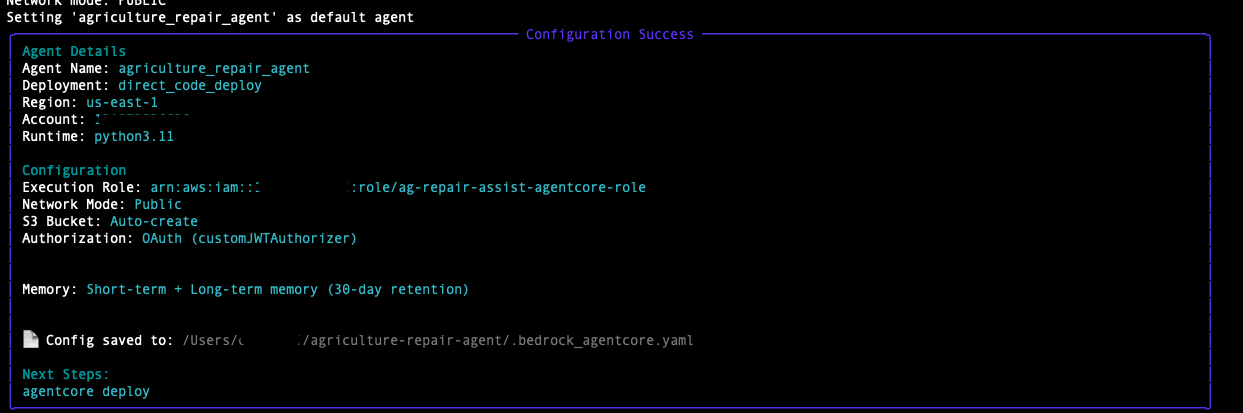
  1. Deploy the agent to AgentCore Runtime. No local Docker is required. The process takes approximately 5–10 minutes.

agentcore launch –env KNOWLEDGE_BASE_ID= –env TABLE_NAME= –env MODEL_ID=us.amazon.nova-2-lite-v1:0

  1. After completion, note the Agent Runtime ARN from the output.
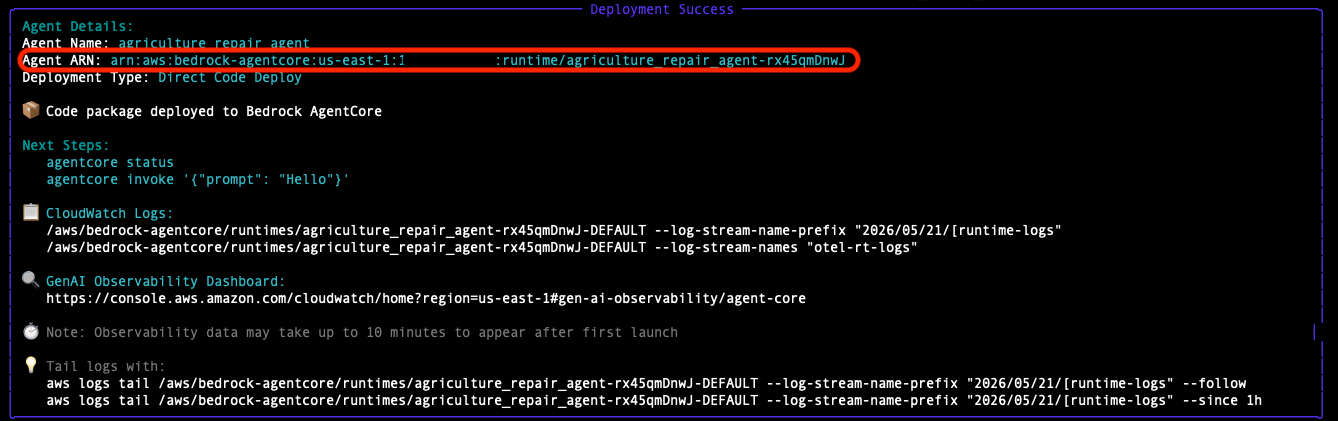
The CloudFormation stack creates the agent execution role with the required permissions. No additional IAM configuration is needed.

Step 7: Deploy the frontend

  1. Download the ML-18699-FrontEnd.zip from the link above.
  2. Navigate to the AmplifyConsoleUrl in the Step 5 CloudFormation Outputs.
  3. Click Deploy updates, choose the Drag and drop method, click Choose .zip folder and then click Save and Deploy.
  4. Wait for deployment to complete.

Using the web application

Open the AmplifyAppUrl from the Step 5 CloudFormation Outputs. On first launch, you will be prompted to enter your configuration details. Enter the values from your CloudFormation stack Outputs (Step 5) and agent deployment (Step 6).
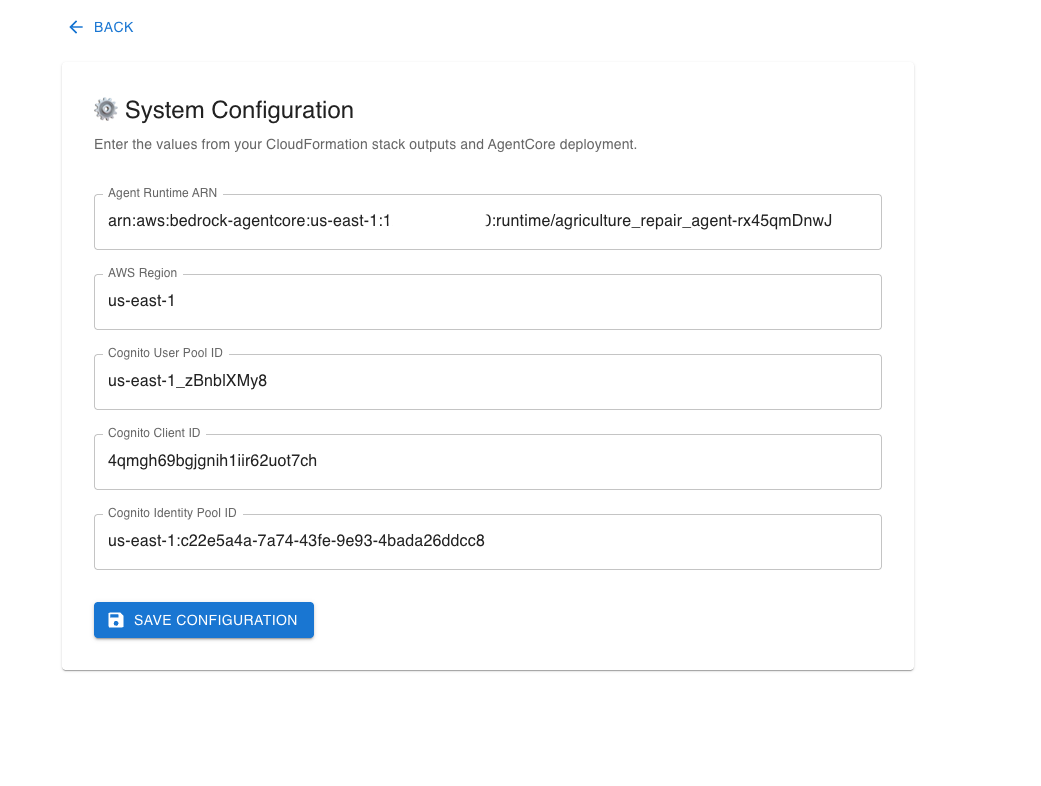


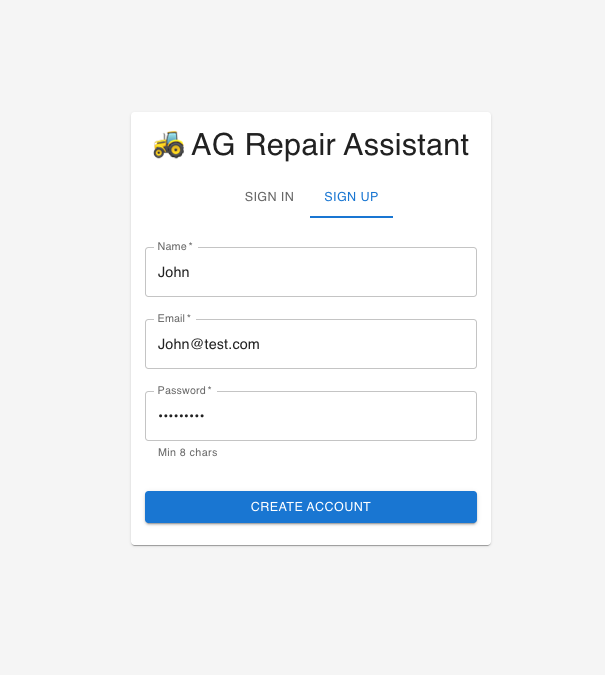
After saving the configuration, create an account using the Sign-Up option, verify your email, and sign in.
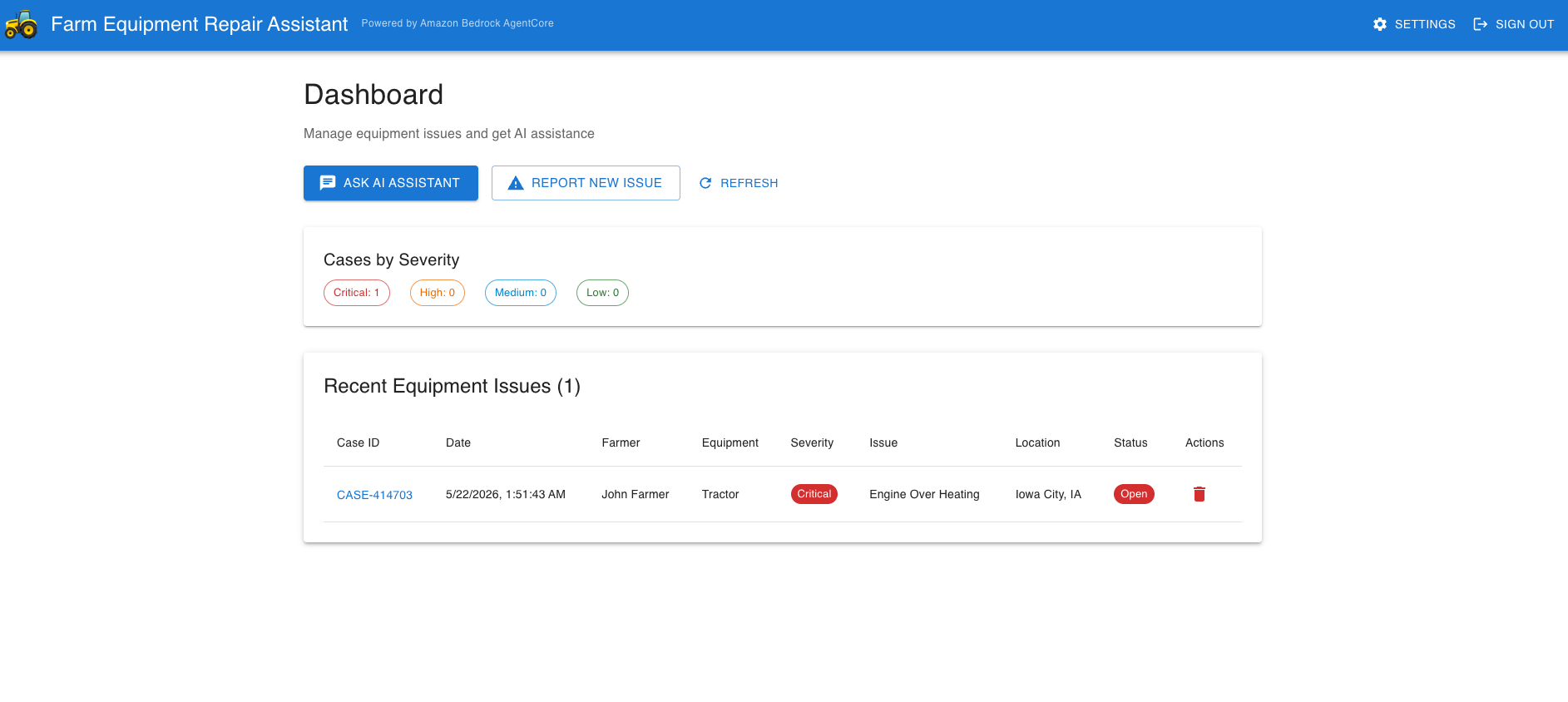
After signing in, you will see the main dashboard.
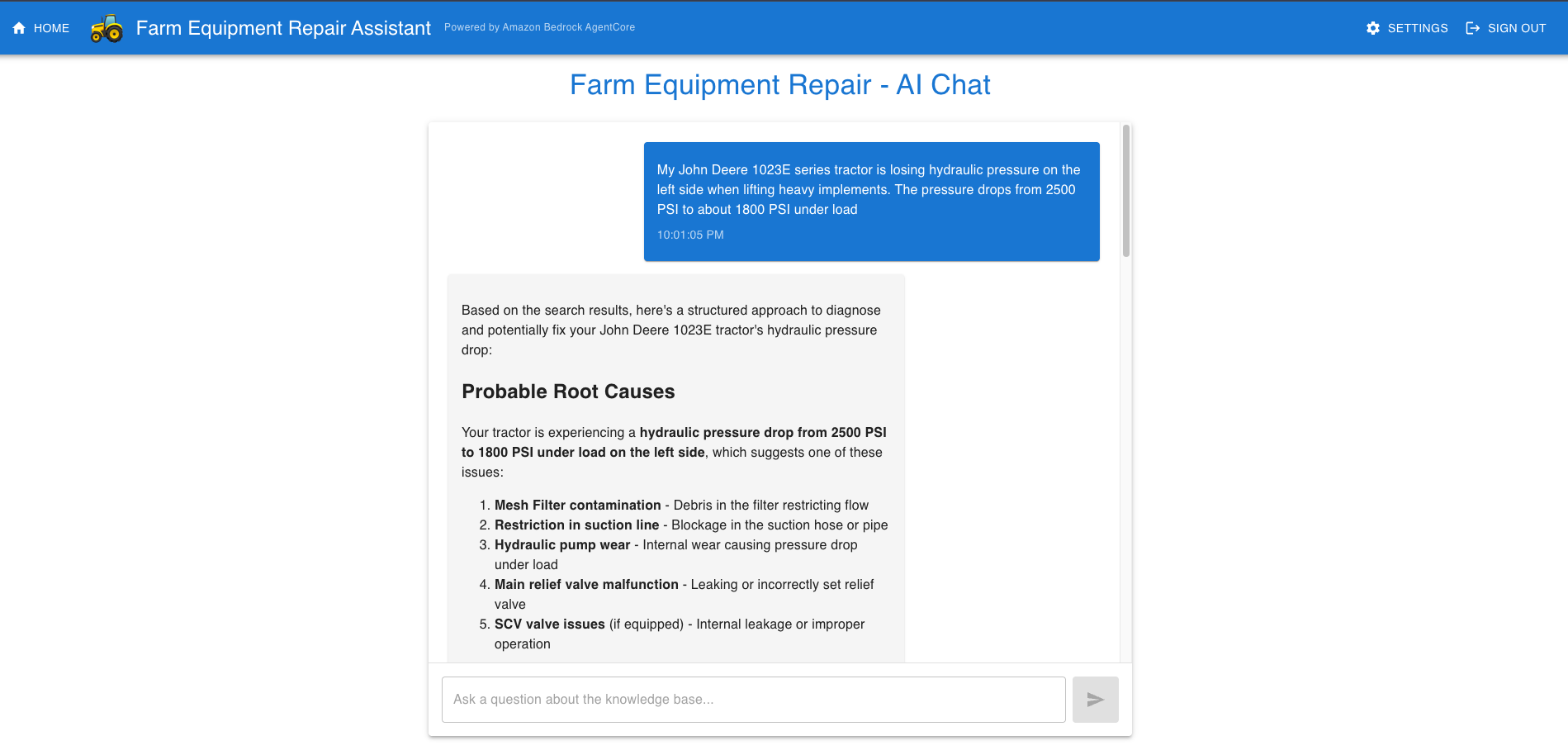
Here are a few sample queries to try:

Issue analysis:

Prompt: My John Deere 1023E series tractor is losing hydraulic pressure on the left side when lifting heavy implements. The pressure drops from 2500 PSI to about 1800 PSI under load.
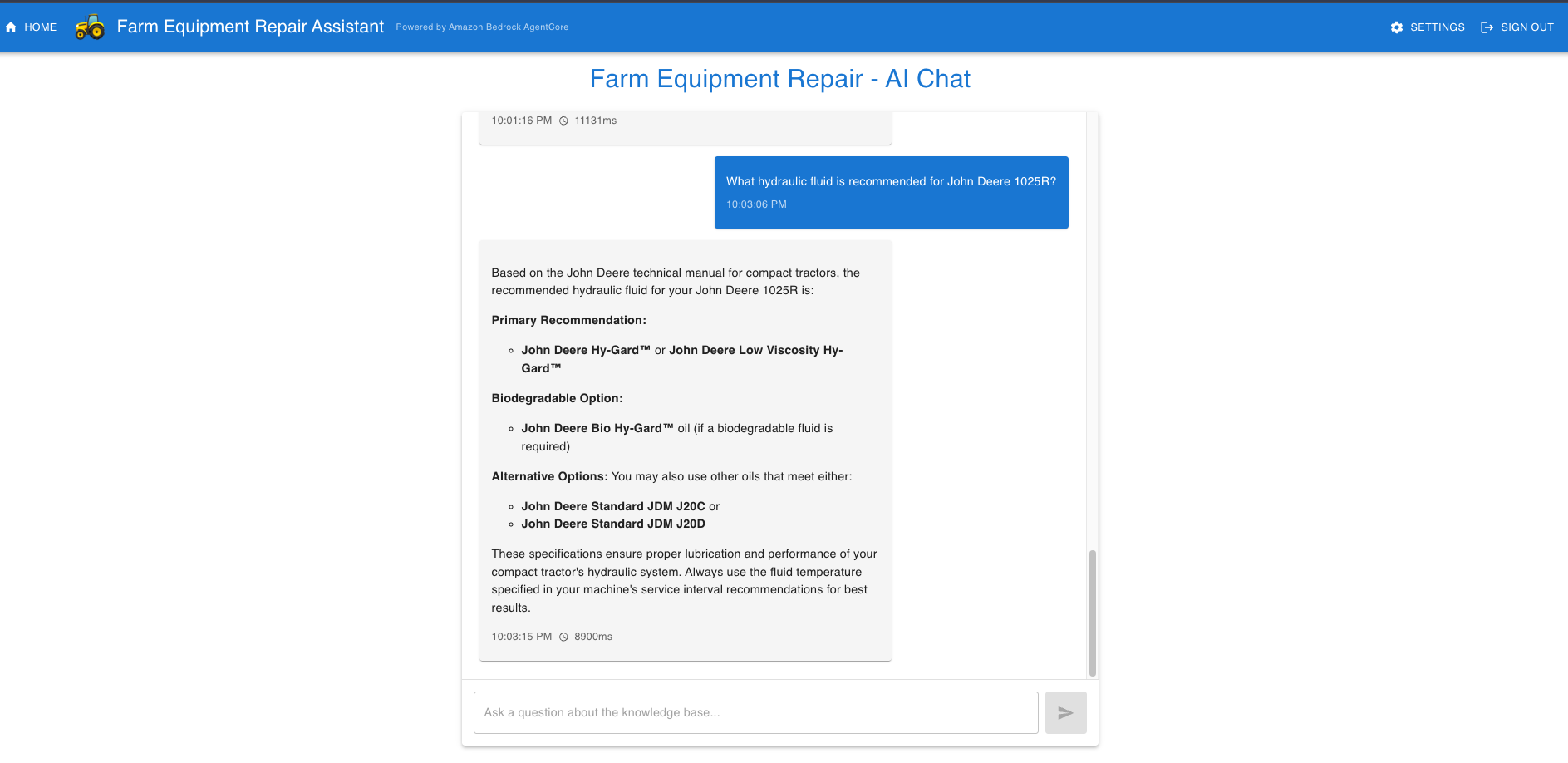
Technician chat:

Prompt: What hydraulic fluid is recommended for John Deere 1025R?
Clean up

Important: AWS resources deployed by this solution incur ongoing charges until deleted. This includes Amazon DynamoDB, Amazon S3, AWS Amplify hosting, and Amazon Cognito. AgentCore Runtime and Amazon Bedrock incur charges only when used. Complete all cleanup steps below to stop incurring charges.

Warning: Deleting an S3 bucket permanently removes all stored equipment documentation. Back up any files you want to retain before proceeding.

  1. Delete the agent:

agentcore destroy

  1. Delete the CloudFormation stack:

aws cloudformation delete-stack –stack-name ag-repair-assist

  1. Delete the Knowledge Base:

In the Amazon Bedrock Knowledge Bases console, select Agriculture-Equipment-Repair-KB and choose Delete.

  1. Empty and delete the S3 bucket:

aws s3 rm s3://agriculture-kb-documents- –recursive
aws s3 rb s3://agriculture-kb-documents-

Implementation considerations

Data management and Knowledge Base setup

As manufacturers release new equipment models and revise existing documentation, the Knowledge Base must evolve accordingly. Regular synchronization schedules paired with automated workflows enable the system to process new uploads seamlessly.

Amazon Bedrock AgentCore configuration

Different troubleshooting scenarios demand varying levels of technical complexity and response accuracy. The Strands Agents code-first approach lets you swap models by changing the MODEL_ID environment variable. AgentCore Memory configuration adds conversation intelligence. Short-term memory maintains context within a diagnostic session, while long-term memory persists technician specializations, farmer fleet details, and recurring issue patterns across sessions. The retrieval configuration top_k and relevance_score thresholds should be tuned based on the breadth and depth of your documentation corpus.

Extensibility

To add new capabilities (inventory checks, parts ordering, dealer communication), add a new @tool function to the agent code. No infrastructure changes are required.

Compliance and safety

Every repair recommendation must align with manufacturer warranties and safety guidelines. Safety protocols embedded throughout the system make sure that users receive proactive warnings about hazards associated with repair procedures. Agricultural equipment involves high-pressure hydraulics, electrical systems, rotating machinery, and other potentially dangerous components. The system must highlight key safety concerns prominently.

Scaling to enterprise grade

This solution is designed to be lightweight for testing and evaluation. When scaling to a production environment, consider the following enhancements:

  • Amazon Bedrock Guardrails: Add prompt attack detection and content filtering to protect against malicious input in equipment descriptions. Configure denied topics to prevent the agent from providing guidance outside its domain.
  • API protection: Place Amazon CloudFront in front of the AgentCore Runtime endpoint with AWS WAF for rate limiting and OWASP protection.
  • Multi-factor authentication: Enable Amazon Cognito MFA (TOTP-based software tokens) for stronger user authentication.
  • Observability and alerting: AgentCore automatically generates metrics, logs, and traces viewable through Amazon CloudWatch generative AI observability dashboards. Configure alarms for agent error rates and response latency. Enable Amazon Bedrock model invocation logging for audit trails.
  • Data lifecycle: Implement Amazon S3 lifecycle policies for equipment documentation versioning and Amazon DynamoDB point-in-time recovery for issue data backup.
  • Multi-region deployment: For global field service teams, deploy AgentCore Runtime in multiple AWS Regions with region-specific Knowledge Bases containing localized equipment documentation.

Next steps

After deploying and testing this solution, consider the following enhancements:

  • Parts ordering integration: Add a @tool that connects to your parts inventory system, enabling the agent to check stock availability and place orders directly from the diagnostic conversation.
  • Dealer communication: Add a @tool that sends diagnostic summaries to the nearest authorized dealer via Amazon Simple Email Service (Amazon SES) or Amazon Simple Notification Service (Amazon SNS).
  • IoT telemetry integration: Connect equipment sensors through AWS IoT Core to automatically create issues when anomalous readings are detected, pre-populating the diagnostic context for the agent.
  • Mobile field app: Build a mobile-optimized frontend for technicians to use on-site, with offline caching for areas with limited connectivity.

Conclusion

This AI-powered equipment repair assistant demonstrates how Amazon Bedrock AgentCore can improve agricultural field service operations. By combining a code-first Strands Agent with comprehensive manufacturer documentation through a Bedrock Knowledge Base, the solution provides technicians with precise diagnostic recommendations and parts identification before they arrive on-site.

Key benefits of this implementation include:

  • Reduced mean time to resolution: faster diagnosis and repair through AI-powered analysis grounded in manufacturer documentation
  • Improved first-time fix rates: comprehensive pre-service analysis makes sure technicians arrive with the right parts and procedures
  • Conversation memory: AgentCore Memory maintains context across multi-turn diagnostic sessions and persists knowledge across sessions
  • Simplified operations: a single AgentCore Runtime endpoint replaces the need for separate API Gateway, Lambda, and Bedrock Agent resources
  • Built-in observability: automatic X-Ray tracing and CloudWatch integration provide end-to-end visibility without additional setup
  • Code-first development: the Strands Agent’s @tool decorator pattern lets you extend capabilities and test locally before deploying

The extensible architecture makes sure organizations can adapt this foundation to their specific equipment portfolios and service requirements. Adding new tools (for parts ordering, inventory checks, or dealer communication) requires only a new @tool function, with no infrastructure changes.

The sample code in this blog post is made available under the MIT-0 license. See the LICENSE file for details.

Disclaimer: This content is provided for informational purposes only and should not be considered legal or compliance advice. Customers are responsible for making their own independent assessment of the information in this document and any use of AWS products or services.

Resources

About the authors

Puneeth Ranjan Komaragiri

Puneeth is a Principal Technical Account Manager at AWS. He is particularly passionate about monitoring and observability, cloud financial management, and generative AI domains. In his current role, Puneeth enjoys collaborating closely with customers, using his expertise to help them design and architect their cloud workloads for optimal scale and resilience.

Chaitanya Addanki

Chaitanya is a Technical Account Manager at AWS with three years of experience partnering with agriculture customers to apply cloud technologies to precision farming and data-driven operations. He holds multiple AWS certifications and enjoys turning complex challenges into scalable, AI-powered solutions.

.Organize the content with appropriate headings and subheadings ( h2, h3, h4, h5, h6). Include conclusion section and FAQs section with Proper questions and answers at the end. do not include the title. it must return only article i dont want any extra information or introductory text with article e.g: ” Here is rewritten article:” or “Here is the rewritten content:”

LLMs help robots understand vague instructions and focus on key details | MIT News

0

Imagine working at a warehouse or office sometime in the near future, and you’re asked to help a new trainee learn the basics of their job. The catch: It’s a robot. To teach them, you might want to play a game of “show and tell” — that is, physically showing how to do something a few different ways, while also explaining what you’re doing.

Let’s say you asked the robot to place some coffee on your desk without disturbing you during a Zoom call. You’ll prefer that the robot doesn’t get too close to you and the laptop so that it doesn’t interrupt your meeting. To enable this behavior, the robot should be trained with data that clearly demonstrates the full task. Computer scientists have attempted to explain manipulation tasks to robots by recording lots of physical demonstrations or writing extensive directions. But if you don’t have both, the machine is likely to misunderstand what it needs to do.

It’s laborious for humans to do all that showing and telling, so researchers at MIT’s Computer Science and Artificial Intelligence Laboratory (CSAIL) have automated the process of teaching a robot, while clarifying instructions automatically and using nearly five times less demonstration data. Their “Masked Inverse Reinforcement Learning” (Masked IRL) approach uses a large language model (LLM) to elaborate on ambiguous prompts based on the data collected from a user’s demo. Another LLM then narrows down which details an algorithm should incorporate into a motion plan, so that a robot can safely complete chores in homes, offices, and factories.

“Our approach could come in handy when a human interacts with a robot but doesn’t want to spell out all the details of a task,” says MIT PhD student and CSAIL researcher Minyoung Hwang, who is a lead author on a paper presenting the project. “We’re minimizing human effort by enabling machines to get to the bottom of what users really want.”

According to Hwang, Masked IRL can help robots safely maneuver in settings where there are elements a human might not describe in a prompt, but that are crucial nonetheless. For example, a machine grabbing you a snack from the kitchen may not know to avoid bumping into your laptop. Likewise, a factory robot placing items into different boxes must carefully navigate around shelves.

To learn new tasks in these situations, Masked IRL uses the robot’s sensors to capture information about its surroundings. These components also log each movement of a kinesthetic demonstration — a training approach where a human physically moves a robot to do a specific action. It’s sort of like being the machine’s physical therapist, bending joints in a particular direction to show a robot how to grab, move, and place objects.

MIT’s system then calls on an LLM to compare this sequence of motions (called a trajectory) to the shortest possible path. The model also elaborates on what might be unclear in a prompt, turning a request like “stay close” into “stay close to the surface of the table.” Using the trajectory comparison and clarified directions, the LLM begins to understand why the motions it was trained on are important to the task. 

A second LLM then evaluates details of the environment, such as the position of obstacles and the shape of the robot’s target object. During this process, it “masks” (in other words, ignores) the elements it deems irrelevant to the task at hand, scoring each one as either a “1” (important) or “0” (not so much). For example, whether or not a user was leaning on a table during a demonstration would be a “0,” making it irrelevant. Any detail considered a “1” is incorporated into the final action plan by an algorithm.

These masks gave Masked IRL a key advantage over comparable baselines in both 3D and real-world demos because it taught a robot which information to prioritize. Thanks to the researchers’ system, virtual and real robots alike were able to skillfully maneuver objects around obstacles, such as moving a coffee mug around a laptop to different spots on a table. In these tasks, Masked IRL correctly identified users’ preferences, which they didn’t explicitly state in their prompts, up to 15 percent more often than comparable baselines.

During simulation experiments, CSAIL researchers also found that Masked IRL was a fast learner. It required fewer demos to understand how to move the mug than its baselines. They also found that the robots performed better when an LLM cleared up instructions, instead of having the machine try to follow a vague request.

This more focused approach also translated well to a real robotic arm, executing prompts the system hadn’t seen during its training phase. After being trained on 50 kinesthetic demonstrations, the robot carefully moved a cup toward a human while avoiding colliding with a user’s computer — an obstacle it learned to avoid by elaborating on a more general request to “stay away.” It also wiped a table down while “staying close” to it, and handed a user a bag of chips while “staying away” from both a human and a table.

Masked IRL senses and explains what users leave unsaid, but soon, it might “see” it too. CSAIL researchers plan to make their approach more dynamic by equipping it with cameras, allowing a robot to take images of its surroundings. Then it could highlight and focus on specific elements nearby. For example, if you asked the machine to pick up a toy, it might see some bananas nearby and ignore them before handling its target object.

Hwang wrote the paper with three CSAIL colleagues: PhD student Alexandra Forsey-Smerek ’20, SM ’22; postdoc Nathaniel Dennler; and MIT Assistant Professor Andreea Bobu, who is a member of the Department of Aeronautics and Astronautics and CSAIL. Their work was supported, in part, by the Tata Group via the MIT Generative AI Impact Consortium Award, and the Department of Defense. They’ll present the project at the 2026 IEEE International Conference on Robotics and Automation in June.

We Ranked #11 on the Top 100 Inspiring Workplaces List. Here’s What Got Us There.

0

Our mission is to empower every team to thrive. Every team. Including ours.

We believe that thriving doesn’t happen by accident. A thriving team is one where people are aligned around something bigger than themselves, empowered to take real ownership, growing in ways that matter to them, and valued—not in a generic way, but personally and genuinely.

We build tools to help other organizations create that. And we hold ourselves to the same standard.

That standard is why we’re proud to share that Quantum Workplace has been named one of the Top 100 Inspiring Workplaces in North America for 2026—ranking #11 overall and #3 among mid-sized organizations. And we want to tell you exactly what got us there.

   Company size Badge Medium 2026 - North America

What the judges saw

The Inspiring Workplaces Awards are judged independently. Organizations share evidence that reflects their employee experience. Judges look at leadership accessibility, inclusion, employee voice, recognition, development, and culture in practice.

Here’s what the judges said about us:

“Quantum Workplace presents a highly aligned and authentic people strategy that is clearly lived throughout the organization. The connection between purpose, leadership, employee experience, and culture is evident, supported by strong engagement data and a consistent commitment to listening and acting on employee feedback. Particularly impressive are the organisation’s leadership accessibility, employee voice practices, onboarding experience, and focus on meaningful development and recognition.”

“Quantum Workplace demonstrates a culture built on trust, transparency, and genuine care for employees. Overall, this is a mature, people-first organization with a clear sense of purpose and a strong employee experience that appears deeply embedded in everyday practice.”


The values behind #QwirkLife

Around here, our employees go by a different name: Qwirks.

It’s not just a nickname. It’s a philosophy. Being a Qwirk means showing up as your full, unfiltered self—the kind of person who makes the workplace more alive just by being in it. The kind of person who never takes themselves too seriously, but always takes the work seriously.

Qwirkiness prioritizes the individual. It’s the belief that the things that make you you—your quirks, your voice, your perspective—aren’t liabilities to be smoothed over. They’re assets to be leaned into.

That shows up in how we work together. And it shows up in our products, which are built on the premise that every individual voice matters and deserves to be heard.

Which brings us to our four values that make all of this possible.

  • Pursue – As a company, we pursue impact. As individuals, we pursue growth. A spirit of pursuit means we are never fully content with the here and now. We have an inner drive and confidence to push forward, and we show courage in the face of adversity. Pursuit is one part vision, one part hustle, and one part grit.
  • Team Over Self – Every team member comes with different strengths, talents, and perspectives. Admitting vulnerabilities and relying on others takes courage. Asking for help is a sign of strength—providing that help is our commitment. We seek the voice of others, build confidence in our teammates, and recognize that the whole really is greater than the sum of its parts. Together we empower teams to thrive.
  • Revel in Work – We do hard things and put in good work, but we like to experience the joy of working together both in and out of work. Whether it’s revelling in solving a difficult problem together or showing up for field day with the whole team, we Revel in Work.
  • Be You – Each one of us is a unique, one-of-a-kind original. What makes us different makes us valuable. Our company is stronger when employees are free to share diverse perspectives and experiences. Our culture is stronger when individuality is not only celebrated and embraced, but expected.

These values come to life through five attributes that guide how we show up every day: curiosity, hustle, flexibility, grit, and care. You can read more about them at quantumworkplace.com/about/culture.

What keeps our Qwirks inspired 

We asked some of our own Qwirks to share what inspires them to work here. Here’s what they said:

Ryan_Herdman-modified

“Quantum Workplace inspires me to be the best version of myself because I’m surrounded by people who challenge, support, and trust one another to grow. It’s even more rewarding knowing that our products make a real difference by helping organizations create better experiences for their employees.”

Ryan Herdman, Account Executive

Marinna-modified

“Quantum Workplace inspires me by surrounding me with people who genuinely want to see each other succeed. The dedication my team brings every day motivates me to show up and give my best in return. When you love what you do and the people you do it with, putting in the effort feels natural.”

Marinna Hunt, Customer Support Specialist

carter-modified

“Quantum Workplace inspires me because we’re focused on helping each and everyone do their best work, and lead by example! Working across teams & disciplines to solve complex problems pushes me to continuously adapt, communicate, and be a better teammate.”

Carter Brehm, Software Developer

Carrie-modified

“QW gives me the autonomy to be myself and work how I work best, while continually encouraging me to grow and reach higher. I always feel supported when I’m taking on something challenging, knowing that I have the freedom to occasionally stumble while in pursuit of growth, and am constantly motivated by those around me to never stop evolving and learning. Being surrounded by so many brilliant, inspiring people is just one thing that makes being a Qwirk amazing!”

Carrie Hughes, Customer Implementation Manager

Abel-modified

“Quantum Workplace inspires me to be the best version of myself because of the people. There’s a genuine culture of support where teammates consistently go the extra mile for one another, and everyone takes pride in building a product that makes a real impact for our customers. What stands out most is that employees truly have a voice. Leadership listens to ideas, values feedback, and turns great suggestions into action, creating an environment where people feel empowered to grow and contribute.”

Abel Avila, Software Developer

sivakumar-modified

“For me, it’s the people who make up QW. Everyone is incredibly supportive, there’s a strong sense of trust and autonomy, and I’m constantly learning from peers who challenge me to improve. Having that kind of environment along with a healthy work-life balance makes it easy to bring my best every day.”

Sivakumar Kailasam, Principal Engineer

A culture where everyone belongs 

Behind this recognition is a group of Qwirks who show up every month to make sure this company is one where everyone truly belongs.

Our Diversity Council exists to ensure that every person on this team can Be You—fully and without hesitation. Made up of 5–7 Qwirks alongside our VP of People and CEO, the council advises leadership, drives real initiatives, and brings the whole company along on the journey. They focus on four things: talent, community, awareness, and voice.

We’re proud of the culture we’ve built. We’re also honest that belonging is never finished work. It takes attention, accountability, and care—every single year.

We practice what we build 

Here’s the thing that moves us most about this recognition: everything the judges called out in us is exactly what we help our customers build.

The listening. The acting on feedback. The development. The recognition. The culture where people feel like they matter.

That’s not a coincidence. We live it here so we can mean it when we tell our customers it’s possible.

We believe every team deserves to thrive. We’ll keep working until that’s not just our mission statement—it’s the reality for every organization we touch, and every Qwirk who calls this place home.