Home Blog Page 11

SmartThings Blog

0

SmartThings Safe Premium is powered by Arlo, a third-party partner that operates the professional monitoring center and coordinates emergency dispatch on our behalf.

Feeling safe, whether at home or on the go, shouldn’t take more than a tap. With SmartThings Safe Premium, users can instantly send help requests, from inside the SmartThings app, to Arlo-powered emergency response providers who can send police, fire, or medical help to their exact location.

SmartThings Safe includes a Basic plan at no cost; the Premium plan adds 24/7 professional emergency dispatch through Arlo.

How It Works

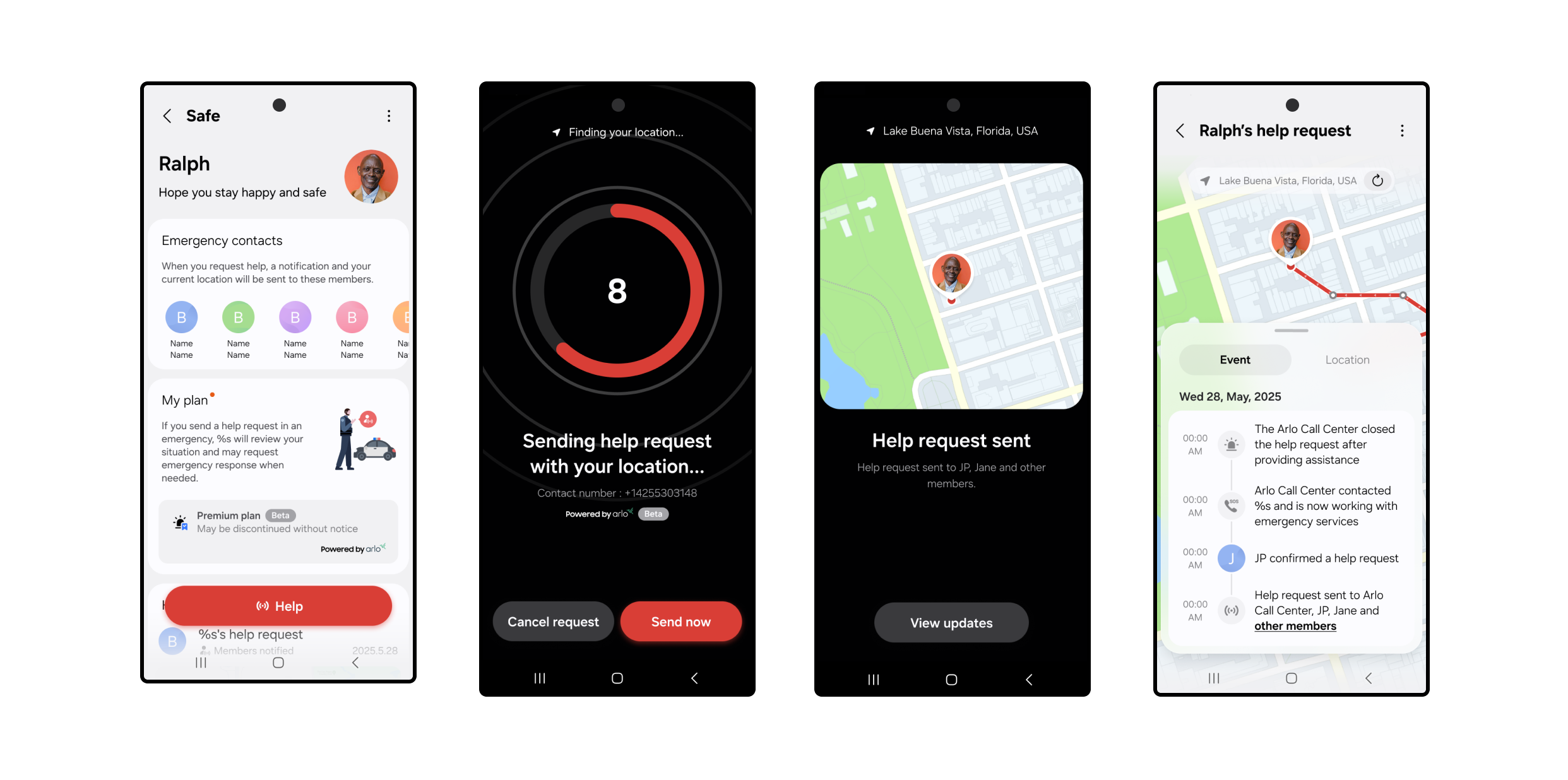
When you press the Safe button, a 10-second countdown starts. After 10 seconds, a help request is automatically sent to a professional monitoring center.

  • An Arlo monitoring agent will immediately call and text you to confirm what type of help (fire, police, or medical) is needed.
  •  If they can’t reach you, they’ll request that local emergency responders (police by default) be dispatched to your current GPS location.
  • At the same time, just like the basic plan, your Location Members will receive a push notification with a map of your location and options to call or text you directly.

You can cancel your request at any time during the 10-second countdown. Once the alert is created, you can still cancel the request by responding to the monitoring center’s call or text.

Setting Up SmartThings Safe Premium 

Getting started takes just a few steps:

  • Open the SmartThings app on your mobile device.
  • Tap the Menu icon at the bottom right of the SmartThings app.
  • Select Safe and complete setup, including agreeing to the terms agreement and completing identity verification.
  • Go to My Plan and select Upgrade to Premium Plan.
  • Follow the Samsung Checkout steps to activate your limited-time free access to SmartThings Safe Premium.
  • Once activated, you’ll see your Safe button appear in the app, ready whenever you need it. 

Share alerts with the people who matter. Add family or friends to any SmartThings location — home, office, wherever — and they’ll stay in the loop automatically. 

  • From the Home tab, tap the three-dot menu in the upper-right corner.
  • Select Location Settings > Invite Members.
  • Enter the Samsung account email addresses of the people you want to add.

Added members will need the following to receive Safe alerts:

  • Have the SmartThings app downloaded.
  • Set up their own Samsung account.
  • Tap the Menu icon at the bottom right of the SmartThings app.
  • Tap the Safe icon and follow the prompts to get started.
  • Review and agree to the Terms & Conditions and complete two-factor authentication. 
  • Have notifications turned on to receive Safe alerts.

These members will then become emergency contacts for dispatchers and the monitoring center.

For even faster access, you can add the Safe button to your Galaxy home screen or Quick Panel by selecting Settings > Add to Home Screen from the device card.

Make Sure Location Services Are On

To share your real-time GPS location with the monitoring center and your added members using the Safe Premium plan, you’ll need to enable Location Services on your phone.

  •  On Galaxy and Android devices: Go to Settings > Location > App permissions > SmartThings > Allow all the time.
  • On iOS: Go to Settings > Privacy & Security > Location Services > SmartThings > Always and turn on Precise Location.

Safe Premium is designed to work when your mobile device has a signal. The service is currently available in the U.S. for supported Galaxy, Android, and iOS devices. Both the Basic and Premium plans of SmartThings Safe are designed for manual, user-triggered help requests, making them a great complement to built-in SOS features on smartphones. While Safe Premium does not currently support automations, routines, or smartwatch-triggered requests, users can receive Safe notifications on Galaxy Watches and Apple Watches.

Whether you’re checking in with loved ones or reaching out for help, SmartThings makes it simple to stay safe, connected, and in control.

Activate your *limited-time free access to SmartThings Safe Premium in the SmartThings app today. 

*SmartThings Safe Premium is currently available as a beta service. Free access may be changed or discontinued without notice.

How to Build an Employee Recognition Budget That Actually Gets Approved

0

A recognition budget isn’t about finding the “right” number off a benchmark chart. It’s about building a number tied to a program design that’s actually going to drive outcomes—one that doesn’t just acknowledge people, but changes behavior, surfaces performance signals, and makes culture visible every day.

Most organizations invest in recognition and never see that return. The program exists. The intention is real. But recognition stays slow, manager-dependent, or stripped of rewards—and people don’t feel valued. Feeling valued is foundational to thriving teams, but a budget alone won’t get you there. The design has to be right first.

That’s what this blog is about: building the number and the program behind employee recognition—one you can defend to finance or leadership.


What is an employee recognition budget? 

An employee recognition budget is the dedicated annual spend an organization commits to acknowledging and rewarding its employees. It funds everything from peer shoutouts and manager-led awards to formal milestones and redeemable rewards. Without a defined budget, recognition stays reactive—something that happens when someone remembers, rather than something built into how your organization runs. Our research shows programs that pair recognition with rewards consistently outperform those that rely on acknowledgment alone.


How much should you spend per employee? 

Impactful recognition programs can start as low as $5 per employee per month—that’s $60 per person annually, or $30,000 for a 500-person team. Organizations with the strongest recognition cultures typically spend closer to $50–$60 per person per month, layering in peer-to-peer recognition, manager-led awards, formal milestones, and a rewards catalog employees can actually choose from.

The gap between $5 and $60 isn’t about company size. It’s about program depth and employee choice.

What matters more than hitting a specific number is building an employee recognition budget that’s recurring and predictable. Ad hoc recognition produces exactly the kind of inconsistency that kills program credibility. Finance needs a line item. Managers need an allocation. Employees need to know recognition is part of how the organization works—not a surprise when someone remembers.

Why the “1% of payroll” benchmark isn’t enough

You’ve probably heard it: allocate 1% of payroll to recognition. It’s not a bad starting point—but it isn’t yours.

A generic benchmark doesn’t account for your headcount, your culture goals, or the types of recognition you actually want to run. And a number that isn’t specific to your organization won’t land with finance the way a customized budget will.

That’s the real problem most HR leaders face. It’s not a lack of belief in recognition. It’s the absence of a number they can trust.

How to find out your current employee recognition spend 

Before you can build a recognition budget, you need to know what you’re already spending—because most organizations are informally spending more than they think. It’s just scattered across expense reports, procurement orders, and manager credit cards, with no one connecting the dots.

Here’s how to get the real number in four steps.

  1. Pull a 12-month expense report look-back. Ask your finance team to filter transactions by Meals & Entertainment, Amazon Business, Gifts, Promotional Items, Office Supplies over $200, and gift card purchases. You’re looking for patterns: the same manager spending $50–$200 a month, recurring Amazon orders, Q4 spikes. Those aren’t anomalies—they’re your informal recognition program.
  2. Talk to procurement. Any company buying branded swag or logo merchandise for internal use—onboarding kits, sales kick-offs, service anniversaries—has a vendor relationship. Pull the last 12 months of POs from those suppliers. Most HR leaders are genuinely surprised by what adds up.
  3. Check your corporate card merchant codes. MCC codes 5812 (restaurants), 5999 (misc retail), 5045 (gift/novelty), and 7299 (misc services) are where informal recognition spend tends to hide. A one-hour export from your Amex or Visa business card data tells the story faster than any internal survey.
  4. Ask your managers directly. A two-question anonymous survey goes a long way: “In the last 90 days, how much did you personally spend—out-of-pocket or on your company card — to recognize your team?” and “What did you buy?” The answers are almost always eye-opening. Managers are already spending. They just aren’t doing it in a way that’s visible, consistent, or connected to culture.

Once you have that number, the conversation with finance changes. You’re not asking for new spend—you’re asking to consolidate what’s already happening into an employee recognition program that actually works.


6 types of employee recognition programs—and what they cost 

Most organizations don’t run one recognition program. They run several, layered together. The mix depends on team size, culture, and goals—but the programs that move the needle tend to pair recognition with rewards. Quantum Workplace research shows 82% of employees say recognition is more impactful when it includes a reward, not just an acknowledgment.

Not sure what types of recognition employees actually want? The answer might surprise you. Here’s how the most common program types break down:

Recognition Type

What It Covers

Budget Impact

Peer-to-peer recognition

Points-based shoutouts sent by any employee, in-platform or via Slack/Teams

Low per-employee cost + high frequency

Manager-led recognition

Manager-initiated awards tied to team contributions and direct observation

Moderate; scales with manager participation

Spot recognition

In-the-moment awards for specific behaviors or wins, given outside a formal cycle

Variable; depends on manager allocation and frequency

Values-based recognition

Recognition explicitly tied to company values, reinforcing the behaviors the org wants to see

Low incremental cost; built into award structure

Milestone and tenure recognition

Work anniversaries, promotions, life events, and years-of-service awards

Predictable; can be budgeted by headcount and tenure data

Performance-based rewards

Redeemable rewards—gift cards, experiences, swag, custom perks—tied to contributions and results

Variable; depends on points redemption and reward catalog

Peer-to-peer and values-based programs cost relatively little per instance and work best at high frequency. Milestone and performance-based rewards are easier to predict and plan for in advance.

Programs that run only one type—usually manager-led—tend to create recognition deserts. Some teams feel celebrated every week. Others go months without acknowledgment. That inconsistency shows up in turnover data long before it shows up in exit interviews.

What a well-built recognition program looks like 

A budget funds a program. But the program has to be designed well for the budget to do anything. The organizations that see recognition actually change their culture share five traits.

  • It focuses on what matters most. Recognition should highlight specific behaviors and outcomes—not generic praise. Tying recognition to company values and meaningful contributions ensures the program reinforces performance, not just presence.
  • It feels meaningful and specific to the people receiving it. One-size-fits-all recognition rarely lands. Employees should have choice in how they’re rewarded, messages should be personal, and the program should feel relevant to individuals—not like a system checking a box.
  • It happens easily and frequently in the flow of work. Recognition works best when there’s no friction. That means integrating into tools like Slack and Teams, refreshing points monthly so the habit stays active, and trusting employees to recognize great work in real time without approvals slowing things down.
  • It scales visibly across the organization. When only managers can recognize, most great work goes unseen. Opening recognition to every employee—and making it public—turns individual moments into shared culture. Visibility is what transforms recognition from an occasional gesture into a daily norm.
  • It serves as a real-time performance signal for leaders. When recognition is frequent and tied to meaningful work, patterns emerge. Leaders can see who is driving results, where contributions are going unnoticed, and how recognition connects to broader performance trends. Recognition stops being just appreciation—it becomes intelligence.


How to allocate the employee recognition budget effectively 

Getting the budget approved is one conversation. Deciding how to split it is another. Most programs divide spend across three buckets: everyday recognition, milestone recognition, and performance-based awards.

A rough starting point: weight the largest share toward everyday recognition. Research shows employees who receive recognition monthly or more are 80% more likely to be highly engaged. Frequent and small beats rare and large, almost every time. is worth a read before you build your proposal.

A few allocation decisions have outsized impact on whether the budget actually performs:

  • Give managers a recurring allocation, not a one-time pool. A manager who runs out of budget in March will stop recognizing in April. Monthly or quarterly replenishment keeps the program running year-round. The monthly refresh also encourages frequency—managers spend what they have because unused points don’t carry over.
  • Open peer-to-peer to everyone, with a modest per-person allowance. Peer recognition scales across teams in ways no single manager can cover alone. It also makes great work highly visible—and that visibility creates richer signal for leaders trying to understand who’s driving impact and where.
  • Reserve a portion for rewards choice. Employees who have the opportunity to choose what they redeem their rewards for are 87% more likely to say recognition feels meaningful, versus 52% when they don’t. A flexible rewards catalog doesn’t require a larger budget—it just requires optionality.
  • Budget separately for milestones. Work anniversaries, new hires, and promotions are predictable enough to plan for. Keeping a separate allocation means managers aren’t pulling from the everyday pool to cover them.

Checklist: Is your recognition program ready to budget? 

Before submitting a budget proposal, make sure you can answer these questions:

  • Do you know your current employee and manager headcount?
  • Have you defined which recognition types you want to fund — peer, manager-led, and formal milestones?
  • Do you have a per-employee-per-month target or range in mind?
  • Can you quantify what turnover costs your organization?
  • Is recognition currently consistent across teams, or reactive and manager-dependent?
  • Do you have a way to track recognition participation and redemption over time?

If several of these are still “no,” that’s a signal you need a starting point—not more benchmarks.

How to make the case internally 

Getting a recognition budget approved is a different problem than knowing what to spend. The conversation with finance or a C-suite leader goes better when you bring three things:

  • A specific number. Not a range. A number with a per-employee breakdown that reflects your actual headcount and program design.
  • The retention math. Frame the spend relative to turnover cost. If your average employee salary is $65,000 and replacement costs 75% of that, one retained employee justifies a meaningful recognition investment.
  • A phased approach. Showing good/better/best options—starting at $5 per employee per month and scaling from there—takes the all-or-nothing pressure off the conversation and makes it easier to get started.


The real cost of skipping this conversation 

Lack of recognition is a top three reason employees leave their jobs. Not compensation. Not workload. Recognition—or the absence of it.

That context matters when you’re making the case to leadership. Recognition isn’t a perk line item. It’s a retention strategy—and retention has a dollar figure finance already understands.

Replacing an employee typically costs 50–200% of their annual salary, depending on role and seniority. A recognition program at $5–$10 per employee per month is a fraction of one employee’s departure.


Build your recognition budget — free, in five minutes 

Recognition programs don’t fail because HR leaders don’t care. They stall because nobody hands them a number they can actually use.

Quantum Workplace’s free Employee Recognition Budget Calculator takes about five minutes. You enter your headcount, design your program, and walk away with a personalized annual budget, a per-employee breakdown, and a summary already formatted to share with leadership or finance.

It’s built for HR leaders who are done guessing—and ready to build something real.

Build My Recognition Budget →


How much should an employee recognition budget be per employee?

Meaningful programs start around $5 per employee per month. Top-performing organizations often spend $50–$60 per person per month when including rewards. The right number depends on your program design, company size, and goals.

What’s the difference between recognition and rewards?

Recognition is the act of acknowledging an employee’s contribution. Rewards are the tangible benefits employees receive—gift cards, experiences, or redeemable points. Programs that combine both are significantly more impactful than acknowledgment alone.

How do I build a recognition budget for a 500-person company?

Start with your headcount and decide which recognition types you want to fund. A peer-to-peer program at $5/employee/month for 500 employees runs $30,000 annually. Layer in awards and rewards based on your goals and build from there.

What should a complete employee recognition program include?

Peer-to-peer recognition, manager-led awards, redeemable rewards, formal milestones, and a platform that makes recognition consistent and trackable across the organization.

How do I justify a recognition budget to leadership?

Ground the conversation in turnover cost. Recognition programs cost a fraction of replacing one employee. Pair that with a specific number — not a benchmark—and bring a phased investment plan they can say yes to incrementally.

Is recognition software worth it for smaller teams?

For organizations with more than 100 employees, yes. Without a platform, recognition stays manager-dependent and inconsistent. A platform makes recognition part of the daily workflow and gives HR the data to measure what’s actually working.

Exploring the societal impacts of AI | MIT News

0

At the recent AI and Society Forum at MIT, experts from across the Institute discussed the potential benefits and dangers of technological innovation on labor, the nature of work, civil discourse, election administration, and other topics.

The event featured individual research presentations and panel discussions, as well as a musical performance exploring the use of generative artificial intelligence in the arts.

The forum was co-organized by the School of Humanities, Arts, and Social Sciences (SHASS) and the Social and Ethical Responsibilities of Computing (SERC). It was presented in collaboration with two of MIT’s strategic initiatives: the MIT Generative AI Impact Consortium (MGAIC) and the MIT Human Insight Collaborative (MITHIC).

Agustín Rayo, the Kenan Sahin Dean of SHASS, and Dan Huttenlocher, dean of the MIT Schwarzman College of Computing, provided opening remarks.

Rayo said bringing scholars from across MIT together was intentional because understanding AI’s impact requires expertise from disciplines throughout the Institute.

“Paying attention to the societal consequences of AI is not a departure from MIT’s mission; it’s a way of ensuring that our technical leadership has maximum impact,” Rayo said.

Huttenlocher added that computing and AI’s rapid growth makes it critical to support interdisciplinary conversations and research.

“Understanding where AI excels and where it falls short is essential not only to unlocking its benefits, but also to avoiding critical errors, overreliance, and unintended consequences,” Huttenlocher said.

Jobs and AI 

Held in the Tull Concert Hall in MIT’s Linde Music Building, the May 12 forum opened with a keynote presentation from economist David Autor, the Daniel (1972) and Gail Rubinfeld Professor in the MIT Department of Economics. Autor challenged the common narrative that AI will simply eliminate jobs by proposing instead that technology’s impact depends on how it affects the scarcity and value of human expertise. 

“When I think about how technology interacts with the value of labor, I think about it in terms of how it changes the scarcity of expertise, whether it makes it more valuable or whether it makes it more of a commodity,” he said.

Autor said that what matters is whether automation removes routine supporting tasks or removes expert tasks. He argued that AI will likely create new specialized work, requiring proactive policies around worker training, wage insurance, and broader capital ownership.

A panel discussion followed, featuring experts from MIT discussing how work is changing and what it means for society. 

Daniela Rus, the MIT Panasonic Professor of Computer Science and director of the Computer Science and Artificial Intelligence Laboratory (CSAIL), described excitement around ways AI could enhance the workplace.

“I’d like to imagine the robot as your friend and assistant, as someone who watches you and figures out how to help you as someone you can task at a high level,” she said. 

Still, Rus said, human judgment remains critical in decision-making.

“We could really think about co-work with the AI tools, but the role of the human as the decider, as the person with good judgment, as the person deciding the next step, whatever that is, remains super important,” she said.

David Mindell, professor of Aeronautics and Astronautics and the Dibner Professor of the History of Engineering and Manufacturing in the Program in Science, Technology, and Society, says the nature of work has constantly changed over the years, but “what matters is the new work.” 

“We need to be supporting individuals, the economy, professions, to constantly be creating the new work,” he said. “It’s absolutely imperative that we give the tools to the young people and let them do what they find creative and show us what the new work is going to be.”

Panelists also talked about the need to maintain safety standards, while also exploring ways to find efficiencies. Mindell used an example of cargo flights that require six pilots due to the length of the flight.

“We don’t know how to take that six number down to five yet, much less two, one, or zero. There’s a lot of money behind solving that problem, but there’s also a very rich system that has evolved to make those systems safe,” he said.

Sendhil Mullainathan, the Peter de Florez Professor with dual appointments in the MIT departments of Economics and Electrical Engineering and Computer Science (EECS), described a vision of AI’s utility and growth that offers productivity improvements, but also cautioned, “I think it’s very much worth differentiating productivity gains from things that actually drive long-term growth.”

Either way, Mullainathan said, it’s clear we’re entering a time of high variance with regard to AI’s impact on the workforce.

“If you said, ‘exactly how will organizations restructure?’ I don’t know. But is there going to be a lot of restructuring? It’s hard to believe there isn’t going to be a lot of restructuring. And in some sense, if we know that what we’re entering is a period of high variance, that itself is incredibly informative,” he said.

Democracy and AI

The day’s second session focused on AI technology and its impact on democracy. 

Chara Podimata, the Class of 1942 Career Development Assistant Professor and assistant professor of operations research and statistics in the MIT Sloan School of Management, presented her research on auditing large language models for bias in election information.

“Algorithms decide a lot of things about our lives right now,” she said. “With regard to chatbots and election information, if I take two people and they interact with the same chatbot … how will the chatbot respond? How will it personalize the information it gives to these people?”

A longitudinal study of 12 major models during the 2024 U.S. presidential election season found responses varied dramatically based on stated demographics and political leanings. Her research team is now working on a new audit of the 2026 U.S. midterm elections, using a redesigned survey with input from political science experts.

During a panel discussion, experts raised concern about the potential for AI to erode democratic norms and processes, but also explored potential positive outcomes.

Bailey Flanigan, the Theodore T. Miller (1922) Career Development Professor in the Department of Political Science, who holds an MIT Schwarzman College of Computing shared position with EECS, said she’s skeptical of how some are applying AI as a tool that can get people to reach decisions or consensus more quickly.

“And there is a reason to think that this is nice because it is more efficient. It’s easier. But it loses a lot of these procedural elements of democracy that are the rituals of how we come together and make decisions,” she said. “And I think it’s a mistake to forget about that when we start thinking about automation.”

Charles Stewart III, the Kenan Sahin (1963) Distinguished Professor of Political Science and founding director of the MIT Election Data and Science Lab, said one challenge is that governmental structures do not evolve at the same rate as technology.

Stewart said his biggest concern is the potential for AI to lead to chaos during and after elections.

“If and when things go wrong, they can go really bad, and really wrong. If an election is called into question, that can lead to violence,” Stewart said.

“We’ve already seen in the low-tech eras election results being manipulated. What worries me is what I’m going to observe this coming Election Day, and the Wednesday after, and if AI has helped to create irreversible disruptions to the election system,” he added.

Lily Tsai, the Ford Professor of Political Science and director and founder of the MIT Governance Lab (MIT GOV/LAB), said in many ways, AI runs against the democratic norms and commitments necessary for a healthy democracy.

“It is really important not just in terms of design principles, but the commitments of designers to be familiar with the values and principles that characterize what democracy is based on: agency, political equality, mutual respect, inclusion, and autonomy,” Tsai said.

Tsai also noted her research has shown some people are more comfortable interacting with machines. She described a “Socratic dialogue chatbot” her team designed that asks people to articulate the thinking behind their beliefs and positions.

“And that actually, interestingly, seems to moderate their policy position in the process,” Tsai said. “So there are absolutely examples of ways in which AI can have positive impacts on democracy. But it really is about designing with the right principles and evaluating them rigorously.”

SmartThings Blog

0

Upcoming Changes to the SmartThings API 

Over the last several years, the SmartThings platform has grown into one of the most robust orchestration layers in the smart home industry, with over 460M+ registered users and hundreds of WWST partner brands — and our API is the gateway that connects third party apps and platforms to the SmartThings ecosystem. 

Today, our commercial partners use it to power everything from short-term rental platforms and energy management systems to API aggregators and custom smart home dashboards, while our developer community uses our API to optimize their personal smart homes.

To ensure the SmartThings API remains capable, reliable, and secure at this scale, we are evolving our infrastructure. In the upcoming months, we will introduce dedicated, paid commercial API tiers as well as a $4.99 a month plan for non-commercial, individual developers.

To note, this update does not affect the millions of SmartThings users who use the SmartThings App with thousands of WWST partner devices.  

Why are we evolving the SmartThings API? 

As our commercial partners and developer community continue to build integrations, they are asking and expecting more from our infrastructure. To support the next generation of smart home innovation at scale, we are transitioning to a structured API model. This evolution allows us to invest heavily in the enterprise-grade features our partners and users have been asking for:

  • Platform Stability: Upgrading our platform to enhance our enterprise-grade reliability required for high-volume, commercial deployments.
  • Optimized Integrations: Building upon our infrastructure to further support scalable integrations.  
  • Expanded Capabilities: Continuing access to Samsung devices such as TVs, smart refrigerators, and more with device states, controls, and health parameters as well as future functionality to build richer integrations.

Powering the Next Generation of Smart Home Services

We’re building on the SmartThings platform, shaped by your feedback, to deliver even more powerful tools for creating premium IoT experiences. The SmartThings API offers different tiers that can support a high rate limit, gives access to our multi-protocol ecosystem (Matter, Cloud-to-Cloud, Zigbee, Z-Wave), and contains deep Samsung integration required to scale your business on our backend and power a variety of use cases, including:

  • Short-Term Rentals, Hospitality, and Property Tech: Automate access control, optimize climate, and enable seamless property management across thousands of units at scale.
  • Telecommunications: Enhance broadband and 5G subscriber apps with premium family care and security solutions.
  • Security: Power smart alarms, access systems, and remote monitoring with our ecosystem of devices and consistent, real-time API data like device states.
  • Senior Care: Enable non-intrusive wellness tracking, activity insights, and automated routines to safely support independent living and aging in place.
  • Family Care: Deliver peace of mind with real-time sensor data, keeping families connected and homes running smoothly.
  • Insurance: Leverage real-time home state data and predictive analytics to proactively prevent damage, reduce risk, and lower claim costs.
  • Energy Management: Build advanced tracking algorithms and cost-saving utility dashboards.
  • With many more use cases and verticals. 

New Tools: 

  • Upgraded Developer Experience: We will deliver a new Developer Center experience and refreshed documentation for API users to make the API as easy to use and implement as possible.
  • The API Usage Dashboard: In the new Developer Center, we will be launching a new API Dashboard. This dashboard will allow partners and individual developers to track API call volume with flexible time-series data. The dashboard will give you current usage and data points to optimize your code and determine which pricing tier fits your needs.

These updates will make onboarding faster and API management more intuitive. 

Next Steps & Timeline: We are targeting availability for the new commercial tiers and personal plan offering in October 2026 – stay tuned for additional details. 

Please note: Your current API usage will not be interrupted today. We are announcing this now to give our API users ample time to prepare for the transition.  Free access will remain available through Q3. We will not begin applying the new usage limits or phasing out free access until October 2026.

  • For Current Commercial Partners: Please reach out to us at partners@smartthings.com to ensure a seamless transition.  
  • For Current Personal Users: We will share more information detailing the full timeline, transition guidelines, and paid plan. 
  • New to the SmartThings API? Are you evaluating SmartThings as the backend for your business? We are currently onboarding new partners to discuss SmartThings API capabilities, pricing, and scalability. Please fill out our form to learn more.

Thank you for building with SmartThings. Our investment in our API and transition to a paid model are efforts to provide an incredible service that will continue to support your needs.  


— The Samsung SmartThings Team

Generate single title from this title Best AI Tools for E-Commerce to Use in 2026 in 100 -150 characters. And it must return only title i dont want any extra information or introductory text with title e.g: ” Here is a single title:”

Write an article about

Artificial intelligence used to be viewed as a solution available only to the largest retailers. Nowadays, many smaller online stores also leverage AI. Overall, 80% of online retailers use AI in one form or another. Around 33% of this number use it for key operations, while the other 47% are still testing or gradually rolling it out. Even though many companies want to use AI, there is still a lot of confusion about it. One of the primary reasons is that there are so many e-commerce AI tools on the market. This makes it difficult for businesses to choose the right one.

This guide is meant to help your e-commerce business join the AI trend. We’ll outline where and how AI fits into e-commerce operations. We’ll also highlight some of the best AI tools for e-commerce that can boost your company’s sales.


5 Best AI Tools for E-Commerce Companies to Add to Their Tech Stack

Below are some of the most widely adopted AI tools across support, personalization, analytics, pricing, and e-commerce automation.


Bloomreach

  • Best for: Medium and large e-commerce businesses with complex setups
  • June 2026 Pricing: Custom, quote-based, $50-430K per year (annual billing)
  • Advantages: Numerous native integrations, prebuilt automation solutions, Loomi AI included for free, open platform for custom integrations
  • Disadvantages: No free trial, may be expensive for small businesses
  • Integrations: Shopify, Shopify Plus, BigCommerce, Salesforce Commerce Cloud, Magento 2, SAP Hybris

Bloomreach is a digital experiences platform. It combines AI-powered reach, personalization, customer engagement, and content management tools.

Their Loomi AI engine, introduced early in 2026, allows e-commerce merchants to make use of personalized product recommendations and optimize search results. Brands can also automate customer experience across multiple channels.

Bloomreach is usually a better fit for larger e-commerce businesses with complex catalogs and advanced personalization needs. Despite being a powerful platform, effective implementation typically requires technical support and long-term planning.


Gorgias
Gorgias

  • Best for: Shopify-first e-commerce brands
  • June 2026 Pricing:
  • Starter: $10 per month (50 tickets)
  • Basic: $50 per month (300 tickets)
  • Pro: $300 per month (2,000 tickets)
  • Advanced: $750 per month (5,000 tickets)
  • Enterprise: Custom
  • Advantages: Seamless Shopify integration, free trial, strong automation, fast setup
  • Disadvantages: Larger tiers are expensive for small businesses, limited use outside e-commerce
  • Integrations: Shopify, Shopify Plus, Magento, WooCommerce, Amazon, eBay, Walmart, Etsy, Klaviyo, Gobot, NetSuite, Instagram, TikTok

Gorgias provides helpdesk support for e-commerce companies and is designed specifically for Shopify merchants.

Their AI solution is used to automate many common customer support issues, like returns, shipping questions, and order tracking. The platform also integrates with e-commerce workflows. This allows support teams to quickly find customer data inside conversations. Gorgias reported that about 10 million purchases across their merchants were influenced by AI.

Gorgias is especially beneficial to companies that want to reduce repetitive support tickets. With Gorgias, it is achievable without building custom automation from scratch.


FullStory
FullStory

  • Best for: Product teams focused on UX optimization
  • June 2026 Pricing:
  • FullstoryFree: Free (30K sessions per month)
  • Business: ~$20-50K per year
  • Advanced: ~$50-150K per year
  • Enterprise: ~$100-500K per year
  • Advantages: Free tier, detailed session playback, strong behavioral insights
  • Disadvantages: Complex advanced features, high cost, reported integration challenges
  • Integrations: Slack, Jira, Google Analytics, Salesforce, Shopify, Mixpanel, Intercom, Microsoft Teams, Zendesk, Zapier, Segment

FullStory is a digital experience analytics platform. It has AI-assisted insights, session replay, and behavioral tracking. In 2026 more of the analytical sections became AI-powered – including UX analytics.

This platform can be used to identify where a customer had trouble during their journey. Such areas include rage clicks, broken flows, confusing navigation, or abandoned checkout processes.

Instead of guessing why customers leave, teams can actually watch session behavior and identify what went wrong. FullStory provides businesses with visibility into their customers’ behaviors, which allows them to make crucial decisions quickly.


Constructor
Constructor

  • Best for: Large e-commerce companies with seach-driven revenue
  • June 2026 Pricing: Free 4-week assessment, contract-based pricing
  • Advantages: Search optimization, AI Shopping Agent, strong personalization
  • Disadvantages: Complex initial setup, expensive for small businesses
  • Integrations: Shopify, Magento, Salesforce Commerce Cloud, custom APIs, analytics and data platforms

Constructor is an AI-powered e-commerce search and discovery platform. It is designed to optimize for revenue instead of simple keyword relevance. They introduced Product Insight Agent in 2026, which recommends products and learns from prompts and answers that lead to conversions.

The system uses clickstream data and customer behavior to rank how products are displayed in search results. It also uses this data to develop product recommendations, which are based on commercial outcomes.

Stores that manage thousands of SKUs can benefit greatly from better search quality. With this tool, they can significantly increase conversion rates. Customers will no longer spend time browsing through entire catalogs. Instead, they can expect to find what they want in a couple of clicks.


Hypersonix
Hypersonix

  • Best for: Any e-commerce business focused on competitive pricing
  • June 2026 Pricing: Contract-based, free trial, no setup fee
  • Advantages: 5 autonomous AI agents in 1 platform, real-time pricing tools, strong analytics capabilities
  • Disadvantages: Complicated and long setup, comparably new AI model, high cost for small businesses
  • Integrations: ERP systems, POS systems, data warehouses, retail analytics tools, custom APIs

Hypersonix is focused on AI-powered pricing, inventory forecasting, and retail intelligence. It helps retailers improve pricing and forecast accuracy. To achieve this, the platform analyzes sales data, buying behavior, competitor activity, and inventory trends. In March 2026, Hypersonix launched agentic pricing technology for real-time pricing adjustments.

Seasonal spikes, inventory shortages, or aggressive competition can make it difficult for retailers to effectively determine prices. So, many leverage platforms such as Hypersonix to take the guesswork out of the equation. Although forecasting will never be an exact science, better predictions are always better than reacting with panic.


AI Tools for Online Stores: Where to Start

When implementing AI in business, it’s important to start with a strategy and decide what it is that you are trying to achieve with the help of AI. Answering the questions below will protect you from wasteful spending and unfinished projects.

Main Questions to Ask Before Adopting AI Solutions

There are a few questions you should ask before adopting any kind of AI for an e-commerce platform.

Where is the main problem in my business?

It may be too many support tickets or customers struggling to find the products they want. Or you may be dealing with high turnover after an initial purchase. AI is typically most effective when it targets costly problems that are negatively impacting the business.

Which tasks are repetitive and data-heavy? Can we automate them?

The best place to start with AI is usually repetitive tasks. Typical examples are product tagging, support replies, or cart recovery emails. You can also include inventory management, fraud monitoring, and detection.

What outcomes are we trying to improve?

These should be specific and clear goals. Your target might be to improve customer retention or inventory accuracy. Or you may want to increase forecasting precision, support efficiency, or boost campaign ROI. Whatever it is, make sure it is measurable. If it isn’t, you’ll likely lose track of where the project is going.

Roadmap to a Successful AI Strategy

Nearly two-thirds of businesses have only implemented AI in a few pilot programs, and fewer than one in 10 have actually integrated AI systems into business functions. That’s why small, measurable use cases typically work better than massive AI rollouts.

Although AI strategies do not look as exciting as expected, they effectively achieve the goals set.

Here’s a realistic roadmap for first steps:

  • Perform an audit of your operations: Identify where delays, customer complaints, wasted labor, or lost revenue occur most often. AI should be used to solve existing friction; it should not create new workflows that nobody needs.
  • Prioritize high-impact use cases: Choose one area where success can be measured quickly. This will cause less confusion across teams rather than when automating everything at once.
  • Prepare your data: AI relies on clean data. This can include product catalogs, customer history, order data, and reports. If the data provided is incorrect, AI will only produce unreliable outputs.
  • Select AI tools that match your business goals: This article looks at some of the popular e-commerce AI agents on the market. They handle support, personalization, pricing, and analytics. If you’re looking for a custom solution that is tailored to your own business workflow, contact our experienced development team via the contact form.
  • Define success metrics: Decide how to evaluate performance after implementation. Some benchmarks for evaluating customer satisfaction are faster resolution of customer inquiries, lower cart abandonment rates, higher repeat purchases, and reduced manual workload.

Unfortunately, this part of the process is often overlooked by many companies — they love to talk about adopting AI, but few of them actually define what successful adoption means.


Types of AI Tools Used in E-Commerce

AI in e-commerce supports many steps along the customer journey. There are multiple tools; some of them work independently in the background, while others interact directly with customers in real time.
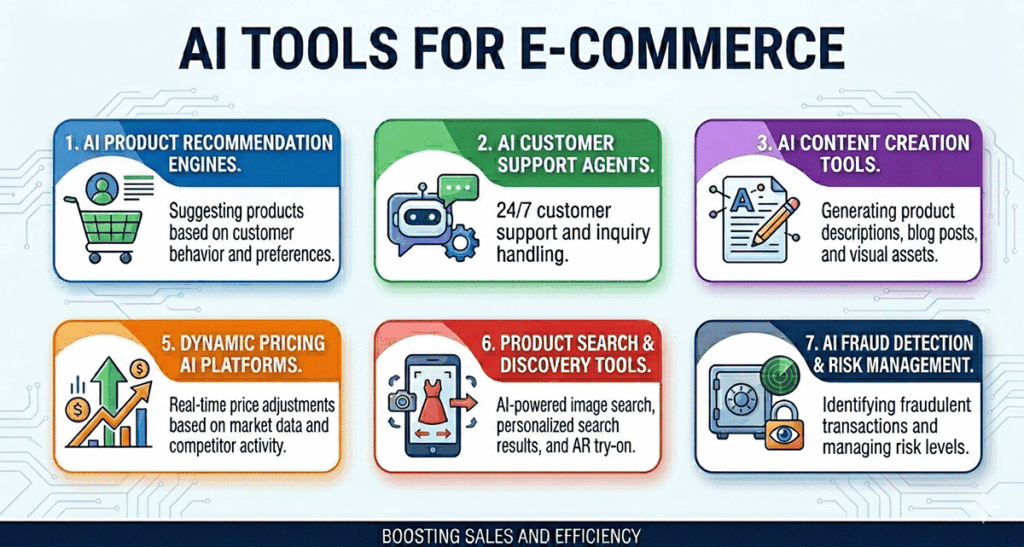
AI Tools for E-Commerce to Boost Sales


AI Product Recommendation Engines

Recommendation engines analyze browsing behavior, purchase history, demographics, and customer intent. This allows the system to suggest relevant products that users are more likely to buy.

According to McKinsey, about 50% of consumers use AI-powered search to discover products and make their buying decisions. Modern recommendation systems don’t just use an algorithm to push random “related items.” Instead, they deliver personalized product recommendations in real time based on a user’s browsing patterns, abandoned products, and customer preferences. This can greatly improve average order value in larger e-commerce stores.

There is another layer to these recommendation systems that many people do not talk about. Product discovery using smart search powered by AI is changing how customers shop online. An increasing number of consumers are now using AI assistants to get recommendations before even searching the online store.

AI Customer Support Agents

The clearest demonstration of AI delivering direct ROI is customer support automation. The first benefit is that support automation has a lower cost-per-contact than human agents. At the same time, it improves speed and consistency in responding to requests.

However, AI agents are not all the same. There are basic chatbots that simply answer FAQs, and there are more sophisticated e-commerce customer AI agents that can actually connect to backend systems. This allows them to process refunds, update shipping addresses, check order status, and modify subscriptions. All of this can be done with little to no human oversight.

A chatbot that only says “Please contact support” isn’t solving anything. The best support platforms are evaluated by their resolution rate. This refers to how often an AI has completely resolved a user’s issue without any human intervention.

AI Content Creation Tools

Content generation is one of the industries experiencing the highest rate of growth for AI in e-commerce.

AI content tools allow teams to generate different types of content more quickly than manual workflows. You can generate product descriptions, SEO copy, email subject lines, ad copy, social captions, and localized content. In addition, AI-generated content and AI-powered image editing greatly increase the speed at which catalogs can be updated and campaigns can be produced.

However, human review will always remain important. There are some e-commerce brands that make the mistake of automating too much of their content. As a result, they end up sounding robotic across all channels. Customers usually notice this, and they might get the wrong impression.

Good e-commerce teams use AI capabilities to speed up production. Then, they use human editing to refine the message to match the brand’s voice and customer context. Successful e-commerce retailers treat AI as a production assistant rather than a tool to replace their judgment.

AI Tools for Email Marketing Campaigns

Email remains one of the most effective channels for e-commerce. TechRadar estimates that for every $1 spent on email marketing, an e-commerce retailer will earn between $36 and $42 on average.

AI-powered marketing automation improves that performance in several ways. This can include abandoned cart flows, retention campaigns, personalized offers, and post-purchase follow-ups with customers.

The speed at which these systems become commonplace is largely due to their relative ease of implementation. Most platforms connect directly to Shopify, WooCommerce, BigCommerce, and CRM systems. This can be done without a major infrastructure upgrade.

Behavioral triggers also make campaigns feel more timely. For example, sending a reminder to someone 30 minutes after they abandoned their cart will usually perform far better than simply sending a generic weekly newsletter to everyone.

Dynamic Pricing AI Platforms

AI pricing platforms perform competitor analysis, track sales data trends, check inventory levels, and research customer demand for specific products. They also track the pricing of competitive products and seasonal behavior. With this tracking approach, these platforms can adjust prices automatically.

E-commerce stores that operate with narrow margins will benefit from these pricing tools, which can help maintain profitability without having to constantly check pricing manually.

AI pricing tools create an even bigger competitive advantage during promotion periods or peak shopping times. During such periods, demand changes quickly. So, retailers that employ AI pricing tools can respond to demand changes much faster than those using spreadsheets and manual checks.

The challenge, however, is finding the proper balance between AI-powered automation and brand positioning. Constant price fluctuations can damage trust if customers feel manipulated.

Product Search & Discovery Tools

Your search quality can directly affect your conversion rate. Research indicates that visitors who use a site’s search function tend to convert at a much higher rate (between 1.8x and 3x).

An AI-powered discovery platform can help businesses create better search experiences. AI tools achieve this by analyzing consumer behavior, purchase patterns, synonyms, and clickstream data.

In the past, e-commerce sites had very literal searches. One typo could prevent customers from finding what they were looking for altogether. Today, AI search systems understand user intent much better. For example, a customer searching for “running shoes for flat feet” would expect to see recommendations. Whereas in the past, they would only get keyword matches.

Because of these changes, product discovery is now much faster, and there is less frustration for consumers.

AI Fraud Detection & Risk Management

Fraud prevention is quickly becoming a major area for e-commerce businesses that would benefit from AI. According to Juniper Research, global e-commerce fraud losses will increase from $56 billion in 2025 to $131 billion in 2030.

AI fraud detection tools can provide real-time analysis of certain factors to detect suspicious activity. Some of the areas these tools analyze include transaction patterns, device data, and payment anomalies. They also analyze user behavior and account activity.

If automation is not used, a fraud investigation team would often need a lot of time to analyze incidents. The stronger systems don’t just review single transactions. Instead, they build identity-level risk signals across customer behavior over time.

Customer Behavior & Predictive Analytics

Through the use of analytics platforms, e-commerce businesses can track and understand what customers are actually doing. This approach prevents teams from making wrong assumptions.

These tools reveal where users abandon checkout, and which pages have lower-than-expected conversion rates. They also show how consumers move through funnels, and which products generate repeat purchases. Predictive analytics helps teams forecast retention, customer churn, and purchase behavior.


Challenges of Integrating AI Tools in E-Commerce

AI can have a huge impact on e-commerce operations, but poor implementation can lead to additional difficulties for businesses that adopt these tools. Below, we take a look at some of the main challenges of integrating AI tools in e-commerce.

Integration With Existing Systems

Integrating AI tools into existing e-commerce infrastructure can consume valuable time and resources. This is usually the case because most businesses function across multiple systems. These include e-commerce platforms, ERPs, CRMs, inventory software, support platforms, analytics dashboards, and payment providers.

Getting AI tools to work seamlessly across these environments takes a lot of work. It often involves complex API integrations, middle-layer programming, and security reviews. Sometimes, it involves redesigning workflow processes.

Data Quality

The quality of data used to drive AI tools is also a critical component. To be effective, AI tools need very accurate product information, customer records, and consistent tracking. Strong governance practices are equally important.

Without high-quality data, even the right AI tools generate poor recommendations, provide inaccurate reporting, and offer unreliable automation. Many so-called AI failures are actually bad data problems.

Data Privacy & Security Risks

E-commerce companies constantly have to keep privacy and compliance concerns in mind as they gather more and more consumer data.

Businesses must manage encryption, access controls, model governance, and compliance with regulations like GDPR and CCPA. And with poorly configured AI systems, companies can only create more issues for themselves. Such systems can expose sensitive personal information. It can also generate unreliable outputs based on incomplete data.

There is also increasing concern about how AI vendors store and process customers’ personal information. So, before adopting any e-commerce AI tool, your business should review the data handling policies carefully.

Transform Sales Experience With LITSLINK AI Agents

AI adoption gets the best results when tools match the real needs of the business rather than generic market trends. A big part of customer success is how well AI is implemented into operations, and that has to do with experience.

LITSLINK currently has over 300 engineers dedicated to helping businesses reduce the risks associated with implementing AI, ensuring solution quality, and developing real business workflows. The company has technical expertise in the development of AI chat systems, personalized search experiences, predictive analytics platforms, automated workflows, and supply chain systems.

Some small marketplace sellers may be looking for basic automation. Other companies need customized AI infrastructure for existing systems. Both scenarios require a distinct set of technical qualifications, which LITSLINK can successfully provide.

LITSLINK offers AI agents for e-commerce to automate, personalize, and scale customer experience across multiple areas. This includes support, search, analytics, and operational workflows.

If you are interested in implementing an AI initiative for your online store, feel free to contact LITSLINK. We can discuss your project requirements and implementation goals.

FAQ

1. What Are the Most Important AI Tools for E-Commerce Companies?

The highest-impact areas to use AI in e-commerce are support automation, email and lifecycle marketing, and product search personalization. AI support automation generally delivers the fastest measurable returns on investment (ROI). This is because any issue resolved without human involvement reduces operational cost.

Additionally, AI-powered personalization and search tools enhance conversion rates, as customers can find products faster when using them. The right place to start depends on where your business currently loses time, revenue, or customers.

2. Which AI Agents Are Best for My Business Objectives?

The best e-commerce AI agents depend on your objectives, operational bottlenecks, data maturity, and technical environment. If your business is focused on retention, the priority areas for you to pursue will typically be email automation and predictive analytics.

However, if you are having difficulty with support volume, you can start with an AI customer service platform. If you run a retail store that sells a lot of products with large catalogs, you can focus on AI-powered search and product discovery.

The “AI Tools for Online Stores: Where to Start” section already explains how businesses can identify the best first use scenario.

3. Are AI Agents and AI Chatbots the Same?

Not really. An AI chatbot can use a script, FAQ content, or predefined workflows to answer questions. But AI agents can do much more than that. They can connect directly to backend systems and perform tasks automatically.

AI agents can process refunds, update subscriptions, modify addresses, check inventory, and retrieve order information in various real-time scenarios. The key distinction is that chatbots deflect conversations, while AI agents resolve issues.

You can learn more about Chatbot vs. Conversational AI.

4. Which AI Tools Are the Best for Email Campaigns?

For smaller e-commerce businesses, you can start with Mailchimp and GetResponse because they’re relatively simple to set up and support automation, segmentation, and campaign analytics. They offer AI-powered content generation and campaign creation tools.

If you’re using Shopify, Klaviyo is one of the strongest e-commerce email platforms because of its deep Shopify integration, predictive analytics, and advanced behavioral targeting. Their own AI tools help not only in email marketing, but in overall marketing processes automation.

The choice of platform usually depends on your list size, automation goals, and the level of connection to customer purchase behavior you want the email to have.

5. How Much Time Does It Take to Integrate Such a Tool Into Our Store?

For many e-commerce AI tools, a first working proof of concept can often be deployed within four to six weeks. The timeline depends on integration depth, data quality, internal approvals, and the number of systems that need to be connected.

.Organize the content with appropriate headings and subheadings ( h2, h3, h4, h5, h6). Include conclusion section and FAQs section with Proper questions and answers at the end. do not include the title. it must return only article i dont want any extra information or introductory text with article e.g: ” Here is rewritten article:” or “Here is the rewritten content:”

New chip could help tiny robots traverse complex environments | MIT News

0

A new chip developed by MIT researchers could help tiny, low-power UAVs avoid obstacles as they zip around tight corners inside an industrial HVAC system to check for gas leaks.

The chip allows small autonomous robots and other battery-limited devices to construct detailed 3D maps of their environments in real-time using only about as much power as a single LED. A robot could use such a map to plan a collision-free path to reach its goal.

Typically, generating such thorough maps requires power-hungry systems and a great deal of memory to build and store 3D representations of the obstacles in a robot’s environment.

The MIT researchers took a different approach by combining an extremely efficient mapping algorithm with specialized hardware designed to accelerate its workload, which minimizes memory and power consumption. 

This system-on-a-chip consumes only about 6 milliwatts of power, a fraction of the power required by other systems. 

This low-power operation could also make the chip well-suited for lightweight augmented reality headsets that can be worn for extended periods, for applications like educational medical simulation or detailed repair and assembly work.

“This paper showcases a key example of how you can leverage co-design of the algorithm and hardware to really push energy efficiency. While there has been a lot of work looking into compact 3D maps, what stands out about this work is that it also ensures that the process to generate those maps is as efficient as possible. Our chip allows you to store very large maps in a very small space, and do it in a very energy efficient manner,” says Vivienne Sze, a professor in the Department of Electrical Engineering and Computer Science (EECS), a member of the Research Laboratory of Electronics (RLE), and senior author of a paper on the chip.

She is joined on the paper by co-lead authors and MIT graduate students Zih-Sing Fu and Peter Zhi Xuan Li as well as Sertac Karaman, a professor of aeronautics and astronautics and the director of LIDS. The work was recently presented at the IEEE Very Large-Scale Integrated Circuits Symposium.

A more compact map

For a robot, generating a 3D map that includes the obstacles in its environment usually demands a lot of power because it must store images captured by its camera, and process all the 3D pixels in each image multiple times.

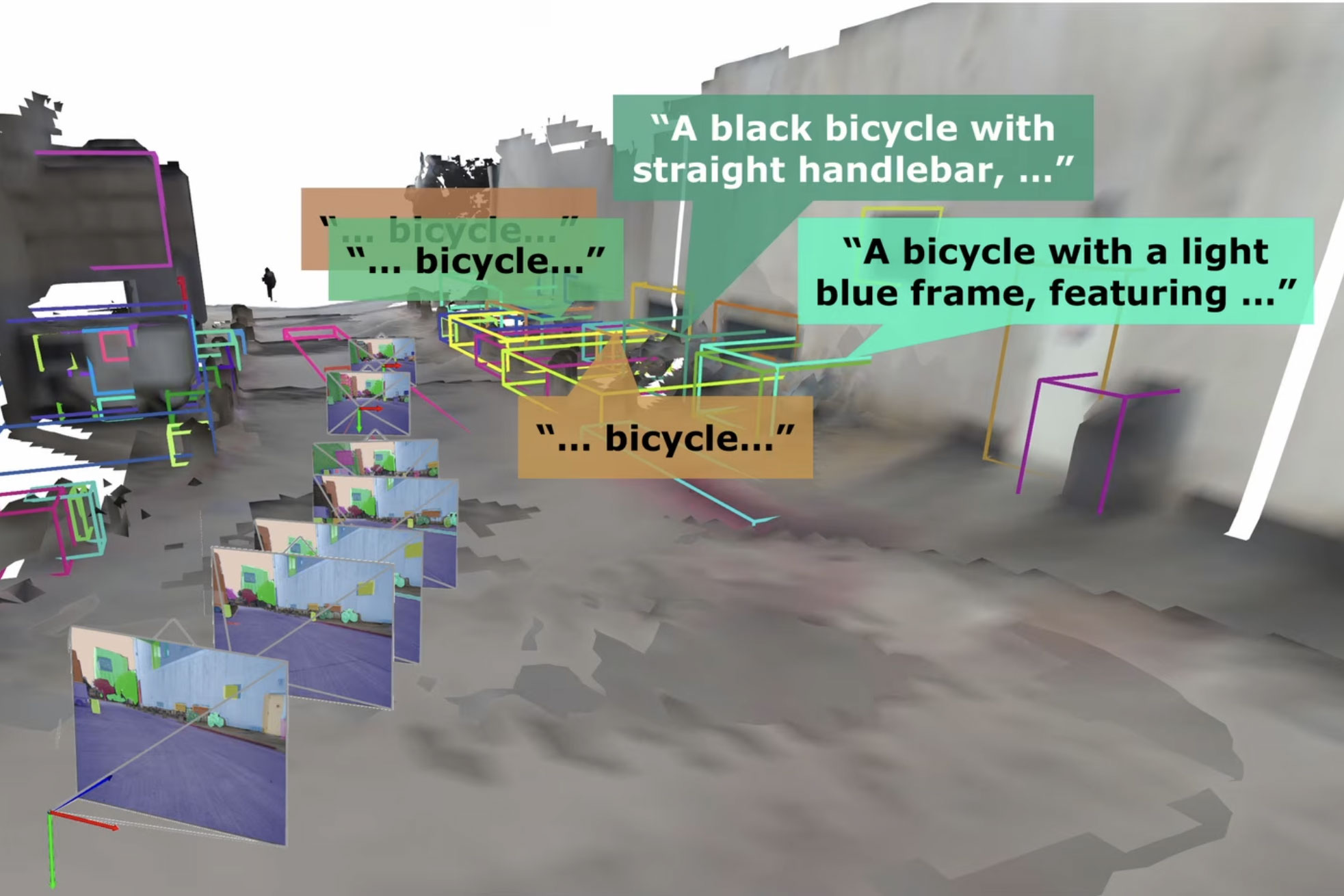
Instead of representing the environment using 3D pixels, which are cubes called voxels, the MIT researchers utilized a technique that maps the obstacles in space using ellipsoid blobs called Gaussians. 

The size, shape, and thickness of these ellipsoids can be smoothly adapted, so they match the shape of curved objects more efficiently than if one uses rigid, cube-shaped voxels. 

Importantly, the map captures the obstacles and free space around the robot, and together these let the robot plan a safe, collision-free path. Mapping obstacles and free space with voxels typically consumes a lot of memory, which makes traditional methods power-hungry. Because Gaussians can flexibly fit the geometry, a single elongated ellipsoid can represent a region that would take many voxels, so occupied surfaces and free space are captured far more compactly.

For their new system-on-a-chip, called Gleanmer, the researchers employed an algorithm their lab developed called GMMap that efficiently generates a 3D map of the robot’s environment using Gaussians to represent obstacles. 

With traditional approaches, a robot would need to load and process each depth image several times to adjust the size and shape of the ellipsoids. The system would usually construct Gaussians by comparing all the pixels in an image to each other. But the amount of memory and power needed to do this remains too high for many edge devices.

To solve this problem, the MIT researchers invented a technique that can generate highly accurate Gaussians from depth images with only one pass, after which they can discard the images, so the chip never has to store an entire image at once. 

Instead of comparing each pixel to every other pixel in the 3D image, their algorithm assumes that nearby pixels belong in the same Gaussian, so it only needs to compare each pixel to its neighbors.

“At any point in time, we only need to store a few pixels in memory, which significantly reduces the memory footprint our algorithm requires,” Li says.

Leveraging co-design

But as the robot moves through the space, it usually sees the same object from different viewpoints. When it generates Gaussians, some will overlap because they represent the same object. This can make the 3D map too large to store on an edge device.

Fusing overlapping Gaussians makes the map more compact, but doing so typically requires the algorithm to process many raw pixels stored in memory. The researchers developed a novel technique to perform this fusion process directly on overlapping Gaussians, without needing to revisit the original pixels. Since Gaussians are more compact than pixels, this significantly reduces memory and power requirements.

The same principle runs through their algorithm — most computations operate directly on compact Gaussians rather than the original pixels, enabling energy efficiency.

The researchers exploit this principle to design a chip that keeps the Gaussians it is actively working on within small, fast on-chip memory right beside the computational units. This is only possible because the Gaussian map is so compact.

The Gaussians the robot needs to work on next are waiting in the on-chip memory units, so they don’t need to be fetched from more distant, power-hungry, off-chip storage. 

“By having a dedicated memory that just stores the objects you’ve seen in the previous few frames, you can access the data much more efficiently,” Fu explains.

They tested the system-on-a-chip by reconstructing a range of diverse, pre-existing 3D environments. The chip can also reconstruct obstacles and free space directly from live data streamed from an iPhone camera.

Gleanmer generated detailed 3D maps in real-time while consuming about 6 milliwatts of power. It required only about 2.5 percent of the power that the best existing chip for map construction would need. 

By reusing compact Gaussians along the path as it plans, the chip lets a robot chart a safe trajectory using only about 20 percent of the energy it would otherwise need.

“We reduce the memory consumption by making sure the algorithm is efficient. Then we accelerate the workload that is performed by that efficient algorithm, so in the end, our chip is as efficient as possible,” Li says.

The researchers plan to further improve energy efficiency by moving the processing units on the chip closer to the sensors that gather environmental data. They could also explore additional applications, such as the use of Gaussians to represent schematics. This could help AI systems reason about complex blueprints more efficiently.

“Real-time 3D mapping has been the missing piece for small autonomous systems. A drone inspecting a pipeline or a pair of AR glasses navigating a room both need to understand the space around them — instantly, continuously, and at almost no power cost. Gleanmer makes that possible for the first time in a chip you can hold between your fingers,” says Karaman.

This work is supported, in part, by the MIT-MathWorks Fellowship, Amazon, the U.S. National Science Foundation, and Intel. 

Generate single title from this title Building AI Agents for AR Glasses and XR Devices with NVIDIA XR AI in 100 -150 characters. And it must return only title i dont want any extra information or introductory text with title e.g: ” Here is a single title:”

0

Write an article about
Developers building for AR glasses and wearable devices face an infrastructure gap. The hardware is ready, but creating AI experiences requires integrating live camera and microphone streams, multimodal AI models, enterprise data, tool use, deployment infrastructure, and device-specific runtimes.

NVIDIA XR AI is designed to address this challenge by providing a reusable foundation for connecting extended reality (XR) devices to GPU-accelerated AI services running in the cloud, data center, workstation, or edge.

Now publicly available in beta, developers have access to an open source library for building intelligent agents for AI glasses, AR glasses, and XR headsets. These intelligent XR agents can see what users see, understand spoken or typed intent, call enterprise tools, and respond within the same XR session. They can help frontline team members find the right information, guide workers through procedures, verify outcomes, and capture the evidence.

XR AI brings intelligence to people where they work, whether in field service, remote assistance, industrial operations, healthcare, training, or other hands-busy environments.

NVIDIA partners in healthcare and manufacturing provide useful examples of how this pattern can be applied. Researchers in the Cong Lab at the Stanford School of Medicine and the Wang Lab at Princeton University have explored XR and AI workflows for stem cell therapy research, helping researchers access contextual information and interact with laboratory systems while remaining focused on complex procedures.

In manufacturing, Siemens is exploring in a research context how NVIDIA XR AI and NVIDIA DGX Spark can help factory engineers find maintenance information, troubleshoot issues, verify work, and capture what happened on the shop floor.

This post walks through the process of building an intelligent XR Agent for your use case. It also explores how XR AI combines visual grounding using NVIDIA Cosmos, voice-first interaction with NVIDIA Nemotron models, enterprise connectivity using Model Context Protocol (MCP), and flexible agent orchestration with frameworks such as NVIDIA NeMo Agent Toolkit.

Components and architecture of an intelligent XR Agent

An intelligent XR Agent starts with live context from the user’s XR device. Camera frames, microphone audio, and data messages flow into the XR Media Hub, where they can be routed to models, tools, and agents that understand the user’s environment and intent. NVIDIA Cosmos models provide visual grounding; NVIDIA Nemotron models provide language understanding, reasoning, and tool calling; and MCP servers expose enterprise tools and data sources. Agent frameworks such as NVIDIA NeMo Agent Toolkit can orchestrate workflows across models and tools, while NVIDIA CloudXR can add rendered spatial content when an application needs rich 3D interaction.

XR AI keeps this architecture modular by separating media transport, model services, tool access, agent orchestration, and client delivery. Video pixels can remain in shared memory while lightweight metadata moves through the system, so agents retrieve image data only when a task requires it. This reduces unnecessary model inference and data movement while letting developers swap clients, models, MCP servers, orchestration frameworks, and deployment environments without rebuilding the entire agent.

The same design also supports multi-user and multi-agent scenarios. Participant identity acts as the routing boundary: multiple clients can connect to the same hub, multiple agents can observe the same streams, and each response is routed back to the correct participant. This pattern enables one foundation to support visual understanding, voice interaction, enterprise tool use, real-time reasoning, context-aware XR responses, and flexible deployment across AI glasses, AR glasses, XR headsets, mobile devices, web clients, and CloudXR-powered experiences.

Get started 

XR AI is now available in public beta. The following sections walk through how you can use XR AI to quickly get to a working intelligent XR Agent, including:

Live camera, microphone, and device data streams

Real-time multimodal interaction

Visual grounding through Cosmos-powered VLMs

Voice interaction through speech recognition and Nemotron models

Enterprise connectivity through MCP

Searchable visual knowledge capture and retrieval workflows

Optional agent orchestration through NeMo Agent Toolkit or other frameworks

Optional CloudXR-rendered spatial content

While implementation details vary across industries, the underlying architecture remains largely the same. 

Build your first intelligent XR agent with the public beta

Step 1. Clone the XR AI repository

The GitHub repository includes sample agents, model-server launchers, MCP servers, web clients, XR workflows, and the core media infrastructure. The quickest way to understand the system is to start with a simple multimodal agent and then add capabilities one layer at a time.

bash git clone https://github.com/NVIDIA/xr-ai.git cd xr-ai

Step 2. Start the AI services

The larger examples use shared AI services that can be started independently:

bash cd agent-samples/model-servers uv sync uv run model_servers

This starts the model processes used by the heavier demos and leaves the weights loaded in the background.

In the current repository, the model server stack includes:

nvidia/parakeet-tdt-0.6b-v3 for speech-to-text

nvidia/Cosmos-Reason1-7B for vision-language reasoning

nvidia/Llama-3.1-Nemotron-Nano-8B-v1 for fast, latency-sensitive language responses

NVIDIA-Nemotron-3-Nano-30B-A3B for deeper tool-calling workflows

The agent-sdk/xr-ai-models package keeps the model layer flexible. Workers reference logical services such as llm, agent_llm, vlm, stt, and tts through configuration, letting developers swap endpoints, use cloud-hosted models, or bring OpenAI-compatible APIs without changing agent logic.

The core AI services to power visual understanding, speech recognition, language reasoning, and voice responses are in place. 

Step 3. Run a sensor-first XR agent

Start the simplest working agent:

bash cd agent-samples/simple-vlm-example uv sync uv run simple_vlm_example

When the service starts, it prints a web client URL and authentication token.

Open the web client, connect, and send a prompt such as ping or ask a question through the microphone.

The workflow is straightforward:

The client streams camera, microphone, and data messages. 

XR AI routes media through the XR Media Hub.

Speech is converted to text.

The latest camera frame is analyzed using the Cosmos-powered VLM path.

The agent generates a response.

The response returns as both text and synthesized audio.

This is now a working intelligent XR agent. It can listen, understand what the user sees, reason over visual context, and respond through the same session using both text and speech.

Before adding enterprise systems, RAG pipelines, or spatial rendering, this validates the most important capability: real-time multimodal interaction grounded in the user’s environment.

Step 4. Connect enterprise data through MCP

Most enterprise agents need more than live perception. A researcher may need protocol steps, experiment metadata, or dataset access. A field technician may need maintenance records. A manufacturing engineer may need work instructions, controller state, or digital-twin information. XR AI uses Model Context Protocol (MCP) as the integration layer for these workflows.

The repository includes MCP servers for XR-specific capabilities:

vlm-mcp for visual question answering

video-mcp for video analysis and queries

render-mcp for scene manipulation

oxr-mcp for OpenXR spatial information

vec-mcp for vector and spatial utilities

transcript-mcp for transcript ingestion and retrieval

Developers can also build custom MCP servers for enterprise systems, retrieval-augmented generation (RAG), databases, digital twins, asset-management systems, and domain-specific workflows.

Many organizations are also interested in capturing and understanding visual information from the physical world. An XR agent can observe procedures, inspections, maintenance activities, or research workflows, then use technologies such as NVIDIA Video Search and Summarization (VSS) to index, summarize, and retrieve that information later. Over time, this creates a searchable visual knowledge base that can support reporting, training, compliance, operational reviews, and retrieval-augmented generation workflows.

This is where the agent begins to move beyond perception and into enterprise action and organizational memory.

Step 5. Add agent orchestration

The following example is adapted from the NeMo Agent Toolkit MCP client workflow pattern. In practice, this configuration would live inside a NeMo Agent Toolkit workflow definition and enable the agent to discover tools exposed by XR AI MCP servers.

function_groups:
xr_tools:
_type: mcp_client
server:
transport: streamable-http
url: “http://localhost:8220/mcp”

workflow:
_type: react_agent
tool_names:
– xr_tools

The important point isn’t the framework, but that XR AI provides a consistent foundation for real-time media, multimodal perception, and enterprise connectivity while enabling developers to choose the orchestration approach that best fits their environment.

Developers interested in more advanced orchestration workflows should review the NeMo Agent Toolkit documentation, which includes detailed examples for MCP integration, tool calling, multi-agent systems, and RAG-based workflows.

Step 6. Add CloudXR-rendered spatial experiences

Not every XR workflow requires rendered 3D content. Some agents only need a camera, microphone, language, and enterprise tools. When a workflow benefits from spatial visualization, XR AI can pair the agent layer with NVIDIA CloudXR.

bash cd agent-samples/xr-render-demo uv sync uv run xr_render_demo

This workflow launches the XR Media Hub, CloudXR runtime, model services, MCP servers, and an agent worker.

The agent can call rendering tools through MCP to create, update, and manipulate objects in a user’s spatial environment. CloudXR streams the resulting experience from GPU infrastructure to the client device.

The demo also shows a useful production pattern. A smaller model handles rapid acknowledgments and status updates while a larger model performs deeper reasoning and tool use. Users receive immediate feedback while more complex operations continue in the background. At this stage, the XR agent can interact with both the physical environment and rendered spatial content. 

You now have a working intelligent XR agent, ready to customize to your use case. You can also learn more or reach out to us for a deeper partnership.

.Organize the content with appropriate headings and subheadings ( h2, h3, h4, h5, h6). Include conclusion section and FAQs section with Proper questions and answers at the end. do not include the title. it must return only article i dont want any extra information or introductory text with article e.g: ” Here is rewritten article:” or “Here is the rewritten content:”
Generate single title from this title Google Cloud generative AI automates council planning operations in 100 -150 characters. And it must return only title i dont want any extra information or introductory text with title e.g: ” Here is a single title:”

Write an article about

Government ministries are deploying Google Cloud generative AI across municipal agencies to automate council planning operations.

Public sector administration handles vast volumes of unstructured data that delay infrastructure development. The UK central government established a target to construct 1.5 million new homes by 2029. Local planning authorities encounter administrative backlogs caused by dense paperwork, delaying these development timelines.

To address these constraints, the Ministry of Housing, Communities and Local Government (MHCLG) and the Department for Science, Innovation and Technology (DSIT) expanded two machine learning tools designed to accelerate municipal processing. Speaking at the Google Cloud Summit London, officials confirmed the nationwide deployment of the ‘Extract’ application and the progression of the ‘Augmented Planning Decisions’ (APD) prototype.

Lila Ibrahim, Chief AI Readiness Officer at Google DeepMind, said: “The UK has an opportunity to build the homes our communities need, but local councils face a mountain of paperwork. That’s why we’re co-creating a sophisticated planning tool directly with councils to solve real-world bottlenecks.

“This will help significantly cut decision times, freeing up planners to focus on the future to get Britain building faster.”

Householder applications – which include routine domestic modifications such as loft conversions or property extensions – account for nearly 70 percent of all planning applications submitted annually. Evaluating these standard submissions manually requires planning officers to spend hours cross-referencing regional policy documents, historical archives, and unstructured PDF files.

Such a repetitive evaluation process consumes administrative hours that would otherwise support major infrastructure and commercial developments. The deployment of automation targets this administrative distribution, aiming to reduce application decision timelines by 50 percent.

Core capabilities of the Google Cloud generative AI tools

Engineers at MHCLG and the government’s applied AI team, the Incubator for AI (i.AI), built the Extract tool internally using Gemini foundation models. Following trials across more than 20 local planning authorities, administrators expanded the application to every council in England.

Extract parses unstructured data locked within legacy PDF records, converting hundreds of pages of historical planning documentation into structured digital datasets within minutes. Operational data from the trial phases indicates that the tool will eliminate roughly 255 hours of manual data entry per council annually. This reduction allows local authorities to reallocate personnel to complex evaluation tasks.

Integrating large language models into public sector workflows requires enterprise-grade security environments. Local authorities process sensitive civic records, requiring strict risk management protocols to prevent data exposure.

The government hosted the Gemini models on Google Cloud to establish a protected operating environment where data sovereignty is maintained. The cloud environment features active security controls to block malicious inputs, including prompt injection attacks. This technical framework ensures that sensitive municipal data remains secure during both testing and production computing cycles.

The APD system, meanwhile, acts as an analytical assistant for municipal planning officers by automating four primary administrative tasks:

  1. The system consolidates incoming documentation by pre-processing data backlogs, flagging missing information gaps, and extracting core geographical site data onto a unified user interface for officer review.
  2. The software identifies relevant national and local zoning laws, assesses compliance margins, and appends precise policy citations for manual verification.
  3. The application parses public consultation letters, summarising stakeholder objections or historical legal precedents.
  4. The model generates initial drafts of final evaluation reports, including the technical rationale and recommended approval conditions.

Protocols dictate that human planning officers retain final decision-making authority over every application. The software does not automate final approvals or rejections independently. Staff members review every line of text generated by the machine learning models, modifying the analytical reasoning before validating the report.

To maintain regulatory accountability, the APD prototype records its internal processing steps sequentially. This mechanism establishes an auditable chain of thought, creating a verification trail for every processed application to support the officer’s final determination.

Local council planning trials and scaling timelines

The development of the APD prototype relies on a collaborative framework linking public sector administrators with engineering teams from Google Cloud, Google DeepMind, and Faculty.

The alpha version undergoes live testing within three local authorities: the London Borough of Barnet, Dorset Council, and the London Borough of Camden. Testing across these distinct regional jurisdictions provides developers with varied municipal datasets to test the software against diverse local policies. 

Central planners intend to complete the alpha phase and deploy the APD tool to all 300-plus English local authorities by 2027. Google Cloud provides the elastic computing infrastructure required to manage the thousands of concurrent inferencing queries generated during daily operations.

Paul Maltby, Director of Public Services at Faculty, commented: “The English planning system is clogged up. Planning officers are forced to spend half their time reviewing applications to convert an attic, putting those for housing estates and warehouses on hold.

“Built with planning officers, our AI system will take the drudgery out of reviewing simple planning applications so they can make quick decisions. It will let planning officers focus on the major developments that matter, and crucially, let families improve their homes without months of delay and uncertainty.”

Naisha Polaine, Executive Director for Growth at Barnet Council, added: “The tool’s ability to collect relevant information, undertake a provisional assessment, and draft the foundations of a report has the potential to save significant officer time spent working on the administration of planning applications and direct this to speeding up the decision-making process for residents. In turn, this will contribute significantly to delivering our house building growth targets in the borough.”

The coordination between MHCLG, i.AI, Google DeepMind, and Faculty establishes a structured division of labour for enterprise software engineering. Public ministries define the policy guidelines and statutory boundaries, while external technical partners engineer and deploy the underlying model architectures.

The successful integration of these systems demonstrates the feasibility of hosting advanced language models within a secured public cloud infrastructure to process core administrative workloads and modernise public service delivery.

See also: EU publishes its AI content labelling playbook ahead of the AI Act’s August deadline

Want to learn more about AI and big data from industry leaders? Check out AI & Big Data Expo taking place in Amsterdam, California, and London. The comprehensive event is part of TechEx and is co-located with other leading technology events including the Cyber Security & Cloud Expo. Click here for more information.

AI News is powered by TechForge Media. Explore other upcoming enterprise technology events and webinars here.

.Organize the content with appropriate headings and subheadings ( h2, h3, h4, h5, h6). Include conclusion section and FAQs section with Proper questions and answers at the end. do not include the title. it must return only article i dont want any extra information or introductory text with article e.g: ” Here is rewritten article:” or “Here is the rewritten content:”
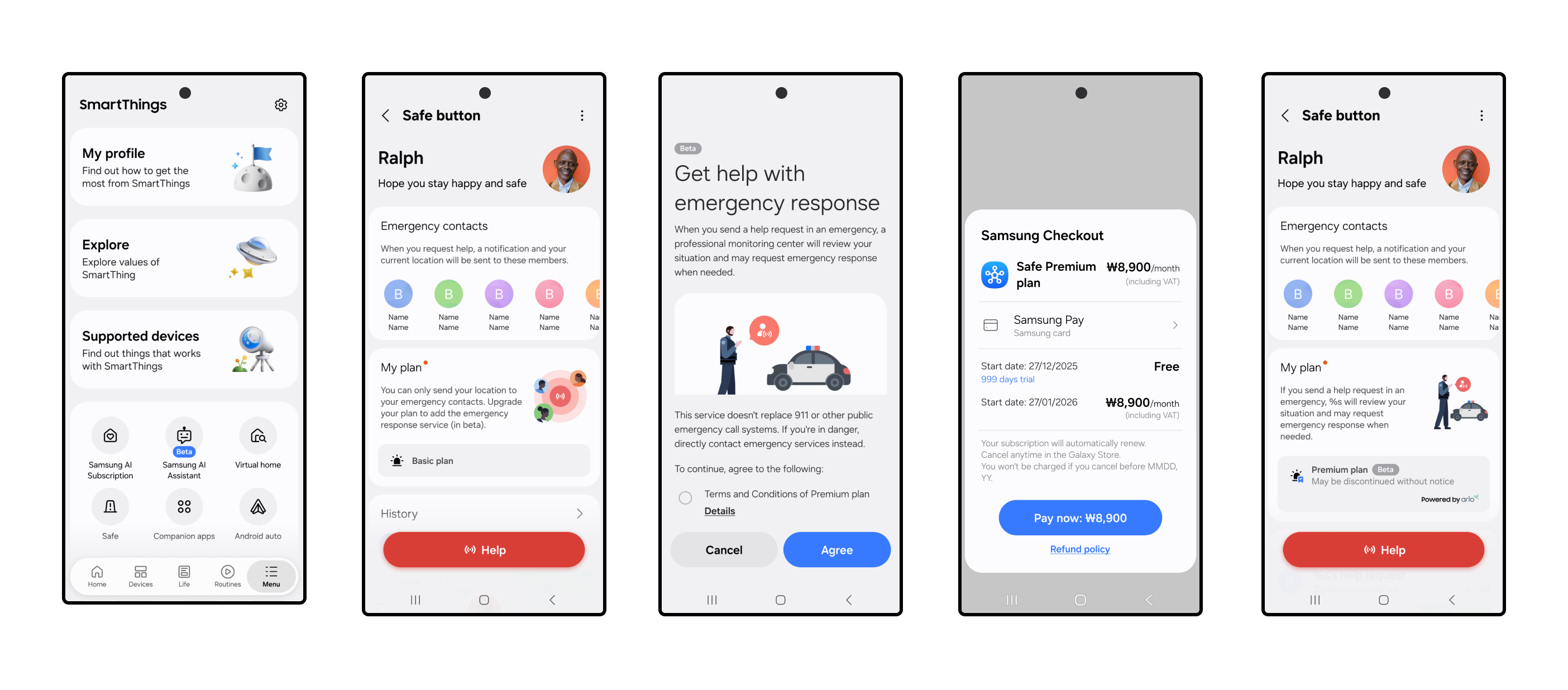
Could AI tell you where you left your keys? | MIT News

0

An auto factory worker can remember the storage bin where she left a partly assembled component the night before, and quickly return to that spot to pick it up. But robots that may work side-by-side with her would struggle to develop and access this same type of “spatiotemporal” memory.

Now, MIT researchers have developed a long-term memory framework that allows robots to rapidly form and recall a detailed mental model of complicated, large-scale environments.

In the future, this advance could allow the factory worker to send a robotic assistant to fetch the item, simply by asking it to “go and grab the component we started assembling last night.”

This new method combines advanced map representations with rich descriptions of the environment that the robot gathers as it travels over a long period of time. The robot can quickly access this memory to answer complex queries about its environment in plain language.

This memory framework, which answers questions more accurately than state-of-the-art methods, runs fast enough for a mobile robot to use in real-time.

In addition to its potential uses in robotics, this method could have applications in augmented reality systems that aid maintenance workers in anomaly detection or assist commuters in wayfinding.

“If we want robots to work side-by-side with humans and interact better with humans, they must speak the same language. The robot must be able to reason about time and space the same way humans do. That is essentially what our method is doing. It is turning a traditional map into a language-based map that is easier for the robot to think about and access using language,” says Luca Carlone, an associate professor in MIT’s Department of Aeronautics and Astronautics (AeroAstro), principal investigator in the Laboratory for Information and Decision Systems (LIDS), and director of the MIT SPARK Laboratory.

He is joined on the paper by lead author Nicolas Gorlo, an MIT graduate student; and Lukas Schmid, a former research scientist at MIT and now professor at the University of Technology Nuremberg in Germany. The research was recently presented at the Conference on Computer Vision and Pattern Recognition (CVPR).

Spatiotemporal memory

Memory allows an artificial intelligence system, like a chatbot, to answer complex questions and reason about previous interactions with its user.

“We want to design a new type of memory, a spatiotemporal memory, that enables an AI-powered robot to remember real interactions and sensor observations. Like ChatGPT, but grounded in the real world and capable of answering any question about the environment, like ‘Where did I leave my wallet?’” Carlone says.

To develop such a memory framework, the MIT researchers bridged two lines of work: computer vision and robotic mapping.

Multimodal computer vision models can understand and richly describe the objects in a scene, but they often only process a single annotation at a time. On the other hand, robotic mapping frameworks create 3D maps of an environment, like an entire apartment or university campus, but usually lack detailed descriptions of objects or are computationally expensive.

The method the MIT researchers created, called Describe Anything, Anywhere, Anytime, at Any Moment (DAAAM), takes the best of both approaches.

Using DAAAM, as a robot traverses its environment, it attaches rich descriptions to objects it sees. For instance, the robot may note that a particular building on the MIT campus is called the Stata Center and is designed with a certain type of architecture, or that a bike rack holds five bicycles and the red one has a flat tire. 

It stores this detailed information in a 3D map-based representation that is arranged spatially, so objects will be grouped into separate regions. In this way, the robot can remember that the red bicycle with the flat tire is in the bike rack outside the Stata Center.

But existing techniques that capture such rich descriptions typically take a few seconds to annotate a few objects. This is too slow for real-time performance, since a robot might see hundreds of objects during a few minutes of exploration.

“The faster the robot can form this spatial memory, the more efficient it will be performing actions in the environment,” Carlone adds.

Streamlining the process

To speed things up, DAAAM aggregates nearby objects as it travels and uses an optimization method to select key frames to annotate. These are images with the clearest view of multiple objects, allowing the system to thoroughly describe several items in parallel, speeding up computation tenfold.

As the robot explores the space, it attaches each batch of annotations to multiple objects in a particular location on the 3D map.

“We annotate every object only once, so our framework can run in very large-scale environments in real time. And by clustering objects into regions, it can answer a wide range of queries about objects and locations in the environment,” Gorlo explains.

Once the system builds this spatial memory, it must retrieve information from an enormous database of objects and descriptions in an efficient manner. 

To enable this, the researchers used an LLM that calls on various tools, which can quickly retrieve specific information in a way that reduces hallucinations. This allows DAAAM to answer a user query accurately in only a few seconds. 

For instance, if one asks a robot about a certain sculpture it saw near an MIT campus building, DAAAM can use a semantic search tool to retrieve information based on the word “sculpture” or a different tool to retrieve information based on the location of the building.

When tested and compared with other methods, DAAAM was between 21 percent and 53 percent more accurate, depending on the question type. 

In the future, the researchers want to expand DAAAM so the system can capture significant events that happened in the environment. They are also working to incorporate confidence levels into the system’s responses.

“Ultimately, we want to have robots that can help with any sort of tasks. With this framework, we are trying to create the foundations to enable a generalist agent that can do anything you ask,” Gorlo says.

This research was funded, in part, by the U.S. Army Research Laboratory and the Office of Naval Research. Carlone is currently on sabbatical as an Amazon Scholar; this article describes work performed at MIT and is not associated with Amazon.

Generate single title from this title Data Science • AI • Advanced Analytics in 100 -150 characters. And it must return only title i dont want any extra information or introductory text with title e.g: ” Here is a single title:”

Write an article about

The AI industry has spent the past few years trying to give models access to more information. But bigger context windows come at a cost, requiring more memory, more compute and more infrastructure.  For organizations building long-running AI systems and agents, managing context is becoming a challenge in its own right.

A new research paper suggests the industry may be approaching the context problem from the wrong direction. While most methods give models access to more information, the researchers argue that intelligently reducing context may be a more scalable and efficient solution. Their work points to a potential breakthrough in making long-context AI systems faster, cheaper and easier to deploy.

The paper was authored by researchers from some of the leading research and educational institutions, including New York University, Columbia University, Princeton University, the University of Maryland, Harvard University, Lawrence Livermore National Laboratory and Modal Labs.

“Long-context language model inference is bottlenecked by memory, as the KV cache grows with context length,” wrote the authors.

(PeopleImages.com – Yuri A/Shutterstock)

The approach taken by the researchers differs from many existing context-compression techniques. Most current methods focus on compressing the KV cache after the full context has already been processed. This means much of the memory and compute cost has already been incurred.

LCLMs take a different approach by compressing information before it even reaches the decoder. 

What exactly were the performance gains? The researchers claim that on the RULER benchmark, LCLMs operating at 16x compression produced output up to 8.8x faster than competing KV cache approaches. That’s an impressive result. 

Another notable aspect of the research is that the reported speed improvements do not appear to come with a significant loss in accuracy. 

At 4x compression, LCLMs achieved 91.76% accuracy on the RULER benchmark, compared with 94.41% without compression. Even at 16x compression, the model outperformed every KV cache compression method evaluated in the study.

Building the system required significant training. The researchers trained LCLMs on more than 350 billion tokens. The training included a combination of pre-training, fine-tuning and reconstruction tasks designed to help the model retain important information even after compression. 

The implications of the research extend beyond handling long documents. As AI agents become more capable, they are being asked to manage larger amounts of information over longer periods of time. Documents retrieved through RAG pipelines, tool outputs, code repositories, conversation histories and intermediate reasoning steps all compete for space within a model’s context window.

That challenge is becoming increasingly important as organizations move from simple chatbots to more autonomous AI systems. An agent tasked with analyzing contracts, reviewing source code, conducting research or managing business workflows may need to reference thousands of pages of information during a single task. Maintaining access to that information can quickly become expensive as memory and compute requirements grow.

(Shutterstock AI Generator)

Context compression offers a different way of approaching the problem. Rather than continuously expanding context windows and accepting the spike in infrastructure costs, LCLMs attempt to reduce the amount of information a model must process while retaining the details needed to complete a task. 

“LCLMs provide a promising substrate for long-horizon agents with large, persistent working memories by dramatically reducing the size of the inputs at scale,” wrote the authors. “Future iterations of LCLMs could further improve the quality-efficiency trade-off by compressing inputs at multiple granularities and dynamically allocating capacity based on information density or input perplexity.” 

They further explained, “Such adaptive compression could allow models to preserve fine-grained details where needed while maintaining a compact global context, reducing reliance on explicit expansion tools.” 

If successful, the approach could allow organizations to build agents that work across larger knowledge bases, longer conversations and more complex workflows without a proportional increase in hardware requirements.

.Organize the content with appropriate headings and subheadings ( h2, h3, h4, h5, h6). Include conclusion section and FAQs section with Proper questions and answers at the end. do not include the title. it must return only article i dont want any extra information or introductory text with article e.g: ” Here is rewritten article:” or “Here is the rewritten content:”