Home Blog Page 116

Thousands of federal health workers are losing their jobs in the US.

0

Drastic “Reductions in Force” Upend HHS Agencies

Thousands of people who work at the Centers for Disease Control and Prevention (CDC) were notified by email today that they were subject to the Trump administration’s efforts to cull federal workforce jobs, Wired reports. Top officials were among those either put on administrative leave, laid off, or reassigned to remote roles, the Washington Post reports.

Affecting Programs and Services

HHS announced last week that it would slash its workforce by 20,000 people. Now, the nation is starting to see how that purge is rolling out, affecting programs meant to prevent and treat HIV infection and sexually transmitted disease, respiratory diseases, and foodborne illnesses, to name a few.

Criticisms and Concerns

“We’re going to have patients die, Jade Pagkas-Bather, an infectious disease doctor at the University of Chicago, tells Wired. “Unnecessary, preventable death.”

Response from HHS

“Unnecessary, preventable death.”

HHS, on the other hand, says the changes will save $1.8 billion a year. “Over time, bureaucracies like HHS become wasteful and inefficient even when most of their staff are dedicated and competent civil servants,” HHS Secretary Robert F. Kennedy, Jr. said in a press release when HHS announced its restructuring last week.

Departure of FDA Official

The FDA’s Center for Biologics Evaluation and Research (CBER) regulates vaccines, and director Peter Marks resigned on Friday, writing that “it has become clear that truth and transparency are not desired by the Secretary, but rather he wishes subservient confirmation of his misinformation and lies.”

Concerns about the FDA’s Future

“The FDA as we’ve known it is finished, with most of the leaders with institutional knowledge and a deep understanding of product development and safety no longer employed,” Robert Califf, FDA commissioner under Joe Biden and Barack Obama, wrote on LinkedIn today.

HHS Press Secretary’s Statement

In an email to The Verge, HHS press secretary Vianca Rodriguez Feliciano maintains that “ongoing critical public health efforts will remain a top priority and will not be impacted by this administrative realignment.”

Conclusion

The recent “reductions in force” at HHS agencies, including the CDC and FDA, have raised concerns about the impact on public health programs and services. Critics argue that the changes will lead to “unnecessary, preventable death,” while HHS officials claim that the changes will save $1.8 billion a year.

FAQs

Q: What is the purpose of the “reductions in force” at HHS agencies?

A: According to HHS, the changes are intended to reduce waste and inefficiency within the agencies.

Q: How will the changes affect public health programs and services?

A: The changes are likely to have a significant impact on programs meant to prevent and treat HIV infection and sexually transmitted disease, respiratory diseases, and foodborne illnesses, among others.

Q: Who is responsible for the changes at HHS agencies?

A: HHS Secretary Robert F. Kennedy, Jr. is responsible for the restructuring efforts.

Q: What is the reaction from the FDA to the changes?

A: The FDA’s Center for Biologics Evaluation and Research (CBER) regulates vaccines, and director Peter Marks resigned on Friday, criticizing the changes.

A Gross Dishonor

0

To the Editor

Re: "V.A. Workers See Chaos in Services for Mental Care" (front page, March 24)

I am a Vietnam veteran. I spent more than 1,000 hours flying to bases between Saigon and the Cambodian border. After returning home in 1971, I went back to school and buried the war.

In 1990, Operation Desert Shield opened up a can of trauma for me and many vets. I believe all the V.A. health services today are nonpareil.

About 6 percent of the nation’s population are veterans, and surveys have found that more than half of Americans have a close relative who has served in the military. Yet I do not hear or see my senators nor, with some exceptions, my representatives, objecting publicly and loudly to what President Trump and his appointees are doing to our veterans’ services. If they want to be re-elected, they should get some backbone and speak out for the V.A. and all veterans.

This is not a political issue but one affecting the health of the nation. Their deafening silence is a gross dishonor. Let’s put some substance behind "thank you for your service."

James C. Wright
Gladwyne, Pa.

The Trump Administration’s Order

The Trump administration’s order that Veterans Affairs mental health professionals conduct therapy calls in an open-floor office violates the privacy interests of their patients, and reflects a similar mistake of the Reagan administration’s opening policy, which it was forced to reverse.

Thomas E. Templeton
Latham, N.Y.
The writer is a licensed mental health counselor.

Losses in Nature

Re: "What the Dodo Tells Us, 300 Years After Its Extinction" (Opinion guest essay, nytimes.com, March 9)

Dr. Bergland rightly notes that extinction is nothing new. But as the chief scientist at the World Wildlife Fund, I am disturbed by the current rate of nature loss.

Monitored wildlife populations have declined on average by 73 percent in less than 50 years. Life on earth hasn’t seen losses this steep since the dinosaurs. Unlike the dinosaurs, however, we have the power to stop and even reverse much of the damage.

Our planet is barreling toward negative tipping points that, if crossed, will have dire consequences for not just nature, but for people as well. That may sound alarmist to some, but the health of even a single species population can have surprising ripple effects and could be the trigger for a more expansive tipping point.

Rebecca Shaw
San Francisco

A.I. and Humans

Re: "A.I. Will Soon Be Smarter Than Humans. Let’s Discuss" by Kevin Roose (The Shift column, Sunday Business, March 16)

I would like to point out that despite all the current fear-mongering, artificial intelligence is not a threat to human beings.

A.I. is an incredible tool when used properly. Its main value is in its predictive abilities. It can sift through huge amounts of data and discern patterns that the human brain, as predisposed to pattern-seeking as it is, cannot.

But A.I. cannot replace human thought. It can never write a work of literature. Yes, it can emulate past authors, but it can do so only in predictive ways. Or random ways.

What it cannot do is create the unexpected. That is something only a gifted author can do. And by "unexpected" I do not mean random. I mean the precise turn of events that creates the most surprise in the reader’s mind, and also the sense that what happened was, in fact, precisely what should have been expected.

Only a human mind can do that. So rest assured: A.I. will not replace us.

David Frank DeLuca
Palm Bay, Fla.

Conclusion

The articles above highlight the importance of addressing the issues faced by veterans, the devastating impact of nature loss, and the potential of artificial intelligence. It is crucial that we acknowledge the concerns of veterans and work towards providing them with the necessary support and services. Additionally, it is essential to address the alarming rate of nature loss and the potential consequences of inaction. Furthermore, the development of artificial intelligence should be approached with a nuanced understanding of its capabilities and limitations.

FAQs

Q: What are the main concerns of veterans?
A: The main concerns of veterans include the lack of support and services provided by the Veterans Affairs, the impact of trauma on their mental health, and the need for a more comprehensive approach to addressing their needs.

Q: What is the current state of nature loss?
A: The current state of nature loss is alarming, with monitored wildlife populations declining on average by 73 percent in less than 50 years.

Q: Is artificial intelligence a threat to human beings?
A: No, artificial intelligence is not a threat to human beings. It is an incredible tool when used properly, but it cannot replace human thought and creativity.

Off the Charts Patient Satisfaction at LifeBridge Health’s Virtual Urgent Care Center

The Challenge

LifeBridge Health, based in Owings Mills, Maryland, faced two primary telemedicine challenges: improving operational efficiency and increasing patient adoption.

Dr. Jonathan Thierman’s Account

Dr. Jonathan Thierman, president and chief executive, ExpressCare and Children’s Urgent Care, at LifeBridge Health, previously had set up the LifeBridge Health Virtual Health Center. From that experience, he knew an efficient telemedicine operation would reduce friction for patients, making it easier for them to adopt the new process.

The Challenges

However, in the urgent care setting, he saw that few patients were using telemedicine, and that wait times were far too long. Beyond these primary challenges, the health system also encountered several technical obstacles. It explored multiple telehealth platforms, each offering a range of features. Ultimately, it found the most important capabilities were those that tightly integrated the platform into patient registration and provider workflows.

Proposal

"We operate a highly efficient network of nearly 35 urgent care centers across Maryland," Thierman said. "One key to our efficiency is our ‘cut-and-paste’ approach – ensuring every detail, from supplies and facility layout to workflow and staffing, is as consistent as possible across all locations.

Meeting the Challenge

For the telemedicine site, LifeBridge Health followed the same process it had used to set up new locations in the past. It hired new staff and providers and established business operations, workflow patterns, and front- and back-end processes to match those of the physical sites as closely as possible.

Results

Almost overnight, telemedicine patient volume doubled with the launch of the virtual center. Within a few months, it had tripled. At the same time, LifeBridge Health significantly reduced wait times and improved patient throughput, creating a highly efficient system with exceptional patient satisfaction, Thierman noted.

Conclusion

By consolidating telemedicine workflows into a single, specialized center, LifeBridge Health aimed to eliminate inefficiencies, improve patient throughput, and ultimately increase telemedicine adoption. The results speak for themselves: increased patient volume, reduced wait times, and improved patient satisfaction.

FAQs

Q: What were the primary telemedicine challenges faced by LifeBridge Health?
A: Improving operational efficiency and increasing patient adoption.

Q: What approach did LifeBridge Health take to set up its telemedicine site?
A: It hired new staff and providers and established business operations, workflow patterns, and front- and back-end processes to match those of the physical sites as closely as possible.

Q: What were the results of LifeBridge Health’s telemedicine initiative?
A: Almost overnight, telemedicine patient volume doubled with the launch of the virtual center. Within a few months, it had tripled. At the same time, LifeBridge Health significantly reduced wait times and improved patient throughput, creating a highly efficient system with exceptional patient satisfaction.

Preserve Value with Data Lineage: Safeguarding Gen AI Investments Through Debugging

Securing Gen AI Products: A Growing Concern for Organisations

As the adoption of AI accelerates, organisations may overlook the importance of securing their Gen AI products. Companies must validate and secure the underlying large language models (LLMs) to prevent malicious actors from exploiting these technologies. Furthermore, AI itself should be able to recognise when it is being used for criminal purposes.

Enhanced Observability and Monitoring

Enhanced observability and monitoring of model behaviours, along with a focus on data lineage, can help identify when LLMs have been compromised. These techniques are crucial in strengthening the security of an organisation’s Gen AI products. Additionally, new debugging techniques can ensure optimal performance for those products.

Establishing Guardrails

The implementation of new Gen AI products significantly increases the volume of data flowing through businesses today. Organisations must be aware of the type of data they provide to the LLMs that power their AI products and, importantly, how this data will be interpreted and communicated back to customers.

Monitoring for Malicious Intent

It’s also crucial for AI systems to recognise when they are being exploited for malicious purposes. User-facing LLMs, such as chatbots, are particularly vulnerable to attacks like jailbreaking, where an attacker issues a malicious prompt that tricks the LLM into bypassing the moderation guardrails set by its application team. This poses a significant risk of exposing sensitive information.

Validation through Data Lineage

The nature of threats to an organisation’s security – and that of its data – continues to evolve. As a result, LLMs are at risk of being hacked and being fed false data, which can distort their responses. While it’s necessary to implement measures to prevent LLMs from being breached, it is equally important to closely monitor data sources to ensure they remain uncorrupted.

A Clustering Approach to Debugging

Ensuring the security of AI products is a key consideration, but organisations must also maintain ongoing performance to maximise their return on investment. DevOps can use techniques such as clustering, which allows them to group events to identify trends, aiding in the debugging of AI products and services.

Conclusion

In their rush to implement the latest Gen AI products, however, organisations must remain mindful of security and performance. A compromised or bug-ridden product could be, at best, an expensive liability and, at worst, illegal and potentially dangerous. Data lineage, observability, and debugging are vital to the successful performance of any Gen AI investment.

Frequently Asked Questions

Q: What is the importance of securing Gen AI products?
A: Securing Gen AI products is crucial to prevent malicious actors from exploiting these technologies.

Q: How can organisations ensure the security of their Gen AI products?
A: Organisations can ensure the security of their Gen AI products by implementing measures such as enhanced observability and monitoring, establishing guardrails, and validating data lineage.

Q: What is the role of data lineage in securing Gen AI products?
A: Data lineage plays a vital role in tracking the origins and movement of data throughout its lifecycle, enabling teams to validate new LLM data before integrating it into their Gen AI products.

Q: What is the importance of debugging in securing Gen AI products?
A: Debugging is crucial in securing Gen AI products, as it allows organisations to identify and fix issues, ensuring optimal performance and minimising the risk of security breaches.

Q: What is the importance of observability in securing Gen AI products?
A: Observability is crucial in securing Gen AI products, as it enables organisations to monitor model behaviours and identify potential security vulnerabilities or malicious attacks.

How These 8 Companies Retain Top Talent

0

Employee retention is a top 3 priority for CEOs and the #1 priority for 1 in 3 HR leaders in 2025. We’re not in the Great Resignation era anymore. But every organization has top talent they can’t afford to lose, no matter the state of the labor market. Organizations are prioritizing employee retention strategies geared toward retaining key talent.

But while retention is top of mind, many leaders admit their employee retention strategies aren’t very effective. Most say their organization’s approach is at the intermediate or beginner level.  


Is your retention strategy effective? Take our quiz to find out >>>


If you’re not taking time to strategically address retention and turnover, you’re leaving a lot on the line. The good news is that a lot of unwanted turnover is predictable and preventable.

These employee retention case studies will give you hope. You’ll learn how these Quantum Workplace customers have optimized their employee listening and performance management strategies for employee retention. And how they’ve leveraged Quantum Workplace to uncover insights, build better workplaces, and retain their best talent. 

Benesch: strengthens culture & connection

Benesch, a leading engineering firm, recognized that employee engagement was critical to retention. They sought to strengthen their workplace culture by prioritizing employee feedback and turning insights into action.

By using Quantum Workplace’s engagement tools, they collected real-time feedback through pulse surveys and engagement assessments. This allowed leaders to identify concerns early, implement targeted interventions, and enhance manager-employee relationships.  

As a result of its proactive talent management strategies, Benesch has seen a more engaged workforce and increased participation in company initiatives. Turnover rates have remained low, while hiring statistics and retention have improved.

Additionally, there has been a notable increase in interest in leadership development programs, demonstrating the positive impact of Benesch’s initiatives on employee engagement and professional growth. 



redwire-logo-stacked-black-red-1

Redwire: enhances employee engagement with transparent communication

As a rapidly expanding aerospace company, Redwire faced challenges in keeping employees engaged and connected during growth and organizational change.

They turned to Quantum Workplace to facilitate transparent communication and build trust among employees. With continuous listening strategies and action-driven leadership initiatives, Redwire provided employees with a voice in the company’s direction.

This approach fostered a sense of belonging and strengthened trust in leadership. The impact of these initiatives was profound. Redwire witnessed a significant decrease in regrettable attrition resulting in substantial cost savings. 



odw-logistics_actionable-resource_magnetic-culture_trends-report

ODW Logistics: develops leaders to reduce employee turnover

ODW Logistics, a supply chain and logistics company, recognized that leadership development played a crucial role in employee retention.

They leveraged Quantum Workplace to provide managers with coaching tools, engagement insights, and structured feedback processes. This empowered leaders to have meaningful conversations with employees, address workplace concerns proactively and create career development opportunities.

By strengthening their managers’ ability to engage and support employees, ODW Logistics saw significant improvements in retention, a boost in employee morale, and a culture centered on continuous learning and professional growth. 



BriggsIndustrialSolutions


Briggs Industrial Solutions digs deep with frontline workers to improve employee retention

Briggs Industrial Solutions began partnering with Quantum Workplace on their engagement survey in 2020.

By taking feedback from the surveys and diving deep into targeted areas of the company via focus groups, Briggs has uncovered solutions and strategies to move the needle on areas that are impacting engagement and retention.  

In 2021, Briggs was struggling to retain their technicians, who make up the majority of the company’s workforce. These technicians spend their days out in the field, traveling to customers and repairing equipment. They are critical to the success of the company. But most were leaving the company before they hit 3-5 years of tenure.   

The leadership team at Briggs knew they needed to take a good look at what might be causing disengagement and turnover. Their engagement survey shed light on specific and actionable challenges to overcome:   

  • Technician “intent to stay” dropped 5% 
  • Perceptions of fair pay dropped 4% 
  • Perceptions of recognition dropped 11% 
  • Value of the ESOP dropped 11% 

With the feedback received from engagement surveys, Briggs continued to evaluate benefits, compensation, and team structure across the board. They also worked to understand why techs were not feeling recognized for their contributions.  

Leaders uncovered multiple areas to review. There was frustration around pay gaps between tenured and incoming employees. Work assignments weren’t always aligned with technicians’ strengths and skill level. And there weren’t clear guidelines on increased compensation for new skills and training assistance.   

As a result, Briggs implemented profit sharing, in addition to ESOP. They created a career path for technicians, providing clarity on what they needed to do to grow, develop, and advance in their career. And finally, they provided more internal classroom training, rather than solely relying on senior technicians.  

The changes the Briggs leadership team made led to impressive results on their next engagement survey:  

  • Perceptions of recognition increased 17 points 
  • “Senior leaders value people as their most important resource” increased 16 points 
  • Perceptions of trust and fairness increased 14 points 
  • Perceptions of fair pay increased 14 points 

“Our industry is very competitive. It’s tough to hire skilled technicians,” says Perez, HR Manager at Briggs. “But we’re now hearing that Briggs is becoming the employer of choice in our industry. Our techs are talking and we’re seeing a ton of referrals now.”  

When it comes to acting on survey results, Perez has this advice:  

“Don’t try to boil the ocean,” she says. “You’re going to get a ton of feedback and a lot of things you want to act on–but you can’t do it all at once. You need to focus on what matters most. On what you can give your full attention to.” 
 

manufacturing_case-study-01

Twin Cities Manufacturing Company uses targeted analysis to tackle employee turnover

As one of the largest privately held companies in the Midwest, this Twin Cities manufacturer has experienced exponential growth over the last several decades.  

Coinciding with that growth, the company has evolved its employee listening strategy to capture and understand the employee experience. They partner with Quantum Workplace to implement engagement, pulse, and lifecycle surveys.  

  • Engagement. The growing manufacturer deploys an employee engagement survey to uncover areas in which the company can move the needle. Leaders pay close attention to what is happening within specific business units and regions.  
  • Pulse. The company uses pulse surveys to hear from employees at locations where acquisitions have happened. The goal is to make sure that new employee onboarding is effective, and employees have what they need to succeed.  
  • Lifecycle. The company uses exit surveys to get a more holistic view of turnover. 

With data from these surveys, the company can understand macro and micro turnover trends. They can also see how turnover affects different employee demographics and pinpoint reasons for turnover within specific groups. Exit survey analytics have helped the company uncover areas of misalignment and opportunity, including:  

  • Creating more clarity on manager/employee workload expectations to help prevent unwanted turnover early in the employee journey 
  • Better understanding compensation expectations in a competitive market 

Survey analytics have also helped shed light on why critical roles and skill sets have left the company, and to uncover trends in areas of the business experiencing higher turnover.  


“The labor market is really tight right now, and we get a lot of great intel from the surveys to help us improve the employee experience and understand why people might be leaving,” said the company’s Organization Effectiveness Leader. “In an industry where turnover is pretty high right now, it’s important for us to have this intel in order to stay competitive.” 


Read more about this Twin Cities Manufacturing Company’s success here >>> 



Meritrust


Meritrust Credit Union uses survey results to understand retention drivers

HR leaders at Meritrust Credit Union wanted to take a deeper dive into the reasons employees leave–and why they stay.

Partnering with the People Insights Team at Quantum Workplace, they were able to uncover key information that shed light on just how critical company culture is to their retention strategy.  

When asked to rate “it would take a lot to get me to leave this organization,” Meritrust followed up with a logic-based response based on how employees answered the question.  

  • If they responded favorably, they were asked “what makes you stay at this organization?” 
  • If they responded unfavorably, they were asked “what would make you leave this organization.” 

Meritrust asked every employee a variation of the question and then turned the responses into a custom survey demographic. What did they find? The primary reasons people stay at Meritrust were:  

  • Workplace culture (90%) 
  • Career advancement opportunities (89%) 
  • Relationship with their manager (84%) 

This proved that culture and career growth are imperative for retention and engagement–something leaders at Meritrust had been trying to improve all along. 



Mutual-of-Omaha-logo-2


Mutual of Omaha leverages pulse surveys to uncover insights & retain top talent

A Fortune 500 insurance company, Mutual of Omaha was founded on a simple but powerful principle: to help people in their time of need and protect those they love the most.  

In recent years, the insurance and financial services industries have become increasingly competitive for talent. Mutual of Omaha was having a hard time recruiting for technology roles—and was seeing high turnover within the first two years of employee tenure.  

The company knew that having the right insights would help them understand and troubleshoot turnover effectively—so they turned to Quantum Workplace’s employee engagement platform.   

Mutual of Omaha utilized a broad range of employee surveys to capture feedback at various stages of the employee journey. In addition to leveraging an annual engagement survey, Mutual of Omaha also launches regular pulse surveys to capture critical feedback on important topics.  

  • For example, they launched a pulse to understand employee perceptions and preferences related to post-pandemic work arrangements. 
  • They also launched a “War for Talent” pulse during the Great Resignation to get a feel for how equipped the company was (or wasn’t) to attract, engage, and retain top talent.

A strategic employee listening strategy has empowered Mutual of Omaha to gain clarity around what is driving people to stay, what is driving them to leave, and what leaders can do to improve retention and engagement. The company has seen measurable improvements: 

  • 94% favorability ratings from new hires after 30 days of employment 
  • 93% of associates making progress on a learning and growth plan (a key magnet in the company’s retention strategy) 
  • 86% employee retention rate 

Read more about Mutual of Omaha’s success here >>> 

 

sammons financial


Sammons Financial Group increases frequency of employee listening to drive change

Sammons Financial Group (SFG) is heavily focused on establishing a “workforce of the future” and best-in-class workplace culture. The company feels both are necessary to retain top talent in a competitive market. To support its retention and talent management efforts, SFG uses employee listening tools from Quantum Workplace.  

Initially, SFG’s survey implementations were infrequent, happening only every 2-3 years. Years later, they had a big question:  

“What are we actually doing to understand employee voice?”  

The company realized employee voices needed to be captured more frequently to achieve a more accurate, timely view. After shortening their engagement survey cadence to 18 months, SFG’s employee engagement efforts started gaining momentum. The company saw an increase in engagement and a stronger organizational commitment to action. The progress led to leadership buying into an annual survey.   

With a regular cadence of employee listening, SFG gains a true year-over-year understanding of employee voices—and can design annual commitments around this timing to better align with opportunities uncovered in the survey data.  

Prior to moving to an annual survey cadence, one of the challenges SFG faced was understanding how to best utilize their data. Now, SFG can equip organizational leaders with the data they need, on a more frequent basis, and understand where to act. They have the potential to activate real, meaningful change when it comes to engagement and retention. 

Read more about Sammons Financial Group’s success here >>> 


Act on turnover risk—before you lose critical talent.

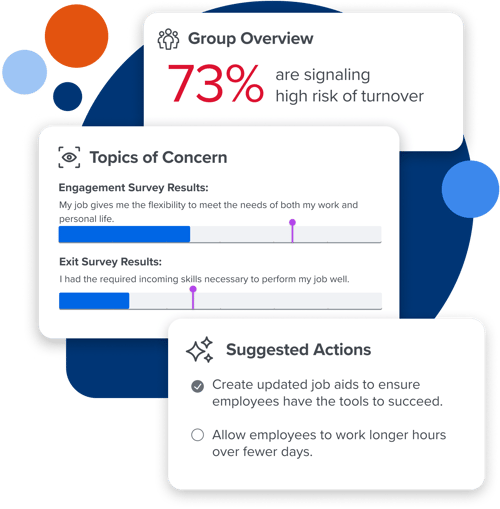
Your employees are already telling you what they need to stay. The key is having the right tools to uncover those insights and take meaningful action. Quantum Workplace’s Retention Radar helps HR leaders predict and prevent turnover by identifying at-risk employees before they leave. With powerful analytics and actionable insights, you can: 

  • Spot early warning signs of disengagement & retention risk
  • Understand key drivers of turnover
  • Equip managers with targeted retention strategies
  • Take proactive steps to keep your top talent
Retention Radar Quantum WOrkplace


How strong is your retention strategy? 

Want to know if your retention strategies are keeping pace with today’s job market? Take our Retention Quiz—a quick assessment designed to help HR leaders pinpoint gaps and get expert guidance on retaining their workforce. 

EMPLOYEE RETENTION QUIZ (2)


Retention success starts with knowing where you stand. With Quantum Workplace, you can take the guesswork out of employee retention and create a workplace where employees thrive—and stay. 

 

A step towards smarter, web-native AI agents

0

Amazon Introduces Nova Act, an Advanced AI Model for Smarter Agents

Amazon has introduced Nova Act, an advanced AI model designed for smarter agents that can execute tasks within web browsers. The company envisions agents as entities capable of performing complex, multi-step tasks in diverse digital and physical environments.

Limitations of Current Market Offerings

Current market offerings often fall short, with many agents requiring continuous human supervision and their functionality dependent on comprehensive API integration—something not feasible for all tasks. Nova Act is Amazon’s answer to these limitations.

Amazon Nova Act SDK

Alongside the model, Amazon is releasing a research preview of the Amazon Nova Act SDK. Using the SDK, developers can create agents capable of automating web tasks like submitting out-of-office notifications, scheduling calendar holds, or enabling automatic email replies.

Key Features of the SDK

  • Breaks down complex workflows into dependable "atomic commands" such as searching, checking out, or interacting with specific interface elements like dropdowns or popups.
  • Supports browser manipulation via Playwright, API calls, Python integrations, and parallel threading to overcome web page load delays.
  • Detailed instructions can be added to refine these commands, allowing developers to, for instance, instruct an agent to bypass an insurance upsell during checkout.

Exceptional Performance on Benchmarks

Unlike other generative models that showcase middling accuracy on complex tasks, Nova Act prioritizes reliability. Amazon highlights its model’s impressive scores of over 90% on internal evaluations for specific capabilities that typically challenge competitors.

Amazon’s Vision for Scalable and Smart AI Agents

One of Nova Act’s standout features is its ability to transfer its user interface understanding to new environments with minimal additional training. Amazon shared an instance where Nova Act performed admirably in browser-based games, even though its training had not included video game experiences. This adaptability positions Nova Act as a versatile agent for diverse applications.

Conclusion

Amazon is clear that Nova Act represents the first stage in a broader mission to craft intelligent, reliable AI agents capable of handling increasingly complex, multi-step tasks. The company is focused on training agents through reinforcement learning across varied, real-world scenarios rather than overly simplistic demonstrations.

Frequently Asked Questions

Q: What is the purpose of the Amazon Nova Act SDK?
A: The SDK is designed to help developers create agents capable of automating web tasks, such as submitting out-of-office notifications, scheduling calendar holds, or enabling automatic email replies.

Q: What are the key features of the Nova Act model?
A: The Nova Act model prioritizes reliability, achieving impressive scores of over 90% on internal evaluations for specific capabilities that typically challenge competitors. It also features the ability to transfer its user interface understanding to new environments with minimal additional training.

Q: How does the Nova Act model differ from other generative models?
A: Unlike other generative models, Nova Act prioritizes reliability, achieving exceptional performance on complex tasks. It is designed to be used in a variety of applications, including browser-based games and real-world scenarios.

Q: What is the long-term vision for Amazon’s AI agents?
A: Amazon’s long-term vision is to create intelligent, reliable AI agents capable of handling increasingly complex, multi-step tasks. The company is focused on training agents through reinforcement learning across varied, real-world scenarios.

iPhone 16 Pro Max vs Samsung Galaxy S25 Ultra: Camera Phone Showdown

0

Camera Phone Shootout: iPhone 16 Pro Max vs Samsung Galaxy S25 Ultra

Camera Phone Specs

iPhone 16 Pro Max Samsung Galaxy S25 Ultra
Chipset Apple A18 Pro Qualcomm SM8750-AB Snapdragon 8 Elite
Main Camera 48 MP f/1.8, 24mm (wide) 200 MP (f/1.7) 24mm (wide)
Zoom Camera 12 MP f/2.8, 120mm (periscope telephoto) 10 MP (f/2.4) 67mm (telephoto) + 50 MP (f/3.4) 111mm (periscope telephoto)
Ultrawide camera 48 MP f/2.2, 13mm 50 MP, f/1.9, 120°
Selfie Camera 12 MP, f/1.9, 23mm 12 MP (f/2.2) 26mm
Video 4K@24/25/30/60/100/120fps 8K@24/30fps, 4K@30/60/120fps
Price $1,199 / £1,199 $1,299.99 / £1,249

Image Comparisons

During today’s camera phone shootout, I took to the sunny streets of Bath armed with both of these flagship camera phones, with the intent to capture the exact same shot with each device. I’ve never shot with either of these phones before, as my current smartphone of choice is the S24 Ultra.

To keep things fair, I stood in the same spot, used the same aspect ratio (16 by 9), and shot using the highest possible quality setting (excluding RAW modes) that both camera phones could muster, which is 48MP for the iPhone 16 Pro Max, and 200MP for the S25 Ultra.

Results and Image Sliders

[Image sliders]

Verdict

I can’t believe that I’m saying this publicly on the internet as a Samsung fan, but I have to admit that the iPhone 16 Pro Max might be the winner here (though it’s very very close). During today’s shootout, having never used either camera phone before, I found it much easier to use the iPhone 16 Pro Max and adjust camera settings on the fly thanks to the new Camera Control Button. Being able to control the aperture so easily really is a game-changer.

However, I did find when using the camera control button that it would active and change quite easily without me meaning to adjust it, and I think this may have been down to the Apple silicone case that we had on the phone during testing. The Samsung S25 Ultra performed exquisitely, as I had no doubt that it would, but the reason I think the iPhone succeeds here is not only ease of use – but the fact that Samsung had the advantage in this shootout with a 200MP main camera compared with the iPhone 16 Pro Max’s 48MP lens, yet the outcomes captured were very similar.

Frequently Asked Questions

Q: What were the camera phone specs compared in this shootout?
A: The camera phone specs compared in this shootout were the iPhone 16 Pro Max and the Samsung Galaxy S25 Ultra.

Q: What were the main differences between the two camera phones?
A: The main differences between the two camera phones were the camera resolutions, with the Samsung Galaxy S25 Ultra having a 200MP main camera compared to the iPhone 16 Pro Max’s 48MP main camera.

Q: Which camera phone was easier to use in this shootout?
A: The iPhone 16 Pro Max was easier to use in this shootout, thanks to its new Camera Control Button that allowed for easy adjustment of camera settings on the fly.

Q: What were the results of the camera phone shootout?
A: The results of the camera phone shootout showed that both camera phones were capable of capturing high-quality images, but the iPhone 16 Pro Max may have had a slight edge due to its ease of use and new Camera Control Button.

Intel’s new CEO vows to run chipmaker like a ‘day one startup’

Intel’s New CEO Outlines Plan to Return Company to Greatness

On Monday, chip giant Intel’s new CEO, Lip-Bu Tan, laid out in broad terms his strategy to return the company to greatness. Speaking at Intel Vision, the company’s annual event for customers and partners in Las Vegas, Tan emphasized changing Intel’s culture, promising to run the company "as a startup, on day one."

Changing Culture

Tan said the culture needs changing because Intel has lost much of its engineering focus over the years. "Intel has lost some of this talent over the years," he said. "I want to re-group the talent and attract some of the new talent. "

Building a Stronger Team

Tan recalled his affection for basketball and California’s Golden State Warriors, saying, "I love the game, how they pass the ball to the teammate to receive it — this is the kind of team I would like to build."

Addressing Past Mistakes

Tan put Intel’s problems front and center. Without enumerating the mistakes in detail, it’s well-known to investors and to the industry at large that Intel has lost an enormous amount of market share to AMD over the years and has ceded the artificial intelligence battle to Nvidia. "It has been a tough period for quite a long time for Intel," observed Tan. "It was very hard for me to watch its struggle; I simply cannot stay on the sideline knowing that I could help turn things around."

Strengthening Balance Sheet

Tan identified some more specific goals. He said the company must strengthen its balance sheet, which has seen the crumbling of profit, leading to a revoking of its dividend payout.

Refashioning Chip Architecture

More substantively, Tan spoke of a need to refashion the "architecture" of Intel’s chips. That is a term of art in the semiconductor world for the way a chip’s transistors are oriented to solve a problem. Nvidia has blown past Intel’s x86 with an architecture for its GPUs that has taken advantage of the AI era. Intel needs to "accelerate development of [a] new compute architecture platform," he said, "to adopt AI and drive significant performance and power efficiency."

Software 2.0 Mentality

Tan referred to that as a "software 2.0 mentality," informed by his years of investing in startup software companies. Before becoming a board member at Intel two years ago, a post he resigned shortly before Gelsinger’s departure, Tan had a long period as a venture capitalist and as the chief executive of software maker Cadence Design Systems.

Conclusion

In fixing what’s broken at Intel, "My motto is very simple: Under-promise and over-deliver," he said. "That has been my trademark. I will not be satisfied until we delight all of you."

FAQs

Q: What is Lip-Bu Tan’s plan to return Intel to greatness?
A: Tan’s plan involves changing Intel’s culture, refashioning its chip architecture, and strengthening its balance sheet.

Q: What is the "software 2.0 mentality" that Tan refers to?
A: The "software 2.0 mentality" is a term used to describe the need for Intel to adopt a new approach to chip design, one that is informed by its years of investing in startup software companies.

Q: What is the importance of Intel’s foundry business?
A: The foundry business is a services business built on a foundation of trust, according to Tan. It is important for Intel to learn and adapt to each customer’s unique design method and style.

Qualcomm Acquires VinAI’s Generative AI Division

0

Qualcomm Acquires VinAI’s Generative AI Division

Acquisition Highlights

Qualcomm, a leading technology company, has acquired the generative AI division of VinAI, an AI research company headquartered in Hanoi, for an undisclosed amount. This move marks Qualcomm’s continued expansion into the AI tooling sector.

About VinAI

VinAI, founded by former DeepMind research scientist Hung Bui, develops a range of generative AI technologies, including computer vision algorithms and language models. The company primarily focuses on AI-powered automotive products, but also conducts higher-level AI research.

Acquisition Benefits

"This acquisition underscores our commitment to dedicating the necessary resources to R&D that makes us the driving force behind the next wave of AI innovation," said Qualcomm SVP of Engineering Jilei Hou. "By bringing in high-caliber talent from VinAI, we are strengthening our ability to deliver cutting-edge AI solutions that will benefit a wide range of industries and consumers."

About the Acquisition

VinAI CEO Hung Bui expects the company’s technology to contribute to a number of Qualcomm’s product families, including its software and chips for smartphones, PCs, and vehicles. Bui will join Qualcomm following the close of the acquisition.

Broader Context

The VinAI acquisition is Qualcomm’s second this year, following its purchase of Edge Impulse, a German AI and internet of things company, in early March. Qualcomm CEO Cristiano Amon recently called edge AI a "tailwind" for the tech giant.

Conclusion

The acquisition of VinAI’s generative AI division is a strategic move by Qualcomm to further solidify its position in the AI tooling sector. With the addition of VinAI’s talented team, Qualcomm is poised to deliver innovative AI solutions that will benefit a wide range of industries and consumers.

Frequently Asked Questions

Q: What is the purpose of the acquisition?
A: The acquisition is aimed at strengthening Qualcomm’s position in the AI tooling sector by bringing in high-caliber talent from VinAI.

Q: What are the benefits of the acquisition?
A: The acquisition will enable Qualcomm to deliver cutting-edge AI solutions that will benefit a wide range of industries and consumers.

Q: What is the next step for VinAI?
A: VinAI CEO Hung Bui will join Qualcomm following the close of the acquisition.

Q: What is the significance of this acquisition in the context of Qualcomm’s overall strategy?
A: The acquisition is a strategic move by Qualcomm to further solidify its position in the AI tooling sector, which is expected to drive innovation and growth in the industry.

Dumb DEV Community

Article