Home Blog Page 13

Generate single title from this title How districts can build a shared AI structure in 100 -150 characters. And it must return only title i dont want any extra information or introductory text with title e.g: ” Here is a single title:”

Write an article about

Key points:

In the second week of January, a senior mathematics teacher with 22 years in the classroom raised a hand at the end of a staff meeting and asked a question that changed the way I now design AI literacy work for entire faculties.

Her question was not about prompts or platforms. It was simpler and more honest than that: “What if I look stupid in front of my students?” The room went quiet. Nobody had said it out loud before, but every teacher present had been carrying some version of the same worry for months. American districts trying to land a shared AI structure are spending too much time on tooling and too little on the question that actually drives teacher uptake.

Over two years, I worked closely with around 50 K-12 colleagues across three international schools in São Paulo on AI literacy. The dominant barrier to adoption was not technophobia, not generational gap, not fear of replacement. It was a more specific worry. Experienced teachers were afraid of being seen by their students as the last person in the room to understand a tool the students were already using. Naming that barrier in a faculty meeting, and giving teachers explicit institutional permission to learn alongside their students, accelerated uptake sharply at around the eight-month mark. American district leaders can replicate this language shift at zero marginal cost, and they should do it before signing a single new procurement contract.

The first decision a district has to make is about the unit of engagement. Whole-school AI professional development days produced low durable change in our cohort. Teachers showed up, took notes, and went back to their classrooms with little behavioral shift visible six weeks later. Self-directed learning produced uneven change concentrated among already-willing teachers, which widened rather than closed the internal gap. The strongest behavioral signal came from department-level structured engagement, in groups of four to eight teachers, across four sessions over six weeks, with one practice task between meetings and one shared observation at the end. The template a district can adapt is simple. Forty-five minutes per session. One specific pedagogical question per session, not one tool per session. One practice task each teacher takes into a real lesson the following week. One shared observation at the final session, written up in two paragraphs and circulated to the rest of the faculty. We did not start with the departments that initially resisted, but instead started with two willing departments, published a short internal write-up of what changed, and let the resistant departments approach us when they were ready. That sequencing matters more than the content.

The second decision is about how the district frames AI use itself. The most damaging framing in current U.S. K-12 policy is the binary one. Did the student use AI or did they not? That binary cannot survive contact with a real classroom. A mathematics student using AI to check work before submission is doing something different from a student using AI to bypass the work entirely. A history student using AI to summarize a primary source is doing something different from a student using AI to substitute one. The framework that worked in our cohort treated AI use as a competence within a discipline, with observable criteria specific to that subject. The drafting time is shorter than most district leaders expect. One paragraph per discipline, three to five observable criteria, written by the head of department and signed off by the principal in around 90 minutes. The statement should be in language a 14-year-old can read, not in language a lawyer drafted. When students can read the criteria, they self-regulate against them. When students cannot read the criteria, they cheat against them.

The third decision is about sequencing. Most districts begin with tooling. They evaluate three platforms, pick one, roll it out, and then wonder why teacher uptake is uneven six months later. The order that worked for us was the reverse. Begin with the language the leader uses about AI in faculty meetings. Move to the structure of department-level engagement. Move to discipline-specific competence statements. Only then choose a platform, and choose it with the heads of department who will actually use it, not with an IT committee deciding in their absence. A district that gets the language, the structure, and the competence statements right will get a return on whatever platform it picks. A district that gets the platform right but the other three wrong will get the budget line and not the behavior change.

What does the district leader do this week, without waiting for the next budget cycle? Change the language about AI in the next faculty meeting from “we will permit it under the following conditions” to “we will learn it alongside our students, and here is what that looks like.” Propose to two department heads a four-session structured engagement with measurement at the end, and offer to attend the first session yourself. Ask one of those heads to draft a single discipline-specific AI competence statement, in plain language, as a template for the rest of the faculty.

None of this requires money the district does not already have. What it requires is the leader changing the language they use in faculty meetings, being honest about which budget lines have produced behavioral change and which have not, and accepting that AI literacy in a district is not a procurement project. It is a language project, a structure project, and a competence project, in that order, and it costs nothing to begin tomorrow.

Roney Lima do Nascimento, University of São PauloRoney Lima do Nascimento is a doctoral candidate in Pure Mathematics at the University of São Paulo (IME-USP) and an IB Diploma Mathematics teacher at Colégio São Luís in São Paulo. Microsoft Innovative Educator Expert 2026, Google Generative AI Leader (valid through 2028). Author of ‘Generative AI for Teachers’. Featured in the April 2026 ISTE+ASCD Blog and the May 2026 print issue of Educational Leadership. Confirmed keynote speaker at ICAILY 2026 in Cape Town in September. Latest posts by eSchool Media Contributors (see all)

.Organize the content with appropriate headings and subheadings ( h2, h3, h4, h5, h6). Include conclusion section and FAQs section with Proper questions and answers at the end. do not include the title. it must return only article i dont want any extra information or introductory text with article e.g: ” Here is rewritten article:” or “Here is the rewritten content:”
Generate single title from this title Training Azerbaijani language models on Amazon SageMaker AI in 100 -150 characters. And it must return only title i dont want any extra information or introductory text with title e.g: ” Here is a single title:”

0

Write an article about
This solution builds on open source tools including PyTorch, Hugging Face Transformers, and Liger Kernels. The authors would also like to thank Aiham Taleb, Arefeh Ghahvechi, Manav Choudhary, Rohit Thekkanal, Daz Akbarov, Jamila Jamilova, Ross Povelikin, Almas Moldakanov, Christelle Xu, and Ivan Khvostishkov for their contributions in making this project possible.
Azercell Telecom LLC, Azerbaijan’s leading telecommunications provider, wanted to build an Azerbaijani large language model (LLM) on Amazon SageMaker AI for telecom use cases and a customer-facing chatbot. The challenge: adapting foundation models (FMs) to a morphologically rich language with limited training data and no existing blueprint for efficient LLM training in Azerbaijani. In a six-week collaboration, Azercell worked with the AWS Generative AI Innovation Center to establish a production-ready framework on Amazon SageMaker AI that delivered a 23% higher training throughput and 58% lower peak GPU memory usage through kernel-level optimizations on an ml.p5.48xlarge instance. The framework also achieved a 2× improvement in tokens per word using a custom tokenizer, effectively doubling the amount of Azerbaijani text that fits within the model’s context window. If you work with low-resource or morphologically complex languages, this post walks through the approach so you can evaluate similar techniques.
Solution overview
The framework implements three sequential stages, each producing artifacts that feed the next.

Stage 1: Tokenizer development builds an efficient tokenizer for Azerbaijani. We evaluated three approaches (baseline English-optimized tokenizers, vocabulary extension, and custom monolingual tokenizers) measuring encoding efficiency through standardized metrics. The custom monolingual tokenizer achieved the strongest results, halving the tokens per word compared to the baseline.
Stage 2: Continued pre-training (CPT) adapts an FM (Llama 3.2 1B) to understand Azerbaijani using distributed training and Liger Kernel optimizations on Amazon SageMaker AI training jobs. This allows for larger batch sizes and higher throughput on the same hardware. While distributed training wasn’t required for this 1B-scale proof-of-concept, it will be essential as Azercell scales to larger models.
Stage 3: Supervised fine-tuning with Low-Rank Adaptation (LoRA) transforms the pre-trained model into a conversational assistant. After CPT, the model can predict Azerbaijani tokens but can’t engage in dialogue. Stage 3 applies LoRA, a parameter-efficient fine-tuning method that significantly reduces trainable parameters.

The training stages (CPT and LoRA fine-tuning) were run as Amazon SageMaker AI training jobs launched from Amazon SageMaker Unified Studio, each pointing to a custom training script. Each job provisions fresh Amazon Elastic Compute Cloud (Amazon EC2) instances and terminates after completion, so you pay only for actual compute time with no idle cluster cost.
The following diagram illustrates the modular architecture, where each stage can be optimized independently. Tokenizer improvements benefit every subsequent training stage, and CPT configurations transfer across fine-tuning tasks.

Figure 1. The training pipeline architecture. Operators launch training jobs from Amazon SageMaker AI Notebook Instances. Training data and model artifacts are stored in Amazon Simple Storage Service (Amazon S3). Training metrics are tracked with TensorBoard in Amazon SageMaker AI, and system metrics are captured through Amazon CloudWatch.

Developing an Azerbaijani tokenizer
Languages like Azerbaijani are morphologically rich, with single words encoding grammatical meaning through suffixes that English would express using multiple words. However, standard English-optimized tokenizers fragment these complex word forms. For example, splitting “kitablardan” (meaning from the books) into multiple subword tokens as illustrated in Figure 2, which reduces the actual content that fits within a fixed-size context window.

Figure 2. Comparison of baseline and custom tokenization for Azerbaijani text, showing reduced token fragmentation.

To address this, we trained a custom tokenizer on Azerbaijani text using a Byte-Level Byte-Pair Encoding (BBPE) algorithm, which iteratively merges the most frequent byte pairs into vocabulary entries. Starting from raw bytes rather than predefined character sets provides full coverage of Azerbaijani-specific characters without requiring manual alphabet definitions. We experimented with vocabulary sizes ranging from 50k–100k tokens to find the right balance: too small and the tokenizer over-fragments words, too large and rare tokens lack sufficient training signal.
We trained custom tokenizers using the Hugging Face tokenizers library with the same configuration as the native Llama 3.2 tokenizer, varying only vocabulary size. After training and evaluating multiple tokenizers with different vocabulary sizes, we selected a final vocabulary of 100k tokens. To verify that the custom tokenizer didn’t sacrifice modeling quality, we compared models after continued pre-training using Bits-Per-Byte (BPB) rather than perplexity, because BPB normalizes for vocabulary differences by measuring prediction quality at the byte level. The model using the custom tokenizer achieved a BPB of 0.5795 on the validation set, compared to the baseline’s 0.6830, confirming that improved encoding efficiency came without a quality trade-off.
Beyond preserving modeling quality, the custom tokenizer delivers substantial practical efficiency gains. Encoding efficiency can be quantified through fertility score—the average number of tokens per word, where lower values indicate more efficient encoding. The baseline Llama 3.2 tokenizer averaged 3.22 tokens per Azerbaijani word, while the custom monolingual tokenizer achieved 1.59—a 2× improvement in encoding efficiency. With Llama 3.2’s 128k-token context window, this translates to real capacity differences: approximately 40k words with the baseline tokenizer versus 80k with the optimized one—effectively doubling the content the model considers at once.
Continued pre-training
Continued pre-training adapts the FM (Llama 3.2 1B) to understand Azerbaijani. The primary bottleneck for this stage is GPU memory: optimizing memory utilization directly determines how much of the hardware investment translates into training throughput. We benchmarked on both ml.p4d.24xlarge (8× NVIDIA A100 GPUs) and ml.p5.48xlarge (8× NVIDIA H100 GPUs) instances. The following sections describe the two optimization approaches benchmarked: distributed training with PyTorch’s Fully Sharded Data Parallel (FSDP) and Liger Kernel integration.
Distributed training with Fully Sharded Data Parallel (FSDP)
A model’s memory footprint includes not just weights, but also gradients, optimizer states, and activations. These components can exceed 100 GB for larger models like Llama 3.1 8B in mixed precision. We developed and validated the distributed training setup on the 1B model so that scaling to larger architectures requires only a configuration change, not a re-architecture of the pipeline. Standard Distributed Data Parallel (DDP) replicates the full model on each GPU, which limits the batch size and model scale you can achieve. FSDP shards parameters, gradients, and optimizer states across GPUs, dynamically gathering only what is needed during each computation step. This reduced per-GPU model state memory from 9.23 GB to 1.17 GB on ml.p4d.24xlarge, freeing headroom for larger batch sizes.
Liger Kernel integration
Liger Kernels are memory-efficient, Triton-based implementations of common LLM operations that fuse multiple operations into single GPU kernel launches, reducing intermediate memory allocations while producing numerically equivalent results. They support several popular model architectures including Llama. We recommend that you verify compatibility with your architecture before adoption.
Integration requires minimal code changes: a single function call patches the model with optimized kernels before instantiation, and Liger Kernels work with PyTorch FSDP without modifications to the distributed training setup. We validated correct execution with PyTorch Profiler, confirming fused operations in the trace. The following table summarizes the cumulative impact of each optimization step across both instance types. Note that DDP memory and throughput on p5 instances weren’t benchmarked because FSDP was the target configuration.

Metric
DDP
FSDP
FSDP + Liger

Max batch size per GPU on ml.p4d.24xlarge (8× NVIDIA A100 GPUs)
2
4
14

Max batch size per GPU on ml.p5.48xlarge (8× NVIDIA H100 GPUs)
4
10
18

Peak GPU memory incl. activations (GB) on ml.p5.48xlarge

64
27

Training throughput per GPU (tokens/s) on ml.p5.48xlarge

63,771
78,319

On ml.p4d.24xlarge, the full optimization stack delivered a 7× increase in maximum batch size over DDP. On ml.p5.48xlarge, peak GPU memory dropped 58% and per-GPU throughput increased 23% when adding Liger Kernels to FSDP.
Pre-training setup
Each tokenizer configuration from Stage 1 was carried through CPT end-to-end to compare convergence behavior and downstream quality. With the custom Azerbaijani tokenizer (100k vocabulary), the training corpus amounts to approximately 2.5B tokens.
The custom training script supports configurable context windows, BFloat16 mixed precision, cosine learning rate scheduling with AdamW, and automatic checkpointing to Amazon S3 for fault tolerance. We set the context window to 2,048 tokens because over 90% of training samples fell below this length after tokenization, though the configuration supports up to the model’s native 128k-token limit.
When new tokens are added to the vocabulary, CPT follows a two-phase approach. In the first phase, the model backbone is frozen and only the embedding layer is trained. This adapts the new token representations to the model’s existing internal space without disrupting pre-trained knowledge. In the second phase, the parameters are unfrozen for full training, allowing the model to deeply learn Azerbaijani language patterns. The following table shows the training configuration using the Azerbaijani custom tokenizer (100k vocabulary). Training used two ml.p4d.24xlarge instances (16 NVIDIA A100 GPUs total) with FSDP and Liger Kernel optimizations.

Parameter
Phase 1: Embedding Adaptation
Phase 2: Full Training

Frozen backbone
Yes
No

Learning rate
0.0032
0.0024

Batch size per GPU
14
14

Steps
5,000
15,000

Training time
~11,400 seconds (~3.2 hours)
~43,000 seconds (~11.9 hours)

A lower learning rate in the full-training phase preserves the knowledge acquired during embedding adaptation. With an effective batch size of 224 (14 per GPU × 16 GPUs) and a 2,048-token context window, each training step processes approximately 450k tokens, yielding an estimated per-epoch time of approximately 4.3 hours on this configuration. On ml.p5.48xlarge, higher per-GPU throughput and larger batch sizes would reduce per-epoch time further.
Supervised fine-tuning with LoRA
After CPT, the model can fluently predict the next Azerbaijani token, but it has no concept of conversational structure. Given a question, it generates plausible continuations rather than helpful answers. LoRA bridges this gap efficiently by freezing the pre-trained weights and training small low-rank decomposition matrices injected into the model’s attention and feed-forward layers. Instead of updating a full weight matrix, LoRA trains two smaller matrices whose product approximates the full update—reducing trainable parameters to a small fraction of the total. The following table summarizes the LoRA fine-tuning configuration.

Parameter
Rank
Alpha
Dropout
Target modules
Max sequence length

Value
64
28
0.05
q, k, v, o projections; gate, up, down projections
1,024

This compact footprint meant fine-tuning ran on a single ml.g5.8xlarge instance (1× NVIDIA A10G GPU), completing in minutes. Fine-tuning used approximately 2,000 single-turn Azerbaijani question-answer pairs using Hugging Face’s SFTTrainer with a learning rate of 1e-4—higher than CPT’s learning rates because LoRA adapters are randomly initialized and benefit from stronger gradient updates.
Training used a Llama-style chat template with assistant-only loss masking: the model is penalized only for predicting the assistant’s response tokens and the end-of-turn token (), while user prompts and template delimiters are excluded from the loss. As a result, the model focuses its learning capacity on generating appropriate responses rather than memorizing user input patterns.
Results and validation
Continued pre-training used approximately 2.5B tokens with the custom Azerbaijani tokenizer, and fine-tuning used 2,000 question-answer pairs. The framework delivered measurable improvements across four dimensions:

2× encoding efficiency through custom tokenization The custom monolingual tokenizer halved the fertility score (from 3.22 to 1.59 tokens per word), effectively doubling the Azerbaijani content that fits within the model’s 128k-token context window. A BPB score of 0.5795 versus the baseline’s 0.6830 confirmed this gain didn’t sacrifice modeling quality.
Significant memory and throughput optimization Fully Sharded Data Parallel (FSDP) sharding and Liger Kernel integration allowed larger batch sizes on the same hardware, up to 7× on ml.p4d.24xlarge and 4.5× on ml.p5.48xlarge over their respective DDP baselines—while reducing peak GPU memory by 58% and increasing per-GPU throughput by 23%.
Production-ready, scalable infrastructure Validated configurations across ml.p4d.24xlarge and ml.p5.48xlarge instances give Azercell a flexible foundation that scales as training requirements grow, with the distributed setup designed so that moving to larger models requires only a configuration change.
Coherent Azerbaijani language generation The off-the-shelf Llama 3.2 1B drifts into repetitive, incoherent output when prompted in Azerbaijani, a common failure mode for underrepresented languages. The fine-tuned model produces concise, semantically coherent responses that demonstrate clear Azerbaijani language understanding. This is illustrated in the following table for a sample prompt provided by Azercell.

Prompt
Azerbaijani output
English translation

Input prompt
Yeni bir dil öyrənmək yalnız ünsiyyət imkanlarını genişləndirmir…
Learning a new language not only expands communication opportunities…

Llama 3.2 1B

Yeni bir dil öyrənmək yalnız ünsiyyət imkanlarını genişləndirmir. Bu, əksinə, dili öyrənən insanlara yeni bir dil öyrənmək üçün fərqli məqsədlərlə yanaşı, onların özü də yeni bir dil öyrənməyə başlayır.
Dil öyrənməsi, həmçinin, yeni bir dil öyrənməyə olan istiqamətlərin və təcrübələrinin genişləndirilməsinə səbəb olur. Yeni bir dil öyrənməyə olan istiqamətləri və təcrübələrinin genişləndirilməsindən sonra, yeni bir dil öyrənməyə olan istiqamətlərin və təcrübələrinin genişləndirilməsi…

Learning a new language not only expands communication opportunities. On the contrary, it also leads people who learn a language to approach language learning with different goals, and they themselves begin the process of learning a new language. Language learning also contributes to the expansion of directions and experiences related to learning a new language. After expanding these directions and experiences, the development of approaches and experiences in learning a new language continues…

Fine-tuned Llama 3.2 1B
Yeni bir dil öyrənmək yalnız ünsiyyət imkanlarını genişləndirmir, həm də yeni dostlar və əlaqələr yaradır.
Learning a new language not only expands communication opportunities but also creates new friendships and connections.

Conclusion
In this post, we showed how Azercell and the AWS Generative AI Innovation Center built a framework for training Azerbaijani language models on Amazon SageMaker AI. The three-stage pipeline (custom tokenization, continued pre-training with FSDP and Liger Kernel optimizations, and LoRA fine-tuning) transforms a general-purpose foundation model into an Azerbaijani conversational assistant while maximizing GPU utilization. Azercell now operates the framework independently, with a methodology that supports larger corpora, scaled architectures, and expanded use cases. To learn more, explore the following resources:

To explore implementing a similar solution, reach out to your AWS account team or visit the AWS Generative AI Innovation Center. If you’re training LLMs for low-resource languages or optimizing GPU utilization on SageMaker AI, we’d love to hear from you. Share your thoughts and questions in the comments.

About the authors

Aleksei Iancheruk is a Data Scientist at the AWS Generative AI Innovation Center (GenAIIC). He specializes in search and retrieval systems, recommender systems, and AI agents. With experience spanning both large enterprises and startups/scaleups, he has designed and shipped production AI systems across diverse technical environments.

Debby Wehner is a Machine Learning Engineer at the AWS GenAIIC, specializing in large language model customization and optimization. Previously at Amazon, she built AI-powered shopping applications as a full-stack software engineer. She holds a PhD in Computational Geophysics from the University of Cambridge, as well as a BSc and MSc from Freie Universität Berlin.

Hanno Bever is a Senior Machine Learning Engineer in the AWS GenAIIC. In his six years at Amazon, he has helped customers across various industries run machine learning workloads on AWS. He specializes in scaling distributed model training and optimizing inference on AWS Trainium and GPU instances.

Sabir Mardanov leads Azercell’s Data & AI organization, shaping the AI strategy behind the company’s transformation from a traditional telco to a tech-centric leader. His work has delivered measurable impact across efficiency, revenue, and productivity. He oversees the development of scalable AI capabilities while embedding strong governance and a data-driven culture across the enterprise.

Irada Bunyatova is a Senior Data Scientist at Azercell, specializing in speech technologies, large language models and agentic AI systems. She designs and deploys production-grade AI solutions across diverse business applications. She holds an MSc&T in Artificial Intelligence and Advanced Visual Computing from École Polytechnique.

.Organize the content with appropriate headings and subheadings ( h2, h3, h4, h5, h6). Include conclusion section and FAQs section with Proper questions and answers at the end. do not include the title. it must return only article i dont want any extra information or introductory text with article e.g: ” Here is rewritten article:” or “Here is the rewritten content:”

Generate single title from this title Google Pay preps for AI agents with Universal Commerce Protocol in 100 -150 characters. And it must return only title i dont want any extra information or introductory text with title e.g: ” Here is a single title:”

Write an article about

Google Pay is overhauling its payment infrastructure for an impending wave of transactions from AI agents.

The latest updates introduce the Universal Commerce Protocol and a new server architecture, positioning Google Pay as a central clearinghouse for purchases executed by autonomous agents rather than human users.

AI agents – designed to perform tasks like booking flights or ordering supplies – cannot effectively navigate the multi-step, visually-oriented checkout pages built for human interaction. Google is attempting to replace this UI-dependent model with a stable, API-driven backend for machines.

This restructuring of Google Pay introduces several components:

  • Universal Commerce Protocol (UCP): This is a new specification intended to standardise how AI agents communicate with payment and merchant systems. It creates a common language for initiating transactions, confirming inventory, and handling fulfillment details. The objective is to eliminate the need for developers to build bespoke integrations for every merchant or payment provider an agent might interact with.
  • New Merchant Commerce Platform (MCP) server: Google is deploying a new server-side system to act as an intermediary. This MCP server manages merchant integrations and analyses transaction trends. For developers building agents, it abstracts away the complexity of the commerce backend. For Google, it centralises a vast amount of transactional data from agent-driven activities.
  • Dynamic callbacks for Android native: To facilitate more complex checkouts, Google is enabling dynamic callbacks within its Android Pay API. This allows for real-time adjustments to an order (e.g. updating shipping costs based on a new address or recalculating tax) without forcing the user or agent to restart the entire process. It makes the transaction flow more resilient to mid-process changes.
  • Expanded WebView support: The company is extending payment support within WebViews. This is a critical detail, as it allows transactions to be completed inside third-party applications, particularly social media platforms where conversational commerce is expected to increase. Agents operating within these environments can now execute payments natively.

Realities of machine-to-machine commerce

The concept of a customer journey, once defined by clicks and page views, now extends to an agent’s ability to parse product data and execute a transaction via an API.

Marketing leaders now have to consider “search engine optimisation” for machines. Product information, pricing, and availability will need to be presented as machine-readable data, not just persuasive copy for a human audience. If an AI agent cannot parse your inventory data to make a purchasing decision, your business becomes invisible in this new commercial channel.

The introduction of the MCP server also raises questions about data governance and vendor dependency. By routing transactions through its platform, Google gains a privileged view of commerce trends driven by AI agents.

CIOs must assess the long-term implications of building reliance on a proprietary protocol and a centralised data aggregation point. The convenience of a universal standard comes with the strategic cost of platform lock-in.

New architectures for security and trust

Authorising transactions initiated by an autonomous agent presents a new set of security challenges. A faulty or malicious agent could execute unauthorised purchases at scale. 

Google’s answer is the introduction of cross-device biometric authentication. This mechanism allows an AI agent to programmatically request human verification for a transaction. A user could receive a prompt on their phone to approve a purchase an agent has arranged on their laptop.

This approach establishes a “human-in-the-loop” security model for high-value or sensitive transactions. It provides a necessary kill-switch and audit trail for agent activities. Defining the policies for when an agent can act autonomously versus when it must seek human approval becomes a new area of corporate governance. These rules will need to be encoded into the agent’s operational logic, creating a direct link between business policy and software behaviour.

These latest updates to Google Pay are an early but concrete signal of the architectural changes required to support a machine-driven economy. Enterprises that continue to view their digital presence as a collection of websites for human consumption will be unprepared for this next phase of commerce.

See also: Google folds Display Ads into AI-first Demand Gen platform

Want to learn more about AI and big data from industry leaders? Check out AI & Big Data Expo taking place in Amsterdam, California, and London. The comprehensive event is part of TechEx and is co-located with other leading technology events including the Cyber Security & Cloud Expo. Click here for more information.

AI News is powered by TechForge Media. Explore other upcoming enterprise technology events and webinars here.

.Organize the content with appropriate headings and subheadings ( h2, h3, h4, h5, h6). Include conclusion section and FAQs section with Proper questions and answers at the end. do not include the title. it must return only article i dont want any extra information or introductory text with article e.g: ” Here is rewritten article:” or “Here is the rewritten content:”

Generate single title from this title Data Science • AI • Advanced Analytics in 100 -150 characters. And it must return only title i dont want any extra information or introductory text with title e.g: ” Here is a single title:”

Write an article about

The same dataset should not need to exist twice just to be useful.
Yet in most environments, it does. One version lives in a file system, shaped for enterprise users and applications that expect paths, directories, and mutable state. Another version is exported into object storage so distributed engines and AI pipelines can process it efficiently. These copies are not created intentionally. They are artifacts of incompatible storage interfaces.

At small scale, this duplication is tolerable. At AI scale, it becomes structural inefficiency. Storage footprints expand faster than the data itself, pipelines accumulate synchronization logic, and compute is increasingly gated by data movement rather than data processing.

Why is this happening?

Two Models, Two Assumptions About Data

File systems and object stores are not interchangeable abstractions. They encode fundamentally different assumptions about how data behaves.


File systems prioritize structure, coordination, and mutability. Object storage prioritizes exabyte-scale, simplicity, and parallelism.
Neither model is wrong. Each is optimized for a different class of workloads. The problem is that modern data pipelines require both at the same time.

AI Workloads Span Both Worlds
AI pipelines do not align cleanly with either paradigm.
Training and large-scale analytics work well with object storage semantics: high-throughput, parallel reads across distributed compute nodes. At the same time, upstream data is often produced in environments that depend on file semantics, where structure, incremental updates, locking, and policy enforcement are essential.
This creates a persistent impedance mismatch.

In practice, organizations compensate by moving data. File datasets are exported into object storage for analytics. Object data is rehydrated into file systems for downstream workflows. Pipelines grow to include staging, copying, and transformation as first-class steps. What starts as integration becomes dependency, and eventually the pipeline is shaped more by storage constraints than by data logic.

Object Storage as the AI Data Plane
Object storage has become the default substrate for large-scale analytics and AI because it aligns with how modern compute behaves.
Distributed training jobs, query engines, and feature pipelines all assume parallel access, stateless interaction, and large sequential reads over immutable datasets. Object storage satisfies these assumptions naturally.

Recent advances have reinforced this role. High-performance object storage increasingly supports direct data paths such as S3 over RDMA, reducing CPU involvement and allowing data to move directly into GPU memory. At this point, storage throughput is not just a background concern. It directly determines the utilization of compute clusters.

This has an architectural consequence. At throughputs of hundreds of Gbps, any layer that intercepts or translates I/O between compute and object storage reintroduces CPU overhead and constrains throughput. At AI scale, that overhead is no longer negligible. It is often the bottleneck.

Files as the Interface for AI Agents
While object storage has become the data plane, files are re-emerging as the control plane for AI-driven systems within a federated data fabric.
AI agents are stateful. They build context, persist intermediate results, and coordinate over time. A file system naturally supports this: directories organize work, paths encode relationships, and the namespace itself becomes shared memory that both humans and agents can navigate.

(Wanan Wanan/Shutterstock)

In contrast, object storage is flat. Agents must reconstruct structure, infer relationships, and manage state externally, adding complexity. A file system makes context explicit and directly usable.

This is especially important for multi-agent workflows. Files act as a coordination layer, where agents communicate by reading and writing artifacts, organizing tasks, and tracking progress within a shared workspace.

The shift is not away from object storage, but toward layering file semantics on top of it. Object storage remains the scalable foundation, while files provide the interface that better matches how agents operate: managing context, memory, and collaboration.

Bridging Approaches Introduce New Bottlenecks
Efforts to unify file and object access have historically taken two forms.
Copy-based approaches export data into object storage for analytics. This preserves native performance for compute workloads but introduces latency, duplication, and governance fragmentation.

Gateway-based approaches translate protocols in real time, exposing file data through object APIs. This avoids duplication but introduces CPU-bound translation overhead and constrains throughput.
Both approaches address part of the problem while reinforcing another. One optimizes for data format, the other for access consistency. Neither removes the fundamental mismatch.

Toward a Unified Storage Architecture
The direction emerging in modern data platforms is convergence, not translation.

A converged architecture treats file and object interfaces as two views over the same data. Data is written once, stored in a format directly consumable by object-native compute, and exposed through file semantics where needed. There is no duplication, no export pipeline, and no protocol translation in the critical path.

The difference is straightforward but significant. Intermediate steps disappear. Data does not need to be moved, reshaped, or re-exposed before it can be used.

Storage stops being something pipelines work around, and becomes something they operate on directly. For data engineers, this shifts pipeline design in a fundamental way.
Instead of treating data movement as a prerequisite, pipelines can operate directly on the authoritative dataset. Access replaces extraction as the first step. Transformation and analysis follow without intermediate staging.

(NicoElNino/Shutterstock)

This reduces pipeline complexity, improves data freshness, and lowers storage overhead. More importantly, it restores alignment between compute and data. Workloads execute where the data already exists, rather than waiting for it to be relocated.

It also enables new interaction patterns. Existing object datasets can be exposed immediately as file systems without migration. Data produced by applications can be consumed by AI pipelines in real time. Agents can operate directly on live datasets, using file semantics for navigation while leveraging object storage for scale.

Conclusion
File and object storage are not competing paradigms. They are complementary abstractions that evolved under different constraints.
What has changed is the nature of the workloads. AI systems, and increasingly AI agents, require both. They need the scalability and parallelism of object storage, and the structure and accessibility of file systems.

Maintaining these as separate systems forces data engineering to bridge the gap through copying, translation, and orchestration. That approach does not scale.

The shift now underway is about removing that burden. By converging file and object access into a single, federated data fabric, storage becomes aligned with how modern systems actually operate.
At that point, storage is no longer something pipelines work around. It becomes part of the execution model itself.

About the Author: Aron Brand, CTO of CTERA, has more than 22 years of experience in designing and implementing distributed software systems. Prior to joining the founding team of Ctera, Aron acted as chief architect of SofaWare Technologies, a Check Point company, where he led the design of security software and appliances for the service provider and enterprise markets.

.Organize the content with appropriate headings and subheadings ( h2, h3, h4, h5, h6). Include conclusion section and FAQs section with Proper questions and answers at the end. do not include the title. it must return only article i dont want any extra information or introductory text with article e.g: ” Here is rewritten article:” or “Here is the rewritten content:”

Generate single title from this title How AI helps teachers spend less time on assessments and more time on impactful instruction in 100 -150 characters. And it must return only title i dont want any extra information or introductory text with title e.g: ” Here is a single title:”

Write an article about

Key points:

The overreliance on AI is a widely discussed topic for teachers, administrators, and families alike. The last thing we want is for technology to stifle the creativity, expertise, and human connection that educators bring to the classroom or hinder our students’ ability to think critically.

At the same time, when used thoughtfully and intentionally, AI can strengthen–rather than replace–the work of educators. By providing real-time insights into student performance in relation to learning standards and grade-level expectations, AI enables teachers to identify learning gaps so they can tailor classroom experiences to address students’ individual needs. 

Perhaps most importantly, AI is becoming more adept at eliminating the cumbersome, lower-level administrative tasks associated with compiling data and summarizing assessments, giving educators more time to focus on meaningful collaboration and develop richer conversations to better inform instruction.

A valuable tool for enhanced teamwork

For years, Westmont Community Unit School District, which serves more than 1,300 K-12 students in DuPage County, Ill., relied on a robust progress-monitoring platform to gauge student understanding through formative and summative assessments.   

The data became a cornerstone of our weekly grade-level team meetings, aligning all teachers around a shared understanding of student performance and allowing them to identify areas of strength and growth. By quickly surfacing standards mastery and spotting where reteaching was needed, educators could collaborate on targeted interventions, such as small groups for reteach sessions, and instructional strategies to ensure students met key learning standards moving forward.

As powerful as the data was, compiling it could be a time-consuming process. Team members had to manually export the information into a spreadsheet, sort the data by teacher, and plug in formulas to analyze results question by question. At a time when educators continued to face increasing demands on their time and energy, adding to their to-do list was a big ask.

Recently, however, new AI technology has been essential in reducing administrative burdens on our busy teachers, freeing up their time so they can have deeper conversations centered on more impactful work.

Through our enhanced assessment platform, team members can simply input prompts into the AI chat tool, asking the system to separate data by teacher, question, and student. The system instantly creates graphs and charts that reveal trends, highlight at-risk groups, and answer questions on student performance. Instead of spending 30 minutes on exporting and organizing information, teachers can gather everything they need in seconds. 

The time-saving capabilities of AI have allowed Westmont’s teachers to administer more than 130,000 assessments over the past year, putting clear, easy-to-understand data at their fingertips. This readily accessible information has become a catalyst for more results-driven discussions. The system can also recommend targeted interventions and resources if needed, helping teachers move quickly from data analysis to an action plan.

For instance, when comparing student performance against math standards, such as multiplication, we can see which fourth-grade classes scored higher in a particular skill area. In turn, this leads to a deeper analysis: What instructional strategies did the teacher use that contributed to this success? How did they intervene when students demonstrated misconceptions? These insights have helped strengthen instruction and promote consistency in teaching, ultimately improving student achievement across classrooms.

Taking AI adoption to the next step

Once teachers became more comfortable analyzing and applying the data, they began inviting students into the process. AI capabilities allow educators and students to review assessments side-by-side and uncover why questions were incorrectly answered, whether errors stemmed from a careless mistake, misread direction, or a gap in understanding that required additional instruction. This reflection helped students develop greater self-awareness and take a more active role in their learning.

We are also ensuring that all AI technology complies with SOPPA, Illinois’ Student Online Personal Protection Act. Over the summer, administrators and teachers will engage in focused discussions to establish the district’s current stance and define our approach moving forward.

As the great AI debate continues to pick up steam, it’s important to see technology for what it should be: a time saver for teachers so they can focus on what matters most–strengthening the connections that drive meaningful learning for their students. AI should never replace the collaboration of educators or the expertise of the humans in the room, but should shine a light on the insights that spark deeper conversations on how to continuously improve the education experience for every student.

Dr. Carla Braun, Community Unit School District 201

Dr. Carla Braun is the Assistant Superintendent of Teaching and Learning at Community Unit School District 201 in Westmont, Illinois.

Latest posts by eSchool Media Contributors (see all)

.Organize the content with appropriate headings and subheadings ( h2, h3, h4, h5, h6). Include conclusion section and FAQs section with Proper questions and answers at the end. do not include the title. it must return only article i dont want any extra information or introductory text with article e.g: ” Here is rewritten article:” or “Here is the rewritten content:”

Generate single title from this title Synthesize Realistic 3D Medical Images at Scale to Ship Pre‑Trained Models in 100 -150 characters. And it must return only title i dont want any extra information or introductory text with title e.g: ” Here is a single title:”

0

Write an article about

High‑quality 3D medical imaging data is the foundation of modern radiology AI, but access to it is often constrained by data scarcity, privacy restrictions, and the high cost of expert annotation. As a result, training reliable 3D medical imaging models is frequently bottlenecked by small, narrow, and hard‑to‑share datasets, limiting model robustness and generalization.

To help teams overcome these challenges, NVIDIA introduced Medical AI for Synthetic Imaging (MAISI) in 2024—a state‑of‑the‑art generative model that synthesizes high‑resolution 3D CT volumes with pixel‑level anatomical segmentation for privacy‑preserving data augmentation and research. 

NV-Generate-CTMR, built on the MAISI architecture family, including MAISI‑v2 with Latent Rectified Flow, delivers an open source, end-to-end framework for synthetic CT and MRI generation. It enables researchers and developers to generate realistic 3D volumes and paired segmentations at scale, integrate them directly into training pipelines, and accelerate downstream medical imaging AI development.

This blog post introduces NV-Generate-MR-Brain, a new model for the synthetic generation of human brain anatomy and structure segmentation built on the MAISI architecture and extending it toward scalable, open workflows for synthetic 3D medical imaging generation. 

Figure shows Generated MR images using NV-Generate-CTMR rflow-mr model

Figure 1. Generated MR images using NV-Generate-CTMR rflow-mr model. The image on the left is a generated T2w prostate MRI; the image on the right is generated T1w brain MRI

Breaking the 3D medical imaging data bottleneck

NV-Generate-MR-Brain was trained on the newly released multimodal MR-RATE dataset from University of Zurich, Medipol University Hospital, Forithmus and NVIDIA. The MR-RATE dataset builds on the highly successful CT-RATE dataset and multimodal foundation models.

MR-RATE, the world’s largest open source multimodal MRI dataset, comprises 100,000 brain MRI studies from more than 83,000 patients—totaling about 700,000 volumes—each paired with de‑identified radiology reports, clinical, and scanner Digital Imaging and Communications in Medicine (DICOM) metadata. The dataset was created to establish an open, large‑scale foundation for developing both research and commercial AI systems that understand both imaging and clinical context.

MR‑RATE captures the diversity of real‑world neuroimaging practice, spanning different scanner types, imaging protocols, and neurological pathologies. The MR-RATE dataset is being released with an open CC-BY-NC license for research institutions with commercial licenses available through Forithmus.  

Image shows a novel dataset of brain and spine volumes from MR-RATE alongside a radiology report that the radiologist can review

Figure 2. MR-RATE is a novel dataset of brain and spine MRI volumes with a corresponding radiology report

Open source by design

The repository includes end‑to‑end inference code, pretrained weights, and training configurations, enabling teams to get started immediately without rebuilding complex pipelines from scratch. Users can generate synthetic images out of the box or fine‑tune the models on their own datasets to adapt to new anatomies, scanners, or modalities—significantly lowering both technical and compute barriers.

For this project all of the ingredients including code, data, and models are released with open source licenses with most models being released under the NVIDIA Open Model License. Inferencing for these models can be run on NVIDIA RTX GPUs royalty-free to generate images, fine-tune the model on new data, or new use cases.

Why image generation is essential for medical AI

Medical image synthesis has rapidly become a core capability for medical AI development. Teams use synthetic data to augment limited training sets, translate between imaging modalities such as CT and MRI, simulate rare pathologies, and enable privacy‑preserving data sharing without exposing real patient information.

By generating realistic, anatomically consistent 3D volumes—often paired with segmentation labels—synthetic data helps models generalize better when labeled examples are scarce and enables consistent benchmarking across sites, scanners, and protocols.

As clinical imaging becomes increasingly personalized, heterogeneous, and multimodal, scalable and controllable generation frameworks are no longer optional—they are essential for building robust medical AI systems.

Limitations of existing medical image synthesis approaches

Over the years, medical image synthesis methods have largely fallen into three categories: direct regression models, generative adversarial network (GAN)‑based approaches, and, more recently, diffusion models that generate images through iterative denoising.

Among these, diffusion models have emerged as the state of the art, offering improved stability and the ability to model complex anatomical distributions. However, applying diffusion models in real clinical workflows remains challenging.

First, real‑world medical images vary widely across scanners, acquisition protocols, and voxel spacings, making it difficult for models trained on narrow datasets to generalize.

Second, CT and MRI are inherently 3D modalities, yet full 3D diffusion models are computationally expensive in both time and GPU memory.

Third, even when conditioning signals—such as masks or anatomy hints—are provided, generated outputs may not faithfully follow those inputs, limiting their usefulness for controlled or task‑specific generation.

Together, these challenges—limited generalization, high computational cost, and weak condition alignment—make many existing approaches difficult to deploy at scale, motivating the need for faster and more controllable 3D synthesis frameworks.

Fast, Open Source 3D Medical Image Synthesis

NV‑Generate‑CTMR is an open‑source framework from NVIDIA designed to make high‑quality 3D medical image synthesis practical for everyday research and development. Rather than treating generative modeling as a narrow, task‑specific solution, it provides a reproducible, ready‑to‑use platform for creating realistic CT and MRI volumes across a wide range of clinical scenarios.

The framework is the first open‑source medical image generation framework to support flexible voxel sizes, variable volume dimensions, and whole‑body coverage within a single model (shown in Figure below). 

This flexibility allows researchers to synthesize data that matches real clinical protocols—from small, cropped regions to full‑resolution, large‑field‑of‑view scans—without retraining separate models for each setting. In this sense, NV‑Generate‑CTMR behaves as a foundation model for medical imaging, adaptable to many downstream tasks and anatomies rather than being limited to a single organ or configuration.

Figure shows generated CT images aren’t limited to a single organ or configuration

Figure 3: NV-Generate-CTMR image generation results from rflow-ct model for variable voxel and volume sizes in three different anatomical regions

Efficient, sustainable AI development

By sharing models and training details openly, NV‑Generate‑CTMR follows the same philosophy as other open‑source foundation models: reuse instead of retrain.

Fine‑tuning an existing model is faster and far more energy‑efficient than training from scratch, reducing development time, lowering electricity consumption, and shrinking environmental impact.

Under the hood

NV‑Generate‑CTMR contains two model architectures:

  • MAISI‑v1, based on Latent Denoising Diffusion Probabilistic Models (DDPM) for stochastic image generation with better diversity 
  • MAISI‑v2, based on Latent Rectified Flow, for 33x acceleration in inference speed and image generation with better quality

Details were published in two technical papers: MAISI-v2: Accelerated 3D High-Resolution Medical Image Synthesis with Rectified Flow and Region-Specific Contrastive Loss at the AAAI Conference on Artificial Intelligence in 2026; and MAISI: Medical AI for Synthetic Imaging at the IEEE/CVF Winter Conference on Applications of Computer Vision (WACV) in 2025.

Fast inference at scale

The MAISI‑v2 model in NV‑Generate‑CTMR achieves state‑of‑the‑art image quality with much faster inference compared to prior medical image generation methods, while delivering inference speeds comparable to leading video generation models. Table 1, below, breaks down the family of NV-Generate models. 

Model Name ddpm-ct rflow-ct rflow-mr NV-Generate-MR-Brain
Modality CT CT MR MR
Release date August 2024 March 2025 October 2025 March 2026
Body Region Whole body Whole body Brain, prostate, abdomen, breast Whole brain, skull-stripped brain (user can specify)
Architecture MAISI-v1 MAISI-v2 MAISI-v2 MAISI-v2
Inference step 1000 30 30 30
Max Volume 512x512x768 512x512x768 512x512x128 512x512x256
Use case Image-only generation; image/mask pair generation Image-only generation; image/mask pair generation Image-only generation Image-only generation; cross-contrast generation
Advantages Better image diversity, whole body coverage Fast inference speed, better image quality, whole body coverage Fast inference speed, multiple body region coverage Fast inference speed, better image quality for brain region
License Open source, Commercial friendly Open source, Commercial friendly Open source, Research Only Open source, Commercial friendly

Table 1. NV-Generate family of models

Multi-contrast generation model for brain MRI

Brain MRI is one of the most widely used applications of magnetic resonance imaging. To support this domain, we released NV-Generate-MR-Brain, a generative model built on the MAISI‑v2 architecture and trained on the newly released MR‑RATE dataset. 

The model is designed for high-fidelity brain MRI synthesis and includes a foundation brain MRI model capable of generating either whole-brain or skull‑stripped images based on user specifications. It supports several widely used sequences and contrasts, including T1‑weighted (T1w), T2‑weighted (T2w), FLAIR, and SWI, enabling realistic and flexible image generation for research and clinical training applications.

The model supports high-resolution volumetric synthesis up to 512 × 512 × 256, approaching the upper range of spatial resolution used in clinical and research brain MRI, enabling realistic full-volume data generation for medical imaging workflows.

In addition, NV-Generate-MR-Brain provides a ControlNet module for generation of specified anatomical structures or cross-sequence synthesis, enabling users to predict one MRI sequence based on  another. 

Real‑world applications and research adoption

Image–mask pairs with tumors generated by NV‑Generate‑CTMR have been used as augmented training data for NV Segment. Beyond NVIDIA, the models have been used or fine‑tuned by external researchers across a wide range of applications, including:

“Synthetic, anatomically realistic neuro MR data from NV-Generate, combined with automated segmentation from NV-Segment and clinical reasoning capabilities from NV-Reason, help us design and validate AI solutions more efficiently,” said Ioannis Panagiotelis, PhD, Business Leader MR at Philips. “This enables radiologists to benefit from smarter, more explainable workflows without compromising patient privacy.”

Try it yourself: Synthesize 3D medical images

The fastest way to experience NV-Generate-CTMR is to run it yourself. 

Online demo: No GPU required, you can explore an interactive browser demo hosted by NVIDIA.

Command Line Interface (CLI): The online demo showcases core capabilities, but the full experience is available from the GitHub repository, which includes pretrained weights and ready-to-use inference scripts for generating complete 3D CT or MRI volumes locally. After cloning the repo and installing dependencies, you can launch inference with a single command:

git clone https://github.com/NVIDIA-Medtech/NV-Generate-CTMR.git

cd NV-Generate-CTMR
export MONAI_DATA_DIRECTORY=”./temp_work_dir”
network=”rflow”
generate_version=”rflow-ct”
python -m scripts.inference \
-t ./configs/config_network_${network}.json \
-i ./configs/config_infer.json \
-e ./configs/environment_${generate_version}.json \
–random-seed 0 \
–version ${generate_version}

This command loads the pretrained rectified flow model and synthesizes full 3D medical volumes directly to your local workspace. You can then visualize the outputs, inspect paired segmentation masks, or plug the generated data into your own training and evaluation pipelines. An example result of the code block above is shown in Figure 4, below.

Example results

An example of a typical CT image generated from mask condition, showing how this pair of image and mask are well aligne

Figure 4. An example of a typical CT image generated from mask condition

Whether you’re testing ideas, augmenting datasets, or benchmarking models, NV-Generate-CTMR makes it easy to start generating realistic medical images right away.

Video 1. An example of generated CT and MR images

Getting started

Code: https://github.com/NVIDIA-Medtech/NV-Generate-CTMR 

Dataset (research access): https://huggingface.co/datasets/Forithmus/MR-RATE

Model checkpoints: 

.Organize the content with appropriate headings and subheadings ( h2, h3, h4, h5, h6). Include conclusion section and FAQs section with Proper questions and answers at the end. do not include the title. it must return only article i dont want any extra information or introductory text with article e.g: ” Here is rewritten article:” or “Here is the rewritten content:”

Generate single title from this title Despite concerns, Gen Z students are optimistic about AI in 100 -150 characters. And it must return only title i dont want any extra information or introductory text with title e.g: ” Here is a single title:”

Write an article about

Key points:

There’s never been a more turbulent time for young people to plan for and embark on their futures, and a new survey gives insights on their feelings and plans.

The new 2026 Career Interest Survey of 11,443 Gen Z students, conducted by National Society of High School Scholars (NSHSS), gives insights into what motivates a vocal, community-focused, tech-savvy emerging workforce. This new data set is part of a bi-annual survey that indicates trends over the past several years.

Students are confident, despite concerns:

  • Nearly all (94 percent) are extremely, very, or somewhat confident about their future after graduating college.
  • Eighty-four percent believe they can personally make a difference in the world.
  • Human rights is their #1 societal issue, followed by equitable access to healthcare and poverty/hunger.
  • Seventy-nine ercent plan to have a job secured prior to graduating or within six months of graduation.

AI use is universal–and complicated:

  • The percentage of students “not using AI at all” decreased from 36 percent in 2024 to 6 percent in 2026. Half (49 percent) use it on a daily or weekly basis.
  • The majority say that AI will have a more negative than positive impact on society, with that sentiment jumping from 59 percent in 2024 to 69 percent in 2026.
  • Virtually all (91 percent) think AI will negatively impact their privacy and security in the next 10 years.
  • AI is rapidly replacing search engines, with 55 percent of respondents using it to search for information on the internet.

Employers, take note: Students know what they want:

  • When asked what benefits matter most, annual salary comes in last (49 percent). Health benefits (72 percent) are the most important, with time off and flexible work schedule tying at 62 percent.
  • Anticipated job turnover for this group is high: more than half (56 percent) expect to stay in their first job for two years or less.
  • When considering a job, fair treatment of allemployees ranks #1, followed by work life balance and corporate social responsibility.
  • They care the most about gaining skills and professional development (66 percent), followed by work/life balance (47 percent), and positive workplace culture (38 percent).
  • Job location is not a big consideration. Those ranking job location least important (#7) increased from 6 percent in 2024 to 21 percent in 2026.
  • Fifty-one percent of respondents would take a job with an organization that does not align with their political beliefs.

Other findings

  • Scholarships are a dominant force in paying for college, ranking #1 at nearly half (49 percent), followed by family contribution (14 percent) and high school/college jobs (13 percent).
  • The top career fields of interest are engineering (17 percent), sciences (16 percent), medicine/health services (15 percent).
  • Fifty-two percent would go down a career path that guarantees financial success but doesn’t appeal to them.
  • The percentage of students who expect to live at home for their first job has increased, from 60 percent in 2022 to 68 percent in 2026.
  • Respondents are largely monolingual: 70 percent are not fluent in any language besides English.  

eSchool Media staff cover education technology in all its aspects–from legislation and litigation, to best practices, to lessons learned and new products. First published in March of 1998 as a monthly print and digital newspaper, eSchool Media provides the news and information necessary to help K-20 decision-makers successfully use technology and innovation to transform schools and colleges and achieve their educational goals.

eSchool News StaffLatest posts by eSchool News Staff (see all)

.Organize the content with appropriate headings and subheadings ( h2, h3, h4, h5, h6). Include conclusion section and FAQs section with Proper questions and answers at the end. do not include the title. it must return only article i dont want any extra information or introductory text with article e.g: ” Here is rewritten article:” or “Here is the rewritten content:”

New research enables a robot to chart a better course | MIT News

0

In the aftermath of a devastating earthquake, unpiloted aerial vehicles (UAVs) could fly through a collapsed building to map the scene, giving rescuers information they need to quickly reach survivors. 

But this remains an extremely challenging problem for an autonomous robot, which would need to swiftly adjust its trajectory to avoid sudden obstacles while staying on course.

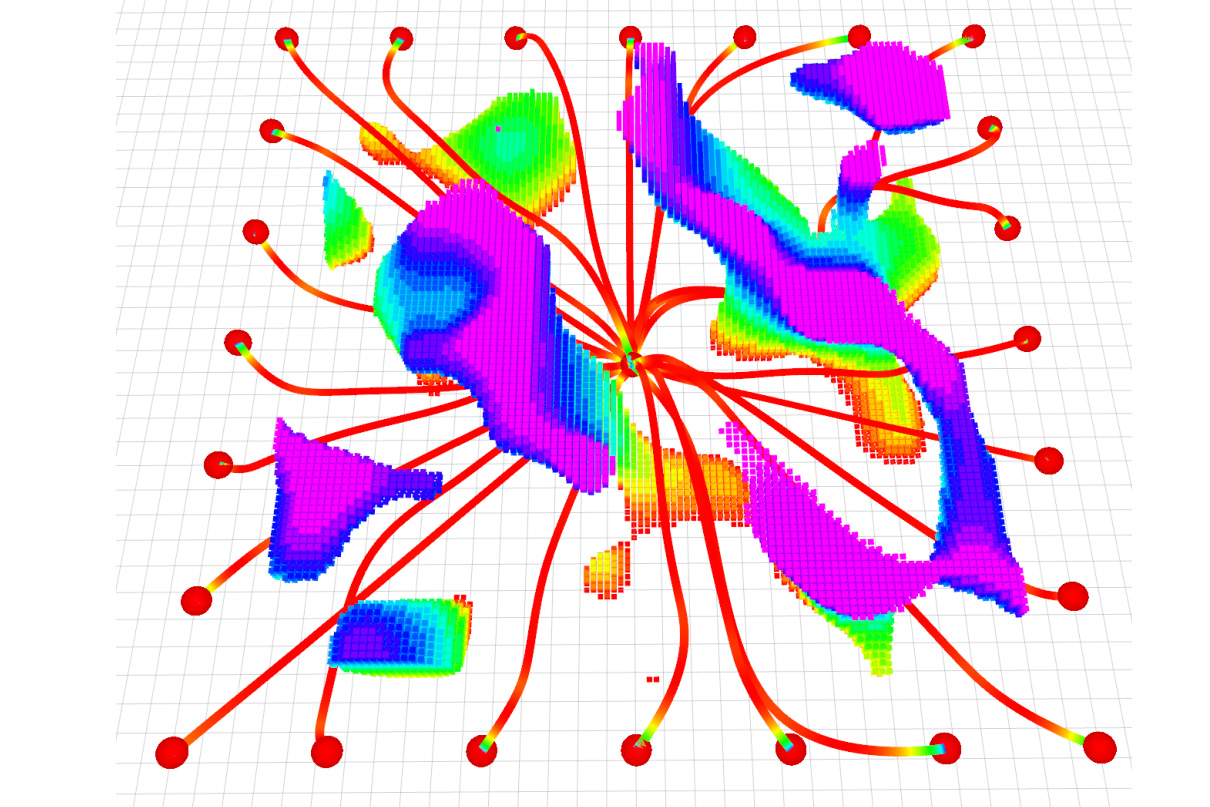
Researchers from MIT and the University of Pennsylvania developed a new trajectory-planning system that tackles both challenges at once. Their technique enables a UAV to react to obstacles in milliseconds while staying on a smooth flight path that minimizes travel time. 

Their system uses a new mathematical formulation that ensures the robot travels safely to its destination along a feasible path, and that is less computationally intensive than other techniques. In this way, it generates smoother trajectories faster than state-of-the-art methods.

The trajectory planner is also efficient enough for real-time flight using only the robot’s onboard computer and sensors. 

Named MIGHTY, the open-source system does not require proprietary software packages that can cost hundreds of thousands of dollars. It could be more readily deployed in a wider variety of real-world settings.

In addition to search-and-rescue, MIGHTY could be utilized in applications like last-mile delivery in urban spaces, where UAVs need to avoid buildings, wires, and people, or in industrial inspection of complex structures, such as wind turbines.

“MIGHTY achieves comparable or better performance using only open-source tools, which means any researcher, student, or company — anywhere in the world — can use it freely. By removing this cost barrier, MIGHTY helps democratize high-performance trajectory planning and opens the door for a much broader community to build on this work,” says Kota Kondo, an aeronautics and astronautics graduate student and lead author of a paper on this trajectory planner.

Kondo is joined on the paper by Yuwei Wu, a graduate student at the University of Pennsylvania; Vijay Kumar, a professor at UPenn; and senior author Jonathan P. How, a Ford professor of aeronautics and astronautics and a principal investigator in the Laboratory for Information and Decision Systems (LIDS) and the Aerospace Controls Laboratory (ACL) at MIT. The research appears in IEEE Robotics and Automation Letters.

Overcoming trade-offs           

When Kondo was a child, the Fukushima Daiichi nuclear accident occurred following the Great East Japan Earthquake. With school cancelled, Kondo was stuck at home and watched the news every day as workers explored and secured the reactor site. Some workers still had to enter hazardous areas to contain the damage and assess the situation, exposing them to high doses of radioactive material.

“I became passionate about creating autonomous robots that can go into these dynamic and dangerous situations, then come back and report to humans who stay out of harm’s way,” Kondo says.

This task requires a strong trajectory planner, which is software that decides the path a robot should follow to safely get from point A to point B. 

But many existing systems force tradeoffs that limit performance. 

While some commercial systems can rapidly generate smooth trajectories, they can cost hundreds of thousands of dollars. Open-source alternatives often underperform compared to commercial solvers or are difficult to use.      

With MIGHTY, Kondo and his colleagues developed an open-source system that produces high-quality, smooth trajectories while reacting to obstacles in real-time, and which runs fast enough for flight using only onboard components.

To do this, they overcame a key challenge that limits many open-source systems. 

These methods usually estimate how long it will take the robot to get from point A to point B as a first step. From that fixed estimation of travel time, the planner finds the best path to reach the destination.

While using a fixed travel time allows the planner to rapidly generate a trajectory, it has drawbacks. For one, if the UAV must go far out of its way to avoid obstacles, it could be forced to crank up the speed to meet the fixed travel-time budget. This makes it harder to avoid sudden hazards.

A MIGHTY method

Instead, MIGHTY uses a mathematical technique, called a Hermite spline, that optimizes the travel time and flight path together, in a single step, to form a smooth trajectory that can be precisely controlled.

“Optimizing the spatial and temporal components together gets us better results, but now the optimization becomes so much bigger that it is harder to solve in a feasible amount of time,” Kondo says.

The researchers used a clever technique to reduce this computational overhead. 

Instead of generating a trajectory from scratch each time, MIGHTY makes an initial guess of a trajectory. Then it refines the trajectory through an iterative optimization, using a map of the scene generated by the UAV’s lidar sensors.

“We can make a decent guess of what the trajectory should be, which is a lot faster than generating the entire thing from nothing,” Kondo says.

This enables MIGHTY to react in real-time to unknown obstacles while keeping the trajectory smooth and minimizing travel time. The system utilizes the UAV’s onboard components, which is important for applications where a robot might travel far from a base station.

In simulated experiments, MIGHTY needed only about 90 percent of the computation time required by state-of-the-art methods, while safely reaching its destination about 15 percent faster than these approaches. 

When they tested the system on real robots, it reached a speed of 6.7 meters per second while avoiding every obstacle that appeared in its path.

“With MIGHTY, everything is integrated in one piece. It doesn’t need to talk to any other piece of software to get a solution. This helps us be even faster than some of the commercial solvers,” Kondo says.

In the future, the researchers want to enhance MIGHTY so it can be used to control multiple robots at once and conduct more flight experiments in challenging environments. They hope to continue improving the open-source system based on user feedback.

“MIGHTY makes an important contribution to agile robot navigation by revisiting the trajectory representation itself. Hermite splines have already been successfully used in visual simultaneous localization and mapping, and it is nice to see their advantages now being exploited for trajectory planning in mobile robots. By enabling joint optimization of path geometry, timing, velocity, and acceleration while retaining local control of the trajectory, MIGHTY gives robots more freedom to compute fast, dynamically feasible motions in cluttered environments,” says Davide Scaramuzza, professor and director of the Robotics and Perception Group at the University of Zurich, who was not involved with this research.

This research was funded, in part, by the United States Army Research Laboratory and the Defense Science and Technology Agency in Singapore.

Generate single title from this title Civitai Block for Australia – How to get around it? in 100 -150 characters. And it must return only title i dont want any extra information or introductory text with title e.g: ” Here is a single title:”

Write an article about

As of 16th March 2026, Civitai has blocked Australian users from using its site. They are required by the Australian Government to ensure that the age of their users and visitors is verified and Civitai claim that that they don’t have the capital to invest in this. Therefore, easiest solution is to block the users.

I’m not sure how they expect to survive if they keep blocking users from accessing their site. I read about many countries that have already been blocked but I didn’t believe it until I saw the message that confirmed this is in affect for Australia as well.

Now the solution is straight forward, move to a country that hasn’t been blocked.

No seriously that’s what they expect their users to do as they fail to comply with the requirements. That’s crazy!

The solution is straight forward get a VPN client on your Computer and you can easily access Civitai. I connected to the US end point using Mega VPN and now I have complete access to Civitai site.

If you’d like to support our site please consider buying us a Ko-fi, grab a product or subscribe. Need a faster GPU, get access to fastest GPUs for less than $1 per hour with RunPod.io

.Organize the content with appropriate headings and subheadings ( h2, h3, h4, h5, h6). Include conclusion section and FAQs section with Proper questions and answers at the end. do not include the title. it must return only article i dont want any extra information or introductory text with article e.g: ” Here is rewritten article:” or “Here is the rewritten content:”

Generate single title from this title Amazon launches Alexa for Shopping as Rufus moves behind the scenes in 100 -150 characters. And it must return only title i dont want any extra information or introductory text with title e.g: ” Here is a single title:”

Write an article about

Amazon has introduced Alexa for Shopping, combining its Rufus shopping chatbot with Alexa+ across its app, website, and Echo Show devices.

The assistant can answer product questions, compare items, track prices, and support shopping reminders. It can also handle scheduled shopping actions and eligible automated purchases.

The company said Alexa for Shopping combines Rufus’ product expertise with Alexa+’s personalised assistant context. Amazon said Rufus helped more than 300 million customers in 2025 research, compare, and buy products.

GeekWire reported that Amazon is retiring the Rufus name from its shopping interface, while Rufus will continue to power parts of the experience behind the scenes.

GeekWire also reported that Amazon CEO Andy Jassy said Rufus monthly active users rose more than 115%, while engagement increased nearly 400% year over year.

Alexa for Shopping is available through the Amazon Shopping app, Amazon’s website, and Echo Show devices. The feature is rolling out to US customers. Signed-in Amazon customers can use it for free, without a Prime membership, Echo device, or Alexa app.

Amazon reported US$426.3 billion in North America net sales and US$161.9 billion in international net sales in 2025. Amazon also reported online stores and third-party seller services as separate revenue categories in its 2025 annual report.

The assistant allows customers to ask shopping-related questions through Amazon’s main search bar instead of using a separate chatbot window. Users can ask for product recommendations or purchase history. They can also ask for advice related to specific shopping needs.

Examples shared by Amazon include questions such as “What’s a good skincare routine for men?” and “When did I last order AA batteries?” Amazon said the assistant uses information from its platform to answer these questions.

Amazon said Alexa for Shopping uses information from a customer’s Amazon activity and Alexa interactions. That includes shopping history, browsing, purchases, and conversations. Amazon said the information is used to recommend products and support shopping actions.

Alexa for Shopping can compare products side by side and provide AI-generated summaries on product pages. It can also show AI-generated overviews in search results with category information.

Price tracking and automated shopping

Alexa for Shopping can monitor price drops for selected items for up to one year. Customers can view a full year of price history on product detail pages or by asking the assistant.

The assistant can create shopping guides for larger purchases. These guides compare product features and prices. They also include reviews from Amazon and the web.

Amazon said customers can use the assistant to set scheduled shopping actions, including restocking household items. Amazon said the assistant can also handle birthday reminders and gift suggestions.

Scheduled actions can also be tied to conditions. For example, the assistant can add an item to the cart if it reaches a target price and has not been purchased within a set period.

The assistant can search past orders and add frequently purchased items to a customer’s cart through conversational prompts.

Amazon said customers can view and update personal details used by Alexa for Shopping. These details can include family members, pets, interests, and dietary needs.

Alexa for Shopping can also surface products from other online stores through Shop Direct. For eligible products, Amazon said its Buy for Me agentic AI feature can complete purchases using a customer’s primary address and payment method.

Echo Show gets full shopping access

Amazon is also adding full-store shopping access to Echo Show. Users can browse, search, and shop using voice, touch, or both.

The Echo Show shopping experience is available for Alexa+ customers on Echo Show 15 and Echo Show 21, with support for other devices to follow.

Amazon also cited AI investments in its first-quarter 2026 results. The company said free cash flow fell to US$1.2 billion for the trailing 12 months. It attributed the decline mainly to a US$59.3 billion increase in property and equipment purchases, primarily reflecting AI investments.

Rajiv Mehta, Amazon’s vice president of conversational shopping, said the assistant can carry customer preferences, past purchases, and conversations across phones, laptops, and Echo devices.

Users can access the assistant by updating the Amazon Shopping app and selecting the Alexa icon in the bottom navigation bar. On the desktop, the feature appears at the top of the screen.

(Photo by Anirudh)

See also: Google tests Remy AI agent for Gemini as focus turns to user control

Want to learn more about AI and big data from industry leaders? Check outAI & Big Data Expo taking place in Amsterdam, California, and London. The comprehensive event is part of TechEx and is co-located with other leading technology events, click here for more information.

AI News is powered by TechForge Media. Explore other upcoming enterprise technology events and webinars here.

.Organize the content with appropriate headings and subheadings ( h2, h3, h4, h5, h6). Include conclusion section and FAQs section with Proper questions and answers at the end. do not include the title. it must return only article i dont want any extra information or introductory text with article e.g: ” Here is rewritten article:” or “Here is the rewritten content:”