Home Blog Page 215

SpaceX Starship spirals out of control in second straight test flight failure

0

SpaceX’s Starship Spirals Out of Control During Test Flight

Launch Marred by Second Consecutive Failure

SpaceX’s Starship spiraled out of control while in space during a test flight on Thursday, marking the second launch in a row that the vehicle has run into a fatal problem on its way to orbit.

Early Progress, Then Disaster

The company launched Starship using its Super Heavy booster, and things looked normal for the first eight minutes of the flight. The ship successfully separated and headed into space, while the booster came back to the company’s launchpad in Texas, where it was caught for a third time by the launch tower. However, at around eight minutes and nine seconds into the flight, SpaceX’s broadcast graphics showed Starship lose multiple Raptor engines on the vehicle. On-board footage showed the ship starting to spiral end over end over the ocean.

Loss of Attitude Control

"We just saw some engines go out, it looks like we are losing attitude control of the ship," SpaceX communications manager Dan Huot said on the broadcast. "At this point, we have lost contact with the ship."

Breakup Over the Bahamas and Dominican Republic

Footage posted to social media showed the ship breaking up over the Bahamas and the Dominican Republic a few minutes later. The company posted to X that it "immediately began coordination with safety officials to implement pre-planned contingency responses."

Recurring Issues with Starship

This is the second consecutive test flight that has ended in failure. The high-profile back-to-back explosions come as SpaceX CEO Elon Musk has spent the last few weeks causing chaos across the U.S. federal government with his Department of Government Efficiency. That has included him deploying employees to the FAA, which oversees SpaceX’s flights.

Mishap Investigation Underway

The Federal Aviation Administration (FAA) briefly halted flights into major Florida airports and appears to have diverted some others out of caution of "space launch debris." The agency told TechCrunch that it is requiring SpaceX to perform what’s known as a mishap investigation into the failure.

Previous Issues and Improvements

The company performed a mishap investigation into the previous failure, which determined that propellant was leaking inside Starship, causing fires and a communications blackout with the ship before it self-destructed. Ahead of this test flight, SpaceX said it made improvements to the lines that send fuel to Starship’s engines and changed the temperature of the propellant. It also added extra vents and "a new purge system" to better hedge against any leaks.

Conclusion

SpaceX’s Starship has experienced two consecutive failures, highlighting the challenges the company still faces in developing the vehicle. While the company continues to push forward with its test flights, it is clear that significant work remains to be done to ensure the safety and success of Starship.

FAQs

Q: What happened during the test flight?
A: Starship spiraled out of control and broke up over the Bahamas and the Dominican Republic.

Q: What was the cause of the failure?
A: It is unclear at this time, but the FAA is conducting a mishap investigation.

Q: How many test flights has Starship had?
A: At least 8 test flights, with the previous 7 flights experiencing issues.

Q: What is the goal of Starship?
A: The goal is to use Starship for commercial missions, with the company aiming to deploy dummy versions of its Starlink satellites during test flights.


New Zealand Launches 24/7 Telehealth

New Zealand Introduces 24/7 Telehealth Service to Ease Overcrowding in Emergency Departments

New Service Details

New Zealand Health Minister Simeon Brown has announced a new 24/7 telehealth service to expand access to primary care, addressing the issue of overcrowding in emergency departments. The government will invest in the new service, which is expected to provide all New Zealanders with better access to video consultations with New Zealand-registered clinicians, such as GPs and nurse practitioners.

Features of the New Service

The 24/7 telehealth service will enable GPs and nurses to issue prescriptions and make referrals for laboratory tests. This will provide more flexibility and convenience for patients, reducing the need to visit emergency departments for non-emergency cases.

Launch Date and Funding

The new telehealth service is set for launch in July, with a NZ$285 million ($163 million) investment in general practice over three years, placement of overseas doctors, and incentives for primary care providers to recruit nurses.

Context and Challenges

Minister Brown highlighted the need for improved primary care access, stating, "We are already investing record funding into healthcare, but many New Zealanders are still finding it too hard to get an appointment with their GP, which is putting pressure on our emergency departments."

Contrasting Views on Telehealth

The new telehealth service comes as the Health Quality and Safety Commission recently concluded that telehealth has not yet proven to be a sustainable solution to care access in New Zealand. The commission’s investigation found that telehealth never became popular in New Zealand, even during the pandemic. Prior to the release of the report, the government had pulled funding for some free telehealth services, including COVID-19, as part of changes to the pandemic response and cost-cutting measures.

Conclusion

The introduction of the 24/7 telehealth service is a step towards addressing the issue of overcrowding in emergency departments and improving primary care access in New Zealand. While there are challenges and concerns surrounding the effectiveness of telehealth, the new service aims to provide better access to healthcare for all New Zealanders.

Frequently Asked Questions

Q: What is the purpose of the 24/7 telehealth service?
A: The service aims to expand access to primary care, addressing the issue of overcrowding in emergency departments.

Q: What features will the new service offer?
A: The service will provide video consultations with New Zealand-registered clinicians, prescription issuance, and laboratory test referrals.

Q: When is the new service set to launch?
A: The service is set to launch in July.

Q: What is the investment in general practice over three years?
A: The government will invest NZ$285 million ($163 million) in general practice over three years.

Hands-On With GPT-4.5

0

GPT-4.5: OpenAI’s Ambitious but Elusive Model

While the improvements feel as incremental as its name suggests, GPT-4.5 is still OpenAI’s most ambitious drop to date. Released in late February as a research preview, GPT-4.5 uses more computing power than its previous models and was trained on more data.

The Mysterious GPT-4.5

So, just how big is the GPT-4.5 research preview? Who knows—since the developers won’t say. And where did this additional training data come from? Their lips are zipped on that as well. To borrow a line from Apple TV’s hit show Severance, right now OpenAI is positioning the alleged improvements in this new model as mysterious and important.

Comparing AI Benchmark Tests

When comparing AI benchmark tests from competitors’ models as well as OpenAI’s "reasoning" releases, the benefits of using GPT-4.5 are not immediately clear. Though, in the model’s system card and in a previous interview with WIRED, the OpenAI researchers who worked on GPT-4.5 claimed improvements can be felt in the anthropomorphic aspects of the model, like a stronger intuition and a deeper understanding of emotion.

A Deeper Understanding of Emotion

After sitting in OpenAI’s office last year and listening to leadership talk about the startup’s plan to further productize ChatGPT as useful software, this was not the release I expected in 2025. Rather than take a more utilitarian approach, this model attempts to be more emotional.

OpenAI’s Path to AGI

OpenAI has steadily grown its number of enterprise contracts, so the company could be expected to put out tentpole releases with baked-in, practical applications, especially inside the most expensive and powerful version of its chatbot. However, GPT-4.5 is more aligned with the output from an academic research group pouring everything they have into chasing artificial general intelligence, a theoretical version of the algorithm that’s deft enough to replace white-collar workers and practically God-like in its ability to process information.

How to Access GPT-4.5

As with most of the new features and models that arrive for ChatGPT, OpenAI’s paid subscribers will be the first to gain access to GPT-4.5. In this case, OpenAI is unlocking access first for ChatGPT Pro subscribers who pay a hefty $200 a month. The large rollout of GPT-4.5 to the other paid tiers—Plus, Team, Enterprise, and Edu—will happen during this week and the next. Past models have eventually trickled down to the free version of ChatGPT as well, but the company does not yet have a plan to release GPT-4.5 to all users, due to its size and computing requirements.

First Impressions of OpenAI’s New Model

The draft headline I put on this article was “With GPT-4.5, OpenAI Gets Lost in the AGI Sauce.” And while no headline featuring the model’s name is going to feel poetic, that’s a bit of a mess. Writing strong, succinct headlines is a difficult skill requiring clear communication as well as a level of aesthetic taste—often involving the input of multiple editors before the perfect message is conveyed. I was curious about whether ChatGPT would be able to punch up that headline, so I tried to do that using both the newest model and GPT-4o, a past release the company describes as “great for most tasks.”

Conclusion

In conclusion, GPT-4.5 is OpenAI’s most ambitious drop to date, but its incremental improvements may not be immediately clear. While the model’s anthropomorphic aspects show promise, the lack of transparency around its training data and computing power raises questions about its capabilities. As OpenAI continues to push the boundaries of AI, it will be interesting to see how GPT-4.5 evolves and how it will impact the future of AI development.

FAQs

Q: What is GPT-4.5 and how does it differ from previous OpenAI models?
A: GPT-4.5 is OpenAI’s latest research preview, using more computing power and trained on more data than its previous models.

Q: What are the benefits of using GPT-4.5?
A: OpenAI claims that GPT-4.5 shows improvements in anthropomorphic aspects, such as a stronger intuition and a deeper understanding of emotion.

Q: How do I access GPT-4.5?
A: OpenAI’s paid subscribers, specifically ChatGPT Pro subscribers, will have access to GPT-4.5 first. The large rollout to other paid tiers will happen during the next few weeks.

Q: Will GPT-4.5 be available to all users?
A: No, GPT-4.5 will not be available to all users, due to its size and computing requirements.

CMU Research: Unlocking AI Puzzle-Solving Abilities through Compression

New Breakthrough in AI Research Challenging Conventional Wisdom

Revolutionizing AI Development: From Pre-Training to Compression

A recent research study, CompressARC, has sent shockwaves through the AI community by proposing a fundamentally different approach to developing artificial intelligence. The study, led by researchers Liao and Gu, suggests that intelligence can emerge from compression rather than relying on massive pre-training datasets and computationally expensive models.

Challenging the Status Quo

The prevailing wisdom in AI development typically relies on massive pre-training datasets and computationally expensive models. However, CompressARC’s findings challenge this conventional approach, proposing a future where tailored compressive objectives and efficient inference-time computation work together to extract deep intelligence from minimal input.

Limitations and Looking Ahead

While CompressARC has shown promising results in solving puzzles involving color assignments, infilling, cropping, and identifying adjacent pixels, it struggles with tasks requiring counting, long-range pattern recognition, rotations, reflections, or simulating agent behavior. These limitations highlight areas where simple compression principles may not be sufficient.

Open Questions and Future Directions

The research has not been peer-reviewed, and the 20% accuracy on unseen puzzles, though notable without pre-training, falls significantly below both human performance and top AI systems. Critics might argue that CompressARC could be exploiting specific structural patterns in the ARC puzzles that might not generalize to other domains, challenging whether compression alone can serve as a foundation for broader intelligence.

Conclusion

Despite the limitations, CompressARC offers a glimpse of a possible alternative path that might lead to useful intelligent behavior without the resource demands of today’s dominant approaches. If the study holds up to further scrutiny, it could unlock an important component of general intelligence in machines, which is still poorly understood.

Frequently Asked Questions

Q: What is CompressARC?
A: CompressARC is a research study that proposes a new approach to developing artificial intelligence, focusing on compression rather than pre-training and massive datasets.

Q: How does CompressARC differ from traditional AI development?
A: CompressARC challenges the conventional wisdom in AI development, which relies on massive pre-training datasets and computationally expensive models. Instead, CompressARC suggests that intelligence can emerge from compression.

Q: What are the limitations of CompressARC?
A: CompressARC struggles with tasks requiring counting, long-range pattern recognition, rotations, reflections, or simulating agent behavior, and its accuracy on unseen puzzles falls below human performance and top AI systems.

Q: What are the potential implications of CompressARC?
A: If CompressARC holds up to further scrutiny, it could lead to a new path for developing artificial intelligence that is more efficient and effective, potentially unlocking new possibilities for machine intelligence.

Larry Page reportedly has a new AI startup

0

Google Co-Founder Larry Page’s New Venture: Dynatomics

Introducing Dynatomics: A New Company Focused on AI-Driven Product Manufacturing

Google co-founder Larry Page is venturing into a new territory with his latest project, Dynatomics, which is focused on applying artificial intelligence (AI) to product manufacturing. According to The Information, Page is working with a small group of engineers on AI technology that can create "highly optimized" designs for objects and then have a factory build them. Chris Anderson, previously the CTO of Page-backed electric airplane startup Kittyhawk, is reportedly running the stealth effort.

AI-Powered Manufacturing: A Game-Changer for Industry

Dynatomics is not the only company exploring the potential of AI in manufacturing. Other startups and established players are also working on innovative solutions to improve production processes. For instance, Orbital Materials is developing an AI platform that can help discover materials ranging from batteries to carbon dioxide-capturing cells. PhysicsX provides tools for engineers to run simulations for projects in areas like automotive, aerospace, and materials science. Additionally, Instrumental is leveraging computer vision and AI to detect factory anomalies.

How AI Can Revolutionize Manufacturing

The integration of AI in manufacturing can have a significant impact on the industry. With AI-driven design and production, companies can create products more efficiently and cost-effectively. AI can also help reduce waste, minimize errors, and improve product quality. Furthermore, AI can enable the development of new products and materials, driving innovation and growth in various industries.

Conclusion

Larry Page’s new venture, Dynatomics, is an exciting development in the world of manufacturing. As the company works to bring together AI and product manufacturing, it is likely to have a significant impact on the industry. With other companies also exploring the potential of AI in manufacturing, the future of production is looking bright. As the technology continues to evolve, we can expect to see new and innovative products emerge, changing the way we live and work.

FAQs

Q: What is Dynatomics?

A: Dynatomics is a new company founded by Google co-founder Larry Page, focused on applying AI to product manufacturing.

Q: What is the goal of Dynatomics?

A: The goal of Dynatomics is to create "highly optimized" designs for objects and then have a factory build them using AI technology.

Q: Who is running the Dynatomics project?

A: Chris Anderson, previously the CTO of Page-backed electric airplane startup Kittyhawk, is reportedly running the stealth effort.

Q: What other companies are exploring AI in manufacturing?

A: Orbital Materials, PhysicsX, and Instrumental are some of the companies working on AI-powered manufacturing solutions.

NVIDIA Researchers Honored for Advancing Filmmaking

For the past 16 years, NVIDIA technologies have been working behind the scenes of every Academy Award-nominated film for Best Visual Effects.

This year, three NVIDIA researchers — Essex Edwards, Fabrice Rousselle and Timo Aila — have been honored with Scientific and Technical Awards by the Academy of Motion Picture Arts and Sciences for their groundbreaking contributions to the film industry. Their innovations in simulation, denoising and rendering are helping shape the future of visual storytelling, empowering filmmakers to create even more breathtaking and immersive worlds.

Ziva VFX: Bringing Digital Characters to Life

Essex Edwards received a Technical Achievement Award, alongside James Jacobs, Jernej Barbic, Crawford Doran and Andrew van Straten, for his design and development of Ziva VFX. This cutting-edge system allows artists to construct and simulate human muscles, fat, fascia and skin for digital characters with an intuitive, physics-based approach.

Providing a robust solver and an artist-friendly interface, Ziva VFX transformed the ways studios bring photorealistic and animated characters to the big screen and beyond.

"Award-winning visuals effect and animation studio DNEG is continuing to develop Ziva VFX to further enhance its creature pipeline," Edwards said.

Disney’s ML Denoiser: Revolutionizing Rendering

Fabrice Rousselle was honored with a Scientific and Engineering Award, alongside Thijs Vogels, David Adler, Gerhard Röthlin and Mark Meyer, for his work on Disney’s ML Denoiser. This advanced machine learning denoiser introduced a pioneering kernel-predicting convolutional network, ensuring temporal stability in rendered images for higher-quality graphics.

Originally developed to enhance the quality of animated films, this breakthrough technology has since become an essential tool in live-action visual effects and high-end rendering workflows. It helps remove noise, sharpens images and speeds up rendering, allowing artists to work faster while achieving higher quality.

Intel Open Image Denoise: Advancing AI-Powered Image Processing

Timo Aila received a Technical Achievement Award, alongside Attila T. Áfra, for his pioneering contributions to AI image denoising. Aila’s early work at NVIDIA focused on the U-Net architecture, which Áfra used in Intel Open Image Denoise — an open-source library that provides an efficient, high-quality solution for AI-driven denoising in rendering.

By preserving fine details while significantly reducing noise, Intel Open Image Denoise has become a vital component in real-time and offline rendering across the industry.

"Path tracing has an inherent noise problem, and in the early days of deep learning, we started looking for architectures that could help," Aila said. "We turned to denoising autoencoders, and the pivotal moment was when we introduced skip connections. Everything began to work, from fixing JPEG compression artifacts to eliminating the kind of Monte Carlo noise that occurs in path-traced computer graphics. This breakthrough led to the production of cleaner, more realistic images in rendering pipelines."

Pushing the Boundaries of Visual Storytelling

With these latest honors, Edwards, Rousselle and Aila join the many NVIDIA researchers who have been recognized by the Academy for their pioneering contributions to filmmaking.

Conclusion

NVIDIA researchers continue to shape the future of visual storytelling, empowering filmmakers to create more breathtaking and immersive worlds. Their innovations in simulation, denoising and rendering are helping push the boundaries of what is possible in the art of filmmaking.

FAQs

Q: What are the latest innovations in visual effects and rendering?
A: NVIDIA researchers have developed cutting-edge technologies like Ziva VFX, Disney’s ML Denoiser, and Intel Open Image Denoise, which are transforming the way studios create photorealistic and animated characters, enhance the quality of rendered images, and speed up rendering.

Q: How are these innovations being used in the film industry?
A: These technologies are being used in various aspects of the film industry, from animation and visual effects to live-action visual effects and high-end rendering. They are helping to create more realistic characters, environments, and effects, as well as reducing the time and effort required to achieve high-quality results.

Q: What are the benefits of these innovations?
A: These innovations are enabling filmmakers to create more breathtaking and immersive worlds, improving the quality of rendered images, and reducing the time and effort required to achieve high-quality results. They are also enabling artists to work more efficiently and effectively, which can lead to increased productivity and reduced costs.

Gundam GQuuuuuuX will stream on Amazon next month

0

Amazon Secures Rights to Stream Gundam GQuuuuuuX

New Anime Series to Premiere on Amazon Prime in Over 240 Countries

Amazon Prime has announced that it has secured the rights to stream dubbed and subbed versions of Gundam GQuuuuuuX, a new anime series produced by studio Khara, directed by Kazyua Tsurumaki, and co-written by Hideaki Anno and Yōji Enokido. The series will make its Western debut on Amazon, following in the footsteps of other highly-anticipated Japanese animations, such as Tatsuki Fujimoto’s Look Back and Khara’s Evangelion: 3.0+1.0 Thrice Upon a Time.

Synopsis of Gundam GQuuuuuuX

Gundam GQuuuuuuX is a new anime series that will premiere on Japanese television and subsequently be streamed on Amazon Prime in over 240 countries. The series is a collaboration between several notable creators, including Kazyua Tsurumaki, who previously directed the original FLCL anime, and Hideaki Anno and Yōji Enokido, who co-wrote the series.

Director’s Statement

Tsurumaki expressed his excitement and honor to work on Gundam GQuuuuuuX, stating that he is thrilled for Western fans to see what his creative team has produced. He also referenced his previous experience with FLCL, which was well-received by international audiences, saying, "FLCL was enjoyed by many fans overseas, which brought me great joy. Now, after all these years, I am truly delighted to be able to present this new title through digital streaming. I sincerely hope audiences around the world will watch and enjoy it."

Premiere Date and Availability

Gundam GQuuuuuuX will begin streaming on Amazon Prime on April 8th, with new episodes debuting on Japanese television at the same time. The series will be available to stream in over 240 countries, allowing fans worldwide to experience the new anime.

Frequently Asked Questions

Q: What is the premiere date for Gundam GQuuuuuuX?
A: April 8th

Q: How many countries will Gundam GQuuuuuuX be available in?
A: Over 240 countries

Q: Who are the creators behind Gundam GQuuuuuuX?
A: Kazyua Tsurumaki, Hideaki Anno, and Yōji Enokido

Q: Is Gundam GQuuuuuuX available to stream in my country?
A: Check the Amazon Prime website for availability in your region.

These Beautiful Depictions

0

Article

Maria’s Artwork: A Journey of Emotions and Memories

Maria’s artwork focuses on emotions and memories, and she adjusts her style to the task at hand. She mainly works on children’s books, with the world around her being a huge source of inspiration.

Inspirational Art

With a diverse collection of scenes depicted in her art – and a huge variety of styles, too, you’re bound to find something you relate to. This serves as perfect inspiration for your own work, and a glorious example of illustration simply to marvel at. See our pick of the best drawing tablets if you want to create using the best digital art software.

O Death, Where is Thy Sting?

<Image: A 2D art piece of a man with a sword>

"This was an emotionally hard piece for me to create and took a lot of rethinking and redrawing. The enemy will be conquered; the finishing line just beyond the horizon."

A Summer Bazaar 1

<Image: A 2D art piece of men at a shop>

"It’s impossible to leave a good bazaar empty-handed! Either you’ll find something to buy, or something will find you."

A Summer Bazaar 2

<Image: A 2D art piece of a child at a grocer’s>

"At bazaars, every small detail can tell its own big story. Using aspects of comic drawing, a single picture feels as though it’s a part of something bigger."

Conclusion

Maria’s artwork is a testament to her ability to capture the essence of emotions and memories through her unique style and approach. Her work serves as a source of inspiration for artists and a reminder of the power of illustration to evoke emotions and tell stories.

FAQs

Q: What is Maria’s primary focus in her artwork?
A: Maria’s primary focus is on emotions and memories.

Q: What type of work does Maria primarily do?
A: Maria mainly works on children’s books.

Q: Where does Maria draw inspiration for her art?
A: Maria draws inspiration from the world around her.

Q: What style does Maria use in her art?
A: Maria adjusts her style to the task at hand, using a diverse range of styles.

Evaluating RAG Responses with Amazon Bedrock, LlamaIndex, and RAGAS

0

RAG Evaluation and Optimization

In the rapidly evolving landscape of artificial intelligence, Retrieval Augmented Generation (RAG) has emerged as a game-changer, revolutionizing how Foundation Models (FMs) interact with organization-specific data. As businesses increasingly rely on AI-powered solutions, the need for accurate, context-aware, and tailored responses has never been more critical.

Enter the powerful trio of Amazon Bedrock, LlamaIndex, and RAGAS– a cutting-edge combination that’s set to redefine the evaluation and optimization of RAG responses. This blog post delves into how these innovative tools synergize to elevate the performance of your AI applications, ensuring they not only meet but exceed the exacting standards of enterprise-level deployments.

RAG Evaluation

RAG evaluation is important to ensure that RAG models produce accurate, coherent, and relevant responses. By analyzing the retrieval and generator components both jointly and independently, RAG evaluation helps identify bottlenecks, monitor performance, and improve the overall system. Current RAG pipelines frequently employ similarity-based metrics such as ROUGE, BLEU, and BERTScore to assess the quality of the generated responses, which is essential for refining and enhancing the model’s capabilities.

Evaluate RAG components with Foundation models

We can also use a Foundation Model as a judge to compute various metrics for both retrieval and generation. Here are some examples of these metrics:

  • Retrieval component
    • Context precision – Evaluates whether all of the ground-truth relevant items present in the contexts are ranked higher or not.
    • Context recall – Ensures that the context contains all relevant information needed to answer the question.
  • Generator component
    • Faithfulness – Verifies that the generated answer is factually accurate based on the provided context, helping to identify errors or “hallucinations.”
    • Answer relevancy – Measures how well the answer matches the question. Higher scores mean the answer is complete and relevant, while lower scores indicate missing or redundant information.

Overview of the solution

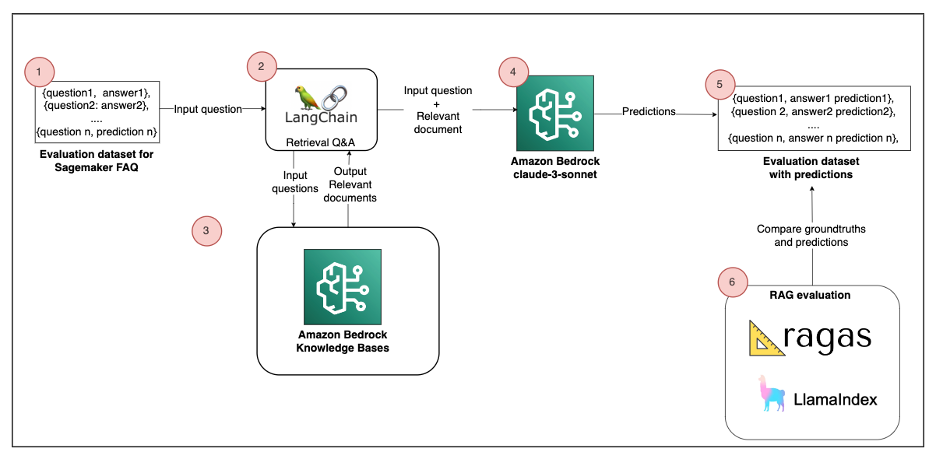
This post guides you through the process of assessing the quality of RAG response with evaluation frameworks such as RAGAS and LlamaIndex with Amazon Bedrock.

Diagram Architecture

The following diagram is a high-level reference architecture that explains how you can evaluate the RAG solution with RAGAS or LlamaIndex.

Code Sample

from llama_index.llms.bedrock import Bedrock
from llama_index.core.evaluation import (
    AnswerRelevancyEvaluator,
    CorrectnessEvaluator,
    FaithfulnessEvaluator
)
from utils import evaluate_llama_index_metric

bedrock_llm_llama = Bedrock(model=BEDROCK_MODEL_ID)
faithfulness = FaithfulnessEvaluator(llm=bedrock_llm_llama)
answer_relevancy = AnswerRelevancyEvaluator(llm=bedrock_llm_llama)
correctness = CorrectnessEvaluator(llm=bedrock_llm_llama)

df_answer_relevancy = evaluate_llama_index_metric(answer_relevancy, dataset)
df_answer_relevancy.head()

df_correctness = evaluate_llama_index_metric(correctness, dataset)
df_correctness.head()

df_faithfulness = evaluate_llama_index_metric(faithfulness, dataset)
df_faithfulness.head()

Conclusion

While Foundation Models offer impressive generative capabilities, their effectiveness in addressing organization-specific queries has been a persistent challenge. The Retrieval Augmented Generation framework emerges as a powerful solution, bridging this gap by enabling LLMs to leverage external, organization-specific data sources.

By adopting this holistic evaluation approach, enterprises can fully harness the transformative power of generative AI applications. This not only maximizes the value derived from these technologies but also paves the way for more intelligent, context-aware, and reliable AI systems that can truly understand and address an organization’s unique needs.

About the authors

[Image of Madhu] Madhu is a Senior Partner Solutions Architect specializing in worldwide public sector cybersecurity partners. With over 20 years in software design and development, he collaborates with AWS partners to ensure customers implement solutions that meet strict compliance and security objectives. His expertise lies in building scalable, highly available, secure, and resilient applications for diverse enterprise needs.

[Image of Babu Kariyaden Parambath] Babu Kariyaden Parambath is a Senior AI/ML Specialist at AWS. At AWS, he enjoys working with customers in helping them identify the right business use case with business value and solve it using AWS AI/ML solutions and services. Prior to joining AWS, Babu was an AI evangelist with 20 years of diverse industry experience delivering AI-driven business value for customers.

The New Glastonbury Festival Falls Flat

0

Glastonbury Festival’s 2025 Lineup Poster: A Step Back from the Usual Flair?

A Disappointing Design

Glastonbury Festival has finally dropped its 2025 lineup via a swanky new poster – say what you want about this year’s headliners, but it’s the design that caught my eye. While there’s always a certain retro flair to each year’s poster, the latest edition almost feels like it lost its flair, with a flat monochromatic design that feels oddly understated.

A Stripped-Back Palette

Typically, Glastonbury Festival posters evoke the spirit of summer with vibrant visuals, playful typography, and stylish illustration. But to me, the 2025 design lacks this same lustre. The poster’s stripped-back palette of earth-toned browns, oranges, and yellows has a distinctly neutral theme that dwindles next to past poster designs which typically feature vibrant, multicolored typography and playful illustration.

A Pleasant Warmth, but Lacking Energy

The design does have a pleasant warmth, complemented by a black border of rounded emblems. A suitably rustic, stained-glass-window-style sun motif at the top of the poster adds to this warmth. However, without the same energetic spirit of past designs, the overall effect is regrettable.

Conclusion

While there are no wrong answers when it comes to creating poster designs, Glastonbury has set a high design standard, and this year’s is sadly a little underwhelming. For more design inspiration, take a look at Marvel’s minimalist new Fantastic Four artwork, which is pure retro perfection. If you’re after more design inspiration, check out Soho Rep Theatre’s unapologetically bold poster art.

FAQs

Q: What’s the Glastonbury Festival 2025 lineup?
A: The lineup has not been officially announced, but the poster hints at several headliners.

Q: What’s the design style of the Glastonbury Festival 2025 poster?
A: The design is a flat, monochromatic style with a stripped-back palette of earth-toned browns, oranges, and yellows.

Q: What’s the main criticism of the Glastonbury Festival 2025 poster design?
A: The design lacks the energy and flair of past Glastonbury Festival posters, which typically feature vibrant visuals, playful typography, and stylish illustration.