Home Blog Page 29

Generate single title from this title AI may unleash the most entrepreneurial generation we’ve ever seen in 100 -150 characters. And it must return only title i dont want any extra information or introductory text with title e.g: ” Here is a single title:”

Write an article about

Editor’s note: This piece originally ran on the Clayton Christensen Institute’s blog and is republished here with permission.

Picture someone sitting at a kitchen table after the kids are finally in bed, laptop open, half-drunk mug of herbal tea nearby. For years, she has had a vague idea for a business–custom curriculum design for small learning pods, for example, or a micro-studio creating bespoke art for local nonprofits. She never moved on it. Too many barriers: no time to figure out incorporation, no budget for a web developer, no clue how to do marketing or bookkeeping, no appetite for the legal and tax homework.

But now she types a prompt into an AI assistant.

Within an evening, she has a draft business plan, a shortlist of ideas for company names with available domains, a first version of a logo, a one-page website, basic contract language, a starter bookkeeping system, filled-out forms and instructions for registering her business, and a rough sense of how many clients she’d need to cover her bills. None of it is perfect. But it’s enough to move from daydream to first customer.

That’s the quiet revolution we’re underestimating.

Most of the public conversation about AI and the labor market is fixated on one (very real) side of the story: which jobs disappear, which tasks get automated, which industries will “lose” the most positions. 

That conversation isn’t wrong. But it’s incomplete. The same technology that allows big companies to run with far fewer people also lowers the barriers to entry for people who want to create value on their own.

AI is about to pull the labor market in two directions at once: inward, as firms need fewer employees; and outward, as more individuals gain the tools to act like firms.

The coming wave of layoffs

Inside large organizations, the logic is brutally simple. If a machine can do part of a task, fewer humans can do the same job. If a machine can coordinate multiple tasks, fewer humans are needed to manage them. AI turns out to be remarkably good at exactly the kind of work that employed millions of people: following procedures, coordinating handoffs between departments, and navigating bureaucratic complexity.

Some companies will use AI to squeeze costs out of business-as-usual: automating reporting, drafting, customer support, basic analysis, etc. Others will be challenged by newcomers who never built the bulky structures at all. A firm launched in 2026 might not need a marketing department; it has an AI system that writes, tests, and schedules campaigns. It might not need layers of middle management; coordination and monitoring can be handled by software.

Clayton Christensen wrote about “efficiency innovations“–efforts to improve profitability by letting a company do the same work with fewer resources. AI might be the ultimate efficiency innovation. Whether it’s deployed by incumbents to trim fat or by startups that never had the fat to begin with, the destination is similar: less demand for traditional employment inside firms.

We will still have multinational corporations worth billions of dollars. But they will be increasingly lean on staff compared with their 20th-century predecessors: more revenue per employee, more output per headcount, and fewer career ladders.

The personal back office

At the same time, something more hopeful is happening at the edges of the economy.

For most of history, the jump from “I have an idea” to “I have a business” required access to expertise. Lawyers to set up entities and contracts. Accountants to manage books and taxes. Designers and engineers to build products, websites, and marketing. Consultants or mentors to help you avoid rookie mistakes. You either had those skills yourself, had friends who did, or had enough capital to hire them. Many people simply didn’t.

AI breaks that bottleneck. It turns fragments of expertise into something you can “rent by the prompt.”

You still need judgment. You still need creativity. You still need taste, grit, and some tolerance for risk. But you no longer need a small army. The solo founder at the kitchen table has, for the first time in history, a kind of general-purpose back office: a system that can draft, design, summarize, translate, troubleshoot, and simulate at a level that used to require multiple professionals.

Entrepreneurship won’t suddenly become easy. Most new ventures will still fail. Markets will still be unforgiving. Competition may become even more fierce as barriers to entry fall. But the option to try becomes widely available in a way it simply wasn’t before. The barrier shifts from “I can’t even begin” to “Is the potential upside on this idea worth the risk,” which is a very different kind of problem.

The paradox young people will inherit

Put these forces together, and the picture that emerges is neither techno-utopian nor apocalyptic.

Inside firms, AI will quietly erode demand for routine cognitive work. Meanwhile, outside firms, AI will expand the frontier of what individuals can plausibly do on their own or in small teams. That’s the real tension: fewer stable slots in the big machines; more tools to build something of your own.

Whether this becomes a story of flourishing or precarity depends on lots of things–tax policy, social safety nets, and the speed of change. But one piece of the puzzle is squarely in the domain I work in: how we educate young people for the world they’re walking into.

The school of compliance in an entrepreneurial age

For more than a century, mass schooling has been the farm system for large organizations. It has been remarkably good at what it was implicitly designed to do: teach people to be reliable cogs in bureaucratic machines.

The official curriculum covers math, reading, science, history, etc. The unofficial curriculum teaches something else: how to succeed in a rule-bound institution.

You learn that:

There is always someone above you who sets the assignment.

The path to success is deciphering what that person wants.

The safest strategy is to follow instructions faithfully.

Tasks come with rubrics that specify the criteria for a good performance.

Your job is to hit those criteria as cleanly as possible.

Do that over thirteen years, and those who get good at winning in the game of school also get very good at reading institutions. They sense where the boundaries are, who has authority, and which boxes need to be checked. They become, in a word, employable–especially in environments where advancement comes from mastering the existing playbook rather than writing a new one.

There is nothing inherently wrong with those skills. For much of the 20th century, this was a rational preparation for a world in which the dominant path to a middle-class life ran through large, hierarchical employers.

But it’s almost the opposite of what today’s entrepreneurship requires.

Innovative entrepreneurship is what happens when there’s no rubric, when no one has written the assignment. When the problem itself is fuzzy, you have to decide which part of it is worth solving. It rewards people who notice friction or unmet needs, test rough solutions, and iterate under uncertainty. It punishes those who are good at execution but expect someone else to tell them what to execute. It favors those who are comfortable with ambiguity and relish innovation. It hobbles those who see their purpose as delivering reliability and efficiency on well-worn rails.

The risk we face is that we will send a generation of students into an AI-transformed economy superbly trained in the old game, just as the old game is shrinking. We’ve taught them to follow procedures, coordinate handoffs, and navigate bureaucracy–precisely the skills AI systems excel at. We’ve led them to expect that career success comes from mastering the rungs on tried-and-true institutionalized career pathways. Meanwhile, the jobs along those conventional pathways are dwindling.

A different kind of preparation

If AI really does reduce the number of people big firms need, while making it dramatically easier for individuals to create value directly, then schools have a choice.

They can double down on being pipelines into a narrowing corporate world–ever more focused on test scores, credentials, and compliance with external standards. Or they can take seriously the task of preparing young people to navigate a world in which many of the best opportunities will be ones they help invent.

That doesn’t mean abandoning core knowledge and skills. Young people will still need to know how to read and communicate with each other and with AI. They’ll still need math and science to conceptually understand how the world works. They’ll still need literature and history to engage with the narratives from the past that define the present. But it also means they’ll need repeated, meaningful practice in:

Identifying problems that no adult has pre-packaged.

Spotting unmet Jobs to Be Done where people are cobbling together workarounds.

Finding their comparative advantages rather than competing on narrow measures.

Designing and testing solutions that might fail.

Dealing with ambiguous feedback.

And exercising agency rather than just obedience.

Learning how to wrestle with problems that are complex, not just complicated.

Traditional schooling trains students to compete for scarce slots–top class rankings, starting positions on teams, and admission to selective colleges–on standardized dimensions where everyone is measured the same way. That made sense when the goal was landing one of a limited number of corporate jobs. But entrepreneurship works differently. It rewards people who identify niches that are valuable but unattractive to large companies, and who figure out where they can meaningfully differentiate rather than trying to be marginally better than everyone else at the same thing.

My prediction, then, is this:

In the coming years, AI will allow companies to do more with fewer employees. At the same time, it will quietly lower the barriers to entrepreneurship and creative self-employment in ways we are only beginning to see. 

The question for education is whether we will keep treating students primarily as future employees of large systems or help them become future innovators in a landscape where powerful new tools of creation are sitting right in front of them.

For more on what the future looks like for today’s students, visit eSN’s Digital Learning hub.

Thomas Arnett, Clayton Christensen InstituteThomas Arnett is a senior research fellow for the Clayton Christensen Institute. His work focuses on using the Theory of Disruptive Innovation to study innovative instructional models and their potential to scale student-centered learning in K–12 education. He also studies demand for innovative resources and practices across the K–12 education system using the Jobs to Be Done Theory. Latest posts by eSchool Media Contributors (see all)

.Organize the content with appropriate headings and subheadings ( h2, h3, h4, h5, h6). Include conclusion section and FAQs section with Proper questions and answers at the end. do not include the title. it must return only article i dont want any extra information or introductory text with article e.g: ” Here is rewritten article:” or “Here is the rewritten content:”

Generate single title from this title Google Launches Personal Intelligence In AI Mode in 100 -150 characters. And it must return only title i dont want any extra information or introductory text with title e.g: ” Here is a single title:”

0

Write an article about

Google is rolling out Personal Intelligence, a feature that connects Gmail and Google Photos to AI Mode in Search, delivering personalized responses based on users’ own data.

The feature, announced in a blog post by Robby Stein, VP of Product at Google Search, is available to Google AI Pro and AI Ultra subscribers who opt in.

What’s New

Personal Intelligence lets AI Mode reference information from a user’s Gmail and Google Photos to tailor search responses. Google describes it as connecting the dots across Google apps to unlock search results that fit individual context.

The feature rolls out as a Labs experiment for eligible subscribers in the U.S. in English. It is available for personal Google accounts only, not for Workspace business, enterprise, or education users.

To enable Personal Intelligence, users can:

  1. Open Search and tap their profile
  2. Click on Search personalization
  3. Select Connected Content Apps
  4. Connect Gmail and Google Photos

In the settings menu, the Gmail connection appears under “Workspace,” though the feature itself is not available to Workspace business, enterprise, or education accounts.

Subscribers may also see an invitation to try the feature directly in AI Mode as the rollout progresses over the next few days.

How It Works

Personal Intelligence uses Gemini 3 to process queries alongside connected account data. When enabled, AI Mode may reference email confirmations, travel bookings, and photo memories to inform responses.

Stein offered examples in the announcement. A user searching for trip activities could receive recommendations based on hotel bookings in Gmail and past travel photos. Someone shopping for a coat could get suggestions that account for preferred brands, upcoming travel destinations from flight confirmations, and expected weather conditions.

Stein wrote:

“With Personal Intelligence, recommendations don’t just match your interests — they fit seamlessly into your life. You don’t have to constantly explain your preferences or existing plans, it selects recommendations just for you, right from the start.”

See an example in the screenshots below:

Screenshot from: blog.google/products-and-platforms/products/search/personal-intelligence-ai-mode-search/, January 2026.


Privacy Controls

Google emphasizes that connecting Gmail and Google Photos is opt-in. Users choose whether to enable the connections and can turn them off at any time.

Google says AI Mode does not train directly on users’ Gmail inbox or Google Photos library. The company says training is limited to specific prompts in AI Mode and the model’s responses, used to improve functionality over time.

Google acknowledges that Personal Intelligence may make mistakes, including incorrectly connecting unrelated topics or misunderstanding context. Users can correct errors through follow-up responses or by providing feedback with the thumbs down button.

Why This Matters

This is the personal context feature Google teased at I/O in May 2025. Seven months later, in December, Google SVP Nick Fox confirmed in an interview that the feature was still in internal testing with no public timeline. Today’s rollout delivers what was delayed.

For the 75 million daily active users Fox reported in AI Mode in that December interview, this could reduce how much context you need to type in order to get tailored responses.

For publishers, the implications depend on how personalization affects which content surfaces in AI Mode responses. If the system prioritizes user-specific context over general search results, some informational queries may resolve without a click to external sites. Google has not shared data on how Personal Intelligence affects citation patterns or traffic flow.

The feature is currently limited to paid subscribers on personal accounts. Whether Google expands it to free users or Workspace accounts would change its reach.

Looking Ahead

Personal Intelligence is rolling out as a Labs feature over the next few days. Google says eligible AI Pro and AI Ultra subscribers in the U.S. will automatically have access as it becomes available.

Watch for whether Google provides analytics or attribution tools that let publishers track how personalized AI Mode responses affect visibility and traffic patterns.

.Organize the content with appropriate headings and subheadings ( h2, h3, h4, h5, h6). Include conclusion section and FAQs section with Proper questions and answers at the end. do not include the title. it must return only article i dont want any extra information or introductory text with article e.g: ” Here is rewritten article:” or “Here is the rewritten content:”

Generate single title from this title New Study Shows How to Close the AI Readiness Gap With Trusted Data and Talent in 100 -150 characters. And it must return only title i dont want any extra information or introductory text with title e.g: ” Here is a single title:”

Write an article about

A recent report from Precisely highlights an interesting paradox: 87% of organizations believe they are ready for AI, yet at the same time, 40% of the leaders reported that data, skills, and infrastructure remain the biggest obstacles.

Precisely’s fourth annual State of Data Integrity and AI Readiness report reveals a growing disconnect in how organizations perceive their AI preparedness.

This confidence gap is already affecting execution. While 71% of respondents said their AI initiatives are aligned with business goals, only 31% reported having metrics tied to business KPIs. This underscores a lack of accountability as organizations attempt to scale AI beyond pilots.

The report identifies a lack of data readiness as the most significant barrier to aligning AI with business objectives. Despite significant investment in data enrichment and location intelligence, many organizations still struggle to trust the data feeding AI systems.

“The research shows that confidence in AI does not automatically translate into ROI. Organizations are moving quickly, but many are doing so without the trusted, governed data foundations required to scale AI responsibly. That disconnect represents what we call the Agentic AI Data Integrity Gap, and it introduces significant risk,” said Dave Shuman, Chief Data Officer, Precisely. 

“As AI systems become more autonomous, data integrity is no longer a nice-to-have; it’s a business imperative. Organizations that invest now in integrated, improved, governed and contextualized Agentic-Ready Data will be best positioned to turn AI ambition into measurable business results.”

In terms of solutions to some of the challenges, Precisely points to data governance as a key differentiator. The report states that in the last 18 to 24 months, the market has reached an inflection point, where AI is shifting to agentic systems. This has widened the gap between organizations with a clearly defined data strategy and those that do not. 

Leaders that value and prioritize accurate and contextual data, backed by strong governance, are more likely to successfully execute and scale AI initiatives. Nearly three in four (71%) of organizations with a data strategy and data governance program report high trust in their data, compared to 50% without it. 

Almost all the organizations surveyed (96%) report that their organizations invest in location intelligence and third-party data enrichment to add context to their data for AI initiatives. 

In addition to the data readiness challenges, the report shows that more than half of the companies are struggling to close the AI skills gap. Only 38% feel very prepared in terms of staff skills and AI training.

The most sought after AI skills include the ability to deploy AI at scale (30%) and expertise in responsible AI and compliance (29%), translating business needs into AI solutions (28%). It’s worth noting that many companies misunderstand AI skills. Earlier this week we covered what it really needs to close the AI skills gap. 

“The skills gap isn’t about a lack of talent in one area, it’s about the need for professionals who can operate across data, business strategy, and AI governance simultaneously,” said Murugan Anandarajan, PhD, Professor and Academic Director at Drexel LeBow’s Center for Applied AI and Business Analytics. “That reality has major implications for how organizations and universities prepare those entering the workforce for the era of Agentic AI.”

(Marko Aliaksandr/Shutterstock)

The findings suggest that AI readiness challenges are compounding rather than isolated. Gaps in data governance, data quality, and skills are reinforcing one another, making it harder for organizations to move from AI experimentation to enterprise-scale deployment. As AI systems become more autonomous, these foundational weaknesses increase operational risk and limit the ability to realize consistent returns from AI investments.

While AI systems continue to become more sophisticated, the success of AI initiatives still depend on the fundamentals: robust data governance integrated tightly with AI, system data quality monitoring and improvement, and comprehensive AI talent development. The report also recommends having a contextual layer to enable more accurate predictions and actions by AI systems. 

Precisely argues that the “window for honest assessment is now”. Those who are not able to fix fundamental issues may concede ground that would be hard to catch up with later. 

The report was conducted in collaboration with the Center for Applied AI and Business Analytics at Drexel University’s LeBow College of Business. The findings are based on a survey of 500+ senior data and analytics leaders across large enterprises in the U.S. and EMEA.

If you want to read more stories like this and stay ahead of the curve in data and AI, subscribe to BigDataWire and follow us on LinkedIn. We deliver the insights, reporting, and breakthroughs that define the next era of technology.

The post New Study Shows How to Close the AI Readiness Gap With Trusted Data and Talent appeared first on BigDATAwire.

.Organize the content with appropriate headings and subheadings ( h2, h3, h4, h5, h6). Include conclusion section and FAQs section with Proper questions and answers at the end. do not include the title. it must return only article i dont want any extra information or introductory text with article e.g: ” Here is rewritten article:” or “Here is the rewritten content:”

Generate single title from this title Teaching visual literacy as a core reading strategy in the age of AI in 100 -150 characters. And it must return only title i dont want any extra information or introductory text with title e.g: ” Here is a single title:”

Write an article about

Key points:

Many years ago, around 2010, I attended a professional development program in Houston called Literacy Through Photography, at a time when I was searching for practical ways to strengthen comprehension, discussion, and reading fluency, particularly for students who found traditional print-based tasks challenging. As part of the program, artists visited my classroom and shared their work with students. Much of that work was abstract. There were no obvious answers and no single “correct” interpretation.

Instead, students were invited to look closely, talk together, and explain what they noticed.

What struck me was how quickly students, including those who struggled with traditional reading tasks, began to engage. They learned to slow down, describe what they saw, make inferences, and justify their thinking. They weren’t just looking at images; they were reading them. And in doing so, they were rehearsing many of the same strategies we expect when reading written texts.

At the time, this felt innovative. But it also felt deeply intuitive.

Fast forward to today.

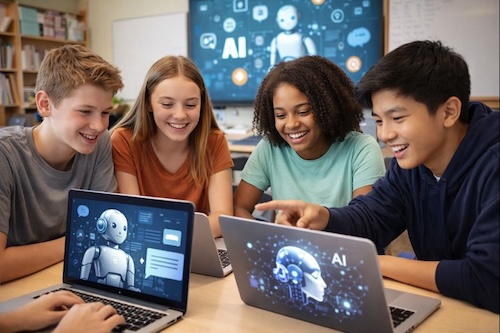
Students are surrounded by images and videos, from photographs and diagrams to memes, screenshots, and, increasingly, AI-generated visuals. These images appear everywhere: in learning materials, on social media, and inside the tools students use daily. Many look polished, realistic, and authoritative.

At the same time, AI has made faking easier than ever.

As educators and school leaders, we now face urgent questions around misinformation, academic integrity, and critical thinking. The issue is no longer just whether students can use AI tools, but whether they can interpret, evaluate, and question what they see.

This is where visual literacy becomes a frontline defence.

Teaching students to read images critically, to see them as constructed texts rather than neutral data, strengthens the same skills we rely on for strong reading comprehension: inference, evidence-based reasoning, and metacognitive awareness.

From photography to AI: A conversation grounded in practice

Recently, I found myself returning to those early classroom experiences through ongoing professional dialogue with a former college lecturer and professional photographer, as we explored what it really means to read images in the age of AI.

A conversation that grew out of practice

Nesreen: When I shared the draft with you, you immediately focused on the language, whether I was treating images as data or as signs. Is this important?

Photographer: Yes, because signs belong to reading. Data is output. Signs are meaning. When we talk about reading media texts, we’re talking about how meaning is constructed, not just what information appears.

Nesreen: That distinction feels crucial right now. Students are surrounded by images and videos, but they’re rarely taught to read them with the same care as written texts.

Photographer: Exactly. Once students understand that photographs and AI images are made up of signs, color, framing, scale, and viewpoint, they stop treating images as neutral or factual.

Nesreen: You also asked whether the lesson would lean more towards evaluative assessment or summarizing. That made me realize the reflection mattered just as much as the image itself.

Photographer: Reflection is key. When students explain why a composition works, or what they would change next time, they’re already engaging in higher-level reading skills.

Nesreen: And whether students are analyzing a photograph, generating an AI image, or reading a paragraph, they’re practicing the same habits: slowing down, noticing, justifying, and revising their thinking.

Photographer: And once they see that connection, reading becomes less about the right answer and more about understanding how meaning is made.

Reading images is reading

One common misconception is that visual literacy sits outside “real” literacy. In practice, the opposite is true.

When students read images carefully, they:

  • identify what matters most
  • follow structure and sequence
  • infer meaning from clues
  • justify interpretations with evidence
  • revise first impressions

These are the habits of skilled readers.

For emerging readers, multilingual learners, and students who struggle with print, images lower the barrier to participation, without lowering the cognitive demand. Thinking comes first. Language follows.

From composition to comprehension: Mapping image reading to reading strategies

Photography offers a practical way to name what students are already doing intuitively. When teachers explicitly teach compositional elements, familiar reading strategies become visible and transferable.

What students notice in an image What they are doing cognitively Reading strategy practiced
Where the eye goes first Deciding importance Identifying main ideas
How the eye moves Tracking structure Understanding sequence
What is included or excluded Considering intention Analyzing author’s choices
Foreground and background Sorting information Main vs supporting details
Light and shadow Interpreting mood Making inferences
Symbols and colour Reading beyond the literal Figurative language
Scale and angle Judging power Perspective and viewpoint
Repetition or pattern Spotting themes Theme identification
Contextual clues Using surrounding detail Context clues
Ambiguity Holding multiple meanings Critical reading
Evidence from the image Justifying interpretation Evidence-based responses

Once students recognise these moves, teachers can say explicitly:

“You’re doing the same thing you do when you read a paragraph.”

That moment of transfer is powerful.

Making AI image generation teachable (and safe)

In my classroom work pack, students use Perchance AI to generate images. I chose this tool deliberately: It is accessible, age-appropriate, and allows students to iterate, refining prompts based on compositional choices rather than chasing novelty.

Students don’t just generate an image once. They plan, revise, and evaluate.

This shifts AI use away from shortcut behavior and toward intentional design and reflection, supporting academic integrity rather than undermining it.

The progression of a prompt: From surface to depth (WAGOLL)

One of the most effective elements of the work pack is a WAGOLL (What A Good One Looks Like) progression, which shows students how thinking improves with precision.

  • Simple: A photorealistic image of a dog sitting in a park.
  • Secure: A photorealistic image of a dog positioned using the rule of thirds, warm colour palette, soft natural lighting, blurred background.
  • Greater Depth: A photorealistic image of a dog positioned using the rule of thirds, framed by tree branches, low-angle view, strong contrast, sharp focus on the subject, blurred background.

Students can see and explain how photographic language turns an image from output into meaningful signs. That explanation is where literacy lives.

When classroom talk begins to change

Over time, classroom conversations shift.

Instead of “I like it” or “It looks real,” students begin to say:

  • “The creator wants us to notice…”
  • “This detail suggests…”
  • “At first I thought…, but now I think…”

These are reading sentences.

Because images feel accessible, more students participate. The classroom becomes slower, quieter, and more thoughtful–exactly the conditions we want for deep comprehension.

Visual literacy as a bridge, not an add-on

Visual literacy is not an extra subject competing for time. It is a bridge, especially in the age of AI.

By teaching students how to read images, schools strengthen:

  • reading comprehension
  • inference and evaluation
  • evidence-based reasoning
  • metacognitive awarenes

Most importantly, students learn that literacy is not about rushing to answers, but about noticing, questioning, and constructing meaning.

In a world saturated with AI-generated images, teaching students how to read visually is no longer optional.

It is literacy.

Author’s note: This article grew out of classroom practice and professional dialogue with a former college lecturer and professional photographer. Their contribution informed the discussion of visual composition, semiotics, and reflective image-reading, without any involvement in publication or authorship.

Nesreen El-Baz, Bloomsbury Education Author & School Governor

Nesreen El-Baz is an ESL educator with over 20 years of experience, and is a certified bilingual teacher with a Master’s in Curriculum and Instruction. El-Baz is currently based in the UK, holds a Masters degree in Curriculum and Instruction from Houston Christian University, and specializes in developing in innovative strategies for English Learners and Bilingual education.

Latest posts by eSchool Media Contributors (see all)

.Organize the content with appropriate headings and subheadings ( h2, h3, h4, h5, h6). Include conclusion section and FAQs section with Proper questions and answers at the end. do not include the title. it must return only article i dont want any extra information or introductory text with article e.g: ” Here is rewritten article:” or “Here is the rewritten content:”

Generate single title from this title Emi Kusano: Redefining AI Art in 100 -150 characters. And it must return only title i dont want any extra information or introductory text with title e.g: ” Here is a single title:”

0

Write an article about

Above: Pixelated Perception (2023) investigates modern ways of seeing through pixelated imagery, commenting on the nature of perception shaped by digital media. The series critically engages with how media influences personal and collective views.

Emi Kusano (emikusano.art) is a Tokyo-born multidisciplinary artist whose practice interweaves nostalgia, pop culture, and emerging technologies. Beginning as a teenage street photographer documenting Harajuku fashion—a body of work later exhibited by the Victoria and Albert Museum—Kusano has long examined how mass media informs both personal identity and collective memory. Her explorations expanded into music as the lead singer of Satellite Young, a retro-futurist band reimagining 1980s J-pop through a contemporary lens.

Today, Kusano is internationally recognized for her AI-based practice, with exhibitions spanning over 20 countries, including presentations at M+ Museum in Hong Kong, Saatchi Gallery in London, and the 21st Century Museum of Contemporary Art in Kanazawa. In 2025, her pioneering contribution to digital culture was acknowledged with her selection as a Young Global Leader by the World Economic Forum.

The Altar of Bonnō (2024) explores the intrinsic nature of human desire through generative AI. This series uses an AI model trained exclusively on the artist’s own face, creating distorted, haunting portraits that reflect the Buddhist concept of “Bonnō” (worldly desires).

In the following conversation with .ART, Kusano reflects on her trajectory from photography and music to AI, positioning the technology as both a tool and a collaborator. She considers the role of self-portraiture within her AI-generated works and the ways in which algorithmic systems reproduce cultural bias.

You originally worked in street photography before moving into new media art. How did that transition happen?

I think I’ve always been creating in one way or another. Both of my parents are artists—my father is a painter and fashion designer, and my mother, while mostly a stay-at-home mom, occasionally worked as an illustrator. So making things was natural for me from a very young age.

When I was in high school, I spent a year in the U.S. as an exchange student. I grew up in Tokyo, but I ended up in a small rural town in Utah. It was very peaceful, with beautiful nature and kind people, but at the same time very homogeneous, with everyone wearing the same clothes and hanging out at the same mall.

When I came back to Tokyo, the contrast was striking. Suddenly, Harajuku fashion felt like a wonderland to me. I hadn’t really appreciated it before, but now I was completely fascinated. I started working part-time as a photographer for a website called JapaneseStreets.com, which documented Tokyo street style. The site is no longer active, but back then it was an important resource for media and researchers. Some of my photos from that time even ended up in the collection of the Victoria & Albert Museum.

That was my first real step into the art world, although at the time I saw myself more as a journalist than an artist. Photography became my way of exploring—having a camera gave me access to fashion shows and cultural events. It opened so many doors for me as a teenager.

Two women in kimono-inspired outfits pose in a sepia-toned street scene in Neural Fad by Emi Kusano. Their futuristic headpieces resemble animal ears, and one carries a cat tucked into her obi. AI-generated, the series imagines alternate histories of fashion, exploring shifting ideals of beauty and style.

Neural Fad (2023) presents a fictitious history of fashion, imagined through AI-generated imagery. The collection portrays non-existent yet convincingly real trends, embodying society’s ever-changing perceptions of beauty and style.

I like how you describe these turning points—moments that build up and lead to the next phase. At what point did you start identifying as an artist and working across different media?

That shift came around 2011–2012, when I started a conceptual band called Satellite Young. I performed as a kind of 1980s Japanese idol, singing songs about technology and the digital age. I’ve always been fascinated by the aesthetics and music of the 1980s. Even though I never studied music formally or played instruments, I wrote lyrics, came up with melodies, and developed the overall concept. It was my first attempt to consciously create something beyond documentation.

I only began to fully see myself as a contemporary artist more recently, especially with the rise of blockchain and AI. Since 2023, I’ve been working actively as an AI artist. In just three years, I’ve exhibited in more than 20 countries, in galleries and museums around the world. That has been a transformative moment for me.

A man in a beige suit and a woman in a white dress stand in a futuristic greenhouse filled with plants, dogs, and humanoid robots in Technoanimism by Emi Kusano. The AI-generated scene explores the intersection of spirituality, nature, and technology, questioning how humanity reconciles tradition with progress.

Technoanimism (2023) blends traditional animistic beliefs with contemporary technology, examining the blurred boundaries between nature and artificiality. The work reflects on how modern humanity reconciles spirituality with technological progress.

So AI not only became a new medium for you, but it also shifted your career and gave you more possibilities. How do you approach working with it?

For me, AI feels like a continuation of what I was already doing in photography and music. I’ve never been interested in mastering one specific craft—like programming or painting—but I love producing, directing, and creating worlds. AI fits this perfectly because it allows me to combine elements, adjust light, characters, moods, and create narratives.

I often insert myself into these works, just like I performed in my music videos. This really started when WWD Japan asked me to create their first AI-generated fashion magazine cover. I modeled my own face for it, and that opened up new ways of using myself as material—not as a person, but almost like an object or avatar. It’s not very different from being in front of the camera for a music video or commercial.

With AI, I can generate a kind of selfless version of myself, which I find fascinating.

That’s really interesting. Can you tell me about some of your recent projects?

In March, I had an exhibition in Paris where I presented a project called Office Ladies. I used my facial and body data to generate AI “assistants” or secretaries—alter egos of myself in retro-style office settings.

The idea came from imagining a personal AI agent, a kind of “mini-me” that could do my work for me. But when I tried to generate AI assistants, I noticed that the results always reflected gender stereotypes: women appeared in mini skirts as secretaries, while men appeared in suits. Even if you try prompts like “woman in a suit, man in an apron,” the images often flip back to stereotypes. It revealed how deeply human bias is embedded in AI systems. By recreating these stereotypical office ladies using my own image, I wanted to highlight that irony and question it.

Two women in brightly colored retro office uniforms pose against a backdrop of stacked files in Office Ladies by Emi Kusano. Generated with AI, the scene highlights gender roles and stereotypes in corporate culture, blending surreal visuals with commentary on modern office life.

Office Ladies (2025) explores gender roles, corporate culture, and the absurdity of modern office life through the lens of AI-generated visuals. The series challenges traditional narratives around female office workers, creating surreal yet relatable scenes.

You’ve also been active internationally, and I saw that you were named a Young Global Leader at the World Economic Forum, which took place in China. Could you tell me more about that?

The Young Global Leaders program is run by the World Economic Forum. Every year, they select people across different fields who are pioneering in their work. I was recognized as one of the first digital artists actively working with AI art, which was a great honor.

Many people are using AI nowadays, but not all of them create something original—they often just let it do everything. How do you see your relationship with AI? Is it a tool for you, or more of a collaborator?

I see it as both—a tool and a collaborator. The situation reminds me a lot of the early days of photography. At first, photography wasn’t considered art, just a way to record reality. People said, “Anyone can take a picture.” And now, of course, everyone really can—babies can take photos with smartphones. But what matters is how you use it: what you choose, what you frame, what you want to express.

It’s the same with AI.

Anyone can generate an image, but to create meaningful work, you have to push the tool, combine different methods, and make it your own.

I work with multiple AI systems, layering, editing, and experimenting. The unpredictability of the results is what excites me the most.

One last question: why did you decide to use a .ART domain name as your online address?

For me, choosing .ART was symbolic. It marked the moment I decided to fully commit to being an artist. It felt authentic and true to what I stand for. It’s not just a website address—it was a statement that I am about art, and that’s the path I’ve chosen for my life.

Learn more about Emi’s work: emikusano.art

The post Emi Kusano: Redefining AI Art appeared first on .ART.

.Organize the content with appropriate headings and subheadings ( h2, h3, h4, h5, h6). Include conclusion section and FAQs section with Proper questions and answers at the end. do not include the title. it must return only article i dont want any extra information or introductory text with article e.g: ” Here is rewritten article:” or “Here is the rewritten content:”

Generate single title from this title First Insight brings conversational AI in retail in 100 -150 characters. And it must return only title i dont want any extra information or introductory text with title e.g: ” Here is a single title:”

Write an article about

One of First Insight’s core claims is that Ellis makes consumer insight accessible outside of specialist analytics teams. Natural-language queries, the company argues, lets senior executives down engage with data with no waiting for analysis.

Democratisation of analytics is a recurring theme in a great deal of industry research. Gartner reports organisations which broaden access to analytics are more likely to see tool adoption and ROI. However, it cautions that systems should be governed to ensure outputs are interpreted correctly and stem from robust data.

First Insight maintains that Ellis retains the methodological rigour of its existing platform, while reducing friction at the point of decision. According to Greg Petro, the company’s chief executive, the goal is to bring predictive insight into the moment when decisions are actually made.

“For nearly 20 years, First Insight has helped retailers predict pricing, product success and assortment decisions by grounding them in real consumer feedback,” a company spokesperson said. “Ellis brings that intelligence directly into line review, early concept development and the boardroom, helping teams move faster without sacrificing confidence.”

.Organize the content with appropriate headings and subheadings ( h2, h3, h4, h5, h6). Include conclusion section and FAQs section with Proper questions and answers at the end. do not include the title. it must return only article i dont want any extra information or introductory text with article e.g: ” Here is rewritten article:” or “Here is the rewritten content:”

Generate single title from this title Chinese EVs inch closer to the US as Canada slashes tariffs in 100 -150 characters. And it must return only title i dont want any extra information or introductory text with title e.g: ” Here is a single title:”

0

Write an article about

Canadian Prime Minister Mark Carney announced Friday that his country will slash its 100% import tax on Chinese EVs to just 6.1%, paving the way for companies like Geely, BYD, Xiaomi, and others to establish a second foothold in the North American automotive market.

Canada is not going all-in on Chinese EVs, though. The country will initially cap annual imports at 49,000 vehicles. That cap will slowly increase to about 70,000 in around five years, according to the Associated Press.

It’s a major shift that comes at a time when China is looking to boost EV exports, especially as the European Union weighs lowering its own tariffs on the vehicles. The U.S. remains a holdout on that front, though this week President Trump said he’d be open to Chinese automakers building factories in the U.S. that produce EVs.

China has already been exporting gas, hybrid, and electric vehicles to Mexico, with the latter especially booming in 2025. Many of the leading EV-makers in China have been agitating to enter the U.S. market, including Geely, which held a drive event at the Consumer Electronics Show in Las Vegas last week. While the company was showcasing a number of models ostensibly meant for the Mexican market, one of its communications executives implied the conglomerate is aiming to announce an entry into the U.S. in the next two-to-three years.

Automotive journalists, influencers, and even some executives — most notably Ford CEO Jim Farley — have praised the quality of Chinese EVs over the last few years.

But the 100% tariff on Chinese cars have so far made the idea of exporting them to the U.S. a non-starter. That’s despite the fact that Chinese EVs are sold at far lower prices than the average car in the U.S. — a feat typically achieved through a combination of extremely low cost of capital, labor, and a willingness to burn money to gain market share.

China’s ability to undercut other automakers on price is just one concern. The U.S. has spent the last few years trying to separate itself from China’s EV supply chain for national security reasons, under both Presidents Biden and Trump. There are other legal hurdles too. Last year, the U.S. Department of Commerce’s Bureau of Industry and Security issued a rule restricting the import and sale of certain connected vehicles and related hardware and software linked to China or Russia.

Techcrunch event

San Francisco
|
October 13-15, 2026

On Thursday, Avery Ash, the CEO of non-profit Securing America’s Future Energy, cautioned against Trump’s idea of allowing Chinese automakers to build cars in the United States.

“We’ve seen this strategy backfire in Europe and elsewhere—it would have potentially catastrophic impacts on our automotive industry, have ripple effects on our entire defense industrial base, and make every American less secure,” he said in a statement. “We urge the President to stay tough against China and protect American auto manufacturers and workers.” 

.Organize the content with appropriate headings and subheadings ( h2, h3, h4, h5, h6). Include conclusion section and FAQs section with Proper questions and answers at the end. do not include the title. it must return only article i dont want any extra information or introductory text with article e.g: ” Here is rewritten article:” or “Here is the rewritten content:”

Generate single title from this title Google removes some AI health summaries after investigation finds “dangerous” flaws in 100 -150 characters. And it must return only title i dont want any extra information or introductory text with title e.g: ” Here is a single title:”

Write an article about

On Sunday, Google removed some of its AI Overviews health summaries after a Guardian investigation found people were being put at risk by false and misleading information. The removals came after the newspaper found that Google’s generative AI feature delivered inaccurate health information at the top of search results, potentially leading seriously ill patients to mistakenly conclude they are in good health.

Google disabled specific queries, such as “what is the normal range for liver blood tests,” after experts contacted by The Guardian flagged the results as dangerous. The report also highlighted a critical error regarding pancreatic cancer: The AI suggested patients avoid high-fat foods, a recommendation that contradicts standard medical guidance to maintain weight and could jeopardize patient health. Despite these findings, Google only deactivated the summaries for the liver test queries, leaving other potentially harmful answers accessible.

The investigation revealed that searching for liver test norms generated raw data tables (listing specific enzymes like ALT, AST, and alkaline phosphatase) that lacked essential context. The AI feature also failed to adjust these figures for patient demographics such as age, sex, and ethnicity. Experts warned that because the AI model’s definition of “normal” often differed from actual medical standards, patients with serious liver conditions might mistakenly believe they are healthy and skip necessary follow-up care.

Vanessa Hebditch, director of communications and policy at the British Liver Trust, told The Guardian that a liver function test is a collection of different blood tests and that understanding the results “is complex and involves a lot more than comparing a set of numbers.” She added that the AI Overviews fail to warn that someone can get normal results for these tests when they have serious liver disease and need further medical care. “This false reassurance could be very harmful,” she said.

Google declined to comment on the specific removals to The Guardian. A company spokesperson told The Verge that Google invests in the quality of AI Overviews, particularly for health topics, and that “the vast majority provide accurate information.” The spokesperson added that the company’s internal team of clinicians reviewed what was shared and “found that in many instances, the information was not inaccurate and was also supported by high-quality websites.”

.Organize the content with appropriate headings and subheadings ( h2, h3, h4, h5, h6). Include conclusion section and FAQs section with Proper questions and answers at the end. do not include the title. it must return only article i dont want any extra information or introductory text with article e.g: ” Here is rewritten article:” or “Here is the rewritten content:”

Generate single title from this title Using generative tools to deepen, not replace, human connection in schools in 100 -150 characters. And it must return only title i dont want any extra information or introductory text with title e.g: ” Here is a single title:”

Write an article about

Key points:

For the last two years, conversations about AI in education have tended to fall into two camps: excitement about efficiency or fear of replacement. Teachers worry they’ll lose authenticity. Leaders worry about academic integrity. And across the country, schools are trying to make sense of a technology that feels both promising and overwhelming.

But there’s a quieter, more human-centered opportunity emerging–one that rarely makes the headlines: AI can actually strengthen empathy and improve the quality of our interactions with students and staff.

Not by automating relationships, but by helping us become more reflective, intentional, and attuned to the people we serve.

As a middle school assistant principal and a higher education instructor, I’ve found that AI is most valuable not as a productivity tool, but as a perspective-taking tool. When used thoughtfully, it supports the emotional labor of teaching and leadership–the part of our work that cannot be automated.

From efficiency to empathy

Schools do not thrive because we write faster emails or generate quicker lesson plans. They thrive because students feel known. Teachers feel supported. Families feel included.

AI can assist with the operational tasks, but the real potential lies in the way it can help us:

  • Reflect on tone before hitting “send” on a difficult email
  • Understand how a message may land for someone under stress
  • Role-play sensitive conversations with students or staff
  • Anticipate barriers that multilingual families might face
  • Rehearse a restorative response rather than reacting in the moment

These are human actions–ones that require situational awareness and empathy. AI can’t perform them for us, but it can help us practice and prepare for them.

A middle school use case: Preparing for the hard conversations

Middle school is an emotional ecosystem. Students are forming identity, navigating social pressures, and learning how to advocate for themselves. Staff are juggling instructional demands while building trust with young adolescents whose needs shift by the week.

Some days, the work feels like equal parts counselor, coach, and crisis navigator.

One of the ways I’ve leveraged AI is by simulating difficult conversations before they happen. For example:

  • A student is anxious about returning to class after an incident
  • A teacher feels unsupported and frustrated
  • A family is confused about a schedule change or intervention plan

By giving the AI a brief description and asking it to take on the perspective of the other person, I can rehearse responses that center calm, clarity, and compassion.

This has made me more intentional in real interactions–I’m less reactive, more prepared, and more attuned to the emotions beneath the surface.

Empathy improves when we get to “practice” it.

Supporting newcomers and multilingual learners

Schools like mine welcome dozens of newcomers each year, many with interrupted formal education. They bring extraordinary resilience–and significant emotional and linguistic needs.

AI tools can support staff in ways that deepen connection, not diminish it:

  • Drafting bilingual communication with a softer, more culturally responsive tone
  • Helping teachers anticipate trauma triggers based on student histories
  • Rewriting classroom expectations in family-friendly language
  • Generating gentle scripts for welcoming a student experiencing culture shock

The technology is not a substitute for bilingual staff or cultural competence. But it can serve as a bridge–helping educators reach families and students with more warmth, clarity, and accuracy.

When language becomes more accessible, relationships strengthen.

AI as a mirror for leadership

One unexpected benefit of AI is that it acts as a mirror. When I ask it to review the clarity of a communication, or identify potential ambiguities, it often highlights blind spots:

  • “This sentence may sound punitive.”
  • “This may be interpreted as dismissing the student’s perspective.”
  • “Consider acknowledging the parent’s concern earlier in the message.”

These are the kinds of insights reflective leaders try to surface–but in the rush of a school day, they are easy to miss.

AI doesn’t remove responsibility; it enhances accountability. It helps us lead with more emotional intelligence, not less.

What this looks like in teacher practice

For teachers, AI can support empathy in similarly grounded ways:

1. Building more inclusive lessons

Teachers can ask AI to scan a lesson for hidden barriers–assumptions about background knowledge, vocabulary loads, or unclear steps that could frustrate students.

2. Rewriting directions for struggling learners

A slight shift in wording can make all the difference for a student with anxiety or processing challenges.

3. Anticipating misconceptions before they happen

AI can run through multiple “student responses” so teachers can see where confusion might arise.

4. Practicing restorative language

Teachers can try out scripts for responding to behavioral issues in ways that preserve dignity and connection.

These aren’t shortcuts. They’re tools that elevate the craft.

Human connection is the point

The heart of education is human. AI doesn’t change that–in fact, it makes it more obvious.

When we reduce the cognitive load of planning, we free up space for attunement.
When we rehearse hard conversations, we show up with more steadiness.
When we write in more inclusive language, more families feel seen.
When we reflect on our tone, we build trust.

The goal isn’t to create AI-enhanced classrooms. It’s to create relationship-centered classrooms where AI quietly supports the skills that matter most: empathy, clarity, and connection.

Schools don’t need more automation.

They need more humanity–and AI, used wisely, can help us get there.

Timothy Montalvo, Iona University & the College of Westchester

Timothy Montalvo is a middle school educator and leader passionate about leveraging technology to enhance student learning. He serves as Assistant Principal at Fox Lane Middle School in Westchester, NY, and teaches education courses as an adjunct professor at Iona University and the College of Westchester. Montalvo focuses on preparing students to be informed, active citizens in a digital world and shares insights on Twitter/X @MrMontalvoEDU or on BlueSky @montalvoedu.bsky.social.

Latest posts by eSchool Media Contributors (see all)

.Organize the content with appropriate headings and subheadings ( h2, h3, h4, h5, h6). Include conclusion section and FAQs section with Proper questions and answers at the end. do not include the title. it must return only article i dont want any extra information or introductory text with article e.g: ” Here is rewritten article:” or “Here is the rewritten content:”

Generate single title from this title AI transformation in financial services: 5 predictors for success in 2026 in 100 -150 characters. And it must return only title i dont want any extra information or introductory text with title e.g: ” Here is a single title:”

Write an article about

Financial services companies are among the most advanced adopters of AI globally, even though they operate in one of the most heavily regulated environments. The reason is simple: these firms understand the long-term transformative power of AI in a disruptive, rapidly evolving industry landscape.

Today, financial services has the highest concentration of Frontier Firms—organizations that embed AI agents across every workflow to drive speed, agility, and scalable innovation. These are companies that have demonstrated greater business impact from AI by blending human judgement with AI agents. A November 2025 IDC study commissioned by Microsoft shows that Frontier Firms report returns on their AI investments roughly three times higher than slow adopters.1

In my previous blog, I detailed a three-phase roadmap for banks to become Frontier Firms. Now, I’d like to share essential practices in AI adoption that we believe are predictors for financial services success in 2026. These are based on hundreds of conversations I’ve had with customers, industry leaders, and technologists worldwide over the past three months. Organizations aiming to maximize AI’s potential in 2026 and beyond should consider these practices as part of their approach to AI transformation.

The new essentials for AI success in financial services

In 2026, success won’t come from experimenting with AI, it will come from re-architecting core business processes to be human-led and AI-operated. Frontier Firms are already heavily invested, with 70% of organizations across industries saying that in the next 24 months, they plan to increase their budgets for generative AI and agentic AI.1

In financial services, there is pressure from senior executives and boards to move at greater pace and scale—to differentiate their firms by infusing AI into the fabric of their business.

In response, our customers are eager to learn how Frontier Firms do it. What are they doing to drive real impact faster than others? How do they make the right investments? What can they not afford to miss?

Regardless of when and how a firm acts, we see five essential keys to success, not all of them purely technical.

1. Value creation will drive innovation in agentic AI

As the adoption of AI evolves, Frontier Firms are re-thinking how they measure value creation. The traditional approach to crafting business cases is giving way to a new, more dynamic model as Frontier Firms are now measuring the impact of AI as use cases are deployed. A/B testing (comparing two versions of a use case to understand which delivers greater impact) has helped organizations like Investec quantify meaningful benefits, including saving bankers up to 200 hours a year with Microsoft Copilot for Sales. Focusing AI enablement on customer-facing teams is a practical way to move beyond internal productivity gains and begin influencing top-line growth. 

Frontier Firms in financial services are now focusing on the measurable impact of AI—revenue growth, increased margins, and market share gain from new products, differentiated customer experiences, and empowered employee workflows. This goes well beyond use cases focused on efficiency. According to IDC, 36% of financial services firms are planning AI use cases in the next two years to boost revenue with new business models, products, or services.1

To scale AI to more powerful, multifunction workflows, Frontier Firms are creating agentic operating models that embed AI more deeply across the business and the workforce. Working under the direction and oversight of humans, these new AI agents can reason, plan, and act across critical workflows.

Embedding agents correlates with value creation by aligning AI with core processes and key metrics. A good example is Generali France, a key player in the insurance sector in France. The organization is powering strategic use cases in customer relations and core business expertise with AI agents. In their helpdesk operations, they’ve developed a 24/7 voice assistant that’s capable of reassuring claimants before a human steps in. Nearly 1.3 million calls—representing 30% of requests—are resolved directly by clients, with no human intervention needed.

IDC predicts such adoption of agentic AI will triple in the next two years.1 Winning firms will anchor their innovation to business outcomes that matter in financial services (such as safer payments, faster credit decisions, and decreased fraud, to name a few), and report outcomes in quarterly scorecards so teams see purpose, not just tools.

2. Skilling and AI fluency will maximize workforce value

Even the best technology will fall short if workers aren’t trained and supported to embrace it.

Successful transformation addresses the human aspect—ensuring everyone understands the benefits and feels part of the journey. Change management is both a top-down and bottom-up process. Leadership must set the vision while making sure that employees at every level are empowered to contribute.

Organizations should start with skilling, with a focus on “learning in the flow of work.” Leaders can foster learning by embedding it into daily tasks so that skills stick and compound over time. They should consider building learning pathways focused on AI fluency for all employees, plus specialized tracks for specific roles, then reinforce adoption with incentives that reward employees for integrating AI into everyday workflows.

Lloyds Banking Group offers a powerful example. Departments competed for a limited number of Microsoft 365 Copilot licenses with bids based on business cases. The firm built a network of 1,000 volunteer “flight instructors” and hosted weekly “promptathons” to share best practices. The impact: over 10,000 employees trained, with 93% daily usage among 30,000 licensed users.

3. Innovation will expand across business processes

Frontier Firms are quickly moving beyond single function use cases and innovating across seven business functions on average. Focused on expanding impact across the business, AI innovation in financial service will map to key functions such as research automation in capital markets, claims in insurance, and anti-money laundering or fraud in banking. Plus, more than 70% of firms are using AI in customer service, marketing, IT, cybersecurity, and product development.1

This broad approach is delivering better outcomes for Frontier Firms on many critical fronts: top-line growth (88%), brand differentiation (87%), cost efficiency (86%), and customer experience (85%).1 Interestingly, it also opens innovation to drive new opportunities, such as transforming support functions into revenue generators through new customer experiences.

The impact of advanced AI spans the financial services industry. In capital markets, it improves market research and analytics, personalizes the client experience across digital channels, and helps tailor services to individual needs. BlackRock, for instance, is transforming its investment lifecycle by embedding AI into its Aladdin platform, used by tens of thousands of users. Likewise, LSEG and Microsoft have built tools that let financial professionals quickly build custom agents leveraging 33-plus petabytes of trusted market data.

In banking, AI is equipping financial institutions with new tools for personalized service and stronger client relationships. AI will help to improve the effectiveness of targeted marketing campaigns, streamline lending and mortgage processes, and safeguard assets with advanced fraud analysis. AI agents will continue to proliferate, thanks to efforts such as Argentina’s Banco Ciudad, which launched a new AI Center of Excellence that delivered 10 agents in six months to improve customer service, workflow automation, and cross-team integration.

In insurance, AI will accelerate value by automating complex, high-value processes such as underwriting, claims management, and policy administration while improving risk modeling and compliance. It will become more effective in helping insurance agents better serve clients, and in helping customers make the best policy choices. Fraud detection and decision making will advance, thanks to innovations such as a new service from Shift Technology designed to help insurance companies by automating classification and extraction of unstructured data.

4. Responsible AI and regulatory readiness will be competitive advantages

The firms that lead in AI will also lead in governance. IDC predicts 1.3 billion AI agents will be in business workflows by 2028.2 As they become part of the organization, business leaders need to think of them as employees in many ways. They will require identities, permissions, and oversight. They’ll need to be trained, monitored, and auditable.

Proactive compliance is now an imperative, if not a competitive advantage. In 2026, regulatory complexity will only intensify, meaning that trust must be the foundation for scale and innovation. Frontier Firms embed responsible AI frameworks into every stage of the lifecycle, from design to deployment and monitoring. Leaders will integrate data privacy, encryption, and access controls across AI innovation from day one.  

Bradesco’s Bridge is an example of how a bank can responsibly operationalize agentic workflows. Bridge uses Microsoft Azure AI to provide a governed API layer to enforce consistent policies and secure data access. The result is 83% resolution rates for digital service and a 30% reduction in tech costs.

Complementing this, Microsoft’s new Agent 365, announced at Microsoft Ignite 2025, addresses the critical need for control at scale. Agent 365 is a unified control plane that extends enterprise management and security to partner-developed agents and even those running outside the Microsoft Cloud. Integrated with Microsoft Entra, Microsoft Purview, and Microsoft Defender, it enforces identity, permissions, and data protection while surfacing telemetry for ROI and compliance. All agent activities are logged into Microsoft Sentinel and Purview audit logs, giving security operations teams a full audit trail to investigate incidents. It also minimizes the risk of “shadow AI” and helps ensure that agent deployment is compliant. 

5. Data strategy will unlock AI at scale

Perhaps the single most important requirement for success with agentic AI is data readiness. Without the right strategy to ensure data interoperability and real-time intelligence, an organization’s most important initiatives are destined to fall short. 

To derive the most value from AI, the first step is to unify all of the organization’s data. Fragmented systems—core banking, risk models, compliance archives, customer relationship management—create blind spots. The traditional approach to doing this—moving all of an organization’s data to a single location—has often proven costly and resource intensive. The new approach is to use a unified data platform, such as Microsoft Fabric, which connects data wherever it sits, giving organizations a single source of truth, even when the data resides on other platforms or systems. This approach empowers organizations to deliver faster insights, lower costs, and unify governance, accelerating their AI deployment.  

LSEG leveraged Microsoft Fabric to modernize their data infrastructure and accelerate time to market. LSEG uses Apache Spark on Fabric to process around 80,000 files daily, consuming approximately 280,000 capacity units per day. Usage is growing rapidly, with month-on-month consumption increasing by more than 50%, signaling the start of a transformative journey.  

Finally, organizations must embed governance and security. Identity-based access, audit trails, and adaptive risk controls are non-negotiable.

AI at scale is not just about models—it’s about the foundation: data, cloud, and governance. Microsoft delivers on all these imperatives: Microsoft Fabric IQ for unified semantics, Foundry IQ for contextual knowledge, Azure for scalable performance, and Microsoft Agent 365 for governance. The mandate is clear—modernize your data foundation today to avoid challenging consequences later.

Now is the time for agentic AI in financial services

Financial institutions have long pursued productivity gains to reinvest in growth, and that imperative remains. But AI is no longer just about cost savings—it’s about reinventing how organizations engage customers, redefine services, bend the innovation curve, and create competitive differentiation.

To empower our customers to accelerate to scale, Microsoft has built a full stack enterprise AI platform that is fully integrated. Our approach is architected around 3 objectives: 

  • AI in the flow of human ambition
    Copilot can be used by end users to develop personal agents to execute tasks on their behalf. For low-code development, customers can use Microsoft Copilot Studio to build agents and assistants that can answer questions and execute workflows that integrate with their data and line of business systems. Both are powered by Work IQ—an intelligence layer that customers can use to give real-time insights into how teams are working across applications and processes and improve operational performance. 
  • Ubiquitous innovation
    To enable ubiquitous innovation, Fabric is an AI-powered, end-to-end data and analytics platform that breaks down the data siloes and unifies data that resides in different places. It is powered by Fabric IQ, a semantic intelligence layer that enables customers to organize data around the language and meaning of their business (such as relationships, entities, and logic) so teams can build agents that are grounded in the same semantic understanding of the business.

    Ubiquitous innovation is also enabled by Microsoft Foundry, Microsoft’s unified Azure platform for building, deploying, and optimizing pro-code AI apps and agents—bringing models and tools together. Foundry IQ makes it easier for teams to build reliable agents and apps that use trusted governed knowledge. Foundry IQ is a knowledge grounding layer for agents: it connects AI apps and agents to content across many sources (like documents, policies, Microsoft SharePoint, OneLake, and external stores) using an Azure AI Search–powered knowledge base and a single grounding API, with permission-aware access. 

  • Observability at every layer
    As organizations navigate the agentic era in financial services, the question isn’t just how to deploy AI agents—it’s how to do it securely, at scale, and in a way that positions the organization as a leader. This requires a connected, trusted, and scalable platform to orchestrate AI across the business, which Microsoft offers. With Agent 365 as a unified control plane, organizations gain a single governance layer that extends enterprise-grade identity, security, and compliance to every agent—whether it’s built in-house or running on external clouds. This means organizations can confidently embrace AI innovation without sacrificing oversight or regulatory alignment. Microsoft’s approach means organizations aren’t just adopting tools; they’re anchoring their business to the platform for the open agentic web—a trusted, interoperable ecosystem where agents and humans collaborate seamlessly.  

The firms that embrace this shift—modernizing data, embedding governance, and preparing their workforce—won’t just adapt; they’ll lead the next era of financial innovation.

Learn more

1 IDC, What every company can learn from Frontier firms leading the AI revolution, sponsored by Microsoft, November 2025.

2 IDC Info Snapshot, sponsored by Microsoft, 1.3 Billion AI Agents by 2028, May 2025 #US53361825.

Bill Borden

Bill Borden

Corporate Vice President of Worldwide Financial Services, Microsoft

Bill leads the development and execution of Microsoft’s financial services industry strategy, supporting banking, capital markets, and insurance customers worldwide in their digital transformation journeys to innovate and grow their businesses.

See more articles from this author

.Organize the content with appropriate headings and subheadings ( h2, h3, h4, h5, h6). Include conclusion section and FAQs section with Proper questions and answers at the end. do not include the title. it must return only article i dont want any extra information or introductory text with article e.g: ” Here is rewritten article:” or “Here is the rewritten content:”