

Write an article about The data suggests soft skills more than quantitative competency equal success in a rapidly changing labour market .Organize the content with appropriate headings and subheadings ( h2, h3, h4, h5, h6). Include conclusion section and FAQs section with Proper questions and answers at the end. do not include the title. it must return only article i dont want any extra information or introductory text with article e.g: ” Here is rewritten article:” or “Here is the rewritten content:”
Generate single title from this title Sentiment Analysis with Text and Audio Using AWS Generative AI Services: Approaches, Challenges, and Solutions in 100 -150 characters. And it must return only title i dont want any extra information or introductory text with title e.g: ” Here is a single title:”
Write an article about
This post is co-written by Instituto de Ciência e Tecnologia Itaú (ICTi) and AWS.
Sentiment analysis has grown increasingly important in modern enterprises, providing insights into customer opinions, satisfaction levels, and potential frustrations. As interactions occur largely through text (such as social media, chat applications, and ecommerce reviews) or voice (such as call centers and telephony), organizations need robust methods to interpret these signals at scale. By accurately identifying and classifying a customer’s emotional state, companies can deliver more proactive, customized experiences, positively impacting customer satisfaction and loyalty.
Despite its strategic value, implementing comprehensive sentiment analysis solutions presents several challenges. Language ambiguity, cultural nuances, regional dialects, sarcastic expressions, and high volumes of real-time data all demand scalable and flexible architectures. Additionally, in voice-based sentiment analysis, critical features such as intonation and prosody can be lost if the audio is transcribed and treated purely as text. Amazon Web Services (AWS) offers a suite of tools to address these challenges. AWS provides services ranging from audio capture and transcription (Amazon Transcribe) to text sentiment classification (Amazon Comprehend), as well as intelligent contact center solutions (Amazon Connect) and real-time data streaming (Amazon Kinesis).
This post, developed through a strategic scientific partnership between AWS and the Instituto de Ciência e Tecnologia Itaú (ICTi), P&D hub maintained by Itaú Unibanco, the largest private bank in Latin America, explores the technical aspects of sentiment analysis for both text and audio. We present experiments comparing multiple machine learning (ML) models and services, discuss the trade-offs and pitfalls of each approach, and highlight how AWS services can be orchestrated to build robust, end-to-end solutions. We also offer insights into potential future directions, including more advanced prompt engineering for large language models (LLMs) and expanding the scope of audio-based analysis to capture emotional cues that text data alone might miss. We explore audio-based sentiment analysis in two stages:
Stage 1 – Transcribe audio into text and perform sentiment analysis using LLMs
Stage 2 – Analyze sentiment directly from the audio signal using audio models
Sentiment analysis in text
In this section, we discuss the method of transcribing audio into text and performing sentiment analysis using LLMS.
Challenges and characteristics
This method presents the following challenges:
Variety of data sources – Textual interactions emerge from numerous channels—social networks, ecommerce platforms, chatbots, and helpdesk tickets—each with unique formats and constraints. For instance, social media text might contain hashtags, emojis, or character limits, whereas chat messages might include acronyms and domain-specific jargon. A robust text-processing pipeline must therefore include appropriate data cleaning and preprocessing steps to normalize these variations.
Ambiguity of natural language – Human language is often ambiguous and context-dependent. Sarcasm, irony, and figurative expressions complicate classification by superficial natural language processing (NLP) techniques. Although deep neural networks—such as BERT, RoBERTa, and Transformers-based architectures—have proven more adept at capturing nuanced semantics, it remains an ongoing challenge to fully account for creative or context-dependent language usage.
Multilingual and dialect considerations – Global enterprises like Itaú Unibanco encounter multiple languages and regional dialects, each requiring specialized models or additional training data. A sentiment model trained primarily on one language or dialect might fail when confronted with slang, colloquialisms, or distinctive grammatical structures from another.
Tested models and rationale
In our experiments, we evaluated several LLMs with a focus on sentiment classification. Among them were popular foundation models (FMs) available through Amazon Bedrock and Amazon SageMaker JumpStart, such as Meta’s Llama 3 70B, Anthropic’s Claude 3.5 Sonnet, Mistral AI’s Mixtral 8x7B, and Amazon Nova Pro. Each service offers unique advantages based on specific needs. For example, Amazon Bedrock simplifies large-scale experimentation by providing a unified, serverless interface to multiple LLM providers through API-based access. SageMaker AI provides a serverful managed experience for accessing popular FMs with a user-friendly UI or API-based deployment and management. Both Amazon Bedrock and SageMaker AI streamline operational concerns like model hosting, scalability, security, and cost optimization—key benefits for enterprise adoption of generative AI.
We tested each model in two configurations:
Zero-shot or few-shot prompting – Using generic prompts to classify sentiment in text
Fine-tuning – Adapting the model on domain-specific sentiment data to assess whether this specialized training improved performance or risked overfitting
AWS services for text analysis
Amazon offers a suite of services to help streamline the process of text analysis. For this post, we used the following services to build a text analysis service:
Amazon Bedrock – Facilitates serverless access to pre-trained FMs from different providers within a single, secure interface—particularly access to closed weights models like Anthropic’s Claude. This allows rapid testing of multiple models without managing underlying infrastructure.
Amazon SageMaker AI – Provides access to the latest open-source FMs like Llama, Mistral, DeepSeek, and more. With SageMaker AI, you have the option to simplify deployment of FMs using Amazon SageMaker JumpStart—an ML and generative AI managed hub that provides simple UI or API based deployment of hundreds of FMs or alternatively helping you deploy your preferred FM and architecture on managed NVIDIA GPU infrastructure with ease.
Amazon Comprehend – An AI service with text analytics capabilities including sentiment analysis, entity recognition, and topic modeling. It can serve as a baseline or be integrated with advanced LLM workflows for a more comprehensive pipeline.
Amazon Kinesis – Handles real-time ingestion and streaming of text data from diverse sources (such as social media feeds, log streams, or real-time customer chat sessions).
A simplified architecture might consist of the following components:
Data ingestion using Kinesis to capture text from various sources
Data preprocessing using AWS Lambda or Amazon EMR for normalization, tokenization, and filtering.
Model inference using either an LLM accessed through Amazon Bedrock or SageMaker AI
Storage and analytics in Amazon Simple Storage Service (Amazon S3) or Amazon Redshift for long-term analysis, reporting, and visualization
Experimental results for text
The following table summarizes performance metrics (accuracy, precision, recall) across different models tested. Each was evaluated on the same text dataset with the goal of classifying sentences as positive, negative, or neutral.
Model
Accuracy
Precision
Recall
Amazon SageMaker JumpStart Llama 3 70B Instruct v1
0.189
0.527
0.189
Amazon Bedrock Anthropic Claude 3.5 Sonnet 2024-06-20-v1
0.187
0.44
0.187
Amazon SageMaker Mixtral 8x7B Instruct v0
0.164
0.545
0.164
Amazon Bedrock Amazon Nova Pro v1
0.159
0.239
0.16
Closed Source state-of-the-art LLM 1 (>50B)
0.159
0.025
0.159
Closed Source state-of-the-art LLM 2 (>50B)
0.159
0.025
0.159
Analysis of findings
We observed the following from our results:
Overall low performance – All models show relatively low accuracy in detecting sentiment polarity. This suggests purely text-based inputs might not provide enough contextual or emotional cues, especially for more subtle expressions like sarcasm or irony.
Impact of fine-tuning – The two fine-tuned OpenAI models achieved higher metrics than most other configurations, though the jump in performance might indicate overfitting. They consistently labeled sentences as non-neutral only when a strong emotional indicator was present.
Model variation – Meta’s Llama 3 70B and Anthropic’s Claude 3.5 Sonnet performed better than some other base models but still below the fine-tuned OpenAI solutions. This might reflect their pre-training objectives and the domain differences between their original training data and our sentiment classification task.
Future directions for text-based analysis
You might consider expanding your text-based analysis in the following ways:
Advanced prompt engineering – Current experiments employed straightforward chain-of-thought prompts. Future work could explore more refined few-shot or zero-shot prompt designs, including advanced reasoning strategies like “buffer of thoughts,” or carefully targeted domain-specific prompting.
Multimodal inputs – Incorporating paralinguistic information (such as intonation or speaker emphasis) might boost text-based classification. Such data could be encoded as metadata or extracted by auxiliary models to enrich the textual context.
Language coverage – Extending to non-English corpora and training domain-specific or multilingual models would likely improve generalization in real-world deployments.
Sentiment analysis in audio
In this section, we discuss the method of analyzing sentiment directly from the audio signal using audio models.
Challenges and characteristics
This method presents the following challenges:
Intonation and prosody – Spoken language carries acoustic cues (tone, pitch, volume, tempo, and rhythm) that greatly influence perceived sentiment. A simple greeting such as “Hi, how are you?” can be genuinely enthusiastic or passively sarcastic, depending on the intonation. Traditional speech-to-text pipelines discard these non-verbal cues, potentially weakening the sentiment signal.
Speech-to-text conversion – Many audio sentiment analysis systems rely on ASR (Automatic Speech Recognition) to generate transcripts, which are then fed into text-based sentiment models. Though beneficial for content understanding, purely textual analysis ignores prosodic features—one reason direct audio-based sentiment classification has garnered research interest.
Noise and recording quality – Real-world audio often contains background noise, overlapping dialogue, or low-fidelity recordings. Models must be robust to such conditions to be viable in environments like call centers or customer support lines.
Experimental datasets
We used two distinct types of datasets, each focusing on different aspects of emotion in speech:
Type 1 – A curated collection of short utterances recorded with different emotional intonations. Initially labeled by arousal (such as, happy, angry, disgusted), the data was then re-labeled by valence (positive, negative, neutral). Recordings labeled as “surprise” were removed because it can manifest as either positive or negative.
Type 2 – Contains more varied sentences, each labeled as positive, negative, or neutral. The diversity and complexity of utterances make this dataset significantly more challenging.
Tested models and rationale
We evaluated three prominent speech-based models:
HuBERT (Hidden Unit BERT) – Employs a self-supervised Transformer that learns hidden cluster assignments in the audio signal. HuBERT excels at capturing prosodic and acoustic patterns crucial for emotion detection.
Wav2Vec – Similar in philosophy to HuBERT, Wav2Vec learns powerful representations directly from raw audio using a Transformer-encoder backbone. Its self-supervised training scheme is highly effective with limited labeled data.
Whisper – A Transformer-based encoder-decoder originally designed for robust speech recognition. Although its emphasis is on transcription and translation, we tested its ability to extract embeddings for downstream sentiment classification tasks.
AWS services for audio analysis
To streamline the training and inference pipeline, we used the following AWS services:
Amazon SageMaker Studio – Allows quick setup of training jobs on purpose-built instances (for example, GPU-enabled) without significant infrastructure overhead. Each model (HuBERT, Wav2Vec, Whisper) was trained and validated in separate SageMaker sessions.
Amazon Transcribe – For those workflows requiring speech-to-text conversion, Amazon Transcribe provides scalable and accurate ASR. Though not the focus of direct audio-based sentiment methods, it’s commonly integrated into contact center architectures, where text transcripts are also used for analytics or compliance checks.
A representative architecture could involve Kinesis for audio ingestion, Lambda for orchestrating pre-processing or route selection (such as direct audio-based sentiment vs. text-based after transcription), and Amazon S3 for storing final results. The following diagram illustrates this example architecture.
Experimental results for audio
Our evaluation considered classification accuracy on separate test splits for Type 1 and Type 2 datasets. In general, all three models achieved higher performance on Type 1 than on Type 2. The following table summarizes these results.
Dataset Type
Sentiment
Wav2Vec
Hubert
Whisper
Precision
Recall
F1
Accuracy
Precision
Recall
F1
Accuracy
Precision
Recall
F1
Accuracy
Type 1: Fixed Phrases
Negative
0.85
0.82
0.83
0.78
0.94
0.83
0.88
0.84
0.98
0.89
0.93
0.91
Type 1: Fixed Phrases
Neutral
0.57
0.95
0.72
0.61
0.98
0.75
0.8
0.96
0.87
Type 1: Fixed Phrases
Positive
0.86
0.49
0.63
0.84
0.74
0.79
0.82
0.92
0.86
Type 2: Variable Phrases
Negative
0.55
0.39
0.46
0.54
0.56
0.37
0.42
0.55
0.6
0.46
0.52
0.58
Type 2: Variable Phrases
Neutral
0.59
0.73
0.65
0.6
0.74
0.66
0.63
0.71
0.67
Type 2: Variable Phrases
Positive
0.35
0.31
0.33
0.38
0.35
0.36
0.44
0.47
0.46
Analysis of findings
We observed the following from our results:
Type 1 – Because the same phrases were repeated with different emotional intonations, models focused more on acoustic cues rather than content. This led to higher accuracy—especially in distinguishing high-arousal (anger, excitement) from low-arousal (sadness, calm) states.
Type 2 – Performance dropped significantly when faced with more varied sentences. Here, the differences in lexical content and context overshadowed purely prosodic features. The models struggled to generalize across diverse sentence structures, speaker styles, and emotional expressions.
Future directions for audio-based analysis
You might consider expanding your text-based analysis in the following ways:
Data diversity – Expanding the datasets to include more languages, regional accents, and environmental conditions might improve the generalizability of these models.
Multimodal fusion – Combining direct audio embeddings (prosody, intonation) with textual analysis (lexical content) might yield richer sentiment representations. This is especially pertinent in customer service scenarios where semantic content and emotional tone both matters.
Real-time inference – For applications like live contact center support using Amazon Connect, real-time inference pipelines are crucial. Researchers can investigate methods such as streaming-based model inference (for example, chunk-by-chunk or frame-level processing) to get immediate feedback on customer sentiment and adapt responses accordingly.
Conclusion
Sentiment analysis—whether performed on text or audio—offers powerful insights into customer perceptions, enabling more proactive and empathetic engagement strategies. However, the technical hurdles are non-trivial:
Text – Ambiguity, irony, and limited context can hinder purely text-based classification. LLMs, even those fine-tuned, might underperform without careful data curation, advanced prompt engineering, or additional metadata.
Audio – Directly analyzing audio captures prosodic and acoustic cues often lost in transcription. However, environmental noise, overlapping speech, and speaker diversity complicate training robust models.
AWS provides an extensive suite of services that cover the end-to-end sentiment analysis pipeline:
Data ingestion – Kinesis for real-time text and audio streaming
Preprocessing – Lambda and Amazon EMR for data cleansing, feature extraction, and transformations
Transcription (Optional) – Amazon Transcribe to convert audio to text if a combined text and audio approach is needed
Sentiment classification – AWS offers the following:
Text – Amazon Comprehend or FMs accessed through Amazon Bedrock and SageMaker AI
Audio – Custom models (such as HuBERT, Wav2Vec, Whisper) trained in SageMaker AI
Customer Engagement – Amazon Connect for intelligent contact centers with potential for real-time sentiment feedback loops
Ultimately, the choice between audio-based, text-based, or hybrid approaches depends on the use case and available data. Direct audio-based methods might capture emotional subtleties crucial in call center interactions—particularly during greetings or highly charged conversations—whereas text-based methods are often more straightforward to deploy at scale for chats, social media, and review-based analysis. By using AWS Cloud-based capabilities alongside rigorous ML methodologies, enterprises can tailor sentiment analysis solutions that balance accuracy, scalability, and cost-effectiveness. Future explorations might further integrate multimodal streams, advanced prompt engineering, and domain-specific fine-tuning, continuously refining our ability to interpret and act on the “voice of the customer.”
About the authors
Caique de Almeida is a Staff Data Scientist at Itaú’s Institute of Science and Technology (ICTI). He focuses on Natural Language Processing, Deep Learning, and Cloud Architecture, bridging applied research with production-grade AI systems. He holds 11 AWS certifications and applies that cloud expertise to building scalable, reliable AI solutions. His current work centers on building customer-facing agents for financial services, applying AI in finance, and investigating factuality and reasoning in generative AI. Outside of work, he enjoys cycling.
Guilherme Rinaldo is a Staff AI Engineer and Researcher at Instituto de Ciência e Tecnologia Itaú (ICTI), where he builds and evaluates Generative AI systems for text and voice, including LLM based agents and deep learning models. With 8 years of experience, he has led work from research prototypes to production pipelines, with an emphasis on reliability, security, and rigorous evaluation. His interests include continual learning, self evolving agents, and model monitoring at scale. Outside of work, Guilherme enjoys writing, travelling, and playing strategy games. You can find Guilherme on LinkedIn.
Paulo Finardi is a Principal Data Scientist at Itaú’s Institute of Science and Technology (ICTI). He has over 10 years of experience in Deep Learning and Natural Language Processing, with a focus on AI applied to finance, simulations, and digital twins. His work spans large-scale applied research, as well as AI strategy and innovation. Outside of work, he enjoys cycling. You can find Finardi on LinkedIn.
Victor Costa Beraldo is a Lead Data Scientist at Itaú’s Institute of Science and Technology (ICTi), working at the intersection of voice and AI. With a strong background in signal processing and deep learning, he focuses on speech-based solutions, including ASR, ASV, emotion recognition, and real-time audio processing, bridging applied research and production systems in financial services. Outside of work, he enjoys watching soccer matches. You can find Victor on LinkedIn.
Vinicius Caridá is a Distinguished Data Scientist at Itaú Unibanco and a member of the scientific and technical committee at Itaú’s Institute of Science and Technology (ICTI). He works across generative AI, natural language processing, virtual assistants, recommendation systems, control systems, and the end-to-end MLOps lifecycle. Vinicius is honored to be recognized as an AWS AI Hero, proudly representing Latin America in the program. His current work focuses on building customer-facing AI agents for financial services and advancing factuality and reasoning in generative models. Outside of work, he loves teaching and learning with the tech community and spending time with his wife Jerusa and their daughter Olivia. You can find Vinicius on LinkedIn.
Pranav Murthy is a Senior Generative AI Data Scientist at AWS, specializing in helping organizations innovate with Generative AI, Deep Learning, and Machine Learning on Amazon SageMaker AI. Over the past 10+ years, he has developed and scaled advanced computer vision (CV) and natural language processing (NLP) models to tackle high-impact problems—from optimizing global supply chains to enabling real-time video analytics and multilingual search. You can find Pranav on LinkedIn.
.Organize the content with appropriate headings and subheadings ( h2, h3, h4, h5, h6). Include conclusion section and FAQs section with Proper questions and answers at the end. do not include the title. it must return only article i dont want any extra information or introductory text with article e.g: ” Here is rewritten article:” or “Here is the rewritten content:”
Generate single title from this title “Dr AI, am I healthy?” 59% of Brits rely on AI for self-diagnosis in 100 -150 characters. And it must return only title i dont want any extra information or introductory text with title e.g: ” Here is a single title:”

Write an article about
AI advancements are changing the way we look at health and deal with health-related issues. According to a new nationwide study by Confused.com Life Insurance, three in five Brits now use AI to self-diagnose health conditions. Through various searches, like side effects of medical conditions, treatment options, and symptom checks, as much as 11% of respondents claim AI has helped improve their conditions. More than a third (35%) are likely to use AI in this context in the future, moving away from traditional GP appointments – increasingly harder to get at short notice.
In the UK, the average GP appointment waiting time is currently 10 days, a period too long for many. Therefore, health related searches have significantly risen since January 2025, including “what is my illness?”, increasing by 85%, “what are the symptoms for?” (33%), and “side effects” (22%).
Most common health-related queries with AI
According to Confused.com, the most searched for health-related query is symptom checks, with 63% seeking advice from AI. Next are side effects at 50% and lifestyle and well-being techniques at 38%. 20% have also sought mental health support through therapy or recommended coping strategies, treating ChatGPT as their virtual therapist.
35% of respondents over 65 are using AI to self diagnose, with 54% using the technology to check their symptoms. This pales in comparison to 18-24 year olds, with 85% using AI to search regularly for health issues.
Tom Vaughan, life insurance expert at Confused.com, commented on these latest findings, saying, “Advances in AI technology have created a new way for people to approach healthcare and self-diagnosis. More individuals are taking steps to support their own and their family’s well-being, getting ahead of health concerns and addressing situations as quickly as possible.”
AI self diagnosis potential benefits
With current GP waiting times sometimes reaching a month, it is no surprise that 42% claimed AI is quicker than waiting for a doctor’s appointment. 50% of 25-34 year olds and 51% of 35-44 year olds said they are not comfortable taking any risks with timings, believing self-diagnosis provides a faster response than waiting for a GP.
Family well-being is also crucial, with 20% using AI to determine the best methods to support their loved one’s health. Not having to physically speak to a doctor is another reason many turned to AI. 24% said they feel more comfortable using AI than discussing their health face to face with a healthcare professional, rising to 39% for 18-24 year olds.
17% are searching for alternative medical solutions and support via AI, increasing to 27% for those aged 25-34. Money is another key factor, as 20% feel self diagnosis through AI could save them substantial private healthcare fees.
AI has also had a positive influence for non-binary individuals and those with an alternative identity. 75% said the technology’s diagnosis had helped them a “great deal”, compared to just 13% for men and 9% for women.
Overall, AI seems to have a positive impact on users’ health situations. For instance, 11% stated that AI has helped their health conditions “a great deal,” while 41% claimed it has helped “somewhat.” The hope is that this self-diagnosis, though not guaranteeing accuracy, will encourage people to visit their GP for a formal diagnosis.
Only a minority of respondents (9%) felt AI has not helped their health in any way, indicating traditional healthcare methods are more reliable.
Tom Vaughan emphasised the importance of GP consultations. “While AI can be useful for initial research and gaining an understanding of a condition, it’s clear that for the ultimate peace of mind people should consult a GP or pharmacist. GPs and other medical professionals are the only people who can accurately diagnose conditions, some of which may worsen or become long-term illnesses without the proper treatment.”
OpenAI launches ChatGPT Health
Confused.com‘s insights into AI use for health concerns coincides with OpenAI’s launch of its new ChatGPT Health feature, part of the ChatGPT platform. This has been set up to meet the substantial number of health-related queries made on the site each day. Figures suggest over 230 million health-related inquiries are made weekly.
ChatGPT Health allows users to connect their personal medical records and wellness apps, like Apple Health, allowing the AI to provide tailored responses, rather than general knowledge surrounding certain health conditions.
Although set up to help users find answers to their health questions, OpenAI has stressed the new feature is not a diagnostic tool or substitute for professional medical care. It has been designed to support medical care, like understanding lab results and track wellness, rather than replace it and give formal medical diagnoses or treatment plans.
ChatGPT Health has been developed with input from hundreds of physicians around the world, ensuring clarity and safety for its users. Despite not being a substitute for medical professionals and traditional GP appointments, the number of people turning to AI for health information and help to understand medical issues is expected to rise, raising important questions and potential repercussions for patient care and clinical trust.
(Image source: “The Sick Classroom by Nge Lay” by Jnzl’s Photos is licensed under CC BY 2.0.)
Want to learn more about AI and big data from industry leaders? Check out AI & Big Data Expo taking place in Amsterdam, California, and London. The comprehensive event is part of TechEx and co-located with other leading technology events. Click here for more information.
AI News is powered by TechForge Media. Explore other upcoming enterprise technology events and webinars here.
.Organize the content with appropriate headings and subheadings ( h2, h3, h4, h5, h6). Include conclusion section and FAQs section with Proper questions and answers at the end. do not include the title. it must return only article i dont want any extra information or introductory text with article e.g: ” Here is rewritten article:” or “Here is the rewritten content:”
Generate single title from this title California SB 243 and What It Means for District IT Teams in 2026 in 100 -150 characters. And it must return only title i dont want any extra information or introductory text with title e.g: ” Here is a single title:”

Write an article about
AI is showing up everywhere in K–12, and district IT teams are feeling it first. What started as a handful of tools has quickly turned into regular questions about what’s being used, how those tools interact with students, and what protections are actually in place.
In California, those questions have picked up speed with SB 243, a state law now in effect that focuses on how conversational AI tools respond to users, especially minors. The law sets expectations for reducing harmful or manipulative responses, requires safeguards in sensitive situations, and places responsibility on AI providers to design safer interactions. In short, SB 243 defines what responsible AI behavior should look like when students are involved.
While SB 243 applies directly to AI companies, it reshapes expectations for districts. When a law spells out how AI should behave around minors, districts are expected to understand whether the tools students are using meet those standards. That means knowing which AI tools are in use, how they handle student interactions, and what protections exist if something goes wrong.
Why SB 243 is landing on the desk of IT teams
In reality, AI oversight questions don’t stay theoretical for long. They show up as real, day-to-day issues.
A principal hears about a new AI tool students are using and asks if it’s allowed. A parent wants to know how the district knows that tool is safe. Leadership asks what guardrails are in place if something goes wrong. Procurement asks what assurances vendors can provide. Before long, all of those questions end up in the same place.
They usually land with IT.
That’s not because IT owns instruction. It’s because IT has visibility into the tools themselves and is often the only group that can explain where AI shows up in the environment and how it actually behaves in practice.
What SB 243 signals about AI oversight
At its core, SB 243 reflects a shift many districts are already experiencing. Student-facing AI has moved from “interesting experiment” to “something we actually need to manage.”
The law reinforces expectations districts are already wrestling with, like:
- Making it obvious when someone is interacting with AI
- Putting real guardrails in place to limit harmful or inappropriate content
- Knowing what to do when an AI conversation raises a serious safety concern
- Avoiding AI designs that push unhealthy or manipulative engagement
Even when these expectations technically sit with AI platforms, districts still need confidence that the tools students use actually meet them. More and more, IT teams are being asked to provide that clarity.
Why blocking AI is not enough
Blocking AI is often the first instinct, and it makes sense. It feels decisive.
But most IT teams know it only goes so far. New tools pop up constantly. Classroom use looks different from school to school. Students are creative when it comes to workarounds. Blocking may limit access, but it does not answer the bigger questions districts are being asked about how AI is actually being used.
SB 243 reflects a shift in thinking. Instead of relying only on restriction, the focus is moving toward visibility, awareness, and safety signals.
Districts that can see how AI tools are being used, understand where risk may exist, and explain their approach clearly are in a much better position when questions come from leadership, educators, or families.
How Securly supports AI oversight
As part of safetyOS™, our AI Transparency Solution helps IT teams understand how AI tools are actually being used in real student interactions. It provides visibility into AI-related activity, surfaces potential safety concerns tied to those interactions, and replaces guesswork with clarity.
Instead of relying on assumptions or one-time vendor assurances, IT teams get a clearer picture of what is happening across their environment and where attention may be needed.
Moving forward with confidence
SB 243 is one example of how expectations around AI are changing in schools, and it likely will not be the last.
AI is not slowing down, and the questions districts are getting are becoming more specific. IT teams that have visibility into AI tools and student interactions are better positioned to respond with confidence, instead of scrambling for answers after an issue comes up.
We are always happy to walk through how districts are approaching AI transparency and oversight in real school environments.
Like this:
Loading…
.Organize the content with appropriate headings and subheadings ( h2, h3, h4, h5, h6). Include conclusion section and FAQs section with Proper questions and answers at the end. do not include the title. it must return only article i dont want any extra information or introductory text with article e.g: ” Here is rewritten article:” or “Here is the rewritten content:”
SmartThings Blog
IKEA’s new Matter-over-Thread devices work natively with SmartThings, expanding Matter offerings for one of the largest open smart home ecosystem
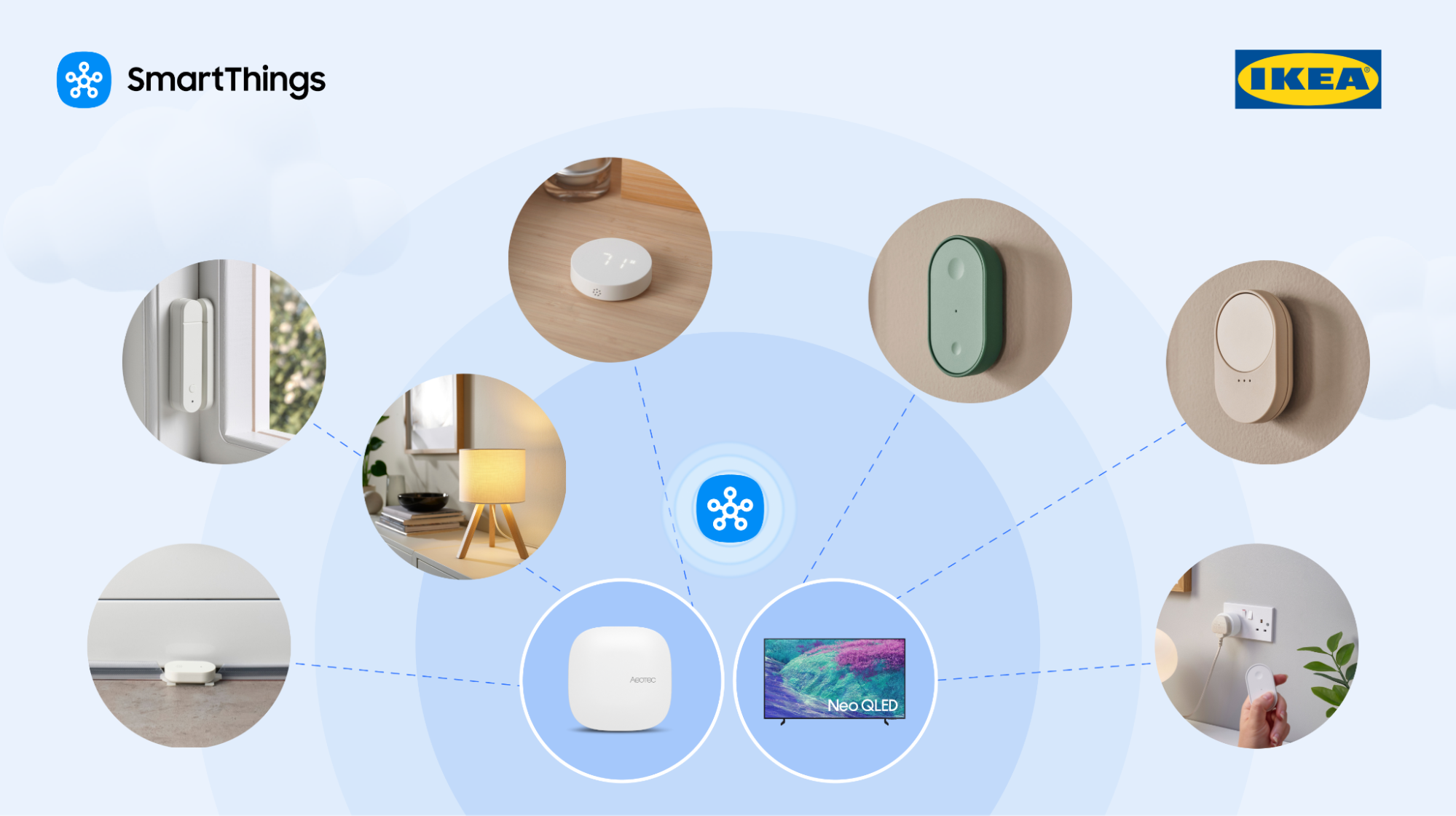
At CES 2026, SmartThings announced that IKEA’s new lineup of Matter-over-Thread smart home products now work out of the box with the platform. SmartThings’ industry-leading Matter support gives both beginner and experienced users confidence that IKEA’s new bulbs, switches, plugs, sensors, and more will deliver a great experience.
A Breakthrough for Beginners and Enthusiasts
With 21 new products, IKEA is delivering one of the most expansive and approachable Matter-over-Thread rollouts yet. Combined with SmartThings’ Matter-over-Thread-ready hubs, it demonstrates how an open smart home can unlock meaningful value for everyone — from first-time users to power pros.
For beginners, IKEA’s approachable design and price points make it easier than ever to start building a smart home. Millions of homes already have everything they need to get started, because SmartThings hubs are directly built into Samsung TV’s, Family Hub fridges, SoundBars, and other Samsung devices. So a single bulb or plug becomes a gateway to routines and automations that are now even easier to create using through SmartThings’ AI Routine Creation Assistant.
A user who loves controlling their first KAJPLATS light with a BILRESA remote control can also set it to dim automatically when they turn on their Samsung TV to watch their favorite show. Or use their TIMMERFLOTTE temperature and humidity sensor, or ALPSTUGA Air Quality sensor, to trigger opening or closing their smart blinds, saving energy without lifting a finger. Galaxy users can use the same sensors to enhance their Sleep Environment Report, with recommendations based on Temperature, Humidity, and CO2 levels in their home and bedroom.
For SmartThings power users who love Matter over Thread devices for their responsiveness, resiliency, and scalability, IKEA’s diverse portfolio of low-cost Matter-over-Thread devices and SmartThings high-performance hubs lets users expand their homes rapidly. And they can do it in a way the whole house will love, with beautifully designed and affordable buttons and sensors that make SmartThings automations responsive, intuitive, and accessible for everyone at home.
And that really means everyone. The new IKEA devices work together with SmartThings Pet Care features to help your home respond to your pets’ routines — from MYGGBETT open/close sensors to let you know when they head outside so you can track their explorations with Galaxy Tags, to MYGGSPRAY motions sensors that can trigger a Samsung Jet Bot to automatically clean up after mealtime. The same devices also support SmartThings Family Care, helping you keep an eye on everyday moments like a door left open, someone starting their day, or a sink that’s been accidentally left running with a KLIPPBOK water leak sensor.
This isn’t just for people starting fresh with the new IKEA devices. Existing IKEA smart home users can now bring their setups into SmartThings by adding their Dirigera hubs to SmartThings through Matter Bridging, allowing users to easily control their existing IKEA smart devices, attached to the IKEA hub, from the SmartThings app, while adding new capabilities to their home by automating them alongside their other smart devices.
Thread fans get even more: for the first time, users can join their IKEA hub to SmartThings’ Thread network (or vice versa) thanks to both platforms pioneering support for Thread Credential Sharing. This creates a stronger, more unified Thread network at home.
The Best Way to Start and Grow IKEA Matter Devices: SmartThings
This is a landmark moment not only for SmartThings and IKEA, but for the broader Matter ecosystem. For the first time, a global retailer is rolling out a wide range of affordable Matter-over-Thread products. With 21 new devices coming at launch and dozens more arriving through early 2026, millions of households can now experience a high-quality, whole-home Matter setup powered by SmartThings and IKEA.
Matter makes it seamless for new and longtime SmartThings users to add IKEA’s devices to their homes. And SmartThings is proud to lead the industry in Matter support, including for physical controls like the new BILRESA button remotes*, that makes it easy for everyone in the home to control their devices.
The experiences SmartThings built for IKEA device users are available on Android and iOS apps; Galaxy phones and watches, and Samsung TVs and appliances. They have met rigorous technical and user experience standards across its full lifecycle, including:
- Effortless onboarding
- Reliable connectivity over Thread
- High-performance automations that work as expected
- Confidence that the product will stay compatible and supported over time
With IKEA and SmartThings’ commitment to Matter and Thread support, users looking to add IKEA devices to SmartThings — or enhance their existing IKEA smart home with SmartThings — can trust that their entire smart home will function seamlessly together.
“At IKEA, our goal is to make smart living more accessible, intuitive, and affordable and we’re strong believers in the power of open standards to make innovation available to the many people.” said David Granath, Range Manager at IKEA. “
“Most people still struggle to know what they need to make things work but they might already have what they need in their Samsung TV, speaker, or appliance. That’s one of the benefits of Matter, making it easier or more affordable for our customers.”
IKEA’s Matter-over-Thread devices begin arriving in early January, marking one of the largest expansions of the Matter device ecosystem to date. As availability begins, we’ll share more details on the new products, setup guidance, and recommended SmartThings Routines to help users make the most of this next generation of IKEA smart home experiences.
*Official BILRESA scroll wheel support will launch early 2026.
Generate single title from this title Latest AI News: Key 8 Takeaways from NeurIPS 2025 in 100 -150 characters. And it must return only title i dont want any extra information or introductory text with title e.g: ” Here is a single title:”
Write an article about
When I was at NeurIPS 2025 this week, it felt like more than just a conference. It felt like watching the whole world of digital intelligence rapidly grow. The energy was incredible. Everyone there knew we were deciding the future of these powerful tools. My main goal, along with the Litslink team, was to find the most important AI news for our clients.
The size of this year’s event was huge. It showed me clearly that AI research is at its highest point ever. We are moving beyond just hype. We are now deeply exploring areas that will shape AI technology news for many years. The things I learned here are not just research papers; I see them as plans for the next wave of business solutions.
1. A New Record for Research
The first thing that really stood out was the massive amount of high-quality work being done. The organizing team shared a number that truly surprised me: over 20,000 research papers were submitted this year. This is a new record by a large margin.
For anyone who follows AI industry news today, this number proves that global efforts in AI are speeding up quickly. I believe this massive amount of research means that new ideas will keep coming fast. For businesses, it tells us that the time between a new idea and a useful product is getting shorter.
2. Thoughts on Large Language Models (LLMs)
Some people suggest LLMs might be slowing down, but the papers at NeurIPS showed me they are still the most important area. About 28% of all research papers were focused on LLMs. I feel like we have just scratched the surface of what these models can do.
However, the focus has changed. It’s not just about making models bigger anymore. The latest AI news from the sessions I attended is about making them safer, easier to control, and work better. I saw lots of research on smaller language models (SLMs). These offer high performance without huge costs, which is important for businesses that want to use AI widely.
3. The Rise of Multimodal Systems
The topic of Multimodality was just as popular as LLMs, also making up about 28% of the research. This is the most exciting development for practical use. The industry is quickly moving from tools that only understand text to models that can handle text, pictures, video, and audio all at once.
This is a big step for AI business news. A truly multimodal system could “see” a problem in a factory, “read” the repair manual, and then “tell” a worker how to fix it. This ability to combine different types of data will open up new possibilities in medicine, robotics, and media.
4. Learning is Back
Another important area at the conference was Reinforcement Learning (RL), which accounted for about 13% of the papers. RL is famous for creating AIs that win games, but now I see it being used for real-world problems.
The latest AI technology news shows RL moving away from games. Researchers are using it to improve supply chains and manage energy systems. This focus on RL suggests a move toward AI systems that can make active decisions to reach long-term goals, not just guess the next step.
5. The Key Topic of AI Reasoning
For AI to become truly mature, it needs better “Reasoning,” which also makes up about 13% of the research. This is how AI learns to “think” logically, instead of just recognizing patterns.
For those following AI business news today, I think this is a vital area for building trust. Businesses in fields like banking or health need AI to explain its decisions. The research I saw aims to combine the cleverness of deep learning with the reliability of logic.
6. Focusing on How to Test AI (Evaluation)
Since AI models are getting so complex, testing how well they work, how safe they are, and whether they are fair has become a big research topic. I was glad to see that about 13% of the papers were focused on “Evaluation Methods.”
This is crucial AI for business news. We can’t put powerful systems into companies without strong ways to test them. I saw the industry focusing on testing how well AI works in real-world situations, if it can be tricked, and if it matches human values. Better testing means safer and more reliable projects for our clients.
7. Honoring Past Achievements: The Sejnowski-Hinton Prize
While we looked at new ideas, NeurIPS also took time to honor the work that made it all possible. The 2025 Sejnowski-Hinton Prize went to Timothy Lillicrap, Daniel Cownden, Douglas Tweed, and Colin Akerman for their 2016 paper.
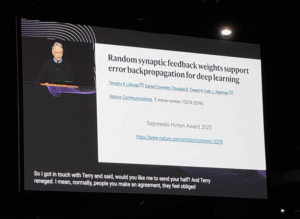
For me, recognizing this work highlights an important part of AI technology news today: today’s big steps rely on years of basic research. This paper helped us understand how deep learning might work in the human brain, which has inspired many of the training methods we use now.
8. Looking Ahead: The Age of Coding Agents
The conference looked at what is happening now, but we also talked about the future. I found Lex Fridman’s prediction about coding agents very interesting. He thinks that by 2026, the focus will be on building AIs that can code by themselves.
His idea makes sense to me: everything today is built with code. If AI can write better and faster code than humans, it will speed up all AI development. This is a huge piece of AI technology news today, which means the speed of change will keep increasing.
Litslink: Turning Ideas into Real Business Solutions
My time at NeurIPS 2025 confirmed one thing: the AI world is changing very quickly. This brings amazing chances but also new challenges. To handle this, you need strong technical experts who can tell the difference between a fad and a lasting tool.
At Litslink, we specialize in taking the latest research I saw here and turning it into real business results. Our engineers and data scientists make sure our clients are always using the most effective tools.
We provide full Artificial Intelligence Services to change how your business works. Whether you need to use the newest multimodal tools to improve customer experience, deploy advanced LLMs for specific tasks, or use reinforcement learning for complex problems, Litslink is here to help. We move your project from a test idea to a finished, working solution that gives you real returns on investment (ROI).
Get a customized AI roadmap for your business!Contact us now!
The post Latest AI News: Key 8 Takeaways from NeurIPS 2025 appeared first on Litslink.
.Organize the content with appropriate headings and subheadings ( h2, h3, h4, h5, h6). Include conclusion section and FAQs section with Proper questions and answers at the end. do not include the title. it must return only article i dont want any extra information or introductory text with article e.g: ” Here is rewritten article:” or “Here is the rewritten content:”
Generate single title from this title Real-Time Decoding, Algorithmic GPU Decoders, and AI Inference Enhancements in NVIDIA CUDA-Q QEC in 100 -150 characters. And it must return only title i dont want any extra information or introductory text with title e.g: ” Here is a single title:”

Write an article about
Real-time decoding is crucial to fault-tolerant quantum computers. By enabling decoders to operate with low latency concurrently with a quantum processing unit (QPU), we can apply corrections to the device within the coherence time. This prevents errors from accumulating, which reduces the value of results received. We can do this online, with a real quantum device, or offline, with a simulated quantum processor.
To help solve these problems and enable research into better solutions, NVIDIA CUDA-Q QEC version 0.5.0 includes a range of improvements. These include support for online real-time decoding, new GPU-accelerated algorithmic decoders, infrastructure for high-performance AI decoder inference, sliding window decoder support, and more Pythonic interfaces.
We’ll cover all of these improvements in this post and dive into how you can use them to accelerate your quantum error correction research, or operationalize real-time decoding with your quantum computer.
Real-time decoding is real with CUDA-Q QEC
Users can perform this in a four-stage workflow. In order, these are: DEM generation, decoder configuration, decoder loading and initialization, and real-time decoding.
First, we characterize how the device errors behave during operation. Using a helper function, we can generate the detector error model (DEM) from a quantum code, noise model, and circuit parameters. The function will generate a complete DEM that maps error mechanisms to syndrome patterns.
# Step 1: Generate detector error model
print(“Step 1: Generating DEM…”)
cudaq.set_target(“stim”)
noise = cudaq.NoiseModel()
noise.add_all_qubit_channel(“x”, cudaq.Depolarization2(0.01), 1)
dem = qec.z_dem_from_memory_circuit(code, qec.operation.prep0, 3, noise)
The next step is to choose a decoder and configure it. We’ll discuss new decoders in greater detail in the following sections.
Using the DEM, the user configures the decoder and then saves this configuration to a YAML file. This file ensures that the decoders can correctly interpret the syndrome measurements.
# Create decoder config
config = qec.decoder_config()
config.id = 0
config.type = “nv-qldpc-decoder”
config.block_size = dem.detector_error_matrix.shape[1]
. . .
# check out nvidia.github.io/cudaqx/examples_rst/qec/realtime_decoding.html
. . .
Before circuit execution, the user loads the YAML file. CUDA-Q QEC interprets the information, sets up the appropriate implementation in the decoder, and registers it with the CUDA-Q runtime.
# Save decoder config
with open(“config.yaml”, ‘w’) as f:
f.write(config.to_yaml_str(200))
Now, users can begin executing quantum circuits. Inside CUDA-Q kernels, the decoding API interacts with the decoders. As the stabilizers of the logical qubits are measured, syndromes are enqueued to the corresponding decoder, which processes them. When corrections are needed, the decoder suggests operations to apply to the logical qubits.
# Load config and run circuit
qec.configure_decoders_from_file(“config.yaml”)
run_result = cudaq.run(qec_circuit, shots_count=10)
GPU-accelerated RelayBP
A recently developed decoder algorithm helps solve the pitfalls of belief propagation decoders, a popular class of quantum low-density parity check algorithmic decoders. BP+OSD (Belief Propagation with Ordered Statistics Decoding) relies on a GPU-accelerated BP decoder and then uses an Ordered Statistics Post-Processing Algorithm on CPU. If BP fails, OSD kicks in. This is fine, but makes it hard to optimize and parallelize for the low latency needed to enable real-time error decoding.
RelayBP modifies BP methods with the concept of memory strengths, at each node of a graph, and controls how much each node remembers or forgets past messages. This dampens or breaks the harmful symmetries that usually trap BP, preventing it from converging.
Users can instantiate a RelayBP decoder easily with a few lines of code, outlined below.
import numpy as np
import cudaq_qec as qec
# Simple 3×7 parity check matrix for demonstration
H_list = [[1, 0, 0, 1, 0, 1, 1], [0, 1, 0, 1, 1, 0, 1],
[0, 0, 1, 0, 1, 1, 1]]
H = np.array(H_list, dtype=np.uint8)
# Configure relay parameters
srelay_config = {
‘pre_iter’: 5, # Run 5 iterations with gamma0 before relay legs
‘num_sets’: 3, # Use 3 relay legs
‘stopping_criterion’: ‘FirstConv’ # Stop after first convergence
}
# Create a decoder with Relay-BP
decoder_relay = qec.get_decoder(“nv-qldpc-decoder”,
H,
use_sparsity=True,
bp_method=3,
composition=1,
max_iterations=50,
gamma0=0.3,
gamma_dist=[0.1, 0.5],
srelay_config=srelay_config,
bp_seed=42)
print(” Created decoder with Relay-BP (gamma_dist, FirstConv stopping)”)
# Decode a syndrome
syndrome = np.array([1, 0, 1], dtype=np.uint8)
decoded_result = decoder_relay.decode(syndrome)
AI decoder inference
AI decoders are becoming increasingly popular for handling specific error models, offering better accuracy or latency than algorithmic decoders.
Users can develop AI decoders by generating training data, training a model, and exporting the model to ONNX. Once this is complete, use the CUDA-Q QEC NVIDIA TensorRT-based AI decoder inference engine to operate low-latency AI decoders.
CUDA-Q QEC recently introduced infrastructure for integrated AI decoder inference with offline decoding. This means that it’s now easy to run any AI decoder saved to an ONNX file with CUDA-Q QEC and an emulated quantum computer.
import cudaq_qec as qec
import numpy as np
# Note: The AI decoder doesn’t use the parity check matrix.
# A placeholder matrix is provided here to satisfy the API.
H = np.array([[1, 0, 0, 1, 0, 1, 1],
[0, 1, 0, 1, 1, 0, 1],
[0, 0, 1, 0, 1, 1, 1]], dtype=np.uint8)
# Create TensorRT decoder from ONNX model
decoder = qec.get_decoder(“trt_decoder”, H,
onnx_load_path=”ai_decoder.onnx”)
# Decode a syndrome
syndrome = np.array([1.0, 0.0, 1.0], dtype=np.float32)
result = decoder.decode(syndrome)
print(f”Predicted error: {result}”)
We also offer a range of recommendations to reduce the initialization time by creating pre-built TensorRT engines. With ONNX files supporting a range of precisions (int8, fp8, fp16, bf16, and tf32) you can explore a range of model and hardware combinations to optimize AI decoder operationalization.
Sliding window decoding
Sliding window decoders enable a decoder to handle circuit-level noise across multiple syndrome extraction rounds. These decoders process the syndrome before the complete measurement sequence is received, which can help reduce the overall latency. The tradeoff is that this can increase logical error rates.
Exploring how and when to use this tool relies on the noise model, error correcting code parameters, and the latency budget of a given quantum processor. With the introduction of the sliding window decoder in 0.5.0, users can now perform experiments using any other CUDA-Q decoder as the “inner” decoder. Additionally, users can vary the window size with simple parameter changes.
import cudaq
import cudaq_qec as qec
import numpy as np
cudaq.set_target(‘stim’)
num_rounds = 5
code = qec.get_code(‘surface_code’, distance=num_rounds)
noise = cudaq.NoiseModel()
noise.add_all_qubit_channel(“x”, cudaq.Depolarization2(0.001), 1)
statePrep = qec.operation.prep0
dem = qec.z_dem_from_memory_circuit(code, statePrep, num_rounds, noise)
inner_decoder_params = {‘use_osd’: True, ‘max_iterations’: 50, ‘use_sparsity’: True}
opts = {
‘error_rate_vec’: np.array(dem.error_rates),
‘window_size’: 1,
‘num_syndromes_per_round’: dem.detector_error_matrix.shape[0] // num_rounds,
‘inner_decoder_name’: ‘nv-qldpc-decoder’,
‘inner_decoder_params’: inner_decoder_params,
}
swdec = qec.get_decoder(‘sliding_window’, dem.detector_error_matrix, **opts)
Each syndrome extraction round must produce a constant number of measurements. The decoder will make no assumptions about the temporal correlations or periodicity in the underlying noise, so users have maximal flexibility in investigating noise variations per round.
Getting started with CUDA-Q QEC
CUDA-Q QEC 0.5.0 brings a wide range of tools to quantum error correction researchers and QPU operators, to accelerate research into operationalizing fault-tolerant quantum computers.
To get started using the CUDA-Q QEC, you can pip install cudaq-qec and see the CUDA-Q QEC documentation.
.Organize the content with appropriate headings and subheadings ( h2, h3, h4, h5, h6). Include conclusion section and FAQs section with Proper questions and answers at the end. do not include the title. it must return only article i dont want any extra information or introductory text with article e.g: ” Here is rewritten article:” or “Here is the rewritten content:”
Generate single title from this title AI use is on the rise, but is guidance keeping pace? in 100 -150 characters. And it must return only title i dont want any extra information or introductory text with title e.g: ” Here is a single title:”

Write an article about
Key points:
The rapid rise of generative AI has turned classrooms into a real-time experiment in technology use. Students are using AI to complete assignments, while teachers are leveraging it to design lessons, streamline grading, and manage administrative tasks.
According to new national survey data from RAND, AI use among both students and educators has grown sharply–by more than 15 percentage points in just the past one to two years. Yet, training and policy have not kept pace. Schools and districts are still developing professional development, student guidance, and clear usage policies to manage this shift.
As a result, educators, students, and parents are navigating both opportunities and concerns. Students worry about being falsely accused of cheating, and many families fear that increased reliance on AI could undermine students’ critical thinking skills.
Key findings:
During the 2024-2025 school year, AI saw rapid growth.
AI use in schools surged during the 2024-2025 academic year. By 2025, more than half of students (54 percent) and core subject teachers (53 percent) were using AI for schoolwork or instruction–up more than 15 points from just a year or two earlier. High school students were the most frequent users, and AI adoption among teachers climbed steadily from elementary to high school.
While students and parents express significant concern about the potential downsides of AI, school district leaders are far less worried.
Sixty-one percent of parents, 48 percent of middle school students, and 55 percent of high school students believe that increased use of AI could harm students’ critical-thinking skills, compared with just 22 percent of district leaders. Additionally, half of students said they worry about being falsely accused of using AI to cheat.
Training and policy development have not kept pace with AI use in schools.
By spring 2025, only 35 percent of district leaders said their schools provide students with training on how to use AI. Meanwhile, more than 80 percent of students reported that their teachers had not explicitly taught them how to use AI for schoolwork. Policy guidance also remains limited–just 45 percent of principals said their schools or districts have policies on AI use, and only 34 percent of teachers reported policies specifically addressing academic integrity and AI.
The report offers recommendations around AI use and guidance:
As AI technology continues to evolve, trusted sources–particularly state education agencies–should provide consistent, regularly updated guidance on effective AI policies and training. This guidance should help educators and students understand how to use AI as a complement to learning, not a replacement for it.
District and school leaders should clearly define what constitutes responsible AI use versus academic dishonesty and communicate these expectations to both teachers and students. In the near term, educators and students urgently need clarity on what qualifies as cheating with AI.
Elementary schools should also be included in this effort. Nearly half of elementary teachers are already experimenting with AI, and these early years are when students build foundational skills and habits. Providing age-appropriate, coherent instruction about AI at this stage can reduce misuse and confusion as students progress through school and as AI capabilities expand.
Ultimately, district leaders should develop comprehensive AI policies and training programs that equip teachers and students to use AI productively and ethically across grade levels.
Laura Ascione is the Editorial Director at eSchool Media. She is a graduate of the University of Maryland’s prestigious Philip Merrill College of Journalism.
 Latest posts by Laura Ascione (see all)
.Organize the content with appropriate headings and subheadings ( h2, h3, h4, h5, h6). Include conclusion section and FAQs section with Proper questions and answers at the end. do not include the title. it must return only article i dont want any extra information or introductory text with article e.g: ” Here is rewritten article:” or “Here is the rewritten content:”
Generate single title from this title 25 predictions about AI and edtech in 100 -150 characters. And it must return only title i dont want any extra information or introductory text with title e.g: ” Here is a single title:”

Write an article about
eSchool News is counting down the 10 most-read stories of 2025. Story #2 focuses on predictions educators made for AI in 2025.
When it comes to education trends, AI certainly has staying power. As generative AI technologies evolve, educators are moving away from fears about AI-enabled cheating and are embracing the idea that AI can open new doors for teaching and learning.
AI tools can reduce the administrative burden so many educators carry, can personalize learning for students, and can help students become more engaged in their learning when they use the tools to brainstorm and expand on ideas for assignments and projects. Having AI skills is also essential for today’s students, who will enter a workforce where AI know-how is becoming more necessary for success.
So: What’s next for AI in education? We asked educators, edtech industry leaders, stakeholders, and experts to share some predictions about where they think AI is headed in 2025. (Here’s our list of 50 predictions for edtech in 2025.)
Here’s what they had to say:
In 2025, online program leaders will begin to unlock the vast potential of generative AI, integrating it more deeply into the instructional design process in ways that can amplify and expedite the work of faculty and instructional designers. This technology, already making waves in instruction and assessment, stands poised to transform the creation of online courses. By streamlining time-intensive tasks, generative AI offers the promise of automation, replication, and scalability, enabling institutions to expand their online offerings at an unprecedented pace. The key is that we maintain rigorous standards of quality–and create clear guardrails around the ethical use of AI at a time when increasingly sophisticated models are blurring the lines between human design–and artificial intelligence. Generative AI holds extraordinary promise, but its adoption must be grounded in practices that prioritize equitable and inclusive access, transparency, and educational excellence.
–Deb Adair, CEO, Quality Matters
In 2025, education in the United States will reflect both the challenges and opportunities of a system in transition. Uncertainty and change at the federal level will continue to shift decision-making power to states, leaving them with greater autonomy but also greater responsibility. While this decentralization may spark localized innovation, it is just as likely to create uneven standards. In some states, we’ve already seen benchmarks lowered to normalize declines, a trend that could spread as states grapple with resource and performance issues. This dynamic will place an even greater burden on schools, teachers, and academic leaders. As those closest to learners, they will bear the responsibility of bridging the gap between systemic challenges and individual student success. To do so effectively, schools will require tools that reduce administrative complexity, enabling educators to focus on fostering personal connections with students–the foundation of meaningful academic growth. AI will play a transformative role in this landscape, offering solutions to these pressures. However, fragmented adoption driven by decentralized decision-making will lead to inequities, with some districts leveraging AI effectively and others struggling to integrate it. In this complex environment, enterprise platforms that offer flexibility, integration, and choice will become essential. 2025 will demand resilience and creativity, but it also offers all of us an opportunity to refocus on what truly matters: supporting educators and the students they inspire.
—Scott Anderberg, CEO, Moodle
As chatbots become more sophisticated, they’re rapidly becoming a favorite among students for their interactive and personalized support, and we can expect to see them increasingly integrated into classrooms, tutoring platforms, and educational apps as educators embrace this engaging tool for learning. Additionally, AI is poised to play an even larger role in education, particularly in test preparation and course planning. By leveraging data and predictive analytics, AI-driven tools will help students and educators create more tailored and effective learning pathways, enhancing the overall educational experience.
—Brad Barton, CTO, YouScience
As we move into 2025, we’ll move past the AI hype cycle and pivot toward solving tangible classroom challenges. Effective AI solutions will integrate seamlessly into the learning environment, enhancing rather than disrupting the teaching experience. The focus will shift to practical tools that help teachers sustain student attention and engagement–the foundation of effective learning. These innovations will prioritize giving educators greater flexibility and control, allowing them to move freely around the classroom while effortlessly managing and switching between digital resources. An approach that ensures technology supports and amplifies the irreplaceable human connections at the heart of learning, rather than replacing them.
–Levi Belnap, CEO, Merlyn Mind
The year 2025 is set to transform science education by implementing AI-driven learning platforms. These platforms will dynamically adjust to the student’s interests and learning paces, enhancing accessibility and inclusivity in education. Additionally, virtual labs and simulations will rise, enabling students to experiment with concepts without geographical constraints. This evolution will make high-quality STEM education more universally accessible.
–Tiago Costa, Cloud & AI Architect, Microsoft; Pearson Video Lesson Instructor
In the two years since GenAI was unleashed, K-12 leaders have ridden the wave of experimentation and uncertainty about the role this transformative technology should have in classrooms and districts. 2025 will see a shift toward GenAI strategy development, clear policy and governance creation, instructional integration, and guardrail setting for educators and students. K-12 districts recognize the need to upskill their teachers, not only to take advantage of GenAI to personalize learning, but also so they can teach students how to use this tech responsibly. On the back end, IT leaders will grapple with increased infrastructure demands and ever-increasing cybersecurity threats.
—Delia DeCourcy, Senior Strategist, Lenovo Worldwide Education Team
AI-driven tools will transform the role of teachers and support staff in 2025: The advent of AI will allow teachers to offload mundane administrative tasks to students and provide them more energy to be at the “heart and soul” of the classroom. Moreover, more than two-thirds (64 percent) of parents agreed or strongly agreed that AI should help free teachers from administrative tasks and help them build connections with the classroom. Impact of technological advancements on hybrid and remote learning models in 2025: AI is revolutionizing the online learning experience with personalized pathways, tailored skills development and support, and enhanced content creation. For example, some HBS Online courses, like Launching Tech Ventures, feature an AI course assistant bot to help address learners’ questions and facilitate successful course completion. While the long-term impact remains uncertain, AI is narrowing the gap between online and in-person education. By analyzing user behavior and learning preferences, AI can create adaptive learning environments that dynamically adjust to individual needs, making education more engaging and effective.
–David Everson, Senior Director of Marketing Solutions, Laserfiche
In education and digital publishing, artificial intelligence (AI) will continue transitioning from novelty applications to solutions that address real-world challenges facing educators and students. Successful companies will focus on data security and user trust, and will create learner-centered AI tools to deliver personalized experiences that adapt to individual needs and enhance efficiency for educators, enabling them to dedicate more time to fostering meaningful connections with students. The ethical integration of AI technologies such as retrieval-augmented generation (RAG) is key to this evolution. Unlike traditional large language models that ingest information from the Internet at large, RAG delivers AI outputs that are grounded in authoritative, peer-reviewed content, reducing the risk of misinformation while safeguarding the integrity of intellectual property. Thoughtfully developed AI tools such as this will become partners in the learning journey, encouraging analysis, problem-solving, and creativity rather than fostering dependence on automated responses. By taking a deliberate approach that focuses on ethical practices, user-centered design, and supporting the cultivation of essential skills, successful education companies will use AI less as innovation for its own sake and more as a means to provide rich and memorable teaching and learning experiences.
—Paul Gazzolo, Senior Vice President & Global General Manager, Gale, a Part of Cengage Group
Adaptive learning technologies will continue to personalize curriculum and assessment, creating a more responsive and engaging educational journey that reflects each student’s strengths and growth areas. Generative AI and other cutting-edge advancements will be instrumental in building solutions that optimize classroom support, particularly in integrating assessment and instruction. We will see more technology that can help educators understand the past to edit materials in the present, to accelerate teachers planning for the future.
—Andrew Goldman, EVP, HMH Labs
We’ll witness a fundamental shift in how we approach student assessment, moving away from conventional testing models toward more authentic experiences that are seamless with instruction. The thoughtful integration of AI, particularly voice AI technology, will transform assessment from an intermittent event into a natural part of the learning process. The most promising applications will be those that combine advanced technology with research-validated methodologies. Voice-enabled assessments will open new possibilities for measuring student knowledge in ways that are more natural and accessible, especially for our youngest learners, leveraging AI’s capabilities to streamline assessment while ensuring that technology serves as a tool to augment, rather than replace, the critical role of teachers.
–Kristen Huff, Head of Measurement, Curriculum Associates
AI is already being used by many educators, not just to gain efficiencies, but to make a real difference in how their students are learning. I suspect in 2025 we’ll see even more educators experimenting and leveraging AI tools as they evolve–especially as more of the Gen Z population enters the teaching workforce. In 2024, surveyed K-12 educators reported already using AI to create personalized learning experiences, provide real-time performance feedback, and foster critical thinking skills. Not only will AI usage continue to trend up throughout 2025, I do believe it will reach new heights as more teachers begin to explore GenAI as a hyper-personalized asset to support their work in the classroom. This includes the use of AI as an official teacher’s assistant (TA), helping to score free response homework and tests and providing real-time, individualized feedback to students on their education journey.
–John Jorgenson, CMO, Cambium Learning Group
The new year will continue to see the topic of AI dominate the conversation as institutions emphasize the need for students to understand AI fundamentals, ethical considerations, and real-world applications outside of the classroom. However, a widening skills gap between students and educators in AI and digital literacy presents a challenge. Many educators have not prioritized keeping up with rapid technological advancements, while students–often exposed to digital tools early on–adapt quickly. This gap can lead to uneven integration of AI in classrooms, where students sometimes outpace their instructors in understanding. To bridge this divide, comprehensive professional development for teachers is essential, focusing on both technical skills and effective teaching strategies for AI-related topics. Underscoring the evolving tech in classrooms will be the need for evidence of outcomes, not just with AI but all tools. In the post-ESSER era, evidence-based decision-making is crucial for K-12 schools striving to sustain effective programs without federal emergency funds. With the need to further justify expenditures, schools must rely on data to evaluate the impact of educational initiatives on student outcomes, from academic achievement to mental health support. Evidence helps educators and administrators identify which programs truly benefit students, enabling them to allocate resources wisely and prioritize what works. By focusing on measurable results, schools can enhance accountability, build stakeholder trust, and ensure that investments directly contribute to meaningful, lasting improvements in learning and well-being.
—Melissa Loble, Chief Academic Officer, Instructure
With AI literacy in the spotlight, lifelong learning will become the new normal. Immediate skills need: The role of “individual contributors” will evolve, and we will all be managers of AI agents, making AI skills a must-have. Skills of the future: Quantum skills will start to be in demand in the job market as quantum development continues to push forward over the next year. Always in-demand skills: The overall increase in cyberattacks and emerging risks, such as harvest now and decrypt later (HNDL) attacks, will further underscore the continued importance of cybersecurity skills. Upskilling won’t end with AI. Each new wave of technology will demand new skills, so lifelong learners will thrive. AI will not be siloed to use among technology professionals. The democratization of AI technology and the proliferation of AI agents have already made AI skills today’s priority. Looking ahead, quantum skills will begin to grow in demand with the steady advance of the technology. Meanwhile cybersecurity skills are an evergreen need.
—Lydia Logan, VP of Global Education & Workforce Development, IBM
This coming year, we’ll see real progress in using technology, particularly GenAI, to free up teachers’ time. This will enable them to focus on what they do best: working directly with students and fostering the deep connections crucial for student growth and achievement. GenAI-powered assistants will streamline lesson planning after digesting information from a sea of assessments to provide personalized recommendations for instruction to an entire class, small groups, and individual students. The bottom line is technology that never aims to replace a teacher’s expertise–nothing ever should–but gives them back time to deepen relationships with students.
—Jack Lynch, CEO, HMH
Looking to 2025, I anticipate several key trends that will further enhance the fusion of educators, AI and multimodal learning. AI-powered personalization enhanced by multimedia: AI will deliver personalized learning paths enriched with various content formats. By adapting to individual learning styles–whether visual, auditory, or kinesthetic–we can make education more engaging and effective. Expansion of multimodal learning experiences: Students will increasingly expect learning materials that engage multiple senses. Integrating short-form videos created and vetted by actual educators, interactive simulations, and audio content will cater to different learning preferences, making education more inclusive and effective. Deepening collaboration with educators: Teachers will play an even more critical role in developing and curating multimodal content. Their expertise ensures that the integration of technology enhances rather than detracts from the learning experience.
–Nhon Ma, CEO & Co-founder, Numerade
AI and automation become a competitive advantage for education platforms and systems. 2025 will be the year for AI to be more infused in education initiatives and platforms. AI-powered solutions have reached a tipping point from being a nice-to-have to a must-have in order to deliver compelling and competitive education experiences. When we look at the education sector, the use cases are clear. From creating content like quizzes, to matching students with education courses that meet their needs, to grading huge volumes of work, enhancing coaching and guidance for students, and even collecting, analyzing and acting on feedback from learners, there is so much value to reap from AI. Looking ahead, there could be additional applications in education for multimodal AI models, which are capable of processing and analyzing complex documents including images, tables, charts, and audio.
—Rachael Mohammed, Corporate Social Responsibility Digital Offerings Leader, IBM
Agentic and Shadow AI are here. Now, building guardrails for safe and powerful use will be key for education providers and will require new skillsets. In education, we expect the start of a shift from traditional AI tools to agents. In addition, the mainstream use of AI technology with ChatGPT and OpenAI has increased the potential risk of Shadow AI (the use of non-approved public AI applications, potentially causing concerns about compromising sensitive information). These two phenomena highlight the importance of accountability, data and IT policies, as well as control of autonomous systems. This is key mostly for education providers, where we think there will be greater attention paid to the AI guardrails and process. To be prepared, educators, students, and decision makers at all levels need to be upskilled in AI, with a focus on AI ethics and data management. If we invest in training the workforce now, they will be ready to responsibly develop and use AI and AI agents in a way that is trustworthy.
—Justina Nixon-Saintil, Vice President & Chief Impact Officer, IBM
Rather than replacing human expertise, AI can be used as a resource to allow someone to focus more of their time on what’s truly important and impactful. As an educator, AI has become an indispensable tool for creating lesson plans. It helps generate examples, activity ideas, and anticipate future students’ questions, freeing me to focus on the broader framework and the deeper meaning of what I’m teaching.
–Sinan Ozdemir, Founder & Chief Technology Officer, Shiba Technologies; Author, Quick Start Guide to Large Language Models
Data analytics and AI will be essential towards tackling the chronic absenteeism crisis. In 2025, the conversation around belonging will shift from abstract concepts to concrete actions in schools. Teachers who build strong relationships with both students and families will see better attendance and engagement, leading more schools to prioritize meaningful connection-building over quick-fix solutions. We’ll see more districts move toward personalized, two-way school communications that create trust with parents and the larger school community. In order to keep up with the growing need for this type of individualized outreach, schools will use data analytics and AI to identify attendance and academic patterns that indicate students are at risk of becoming chronically absent. It won’t be dramatic, but we’ll see steady progress throughout the year as schools recognize that student success depends on creating environments where both students and families feel valued and heard.
—Dr. Kara Stern, Director of Education and Engagement, SchoolStatus
As access to AI resources gains ground in classrooms, educators will face a dire responsibility to not only master these tools but to establish guidelines and provide best practices to ensure effective and responsible use. The increasing demand for AI requires educators to stay informed about emerging applications and prioritize ethical practices, ensuring AI enhances rather than impedes educational outcomes.. This is particularly critical in STEM fields, where AI has already transformed industries and is shaping career paths, providing new learning opportunities for students. To prevent the exacerbation of the existing STEM gap, educators must prioritize equitable access to AI resources and tools, ensuring that all students, regardless of background, have the opportunity to engage with and fully understand these technologies. This focus on equity is essential in leveling the playing field, helping bridge disparities that could otherwise limit students’ future success. Achieving these goals will require educators to engage in professional development programs designed to equip them with necessary skills and content knowledge to implement new technology in their classrooms. Learning how to foster inclusive environments is vital to cultivating a positive school climate where students feel motivated to succeed. Meanwhile, professionally-trained educators can support the integration of new technologies to ensure that every student has the opportunity to thrive in this new educational landscape.
—Michelle Stie, Vice President, Program Design & Innovation, NMSI
Artificial intelligence (AI) is poised to increase in use in K-12 classrooms, with literacy instruction emerging as a key area for transformative impact. While educators may associate AI with concerns like cheating, its potential to enhance human-centered teaching is gaining recognition. By streamlining administrative tasks, AI empowers teachers to focus on connecting with students and delivering personalized instruction. One trend to watch is AI’s role in automating reading assessments. These tools reduce the time educators spend administering and analyzing tests, offering real-time insights that guide individualized instruction. AI is also excelling at pinpointing skill gaps, allowing teachers to intervene early, particularly in foundational reading areas. Another emerging trend is AI-driven reading practice. Tools can adapt to each student’s needs, delivering engaging, personalized reading tutoring with immediate corrective feedback. This ensures consistent, intentional practice–a critical factor in literacy growth. Rather than replacing teachers, AI frees up educator time for what matters most: fostering relationships with students and delivering high-quality instruction. As schools look to optimize resources in the coming year, AI’s ability to augment literacy instruction can be an important tool that maximizes students’ growth, while minimizing teachers’ work.
—Janine Walker-Caffrey, Ed.D., Chief Academic Officer, EPS Learning
We expect a renewed focus on human writing with a broader purpose–clear communication that demonstrates knowledge and understanding, enhanced, not replaced by available technology. With AI making basic elements of writing more accessible to all, this renaissance of writing will emphasize the ability to combine topical knowledge, critical thinking, mastery of language and AI applications to develop written work. Instead of being warned against using generative AI, students will be asked to move from demand–asking AI writing tools to produce work on their behalf, to command–owning the content creation process from start to finish and leveraging technology where it can be used to edit, enhance or expand original thinking. This shift will resurface the idea of co-authorship, including transparency around how written work comes together and disclosure of when and how AI tools were used to support the process.
—Eric Wang, VP of AI, Turnitin
GenAI and AI writing detection tools will evolve, adding advanced capabilities to match each other’s detectability flex. End users are reaching higher levels of familiarity and maturity with AI functionality, resulting in a shift in how they are leveraged. Savvy users will take a bookend approach, focusing on early stage ideation, organization and expansion of original ideas as well as late stage refinement of ideas and writing. Coupling the use of GenAI with agentic AI applications will help to overcome current limitations, introducing multi-source analysis and adaptation capabilities to the writing process. Use of detection tools will improve as well, with a focus on preserving the teaching and learning process. In early stages, detection tools and indicator reports will create opportunities to focus teaching on addressing knowledge gaps and areas lacking original thought or foundation. Later stage detection will offer opportunities to strengthen the dialogue between educators and students, providing transparency that will reduce student risk and increase engagement.
—Eric Wang, VP of AI, Turnitin
Advanced AI tools will provide more equitable access for all students, inclusive of reaching students in their home language, deaf and hard of hearing support through AI-enabled ASL videos, blind and visually impaired with real time audio descriptions, tactiles, and assistive technology.
–Trent Workman, SVP for U.S. School Assessments, Pearson
Generative AI everywhere: Generative AI, like ChatGPT, is getting smarter and more influential every day, with the market expected to grow a whopping 46 percent every year from now until 2030. By 2025, we’ll likely see AI churning out even more impressive text, images, and videos–completely transforming industries like marketing, design, and content creation. Under a Trump administration that might take a more “hands-off” approach, we could see faster growth with fewer restrictions holding things back. That could mean more innovative tools hitting the market sooner, but it will also require companies to be careful about privacy and job impacts on their own. The threat of AI-powered cyberattacks: Experts think 2025 might be the year cybercriminals go full throttle with AI. Think about it: with the advancement of the technology, cyberattacks powered by AI models could start using deepfakes, enhanced social engineering, and ultra-sophisticated malware. If the Trump administration focuses on cybersecurity mainly for critical infrastructure, private companies could face gaps in support, leaving sectors like healthcare and finance on their own to keep up with new threats. Without stronger regulations, businesses will have to get creative–and fast–when it comes to fighting off these attacks.
–Alon Yamin, Co-Founder & CEO, Copyleaks
Laura Ascione is the Editorial Director at eSchool Media. She is a graduate of the University of Maryland’s prestigious Philip Merrill College of Journalism.
Latest posts by Laura Ascione (see all)
.Organize the content with appropriate headings and subheadings ( h2, h3, h4, h5, h6). Include conclusion section and FAQs section with Proper questions and answers at the end. do not include the title. it must return only article i dont want any extra information or introductory text with article e.g: ” Here is rewritten article:” or “Here is the rewritten content:”
Generate single title from this title The future of rail: Watching, predicting, and learning in 100 -150 characters. And it must return only title i dont want any extra information or introductory text with title e.g: ” Here is a single title:”

Write an article about
A recent industry report [PDF] argues that Britain’s railway network could carry an extra billion journeys by the mid-2030s, building on the 1.6 billion passenger rail journeys recorded to year-end March 2024. The next decade will involve a combination of complexity and control, as more digital systems, data, and interconnected suppliers create the potential for more points of failure.
The report’s central theme is that AI will become the operating system for modern rail, not as a single, centralised collection of models and algorithms, but as layers of prediction, optimisation, and automated monitoring found in infrastructure, rolling stock, maintenance yards, and stations (pp.18-23). This technology will guide human focus within daily work schedules rather than replace human activity entirely.
Maintenance to become predictive and data-driven
Traditional rail maintenance relies on fixed schedules and manual inspections, a reactive and labour-intensive practice. The whitepaper cites Network Rail’s reliance on engineers walking the track to spot defects (p.18). AI will shift the industry to predictive maintenance, analysing data from sensors to forecast failures before they cause significant disruption.
This involves a combination of sensors and imaging, including high-definition cameras, LiDAR scanners, and vibration monitors. These provide machine-learning systems with data that can flag degradation in track, signalling, and electrical assets ahead of failure (pp.18-19).
These monitoring programs can generate alerts months in advance, reducing emergency call-outs. The timeframe for predicting asset failure varies by asset type. Network Rail’s intelligent infrastructure efforts should transition from “find and fix” to “predict and prevent.”
Network Rail emphasises data-led maintenance and tools designed to consolidate asset information, while European R&D programs (like Europe’s Rail and its predecessor, Shift2Rail) fund projects like DAYDREAMS, similarly aimed at prescriptive asset management. Prediction at scale requires a common approach to achieve transformation.
Traffic control and energy efficiency
Operational optimisation, beyond predictive maintenance, offers significant returns. AI systems use live and historical operating data—train positions, speeds, weather forecasts—to anticipate disruption and adjust traffic flow. Digital twin and AI-based traffic management trials in Europe, alongside research and testing of AI-assisted driving and positioning, could increase overall network capacity without laying more track (p.20).
Algorithms also advise drivers on optimal acceleration and braking, potentially saving 10-15% in energy. Considering route variations, traction, and timetable constraints, energy savings compound quickly across a large network.
Safety monitoring and CCTV
Visible AI applications focus on safety and security. Obstacle detection uses thermal cameras and machine learning to identify hazards beyond human visibility. AI also monitors level crossings and analyses CCTV footage to spot unattended items and suspicious activity (pp.20-21). For example, AI and LiDAR are used for crowd monitoring at London Waterloo as part of a suite of safety tools.
Passenger flows and journey optimisation
AI can forecast demand using ticket sales, events, and mobile signals, allowing operators to adjust the number of carriages and reduce overcrowding, the report states. Passenger counting is a high-impact, low-drama application: better data supports better timetables and clearer customer information.
Cybersecurity issues
As operational technology converges with IT, cybersecurity becomes a critical operational issue. Legacy systems, lacking replacement plans, pose a risk, as does integrating modern analytics with older infrastructure. This creates conditions attractive to attackers.
The future of AI in rail involves sensors performing in extreme environments, models trusted and tested by operators, and governance that treats cyber resilience as inseparable from physical safety. The report’s message is that AI will arrive regardless. The question is whether railways proactively adopt and control it or inherit it as un-managed complexity.
(Image source: “Train Junction” by jcgoble3 is licensed under CC BY-SA 2.0.)
Want to learn more about AI and big data from industry leaders? Check out AI & Big Data Expo taking place in Amsterdam, California, and London. The comprehensive event is part of TechEx and co-located with other leading technology events. Click here for more information.
AI News is powered by TechForge Media. Explore other upcoming enterprise technology events and webinars here.
.Organize the content with appropriate headings and subheadings ( h2, h3, h4, h5, h6). Include conclusion section and FAQs section with Proper questions and answers at the end. do not include the title. it must return only article i dont want any extra information or introductory text with article e.g: ” Here is rewritten article:” or “Here is the rewritten content:”
