Home Blog Page 31

Generate single title from this title The future of rail: Watching, predicting, and learning in 100 -150 characters. And it must return only title i dont want any extra information or introductory text with title e.g: ” Here is a single title:”

Write an article about

A recent industry report [PDF] argues that Britain’s railway network could carry an extra billion journeys by the mid-2030s, building on the 1.6 billion passenger rail journeys recorded to year-end March 2024. The next decade will involve a combination of complexity and control, as more digital systems, data, and interconnected suppliers create the potential for more points of failure.

The report’s central theme is that AI will become the operating system for modern rail, not as a single, centralised collection of models and algorithms, but as layers of prediction, optimisation, and automated monitoring found in infrastructure, rolling stock, maintenance yards, and stations (pp.18-23). This technology will guide human focus within daily work schedules rather than replace human activity entirely.

Maintenance to become predictive and data-driven

Traditional rail maintenance relies on fixed schedules and manual inspections, a reactive and labour-intensive practice. The whitepaper cites Network Rail’s reliance on engineers walking the track to spot defects (p.18). AI will shift the industry to predictive maintenance, analysing data from sensors to forecast failures before they cause significant disruption.

This involves a combination of sensors and imaging, including high-definition cameras, LiDAR scanners, and vibration monitors. These provide machine-learning systems with data that can flag degradation in track, signalling, and electrical assets ahead of failure (pp.18-19).

These monitoring programs can generate alerts months in advance, reducing emergency call-outs. The timeframe for predicting asset failure varies by asset type. Network Rail’s intelligent infrastructure efforts should transition from “find and fix” to “predict and prevent.”

Network Rail emphasises data-led maintenance and tools designed to consolidate asset information, while European R&D programs (like Europe’s Rail and its predecessor, Shift2Rail) fund projects like DAYDREAMS, similarly aimed at prescriptive asset management. Prediction at scale requires a common approach to achieve transformation.

Traffic control and energy efficiency

Operational optimisation, beyond predictive maintenance, offers significant returns. AI systems use live and historical operating data—train positions, speeds, weather forecasts—to anticipate disruption and adjust traffic flow. Digital twin and AI-based traffic management trials in Europe, alongside research and testing of AI-assisted driving and positioning, could increase overall network capacity without laying more track (p.20).

Algorithms also advise drivers on optimal acceleration and braking, potentially saving 10-15% in energy. Considering route variations, traction, and timetable constraints, energy savings compound quickly across a large network.

Safety monitoring and CCTV

Visible AI applications focus on safety and security. Obstacle detection uses thermal cameras and machine learning to identify hazards beyond human visibility. AI also monitors level crossings and analyses CCTV footage to spot unattended items and suspicious activity (pp.20-21). For example, AI and LiDAR are used for crowd monitoring at London Waterloo as part of a suite of safety tools.

Passenger flows and journey optimisation

AI can forecast demand using ticket sales, events, and mobile signals, allowing operators to adjust the number of carriages and reduce overcrowding, the report states. Passenger counting is a high-impact, low-drama application: better data supports better timetables and clearer customer information.

Cybersecurity issues

As operational technology converges with IT, cybersecurity becomes a critical operational issue. Legacy systems, lacking replacement plans, pose a risk, as does integrating modern analytics with older infrastructure. This creates conditions attractive to attackers.

The future of AI in rail involves sensors performing in extreme environments, models trusted and tested by operators, and governance that treats cyber resilience as inseparable from physical safety. The report’s message is that AI will arrive regardless. The question is whether railways proactively adopt and control it or inherit it as un-managed complexity.

(Image source: “Train Junction” by jcgoble3 is licensed under CC BY-SA 2.0.)


Want to learn more about AI and big data from industry leaders? Check out AI & Big Data Expo taking place in Amsterdam, California, and London. The comprehensive event is part of TechEx and co-located with other leading technology events. Click here for more information.

AI News is powered by TechForge Media. Explore other upcoming enterprise technology events and webinars here.

.Organize the content with appropriate headings and subheadings ( h2, h3, h4, h5, h6). Include conclusion section and FAQs section with Proper questions and answers at the end. do not include the title. it must return only article i dont want any extra information or introductory text with article e.g: ” Here is rewritten article:” or “Here is the rewritten content:”

Generate single title from this title Ironman, Not Superman in 100 -150 characters. And it must return only title i dont want any extra information or introductory text with title e.g: ” Here is a single title:”

0

Write an article about

I recently became frustrated while working with Claude, and it led me to an interesting exchange with the platform, which led me to examining my own expectations, actions, and behavior…and that was eye-opening. The short version is I want to keep thinking of AI as an assistant, like a lab partner. In reality, it needs to be seen as a robot in the lab – capable of impressive things, given the right direction, but only within a solid framework. There are still so many things it’s not capable of, and we, as practitioners, sometimes forget this and make assumptions based on what we wish a platform is capable of, instead of grounding it in the reality of the limits.

And while the limits of AI today are truly impressive, they pale in comparison to what people are capable of. Do we sometimes overlook this difference and ascribe human characteristics to the AI systems? I bet we all have at one point or another. We’ve assumed accuracy and taken direction. We’ve taken for granted “this is obvious” and expected the answer to “include the obvious.” And we’re upset when it fails us.

AI sometimes feels human in how it communicates, yet it does not behave like a human in how it operates. That gap between appearance and reality is where most confusion, frustration, and misuse of large language models actually begins. Research into human computer interaction shows that people naturally anthropomorphize systems that speak, respond socially, or mirror human communication patterns.

This is not a failure of intelligence, curiosity, or intent on the part of users. It is a failure of mental models. People, including highly skilled professionals, often approach AI systems with expectations shaped by how those systems present themselves rather than how they truly work. The result is a steady stream of disappointment that gets misattributed to immature technology, weak prompts, or unreliable models.

The problem is none of those. The problem is expectation.

To understand why, we need to look at two different groups separately. Consumers on one side, and practitioners on the other. They interact with AI differently. They fail differently. But both groups are reacting to the same underlying mismatch between how AI feels and how it actually behaves.

The Consumer Side, Where Perception Dominates

Most consumers encounter AI through conversational interfaces. Chatbots, assistants, and answer engines speak in complete sentences, use polite language, acknowledge nuance, and respond with apparent empathy. This is not accidental. Natural language fluency is the core strength of modern LLMs, and it is the feature users experience first.

When something communicates the way a person does, humans naturally assign it human traits. Understanding. Intent. Memory. Judgment. This tendency is well documented in decades of research on human computer interaction and anthropomorphism. It is not a flaw. It is how people make sense of the world.

From the consumer’s perspective, this mental shortcut usually feels reasonable. They are not trying to operate a system. They are trying to get help, information, or reassurance. When the system performs well, trust increases. When it fails, the reaction is emotional. Confusion. Frustration. A sense of having been misled.

That dynamic matters, especially as AI becomes embedded in everyday products. But it is not where the most consequential failures occur.

Those show up on the practitioner side.

Defining Practitioner Behavior Clearly

A practitioner is not defined by job title or technical depth. A practitioner is defined by accountability.

If you use AI occasionally for curiosity or convenience, you are a consumer. If you use AI repeatedly as part of your job, integrate its output into workflows, and are accountable for downstream outcomes, you are a practitioner.

That includes SEO managers, marketing leaders, content strategists, analysts, product managers, and executives making decisions based on AI-assisted work. Practitioners are not experimenting. They are operationalizing.

And this is where the mental model problem becomes structural.

Practitioners generally do not treat AI like a person in an emotional sense. They do not believe it has feelings or consciousness. Instead, they treat it like a colleague in a workflow sense. Often like a capable junior colleague.

That distinction is subtle, but critical.

Practitioners tend to assume that a sufficiently advanced system will infer intent, maintain continuity, and exercise judgment unless explicitly told otherwise. This assumption is not irrational. It mirrors how human teams work. Experienced professionals regularly rely on shared context, implied priorities, and professional intuition.

But LLMs do not operate that way.

What looks like anthropomorphism in consumer behavior shows up as misplaced delegation in practitioner workflows. Responsibility quietly drifts from the human to the system, not emotionally, but operationally.

You can see this drift in very specific, repeatable patterns.

Practitioners frequently delegate tasks without fully specifying objectives, constraints, or success criteria, assuming the system will infer what matters. They behave as if the model maintains stable memory and ongoing awareness of priorities, even when they know, intellectually, that it does not. They expect the system to take initiative, flag issues, or resolve ambiguities on its own. They overweight fluency and confidence in outputs while under-weighting verification. And over time, they begin to describe outcomes as decisions the system made, rather than choices they approved.

None of this is careless. It is a natural transfer of working habits from human collaboration to system interaction.

The issue is that the system does not own judgment.

Why This Is Not A Tooling Problem

When AI underperforms in professional settings, the instinct is to blame the model, the prompts, or the maturity of the technology. That instinct is understandable, but it misses the core issue.

LLMs are behaving exactly as they were designed to behave. They generate responses based on patterns in data, within constraints, without goals, values, or intent of their own.

They do not know what matters unless you tell them. They do not decide what success looks like. They do not evaluate tradeoffs. They do not own outcomes.

When practitioners assign thinking tasks that still belong to humans, failure is not a surprise. It is inevitable.

This is where thinking of Ironman and Superman becomes useful. Not as pop culture trivia, but as a mental model correction.

Ironman, Superman, And Misplaced Autonomy

Superman operates independently. He perceives the situation, decides what matters, and acts on his own judgment. He stands beside you and saves the day.

That is how many practitioners implicitly expect LLMs to behave inside workflows.

Ironman works differently. The suit amplifies strength, speed, perception, and endurance, but it does nothing without a pilot. It executes within constraints. It surfaces options. It extends capability. It does not choose goals or values.

LLMs are Ironman suits.

They amplify whatever intent, structure, and judgment you bring to them. They do not replace the pilot.

Once you see that distinction clearly, a lot of frustration evaporates. The system stops feeling unreliable and starts behaving predictably, because expectations have shifted to match reality.

Why This Matters For SEO And Marketing Leaders

SEO and marketing leaders already operate inside complex systems. Algorithms, platforms, measurement frameworks, and constraints you do not control are part of daily work. LLMs add another layer to that stack. They do not replace it.

For SEO managers, this means AI can accelerate research, expand content, surface patterns, and assist with analysis, but it cannot decide what authority looks like, how tradeoffs should be made, or what success means for the business. Those remain human responsibilities.

For marketing executives, this means AI adoption is not primarily a tooling decision. It is a responsibility placement decision. Teams that treat LLMs as decision makers introduce risk. Teams that treat them as amplification layers scale more safely and more effectively.

The difference is not sophistication. It is ownership.

The Real Correction

Most advice about using AI focuses on better prompts. Prompting matters, but it is downstream. The real correction is reclaiming ownership of thinking.

Humans must own goals, constraints, priorities, evaluation, and judgment. Systems can handle expansion, synthesis, speed, pattern detection, and drafting.

When that boundary is clear, LLMs become remarkably effective. When it blurs, frustration follows.

The Quiet Advantage

Here is the part that rarely gets said out loud.

Practitioners who internalize this mental model consistently get better results with the same tools everyone else is using. Not because they are smarter or more technical, but because they stop asking the system to be something it is not.

They pilot the suit, and that’s their advantage.

AI is not taking control of your work. You are not being replaced. What is changing is where responsibility lives.

Treat AI like a person, and you will be disappointed. Treat it like a syste,m and you will be limited. Treat it like an Ironman suit, and YOU will be amplified.

The future does not belong to Superman. It belongs to the people who know how to fly the suit.

More Resources:

This post was originally published on Duane Forrester Decodes.

Featured Image: Corona Borealis Studio/Shutterstock

.Organize the content with appropriate headings and subheadings ( h2, h3, h4, h5, h6). Include conclusion section and FAQs section with Proper questions and answers at the end. do not include the title. it must return only article i dont want any extra information or introductory text with article e.g: ” Here is rewritten article:” or “Here is the rewritten content:”

Generate single title from this title A New 3D Chip Design Targets One of AI’s Biggest Data Bottlenecks: The Memory Wall in 100 -150 characters. And it must return only title i dont want any extra information or introductory text with title e.g: ” Here is a single title:”

Write an article about

When AI systems scale, the performance limits are showing up in different places. Some workloads run out of compute, while others hit power ceilings. Cooling capacity can also create issues. In many cases, systems slow down even when compute is available and models are well optimized. That sort of friction often shows up inside the hardware, where moving data between memory and compute becomes increasingly expensive in terms time and energy.

So, if AI performance is increasingly constrained by how fast data can move inside a chip, can changing the physical structure of silicon itself relieve that pressure? Or are today’s memory bottlenecks simply an unavoidable cost of modern AI workloads? Could a new type of 3D chip offer a solution? 

A new study from researchers at Stanford University, Carnegie Mellon University, the University of Pennsylvania, and MIT has created a new kind of 3D computer chip that stacks memory and computing elements vertically resulting in significantly faster data movement. They claim that “The prototype already beats comparable chips by several times, with future versions expected to go much further.”

The team worked with SkyWater Technology, a semiconductor engineering and fabrication foundry, to develop a monolithic 3D chip architecture that has memory and logic vertically rather than across a flat surface. By shortening internal data paths and increasing connectivity, the researchers set out to test whether reorganizing silicon around data locality can deliver measurable performance gains on AI workloads.

Flat chip designs rely on a limited number of wide internal data pathways to serve many compute elements. As models grow and memory access intensifies, those shared routes turn into choke points. This forces work that could run in parallel to compete for the same internal bandwidth. Data transfers slow because too many operations are serialized inside the chip.

                  (Inked-Pixels/Shutterstock)

The result? Stalled execution and uneven utilization. Some compute units sit idle while others wait on inputs. This happens even when raw compute capacity is available. Energy efficiency also takes a hit. As data is pushed across longer distances and through congested channels, the system’s effective throughput falls well below its theoretical limits. What this shows is that internal data movement is a hard ceiling that even additional compute alone cannot overcome.

This is what many refer to as “the memory wall”. This is where data delivery acts as the primary constraint on system performance. 

In their efforts to find a solution to this, the researchers found that reorganizing silicon around data locality can have a major impact. It can materially change how AI workloads execute. When you have memory and logic built vertically in a monolithic structure, the chip replaces shared internal pathways with a dense network of short vertical connections. This allows data to move more quickly and with less contention between layers.

In early hardware tests, the architecture sustained higher utilization by feeding compute elements more reliably, reducing stalls caused by delayed memory access. As the design scales upward in simulation, those gains grow, particularly for AI workloads dominated by frequent reads and writes. The team reports improvements in raw performance and also in energy efficiency. The shorter data paths reduce the cost of moving information relative to performing computation.

Many researchers have explored 3D chip designs for years, however, those efforts have largely remained confined to lab demos or small-scale prototypes. According to the researchers, this work marks a rare step beyond that boundary, combining measurable performance gains with fabrication in a commercial foundry environment.

“This opens the door to a new era of chip production and innovation,” said Subhasish Mitra, the William E. Ayer Professor in Electrical Engineering and professor of computer science at Stanford University, and principal investigator of the paper describing the chip, presented at the 71st Annual IEEE International Electron Devices Meeting. “Breakthroughs like this are how we get to the 1,000-fold hardware performance improvements future AI systems will demand.”

               (JNT-Visual/Shutterstock)

While the performance improvements are significant, the researchers highlight that the real value of the work is its implications for future hardware development. 

A monolithic 3D integration introduces its own challenges, particularly around thermal management and manufacturing yield. The researchers also expect the design complexity to be a greater challenge as layers increase. How quickly such architectures move into production systems will depend on several factors including advances in fabrication and software co-design. 

While the challenges and obstacles exist, fabricating a monolithic 3D chip in a commercial foundry demonstrates that vertical integration can be treated as an infrastructure capability. So, this is not just a research concept. That transition enables more rapid design cycles and wider participation in advanced chip architectures. This broadens the set of options available for building data-efficient AI systems.

“Breakthroughs like this are of course about performance,” said H.-S. Philip Wong, the Willard R. and Inez Kerr Bell Professor in the Stanford School of Engineering and principal investigator of the Northwest-AI-Hub. “But they’re also about capability. If we can build advanced 3D chips, we can innovate faster, respond faster, and shape the future of AI hardware.”

If you want to read more stories like this and stay ahead of the curve in data, AI, and infrastructure, subscribe to BigDataWire and follow us on LinkedIn. We deliver the insights, reporting, and breakthroughs that define the next era of technology.

The post A New 3D Chip Design Targets One of AI’s Biggest Data Bottlenecks: The Memory Wall appeared first on BigDATAwire.

.Organize the content with appropriate headings and subheadings ( h2, h3, h4, h5, h6). Include conclusion section and FAQs section with Proper questions and answers at the end. do not include the title. it must return only article i dont want any extra information or introductory text with article e.g: ” Here is rewritten article:” or “Here is the rewritten content:”

Generate single title from this title This math platform leverages AI coaching to help students tackle tough concepts in 100 -150 characters. And it must return only title i dont want any extra information or introductory text with title e.g: ” Here is a single title:”

Write an article about

eSchool News is counting down the 10 most-read stories of 2025. Story #5 focuses on a math platform that offers AI coaching for maximum impact.

Math is a fundamental part of K-12 education, but students often face significant challenges in mastering increasingly challenging math concepts.

Many students suffer from math anxiety, which can lead to a lack of confidence and motivation. Gaps in foundational knowledge, especially in early grades and exacerbated by continued pandemic-related learning loss, can make advanced topics more difficult to grasp later on. Some students may feel disengaged if the curriculum does not connect to their interests or learning styles.

Teachers, on the other hand, face challenges in addressing diverse student needs within a single classroom. Differentiated instruction is essential, but time constraints, large class sizes, and varying skill levels make personalized learning difficult.

To overcome these challenges, schools must emphasize early intervention, interactive teaching strategies, and the use of engaging digital tools.

Last year in New York City Public Schools, Franklin Delano Roosevelt High School (FDR) teachers started using a real-time AI math coaching platform from Edia to give students instant access to math support.

Edia aligns with Illustrative Mathematics’ IM Math, which New York City Public Schools adopted in 2024 as part of its “NYC Solves” initiative–a program aiming to help students develop the problem-solving, critical thinking, and math skills necessary for lifetime success. Because Edia has the same lessons and activities built into its system, learning concepts are reinforced for students.

FDR started using Edia in September of 2024, first as a teacher-facing tool until all data protection measures were in place, and now as an instructional tool for students in the classroom and at home.

The math platform’s AI coaching helps motivate students to persevere through tough-to-learn topics, particularly when they’re completing work at home.

“I was looking for something to have a back-and-forth for students, so that when they need help, they’d be able to ask for it, at any time of the day,” said Salvatore Catalano, assistant principal of math and technology at FDR.

On Edia’s platform, an AI coach reads students’ work and gives them personalized feedback based on their mistakes so they can think about their answers, try again, and master concepts.

Some FDR classes use Edia several days a week for specific math supports, while others use it for homework assignments. As students work through assignments on the platform, they must answer all questions in a given problem set correctly before proceeding.

Jeff Carney, a math teacher at FDR, primarily uses the Edia platform for homework assignments, and said it helps students with academic discovery.

“With the shift toward more constructivist modes of teaching, we can build really strong conceptual knowledge, but students need time to build out procedural fluency,” he said. “That’s hard to do in one class session, and hard to do when students are on their own. Edia supports the constructivist model of discovery, which at times can be slower, but leads to deeper conceptual understanding–it lets us have that class time, and students can build up procedural fluency at home with Edia.”

On Edia, teachers can see every question a student asks the AI coach as they try to complete a problem set.

“It’s a nice interface–I can see if a student made multiple attempts on a problem and finally got the correct answer, but I also can see all the different questions they’re asking,” Carney said. “That gives me a better understanding of what they’re thinking as they try to solve the problem. It’s hugely helpful to see how they’re processing the information piece by piece and where their misconceptions might be.”

As students ask questions, they also build independent research skills as they learn to identify where they struggle and, in turn, ask the AI coach the right questions to target areas where they need to improve.

“We can’t have 30 kids saying, ‘I don’t get it’–there has to be a self-sufficient aspect to this, and I believe students can figure out what they’re trying to do,” Carney said.

“I think having this platform as our main homework tool has allowed students to build up that self-efficacy more, which has been great–that’s been a huge help in enabling the constructivist model and building up those self-efficacy skills students need,” he added.

Because FDR has a large ELL population, the platform’s language translation feature is particularly helpful.

“We set up students with an Illustrative Math-aligned activity on Edia and let them engage with that AI coaching tool,” Carney said. “Kids who have just arrived or who are just learning their first English words can use their home languages, and that’s helpful.”

Edia’s platform also serves as a self-reflection tool of sorts for students.

“If you’re able to keep track of the questions you’re asking, you know for yourself where you need improvement. You only learn when you’re asking the good questions,” Catalano noted.

The results? Sixty-five percent of students using Edia improved their scores on the state’s Regents exam in algebra, with some demonstrating as much as a 40-point increase, Catalano said, noting that while increased scores don’t necessarily mean students earned passing grades, they do demonstrate growth.

“Of the students in a class using it regularly with fidelity, about 80 percent improved,” he said.

For more spotlights on innovative edtech, visit eSN’s Profiles in Innovation hub.

Laura Ascione is the Editorial Director at eSchool Media. She is a graduate of the University of Maryland’s prestigious Philip Merrill College of Journalism.

Laura AscioneLatest posts by Laura Ascione (see all)

.Organize the content with appropriate headings and subheadings ( h2, h3, h4, h5, h6). Include conclusion section and FAQs section with Proper questions and answers at the end. do not include the title. it must return only article i dont want any extra information or introductory text with article e.g: ” Here is rewritten article:” or “Here is the rewritten content:”

Generate single title from this title What we lose when AI replaces teachers in 100 -150 characters. And it must return only title i dont want any extra information or introductory text with title e.g: ” Here is a single title:”

Write an article about

eSchool News is counting down the 10 most-read stories of 2025. Story #8 focuses on the debate around teachers vs. AI.

Key points:

A colleague of ours recently attended an AI training where the opening slide featured a list of all the ways AI can revolutionize our classrooms. Grading was listed at the top. Sure, AI can grade papers in mere seconds, but should it?

As one of our students, Jane, stated: “It has a rubric and can quantify it. It has benchmarks. But that is not what actually goes into writing.” Our students recognize that AI cannot replace the empathy and deep understanding that recognizes the growth, effort, and development of their voice. What concerns us most about grading our students’ written work with AI is the transformation of their audience from human to robot.

If we teach our students throughout their writing lives that what the grading robot says matters most, then we are teaching them that their audience doesn’t matter. As Wyatt, another student, put it: “If you can use AI to grade me, I can use AI to write.” NCTE, in its position statements for Generative AI, reminds us that writing is a human act, not a mechanical one. Reducing it to automated scores undermines its value and teaches students, like Wyatt and Jane, that the only time we write is for a grade. That is a future of teaching writing we hope to never see.

We need to pause when tech companies tout AI as the grader of student writing. This isn’t a question of capability. AI can score essays. It can be calibrated to rubrics. It can, as Jane said, provide students with encouragement and feedback specific to their developing skills. And we have no doubt it has the potential to make a teacher’s grading life easier. But just because we can outsource some educational functions to technology doesn’t mean we should.

It is bad enough how many students already see their teacher as their only audience. Or worse, when students are writing for teachers who see their written work strictly through the lens of a rubric, their audience is limited to the rubric. Even those options are better than writing for a bot. Instead, let’s question how often our students write to a broader audience of their peers, parents, community, or a panel of judges for a writing contest. We need to reengage with writing as a process and implement AI as a guide or aide rather than a judge with the last word on an essay score.

Our best foot forward is to put AI in its place. The use of AI in the writing process is better served in the developing stages of writing. AI is excellent as a guide for brainstorming. It can help in a variety of ways when a student is struggling and looking for five alternatives to their current ending or an idea for a metaphor. And if you or your students like AI’s grading feature, they can paste their work into a bot for feedback prior to handing it in as a final draft.

We need to recognize that there are grave consequences if we let a bot do all the grading. As teachers, we should recognize bot grading for what it is: automated education. We can and should leave the promises of hundreds of essays graded in an hour for the standardized test providers. Our classrooms are alive with people who have stories to tell, arguments to make, and research to conduct. We see our students beyond the raw data of their work. We recognize that the poem our student has written for their sick grandparent might be a little flawed, but it matters a whole lot to the person writing it and to the person they are writing it for. We see the excitement or determination in our students’ eyes when they’ve chosen a research topic that is important to them. They want their cause to be known and understood by others, not processed and graded by a bot.

The adoption of AI into education should be conducted with caution. Many educators are experimenting with using AI tools in thoughtful and student-centered ways. In a recent article, David Cutler describes his experience using an AI-assisted platform to provide feedback on his students’ essays. While Cutler found the tool surprisingly accurate and helpful, the true value lies in the feedback being used as part of the revision process. As this article reinforces, the role of a teacher is not just to grade, but to support and guide learning. When used intentionally (and we emphasize, as in-process feedback) AI can enhance that learning, but the final word, and the relationship behind it, must still come from a human being.

When we hand over grading to AI, we risk handing over something much bigger–our students’ belief that their words matter and deserve an audience. Our students don’t write to impress a rubric, they write to be heard. And when we replace the reader with a robot, we risk teaching our students that their voices only matter to the machine. We need to let AI support the writing process, not define the product. Let it offer ideas, not deliver grades. When we use it at the right moments and for the right reasons, it can make us better teachers and help our students grow. But let’s never confuse efficiency with empathy. Or algorithms with understanding.

Dennis Magliozzi & Kristina Peterson, University of New Hampshire’s Writers Academy

Kristina Peterson and Dennis Magliozzi have been teaching English since 2008. Kristina has a master’s degree in teaching and over a decade of experience mentoring teachers. Dennis holds an MFA in poetry and a PhD from the University of New Hampshire. Together, they co-teach in the University of New Hampshire’s Writers Academy and Learning Through Teaching program. Their work on generative AI’s impact in the classroom is highlighted on Heinemann’s blog, and in their forthcoming book, AI in the Writing Workshop: Finding the Write Balance.

Latest posts by eSchool Media Contributors (see all)

.Organize the content with appropriate headings and subheadings ( h2, h3, h4, h5, h6). Include conclusion section and FAQs section with Proper questions and answers at the end. do not include the title. it must return only article i dont want any extra information or introductory text with article e.g: ” Here is rewritten article:” or “Here is the rewritten content:”

Generate single title from this title Marketing agencies using AI in workflows serve more clients in 100 -150 characters. And it must return only title i dont want any extra information or introductory text with title e.g: ” Here is a single title:”

Write an article about

Of all the many industries, it’s marketing where AI is no longer an “innovation lab” side project but embedded in briefs, production pipelines, approvals, and media optimisation. A WPP iQ post published in December, based on a webinar with WPP and Stability AI, shows what AI deployment in daily operations looks like.

Here, we’re talking about a focus on the practical constraints that determine whether AI changes daily work or merely adds another layer of complexity or tooling.

Brand accuracy a repeatable capability

Marketing agencies’ AI treats brand accuracy as something to be engineered. WPP and Stability AI note that off-the-shelf models “don’t come trained on your brand’s visual identity”, so outputs can often look generic. The companies’ remedy is fine-tuning, that is, training models on brand-specific datasets so the model learns the brand playbook, including style, look, and colours. Then, these elements can be reproduced consistently.

WPP’s Argos is a prime example. After fine-tuning a model for the retailer, the team described how the model picked up details beyond the characters, including lighting and subtle shadows used in the brand’s 3D animations. Reproducing these finer details can be where time disappears in production, in the form of re-rendering and several rounds of approvals. When AI outputs start closer to “finished”, teams spend less time correcting and more time shaping narratives and adapting media for different channels.

Cycle time collapses (and calendars change)

WPP and Stability AI point out that traditional 3D animation can be too slow for reactive marketing. After all, cultural moments demand immediate content, not cycles defined in weeks or months. In its Argos case study, WPP trained custom models on two 3D toy characters so the models learned how they look and behave, including details such as proportions and how characters hold objects.

The outcome was “high-quality images…generated in minutes instead of months”.

The accelerated workflow moves rather than removes production bottlenecks. If generating variations becomes fast, then review, compliance, rights management and distribution, become the constraints. Those issues were always there, but the speed and efficiency of AI in this context shows the difference between what’s possible, and systems that have become embedded and accepted into workflows. Agencies that want AI to change daily operations have to redesign the workflow around it, not just add the technology as a new tool.

The “AI front end” becomes essential

WPP and Stability AI call out a “UI problem”, wherecreative teams lose time interfaces to common tools are “disconnected, complex and confusing”, forcing workarounds and constant asset movement between tools. Often, responses are bespoke, brand-specific front ends with complex workflows in the back end..

WPP positions WPP Open as a platform that encodes WPP’s proprietary knowledge into “globally accessible AI agents”, which helps teams plan, produce, create media, and sell. Operational gains come from cleaner handoffs between tools, as work moves from briefs into production, assets into activation, and performance signals back into planning.

Self-serve capability changes agency operations

AI-powered marketing platforms are also becoming client-facing. Operationally, that pushes agencies to concentrate on the parts of the workflow their clients can’t self-serve easily, like designing the brand system, building fine-tunings, and ensuring governance is embedded.

Governance moves from policy to workflow

For AI to be used daily, governance needs to be embedded where work happens. Dentsu describes building “walled gardens”, which are digital spaces where employees can prototype and develop AI-enabled solutions securely, and commercialise the best ideas. This reduces the risk of sensitive data exposure and lets experiments move into production systems.

Planning and insight compress too

The operational impact is not limited to production. Publicis Sapient describes AI-powered content strategy and planning that “transforms months of research into minutes of insight” by combining large language models with contextual knowledge and prompt libraries [PDF]. Research and brief development compress work schedules, so more client work can happen and the agency has faster responses to shifting culture and platform algorithms.

What changes for people

Across these examples, the impact on marketing professionals is one of rebalancing and shifting job descriptions. Less time goes on mechanical drafting, resizing, and versioning, and more time goes on brand stewardship. New operational roles expand, with titles like– model trainer, workflow designer, and AI governance lead.

AI makes the biggest operational difference when agencies use customised models, usable front ends that make adoption (especially by clients) frictionless, and integrated platforms that connect planning, production, and execution.

The headline benefit is speed and scale, but the deeper change is that marketing delivery starts to resemble a software-enabled supply chain, standardised, flexible where it needs to be, and measurable.

(Image source: “Solar Wind Workhorse Marks 20 Years of Science Discoveries” by NASA Goddard Photo and Video is licensed under CC BY 2.0.)


Want to learn more about AI and big data from industry leaders? Check out AI & Big Data Expo taking place in Amsterdam, California, and London. The comprehensive event is part of TechEx and co-located with other leading technology events. Click here for more information.

AI News is powered by TechForge Media. Explore other upcoming enterprise technology events and webinars here.

.Organize the content with appropriate headings and subheadings ( h2, h3, h4, h5, h6). Include conclusion section and FAQs section with Proper questions and answers at the end. do not include the title. it must return only article i dont want any extra information or introductory text with article e.g: ” Here is rewritten article:” or “Here is the rewritten content:”

Generate single title from this title Meta is developing a new image and video model for a 2026 release, report says in 100 -150 characters. And it must return only title i dont want any extra information or introductory text with title e.g: ” Here is a single title:”

0

Write an article about

It’s all hands on deck at Meta, as the company develops new AI models under its superintelligence lab led by Scale AI co-founder, Alexandr Wang. The company is now working on an image and video model codenamed “Mango” along with a new text-based model internally known as “Avocado,” The Wall Street Journal reported.

The tech giant plans to release the new models in the first half of 2026, the publication said, citing an internal Q&A at Meta on Thursday, where Wang and chief product officer Chris Cox unveiled the new roadmap.

Wang had said Meta aims to make the text-based model better at coding while also exploring new world models that understand visual information and can reason, plan, and act without needing to be trained on every possibility.

Meta has more recently fallen behind its rivals, like OpenAI, Anthropic, and Google, in the AI race. The company’s AI division saw significant restructurings this year, which included leadership changes and the poaching of researchers from other top companies. However, several of the researchers who joined Meta SuperIntelligence Labs (MSL) have already left the company.

Last month, the company’s chief AI scientist, Yann Lecun, also announced that he’s leaving to create his own startup.

Meta doesn’t have a winning AI product as of yet. Instead, Meta AI assistant’s numbers are buoyed by the company’s existing social networks spanning billions of users, since the company places the assistant in the search bar of its apps.

This means the first projects and models coming out of MSL will have a lot riding on them.

.Organize the content with appropriate headings and subheadings ( h2, h3, h4, h5, h6). Include conclusion section and FAQs section with Proper questions and answers at the end. do not include the title. it must return only article i dont want any extra information or introductory text with article e.g: ” Here is rewritten article:” or “Here is the rewritten content:”

“Wait, we have the tech skills to build that” | MIT News

0

Students can take many possible routes through MIT’s curriculum, which can zigag through different departments, linking classes and disciplines in unexpected ways. With so many options, charting an academic path can be overwhelming, but a new tool called NerdXing is here to help.

The brainchild of senior Julianna Schneider and other students in the MIT Schwarzman College of Computing Undergraduate Advisory Group (UAG), NerdXing lets students search for a class and see all the other classes students have gone on to take in the past, including options that are off the beaten track.

“I hope that NerdXing will democratize course knowledge for everyone,” Schneider says. “I hope that for anyone who’s a freshman and maybe hasn’t picked their major yet, that they can go to NerdXing and start with a class that they would maybe never consider — and then discover that, ‘Oh wait, this is perfect for this really particular thing I want to study.’”

As a student double-majoring in artificial intelligence and decision-making and in mathematics, and doing research in the Biomimetic Robotics Laboratory in the Department of Mechanical Engineering, Schneider knows the benefits of interdisciplinary studies. It’s a part of the reason why she joined the UAG, which advises the MIT Schwarzman College of Computing’s leadership as it advances education and research at the intersections between computing, engineering, the arts, and more.

Through all of her activities, Schneider seeks to make people’s lives better through technology.

“This process of finding a problem in my community and then finding the right technology to solve that — that sort of approach and that framework is what guides all the things I do,” Schneider says. “And even in robotics, the things that I care about are guided by the sort of skills that I think we need to develop to be able to have meaningful applications.”

From Albania to MIT

Before she ever touched a robot or wrote code, Schneider was an accomplished young classical pianist in Albania. When she discovered her passion for robotics at age 13, she applied some of the skills she had learned while playing piano.

“I think on some fundamental level, when I was a pianist, I thought constantly about my motor dynamics as a human being, and how I execute really complex skills but do it over and over again at the top of my ability,” Schneider says. “When it came to robotics, I was building these robotic arms that also had to operate at the top of their ability every time and do really complex tasks. It felt kind of similar to me, like a fun crossover.”

Schneider joined her high school’s robotics team as a middle schooler, and she was so immediately enamored that she ended up taking over most of the coding and building of the team’s robot. She went on to win 14 regional and national awards across the three teams she led throughout middle and high school. It was clear to her that she’d found her calling.

NerdXing wasn’t Schneider’s first experience building new technology. At just 16, she built an app meant to connect English-speaking volunteers from her international school in Tirana, Albania, to local charities that only posted jobs in Albanian. By last year, the platform, called VoluntYOU, had 18 ambassadors across four continents. It has enabled volunteers to give out more than 2,000 burritos in Reno, Nevada; register hundreds of signatures to support women’s rights legislation in Albania; and help with administering Covid-19 vaccines to more than 1,200 individuals a day in Italy.

Schneider says her experience at an international school encouraged her to recognize problems and solutions all around her.

“When I enter a new community and I can immediately be like, ‘Oh wait, if we had this tool, that would be so cool and that would help all these people,’ I think that’s just a derivative of having grown up in a place where you hear about everyone’s super different life experiences,” she says.

Schneider describes NerdXing as a continuation of many of the skills she picked up while building VoluntYOU.

“They were both motivated by seeing a challenge where I thought, ‘Wait, we have the tech skills to build that. This is something that I can envision the solution to.’ And then I wanted to actually go and make that a reality,” Schneider says.

Robotics with a positive impact

At MIT, Schneider started working in the Biomimetic Robotics Laboratory of Professor Sangbae Kim, where she has now participated in three research projects, one of which she’s co-authoring a paper on. She’s part of a team that tests how robots, including the famous back-flipping mini cheetah, move, in order to see how they could complement humans in high-stakes scenarios.

Most of her work has revolved around crafting controllers, including one hybrid-learning and model-based controller that is well-suited to robots with limited onboard computing capacity. It would allow the robot to be used in regions with less access to technology.

“It’s not just doing technology for technology’s sake, but because it will bridge out into the world and make a positive difference. I think legged robotics have some of the best potential to actually be a robotic partner to human beings in the scenarios that are most high-stakes,” Schneider says.

Schneider hopes to further robotic capabilities so she can find applications that will service communities around the world. One of her goals is to help create tools that allow a surgeon to operate on a patient a long distance away. 

To take a break from academics, Schneider has channeled her love of the arts into MIT’s vibrant social dancing scene. This year, she’s especially excited about country line dancing events where the music comes on and students have to guess the choreography.

“I think it’s a really fun way to make friends and to connect with the community,” she says.

SmartThings Blog

0

As the first smart home ecosystem to support Matter 1.5 compatible cameras, SmartThings is partnering with Aqara, Eve and Xthings, to bring users comprehensive security and safety monitoring features.

SmartThings, Samsung’s AI Home platform, is the first global smart home platform to support Matter-compatible cameras as a fully supported device category, enabling users access to comprehensive security and safety monitoring experiences within a single platform. across brands on the latest specification, Matter 1.5.  

Matter cameras are essential for any smart home, providing reliable security and monitoring for indoor and outdoor spaces. With this update, SmartThings users can seamlessly integrate cameras alongside lights, locks, sensors, and other Matter-enabled devices to create a unified and secure smart home experience.

To bring these capabilities to market, SmartThings is partnering with Aqara, Eve and Xthings.  Each company will bring its own Matter-compatible camera to market in early 2026, all of which will be supported by SmartThings. And now, manufacturers can deploy Matter cameras without building separate APIs, simplifying development and accelerating time to market.

Launched in November by the Connectivity Standards Alliance (CSA), Matter 1.5 brings cameras into the standard and enhances support for blinds, awnings, and garage doors, giving users more control and improving energy efficiency throughout the home.

“As one of the first platforms to support Matter 1.5, SmartThings underscores its commitment to delivering the best possible experience for our users,” said Mark Benson, Head of Samsung SmartThings. “Our leadership in Matter has allowed us to build one of the largest and fastest-growing libraries of supported and certified Matter devices, enabling users to integrate new Matter devices with confidence.”

With the Matter 1.5 update, SmartThings’ support for Matter cameras will include:

  • Live streaming — Watch your home in real time from anywhere.
  • Clip storage — Securely save and access video recordings.
  • Two-way talk — Communicate through your camera.
  • Motion detection — Receive alerts for movement in or around your home.
  • Advanced camera settings – Customize preferences to suit your needs.
  • Event history — See a timeline of event notifications.
  • Motion and privacy zones — Block zones from reporting motion and from clear view to protect your privacy. 

Together, these features will be accessible directly through SmartThings Hubs (Aeotec Smart Home Hub 2, Aeotec Smart Home Hub, SmartThings Hub 2018, and the ThingsOne Smart Home Hub) at initial launch, with updates to come in 2026 to SmartThings Hub 2015, making it easier than ever to manage connected devices from a single platform.

SmartThings continues to lead in smart home innovation by rapidly rolling out support for Matter standards just as it has done with every Matter release to date. Today, SmartThings supports 58 Matter device types through the 1.5 specification, and this update also opens the door for new Works With SmartThings-certified partners to bring cameras to millions of households worldwide.

“Partnering with SmartThings to bring our Matter-certified camera to their platform is an important milestone for Aqara,” said Cathy You, Senior Vice President of Global Business and Strategy at Aqara. “This integration gives users a secure, intelligent, and seamless home monitoring experience, and paves the way for a future of connected living with even more innovative Matter-enabled devices in the future. We look forward to continuing our long-term partnership with SmartThings to drive the mass adoption of smart home technology.”

With Matter 1.5, SmartThings is strengthening its position as an open, unified and trusted smart home platform, helping its base of over 425 million users create safer, smarter, and more connected homes.

For more information, visit www.samsung.com/smartthings.  

Generate single title from this title An educator’s top tips to integrate AI into the classroom in 100 -150 characters. And it must return only title i dont want any extra information or introductory text with title e.g: ” Here is a single title:”

Write an article about

eSchool News is counting down the 10 most-read stories of 2025. Story #10 focuses on teaching strategies around AI.

Key points:

In the last year, we’ve seen an extraordinary push toward integrating artificial intelligence in classrooms. Among educators, that trend has evoked responses from optimism to opposition. “Will AI replace educators?” “Can it really help kids?” “Is it safe?” Just a few years ago, these questions were unthinkable, and now they’re in every K-12 school, hanging in the air.

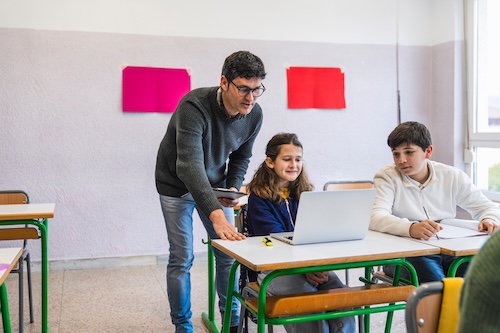
Given the pace at which AI technologies are changing, there’s a lot still to be determined, and I won’t pretend to have all the answers. But as a school counselor in Kansas who has been using SchoolAI to support students for years, I’ve seen that AI absolutely can help kids and is safe when supervised. At this point, I think it’s much more likely to help us do our jobs better than to produce any other outcome. I’ve discovered that if you implement AI thoughtfully, it empowers students to explore their futures, stay on track for graduation, learn new skills, and even improve their mental health.

Full disclosure: I have something adjacent to a tech background. I worked for a web development marketing firm before moving into education. However, I want to emphasize that you don’t have to be an expert to use AI effectively. Success is rooted in curiosity, trial and error, and commitment to student well-being. Above all, I would urge educators to remember that AI isn’t about replacing us. It allows us to extend our reach to students and our capacity to cater to individual needs, especially when shorthanded.

Let me show you what that looks like.

Building emotional resilience

Students today face enormous emotional pressures. And with national student-to-counselor ratios at nearly double the recommended 250-to-1, school staff can’t always be there right when students need us.

That’s why I created a chatbot named Pickles (based on my dog at home, whom the kids love but who is too rambunctious to come to school with me). This emotional support bot gives my students a way to process small problems like feeling left out at recess or arguing with a friend. It doesn’t replace my role, but it does help triage students so I can give immediate attention to those facing the most urgent challenges.

Speaking of which, AI has revealed some issues I might’ve otherwise missed. One fourth grader, who didn’t want to talk to me directly, opened up to the chatbot about her parents’ divorce. Because I was able to review her conversation, I knew to follow up with her. In another case, a shy fifth grader who struggled to maintain conversations learned to initiate dialogue with her peers using chatbot-guided social scripts. After practicing over spring break, she returned more confident and socially fluent.

Aside from giving students real-time assistance, these tools offer me critical visibility and failsafes while I’m running around trying to do 10 things at once.

Personalized career exploration and academic support

One of my core responsibilities as a counselor is helping students think about their futures. Often, the goals they bring to me are undeveloped (as you would expect—they’re in elementary school, after all): They say, “I’m going to be a lawyer,” or “I’m going to be a doctor.” In the past, I would point them toward resources I thought would help, and that was usually the end of it. But I always wanted them to reflect more deeply about their options.

So, I started using an AI chatbot to open up that conversation. Instead of jumping to a job title, students are prompted to answer what they’re interested in and why. The results have been fascinating—and inspiring. In a discussion with one student recently, I was trying to help her find careers that would suit her love of travel. After we plugged in her strengths and interests, the chatbot suggested cultural journalism, which she was instantly excited about. She started journaling and blogging that same night. She’s in sixth grade.

What makes this process especially powerful is that it challenges biases. By the end of elementary school, many kids have already internalized what careers they think they can or can’t pursue–often based on race, gender, or socioeconomic status. AI can disrupt that. It doesn’t know what a student looks like or where they’re from. It just responds to their curiosity. These tools surface career options for kids–like esports management or environmental engineering–that I might not be able to come up with in the moment. It’s making me a better counselor and keeping me apprised of workforce trends, all while encouraging my students to dream bigger and in more detail.

Along with career decisions, AI helps students make better academic decisions, especially in virtual school environments where requirements vary district to district. I recently worked with a virtual school to create an AI-powered tool that helps students identify which classes they need for graduation. It even links them to district-specific resources and state education departments to guide their planning. These kinds of tools lighten the load of general advising questions for school counselors and allow us to spend more time supporting students one on one.

My advice to educators: Try it

We tell our students that failure is part of learning. So why should we be afraid to try something new? When I started using AI, I made mistakes. But AI doesn’t have to be perfect to be powerful. Around the globe, AI school assistants are already springing up and serving an ever-wider range of use cases.

I recommend educators start small. Use a trusted platform. And most importantly, stay human. AI should never replace the relationships at the heart of education. But if used wisely, it can extend your reach, personalize your impact, and unlock your students’ potential.

We have to prepare our students for a world that’s changing fast–maybe faster than ever. I, for one, am glad I have AI by my side to help them get there.

Hanna Kemble-Mick, Indian Hills Elementary

Hanna Kemble-Mick has been an elementary school counselor for eight years. She currently works at Indian Hills Elementary, where she uses SchoolAI to enhance her work. She’s also the Dean of Elementary School Counselors for USD 437, holds the Kansas School Counselor of the Year title, and is a 2025 School Counselor of the Year® finalist. Additionally, she works as a Counselor Leader Coordinator for KSDE. Hanna is committed to supporting counselors and providing practical solutions for their practice.

Latest posts by eSchool Media Contributors (see all)

.Organize the content with appropriate headings and subheadings ( h2, h3, h4, h5, h6). Include conclusion section and FAQs section with Proper questions and answers at the end. do not include the title. it must return only article i dont want any extra information or introductory text with article e.g: ” Here is rewritten article:” or “Here is the rewritten content:”