Home Blog Page 35

Generate single title from this title Democratizing AI: How Thomson Reuters Open Arena supports no-code AI for every professional with Amazon Bedrock in 100 -150 characters. And it must return only title i dont want any extra information or introductory text with title e.g: ” Here is a single title:”

0

Write an article about

This post is cowritten by Laura Skylaki, Vaibhav Goswami, Ramdev Wudali and Sahar El Khoury from Thomson Reuters.

Thomson Reuters (TR) is a leading AI and technology company dedicated to delivering trusted content and workflow automation solutions. With over 150 years of expertise, TR provides essential solutions across legal, tax, accounting, risk, trade, and media sectors in a fast-evolving world.

TR recognized early that AI adoption would fundamentally transform professional work. According to TR’s 2025 Future of Professionals Report, 80% of professionals anticipate AI significantly impacting their work within five years, with projected productivity gains of up to 12 hours per week by 2029. To unlock this immense potential, TR needed a solution to democratize AI creation across its organization.

In this blog post, we explore how TR addressed key business use cases with Open Arena, a highly scalable and flexible no-code AI solution powered by Amazon Bedrock and other AWS services such as Amazon OpenSearch Service, Amazon Simple Storage Service (Amazon S3), Amazon DynamoDB, and AWS Lambda. We’ll explain how TR used AWS services to build this solution, including how the architecture was designed, the use cases it solves, and the business profiles that use it. The system demonstrates TR’s successful approach of using existing TR services for rapid launches while supporting thousands of users, showcasing how organizations can democratize AI access and support business profiles (for example, AI explorers and SMEs) to create applications without coding expertise.

Introducing Open Arena: No-code AI for all

TR introduced Open Arena to non-technical professionals to create their own customized AI solutions. With Open Arena users can use cutting-edge AI powered by Amazon Bedrock in a no-code environment, exemplifying TR’s commitment to democratizing AI access.

Today, Open Arena supports:

  • High adoption: ~70% employee adoption, with 19,000 monthly active users.
  • Custom solutions: Thousands of customized AI solutions created without coding, used for internal workflows or integrated into TR products for customers.
  • Self-served functionality: 100% self-served functionality, so that users, irrespective of technical background, can develop, evaluate, and deploy generative AI solutions.

The Open Arena journey: From prototype to enterprise solution

Conceived as a rapid prototype, Open Arena was developed in under six weeks at the onset of the generative AI boom in early 2023 by TR Labs – TR’s dedicated applied research division focused on the research, development, and application of AI and emerging trends in technologies. The goal was to support internal team exploration of large language models (LLMs) and discover unique use cases by merging LLM capabilities with TR company data.

Open Arena’s introduction significantly increased AI awareness, fostered developer-SME collaboration for groundbreaking concepts, and accelerated AI capability development for TR products. The rapid success and demand for new features quickly highlighted Open Arena’s potential for AI democratization, so TR developed an enterprise version of Open Arena. Built on the TR AI Platform, Open Arena enterprise version offers secure, scalable, and standardized services covering the entire AI development lifecycle, significantly accelerating time to production.

The Open Arena enterprise version uses existing system capabilities for enhanced data access controls, standardized service access, and compliance with TR’s governance and ethical standards. This version introduced self-served capabilities so that every user, irrespective of their technical ability, can create, evaluate, and deploy customized AI solutions in a no-code environment.

“The foundation of the AI Platform has always been about empowerment; in the early days it was about empowering Data Scientists but with the rise of Gen AI, the platform adapted and evolved on empowering users of any background to leverage and create AI Solutions.”

– Maria Apazoglou, Head of AI Engineering, CoCounsel

As of July 2025, the TR Enterprise AI Platform consists of 15 services spanning the entire AI development lifecycle and user personas. Open Arena remains one of its most popular, serving 19,000 users each month, with increasing monthly usage.

Addressing key enterprise AI challenges across user types

Using the TR Enterprise AI Platform, Open Arena helped thousands of professionals transition into using generative AI. AI-powered innovation is now readily in the hands of everyone, not just AI scientists.

Open Arena successfully addresses four critical enterprise AI challenges:

  • Enablement: Delivers AI solution building with consistent LLM and service provider experience and support for various user personas, including non-technical.
  • Security and quality: Streamlines AI solution quality tracking using evaluation and monitoring services, whilst complying with data governance and ethics policies.
  • Speed and reusability: Automates workflows and uses existing AI solutions and prompts.
  • Resources and cost management: Tracks and displays generative AI solution resource consumption, supporting transparency and efficiency.

The solution currently supports several AI experiences, including tech support, content creation, coding assistance, data extraction and analysis, proof reading, project management, content summarization, personal development, translation, and problem solving, catering to different user needs across the organization.
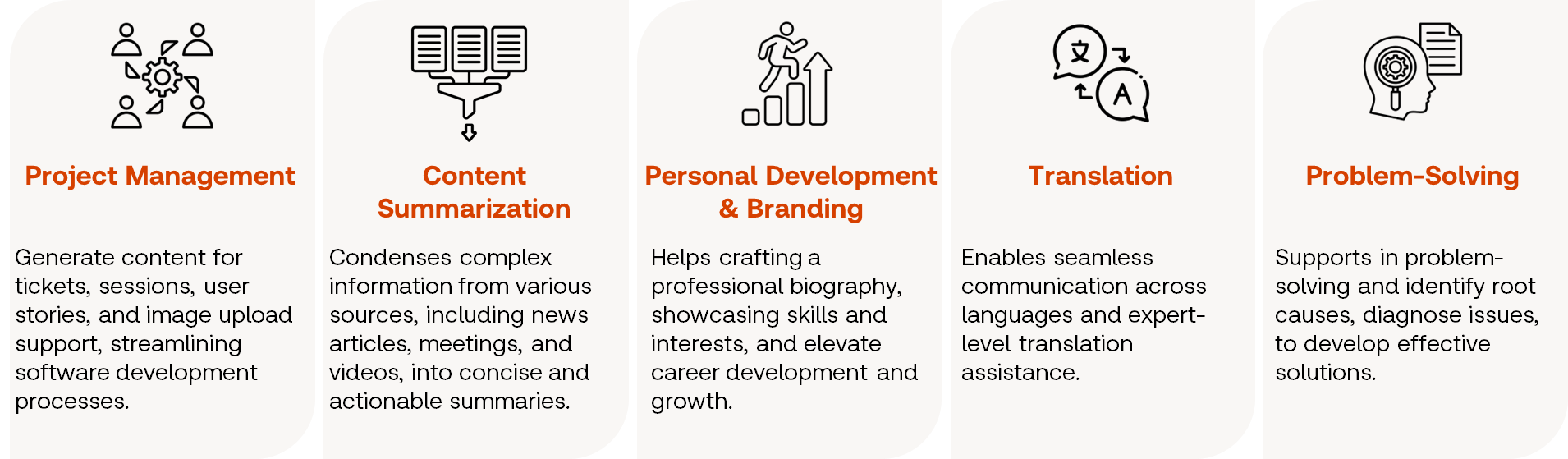
Different use cases of Open Arena (2)

Figure 1. Examples of Open Arena use cases.

AI explorers use Open Arena to speed up day-to-day tasks, such as summarizing documents, engaging in LLM chat, building custom workflows, and comparing AI models. AI creators and Subject Matter Experts (SMEs) use Open Arena to build custom AI workflows and experiences and to evaluate solutions without requiring coding knowledge. Meanwhile, developers can develop and deploy new AI solutions at speed, training models, creating new AI skills, and deploying AI capabilities.

Why Thomson Reuters selected AWS for Open Arena

TR strategically chose AWS as a primary cloud provider for Open Arena based on several critical factors:

  • Comprehensive AI/ML capabilities: Amazon Bedrock offers easy access to a choice of high-performing foundation models from leading AI companies like AI21 Labs, Anthropic, Cohere, DeepSeek, Luma AI, Meta, Mistral AI, OpenAI, Qwen, Stability AI, TwelveLabs, Writer, and Amazon. It supports simple chat and complex RAG workflows, and integrates seamlessly with TR’s existing Enterprise AI Platform.
  • Enterprise-grade security and governance: Advanced security controls, model access using RBAC, data handling with enhanced security features, single sign-on (SSO) enabled, and clear operational and user data separation across AWS accounts.
  • Scalable infrastructure: Serverless architecture for automatic scaling, pay-per-use pricing for cost optimization, and global availability with low latency.
  • Existing relationship and expertise: Strong, established relationship between TR and AWS, existing Enterprise AI Platform on AWS, and deep AWS expertise within TR’s technical teams.

“Our long-standing partnership with AWS and their robust, flexible and innovative services made them the natural choice to power Open Arena and accelerate our AI initiatives.”

– Maria Apazoglou, Head of AI Engineering, CoCounsel

Open Arena architecture: Scalability, extensibility, and security

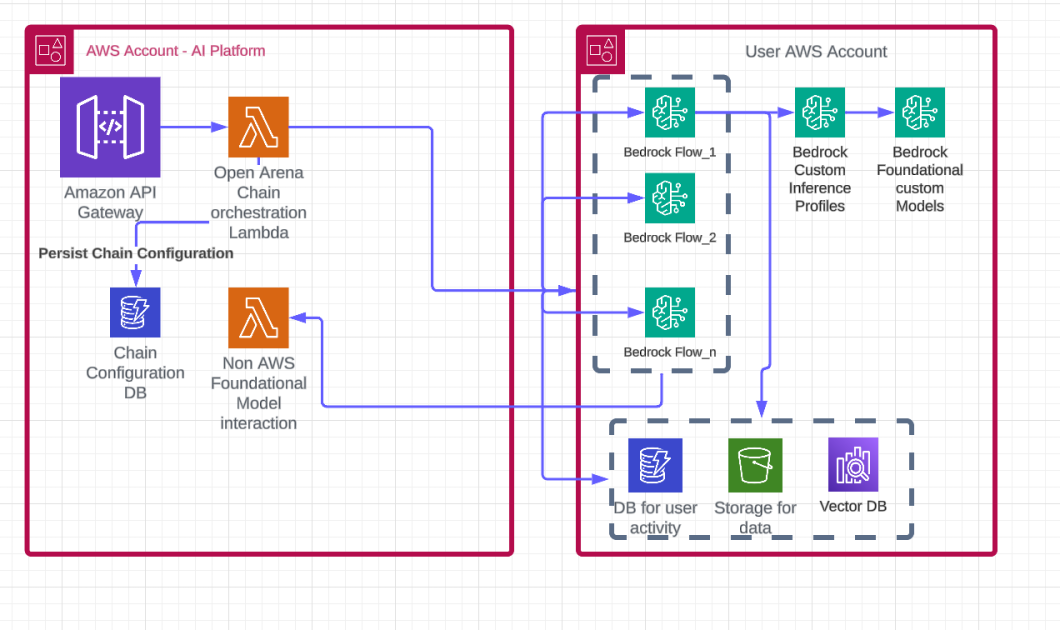
Designed for a broad enterprise audience, Open Arena prioritizes scalability, extensibility and security while maintaining simplicity for non-technical users to create and deploy AI solutions. The following diagram illustrates the architecture of Open Arena.
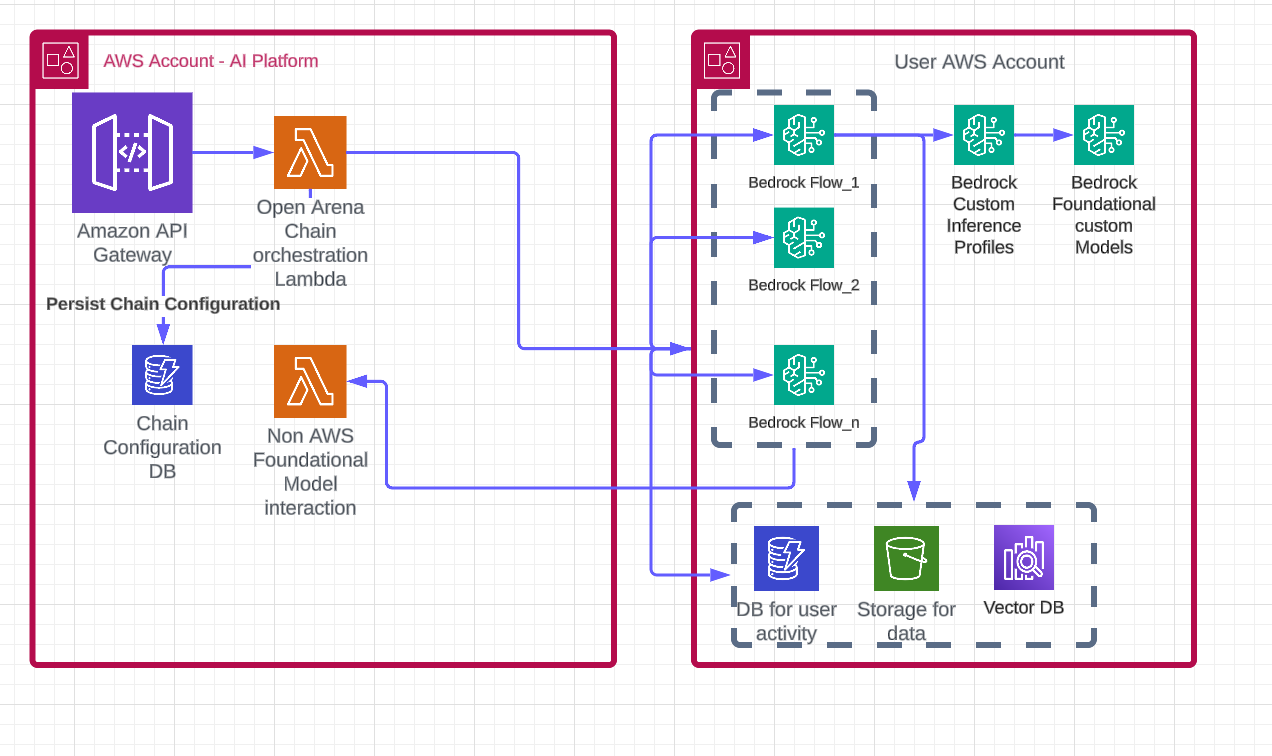
Architecture Design

Figure 2. Architecture design of Open Arena.

The architecture design facilitates enterprise-grade performance with clear separation between capability and usage, aligning with TR’s enterprise cost and usage tracking requirements.

The following are key components of the solution architecture:

  • No-code interface: Intuitive UI, visual workflow builder, pre-built templates, drag-and-drop functionality.
  • Enterprise integration: Seamless integration with TR’s Enterprise AI Platform, SSO enabled, data handling with enhanced security, clear data separation.
  • Solution management: Searchable repository, public/private sharing, version control, usage analytics.

TR developed Open Arena using AWS services such as Amazon Bedrock, Amazon OpenSearch, Amazon DynamoDB, Amazon API Gateway, AWS Lambda, and AWS Step Functions. It uses Amazon Bedrock for foundational model interactions, supporting simple chat and complex Retrieval-Augmented Generation (RAG) tasks. Open Arena uses Amazon Bedrock Flows as the custom workflow builder where users can drag-and-drop components like prompts, agents, knowledge bases and Lambda functions to create sophisticated AI workflows without coding. The system also integrates with AWS OpenSearch for knowledge bases and external APIs for advanced agent capabilities.

For data separation, orchestration is managed using the Enterprise AI Platform AWS account, capturing operational data. Flow instances and user-specific data reside in the user’s dedicated AWS account, stored in a database. Each user’s data and workflow executions are isolated within their respective AWS accounts, which is required for complying with Thomson Reuters data sovereignty and enterprise security policies with strict regional controls. The system integrates with Thomson Reuters SSO solution to automatically identify users and grant secure, private access to foundational models.

The orchestration layer, centrally hosted within the Enterprise AI Platform AWS account, manages AI workflow activities, including scheduling, deployment, resource provisioning, and governance across user environments.

The system features fully automated provisioning of  Amazon Bedrock Flows directly within each user’s AWS account, avoiding manual setup and accelerating time to value. Using AWS Lambda for serverless compute and DynamoDB for scalable, low-latency storage, the system dynamically allocates resources based on real-time demand. This architecture makes sure prompt flows and supporting infrastructure are deployed and scaled to match workload fluctuations, optimizing performance, cost, and user experience.

“Our decision to adopt a cross-account architecture was driven by a commitment to enterprise security and operational excellence. By isolating orchestration from execution, we make sure that each user’s data remains private and secure within their own AWS account, while still delivering a seamless, centrally-managed experience. This design empowers organizations to innovate rapidly without compromising compliance or control.”

– Thomson Reuters’ architecture team

Evolution of Open Arena: From classic to Amazon Bedrock Flows-powered chain builder

Open Arena has evolved to cater to varying levels of user sophistication:

  • Open Arena v1 (Classic): Features a form-based interface for simple prompt customization and basic AI workflow deployment within a single AWS account. Its simplicity appeals to novice users for straightforward use cases, though with limited advanced capabilities.
  • Open Arena v2 (Chain Builder): Introduces a robust, visual workflow builder interface, enabling users to design complex, multi-step AI workflows using drag-and-drop components. With support for advanced node types, parallel execution, and seamless cross-account deployment, Chain Builder dramatically expands the system’s capabilities and accessibility for non-technical users.

Thomson Reuters uses Amazon Bedrock Flows as a core feature of Chain Builder. Users can define, customize, and deploy AI-driven workflows using Amazon Bedrock models. Bedrock Flows supports advanced workflows combining multiple prompt nodes, incorporating AWS Lambda functions, and supporting sophisticated RAG pipelines. Operating seamlessly across user AWS accounts, Bedrock Flows facilitates secure, scalable execution of personalized AI solutions, serving as the fundamental engine for the Chain Builder workflows and driving TR’s ability to deliver robust, enterprise-grade automation and innovation.

What’s next?

TR continues to expand Open Arena’s capabilities through the strategic partnership with AWS, focusing on:

  • Driving further adoption of Open Arena’s DIY capabilities.
  • Enhancing flexibility for workflow creation in Chain Builder with custom components, such as inline scripts.
  • Developing new templates to represent common tasks and workflows.
  • Enhancing collaboration features within Open Arena.
  • Extending multimodal capabilities and model integration.
  • Expanding into new use cases across the enterprise.

“From innovating new product ideas to reimagining daily tasks for Thomson Reuters employees, we continue to push the boundaries of what’s possible with Open Arena.”

– Maria Apazoglou, Head of AI Engineering, CoCounsel

Conclusion

In this blog post, we explored how Thomson Reuters’ Open Arena demonstrates the successful democratization of AI across an enterprise by using AWS services, particularly Amazon Bedrock and Bedrock Flows. With 19,000 monthly active users and 70% employee adoption, the system proves that no-code AI solutions can deliver enterprise-scale impact while maintaining security and governance standards.

By combining the robust infrastructure of AWS with innovative architecture design, TR has created a blueprint for AI democratization that empowers professionals across technical skill levels to harness generative AI for their daily work.

As Open Arena continues to evolve, it exemplifies how strategic cloud partnerships can accelerate AI adoption and transform how organizations approach innovation with generative AI.

About the authors

Laura Skylaki, PhD, leads the Enterprise AI Platform at Thomson Reuters, driving the development of GenAI services that accelerate the creation, testing and deployment of AI solutions, enhancing product value. A recognized expert with a doctorate in stem cell bioinformatics, her extensive experience in AI research and practical application spans legal, tax, and biotech domains. Her machine learning work is published in leading academic journals, and she is a frequent speaker on AI and machine learning

Vaibhav Goswami is a Lead Software Engineer on the AI Platform team at Thomson Reuters, where he leads the development of the Generative AI Platform that empowers users to build and deploy generative AI solutions at scale. With expertise in building production-grade AI systems, he focuses on creating tools and infrastructure that democratize access to cutting-edge AI capabilities across the enterprise.

Ramdev Wudali is a Distinguished Engineer, helping architect and build the AI/ML Platform to enable the Enterprise user, data scientists and researchers to develop Generative AI and machine learning solutions by democratizing access to tools and LLMs. In his spare time, he loves to fold paper to create origami tessellations, and wearing irreverent T-shirts

As the director of AI Platform Adoption and Training, Sahar El Khoury guides users to seamlessly onboard and successfully use the platform services, drawing on her experience in AI and data analysis across robotics (PhD), financial markets, and media.

Vu San Ha Huynh is a Solutions Architect at AWS with a PhD in Computer Science. He helps large Enterprise customers drive innovation across different domains with a focus on AI/ML and Generative AI solutions.

Paul Wright is a Senior Technical Account Manager, with over 20 years experience in the IT industry and over 7 years of dedicated cloud focus. Paul has helped some of the largest enterprise customers grow their business and improve their operational excellence. In his spare time Paul is a huge football and NFL fan.

Mike Bezak is a Senior Technical Account Manager in AWS Enterprise Support. He has over 20 years of experience in information technology, primarily disaster recovery and systems administration. Mike’s current focus is helping customers streamline and optimize their AWS Cloud journey. Outside of AWS, Mike enjoys spending time with family & friends.

.Organize the content with appropriate headings and subheadings ( h2, h3, h4, h5, h6). Include conclusion section and FAQs section with Proper questions and answers at the end. do not include the title. it must return only article i dont want any extra information or introductory text with article e.g: ” Here is rewritten article:” or “Here is the rewritten content:”


Generate single title from this title Preserving critical thinking amid AI adoption in 100 -150 characters. And it must return only title i dont want any extra information or introductory text with title e.g: ” Here is a single title:”

Write an article about

Key points:

AI is now at the center of almost every conversation in education technology. It is reshaping how we create content, build assessments, and support learners. The opportunities are enormous. But one quiet risk keeps growing in the background: losing our habit of critical thinking.

I see this risk not as a theory but as something I have felt myself.

The moment I almost outsourced my judgment

A few months ago, I was working on a complex proposal for a client. Pressed for time, I asked an AI tool to draft an analysis of their competitive landscape. The output looked polished and convincing. It was tempting to accept it and move on.

Then I forced myself to pause. I began questioning the sources behind the statements and found a key market shift the model had missed entirely. If I had skipped that short pause, the proposal would have gone out with a blind spot that mattered to the client.

That moment reminded me that AI is fast and useful, but the responsibility for real thinking is still mine. It also showed me how easily convenience can chip away at judgment.

AI as a thinking partner

The most powerful way to use AI is to treat it as a partner that widens the field of ideas while leaving the final call to us. AI can collect data in seconds, sketch multiple paths forward, and expose us to perspectives we might never consider on our own.

In my own work at Magic EdTech, for example, our teams have used AI to quickly analyze thousands of pages of curriculum to flag accessibility issues. The model surfaces patterns and anomalies that would take a human team weeks to find. Yet the real insight comes when we bring educators and designers together to ask why those patterns matter and how they affect real classrooms. AI sets the table, but we still cook the meal.

There is a subtle but critical difference between using AI to replace thinking and using it to stretch thinking. Replacement narrows our skills over time. Stretching builds new mental flexibility. The partner model forces us to ask better questions, weigh trade-offs, and make calls that only human judgment can resolve.

Habits to keep your edge

Protecting critical thinking is not about avoiding AI. It is about building habits that keep our minds active when AI is everywhere.

Here are three I find valuable:

1. Name the fragile assumption
Each time you receive AI output, ask: What is one assumption here that could be wrong? Spend a few minutes digging into that. It forces you to reenter the problem space instead of just editing machine text.

2. Run the reverse test
Before you adopt an AI-generated idea, imagine the opposite. If the model suggests that adaptive learning is the key to engagement, ask: What if it is not? Exploring the counter-argument often reveals gaps and deeper insights.

3. Slow the first draft
It is tempting to let AI draft emails, reports, or code and just sign off. Instead, start with a rough human outline first. Even if it is just bullet points, you anchor the work in your own reasoning and use the model to enrich–not originate–your thinking.

These small practices keep the human at the center of the process and turn AI into a gym for the mind rather than a crutch.

Why this matters for education

For those of us in education technology, the stakes are unusually high. The tools we build help shape how students learn and how teachers teach. If we let critical thinking atrophy inside our companies, we risk passing that weakness to the very people we serve.

Students will increasingly use AI for research, writing, and even tutoring. If the adults designing their digital classrooms accept machine answers without question, we send the message that surface-level synthesis is enough. We would be teaching efficiency at the cost of depth.

By contrast, if we model careful reasoning and thoughtful use of AI, we can help the next generation see these tools for what they are: accelerators of understanding, not replacements for it. AI can help us scale accessibility, personalize instruction, and analyze learning data in ways that were impossible before. But its highest value appears only when it meets human curiosity and judgment.

Building a culture of shared judgment

This is not just an individual challenge. Teams need to build rituals that honor slow thinking in a fast AI environment. Another practice is rotating the role of “critical friend” in meetings. One person’s task is to challenge the group’s AI-assisted conclusions and ask what could go wrong. This simple habit trains everyone to keep their reasoning sharp.

Next time you lean on AI for a key piece of work, pause before you accept the answer. Write down two decisions in that task that only a human can make. It might be about context, ethics, or simple gut judgment. Then share those reflections with your team. Over time this will create a culture where AI supports wisdom rather than diluting it.

The real promise of AI is not that it will think for us, but that it will free us to think at a higher level.

The danger is that we may forget to climb.

The future of education and the integrity of our own work depend on remaining climbers. Let the machines speed the climb, but never let them choose the summit.

Laura Ascione is the Editorial Director at eSchool Media. She is a graduate of the University of Maryland’s prestigious Philip Merrill College of Journalism.

Laura AscioneLatest posts by Laura Ascione (see all)

.Organize the content with appropriate headings and subheadings ( h2, h3, h4, h5, h6). Include conclusion section and FAQs section with Proper questions and answers at the end. do not include the title. it must return only article i dont want any extra information or introductory text with article e.g: ” Here is rewritten article:” or “Here is the rewritten content:”

EA FC26: A Deep Look at EA’s Latest Football Simulation

0

What’s New in EA FC26?

EA FC26 marks the second installment in Electronic Arts’ rebranded football simulation series following their split from FIFA. Released in late 2025, this iteration builds upon the foundation established by its predecessor while introducing several notable improvements that American soccer enthusiasts and gamers have been eagerly anticipating.

The most striking enhancement comes in the form of completely revamped gameplay mechanics. EA has finally addressed the pace exploitation issues that plagued previous editions by implementing a more balanced movement system. Players now move with greater realism – defenders can actually catch up to speedy forwards when positioned correctly, creating a more authentic on-field experience.

Graphics have taken a substantial leap forward as well. Player models feature incredible detail, with facial expressions that react naturally to in-game situations. The stadiums feel alive with dynamic lighting that changes throughout matches, reflecting realistic weather patterns and time-of-day transitions.

Gameplay Innovations That Change Everything

EA FC26 introduces the revolutionary “Football IQ” system, which transforms how AI teammates behave on the pitch. Unlike previous editions where computer-controlled players often made frustrating decisions, the new AI demonstrates remarkable situational awareness. Defenders maintain proper positioning, midfielders create intelligent passing lanes, and forwards make timely runs behind the defense.

The revamped shooting mechanics deserve special mention. Gone are the days of repetitive goal-scoring methods that dominated online play. The new “Precision Finish” system requires players to consider angle, power, and timing when attempting shots. This creates a higher skill ceiling while making each goal feel genuinely earned.

Passing has also received significant attention. The “Vision Pass” feature allows players to execute creative passes that weren’t possible in previous games. By holding a trigger button and using the right stick, you can now curve passes around defenders or deliver perfectly weighted through balls that split defensive lines.

Free kicks and penalties have been completely redesigned with an intuitive new interface that gives players greater control while maintaining accessibility for newcomers.

Career Mode Gets the Attention It Deserves

For years, Career Mode fans felt neglected as EA focused primarily on Ultimate Team. FC26 finally addresses these concerns with substantial improvements to both Player and Manager Career experiences.

The Manager Career now features a comprehensive staff management system where you can hire specialists across multiple departments. Your coaching staff directly impacts player development, while scouts determine the quality of potential signings. The transfer negotiation system has been expanded with more realistic AI behavior during negotiations.

Player Career mode introduces branching storylines that change based on your performance and decisions. Your player can develop rivalries with specific opponents, form special connections with teammates, and even deal with off-field situations that affect your standing within the club.

Both career modes benefit from enhanced presentation elements, including authentic press conferences with meaningful questions and responses that impact team morale and public perception.

Ultimate Team Evolution

Ultimate Team remains EA’s most profitable mode, and FC26 introduces several quality-of-life improvements without abandoning the core formula. The controversial pack system remains, but EA has implemented a “Duplicate Protection” feature that significantly reduces the frustration of pulling the same high-rated players repeatedly.

The new “Team Chemistry” system replaces the old chemistry lines, allowing for more creative squad building. Players now develop chemistry based on shared leagues, nationalities, clubs, and even playing styles rather than requiring direct links between adjacent positions.

Weekend League has been restructured to be less time-consuming while maintaining competitive integrity. Players now have the entire weekend to complete 20 matches (down from 30), making the mode more accessible to those with busy schedules.

Clubs Mode Takes Center Stage

Perhaps the most impressive improvement comes in the rebranded Clubs mode (formerly Pro Clubs). This cooperative online experience allows friends to form a virtual team where each person controls a single player.

FC26 introduces cross-platform play for Clubs, finally uniting the player base across PlayStation, Xbox, and PC. The drop-in match system has been refined to match players with similar skill levels, reducing the frustration of being paired with inexperienced teammates.

The progression system now features specialized skill trees that allow for truly unique player builds. Want to create a towering target man with surprising agility? Or perhaps a diminutive midfielder with exceptional long-range shooting? The new customization options make these specialized builds viable and fun.

Community Reception and Ongoing Support

The American gaming community has responded positively to EA FC26, with particular praise directed toward the gameplay improvements and attention to long-neglected modes. Professional players and content creators have highlighted the increased skill gap as a welcome change that rewards technical ability over exploitation of game mechanics.

EA has demonstrated a commitment to post-launch support with a transparent roadmap of upcoming features and balance adjustments. The first major patch addressed some early exploits discovered by the community, showing EA’s willingness to respond quickly to feedback.

The competitive scene has embraced FC26 enthusiastically. The eMLS tournament series has seen record participation, with several American players making deep runs in international competitions. The improved spectator tools make watching competitive matches more engaging than ever before.

Where FC26 Still Falls Short

Despite the numerous improvements, FC26 isn’t without flaws. Server stability during peak hours remains inconsistent, with many players reporting disconnections during crucial Weekend League matches. The latency issues that have plagued the series for years still appear occasionally, particularly in modes with multiple human players.

Some fans have criticized the continued emphasis on microtransactions in Ultimate Team. While the gameplay improvements apply to all modes, the most desirable rewards remain locked behind either significant time investment or monetary purchases.

Women’s football, while included, still feels somewhat underdeveloped compared to the men’s game. The absence of a women’s career mode is particularly noticeable given the growing popularity of women’s soccer in the United States following recent World Cup successes.

The Future of Football Gaming

EA FC26 represents a significant step forward for the franchise. By addressing longstanding community complaints while introducing meaningful innovations, EA has demonstrated their commitment to evolving beyond the FIFA partnership.

With competitor eFootball (formerly PES) still struggling to gain market share and the newly announced FIFA game from 2K Games still in development, EA FC26 currently stands as the premier football simulation experience. The improvements to gameplay fundamentals combined with meaningful updates across all major modes make this the most complete football game in years.

For American soccer fans and gamers looking for an authentic football experience, EA FC26 delivers despite its imperfections. The foundation established this year suggests an exciting future for the franchise as it continues to forge its own identity separate from the FIFA branding.”

Can we do that? Maybe it’s easier to quickly publish

Generate single title from this title How Data Is Reshaping Science in 100 -150 characters. And it must return only title i dont want any extra information or introductory text with title e.g: ” Here is a single title:”

Write an article about

(Inovational World/Shutterstock)

From the early breakthroughs of the telescope, which expanded the universe; from Schleiden and Schwann recognizing plant cells to the microscope, which revealed the cell; and from Rutherford defining the nucleus of the atom to the particle accelerator, science has often made significant strides through its instruments. This trend continues with the defining instrument of this era: the dataset and its companion, AI. Together, they make for a new laboratory where data is both the substance and the means for discovery.

This is the story that launches with our new series, The Data Frontier of Science, which explores how data-oriented approaches are revitalizing science and engineering. The current article marks the beginning of that series, zooming in on its transition from observation to simulation. It examines examples across a wide range of fields. In analyzing how scientists are learning to trust what their models predict as much as what their tools record, we consider what this shift implies for the future of scientific discovery.

The Changing Nature of Scientific Discovery

With so much data and powerful AI models at their fingertips, researchers are doing more and more of their work inside machines. Across many fields, experiments that once started in a lab now begin on a screen. AI and simulation have flipped the order of discovery. In many cases, the lab has become the final step, not the first.

                   (GarryKillian/Shutterstock)

You can see this happening in almost every area of science. Instead of testing one idea at a time, researchers now run thousands of simulations to figure out which ones are worth trying in real life. Whether they’re working with new materials, brain models, or climate systems, the pattern is clear: computation has become the proving ground for discovery.

Lawrence Berkeley National Laboratory’s Materials Project was developed to test new compounds through the computer. Scientists run thousands of simulations to see how a material might act instead of mixing chemicals and seeing what happens. The system can predict anything from electrical conductivity to thermal limits to chemical stability. This happens all before it is ever manufactured. Only candidates that seem extremely promising are selected.              

The Human Brain Project’s EBRAINS allows scientists to simulate brain circuits—testing how neurons will respond to medications or stimulation without depending on animal studies or highly invasive testing. NVIDIA’s Earth-2 is already being developed to model the effects of climate change with such detail that entire scenarios can be tested thoroughly and quickly.

This isn’t simply a race. It’s not just about more investigations or more chances to fail, but more opportunities to learn. If something fails, it doesn’t waste weeks of labor—it becomes data for the next iteration. The lab isn’t where reseachers try things anymore. It’s where reseachers get answers. 

The New Instruments of Science

Data changed how science works at a fundamental level. The guess-and-check rhythm of traditional experimentation has been replaced. Rather than starting from a petri dish, discovery begins with data. Instead of contemplating which hypotheses to test, researchers let the model show the way.

Tools like Open Catalyst, from Meta and Carnegie Mellon, help scientists figure out how molecules might react—before running any lab tests. The system simulates chemical reactions on a computer, which saves time and cuts down on expensive trial-and-error. It’s especially useful for finding better materials for clean energy, like new catalysts for hydrogen fuel or carbon capture.

In the life sciences, DeepMind’s AlphaFold predicts how proteins fold based on their amino acid sequences—something that once required many years of lab work. The results are now used to guide everything from experimental plans to drug targeting, via a public database hosted by EMBL-EBI. For many biologists, AlphaFold is now the first step in their research.

Simulations are also taking over physics, where observation was once untouchable. Scientists use the Aurora supercomputer at Argonne National Lab to simulate conditions that can’t be replicated directly—such as plasma behavior, star formation, or what happened moments after the Big Bang. These aren’t just visualizations—they stand in for real experiments.

The microscope hasn’t vanished. The telescope still counts. But in this new environment, they’re rarely the first tools used. More often than not, the model leads—and the lab follows.

Digital Twins and Synthetic Data: The New Fuel for Discovery

Science used to start with the question: what can we observe? Now it often starts with a different one: what can we simulate?

Across the sciences, the first draft of discovery is no longer happening in a notebook or on a lab bench. It’s happening inside a model. Digital twins—software-based replicas of physical systems—and synthetic datasets are quickly becoming the tools researchers reach for first. They let you rehearse an experiment before reality gets involved. If it doesn’t look promising in simulation? You don’t bother taking it into the real world.

                (DC Studio/Shutterstock)

At NASA’s aero research, this is becoming a standard practice. New aircraft designs don’t go straight into wind tunnels, instead, they live for weeks or months inside computational fluid dynamics simulators. Engineers test how air flows across the wings, how pressure shifts in turbulence, how drag affects lift. If something fails, they tweak it and run it again. Data enables them to not worry about mistakes or wasted materials. By the time they build a prototype, they’ve already watched it fly.

In energy, the same logic plays out underground. Shell and BP model rock formations and pressure systems using synthetic seismic data. They map out virtual wells and simulate how the earth might respond before a single drill touches soil. It’s still science. It’s just the kind that happens first in code.

Even agriculture has gotten in on this shift. Companies like OneSoil and PEAT are building digital fields, like entire farms, virtually recreated from satellite imagery and climate data. They simulate what’ll happen if you plant early, or irrigate less, or skip pesticide altogether. These models aren’t abstract. They’re tied to actual fields, real farmers, real seasons. It’s just that the trials happen in a few seconds, not a few months.

What makes all of this so powerful isn’t just speed or scale. It’s the filtering effect. In the past, the lab was where you started. Now it’s where you go once the simulations give you a reason. The real world hasn’t gone away, but it’s earned a new role of being the validator of the virtual.

The Scientist’s New Role in a Simulated World

Yes, the job’s changing. Scientists aren’t just testing hypotheses or peering into microscopes anymore. More and more, they’re managing systems — trying to stop models from drifting, tracking what changed and when, making sure what comes out actually means something. They’ve gone from running experiments to building the environment where those experiments even happen.

And whether they’re at DeepMind, Livermore, NOAA, or just some research team spinning up models, it’s the same kind of work. They’re checking whether the data is usable, figuring out who touched it last, wondering if the labels are even accurate. AI can do a lot, but it doesn’t know when it’s wrong. It just keeps going. That’s why this still depends on the human in the loop.

They’re still curious. Still chasing insight. But now a big part of the job is just keeping the system honest. Because the model output will look right. It will look clean. But unless you’ve followed every step it took to get there, you can’t be sure it’s real. That call — the gut check — that’s still on you – the human. This is still science. It’s just happening further upstream.

What We Lose and Gain When Reality Becomes Code

There’s a lot you get when science moves into simulation. It’s fast. You can scale ideas like never before. Models don’t get tired. You can run a thousand experiments before you even finish your coffee. You get cleaner outputs, tighter control. On paper, it all looks like progress. And it is. 

         (Shutterstock AI Image)

However, you lose something too. 

When everything happens inside a machine, you don’t get the odd smells, the broken glass, the weird reactions that don’t belong. You lose the little things that used to raise eyebrows in a lab. The gut checks. The accidents that turned into discoveries. Models don’t give you that. They do what they’re told.

So yeah, you gain precision. But you give up a bit of the feel. You get control. But context slips. Reality is messy, but it pushes back. Models don’t. Not unless you make them. You have to tell them where to look. When to stop. What not to trust.

That’s still on the scientist. The tools have changed. The terrain’s different. But the job? Still about knowing when something’s off — even when the numbers look perfect. Especially then.

In the next part of this series,  we’re diving into the models — the ones trained on papers, lab data, and decades of scientific work. In the later parts, we’ll look at the infrastructure behind it all, and then the reproducibility problem that’s still haunting AI-powered science research. It all comes back to data — how it’s built, trusted, and used. Subscribe and follow so you don’t miss it. 

.Organize the content with appropriate headings and subheadings ( h2, h3, h4, h5, h6). Include conclusion section and FAQs section with Proper questions and answers at the end. do not include the title. it must return only article i dont want any extra information or introductory text with article e.g: ” Here is rewritten article:” or “Here is the rewritten content:”

Generate single title from this title Microsoft’s next big AI bet: building a humanist superintelligence in 100 -150 characters. And it must return only title i dont want any extra information or introductory text with title e.g: ” Here is a single title:”

Write an article about

Microsoft is forming a new team to research superintelligence and other advanced forms of artificial intelligence.

Mustafa Suleyman, who leads Microsoft’s AI division overseeing Bing and Copilot, announced the creation of the MAI Superintelligence Team in a blog post. He said he will head the group and that Microsoft plans to put “a lot of money” behind the effort.

“We are doing this to solve real, concrete problems and do it in such a way that it remains grounded and controllable,” Suleyman wrote. “We are not building an ill-defined and ethereal superintelligence; we are building a practical technology explicitly designed only to serve humanity.”

Building a ‘humanist’ approach to superintelligence

The move comes as big tech companies race to attract top AI researchers. Meta, Facebook’s parent company, recently created its own Meta Superintelligence Labs and spent billions recruiting experts, even offering signing bonuses as high as $100 million. Suleyman didn’t comment on whether Microsoft plans to match such offers but said the new team will include both internal talent and new hires, with Karen Simonyan as chief scientist.

Before joining Microsoft, Suleyman co-founded DeepMind, which Google bought in 2014. He later led the AI startup Inflection, which Microsoft acquired last year along with several of its employees.

The hiring push reflects a broader trend. Since OpenAI released ChatGPT in 2022, companies have raced to bring generative AI into their products. Microsoft uses OpenAI’s models in Bing and Copilot, while OpenAI relies on Microsoft’s Azure cloud to power its tools. Microsoft also holds a $135 billion stake in OpenAI after a recent restructuring.

Reducing reliance on OpenAI

Despite the partnership, Microsoft has been working to diversify its AI sources as it lays the groundwork for future superintelligence research. Following the Inflection acquisition, the company began experimenting with models from Google and Anthropic, another AI startup founded by former OpenAI executives.

The new Microsoft AI research group will aim to build useful AI companions that assist people in education and other areas. Suleyman said the team also plans to focus on projects in medicine and renewable energy.

A different path from rivals

Unlike some peers, Suleyman said Microsoft isn’t trying to build an “infinitely capable generalist” AI. He doubts such systems could be kept under control and instead wants to develop what he calls “humanist superintelligence” – AI that serves human needs and delivers real-world benefits.

“Humanism requires us to always ask the question: does this technology serve human interests?” he said.

While the risks of AI are widely debated – from bias to existential threats – Suleyman said his team’s goal is to create specialist systems that achieve “superhuman performance” without posing major risks. He cited examples like AI that could improve battery storage or design new molecules, similar to DeepMind’s AlphaFold project that predicts protein structures.

Medical superintelligence on the horizon

Suleyman said Microsoft is especially focused on healthcare, predicting that AI capable of expert-level diagnosis could emerge in the next two or three years.

He described it as technology that can reason through complex medical problems and detect preventable diseases much earlier. “We’ll have expert-level performance at the full range of diagnostics, alongside highly capable planning and prediction in operational clinical settings,” he wrote.

As investors question whether massive AI spending will translate into profits, Suleyman emphasised that Microsoft is setting clear limits. “We are not building a superintelligence at any cost, with no limits,” he said.

(Photo by Praswin Prakashan)

See also: Microsoft gives free Copilot AI services to US government workers

Want to learn more about AI and big data from industry leaders? Check out AI & Big Data Expo taking place in Amsterdam, California, and London. The comprehensive event is part of TechEx and co-located with other leading technology events. Click here for more information.

AI News is powered by TechForge Media. Explore other upcoming enterprise technology events and webinars here.

.Organize the content with appropriate headings and subheadings ( h2, h3, h4, h5, h6). Include conclusion section and FAQs section with Proper questions and answers at the end. do not include the title. it must return only article i dont want any extra information or introductory text with article e.g: ” Here is rewritten article:” or “Here is the rewritten content:”

Generate single title from this title Enhancing GPU-Accelerated Vector Search in Faiss with NVIDIA cuVS in 100 -150 characters. And it must return only title i dont want any extra information or introductory text with title e.g: ” Here is a single title:”

0

Write an article about

As companies collect more unstructured data and increasingly use large language models (LLMs), they need faster and more scalable systems. Advanced tools for finding information, such as retrieval-augmented generation (RAG), can take hours or even days to process massive amounts of data—sometimes at the scale of terabytes or petabytes.

Meanwhile, online search applications like ad recommendation systems struggle to deliver instant results on CPUs. Thousands of CPUs would be required to meet real-time speed requirements, increasing infrastructure costs.

This post explores how to solve these challenges using NVIDIA cuVS with the Meta Faiss library for efficient similarity search and clustering of dense vectors. cuVS uses GPU acceleration to dramatically speed up both the creation of search indexes and the actual search process. The result is much faster, lower-cost, and more efficient performance, all while maintaining seamless compatibility between CPUs and GPUs.

Specifically, the post covers:

  • The benefits of integrating cuVS and Faiss 
  • How and where cuVS improves vector search performance
  • Performance with GPU-accelerated inverted file index (IVF) and graph-based indexes 
  • Benchmarks and Python code examples demonstrating how to build and search cuVS-powered indexes with Faiss

What are the benefits of integrating cuVS and Faiss?

Whether you’re querying millions of vectors per second, working with large multi-modal embeddings, or building massive indexes with GPUs, the cuVS integration with Faiss unlocks the next level of performance and flexibility.

cuVS enables you to: 

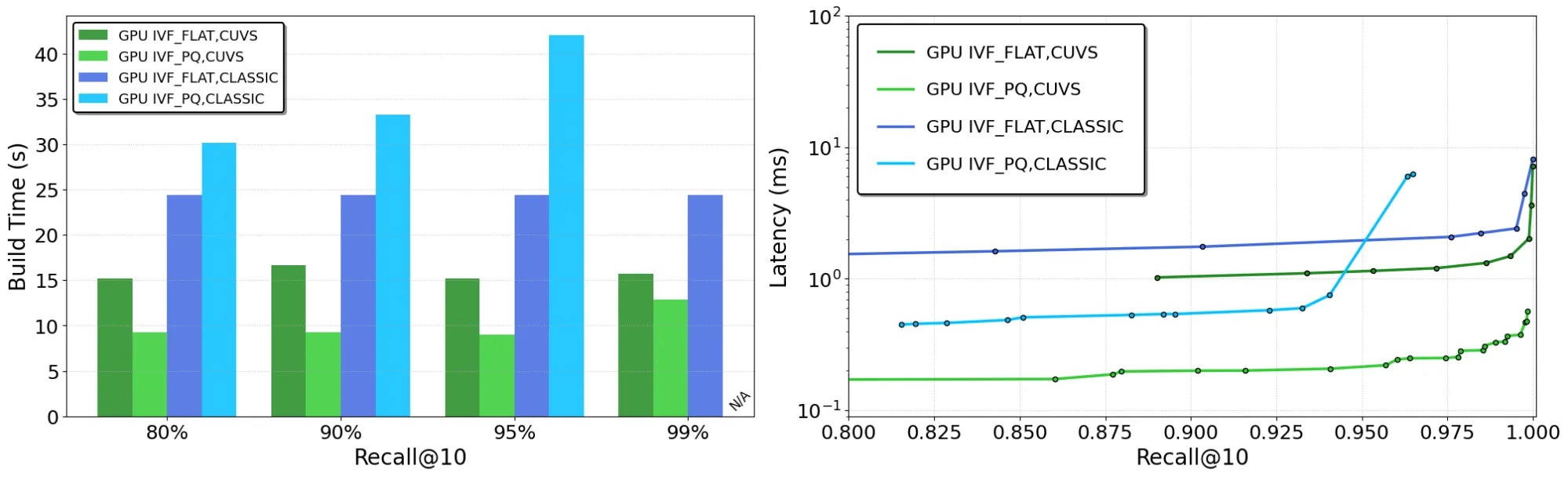
  • Build indexes up to 12x faster on GPU at 95% recall
  • Achieve search latencies up to 8x lower at 95% recall
  • Easily move indexes between GPU and CPU environments to match your deployment needs

GPU acceleration in Faiss

Faiss is a popular library for vector search across research and production environments. It supports standalone usage, integration with PyTorch, and embedding within vector databases like RocksDB, OpenSearch, and Milvus.

Faiss pioneered GPU support in 2018 and has continued evolving since then. At the NeurIPS 2021 big-ann-benchmarks competition, NVIDIA claimed first place with GPU-accelerated algorithms. These methods were later contributed to Faiss and now live in the open source cuVS library.

Since Faiss v1.10.0, users can opt into cuVS for enhanced versions of inverted file index algorithms IVF-PQ, IVF-Flat, Flat (aka brute-force), and CAGRA (Cuda Anns GRAph-based)—a high-performance graph-based index built from the ground up for GPUs.

Effortless CPU-GPU interoperability

Accelerating GPU indexes in Faiss with cuVS unlocks new levels of CPU-GPU interoperability. With Faiss, you can build indexes on the GPU and then deploy them to the CPU. This gives Faiss users the ability to accelerate index building with GPUs while maintaining their CPU search architectures. It’s all accomplished seamlessly in the Faiss library.

To provide an example, Hierarchical Navigable Small-World (HNSW) indexes are notoriously slow to build on the CPU, especially at scale, taking several hours or even days. CAGRA indexes, on the other hand, can be built up to 12x faster. These CAGRA graphs can be formatted as HNSW indexes in Faiss and then deployed for search on the CPU.

Benchmarking Faiss with cuVS

Performance benchmarks were performed comparing on the following two datasets comparing Faiss with and without cuVS enabled:

  1. Deep100M: A 100M-vector subset of the Deep1B dataset (96 dimensions). 
  2. OpenAI Text Embeddings: 5M vectors (1,536 dimensions) from the text-embedding-ada-002 model.

Tests were run on an NVIDIA H100 Tensor Core GPU and an Intel Xeon Platinum 8480CL CPU. Measurements were taken for:

  • Index build time
  • Single-query latency (online search)
  • Large-batch throughput (offline search)

Because the growth of unstructured data is happening so quickly, it’s important that index build performance continues to increase. However, measuring an index build time alone is meaningless without considering the search performance and quality of the resulting model. For this reason, the team created its own methodology for benchmarking index builds. For more details, see the cuVS documentation. 

In addition to considering search performance and quality, it’s also important to compare models against the best performing parameter settings. This is done using Pareto curves to ensure that each comparison is fair. Speedups in latency and throughput to compare various indexes are done at the 95% recall level.

IVF: cuVS versus Faiss GPU classic

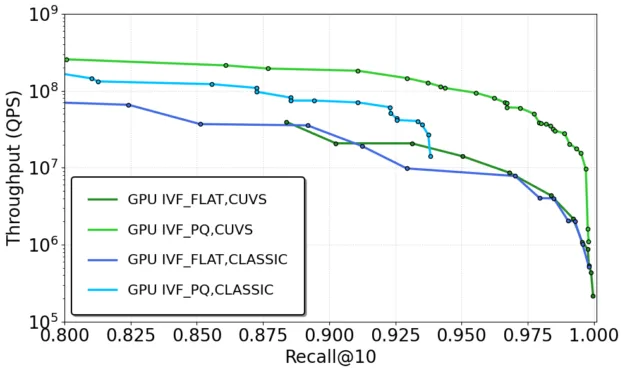
We first benchmarked the IVF indexes IVF-Flat and IVF-PQ to compare Faiss classic GPU implementations against the new Faiss variants w/ cuVS support:

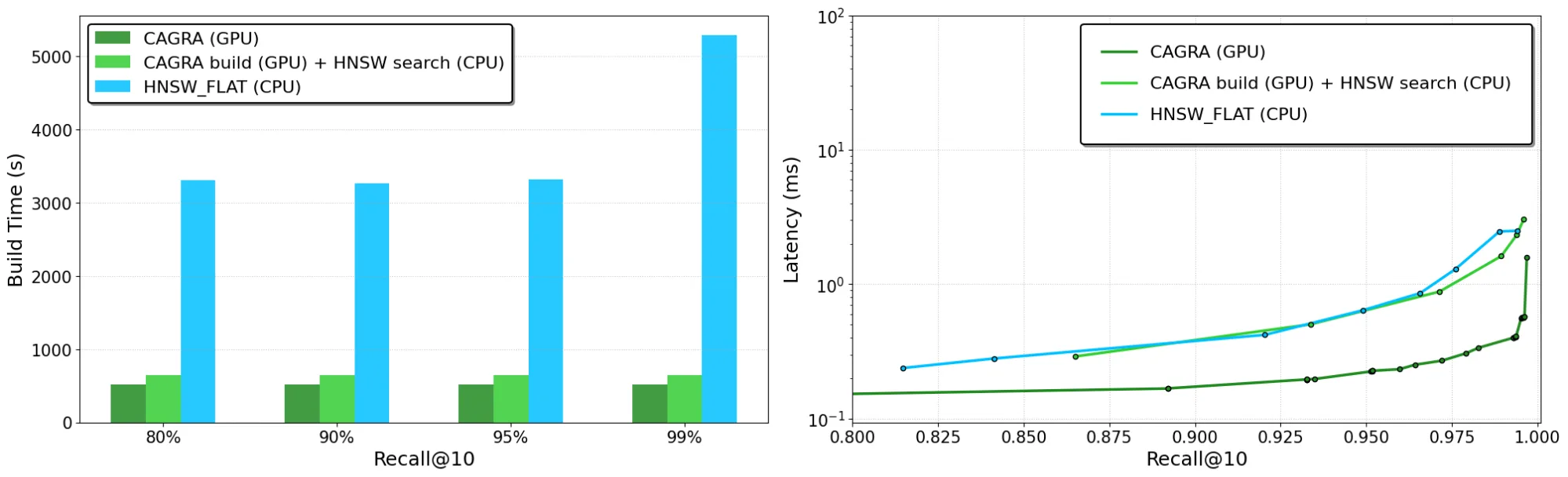
  • Build time: IVF-PQ and IVF-Flat were built up to 4.7x faster using cuVS (Figure 1)
  • Latency: Search latency was up to 8x lower for IVF-PQ, and 90% lower for IVF-Flat (Figure 1)
  • Throughput: cuVS improved large-batch search throughput up to 3x for IVF-PQ across both datasets (Figure 2), while maintaining comparable performance for IVF-Flat. This makes it well-suited for high-volume and large offline search workloads.

Online latency

Figures 1a and 1b show online search latency and build time across IVF index variants. cuVS consistently delivers faster index builds and significantly lower search latency across both datasets compared to classic Faiss.

Figure 1a. For Deep100M images (100M x 96), average index build times for best-performing configurations (lowest online latency) at specific recall levels (left), and search latency Pareto frontier for single-query online search at k=10—lower is better (right)

Two side-by-side images: On the left:  chart showing pareto frontier curves for search latency for the best performing configurations of the IVF-Flat and IVF-PQ indexes on the OpenAI text embeddings dataset. FAISS w/ cuVS shows comparable or better performance than FAISS Classic on GPU. On the right: A chart showing pareto frontier curves for search latency for the best performing configurations of the IVF-Flat and IVF-PQ indexes on the OpenAI text embeddings dataset. FAISS w/ cuVS shows comparable or better performance than FAISS Classic on GPU.Figure 1b. For OpenAI text embeddings, average index build times for best-performing configurations (left) and search latency Pareto frontier—lower is better (right)
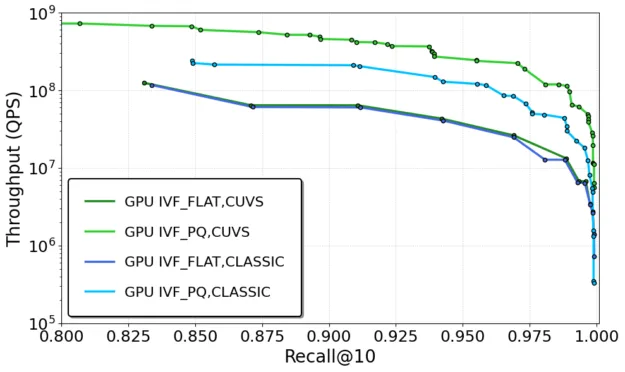
Batch (offline) throughput

Figure 2 shows batch throughput across IVF index variants. cuVS improves batch processing performance, serving significantly more queries per second across both image and text embeddings. 

A chart showing pareto frontier curves of search large-batch search throughput for the best performing configurations of the best performining configurations on the Deep-100M dataset. FAISS w/ cuVS demonstrates comparable or better performance than FAISS Classic on GPU.

 chart showing Pareto Frontier curves of search large-batch search throughput for the best performing configurations of the best performing configurations on the OpenAI text embeddings dataset. FAISS w/ cuVS demonstrates comparable or better performance than FAISS Classic on GPU.
Figure 2. Search throughput with batches of 10,000 queries indicating number of queries served per second (higher is better) for Deep100M images (left) and OpenAI text embeddings (right)

These improvements stem from better GPU clustering (for example, balanced k-means), expanded parameter support (for example, more subquantizers for IVF-PQ), and code-level optimizations.

Graph-based indexes: cuVS CAGRA versus Faiss HNSW (CPU)

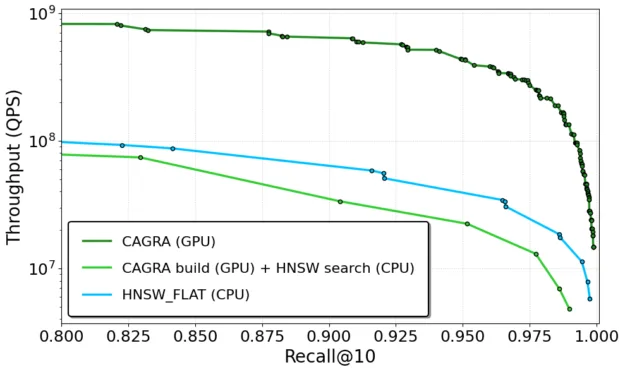
CAGRA is a GPU-optimized, fixed-degree flat graph index that offers major performance advantages over CPU-based HNSW, including:

  • Build time: CAGRA builds up to 12.3x faster (Figure 3)
  • Latency: Online search is up to 4.7x faster (Deep100M) (Figure 3)
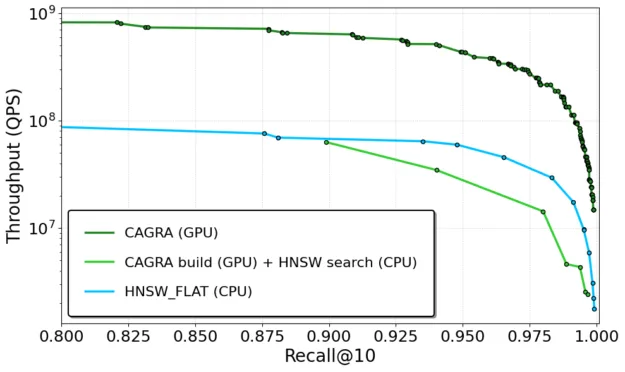
  • Throughput: In offline search settings, CAGRA delivers up to 18x higher throughput for image data and more than 8x for text embeddings (Figure 4), making it ideal for workloads requiring high-volume inference at low latency.

cuVS enables a CAGRA graph to be converted directly to an HNSW graph, which allows the graph to build much faster on the GPU, while using the CPU for search with comparable speed and quality.

Online latency

Figures 3a and 3b show online latency and build time for GPU CAGRA versus CPU HNSW. CAGRA dramatically accelerates index builds and lowers online query latency—up to 4.7x faster search compared to HSNW on CPU for Deep100M.

Two side-by-side images. One the left: A chart showing average index build times for the best performing configurations of the CAGRA and HNSW indexes on the Deep-100M dataset. FAISS w/ cuVS (CAGRA) consistently outperforms FAISS on CPU (HNSW). On the right: A chart showing pareto frontier curves for search latency for the best performing configurations of the CAGRA and HNSW indexes on the Deep-100M dataset. FAISS w/ cuVS (CAGRA) shows much better performance than FAISS on CPU (HNSW) while searching a CAGRA graph on the CPU w/ HNSW show comparable performance.Figure 3a. For Deep100M (100M x 96) for GPU CAGRA versus CPU HNSW: average index build times for best-performing configurations across recall levels (left) and search latency Pareto frontier for single query search—lower is better (right)

Two side-by-side images. On the left: A chart showing average index build times for the best performing configurations of the CAGRA and HNSW indexes on the OpenAI text embeddings dataset. FAISS w/ cuVS (CAGRA) consistently outperforms FAISS on CPU (HNSW). On the right: A chart showing pareto frontier curves for search latency for the best performing configurations of the CAGRA and HNSW indexes on the OpenAI text embeddings dataset. FAISS w/ cuVS (CAGRA) shows much better performance than FAISS on CPU (HNSW) while searching a CAGRA graph on the CPU w/ HNSW show comparable performance.Figure 3b. For OpenAI text embeddings (5M x 1,536) for GPU CAGRA versus CPU HNSW: average index build times for best-performing configurations (left) and search latency Pareto frontier—lower is better (right)
Batch (offline) throughput

Figure 4 shows GPU CAGRA versus CPU HNSW batch throughput. CAGRA achieves high throughput in batch scenarios—serving millions of queries per second and outperforming CPU-based HNSW across both datasets.

A chart showing pareto frontier curves for large-batch search throughput for the best performing configurations of the CAGRA and HNSW indexes on the Deep-100M dataset. FAISS w/ cuVS (CAGRA) shows much better performance than FAISS on CPU (HNSW) while searching a CAGRA graph on the CPU w/ HNSW shows comparable performance.

A chart showing pareto frontier curves for large-batch search throughput for the best performing configurations of the CAGRA and HNSW indexes on the OpenAI Text Embeddings dataset. FAISS w/ cuVS (CAGRA) shows much better performance than FAISS on CPU (HNSW) while searching a CAGRA graph on the CPU w/ HNSW shows comparable performance.
Figure 4. Search throughput with batches of 10,000 queries indicating number of queries served per second (higher is better) for Deep100M images (left) and OpenAI text embeddings (right)

How to get started with cuVS in Faiss

This section briefly introduces the process for installing Faiss with cuVS support and provides brief code examples for creating and searching an index with Python. 

Installation

You can build Faiss with cuVS or with prebuilt Conda packages:

# Conda install (CUDA 12.4)
conda install -c rapidsai -c conda-forge -c nvidia pytorch::faiss-gpu-cuvs
‘cuda-version>=12.0,<=12.9'

Alternatively, you can install the latest nightly build of the cuVS-enabled Faiss package using the following command:

conda install -c rapidsai -c rapidsai-nightly -c conda-forge -c nvidia
pytorch/label/nightly::faiss-gpu-cuvs ‘cuda-version>=12.0,<=12.9'

Memory management

Use the following snippet to enable GPU memory pooling with RMM (recommended). This approach can improve performance.

import rmm
pool = rmm.mr.PoolMemoryResource(
rmm.mr.CudaMemoryResource(),
initial_pool_size=2**30
)
rmm.mr.set_current_device_resource(pool)

Build an IVFPQ Index with cuVS

With the faiss-gpu-cuvs package, cuVS is automatically used for supported index types—requiring no code changes to benefit from its performance improvements. An example of creating an IVFPQ index using the cuVS backend is shown below:

import faiss
import numpy as np

np.random.seed(1234)
xb = np.random.random((1000000, 96)).astype(‘float32’)
xq = np.random.random((10000, 96)).astype(‘float32’)
xt = np.random.random((100000, 96)).astype(‘float32’)

res = faiss.StandardGpuResources()
# Disable the default temporary memory allocation since an RMM pool resource has already been set.
res.noTempMemory()

# Case 1: Creating cuVS GPU index
config = faiss.GpuIndexIVFPQConfig()
config.interleavedLayout = True
index_gpu = faiss.GpuIndexIVFPQ(res, 96, 1024, 96, 6, faiss.METRIC_L2, config) # expanded parameter set with cuVS (bits per code = 6).
index_gpu.train(xt)
index_gpu.add(xb)

# Case 2: Cloning a CPU index to a cuVS GPU index
quantizer = faiss.IndexFlatL2(96)
index_cpu = faiss.IndexIVFPQ(quantizer,96, 1024, 96, 8, faiss.METRIC_L2)
index_cpu.train(xt)
co = faiss.GpuClonerOptions()
index_gpu = faiss.index_cpu_to_gpu(res, 0, index_cpu, co)
# The cuVS index now uses the trained quantizer as it’s IVF centroids.
assert(index_gpu.is_trained)
index_gpu.add(xb)
k = 10
D, I = index_gpu.search(xq, k)

Build a cuVS CAGRA index

The following example demonstrates how to build and query a CAGRA index using Faiss with cuVS acceleration.

import faiss
import numpy as np

# Step 1: Create the CAGRA index config
config = faiss.GpuIndexCagraConfig()
config.graph_degree = 32
config.intermediate_graph_degree = 64

# Step 2: Initialize the CAGRA index
res = faiss.StandardGpuResources()
gpu_cagra_index = faiss.GpuIndexCagra(res, 96, faiss.METRIC_L2, config)

# Step 3: Add the 1M vectors to the index
n = 1000000
data = np.random.random((n, 96)).astype(‘float32’)
gpu_cagra_index.train(data)

# Step 4: Search the index for top 10 neighbors for each query.
xq = np.random.random((10000, 96)).astype(‘float32’)
D, I = gpu_cagra_index.search(xq,10)

CAGRA indexes can be automatically converted to HNSW format through the new faiss.IndexHNSWCagra CPU class, enabling GPU-accelerated index builds followed by CPU-based search:

# Create the HNSW index object for vectors with 96 dimensions.
M = 16
cpu_hnsw_index = faiss.IndexHNSWCagra(96, M, faiss.METRIC_L2)
cpu_hnsw_index.base_level_only=False

# Initializes the HNSW base layer with the CAGRA graph.
gpu_cagra_index.copyTo(cpu_hnsw_index)

# Add new vectors to the hierarchy.
newVecs = np.random.random((100000, 96)).astype(‘float32’)
cpu_hnsw_index.add(newVecs)

For full code examples, see the Faiss cuVS notebook.

Get more from your vectors

The integration of NVIDIA cuVS into Faiss delivers substantial improvements in both speed and scalability for approximate nearest neighbors (ANN) search. Whether you’re working with inverted file (IVF) indexes or graph-based methods, Faiss integration of cuVS offers:

  • Faster index builds: Up to 12x acceleration on GPU
  • Lower search latency: Up to 4.7x improvement in real-time search
  • Effortless CPU-GPU interoperability: Build on GPU, search on CPU, and vice versa

The team has also introduced CAGRA, a high-performance, graph-based index purpose-built for GPUs, which outperforms classical CPU-based HNSW in both build time and throughput. Better still, CAGRA graphs can be converted to HNSW for efficient CPU-based inference—offering the best of both for hybrid deployments.

Whether you’re scaling search infrastructure to handle millions of queries per second or rapidly experimenting with new embedding models, integrating Faiss with cuVS gives you the tools to move faster, iterate smarter, and deploy confidently.

Ready to get started? Install the faiss-gpu-cuvs package and explore the example notebook.

.Organize the content with appropriate headings and subheadings ( h2, h3, h4, h5, h6). Include conclusion section and FAQs section with Proper questions and answers at the end. do not include the title. it must return only article i dont want any extra information or introductory text with article e.g: ” Here is rewritten article:” or “Here is the rewritten content:”

SmartThings Blog

0

From real-time temperature insights to automated blinds, the SmartThings Sleep Environment report helps you begin your journey to better sleep.  

Sleep is one of the most important parts of your health and well-being. Yet so many of us struggle with it, tossing and turning, waking up groggy, or dealing with little ones who just won’t stay down for the night.

The truth is, your environment plays a huge role in how well you rest. The SmartThings Sleep Environment Report gives you a clearer picture of what’s happening in your bedroom while you rest, so you can make small changes that add up to better nights and brighter mornings. With the Aeotec Smart Home Hub 2 and the Eve Weather Connected Weather Station, you’ll have everything you need to get started.  

How to get started with better sleep

The Aeotec Smart Home Hub 2 is the brain of your smart home, connecting your devices and automations in one place. Pair it with Eve Weather and you unlock powerful new insights into your sleep environment, making this duo the perfect starting point for a smarter, healthier home.

Both devices are Matter-certified for simple setup, work with both Android and iOS, and are designed to make your home more responsive from day one.

Smarter Insights with the Sleep Environment Report

The SmartThings Sleep Environment Report collects and analyzes data from connected devices in your home to help you understand what’s impacting your rest. It highlights patterns and potential disturbances like changes in temperature, humidity, or air quality, and shows when devices were active during the night. 

When paired with Eve Weather, SmartThings gains precise temperature and humidity readings from your bedroom. When combined with additional WWST sensors, insights such as CO2 levels and lighting can also be included. The report then uses that data to visualize your overnight environment, revealing whether your room got too warm, too cool, or too dry at any point. 

Was the room too warm between 1 a.m. and 3 a.m.? SmartThings highlights the factors that could be disturbing your rest and even shows which devices were running during the night. 

In addition, with the Samsung Health integration, you can combine this environmental data with your actual sleep measurements from Galaxy wearables to give you the full picture of both how you slept and why.

Automations that Work While You Sleep

Once SmartThings identifies the factors affecting your sleep, it helps you fix them automatically. By pairing the Smart Home Hub 2 with Eve Weather, you can set up routines that respond to changes in real time:  

  • Lowering the thermostat when the room gets too warm in the middle of the night
  • Turning on a humidifier if the air gets too dry
  • Dimming or shutting off lights at bedtime to help you wind down
  • Raise blinds upon waking up 

Instead of waking up to discomfort, your smart home quietly adjusts to keep your environment optimized for rest. 

Sleep Better, Live Better

It’s not just about comfort, it’s about waking up refreshed and ready for your day. With a smarter nighttime routine powered by SmartThings, the Smart Home Hub 2, and Eve Weather, you’ll finally have the environment your body needs for deeper rest.

And this solution works for the whole family. Parents can create routines that keep nurseries cozy through the night. Busy professionals can finally stop blaming stress when it’s really the air or temperature at fault. Even tech enthusiasts will love how seamlessly the system responds to real conditions in real time.

To take your sleep setup a step further, pair your system with Eve Blinds, motorized, Matter-enabled blinds that automatically close at bedtime to block out streetlights or early morning sun, then open gently when it’s time to wake.  Combined with your Eve Weather data and Sleep Environment Report insights, you can create a “Good Night” routine that lowers blinds, turns off lights, adjusts the thermostat, and begins tracking your sleep conditions, automatically through SmartThings. 

If you’re ready to say goodbye to restless nights and hello to mornings that feel truly refreshing, start with the Smart Home Hub 2 and Eve Weather, and consider adding Eve Blinds for the ultimate smart sleep setup. Together, they’ll help you understand your environment, improve your comfort, and create routines that support the rest you deserve.

Shop Eve Weather and Aeotec Smart Home Hub 2 now on Samsung.com.

Teaching robots to map large environments | MIT News

0

A robot searching for workers trapped in a partially collapsed mine shaft must rapidly generate a map of the scene and identify its location within that scene as it navigates the treacherous terrain.

Researchers have recently started building powerful machine-learning models to perform this complex task using only images from the robot’s onboard cameras, but even the best models can only process a few images at a time. In a real-world disaster where every second counts, a search-and-rescue robot would need to quickly traverse large areas and process thousands of images to complete its mission.

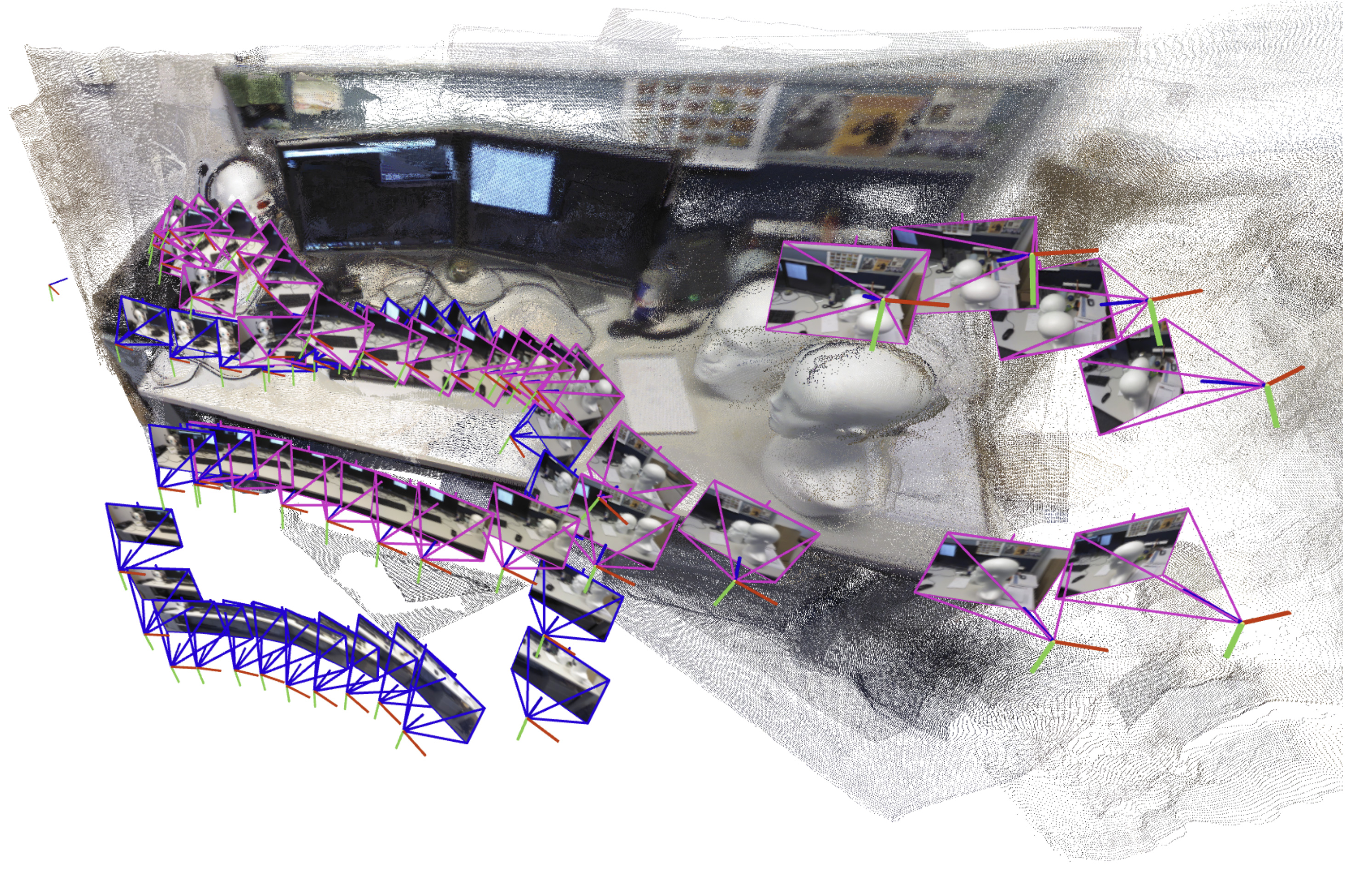
To overcome this problem, MIT researchers drew on ideas from both recent artificial intelligence vision models and classical computer vision to develop a new system that can process an arbitrary number of images. Their system accurately generates 3D maps of complicated scenes like a crowded office corridor in a matter of seconds. 

The AI-driven system incrementally creates and aligns smaller submaps of the scene, which it stitches together to reconstruct a full 3D map while estimating the robot’s position in real-time.

Unlike many other approaches, their technique does not require calibrated cameras or an expert to tune a complex system implementation. The simpler nature of their approach, coupled with the speed and quality of the 3D reconstructions, would make it easier to scale up for real-world applications.

Beyond helping search-and-rescue robots navigate, this method could be used to make extended reality applications for wearable devices like VR headsets or enable industrial robots to quickly find and move goods inside a warehouse.

“For robots to accomplish increasingly complex tasks, they need much more complex map representations of the world around them. But at the same time, we don’t want to make it harder to implement these maps in practice. We’ve shown that it is possible to generate an accurate 3D reconstruction in a matter of seconds with a tool that works out of the box,” says Dominic Maggio, an MIT graduate student and lead author of a paper on this method.

Maggio is joined on the paper by postdoc Hyungtae Lim and senior author Luca Carlone, associate professor in MIT’s Department of Aeronautics and Astronautics (AeroAstro), principal investigator in the Laboratory for Information and Decision Systems (LIDS), and director of the MIT SPARK Laboratory. The research will be presented at the Conference on Neural Information Processing Systems.

Mapping out a solution

For years, researchers have been grappling with an essential element of robotic navigation called simultaneous localization and mapping (SLAM). In SLAM, a robot recreates a map of its environment while orienting itself within the space.

Traditional optimization methods for this task tend to fail in challenging scenes, or they require the robot’s onboard cameras to be calibrated beforehand. To avoid these pitfalls, researchers train machine-learning models to learn this task from data.

While they are simpler to implement, even the best models can only process about 60 camera images at a time, making them infeasible for applications where a robot needs to move quickly through a varied environment while processing thousands of images.

To solve this problem, the MIT researchers designed a system that generates smaller submaps of the scene instead of the entire map. Their method “glues” these submaps together into one overall 3D reconstruction. The model is still only processing a few images at a time, but the system can recreate larger scenes much faster by stitching smaller submaps together.

“This seemed like a very simple solution, but when I first tried it, I was surprised that it didn’t work that well,” Maggio says.

Searching for an explanation, he dug into computer vision research papers from the 1980s and 1990s. Through this analysis, Maggio realized that errors in the way the machine-learning models process images made aligning submaps a more complex problem.

Traditional methods align submaps by applying rotations and translations until they line up. But these new models can introduce some ambiguity into the submaps, which makes them harder to align. For instance, a 3D submap of a one side of a room might have walls that are slightly bent or stretched. Simply rotating and translating these deformed submaps to align them doesn’t work.

“We need to make sure all the submaps are deformed in a consistent way so we can align them well with each other,” Carlone explains.

A more flexible approach

Borrowing ideas from classical computer vision, the researchers developed a more flexible, mathematical technique that can represent all the deformations in these submaps. By applying mathematical transformations to each submap, this more flexible method can align them in a way that addresses the ambiguity.

Based on input images, the system outputs a 3D reconstruction of the scene and estimates of the camera locations, which the robot would use to localize itself in the space.

“Once Dominic had the intuition to bridge these two worlds — learning-based approaches and traditional optimization methods — the implementation was fairly straightforward,” Carlone says. “Coming up with something this effective and simple has potential for a lot of applications.

Their system performed faster with less reconstruction error than other methods, without requiring special cameras or additional tools to process data. The researchers generated close-to-real-time 3D reconstructions of complex scenes like the inside of the MIT Chapel using only short videos captured on a cell phone.

The average error in these 3D reconstructions was less than 5 centimeters.

In the future, the researchers want to make their method more reliable for especially complicated scenes and work toward implementing it on real robots in challenging settings.

“Knowing about traditional geometry pays off. If you understand deeply what is going on in the model, you can get much better results and make things much more scalable,” Carlone says.

This work is supported, in part, by the U.S. National Science Foundation, U.S. Office of Naval Research, and the National Research Foundation of Korea. Carlone, currently on sabbatical as an Amazon Scholar, completed this work before he joined Amazon.

Generate single title from this title How AI is streamlining special education in 100 -150 characters. And it must return only title i dont want any extra information or introductory text with title e.g: ” Here is a single title:”

Write an article about

Key points:

Districts nationwide are grappling with increased special education demands amid persistent staff shortages and compliance pressures. At the intersection of technology and student support, Maura Connor, chief operating officer of Better Speech, is leading the launch of Streamline, an AI-powered special education management platform designed to ease administrative burdens and enhance service delivery.

In this Q&A, Connor discusses the realistic, responsible ways AI can empower educators, optimize workflows, and foster stronger connections between schools and families.

1. Many districts are experiencing an increase in special education caseloads while struggling with staff shortages and retention. From your perspective, where can AI most realistically help relieve pressure on special educators without compromising their quality of service?

AI is most impactful when it handles time-intensive, repetitive tasks that don’t require nuanced human judgment. For example, AI can assist in drafting initial progress or intervention notes and tracking intervention outcomes to help identify students who may need additional support. By automating these administrative tasks, special educators and service providers can spend more time delivering direct instruction or therapy, collaborating with colleagues, and planning individualized support for students.

Importantly, AI is a tool that augments, not replaces, human expertise. It can relieve pressure in the special education ecosystem while allowing educators to maintain the high-quality services students need.

2. Special education leaders need to balance efficiency with compliance when it comes to IEP evaluations and goals. How can AI help schools and districts with this?

AI can standardize data collection and analysis, ensuring evaluations capture all legally required components while reducing the manual burden. Advanced AI analytics can also flag potential compliance gaps before they become serious risks and help identify patterns across a student’s performance.

For case managers and providers, especially those new to special education, AI can accelerate skill-building by helping draft legally-defensible, evidence-based IEP goals and recommendations. Rather than spending hours on formatting and documentation, this allows educators and administrators to focus on meaningful decision-making, personalized student support, and family engagement.

3. Beyond easing paperwork, what are some practical ways school and district leaders can use AI to reallocate staff time toward more student-facing work?

AI can help leaders identify trends and bottlenecks across their special education programs, such as caseload imbalances, scheduling inefficiencies, budget planning, or capacity in high-demand intervention areas. By surfacing these insights, districts can make data-informed staffing adjustments, prioritize coaching and professional development, and streamline workflows so teachers and service providers are freed up for individual instruction, small-group interventions, and collaborative planning.

Essentially, AI can turn administrative time into actionable intelligence that translates directly into better targeted student support.

4. When it comes to parent engagement, how can AI support stronger, more transparent communication between schools and families?

Parent engagement in the special education process can be a sensitive experience for districts and families alike. And, it’s a critical challenge we often hear about from leaders and teachers.

AI relieves some of the pressure by generating clear, real-time updates on student progress. In this way, AI can increase transparency and communication, helping families stay informed and engaged without overwhelming staff through repetitive outreach. For example, automated notifications about milestones, progress toward IEP goals, or upcoming meetings can ensure families receive timely, understandable information.

AI can also assist in translating materials for non-English-speaking families, creating more equitable access to information and empowering parents to be active partners in their child’s education.

5. Given the growing availability and use of generative AI tools, how can school and district leaders set guardrails to ensure educators use these tools ethically and securely?

Responsible and ethical use of AI in education starts with districts setting clear policies and engaging in targeted professional development. Leaders should define boundaries around student data privacy, clarify when AI outputs require human review, and provide training on responsible AI use. AI should always enhance staff capacity without compromising student safety or the integrity of decision-making. Since AI can “hallucinate,” it is absolutely critical that educators and providers use their own professional and clinical judgment in reviewing and approving any recommendations generated by AI. Districts should also consider using a proprietary, evidence-based LLM engine instead of open-source AI tools to lessen this risk.

Establishing guardrails also means monitoring usage, maintaining transparency with families, and fostering a culture where AI is a support, not a replacement, for professional and clinical judgment.

6. Overall, what role can AI-powered analytics play in helping school and district leaders make more data-driven, proactive decisions?

AI-powered analytics can transform reactive management into proactive planning. By aggregating and analyzing multiple data points–from academic performance to intervention outcomes–leaders can identify trends and potential compliance issues before they become legal risks. District leaders can also allocate resources more strategically and design targeted programs for students who need the most support or readily plan for coverage or extra resources when settings need to increase capacity.

Overall, AI’s predictive capability can help districts move beyond compliance toward strategic continuous improvement, ensuring every decision is informed by actionable insights rather than intuition alone.

Maura Connor is Chief Operating Officer of Better Speech, where she leads the launch of Streamline, an AI-powered special education management platform that reduces administrative burden and empowers schools to better support students and families. With extensive leadership experience across education and healthcare technology, she specializes in scaling organizations, driving innovation, and advancing solutions that improve outcomes for children and communities.

Laura Ascione is the Editorial Director at eSchool Media. She is a graduate of the University of Maryland’s prestigious Philip Merrill College of Journalism.

Laura AscioneLatest posts by Laura Ascione (see all)

.Organize the content with appropriate headings and subheadings ( h2, h3, h4, h5, h6). Include conclusion section and FAQs section with Proper questions and answers at the end. do not include the title. it must return only article i dont want any extra information or introductory text with article e.g: ” Here is rewritten article:” or “Here is the rewritten content:”

Generate single title from this title IoT Devices by the Numbers: How Many Are Expected in 2025? in 100 -150 characters. And it must return only title i dont want any extra information or introductory text with title e.g: ” Here is a single title:”

Write an article about

How many IoT devices are there today, and how fast will that number grow? Businesses, governments, and consumers face this question as connected devices enter nearly every part of life. From smart homes to predictive maintenance in factories, the Internet of Things changes the way systems work. 

Still, many people ask how many IoT devices there will be in 2025 compared to today. A moderate estimate shows about 19.08 billion connected devices in 2025, rising from 17.08 billion in 2024. That growth feels massive, but it also raises questions about costs, security, and adoption barriers. In this blog, we explore the real numbers, growth trends, and future projections to see where IoT stands.

Launch your IoT solution ! Cotact Us

Current Estimates of IoT Devices Worldwide

Analysts debate the number of IoT devices by 2025. Different reports use different definitions, so estimates range from modest to massive. IoT Analytics sets the figure near 27.1 billion IoT connected devices forecast by 2025. On the other hand, more cautious studies show numbers closer to 19 billion. 

El País reports that connected devices will exceed 25 billion in early 2026, heading toward 40 billion before 2030. These differences show why people keep asking: how many IoT devices are there currently, and how fast will adoption rise?

Number of IoT devices in use today

Today’s numbers give us a baseline. Most researchers agree that over 17 billion IoT devices are active in 2024. This includes consumer tools like smart speakers, as well as enterprise and industrial systems. The number of IoT devices continues to grow each quarter as more industries embrace automation. 

When people ask how many IoT devices are there in the world today, the safest answer is 17–18 billion devices currently in use. This context helps make sense of the next surge in adoption.

Consumer vs. enterprise adoption

Consumer and enterprise adoption both fuel IoT growth, but the balance looks different depending on the market. Consumers eagerly buy smart homes, wearables, and connected cars. Enterprises heavily invest in healthcare devices, logistics tracking, and factory automation. 

Both sides answer the question of how many IoT devices are estimated to be in the world. Right now, consumer devices outnumber enterprise units, but revenue impact is larger in enterprise and industrial adoption.

Leading industries in IoT adoption

Industry Share of Global IoT Devices (2024–2025) Examples of Applications
Consumer Electronics 45% Smart homes, wearables, connected cars
Healthcare 12% Remote monitoring, telemedicine devices
Manufacturing 15% Predictive maintenance, robotics integration
Retail & Logistics 10% Supply chain tracking, smart shelves
Smart Cities 8% Traffic control, energy grids, safety nets
Other Sectors 10% Agriculture, utilities, oil & gas

The number of IoT devices by 2025 will reflect this mix. Industries like healthcare and logistics expand fast as IoT links with artificial intelligence. For example, supply chains now use smart systems as explained in IoT in supply chain.

IoT Growth Trends in Recent Years

The Internet of Things statistics from the last four years tell a clear story. Device adoption accelerates year after year, with small dips only when chip shortages hit. Many experts track the compound annual growth rate, or CAGR, to see the pace. These IoT growth statistics show both opportunity and pressure for companies to adapt.

CAGR of IoT devices from 2020–2024

Between 2020 and 2024, IoT devices increased at a CAGR of nearly 20%, depending on the sector. In 2020, there were around 10–12 billion devices, while by 2024, the number had reached 17 billion. That means billions of new devices connect every year. People who ask how many IoT devices are there in the world today may be shocked at the speed of this growth.

CAGR Growth Table

Year Number of IoT Devices (approx) Growth vs. Previous Year
2020 11 billion
2021 13.5 billion 0.23
2022 15.1 billion 0.12
2023 16.2 billion 0.07
2,024 17.08 billion 0.05

The table shows how many IoT devices are there currently, and why the question of 2025 numbers draws attention. Slower growth in 2023–2024 came from supply issues, but trends suggest a rebound.

Key factors fueling IoT growth

Several factors explain the fast rise in IoT adoption. These drivers shape the answer to how many IoT devices there will be in 2025 and beyond.

Driver Description Impact on IoT Growth
Falling Sensor Costs The price of sensors has dropped from dollars to cents, making IoT devices more affordable. Expands accessibility and adoption of IoT devices worldwide
Expansion of 5G Networks 5G rollout increases network speed and bandwidth, enabling more devices to connect simultaneously Facilitates the connection of a larger number of IoT devices
Edge Computing Adoption Devices process data locally at the edge, reducing latency and improving real-time applications Enhances the performance and scalability of IoT systems
Cloud Integration IoT relies on cloud platforms for data storage and advanced analytics, accelerating growth. Simplifies management and drives rapid IoT expansion
Industry Demand for Automation Sectors like healthcare and manufacturing require automation for predictive maintenance and monitoring Boosts the number and use cases for IoT devices
Consumer Demand for Smart Living Growth in smart home devices and wearables reflects rising consumer interest in smart lifestyles Drives mass adoption and mainstream integration of IoT

Barriers that slowed adoption

Not every factor drives growth. Some barriers explain why numbers remain lower than early high forecasts. Chip shortages during 2021–2022 limited device availability. Security fears stop some enterprises from scaling adoption. Standards remain fragmented, so devices from one brand may not connect easily with another. 

High upfront costs also slow small businesses. These barriers matter because they show why estimates differ when experts discuss how many IoT devices are there in 2025. For companies focused on sustainable adoption, even ESG priorities affect how IoT growth unfolds.

Future Projections: How Many IoT Devices by 2025?

Forecasts for 2025 raise the central question: how many IoT devices are there in 2025 compared to today? The short answer is billions more. The range sits between 19.08 billion devices from Scoop.market.us and 27.1 billion devices from IoT Analytics. 

This wide range makes people wonder what definition experts use for IoT devices. Do we count sensors inside factories, or just consumer gadgets? Regardless of method, the number of IoT devices by 2025 nearly doubles what we saw only five years ago.

1. Forecasted global number of IoT devices

Forecasts are useful because they shape budgets and technology planning. Investors ask how many IoT devices are there estimated to be in the world, and the answer drives billions in funding. 

Governments need these numbers to plan for 5G rollout, smart cities, and energy grids. Businesses track IoT connected devices forecast to see what consumer demand means for them. Even conservative estimates show billions of new devices connecting each year.

2. Long-term projections beyond 2025

Looking past 2025, forecasts get bolder. El País reports that IoT devices will exceed 25 billion in early 2026 and reach 40 billion before 2030. This pace shows why companies keep asking how many IoT devices are there currently, and how much faster adoption will rise. 

The long-term number of IoT devices depends on chip supply, consumer interest, and security fixes. But with new industries joining every year, the Internet of Things statistics keep climbing.

3. Economic impact and revenue growth

Numbers mean little without context on economic impact. McKinsey Global Institute estimates IoT applications could generate between $3.9 trillion and $11.1 trillion per year by 2025. That includes healthcare, manufacturing, smart cities, logistics, and consumer electronics. 

Enterprises see IoT as both a cost saver and a revenue driver. This explains why enterprise IoT spending grows from $159 billion in 2021 to $412 billion in 2025. Numbers like these show why companies ask not just how many IoT devices are there in 2025, but how much money those devices will produce.

Regional Distribution of IoT Adoption

The growth of IoT differs by region. Some areas move fast because they have infrastructure, others lag behind due to costs or regulations. Analysts break down the number of IoT devices by 2025 regionally, since different industries dominate in different areas.

North America: Smart homes and enterprise IoT

In North America, smart homes, wearables, and connected cars lead adoption. Enterprises focus on healthcare and logistics. People ask how many IoT devices are there in the US, and the answer is tens of millions across households and businesses. With a strong 5G rollout, the US and Canada keep pace with Europe. 

By 2025, North America may host over 6 billion devices. Healthcare is especially strong, with remote patient monitoring becoming standard. Smart farming solutions also rise as seen in smart farming apps.

Europe: Industry 4.0 and sustainable solutions

Europe stands out with Industry 4.0 adoption. Manufacturing plants integrate predictive maintenance and automation at scale. When companies in Europe ask how many IoT devices there are estimated to be in the world, they focus on industry share. Germany, France, and the UK drive adoption in factories. 

Sustainability also guides European adoption. Smart energy grids and efficient transportation systems show how IoT aligns with ESG priorities. By 2025, Europe should account for 20–22% of global IoT devices.

Asia-Pacific: Consumer electronics and manufacturing

Asia-Pacific leads the world in IoT adoption. China and India grow fastest due to manufacturing demand and consumer electronics. India alone sees growth above 29% CAGR in Industrial IoT. 

By 2025, Asia-Pacific could host 58% of Industrial IoT data, up from 46% in 2020. When people ask how many IoT devices are there in 2025, Asia-Pacific holds most of the answer. Consumer devices like smartphones, wearables, and connected cars grow quickly. Industrial automation in China also fuels billions of connections.

Emerging markets: Middle East, Africa, Latin America

Emerging markets expand slower but show promise. Smart cities in the Middle East drive adoption through energy and water management. Africa sees IoT in agriculture, logistics, and mobile health. 

Latin America invests in retail IoT and smart homes. Even though growth is uneven, the question of how many IoT devices are there in the world today includes millions from these regions. By 2025, emerging markets together may account for 10–12% of all IoT devices.

Key Use Cases of IoT Devices in 2025

Numbers alone do not tell the full story. IoT devices show their value in real use cases. People ask how many IoT devices are there in 2025 because they want to understand where adoption happens.

Projected IoT Device Growth by Sector

1. Consumer IoT: Smart homes, wearables, connected cars

Consumers buy IoT devices for convenience. Smart homes, wearable devices, and connected cars dominate this sector. These devices explain much of the number of IoT devices by 2025. Smart speakers, thermostats, and security cameras are everywhere in homes. Connected cars give drivers safety and automation. Wearables track health data daily. The growth of IoT devices in this area connects directly to consumer demand for a smarter lifestyle.

2. Enterprise IoT: Healthcare, retail, logistics

Enterprises adopt IoT to save money and improve operations. Healthcare leads with telemedicine and patient monitoring. Retail uses IoT for smart shelves and customer tracking. Logistics uses sensors for supply chain tracking. Enterprise adoption adds billions to how many IoT devices are there currently. IoT growth statistics show strong spending here, with enterprise IoT hitting $412 billion in 2025. Case studies like AI in IoT show why enterprises mix AI and IoT for smarter results.

3. Industrial IoT: Predictive maintenance, automation

Industrial IoT, or IIoT, includes devices in factories, plants, and energy systems. Predictive maintenance uses sensors to reduce downtime. Automation boosts output. By 2025, Industrial IoT may reach 152 million devices worldwide. 

These numbers matter because they add depth to how many IoT devices are there in 2025. Manufacturing in Europe and Asia grows fast, while North America and India follow close.

4. Smart Cities: Energy grids, traffic, safety systems

Smart cities highlight IoT’s impact on society. IoT devices power energy grids, monitor traffic, and keep streets safe. The Internet of Things statistics show billions invested in smart infrastructure by 2025. Governments often ask how many IoT devices are there in the world today to plan city budgets. From Barcelona to Dubai, smart city IoT adoption shapes urban living.

Build your scalable IoT system today!Let’s build it!

The Impact of IoT Device Growth on Businesses

Businesses cannot ignore IoT adoption. Growth in devices changes business models, customer service, and data management. Leaders ask how many IoT devices are there estimated to be in the world, because these numbers drive competition and strategy.

Opportunities for startups and enterprises

Startups find opportunity in IoT apps and platforms. Enterprises expand into automation, logistics, and smart services. The number of IoT devices by 2025 ensures markets for developers, service providers, and hardware suppliers. Companies see IoT as a way to cut costs and reach new markets. The spread of IoT in supply chains shows how startups can build supply chain apps to meet enterprise demand.

Data privacy, interoperability, and security challenges

The rise of billions of devices means billions of risks. Data privacy becomes harder to control. Interoperability challenges mean devices from different brands may not connect. Security gaps make IoT a target for cyberattacks. Many executives who ask how many IoT devices are there in 2025 also ask how secure those devices are. Without clear standards, growth comes with risks.

Global IoT Outlook: Stats Table

To close the analysis, here is a summary table with the top forecasts, long-term outlook, and economic impact.

Metric Estimate/Forecast
IoT devices in 2025 19.08 billion
IoT devices in 2025 27.1 billion
IoT devices early 2026 >25 billion
IoT devices by 2030 40 billion
IoT economic impact 2025 $3.9–11.1 trillion annually
Enterprise IoT spending 2025 $412 billion

This table brings clarity to how many IoT devices are there in 2025 and what economic value they carry.

Why Choose LITSLINK for IoT Development in 2025

The question of how many IoT devices are there in 2025 matters because businesses need expert partners to build real solutions. At LITSLINK, we work with startups and enterprises on IoT apps, industrial systems, and smart city projects. 

Our team brings strong skills in both software and hardware integration. We guide companies from idea to launch, helping them manage costs, security, and scalability. 

By 2025, experts forecast between 19 to 27 billion IoT devices worldwide. Growth comes from consumer electronics, industrial systems, and smart cities, driving trillions in economic impact. This surge reshapes industries and daily life with connected solutions.

The Internet of Things statistics point to billions of devices and trillions in impact, but what matters most is how your business uses that opportunity. If you plan IoT adoption, you need a partner who listens, builds, and supports. 

So, the final question: are you ready to join the IoT growth wave and make your business part of the future? Contact LITSLINK today and let us help you build your next IoT success.

More devices mean more data, smarter systems, and better decisions. Start your IoT transformation today!
Contact us now!

The post IoT Devices by the Numbers: How Many Are Expected in 2025? appeared first on Litslink.

.Organize the content with appropriate headings and subheadings ( h2, h3, h4, h5, h6). Include conclusion section and FAQs section with Proper questions and answers at the end. do not include the title. it must return only article i dont want any extra information or introductory text with article e.g: ” Here is rewritten article:” or “Here is the rewritten content:”