Home Blog Page 34

Generate single title from this title New Data Reveals The Top 20 Factors Influencing ChatGPT Citations in 100 -150 characters. And it must return only title i dont want any extra information or introductory text with title e.g: ” Here is a single title:”

0

Write an article about

SE Ranking analyzed 129,000 unique domains across 216,524 pages in 20 niches to identify which factors correlate with ChatGPT citations.

The number of referring domains ranked as the single strongest predictor of citation likelihood.

What The Data Says

Backlinks And Trust Signals

Link diversity showed the clearest correlation with citations. Sites with up to 2,500 referring domains averaged 1.6 to 1.8 citations. Those with over 350,000 referring domains averaged 8.4 citations.

The researchers identified a threshold effect at 32,000 referring domains. At that point, citations nearly doubled from 2.9 to 5.6.

Domain Trust scores followed a similar pattern. Sites with Domain Trust below 43 averaged 1.6 citations. The benefits accelerated significantly at the top end: sites scoring 91–96 averaged 6 citations, while those scoring 97–100 averaged 8.4.

Page Trust mattered less than domain-level signals. Any page with a Page Trust score of 28 or above received roughly the same citation rate (8.3 average), suggesting ChatGPT weighs overall domain authority more heavily than individual page metrics .

One notable finding: .gov and .edu domains didn’t automatically outperform commercial sites. Government and educational domains averaged 3.2 citations, compared to 4.0 for sites without trusted zone designations.

The authors wrote:

“What ultimately matters is not the domain name itself, but the quality of the content and the value it provides.”

Traffic & Google Rankings

Domain traffic ranked as the second most important factor, though the correlation only appeared at high traffic levels.

Sites under 190,000 monthly visitors averaged 2 to 2.9 citations regardless of exact traffic volume. A site receiving 20 organic visitors performed similarly to one receiving 20,000.

Only after crossing 190,000 monthly visitors did traffic correlate with increased citations. Domains with over 10 million visitors averaged 8.5 citations.

Homepage traffic specifically mattered. Sites with at least 7,900 organic visitors to their main page showed the highest citation rates.

Average Google ranking position also tracked with ChatGPT citations. Pages ranking between positions 1 and 45 averaged 5 citations. Those ranking 64 to 75 averaged 3.1.

The authors noted:

“While this doesn’t prove that ChatGPT relies on Google’s index, it suggests both systems evaluate authority and content quality similarly.”

Content Depth & Structure

Content length showed consistent correlation. Articles under 800 words averaged 3.2 citations. Those over 2,900 words averaged 5.1.

Structure mattered beyond raw word count. Pages with section lengths of 120 to 180 words between headings performed best, averaging 4.6 citations. Extremely short sections under 50 words averaged 2.7 citations.

Pages with expert quotes averaged 4.1 citations versus 2.4 for those without. Content with 19 or more statistical data points averaged 5.4 citations, compared to 2.8 for pages with minimal data.

Content freshness produced one of the clearer findings. Pages updated within three months averaged 6 citations. Outdated content averaged 3.6.

Surprisingly, the raw data showed that pages with FAQ sections actually received fewer citations (3.8) than those without (4.1). However, the researchers noted that their predictive model viewed the absence of an FAQ section as a negative signal. They suggest this discrepancy exists because FAQs often appear on simpler support pages that naturally earn fewer citations.

The report also found that using question-style headings (e.g., as H1s or H2s) underperformed straightforward headings, earning 3.4 citations versus 4.3. This contradicts standard voice search optimization advice, suggesting AI models may prefer direct topical labeling over question formats.

Social Signals & Review Platforms

Brand mentions on discussion platforms showed strong correlation with citations.

Domains with minimal Quora presence (up to 33 mentions) averaged 1.7 citations. Heavy Quora presence (6.6 million mentions) corresponded to 7.0 citations.

Reddit showed similar patterns. Domains with over 10 million mentions averaged 7 citations, compared to 1.8 for those with minimal activity.

The authors positioned this as particularly relevant for smaller sites:

“For smaller, less-established websites, engaging on Quora and Reddit offers a way to build authority and earn trust from ChatGPT, similar to what larger domains achieve through backlinks and high traffic.”

Presence on review platforms like Trustpilot, G2, Capterra, Sitejabber, and Yelp also correlated with increased citations. Domains listed on multiple review platforms earned 4.6 to 6.3 citations on average. Those absent from such platforms averaged 1.8.

Technical Performance

Page speed metrics correlated with citation likelihood.

Pages with First Contentful Paint under 0.4 seconds averaged 6.7 citations. Slower pages (over 1.13 seconds) averaged 2.1.

Speed Index showed similar patterns. Sites with indices below 1.14 seconds performed reliably well. Those above 2.2 seconds experienced steep decline.

One counterintuitive finding: pages with the fastest Interaction to Next Paint scores (under 0.4 seconds) actually received fewer citations (1.6 average) than those with moderate INP scores (0.8 to 1.0 seconds, averaging 4.5 citations). The researchers suggested extremely simple or static pages may not signal the depth ChatGPT looks for in authoritative sources.

URL & Title Optimization

The report found that broad, topic-describing URLs outperformed keyword-optimized ones.

Pages with low semantic relevance between URL and target keyword (0.00 to 0.57 range) averaged 6.4 citations. Those with highest semantic relevance (0.84 to 1.00) averaged only 2.7 citations.

Titles followed the same pattern. Titles with low keyword matching averaged 5.9 citations. Highly keyword-optimized titles averaged 2.8.

The researchers concluded: “ChatGPT prefers URLs that clearly describe the overall topic rather than those strictly optimized for a single keyword.”

Factors That Underperformed

Several commonly recommended AI optimization tactics showed minimal or negative correlation with citations.

FAQ schema markup underperformed. Pages with FAQ schema averaged 3.6 citations. Pages without averaged 4.2.

LLMs.txt files showed negligible impact. Outbound links to high-authority sites also showed minimal effect on citation likelihood.

Why This Matters

The findings suggest your existing SEO strategy may already serve AI visibility goals. If you’re building referring domains, earning traffic, maintaining fast pages, and keeping content updated, you’re addressing the factors this report identified as most predictive.

For smaller sites without extensive backlink profiles, the research points to community engagement on Reddit and Quora as a viable path to building authority signals The data also suggests focusing on content depth over keyword density.

The researchers note that factors are interdependent. Optimizing one signal while ignoring others reduces overall effectiveness.

Looking Ahead

SE Ranking analyzed ChatGPT specifically. Other AI systems may weight factors differently.

SE Ranking doesn’t specify which ChatGPT version or timeframe the data represents, so these patterns should be treated as directional correlations rather than proof of how ChatGPT’s ranking algorithm works.

Featured Image: BongkarnGraphic/Shuttersrtock

.Organize the content with appropriate headings and subheadings ( h2, h3, h4, h5, h6). Include conclusion section and FAQs section with Proper questions and answers at the end. do not include the title. it must return only article i dont want any extra information or introductory text with article e.g: ” Here is rewritten article:” or “Here is the rewritten content:”

Generate single title from this title GFN Thursday: 50% Off Three Months Ultimate in 100 -150 characters. And it must return only title i dont want any extra information or introductory text with title e.g: ” Here is a single title:”

0

Write an article about

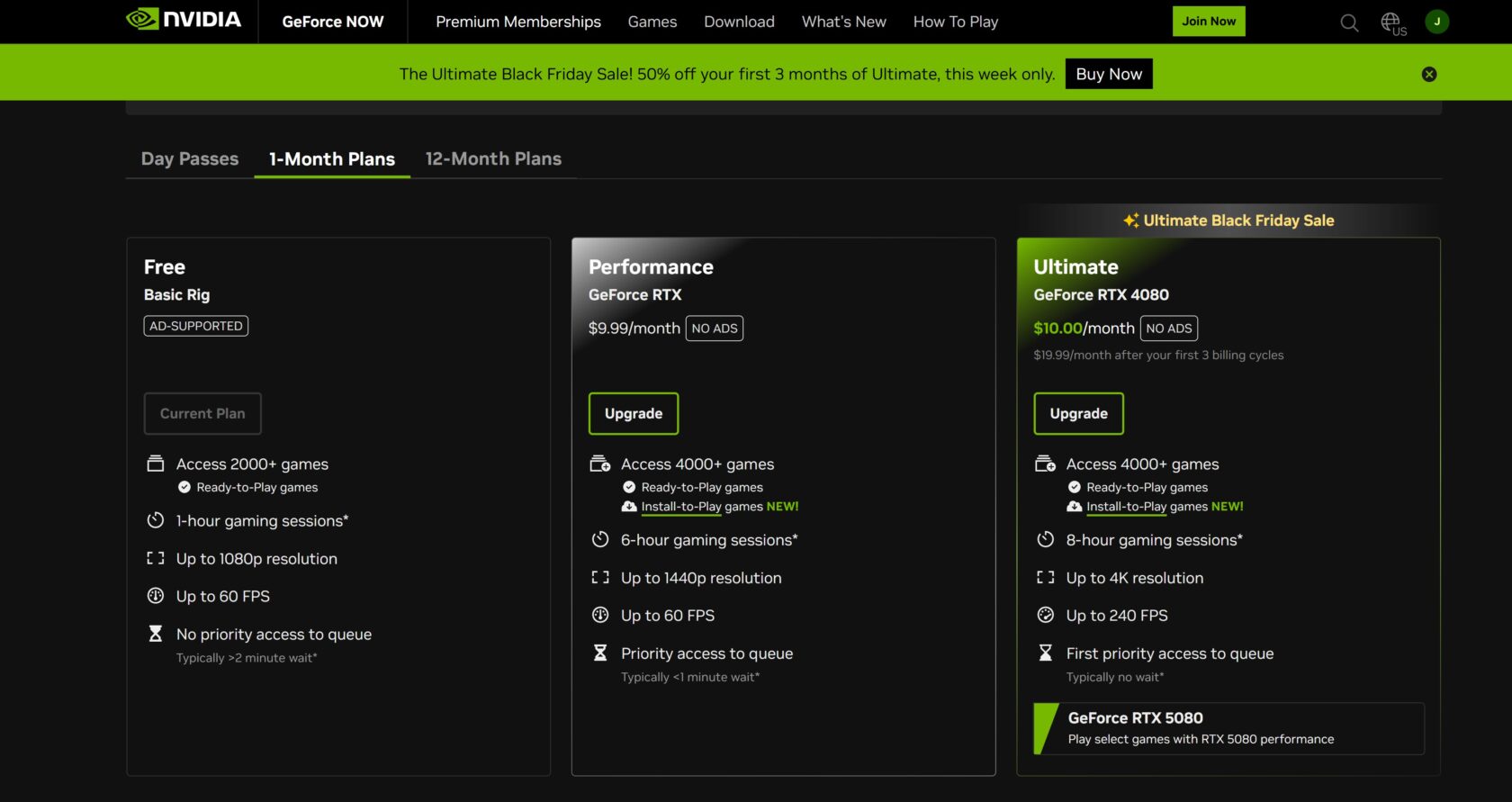
Black Friday is leveling up. Get ready to score one of the biggest deals of the season — 50% off the first three months of a new GeForce NOW Ultimate membership. That’s GeForce RTX 5080-class power in the cloud for half the price.

The completed Ultimate upgrade.

The NVIDIA Blackwell RTX upgrade is now fully live across all servers — including in Stockholm, the final region to receive the upgrade — bringing even faster performance and lower latency to more members.

To celebrate this milestone, Ultimate members can claim a Battlefield 6 reward to show off in style.

Kick off a gaming-filled weekend with seven new titles joining the GeForce NOW library.

And the GeForce NOW Community Video Contest continues. Submit epic gameplay moments or share what makes streaming with GeForce NOW special for a chance to win Ultimate day passes or even a full year of Ultimate access. Keep those clips rolling — there’s still time to enter and level up chances to win.

Black Friday, GFN Thursday

Black Friday Product MatrixGreen is the new black.

The Ultimate Black Friday Sale is the perfect time to upgrade to peak cloud performance, with Blackwell RTX now live worldwide. Through Sunday, Nov. 30, the first three months of an Ultimate membership are 50% off.

An Ultimate membership delivers GeForce RTX 5080-class power from the cloud, powering the fastest frame rates, ultrasmooth gameplay and breathtaking visuals with NVIDIA DLSS 4 technology. With cinematic-quality streaming up to 5K 120 frames per second, every session plays out with premium precision.

Top titles like Battlefield 6, Borderlands 4 and Outer Worlds 2 shine with GeForce RTX 50 Series performance. From explosive action to expansive worlds, Ultimate transforms every adventure into a showpiece.

The Ultimate Black Friday Sale — available in the U.S., Mexico and Japan — ends at the end of this week. Take advantage now for epic savings and next-level performance.

Built for Victors

Battlefield 6 reward on GeForce NOWDominate the battlefield.

Ultimate members will turn heads in Battlefield 6 with a new free reward: an in-game weapon skin for the Marksman SVK-8.6 DMR, forged for those who thrive where chaos reigns.

The fight takes on new style with a skin that means business, featuring battle-scarred alloy, digital accents and just enough swagger to stir envy among any squad. This weapon skin stands ready for gamers who lock in on victory, even as the odds explode around them.

The limited-time reward is available through Friday, Dec. 26. Ultimate members can sign in to GeForce NOW and claim an edge in the midst of chaos.

Zoom to New Games

Project Motor Racing on GeForce NOWBorn to push the limits.

Project Motor Racing is an ambitious racing simulation game that captures the intensity and challenge of professional motorsport, featuring a wide selection of meticulously recreated cars and global circuits.

Designed for both seasoned sim racers and newcomers, it offers deep single-player career modes and robust online competition, all built around immersive physics, dynamic weather and a dedication to authenticity. Every race is a fresh test of skill, with relentless attention to detail and a vibrant, competitive racing community.

Check out this week’s new games here:

  • Of Ash and Steel (New release on Steam, Nov. 24, GeForce RTX 5080-ready)
  • Kill It With Fire (Xbox, available on PC Game Pass, Nov. 25)
  • Project Motor Racing (New release on Steam, Nov. 25)
  • Brotato (Steam)
  • Cricket 26 (Steam)
  • GODBREAKERS (Steam)
  • Zero Hour (Epic Games Store)

And another GeForce RTX 5080-ready game atop this week’s addition Of Ash and Steel:

Launch dates shared on GFN Thursdays reflect release dates for new titles, which will arrive on GeForce NOW within the following week.

Before digging into a gaming weekend, check out the question below. Post answers on X or in the comments below.

So, here’s the deal. Literally. 💸💸

The Ultimate Black Friday deal is live!

GO 🏃‍♂️‍➡️ https://t.co/mMt5aYmSsH #GeForceSeason pic.twitter.com/idnvq6VBlO

— 🌩️ NVIDIA GeForce NOW (@NVIDIAGFN) November 25, 2025

.Organize the content with appropriate headings and subheadings ( h2, h3, h4, h5, h6). Include conclusion section and FAQs section with Proper questions and answers at the end. do not include the title. it must return only article i dont want any extra information or introductory text with article e.g: ” Here is rewritten article:” or “Here is the rewritten content:”

Generate single title from this title Students must intentionally develop durable skills to thrive in an AI-dominated world in 100 -150 characters. And it must return only title i dont want any extra information or introductory text with title e.g: ” Here is a single title:”

Write an article about

Key points:

As AI increasingly automates technical tasks across industries, students’ long-term career success will rely less on technical skills alone and more on durable skills or professional skills, often referred to as soft skills. These include empathy, resilience, collaboration, and ethical reasoning–skills that machines can’t replicate.

This critical need is outlined in Future-Proofing Students: Professional Skills in the Age of AI, a new report from Acuity Insights. Drawing on a broad body of academic and market research, the report provides an analysis of how institutions can better prepare students with the professional skills most critical in an AI-driven world.

Key findings from the report:

  • 75 percent of long-term job success is attributed to professional skills, not technical expertise.
  • Over 25 percent of executives say they won’t hire recent graduates due to lack of durable skills.
  • COVID-19 disrupted professional skill development, leaving many students underprepared for collaboration, communication, and professional norms.
  • Eight essential durable skills must be intentionally developed for students to thrive in an AI-driven workplace.

“Technical skills may open the door, but it’s human skills like empathy and resilience that endure over time and lead to a fruitful and rewarding career,” says Matt Holland, CEO at Acuity Insights. “As AI reshapes the workforce, it has become critical for higher education to take the lead in preparing students with these skills that will define their long-term success.”

The eight critical durable skills include:

  • Empathy
  • Teamwork
  • Communication
  • Motivation
  • Resilience
  • Ethical reasoning
  • Problem solving
  • Self-awareness

These competencies don’t expire with technology–they grow stronger over time, helping graduates adapt, lead, and thrive in an AI-driven world.

The report also outlines practical strategies for institutions, including assessing non-academic skills at admissions using Situational Judgment Tests (SJTs), and shares recommendations on embedding professional skills development throughout curricula and forming partnerships that bridge AI literacy with interpersonal and ethical reasoning.

students-develop-durable-skills-ai-dominated-world Latest posts by eSchool Media Contributors (see all)

.Organize the content with appropriate headings and subheadings ( h2, h3, h4, h5, h6). Include conclusion section and FAQs section with Proper questions and answers at the end. do not include the title. it must return only article i dont want any extra information or introductory text with article e.g: ” Here is rewritten article:” or “Here is the rewritten content:”

Generate single title from this title How to stop students from falling into AI blind spots in 100 -150 characters. And it must return only title i dont want any extra information or introductory text with title e.g: ” Here is a single title:”

Write an article about

AI is a present-day reality rapidly integrating into K-12 classrooms. From personalized learning to drafting assignments, AI tools are changing how students learn, write, and create. This transformation holds immense potential, but it’s also happening faster than anyone was ready for. For most school districts, this new reality has created a feeling of “flying blind.” You’re being asked to fly a new kind of plane, at incredible speed, while you’re still building it. And right now, most of the cockpit instruments are dark.

The Alarming Gaps We Can’t See

Perhaps the most alarming challenge is the sheer lack of official guidance. This isn’t a failure of leadership; it’s a symptom of speed. 

Teachers and administrators are operating in a gray area, making decisions on the fly about which tools are permissible and how they should be used. The data confirms this unsettling reality: Nearly half of teachers, principals, and district leaders say their district or school does not have an AI policy, according to a survey conducted in summer 2025 by the EdWeek Research Center.

The greatest hurdles schools face today center on three critical areas: student safety, classroom management, and AI policy enforcement.

The Human Blind Spot: The Student in Crisis

Generative AI chatbots are conversational, making them an attractive, private outlet for students to discuss sensitive topics. While most interactions are harmless, students may enter prompts related to self-harm, violence, bullying, or other concerning behaviors. Unlike regular searches and browsing activity, these often deeply personal conversations happen in a walled-off environment that traditional safety tools don’t have visibility into. This leaves school safety teams with a critical blind spot, unable to intervene when a student is communicating their distress to an AI.

The Classroom Blind Spot: The Teacher in the Dark

When AI is used extensively, educators are struggling to manage its presence in the learning environment. Teachers wonder, “Are my students using it to learn, or just to cheat? Are they exploring new ideas, or just spinning up generic, soulless text?” 

Without clarity, the teacher is burdened with managing a powerful, opaque technology they can’t see. They’re caught between being an innovator and being an AI cop, which distracts from their real mission: to teach.

The District Blind Spot: The Leader Without Data

Finally, there’s the district leader. You’re trying to write responsible policy for a technology that changes every week, but that policy is unenforceable because you have no data. You’re left wondering: Which AI tools are really being used? Are they being applied equitably across different schools? Are the rules we just wrote even being followed?

Without answers, you can’t make smart decisions about technology, ensure safety, or prove that your policies are working.

The Solution: Securly’s AI Transparency for Clarity and Control

The future of K-12 education isn’t about blocking AI. That’s a losing battle, and it locks away a powerful tool for learning.

The key isn’t restriction; it’s transparency.

We need to turn the lights on in the cockpit.

That’s why Securly created the first-of-its-kind AI Transparency Solution, part of the comprehensive Securly safetyOS™ for K-12. It’s designed to close the visibility gap and give districts the tools they need to navigate AI both safely and effectively.

Here’s how it works:

1. For the Student in Crisis: AI Safety Alerts

Student safety in the age of AI requires a new defense. Through seamless integration with Securly Aware, the solution includes AI Safety Alerts that automatically detect and flag risky or concerning AI conversations. Whether a student is expressing suicidal ideation or planning harm, Securly’s award-winning safety engine works 24/7 to catch these critical, life-saving signals within the context of their AI chats. This ensures that the essential layer of safety and wellness support extends to this new digital frontier.

2. For the Teacher in the Dark: Prompt-Level Classroom Visibility

What about the teacher managing their lesson? This solution gives them real-time insight into the exact prompts their students are entering into AI tools, right from the classroom management interface they already use. Teachers can now instantly see how a student is interacting with AI during a lesson. This visibility helps them guide students on responsible AI use and manage the technology within their lessons.

3. For the Leader Without Data: AI Transparency Dashboard

For the district leader, this dashboard is the new instrument panel. For the first time, you get a centralized, high-level view of AI usage across the entire district, and can zoom in by school, grade, or classroom. You can finally make data-informed decisions, see if your policies are working, and ensure equitable access, all while spotting potential policy violations quickly.

4. For the Policy Stuck on Paper: Real AI Guardrails

Instead of simply blocking all AI, Securly enables districts to set granular, district-specific AI policies that align with instructional goals and student privacy requirements. This means schools can limit specific tools by grade level or block inappropriate output, transforming a blanket ban into a nuanced, policy-driven approach. It’s the difference between a blunt instrument and a surgical tool, allowing you to foster ethical AI literacy without sacrificing safety.

Lead the Way, Don’t Be Dragged Along

By delivering this critical transparency and control, Securly’s AI Transparency Solution empowers schools to move beyond anxiety and confidently lead their students into an AI-powered future.

Watch the clip from our recent webinar to hear more about what’s next for AI Transparency in K-12 schools.


Securly CEO Tammy Wincup recently sat down with Lindbergh Schools’ Director of AI and Blended Learning Colin Davitt to explore how districts can lead confidently through the AI revolution. In their conversation, they explore why transparency, not restriction, is the key to empowering safe and effective AI use; how to build a culture of responsible AI use for both students and staff; and practical steps for balancing the promise of innovation with the non-negotiable responsibility to keep students safe.

Watch their full conversation here.

Ready to see Securly’s AI Transparency Solution in action? Schedule a demo today to close the AI visibility gaps in your district.

Like this:

Like Loading…

.Organize the content with appropriate headings and subheadings ( h2, h3, h4, h5, h6). Include conclusion section and FAQs section with Proper questions and answers at the end. do not include the title. it must return only article i dont want any extra information or introductory text with article e.g: ” Here is rewritten article:” or “Here is the rewritten content:”

Generate single title from this title SpaceX’s upgraded Starship suffers explosion during testing in 100 -150 characters. And it must return only title i dont want any extra information or introductory text with title e.g: ” Here is a single title:”

0

Write an article about

SpaceX rolled out an upgraded version of its Starship rocket booster in South Texas on Thursday to begin testing, and just a few hours later, something inside it exploded.

Live streamers who watch SpaceX’s Starbase complex closely caught the explosion in the pre-dawn hours Friday, around 4:00 a.m. local time. Other creators in the area have since captured photos that offer a closer look at the damage.

Unlike the more fireball-type explosions SpaceX has dealt with while developing its rockets in the past, this one appears to have blown out an entire side of the lower section of the booster — and left the rest of it standing. It also happened very early in the process. The booster didn’t even have rocket engines installed yet, according to Ars Technica.

SpaceX said in a post on X that it was performing “gas system pressure testing” when the explosion happened. The company says no one was hurt, as the area was cleared for testing.

“The teams need time to investigate before we are confident of the cause,” SpaceX wrote Friday.

The booster was the first major piece of what SpaceX is referring to as Starship version three, or “V3.” Starship V3 is supposed to be larger, more powerful, more reliable, and capable of docking other Starships in orbit around the Earth — a crucial piece of SpaceX’s plan for getting to the Moon and Mars. (The company flew the final V2 design in October.)

It’s not immediately clear what kind of impact the explosion could have on SpaceX’s next steps. But any significant delay to its testing program could put SpaceX’s overall plans at risk.

Techcrunch event

San Francisco
|
October 13-15, 2026

The company has been aiming at a very busy 2026 for Starship. That includes demonstrating the ability to transfer fuel to Starship from a “tanker” version of the rocket while in orbit. SpaceX needs to prove that capability to NASA before it can proceed with crewed missions to the Moon, which it is reportedly targeting for 2028.

Acting NASA administrator Sean Duffy has already criticized SpaceX for not moving quickly enough on its Moon-mission progress, and has said he may want to give Jeff Bezos’ Blue Origin a chance to take the contract instead.

Blue Origin is picking up the pace on developing its own mega-rocket. Just last week, the company launched its New Glenn rocket for the second time and delivered its first commercial payload for NASA. The company also landed its first New Glenn rocket booster. On Thursday, the company revealed an even larger design for New Glenn that will more directly compete with Starship.

This story has been updated with new information from SpaceX.

.Organize the content with appropriate headings and subheadings ( h2, h3, h4, h5, h6). Include conclusion section and FAQs section with Proper questions and answers at the end. do not include the title. it must return only article i dont want any extra information or introductory text with article e.g: ” Here is rewritten article:” or “Here is the rewritten content:”

Generate single title from this title Apple’s AirPods Max 2 just dipped under $480 in 100 -150 characters. And it must return only title i dont want any extra information or introductory text with title e.g: ” Here is a single title:”

0

Write an article about

Since getting into the best budget audiophile headphones this year, I’ve slept on the AirPods Max a bit. But with a price drop to $479 over at Best Buy, for the new USB-C port model, I think it’s time to give them a little love.

The thing is you can’t alter the Max’s sound, as you can with amazing, far cheaper wired headphones like the $165 Fiio FT1s – or indeed with all the other Bluetooth cans that have an app. And that might have been a deal breaker, if the Apple AirPods Max didn’t sound so good out the box, and come with near industry-leading ANC, and industry-leading transparency mode.

Image 1 of 3

(Image credit: Future)A selection of Apple AirPods Max headphones. (Image credit: Future)A selection of Apple AirPods Max headphones. (Image credit: Future)

The best ANC headphones?

But we’re specifically talking about Bluetooth, wireless headphones here, so how do the AirPods Max stack up? If you want the absolute best active noise cancellation in your Bluetooth headphone, the Sony WH-1000XM6s are the ones($428). If you want the lightest, the Bose Quiet Comfort Ultras are for you ($449). If you want a mixture of these, and the best sound, I think there’s no beating the Sennheiser Momentum 4s ($250).

And, again, unlike all of the above, there is no app that you can go into and make a sound profile to suit your pastes with the Max. Of course, most people don’t care about that, and all that matters is the stock sound that the cans come with.

In this respect, Apple AirPods Max do a really good job. The sound frequency that you get has enough mid detail to compete with its punchy bass and clear treble. You won’t get the imaging and detail that you’ll get with, say, the new industry-leading $800 audiophile headphones, the HEDDphone D1, but then no one would expect that!

This is a cool-looking Apple headphone that sounds really good, and sells at a notoriously stubborn price point. Seeing it drop under $500 is good. Seeing it fall to $480 is better.

Today’s best Apple Airpods Max and FiiO FT1 deals

.Organize the content with appropriate headings and subheadings ( h2, h3, h4, h5, h6). Include conclusion section and FAQs section with Proper questions and answers at the end. do not include the title. it must return only article i dont want any extra information or introductory text with article e.g: ” Here is rewritten article:” or “Here is the rewritten content:”

Generate single title from this title What Europe’s AI education experiments can teach a business in 100 -150 characters. And it must return only title i dont want any extra information or introductory text with title e.g: ” Here is a single title:”

Write an article about

We’re all chasing talent. It’s become as crucial to success as building amazing products, and a lot of businesses are feeling the squeeze. The problem is that demand for people with AI skills is skyrocketing, but the supply isn’t keeping up. The OECD points this out – lots of us need AI expertise, but very few job postings actually require it.

But there’s a promising trend emerging, and it’s happening in Europe. On the continent and in the UK, some things are happening in AI education – experiments that use AI to change how people learn. These are glimpses into the future workforce, showing us how the next generation will approach problem-solving and collaboration in a world increasingly using AI.

Let’s take a look at a few examples, and examine how they can help businesses rethink their approach to talent.

Training teachers to work with AI – the Manchester story

The University of Manchester is integrating generative AI into how it prepares future educators, using the tools critically, creatively, and thoughtfully, combining AI’s suggestions with their students’ knowledge and experience.

That suggests a future where employees aren’t consumers of training but are comfortable co-creating with AI. Future generations will expect AI assistance in their day-to-day tasks, and the real competitive edge won’t be whether people use AI, but how they use it responsibly and ethically. UNESCO’s take is spot-on, highlighting the enhancing of human capabilities, not replacing them.

Building AI skills from the ground up: AI-ENTR4YOUTH

AI-ENTR4YOUTH is a programme bringing together Junior Achievement Europe and partners in ten European countries. Here AI is embedded in entrepreneurship education, where students use AI tools to tackle real-world problems, with a focus on innovation and European values.

This develops practical AI literacy early on, linking AI with the entrepreneurial mindset; the ability to spot opportunities and test new ideas. Importantly, it’s broadening the pool of AI talent by reaching students who might chose business, not technical degrees.

The skills gap can be solved. Companies that complain about a lack of AI talent should ask: How can we actively support or emulate programmes like AI-ENTR4YOUTH to build the workforce we need?

Personalised learning & impact: The Social Tides perspective

Social Tides champions education innovators in Europe. Its work highlights projects that use AI to create more tailored learning experiences, particularly for students who need extra support or have diverse learning styles. AI is helping personalise content, act as mentor, and build communities around students.

The common thread is human oversight. AI gives recommendations and insight, but humans are still very much in the loop, making judgements and offering support. This aligns with best AI business practice, as leaders try to make learning an integral part of the working day.

Key questions for leaders

What does this mean for decision-makers? Here are a few questions to consider:

  • Learning architecture: Are we embracing AI-assisted, personalised learning paths internally?
  • Talent & pipeline: Are we shaping the future talent pool through partnerships with local schools and universities?
  • Governance & ethics: Do we have clear guidelines for AI use in training, ensuring fairness and transparency?
  • Vendor choices: Are we selecting AI tools that align with our values and pertinent regulations?

Although these educational programmes could be termed experiments, they are a signal of how the future of work might be shaped. Companies that pay attention now will be the ones to secure better talent and build more adaptable, learning-driven organisations.

(Image source: “Laboratory” by ♔ Georgie R is licensed under CC BY-ND 2.0. T)


Want to learn more about AI and big data from industry leaders? Check out AI & Big Data Expo taking place in Amsterdam, California, and London. The comprehensive event is part of TechEx and co-located with other leading technology events. Click here for more information.

AI News is powered by TechForge Media. Explore other upcoming enterprise technology events and webinars here.

.Organize the content with appropriate headings and subheadings ( h2, h3, h4, h5, h6). Include conclusion section and FAQs section with Proper questions and answers at the end. do not include the title. it must return only article i dont want any extra information or introductory text with article e.g: ” Here is rewritten article:” or “Here is the rewritten content:”

Generate single title from this title AI in Education: Current Statistics and Trends for 2025 in 100 -150 characters. And it must return only title i dont want any extra information or introductory text with title e.g: ” Here is a single title:”

Write an article about

Particularly since digital learning has accelerated globally, artificial intelligence has played a significant role in changing education. According to AI in education statistics, intelligent systems are becoming commonplace solutions that drive automation, accessibility, and personalization in colleges and universities rather than merely being experimental tools.

The use of AI is growing at an unprecedented rate, from virtual classrooms and adaptive platforms to AI tutors. By leveraging these innovations, educational institutions can gain a competitive edge and provide students with more flexible and engaging learning opportunities. In this article, we’ll explore statistics about AI in education, the benefits and challenges it brings, and the AI in education trends that will define 2025.

Want to hire an expert AI development partner?Contact Us!

Why Statistics on AI in Education Matter

One of the most data-driven industries in the world is education. Educators, investors, and policymakers use statistics on AI in education to guide workforce planning, curriculum development, and funding decisions.

  • Investors use numbers to identify growth opportunities.
  • Universities monitor adoption rates to justify their spending on EdTech.
  • Teachers analyze usage data to refine classroom strategies.

LITSLINK’s blog on Generative AI in Education has additional information about the moral and practical ramifications of AI in education.

AI in Education Market Growth Statistics

The market is growing quickly.

Statistic / Region Data / Value Notes
Global Market Size (2025) $7.7 billion – $8 billion Expected to reach $32.3 billion by 2030 (CAGR ~31%)
North America Market Size (2025) $2.8 billion Largest regional share (36%); projected $10.8 billion by 2030
Asia-Pacific Market Growth Rate 35% – 48% CAGR Fastest-growing region, driven by India and China
Europe Market Size (2025) $2.0 billion Focus on compliance and GDPR; projected $8 billion by 2030

According to AI in education market growth statistics, the demand for AI is expected to continue increasing, which is good news for institutions considering the implementation of this technology. Find out how LITSLINK’s artificial intelligence services can benefit you.

Student Usage: What Percentage of Students Use ChatGPT?

Classrooms now widely use ChatGPT and other generative AI tools. According to surveys, a remarkably high percentage of students use ChatGPT:

Student Group Percentage Using ChatGPT Typical Usage Notes
High School Students 26% Regular use for assignments Usage doubled since 2023
Undergraduate Students 90% Rely on AI for studying Highest adoption rate among student groups
Graduate Students 65% Use AI for research, coding, and writing Broad usage across academic activities
Overall Student Usage 86% Use AI tools for academic work Includes writing assistance, test prep, and study
Growth Since 2023 2x to 4x increase Rapid normalization of AI in education Surge in both K-12 and higher education

The use of AI in education statistics indicates that generative AI is now a common academic companion rather than a specialized tool. Its broad use demonstrates that students are becoming more comfortable with relying on AI to boost productivity, whether for studying, writing assistance, or test preparation. Teachers are also incorporating AI into their workflows for lesson planning, grading, and providing customized feedback.

However, this rapid ascent also raises significant issues, including plagiarism, the lack of critical thinking, and biased evaluation. According to some teachers, the overuse of AI could potentially impede students’ ability to think independently and solve problems.

Universities and educational institutions are experimenting with AI-detection tools, updating honor codes, and modifying assignments to place more emphasis on applied knowledge and creativity than on memorization. However, forward-thinking organizations argue that mastering the responsible use of AI is a crucial skill for the future workforce.

Teacher Usage and Attitudes Toward AI

The adoption of AI by educators has been more cautious, whereas students have quickly embraced it.

Aspect Data / Statistic Description / Notes
Teachers using personalized learning 35% Implement AI-based personalized learning plans
Teachers using AI for grading 45% Automate grading to save time and improve efficiency
Educator attitudes 3 groups: Optimists, Skeptics, Neutral Optimists see productivity gain, skeptics worry about jobs, neutrals await policies
University instructors using AI daily 58% Majority use generative AI tools regularly in academic tasks
Time saved by teachers using AI Up to 44% Reduced workload on lesson planning, grading, content creation
Faculty AI preparedness 42% feel well-equipped Significant increase from 18% in previous year (2024)

Despite some teachers’ hesitation—often centered on privacy, bias, and increased workload—AI adoption in education is growing steadily as institutions see clear benefits in engagement, retention, and operational efficiency. More transparent governance, human-in-the-loop workflows, and measurable outcomes are easing concerns and moving AI from isolated pilots to program-level initiatives.

With AI as a Service, LITSLINK enables secure, efficient integration by plugging into existing LMS/SIS and content systems while protecting data with role-based access, encryption, audit logging, and options for private deployments (e.g., GDPR/FERPA alignment).

Schools can begin with low-risk use cases, such as grading assistance, accessibility support, and enrollment triage, then scale to adaptive learning and early-alert analytics—with faculty onboarding and policy guidance to ensure responsible and sustainable adoption.

Benefits of AI in Education Statistics

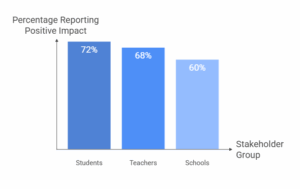
The numbers are precise. 72% of students report being more engaged with AI tutors, 68% of teachers say that automating grading makes their jobs less stressful, and 60% of schools report saving money by using AI-powered administrative systems. AI enhances learning by providing students with real-time feedback, personalized learning paths, and 24/7 support that meets them where they are, at their own pace.

Teachers receive back hours for high-impact teaching and mentoring, and predictive analytics identify students who need extra help before minor problems escalate into major ones. Institutions can streamline admissions, scheduling, and financial workflows, making them more accurate and scalable without the need for additional personnel. These AI-in-education statistics demonstrate that AI enables schools to save time and money while also enhancing student performance.

If you’re ready to use these gains to get ahead of your competitors, check out LITSLINK’s eLearning solutions development to learn more.

Seeking a trusted AI development partner?Contact Us!

Trends in Educational Technology and AI

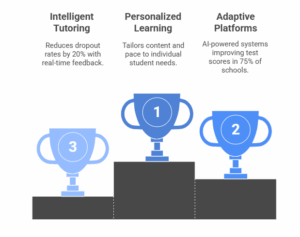
Trends in AI and educational technology: Personalized learning is going from a promise to a reality. AI-powered adaptive platforms tailor the content and pace of learning to each student. According to personalized learning statistics, 75% of schools that utilize these systems report that their students’ test scores have improved. Intelligent tutoring is becoming the primary method for receiving help in virtual classrooms. AI adoption in education statistics for 2025 indicates that AI tutors can lower dropout rates by 20%, keeping students engaged with real-time feedback, targeted practice, and explanations on demand.

Top AI Trends in Education

Automation is changing the way things work behind the scenes. Forty percent of universities now use AI for scheduling and enrollment, which reduces manual work, errors, and staff time, allowing them to focus on supporting students. Accessibility is also advancing rapidly! AI tools in education demonstrate that voice-to-text, automated captioning, and translation features make it easier for students with disabilities to learn by making lectures searchable, ensuring that materials are more accessible, and creating inclusive classrooms that cater to a wide range of needs.

These trends indicate that AI has two effects: it enhances the (virtual) classroom experience and streamlines institutional workflows, making them leaner and more responsive. Institutions that carefully combine these features are seeing real improvements in student achievement, retention, and experience.

Case Studies: AI Use in Education

  • LITSLINK’s E-learning App
    Showcased in our E-learning case study, adaptive testing helped scale learning outcomes.
  • AI in Medical Education
    Our medical education AI blog details how AI simulators improve medical training.
  • VR and AI
    The blend of immersive VR with AI has been detailed in Virtual Reality in Education.

Conclusion

The rise of AI in education statistics for 2025 shows that AI is no longer just a test; it’s a must-have. Institutions that utilize AI benefit from improved student satisfaction, increased efficiency, and reduced costs. Examples of AI use in schools include personalized learning and automated grading.

LITSLINK can help you if you’re ready to use AI in your learning platform. We create AI-powered products that can grow, adhere to rules, and make a meaningful difference. We are experts in AI software development and custom eLearning solutions.

Fortunately, we have extensive experience in creating custom software. We can also assist you with that. Simply contact us to begin the process!

Need AI development services?Get in touch!

The post AI in Education: Current Statistics and Trends for 2025 appeared first on Litslink.

.Organize the content with appropriate headings and subheadings ( h2, h3, h4, h5, h6). Include conclusion section and FAQs section with Proper questions and answers at the end. do not include the title. it must return only article i dont want any extra information or introductory text with article e.g: ” Here is rewritten article:” or “Here is the rewritten content:”

Generate single title from this title Preparing for a new era of teaching and learning in 100 -150 characters. And it must return only title i dont want any extra information or introductory text with title e.g: ” Here is a single title:”

Write an article about

Key points:

When I first started experimenting with AI in my classroom, I saw the same thing repeatedly from students. They treated it like Google. Ask a question, get an answer, move on. It didn’t take long to realize that if my students only engage with AI this way, they miss the bigger opportunity to use AI as a partner in thinking. AI isn’t a magic answer machine. It’s a tool for creativity and problem-solving. The challenge for us as educators is to rethink how we prepare students for the world they’re entering and to use AI with curiosity and fidelity.

Moving from curiosity to fluency

In my district, I wear two hats: history teacher and instructional coach. That combination gives me the space to test ideas in the classroom and support colleagues as they try new tools. What I’ve learned is that AI fluency requires far more than knowing how to log into a platform. Students need to learn how to question outputs, verify information and use results as a springboard for deeper inquiry.

I often remind them, “You never trust your source. You always verify and compare.” If students accept every AI response at face value, they’re not building the critical habits they’ll need in college or in the workforce.

To make this concrete, I teach my students the RISEN framework: Role, Instructions, Steps, Examples, Narrowing. It helps them craft better prompts and think about the kind of response they want. Instead of typing “explain photosynthesis,” they might ask, “Act as a biologist explaining photosynthesis to a tenth grader. Use three steps with an analogy, then provide a short quiz at the end.” Suddenly, the interaction becomes purposeful, structured and reflective of real learning.

AI as a catalyst for equity and personalization

Growing up, I was lucky. My mom was college educated and sat with me to go over almost every paper I wrote. She gave me feedback that helped to sharpen my writing and build my confidence. Many of my students don’t have that luxury. For these learners, AI can be the academic coach they might not otherwise have.

That doesn’t mean AI replaces human connection. Nothing can. But it can provide feedback, ask guiding questions, and provide examples that give students a sounding board and thought partner. It’s one more way to move closer to providing personalized support for learners based on need.

Of course, equity cuts both ways. If only some students have access to AI or if we use it without considering its bias, we risk widening the very gaps we hope to close. That’s why it’s our job as educators to model ethical and critical use, not just the mechanics.

Shifting how we assess learning

One of the biggest shifts I’ve made is rethinking how I assess students. If I only grade the final product, I’m essentially inviting them to use AI as a shortcut. Instead, I focus on the process: How did they engage with the tool? How did they verify and cross-reference results? How did they revise their work based on what they learned? What framework guided their inquiry? In this way, AI becomes part of their learning journey rather than just an endpoint.

I’ve asked students to run the same question through multiple AI platforms and then compare the outputs. What were the differences? Which response feels most accurate or useful? What assumptions might be at play? These conversations push students to defend their thinking and use AI critically, not passively.

Navigating privacy and policy

Another responsibility we carry as educators is protecting our students. Data privacy is a serious concern. In my school, we use a “walled garden” version of AI so that student data doesn’t get used for training. Even with those safeguards in place, I remind colleagues never to enter identifiable student information into a tool.

Policies will continue to evolve, but for day-to-day activities and planning, teachers need to model caution and responsibility. Students are taking our lead.

Professional growth for a changing profession

The truth of the matter is most of us have not been professionally trained to do this. My teacher preparation program certainly did not include modules on prompt engineering or data ethics. That means professional development in this space is a must.

I’ve grown the most in my AI fluency by working alongside other educators who are experimenting, sharing stories, and comparing notes. AI is moving fast. No one has all the answers. But we can build confidence together by trying, reflecting, and adjusting through shared experience and lessons learned. That’s exactly what we’re doing in the Lead for Learners network. It’s a space where educators from across the country connect, learn and support one another in navigating change.

For educators who feel hesitant, I’d say this: You don’t need to be an expert to start. Pick one tool, test it in one lesson, and talk openly with your students about what you’re learning. They’ll respect your honesty and join you in the process.

Preparing students for what’s next

AI is not going away. Whether we’re ready or not, it’s going to shape how our students live and work. That gives us a responsibility not just to keep pace with technology but to prepare young people for what’s ahead. The latest futures forecast reminds us that imagining possibilities is just as important as responding to immediate shifts.

We need to understand both how AI is already reshaping education delivery and how new waves of change will remain on the horizon as tools grow more sophisticated and widespread.

I want my students to leave my classroom with the ability to question, create, and collaborate using AI. I want them to see it not as a shortcut but as a tool for thinking more deeply and expressing themselves more fully. And I want them to watch me modeling those same habits: curiosity, caution, creativity, and ethical decision-making. Because if we don’t show them what responsible use looks like, who will?

The future of education won’t be defined by whether we allow AI into our classrooms. It will be defined by how we teach with it, how we teach about it, and how we prepare our students to thrive in a world where it’s everywhere.

Ian McDougall, Yuma Union High School District

Ian McDougall is a history teacher and edtech coach at Yuma Union High School District in Arizona. He also facilitates the Lead for Learners Community, an online hub for learner-centered educators nationwide. With extensive experience in K–12 education and technology integration, Ian supports schools in adopting innovative practices through professional development and instructional coaching. He holds a master’s degree in United States history from Adams State University, further strengthening his expertise as both a teacher and coach.

Latest posts by eSchool Media Contributors (see all)

.Organize the content with appropriate headings and subheadings ( h2, h3, h4, h5, h6). Include conclusion section and FAQs section with Proper questions and answers at the end. do not include the title. it must return only article i dont want any extra information or introductory text with article e.g: ” Here is rewritten article:” or “Here is the rewritten content:”

Generate single title from this title Growing AI use in school PR leads to roadmap for responsible use in 100 -150 characters. And it must return only title i dont want any extra information or introductory text with title e.g: ” Here is a single title:”

Write an article about

This press release originally appeared online.

Key points:

A new collaborative report from the National School Public Relations Association (NSPRA) and engagement platform ThoughtExchange reveals a swift rise in the use of AI in K-12 communication and provides guidance for its effective, ethical use in public schools.

Future-Proofing K-12 Communications: School PR Strategies in the Age of AI draws on insights from 200 school communication professionals across 37 states. The findings illustrate how AI is enhancing day-to-day work and underscore the importance of thoughtful policies, staff training and transparency around its use.

As the technology becomes more embedded in daily practice, the report emphasizes the importance of balancing innovation with intention.

“School communicators have always been adaptable and forward-thinking, and it’s no surprise many have been on the leading edge of exploring how AI can support their work,” said Barbara M. Hunter, APR, executive director of NSPRA. “But while AI offers exciting potential, it cannot replace the strategy, relationships and human voice that define effective school PR. As technology evolves, what matters most is using AI in ways that reflect ethics, transparency and a clear understanding of the role human judgment still plays.”

Key findings from the report note that:

  • 91 percent of respondents are already using AI tools in their communications work
  • 69 percent report that their districts do not have a formal policy on employee AI use
  • 61 percent say they do not disclose their use of AI in official communications

The report shows how communicators are using AI to streamline processes, improve accessibility and respond quickly in time-sensitive situations. While many report increased efficiency and clarity, concerns remain around data privacy, misinformation and overreliance on automation.

“At ThoughtExchange, we believe AI is becoming an indispensable ally for school district communications professionals–amplifying their reach, insight and responsiveness,” said George Psiharis, CEO of ThoughtExchange. “However, the authenticity of human connection remains at the heart of trust and understanding. Our research shows that when school districts deeply listen to their communities, they not only elevate engagement, they drive better, more aligned policy outcomes that reflect the true needs of those they serve.”

What district leaders can do now

To support responsible AI use, the report outlines four key recommendations for school systems:

  1. Enhance AI education and awareness
  2. Accelerate policy timelines to match technology’s pace
  3. Expand AI policy scope from its current student focus to include employees
  4. Shift from urgency-driven to proactive policy formation

These recommendations are paired with practical tips to help districts bridge the gap between emerging technologies and the people using them to support students, staff and families. The guidance reinforces that AI is most effective when paired with human oversight and communication rooted in trust.

growing-ai-use-in-school-pr-leads-to-roadmap-for-responsible-use Latest posts by eSchool Media Contributors (see all)

.Organize the content with appropriate headings and subheadings ( h2, h3, h4, h5, h6). Include conclusion section and FAQs section with Proper questions and answers at the end. do not include the title. it must return only article i dont want any extra information or introductory text with article e.g: ” Here is rewritten article:” or “Here is the rewritten content:”