Home Blog Page 37

Generate single title from this title Samsung on track for highest profit in 3 years in 100 -150 characters. And it must return only title i dont want any extra information or introductory text with title e.g: ” Here is a single title:”

Write an article about

Unlock the Editor’s Digest for free

Samsung Electronics expects to post its highest operating profit in three years on the back of high demand for memory chips used in artificial intelligence, after several quarters of tepid growth fuelled concerns it was losing ground to rivals.

The tech conglomerate on Tuesday said operating profit in the quarter ending in September was projected to rise more than 30 per cent compared with a year ago to Won12.1tn ($8.5bn), significantly higher than the Won9.7tn forecast by analysts in a Bloomberg estimate. The company will report full earnings at the end of this month.

Samsung’s shares rose as much as 3 per cent to a record high of Won97,500 on Tuesday after the earnings guidance. The company’s stock has rallied more than 66 per cent in the past six months as a result of the AI boom, helping it to recover from a series of mis-steps, including its failure to pass Nvidia’s stringent qualification tests for the most advanced AI chips.

The South Korean chipmaker this month signed a letter of intent with OpenAI to supply semiconductors for the ChatGPT maker’s $500bn Stargate data centre project.

Samsung accounts for just over a quarter of the global market for high-bandwidth memory products, which are used in AI chips, with SK Hynix and US-based Micron the other leading groups in the sector, according to consultancy TrendForce.

Having lost to SK Hynix as Nvidia’s principal supplier, Samsung’s HBM business was also hit last year by US export restrictions on deliveries of advanced memory chips to China.

But analysts said Samsung was benefiting from a boom in demand from tech companies for customised AI chips that require specialised memory products.

That surge in demand has pushed up prices of dynamic random-access memory chips, which enable short-term data storage when a device is being used — and a segment in which Samsung still leads.

It is also projected to boost Samsung’s sales of lower-value Nand flash memory chips, which allow for long-term storage of data without power.

Samsung’s contract chipmaking business was further buoyed this year by the announcement that it would produce AI chips for Tesla at its new fabrication plant in Texas, raising hopes that it is on course to stem mounting losses as it has steadily lost market share to Taiwanese rival TSMC over the past decade.

Apple also announced in August that Samsung would produce image sensors in Texas for its next generation of the iPhone, marking a reconciliation between the two tech groups following an acrimonious split in the 2010s over patent disputes.

.Organize the content with appropriate headings and subheadings ( h2, h3, h4, h5, h6). Include conclusion section and FAQs section with Proper questions and answers at the end. do not include the title. it must return only article i dont want any extra information or introductory text with article e.g: ” Here is rewritten article:” or “Here is the rewritten content:”

Reforming the Sponsored Visas System Can Change That

0

Almost one in five workers in the UK today was born abroad.[i] Migrants fill as many as 25% of health and care jobs, and 22% of all jobs in communication and IT.[ii] This is not just an outcome of mobilities past. Industry leaders project that migrant labour is also critical to the delivery of strategic government objectives, including building more housing for a generation of Britons who do not yet own a home,[iii] caring for an increasingly older population,[iv] and sustaining growth.

Yet despite this vital contribution to the UK, the future of work migration looks daunting. In the five years since the UK officially left the European Union (EU), the government has replaced a system of largely free movement with an archaic system of sponsorship where migrant workers’ mobility is to a large degree controlled by their employers. Reports of labour exploitation soared, as thousands of unscrupulous bosses[v] used their power over visas to deceive, overwork, underpay, and threaten migrants who complained with deportation. But it is the government’s response to this exploitation that casts the biggest shadow over the future of migrant workers – and with it, over the future of progressive politics in the UK. In this article, I reflect on how we got here and what is at stake.

The end of free movement and the rise of sponsored work visas

The UK’s exit from the European Union on 31 December 2020 opened a new chapter in the history of labour migration. Just days before the end of free movement, on Christmas Eve, a triumphant Boris Johnson declared that the UK had “taken back control of laws and our destiny […] every jot and tittle of our regulation.”[vi]  But words alone have never filled vacancies, and as businesses continued to need migrant labour, the Home Office had to come up with a system that would meet business requirements, while retaining the image of strict border control. This is how we came to “the points based system” – more accurately known as the system of employer-sponsored visas.

From January 2021, businesses were allowed to recruit foreign nationals, provided they obtained a licence from the Home Office, and asked the department to issue sufficient Certificates of Sponsorship (COSs) to meet their recruitment needs. Employers would grant a COS from their batch to every foreign national they wanted to hire, and the COS enabled migrants, in turn, to obtain the essential points to obtain a work visa. All visas under this system were strictly tied to the sponsoring employers. If employment ended, migrants officially had just 60 days to find another sponsor, or risked sliding into irregularity.[vii] The tie of sponsorship could only cease if, after 5 years of continuous employment, migrants applied for Indefinite Leave to Remain. In many ways, this was similar to the migration system applied to non-EU nationals before Brexit – only this time it was wider, it grew faster, and employers had to jump through fewer hoops.

More businesses get a licence to sponsor

On the surface, sponsorship was working. Within the first couple of years, the Home Office had licensed almost 30,000 new businesses (Fig 1). This almost doubled the overall number of employers entrusted to sponsor migrant workers long-term.

Figure 1 – Total number of employers with a Tier 2 licence to sponsor skilled workers. Source: Transparency in Migration statistics, last updated Q2 2025.

In that same period, as many as 661,000 sponsored work visas were issued to main applicants and their dependents (Fig 2), in sectors like care, which took the lion’s share of international recruitment, but also hospitality and IT. It did not take long, however, for the cracks in the system to appear – and reports of labour exploitation soared.
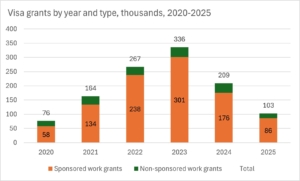
Figure 2- Entry clearance visas issued to main applicants and dependants. Source: Home Office statistics, last updated Q2 2025.

Figure 2- Entry clearance visas issued to main applicants and dependants. Source: Home Office statistics, last updated Q2 2025.

The first reports of workers exploited by visa sponsors

Suddenly, then irreversibly, around the start of 2023, the Work Rights Centre, the employment rights charity I run, started getting a new and worrying pattern of enquiries.[viii] People from India, Bangladesh, then gradually from Ghana, Nigeria and Zimbabwe, who had come to the UK hoping to work in adult social care, but also other sectors, contacted the charity to report an unusual pattern of financial and labour exploitation.

In almost every case, the story followed the same arc. Migrants had sold land, quit good jobs and borrowed money to pay eye-watering fees to agents who pretended they could place them with Home Office-approved employers. The employers were licensed, and the visas they opened access to were valid. Upon arrival, however, the work promised never materialised. The workers who dared to speak up were often threatened with deportation, usually, but also with violence. Meanwhile, they were stuck on a visa that was so controlled it neither permitted them to access public funds nor to take up other full-time work. Too indebted to return to their countries of origin, most of our clients were getting by on casual work, with loans, support from friends or food banks, hoping only that one day they would find a fairer employer to sponsor a new work visa.

Calls for reform of the sponsorship system intensify

Within a year, the story of how the Home Office had built a system ripe for exploitation featured in every major news outlet.[ix] By that point, the Work Rights Centre wasn’t just supporting victims of scams. We were also bringing tribunal cases for victims of forced labour who had been severely overworked, underpaid, and threatened if they dared to blow the whistle.  Our reports were joined by other charities, MPs, the Independent Chief Inspector for Borders and Immigration,[x] the Public Accounts Committee,[xi] and the Independent Anti-Slavery Commissioner.[xii] Together, we left the government in no doubt: sponsorship is a work migration system that dangerously deepens the power imbalance between workers and employers, and is in urgent need for reform.

The policy solutions, we at the Work Rights Centre argued, were evident. The ambitious option would be to end sponsorship, a system that is more reminiscent of Tudor vagrancy laws than is suited to today’s dynamic labour needs, and replace it with a system where visas don’t tie anyone to a single employer. This would be better for workers, simpler for the Home Office to administer, and significantly cheaper for employers. The less ambitious version would be to implement safeguards to curb the power of sponsoring employers.[xiii] This included imposing fines and penalties for rule-breaking employers, giving workers 6 months (not the current 60 days) after the end of employment in which to find another sponsor, and instituting a Workplace Justice Visa to empower victims to report exploitation, without fear of losing their immigration status. All these measures are already in place, in some iteration, in Australia, Canada, and Ireland. Unfortunately, it is not what the UK government did.

The government learns the wrong lessons

Faced with mounting evidence of exploitation, the Home Office improved due diligence at the point of licensing new sponsors, and radically increased actions against employers already on the list. Having started with a laissez faire approach, by 2024 the department was revoking hundreds more licences every quarter (Figure 3).
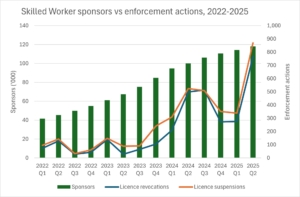
Figure 3 - Licence suspensions and revocations, and total number of sponsors. Source: Home Office: Quarterly sponsorship transparency data. Last updated Q2 2025

Figure 3 – Licence suspensions and revocations, and total number of sponsors. Source: Home Office: Quarterly sponsorship transparency data. Last updated Q2 2025

The sad irony, however, is that with every story of successful immigration enforcement against employers, migrant workers were collateral damage. Once a business lost its licence, all workers tied to it risked having their visas curtailed. Officially, this meant that people were left with just 60 days to find a new sponsor. Unofficially, the Home Office gave some workers (particularly in the adult social care sector) more time. But this momentary leniency was no match for the structural barriers that stood in the way of re-employment. By the time migrant care workers were looking for new roles, indebted and with months of involuntary unemployment accumulating, few had the finances to take up driving lessons and purchase cars, to meet the requirements of employers.

Re-employment was also impeded by the fact that, despite the protests of industry leaders and unions, the government made hiring foreign workers increasingly expensive. Successive governments raised the minimum salary requirements and costs of compliance (though none applied any financial penalties to non-compliant sponsors). After the latest changes imposed by Labour, a small bona fide employer in the care sector who wishes to hire a migrant worker for three years needs to make an upfront payment of over £2,500 to the Home Office, up from £1,870 before.[xiv] Set to “wean businesses of migrant labour” at all costs, from July 2025, the government also banned recruitment for roles below RQF level 6 (undergraduate degree), and entirely ended the international recruitment of care workers under the Health and Care Worker visa.[xv]

Yet now, just like before, civil servants have had to pull the rabbit out of the hat; re-invent another contorted system that projects an image of strict border control, while quietly catering for business needs. In the same breath, the immigration white paper announced the exclusion of roles below graduate level from the list of jobs eligible for sponsorship, and the re-introduction of some of those roles onto a new Temporary Shortage List. Temporariness plays today the same political role that sponsorship played after Brexit. It is the sticking plaster that desperately tries to marry the two competing objectives of economic mobility and border control, but manages only to increase business uncertainty and prolong the misery of migrant workers.

What is at stake?

It feels like we have been here before. It is endlessly frustrating to observe how so many lives get caught in the crosshairs of political communications strategy, and how moderate policy decisions that could safeguard migrant workers get buried in the rush to appear ever tougher.

None of the thousands of migrant workers who were exploited by Home Office-approved visa sponsors were compensated – though their employers walked away freely. The thousands more who will continue to arrive on employer-sponsored visas face the same risks of exploitation, because they face the same radical power-imbalance. Most disappointingly, migrants who hoped that their sacrifice was not in vain were recently dealt a blow when, unexpectedly and without consultation, the government announced it will double the time to settlement, from the current 5 years to 10 years. That is another five years of precarious work, at the mercy of visa sponsors; five years of visa fees and yearly Immigration Health Surcharge payments; and five years of exclusion from social security.

Workers’ rights advocates will no doubt have gleaned the bitter irony of seeing a Labour government betray migrant workers so ruthlessly. There is more. The government has sacrificed the scope of the Employment Rights Bill, so that key provisions like the adoption of a single worker status are delayed. Journalists have also reported that government insiders were considering introducing Employment Tribunal fees – a tried and previously binned provision that would put justice out of reach for the poorest workers. Then there is everything the government is unknowingly sacrificing by going back to the politics of control: business and consumer confidence, which are both critical to growth; faith in progressive values, which are now rebranded as “patriotic progressivism”; and our community cohesion, which is increasingly splintered by the language of us and them.

We need to say no to this. At the Work Rights Centre, we have a small but fierce team of lawyers who empower migrant workers to take action against rogue employers. We use every win to expose the system that fosters exploitation, and raise awareness of the reforms needed to safeguard migrant workers.  Everyone can join, whether it is contacting their MP to call out the harm the government is causing to migrant communities, or getting their union to campaign. Unite and the Royal College of Nursing have led the chorus of union voices who condemned the degrading treatment of sponsored workers, and asked for an immigration system that ends the toxic tie of employer sponsorship. Given the risks that lie ahead, it is time for these voices to get louder.

Dr. Dora-Olivia Vicol is an anthropologist and CEO of the Work Rights Centre, a charity that provides free employment and immigration legal advice, and that uses frontline intelligence to advocate for better protections for migrant and vulnerable workers.

[i] Marina Fernández-Reino and Ben Brindle, ‘Migrants in the UK Labour Market: An Overview’, Migration Observatory, 2024, https://migrationobservatory.ox.ac.uk/resources/briefings/migrants-in-the-uk-labour-market-an-overview/.

[ii] Fernández-Reino and Brindle, ‘Migrants in the UK Labour Market’.

[iii] Gino Spocchia, ‘RIBA Says Government’s Immigration Clampdown Risks 1.5m Homes Target’, The Architects’ Journal, 15 May 2025, https://www.architectsjournal.co.uk/news/riba-says-governments-immigration-rhetoric-risks-1-5m-homes-target.

[iv] Aletha Adu and Aletha Adu Political correspondent, ‘Labour Axing Care Worker Visa Will Put Services at Risk, Say Unions and Care Leaders’, Society, The Guardian, 11 May 2025, https://www.theguardian.com/society/2025/may/11/labour-axing-care-worker-visa-will-put-services-at-risk-say-unions-and-care-leaders.

[v] ‘Record Numbers of Visa Sponsor Licences Revoked for Rule Breaking’, GOV.UK, 2025, https://www.gov.uk/government/news/record-numbers-of-visa-sponsor-licences-revoked-for-rule-breaking.

[vi] ‘Prime Minister’s Statement on EU Negotiations: 24 December 2020’, GOV.UK, 24 December 2020, https://www.gov.uk/government/speeches/prime-ministers-statement-on-eu-negotiations-24-december-2020.

[vii] Adis Sehic and Dora-Olivia Vicol, ‘The Systemic Drivers of Migrant Worker Exploitation in the UK’, Work Rights Centre, 2023, https://www.workrightscentre.org/news/report-the-systemic-drivers-of-migrant-worker-exploitation-in-the-uk.

[viii] Sehic and Vicol, ‘Report’.

[ix] Rosie Swash et al., ‘Rape and Sexual Harassment Reported by Foreign Care Workers across UK’, Global Development, The Guardian, 12 March 2024, https://www.theguardian.com/global-development/2024/mar/12/health-care-worker-visas-abuses-exploitation-rape-sponsors-right-work-uk; ‘Migrant Carer “drowning” in Debt after £15k Visa Scam’, Cornwall, BBC News, 21 February 2024, https://www.bbc.com/news/uk-england-cornwall-68337205.

[x] ICIBI, ‘An Inspection of the Immigration System as It Relates to the Social Care Sector (August 2023 to November 2023)’, GOV.UK, 2024, https://www.gov.uk/government/publications/an-inspection-of-the-immigration-system-as-it-relates-to-the-social-care-sector-august-2023-to-november-2023.

[xi] ‘Parliamentary Report Acknowledges Scale of Exploitation on the Skilled Worker Visa | Work Rights Centre’, accessed 3 October 2025, https://www.workrightscentre.org/publications/2025/parliamentary-report-acknowledges-scale-of-exploitation-on-the-skilled-worker-visa/.

[xii] Shanti Das, ‘Flawed UK Visa Scheme Led to “Horrific” Care Worker Abuse, Says Watchdog’, World News, The Guardian, 16 March 2025, https://www.theguardian.com/world/2025/mar/16/flawed-uk-visa-scheme-led-to-horrific-care-worker-abuse-says-watchdog.

[xiii] ‘Safeguarding Sponsored Workers: A UK Workplace Justice Visa, and Other Proposals from a Six-Country Comparison | Work Rights Centre’, accessed 3 October 2025, https://www.workrightscentre.org/publications/2025/safeguarding-sponsored-workers-a-uk-workplace-justice-visa-and-other-proposals-from-a-six-country-comparison/.

[xiv] ‘No Match. Why Funding Rematching Hubs for Displaced Migrant Care Workers Is Not Enough to Tackle Exploitation | Work Rights Centre’, 10, accessed 3 October 2025, https://www.workrightscentre.org/publications/2025/no-match-why-funding-rematching-hubs-for-displaced-migrant-care-workers-is-not-enough-to-tackle-exploitation/.

[xv] ‘Latest Changes to the Immigration Rules: “A Sub-Optimal Way to Make Policy” | Work Rights Centre’, accessed 3 October 2025, https://www.workrightscentre.org/publications/2025/latest-changes-to-the-immigration-rules-a-sub-optimal-way-to-make-policy/.

Image credit: Steve Sharp via Unsplash

Futures of Work ~ The Modern Slavery Act: 10 years on

0

This year marks the 10th anniversary of the UK’s Modern Slavery Act, proving an obvious point for reflecting on its legacy. When the Act was passed, it was touted as being a ‘world leading’ piece of legislation. This was accurate ten years ago because the only similar piece of legislation was California’s Transparency in Supply  Chains Act, upon which the UK’s Modern Slavery Act was modelled. Both acts require companies to report on the actions companies are taking to address labour exploitation in their supply chains. However, California’s legislation has a threshold of $100 million, is only applied to a limited range of sectors, and is limited to California. The UK’s MSA, by contrast, applies to all companies with earnings above £36 million operating in the UK. New provisions were also made for an Independent Anti-Slavery Commissioner, and the creation of a new offence with which to prosecute exploiters.

Does this mean the UK, 10 years later, can celebrate having eradicated modern slavery? Not quite. In fact, it is not clear what impact the legislation has had beyond raising awareness of the problem and leading to the production of company disclosures on the steps companies have taken, which, in many cases, do not amount to much. This is despite many companies proclaiming to have a “zero tolerance” stance on modern slavery, but making limited or superficial changes to their existing operations. There are of course, exceptions where companies have taken their responsibilities more seriously, but these are unfortunately in the minority. Additionally, immigration policies have clashed with the commitment to support victims of exploitation. As the various articles in this issue make clear, the legacy of the Modern Slavery Act is a complicated one.

To begin with, despite the MSA being in place for 10 years, there is still virtually no consensus on any key aspect of modern slavery, including how to define it or whether the term should be used at all. As Pankhuri Agarwal and Sharmila Parmanand highlight in their article, the expansive use of the term modern slavery beyond exploitation has rendered it almost meaningless in some contexts. And the shift away from focusing on good working conditions, fair pay and the ability to organise has created a political spectacle out of exploitation. This is especially the case in the framing often used of perpetrators as evildoers and the exploited as their victims, at the expense of focusing on what works for addressing exploitative working practices. Pankhuri and Sharmila argue that a return to the basics of protecting labour rights is required.

Looking within the broader call for the improvement of workers’ rights, we find the complexities experienced by the most vulnerable group of workers: migrants. Addressing this issue, Olivia Vicol, CEO of the Work Rights Centre, highlights the impact of the implementation of increasingly anti-immigration policies. In this article, it is argued that migrant workers are being subjected to the ‘politics of control’ where the ground shifts beneath their feet, whereby terms and conditions are changed while they support essential aspects of the UK economy.

Continuing within the theme of migrant vulnerabilities, Dame Sara Thornton, who served a three year term as the UK’s Independent Anti-Slavery Commissioner, argues that at a political level, modern slavery has been conflated with immigration. This has undermined the idea that victims of exploitation will be provided with appropriate support. It seems the Modern Slavery Act itself may now also be under threat, with some government ministers arguing that it is being abused for the purposes of preventing deportation. Sara goes on to argue that attention needs to be turned more substantially towards prevention rather than only prosecutions and victim support.

In more recent years, it has been acknowledged by those working in the field of modern slavery that there are multiple forms of expertise that we must draw on in order to understand how to address the problem and support those who have been exploited. One perspective that is being incorporated more into research, consultations, and government enquiries is that of people with lived experience of exploitation. From this perspective, Brandon Thomas argues for a move away from understanding those with lived experience only as ‘victims’, and instead as human beings with their own hopes, dreams, and aspirations who happen to have been exploited. Placing the dignity of workers and those who have experienced exploitation can help reorient our approaches to address the problem. Similarly, Nina Briggs argues that some people are deemed too ‘atypical’ to receive support after having been exploited, and in doing so, challenges perceptions about who might be vulnerable to exploitation and how support is provided. Better systems of support must therefore be built if we are serious about supporting survivors.

As the articles in this issue highlight, there is no shortage of criticisms of the Modern Slavery Act, or how various governments have approached the issue. Nevertheless, this issue also offers a variety of ways forward that, if followed, would help to ensure legislation is improved rather than weakened, that businesses are held to account, and that people who have been exploited are treated with the dignity they deserve.

Image credit: Masahiro Miyagi via Unsplash

Futures of Work ~ Graves into Gardens

0

Futures of Work: Seeing People Before Exploitation

When people talk about modern slavery, the focus is often on statistics, compliance, or policy. But for me and many others like me, this is not abstract. It is a lived reality. Before exploitation, I was a business owner. I have experience in asset management, ambition, and huge responsibility. I also had vulnerabilities, and those vulnerabilities were exploited. However, it is important to remember that modern slavery doesn’t happen because people are vulnerable; in one way or another, we all are. It happens because somebody decides to exploit those vulnerabilities.

This is where the conversation must begin: people affected by modern slavery are people first. We are not defined only by the harm we experienced. Our skills, aspirations, and dignity existed before exploitation, and they remain after. To view us only as “victims” is to miss the bigger picture of who we are and what we can contribute to the future of work, and particularly work in modern slavery.

Healing from exploitation is not about forgetting. The memories do not vanish. Trauma leaves scars that remain part of us. But survivors often talk about the importance of forward momentum.

For me, that has meant turning graves into gardens. Taking the ground of pain and planting something new: perspective, resilience, hope. It is not a false reality. It is the honest work of facing trauma and rewriting its meaning. We do this by investigating what was done to us – the vulnerabilities, the fears, the abuse, the control – then change the narrative of it.

This is why opportunities for work and dignity matter so much. Work is not only income. It is belonging, stability, and participation in society. When employers recognise survivors as contributors, they help create the soil in which new gardens can grow.

The Role of Business in Eradication

The most recent ILO (International Labour Organization) report indicates that profits from forced labour reached a staggering $236 billion, highlighting the alarming scale of exploitation in the global economy. This also draws a picture that says, at its core, modern slavery is an economic issue. Human beings are treated as commodities, to be used for profit or personal gain. Whether through cheap labour in supply chains, sexual exploitation, or forced criminality, the logic is the same: people are reduced to transactions.

This is why harsher penalties are needed for those who exploit. Modern slavery continues because exploitation is cheap and low risk. To end it, exploitation must become costly and unacceptable. Businesses, too, must acknowledge the uncomfortable truth that their systems and supply chains may enable exploitation. When cost-cutting and profit take precedence over people, the conditions for modern slavery flourish.

Businesses cannot, therefore, treat modern slavery as a box-ticking exercise. A glossy report or surface-level audit does not protect workers. Real responsibility means embedding dignity into every decision: procurement, recruitment, partnerships, and culture.

Companies need to invest in long-term relationships with suppliers, build safe reporting channels, and challenge the assumption that cheaper always means better. They must also engage with survivors. Auditors can spot irregularities, but survivors know the control methods traffickers use. We know the vulnerabilities they exploit. We know how fear, threats, and debt bondage can keep people trapped. And we know the signs because those signs were once all over us.

Lived experience engagement is not optional. It is crucial. If businesses are serious about tackling modern slavery, they must listen to and learn from those of us who have lived it. Legislation should require companies to disclose in their modern slavery statements a survivor engagement plan, guided by NGOs that have modern slavery expertise. This means a plan that puts lived experience at the centre of modern slavery action and details how companies intend to safeguard, ensuring people with lived experience receive recognition and value through fair compensation, acknowledgement and opportunities to lead.

Survivor insight should and must be embedded into prevention, remediation, escalation, and long-term business practices. This ensures remedies and escalation paths respond to real needs rather than corporate assumptions. It also shifts the power dynamic and mindset from business leaders feeling like they are fixing survivors’ problems to survivors actively defining and leading on what eradication, dignity, justice, and recovery look like.

Flawed Legislation

Over the past few years, I’ve seen how flawed legislation can worsen the challenges survivors face. A good example of this is the Nationality and Borders Act 2022. It was presented and portrayed as a way to strengthen immigration control and protect the UK’s borders. However, it has made life harder for people like me. Instead of creating pathways to safety, it has created suspicion. Survivors are forced to “prove” their exploitation at the very moment they most need trust and protection. Modern Slavery is not an immigration issue; it is a crime that survivors shouldn’t have to do the time for.

Legislation that is supposed to safeguard survivors should not re-traumatise them. Yet under the Act, evidential thresholds are so high that many are disbelieved, discredited, or denied support. Survivors already live with trauma, fear, and stigma. Flawed laws deepen those wounds. When systems punish survivors instead of protecting them, traffickers benefit. Exploitation thrives in silence, and silence grows when survivors are afraid to come forward.

My Aspirations for a Future Without Exploitation

My own aspirations are clear. I want to influence legislation so that survivors are better protected, not punished. Laws like the Nationality and Borders Act 2022 need reform. Survivor voices must be present in parliamentary debates, advisory groups, and policymaking. Without lived experience at the table, policies risk repeating the same mistakes.

I also want to work alongside businesses. The future of work cannot be built on exploitation. It must be built on fairness, accountability, and dignity. My goal is to show businesses the responsibility they truly have. Not just to comply with the law, but to lead by embedding ethical practices and survivor engagement into every part of their operations.

The choices we make today will define the future of work. If survivors continue to be silenced by flawed legislation, exploitation will remain hidden. If businesses continue to view people as commodities, modern slavery will persist.

But if survivors are seen as people first, as colleagues, leaders, and changemakers, we can shape a different future. One where lived experience informs policy. One where businesses embrace their moral and economic responsibility. One where graves are turned into gardens.

That is the future I want to see, and I believe it is possible.

Brandon Thomas has a background in asset management and brings his professional expertise to modern slavery charity Unseen UK’s business team, combining it with his lived experience to drive meaningful change. He began his journey with Unseen in 2022 as a survivor consultant, working closely with the policy and research team to ensure legislation meets the real needs of survivors. He has worked alongside universities across the UK on research projects that have fed into legislation and visited parliament to advise the Home Affairs Select Committee on what recovery should look like for survivors.

Image credit: Sergei Lisovskiy via Unsplash

Futures of Work ~ Reflections and recommendations from the second U.K. Independent Anti-Slavery Commissioner

0

The role of the Independent Anti-Slavery Commissioner was established by the Modern Slavery Act 2015 to encourage good practice in the prevention, investigation and prosecution of modern slavery offences and the identification and support for victims.

In 2019, I was appointed as the UK’s Commissioner and served for three years.  This article reflects upon my experience in that role, makes observations on recent developments and recommendations for future legislation on modern slavery.

My strategic plan set four high-level objectives in 2019: improving victim care and support; supporting law enforcement and prosecutions; focusing on prevention; and getting value from research and innovation.

Improving victim care and support

The focus of victim care had historically been on identification and immediate support, and while this remained important, I was also keen to increase support over the long term and enable survivors to live lives of sustainable independence.  Key to this were issues such as access to education and training, job opportunities, decent accommodation, settled immigration status and long-term psychological support. I worked closely with survivor groups on this agenda and employed a survivor in my office.

However, my work to support victims took place in an increasingly hostile environment.  Shortly after I took up my appointment, there was a change of government, and modern slavery was no longer a political priority; victims of trafficking were seen almost exclusively through an immigration lens.  The focus of ministers was on immigration legislation and recommendations of the Independent Review into the Modern Slavery Act[1] to amend and strengthen the Act, which the government had largely accepted were never implemented.  The New Plan for Immigration was published in March 2021, and the accompanying press release claimed ‘an alarming rise in people abusing our modern slavery system by posing as victims in order to prevent their removal and enable them to stay in the country’[2].

The evidence of this alleged abuse was never produced, and annual increases in the number of victims identified were seen as proof of abuse – with no account taken of the Home Office’s positive assessment of 85-90% of cases.  This strategy laid the way for two pieces of legislation: the Nationality and Borders Act in 2022 and then the Illegal Migration Act in 2023.  Both severely undermined victim protection in general.  As a consequence of the change in government, many of these provisions have not been enacted, but they remain on the statute book.

However, as the political focus on irregular arrivals on small boats across the Channel has intensified, it was inevitable that the current Labour government would return to the issue.  In September 2025, an Eritrean man who had arrived in the UK by small boat and was due to be returned to France under the “one in, one out” returns pilot scheme between the UK and France won a last-minute legal claim to temporarily block his removal to France.[3]  His lawyers successfully argued that he needed more time to present evidence that he might be a victim of modern slavery.

The government has put much store by the agreement with the French, and it was no surprise to hear the Home Secretary observe, “Migrants suddenly deciding that they are a modern slave on the eve of their removal, never having made a claim before, make a mockery of our laws and his country’s generosity”.[4] The Home Office immediately challenged this decision in the Court of Appeal but was unsuccessful.  This skirmish in the courts has led the Home Secretary to vow to look again at the Modern Slavery Act[5] and the Prime Minister to argue that we need to look again at the interpretation by the courts of the European Convention on Human Rights (ECHR) and other international treaties in immigration cases.[6]  There is increasing unease that some provisions of international law are being interpreted too expansively to allow states to cope with the modern scale of migration.  Victims of modern slavery in need of protection may well be impacted.

Supporting law enforcement and prosecutions

I used my knowledge and networks as a former chief constable to encourage prioritisation and professionalisation.  Cases of slavery and trafficking are complex and complicated – they require the development of expertise and adequate resourcing.  I convened and supported law enforcement, and in particular, encouraged the use of financial investigation and prosecutions that did not rely on the testimony of vulnerable victims. The House of Lords report on the Modern Slavery Act in 2024 reported that the prosecution rate was low at 1.8% but acknowledged the difficulty of evidence gathering given the hidden nature of the crime and the similarity to rates for domestic abuse and sexual offences, which are respectively 1% and 3%. [7]

‘Follow the money’ was originally about political corruption, but it is a good response for anti-slavery.  I pursued this theme while encouraging good practice with both law enforcement and the financial services sector.  I published two reports on financial investigation and recommended to law enforcement that they make a step change in their use of financial investigation, financial intelligence from suspicious activity reports and their investment in public-private partnerships.[8] [9] Financial investigation can provide vital evidence for the prosecution, but it also increases the opportunity of returning the proceeds of crime to victims.

However, as the political focus on modern slavery diminished, it was inevitable that the law enforcement focus would do so too. In the last few months, the Independent Anti-Slavery Commissioner has reported that “the leadership and coordinated action that once drove progress have faded. The policing structures built to tackle modern slavery are being dismantled, leaving hard-working officers ill-equipped to tackle modern slavery.”[10]

Focusing on prevention

Protecting victims and prosecuting traffickers is not enough. There needs to be a greater focus on prevention. Given an estimated 28 million people in forced labour across the globe, more needs to be done to tackle the global systems and structures that allow this devastating crime of modern slavery to thrive[11]. Aggressive commercial practices and corporate negligence intersect with fragile communities, migrant labour, corruption and criminality, resulting in exploitation across the globe.  Modern slavery and human trafficking are economic crimes generating US$236 billion a year in profit[12].  In my time as Commissioner, I published several reports on the role of business in preventing exploitation.[13][14]

In the four years since I stepped down as the Commissioner, I have focused my efforts on the role of business in preventing modern slavery. At the University of Nottingham’s Rights Lab, we partner with Sainsbury’s to research their salient and evolving human rights risks, interpret how these risks will affect their business in the future and understand how they can respond. [15] At CCLA Investment Management, we have benchmarked the top UK companies on their performance in addressing modern slavery so that investors can hold them to account and encourage improvement.[16]

And lastly, I was keen to bridge from the academy to policy and practice.  Building collaborations with many research centres and supporting their work was a priority.  And no,w as a member of a research centre, I am continuing that work from the other side of the bridge.

 Recommendations

 It is tempting to collate a long wish list of recommendations, but I have tried to focus on the priorities and restricted myself to three.

  1. Light-touch approaches to forced labour in businesses and their supply chains have not impacted the business models where short-term profit is pursued at the expense of long-term harm. The transparency in supply chains requirements of the Modern Slavery Act need to be tightened up to include the public sector, to mandate the information required by modern slavery statements, and to impose civil penalties for non-compliance.  But ultimately, this legislation is about disclosure.  Legislation needs to prompt action to identify risks and prevent and mitigate them.  While this government urges businesses to conduct human rights and environmental due diligence, the Joint Committee on Human Rights recently concluded that goods made with forced labour were entering the UK – cotton, tomato products, solar panels and critical minerals.[17]  Voluntary approaches are clearly not succeeding, and the government should introduce legislation to hold companies to account for conducting human rights and environmental due diligence.
  2. The conflation of modern slavery and immigration puts the Independent Ant-Slavery Commissioner in the political crosshairs. The independence of the role needs to be strengthened: the appointment and renewal should not be in the hands of a minister where there is an obvious conflict of interest; the appointment should be for five or seven years so that a post holder can speak without fear of favour and there should be adequate resourcing.
  3. Modern slavery is the most egregious form of exploitation, but it flourishes where labour inspection, enforcement of standards and worker engagement are poor. The establishment of the Fair Work Agency is an opportunity to make a step change in the protection of workers; it must not be wasted.

Dame Sara Thornton, a former chief constable, served as the U.K.’s Independent Anti-Slavery  Commissioner from 2019-2022. She is a Professor of Practice in Modern Slavery Policy at the Rights Lab, University of Nottingham and a consultant in modern slavery at CCLA Investment Management. 

[1] https://www.gov.uk/government/publications/independent-review-of-the-modern-slavery-act-final-report/independent-review-of-the-modern-slavery-act-final-report-accessible-version

[2] https://www.gov.uk/government/news/alarming-rise-of-abuse-within-modern-slavery-system?utm_medium=email&utm_campaign=govuk-notifications&utm_source=6c102776-b34d-40fa-be92-832918e4befd&utm_content=daily

[3] https://www.bbc.co.uk/news/articles/c1dqe2443l1o

[4] https://www.bbc.co.uk/news/articles/cj3yrrnydero

[5] https://www.theguardian.com/uk-news/2025/sep/23/home-office-blocked-from-appealing-against-halt-to-deportation-of-eritrean-under-one-in-one-out

[6] https://www.bbc.co.uk/news/articles/cd72p30v574o

[7] https://publications.parliament.uk/pa/ld5901/ldselect/ldmodslav/8/8.pdf

[8] https://www.antislaverycommissioner.co.uk/media/jk0ohl1i/financial-investigation-of-modern-slavery-march-2021.pdf

[9] https://www.antislaverycommissioner.co.uk/media/n5emst4j/financial-review-part-2-november-2021-iasc.pdf

[10] https://www.antislaverycommissioner.co.uk/news-insights/report-policing-response-to-modern-slavery-how-has-it-changed-in-the-last-10-years/

[11] https://www.ilo.org/publications/major-publications/global-estimates-modern-slavery-forced-labour-and-forced-marriage

[12] https://www.ilo.org/resource/news/annual-profits-forced-labour-amount-us-236-billion-ilo-report-finds

[13] https://www.antislaverycommissioner.co.uk/media/z35hayca/iasc-operation-fort-review-june-2020.pdf

[14] https://antislaverycommissioner.co.uk/media/vadopfrl/iasc-report-sep-2021-the-role-of-the-financial-services-sector-in-eradicating-modern-slavery.pdf

[15] https://corporate.sainsburys.co.uk/media/zvhapkg4/sainsburys-modern-slavery-statement-2024-25.pdf

[16] https://www.ccla.co.uk/sites/default/files/2025-03/Modern%20Slavery%20UK%20Benchmark_3_0.pdf

[17] https://committees.parliament.uk/publications/49011/documents/257592/default/

Image credit: Karim MANJRA via Unsplash

Futures of Work ~ Building Better Systems for Survivors of Exploitation

0

No one expects to be enslaved. All who find themselves in these abusive situations also find themselves staring down an unfamiliar maze of checks and legislation, and their lives and dignity depend on being able to navigate it successfully. Survivors do not have the time or resources to prepare to save themselves, and a very small subset of the population is ever educated on the warning signs, prevalence, and supports.

I myself faced barriers as a survivor of modern slavery who was too ‘atypical’ to receive substantial support. I am a native English speaker and educated white-collar professional who never thought I would be forced to work under constant surveillance and abuse for pennies, only to be threatened with the removal of my visa and social circle if I spoke out or got away. In finally breaking free and reaching out, I was confronted not only by a chasm where legal supports should be, but I also faced individuals who refused to pass along my case because I ‘never should have come here’ [to Northern Ireland] and other similar biased rationale. Rather than resigning myself to the abuse or giving up on my adopted home, I decided to give back and push for updates to the Modern Slavery Act and the support systems designed to uphold it.

In response to these gaps, I began working with Migrants at Work, a national organisation committed to labour justice, legal access, and anti-racism rooted in lived experience. Our work across the UK builds structural solutions around data, early warning systems, and migrant-led reporting — because if institutions won’t see us, we will make ourselves visible. We have liaised with politicians across the country to bring these gaps and stories to light, and we have already brought questions to the Minister for Justice in the Northern Ireland Assembly in regards to expanding legal training and funding to grow the dwindling immigration and human rights legal community here in Northern Ireland.

We also work closely with community groups and trade unions across sectors to challenge the culture of silence and complicity in the workplace. Through union workshops, we train both migrant and non-migrant workers to recognise signs of trafficking, challenge misinformation, and become proactive upstanders. This is critical: modern slavery thrives not only in isolation, but in environments where no one asks questions.

In 2015, The Modern Slavery Act was passed in the hopes of streamlining support to ensure that survivors were helped, and perpetrators held to account. While the act has achieved this aim in some cases, loopholes in wording and the stagnation and stripping of community and government supports have left many without access to justice. Ten years on, the Modern Slavery Act remains more promise than protection — especially in Northern Ireland. The law’s intent was clear: identify victims, support them, and hold perpetrators accountable. But intent is not impact.

The number of potential victims of modern slavery referred to the UK’s National Referral Mechanism (NRM) continues to rise year-on-year. Home office reports show that in 2024, 19,125 people were referred into the National Referral Mechanism (NRM) – the formal system for formally identifying and providing support for victims of trafficking and slavery in the UK. These numbers represent a 13% rise in cases from the previous year. Unfortunately, a large number of cases are likely to go completely unreported, and a growing proportion receive no meaningful follow-up or support.

Even in cases where an individual is found to be a likely victim of modern slavery and human trafficking, thousands of potential survivors are now choosing not to enter the NRM. The rationale for doing so is many and vary based on demographics like country of origin. The most common reasons include: Fear of authorities, Distrust of government systems, and Desire to avoid re-traumatisation. Survivors often see the formal identification process as invasive, slow, and unlikely to lead to safety or justice –  and they’re not wrong.

The backlog of unresolved modern slavery cases is so severe that conclusive grounds decisions can take over 500 days. A Home Office review claimed the backlog could be cleared in two years, a time that these individuals may not have if leaving their abuse has left them without a stable visa. Decision times are longer, and the likelihood of a positive outcome is less likely for those facing additional marginalisation – women and children. Women and girls face some of the longest wait times and harshest criteria, with the positive conclusive grounds decision rate for women in dropping significantly from 2022 to a positive decision rate for 2024, hovering around 60% – barely higher than a coin flip. This disproportionately affects those escaping sexual exploitation, compounding trauma with systemic disbelief.

Survivors awaiting conclusive grounds hearings or whose cases have been denied remain in extended limbo. During this time, they often lack access to housing, employment, and legal protection from their abusers. This leaves a very high risk of re-exploitation, deportation, or destitution, and it also leaves the public at greater risk of being trafficked or enslaved by the abusers who were effectively set free.

Cases often fall through the cracks due to a fragmented and under-resourced body of support. Nowhere are these failures more pronounced than in Northern Ireland — a region where enforcement is aggressive, but support is almost nonexistent. From the cross-border trafficking and forced adoption of infants through mother-and-baby homes, to the brothels and labour exploitation rings uncovered today, Northern Ireland has a long and painful history with modern slavery. However, this doesn’t translate to a longstanding history of support and accountability. Rollout of legislation and support in Northern Ireland is painfully slow. The region lacks the solicitor training, trauma-informed pathways, data transparency, and coordinated response needed to uphold survivors’ rights.

This delay in infrastructure and education also means that public understanding of trafficking remains dangerously limited. When cases are complex and require effort from limited and overtaxed support, they are often ignored or misclassified. For example, recent Department of Justice research confirmed that children exploited into criminality by paramilitaries in Northern Ireland are often not recognized as victims at all, even when they clearly meet the legal criteria. Despite being eligible for support and leniency under the Modern Slavery Act, these children are routinely misclassified as offenders and face prosecution instead of receiving protection.

In 2023, Women’s Aid Belfast and Lisburn reported that it was supporting over 230 women who had experienced trafficking — a dramatic increase from just 47 in 2021. That same year, the PSNI confirmed that six women had been forced into prostitution, and Women’s Aid documented a shocking case of organ harvesting, involving a woman trafficked in transit to Northern Ireland. These cases were often overlooked because they were considered “atypical” — or simply because many people didn’t want to believe this could happen on the streets of South Belfast.

The same patterns of denial and delay are reflected in the rampant use of immigration raids. Belfast now has the highest per capita rate of immigration enforcement in the entire UK, with the top two postcode areas each experiencing over 100 times the number of raids seen in most non-top-ten areas. Yet when local politicians began to investigate, they found themselves shut out of data, uninformed on protocol, and unsure how to intervene — even in cases where raids uncovered evidence of trafficking or abuse. Some officials who tried to help survivors reported being given no follow-up about whether the survivors were supported or how the abuse had occurred in the first place.

This disproportionate enforcement, paired with a vacuum of accessible support, makes Northern Ireland especially hostile terrain for survivors of modern slavery. The gap between punitive immigration measures and protective services does not simply represent bureaucratic inefficiency — it deepens trauma, destroys trust, and drives vulnerable people further underground.

We call upon our legislators, coworkers, and neighbours to look out for each other and to help us push for reforms and safety nets that leave no refuge for modern slavery and trafficking to go unseen. Most of all, we call for a shift in attitude: to stop asking “why didn’t they leave sooner” and start asking “why did we build a system that made it so hard to be believed?”

Because no one expects to be enslaved. But we should all expect a system that acts — and acts with care — when it happens.

Nina Briggs is a policy analyst for Migrants at Work.

Image credit: Simon Goldstein via Unsplash

Where is the “Modern Slavery” Agenda Heading?

0

Once, fighting exploitation meant better wages, stronger unions, and safer workplaces. Today, it means police raids, satellite imagery, and border control. “Modern slavery”, often used interchangeably with “trafficking”, has become a political spectacle, dramatic enough to stir emotions, vague enough to serve power.

Labour interventions have long shaped our understanding of work and exploitation. Since its founding in 1919, the International Labour Organization has developed a framework of international labour standards aimed at promoting decent work and social justice, despite resistance from wealthy industrial nations. Early conventions laid the groundwork for regulating working time and child labour. [1] Over the decades, landmark instruments and national legislation expanded the language of rights, ensuring protections around collective bargaining, non-discrimination, and fair wages.[2]

By the late 1990s, a wave of anti-trafficking and anti-slavery campaigns began to reshape how we talk about exploitation at work.  Workers’ rights, better wages, and social protection gave way to moral theatre. The spotlight shifted from structural reform to simplistic narratives of heroic Non-Government Organisations and government agencies rescuing victims and punishing villains. Police raids on bars and brothels, massage parlours, garment factories, and nail salons continue to grab headlines across the world, including in our research sites in Leicester, Delhi and Manila. But our research shows that these interventions rarely change the lives of workers and may even deepen their precarity, while leaving intact the structural vulnerabilities produced by poverty, weak labour laws, and restrictive migration regimes.

Take the 2020 Boohoo scandal in Leicester. Allegations of modern slavery prompted state raids and factory closures. Brands distanced themselves, and Boohoo shifted production elsewhere. The workers—mostly South Asian—were left behind. Many turned to gig work or other low-paid jobs. Women lost the kinship networks that had formed around garment work. What, then, did the antislavery intervention actually achieve? It did not lead to better wages, stronger enforcement, or mechanisms for worker voice. In India, too, workers “rescued” from brick kilns or domestic labour often returned to the same jobs. Legal cases dragged on for years, and workers simply could not afford to wait. In Manila, women sex workers “rescued” from bars and brothels by Western NGOs often returned to sex work because the alternatives available—such as domestic work or factory work—were even more labour-intensive, insecure, inflexible, and poorly paid.

Where is the agenda heading?

More recently, the language of “modern slavery” has been stretched far beyond the original focus on exploitative labour practices. It is now regularly invoked in relation to a wide array of issues – from war and migration to climate displacement and digital surveillance. But what does this expansion actually achieve? When slavery becomes a metaphor for everything, does the term retain any meaning at all?

In Ukraine, trafficking reports surged after the invasion, but this framing often obscured the informal economies that displaced people entered. A similar dynamic is emerging around climate migration – one of the most regressive turns in the modern slavery agenda. In Bangladesh, over 90% of migrants from climate-affected regions such as Sylhet and Pirojpur report experiencing wage withholding, debt bondage, restricted movement, and physical abuse. Many are pushed into internal migration or sent abroad to Gulf countries, where they end up in exploitative labour conditions in construction, agriculture, or domestic work. Yet rather than building safe migration pathways and stronger labour protections, policymakers often frame these migrants as trafficking victims, subjecting them to surveillance, crackdowns, and immigration restrictions in the name of “protection”, while failing to address the structural drivers of exploitation. If climate migration is inevitable, the real question is why we are still failing to build systems that ensure dignity, safety, and rights for those on the move.

Further, authoritarian regimes have weaponised anti-slavery rhetoric to justify exclusion, surveillance, and crackdowns on migrants, yet exploitative conditions are maintained: In Saudi Arabia, the Kafala system continues to give employers near-total control over migrant workers’ legal status, movement, and employment. Despite reforms, workers, especially from Ethiopia, Nepal, and India, face wage theft, passport confiscation, and forced labour on mega-projects like NEOM, a high-tech, carbon-neutral mega-city, envisioned as a showcase for futuristic urban design and economic diversification, where over 21,000 migrant workers have died since construction began. Meanwhile, in the UK,  the government is not revising its Modern Slavery Act 2015 to strengthen worker protection but to restrict asylum seekers’ access to it. The Border Security, Asylum & Immigration Bill (2025) retains provisions disqualifying trafficking claims and detaining child asylum seekers. In September 2025, Home Secretary Shabana Mahmood announced further reforms narrowing protections, following court rulings that had blocked deportations of people who claimed trafficking status. Theresa May chairs the Global Commission on Modern Slavery and Human Trafficking, despite significantly rolling back protections for migrant domestic workers in the UK as Home Secretary.

Meanwhile, tech companies market AI dashboards, apps, blockchain audits, and satellite imagery as tools to detect slavery in supply chains from cocoa to cobalt. Projects like Slavery from Space and Exiger’s AI platform promise visibility of slavery, deflecting attention from the low-wage, informal labour that underpins global production. Apps targeted at due diligence or worker voice have already been critiqued for problematic methodologies, wrongful prosecution and concerns around vulnerable workers’ data misuse without improving their structural conditions. Meanwhile, resources are shrinking. In 2024–25 alone, the US Department of Labour’s Bureau of International Labour Affairs cut over US$500 million in grants for labour standard enforcement affecting critical programmes on preventing child labour, forced labour and human trafficking in 40 countries across Mexico, Central America, Southeast Asia, and Africa, leaving even less money for structural improvements.

But with all these diverse phenomena being folded into the vocabulary of slavery and trafficking, what does it mean when “slavery” becomes a catch-all metaphor for injustice? Does its rhetorical expansion heighten political urgency or dilute its capacity to address the everyday conditions of workers? If slavery is everywhere, in war, in tech, in space, in supply chains, is it also nowhere in particular?

Returning to the basics.

Once, labour rights meant something tangible: fair wages, safe working conditions, and the power to organise. Today, the modern slavery agenda has traded those foundations for theatrics. It no longer asks how exploitation is produced; it asks who can be saved, and how loudly. Structural concerns like welfare, enforcement, and worker voice are sidelined in favour of border raids, supply chain audits, and algorithmic dashboards.

Given this trajectory, it is unsurprising that “modern slavery” discourse has been easily folded into right-wing populist agendas. Instead of advancing justice, it now underwrites detention centres, deportation flights, and empty corporate compliance rituals. The result is a future where migrants are criminalised in the name of protection, tech firms sell “freedom” through satellite imagery, and governments cut funding for labour rights while expanding surveillance.

There is an urgent need for course correction that recentres more radical, even if less glamorous, objectives: fair wages, strong and comprehensive social services, and dignified work. These don’t make headlines. They don’t fit into glossy CSR reports or triumphant rescue narratives, but they are the best way to prevent exploitation.

 Pankhuri Agarwal is a Leverhulme Early Career Research Fellow at the University of Bath and King’s College London. Her work can be found here.

Dr Sharmila Parmanand is an Assistant Professor of Gender, Development and Globalisation at the London School of Economics and Political Science. 

[1] Such as the Hours of Work (Industry) Convention, 1919 (No. 1) and the Minimum Age Convention, 1919 (No. 5).

[2] For example, the Forced Labour Convention, 1930 (No. 29), Freedom of Association and Protection of the Right to Organise Convention, 1948 (No. 87), and the Equal Remuneration Convention, 1951 (No. 100)

Image credit: Jon Tyson via Unsplash

Generate single title from this title I compared 5G network signals of Verizon, T-Mobile, and AT&T at a baseball stadium – here’s the winner in 100 -150 characters. And it must return only title i dont want any extra information or introductory text with title e.g: ” Here is a single title:”

Write an article about Adam Doud/ZDNET

Follow ZDNET: Add us as a preferred source on Google.

Last week, while my beloved Cubbies were fighting for their playoff lives, I decided to see how speeds were doing on the three biggest carriers in the US. Since my hometown of Chicago was one of the first test beds for 5G, I’ve been maintaining an interest in it throughout my career.

You see, back when 5G was still in its infancy, we were sold two big promises about 5G — speed and capacity. For speed, the biggest example we were given was “You can download an entire movie while you sit on the tarmac waiting to take off! Well, concerns surrounding 5G and airport safety quickly quashed those dreams. 

Also: The best 5G phones in 2025: Where does the iPhone 17 rank?

The other promise was capacity. The promise was “you can go to a concert and still stream to your friends back home” and yadda yadda. So far, in my experience, that has very much not been the case. Any time I find myself in an amusement park or a ballgame, my phone becomes a nice camera, as long as I don’t try to send photos to anyone. It’s been a while since I’ve run into that situation, so I wanted to take the temperature these days.

When the Cubs advanced to the Wild Card playoffs, I saw an opportunity. Cubs games are typically well-represented, but considering the last time they played in front of a home crowd in the playoffs was back in 2017, I wanted to see how these networks handled me hanging around with 41,000 of my closest friends. Packing three identical Pixel 10 Pros, I headed down for some fun at the old ballpark — from the outside because getting tickets was impossible.

The game plan

Since traffic around Wrigley Field (and anywhere within a three-mile radius) is perilous at the best of times, I headed over to Wrigley Field from 10 miles away (hi, mom) on my Engwe LE 20 electric bike — side note: I ride this bike more than my car during the summer months. 

Also: Your iPhone wants to track every place you visit – here’s how to stop it

Fortunately (or unfortunately), I got a bit of a late start, so when the first pitch arrived at 2:08, I found myself about 4.8 miles away. That’s actually OK, because I wanted to get a baseline for the networks before I moved within range of the park. 

Once I was at the park, I was surprised at the lack of foot traffic outside the stadium. Granted, this was a day game, so there was less socializing outside the park. Beyond foot traffic, the biggest obstacles I anticipated that might impact connectivity were the stadium itself and all the people inside it trying to livestream or share videos of their views from the seats.

So at the corner of Lawrence and Pulaski, I ran my first tests.

Location 1: Lawrence and Pulaski

T-Mobile Up

T-Mobile Down

Verizon Up

Verizon Down

AT&T Up

AT&T Down

75.1 (Mbps)

356

126

837

81.6

371

San Diego got off to a hot start with a Jackson Merrill sacrifice fly in the first inning to drive in Fernando Tatis Jr. The Cubs could not retaliate against Dylan Cease, so I was still 2.3 miles from Wrigley Field at the corner of Lincoln and Wilson when the second inning started.

Location 2: Lincoln and Wilson

T-Mobile Up

T-Mobile Down

Verizon Up

Verizon Down

AT&T Up

AT&T Down

42.2 (Mbps)

835

28.5

528

20.4

439

By then, Andrew Kittredge had left the game, his role of “opener” finished, and Japanese star pitcher Shota Iminaga had entered as the actual starter for the game. For the record, I don’t like openers, but I’m also not a Major League manager, so I don’t get a vote. Nothing happened in the second inning, but by the beginning of the third inning, I’d arrived at the front gate of Wrigley Field for my first tests on site, and holy Toledo!

Location 3: Front gate

T-Mobile Up

T-Mobile Down

Verizon Up

Verizon Down

AT&T Up

AT&T Down

6.91 (Mbps)

35.5

63.4

2666

18

1299

Those are no misplaced decimals — those are four-digit download speeds from both Verizon and AT&T. I’ll spare you the rest of the baseball recaps for here on out, but from here I moved to the right field gate.

Location 4: Right-field gate

T-Mobile Up

T-Mobile Down

Verizon Up

Verizon Down

AT&T Up

AT&T
Down

0 (Mbps)

0

31.7

70.3

9.29

8.55

At this gate, T-Mobile refused to run a speed test at all, failing to even connect to the server. That’s not great, but it would have a chance at redemption later in the game. Still, you can see the crowd may have been beginning to take a toll. On to the left field gate!

Location 5: Left-field gate

T-Mobile Up

T-Mobile Down

Verizon Up

Verizon Down

AT&T Up

AT&T Down

50.6 (Mbps)

8.43

14.7

46.2

48.5

93.5

Fortunately. At the left field gate, there was a TV on in a bar that I could see from where I was standing. Also, this is where I ran my first download test. Using the same three phones, I downloaded the same 2GB file from my personal Google Drive. It was a 4K video file from a recent video project I shot. Here are the times, formatted in minutes and seconds.

T-Mobile

Verizon

AT&T

3:55

4:34

1:15

From here, I decided I wanted to get one more baseline, so for the fifth inning, I headed over to the lakefront, which is just about a mile away from the park. 

Also: My phone struggled to get signal: These 5 quick fixes instantly improved its reception

Being separated from the crowd, the networks behaved once again, even if the Padres did not — they scored another two runs.

Location 6: Lakefront

T-Mobile Up

T-Mobile Down

Verizon Up

Verizon Down

AT&T Up

AT&T Down

41.6 (Mbps)

479

28.5

476

48.8

89.7

Once again, I headed back to the ballpark to see what the crowd had to say about those numbers. They did not agree. As I stood by the entrance to the bleachers, with the borderline creepy tribute to Harry Carey, I took another reading at the top of the 6th inning.

Location 7: Bleachers

Google Pixel 10 phones at Chicago Cubs baseball stadium Adam Doud/ZDNET

T-Mobile Up

T-Mobile Down

Verizon Up

Verizon Down

AT&T Up

AT&T Down

0 (Mbps)

0

27.9

163

6.03

26.8

Once again, T-Mobile was not participating, so I decided to head back to the right field entrance to see if it was just a Sheffield Avenue thing. It was not.

Location 8: Sheffield Avenue

T-Mobile Up

T-Mobile Down

Verizon Up

Verizon Down

AT&T Up

AT&T Down

13.7 (Mbps)

88.9

17.6

196

0.45

4.81

Here lies our first mystery — well, second mystery, actually. The first mystery is how Eddie Vedder (yes, Pearl Jam Eddie Vedder) talked his way into singing “Take Me Out to the Ballgame” two days in a row. The second mystery is how T-Mobile decided not to play at all on my first visit to this spot, literally 30 minutes ago, and now it’s beating the pants off of its two competitors.

Also: How to clear your Android phone cache (and why it makes such a big difference)

Anyway, for my last test, I headed to Gallagher Way, which is a sort of entertainment spot for Cubs ticket holders outside of the park. Gallagher Way is also a popular spot for non-ticket holders due to the giant Jumbotron that broadcasts the games. That’s where I stayed for the last test, which took two innings for a particular reason I’ll get to in a moment. Here are the speed test results:

Location 9: Gallagher Way

T-Mobile Up

T-Mobile Down

Verizon Up

Verizon Down

AT&T Up

AT&T Down

53.2 (Mbps)

184

23.8

378

12.7

12.9

I spent so much time at Gallagher Way because I also ran my second download speed test there, and AT&T decided it didn’t really feel like working on anything. I had to stop the download test after 12 minutes, during which it only completed about 75% of the download because by then, the game had ended, and we were all sad. 

More importantly, though, people were starting to flood out of the park, and I simply could not stay where I was.

T-Mobile

Verizon

AT&T

3:14

3:16

12:00
didn’t finish

After I left the park, I wanted to get one last baseline, so once I got to the corner of Lawrence and Clark, about 2.5 miles away, I ran one last speed test and one last download test. Here are the results:

Location 10: Lawrence and Clark

T-Mobile Up

T-Mobile Down

Verizon Up

Verizon Down

AT&T Up

AT&T Down

34.8 (Mbps)

423

25.6

240

30.4

108

T-Mobile

Verizon

AT&T

1:00

1:56

2:02

ZDNET’s key takeaways

Well, first of all, cellular networks are finicky things. There are dozens, if not hundreds, of factors that will determine how fast your phone will be at any given time. One second, you get no signal. Next, you’re speeding through the fast lane. Is that because 39,000 other people all decided to put down their phones and sing a song together? Probably not.

The reality is, though, that network congestion absolutely can be a major factor in slowing down your phone. Every time I drifted away from the park, things got a lot better. So congestion is certainly a factor, but it’s definitely not the only factor.

Also: Your Samsung phone has a hidden Wi-Fi menu that’s seriously useful – how to turn it on

Of the three networks, Verizon had the fastest download speed at 2,666 Mbps, and it wasn’t even close. AT&T was the second fastest at the same location with 1,299 Mbps. T-Mobile’s speed topped out at 835 Mbps away from the park, but in the area around the park, it maxed out at 184 Mbps.

Interestingly enough, T-Mobile seemed to be the carrier most affected by the crowd — and that tracks with my own experience. Away from the park, the carrier managed speeds in the 300s, 400s, and even 800s, but once I got outside the park, that dropped to single or double digits. Speaking of which, here’s how often each carrier hit single, double, and triple digits:

T-Mobile Up

T-Mobile Down

Verizon Up

Verizon Down

AT&T Up

AT&T Down

Single digits

3

3

0

0

3

2

Double digits

7

2

10

2

7

4

Triple Digits

0

5

0

7

0

2

Verizon never hit single digits and hit triple digits the most than any the carrier. Does that make Verizon the clear winner? That’s an arguable point. Well played, Verizon. 

Also: Android’s eSIM transfer comes to more smartphones. Here’s how it works

I contacted all three carriers, and I’ll update this article when/if they respond. Generally, it’s important to acknowledge that this is a small sample size. This is network performance in a confined area during a particular three-hour stretch, and it isn’t indicative of overall network performance. 

But it paints a picture, one that is consistent with my experience as a T-Mobile customer. Put simply, when a lot of people gather in one place — ball games, amusement parks, concerts — networks can struggle. That’s still a thing despite the promises of 5G that are almost seven years old. Maybe the Cubs will have better luck than the networks so far.

.Organize the content with appropriate headings and subheadings ( h2, h3, h4, h5, h6). Include conclusion section and FAQs section with Proper questions and answers at the end. do not include the title. it must return only article i dont want any extra information or introductory text with article e.g: ” Here is rewritten article:” or “Here is the rewritten content:”

Generate single title from this title Google aims to put an AI agent on every desk in 100 -150 characters. And it must return only title i dont want any extra information or introductory text with title e.g: ” Here is a single title:”

Write an article about

Google Cloud has launched Gemini Enterprise, a new platform it calls “the new front door for AI in the workplace”.

Announced during a virtual press conference, the platform brings together Google’s Gemini models, first and third-party agents, and the core technology of what was formerly known as Google Agentspace to create a singular agentic platform. It aims to democratise the creation and use of AI-powered agents for automating complex workflows and boosting productivity across entire organisations.

Thomas Kurian, CEO of Google Cloud, introduced the new offering, explaining that as customers moved beyond simply building applications with AI, the company saw them “advancing to build agents”.

Gemini Enterprise is Google’s answer to this evolution, bundling its entire AI stack into a cohesive user experience that allows developers and business users alike to build agents with a no-code workbench.

The platform is built on six core components. The “brains” are Google’s powerful Gemini models, including the newly available Gemini 2.5 Flash Image. The “workbench” is the agent creation and orchestration technology pioneered with Agentspace, allowing any user to manage agents and automate processes. Finally, this is complemented by the “taskforce,” a suite of pre-built Google agents for specialised jobs like the new Code Assist Agent and the Deep Research Agent.

To make these agents effective, there is deep integration with a company’s data through new connectors for systems like Microsoft Teams, Salesforce, Box, Confluence, and Jira. Kurian explained the system’s intelligence, stating, “We remember who you are and what you do and use it to personalise the context you have when we work with a large language model”.

A central “governance” framework allows organisations to monitor, secure, and audit all agents from one place, with protections like Model Armor now built-in. Finally, the platform is built on an open “ecosystem” of over 100,000 partners.

Gemini Enterprise: A glimpse into the future of work

To demonstrate the platform’s capabilities, Maryam Gholami walked through a practical use case.

“The beauty of Gemini Enterprise is that it offers the familiar interface of the Gemini but built for enterprise workflows, including full control to enable or disable any of the sources as needed,” Gholami said.

Using a custom ‘campaigns agent’, she used four different agents to handle market research, media generation, team communications, and inventory management. The agent identified a market trend towards sci-fi themes, flagged a 25 percent inventory gap, created a purchase order in ServiceNow, drafted an email to store managers, and generated social media assets.

“Gemini Enterprise is more than just a chat interface,” Gholami concluded after the demonstration. “It’s an end-to-end AI system that unifies your data, your tools, and your teams, turning weeks of complex work into a single, streamlined conversation”.

Customers drive transformation with AI fleets

Proving the platform’s real-world value, Nirmal Saverimuttu, CEO of Virgin Voyages, shared his perspective that “any major disruption like AI requires a cultural transformation to be successful”.

Importantly, Saverimuttu stressed that AI’s role is to work alongside, not replace, his team.

“Our people are our biggest asset. AI. And never replace our people,” he stated. “To me, AI is about getting the best from our people. It’s about unleashing human potential”.

The cruise line has deployed a fleet of over 50 specialised AI agents company-wide. The first, ‘Email Ellie’, has boosted content production speed by 40 percent and contributed to a 28 percent year-over-year increase in July sales. Saverimuttu also noted welcome operational gains, including a “35 percent reduction in agency dependency costs, resulting in creative independence”.

Another early adopter is Macquarie Bank. The bank, one of Australia’s largest, has rolled out Gemini Enterprise to every employee and reports that 99 percent of its staff have already completed generative AI training.

Google emphasised that Gemini Enterprise is an open platform, with partners like Box, Salesforce, and ServiceNow announcing compatible agents. A new AI agent finder will also help customers discover thousands of validated partner solutions.

To support adoption, Google has also launched Google Skills, a new free learning platform with 3,000 courses. As part of this, the company announced the Gemini Enterprise Agent Ready (GEAR) program; an educational sprint designed to enable one million developers to build and deploy agents.

Pricing and availability of Gemini Enterprise

Gemini Enterprise is available globally in all countries where Google Cloud products are sold. Gemini Business, for small businesses, starts at $21 per seat per month, while Gemini Enterprise Standard and Plus editions for larger organisations start at $30 per seat per month.

For Kurian, the launch is about democratising powerful technology.

“Gemini Enterprise technology is really about reimagining a super powerful AI technology [for the workplace] but making it super easy to use and putting it in the hands of every company and every user in those companies,” Kurian concludes.

See also: AI value remains elusive despite soaring investment

Banner for AI & Big Data Expo by TechEx events.

Want to learn more about AI and big data from industry leaders? Check out AI & Big Data Expo taking place in Amsterdam, California, and London. The comprehensive event is part of TechEx and is co-located with other leading technology events including the Cyber Security Expo, click here for more information.

AI News is powered by TechForge Media. Explore other upcoming enterprise technology events and webinars here.

.Organize the content with appropriate headings and subheadings ( h2, h3, h4, h5, h6). Include conclusion section and FAQs section with Proper questions and answers at the end. do not include the title. it must return only article i dont want any extra information or introductory text with article e.g: ” Here is rewritten article:” or “Here is the rewritten content:”

Generate single title from this title NVIDIA Blackwell Leads on SemiAnalysis InferenceMAX™ v1 Benchmarks in 100 -150 characters. And it must return only title i dont want any extra information or introductory text with title e.g: ” Here is a single title:”

0

Write an article about

SemiAnalysis recently launched InferenceMAX™ v1, a new open source initiative that provides a comprehensive methodology to evaluate inference hardware performance. Published results demonstrate that NVIDIA GPUs deliver the highest inference performance across all workloads.  

What does the data tell us? NVIDIA Blackwell demonstrated a 15x performance gain over the Hopper generation, unlocking a 15x revenue opportunity (Figure 1). This industry-leading performance and profitability are driven by extreme hardware-software co-design, including native support for NVFP4 low precision format, fifth-generation NVIDIA NVLink and NVLink Switch, and NVIDIA TensorRT-LLM and NVIDIA Dynamo inference frameworks.

With InferenceMAX v1 now open source, the AI community can reproduce NVIDIA’s industry-leading performance. We invite our customers, partners, and the wider ecosystem to use these recipes to validate the versatility and performance leadership of NVIDIA Blackwell across many AI inference scenarios.  

This independent third-party evaluation from SemiAnalysis provides yet another example of the world-class performance that the NVIDIA inference platform delivers for deploying AI at scale.

Figure 1. DeepSeek-R1 8K/1K results show a 15x performance benefit and revenue opportunity for NVIDIA Blackwell GB200 NVL72 over Hopper H200 

Inside InferenceMAX v1

A key differentiator of InferenceMAX v1 is its continuous, automated testing. Continuous Integration (CI) results from benchmark sweeps are published each day, with tests run across multiple inference frameworks, SGLang, TensorRT-LLM, and vLLM, to capture performance improvements from the latest software releases.

The benchmarks cover both single-node and multi-node wide Expert Parallelism (EP) configurations, ensuring results reflect the diverse deployment scenarios used in production environments. Table 1 provides additional details on the models, precisions, input sequence lengths (ISL) and output sequence lengths (OSL) tested. Variable sequence lengths are used (80-100% of ISL/OSL combinations) to reflect the dynamic nature of real-world deployments.

Model Type Parameters Precisions Chat (ISL/OSL) Summarization (ISL/OSL) Deep Reasoning (ISL/OSL)
DeepSeek-R1 MoE 671B
(37B active)
FP8, NVFP4 1K/1K 8K/1K 1K/8K
gpt-oss-120b MoE 117B (5.1B active) FP8, MXFP4 1K/1K 8K/1K 1K/8K
Llama 3.3 70B Dense 70B FP8, NVFP4 1K/1K 8K/1K 1K/8K

Table 1. Types of models, precisions, and input and output sequence lengths covered in the InferenceMAX v1 benchmarks

InferenceMAX v1 provides data across multiple dimensions including latency, throughput, batch sizes, and various input/output ratios covering reasoning tasks, document processing and summarization, and chat scenarios.

How did NVIDIA Blackwell perform in InferenceMAX v1?

The InferenceMAX v1 benchmark data clearly show that the generational leap from NVIDIA Hopper HGX H200 to NVIDIA Blackwell DGX B200 and NVIDIA GB200 NVL72 platforms bring dramatic gains in efficiency and cost-effectiveness. Blackwell features fifth-generation Tensor Cores with native FP4 acceleration and 1,800 GB/s of NVLink bandwidth, and uses the latest HBM3e memory. 

This leads to an order-of-magnitude increase in compute-per-watt and memory bandwidth, delivering both significantly better energy efficiency and dramatically lower cost per million tokens compared to Hopper. 

This post dives into the standout innovations behind these results and breaks down how the Blackwell architecture delivers such remarkable performance.

Continuous software optimizations deliver boost in performance over time

Alongside the steady cadence of NVIDIA hardware innovation, NVIDIA also drives continuous performance gains through ongoing software optimizations. At the initial model launch of gpt-oss-120b, Blackwell B200 performance with TensorRT-LLM was solid, but left room for improvement as early per-GPU throughput numbers were substantially lower than today’s best. In a short time, NVIDIA engineering teams and the wider community have worked extensively to optimize the TensorRT-LLM stack for open source LLMs, unlocking even better performance (Figure 2). 

Line graph comparing throughput (TPS per GPU) and interactivity (TPS per user) across different software releases on Blackwell B200 for gpt-oss-120b. The graph highlights TensorRT-LLM achieving 60,000 TPS/GPU max throughput, 5x improvement to 30,000 TPS/GPU at 100 TPS/User, and 1,000 TPS/user max interactivity between August and October releases.Figure 2. NVIDIA TensorRT-LLM sees 60,000 TPS/GPU max throughput, 1,000 TPS/user max interactivity, and 5x performance improvement in two months on gpt-oss-120b

The B200 InferenceMAX v1 configuration in Figure 2 shows the progress achieved since the launch of gpt-oss on August 5, leading to boosted throughput at all points of the Pareto frontier. At roughly 100 TPS/user, B200 achieves almost 2x better throughput on InferenceMax v1 than at the model launch.

Looking at October 9, the latest version of TensorRT-LLM introduces powerful new features such as EP and DEP (Data and Expert Parallelism) mappings, further increasing max throughput at 100 TPS/user by up to 5x compared to launch day, rising from roughly 6K to 30K max per-GPU throughput. One way this is achieved is by leveraging higher concurrencies compared to ones seen in the InferenceMAX v1 benchmark, as InferenceMAX currently only tests concurrencies 4-64. 

In addition, parallelism configurations like DEP achieve high throughput by distributing gpt-oss-120b Attention and MoE layers across multiple GPUs. This rapid, all-to-all communication is made possible by the 1,800 GB/s bidirectional bandwidth of NVLink and the NVLink Switch, which avoids traditional PCIe bottlenecks. The resulting high concurrency enables the system to serve many simultaneous inference requests at full speed, keeping the hardware fully utilized for all users (Figure 3).

A curved line graph plots throughput (TPS/GPU) on the vertical axis and interactivity (TPS/user) on the horizontal axis. Key points along the curve are marked with parallelism configurations going from DEP4 and DEP2 as throughput increases to the left and TP2, TP4, and TP8 as interactivity increases to the right.
Figure 3. The gpt-oss-120b Pareto frontier favors multi-GPU Tensor and Expert Parallelism greater than TP1, which rely on high-speed GPU-to-GPU NVLink

For instance, in the full DEP2 scheme, attention for each request is handled on one GPU (with its KV cache localized), while expert tokens for the MoE layers are dynamically routed and processed across two GPUs (64 experts per GPU). The NVLink Switch fabric ensures these expert tokens are distributed and aggregated with minimal delay, supporting immediate, direct exchanges between GPUs. 

Another significant milestone is the enablement of speculative decoding for gpt-oss-120b using the newly released gpt-oss-120b-Eagle3-v2 model. With EAGLE-enabled speculation, per-GPU throughput at 100 TPS/user triples compared to published InferenceMAX v1 results, going from 10K to 30K tokens/second, making large-scale inference significantly more cost-efficient and responsive.

In fact, accounting for these software improvements, in the two months since the model was released, the cost per million tokens at 100 TPS/user has reduced 5x, from $0.11 at launch to $0.02 today (Figure 4). For API service providers, this translates to greater revenue as model inference becomes both faster and less expensive to deliver at scale. Even at an ultra-high interactivity of 400 TPS/user, the cost per million tokens stays relatively low at $0.12, enabling the feasibility of more complex multi-agent use cases.

These layered software enhancements, combined with open innovation, underscore NVIDIA’s commitment to pushing both hardware and software boundaries for generative AI at scale.

A line graph compares cost per million tokens on the y-axis and interactivity (TPS/user) on the x-axis for Blackwell B200 running gpt-oss-120b across four software releases. The latest TRT-LLM (October 9) release is shown as the lowest curve, much lower costs at all interactivity levels versus the gpt-oss launch (Aug 5) line. Annotations highlight a 5x reduction to $0.02 per million tokens at 100 TPS/user and cost of $0.12 at 400 TPS/user.Figure 4. B200 gpt-oss-120b 1K/1K results over time show a 5x reduction in cost per million tokens since launch in August and the lowest cost at ultra-high interactivity

NVIDIA Blackwell powers high-efficiency Llama 3.3 70B inference with NVFP4

Blackwell B200 sets a new performance standard in InferenceMAX v1 benchmarks for dense AI models, such as Llama 3.3 70B, that demand significant computational resources due to their large parameter count and the fact that all parameters are utilized simultaneously during inference. Blackwell delivers 10,000 tokens per second at 50 TPS/user in the Llama 3.3 70B 1K/1K benchmark, more than 4x higher per-GPU throughput compared to Hopper H200 (Figure 5).

This demonstrates that Blackwell architectural innovations such as NVFP4 support leadership in both dense and sparse workloads, enabling faster inference and more responsive experiences for users regardless of model complexity. 

By mapping performance and TCO across this frontier, InferenceMAX v1 shows that the NVIDIA Blackwell platform leads not just at one optimal point, but across the entire range of operational demands.

Line graph comparing throughput (tokens per second per GPU) versus interactivity (tokens per second per user) for Llama 3.3 70B on Blackwell B200 (green line) and Hopper H200 (gray line) using a 1K/1K input-output sequence length. B200 shows up to 4x higher throughput than H200, 10,000 TPS/GPU at the 50 TPS per user mark, with both curves sloping downward but B200 outperforming and remaining above H200 throughout the range. Figure 5. Blackwell B200 achieves up to 4x more throughput versus Hopper H200 on the Llama 3.3 70B 1K/1K benchmark

Blackwell GB200 NVL72 is the new standard in AI cost efficiency

The data from InferenceMAX v1 shows that GB200 NVL72 delivers significantly better total cost of ownership (TCO) compared to the prior generation H200 on the DeepSeek-R1 reasoning model (Figure 6).

A graph comparing the cost per million tokens for NVIDIA GB200 and H200 GPUs against interactivity (tokens per second per user). GB200 maintains a flat, near-zero cost line across low to moderate interactivity, while the H200 rises steeply maxing out just over 70 TPS/user. GB200 is highlighted as having a 15x lower cost per token at around the same latency target versus H200.
Figure 6. Blackwell GB200 NVL72 demonstrates a clear TCO advantage compared to the previous Hopper generation

Across all measured interactivity levels, indicated as tokens per second per user, GB200 NVL72 consistently delivers a significantly lower cost per million tokens compared to H200. For example, at an interactivity of roughly 75 tokens per second the H200 cost is $1.56 per million tokens, while GB200 NVL72 brings this down to just over $0.10 per million tokens, a striking 15x reduction in cost. The GB200 cost curve remains substantially flatter for longer, which allows for serving past 100 TPS/user before costs noticeably increase.

For large-scale AI deployments, the implications of this performance are profound: AI factories leveraging GB200 NVL72 can serve far more users at better interactivity targets without incurring higher operational expenses or sacrificing throughput. 

Overall, as interactivity demands and the number of concurrent users grow, GB200 NVL72 maintains the lowest cost per million tokens among all compared architectures, making it the ideal solution for maximizing both user base and revenue at massive scale. 

Disaggregated serving and how GB200 NVL72, Dynamo, and TensorRT-LLM unlock the full performance of MoE models

Verified benchmarks from SemiAnalysis (Figures 1 and 6) show that the combination of GB200 NVL72, Dynamo, and TensorRT-LLM dramatically increases throughput of MoE models like DeepSeek-R1 under a wide range of SLA constraints, outperforming previous-generation Hopper-based systems.

The GB200 NVL72 scale-up design connects 72 GPUs through high-speed NVLink, forming a single, tightly integrated domain with up to 130 TB/s of bandwidth for GPU-to-GPU communication. This high-bandwidth, low-latency interconnect is critical for MoE models, enabling seamless communication between experts without the bottlenecks introduced by traditional internode links like InfiniBand.

In parallel, disaggregated inference in Dynamo introduces another layer of efficiency by separating the prefill and decode phases across different GB200 NVL72 nodes. This separation is critical as it enables each phase to be independently optimized with different GPU counts and configurations. The memory-bound decode phase can now leverage wide EP for expert execution without holding back the compute-heavy prefill phase.

Finally, TensorRT-LLM mitigates the risk of GPU underutilization in EP. In large-scale wide EP deployments, it’s common for some GPUs to remain idle if they host experts that are rarely activated. This leads to inefficient use of compute resources. To address this, the wide EP implementation of TensorRT-LLM intelligently monitors expert load and distributes frequently used experts across different GPUs. It can also replicate popular experts to better balance workloads. This ensures efficient GPU usage and performance. 

Together, GB200 NVL72, Dynamo, and TensorRT-LLM create an inference-optimized stack that unlocks the full potential of MoE models. 

NVIDIA partners with SGLang and vLLM to co-develop kernels and optimizations

Beyond advancements in the open source Dynamo and TensorRT-LLM frameworks, NVIDIA has partnered with the SGLang and vLLM open source projects to co-develop new Blackwell kernels and optimizations. These contributions, delivered through FlashInfer, include enhanced or newly introduced kernels for Attention Prefill & Decode, Communication, GEMM, MNNVL, MLA, and MoE. 

At the runtime level, further optimizations have been contributed to these LLM frameworks over the last few months. For SGLang, support for MTP (multi-token prediction) and disaggregation for the DeepSeek-R1 model were added. For vLLM, overlap async scheduling capabilities to reduce host overhead and improve throughput and automatic graph fusions were implemented. Additionally, performance and functionality improvements for gpt-oss, Llama 3.3, and general architectures have also been integrated into vLLM. 

Through advanced hardware, software optimizations, and open source collaboration, NVIDIA enables full performance and efficiency of Blackwell across popular open source inference frameworks.

Get started with NVIDIA Blackwell

The launch of SemiAnalysis InferenceMAX v1 benchmarking suite introduces an open source and continuously updated framework for measuring inference performance. Through InferenceMAX v1, the NVIDIA Blackwell family has emerged as a clear leader, with B200 and GB200 NVL72 demonstrating up to 15x improvements in performance over the previous Hopper generation and driving up to a 15x revenue opportunity for AI factories. 

These results validate NVIDIA Blackwell architectural innovations, including NVFP4 precision, NVLink 5 interconnects, TensorRT-LLM, and Dynamo across a wide set of workloads and open source inference frameworks. As the NVIDIA platform continues to advance, ongoing software improvements drive even greater value.

Learn more and check out our latest NVIDIA performance data. 

To explore or reproduce the benchmarks, visit the SemiAnalysis InferenceMAX GitHub repo where the full set of containers and configurations are available.

.Organize the content with appropriate headings and subheadings ( h2, h3, h4, h5, h6). Include conclusion section and FAQs section with Proper questions and answers at the end. do not include the title. it must return only article i dont want any extra information or introductory text with article e.g: ” Here is rewritten article:” or “Here is the rewritten content:”