Home Blog Page 38

Using generative AI to diversify virtual training grounds for robots | MIT News

0

Chatbots like ChatGPT and Claude have experienced a meteoric rise in usage over the past three years because they can help you with a wide range of tasks. Whether you’re writing Shakespearean sonnets, debugging code, or need an answer to an obscure trivia question, artificial intelligence systems seem to have you covered. The source of this versatility? Billions, or even trillions, of textual data points across the internet.

Those data aren’t enough to teach a robot to be a helpful household or factory assistant, though. To understand how to handle, stack, and place various arrangements of objects across diverse environments, robots need demonstrations. You can think of robot training data as a collection of how-to videos that walk the systems through each motion of a task. Collecting these demonstrations on real robots is time-consuming and not perfectly repeatable, so engineers have created training data by generating simulations with AI (which don’t often reflect real-world physics), or tediously handcrafting each digital environment from scratch.

Researchers at MIT’s Computer Science and Artificial Intelligence Laboratory (CSAIL) and the Toyota Research Institute may have found a way to create the diverse, realistic training grounds robots need. Their “steerable scene generation” approach creates digital scenes of things like kitchens, living rooms, and restaurants that engineers can use to simulate lots of real-world interactions and scenarios. Trained on over 44 million 3D rooms filled with models of objects such as tables and plates, the tool places existing assets in new scenes, then refines each one into a physically accurate, lifelike environment.

Steerable scene generation creates these 3D worlds by “steering” a diffusion model — an AI system that generates a visual from random noise — toward a scene you’d find in everyday life. The researchers used this generative system to “in-paint” an environment, filling in particular elements throughout the scene. You can imagine a blank canvas suddenly turning into a kitchen scattered with 3D objects, which are gradually rearranged into a scene that imitates real-world physics. For example, the system ensures that a fork doesn’t pass through a bowl on a table — a common glitch in 3D graphics known as “clipping,” where models overlap or intersect.

How exactly steerable scene generation guides its creation toward realism, however, depends on the strategy you choose. Its main strategy is “Monte Carlo tree search” (MCTS), where the model creates a series of alternative scenes, filling them out in different ways toward a particular objective (like making a scene more physically realistic, or including as many edible items as possible). It’s used by the AI program AlphaGo to beat human opponents in Go (a game similar to chess), as the system considers potential sequences of moves before choosing the most advantageous one.

“We are the first to apply MCTS to scene generation by framing the scene generation task as a sequential decision-making process,” says MIT Department of Electrical Engineering and Computer Science (EECS) PhD student Nicholas Pfaff, who is a CSAIL researcher and a lead author on a paper presenting the work. “We keep building on top of partial scenes to produce better or more desired scenes over time. As a result, MCTS creates scenes that are more complex than what the diffusion model was trained on.”

In one particularly telling experiment, MCTS added the maximum number of objects to a simple restaurant scene. It featured as many as 34 items on a table, including massive stacks of dim sum dishes, after training on scenes with only 17 objects on average.

Steerable scene generation also allows you to generate diverse training scenarios via reinforcement learning — essentially, teaching a diffusion model to fulfill an objective by trial-and-error. After you train on the initial data, your system undergoes a second training stage, where you outline a reward (basically, a desired outcome with a score indicating how close you are to that goal). The model automatically learns to create scenes with higher scores, often producing scenarios that are quite different from those it was trained on.

Users can also prompt the system directly by typing in specific visual descriptions (like “a kitchen with four apples and a bowl on the table”). Then, steerable scene generation can bring your requests to life with precision. For example, the tool accurately followed users’ prompts at rates of 98 percent when building scenes of pantry shelves, and 86 percent for messy breakfast tables. Both marks are at least a 10 percent improvement over comparable methods like “MiDiffusion” and “DiffuScene.”

The system can also complete specific scenes via prompting or light directions (like “come up with a different scene arrangement using the same objects”). You could ask it to place apples on several plates on a kitchen table, for instance, or put board games and books on a shelf. It’s essentially “filling in the blank” by slotting items in empty spaces, but preserving the rest of a scene.

According to the researchers, the strength of their project lies in its ability to create many scenes that roboticists can actually use. “A key insight from our findings is that it’s OK for the scenes we pre-trained on to not exactly resemble the scenes that we actually want,” says Pfaff. “Using our steering methods, we can move beyond that broad distribution and sample from a ‘better’ one. In other words, generating the diverse, realistic, and task-aligned scenes that we actually want to train our robots in.”

Such vast scenes became the testing grounds where they could record a virtual robot interacting with different items. The machine carefully placed forks and knives into a cutlery holder, for instance, and rearranged bread onto plates in various 3D settings. Each simulation appeared fluid and realistic, resembling the real-world, adaptable robots steerable scene generation could help train, one day.

While the system could be an encouraging path forward in generating lots of diverse training data for robots, the researchers say their work is more of a proof of concept. In the future, they’d like to use generative AI to create entirely new objects and scenes, instead of using a fixed library of assets. They also plan to incorporate articulated objects that the robot could open or twist (like cabinets or jars filled with food) to make the scenes even more interactive.

To make their virtual environments even more realistic, Pfaff and his colleagues may incorporate real-world objects by using a library of objects and scenes pulled from images on the internet and using their previous work on “Scalable Real2Sim.” By expanding how diverse and lifelike AI-constructed robot testing grounds can be, the team hopes to build a community of users that’ll create lots of data, which could then be used as a massive dataset to teach dexterous robots different skills.

“Today, creating realistic scenes for simulation can be quite a challenging endeavor; procedural generation can readily produce a large number of scenes, but they likely won’t be representative of the environments the robot would encounter in the real world. Manually creating bespoke scenes is both time-consuming and expensive,” says Jeremy Binagia, an applied scientist at Amazon Robotics who wasn’t involved in the paper. “Steerable scene generation offers a better approach: train a generative model on a large collection of pre-existing scenes and adapt it (using a strategy such as reinforcement learning) to specific downstream applications. Compared to previous works that leverage an off-the-shelf vision-language model or focus just on arranging objects in a 2D grid, this approach guarantees physical feasibility and considers full 3D translation and rotation, enabling the generation of much more interesting scenes.”

“Steerable scene generation with post training and inference-time search provides a novel and efficient framework for automating scene generation at scale,” says Toyota Research Institute roboticist Rick Cory SM ’08, PhD ’10, who also wasn’t involved in the paper. “Moreover, it can generate ‘never-before-seen’ scenes that are deemed important for downstream tasks. In the future, combining this framework with vast internet data could unlock an important milestone towards efficient training of robots for deployment in the real world.”

Pfaff wrote the paper with senior author Russ Tedrake, the Toyota Professor of Electrical Engineering and Computer Science, Aeronautics and Astronautics, and Mechanical Engineering at MIT; a senior vice president of large behavior models at the Toyota Research Institute; and CSAIL principal investigator. Other authors were Toyota Research Institute robotics researcher Hongkai Dai SM ’12, PhD ’16; team lead and Senior Research Scientist Sergey Zakharov; and Carnegie Mellon University PhD student Shun Iwase. Their work was supported, in part, by Amazon and the Toyota Research Institute. The researchers presented their work at the Conference on Robot Learning (CoRL) in September.

Generate single title from this title AI, CTE are key to preparing students for future careers in 100 -150 characters. And it must return only title i dont want any extra information or introductory text with title e.g: ” Here is a single title:”

Write an article about

This press release originally appeared online.

Key points:

Educators are embracing AI and career and technical education (CTE) as keys to preparing students for their future after high school, according to the 2025 Savvas Educator Index from K-12 learning solutions provider Savvas Learning Company.

The annual national survey of K-12 teachers and administrators offers a pulse check on what educators see as the most pressing challenges and promising solutions in U.S. education this coming school year and beyond.

“Educators are embracing new possibilities for student success and are eager for innovative tools that empower more effective, relevant learning experiences,” said Bethlam Forsa, CEO of Savvas Learning Company. “This year’s Savvas Educator Index highlights a collective demand for solutions that meet the moment, including AI and CTE, without compromising durable, essential skills like critical thinking, communication, and collaboration.”

AI in classrooms? Only if it builds real-world skills

Educators are cautiously optimistic about AI, with 66 percent planning to increase AI use in the 2025-26 school year–up from 57 percent last year. Of those who teach or oversee high school, more than half (56 percent) believe understanding AI is “very” or “extremely” important for students’ future success.

But that optimism is tempered by concern.

  • Only 5 percent of educators are confident that their students know how to use AI responsibly and critically.
  • The majority (70 percent) of educators say they have received no professional development to support students in learning to use AI for schoolwork.
  • Nearly half (43 percent) of all educators believe current AI use is negatively impacting students’ development of durable skills like communication and critical thinking. This increases to 51 percent among grade 6-8 teachers and 68 percent among high school teachers.

The disparity between educators’ optimism around implementation and concern around students’ durable skills sends a clear signal: educators want AI tools that come with guardrails, guidance for implementation, and controls meant to develop those skills, not create shortcuts.

CTE Is the leading model for future workforce readiness

While traditional academic routes like Advanced Placement (AP) courses have fallen behind in educator favor, CTE is the clear frontrunner when it comes to preparing students for life beyond high school, according to the survey.

  • More than double the number of educators selected CTE (63 percent) as the top program to best prepare students for success after high school compared to those who selected AP courses (26 percent).
  • Among educators who believe CTE programs help students be successful after high school, 87 percent identified job-ready skills and technical training and 79 percent identified early exposure to career pathways and interests as the key benefits students gain from participating in CTE programs while in high school.
  • Among teachers who believe CTE programs help students be successful after high school, 77 percent said CTE enhances students’ employability after high school; that number jumps to 79 percent among administrators.

Dual enrollment is a critical bridge to success

As part of the broader shift toward workforce readiness, the survey found dual enrollment programs are also powerful tools to help students prepare for college and career pathways. Among high school educators whose schools offer these courses, the benefits are clear and compelling.

  • The opportunity to earn college credit while still in high school was cited by 88 percent of educators as a major advantage.
  • Reduced tuition costs followed closely behind as a major advantage at 75 percent, and a smoother transition to postsecondary education at 70 percent, underscoring dual enrollment’s role in making higher education more affordable and accessible.

Beyond cost savings, educators emphasized the importance of early exposure to college-level work and future career pathways, aligning with a national push to introduce students to postsecondary options earlier in their academic journeys.

Without relevance, students struggle to stay motivated

Educators are also sounding the alarm on a persistent and systemic issue: student motivation.

  • Three-fourths of educators surveyed (75 percent) cited lack of motivation as a leading challenge for the coming school year, with half of those respondents saying it is the top challenge students face.
  • Sixty-four percent of high school educators said motivation is a major barrier to earning a living wage after high school, and 45 percent said it hinders students’ college success.

These concerns further reinforce the demand for learning that feels connected to students’ lives and futures, and educators overwhelmingly point to intentional use of AI-powered tools and CTE offerings as ways to deliver student success beyond their K-12 education.

ai-cte-are-key-to-preparing-students-for-future-careers Latest posts by eSchool Media Contributors (see all)

.Organize the content with appropriate headings and subheadings ( h2, h3, h4, h5, h6). Include conclusion section and FAQs section with Proper questions and answers at the end. do not include the title. it must return only article i dont want any extra information or introductory text with article e.g: ” Here is rewritten article:” or “Here is the rewritten content:”

Generate single title from this title AI in eCommerce: Must-Know Statistics for 2025 and Beyond in 100 -150 characters. And it must return only title i dont want any extra information or introductory text with title e.g: ” Here is a single title:”

Write an article about

Ever argued with a chatbot that just wouldn’t listen? Or maybe clicked on a product ad that felt like it read your mind? That’s the real impact of Artificial Intelligence on your shopping experience. But how deep does it go? 

Here’s a simple question: Is your online store really using Artificial Intelligence to help you sell better, faster, smarter? If not, you’re not just missing out, you’re slipping behind. 

In this blog, we bring together AI in e-commerce statistics from trusted sources like Gartner, McKinsey, Statista, and more, so you understand what’s working, what isn’t, and where to put your money in 2025 and beyond.

Start your AI-powered eCommerce solution today!Get started now!

AI in eCommerce Market Size & Growth Projections

The size of the AI-enabled eCommerce market is growing fast. Retailers are pouring money into smart tools to improve everything from search to shipping. Here is how the market looks over the years:

Year AI-Enabled Ecommerce Market Size
2022 $5.81 billion
2023 $6.63 billion
2024 $7.57 billion
2025 $8.65 billion
2026 $9.9 billion
2027 $11.33 billion
2028 $12.99 billion
2029 $14.9 billion
2030 $17.1 billion
2031 $19.65 billion
2032 $22.6 billion

These AI in e-commerce statistics are hard to ignore. Between 2024 and 2032, the market is expected to triple. If your business isn’t preparing now, it might be irrelevant tomorrow. 

A study on Artificial Intelligence in e-commerce clearly shows that revenue is being driven by companies that invest in automation and machine learning to personalize experience and streamline operations.

From product recommendations to automated support, AI enhances customer experience across digital storefronts.

LITSLINK’s AI development services help brands implement custom solutions that scale.

Create your smart online store now!Let’s build it!

AI Adoption Rates Among Online Retailers

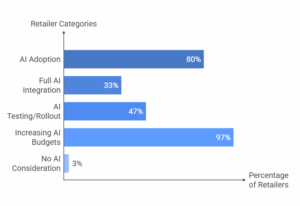
Retailers are no longer asking whether they should adopt AI. Most already have. Around 80% of online retailers now use some form of AI. Out of these, 33% use it across key operations, while 47% are still testing or rolling it out.

97% of retailers are increasing AI budgets in 2025. Only 3% are not considering AI at all, a number expected to drop to almost zero in a couple of years. These AI in ecommerce statistics prove that Artificial Intelligence is not an option anymore; it’s infrastructure.

This evolution reflects the journey of artificial intelligence, past and future,  from experimental novelty to essential retail infrastructure.

Retailers that use smart agents to assist with pricing, inventory, chat support, and recommendations are watching their performance rise. A study on Artificial Intelligence in e commerce also suggests that laggards will suffer high customer churn rates.

For companies planning to launch or expand an online marketplace, combining AI with smart design is key.

Our marketplace app development services are built to meet evolving e-commerce needs.

Boost in Conversions and Customer Experience

AI isn’t just for tech giants. Brands that use machine learning see measurable results. According to Gartner, AI-powered chat features deliver a 4x boost in conversions. Users who engage with chat tools convert at 12.3%, compared to only 3.1% for those who don’t.

Moreover, AI helps repeat customers spend more. Data from HelloRep.ai shows that repeat buyers using AI tools spend 25% more. Purchase decisions are 47% faster, reducing drop-offs. Chatbots alone increase retail sales by 67%, thanks to better product discovery and immediate query resolution.

Take a look at this:

Customer Benefit of eCommerce Chatbots Share of Shoppers (%)
Available 24/7 61%
Immediate answers 45%
Product recommendations 36%
Time saving 35%
Personalized advice 21%
Proactive assistance 21%
Access to detailed product info 19%
No need to visit the store 18%
Helps avoid purchase errors 15%
Multilingual support 12%
Purchase inspiration 9%
Helps reduce spending 8%
No benefit seen 21%

AI in e-commerce statistics like these confirm that customers are adapting fast. Businesses must respond with better tools and smarter strategies.

AI is rapidly changing how online retailers personalize shopping, optimize pricing, and manage inventory. This breakdown of AI in eCommerce shows how businesses are using intelligent tools to drive growth.

Holiday Season Insights: AI’s Role in Consumer Behavior

The 2024 holiday season showed how critical AI has become. According to Reuters, global AI-influenced sales crossed $229 billion. U.S. online sales alone grew 4% year over year to reach $282 billion.

Consumers showed clear preferences. 79% of purchases happened on mobile devices. Chatbot use rose 42% year-over-year. These AI in ecommerce statistics point to a sharp behavioral shift. Customers want speed, accuracy, and convenience. Businesses using old systems will fall behind during peak shopping cycles.

Personalization and AI-Driven Experiences

Consumers expect retailers to know what they want, sometimes before they do. Around 91% of shoppers are more likely to buy from brands that offer personalized recommendations, according to Statista. That’s not a hunch, it’s documented consumer behavior.

When experiences feel generic, 71% of users feel frustrated. 66% even say they will stop shopping from that site. Personalization is no longer a feature. It is expected. The same AI in ecommerce statistics also reveals:

Metric Performance Impact
Product recommendations offered by sites 71% overall (90% in Nordics)
Revenue increase via personalization Up to 300%
Conversion lift Up to 150%
Average order value boost Up to 50%

A study on Artificial Intelligence in e-commerce repeatedly proves that personalization is the single most profitable investment area for 2025.

While AI improves efficiency, it also raises important questions about workforce evolution.

This article on AI and jobs explores the balance between automation and employment.

Develop your AI eCommerce platform today!Hire us now!

Conversational & Generative AI in Shopping

As shoppers get smarter, they expect digital tools to keep up. The trend is now shifting toward conversational and generative tools that simulate real advice. For example, voice assistants and generative AI product descriptions are becoming standard.

Recent surveys show that 58% of Millennials and over 40% of Gen X and Boomers want personalized recommendations. 51% of Millennials demand frictionless payments. Younger audiences like Gen Z also want voice shopping, with 30% preferring voice-powered search and checkout.

Here’s what consumers wish for:

Innovation Gen Z Millennials Gen X Boomers
Personalized product recommendations 44% 58% 41% 41%
Frictionless payment 39% 51% 43% 42%
Personalized service 39% 58% 40% 31%
Seamless omnichannel experience 35% 53% 25% 16%
VR/AR features 29% 46% 28% 14%
Voice assistants 30% 45% 26% 11%

Yet, AI in payments is still slow to catch on. Only 10% globally are comfortable using it, especially in North America and Europe. The two biggest concerns? Data security and lack of awareness.

Security, Ethics & Return Rates

AI helps improve profits. But it brings challenges too. HelloRep.ai reports that 91% of businesses are rethinking voice-based verification due to the risk of voice cloning.

Holiday returns are also rising. Reuters says that 28% of orders in 2024 were returned, up from 20% the year before. That’s a serious issue for margins, especially when AI is pushing volume without enough context.

As AI expands, governance becomes essential. A study on Artificial Intelligence in e commerce suggests more firms will need to invest in data protection and customer trust.

Predicting trends is essential in a competitive retail environment. This guide on AI for demand forecasting explains how intelligent tools help retailers manage inventory more effectively.

Future Trends: Where AI in eCommerce is Headed

Market Aspect Data/Statistic
Market Size in 2025 $11.73 billion
Market Size in 2030 $40.53 billion
Compound Annual Growth Rate (CAGR) 28.2%
Large Companies Using AI About 90% of large companies
Planned Major Investments 29% planning major investments in next 3 years
Revenue Growth Up to 4%
Inventory Reduction Up to 20%
Supply Chain Cost Cut Up to 10%
AI Adoption 38% view AI as mission-critical
Readiness for Full Rollout 30% are ready for full-scale AI rollout

Many leading e-commerce brands are already seeing the impact of AI across their operations. These examples of companies using AI show how tech is becoming central to success.

LITSLINK – Technical Partner for Developing Applications and Business Software for eCommerce

Building smarter eCommerce experiences takes more than vision. You need the right technical partner to implement what matters. LITSLINK specializes in eCommerce AI applications that automate, personalize, and scale. Whether it’s AI-powered chat, personalized search, or predictive supply chain management, Litslink delivers.

If you’re looking to integrate AI into your eCommerce business, expert guidance makes all the difference. Contact LITSLINK to discuss your project goals and next steps.

Begin your AI eCommerce project today!Contact us now!

The post AI in eCommerce: Must-Know Statistics for 2025 and Beyond appeared first on Litslink.

.Organize the content with appropriate headings and subheadings ( h2, h3, h4, h5, h6). Include conclusion section and FAQs section with Proper questions and answers at the end. do not include the title. it must return only article i dont want any extra information or introductory text with article e.g: ” Here is rewritten article:” or “Here is the rewritten content:”

Generate single title from this title Perplexity Launches Comet Browser For Free Worldwide in 100 -150 characters. And it must return only title i dont want any extra information or introductory text with title e.g: ” Here is a single title:”

0

Write an article about Perplexity released its Comet browser to everyone today, shifting from a waitlist to free desktop downloads worldwide.
Comet bakes an AI assistant into every new tab so you can ask questions, summarize pages, and navigate without jumping between search results and multiple tools.
Perplexity first introduced Comet in July in a limited release. Since then, the company says “millions” have joined the waitlist, and early users asked 6–18 times more questions on day one.
The move poses a challenge to traditional search engines and browsers by adopting an AI-first approach to web navigation, which reduces the need for multiple searches and the management of numerous tabs.
What Makes Comet Different
At the core of Comet’s functionality is the Comet Assistant, an AI-powered helper that browses alongside users and handles tasks such as research, meeting support, coding assistance, and e-commerce activities.
The assistant appears in every new tab, ready to answer questions or complete actions without requiring users to navigate away from their current workflow.
Unlike traditional browsers where users must open a separate search engine, copy information between tabs, or use multiple tools, Comet integrates assistance directly into the browsing experience. You can ask questions in natural language, and the assistant provides answers drawn from web sources.
Background Assistants
Perplexity also announced Background Assistants today. These assistants work simultaneously and asynchronously in the background, handling tasks without requiring active user supervision.
The Background Assistants join the recently announced Email Assistant, currently available to Max Subscribers. The Email Assistant can be cc’d on email threads to handle scheduling, draft replies, and manage inbox tasks without opening a separate application.
Mobile & Voice Coming Soon
While Comet has been desktop-only since its July launch, Perplexity recently previewed mobile versions for iPhone and Android.
The mobile version will include voice technology, allowing users to interact with Comet assistants through speech rather than typing.
Availability
Comet is now available for free download at perplexity.ai/comet for desktop users.
For tips on using the browser, see Perplexity’s resource hub.

Featured Image: Sidney van den Boogaard/Shutterstock

.Organize the content with appropriate headings and subheadings ( h2, h3, h4, h5, h6). Include conclusion section and FAQs section with Proper questions and answers at the end. do not include the title. it must return only article i dont want any extra information or introductory text with article e.g: ” Here is rewritten article:” or “Here is the rewritten content:”

Accounting for uncertainty to help engineers design complex systems | MIT News

0

Designing a complex electronic device like a delivery drone involves juggling many choices, such as selecting motors and batteries that minimize cost while maximizing the payload the drone can carry or the distance it can travel.

Unraveling that conundrum is no easy task, but what happens if the designers don’t know the exact specifications of each battery and motor? On top of that, the real-world performance of these components will likely be affected by unpredictable factors, like changing weather along the drone’s route.

MIT researchers developed a new framework that helps engineers design complex systems in a way that explicitly accounts for such uncertainty. The framework allows them to model the performance tradeoffs of a device with many interconnected parts, each of which could behave in unpredictable ways.

Their technique captures the likelihood of many outcomes and tradeoffs, giving designers more information than many existing approaches which, at most, can usually only model best-case and worst-case scenarios.

Ultimately, this framework could help engineers develop complex systems like autonomous vehicles, commercial aircraft, or even regional transportation networks that are more robust and reliable in the face of real-world unpredictability.

“In practice, the components in a device never behave exactly like you think they will. If someone has a sensor whose performance is uncertain, and an algorithm that is uncertain, and the design of a robot that is also uncertain, now they have a way to mix all these uncertainties together so they can come up with a better design,” says Gioele Zardini, the Rudge and Nancy Allen Assistant Professor of Civil and Environmental Engineering at MIT, a principal investigator in the Laboratory for Information and Decision Systems (LIDS), an affiliate faculty with the Institute for Data, Systems, and Society (IDSS), and senior author of a paper on this framework.

Zardini is joined on the paper by lead author Yujun Huang, an MIT graduate student; and Marius Furter, a graduate student at the University of Zurich. The research will be presented at the IEEE Conference on Decision and Control.

Considering uncertainty

The Zardini Group studies co-design, a method for designing systems made of many interconnected components, from robots to regional transportation networks.

The co-design language breaks a complex problem into a series of boxes, each representing one component, that can be combined in different ways to maximize outcomes or minimize costs. This allows engineers to solve complex problems in a feasible amount of time.

In prior work, the researchers modeled each co-design component without considering uncertainty. For instance, the performance of each sensor the designers could choose for a drone was fixed.

But engineers often don’t know the exact performance specifications of each sensor, and even if they do, it is unlikely the senor will perfectly follow its spec sheet. At the same time, they don’t know how each sensor will behave once integrated into a complex device, or how performance will be affected by unpredictable factors like weather.

“With our method, even if you are unsure what the specifications of your sensor will be, you can still design the robot to maximize the outcome you care about,” says Furter.

To accomplish this, the researchers incorporated this notion of uncertainty into an existing framework based on category theory.

Using some mathematical tricks, they simplified the problem into a more general structure. This allows them to use the tools of category theory to solve co-design problems in a way that considers a range of uncertain outcomes.

By reformulating the problem, the researchers can capture how multiple design choices affect one another even when their individual performance is uncertain.

This approach is also simpler than many existing tools that typically require extensive domain expertise. With their plug-and-play system, one can rearrange the components in the system without violating any mathematical constraints.

And because no specific domain expertise is required, the framework could be used by a multidisciplinary team where each member designs one component of a larger system.

“Designing an entire UAV isn’t feasible for just one person, but designing a component of a UAV is. By providing the framework for how these components work together in a way that considers uncertainty, we’ve made it easier for people to evaluate the performance of the entire UAV system,” Huang says.

More detailed information

The researchers used this new approach to choose perception systems and batteries for a drone that would maximize its payload while minimizing its lifetime cost and weight.

While each perception system may offer a different detection accuracy under varying weather conditions, the designer doesn’t know exactly how its performance will fluctuate. This new system allows the designer to take these uncertainties into consideration when thinking about the drone’s overall performance.

And unlike other approaches, their framework reveals distinct advantages of each battery technology.

For instance, their results show that at lower payloads, nickel-metal hydride batteries provide the lowest expected lifetime cost. This insight would be impossible to fully capture without accounting for uncertainty, Zardini says.

While another method might only be able to show the best-case and worst-case performance scenarios of lithium polymer batteries, their framework gives the user more detailed information.

For example, it shows that if the drone’s payload is 1,750 grams, there is a 12.8 percent chance the battery design would be infeasible.

“Our system provides the tradeoffs, and then the user can reason about the design,” he adds.

In the future, the researchers want to improve the computational efficiency of their problem-solving algorithms. They also want to extend this approach to situations where a system is designed by multiple parties that are collaborative and competitive, like a transportation network in which rail companies operate using the same infrastructure.

“As the complexity of systems grow, and involves more disparate components, we need a formal framework in which to design these systems. This paper presents a way to compose large systems from modular components, understand design trade-offs, and importantly do so with a notion of uncertainty. This creates an opportunity to formalize the design of large-scale systems with learning-enabled components,” says Aaron Ames, the Bren Professor of Mechanical and Civil Engineering, Control and Dynamical Systems, and Aerospace at Caltech, who was not involved with this research. 

SmartThings Blog

0

New industry-first capability simplifies smart home setup, boosts network performance, and enables greater interoperability across ecosystems

October 1, 2025 — Mountain View, CA — SmartThings, Samsung Electronics’s global connected living platform, today announced it is one of the first major smart home ecosystems to support two-way Thread network unification, enabling users to seamlessly join SmartThings Hubs to existing Thread networks formed by other ecosystems and vice versa.

This update helps users build and grow their smart home with Thread devices, taking advantage of Thread’s mesh networking for better range, responsiveness, and reliability. With Thread network unification, a new SmartThings Hub can either join an existing Thread network right after the initial setup or allow a Border Router (BR) from another ecosystem to join the Thread network already in use by SmartThings. Once unified, all Border Routers in the home work together seamlessly.

“SmartThings has always been about giving users choice and flexibility in how they build their smart home,” said Mark Benson, Head of SmartThings US. “Thread network unification eliminates the barriers between ecosystems, so devices and Border Routers can work together in one powerful mesh, delivering the performance and simplicity our users have been asking for.”

Key Benefits

  • Better Range & Reliability — Unified BRs form a single, self-healing mesh that covers more of the home, maintains connections even if a device goes offline, and routes data along the fastest available path.
  • Simplified Setup — Joining the right Thread network from the start prevents network fragmentation and avoids the complexity of migrating devices later.
  • Flexible Network Management — Users can add or remove BRs from the unified network at any time, see all connected BRs across ecosystems, and maintain connected devices even when a BR leaves a network.

How It Works

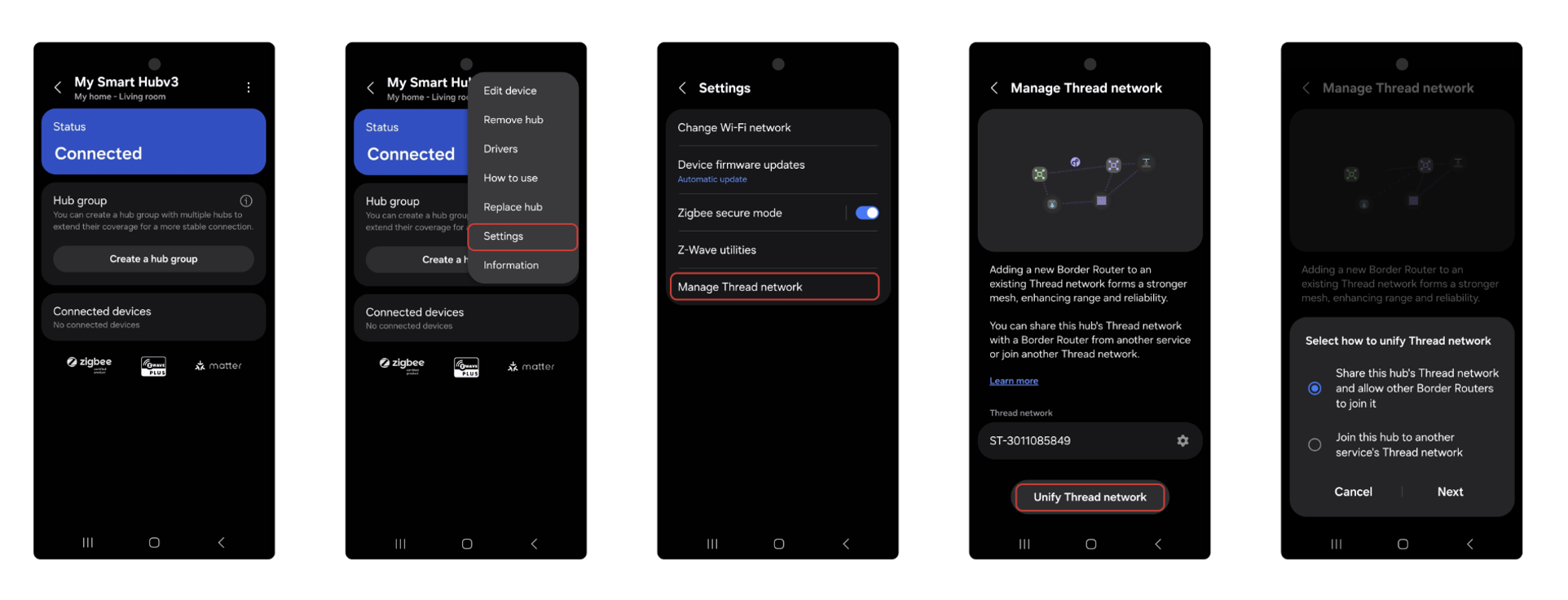
A new “Manage Thread Network” menu in the SmartThings Hub interface guides users through the unification process:

  • Joining a SmartThings hub to an Existing Thread Network:
    • Select “Join another network” in the SmartThings app.

      Join a chosen network via saved Thread credentials in the mobile OS credential locker, or by scanning a QR code/entering a one-time passcode (OTP) from a third-party app with a compatible Thread 1.4 Border Router in the sharing mode.

    • The SmartThings hub securely retrieves credentials and joins the target network in minutes.
  • Adding a Third-Party Border Router to a SmartThings Hub’s Thread Network:
    • Select “Share SmartThings network” in the SmartThings app.
    • Initiate the Thread 1.4 credential sharing, which generates a QR code and a one-time passcode (OTP).
    • Scan the QR code or enter the OTP in the third-party app to join its Border Router to the SmartThings Thread network.

While Thread Network Unification delivers a significant leap in simplicity and performance, realizing the full benefits of Thread 1.4 credential sharing depends on having compatible Thread 1.4 BRs across ecosystems. At launch in Q3 2025, the feature will be available on select SmartThings hubs (including the Aeotec Smart Home Hub and the Aeotec Smart Home Hub 2), with more hubs to follow. Users will need the latest 0.58.x hub firmware and iOS 1.7.37.x and Android OS 1.8.37.x mobile app from SmartThings. Third-party ecosystems may release Thread 1.4 compatibility updates to their Border Routers on their own timelines.

For more information about Thread Network Unification and the latest SmartThings updates, visit https://www.samsung.com/smartthings.

###

About SmartThings

SmartThings, Samsung’s global connected living platform, builds smart homes that are convenient, safe, sustainable, and fun. Millions of people, in nearly 200 countries, use SmartThings to easily control their connected homes and IoT devices. SmartThings delivers simple, powerful experiences across Samsung’s leading portfolio of phones, TV, and appliances. We offer the most versatile smart home experience as an open platform with a rich partner ecosystem. As a founding member of Matter, we are a leader in the industry to help make smart homes more secure, reliable, and seamless to use. Do the SmartThings at www.partners.smartthings.com

Generate single title from this title The value gap from AI investments is widening dangerously fast in 100 -150 characters. And it must return only title i dont want any extra information or introductory text with title e.g: ” Here is a single title:”

Write an article about

Boston Consulting Group (BCG) has found a widening chasm separating an elite of AI masters from the majority of firms struggling to generate any value from their AI investments.

A study from BCG found that a mere five percent of companies are successfully achieving bottom-line value from AI at scale. In sharp contrast, 60 percent are failing to achieve any material value, reporting only minimal gains despite making substantial investments in the technology.

“AI is reshaping the business landscape far faster than previous technology waves,” said Nicolas de Bellefonds , a managing director and senior partner and global leader of BCG’s AI efforts, and a coauthor of the report.

“The companies that are capturing real value from AI aren’t just automating—they’re reshaping and reinventing how their businesses work. And they’re pulling away.”

Top-performing organisations, which BCG labels “future-built,” aren’t just succeeding; they are creating a formidable and widening AI value gap. They already generate 1.7 times more revenue growth and 1.6 times higher EBIT margins than the lagging majority. This elite group has moved beyond isolated experiments to fundamentally reinvent their operations, driving shareholder returns through revenue increases and measurable workflow improvements. The remaining 35 percent of companies are making efforts to scale up but admit they are not moving fast enough to keep pace.

Future-built companies, having reaped early rewards, are now reinvesting their gains to pull even further ahead. They plan to spend 26 percent more on IT and dedicate 64 percent more of their IT budget to AI in 2025. This results in an overall AI investment that is 120 percent higher than their slower competitors.

As a consequence, future-built companies expect to see double the revenue increases and 1.4 times greater cost reductions from their AI applications. For the laggards, who lack foundational capabilities and generate almost no value, this creates what BCG calls a “vicious cycle of losing ground.”

A key reason for this disparity is a failure of leadership. Among lagging firms, top management often delegates AI strategy to middle or lower management, fails to articulate a clear vision for value from investments, and spreads resources too thinly across disconnected initiatives.

The secret to success lies in a proven playbook followed by the leading five percent. These firms approach AI as a board and CEO-sponsored multiyear programme with ambitious, clearly defined targets. 

Nearly all C-level leaders in future-built organisations are deeply engaged with AI, compared to only eight percent in lagging companies. They foster a model of shared ownership between business and IT departments, a practice they are 1.5 times more likely to adopt than their peers. One senior retail executive told BCG they “concentrate in particular on senior sponsorship and ownership of AI benefits by the businesses, which creates the room to invest.”

These leaders are not merely automating existing processes. They focus on reshaping and inventing core business workflows where the majority of value lies. The report found that 70 percent of AI’s potential value is concentrated in core functions such as R&D, sales, marketing, and manufacturing. Future-built companies prioritise this reinvention, resulting in 62 percent of their AI initiatives already being deployed, compared to just 12 percent for the laggards.

An accelerator of the value gap is the emergence and investment in agentic AI – which combines predictive and generative capabilities – allowing it to “reason, learn, and act autonomously” with minimal human input. These AI agents can be seen as digital workers, capable of handling complex workflows from supply chain management to customer service.

While hardly discussed in 2024, agentic AI already accounts for 17 percent of total AI value in 2025 and is projected to almost double to 29 percent by 2028. The top firms are moving quickly, with a third already using agents, compared to almost none of the laggards. These leaders are prioritising customer experience use cases for agents, with customer service being the top focus for 50 percent of companies.

“Agentic AI isn’t a future concept—it’s already reshaping workflows and redefining roles. Companies should view it as the next step in scaling AI, not as the starting point,” said Amanda Luther , a managing director and senior partner at BCG and a coauthor of the report.

“Agents represent a huge opportunity but aren’t simply plug-and-play: companies urgently need to redesign how work gets done, addressing the impact of agents on existing processes, roles, and skills.”

Talent is another key differentiator. Rather than focusing on job losses, future-built companies are aggressively upskilling their workforce to collaborate with AI. They plan to upskill more than 50 percent of their internal staff, making investments in broad-based employee AI enablement and carving out dedicated time for structured learning. This approach is six times more likely than in lagging companies. They also involve employees twice as often in the process of co-designing and reshaping workflows to incorporate AI agents, ensuring smoother adoption and building trust.

Leading organisations avoid the “GenAI burden” of siloed, unscalable proofs-of-concept by building on a central, integrated AI platform. They are three times more likely to operate such a platform, allowing them to build common capabilities for security and monitoring just once and then reuse them, accelerating deployment and ensuring enterprise-wide scale. More than half of these firms operate on a single, enterprise-wide data model, compared to just four percent of their stagnating peers, giving teams quick access to reliable and governed data.

For the 95 percent of companies falling behind, the message is urgent. The path to success is clearly delineated, but it requires a fundamental shift in mindset and organisation. BCG advises following a “10-20-70 rule,” where transformation efforts should focus 70 percent on people and processes, 20 percent on technology, and only 10 percent on the algorithms themselves.

The biggest roadblocks to achieving value from AI investments are not technical but organisational, relating to people, strategy, and processes. As the technology advances and the leaders accelerate, the window for catching up is closing fast. Firms that fail to act decisively now risk being permanently left behind.

See also: Samsung benchmarks real productivity of enterprise AI models

Want to learn more about AI and big data from industry leaders? Check out AI & Big Data Expo taking place in Amsterdam, California, and London. The comprehensive event is part of TechEx and is co-located with other leading technology events, click here for more information.

AI News is powered by TechForge Media. Explore other upcoming enterprise technology events and webinars here.

.Organize the content with appropriate headings and subheadings ( h2, h3, h4, h5, h6). Include conclusion section and FAQs section with Proper questions and answers at the end. do not include the title. it must return only article i dont want any extra information or introductory text with article e.g: ” Here is rewritten article:” or “Here is the rewritten content:”

Generate single title from this title Deloitte Highlights the Shift From Data Wranglers to Data Storytellers in 100 -150 characters. And it must return only title i dont want any extra information or introductory text with title e.g: ” Here is a single title:”

Write an article about

(Gorodenkoff/Shutterstock)

Public sector science and research relies heavily on data, but the sheer volume now is on another level. Government agencies in charge of health, energy, agriculture, and space exploration find themselves drowning in information that is vital yet difficult to handle. 

For the engineers and scientists trying to guide public sector growth in this space, data is both the fuel of discovery and the weight that slows the process down. However, AI is beginning to change that balance. Not only can it handle the grind of cleaning and sorting, but its real value is in surfacing anomalies and weaving together insights from datasets that once existed in isolation.

Deloitte has released an analysis that takes a practical look at how AI can help government researchers work faster, uncover deeper insights, and tackle some of society’s toughest challenges 

The report makes the case that AI is not designed to replace researchers but to give them more time to focus on higher-value work. Instead of spending long hours on repetitive cleanup and organization, scientists could use that time to interpret results, shape policy, or design new experiments. Deloitte points out that automation can ease one of the biggest drags on progress and allow experts to put their skills to work where they matter most.

Deloitte writes that “Artificial intelligence, AI agents, and generative AI technologies are revolutionizing how government agencies conduct research—speeding up scientific discovery, improving accuracy, and enabling new ways to address pressing challenges such as energy resilience, public health crises, and technological innovation”

Each of these AI technologies plays a role in the process. Algorithms can scan through huge data collections, pulling out patterns and signals that people might never notice on their own. GenAI helps researchers keep up with the steady flow of new papers by turning long studies into clear summaries. AI agents go further by handling basic lab work like data entry or monitoring, which leaves scientists free to spend more time on interpretation and discovery.

As AI becomes more common in public sector research, the role of the scientist is beginning to stretch in new directions. Deloitte’s analysis notes that data experts cannot remain only technicians. They are increasingly expected to act as translators who can turn complex results into narratives that shape policy and guide public decisions. 

In this vision, the government scientist is not just running code or reviewing datasets. They are also the ones explaining what the results mean and how those insights connect to problems facing society.

This shift calls for a wider mix of skills. Knowledge of automation and machine learning will still matter, but so will abilities such as problem solving, creativity, and sound judgment. Deloitte describes this as a move from data wranglers to data storytellers. The real value of science lies not only in producing findings but in explaining them in ways that help leaders act with clarity and confidence.

(NicoElNino/Shutterstock)

The AI-amplified data scientist is Deloitte’s term for what comes next. The idea is not only that machines can take away routine tasks but that they can open new ground for research. With these tools, scientists in government agencies can scan across fields that never connected before, drawing links between health data, energy grids, or even defense modeling. 

They can test ideas more quickly, run scenarios with more confidence, and put insights on the table when leaders need them most. What is amplified here is not just efficiency. It is the scope of science itself.

Deloitte also offers insight into the range of users it expects will take part in the shift to AI, and the roles differ quite a bit. Some will be AI Consumers, people using straightforward tools that help with everyday tasks without requiring much technical training. 

Others will step into roles as AI Builders or AI Architects, taking responsibility for the design and upkeep of larger projects that embed AI inside agency systems. On the far side are AI Pathfinders, Ambassadors, and Visionaries, positions that focus more on strategy, on encouraging adoption, and on setting longer term direction. Seen this way, the AI-amplified data scientist is only one piece of a wider ecosystem. Success will not depend on a single type of expert but on the ability of all these roles to work together.

Related Items

Agentic AI and the Scientific Data Revolution in Life Sciences

NASA’s Metadata Project Expands Access to Critical Science Data

NIH Highlights AI and Advanced Computing in New Data Science Strategic Plan

.Organize the content with appropriate headings and subheadings ( h2, h3, h4, h5, h6). Include conclusion section and FAQs section with Proper questions and answers at the end. do not include the title. it must return only article i dont want any extra information or introductory text with article e.g: ” Here is rewritten article:” or “Here is the rewritten content:”

Generate single title from this title Is the Apple Watch SE 3 a good deal? in 100 -150 characters. And it must return only title i dont want any extra information or introductory text with title e.g: ” Here is a single title:”

0

Write an article about

Apple recently unveiled three new Apple Watch models: the Apple Watch Series 11, Apple Watch SE 3, and Apple Watch Ultra 3. With its $799 price tag, the Apple Watch Ultra 3 is clearly aimed at a niche, high-end market and athletes. For most consumers, the purchasing decision likely lies between the Apple Watch SE 3 and the Apple Watch Series 11, starting at $249 and $399, respectively.

Despite its lower price tag, the Apple Watch SE 3 comes with much of the same software as the Series 11. If you’re looking for a straightforward smartwatch with essential features like step counting and sleep tracking, the SE 3 is an excellent and affordable choice. 

While the Series 11 and Ultra 3 offer modest improvements over their predecessors, the SE 3 has received a significant upgrade from the SE 2. The smartwatch jumps from the S8 chip to the S10 and now features an always-on display, supports fast charging, offers better crack resistance, introduces new health features, includes a wrist-temperature sensor for advanced sleep tracking and retrospective ovulation insights, and more. 

Image Credits:Apple

Although it’s not as flashy as the Series 11 and Ultra 3, it definitely stands out and packs great value, especially for first-time buyers. The gap between the standard and budget smart watches has never felt smaller. 

Of course, if you want access to more advanced health features, better battery life, and a larger display, the Series 11 would be the better option for your needs. But, it’s worth comparing both models because the SE 3 might be all you need.

We’ll walk you through the similarities and differences between the two smart watches to help inform your decision.

Similarities between the Apple Watch Series 11 and Apple Watch SE 3

Image Credits:Apple

  • S10 chip: Both models come with the same chip, which means there won’t be significant differences in performance.
  • Always-on Retina display: The watches can display the watch face and time, even when your wrist is down.
  • Heart health features: Both watches feature high and low heart rate notifications, irregular rhythm notifications, and low cardio fitness notifications.
  • Wrist flick and double tap gestures: Both models let you do a “wrist flick” gesture to dismiss notifications and timers, and a “double tap” gesture to trigger actions like answering calls or playing music.
  • Emergency SOS: The watches can quickly call local emergency services, share your location, and notify your emergency contacts once you press and hold the side button.
  • Fall detection and crash detection: Both watches can automatically alert emergency services and designated emergency contacts when a hard fall or severe car crash is detected.
  • Water resistant to 50 meters: Both watches can be used for swimming.
  • Sleep tracking: Both models feature sleep tracking, sleep tracking notifications, and Apple’s new Sleep score, which gives you a number on a scale of 1 to 100 for how well you slept. They both also have temperature sensing, which can provide insight into your well-being by tracking nightly changes in your wrist temperature.
  • Cycle tracking with retrospective ovulation estimates: The watches can determine when you most likely ovulated in your previous cycle.
  • Fast charging capabilities: Both watches are fast-charge capable (up to 80% charge in about 30 minutes for the Series 11 and up to 80% charge in about 45 minutes for the SE 3; 15 minutes for up to eight hours of normal use for both models). 
  • Find iPhone: Both watches let you press a button to play a sound on your iPhone to help you locate it. However, the Series 11 does feature “precision finding,” which means it can pinpoint the exact location of your phone.

Differences between the Apple Watch Series 11 and Apple Watch SE 3

  • Battery life: The Series 11 can last up to 24 hours (28 hours in low-power mode), while the SE can last up to 18 hours (32 hours in low-power mode).
  • Health features: The Series 11 comes with more advanced health tracking features, including hypertension notifications (detects high blood pressure), an electrical heat sensor, an ECG app, and Blood Oxygen app.
  • Screen and display: The Series 11 can reach up to 2000 nits, while the SE 3 goes up to 1000 nits. Plus, the Series 11 features a wide-angle OLED, while the SE 3 has a simple OLED display.
  • Size: The Series 11 is available in 46mm and 44mm sizes with aluminum or titanium cases, while the SE 3 comes in 44mm and 40mm sizes with an aluminum case. Additionally, the Series 11 is almost 10% thinner than the SE 3. 
  • Color: The Series 11 comes in aluminum colors: Jet Black, Silver, Rose Gold, and Space Gray, and titanium colors: Natural, Gold, and Slate. The SE 3 comes in Midnight Aluminum and Starlight Aluminum.
  • Other smaller differences: The Series 11 comes with a depth gauge to six meters, a water temperature sensor, 1 nit minimum brightness (vs 2 nit minimum brightness on the SE 3), and certified IP6X dust resistance.

.Organize the content with appropriate headings and subheadings ( h2, h3, h4, h5, h6). Include conclusion section and FAQs section with Proper questions and answers at the end. do not include the title. it must return only article i dont want any extra information or introductory text with article e.g: ” Here is rewritten article:” or “Here is the rewritten content:”

SmartThings Blog

0

With push notifications that keep your inner circle updated, the new offering provides daily peace of mind

Staying connected with loved ones has never been more important. Whether it’s parents wanting to know their kids got home safely, caregivers checking in on aging relatives, or friends looking out for each other during a night out—location sharing has become a core part of how families support one another. In fact, 41% of U.S. adults already share their location with someone they trust, showing just how common these check-ins have become.

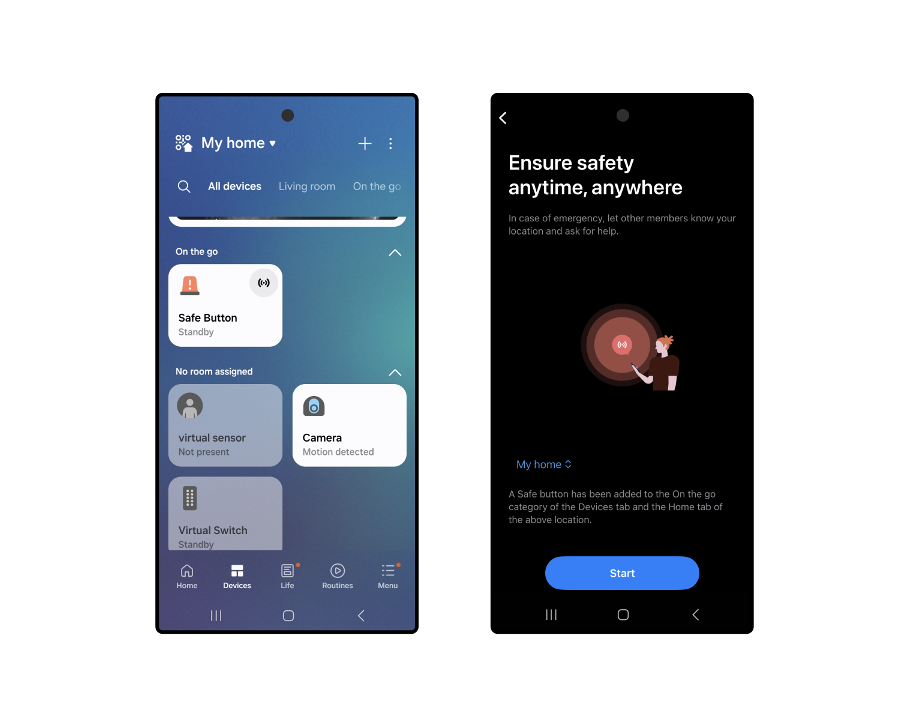
That’s why SmartThings is launching the SmartThings Safe Button (Free). With just one tap in the SmartThings app, you can instantly send a push notification requesting help and your GPS location to family and friends you’ve added as Location Members—providing daily peace of mind at no cost.

Whether you’re walking home late, traveling, or simply want to let someone know you’ve arrived safely, SmartThings Safe Button (Free) makes staying connected effortless.

How It Works

With SmartThings Safe Button (Free), checking in is as simple as tapping a button in the SmartThings app. When you press the Safe Button:

  • A push notification is sent to all family and friends you’ve added as Location Members.
  • The push notification instantly alerts your trusted contacts, sharing your GPS location and providing quick options to call, text, or navigate directly to you.
  • Your family and friends can quickly see where you are and the SmartThings app will prompt them to respond right away via SMS or Phone Call.

This service is designed for staying connected with your loved ones. SmartThings Safe Button (Free) does not call or notify emergency services; instead, it provides a fast, reliable way to let the people who matter most know where you are. Please note users must have Location Services enabled on their mobile device in order to send their real-time location.

Setting Up SmartThings Safe Button (Free)

Getting started is simple:

  1. Open the SmartThings app on your mobile device.
  2. Navigate to the More tab in the bottom right corner.
  3. Select the Safe icon and follow the prompts to set up SmartThings Safe Button (Free).

To make sure the alerts reach the right people, you’ll want to add family members or friends as Location Members:

  • From the Home tab, tap the ‘+’ sign next to the options menu (three dots) in the upper right corner.
  • After tapping the ‘+’ sign, select the last option in the dropdown menu: ‘Invite Members.’
  • Enter their email addresses associated with their SmartThings account (user must create a SmartThings account in order to be added as a Member) of the people you’d like to add. Once they accept, they’ll begin receiving your Safe Button notifications.

Please note, Location Members must have the SmartThings app on their device as well as a SmartThings account to receive the Location Member notifications. Location Members will only receive the Safe Button alerts if they have their SmartThings notifications enabled.

SmartThings Safe Button (Free) is now available on both iOS and Android mobile phones. Users with Galaxy watches and Apple Watches can receive Safe notifications on their watch. Note: You cannot request help from Smart Watches at this time. For additional questions, you can check out the FAQ for SmartThings Safe Button (Free) here.

Stay tuned for future updates as we continue to expand safety features across the SmartThings ecosystem.