Home Blog Page 44

Generate single title from this title Michigan School Policy Changes: Everything School Leaders Need to Know in 2025–26 in 100 -150 characters. And it must return only title i dont want any extra information or introductory text with title e.g: ” Here is a single title:”

Write an article about

Michigan school districts are heading into a transformative year. With new state legislation and continued funding initiatives shaping everything from device usage to mental health infrastructure, K-12 leaders across the state are facing an evolving set of responsibilities. The 2025-26 school year won’t just be about keeping up – it’ll be about planning ahead, building compliance into every layer of operations, and keeping students safe, supported, and connected in line with Michigan school policy.

Whether you’re part of a large urban district or a smaller suburban system, Michigan’s latest policy changes are designed to impact how schools manage technology, protect student data, and deliver equitable support services. For district leaders, the key will be balancing compliance with practicality, and finding ways to implement new policies in a manner that’s both scalable and student-first.

What’s Changing for Michigan School Policy in 2025-26?

Cell Phone Bans: HB 5921 (Proposed)
If passed, HB 5921 would restrict student smartphone and device usage during instructional time, beginning Fall 2025. Districts should begin drafting classroom device policies, identifying exceptions for emergencies or instructional use, and planning training for teachers and staff on enforcement procedures.

Student Data Privacy & Protection
Federal policies like FERPA and COPPA still apply, but public scrutiny around vendor compliance is intensifying. Michigan districts are expected to audit all edtech vendors, formalize data privacy policies, and clearly communicate data access rights to families. SAF grants and federal cybersecurity funds can help support upgrades and compliance.

Internet Safety & Cyberbullying: Matt Epling Safe Schools Law
This active legislation mandates a comprehensive cyberbullying response, including annual training, restorative practices, and formal reporting procedures. Schools must also support community-aligned interventions such as OK2Say and broader SEL integration. Funding is available through SAF grants, Stronger Connections, and SchoolSafety.gov.

Technology-Based School Safety: PA 2024 No. 148
Districts must now implement security camera systems, firearms detection technology, and a centralized Student Safety Management System. Compliance also requires the use of Michigan’s state emergency planning platform and protocols for real-time threat reporting. $350M in SAF funding and state budget increases are available to support this transformation.

Mental Health Technology Services: HB 5549
By October 2026, every district must implement behavioral threat assessment teams and formalized safety plans. This means investing in trained staff, consistent documentation, and scalable intervention protocols. SAF grants and additional state budget increases can be applied to this initiative, along with wellness-aligned federal funds.

Parental Rights & Technology Oversight
While not governed by new legislation, expectations around parental engagement and tech transparency are rising. Michigan schools should provide activity reports, mental health alerts, and easy-to-use privacy tools that foster trust and collaboration with families.

Download the 2025-26 School Readiness Guide

To help district and school leaders stay ahead of these shifts, we’ve created the 2025-26 School Readiness Guide: a national resource designed to help K-12 decision-makers align their practices with the latest legislation, safety mandates, and student wellness priorities.

The guide includes six key focus areas:

  • Cell phone bans & digital distractions
  • Student data privacy & vendor accountability
  • Campus & physical safety
  • Online safety & digital wellbeing
  • Responsible AI readiness & usage
  • Community-centered student support

Each section includes a clear checklist and action items to follow, making the guide easy to reference and implement.

You can download the guide for free here.

Further K-12 Guidance & Support is Just a Click Away

At Securly, we’re proud to support 424,945 students across 285 schools and districts in Michigan. From Ann Arbor Public Schools and Lansing Public Schools, to Jackson County ISD and Kentwood Public Schools, we’re trusted by districts of all sizes to help create safer, more connected, and more future-ready learning environments.

Whether you’re responding to new policy, evaluating your safety and wellness tools, or looking for expert support, our team is always here to support you along the way.

To learn more about Securly, visit our website.

For regularly updated Michigan school policy information, bookmark the hub.

To discuss your school and its needs for 2025-26 with one of our experts, schedule a call.

Like this:

Like Loading…

.Organize the content with appropriate headings and subheadings ( h2, h3, h4, h5, h6). Include conclusion section and FAQs section with Proper questions and answers at the end. do not include the title. it must return only article i dont want any extra information or introductory text with article e.g: ” Here is rewritten article:” or “Here is the rewritten content:”


Generate single title from this title Everything K-12 Leaders Need to Know About 2025-26 School Policy Changes in 100 -150 characters. And it must return only title i dont want any extra information or introductory text with title e.g: ” Here is a single title:”

Write an article about

From new AI regulations to widespread cell phone bans, the 2025-26 school year brings sweeping changes – and K-12 school leaders need to be ready.

Across the country, state-level legislation is reshaping what school operations, digital learning, and student safety look like. New policies touch everything from student privacy and online wellbeing, to teacher support and parental engagement. These shifts create both opportunity and uncertainty, especially for those tasked with leading change in their districts.

That’s why we launched our 2025-26 School Readiness Guide: to help school leaders plan and prepare with clarity and purpose.

Why This Matters for K-12 Schools Right Now

This school year is being shaped by a growing wave of new state mandates on top of longstanding federal requirements like CIPA and FERPA. In many states, legislation now outlines exactly how districts must approach key K-12 topics, including:

  • Student cell phone usage
  • AI in the classroom
  • Wellness monitoring
  • Edtech contracts and data governance
  • Physical campus safety
  • Family engagement
  • Digital classroom management

The public conversation around student safety and educational equity is louder – and more complex – than ever before. Districts need to stay proactive, compliant, and grounded in student-centered strategy.

“How do we support these students in their academic learning? Our job is to follow the policies of the district and the state, while always putting the student – and the student voice – first.”

Tammy Wincup, CEO, Securly

Inside the 2025-26 School Readiness Guide

To support school and district leaders through this ever-changing landscape, we created the School Readiness Guide: a comprehensive resource designed to help K-12 decision-makers align their practices with emerging policy, safety needs, and leadership best practices.

The guide covers six key focus areas, each with breakdowns of what’s changed, why it matters to you and your schools, and what actions to consider next:

  • Cell phone bans & digital distractions
  • Student data privacy & vendor accountability
  • Campus & physical safety
  • Online safety & digital wellbeing
  • Responsible AI readiness & usage
  • Community-centered student support

Each section includes a clear checklist and action items to follow, making the guide easy to reference and implement.

You can download the guide for free here.

Explore the Latest 2025-26 School Policy Shifts in Your State

While the School Readiness Guide offers national insights, each state has unique legislation and timelines that affect how districts should respond.

Alongside the School Readiness Guide, we’re creating state-specific readiness pages to help you stay informed and take the right steps locally. These resources include:

  • Summaries of relevant legislation and funding opportunities
  • Key deadlines and implementation details
  • Guidance on what K-12 school leaders need to do next

Choose your state from the alphabetized list below to learn more; we’ll be updating our state-specific list as more states are added to our website in the coming weeks and months:

Further K-12 Guidance & Support is Just a Click Away

At Securly, we support thousands of K-12 schools and districts in building safer, better connected, more future-ready learning environments. Whether you’re navigating new legislation or looking for a long-term partner in student wellness, digital safety, or classroom management, we’re here to help.

To learn more about Securly, visit our website.

To discuss your school and its needs for 2025-26 with one of our experts, schedule a call.

Like this:

Like Loading…

.Organize the content with appropriate headings and subheadings ( h2, h3, h4, h5, h6). Include conclusion section and FAQs section with Proper questions and answers at the end. do not include the title. it must return only article i dont want any extra information or introductory text with article e.g: ” Here is rewritten article:” or “Here is the rewritten content:”

What is robotics vs. automation vs. robots?

0

This is the third article in a series of FAQs about robotics. The first one and the second one can be found on this website. This article deals with the question: What is robotics vs. automation vs. robots?

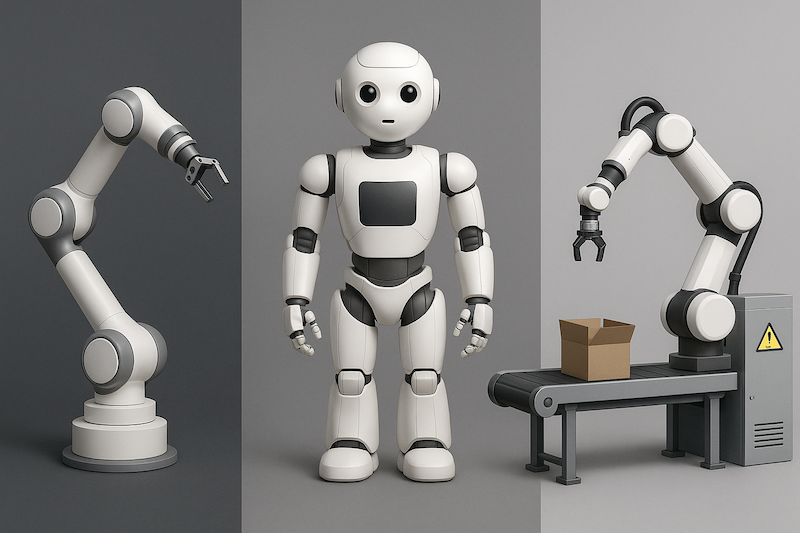
In simple terms, “robotics” is the broader science; “robots” are physical units; and “automation” is the enabling technology. Moreover, “automation” is the umbrella term within which “robotics” is a sub-sector.

Though often used interchangeably, the terms robotics, robots, and automation refer to distinct – but overlapping – concepts.

Understanding the differences is essential for anyone navigating today’s rapidly evolving technological landscape, from engineers and investors to factory workers and everyday consumers. Robotics: The science and engineering discipline

Robotics is the multidisciplinary field that encompasses the design, construction, programming, and operation of robots. It draws on mechanical engineering, electrical engineering, computer science, control systems, artificial intelligence, and other domains.

The field includes both the theoretical underpinnings and the practical applications of machines that can sense, decide, and act.

Robotics doesn’t necessarily imply autonomy – many robots are manually operated – but it does focus on machines designed to interact with the physical world, often in complex or dynamic environments.

Robots: The physical machines

A robot is a physical machine – usually programmable – that can carry out a range of tasks. Robots often include mechanical components such as arms, wheels, or legs, sensors to perceive the environment, and controllers to interpret data and make decisions.

Some robots are fully autonomous, while others are semi-autonomous or remotely controlled.

Industrial robot arms on an assembly line, quadrupeds used in military inspections, humanoids that mimic human movements, and vacuum cleaners that map your living room all fall under the broad category of robots.

They vary widely in form and intelligence, but all are physical embodiments of robotic principles.

Automation: The wider technological context

Automation refers to the broader concept of using technology to perform tasks without human intervention. It doesn’t necessarily involve robots. For instance, a thermostat that regulates temperature is a form of automation.

So is a software script that processes invoices. Automation can be purely digital, purely mechanical, or a blend of both.

In industrial settings, robots are often tools for automation – but not the only ones. Conveyor belts, pneumatic systems, and software-driven workflows also contribute to automating processes.

Putting it all together

Think of it this way: automation is the goal, robotics is one of the disciplines used to achieve that goal, and robots are the tools – or systems – developed through that discipline. Automation can exist without robots, but robots are almost always designed to automate something.

As the technologies continue to evolve and merge with artificial intelligence, the distinctions may blur even further. But the foundational definitions remain a useful starting point for understanding where we are – and where we’re headed.

Generate single title from this title Inside the relentless race for AI capacity in 100 -150 characters. And it must return only title i dont want any extra information or introductory text with title e.g: ” Here is a single title:”

Write an article about

These spikes threaten cascading power outages, affecting homes and businesses that feed off the same grid network. Last summer, utility providers in Virginia had to grapple with a sudden surge in power after a cluster of facilities switched to back-up generators as a safety precaution, leading to an excess supply that risked grid infrastructure.

With abundant power the priority, operators have also ended up in areas with significant water constraints. Hyperscale and colocation sites in the US consumed 55bn litres of water in 2023, according to researchers at the LBNL. Indirect consumption tied to energy use is markedly higher at 800bn litres a year, the equivalent annual water usage of almost 2mn US homes.

In 2023, Microsoft said that 42 per cent of its water came from “areas with water stress”, while Meta said roughly 16 per cent of its water usage was derived from similar areas during the same time period. Google said last year almost 30 per cent of its water came from watersheds with a medium or high risk of “water depletion or scarcity”. Amazon does not disclose its figure.

Data centres in drought-prone states such as Arizona and Texas have led to concern among locals, while residents in Georgia have complained that Meta’s development in the state has damaged water wells, pushed up the cost of municipal water and led to shortages that could see water rationed.

Some believe that this endless race for ever-greater computing power is misplaced.

Sasha Luccioni, AI and climate lead at open-source start-up Hugging Face, said alternative techniques to train AI models, such as distillation or the use of smaller models, were gaining popularity and could allow developers to build powerful models at a fraction of the cost.

“It’s almost like a mass hallucination where everyone is on the same wavelength that we need more data centers without actually questioning why,” she said.

Cooling

Increased chip density has another unwanted effect: heat. About two-fifths of the energy used by an AI data centre stems from cooling chips and equipment, according to consultants McKinsey.

Early data centres running cloud workloads deployed industrial-grade air conditioning units similar to those used in offices to cool servers. But as chips started to draw more power, it has become harder to keep them within their safe operating range between 30 and 40C, with data centres requiring more advanced cooling methods to avoid malfunctions. The challenge has led to significant investment in cutting-edge innovations.

Operators have turned to installing pipes filled with cold water in the server room to transfer heat away from equipment. This water is then directed to large cooling towers that use evaporation to reduce the facility’s temperature to a safe range. But the approach leads to water loss, with a single tower churning through about 19,000 litres per minute.

Microsoft and others have adopted a closed-loop system that depends on chillers — in effect, a refrigerator —to cool the water. This process is less wasteful and more efficient than evaporative options.

.Organize the content with appropriate headings and subheadings ( h2, h3, h4, h5, h6). Include conclusion section and FAQs section with Proper questions and answers at the end. do not include the title. it must return only article i dont want any extra information or introductory text with article e.g: ” Here is rewritten article:” or “Here is the rewritten content:”
Generate single title from this title Open-source AI that hones its reasoning skills in 100 -150 characters. And it must return only title i dont want any extra information or introductory text with title e.g: ” Here is a single title:”

Write an article about

Deep Cogito has released Cogito v2, a new family of open-source AI models that sharpen their own reasoning skills.

Released under an open-source licence, the new Cogito v2 lineup includes four hybrid reasoning AI models: two mid-sized at 70B and 109B parameters, and two large-scale versions at 405B and 671B. 

The largest, a 671B Mixture-of-Experts (MoE) model, is already being touted as one of the most powerful open-source AIs in the world. The company reports that it competes with the latest from DeepSeek and is closing the gap on proprietary systems like O3 and Claude 4 Opus.

But the real story isn’t just about size or power; it’s about a fundamental shift in how the AI learns. Instead of just ‘thinking’ longer at inference time to find an answer, Cogito v2 is designed to internalise its own reasoning processes.

This internalised reasoning is achieved through a technique called Iterated Distillation and Amplification (IDA), which distils the discoveries from a search back into the model’s core parameters. The goal is to build a stronger ‘intuition’, allowing the model to anticipate the outcome of its own reasoning without having to perform the entire search.

Because the open-source AI models have a better “gut feeling” for the right approach, their reasoning chains are 60% shorter than those of rivals like Deepseek R1.

This efficiency extends to the budget. Deep Cogito says that it developed all its models – from experiments to final training – for a combined total of less than $3.5 million. Still a large sum likely for you or I, but miniscule compared to the spending of many of the leading AI labs.

The flagship 671B model received special attention, trained not only to improve its final answers but to refine the thinking process itself. This approach discourages the model from “meandering” and rewards a more direct path to the solution. The performance data suggests it works, with Deep Cogito’s open-source AI model matching or exceeding the latest DeepSeek versions on key benchmarks while being close to proprietary alternatives:

Perhaps one of the most surprising outcomes is the models’ ability to reason about images; a skill they were never explicitly trained for.

The team shared an example of this reasoning where Deep Cogito’s open-source AI model compared two images of a duck and a lion, demonstrating a deep thinking process about their habitats, colours, and composition purely through transfer learning. Deep Cogito believes this emergent property could be a powerful way to bootstrap training data for future multimodal reasoning systems.

Looking ahead, the Deep Cogito team plans to “hill climb on the gains of iterative self-improvement” in its quest to build superintelligence. They have restated their commitment that all AI models they create will be open-source.

See also: Leak suggests OpenAI’s open-source AI model release is imminent

Want to learn more about AI and big data from industry leaders? Check out AI & Big Data Expo taking place in Amsterdam, California, and London. The comprehensive event is co-located with other leading events including Intelligent Automation Conference, BlockX, Digital Transformation Week, and Cyber Security & Cloud Expo.

Explore other upcoming enterprise technology events and webinars powered by TechForge here.

.Organize the content with appropriate headings and subheadings ( h2, h3, h4, h5, h6). Include conclusion section and FAQs section with Proper questions and answers at the end. do not include the title. it must return only article i dont want any extra information or introductory text with article e.g: ” Here is rewritten article:” or “Here is the rewritten content:”

Generate single title from this title Fundamental Research Labs nabs $30M to build AI agents across verticals in 100 -150 characters. And it must return only title i dont want any extra information or introductory text with title e.g: ” Here is a single title:”

0

Write an article about

Applied AI research company Fundamental Research Labs (formerly known as Altera) announced today that it has raised $30 million in Series A funding led by Prosus with participation from Stripe co-founder and CEO Patrick Collison.

The company has a curious structure as it is working on multiple AI applications in different fields. When it raised its seed funding, Fundametal Research Labs was developing bots that could play Minecraft with you.

Today, the company has a games team, a prosumer team building apps, a core research team, and a platform team. Yang says that Fundamental Research Labs wants to be a “historical” company without adhering to a typical startup structure.

The startup’s founder, Dr. Robert Yang, a former faculty member at MIT, said that the company is already charging users for this agent post a seven-day trial and bringing in revenue.

Among the products Fundamental Research Labs offers is a general-purpose consumer assistant called Fairies. This app allows you to chat with an AI bot, connect applications, and ask questions across the knowledge bases of those applications, then ask it to schedule appointments for you on your calendar. The app can schedule workflows for you to repeatedly execute some tasks. Yang said that this app allows the startup’s engineers to test out various capabilities of models and platform tech it is developing.

The company also offers a spreadsheet-based agent called Shortcut, which has been used by analysts for creating different financial models and performing analysis over them. The startup said that this agent works like a junior analyst and can do work autonomously. The company has made it look like Excel and has tried to retain a lot of functionality for power users.

“We’ve seen many early-stage startups, but what stood out here is a small, highly mission-driven team focused on digital humans with actual use cases. Their recent launches, like Fairies and Shortcut, aren’t just demos; they’re already demonstrating how AI can augment the human workforce in meaningful ways,” Sandeep Bakshi, an investment partner at Prosus, told TechCrunch over email.

Techcrunch event

San Francisco
|
October 27-29, 2025

“What stood out with Fundamental Research Labs is not just the ambition of the vision, but again the caliber of the team driving it,” he added. “Their ability to attract some of the brightest minds in the world, and turn that talent into real-world products, makes this a uniquely compelling venture opportunity for us.”

The company raised $9 million in a seed round last year, which was co-led by First Spark Ventures and Patron, with participation from a16z SPEEDRUN and Eric Schmidt. The startup has raised over $40 million in funding to date.

Shortcut – the first superhuman excel agent – is live.

While not perfect, Shortcut beats first year analysts from McKinsey/Goldman head-to-head 89.1% (220:27) when blindly judged by their managers.

We even gave humans 10x more time.

Try Shortcut now (before your boss does). pic.twitter.com/bOCVx6J77W

— nico (@nicochristie) July 28, 2025

Yang said the company is open to trying out various application models and eventually wants to build robots as well.

“We are working on productivity (apps) now because that is where the most value is created. You can make a lot of money doing this and build your team and tech. Eventually, we want to solve physical problems and move towards working on embodiment,” Yang said.

.Organize the content with appropriate headings and subheadings ( h2, h3, h4, h5, h6). Include conclusion section and FAQs section with Proper questions and answers at the end. do not include the title. it must return only article i dont want any extra information or introductory text with article e.g: ” Here is rewritten article:” or “Here is the rewritten content:”

Generate single title from this title What really shapes the future of AI in education? in 100 -150 characters. And it must return only title i dont want any extra information or introductory text with title e.g: ” Here is a single title:”

Write an article about

This post originally appeared on the Christensen Institute’s blog and is reposted here with permission.

Key points:

A few weeks ago, MIT’s Media Lab put out a study on how AI affects the brain. The study ignited a firestorm of posts and comments on social media, given its provocative finding that students who relied on ChatGPT for writing tasks showed lower brain engagement on EEG scans, hinting that offloading thinking to AI can literally dull our neural activity. For anyone who has used AI, it’s not hard to see how AI systems can become learning crutches that encourage mental laziness.

But I don’t think a simple “AI harms learning” conclusion tells the whole story. In this blog post (adapted from a recent series of posts I shared on LinkedIn), I want to add to the conversation by tackling the potential impact of AI in education from four angles. I’ll explore how AI’s unique adaptability can reshape rigid systems, how it both fights and fuels misinformation, how AI can be both good and bad depending on how it is used, and why its funding model may ultimately determine whether AI serves learners or short-circuits their growth.

What if the most transformative aspect of AI for schools isn’t its intelligence, but its adaptability?

Most technologies make us adjust to them. We have to learn how they work and adapt our behavior. Industrial machines, enterprise software, even a basic thermostat—they all come with instructions and patterns we need to learn and follow.

Education highlights this dynamic in a different way. How does education’s “factory model” work when students don’t come to school as standardized raw inputs? In many ways, schools expect students to conform to the requirements of the system—show up on time, sharpen your pencil before class, sit quietly while the teacher is talking, raise your hand if you want to speak. Those social norms are expectations we place on students so that standardized education can work. But as anyone who has tried to manage a group of six-year-olds knows, a class of students is full of complicated humans who never fully conform to what the system expects. So, teachers serve as the malleable middle layer. They adapt standardized systems to make them work for real students. Without that human adaptability, the system would collapse.

Same thing in manufacturing. Edgar Schein notes that engineers aim to design systems that run themselves. But operators know systems never work perfectly. Their job—and often their sense of professional identity—is about having the expertise to adapt and adjust when things inevitably go off-script. Human adaptability in the face of rigid systems keeps everything running.

So, how does this relate to AI? AI breaks the mold of most machines and systems humans have designed and dealt with throughout history. It doesn’t just follow its algorithm and expect us to learn how to use it. It adapts to us, like how teachers or factory operators adapt to the realities of the world to compensate for the rigidity of standardized systems.

You don’t need a coding background or a manual. You just speak to it. (I literally hit the voice-to-text button and talk to it like I’m explaining something to a person.) Messy, natural human language—the age-old human-to-human interface that our brains are wired to pick up on as infants—has become the interface for large language models. In other words, what makes today’s AI models amazing is their ability to use our interface, rather than asking us to learn theirs.

For me, the early hype about “prompt engineering” never really made sense. It assumed that success with AI required becoming an AI whisperer who knew how to speak AI’s language. But in my experience, working well with AI is less about learning special ways to talk to AI and more about just being a clear communicator, just like a good teacher or a good manager.

Now imagine this: what if AI becomes the new malleable middle layer across all kinds of systems? Not just a tool, but an adaptive bridge that makes other rigid, standardized systems work well together. If AI can make interoperability nearly frictionless—adapting to each system and context, rather than forcing people to adapt to it—that could be transformative. It’s not hard to see how this shift might ripple far beyond technology into how we organize institutions, deliver services, and design learning experiences.

Consider two concrete examples of how this might transform schools. First, our current system heavily relies on the written word as the medium for assessing students’ learning. To be clear, writing is an important skill that students need to develop to help them navigate the world beyond school. Yet at the same time, schools’ heavy reliance on writing as the medium for demonstrating learning creates barriers for students with learning disabilities, neurodivergent learners, or English language learners—all of whom may have a deep understanding but struggle to express it through writing in English. AI could serve as that adaptive layer, allowing students to demonstrate their knowledge and receive feedback through speech, visual representations, or even their native language, while still ensuring rigorous assessment of their actual understanding.

Second, it’s obvious that students don’t all learn at the same pace—yet we’ve forced learning to happen at a uniform timeline because individualized pacing quickly becomes completely unmanageable when teachers are on their own to cover material and provide feedback to their students. So instead, everyone spends the same number of weeks on each unit of content and then moves to the next course or grade level together, regardless of individual readiness. Here again, AI could serve as that adaptive layer for keeping track of students’ individual learning progressions and then serving up customized feedback, explanations, and practice opportunities based on students’ individual needs.

Third, success in school isn’t just about academics—it’s about knowing how to navigate the system itself. Students need to know how to approach teachers for help, track announcements for tryouts and auditions, fill out paperwork for course selections, and advocate for themselves to get into the classes they want. These navigation skills become even more critical for college applications and financial aid. But there are huge inequities here because much of this knowledge comes from social capital—having parents or peers who already understand how the system works. AI could help level the playing field by serving as that adaptive coaching layer, guiding any student through the bureaucratic maze rather than expecting them to figure it out on their own or rely on family connections to decode the system.

Can AI help solve the problem of misinformation?

Most people I talk to are skeptical of the idea in this subhead—and understandably so.

We’ve all seen the headlines: deep fakes, hallucinated facts, bots that churn out clickbait. AI, many argue, will supercharge misinformation, not solve it. Others worry that overreliance on AI could make people less critical and more passive, outsourcing their thinking instead of sharpening it.

But what if that’s not the whole story?

Here’s what gives me hope: AI’s ability to spot falsehoods and surface truth at scale might be one of its most powerful—and underappreciated—capabilities.

First, consider what makes misinformation so destructive. It’s not just that people believe wrong facts. It’s that people build vastly different mental models of what’s true and real. They lose any shared basis for reasoning through disagreements. Once that happens, dialogue breaks down. Facts don’t matter because facts aren’t shared.

Traditionally, countering misinformation has required human judgment and painstaking research, both time-consuming and limited in scale. But AI changes the equation.

Unlike any single person, a large language model (LLM) can draw from an enormous base of facts, concepts, and contextual knowledge. LLMs know far more facts from their training data than any person can learn in a lifetime. And when paired with tools like a web browser or citation database, they can investigate claims, check sources, and explain discrepancies.

Imagine reading a social media post and getting a sidebar summary—courtesy of AI—that flags misleading statistics, offers missing context, and links to credible sources. Not months later, not buried in the comments—instantly, as the content appears. The technology to do this already exists.

Of course, AI is not perfect as a fact-checker. When large language models generate text, they aren’t producing precise queries of facts; they’re making probabilistic guesses at what the right response should be based on their training, and sometimes those guesses are wrong. (Just like human experts, they also generate answers by drawing on their expertise, and they sometimes get things wrong.) AI also has its own blind spots and biases based on the biases it inherits from its training data. 

But in many ways, both hallucinations and biases in AI are easier to detect and address than the false statements and biases that come from millions of human minds across the internet. AI’s decision rules can be audited. Its output can be tested. Its propensity to hallucinate can be curtailed. That makes it a promising foundation for improving trust, at least compared to the murky, decentralized mess of misinformation we’re living in now.

This doesn’t mean AI will eliminate misinformation. But it could dramatically increase the accessibility of accurate information, and reduce the friction it takes to verify what’s true. Of course, most platforms don’t yet include built-in AI fact-checking, and even if they did, that approach would raise important concerns. Do we trust the sources that those companies prioritize? The rules their systems follow? The incentives that guide how their tools are designed? But beyond questions of trust, there’s a deeper concern: when AI passively flags errors or supplies corrections, it risks turning users into passive recipients of “answers” rather than active seekers of truth. Learning requires effort. It’s not just about having the right information—it’s about asking good questions, thinking critically, and grappling with ideas. That’s why I think one of the most important things to teach young people about how to use AI is to treat it as a tool for interrogating the information and ideas they encounter, both online and from AI itself. Just like we teach students to proofread their writing or double-check their math, we should help them develop habits of mind that use AI to spark their own inquiry—to question claims, explore perspectives, and dig deeper into the truth. 

Still, this focuses on just one side of the story. As powerful as AI may be for fact-checking, it will inevitably be used to generate deepfakes and spin persuasive falsehoods.

AI isn’t just good or bad—it’s both. The future of education depends on how we use it.

Much of the commentary around AI takes a strong stance: either it’s an incredible force for progress or it’s a terrifying threat to humanity. These bold perspectives make for compelling headlines and persuasive arguments. But in reality, the world is messy. And most transformative innovations—AI included—cut both ways.

History is full of examples of technologies that have advanced society in profound ways while also creating new risks and challenges. The Industrial Revolution made it possible to mass-produce goods that have dramatically improved the quality of life for billions. It has also fueled pollution and environmental degradation. The internet connects communities, opens access to knowledge, and accelerates scientific progress—but it also fuels misinformation, addiction, and division. Nuclear energy can power cities—or obliterate them.

AI is no different. It will do amazing things. It will do terrible things. The question isn’t whether AI will be good or bad for humanity—it’s how the choices of its users and developers will determine the directions it takes. 

Because I work in education, I’ve been especially focused on the impact of AI on learning. AI can make learning more engaging, more personalized, and more accessible. It can explain concepts in multiple ways, adapt to your level, provide feedback, generate practice exercises, or summarize key points. It’s like having a teaching assistant on demand to accelerate your learning.

But it can also short-circuit the learning process. Why wrestle with a hard problem when AI will just give you the answer? Why wrestle with an idea when you can ask AI to write the essay for you? And even when students have every intention of learning, AI can create the illusion of learning while leaving understanding shallow.

This double-edged dynamic isn’t limited to learning. It’s also apparent in the world of work. AI is already making it easier for individuals to take on entrepreneurial projects that would have previously required whole teams. A startup no longer needs to hire a designer to create its logo, a marketer to build its brand assets, or an editor to write its press releases. In the near future, you may not even need to know how to code to build a software product. AI can help individuals turn ideas into action with far fewer barriers. And for those who feel overwhelmed by the idea of starting something new, AI can coach them through it, step by step. We may be on the front end of a boom in entrepreneurship unlocked by AI.

At the same time, however, AI is displacing many of the entry-level knowledge jobs that people have historically relied on to get their careers started. Tasks like drafting memos, doing basic research, or managing spreadsheets—once done by junior staff—can increasingly be handled by AI. That shift is making it harder for new graduates to break into the workforce and develop their skills on the job.

One way to mitigate these challenges is to build AI tools that are designed to support learning, not circumvent it. For example, Khan Academy’s Khanmigo helps students think critically about the material they’re learning rather than just giving them answers. It encourages ideation, offers feedback, and prompts deeper understanding—serving as a thoughtful coach, not a shortcut. But the deeper issue AI brings into focus is that our education system often treats learning as a means to an end—a set of hoops to jump through on the way to a diploma. To truly prepare students for a world shaped by AI, we need to rethink that approach. First, we should focus less on teaching only the skills AI can already do well. And second, we should make learning more about pursuing goals students care about—goals that require curiosity, critical thinking, and perseverance. Rather than training students to follow a prescribed path, we should be helping them learn how to chart their own. That’s especially important in a world where career paths are becoming less predictable, and opportunities often require the kind of initiative and adaptability we associate with entrepreneurs.

In short, AI is just the latest technological double-edged sword. It can support learning, or short-circuit it. Boost entrepreneurship—or displace entry-level jobs. The key isn’t to declare AI good or bad, but to recognize that it’s both, and then to be intentional about how we shape its trajectory. 

That trajectory won’t be determined by technical capabilities alone. Who pays for AI, and what they pay it to do, will influence whether it evolves to support human learning, expertise, and connection, or to exploit our attention, take our jobs, and replace our relationships.

What actually determines whether AI helps or harms?

When people talk about the opportunities and risks of artificial intelligence, the conversation tends to focus on the technology’s capabilities—what it might be able to do, what it might replace, what breakthroughs lie ahead. But just focusing on what the technology does—both good and bad—doesn’t tell the whole story. The business model behind a technology influences how it evolves.

For example, when advertisers are the paying customer, as they are for many social media platforms, products tend to evolve to maximize user engagement and time-on-platform. That’s how we ended up with doomscrolling—endless content feeds optimized to occupy our attention so companies can show us more ads, often at the expense of our well-being.

That incentive could be particularly dangerous with AI. If you combine superhuman persuasion tools with an incentive to monopolize users’ attention, the results will be deeply manipulative. And this gets at a concern my colleague Julia Freeland Fisher has been raising: What happens if AI systems start to displace human connection? If AI becomes your go-to for friendship or emotional support, it risks crowding out the real relationships in your life.

Whether or not AI ends up undermining human relationships depends a lot on how it’s paid for. An AI built to hold your attention and keep you coming back might try to be your best friend. But an AI built to help you solve problems in the real world will behave differently. That kind of AI might say, “Hey, we’ve been talking for a while—why not go try out some of the things we’ve discussed?” or “Sounds like it’s time to take a break and connect with someone you care about.”

Some decisions made by the major AI companies seem encouraging. Sam Altman, OpenAI’s CEO, has said that adopting ads would be a last resort. “I’m not saying OpenAI would never consider ads, but I don’t like them in general, and I think that ads-plus-AI is sort of uniquely unsettling to me.” Instead, most AI developers like OpenAI and Anthropic have turned to user subscriptions, an incentive structure that doesn’t steer as hard toward addictiveness. OpenAI is also exploring AI-centric hardware as a business model—another experiment that seems more promising for user wellbeing.

So far, we’ve been talking about the directions AI will take as companies develop their technologies for individual consumers, but there’s another angle worth considering: how AI gets adopted into the workplace. One of the big concerns is that AI will be used to replace people, not necessarily because it does the job better, but because it’s cheaper. That decision often comes down to incentives. Right now, businesses pay a lot in payroll taxes and benefits for every employee, but they get tax breaks when they invest in software and machines. So, from a purely financial standpoint, replacing people with technology can look like a smart move. In the book, The Once and Future Worker, Oren Cass discusses this problem and suggests flipping that script—taxing capital more and labor less—so companies aren’t nudged toward cutting jobs just to save money. That change wouldn’t stop companies from using AI, but it would encourage them to deploy it in ways that complement, rather than replace, human workers.

Currently, while AI companies operate without sustainable business models, they’re buoyed by investor funding. Investors are willing to bankroll companies with little or no revenue today because they see the potential for massive profits in the future. But that investor model creates pressure to grow rapidly and acquire as many users as possible, since scale is often a key metric of success in venture-backed tech. That drive for rapid growth can push companies to prioritize user acquisition over thoughtful product development, potentially at the expense of safety, ethics, or long-term consequences. 

Given these realities, what can parents and educators do? First, they can be discerning customers. There are many AI tools available, and the choices they make matter. Rather than simply opting for what’s most entertaining or immediately useful, they can support companies whose business models and design choices reflect a concern for users’ well-being and societal impact.

Second, they can be vocal. Journalists, educators, and parents all have platforms—whether formal or informal—to raise questions, share concerns, and express what they hope to see from AI companies. Public dialogue helps shape media narratives, which in turn shape both market forces and policy decisions.

Third, they can advocate for smart, balanced regulation. As I noted above, AI shouldn’t be regulated as if it’s either all good or all bad. But reasonable guardrails can ensure that AI is developed and used in ways that serve the public good. Just as the customers and investors in a company’s value network influence its priorities, so too can policymakers play a constructive role as value network actors by creating smart policies that promote general welfare when market incentives fall short.

In sum, a company’s value network—who its investors are, who pays for its products, and what they hire those products to do—determines what companies optimize for. And in AI, that choice might shape not just how the technology evolves, but how it impacts our lives, our relationships, and our society.

Thomas Arnett, The Clayton Christensen InstituteThomas Arnett is a senior research fellow for the Clayton Christensen Institute. His work focuses on using the Theory of Disruptive Innovation to study innovative instructional models and their potential to scale student-centered learning in K–12 education. He also studies demand for innovative resources and practices across the K–12 education system using the Jobs to Be Done Theory. Latest posts by eSchool Media Contributors (see all)

.Organize the content with appropriate headings and subheadings ( h2, h3, h4, h5, h6). Include conclusion section and FAQs section with Proper questions and answers at the end. do not include the title. it must return only article i dont want any extra information or introductory text with article e.g: ” Here is rewritten article:” or “Here is the rewritten content:”

Generate single title from this title What we lose when AI replaces teachers in 100 -150 characters. And it must return only title i dont want any extra information or introductory text with title e.g: ” Here is a single title:”

Write an article about

Key points:

A colleague of ours recently attended an AI training where the opening slide featured a list of all the ways AI can revolutionize our classrooms. Grading was listed at the top. Sure, AI can grade papers in mere seconds, but should it?

As one of our students, Jane, stated: “It has a rubric and can quantify it. It has benchmarks. But that is not what actually goes into writing.” Our students recognize that AI cannot replace the empathy and deep understanding that recognizes the growth, effort, and development of their voice. What concerns us most about grading our students’ written work with AI is the transformation of their audience from human to robot.

If we teach our students throughout their writing lives that what the grading robot says matters most, then we are teaching them that their audience doesn’t matter. As Wyatt, another student, put it: “If you can use AI to grade me, I can use AI to write.” NCTE, in its position statements for Generative AI, reminds us that writing is a human act, not a mechanical one. Reducing it to automated scores undermines its value and teaches students, like Wyatt and Jane, that the only time we write is for a grade. That is a future of teaching writing we hope to never see.

We need to pause when tech companies tout AI as the grader of student writing. This isn’t a question of capability. AI can score essays. It can be calibrated to rubrics. It can, as Jane

said, provide students with encouragement and feedback specific to their developing skills. And we have no doubt it has the potential to make a teacher’s grading life easier. But just because we can outsource some educational functions to technology doesn’t mean we should.

It is bad enough how many students already see their teacher as their only audience. Or worse, when students are writing for teachers who see their written work strictly through the lens of a rubric, their audience is limited to the rubric. Even those options are better than writing for a bot. Instead, let’s question how often our students write to a broader audience of their peers, parents, community, or a panel of judges for a writing contest. We need to reengage with writing as a process and implement AI as a guide or aide rather than a judge with the last word on an essay score.

Our best foot forward is to put AI in its place. The use of AI in the writing process is better served in the developing stages of writing. AI is excellent as a guide for brainstorming. It can help in a variety of ways when a student is struggling and looking for five alternatives to their current ending or an idea for a metaphor. And if you or your students like AI’s grading feature, they can paste their work into a bot for feedback prior to handing it in as a final draft.

We need to recognize that there are grave consequences if we let a bot do all the grading. As teachers, we should recognize bot grading for what it is: automated education. We can and should leave the promises of hundreds of essays graded in an hour for the standardized test providers. Our classrooms are alive with people who have stories to tell, arguments to make, and research to conduct. We see our students beyond the raw data of their work. We recognize that the poem our student has written for their sick grandparent might be a little flawed, but it matters a whole lot to the person writing it and to the person they are writing it for. We see the excitement or determination in our students’ eyes when they’ve chosen a research topic that is important to them. They want their cause to be known and understood by others, not processed and graded by a bot.

The adoption of AI into education should be conducted with caution. Many educators are experimenting with using AI tools in thoughtful and student-centered ways. In a recent article, David Cutler describes his experience using an AI-assisted platform to provide feedback on his students’ essays. While Cutler found the tool surprisingly accurate and helpful, the true value lies in the feedback being used as part of the revision process. As this article reinforces, the role of a teacher is not just to grade, but to support and guide learning. When used intentionally (and we emphasize, as in-process feedback) AI can enhance that learning, but the final word, and the relationship behind it, must still come from a human being.

When we hand over grading to AI, we risk handing over something much bigger–our students’ belief that their words matter and deserve an audience. Our students don’t write to impress a rubric, they write to be heard. And when we replace the reader with a robot, we risk teaching our students that their voices only matter to the machine. We need to let AI support the writing process, not define the product. Let it offer ideas, not deliver grades. When we use it at the right moments and for the right reasons, it can make us better teachers and help our students grow. But let’s never confuse efficiency with empathy. Or algorithms with understanding.

Dennis Magliozzi & Kristina Peterson, University of New Hampshire’s Writers Academy

Kristina Peterson and Dennis Magliozzi have been teaching English since 2008. Kristina has a master’s degree in teaching and over a decade of experience mentoring teachers. Dennis holds an MFA in poetry and a PhD from the University of New Hampshire. Together, they co-teach in the University of New Hampshire’s Writers Academy and Learning Through Teaching program. Their work on generative AI’s impact in the classroom is highlighted on Heinemann’s blog, and in their forthcoming book, AI in the Writing Workshop: Finding the Write Balance.

Latest posts by eSchool Media Contributors (see all)

.Organize the content with appropriate headings and subheadings ( h2, h3, h4, h5, h6). Include conclusion section and FAQs section with Proper questions and answers at the end. do not include the title. it must return only article i dont want any extra information or introductory text with article e.g: ” Here is rewritten article:” or “Here is the rewritten content:”

Performance Management Trends – Powering Progress, Not Process

0

Picture this: It’s December. Managers are rushing to wrap up annual reviews, employees are bracing for vague feedback on projects they barely remember, and no one leaves the conversation feeling energized or empowered.

Sound familiar?

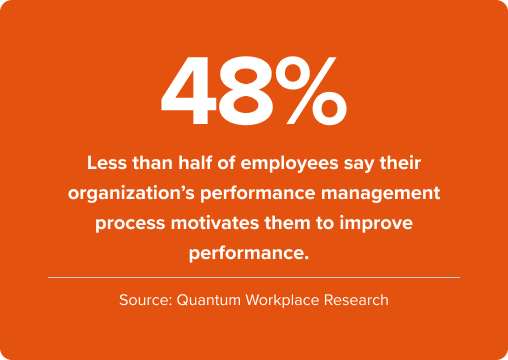
You’re not alone. Fewer than half of employees say their performance review motivates them to improve. Even worse? Only 49% feel it’s a good use of their time.


The problem isn’t performance management itself—it’s the way we’ve been doing it.

Traditional, check-the-box approaches are falling short. But progressive HR leaders are rewriting the script. They’re shifting from managing performance to enabling it—using modern tools, real-time feedback, and strategic alignment to turn performance into a catalyst for progress.

This blog explores the trends, strategies, and mindset shifts that are powering a new era of performance—one where both people and business outcomes thrive.


What’s Changing with Employee Performance – and Why Now?


From Annual Checkpoints to Real-Time Progress

The old way? Set goals in January, go quiet for months, then scramble to summarize a year’s worth of work in a December review. That made sense when business moved slowly and predictability ruled. But in today’s fast-moving world, annual cycles don’t cut it.

Modern performance is about building capability in real time. It’s about giving employees the clarity, feedback, and direction they need—when they need it—not months later. Instead of rating performance after the fact, high-performing organizations are enabling it in the moment.


HR Needs to Take the Lead—A Different Lead

Why the urgency to change? Because leaders see the disconnect. While 70% of executives believe HR should focus on unlocking human potential—not just productivity—only 20% say that’s happening today.

That gap isn’t just theoretical. It’s costing organizations real momentum when top performers feel stuck, unsupported, or unclear on where they’re headed.


As Marie Potter, VP of Talent & Culture at Getty Images, puts it:

“Performance management should be fuel, not friction. When measurement reigns, momentum stalls.”


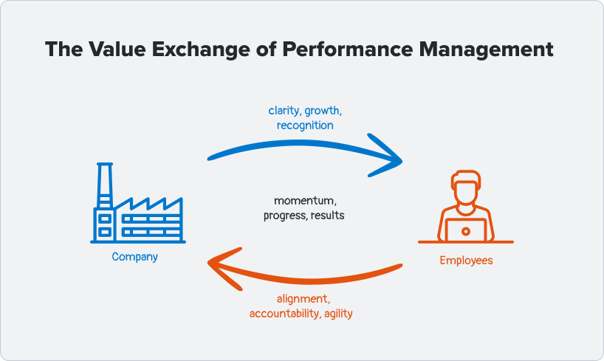
Forward-thinking companies are flipping the script—treating performance as a continuous, two-way value exchange. One where employees grow and the business moves faster, together.


When Performance Measurement Misses the Mark

Performance management breaks down when employees don’t see how their work connects to the bigger picture. When tools are clunky, conversations feel forced, and managers don’t have the support to lead effectively, the system stops working.

Employees feel like they’re being judged, not developed. Reviews feel disconnected from the real work. And instead of driving clarity and growth, the process becomes something to get through—not something that moves anyone forward.

Performance management should never feel like a checkbox exercise. It should feel like momentum.


What Happens If You Don’t Act?


The Immediate Business Risks

Outdated performance practices don’t just frustrate employees—they drag down results. When performance management feels like paperwork, employees disengage. And disengaged employees don’t deliver.

Critical priorities get lost in the noise. Managers spend more time chasing forms than coaching their teams. High performers lose steam when systems don’t help them grow. And employees who need support miss the chance to course-correct—because feedback comes too late to make a difference.

These issues don’t stay contained in HR. They ripple across productivity, retention, and the bottom line.


The Culture Signal You Might Be Sending

Performance management is more than a process—it’s one of the most visible ways employees experience your culture. More than mission statements. More than values on the wall.

When your approach feels disconnected or inconsistent, employees notice. And they interpret it as a sign that development isn’t a real priority. That perception spreads quickly, undermining trust and momentum in ways that are hard to undo.


The Risk of Falling Behind

Organizations that wait to evolve their performance strategy are already behind. While they manage performance in hindsight, competitors are building capability in real time—developing talent, driving alignment, and creating agile teams.

Each quarter that passes widens the gap. And catching up only gets harder.


What Leading HR Teams Are Doing Instead


Building “3D” Managers who Drive Progress

Forward-thinking HR teams aren’t just tweaking old performance systems—they’re reimagining the role of the manager entirely. They’re moving beyond annual reviews and static ratings to create real-time performance systems that spark clarity, action, and growth.

At the heart of these systems? Managers who are discerning, developing, and disciplined—what we call “3D” managers.

These leaders know how to separate activity from impact. They tailor their approach to what motivates each employee. And they make performance conversations a part of everyday work—not just a once-a-year formality.


Discernment: Seeing What Moves the Needle

Effective managers know how to focus on what matters most. They can spot patterns, recognize meaningful contributions, and guide their teams toward high-impact work. But there’s a gap. While 83% of managers believe they can identify top performers, only 74% of employees agree. That disconnect signals a clear need to sharpen this skill.


Development: Motivating the Individual

Driving performance starts with knowing your people. That means going deeper than goal tracking—it’s about understanding what energizes each person.


“You’re working with people who are wired differently,” says Anne Maltese, VP of People Insights at Quantum Workplace. “It’s not just about the work—it’s about unlocking what motivates them to bring their best.”


Performance-Process Isnt Motivating


Discipline: Making Performance a Habit, Not a Handoff

Strong performance doesn’t come from one-off conversations. Great managers build it into their daily rhythm—celebrating wins, clearing roadblocks, and fueling growth in real time.

That kind of consistency takes discipline. But it’s easier when HR equips managers with clear performance management frameworks, simple tools, and just-in-time support.


Putting It Into Practice

Mikala Friedrich, CHRO at Scooter’s Coffee, has seen the impact of this shift firsthand:

“When employees feel like they’re winning personally, and their work clearly aligns with company goals, their output is significantly better. But if performance management feels like a box-checking exercise, employees check out.”


The takeaway: performance systems should help people thrive—not just track their work.


What to Avoid: The Perfect Process Trap

High-performing organizations don’t chase the perfect performance system—they focus on what actually works. They step back and ask the hard questions:

Does this process add value?
Does it help employees grow—or just generate documentation?

If it’s just another box to check, they cut it.

A common pitfall is believing that one tool or framework will fix everything. But performance isn’t one-size-fits-all—it’s dynamic. It shifts with your people, your culture, and your business priorities.

The organizations that get it right aren’t looking for a silver bullet. They’re committed to thoughtful execution, ongoing refinement, and empowering managers to lead well—no matter the system.


How to Transform Employee Performance in 90 Days?


You don’t need a full system overhaul to start seeing real change. Pick one of these five proven strategies to start shifting from performance management to performance enablement. Each one builds momentum, shows visible impact, and lays the groundwork for long-term progress.


1. Reframe performance management as a value exchange.

Start by shifting the conversation—from evaluation to enablement. Instead of asking, “How did this employee perform?” ask, “How can we help this employee excel?” 

That mindset shift changes everything. It turns performance conversations into opportunities for alignment, growth, and progress. Help employees see how their work contributes to what matters most. When they connect the dots between their goals and business success, motivation follows.


Performance-Value Exchange


2. Equip managers to lead, not just comply.

Most managers aren’t given the tools to lead performance well. They’re handed processes—but not the coaching skills to make them meaningful.

Flip that script. Train managers to be discerning, developing, and disciplined. Help them focus on impact, tailor their approach to each person, and make performance part of their daily rhythm. When managers feel confident in their role, they do more than manage—they lead.


3. Remove the friction.

Audit your current tools and workflows. Ask yourself:

  • Does this step help employees grow?
  • Does it help managers lead more effectively?
  • Or is it just a legacy process that no longer serves a purpose?

If it doesn’t add value, cut it. Simplify wherever possible. The best performance strategies are clear, usable, and built for how people actually work.


4. Make performance a daily habit.

Performance shouldn’t peak in Q4. It should happen all year long. Help managers build momentum through frequent check-ins, in-the-moment feedback, and regular growth conversations. Celebrate wins early. Tackle blockers before they become problems. Create space for reflection and recognition in the flow of work. When performance becomes part of the everyday rhythm, improvement feels natural—not forced.


5. Let employee feedback guide you.

Want to improve your performance approach? Ask the people experiencing it every day. Employees and managers know where things feel clunky, redundant, or disconnected. Their feedback helps you make smarter, more targeted improvements—ones that build buy-in instead of resistance.


As Teresa Preister, Senior Insights Analyst at Quantum Workplace, puts it: “If we think about performance as enablement, it changes everything. The goal is to move people forward and make them more valuable—to themselves and the business.”


Choose Your Starting Point

Improving employee performance isn’t a one-and-done fix—it’s an ongoing practice. The most effective organizations know it’s about progress, not perfection.

Start with the strategy that feels most actionable right now. The key is to test, learn, and refine. Those small, intentional steps add up—driving meaningful change faster than any “perfect” system ever could.

Ready to reshape your approach to performance?

Explore all 7 trends in the full 2025 Workplace Trends Report to see how today’s top organizations are staying ahead.

READ THE REPORT NOW >>>

Trends-grid-performance


Futures of Work ~ Polly Morland’s A Fortunate Woman and care continuity in adult social care 

0

Polly Morland’s A Fortunate Woman: A Country Doctor’s Story – an ethnography of a GP living and working in the rural Midlands – is a readable, lyrical work of great depth. Morland and the doctor live in the same valley that was home to ‘Dr John Sassall’, the subject of John Berger and photographer Jean Mohr’s revered A Fortunate Man. When Morland came across Berger’s book, it dawned on her that her home for the last decade had been the place where, in 1966, Berger and Mohr had spent six weeks documenting Sassall’s life. Morland made her discovery in the summer of 2020 and, drawing inspiration from Berger’s book, she – alongside photographer Richard Baker – started to chronicle the life of a current GP. 

Thinking with Berger and ‘Sassall’ 

Morland revisits Sassall’s life and work as she unfolds observations of his modern-day counterpart’s situation. This learning prompts considerations of the future of general practice. Key to her argument – which she builds through stories in a persuasive, non-didactic way – is care continuity once again being central. Reading the book prompted me to think further about the care work that I have encountered, both on the front line and as a researcher: that of paid adult social care (ASC) work. Much of the book’s content chimes with my experience and knowledge, and with wider narratives about and understanding of paid ASC work. However, there are some key differences, and these shed light on hierarchies between health and social care. 

Morland composes a picture where time, in the everyday and over seasons, years and generations, enhances relationships, and thus the quality of the doctor’s care and work:

Being there, available most days for your patients, is one of the key elements in building relationships, and strong, rooted relationships don’t just help the patients. They also help the doctor. 

Time allows for learning and creates space for the doctor to see and to know. When this happens repeatedly over time, the doctor benefits from the ‘accumulated knowledge’ (a concept Berger employs) derived from continuity. This accumulation is the layered understanding the doctor gains of individual patients through repeated consultation. Towards the end of the book, Morland refers to a burgeoning academic literature on the multilayered benefits of care continuity, both to individual doctors and patients, and to the wider health system. With time, this accumulated knowledge can also be holistic in nature, and expose doctors to valuable and useful information about patients’ lives that is not obviously or narrowly ‘medical’. In the ASC context, this carries echoes of insights from perspectives on disability rights, and of the importance of understanding the person rather than focusing narrowly on any condition they may have. 

Time is created for stories, and trust paves the way for them to be told and heard. This listening – and observation – is central to work across health and social care, including for paid ASC workers. Morland’s stories are deftly curated: free from repetition, they are consistently involving and fascinating, and convey the variety of the doctor’s lifeworld. The sadness of profound emotional loneliness comes through in the account of an older woman who had never before been asked about the effect a serious accident sustained in her youth had had on her, until the doctor thought to delve a little. This sharing of stories has the potential to prompt preventative intervention, including alleviating loneliness. 

The practices of paid adult social care work 

Companionship and ‘being there’ are part of the support that paid ASC workers offer, and they often take on responsibilities identified by doctors or other health workers (and those in other occupations such as social work). Paid ASC workers’ skilled, complex work can include supporting people with taking medication, helping to implement dietary changes, or assisting with physio routines. Despite working conditions that are among the worst in the labour market, ASC employees identify strongly with their work, and hold attachment to it and particularly to the people they support.  

Morland implants her case for care continuity within the debate on the future of GP services. However, in ASC, despite inadequate solutions to a persistent labour shortage and sustainability challenge, much of the debate focuses on numbers or sectoral or care provider concerns with recruitment and retention. This is at the expense of arguments that foreground care continuity and its benefits for supported people, and for the relationships that matter to workers and enrich the quality of their work. The negativity around ASC – the constant talk of ‘crisis’– is palpable in discussions on its future, yet set against this context of scarcity, unmet need and declining care quality and coverage, Morland offers a positive account of good care and its life-affirming qualities. Social care has the potential to offer the same on a more consistent basis, and continuity ought to be at the heart of the case for life-enhancing, sustainable care supported by a stable, valued and more appropriately rewarded workforce. 

Debates continue over the ‘professionalisation’ of ASC work, yet such efforts to enhance status, valorisation and desirability are stymied by inadequate progression routes and the lack of a binding, national (in England) long-term workforce strategy. This is before we mention the endemic and normalised very low pay in ASC. Morland does not mention pay: it is axiomatic that this is a financially secure position for the doctor. Clearly there is a vertical distinction between GPs and frontline ASC workers and what their job requires, but this plays out horizontally too. For example, healthcare assistants in the NHS earn more than ASC workers, who do similar roles. The former have access to a wide range of occupational welfare (including pensions), pay banding and career progression routes, and benefit from higher levels of unionisation and collective voice. Despite ASC’s ubiquity and the growing need for it, the rewards do not encourage or incentivise staying on: increases for length of service, qualifications or promotions are often piecemeal. Health Foundation research estimates that one in five residential care workers lives in poverty.  

The state and paid adult social care’s political traction 

The state plays a defining role in setting working condition standards in ASC, despite the dominance of outsourced – via majority private providers, delivery of care. The cost of care, which shapes rates of pay, is largely set by local authority commissioning. The Department for Health and Social Care has responsibility for workforce development, and the Care Quality Commission has regulatory powers over care standards. Other areas of policy, such as migration, have profoundly shaped ASC services, particularly in the last decade. I would argue that the state has, in recent years, actively and directly undermined workforce – and thus care – continuity in ASC. Examples include mandating COVID-19 vaccines in ASC settings before any others, and the frequent, and largely harsh and restrictive, Health and Social Care visa reforms. The latter have culminated in the government’s May 2025 announcement that workers will no longer be able to come from abroad to take up employment in ASC. The politicised, short-term reforms to migration for ASC employment have been antithetical to stability and continuity. Paid ASC workers do stand to benefit from changes through the Employment Rights Bill, but questions remain over the viability of implementation when the government’s ASC review does not report until 2028. 

Class is arguably an important factor here. A few years ago, I asked a social science professor and care expert why she thought the political leverage of social care differed from the NHS so much, and she proposed class as a crucial element. She pointed out that the NHS workforce is more middle class than working-class-dominated paid ASC work. She also said that the middle class benefits more from NHS services than from ASC. ASC is means tested, and state-funded services overwhelmingly cater for people with lower levels of income and wealth. Proposing the introduction of means testing in the NHS, for example, would be highly contentious politically. This relates to what ASC commentator Richard Humphries terms the ‘different political or moral calculus’ between the NHS and ASC. This has relevance in the context of recent industrial action: contrast the unified, collective actions across different areas of the NHS with the dispersed pockets of paid ASC worker organising, symptomatic of a fragmented workforce lacking collective voice or instrument.  

Workers across health and social care have faced degradations to their pay, conditions and working environments in recent times, but the severity of cuts to ASC budgets and lack of long-term planning mean it has suffered more heavily. New pressures caused by the pandemic have exacerbated these, and Morland’s book provides an additional function as an important human document of that time alongside the likes of Stu Hennigan’s blistering Ghost Signs. ASC services continue to be the junior partner to the NHS in many senses. Many of the arguments Morland makes about care continuity in this affecting book apply in ASC settings too, and they should be at the forefront of attempts to improve ASC provision and employment. ASC suffers in terms of perceived importance relevant to healthcare, and when compared with other public and health policy priorities. We need stories about how care continuity, based on ‘accumulated knowledge’, can be life-affirming for supported people, and transformative for social care and paid ASC workers.

Duncan U. Fisher is a researcher at the ESRC Centre for Care at the University of Sheffield, UK. His research focuses on paid care work within adult social care, with his current project a study of organising, activism and trade union activity among paid care workers in England. He wrote this article about the depiction of paid care work in Ken Loach’s film Sorry We Missed You for a previous issue of Futures of Work.

Image credit: Centre for Ageing Better via Unsplash