Home Blog Page 45

Futures of Work ~ Continuity and change in the homecare sector: A fine balance

0

We work in domiciliary care, supporting people in various ways in their own homes. The relationship between paid homecare workers and the people we support is often complex.

The intrinsically ‘social’ part of social care means we are encouraged to form genuine relationships with the people we visit. Companionship and emotional support are, therefore, a central component of our responsibilities. We get to know people’s likes and dislikes, and often assist with the most intimate of daily routines. This must all be done while maintaining strict professional and personal boundaries. Unsurprisingly, the lines sometimes become blurred.

Professional boundaries are the official rules and limits in place between a paid care worker and the person they support, as set by legal, ethical, and organisational frameworks. For example, we should not accept gifts from clients, overshare personal details about ourselves or exchange personal phone numbers.

Yet due to the social nature of our roles, it may feel natural for the people we support to want to treat us as a friend or extension to their family, which could mean offering gifts on occasions like our birthdays, or when we visit them on Christmas Day. To maintain strict professional boundaries in these circumstances can be awkward to say the least and, depending on the individual, cause real offence.

Continuity of care is hugely important to the wellbeing of the people we support. I (Hannah) remember an individual being upset because in one week she had seen ten different caregivers: some familiar, some not. Imagine ten people coming into your home at different times, seeing you at your most vulnerable? This can be very anxiety-inducing. Aside from a general sense of unease, there is also the frustration of having to explain specific preferences, routines, the places that things are kept and so on, to each new caregiver. Two people may get into a good routine and then all of a sudden somebody new takes the caregiver’s place and the process must begin again from scratch. Good continuity of care also allows us to pick up on small but sometimes important changes that an unfamiliar face is unlikely to notice. Whether that’s a change in behaviour, eating habits or general wellbeing. Our employers benefit from ensuring good continuity of care because it allows them to develop consistent runs, keeping both employees and clients happy.

With clear benefits to all involved, you would expect continuity of care to be a fine-tuned art. So how come so many people live with a ‘revolving door’ of different faces turning up at their home?

To an extent, change and unpredictability are inevitable features of adult social care, particularly in a domiciliary context, whereby the people we support often vary due to hospitalisation, relocation to care homes and lives coming to an end. This leads to regular rota changes, which can cause frequent disruption to an individual’s care package.

Of greater significance is the fact that employment in domiciliary care generally offers little to buffer these unpredictabilities. The most common scenario in which a paid care worker provides support to someone in their own home is when they are employed by a homecare agency, of which there were over 13,000 in England alone at Skills For Care’s last count. The individual in need of support buys the services of the agency. Homecare workers are often paid for contact time only, their pay relying on a patchwork of visits rather than consistent shifts. When the inevitable happens and a client goes into hospital or passes away, this is experienced by workers as an immediate loss of income until a new client can be found to fill the gaps. This unpredictability of income is why many homecare workers move to roles in residential care settings like care homes or nursing homes, where they will be paid for a full shift regardless of whether some of the beds are empty.

Most but not all homecare employers set their hourly rate of pay at least a couple of pounds higher than the National Minimum Wage in an effort to ensure workers are paid at least this amount once unpaid gaps between visits are taken into account (legally payable up to 60 minutes). Yet Homecare Voices’ true hourly pay calculator finds evidence of widespread underpayment of the National Minimum Wage in homecare as a result of these unpaid gaps. This is a known issue throughout the sector. Due to these realities of pay and working conditions in homecare, many of us do not stay in the role for long, with resounding implications for continuity of care.

For paid care workers, there is a drawback to forming strong relationships with the people we support. Doing so can put pressure on us to put up with poor pay and working conditions imposed on us by an employer, since we do not wish to let down the people we support. Unfortunately, a ‘labour of love, not money’ culture alongside a pressure to always be prepared to ‘take one for the team’ can be taken advantage of by those managing homecare agencies.

On the earlier point of professional boundaries, from a practical point of view, it can be difficult to maintain these since we are generally expected to use our personal phones for work purposes. Employers will often ask us to contact clients using these, for example, to let them know if we’re running late. Sometimes employers specifically request that we keep a line of communication open with certain clients or their family members, using our personal phones to do so. Since the majority of us are employed via zero-hours contracts or restrictive Certificates of Sponsorship, there is pressure to do as instructed by our employer in such scenarios.

Our priority as homecare workers is to ensure people can lead the life they wish to with our well-placed support. We will continue to establish good relationships where possible, doing our utmost to remain on the right side of that professional boundary and accepting that change is an inevitable part of the work we do.

Homecare Voices is a free-to-join, not-for-profit peer support network run by and for domiciliary care workers throughout the UK. Established in 2023, over 500 homecare workers are now part of this growing community, which aims not only to ensure access to high-quality, peer-led support for lone workers in high-responsibility roles but also to bring the voices of more homecare workers to national conversations about the future of adult social care.

Rachel Kelso is a domiciliary care worker and the founder of Homecare Voices: a free-to-join, not-for-profit peer support network and advocacy body run by and for domiciliary care workers in the UK. With daily talking points and fortnightly online meetups, Homecare Voices is a trusted community of best practice for lone workers in notoriously precarious roles. By connecting people with opportunities to participate in research and attend external events, Homecare Voices provides a channel through which the insights of those at the helm of the adult social care system may be heard.

 Hannah Reseigh-Lincoln is a Senior Care Giver who works full-time in the community, travelling to people’s homes to provide care. She has been in the caregiving profession for nearly three years following a significant career change. Hannah is a volunteer member of the Care Workers Charity Advisory Board and the Champions Project, as well as a member of the Homecare Voices community, founded by Rachel.

Image credit: Alex Boyd via Unsplash

Futures of Work ~ Client: Nancy S

0

Date of birth: 25 September 1931

Primary condition: Old age

My dear sweet Nancy. This lady was the first client to break my heart. I was the first carer to visit her. She lived in a large detached house in a quiet cul-de-sac. Her front door was unlocked. I knocked and entered. She sat on the sofa with her neighbour and friend. She was small and slight, birdlike, frail. Her skin was dark and looked bruised. She had an air of defiance. She didn’t look at me. Her friend smiled and looked embarrassed. “Hello,” I said. Nancy didn’t respond, but looked to her neighbour and asked, “Who is she?”. “My name is Julie,” I said. “I’m here to help.” Again, she turned to her neighbour: “But I don’t need these people!” Her neighbour turned to me and apologised. “I’m so sorry,” she said. “Nancy has never needed carers before, but they wouldn’t let her come out of the hospital without you. She’s been incredibly independent her whole life. Never needed help before. She’s struggling to come to terms with the situation she’s now in.”

And there we have it. I don’t know Nancy from Adam. I’ve never set foot in her home before, and yet here I am. I have let myself in, just shouting “Hello” as I enter her hallway. This is my workplace, but it’s also Nancy’s home, a place where she feels safe and secure. She’s always been able to dictate who comes through her door, until now.

Nancy wasn’t happy I was there – a stranger in her home. I hadn’t been invited. She, like many older people (but not all), was resisting the ageing process with every fibre of her being. Yes, this was going to prove challenging, but her failure to acknowledge she was old and her utter determination to fight the ageing process, ignore it, turn a blind eye to it, whatever term you use, was in itself inspiring. As time went on, I began to admire that fighting spirit. In her mind, she was still youthful, beautiful, spirited and I loved her for it.

I didn’t do much on that first call. I don’t think Nancy once made eye contact with me, but as I left, I turned to her and said quietly, “I understand why you don’t want me here, I honestly do, but one day, maybe you will look forward to my visits.” I didn’t know it at the time, but those words turned out to be more accurate than I could possibly have imagined.

My first few visits to Nancy were stilted. I had an hour for her tea call and an hour for her bed call and there wasn’t a great deal to do. It was difficult to fill the time. I did what I had to do. I never pushed her to open up to me, though I desperately wanted her to. It started slowly, little snippets of her life, which she delivered while I was doing something else – cleaning, cooking. She was from Oxford and had one child, a son. When he was eight years old, she discovered he was diabetic. This was a story she told me many times. How in those days it was much more difficult to give him injections. She said she did it every day for him until he could do it himself. At this point she would demonstrate how it’s done today by tapping her arm gently. “In those days it was a huge great needle and you did this!” She would thump her fist against her arm from a distance to demonstrate just how big and painful that needle was! She bruised her arm many times doing this.

Her son went to Nottingham University, where he met his future wife. They had two children – a girl and a boy. Nancy’s husband decided it would be a good idea to move to Nottingham to be closer to them, so they did. She hated it. Another story she regularly relayed to me was how that very first day in Nottingham, while her husband was out, she left the house and got into her car. It was, she told me, a top-of-the-range sports car. As I got to know Nancy better, I realised that she liked to have the best of everything and she wanted everyone to know it! She drove around Nottingham, she told me. She had no idea where she was going, she just drove, for miles, along unfamiliar roads. As she drove, she began to cry. “Damn that husband of mine,” she said to herself. “Why am I here? I have no friends here, this place is alien to me.” She drove for hours and hours and got utterly lost. She decided she was not going to stay. She was going back to Oxford.

Nancy is now 96. She’s still in Nottingham and I am her carer. Her son brings bottles of white wine. He hides them in a cupboard. I should get one out on a Friday evening, he tells me, for her to have over the weekend. If we don’t hide it, she would drink a bottle a day. I smile and look at his wife, who smiles back. Is she thinking the same as me? She’s 96! I think if I were 96, I would probably do whatever I damn well liked, and if that meant drinking a bottle of wine every day, then that’s exactly what I would do. Obviously her son doesn’t think so, but what her son doesn’t know, although he’ll find out soon enough, is that Nancy knows exactly where he hides that wine!

Nancy’s tea call starts at 3.30pm and ends at 4.30pm. A few minutes before I leave, I can see her eyeing up that cupboard. I know that the moment I’m gone, she will be there rummaging around the back of it for that bottle. When I come back at 8.30pm she’ll be halfway through it. She’s so small and frail that half a bottle of wine is the equivalent of you or I drinking two. She laughs and giggles like a child. She recounts the time she kissed another man behind her husband’s back. He went to his grave not knowing about that one. She has been propositioned more times than I think I’ve had hot meals. She was stunningly beautiful. She believes she still is. Next to her bed on her bedside table is some face powder and lipstick. Every now and then, she reaches for it and applies it while looking into her little handheld mirror. “I look good for 96, don’t I?” she says. “You look amazing,” I tell her. What she actually looks like is a 96-year-old woman applying make up to a little wizened face, but she’s happy in her belief, and if Nancy is happy, then so am I.

It isn’t long before her son realises that hiding the wine is a fruitless endeavour. She will find it no matter where he puts it. She can smell the alcohol from any room in the house. In the end he concedes defeat. “She can have it when she wants it,” he says, so her first glass gets earlier and earlier. She begins to pour herself a glass before I leave her tea call and then she starts pouring it as I walk into her home for her tea call, eventually having a full glass in hand when I get there at 3.30. Sometimes she meets me at the front door, glass in hand. She knows all the young children in the street. They shout “Hello!” when they see her. She presses her small wiry fingers to her lips and blows them all a kiss. “Hello darlings!” she smiles.

I continue to see Nancy regularly. We talk, we laugh, we cry and on one occasion she turns to me and says suddenly, “who are you and why did you start coming here?” “I’m your carer,” I say. “Oh no,” she replies. “You’re not my carer, you’re my friend!”

Of course, Nancy is old, and with or without her wine, she’s getting more and more frail. Although it’s a slow process, I see her deteriorate before my eyes. She just finds it harder and harder to get around, until eventually she is bedridden. A few days before she passes, she’s not really engaging anymore. Her friends and family come more frequently. They’re often here when I visit. They sit next to her bed and hold her hand. She stops eating and eventually stops drinking. Not even the wine can tempt her. On her last evening, I sit on the edge of her bed. As I reach for her hand, she opens her eyes. Smiling sweetly, she simply say,s “hello darling,” and closes her eyes again. The next day, she is gone. She died on the same day as my daughter’s 18th birthday. I won’t forget that day, nor will I forget my dear friend Nancy.

The day after Nancy’s death, the office removed her calls from my rota. In Nancy’s space, there is simply an unpaid gap. We only get paid for our time with clients, nothing in between, not for travel time nor for gaps between calls, so my pay will inevitably go down. I may or may not be able to afford my bills because of this.

When I receive my rota for the following week, there is another call in Nancy’s place. A lady I have never met before, a new client perhaps. I don’t want to go. She is not Nancy. I’m yet to meet her, but I feel I already dislike her for no apparent reason. There is a word, you see, that no one in the office ever cares to use. They are aware of this word, but it’s not in their interest to acknowledge it. They are a business, and their primary objective is to make money. If it isn’t profitable for them, then it isn’t going to happen.

The word I’m talking about is grief. To be an exemplary carer, we must care. Sounds obvious! And yet the companies we work for seem to lack compassion for anyone – their staff, their clients. A client dies. This means the funding this client brings to them ceases. So they simply look for another source of revenue.

Not once did anyone from the office ask if I was OK, if I needed some time to grieve, a couple of days off, a chat, a good cry, or a hug. They don’t want carers to care, they want us to do the tasks set out in each care plan, then move on to the next call. They don’t want us to form bonds. They want to be able to change our rotas when it suits them. Clients we saw every day for years could suddenly be whipped off our runs and allocated to someone else, someone who had no idea of their routines, their needs, their likes and dislikes. This has a detrimental effect on us and the clients we are caring for.

In the end, I had no choice but to accept the change in my rota. I couldn’t take time off as these companies don’t provide sick pay. So you bury your grief. It’s all you can do, but it’s something we all experience, and the lack of support we receive when it happens is just one of the many injustices we experience as care workers.

Julie Sansom has worked in domiciliary care for around seven years. She entered the care sector after being made redundant from a 20-year career in an office-based role. She is a passionate advocate for fair employment practices within the care sector, especially the elimination of zero-hours contracts. She believes these contracts offer no job security or consistency and can often be used exploitatively by employers, silencing workers’ dissent by threatening to reduce their hours.

This article is part of a book Julie is writing about her experiences working in the private care sector. The book seeks to lift the lid on what is really happening from the inside.

Image credit: Chastagner Thierry via Unsplash

Futures of Work ~ Making ‘caring’ work for working carers

0

The role of employers in supporting the provision and providers of care labour takes various forms. Employers of workers in the social care sector are clearly critical. However, there are other important relationships between carers and employers that are less well recognised or understood. A growing number of employees in the general workforce provide unpaid care outside their paid employment for a family member, friend or neighbour affected by long-term illness, disability or old age. Perhaps employers are seen to have a less moral, more instrumental economic stake; we are therefore less inclined to call on them to create a supportive environment for effective and sustainable caregiving alongside employment. However, we suggest that employers play an important role in shaping experiences of care provision. Neglecting to understand their perspectives is likely to be to the detriment of both carers and employers.

Globally, unpaid caregiving is a widespread phenomenon. According to the International Alliance of Carer Organizations (IACO), reported in Embracing Carers, there are 63 million carers internationally, with 67 per cent of them being the primary carer for a household member. Around the world, 16 billion hours are spent providing unpaid domestic and care work. If a monetary value is to be assigned, then the hours spent are equivalent to a substantial portion of global GDP, exceeding 40 per cent in some countries according to conservative estimates. While the economic value of unpaid care work is acknowledged, it does not reflect in measures of the economy. Unpaid or underpaid care work fundamentally remains invisible, and potential costs to the economy resulting from providing unpaid care, e.g. loss of labour and skills and underemployment in terms of hours, wages and skills, are largely overlooked.

Given the ageing global population, it is estimated that care needs will increase significantly, worsening the existing care crisis. By 2030, an extra 100 million older people and an additional 100 million children aged 6–14 will need care.

Increasing demand for care is also an important issue in the UK. Carers UK’s Valuing Carers 2021 report suggests that unpaid carers provide care worth £162 billion a year in England and Wales (similar to the year’s NHS spending budget!). The Labour government’s current economic growth agenda to promote employment, increase productivity and reduce economic inactivity offers fertile ground to explore further the implications of care for employment. Unpaid carers are explicitly mentioned in the Ministerial Foreword to the Get Britain Working White Paper, but they are not a focus of the report. This is surprising, given that the majority of unpaid carers are of working age. Carers UK suggests that as many as one in seven of all employees are unpaid carers, and it is estimated that almost two million employees in the UK will take on this role every year.

Considering the current spiralling social care crisis, working carers are an increasingly critical resource in an already burdened social care system. While much emphasis has been placed on the value of this unpaid care and carers’ struggle to combine care roles with paid employment, things have not improved much beyond the Carer’s Leave Act and the Flexible Working Act. In this regard, we draw attention to employers’ relative lack of voice in the debates concerning working carers. While some employers have policies to support carers, many do not. We argue this could be because supporting working carers is framed as a wider social responsibility and an issue for the social care sector, wider community and voluntary sector organisations. A key stakeholder is thus overlooked, alongside their responsibility, capacity and motivation to support working carers.

Carers are often understandably reticent to discuss the impact of care roles on their paid work, and employers may be unaware they have carers working for them. This limited visibility makes it difficult to identify or attribute monetary/economic value to what skills are lost from the labour force when combining unpaid care with employment failures. What types of carers most successfully juggle these roles? Which groups do we lose altogether from the labour force and at what career stages? What skills are lost? Where are employers more effective at retaining skills, or more motivated to do so? What drives employers to support carers beyond appearing ‘carer friendly’ and meeting CSR objectives? By raising these questions, we propose a more nuanced examination of the ‘business case’ for providing workplace policies to support carers. While there is an estimate of the value to the economy of unpaid care work, there is a limited assessment of its cost to the economy (few reported estimates, e.g. £3.5 billion annually) in terms of lost productivity, skills and expertise. This should be of concern not only to employers but also to the government, and it is unlikely to be solved merely by employers offering family-friendly policies, flexible working and an annual week of paid leave.

In drawing attention to the role of employers in supporting working carers, we recognise that just as diversity is observed in carers – in terms of socioeconomic status and career needs – employers are also diverse (e.g. size, sector, financial resources and skills needs). Will all employers be equally committed to supporting carers? Are the espoused financial costs and benefits the same for all employers? And are employers equally equipped and resourced to support the diverse needs of carers working in their organisations?

There are tensions and complexities of relationships between employers and carers who are in, or wish to be in, paid employment. While there may be a moral and social case that we would all support, we need to better understand the role of employers as key stakeholders and the drivers that may leverage employer support of this critical but diverse group of carers in employment.

Chandrima Roy is an Assistant Professor in Work, Employment and Organisation Studies in the School of Management at the University of Leicester, UK. Her research explores the complex interplay between employment and caregiving, with a particular focus on the UK social care sector. Chandrima investigates care workers’ employment experiences and perceptions of job quality, offering insights with policy implications for employment practices, public service HRM and the retention of frontline care practitioners who support vulnerable populations. She collaborates closely with community partners, charities and care organisations to better understand the social and political tensions surrounding care provision and employment.

Katharine Venter is an Associate Professor of Sociology in the School of Management at the University of Leicester, UK. Throughout her career, she has explored the intersections between various forms of care roles and the dynamics of careers and working lives. Partly inspired by her own experiences of caregiving, Katharine’s research has focused on issues including the work and career experiences of those caring for children whose paths to independence may be affected by chronic illness or disability. She has also examined the tensions inherent in both paid and unpaid care roles within the non-profit and charity sectors.

Image credit: Max Kleinen via Unsplash

Futures of Work ~ Simply caring about the environment is not enough

0

The facts on the climate crisis are now so clear that it would be a waste of my time to write about them at any length. In fact, Professor Kimberly Nicholas summed climate science up in 12 words:

I would also argue that many of the ways that we need to fix climate change have been rehearsed ad nauseam, yet it is meaningful action that proves more difficult. So the real question is what are the barriers that are stopping us from acting more decisively and how can we break them down?

The answer is of course multilayered and different for every section of society. I am going to focus here on education. This is partly because of my personal experience – I was, for a long time, a secondary teacher and I am now working with Let’s Go Zero, a project run by the charity Ashden, which supports climate action in hundreds of schools across England. And it is also partly because education has such potential to make change when it comes to the climate, given the way that schools act as a hub for so many communities.

Change is of course already taking place in schools, and despite the enormous pressures that they are under, there are some wonderful examples of action – from the installation of solar panels and heat pumps, and the embedding of sustainability in the curriculum of primary schools such as St Edmund Campion to the United Learning Trust’s switch to a renewable energy tariff for all of its 100+ schools. But change is not happening quickly enough for the generations that the schools exist to serve.

The obvious answer to the question of what is stopping more decisive action on climate change within education is money and capacity. The challenges of funding in education are well documented, and the 2024 NASUWT survey reports that four in five teachers say that teaching has adversely affected their mental health, the most important reason for this being workload.

In the current climate (no pun intended), an injection of cash or more teachers into the education system to tackle climate change is exceedingly unlikely, so I want instead to explore some more hopeful ways that we can drive forward climate change action in schools. There is no shortage of staff and students who care passionately about the environment. This is demonstrated both in the statistics – more than 7k schools have signed up to the Let’s Go Zero campaign (the national campaign uniting teachers, pupils, parents and their schools as they all work together to be zero carbon by 2030)and through the numerous conversations that I have had in schools. However, we need to find better ways of channelling this care and passion to bring about meaningful action.

The first such way is by ensuring continuity. As I have discovered through my work with Let’s Go Zero, change within schools is so often driven by one person – a passionate teacher who leads an eco council, a committed headteacher who threads sustainability through the curriculum, a business manager who invests in renewable energy, or a site team who puts up solar panels. And while this change is often wonderful, it raises a problem – what happens when that person leaves? How can the momentum be sustained? Continuity can be enabled if climate action becomes a whole-school project that involves all of the people mentioned above. So instead of sporadic one-off assemblies, or brilliant but isolated projects by the eco club, there must be a wholehearted effort to embed sustainability into the school fabric – a continuous thread through all parts of the school with sustainability the focus in the way the school estate, the curriculum and the leadership is managed. This idea is supported by the DfE expectation that all schools will have a Climate Action Plan and sustainability lead in place by 2025. And importantly, the four areas covered by this plan (Decarbonisation, Adaptation and Resilience, Biodiversity and Curriculum and Green Careers) by necessity require a whole-school approach, since they cut across the responsibilities of many different staff. That is why I would encourage all schools to get support from Let’s Go Zero’s Climate Action Advisors, because we give free, independent support to create and deliver climate action plans.

The second way of achieving meaningful action is to align caring for the environment with caring for yourself. This could be seen as counterintuitive, given that the narrative around climate change action is usually one of denial and self-flagellation – deny yourself the enjoyment of flying to other countries, deny yourself meat, deny yourself consumption of fast fashion. And while all of these things are important to act upon, it seems to me that they will not be sustainable unless action is framed in a different way, by seeking to make change joyfully. Unless you find a way to care for the environment that motivates, sustains and inspires you, you are doomed to fail.

I have drawn this idea from the brilliant work of biologist and writer Ayana Elizabeth Johnson. She has created a Venn diagram (based on the Japanese concept of Ikigai) to inspire action.

She argues that the action you take as an individual should be at the intersection of three circles, each of which represents a question: What works need doing? What are you good at? What brings you joy? If you are a student in a school, you might know that the work that needs doing is to lower your school’s carbon footprint. You might recognise that your skills do not lie in altering the gas boiler settings, and equally you don’t have the influence to persuade all your teachers to car-share. Instead, you might draw on your interest in clothes and your skills in organisation and influencing peers and set up a uniform swap shop, recognising that a large part of a school’s carbon footprint lies in the production of school uniforms. Johnson believes that everyone should create their own Venn diagram and use the intersection of the circles to drive forward climate action. Self-care in this context means an acknowledgement of your own skills, needs and passions in the work that you do.

Finally, we need to give the care that young people feel about the environment a meaningful outlet when they leave school. It is not enough for schools to educate and take action on climate if there is no way for young people to then realise their passion for change through their work. It is well documented that green careers (in the broadest sense) are going to form a critical part of our economic future – in fact they are already playing a vital role in our current economy: The Confederation of British Industry (CBI) has just released analysis that states that the ‘green sector’ is growing at triple the rate of the UK economy and providing high-wage jobs across the country while cutting emissions and increasing energy security. As is stated by Green Shoots, a report by Green Alliance,

Numerous surveys have shown that young people are enthusiastic about working in green jobs, viewing them as modern, high skilled and interesting. But they are being held back by poor knowledge and awareness of the green economy. There are few opportunities for young people to develop the skills for this work both within and outside the mainstream educational curriculum…those from marginalised communities face additional barriers to accessing training.

As climate education and action takes hold in schools across England, this must be echoed by opportunities for meaningful careers in the environmental sector. We need to build on the work of organisations such as the Youth Environmental Service whose vision is that ‘every young person should have the chance to spend a year doing paid environmental work, addressing the growing gap between what needs to be done and the capacity to make it happen’.

Competing priorities in schools make it difficult to focus on an issue that sometimes feels far removed from the day-to-day struggles of getting students through the door, safeguarding them from numerous challenges and supporting them to pass exams that may shape their life opportunities. However, if the purpose of education in its broadest sense is to enable young people to thrive in the world, then caring for that world must be fundamental. In Johnson’s words: ‘Averting climate catastrophe – this is the work of our lifetimes… Be tenacious on behalf of life on Earth.’

 Oci Stott is a teacher and environmentalist, now working as a Climate Action Advisor for Ashden’s Let’s Go Zero Campaign. In this role she advises schools and trusts across London on how to embed sustainability in all aspects of their work (including green skills and careers). Prior to this role she was a secondary English teacher and sustainability lead for many years. She has extensive experience of working in schools and is passionate about supporting them to take action on climate change.

Image credit: Markus Spiske via Unsplash

Generate single title from this title Data, privacy, and cybersecurity in schools: A 2025 wake-up call in 100 -150 characters. And it must return only title i dont want any extra information or introductory text with title e.g: ” Here is a single title:”

Write an article about

Key points:

In 2025, schools are sitting on more data than ever before. Student records, attendance, health information, behavioral logs, and digital footprints generated by edtech tools have turned K-12 institutions into data-rich environments. As artificial intelligence becomes a central part of the learning experience, these data streams are being processed in increasingly complex ways. But with this complexity comes a critical question: Are schools doing enough to protect that data?

The answer, in many cases, is no.

The rise of shadow AI

According to CoSN’s May 2025 State of EdTech District Leadership report, a significant portion of districts, specifically 43 percent, lack formal policies or guidance for AI use. While 80 percent of districts have generative AI initiatives underway, this policy gap is a major concern. At the same time, Common Sense Media’s Teens, Trust and Technology in the Age of AI highlights that many teens have been misled by fake content and struggle to discern truth from misinformation, underscoring the broad adoption and potential risks of generative AI.

This lack of visibility and control has led to the rise of what many experts call “shadow AI”: unapproved apps and browser extensions that process student inputs, store them indefinitely, or reuse them to train commercial models. These tools are often free, widely adopted, and nearly invisible to IT teams. Shadow AI expands the district’s digital footprint in ways that often escape policy enforcement, opening the door to data leakage and compliance violations. CoSN’s 2025 report specifically notes that “free tools that are downloaded in an ad hoc manner put district data at risk.”

Data protection: The first pillar under pressure

The U.S. Department of Education’s AI Toolkit for Schools urges districts to treat student data with the same care as medical or financial records. However, many AI tools used in classrooms today are not inherently FERPA-compliant and do not always disclose where or how student data is stored. Teachers experimenting with AI-generated lesson plans or feedback may unknowingly input student work into platforms that retain or share that data. In the absence of vendor transparency, there is no way to verify how long data is stored, whether it is shared with third parties, or how it might be reused. FERPA requires that if third-party vendors handle student data on behalf of the institution, they must comply with FERPA. This includes ensuring data is not used for unintended purposes or retained for AI training.

Some tools, marketed as “free classroom assistants,” require login credentials tied to student emails or learning platforms. This creates additional risks if authentication mechanisms are not protected or monitored. Even widely-used generative tools may include language in their privacy policies allowing them to use uploaded content for system training or performance optimization.


Data processing and the consent gap

Generative AI models are trained on large datasets, and many free tools continue learning from user prompts. If a student pastes an essay or a teacher includes student identifiers in a prompt, that information could enter a commercial model’s training loop. This creates a scenario where data is being processed without explicit consent, potentially in violation of COPPA (Children’s Online Privacy Protection Act) and FERPA. While the FTC’s December 2023 update to the COPPA Rule did not codify school consent provisions, existing guidance still allows schools to consent to technology use on behalf of parents in educational contexts. However, the onus remains on schools to understand and manage these consent implications, especially with the rule’s new amendments becoming effective June 21, 2025, which strengthen protections and require separate parental consent for third-party disclosures for targeted advertising.

Moreover, many educators and students are unaware of what constitutes “personally identifiable information” (PII) in these contexts. A name combined with a school ID number, disability status, or even a writing sample could easily identify a student, especially in small districts. Without proper training, well-intentioned AI use can cross legal lines unknowingly.

Cybersecurity risks multiply

AI tools have also increased the attack surface of K-12 networks. According to ThreatDown’s 2024 State of Ransomware in Education report, ransomware attacks on K-12 schools increased by 92 percent between 2022 and 2023, with 98 total attacks in 2023. This trend is projected to continue as cybercriminals use AI to create more targeted phishing campaigns and detect system vulnerabilities faster. AI-assisted attacks can mimic human language and tone, making them harder to detect. Some attackers now use large language models to craft personalized emails that appear to come from school administrators.

Many schools lack endpoint protection for student devices, and third-party integrations often bypass internal firewalls. Free AI browser extensions may collect keystrokes or enable unauthorized access to browser sessions. The more tools that are introduced without IT oversight, the harder it becomes to isolate and contain incidents when they occur. CoSN’s 2025 report indicates that 60 percent of edtech leaders are “very concerned about AI-enabled cyberattacks,” yet 61 percent still rely on general funds for cybersecurity efforts, not dedicated funding.

Building a responsible framework

To mitigate these risks, school leaders need to:

  • Audit tool usage using platforms like Lightspeed Digital Insight to identify AI tools being accessed without approval. Districts should maintain a living inventory of all digital tools. Lightspeed Digital Insight, for example, is vetted by 1EdTech for data privacy.
  • Develop and publish AI use policies that clarify acceptable practices, define data handling expectations, and outline consequences for misuse. Policies should distinguish between tools approved for instructional use and those requiring further evaluation.
  • Train educators and students to understand how AI tools collect and process data, how to interpret AI outputs critically, and how to avoid inputting sensitive information. AI literacy should be embedded in digital citizenship curricula, with resources available from organizations like Common Sense Media and aiEDU.
  • Vet all third-party apps through standards like the 1EdTech TrustEd Apps program. Contracts should specify data deletion timelines and limit secondary data use. The TrustEd Apps program has vetted over 12,000 products, providing a valuable resource for districts.
  • Simulate phishing attacks and test breach response protocols regularly. Cybersecurity training should be required for staff, and recovery plans must be reviewed annually.

Trust starts with transparency

In the rush to embrace AI, schools must not lose sight of their responsibility to protect students’ data and privacy. Transparency with parents, clarity for educators, and secure digital infrastructure are not optional. They are the baseline for trust in the age of algorithmic learning.

AI can support personalized learning, but only if we put safety and privacy first. The time to act is now. Districts that move early to build policies, offer training, and coordinate oversight will be better prepared to lead AI adoption with confidence and care.

Rishi Raj Gera, Magic Edtech

Rishi Raj Gera is the Chief Solutions Officer at Magic Edtech. Rishi brings over two decades of experience in designing digital learning systems that sit at the intersection of accessibility, personalization, and emerging technology. His work is driven by a consistent focus on building educational systems that adapt to individual learner needs while maintaining ethical boundaries and equity in design. Rishi continues to advocate for learning environments that are as human-aware as they are data-smart, especially in a time when technology is shaping how students engage with knowledge and one another.

Latest posts by eSchool Media Contributors (see all)

.Organize the content with appropriate headings and subheadings ( h2, h3, h4, h5, h6). Include conclusion section and FAQs section with Proper questions and answers at the end. do not include the title. it must return only article i dont want any extra information or introductory text with article e.g: ” Here is rewritten article:” or “Here is the rewritten content:”


Futures of Work ~ Editorial

0

In this Futures of Work issue, we focus on continuity and change in caring relationships. In the NICE (National Institute for Health and Care Excellence) quality standard on people’s experience using adult social care services, quality statement 3 asserts: ‘People using adult social care services have continuity of care and support.’ Knowing a person, their preferences and needs, goes the rationale, allowing better care provision, with positive impacts for a person’s wellbeing and quality of life. Unfortunately, the articles in this issue show that this is more of an ambition than a reality. We include diverse perspectives on what it means to provide care, whether in the workplace or in the home. We explore relationships between care providers and care recipients, both in the context of adult social care service provision and beyond it. 

 A theme of continuity and change in care runs through all the pieces. In the opening article, Duncan U. Fisher uses Penny Morland’s book A Fortunate Woman as his jumping-off point. He considers Morland’s argument that continuity of care should once again be integral to shaping general practice services and work. This theme is reflected in Hannah Reseigh-Lincoln and Rachel Kelso’s piece, written from the perspective of domiciliary care workers. They outline how boundaries between care worker and cared for can become blurred and how this makes it all the more important to have continuity of care. They also describe, however, how the very nature of such care means that ‘many people live with a “revolving door”’ of different faces turning up at their home. This can have huge implications for those receiving care and their ability to engage with and trust their (changing) care workers. Julie Sansom describes this in her account of client Nancy S, who initially rejects her and then becomes a friend. The cycles of continuity and change continue after Nancy dies, as the care worker has to adapt to supporting a new person requiring care without much time to grieve. The role of the employer is key here, and this extends beyond employers in adult social care. Chandrima Roy and Katharine Venter discuss the role of employers of individuals who care outside their employment context, and query what such employers can and should do to support those caregivers. Some organisations work hard to (appear to be) ‘carer friendly’ and have good corporate social responsibility objectives, but the reasons that motivate employers to commit to supporting carers are still poorly understood. The final piece by Oci Stott also considers care beyond the health and social care sector. Examining the provision of climate change education in schools, this article emphasises the centrality of continuity but also highlights the dangers of such continuity being driven by individuals who might leave. An alternative approach is suggested to make sure that care for the environment turns into meaningful action that is aligned with self-care. In the process, Stott provides positive and practical suggestions of how caring could be undertaken differently.  

Vanessa Beck is a Professor in Employment Studies at the University of Bristol. She is interested in individuals and groups at the margins of the labour market, including those who are unemployed or underemployed, and who experience multiple and complex barriers to (decent) employment. Her work centres on the interrelationship between individual experiences and social or structural contexts, with a particular focus on gender and age. She publishes in journals such as Work, Employment and Society, Human Resource Management Journal, Organization, Education + Training, and the Journal of Education and Work. 

 Duncan U. Fisher is a researcher at the ESRC Centre for Care at the University of Sheffield, UK. His research focuses on paid care work within adult social care, with his current project a study of organising, activism and trade union activity among paid care workers in England. He wrote this article about the depiction of paid care work in Ken Loach’s film Sorry We Missed You for a previous issue of Futures of Work. 

Image credit: Claudio Schwarz via Unsplash

Generate single title from this title How to avoid cognitive debt by building critical thinking skills in 100 -150 characters. And it must return only title i dont want any extra information or introductory text with title e.g: ” Here is a single title:”

Write an article about

Key points:

As AI tools become increasingly embedded in K-12 education, they offer personalized learning, real-time feedback, and access to information at unprecedented speed.

However, alongside these benefits lies a growing concern: cognitive debt. This concept refers to the passive overreliance on AI for thinking, problem-solving, and content generation, where students outsource mental effort to AI tools instead of developing their own critical cognitive skills.

To ensure students use AI as a support tool rather than a crutch, educators and schools must adopt strategies that actively promote critical thinking, reflection, and responsible technology use. Here are five evidence-informed strategies to help students avoid cognitive debt while gaining the full benefits of AI-assisted learning.

1. Make AI use transparent and purposeful

The first step to preventing cognitive debt is ensuring that students understand how and why they are using AI tools. Most students want to know when they are interacting with AI, and many want clear boundaries around its use.

Teachers should encourage students to reflect on the purpose of each AI interaction. Is it to brainstorm, generate ideas, verify knowledge, or seek clarification? Embedding questions such as “What did the AI tool help you learn?” or “What part did you still need to figure out on your own?” helps students maintain agency over their learning and avoid blind reliance on machine output.

2. Use AI to support, not replace, thoughtful work

AI tools can be helpful when used to augment–not replace–student effort. For example, students might use an AI chatbot to summarize a complex text, but then be required to rewrite the summary in their own words or compare it with a peer’s interpretation. In writing, students can use AI for grammar suggestions but still be expected to revise structure, tone, and clarity on their own.

This aligns with cognitive science research on the “generation effect,” which shows that learning improves when students create their own responses rather than passively consuming information. AI can be a useful scaffold, but it should never be the endpoint of the thinking process.

3. Teach AI literacy alongside traditional digital literacy

Just as students are taught to evaluate sources for credibility online, they also need to be equipped with AI literacy–the skills to understand how AI works, what its limitations are, and how to question its output. This includes recognizing bias, inaccuracies, and hallucinations (false information presented as fact), which are common in generative AI systems.

For instance, students should learn how to spot when AI responses are overly confident but incorrect, how to cross-check claims with reputable sources, and when human judgment must override machine suggestions. Embedding short lessons or “AI checkpoints” into the curriculum helps build this critical awareness over time.

4. Encourage critical dialogue and metacognition

One of the best ways to combat cognitive offloading is to bring thinking into the open. Teachers can create assignments that require students to reflect on their problem-solving process or justify why they chose to use an AI tool at a certain point.

Classroom discussions around AI-assisted work can also be powerful. For example, students might compare multiple AI-generated responses to the same prompt, evaluate which is most useful, and discuss why. These metacognitive exercises foster deeper awareness of learning processes and help students internalize that AI is a tool, not a thinker.

5. Design assignments that prioritize process over product

When assignments are structured to value only the final output, students are more tempted to bypass critical thinking and let AI do the heavy lifting. To counter this, educators should design tasks that reward the process–drafting, revising, reflecting, and reasoning–as much as the product.

Portfolios, step-by-step project journals, and “thinking aloud” videos are all ways to assess student learning beyond the end result. When students know their thinking process will be evaluated, they’re more likely to stay mentally engaged rather than turn the task over to AI.

Responsible AI use starts with mindful learning

AI tools have the power to support learning, level the playing field, and unlock new possibilities for students. But without thoughtful guidance, they can also short-circuit the very skills schools aim to nurture: analysis, creativity, and independent thinking.

Laura Ascione is the Editorial Director at eSchool Media. She is a graduate of the University of Maryland’s prestigious Philip Merrill College of Journalism. Latest posts by Laura Ascione (see all)

.Organize the content with appropriate headings and subheadings ( h2, h3, h4, h5, h6). Include conclusion section and FAQs section with Proper questions and answers at the end. do not include the title. it must return only article i dont want any extra information or introductory text with article e.g: ” Here is rewritten article:” or “Here is the rewritten content:”

Generate single title from this title Navigating AI in the classroom in 100 -150 characters. And it must return only title i dont want any extra information or introductory text with title e.g: ” Here is a single title:”

Write an article about

Key points:

If you are old enough, you remember it well. The flimsy blue book handed out as you walked through the door to a college exam. The little blue book’s job was to assess not only what you remembered, but how well you could organize your thoughts, construct a coherent argument and keep your handwriting legible in the time allotted. And with an aching hand, you passed the blue book back and walked out, wondering if it was enough. With no easy edits, delete keys, or copy and paste, the blue book was truly an exercise in thinking on your feet.

Fast forward to today, where we can access all the information we could ever need from the device in our pocket. AI can answer questions for us, organize information, structure arguments, and assess the quality of supporting statements. AI can construct an argument and show its thinking. AI can remove unnecessary or time-consuming tasks from our plates.

The upside of this is obvious and one of the reasons we turn to AI daily. The less apparent downside is that frequently outsourcing cognitive tasks to AI prevents us from deep, analytical thinking. Our recall is weakened because we aren’t connecting concepts in our brains. We have less ownership in our work because the thoughts and the arguments aren’t our own. Research shows that the overuse of technology causes a loss of critical thinking skills, which researchers call cognitive debt.

What role should education play in helping students develop critical thinking skills, analyze information and structure their own arguments and opinions? This is mentally exhausting work that many students would prefer to avoid, especially when AI can deliver a grammatically correct essay for them. How do we get learners to put their brains to the test as they learn to think critically on their feet when AI is in their pocket?

Education helps develop our cognitive muscles. Letting AI do it for us is not the answer, but could AI be a thought partner to help build this skill? Could we be teaching students about prompt engineering so AI can help them find holes in the arguments? Consider different viewpoints? Write for different audiences? Does removing the human element from pair work let students be more vulnerable, share, and get feedback that grows them as critical thinkers? Used strategically, could it prepare them for the moment they are handed that blue book and are alone with their mind and a pen to draft their response?

This is perhaps where the evolution of “show your work” lies. Teachers ask students to show their work to prevent cheating and also to understand students’ thinking. Students can (and should) still show their work in the age of AI, but it might look a little different. It could mean showing their questioning process with an AI bot or explaining how they used AI to develop their thinking. In this model, AI isn’t a tool students use to cheat, but is an amplifier of their cognitive growth instead.

AI can be a powerful tool in making learning accessible to all students. AI can help a teacher understand the challenges a particular student might face and proactively address them. AI can adapt content to students’ needs, leveling reading and assignments to meet students where they are. Features like text-to-speech, speech-to-text, real-time transcription, and translation tools break down barriers and allow all students access to the learning.

Teachers can leverage AI for personalized academic support, supporting learners when human tutors aren’t available due to location, time of day, or area of expertise. AI bots can identify learner misconceptions and develop personalized learning plans with real time feedback to help get learners back on track and working at the level of their peers. AI also allows students to connect learning to their individual passions. LLMs provide access to more knowledge than any single human can, allowing students to dive into areas that interest them and use their critical thinking skills to make connections to what they are learning in the classroom.

As we teach students how to use AI to develop their thinking, we must also help learners develop strong digital literacy skills. This includes understanding the ethical implications of AI, including data privacy, responsible use and human oversight. Students need to understand where AI data comes from, what algorithm bias is, and how AI can perpetuate misinformation. This knowledge will help students work alongside AI and highlights the importance of human skills such as empathy, judgment, creativity, and cross-cultural collaboration.

The shift from the solitary struggle of the “little blue book” to the pervasive presence of AI is today’s education challenge. Meaningful implementation of AI is not just a consideration of how it could allow cheating, but what workplace skills students need and how we make sure they develop them in the age of AI. Maybe the answer is the return of the blue book, but more likely it is a repositioning of the role AI plays in education and in our daily lives, where instead of reducing our cognitive workload, it works beside us, pushing our thinking and developing a generation of learners who have used AI for cognitive gain.

Kris Astle, SMART Technologies

Kris Astle is an Education Strategist with SMART Technologies.

Latest posts by eSchool Media Contributors (see all)

.Organize the content with appropriate headings and subheadings ( h2, h3, h4, h5, h6). Include conclusion section and FAQs section with Proper questions and answers at the end. do not include the title. it must return only article i dont want any extra information or introductory text with article e.g: ” Here is rewritten article:” or “Here is the rewritten content:”

Generate single title from this title AI in healthcare statistics: Key Trends Shaping 2025 in 100 -150 characters. And it must return only title i dont want any extra information or introductory text with title e.g: ” Here is a single title:”

Write an article about

Artificial intelligence has become a key component of clinical decision-making, operations, and patient care, according to 2025 AI in healthcare statistics. Deloitte’s Health Care Outlook states that 80% of hospitals now use AI to improve patient care and operational efficiency. AI is being used more and more for patient engagement, administrative work, triage, and diagnosis in both large hospital systems and rural clinics. 

In this article, we’ll break down the current status of AI in healthcare, examine the AI in healthcare market size, identify illustrative trends using an AI in healthcare graph, and look into the larger statistics of AI in healthcare that are spurring innovation.

Medical facilities collaborate with LITSLINK to organize their shifts

Learn more!

The Current Status of AI in Healthcare

AI is currently being rapidly implemented and widely adopted in the healthcare industry. 46% of US healthcare organisations are in the early phases of implementing Generative AI. AI tools like image analysis, predictive analytics, and NLP-driven transcription are now used in the daily operations of a sizable majority of hospitals. AI-assisted decision support systems are being used by doctors and nurses more and more to expedite workflows and lower errors. Administrative departments are using AI for everything from scheduling patients to processing claims.

In 2025, clinical departments have successfully incorporated AI solutions, providing:

  • Real-time imaging analysis to aid radiologists
  • Automated patient intake via virtual assistants
  • Intelligent monitoring for high-risk patients
  • Data-driven support for policy and decision-making

This indicates a move from experimental to operational use and an increase in confidence in medical devices driven by AI.


AI in Healthcare Market Size & Growth

The AI in the healthcare market size is still expanding. The global market is expected to reach $431.05 billion by 2032. The majority of this value is directed towards treatment planning systems, remote monitoring platforms, and diagnostic tools. Both the financial returns and the clinical benefits experienced during deployment are reflected in the increasing investments, particularly in North America and Western Europe.

Global AI Healthcare Market Size 2020-2032

The momentum is notable:

  • Health systems invest in AI not just for its clinical potential, but also for its operational efficiency
  • Private equity influx into AI-focused health-tech startups accelerates adoption
  • Governments and public institutions launch AI-friendly regulations, encouraging broader acceptance

The importance of AI as a fundamental component of healthcare modernisation is highlighted by this growing market.


Visualizing Trends: An AI in Healthcare Graph

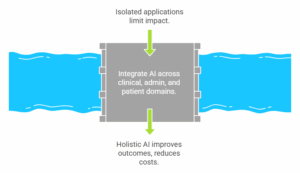
AI transforms healthcare

The general trend towards intelligent healthcare is reflected in the following trends, which are based on several industry analyses:

  • These days, clinical AI deployments are frequently utilised for report summarisation, imaging, and diagnostics.
  • Revenue cycle management systems and other administrative AI provide significant cost savings.
  • Tools for patient engagement, such as remote monitoring applications and conversational assistants, improve accessibility and lower readmission rates.

These changes demonstrate the vertical maturity of AI applications across the operational, clinical, and patient-facing domains.


Key Trends and Use Cases in 2025

Diagnostic Intelligence

Hospitals and diagnostic facilities now frequently use AI-powered systems to analyse pathology or imaging slides. These cutting-edge technologies quickly process thousands of photos using computer vision and deep learning to spot minute patterns that the human eye might overlook. They give radiologists and pathologists a valuable second opinion by promptly pre-screening cases, identifying possible abnormalities, and providing quantitative evaluations, such as tumour size, location, or density.

AI Impact on Clinical Outcomes

These systems not only expedite workflows but also improve clinical precision by lowering errors caused by fatigue and facilitating more consistent interpretations across high patient volumes. Additionally, they help prioritise urgent cases so that patients with the most important findings are examined first. As a result, physicians enhance patient outcomes and treatment planning in addition to increasing diagnostic accuracy. The increasing use of these tools signals a change to a more effective, data-driven diagnostic procedure that improves healthcare delivery speed and safety.

AI-Powered Medical Records

These days, NLP-based AI systems compile medical records, identify important insights, and recommend courses of action. By drastically lowering the paperwork load, these systems free up healthcare providers to concentrate more on patient care and less on administrative duties.

Predictive Analytics

Predictive models are being used by hospitals more and more to improve clinical care and operational effectiveness. For example, 25% of U.S. hospitals use predictive analytics now.

Large volumes of historical and current data, including patient demographics, medical histories, lab results, and environmental factors, are analysed by these AI-driven tools to predict important events like patient decline, readmission risks, and future staffing needs. These models allow medical professionals to foresee issues before they occur by spotting trends and risk factors early.

Predictive analytics, for instance, can notify physicians of subtle respiratory failure or sepsis warning signs hours before symptoms become clinically evident, enabling prompt interventions that may save lives. In a similar vein, hospitals can create focused post-discharge plans to enhance results and lower penalties by identifying which patients are most likely to require readmission.

On the operational side, administrators can balance workloads, prevent bottlenecks, and guarantee the provision of high-quality care by forecasting patient volumes and staff requirements. These realisations enable healthcare systems to shift from a reactive to a more strategic and proactive approach.

Virtual Health Assistants

AI-driven solutions, such as voice-activated triage assistants and chatbots for appointment scheduling, are enhancing access and cutting wait times while helping patients outside of hospitals.

Comparing the accuracy and sensitivity of AI and doctors in medical imaging

Detection Task AI (%)
Lung Nodule Detection 94 65
Breast Cancer Detection 90 78

Operational Automation

These days, AI systems automate operations scheduling, billing, and claims adjudication. Institutions can increase productivity and reduce administrative expenses without sacrificing the quality of care by incorporating intelligent workflows. Hospitals report ROI of $3.20 for every $1 spent, often within 14 months of implementation. 

Build Custom Healthcare Software With Industry Experts!

Contact us!

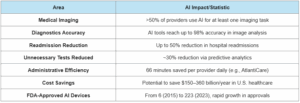
Artificial Intelligence in Healthcare: Broader Metrics

Artificial intelligence in healthcare statistics indicates a consistent rise in the use of AI in clinics and health systems:

  • The majority of hospitals now integrate at least one AI-powered system
  • Healthcare institutions report noticeable improvements in patient flow and reduced clinician burnout
  • Startups focused on AI-driven health solutions attract record-breaking investments

Rapid Growth of FDA-Approved AI Medical Devices

Additionally, integration initiatives prioritise unified workflows over standalone tools, improving patient-care ecosystems as a whole. Approximately 92% of healthcare leaders believe automation addresses staffing shortages. 


Challenges on the Road Ahead

Today, the use of AI in healthcare still faces significant obstacles, despite significant advancements. Over 10% of healthcare professionals in the U.S. use AI, and nearly 50% plan to use it in the future. Bias and fairness are two main issues; not all models function equally well across a range of patient populations, and resolving this problem calls for thorough testing and assessment. The skills of the workforce present another difficulty, since many medical professionals require specialised training to successfully integrate AI tools into their daily tasks. Obstacles to data integration also exist; electronic health record systems frequently continue to be isolated and have irregular formats, which prevent smooth interoperability. 

Furthermore, regulatory compliance is a continuous concern, necessitating ongoing attention due to changing standards regarding clinical safety, algorithmic transparency, and data privacy. The ethical, efficient, and fair application of AI technologies in contemporary healthcare depends on overcoming these obstacles.


Why These Metrics Matter to You

It is important to comprehend these AI in healthcare statistics for several reasons:

  • Making strategic decisions: Understanding the obstacles and best practices is necessary for investing in successful AI solutions.
  • Patient outcomes: AI can improve diagnosis speed and accuracy, ultimately saving lives.
  • Operational performance: Automation facilitates resource management, billing, and staffing.
  • Innovation readiness: Organisations that use AI now create the framework for personalised medicine in the future.

To optimise benefits, healthcare leaders must match the adoption of technology with organisational objectives and clinical evidence. 40% of U.S. physicians are ready to use generative AI when interacting with patients at the point-of-care.


Real-World Example: AI Improves Patient Triage

In late 2024, a mid-sized American hospital integrated an AI triage solution with its electronic health record (EHR) system. The system, which was first implemented during periods of high traffic, analysed patient symptoms, medical history, and real-time vitals using predictive algorithms. By correctly identifying high-risk patients, it allowed clinical staff to prioritise care and drastically cut down on wait times in emergency rooms. In addition to improving patient outcomes, this also lessened staff burnout during busy times.

The hospital broadened the scope of the solution by early 2025 to include chronic disease monitoring for ailments like COPD, diabetes, and heart failure. The AI identified warning signs before they became emergencies by continuously analysing patient data from wearables and home monitoring devices. By taking a proactive stance, doctors were able to help patients better manage their conditions at home and intervene earlier. As a result, the hospital experienced better continuity of care, a quantifiable decrease in preventable hospitalisations, and more effective departmental resource allocation.


How LITSLINK Supports Healthcare AI

We guide healthcare organisations through the responsible deployment of AI as part of our AI integration services. We help care providers improve outcomes and streamline operations by providing safe, scalable software solutions, like virtual assistant systems, medical image analysis pipelines, and NLP summarisation tools.

Explore more in our Healthcare Software Solutions or discover our full AI development services designed for regulated industries.


Final Thoughts

The comprehensive 2025 AI in healthcare statistics show that AI integration is already well underway and is speeding up. Clear clinical outcomes and administrative advantages are what motivate adoption. However, proactive attention is required in challenging areas such as interoperability and bias.

Working with a competent development team is crucial if you’re creating AI-powered healthcare solutions or trying to update clinical workflows.

Fortunately, we have extensive experience with safe software integration and AI platforms of the highest calibre for healthcare. We can also do that for you. Let’s begin by getting in touch with us!

Discuss Your Business Needs

Get a consultation!

.Organize the content with appropriate headings and subheadings ( h2, h3, h4, h5, h6). Include conclusion section and FAQs section with Proper questions and answers at the end. do not include the title. it must return only article i dont want any extra information or introductory text with article e.g: ” Here is rewritten article:” or “Here is the rewritten content:”

Generate single title from this title Benchmarking Amazon Nova: A comprehensive analysis through MT-Bench and Arena-Hard-Auto in 100 -150 characters. And it must return only title i dont want any extra information or introductory text with title e.g: ” Here is a single title:”

0

Write an article about
Large language models (LLMs) have rapidly evolved, becoming integral to applications ranging from conversational AI to complex reasoning tasks. However, as models grow in size and capability, effectively evaluating their performance has become increasingly challenging. Traditional benchmarking metrics like perplexity and BLEU scores often fail to capture the nuances of real-world interactions, making human-aligned evaluation frameworks crucial. Understanding how LLMs are assessed can lead to more reliable deployments and fair comparisons across different models.
In this post, we explore automated and human-aligned judging methods based on LLM-as-a-judge. LLM-as-a-judge refers to using a more powerful LLM to evaluate and rank responses generated by other LLMs based on predefined criteria such as correctness, coherence, helpfulness, or reasoning depth. This approach has become increasingly popular due to the scalability, consistency, faster iteration, and cost-efficiency compared to solely relying on human judges. We discuss different LLM-as-a-judge evaluation scenarios, including pairwise comparisons, where two models or responses are judged against each other, and single-response scoring, where individual outputs are rated based on predefined criteria. To provide concrete insights, we use MT-Bench and Arena-Hard, two widely used evaluation frameworks. MT-Bench offers a structured, multi-turn evaluation approach tailored for chatbot-like interactions, whereas Arena-Hard focuses on ranking LLMs through head-to-head response battles in challenging reasoning and instruction-following tasks. These frameworks aim to bridge the gap between automated and human judgment, making sure that LLMs aren’t evaluated solely based on synthetic benchmarks but also on practical use cases.
The repositories for MT-Bench and Arena-Hard were originally developed using OpenAI’s GPT API, primarily employing GPT-4 as the judge. Our team has expanded its functionality by integrating it with the Amazon Bedrock API to enable using Anthropic’s Claude Sonnet on Amazon as judge. In this post, we use both MT-Bench and Arena-Hard to benchmark Amazon Nova models by comparing them to other leading LLMs available through Amazon Bedrock.
Amazon Nova models and Amazon Bedrock
Our study evaluated all four models from the Amazon Nova family, including Amazon Nova Premier, which is the most recent addition to the family. Introduced at AWS re:Invent in December 2024, Amazon Nova models are designed to provide frontier-level intelligence with leading price-performance ratios. These models rank among the fastest and most economical options in their respective intelligence categories and are specifically optimized for powering enterprise generative AI applications in a cost-effective, secure, and reliable manner.
The understanding model family comprises four distinct tiers: Amazon Nova Micro (text-only, designed for ultra-efficient edge deployment), Amazon Nova Lite (multimodal, optimized for versatility), Amazon Nova Pro (multimodal, offering an ideal balance between intelligence and speed for most enterprise applications), and Amazon Nova Premier (multimodal, representing the most advanced Nova model for complex tasks and serving as a teacher for model distillation). Amazon Nova models support a wide range of applications, including coding, reasoning, and structured text generation.
Additionally, through Amazon Bedrock Model Distillation, customers can transfer the intelligence capabilities of Nova Premier to faster, more cost-effective models such as Nova Pro or Nova Lite, tailored to specific domains or use cases. This functionality is accessible through both the Amazon Bedrock console and APIs, including the Converse API and Invoke API.
MT-Bench analysis
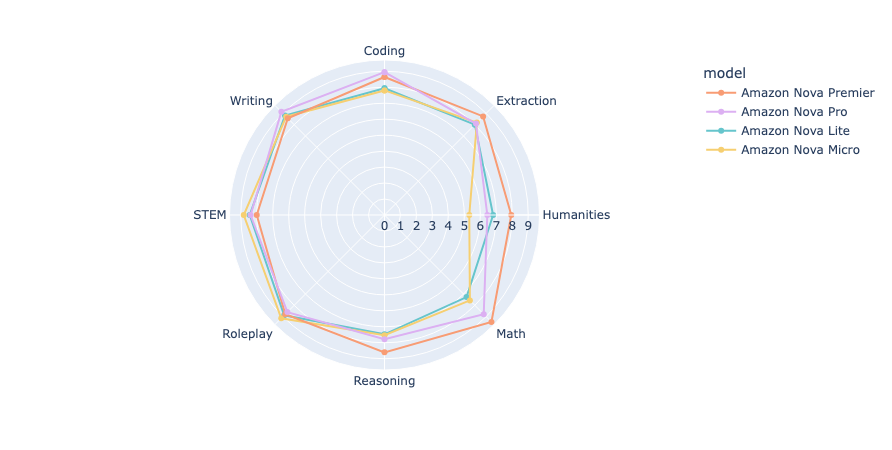
MT-Bench is a unified framework that uses LLM-as-a-judge, based on a set of predefined questions. The evaluation questions are a set of challenging multi-turn open-ended questions designed to evaluate chat assistants. Users also have the flexibility to define their own question and answer pairs in a way that suits their needs. The framework presents models with challenging multi-turn questions across eight key domains:

Writing
Roleplay
Reasoning
Mathematics
Coding
Data Extraction
STEM
Humanities

The LLMs are evaluated using two types of evaluation:

Single-answer grading – This mode asks the LLM judge to grade and give a score to a model’s answer directly without pairwise comparison. For each turn, the LLM judge gives a score on a scale of 0–10. Then the average score is computed on all turns.
Win-rate based grading – This mode uses two metrics:

pairwise-baseline – Run a pairwise comparison against a baseline model.
pairwise-all – Run a pairwise comparison between all model pairs on all questions.

Evaluation setup
In this study, we employed Anthropic’s Claude 3.7 Sonnet as our LLM judge, given its position as one of the most advanced language models available at the time of our study. We focused exclusively on single-answer grading, wherein the LLM judge directly evaluates and scores model-generated responses without conducting pairwise comparisons.
The eight domains covered in our study can be broadly categorized into two groups: those with definitive ground truth and those without. Specifically, Reasoning, Mathematics, Coding, and Data Extraction fall into the former category because they typically have reference answers against which responses can be objectively evaluated. Conversely, Writing, Roleplay, STEM, and Humanities often lack such clear-cut ground truth. Here we provide an example question from the Writing and Math categories:

{
    “question_id”: 81,
    “category”: “writing”,
    “turns”: [
        “Compose an engaging travel blog post about a recent trip to Hawaii,
        highlighting cultural experiences and must-see attractions.”,
        “Rewrite your previous response. Start every sentence with the letter A.”
    ]
}
{
    “question_id”: 111,
    “category”: “math”,
    “turns”: [
        “The vertices of a triangle are at points (0, 0), (-1, 1), and (3, 3).
         What is the area of the triangle?”,
        “What’s area of the circle circumscribing the triangle?”
    ],
    “reference”: [
        “Area is 3”,
        “5pi”
    ]
}

To account for this distinction, MT-Bench employs different judging prompts for each category (refer to the following GitHub repo), tailoring the evaluation process to the nature of the task at hand. As shown in the following evaluation prompt, for questions without a reference answer, MT-Bench adopts the single-v1 prompt, only passing the question and model-generated answer. When evaluating questions with a reference answer, it only passes the reference_answer, as shown in the single-math-v1 prompt.

{
    “name”: “single-v1”,
    “type”: “single”,
    “system_prompt”: “You are a helpful assistant.”,
    “prompt_template”:
        “[Instruction]\nPlease act as an impartial judge and evaluate the quality of
         the response provided by an AI assistant to the user question displayed below.
         Your evaluation should consider factors such as the helpfulness, relevance, accuracy,
         depth, creativity, and level of detail of the response. Begin your evaluation by providing a short explanation. Be as objective as possible.
        After providing your explanation, you must rate the response on a scale of 1 to 10 by strictly following this format: \”[[rating]]\”,
        for example: \”Rating: [[5]]\”.\n\n[Question]\n{question}\n\n[The Start of Assistant’s Answer]\n{answer}\n[The End of Assistant’s Answer]”,
    “description”: “Prompt for general questions”,
    “category”: “general”,
    “output_format”: “[[rating]]”
}
{
    “name”: “single-math-v1”,
    “type”: “single”,
    “system_prompt”: “You are a helpful assistant.”,
    “prompt_template”:
        “[Instruction]\nPlease act as an impartial judge and evaluate the quality of the response provided by an AI assistant
        to the user question displayed below. Your evaluation should consider correctness and helpfulness.
        You will be given a reference answer and the assistant’s answer. Begin your evaluation by comparing the assistant’s answer with the reference answer.
        Identify and correct any mistakes. Be as objective as possible. After providing your explanation,
        you must rate the response on a scale of 1 to 10 by strictly following this format: \”[[rating]]\”, for example: \”Rating: [[5]]\”.
        \n\n[Question]\n{question}\n\n[The Start of Reference Answer]\n{ref_answer_1}\n[The End of Reference Answer]
        \n\n[The Start of Assistant’s Answer]\n{answer}\n[The End of Assistant’s Answer]”,
    “description”: “Prompt for general questions”,
    “category”: “math”,
    “output_format”: “[[rating]]”
}

Overall performance analysis across Amazon Nova Models
In our evaluation using Anthropic’s Claude 3.7 Sonnet as an LLM-as-a-judge framework, we observed a clear performance hierarchy among Amazon Nova models. The scores ranged from 8.0 to 8.6, with Amazon Nova Premier achieving the highest median score of 8.6, followed closely by Amazon Nova Pro at 8.5. Both Amazon Nova Lite and Nova Micro achieved respectable median scores of 8.0.
What distinguishes these models beyond their median scores is their performance consistency. Nova Premier demonstrated the most stable performance across evaluation categories with a narrow min-max margin of 1.5 (ranging from 7.94 to 9.47). In comparison, Nova Pro showed greater variability with a min-max margin of 2.7 (from 6.44 to 9.13). Similarly, Nova Lite exhibited more consistent performance than Nova Micro, as evidenced by their respective min-max margins. For enterprise deployments where response time is critical, Nova Lite and Nova Micro excel with less than 6-second average latencies for single question-answer generation. This performance characteristic makes them particularly suitable for edge deployment scenarios and applications with strict latency requirements. When factoring in their lower cost, these models present compelling options for many practical use cases where the slight reduction in performance score is an acceptable trade-off.
Interestingly, our analysis revealed that Amazon Nova Premier, despite being the largest model, demonstrates superior token efficiency. It generates more concise responses that consume up to 190 fewer tokens for single question-answer generation than comparable models. This observation aligns with research indicating that more sophisticated models are generally more effective at filtering irrelevant information and structuring responses efficiently.
The narrow 0.6-point differential between the highest and lowest performing models suggests that all Amazon Nova variants demonstrate strong capabilities. Although larger models such as Nova Premier offer marginally better performance with greater consistency, smaller models provide compelling alternatives when latency and cost are prioritized. This performance profile gives developers flexibility to select the appropriate model based on their specific application requirements.
The following graph summarizes the overall performance scores and latency for all four models.

The following table shows token consumption and cost analysis for Amazon Nova Models.

Model
Avg. total tokens per query
Price per 1k input tokens
Avg. cost per query (cents)

Amazon Nova Premier
2154
$0.0025
$5.4

Amazon Nova Pro
2236
$0.0008
$1.8

Amazon Nova Lite
2343
$0.00006
$0.14

Amazon Nova Micro
2313
$0.000035
$0.08

Category-specific model comparison
The following radar plot compares the Amazon Nova models across all eight domains.

The radar plot reveals distinct performance patterns across the Amazon Nova model family, with a clear stratification across domains. Nova Premier consistently outperforms its counterparts, showing particular strengths in Math, Reasoning, Humanities, and Extraction, where it achieves scores approaching or exceeding 9. Nova Pro follows closely behind Premier in most categories, maintaining competitive performance especially in Writing and Coding, while showing more pronounced gaps in Humanities, Reasoning, and Math. Both Nova Lite and Micro demonstrate similar performance profiles to each other, with their strongest showing in Roleplay, and their most significant limitations in Humanities and Math, where the differential between Premier and the smaller models is most pronounced (approximately 1.5–3 points).
The consistent performance hierarchy across all domains (Premier > Pro > Lite ≈ Micro) aligns with model size and computational resources, though the magnitude of these differences varies significantly by category. Math and reasoning emerge among the most discriminating domains for model capability assessment and suggest substantial benefit from the additional scale of Amazon Nova Premier. However, workloads focused on creative content (Roleplay, Writing) provide the most consistent performance across the Nova family and suggest smaller models as compelling options given their latency and cost benefits. This domain-specific analysis offers practitioners valuable guidance when selecting the appropriate Nova model based on their application’s primary knowledge requirements.
In this study, we adopted Anthropic’s Claude 3.7 Sonnet as the single LLM judge. However, although Anthropic’s Claude 3.7 Sonnet is a popular choice for LLM judging due to its capabilities, studies have shown that it does exhibit certain bias (for example, it prefers longer responses). If permitted by time and resources, consider adopting a multi-LLM judge evaluation framework to effectively reduce biases intrinsic to individual LLM judges and increase evaluation reliability.
Arena-Hard-Auto analysis
Arena-Hard-Auto is a benchmark that uses 500 challenging prompts as a dataset to evaluate different LLMs using LLM-as-a-judge. The dataset is curated through an automated pipeline called BenchBuilder, which uses LLMs to automatically cluster, grade, and filter open-ended prompts from large, crowd-sourced datasets such as Chatbot-Arena to enable continuous benchmarking without a human in the loop. The paper reports that the new evaluation metrics provide three times higher separation of model performances compared to MT-Bench and achieve a 98.6% correlation with human preference rankings.
Test framework and methodology
The Arena-Hard-Auto benchmarking framework evaluates different LLMs using a pairwise comparison. Each model’s performance is quantified by comparing it against a strong baseline model, using a structured, rigorous setup to generate reliable and detailed judgments. We use the following components for the evaluation:

Pairwise comparison setup – Instead of evaluating models in isolation, they’re compared directly with a strong baseline model. This baseline provides a fixed standard, making it straightforward to understand how the models perform relative to an already high-performing model.
Judge model with fine-grained categories – A powerful model (Anthropic’s Claude 3.7 Sonnet) is used as a judge. This judge doesn’t merely decide which model is better, it also categorizes the comparison into five detailed preference labels. By using this nuanced scale, large performance gaps are penalized more heavily than small ones, which helps separate models more effectively based on performance differences:

A >> B (A is significantly better than B)
A > B (A is better than B)
A ~= B (A and B are similar)
B > A (B is better than A)
B >> A (B is significantly better than A)

Chain-of-thought (CoT) prompting – CoT prompting encourages the judge model to explain its reasoning before giving a final judgment. This process can lead to more thoughtful and reliable evaluations by helping the model analyze each response in depth rather than making a snap decision.
Two-game setup to avoid position bias – To minimize bias that might arise from a model consistently being presented first or second, each model pair is evaluated twice, swapping the order of the models. This way, if there’s a preference for models in certain positions, the setup controls for it. The total number of judgments is doubled (for example, 500 queries x 2 positions = 1,000 judgments).
Bradley-Terry model for scoring – After the comparisons are made, the Bradley-Terry model is applied to calculate each model’s final score. This model uses pairwise comparison data to estimate the relative strength of each model in a way that reflects not only the number of wins but also the strength of wins. This scoring method is more robust than simply calculating win-rate because it accounts for pairwise outcomes across the models.
Bootstrapping for statistical stability – By repeatedly sampling the comparison results (bootstrapping), the evaluation becomes statistically stable. This stability is beneficial because it makes sure the model rankings are reliable and less sensitive to random variations in the data.
Style control – Certain style features like response length and markdown formatting are separated from content quality, using style controls, to provide a clearer assessment of each model’s intrinsic capabilities.

The original work focuses on pairwise comparison only. For our benchmarking, we also included our own implementation of single-score judgment, taking inspiration from MT-Bench. We again use Anthropic’s Claude 3.7 Sonnet as the judge and use the following prompt for judging without a reference model:

{
“system_prompt”:
“Please act as an impartial judge and evaluate the quality
of the response provided by an AI assistant to the user question
displayed below. Your evaluation should consider factors
such as the helpfulness, relevance, accuracy, depth, creativity,
and level of detail of the response.
Begin your evaluation by providing a short explanation.
Be as objective as possible. After providing your explanation,
you must rate the response on a scale of 1 to 10 by strictly
following this format: \”[[rating]]\”, for example: \”Rating: [[5]]\”.”
}

Performance comparison
We evaluated five models, including Amazon Nova Premier, Amazon Nova Pro, Amazon Nova Lite, Amazon Nova Micro, DeepSeek-R1, and a strong reference model. The Arena-Hard benchmark generates confidence intervals by bootstrapping, as explained before. The 95% confidence interval shows the uncertainty of the models and is indicative of model performance. From the following plot, we can see that all the Amazon Nova models get a high pairwise Bradley-Terry score. It should be noted that the Bradley-Terry score for the reference model is 5; this is because Bradley-Terry scores are computed by pairwise comparisons where the reference model is one of the models in the pair. So, for the reference model, the score will be 50%, and because the total score is normalized between 0 and 10, the reference model has a score of 5.

The confidence interval analysis, as shown in the following table, was done to statistically evaluate the Amazon Nova model family alongside DeepSeek-R1, providing deeper insights beyond raw scores. Nova Premier leads the pack (8.36–8.72), with DeepSeek-R1 (7.99–8.30) and Nova Pro (7.72–8.12) following closely. The overlapping confidence intervals among these top performers indicate statistically comparable capabilities. Nova Premier demonstrates strong performance consistency with a tight confidence interval (−0.16, +0.20), while maintaining the highest overall scores. A clear statistical separation exists between these leading models and the purpose-built Nova Lite (6.51–6.98) and Nova Micro (5.68–6.14), which are designed for different use cases. This comprehensive analysis confirms the position of Nova Premier as a top performer, with the entire Nova family offering options across the performance spectrum to meet varied customer requirements and resource constraints.

Model
Pairwise score 25th quartile
Pairwise score 75th quartile
Confidence interval

Amazon Nova Premier
8.36
8.72
(−0.16, +0.20)

Amazon Nova Pro
7.72
8.12
(−0.18, +0.23)

Amazon Nova Lite
6.51
6.98
(−0.22, +0.25)

Amazon Nova Micro
5.68
6.14
(−0.21, +0.25)

DeepSeek-R1
7.99
8.30
(−0.15, +0.16)

Cost per output token is one of the contributors to the overall cost of the LLM model and impacts the usage. The cost was computed based on the average output tokens over the 500 responses. Although Amazon Nova Premier leads in performance (85.22), Nova Light and Nova Micro offer compelling value despite their wider confidence intervals. Nova Micro delivers 69% of the performance of Nova Premier at 89 times cheaper cost, while Nova Light achieves 79% of the capabilities of Nova Premier, at 52 times lower price. These dramatic cost efficiencies make the more affordable Nova models attractive options for many applications where absolute top performance isn’t essential, highlighting the effective performance-cost tradeoffs across the Amazon Nova family.
Conclusion
In this post, we explored the use of LLM-as-a-judge through MT-Bench and Arena-Hard benchmarks to evaluate model performance rigorously. We then compared Amazon Nova models against a leading reasoning model, that is, DeepSeek-R1 hosted on Amazon Bedrock, analyzing their capabilities across various tasks. Our findings indicate that Amazon Nova models deliver strong performance, especially in Extraction, Humanities, STEM, and Roleplay, while maintaining lower operational costs, making them a competitive choice for enterprises looking to optimize efficiency without compromising on quality. These insights highlight the importance of benchmarking methodologies in guiding model selection and deployment decisions in real-world applications.
For more information on Amazon Bedrock and the latest Amazon Nova models, refer to the Amazon Bedrock User Guide and Amazon Nova User Guide. The AWS Generative AI Innovation Center has a group of AWS science and strategy experts with comprehensive expertise spanning the generative AI journey, helping customers prioritize use cases, build a roadmap, and move solutions into production. Check out Generative AI Innovation Center for our latest work and customer success stories.

About the authors
Mengdie (Flora) Wang is a Data Scientist at AWS Generative AI Innovation Center, where she works with customers to architect and implement scalable Generative AI solutions that address their unique business challenges. She specializes in model customization techniques and agent-based AI systems, helping organizations harness the full potential of generative AI technology. Prior to AWS, Flora earned her Master’s degree in Computer Science from the University of Minnesota, where she developed her expertise in machine learning and artificial intelligence.
Baishali Chaudhury is an Applied Scientist at the Generative AI Innovation Center at AWS, where she focuses on advancing Generative AI solutions for real-world applications. She has a strong background in computer vision, machine learning, and AI for healthcare. Baishali holds a PhD in Computer Science from University of South Florida and PostDoc from Moffitt Cancer Centre.
Rahul Ghosh is an Applied Scientist at Amazon’s Generative AI Innovation Center, where he works with AWS customers across different verticals to expedite their use of Generative AI. Rahul holds a Ph.D. in Computer Science from the University of Minnesota.
Jae Oh Woo is a Senior Applied Scientist at the AWS Generative AI Innovation Center, where he specializes in developing custom solutions and model customization for a diverse range of use cases. He has a strong passion for interdisciplinary research that connects theoretical foundations with practical applications in the rapidly evolving field of generative AI. Prior to joining Amazon, Jae Oh was a Simons Postdoctoral Fellow at the University of Texas at Austin. He holds a Ph.D. in Applied Mathematics from Yale University.
Jamal Saboune is an Applied Science Manager with AWS Generative AI Innovation Center. He is currently leading a team focused on supporting AWS customers build innovative and scalable Generative AI products across several industries. Jamal holds a PhD in AI and Computer Vision from the INRIA Lab in France, and has a long R&D experience designing and building AI solutions that add value to users.
Wan Chen is an Applied Science Manager at the Generative AI Innovation Center. As a ML/AI veteran in tech industry, she has wide range of expertise on traditional machine learning, recommender system, deep learning and Generative AI. She is a stronger believer of Superintelligence, and is very passionate to push the boundary of AI research and application to enhance human life and drive business growth. She holds Ph.D in Applied Mathematics from University of British Columbia, and had worked as postdoctoral fellow in Oxford University.
Anila Joshi has more than a decade of experience building AI solutions. As a AWSI Geo Leader at AWS Generative AI Innovation Center, Anila pioneers innovative applications of AI that push the boundaries of possibility and accelerate the adoption of AWS services with customers by helping customers ideate, identify, and implement secure generative AI solutions.

.Organize the content with appropriate headings and subheadings ( h2, h3, h4, h5, h6). Include conclusion section and FAQs section with Proper questions and answers at the end. do not include the title. it must return only article i dont want any extra information or introductory text with article e.g: ” Here is rewritten article:” or “Here is the rewritten content:”