Home Blog Page 46

Generate single title from this title National AI training hub for educators to open, funded by OpenAI and Microsoft in 100 -150 characters. And it must return only title i dont want any extra information or introductory text with title e.g: ” Here is a single title:”

Write an article about

This story was originally published by Chalkbeat. Sign up for their newsletters at ckbe.at/newsletters.

More than 400,000 K-12 educators across the country will get free training in AI through a $23 million partnership between a major teachers union and leading tech companies that is designed to close gaps in the use of technology and provide a national model for AI-integrated curriculum.

The new National Academy for AI Instruction will be based in the downtown Manhattan headquarters of the United Federation of Teachers, the New York City affiliate of the American Federation of Teachers, and provide workshops, online courses, and hands-on training sessions. This hub-based model of teacher training was inspired by work of unions like the United Brotherhood of Carpenters that have created similar training centers with industry partners, according to AFT President Randi Weingarten.

“Teachers are facing huge challenges, which include navigating AI wisely, ethically and safely,” Weingarten said at a press conference Tuesday announcing the initiative. “The question was whether we would be chasing it or whether we would be trying to harness it.”

The initiative involves the AFT, UFT, OpenAI, Microsoft, and Anthropic.

The Trump administration has encouraged AI integration in the classroom. More than 50 companies have signed onto a White House pledge to provide grants, education materials, and technology to invest in AI education.

In the wake of federal funding cuts to public education and the impact of Trump’s sweeping tax and policy bill on schools, Weingarten sees this partnership with private tech companies as a crucial investment in teacher preparation.

“We are actually ensuring that kids have, that teachers have, what they need to deal with the economy of today and tomorrow,” Weingarten said.

The academy will be based in a city where the school system initially banned the use of AI in the classroom, claiming it would interfere with the development of critical thinking skills. A few months later, then-New York City schools Chancellor David Banks did an about-face, pledging to help schools smartly incorporate the technology. He said New York City schools would embrace the potential of AI to drive individualized learning. But concrete plans have been limited.

The AFT, meanwhile, has tried to position itself as a leader in the field. Last year, the union released its own guidelines for AI use in the classroom and funded pilot programs around the country.

Vincent Plato, New York City Public Schools K-8 educator and UFT Teacher Center director, said the advent of AI reminds him of when teachers first started using word processors.

“We are watching educators transform the way people use technology for work in real time, but with AI it’s on another unbelievable level because it’s just so much more powerful,” he said in a press release announcing the new partnership. “It can be a thought partner when they’re working by themselves, whether that’s late-night lesson planning, looking at student data or filing any types of reports — a tool that’s going to be transformative for teachers and students alike.”

Teachers who frequently use AI tools report saving 5.9 hours a week, according to a national survey conducted by the Walton Family Foundation in cooperation with Gallup. These tools are most likely to be used to support instructional planning, such as creating worksheets or modifying material to meet students’ needs. Half of the teachers surveyed stated that they believe AI will reduce teacher workloads.

“Teachers are not only gaining back valuable time, they are also reporting that AI is helping to strengthen the quality of their work,” Stephanie Marken, senior partner for U.S. research at Gallup, said in a press release. “However, a clear gap in AI adoption remains. Schools need to provide the tools, training, and support to make effective AI use possible for every teacher.”

While nearly half of school districts surveyed by the research corporation RAND have reported training teachers in utilizing AI-powered tools by fall 2024, high-poverty districts are still lagging behind their low poverty counterparts. District leaders across the nation report a scarcity of external experts and resources to provide quality AI training to teachers.

OpenAI, a founding partner of the National Academy for AI Instruction, will contribute $10 million over the next five years. The tech company will provide educators and course developers with technical support to integrate AI into classrooms as well as software applications to build custom, classroom-specific tools.

Tech companies would benefit from this partnership by “co-creating” and improving their products based on feedback and insights from educators, said Gerry Petrella, Microsoft general manager, U.S. public policy, who hopes the initiative will align the needs of educators with the work of developers.

In a sense, the teachers are training AI products just as much as they are being trained, according to Kathleen Day, a lecturer at Johns Hopkins Carey Business School. Day emphasized that through this partnership, AI companies would gain access to constant input from educators so they could continually strengthen their models and products.

“Who’s training who?” Day said. “They’re basically saying, we’ll show you how this technology works, and you tell us how you would use it. When you tell us how you would use it, that is a wealth of information.”

Many educators and policymakers are also concerned that introducing AI into the classroom could endanger student data and privacy. Racial bias in grading could also be reinforced by AI programs, according to research by The Learning Agency.

Additionally, Trevor Griffey, a lecturer in labor studies at the University of California Los Angeles, warned the New York Times that tech firms could use these deals to market AI tools to students and expand their customer base.

This initiative to expand AI access and training for educators was likened to New Deal efforts in the 1930s to expand equal access to electricity by Chris Lehane, OpenAI’s chief global affairs officer. By working with teachers and expanding AI training, Lehane hopes the initiative will “democratize” access to AI.

“There’s no better place to do that work than in the classroom,” he said at the Tuesday press conference.

Chalkbeat is a nonprofit news site covering educational change in public schools.

For more news on AI training, visit eSN’s Digital Learning hub.

Norah Rami, Chalkbeat

Norah Rami is a Dow Jones education reporting intern on Chalkbeat’s national desk. Reach Norah at nrami@chalkbeat.org.

Latest posts by eSchool Media Contributors (see all)

.Organize the content with appropriate headings and subheadings ( h2, h3, h4, h5, h6). Include conclusion section and FAQs section with Proper questions and answers at the end. do not include the title. it must return only article i dont want any extra information or introductory text with article e.g: ” Here is rewritten article:” or “Here is the rewritten content:”

Robot, know thyself: New vision-based system teaches machines to understand their bodies | MIT News

0

In an office at MIT’s Computer Science and Artificial Intelligence Laboratory (CSAIL), a soft robotic hand carefully curls its fingers to grasp a small object. The intriguing part isn’t the mechanical design or embedded sensors — in fact, the hand contains none. Instead, the entire system relies on a single camera that watches the robot’s movements and uses that visual data to control it.

This capability comes from a new system CSAIL scientists developed, offering a different perspective on robotic control. Rather than using hand-designed models or complex sensor arrays, it allows robots to learn how their bodies respond to control commands, solely through vision. The approach, called Neural Jacobian Fields (NJF), gives robots a kind of bodily self-awareness. An open-access paper about the work was published in Nature on June 25.

“This work points to a shift from programming robots to teaching robots,” says Sizhe Lester Li, MIT PhD student in electrical engineering and computer science, CSAIL affiliate, and lead researcher on the work. “Today, many robotics tasks require extensive engineering and coding. In the future, we envision showing a robot what to do, and letting it learn how to achieve the goal autonomously.”

The motivation stems from a simple but powerful reframing: The main barrier to affordable, flexible robotics isn’t hardware — it’s control of capability, which could be achieved in multiple ways. Traditional robots are built to be rigid and sensor-rich, making it easier to construct a digital twin, a precise mathematical replica used for control. But when a robot is soft, deformable, or irregularly shaped, those assumptions fall apart. Rather than forcing robots to match our models, NJF flips the script — giving robots the ability to learn their own internal model from observation.

Look and learn

This decoupling of modeling and hardware design could significantly expand the design space for robotics. In soft and bio-inspired robots, designers often embed sensors or reinforce parts of the structure just to make modeling feasible. NJF lifts that constraint. The system doesn’t need onboard sensors or design tweaks to make control possible. Designers are freer to explore unconventional, unconstrained morphologies without worrying about whether they’ll be able to model or control them later.

“Think about how you learn to control your fingers: you wiggle, you observe, you adapt,” says Li. “That’s what our system does. It experiments with random actions and figures out which controls move which parts of the robot.”

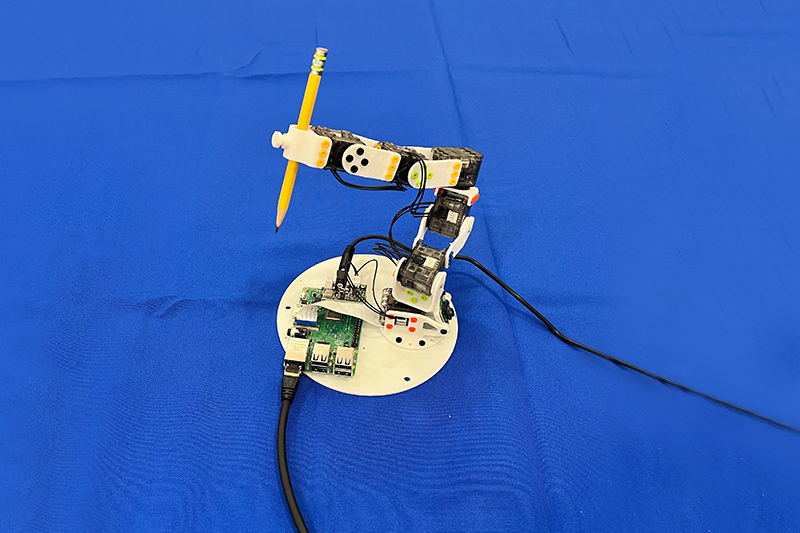
The system has proven robust across a range of robot types. The team tested NJF on a pneumatic soft robotic hand capable of pinching and grasping, a rigid Allegro hand, a 3D-printed robotic arm, and even a rotating platform with no embedded sensors. In every case, the system learned both the robot’s shape and how it responded to control signals, just from vision and random motion.

The researchers see potential far beyond the lab. Robots equipped with NJF could one day perform agricultural tasks with centimeter-level localization accuracy, operate on construction sites without elaborate sensor arrays, or navigate dynamic environments where traditional methods break down.

At the core of NJF is a neural network that captures two intertwined aspects of a robot’s embodiment: its three-dimensional geometry and its sensitivity to control inputs. The system builds on neural radiance fields (NeRF), a technique that reconstructs 3D scenes from images by mapping spatial coordinates to color and density values. NJF extends this approach by learning not only the robot’s shape, but also a Jacobian field, a function that predicts how any point on the robot’s body moves in response to motor commands.

To train the model, the robot performs random motions while multiple cameras record the outcomes. No human supervision or prior knowledge of the robot’s structure is required — the system simply infers the relationship between control signals and motion by watching.

Once training is complete, the robot only needs a single monocular camera for real-time closed-loop control, running at about 12 Hertz. This allows it to continuously observe itself, plan, and act responsively. That speed makes NJF more viable than many physics-based simulators for soft robots, which are often too computationally intensive for real-time use.

In early simulations, even simple 2D fingers and sliders were able to learn this mapping using just a few examples. By modeling how specific points deform or shift in response to action, NJF builds a dense map of controllability. That internal model allows it to generalize motion across the robot’s body, even when the data are noisy or incomplete.

“What’s really interesting is that the system figures out on its own which motors control which parts of the robot,” says Li. “This isn’t programmed — it emerges naturally through learning, much like a person discovering the buttons on a new device.”

The future is soft

For decades, robotics has favored rigid, easily modeled machines — like the industrial arms found in factories — because their properties simplify control. But the field has been moving toward soft, bio-inspired robots that can adapt to the real world more fluidly. The trade-off? These robots are harder to model.

“Robotics today often feels out of reach because of costly sensors and complex programming. Our goal with Neural Jacobian Fields is to lower the barrier, making robotics affordable, adaptable, and accessible to more people. Vision is a resilient, reliable sensor,” says senior author and MIT Assistant Professor Vincent Sitzmann, who leads the Scene Representation group. “It opens the door to robots that can operate in messy, unstructured environments, from farms to construction sites, without expensive infrastructure.”

“Vision alone can provide the cues needed for localization and control — eliminating the need for GPS, external tracking systems, or complex onboard sensors. This opens the door to robust, adaptive behavior in unstructured environments, from drones navigating indoors or underground without maps to mobile manipulators working in cluttered homes or warehouses, and even legged robots traversing uneven terrain,” says co-author Daniela Rus, MIT professor of electrical engineering and computer science and director of CSAIL. “By learning from visual feedback, these systems develop internal models of their own motion and dynamics, enabling flexible, self-supervised operation where traditional localization methods would fail.”

While training NJF currently requires multiple cameras and must be redone for each robot, the researchers are already imagining a more accessible version. In the future, hobbyists could record a robot’s random movements with their phone, much like you’d take a video of a rental car before driving off, and use that footage to create a control model, with no prior knowledge or special equipment required.

The system doesn’t yet generalize across different robots, and it lacks force or tactile sensing, limiting its effectiveness on contact-rich tasks. But the team is exploring new ways to address these limitations: improving generalization, handling occlusions, and extending the model’s ability to reason over longer spatial and temporal horizons.

“Just as humans develop an intuitive understanding of how their bodies move and respond to commands, NJF gives robots that kind of embodied self-awareness through vision alone,” says Li. “This understanding is a foundation for flexible manipulation and control in real-world environments. Our work, essentially, reflects a broader trend in robotics: moving away from manually programming detailed models toward teaching robots through observation and interaction.”

This paper brought together the computer vision and self-supervised learning work from the Sitzmann lab and the expertise in soft robots from the Rus lab. Li, Sitzmann, and Rus co-authored the paper with CSAIL affiliates Annan Zhang SM ’22, a PhD student in electrical engineering and computer science (EECS); Boyuan Chen, a PhD student in EECS; Hanna Matusik, an undergraduate researcher in mechanical engineering; and Chao Liu, a postdoc in the Senseable City Lab at MIT. 

The research was supported by the Solomon Buchsbaum Research Fund through MIT’s Research Support Committee, an MIT Presidential Fellowship, the National Science Foundation, and the Gwangju Institute of Science and Technology.

Generate single title from this title Lack of infrastructure and vision limit AI’s potential in 100 -150 characters. And it must return only title i dont want any extra information or introductory text with title e.g: ” Here is a single title:”

Write an article about

Key points:

AI tools to support and personalize student learning will have the most significant impact on students in the next few years, according to PowerSchool’s 2025 National Educator Survey.

The survey draws on more than 2,500 responses from classroom teachers, administrators, and education leaders across the U.S.

More than half of educators (54 percent) believe AI tools that support and personalize learning will be the most influential factor in improving student outcomes over the next 2-4 years.

Despite this optimism, actual use of AI in classrooms remains limited–only 13 percent of teachers and 11 percent of school administrators report currently using AI to support work-based learning.

There’s also a notable gap in strategic planning. Just 12 percent of educators strongly agree that their district has a clear vision for how AI should be integrated into classroom instruction, while 55 percent say they disagree.

The lack of professional development is another major barrier. Only 12 percent of educators strongly feel their district provides adequate AI-related training and support, highlighting a disconnect between the potential of AI and the resources available to implement it effectively.

Top education challenges include promoting attendance (50 percent), student behavior interventions (42 percent), addressing staff vacancies (40 percent), and supporting fundamental learning needs (39 percent).

Educators’ most pressing edtech priorities include communicating with families (54 percent), connecting data across systems (51 percent), personalizing student learning (47 percent), and addressing absenteeism (36 percent).

Different educator roles have different priorities. District administrators are primarily focused on strategic budgeting and addressing staffing shortages. School administrators cite student attendance as their most pressing concern. Classroom educators are most concerned with meeting student learning needs and managing classroom behavior.

When it comes to teacher shortages and burnout, nearly half of district administrators (48 percent) identify filling teacher vacancies as a top challenge. Meanwhile, 37 percent of classroom educators and 38 percent of school leaders point to staff and student mental health as a significant concern. Half of school leaders (50 percent) also report that staff morale and motivation are major issues that weigh heavily on them.

U.S. educators envision the school of the future as one that offers dynamic and student-centered learning experiences. These include flexible, integrated learning environments; personalized instruction supported by AI; project-based and interdisciplinary approaches; hands-on, immersive activities; competency- and skill-based education; and flexible schedules that promote student autonomy and self-directed learning

Laura Ascione is the Editorial Director at eSchool Media. She is a graduate of the University of Maryland’s prestigious Philip Merrill College of Journalism.

Laura AscioneLatest posts by Laura Ascione (see all)

.Organize the content with appropriate headings and subheadings ( h2, h3, h4, h5, h6). Include conclusion section and FAQs section with Proper questions and answers at the end. do not include the title. it must return only article i dont want any extra information or introductory text with article e.g: ” Here is rewritten article:” or “Here is the rewritten content:”

Generate single title from this title 5 AI tools that offer more than hype in 100 -150 characters. And it must return only title i dont want any extra information or introductory text with title e.g: ” Here is a single title:”

Write an article about

Key points:

The term “AI-powered” is today’s most popular buzzword–particularly in education. A growing number of edtech tools now claim to leverage AI, promising smarter, faster, and more personalized learning experiences.

But as AI becomes a marketing must-have, educators and school leaders must separate meaningful functionality from superficial hype.

Not all AI is created equal. Just because a tool claims to use AI doesn’t mean it provides real value in the classroom. In some cases, AI is merely used to automate basic tasks like spell-checking or keyword tagging–functions that have existed for years. In others, AI features may exist in name only, offering little beyond what traditional software can already do.

This creates a challenge for educators trying to make informed decisions. With budgets tight and pressure high to integrate technology that truly supports student learning, choosing tools with genuinely impactful AI features is more important than ever. Educators should feel empowered to ask tough questions about the tools they use. By focusing on practical, student-centered AI features, schools can ensure they’re investing in technology that actually enhances teaching and learning–not just riding the latest trend.

Here are 5 AI tools or (edtech tools with unique AI-driven features) that can actually help in the classroom:

Class Dojo’s Sidekick is an AI assistant that helps reduce busywork and give teachers more time with students. Sidekick assists with lesson planning, admin tasks, and everyday classroom workflows–and continues to evolve based on teacher feedback. A report card comment generator transforms notes into personalized feedback, freeing up valuable educator time. Sidekick also helps teachers write thank-you notes, respond to messages, create multiple-choice assessments, write story posts, and more. Melissa Chapple, a teacher at a K-12 Virtual Academy, uses Class Dojo’s Sidekick to work smarter but maintain a personal connection. Chapple refers to Sidekick as her “teaching assistant”–a resource that eases her workload without sacrificing quality. From drafting report card comments and planning behavior interventions to addressing sensitive parent messages, Sidekick enables her to work more efficiently and with greater confidence.

Brisk is a Chrome and Edge extension that helps teachers with curriculum, feedback, and differentiation, while giving leaders peace of mind with student-safe AI and real-time visibility into how it’s being used. The browser extension works inside the tools schools already use, like online textbooks, Docs, images, PDFs, and more, providing support without added complexity. Brisk includes more than 30 built-in tools and enables teachers to: inspect student writing, tracking revision history and generating insights on writing processes; create curriculum and assessments quickly, including lesson plans and quizzes, presentations, rubrics, syllabi, and ACT/SAT practice tests; provide personalized feedback in Google Docs via AI-generated comments; and differentiate learning materials by adjusting reading levels or translating text, which is ideal for supporting diverse learners, ESL, or IEP needs.

Eduaide, an application for AI-assisted instructional design, helps educators create content in all subject areas, such as inquiry-based STEM labs and projects, math word problems and real-world applications, essay outlines and writing scaffolds, primary source analysis, and scenario-based CTE assignments. The teacher-centered interface connects users with more than 120 tools to help plan lessons, create learning resources, differentiate instruction, provide actionable and timely feedback, and automate administrative tasks. Its feedback tool allows educators to receive targeted insights and feedback on submitted student work.

Twee is an AI‑driven platform tailored for language educators, streamlining lesson creation, assignment management, and feedback. Teachers simply input a topic, link, or vocabulary list, and Twee instantly generates CEFR-aligned content–like texts, dialogues, gap‑fills, comprehension questions, writing prompts, and more–for different language proficiency levels. Once generated, materials can be delivered in multiple formats: downloadable PDF or Word documents, interactive Google Forms, or live assignments via Twee’s online interface . It even offers instant grading, using AI to assess multiple‑choice, gap‑fill, and written responses.

Diffit helps teachers effortlessly craft accessible, engaging learning materials tailored to every student’s level. By inputting existing curriculum, text excerpts, PDFs, URLs or even YouTube links, educators receive leveled content–from 2nd grade to advanced–complete with vocabulary lists, comprehension questions, and graphic organizers. Teachers can use existing curriculum or generate standards-aligned content with real, cited sources. Next, they’ll choose a grade level and language, and Diffit creates complete, differentiated resources. Diffit emphasizes educational quality and uses real, cited sources, aligns closely with standards, and preserves teacher control while supporting differentiated instruction. Privacy is also prioritized–no student data is collected.

Laura Ascione is the Editorial Director at eSchool Media. She is a graduate of the University of Maryland’s prestigious Philip Merrill College of Journalism.

Laura AscioneLatest posts by Laura Ascione (see all)

.Organize the content with appropriate headings and subheadings ( h2, h3, h4, h5, h6). Include conclusion section and FAQs section with Proper questions and answers at the end. do not include the title. it must return only article i dont want any extra information or introductory text with article e.g: ” Here is rewritten article:” or “Here is the rewritten content:”

Generate single title from this title Geometries of Lives – AI-ARTS in 100 -150 characters. And it must return only title i dont want any extra information or introductory text with title e.g: ” Here is a single title:”

0

Write an article about

Yl Qena

I humbly explore the endless possibilities of combining traditional and non-traditional techniques with the aim of producing radical and emotional visual narratives. I am a multidisciplinary graphic experimenter with a passion for exploring new creative expressions. Over the years I have experimented with different mediums and technologies, from photography, 3D modeling, and video editing to traditional oil painting, pencil and ink illustration, and sculpture. In recent years, I have been fascinated by the potential of AI generative art, and I have been exploring different methods and programming languages to create my own generative art pieces based on my traditional artworks. For me, the beauty of art lies in its ability to communicate and express emotions and ideas in unique and innovative ways. That’s why I always try to combine different mediums and techniques to create something truly unique and thought-provoking. I strongly believe that the emergence of AI generative art is comparable to the shift caused by digital art and the internet, and it is leading to a massive change in the artistic world. I feel lucky to be part of this transformative moment, and I can’t wait to see where it will take us.

.Organize the content with appropriate headings and subheadings ( h2, h3, h4, h5, h6). Include conclusion section and FAQs section with Proper questions and answers at the end. do not include the title. it must return only article i dont want any extra information or introductory text with article e.g: ” Here is rewritten article:” or “Here is the rewritten content:”

Generate single title from this title OpenAI and Oracle announce Stargate AI data centre deal in 100 -150 characters. And it must return only title i dont want any extra information or introductory text with title e.g: ” Here is a single title:”

Write an article about

OpenAI has shaken hands with Oracle on a colossal deal to advance the former’s colossal Stargate AI data centre initiative.

It’s one thing to talk about the AI revolution in abstract terms, but it’s another thing entirely to grasp the sheer physical scale of what’s being built to make it happen. The foundations of our AI future are being laid in concrete, steel, and miles of fibre-optic cable, and those foundations are getting colossally bigger.

Together, OpenAI and Oracle are going to build new data centres in the US packed with enough hardware to consume 4.5 gigawatts of power. It’s hard to overstate what a staggering amount of energy that is—it’s the kind of power that could light up a major city. And all of it will be dedicated to one thing: powering the next generation of AI.

This isn’t just a random expansion; it’s a huge piece of OpenAI’s grand Stargate plan. The goal is simple: to build enough computing power to bring advanced AI to everyone.

When you add this new project to the work already underway in Abilene, Texas, OpenAI is now developing over 5 gigawatts of data centre capacity. That’s enough space to run more than two million of the most powerful computer chips available.

This move shows they are dead serious about a pledge they made at the White House earlier this year to plough half a trillion dollars into US AI infrastructure. In fact, with the momentum they’re getting from partners like Oracle and Japan’s SoftBank, they now expect to blow past that initial goal.

But this story isn’t just about silicon chips and corporate deals; it’s about people. OpenAI believes that building and running these new Stargate AI data centres will create over 100,000 jobs.

That job creation presents real opportunities for families across the country from construction crews pouring the concrete, to specialised electricians wiring up racks of servers, and the full-time technicians who will keep these digital brains running day and night.

In Abilene, the first phase of OpenAI’s development of Stargate data centres is already humming with activity. The first truckloads of Nvidia’s brand-new GB200 chips have arrived, and OpenAI’s researchers are already using them to see what their next AI models are capable of.

Of course, a project this huge is never a two-player game. While Oracle is helping build the physical capacity for the Stargate initiative, OpenAI is also working closely with SoftBank to completely rethink how AI data centres should be designed from the ground up. And let’s not forget Microsoft, which remains the key cloud partner, providing the digital plumbing that connects everything together.

Behind the curtain, there is a very real and very human industrial effort underway on a scale we’ve rarely seen before. It’s a powerful reminder that our digital world is built with grit, ambition, and an almost unbelievable (albeit concerning) amount of electricity.

See also: Can speed and safety truly coexist in the AI race?

Want to learn more about AI and big data from industry leaders? Check out AI & Big Data Expo taking place in Amsterdam, California, and London. The comprehensive event is co-located with other leading events including Intelligent Automation Conference, BlockX, Digital Transformation Week, and Cyber Security & Cloud Expo.

Explore other upcoming enterprise technology events and webinars powered by TechForge here.

.Organize the content with appropriate headings and subheadings ( h2, h3, h4, h5, h6). Include conclusion section and FAQs section with Proper questions and answers at the end. do not include the title. it must return only article i dont want any extra information or introductory text with article e.g: ” Here is rewritten article:” or “Here is the rewritten content:”

Generate single title from this title Bridging the language gap with AI tools every teacher can use in 100 -150 characters. And it must return only title i dont want any extra information or introductory text with title e.g: ” Here is a single title:”

Write an article about

Key points:

“I don’t think he understands anything I say in class,” Ms. Pierce, a high school science teacher, admitted to me recently. She was talking about her new Ukrainian student, who had just arrived and was placed in a mainstream class with little English support. Like many content teachers, Ms. Pierce is experienced, dedicated, and compassionate, but not trained in ESL instruction. She wanted to help, but didn’t know where to begin.

I suggested starting with something simple yet powerful: Use AI tools to generate clear, labelled images to introduce key vocabulary. According to the SIOP Model (Sheltered Instruction Observation Protocol), building background and explicitly teaching vocabulary are essential steps in making content comprehensible for English Learners. Visuals for terms like evaporation, cell wall, or friction give students a foundation before they encounter these words in complex reading or classroom discussions. For newcomers, especially, a single image can unlock an entire lesson.

But vocabulary is only part of the challenge. Many English Learners, especially those new to a country or school system, also lack background knowledge. When we assume students understand what a “revolution,” “ecosystem,” or “photosynthesis” means, we’re often skipping over cultural and conceptual gaps. That’s where AI-generated videoscan be transformative.

Using platforms like Pictory, Fliki, or KreadoAI, teachers can paste a short, student-friendly script into the platform and instantly generate a video. These often include narration, images, captions, and sometimes even avatars. A science teacher can create a 90-second explanation of the water cycle; a history teacher can summarize the causes of the American Revolution. English Learners benefit from the layered input–hearing narration, reading subtitles, and seeing key concepts illustrated–all at once.

To reinforce language development, especially in writing, content teachers can take this further by using AI to support sentence structure and cohesion. One effective combination is Quill.org, ChatGPT and AIR Language,an AI-powered platform designed specifically for English Language Learners. Developed by a passionate educator in Texas, a place I still consider my second home, AIR Language offers levelled, adaptive practice in grammar, vocabulary, and speaking. Teachers can assign lessons or have students engage with guided AI prompts that build academic vocabulary, sentence structure, and confidence in real time.

Quill offers structured grammar and writing practice, including focused exercises on cause-and-effect transitions like “because,” “so,” “therefore,” and “as a result.” Students receive immediate feedback and revision opportunities, making it a low-stress environment for mastering academic language.

Pairing this with a generative tool like ChatGPT helps students apply those skills in context. Teachers can prompt students to write short paragraphs explaining scientific processes or historical events, then use ChatGPT to check their use of transitions. For those new to AI, here are two simple prompts you can copy and try:

“Here’s a paragraph about the water cycle. Give feedback on the use of transition words showing cause and effect. Suggest better alternatives if needed.”

“Rewrite this student’s paragraph using clearer cause-and-effect transitions like ‘because,’ ‘therefore,’ or ‘as a result.’”

AI can also play a valuable role in differentiating instruction and assessing English Learners in real time. Tools like MagicSchool AI or ChatGPT can help teachers generate multiple versions of the same reading passage or quiz, adjusting the language complexity to match students’ English proficiency levels. A biology teacher, for example, could create three versions of a summary about photosynthesis: one for newcomers with simple sentence frames, one for intermediate learners using visuals and transition words, and one for advanced students using more academic language. For quick assessments, teachers can use tools like Formative or Quizizz AIto design exit tickets or comprehension checks that adapt questions for ELLs while still assessing the same core concept. These differentiated strategies align with the SIOP model and help ensure that all students can access and demonstrate learning, even if their English skills are still developing.

These tools aren’t a replacement for good teaching, but they offer powerful scaffolds. Teachers can differentiate, reinforce, and expand instruction, without needing to become language specialists. While powerful, AI tools should always be used thoughtfully, and teachers should review outputs for accuracy and appropriateness.

For students like Ms. Pierce’s Ukrainian learner, these supports could mean the difference between silent confusion and real understanding. AI is not just changing education, it’s helping to level the playing field. With the right tools and a bit of guidance, every teacher can become a language teacher.

Ready to try? Start with just one tool this week and see the difference.

If you’re new to AI image generation and want a simple step-by-step guide, consider completing the free MagicSchool Image Generator Certification Course. It walks educators through crafting prompts, generating educational visuals, and even customizing them using Adobe Express.

Prefer to watch instead? This 2-minute video walkthrough shows how to use MagicSchool’s Image Generator in real time, perfect for getting started quickly.

Nesren El-Baz, ESL EducatorNesren El-Baz is an ESL educator with over 20 years of experience, and is a certified bilingual teacher with a Master’s in Curriculum and Instruction. El-Baz is currently based in the UK, holds a Masters degree in Curriculum and Instruction from Houston Christian University, and specializes in developing in innovative strategies for English Learners and Bilingual education. Latest posts by eSchool Media Contributors (see all)

.Organize the content with appropriate headings and subheadings ( h2, h3, h4, h5, h6). Include conclusion section and FAQs section with Proper questions and answers at the end. do not include the title. it must return only article i dont want any extra information or introductory text with article e.g: ” Here is rewritten article:” or “Here is the rewritten content:”

Manager Effectiveness – How to Support Leaders in an Era of Expanding Responsibilities

0

When managers are overwhelmed, business performance suffers. But across industries, leaders are asking managers to take on more—with less. Since 2017, average team sizes have tripled. Expectations have skyrocketed. And support from organizations hasn’t kept pace.

The result isn’t just stressed-out managers. It’s execution gaps, delayed decisions, and stalled progress on your most important initiatives. In fact, today’s managers are responsible for 51% more than they can effectively handle. Manager effectiveness is a make-or-break factor for organizational performance.


Why It’s Time to Rethink Manager Effectiveness 

Today’s managers sit at the intersection of strategy and execution—but most aren’t set up to succeed. Their role has evolved dramatically. They’re no longer just overseeing work. They’re coaching teams, translating vision into action, and driving outcomes in increasingly complex environments.

And yet, most manager support strategies haven’t kept pace, leaving leaders overwhelmed, teams underdeveloped, and performance on the line.


When managers are overloaded, everything slows down

Managers are being asked to do more than ever—but without the structure or tools to keep up. 


“Instead of thinking about burnout of managers, think about the situation they’re in,” says Anne Maltese, VP of People Insights at Quantum Workplace. “Are we teeing them up to be effective? Or are we creating hurdles they can’t overcome?”


The fallout is real:

  • Coaching and career conversations take a back seat
  • Performance check-ins become rushed or reactive
  • Strategic priorities lose momentum

And as managers stretch to cover more ground, execution bottlenecks, missed decisions, and disengaged teams follow close behind.


Management is a capability, not just a job title

High performers are often rewarded with leadership roles—but few are equipped to lead. Nearly 4 in 10 managers have never received formal training, and only 36% of HR leaders say their programs prepare managers for the future.

Leadership today demands more than technical knowledge. Managers must navigate complex dynamics, coach in real time, and create psychological safety. And without the right support, even your best people can flounder in these roles. 

If we want better leaders, we need to build them—intentionally.


Managers-HR confidence in leadership programs


Your leadership pipeline is at risk  

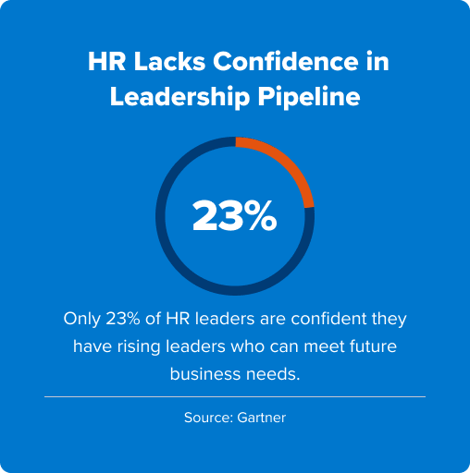
The leadership crisis is already here. As experienced leaders retire and rising talent opts out, succession planning is becoming a strategic vulnerability. Only 23% of HR leaders feel confident they have future-ready leaders in place.

Worse still, 72% of Gen Z workers say they’d rather grow as individual contributors than take on management roles. And 1 in 5 managers would leave leadership if they had the option.

Why? Because the role feels broken—too administrative, too stressful, and too disconnected from meaningful work. To reverse this trend, organizations must make leadership a path worth pursuing again.


AI can be a turning point—if we use it right

AI isn’t replacing managers—it’s reimagining how they lead. When used well, AI eliminates administrative drag and frees managers to focus on high-impact work: coaching, developing, and delivering results.

Managers who effectively use technology are 3.4x more likely to be rated as strong leaders. But nearly half say their current tools don’t help them lead effectively. That’s a missed opportunity—and a competitive risk.


Managers-effective tech users more effective

The future of work isn’t just digital. It’s human-centered and tech-enabled. And the organizations that invest in AI-powered tools—and empower managers to use them—will lead the way.


The Business Risk of Standing Still  

Weak manager support doesn’t just slow your teams. It slows your business. Without effective leaders, strategic initiatives stall, employee experience suffers, and long-term growth loses its footing.


Day-to-day strain turns into strategic drag

When managers are stretched thin, the impact ripples through every layer of the organization:

  • Priorities become blurred
  • Communication slows
  • High performers don’t get the development they need

Teams operate in reactive mode. Decisions stall. And the connection between vision and execution starts to break down.


Burnout builds—and talent starts to walk

The human cost shows up fast:

Overloaded managers can’t deliver the leadership employees expect. Engagement drops. Frustration builds. And your best people start seeking growth elsewhere.


Managers-HR say managers overwhelmed


Long-term gaps threaten future growth

Manager ineffectiveness today becomes a pipeline problem tomorrow. Without the right training and support, future leaders don’t develop. Institutional knowledge walks out the door. And your organization becomes known for weak leadership development—a red flag for ambitious talent.

In an era where performance, agility, and engagement are make-or-break, manager effectiveness isn’t something organizations can afford to take lightly.


Best Practices for Building Manager Effectiveness at Scale

High-performing organizations don’t treat management as a reward for top performers—they treat it as a critical capability to build and sustain. They know that being great at the work isn’t the same as being great at leading people. That’s why forward-thinking HR leaders invest early, design intentionally, and enable managers with the tools, structure, and support to thrive. Here’s how they do it:


Plan ahead—way ahead

Great leadership doesn’t happen overnight. Leading organizations start developing managers two to three years before they step into formal leadership roles.


“Excelling in a role doesn’t automatically prepare someone to lead,” explains Julie Melidis, Director of Learning & Development at Benesch. “That’s why we don’t wait. Without preparation, the transition is a shock. Handing someone a team and saying, ‘Good luck,’ sets them up to fail.”


By starting early, organizations build confidence, close skill gaps, and ensure smoother transitions into leadership.


Redesign the role for scale and impact

To make manager effectiveness sustainable, organizations rethink the role itself. They eliminate low-value tasks—approvals, scheduling issues, administrative clutter—and reallocate that time toward what matters most: coaching, strategic decision-making, and people development. Automation, delegation, and clear boundaries help managers stay focused on the responsibilities only they can fulfill.


Use technology as a multiplier 

Technology doesn’t replace good leadership—it enables it. AI and automation can handle time-consuming tasks like data gathering, reporting, and workflow management, freeing managers to focus on their teams. When implemented thoughtfully, technology provides:

  • Timely nudges and insights for coaching
  • Feedback and goal-setting recommendations
  • Real-time visibility into team progress

    Managers-ineffective tech stack


Treat succession planning as a shared responsibility

Leadership pipelines don’t build themselves. Leading HR teams partner closely with people managers to identify and develop future leaders early and intentionally. That includes:

  • Data-driven systems for identifying high-potential talent
  • Tools for assessing leadership readiness and skill gaps
  • Stretch assignments, mentorship, and real-time coaching


“What’s missing is continuous coaching and support,” says Todd Pernicek, Senior Insights Analyst at Quantum Workplace. “Many companies offer one-time training, but leadership development isn’t a single event. It needs to be ongoing.”


These organizations embed leadership growth and succession planning into daily operations—not just classrooms—and build future-ready leaders from the ground up.


Five Manager Effectiveness Strategies You Can Implement This Quarter

You don’t need to overhaul everything at once to drive real change. By focusing on a few high-impact actions, you can start building stronger, more effective leaders—right now. These five strategies will help you create momentum this quarter while laying the groundwork for long-term leadership success.


Redesign the role to scale

Start with a workload audit to understand what’s consuming your managers’ time—and what shouldn’t be. Map daily activities into three categories:

  • Tasks only managers can do (e.g., coaching, performance feedback)
  • Tasks others can own (e.g., scheduling, admin)
  • Tasks that can be automated (e.g., status reporting, approvals)

Then start clearing the path. Streamlining these tasks gives managers space to lead, not just react.


Build leadership as a continuous capability

Leadership isn’t a destination—it’s a skill to build over time. Create systems that provide:

  • Ongoing coaching tied to real workplace challenges
  • Peer groups where managers learn from one another
  • Mentorship programs pairing emerging leaders with seasoned ones

Give managers access to resources, frameworks, and guidance—when they need it, not months later in a training binder.


Managers-Lack of Confidence in Leadership Pipeline


Align on succession—before it’s urgent

Don’t wait until a key leader exits to think about who’s next.

  • Define what great leadership looks like at your organization
  • Use that model to assess current managers and surface high-potential talent
  • Hold regular talent reviews where HR and managers collaborate on development plans and succession readiness

When HR and people leaders align, your leadership bench strengthens—by design, not default.


Use AI and technology to amplify managers

Choose one area where AI can remove busywork and enhance leadership impact. Start small—maybe it’s automating performance summaries, surfacing engagement insights, or tracking team development activity.

Well-designed tools don’t just save time—they sharpen judgment, guide more effective conversations, and help managers lead with clarity.

Most importantly, they equip managers to build thriving teams that are:

  • Connected and engaged in their work, team, and organization
  • Aligned and high-performing, with visibility into goals, progress, and obstacles
  • Growing and future-ready, supported by clear development opportunities and coaching

When technology supports the human side of leadership, managers have the space—and the tools—to lead well.


Make manager enablement a business priority

If you want better leadership outcomes, manage them like you would any strategic initiative.

  • Set clear metrics: team engagement, development activity, retention
  • Secure executive sponsorship and model the behaviors you expect
  • Report progress, share wins, and refine along the way

Manager effectiveness shouldn’t be an HR-only initiative—it’s a business-wide responsibility.


Want the Full Picture of 2025 Workplace Trends?

Access the complete strategic insights that forward-thinking HR leaders are using to build competitive advantage. The Workplace Trends Report delivers actionable intelligence across all seven game-changing areas.

Read the report now >>

Trends-grid-managers

SmartThings Blog

0

A SmartThings user shares how one costly mistake led to a simple, smart solution

There are moments in life that test your patience, your resilience, and your relationship with frozen pizza. For me, that moment came on a sleepy Saturday morning, when I entered my kitchen and discovered a scene that can only be described as devastatingly soggy. I had left the freezer door cracked open overnight after I’d grabbed a bedtime snack. Everything from ice cream to expensive cuts of meat was ruined. A full freezer, lost to forgetfulness.

After cycling through the five stages of grief (and a deep clean), I realized this didn’t have to happen. I use SmartThings, the platform built to make life easier, not ruin my day with four pints of liquified ice cream.

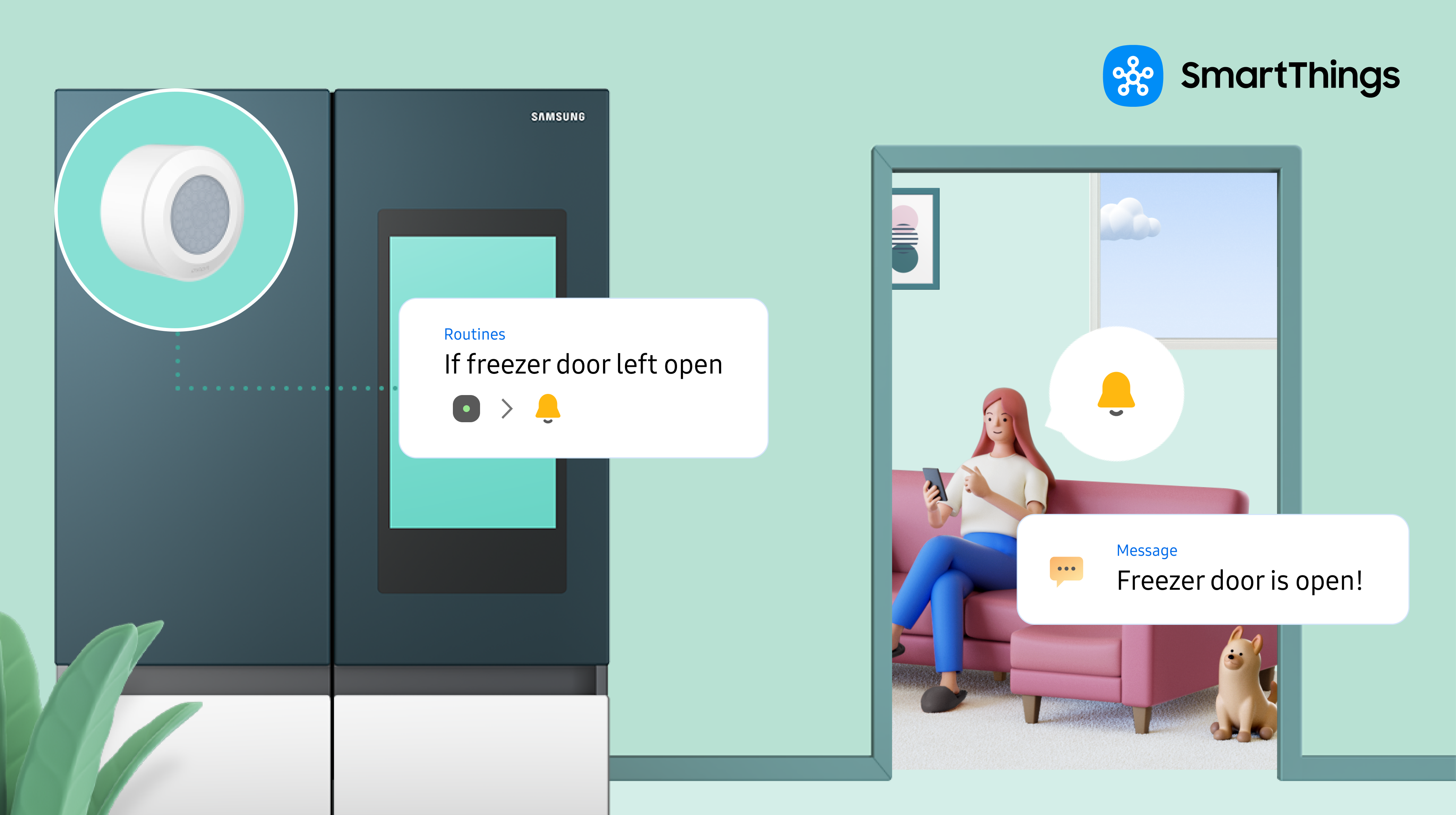
So I did what any tech-savvy, freshly humbled human would do: installed a SmartThings-compatible Aqara sensor, synced it to my SmartThings app on iOS ( the setup is just as easy as it is for Android), and created a routine to send me an alert if the freezer is open for more than a minute. Simple. Seamless. Sanity-saving.

A $20 Sensor vs. a $300 Grocery Bill

Smart home devices aren’t just for sci-fi enthusiasts or gadget geeks. They’re for everyday people who want to avoid real-world chaos. Whether it’s a cracked freezer door, a garage left open, or lights on all night in your kid’s room, SmartThings can quietly step in to keep things running smoothly and dodge dishing out big bucks down the line.
Here’s how my SmartThings setup will now save the day and how yours can, too:

  • Custom Alerts: I created a rule in the SmartThings app that sends a push notification to my phone if the freezer door stays open too long.  I can extend this logic to my fridge, wine cooler, or cabinet where I hide my snacks.
  • Peace of Mind on Autopilot: SmartThings doesn’t just tell you something’s wrong, it gives you the tools to fix it. I could’ve connected a smart light to blink red if the door was left ajar or used a voice assistant to chime in with a reminder. Drama avoided.
  • One App, So Many Solutions: The beauty of SmartThings is that it plays nicely with thousands of devices. Aqara is just one of many partners whose devices work with SmartThings, and because it’s Matter-certified, all I had to do was open the box and scan the QR code for SmartThings to discover it and add it to my devices. Once the sensor was added, I created a routine, and was finally able to move on with my life — and onto my new ice cream.

How to Set It Up in SmartThings

Want to avoid your own frozen food fail? Here’s how to create a simple routine in the SmartThings app using any Works with SmartThings sensor:

  1. Add the sensor to your SmartThings app by scanning the QR code or using “Add device” and selecting the brand/model.
  2. Tap + and select “Create routine”
  3. Tap “If” condition:
    Select Device
    Set Contact sensor = Open
  4. Then tap + Add condition → Add delay → set it to 1 minute
    (This gives you a grace period before triggering an alert in case you’re just grabbing a snack.)
  5. For the “Then” action:
    Select Send notification
    Customize your message (e.g., “Freezer door left open!!!)
  6. Tap Done to save.
     

Smarter Living Starts with Small Steps

We don’t always think about tech until we need it.  The small, everyday decisions like setting up a routine or adding a sensor are what often save us the most time, money, and frustration.

So if you’ve ever lost a freezer full of food, forgot to turn off the lights before a trip, or wondered if your front door was locked after you boarded a flight, SmartThings might just be your new best friend. If you want to go a step further, you can even choose a Samsung refrigerator with built-in sensors that connect directly to SmartThings, so you’ll know right away if the door’s been left open, no extra device required.

Take it from me: the smartest home isn’t the one with the most devices. It’s the one that works for you, in the moments that matter most.

Ready to prevent your next home fiasco? Explore Works with SmartThings sensors and build your own custom automations today.  A smarter (and less soggy) home is just a tap away.

Generate single title from this title AI tools are everyday study buddies, survey finds in 100 -150 characters. And it must return only title i dont want any extra information or introductory text with title e.g: ” Here is a single title:”

Write an article about

Key points:

Across the U.S., AI tools are becoming go-to learning companions for students–helping them brainstorm essays, practice languages, and solve tough math problems, according to a new survey from Preply.

But while these tools offer speed and convenience, true learning takes more than quick answers. It requires thoughtful guidance, encouragement, and critical thinking–things AI can support, but not replace. And depending on where they live, some students may be missing out more than others.

AI chatbots like ChatGPT, Google Gemini, and Microsoft Copilot are becoming increasingly popular in classrooms and dorm rooms alike.

In fact, 80 percent of students and recent graduates say they’ve used AI during their education.

Among the most common subjects for AI use: English/language arts (42 percent), mathematics (42 percent), and history (27 percent).

In language arts, students turn to AI to break down complex texts, improve their writing, and fix grammar and spelling. In math, AI is often used to clarify tricky formulas and explain multi-step problems–a valuable resource as students tackle increasingly advanced concepts like algebra and pre-calculus.

For history assignments, AI tools can help summarize dense material or suggest key points for essays. However, experts caution that these tools don’t always get the facts right. Encouragingly, 78 percent of students say they double-check AI-generated information before including it in schoolwork.

Language learning is another major use case. English, Spanish, and French top the list of languages students practice with AI, making it easier to build vocabulary, improve pronunciation, and strengthen grammar–all in a low-pressure environment. Still, while AI can offer helpful support, it’s the insight and encouragement from experienced educators and tutors that spark deeper understanding and lasting growth.

AI usage also varies widely by location. Students in Arkansas, Mississippi, and Texas report the highest levels of AI use, while those in Illinois, Nevada, and Oregon are among the least likely to engage with these tools.

College students, in particular, are leading the charge, with many reporting daily use of AI to support their learning.

As AI becomes more embedded in how students learn, it’s critical to remember that technology works best when paired with real human connection. Fast answers are helpful–but it’s the combination of knowledge, empathy, and mentorship that helps students truly thrive.

The most common way students use AI is to help summarize or understand reading materials, with over 40 percent reporting this as a key task. Close behind, 44 percent of students say they use AI to edit essays or reports, making it the second most frequent use.

In third place is using AI to solve math or science problems, followed by brainstorming ideas or creating outlines–something 2 in 5 students say they rely on AI for. Rounding out the top five tasks is writing essays or reports, which more than one-third of students report doing with AI support.

Overall, college students are more likely than high school students to use AI tools, and they are also more diligent when it comes to verifying AI-generated content. Both college students and recent graduates are more likely to consistently fact-check their work before submitting it. Still, not all students take that extra step–nearly 1 in 5 say they rarely or never review the information AI provides, which raises concerns about the potential downsides of relying too heavily on these tools in education.

Laura Ascione is the Editorial Director at eSchool Media. She is a graduate of the University of Maryland’s prestigious Philip Merrill College of Journalism. Latest posts by Laura Ascione (see all)

.Organize the content with appropriate headings and subheadings ( h2, h3, h4, h5, h6). Include conclusion section and FAQs section with Proper questions and answers at the end. do not include the title. it must return only article i dont want any extra information or introductory text with article e.g: ” Here is rewritten article:” or “Here is the rewritten content:”