Home Blog Page 47

Generate single title from this title Hackathon Winners Bring Agentic AI to Life with the NVIDIA NeMo Agent Toolkit in 100 -150 characters. And it must return only title i dont want any extra information or introductory text with title e.g: ” Here is a single title:”

0

Write an article about

The best way to learn a new toolkit is to build something real, and that’s exactly what developers did at the recent NVIDIA NeMo Agent Toolkit Hackathon. Over two weeks, participants across skill levels—from students to seasoned professionals—experimented, prototyped, and created intelligent multi-agent AI workflows using the open-source NeMo Agent toolkit (formerly known as the AIQ toolkit).

With access to example projects, technical documentation, and office hours with NVIDIA engineers, participants explored the toolkit’s orchestration, memory, and profiling features—often combining them with other NVIDIA technologies and contributing improvements upstream. 

Submissions were judged on real-world applicability, technical execution, and how effectively they demonstrated agentic AI in action. The results were inspiring: functional, innovative projects that showcase how AI agents solve real problems across logistics, software development, and personal travel planning. 

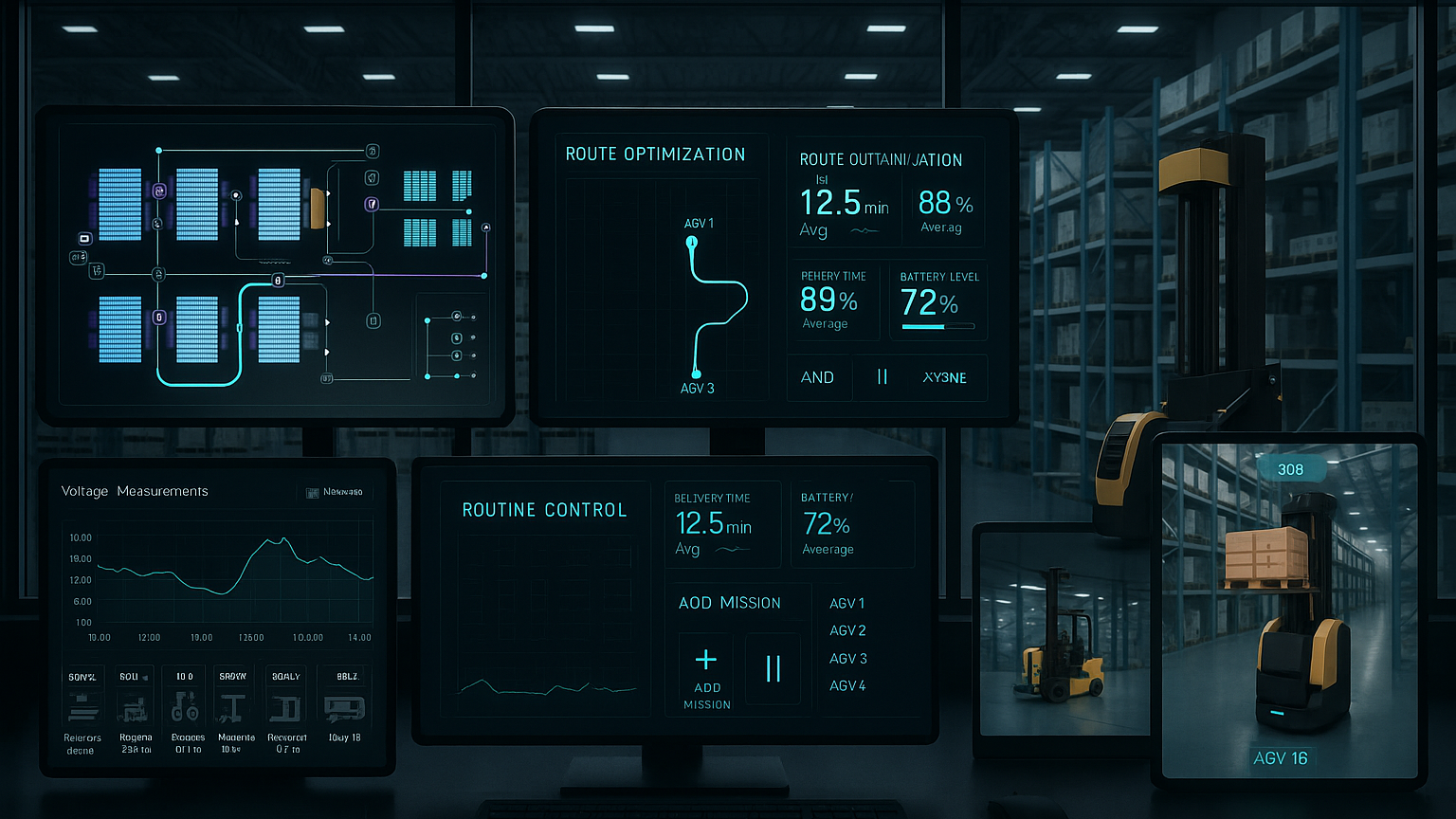
Developed by a member of the TCS Smart Mobility Group, the winning project demonstrated a powerful integration of the NVIDIA NeMo Agent toolkit, NVIDIA cuOpt, and NVIDIA Omniverse libraries to solve complex logistics and supply chain challenges. 

This intelligent system orchestrates a team of AI agents—each specializing in natural language understanding, constraint extraction, and route computation. The agents collaborate to interpret user instructions, such as “plan optimized routes for three forklifts to deliver material from storage to trucks, each with limited capacity,” extract operational constraints, and invoke cuOpt to compute optimal routing plans in seconds.

TCS developed an application on the Omniverse Kit SDK to provide a simulation environment, test scenarios, and train agents safely. Once optimized, the routes are deployed onto NVIDIA Jetson Nano-powered autonomous mobile robots (AMRs), such as MyAGV robots, completing a full simulation-to-deployment pipeline.

Key features:

  • Natural language interface: Enables users to describe logistics tasks in plain English, enabling intuitive interaction without the need for technical commands.
  • Dynamic multi-agent orchestration: Chains together language models, optimization engines, and data pipelines to automate complex tasks from input interpretation to execution.
  • Real-time optimization: Utilizes cuOpt to generate rapid, constraint-aware route plans in dynamic real-world environments.
  • Simulation-to-deployment pipeline: Uses Omniverse to simulate and validate routes before deploying them to physical robots, ensuring safe and effective real-world execution.

This project demonstrates how agentic AI—when paired with high-performance NVIDIA CUDA-X solvers like cuOpt—can drastically streamline fleet management, reduce operational costs, and enable faster, smarter operational decisions.

OpenCodeReview empowers developers with automated, AI-driven code analysis to detect security vulnerabilities and improve code quality. Built using the NeMo Agent toolkit, the system scans selected files, highlights issues, and recommends fixes, integrated into existing workflows effectively.

A standout feature is the ability to swap between different AI models by adjusting configuration files, enabling customization across coding standards or team needs. Developers don’t need to prompt-tune anything—the agent instructions are pre-configured for ease of use. Developers can also flexibly use different AI models—some models may be better suited for certain programming languages, and more easily select the best models for their use case.

By leveraging the NeMo Agent toolkit’s orchestration and memory features, OpenCodeReview democratizes secure coding practices, making advanced review accessible to individual developers, startups, and large organizations alike. The toolkit also makes it easy to update or add additional AI agents by simply changing the configuration files.

This modular travel assistant, built directly into the NeMo Agent toolkit’s examples folder, demonstrates how agentic AI can unify fragmented travel tasks into a single, conversational experience. This submission included a large number of tools and an impressive number of features. For example, users can: 

  • Search and book flights using natural language queries across APIs.
  • Plan end-to-end journeys including hotels, activities, and maps.
  • Rely on resilient data access, with a local fallback database in case of API outages.
  • Interact naturally across tasks, with contextual memory preserving the flow, from flights to hotels to local recommendations.
  • Visualize travel plans through embedded maps and destination data, a feature we didn’t even realize was possible with the UI prior to this submission.

The workflow is powered by the DeepSeek LLM to orchestrate queries and API interactions and is easily swappable with other models. This tool highlights the power of multi-step, memory-aware agentic interactions in personal productivity applications. 

This cyber defense tool is designed to detect subtle indicators of compromise (IoCs) on macOS systems. It addresses the growing challenge faced by organizations as cyber threats become more sophisticated and stealthy, often leaving behind only faint traces—such as suspicious log entries, unusual network connections, or unexpected processes—that signal a breach. 

Key features: 

  • AI-powered detection: AI processes and analyzes vast volumes of data at speeds faster than humans, enabling identification of patterns, anomaly detection, and adapting to new threats, providing an edge over traditional, manual security analysis.
  • Modular agent architecture: built around a team of specialized AI sub-agents, each focused on a specific domain—system logs, network activity, or running processes—mirroring the structure of a real-world security operations center. The modular design enables easy extension: new sub-agents with specialized capabilities can be added as threats evolve or organizational needs change.
  • Collaborative workflow: the sub-agents operate within a coordinated workflow, calling appropriate tools and sharing findings. This ensures a comprehensive and unified response to potential threats, increasing the speed and accuracy of detection.

Combining the speed and intelligence of AI with the expertise of human analysts, this agent-based approach represents a new paradigm in cyber defense—one that is adaptive, collaborative, and proactive—empowering organizations to detect, investigate, and respond to threats faster and more accurately than ever before. 

The top projects exemplify how fast developers can build functional, real-world AI workflows by combining NeMo Agent toolkit’s orchestration, contextual memory, and tool integration features with open APIs, Omniverse’s industrial AI and data interoperability libraries, and domain-specific accelerators like cuOpt. 

Whether it’s orchestrating logistics agents that reason about forklift capacity or building productivity agents that review code or plan vacations, these projects show that you don’t need a massive team or budget to create.

If you’re curious about agent-based AI, now is the time to dive in. The NeMo Agent toolkit is open source, well-documented, and designed for experimentation. Try the examples, remix the agents, and see how far your ideas can go.

.Organize the content with appropriate headings and subheadings ( h2, h3, h4, h5, h6). Include conclusion section and FAQs section with Proper questions and answers at the end. do not include the title. it must return only article i dont want any extra information or introductory text with article e.g: ” Here is rewritten article:” or “Here is the rewritten content:”
New tool gives anyone the ability to train a robot | MIT News

0

Teaching a robot new skills used to require coding expertise. But a new generation of robots could potentially learn from just about anyone.

Engineers are designing robotic helpers that can “learn from demonstration.” This more natural training strategy enables a person to lead a robot through a task, typically in one of three ways: via remote control, such as operating a joystick to remotely maneuver a robot; by physically moving the robot through the motions; or by performing the task themselves while the robot watches and mimics.

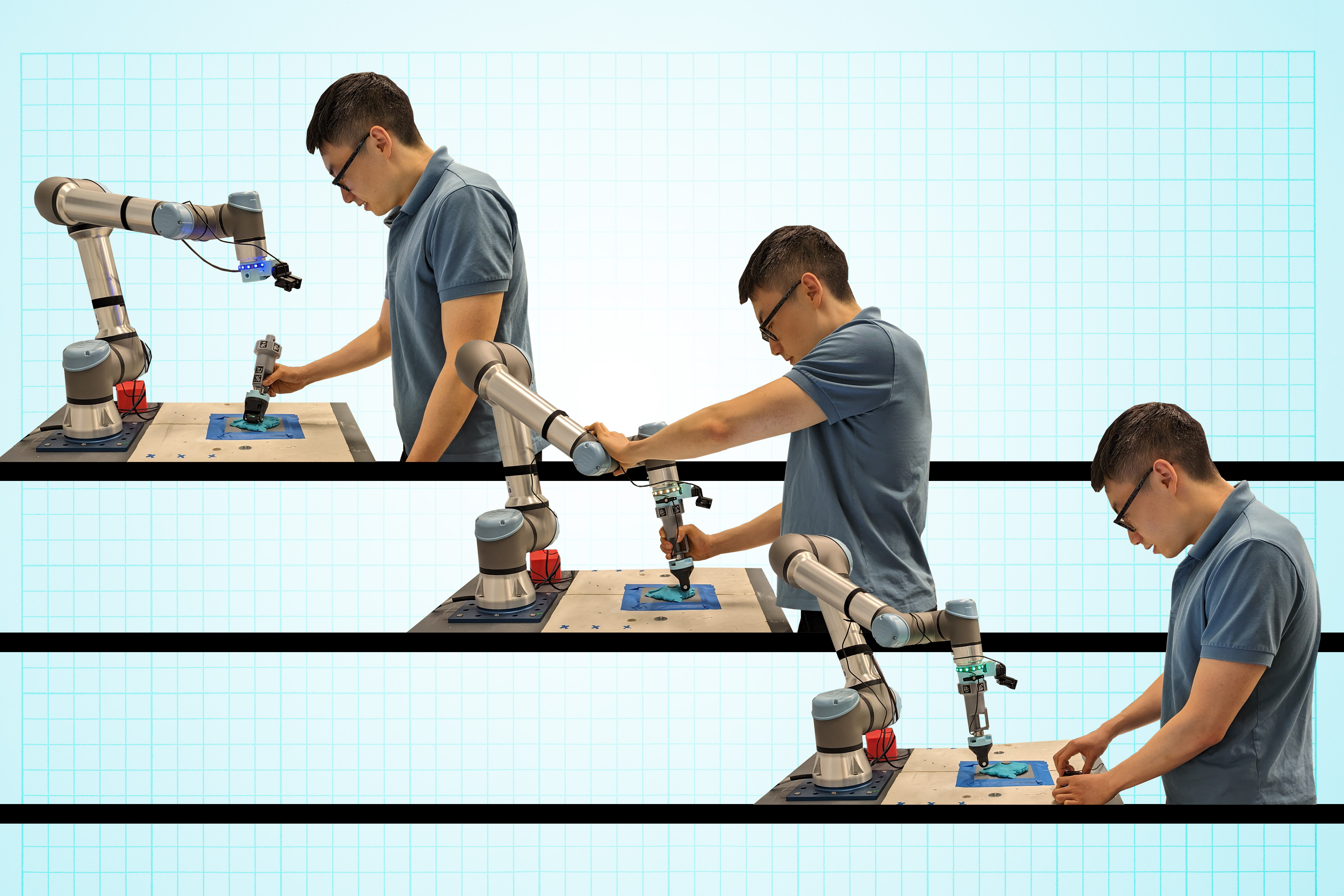
Learning-by-doing robots usually train in just one of these three demonstration approaches. But MIT engineers have now developed a three-in-one training interface that allows a robot to learn a task through any of the three training methods. The interface is in the form of a handheld, sensor-equipped tool that can attach to many common collaborative robotic arms. A person can use the attachment to teach a robot to carry out a task by remotely controlling the robot, physically manipulating it, or demonstrating the task themselves — whichever style they prefer or best suits the task at hand.

The MIT team tested the new tool, which they call a “versatile demonstration interface,” on a standard collaborative robotic arm. Volunteers with manufacturing expertise used the interface to perform two manual tasks that are commonly carried out on factory floors.

The researchers say the new interface offers increased training flexibility that could expand the type of users and “teachers” who interact with robots. It may also enable robots to learn a wider set of skills. For instance, a person could remotely train a robot to handle toxic substances, while further down the production line another person could physically move the robot through the motions of boxing up a product, and at the end of the line, someone else could use the attachment to draw a company logo as the robot watches and learns to do the same.

“We are trying to create highly intelligent and skilled teammates that can effectively work with humans to get complex work done,” says Mike Hagenow, a postdoc at MIT in the Department of Aeronautics and Astronautics. “We believe flexible demonstration tools can help far beyond the manufacturing floor, in other domains where we hope to see increased robot adoption, such as home or caregiving settings.”

Hagenow will present a paper detailing the new interface, at the IEEE Intelligent Robots and Systems (IROS) conference in October. The paper’s MIT co-authors are Dimosthenis Kontogiorgos, a postdoc at the MIT Computer Science and Artificial Intelligence Lab (CSAIL); Yanwei Wang PhD ’25, who recently earned a doctorate in electrical engineering and computer science; and Julie Shah, MIT professor and head of the Department of Aeronautics and Astronautics.

Training together

Shah’s group at MIT designs robots that can work alongside humans in the workplace, in hospitals, and at home. A main focus of her research is developing systems that enable people to teach robots new tasks or skills “on the job,” as it were. Such systems would, for instance, help a factory floor worker quickly and naturally adjust a robot’s maneuvers to improve its task in the moment, rather than pausing to reprogram the robot’s software from scratch — a skill that a worker may not necessarily have.

The team’s new work builds on an emerging strategy in robot learning called “learning from demonstration,” or LfD, in which robots are designed to be trained in more natural, intuitive ways. In looking through the LfD literature, Hagenow and Shah found LfD training methods developed so far fall generally into the three main categories of teleoperation, kinesthetic training, and natural teaching.

One training method may work better than the other two for a particular person or task. Shah and Hagenow wondered whether they could design a tool that combines all three methods to enable a robot to learn more tasks from more people.

“If we could bring together these three different ways someone might want to interact with a robot, it may bring benefits for different tasks and different people,” Hagenow says.

Tasks at hand

With that goal in mind, the team engineered a new versatile demonstration interface (VDI). The interface is a handheld attachment that can fit onto the arm of a typical collaborative robotic arm. The attachment is equipped with a camera and markers that track the tool’s position and movements over time, along with force sensors to measure the amount of pressure applied during a given task.

When the interface is attached to a robot, the entire robot can be controlled remotely, and the interface’s camera records the robot’s movements, which the robot can use as training data to learn the task on its own. Similarly, a person can physically move the robot through a task, with the interface attached. The VDI can also be detached and physically held by a person to perform the desired task. The camera records the VDI’s motions, which the robot can also use to mimic the task when the VBI is reattached.

To test the attachment’s usability, the team brought the interface, along with a collaborative robotic arm, to a local innovation center where manufacturing experts learn about and test technology that can improve factory-floor processes. The researchers set up an experiment where they asked volunteers at the center to use the robot and all three of the interface’s training methods to complete two common manufacturing tasks: press-fitting and molding. In press-fitting, the user trained the robot to press and fit pegs into holes, similar to many fastening tasks. For molding, a volunteer trained the robot to push and roll a rubbery, dough-like substance evenly around the surface of a center rod, similar to some thermomolding tasks.

For each of the two tasks, the volunteers were asked to use each of the three training methods, first teleoperating the robot using a joystick, then kinesthetically manipulating the robot, and finally, detaching the robot’s attachment and using it to “naturally” perform the task as the robot recorded the attachment’s force and movements.

The researchers found the volunteers generally preferred the natural method over teleoperation and kinesthetic training. The users, who were all experts in manufacturing, did offer scenarios in which each method might have advantages over the others. Teleoperation, for instance, may be preferable in training a robot to handle hazardous or toxic substances. Kinesthetic training could help workers adjust the positioning of a robot that is tasked with moving heavy packages. And natural teaching could be beneficial in demonstrating tasks that involve delicate and precise maneuvers.

“We imagine using our demonstration interface in flexible manufacturing environments where one robot might assist across a range of tasks that benefit from specific types of demonstrations,” says Hagenow, who plans to refine the attachment’s design based on user feedback and will use the new design to test robot learning. “We view this study as demonstrating how greater flexibility in collaborative robots can be achieved through interfaces that expand the ways that end-users interact with robots during teaching.”

This work was supported, in part, by the MIT Postdoctoral Fellowship Program for Engineering Excellence and the Wallenberg Foundation Postdoctoral Research Fellowship.

Generate single title from this title Gen Z educators embrace AI tools more often than Gen X in 100 -150 characters. And it must return only title i dont want any extra information or introductory text with title e.g: ” Here is a single title:”

Write an article about

Key points:

While educators demonstrate enthusiasm for AI’s efficiency and accessibility benefits–especially younger educators–they have a desire to preserve the human element in teaching and would like clearer guidance on AI usage, according to a new survey from D2L.

AI in Education, a survey of U.S. K-12 and higher education teachers, professors, administrators, and public respondents, shows that a majority of younger educators see AI playing an important role in the future of education and are more likely to use AI chatbots in teaching.

Most educators are optimistic about AI’s classroom potential, but stress the need for clearer policies and guidelines around AI, including direction for use in classrooms. They also feel that maintaining a human connection, thoughtful integration, ongoing training, and implementing policies that balance innovation with academic integrity are critical as they integrate AI into lessons.

The survey findings also reveal:

  • Eighty-eight percent of Gen Z educators used AI in the 2024–25 academic year–twice the rate of Gen X (48 percent) and four times that of Baby Boomers (19 percent).
  • Sixty-three percent of Gen Z and Millennial educators believe AI will be “important or essential” to teaching by 2030, compared to less than half (48 percent) of Gen X and Boomer-aged educators.
  • Thirty-eight percent of Gen Z educators cite cheating as the top reason students use AI, compared to 13 percent of Gen Z non-educators. Just 26 percent of Gen Z educators think students use AI to save time on schoolwork, compared to 34 percent of non-educator Gen Z respondents.
  • Educators are 3 times more likely to say AI has enhanced, rather than worsened, classroom engagement when asked how AI has impacted learning in the classroom environment.

“AI is revolutionizing education, but human connections remain at the heart of the learning experience. Educators and leaders seek tools that save time and enhance learning without compromising the personal bonds that drive success,” said John Baker, founder and CEO of D2L. “As younger educators embrace AI-native tools, they’re eager to integrate them into classrooms while maintaining strong ties with students, and to free up time for more personalized feedback and group collaboration.”

Educators prioritize human connection and responsible AI use

Most educators agree that AI should enhance, not replace, traditional teaching, that educators should be in the driver’s seat on how AI is deployed in the classroom, and that maintaining a human connection with students is vital.

  • When asked about the increased use of AI in education, educators cited ‘loss of human connection’ as their top concern, followed by student over-reliance on AI tools (combined 52 percent). Privacy, decreased academic integrity, and equity issues were also cited (combined 40 percent). Only 9 percent said they have no concerns about AI in education.
  • More than 4 in 10 Educators surveyed (44 percent) said AI made learning more efficient, but not necessarily more engaging or personalized. This opinion mirrors the response from general population respondents (43 percent).
  • Nearly two-thirds of educators (65 percent) believe teachers, professors and school administrators should be the primary decision-makers on AI adoption, compared to just 13 percent who favor state or federal government control.
  • Nearly a quarter (24 percent) of educators said they worry that using the AI tools provided to them by their institutions could be tracked or interpreted as taking shortcuts. ChatGPT (OpenAI) ranks as the AI tool most used by educators, followed by Gemini (Google) and Copilot (Microsoft).

Regardless of generational or philosophical views, AI is becoming embedded in learning environments. Most educators (54 percent) already say they used AI tools in the 2024-2025 academic year and that number will grow slightly (to 56 percent) in the 2025-2026 academic year. The three most-cited growth areas for AI use among educators include supporting students with accessibility needs, detecting plagiarism, and developing lesson plans.

This press release originally appeared online.

eSchool Media staff cover education technology in all its aspects–from legislation and litigation, to best practices, to lessons learned and new products. First published in March of 1998 as a monthly print and digital newspaper, eSchool Media provides the news and information necessary to help K-20 decision-makers successfully use technology and innovation to transform schools and colleges and achieve their educational goals.

eSchool News StaffLatest posts by eSchool News Staff (see all)

.Organize the content with appropriate headings and subheadings ( h2, h3, h4, h5, h6). Include conclusion section and FAQs section with Proper questions and answers at the end. do not include the title. it must return only article i dont want any extra information or introductory text with article e.g: ” Here is rewritten article:” or “Here is the rewritten content:”

Generate single title from this title Technical Approaches and Practical Tradeoffs in 100 -150 characters. And it must return only title i dont want any extra information or introductory text with title e.g: ” Here is a single title:”

Write an article about

(Chuysang/Shutterstock)

In the world of monitoring software, how you process telemetry data can significantly impact your ability to derive insights, troubleshoot issues, and manage costs.

There are 2 primary use cases for how telemetry data is leveraged:

  • Radar (Monitoring of systems) usually falls into the bucket of known knowns and known unknowns. This leads to scenarios where some data is almost ‘pre-determined’ to behave, be plotted in a certain way – because we know what we are looking for.
  • Blackbox (Debugging, RCA etc.) ones on the other hand are more to do with unknown unknowns. Which entails to what we don’t know and may need to hunt for to build an understanding of the system.

Understanding Telemetry Data Challenges

Before diving into processing approaches, it’s important to understand the unique challenges of telemetry data:

  • Volume: Modern systems generate enormous amounts of telemetry data
  • Velocity: Data arrives in continuous, high-throughput streams
  • Variety: Multiple formats across metrics, logs, traces, profiles and events
  • Time-sensitivity: Value often decreases with age
  • Correlation needs: Data from different sources must be linked together

These characteristics create special considerations when choosing between ETL and ELT approaches.


ETL for Telemetry: Transform-First Architecture

Technical Architecture

In an ETL approach, telemetry data undergoes transformation before reaching its final destination:

Fig. 1 — ETL for Telemetry

A typical implementation stack might include:

  • Collection: OpenTelemetry, Prometheus, Fluent Bit
  • Transport: Kafka or Kinesis or in memory as the buffering layer
  • Transformation: Stream processing
  • Storage: Time-series databases (Prometheus) or specialized indices or Object Storage (s3)

Key Technical Components

  1. Aggregation Techniques

Pre-aggregation significantly reduces data volume and query complexity. A typical pre-aggregation flow looks like this:

Fig. 2 — Aggregation Techniques

This transformation condenses raw data into 5-minute summaries, dramatically reducing storage requirements and improving query performance.

Example: For a gaming application handling millions of requests per day, raw request latency metrics (potentially billions of data points) can be grouped by service and endpoint, then aggregated into 5-minute (or 1-minute) windows. A single API call that generates 100 latency data points per second (8.64 million per day) is reduced to just 288 aggregated entries per day (one per 5-minute window), while still preserving critical p50/p90/p99 percentiles needed for SLA monitoring.

  1. Cardinality Management

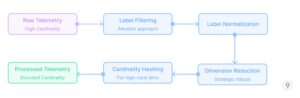
High-cardinality metrics can break time-series databases. The cardinality management process follows this pattern:

Fig. 3 — Cardinality-Management

Effective strategies include:

  • Label filtering and normalization
  • Strategic aggregation of specific dimensions
  • Hashing techniques for high-cardinality values while preserving query patterns

Example: A microservice tracking HTTP requests includes user IDs and request paths in its metrics. With 50,000 daily active users and thousands of unique URL paths, this creates millions of unique label combinations. The cardinality management system filters out user IDs entirely (configurable, too high cardinality), normalizes URL paths by replacing dynamic segments with placeholders (e.g., /users/123/profilebecomes /users/{id}/profile), and applies consistent categorization to errors. This reduces unique time series from millions to hundreds, allowing the time-series database to function efficiently.

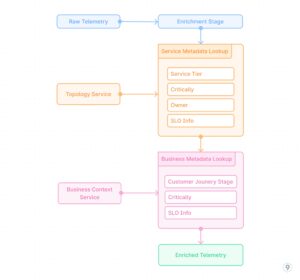
Fig. 4 — Real-time Enrichment

  1. Real-time Enrichment

Adding context to metrics during the transformation phase involves integrating external data sources:

This process adds critical business and operational context to raw telemetry data, enabling more meaningful analysis and alerting based on service importance, customer impact, and other factors beyond pure technical metrics.

Example: A payment processing service emits basic metrics like request counts, latencies, and error rates. The enrichment pipeline joins this telemetry with service registry data to add metadata about the service tier (critical), SLO targets (99.99% availability), and team ownership (payments-team). It then incorporates business context to tag transactions with their type (subscription renewal, one-time purchase, refund) and estimated revenue impact. When an incident occurs, alerts are automatically prioritized based on business impact rather than just technical severity, and routed to the appropriate team with rich context.

Technical Advantages

  • Query performance: Pre-calculated aggregates eliminate computation at query time
  • Predictable resource usage: Both storage and query compute are controlled
  • Schema enforcement: Data conformity is guaranteed before storage
  • Optimized storage formats: Data can be stored in formats optimized for specific access patterns

Technical Limitations

  • Loss of granularity: Some detail is permanently lost
  • Schema rigidity: Adapting to new requirements requires pipeline changes
  • Processing overhead: Real-time transformation adds complexity and resource demands
  • Transformation-time decisions: Analysis paths must be known in advance

ELT for Telemetry: Raw Storage with Flexible Transformation

Technical Architecture

ELT architecture prioritizes getting raw data into storage, with transformations performed at query time:

Fig. 5 — ELT for Telemetry

A typical implementation might include:

  • Collection: OpenTelemetry, Prometheus, Fluent Bit
  • Transport: Direct ingestion without complex processing
  • Storage: Object storage (S3, GCS) or data lakes in Parquet format
  • Transformation: SQL engines (Presto, Athena), Spark jobs, or specialized OLAP systems

Key Technical Components

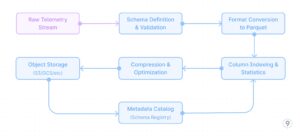
Fig. 6 — Efficient-Raw-Storage

  1. Efficient Raw Storage

Optimizing for long-term storage of raw telemetry requires careful consideration of file formats and storage organization:

This approach leverages columnar storage formats like Parquet with appropriate compression (ZSTD for traces, Snappy for metrics), dictionary encoding, and optimized column indexing based on common query patterns (trace_id, service, time ranges).

Example: A cloud-native application generates 10TB of trace data daily across its distributed services. Instead of discarding or heavily sampling this data, the complete trace information is captured using OpenTelemetry collectors and converted to Parquet format with ZSTD compression. Key fields like trace_id, service name, and timestamp are indexed for efficient querying. This approach reduces the storage footprint by 85% compared to raw JSON while maintaining query performance. When a critical customer-impacting issue occurred, engineers were able to access complete trace data from 3 months prior, identifying a subtle pattern of intermittent failures that would have been lost with traditional sampling.

  1. Partitioning Strategies

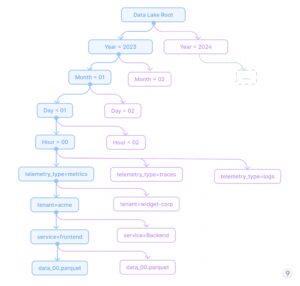
Effective partitioning is crucial for query performance against raw telemetry. A well-designed partitioning strategy follows this hierarchy:

Fig. 7 — Partitioning-Strategies

This partitioning approach enables efficient time-range queries while also allowing filtering by service and tenant, which are common query dimensions. The partitioning strategy is designed to:

  • Optimize for time-based retrieval (most common query pattern)
  • Enable efficient tenant isolation for multi-tenant systems
  • Allow service-specific queries without scanning all data
  • Separate telemetry types for optimized storage formats per type

Example: A SaaS platform with 200+ enterprise customers uses this partitioning strategy for its observability data lake. When a high-priority customer reports an issue that occurred last Tuesday between 2-4pm, engineers can immediately query just those specific partitions: /year=2023/month=11/day=07/hour=1[4-5]/tenant=enterprise-x/*. This approach reduces the scan size from potentially petabytes to just a few gigabytes, enabling responses in seconds rather than hours. When comparing current performance against historical baselines, the time-based partitioning allows efficient month-over-month comparisons by scanning only the relevant time partitions.

  1. Query-time Transformations

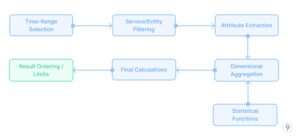
SQL and analytical engines provide powerful query-time transformations. The query processing flow for on-the-fly analysis looks like this (See Fig. 8).

This query flow demonstrates how complex analysis like calculating service latency percentiles, error rates, and usage patterns can be performed entirely at query time without needing pre-computation. The analytical engine applies optimizations like predicate pushdown, parallel execution, and columnar processing to achieve reasonable performance even against large raw datasets.

Fig. 8 — Query-time-Transformations

Example: A DevOps team investigating a performance regression discovered it only affected premium customers using a specific feature. Using query-time transformations against the ELT data lake, they wrote a single query that first filtered to the affected time period, joined customer tier information, extracted relevant attributes about feature usage, calculated percentile response times grouped by customer segment, and identified that premium customers with high transaction volumes were experiencing degraded performance only when a specific optional feature flag was enabled. This analysis would have been impossible with pre-aggregated data since the customer segment + feature flag dimension hadn’t been previously identified as important for monitoring.

Technical Advantages

  • Schema flexibility: New dimensions can be analyzed without pipeline changes
  • Cost-effective storage: Object storage is significantly cheaper than specialized DBs
  • Retroactive analysis: Historical data can be examined with new perspectives

Technical Limitations

  • Query performance challenges: Interactive analysis may be slow on large datasets
  • Resource-intensive analysis: Compute costs can be high for complex queries
  • Implementation complexity: Requires more sophisticated query tooling
  • Storage overhead: Raw data consumes significantly more space

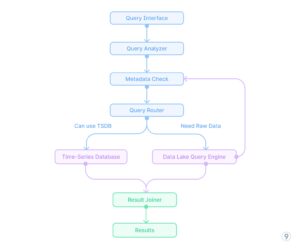
Technical Implementation: The Hybrid Approach

Core Architecture Components

Implementation Strategy

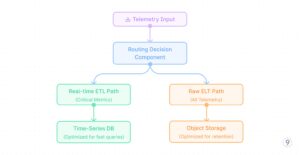
  1. Dual-path processing

    Fig. 10 — -Dual-path-processing

Example: A global ride-sharing platform implemented a dual-path telemetry system that routes service health metrics and customer experience indicators (ride wait times, ETA accuracy) through the ETL path for real-time dashboards and alerting. Meanwhile, all raw data including detailed user journeys, driver activities, and application logs flows through the ELT path to cost-effective storage. When a regional outage occurred, operations teams used the real-time dashboards to quickly identify and mitigate the immediate issue. Later, data scientists used the preserved raw data to perform a comprehensive root cause analysis, correlating multiple factors that wouldn’t have been visible in pre-aggregated data alone.

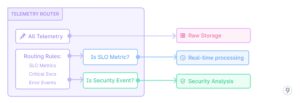
  1. Smart data routing

Fig. 11 — Smart Data Routing

Example: A financial services company deployed a smart routing system for their telemetry data. All data is preserved in the data lake, but critical metrics like transaction success rates, fraud detection signals, and authentication service health metrics are immediately routed to the real-time processing pipeline. Additionally, any security-related events such as failed login attempts, permission changes, or unusual access patterns are immediately sent to a dedicated security analysis pipeline. During a recent security incident, this routing enabled the security team to detect and respond to an unusual pattern of authentication attempts within minutes, while the complete context of user journeys and application behavior was preserved in the data lake for subsequent forensic analysis.

  1. Unified query interface

Real-world Implementation Example

A specific engineering implementation at last9.io demonstrates how this hybrid approach works in practice:

For a large-scale Kubernetes platform with hundreds of clusters and thousands of services, we implemented a hybrid telemetry pipeline with:

  • Critical-path metrics processed through a pipeline that:

    Fig. 12 — Unified query interface

    • Performs dimensional reduction (limiting label combinations)
    • Pre-calculates service-level aggregations
    • Computes derived metrics like success rates and latency percentiles
  • Raw telemetry stored in a cost-effective data lake:
    • Partitioned by time, data type, and tenant
    • Optimized for typical query patterns
    • Compressed with appropriate codecs (Zstd for traces, Snappy for metrics)
  • Unified query layer that:
    • Routes dashboard and alerting queries to pre-aggregated storage
    • Redirects exploratory and ad-hoc analysis to the data lake
    • Manages correlation queries across both systems

This approach delivered both the query performance needed for real-time operations and the analytical depth required for complex troubleshooting.

Decision Framework

When architecting telemetry pipelines, these technical considerations should guide your approach:

Decision Factor Use ETL Use ELT
Query latency requirements < 1 second Can wait minutes
Data retention needs Days/Weeks Months/Years
Cardinality Low/Medium Very high
Analysis patterns Well-defined Exploratory
Budget priority Compute Storage

Conclusion

The technical realities of telemetry data processing demand thinking beyond simple ETL vs. ELT paradigms. Engineering teams should architect tiered systems that leverage the strengths of both approaches:

  • ETL-processed data for operational use cases requiring immediate insights
  • ELT-processed data for deeper analysis, troubleshooting, and historical patterns
  • Metadata-driven routing to intelligently direct queries to the appropriate tier

This engineering-centric approach balances performance requirements with cost considerations while maintaining the flexibility required in modern observability systems.

About the author: Nishant Modak is the founder and CEO of Last9, a high cardinality observability platform company backed by Sequoia India (now PeakXV). He’s been an entrepreneur and working with large scale companies for nearly two decades.

Related Items:

From ETL to ELT: The Next Generation of Data Integration Success

Can We Stop Doing ETL Yet?

50 Years Of ETL: Can SQL For ETL Be Replaced?

.Organize the content with appropriate headings and subheadings ( h2, h3, h4, h5, h6). Include conclusion section and FAQs section with Proper questions and answers at the end. do not include the title. it must return only article i dont want any extra information or introductory text with article e.g: ” Here is rewritten article:” or “Here is the rewritten content:”

Generate single title from this title Using AI to reimagine teacher preparation for scale, equity, and reflective practice in 100 -150 characters. And it must return only title i dont want any extra information or introductory text with title e.g: ” Here is a single title:”

Write an article about

Key points:

With growing teacher shortages nationwide, particularly in high-need subject areas and underserved communities, educator preparation programs (EPPs) have a big task at hand: prepare more pre-service teachers to enter K-12 classrooms without compromising the quality and level of support these teachers receive.

At Valdosta State University, the opportunity and responsibility to meet this need led us to designing a more scalable, equitable, and reflective preparation model–one that leverages technology and artificial intelligence (AI) to take it to the next level.

Launching a fully-online elementary education program

In the Fall of 2022, Georgia public schools hired just over 10,000 new teachers, while the state’s public and private universities had just 5,000 students complete teacher preparation programs that year.

To help meet this shortage, Valdosta State University launched a fully-online elementary education program in the summer of 2022. This program was designed for adult learners with eight-week asynchronous classes and a flat fixed-rate tuition with no hidden fees. In particular, this program was designed with paraprofessionals in mind. We hoped to enable them to become classroom teachers in the rural areas they were already serving–the same areas that often have the most difficulty in hiring new teachers.

Our online program has proven to be overwhelmingly successful with more than 500 students currently enrolled. Because of the high demand, as well as the physical location of our pre-service teachers statewide and beyond, the traditional model of supervision of our pre-service teachers’ practicum and clinical teaching placements was not tenable.

With the need to retain our reputation of producing excellent teachers, we needed to find a way to work with these pre-service teachers to provide high-quality and feedback-rich observations of their experiences in the classroom. Supervising hundreds of pre-service teachers across dozens of school systems is not sustainable using conventional observation models alone.

To that end, we turned to technology as a thoughtful enabler of this process.

Supporting pre-service teachers with video coaching

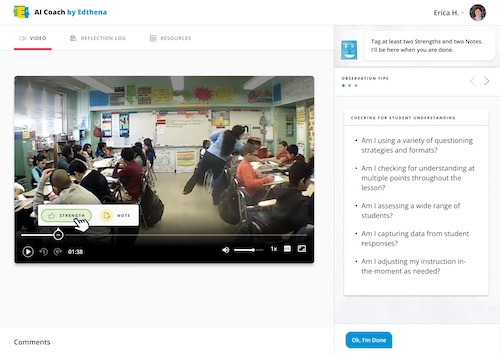
Edthena provided our program with the technology and support needed to make high-quality observations a reality. Using the VC3 video coaching platform, our preservice teachers upload video of their classroom teaching and then receive time-stamped feedback from our clinical supervisors.

The benefits of video as a tool for teacher training are well explored through an expansive set of academic literature. However, like any observation process, there is still a considerable amount of time invested in this process: there is the time of the actual teaching in the classroom, the time of the supervisor watching the video, and the time of the pre-service teacher watching the video with the embedded feedback. The observation process, of course, is just one of the responsibilities of our clinical supervisors.

As our enrollment continued to grow, we wanted to find a way to give more time back to our clinical supervisors so they, in turn, can better support our pre-service teachers.

In steps AI.

Implementing AI as a collaborative partner to guide teachers’ self-reflection

In a stroke of perfect timing, Edthena introduced the AI Coach platform just as our clinical supervisors were really feeling a time burden. The platform’s computerized AI support model provides our pre-service teachers with the opportunity to engage in scalable, self-guided reflection.

Naturally, we had some initial skepticism about a computerized coach truly supporting pre-service teacher learning up to our rigorous program and state standards. Yet, upon investigation, we discovered this technology is not only viable, but immediately deployable.

With the platform, pre-service teachers input their own pedagogical goals for a given lesson and then reflect on video of their teaching. The AI Coach platform provides the ‘guide on the side’ feedback needed to help them determine if these goals were met, as well as tips and resources to help them improve their practice.  The AI-powered process prompts our pre-service teachers to think independently and take ownership over their learning, which we continue to view as a critical goal of our pre-service teacher education experience.

While the AI Coach platform does not eliminate the need for human clinical supervision of our pre-service teacher practicum and clinical experience, it does greatly decrease the time burden on our supervisors, allowing us to continue to grow and scale the program. Part of this is because the AI coaching experience is rooted in research on teacher noticing, improvement science, and iterative practice. So now our human supervisors can read the ‘conversations’ between the pre-service teachers and the virtual coach, instead of needing to watch all the videos directly.

Pushing boundaries to meet today’s demands

As shown by the 2022 data in Georgia, traditional EPPs have not kept up with the demand in the field. Traditional EPPs also face increased competition from online solutions offering faster and cheaper results, therefore, we have to find ways to innovate to retain high-quality programming while meeting the demands of our future students.

In our case, turning to AI-driven coaching has allowed us to support our pre-service teachers while helping to push the boundary on how, what, and where we can deliver excellence to meet the needs of school systems in Georgia and beyond.

Now is the time for all EPPs to innovate and harness our collective commitment to rigorous, reflective, and research-based practices to prepare more pre-service teachers to enter the classroom.

David A. Slykhuis, Ph.D., Valdosta State University

David A. Slykhuis, Ph.D., is a 21-year veteran in higher education who holds a doctoral degree in science education, with much of his research focused on educational technology. He is currently the dean of the Dewar College of Education and Human Services at Valdosta State University in Georgia. He is the chair of the National Technology Leadership Summit and former chair of AACTE’s (American Association of Colleges for Teacher Education) standing committee on innovation and technology. Slykhuis is a past president of the Society for Information Technology and Teacher Education (SITE). He is one of the four researchers who developed the Teacher Educator Technology Competencies and was awarded the AACTE Edward C. Pomeroy award for outstanding contributions to teacher education.

Latest posts by eSchool Media Contributors (see all)

.Organize the content with appropriate headings and subheadings ( h2, h3, h4, h5, h6). Include conclusion section and FAQs section with Proper questions and answers at the end. do not include the title. it must return only article i dont want any extra information or introductory text with article e.g: ” Here is rewritten article:” or “Here is the rewritten content:”

Building Belief: Organizational Change Management Strategies

0

There’s nothing new about managing change. But the pace, complexity, and consequences of change are evolving in today’s workplace.  

Most organizations aren’t just managing change; they’re navigating major transformations to keep up with mergers, reorgs, new tech, retiring execs, and global instability. 

According to Gartner, half of all major change initiatives fail, and only 34% are considered a clear success. 

And it’s not just the logistics that get tricky—it’s the people part. 


We recently hosted an AMA (Ask Me Anything) with two of our in-house experts: Anne Maltese, VP of People Insights, and Rachel Hudson, Senior Insights Analyst.  

They pulled back the curtain on what it really takes to lead through change and how to build belief, not just compliance. 

Here’s what we learned: 


📺 Want to watch the full recording? Click here! >> 


What are effective ways to gather employee input during times of disruption? 

Many organizations hesitate to launch engagement surveys or gather feedback in the middle of a change. But that’s when listening matters most. 

“We would actually encourage organizations to go through with that survey because it generates such important insights and intelligence that can help navigate through change,” said Anne.  

She emphasized that feedback is intelligence, not just a performance metric. By collecting open-ended responses and asking targeted questions about how employees are experiencing change, you can uncover actionable insights before challenges become barriers. 


Pulse surveys are especially useful throughout a change timeline: 

Before the change: Are employees clear on what’s happening and why? 

During the change: Where are the pain points coming up? 

After the change: Is there renewed confidence in the future? 


“The timing of communication affects how employees perceive the change overall,” noted Rachel. “It also affects their own engagement and their desire to remain at their current organization.” 


How do you collect feedback during change without creating confusion or slowing momentum? 

Some leaders worry that gathering input mid-change will stir anxiety or slow things down. But the experts argued that not listening creates bigger issues. 

“Change is an opportunity for us to recenter our values, our purpose,” said Rachel. “It’s a chance for us to navigate through uncertainty by relying on some of those elements of our culture.” 


She shared a story about a public accounting firm undergoing rapid M&A growth. Rather than delay listening efforts, the company created an M&A pulse framework: short surveys on day 1, day 30, day 60, and day 90 for new employees. It revealed gaps in support, surfaced cultural mismatches, and helped refine onboarding processes across future acquisitions. 

“It does not take those employees very long to complete those short pulse surveys, but it’s become an invaluable tool for leaders,” said Rachel. 


What’s the best way to get managers bought into change—especially if past efforts have failed?

No change initiative can succeed without managers. But they’re often overwhelmed, skeptical, or burned out from previous changes that didn’t go well. 

“The manager’s job is hard and it’s probably harder than it ever has been,” said Anne. “Have empathy around that—because when we roll out change, it feels like there’s one more thing being added to their plate.”


That means: 

  • Acknowledging the emotional toll of change 
  • Explaining not just what’s changing, but why 
  • Helping managers connect the dots for their teams 
  • Equipping them with talking points, tools, and support 


“Create belief so managers are bought in and excited about where they may go, even though it is probably going to impact their team and disrupt it. And then, equip them with the tools to succeed through it,” said Anne. 


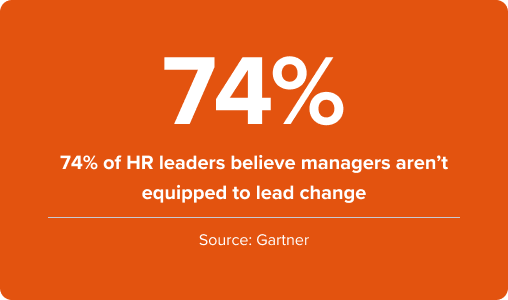
Change-Managers Arent Equipped


Rachel added that listening to managers early in the process can surface friction before it spreads. In one example, a firm saw that belief in the change dropped sharply between executives and mid-level leaders. That insight helped them focus their communication and coaching on where it was most needed. 

🔍 Read more about how to redirect disruption into belief and positive momentum in our 2025 HR Trends Report >> 


How do you create clarity and belief around change?

Even when the change is strategic, it can feel personal. And when people don’t understand what’s happening or how it affects them, they fill in the blanks with fear or skepticism. That’s why it’s critical to pivot disruption into belief.

“If everything around us is changing so quickly, is the way that we operate as a team keeping up with that?” Anne asked. 


Building belief starts with clear communication, specifically a few key questions: 

  • Why is this change happening? 
  • How does this impact me? 
  • What support is available? 


When employees understand the reason for change and their role in it, they’re far more likely to move through it with resilience, not resistance. 


What’s the biggest barrier to successful change? 

“We have to listen to our employees to understand if they’re truly bought into the change or not,” said Rachel, “We’ve got to continue listening to understand what their challenges are.” 


Creating an open, two-way feedback loop is the key to navigating change and creating belief. Here’s how to make that happen: 

✔️ Acknowledge feedback and thank employees for sharing 
✔️ Act on what you hear—or explain why you’re not 
✔️ Share what’s changing and how feedback influenced decisions 
✔️ Repeat the cycle to build long-term trust 


Final Advice? 

“We have to get comfortable with not having a GPS for navigating change, but rather having a well-thought-out vision, confidence, and a plan along the way that’s agile,” said Anne. 

Don’t wait for the perfect plan. Instead, start where you are and listen, provide clarity, and believe in it. 

And above all, believe in your people’s ability to navigate what’s next with the right support behind them. 


Want to go deeper?

📈 Explore the 2025 Workplace Trends Report >> 

💡Check out our pulse survey software >>

💬 See how our Feedback tool works >>


📺 Watch the full AMA ⬇️


Generate single title from this title How Kai Cenat saved my high school English class in 100 -150 characters. And it must return only title i dont want any extra information or introductory text with title e.g: ” Here is a single title:”

Write an article about

Key points:

Like many teachers since the public release of ChatGPT, I’ve encountered frustration. For a lot of us, it has felt as though we are spending more of our time as graders determining whether a student completed an assignment with or without AI than we are actually providing meaningful feedback. The number of hours I have committed to consulting AI-checkers and poring over Google Doc version histories is far more than I ever would have predicted or hoped.

Detecting cheating was a fairly straightforward task when ChatGPT was publicly released in November 2022. Most students who decided to use generative AI to cheat on one of my assigned essays would do so by plugging my prompt into ChatGPT or Google Gemini, watching the AI generate a complete essay in moments, and then lazily pasting the text into their Google Doc. On more than one occasion, a student accidentally pasted their prompt request into the document.

As time went by, though, the cheaters adapted. Realizing the incriminating nature of pasting large chunks of text, they would use multiple browser windows to look at their AI-generated prompts on one half of their computer screen and use the other half to take dictation in lieu of writing out ideas of their own.

I’m in my fifteenth year of teaching high school, and by now I have a pretty good nose for sniffing out inauthentic work. But proving it isn’t always easy, and gathering the necessary evidence takes up a lot of my time. Not to mention that generative AI is so easy to use and becoming so sophisticated that students can use it for virtually any assignment, not just the end-of-the-unit essays and projects. It got to the point that whenever I assigned anything new–comprehension questions, reflection prompts, even personal narrative assignments for crying out loud–I would brace myself for the imminent and disheartening detective work I knew would follow.

That’s when I figured out a way to use technology to fight back.

Not through AI-checkers, as that technology still has some time before its reliability is
guaranteed. Instead, I decided to follow the lead of Kai Cenat.

If you have no idea who Kai Cenat is, that’s probably a good thing. I would be wary of most educational professionals over 30 who are highly invested in the goings-on of Kai Cenat. But chances are, your students know about him. And Mr. Beast. And IShowSpeed. Maybe Logan Paul, too, but he might already be too old for your K-12 students. (Sorry, Logan. Happens to the best of us.)

Point is, these streamers are wildly popular for people too young to vote, which means that their audiences are very familiar with streamers’ preferred method of communication: recording video of themselves off a smartphone.

About halfway through my unit on The Great Gatsby, I started asking students to provide video responses of their reactions to the latest read chapter. As I reviewed their responses, I had a feeling that I cannot recall the last time I felt.

I was having fun grading.

Some reactions may have been more insightful than others, and the production value of the videos will not cause any worry for Mr. Cenat over losing followers anytime soon. Nevertheless, what I was seeing in these video responses was personality and authenticity–two things you never get from reading AI-generated content.

The braver students volunteered to have their videos shown on my classroom projector. It led to some laughs, but it also created so many opportunities for me to pause the videos so that the group could have a deeper discussion about a great point their classmate made in their recording. As we did more of these assignments, more of the students wanted their videos shown in class. The class clowns had fun with questionable (albeit entertaining) editing choices.

I welcomed all of it. It made English class fun again for the students and for me.

It’s more about having fun, though, when it comes to teaching students about effective virtual communication. While most of my students won’t become English majors, the vast majority of them will find themselves applying for a job that requires them to do so virtually. Today’s generation of job applicants are already being asked to conduct live video interviews in addition to submitting pre-recorded video responses. When teachers give their students opportunities to record their thoughts on video, we offer them a chance to communicate effectively in a modern medium, which has always been a hallmark of English Language Arts.

I still assign my students literary analysis essays, journal prompts, in-class presentations, and reading comprehension questions. Plenty of my students still use generative AI to some extent to complete these assignments, which is just something we educators have to deal with for the time being. But on the bright side, I have at least one way for students to share their ideas in a way that they are less likely to ask AI to do all the thinking for them.

Mathias Muschal, Cardinal Ritter College Prep, Archdiocese of St. Louis

Mathias Muschal teaches at Cardinal Ritter College Prep in the Archdiocese of St. Louis. He has been teaching professionally since 2006 in places like Chicago, Austria, and Saint Louis, and he still gets nervous at the start of each new school year.

Latest posts by eSchool Media Contributors (see all)

.Organize the content with appropriate headings and subheadings ( h2, h3, h4, h5, h6). Include conclusion section and FAQs section with Proper questions and answers at the end. do not include the title. it must return only article i dont want any extra information or introductory text with article e.g: ” Here is rewritten article:” or “Here is the rewritten content:”

SmartThings Blog

0

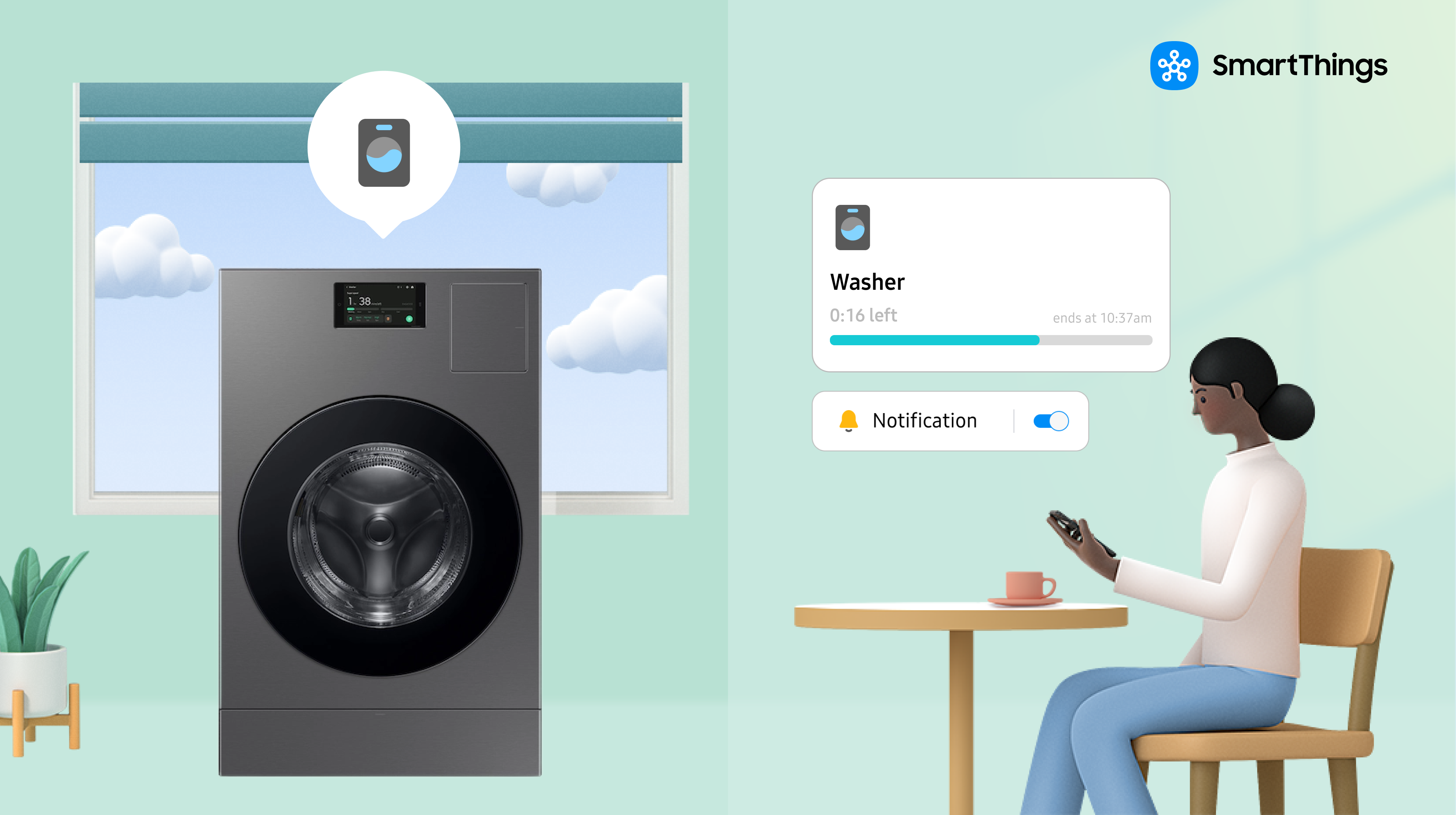
Let’s face it, laundry isn’t exactly thrilling. What if it could be easier, faster, and actually kind of satisfying?  With SmartThings, your Samsung washer and dryer get a serious upgrade. From real-time updates to remote control and energy savings, SmartThings makes laundry day feel less like a chore and more like a life hack.

Stay Connected to Every Load

SmartThings has your back (and basket), whether you’re on the couch or running errands, SmartThings keeps you in the loop. Get real-time notifications when a cycle starts, pauses, or finishes, so you’re never left wondering if the laundry’s done. If a load needs attention (like when it’s been sitting too long after drying), SmartThings will send you a gentle nudge before your clothes go from fresh to funky. It’s like having a laundry buddy who never forgets!

Customize Cycles to Fit Your Needs

Forget digging through manuals or pressing buttons at random. SmartThings makes it easy to tailor your washer and dryer settings, helping you choose the perfect cycle based on your load type, size, and fabric. Beyond choosing the temperature and spin intensity, select optimized cycles directly in the app based on your fabric type, load size, or soil level.

Here are just a few examples of features and cycles:

  • Activewear: Designed for jersey and moisture-wicking gym clothes
  • Bedding: Designed for bulky sheets and comforters
  • Baby Care: Gently sanitize clothes at a high temperature
  • Fabric Specific Cycles: Wool, Denim, Delicates, a custom cycle based on the fabrics within
  • Wrinkle Prevent: Optional setting to keep clothes wrinkle-free for up to three hours
  • Damp Alert: Be notified for the optimal time to iron clothes right out of the dryer
  • Eco-modes: Energy-saving mode that balances performance and efficiency
  • Unemptied Laundry Alerts: We all forget clothes sometimes, but now you can be reminded up to 24 hours to remove your clothes from the washer or take them out for folding
  • Sensor Dry: Automatically adjusts time based on moisture levels

You can even save your combinations, so your go-to routines are ready with one tap.

Prevent and Diagnose Issues Before They Disrupt Your Day

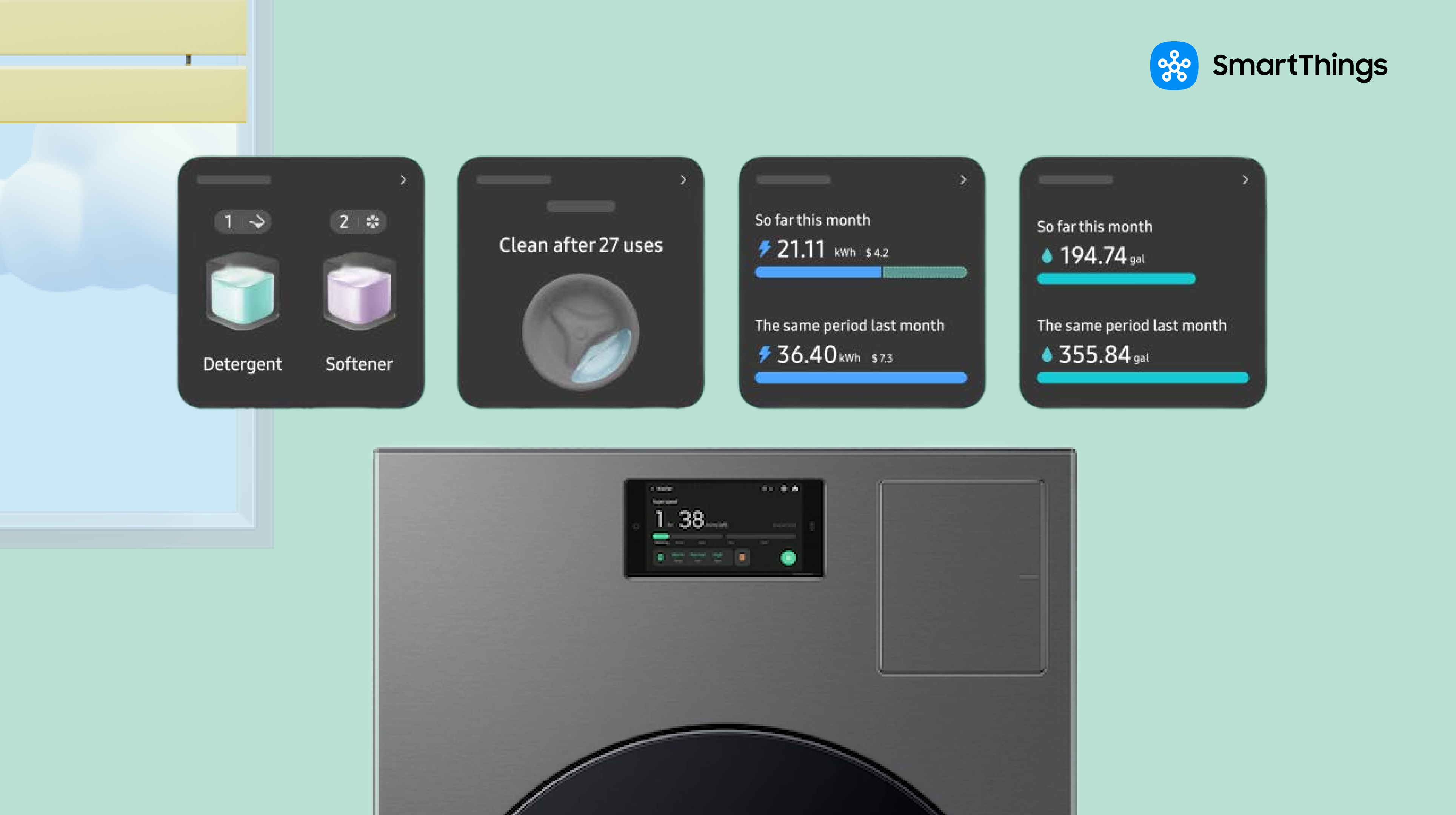
Your washer and dryer are smart, and with SmartThings, they practically think for themselves.  SmartThings makes troubleshooting easy, becoming a proactive experience. Not only can you select maintenance modes to help keep your washer and dryer clean, but SmartThings can also alert you to performance issues and guide you through self-diagnosis steps, often before you even realize there’s a problem. This helps prevent breakdowns and saves you time (and service calls).

Control Laundry From Anywhere, Anytime

Running late? Mid-binge watch on your favorite show? Cozy in bed? No problem.  Start, stop, or monitor your washer and dryer directly from your phone, and even schedule cycles to run when energy rates are lower or it’s simply more convenient. It’s smarter laundry on your terms, saving time, energy, and hassle.

Built-In Intelligence

SmartThings doesn’t just connect your appliances, it helps them work smarter together. For example, it can recommend optimal drying settings based on the type of wash cycle you just completed. Washed a load with Heavy Duty mode? SmartThings will recommend the best dryer settings to match. The result? Better fabric care and less guesswork.

It’s time to bring smarter care to your clothes—and a little more free time back in your day. Download the SmartThings app and connect your Samsung washer and dryer to unlock the full potential of your laundry room.

Generate single title from this title AI is rewriting the rules of the insurance industry in 100 -150 characters. And it must return only title i dont want any extra information or introductory text with title e.g: ” Here is a single title:”

Write an article about

Despite its traditionally risk-averse nature, the insurance industry is being fundamentally reshaped by AI.

AI has already become vital for the insurance industry, touching everything from complex risk calculations to the way insurers talk to their customers. However, while nearly eight out of ten companies are dipping their toes in the AI water, a similar number admit it hasn’t actually made them any more money.

Such figures reveal a simple truth: just buying the fancy new tech isn’t enough. The real winners will be the ones who figure out how to weave it into the very fabric of who they are and everything they do.

You can see the most dramatic changes right at the heart of the business: handling claims. That mountain of paperwork and endless phone calls, a process that could drag on for weeks, is finally being bulldozed by AI.

A deployment by New York-based insurer Lemonade back in 2021 resulted in settling over a third of its claims in just three seconds, with no human input. Or look at a major US travel insurer that handles 400,000 claims a year; it went from a completely manual system to one that was 57% automated, cutting down processing times from weeks to just minutes.

However, this isn’t just about moving faster; it’s about getting it right. AI can slash the kind of costly human errors that lead to claims leakage in the insurance industry by as much as 30%. The knock-on effect is a huge productivity leap, with adjusters able to handle 40-50% more cases. This frees up the real experts to stop being paper-pushers and start focusing on the tricky cases where a human touch and genuine empathy make all the difference.

It’s a similar story for the underwriters, the people who calculate the risks. AI is giving them superpowers, letting them analyse colossal amounts of data from all sorts of places – like telematics or credit scores – that a person could never sift through alone. It can even draft an initial risk report with incredible accuracy by looking at past data and policies in the blink of an eye.

In practice, this helps create pricing that is fairer and more accurately reflects a person’s unique situation. Zurich, for example, used a modern platform to build a risk management tool that made their assessments 90% more accurate.

Suddenly, underwriting isn’t about looking in the rearview mirror anymore—it’s a living, breathing process that can adapt on the fly to new, complex threats like cyberattacks or the effects of climate change.

But this isn’t just about back-office wizardry. When deployed in the insurance industry, AI is completely changing the conversation between insurers and the people they serve. It’s allowing a move away from simply reacting to problems to proactively helping customers.

AI chatbots can offer 24/7 support, getting smarter with every question they answer. This lets the human team focus on the more difficult conversations. The real game-changer, though, is making things personal. 

By understanding a customer’s policy and behaviour, AI can gently nudge them with a renewal reminder or suggest a product that actually fits their life, like usage-based car insurance. It’s about showing customers you actually get them, which builds the kind of loyalty that’s been so hard to come by in an industry where over 30% of claimants feel dissatisfied, and 60% blame slow settlements.

This protective instinct also helps the whole system. AI is a brilliant fraud detective for the insurance industry and beyond, spotting weird patterns in data that a person would miss, and has the potential to cut fraud-related losses by up to 40%. It keeps everyone honest and protects the business and its customers.

What’s pouring fuel on this fire of change? A new breed of low-code platforms. They are the accelerators, letting insurers build and launch new apps and services much faster than before. In a world where customer tastes and rules can change overnight, that kind of speed is everything.

The best part of such tools is they democratise access and put the power to innovate into more hands. They allow regular business users – or ‘citizen developers’ – to build the tools they need without having to be coding geniuses. These platforms often come with strong security and controls, meaning this newfound speed doesn’t have to mean sacrificing safety or compliance, which is non-negotiable for an industry like insurance.

When you step back and look at the big picture, it’s clear that getting on board with AI isn’t just a tech project; it’s a make-or-break business strategy. Those who jumped in early are already pulling away from the pack, seeing things like a 14% jump in customer retention and a 48% rise in Net Promoter Scores. 

The market for this technology is set to explode to over $14 billion dollars by 2034, and some believe AI could add $1.1 trillion in value to the industry every year. But the biggest roadblocks aren’t about the technology itself; they’re about people and old habits.

Data, especially in an industry like insurance, is often stuck in old systems which stops AI from seeing the whole picture. To get past this, you need more than clever software. You need leaders with a clear vision, a willingness to change the company culture, and a commitment to training their people.

The winners in this new era won’t be the ones tinkering with AI in a corner—they’ll be the ones who lead from the top, with a clear plan to make it a part of their DNA. This will require an understanding that it’s not just about doing old things better, but about finding entirely new ways to bring value and build trust.

Learn more about how AI is rewriting the rules of the insurance industry at the upcoming webinar “From Complexity to Clarity: AI + Agility Layer for Intelligent Insurance” on July 16, 2025, at 7PM BST / 2PM ET. Industry experts from Appian and EXL will share real-world examples and practical insights into how leading carriers are implementing these technologies. Registration is available at the webinar link.

Featured speakers include:

  • Vikram Machado, Senior Vice President & Practice Leader – Life, Annuities, Retirements & Group Insurance, EXL
  • Vikrant Saraswat, Vice President – AI Consulting, EXL
  • Jack Moroney, Enterprise Account Executive – Insurance & Financial Services, Appian
  • Andrew Kearns, Insurance Industry Lead, Appian
  • Michaela Morari, Senior Solution Consultant – Insurance & Financial Services, Appian

See also: UK and Singapore form alliance to guide AI in finance

.Organize the content with appropriate headings and subheadings ( h2, h3, h4, h5, h6). Include conclusion section and FAQs section with Proper questions and answers at the end. do not include the title. it must return only article i dont want any extra information or introductory text with article e.g: ” Here is rewritten article:” or “Here is the rewritten content:”

Simulation-based pipeline tailors training data for dexterous robots | MIT News

0

When ChatGPT or Gemini give what seems to be an expert response to your burning questions, you may not realize how much information it relies on to give that reply. Like other popular generative artificial intelligence (AI) models, these chatbots rely on backbone systems called foundation models that train on billions, or even trillions, of data points.

In a similar vein, engineers are hoping to build foundation models that train a range of robots on new skills like picking up, moving, and putting down objects in places like homes and factories. The problem is that it’s difficult to collect and transfer instructional data across robotic systems. You could teach your system by teleoperating the hardware step-by-step using technology like virtual reality (VR), but that can be time-consuming. Training on videos from the internet is less instructive, since the clips don’t provide a step-by-step, specialized task walk-through for particular robots.

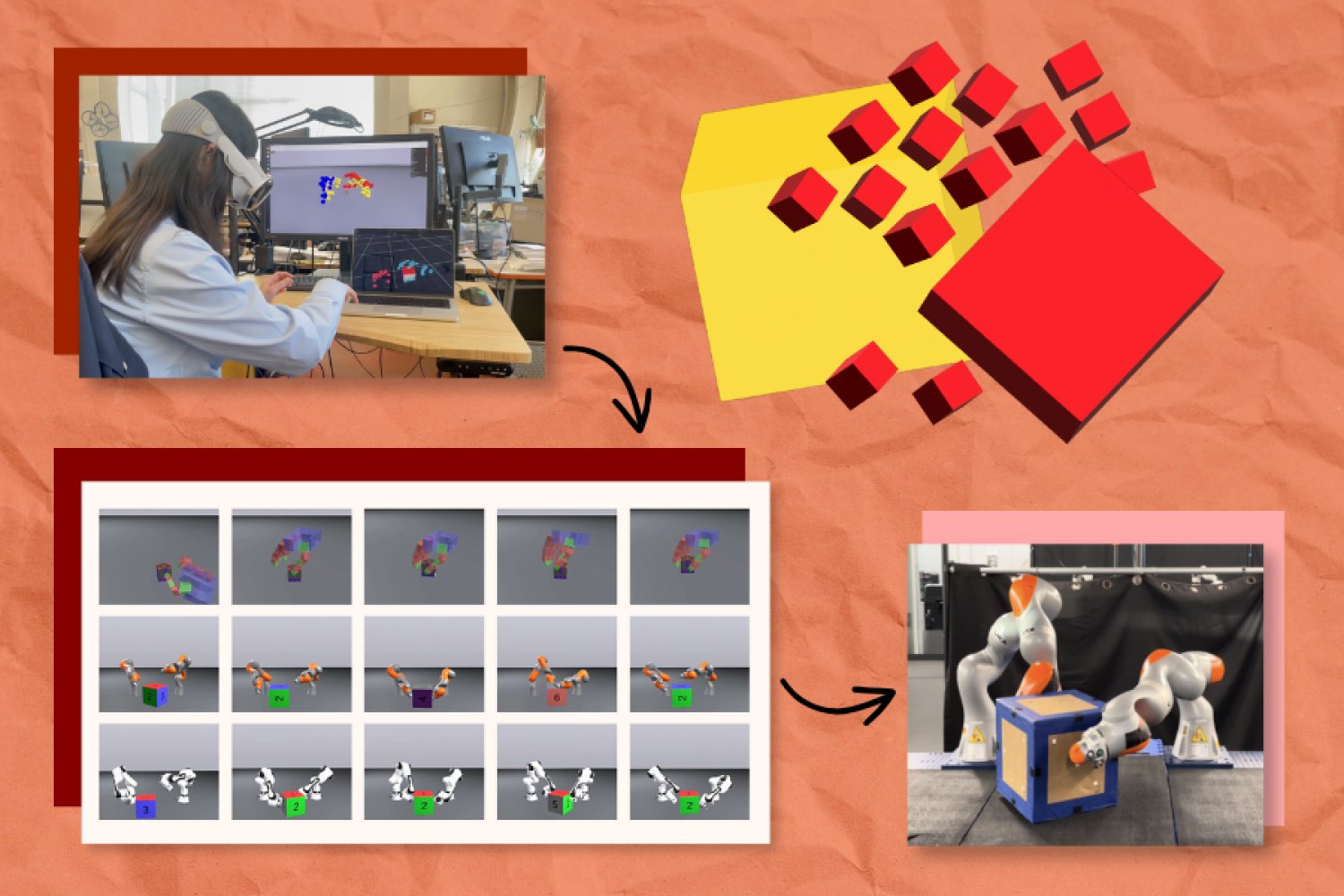
A simulation-driven approach called “PhysicsGen” from MIT’s Computer Science and Artificial Intelligence Laboratory (CSAIL) and the Robotics and AI Institute customizes robot training data to help robots find the most efficient movements for a task. The system can multiply a few dozen VR demonstrations into nearly 3,000 simulations per machine. These high-quality instructions are then mapped to the precise configurations of mechanical companions like robotic arms and hands. 

PhysicsGen creates data that generalize to specific robots and condition via a three-step process. First, a VR headset tracks how humans manipulate objects like blocks using their hands. These interactions are mapped in a 3D physics simulator at the same time, visualizing the key points of our hands as small spheres that mirror our gestures. For example, if you flipped a toy over, you’d see 3D shapes representing different parts of your hands rotating a virtual version of that object.

The pipeline then remaps these points to a 3D model of the setup of a specific machine (like a robotic arm), moving them to the precise “joints” where a system twists and turns. Finally, PhysicsGen uses trajectory optimization — essentially simulating the most efficient motions to complete a task — so the robot knows the best ways to do things like repositioning a box.

Each simulation is a detailed training data point that walks a robot through potential ways to handle objects. When implemented into a policy (or the action plan that the robot follows), the machine has a variety of ways to approach a task, and can try out different motions if one doesn’t work.

“We’re creating robot-specific data without needing humans to re-record specialized demonstrations for each machine,” says Lujie Yang, an MIT PhD student in electrical engineering and computer science and CSAIL affiliate who is the lead author of a new paper introducing the project. “We’re scaling up the data in an autonomous and efficient way, making task instructions useful to a wider range of machines.”

Generating so many instructional trajectories for robots could eventually help engineers build a massive dataset to guide machines like robotic arms and dexterous hands. For example, the pipeline might help two robotic arms collaborate on picking up warehouse items and placing them in the right boxes for deliveries. The system may also guide two robots to work together in a household on tasks like putting away cups.

PhysicsGen’s potential also extends to converting data designed for older robots or different environments into useful instructions for new machines. “Despite being collected for a specific type of robot, we can revive these prior datasets to make them more generally useful,” adds Yang.

Addition by multiplication

PhysicsGen turned just 24 human demonstrations into thousands of simulated ones, helping both digital and real-world robots reorient objects.

Yang and her colleagues first tested their pipeline in a virtual experiment where a floating robotic hand needed to rotate a block into a target position. The digital robot executed the task at a rate of 81 percent accuracy by training on PhysicGen’s massive dataset, a 60 percent improvement from a baseline that only learned from human demonstrations.

The researchers also found that PhysicsGen could improve how virtual robotic arms collaborate to manipulate objects. Their system created extra training data that helped two pairs of robots successfully accomplish tasks as much as 30 percent more often than a purely human-taught baseline.

In an experiment with a pair of real-world robotic arms, the researchers observed similar improvements as the machines teamed up to flip a large box into its designated position. When the robots deviated from the intended trajectory or mishandled the object, they were able to recover mid-task by referencing alternative trajectories from their library of instructional data.

Senior author Russ Tedrake, who is the Toyota Professor of Electrical Engineering and Computer Science, Aeronautics and Astronautics, and Mechanical Engineering at MIT, adds that this imitation-guided data generation technique combines the strengths of human demonstration with the power of robot motion planning algorithms.

“Even a single demonstration from a human can make the motion planning problem much easier,” says Tedrake, who is also a senior vice president of large behavior models at the Toyota Research Institute and CSAIL principal investigator. “In the future, perhaps the foundation models will be able to provide this information, and this type of data generation technique will provide a type of post-training recipe for that model.”

The future of PhysicsGen

Soon, PhysicsGen may be extended to a new frontier: diversifying the tasks a machine can execute.

“We’d like to use PhysicsGen to teach a robot to pour water when it’s only been trained to put away dishes, for example,” says Yang. “Our pipeline doesn’t just generate dynamically feasible motions for familiar tasks; it also has the potential of creating a diverse library of physical interactions that we believe can serve as building blocks for accomplishing entirely new tasks a human hasn’t demonstrated.”

Creating lots of widely applicable training data may eventually help build a foundation model for robots, though MIT researchers caution that this is a somewhat distant goal. The CSAIL-led team is investigating how PhysicsGen can harness vast, unstructured resources — like internet videos — as seeds for simulation. The goal: transform everyday visual content into rich, robot-ready data that could teach machines to perform tasks no one explicitly showed them.

Yang and her colleagues also aim to make PhysicsGen even more useful for robots with diverse shapes and configurations in the future. To make that happen, they plan to leverage datasets with demonstrations of real robots, capturing how robotic joints move instead of human ones.

The researchers also plan to incorporate reinforcement learning, where an AI system learns by trial and error, to make PhysicsGen expand its dataset beyond human-provided examples. They may augment their pipeline with advanced perception techniques to help a robot perceive and interpret their environment visually, allowing the machine to analyze and adapt to the complexities of the physical world.

For now, PhysicsGen shows how AI can help us teach different robots to manipulate objects within the same category, particularly rigid ones. The pipeline may soon help robots find the best ways to handle soft items (like fruits) and deformable ones (like clay), but those interactions aren’t easy to simulate yet.

Yang and Tedrake wrote the paper with two CSAIL colleagues: co-lead author and MIT PhD student Hyung Ju “Terry” Suh SM ’22 and MIT PhD student Bernhard Paus Græsdal. Robotics and AI Institute researchers Tong Zhao ’22, MEng ’23, Tarik Kelestemur, Jiuguang Wang, and Tao Pang PhD ’23 are also authors. Their work was supported by the Robotics and AI Institute and Amazon.

The researchers recently presented their work at the Robotics: Science and Systems conference.