Home Blog Page 48

Generate single title from this title OpenAI And Perplexity Set To Battle Google For Browser Dominance in 100 -150 characters. And it must return only title i dont want any extra information or introductory text with title e.g: ” Here is a single title:”

0

Write an article about

Credible rumors are circulating that OpenAI is developing a browser. However, the timing of the anonymous tip is curious, because Perplexity coincidentally announced they are releasing a browser named Comet.

It’s a longstanding tradition in Silicon Valley for competitors to try to overshadow competitor announcements with competing announcements of their own, and the timing of OpenAI’s anonymous rumor seems more than coincidental. For example, OpenAI leaked rumors of their own competing search engine on the exact same date that Google officially announced Gemini 1.5, on February 15, 2024. It’s a thing.

According to Reuters:

“OpenAI is close to releasing an AI-powered web browser that will challenge Alphabet’s (GOOGL.O), opens new tab market-dominating Google Chrome, three people familiar with the matter told Reuters.

The browser is slated to launch in the coming weeks, three of the people said, and aims to use artificial intelligence to fundamentally change how consumers browse the web. It will give OpenAI more direct access to a cornerstone of Google’s success: user data.”

Perplexity Comet

According to TechCrunch, Perplexity’s Comet browser comes with its Perplexity AI search engine as the default. The browser includes an AI agent called Comet Assistant that can help with everyday tasks like summarizing emails and navigating the web. Comet will be released first to its $200/month subscribers and to a list of VIPs invited to try it out.

There’s something old-school about Google, Perplexity, and OpenAI battling it out for browser dominance, a technological space that continues to have relevance to users and perhaps the one constant of the Internet, which is that and pop-ups.

.Organize the content with appropriate headings and subheadings ( h2, h3, h4, h5, h6). Include conclusion section and FAQs section with Proper questions and answers at the end. do not include the title. it must return only article i dont want any extra information or introductory text with article e.g: ” Here is rewritten article:” or “Here is the rewritten content:”

Generate single title from this title Common Sense Media releases AI toolkit for school districts in 100 -150 characters. And it must return only title i dont want any extra information or introductory text with title e.g: ” Here is a single title:”

Write an article about

Key points:

Common Sense Media has released its first AI Toolkit for School Districts, which gives districts of all sizes a structured, action-oriented guide for implementing AI safely, responsibly, and effectively.

Common Sense Media research shows that 7 in 10 teens have used AI. As kids and teens increasingly use the technology for schoolwork, teachers and school district leaders have made it clear that they need practical, easy-to-use tools that support thoughtful AI planning, decision-making, and implementation.

Common Sense Media developed the AI Toolkit, which is available to educators free of charge, in direct response to district needs.

“As more and more kids use AI for everything from math homework to essays, they’re often doing so without clear expectations, safeguards, or support from educators,” said Yvette Renteria, Chief Program Officer of Common Sense Media.

“Our research shows that schools are struggling to keep up with the rise of AI–6 in 10 kids say their schools either lack clear AI rules or are unsure what those rules are. But schools shouldn’t have to navigate the AI paradigm shift on their own. Our AI Toolkit for School Districts will make sure every district has the guidance it needs to implement AI in a way that works best for its schools.”

The toolkit emphasizes practical tools, including templates, implementation guides, and customizable resources to support districts at various stages of AI exploration and adoption. These resources are designed to be flexible to ensure that each district can develop AI strategies that align with their unique missions, visions, and priorities.

In addition, the toolkit stresses the importance of a community-driven approach, recognizing that AI exploration and decision-making require input from all of the stakeholders in a school community.

By encouraging districts to give teachers, students, parents, and more a seat at the table, Common Sense Media’s new resources ensure that schools’ AI plans meet the needs of families and educators alike.

This press release originally appeared online.

eSchool Media staff cover education technology in all its aspects–from legislation and litigation, to best practices, to lessons learned and new products. First published in March of 1998 as a monthly print and digital newspaper, eSchool Media provides the news and information necessary to help K-20 decision-makers successfully use technology and innovation to transform schools and colleges and achieve their educational goals.

eSchool News StaffLatest posts by eSchool News Staff (see all)

.Organize the content with appropriate headings and subheadings ( h2, h3, h4, h5, h6). Include conclusion section and FAQs section with Proper questions and answers at the end. do not include the title. it must return only article i dont want any extra information or introductory text with article e.g: ” Here is rewritten article:” or “Here is the rewritten content:”

Supporting mission-driven space innovation, for Earth and beyond | MIT News

0

As spaceflight becomes more affordable and accessible, the story of human life in space is just beginning. Aurelia Institute wants to make sure that future benefits all of humanity — whether in space or here on Earth.

Founded by Ariel Ekblaw SM ’17, PhD ’20; Danielle DeLatte ’11; and former MIT research scientist Sana Sharma, the nonprofit institute serves as a research lab for space technology and architecture, a center for education and outreach, and a policy hub dedicated to inspiring more people to work in the space industry.

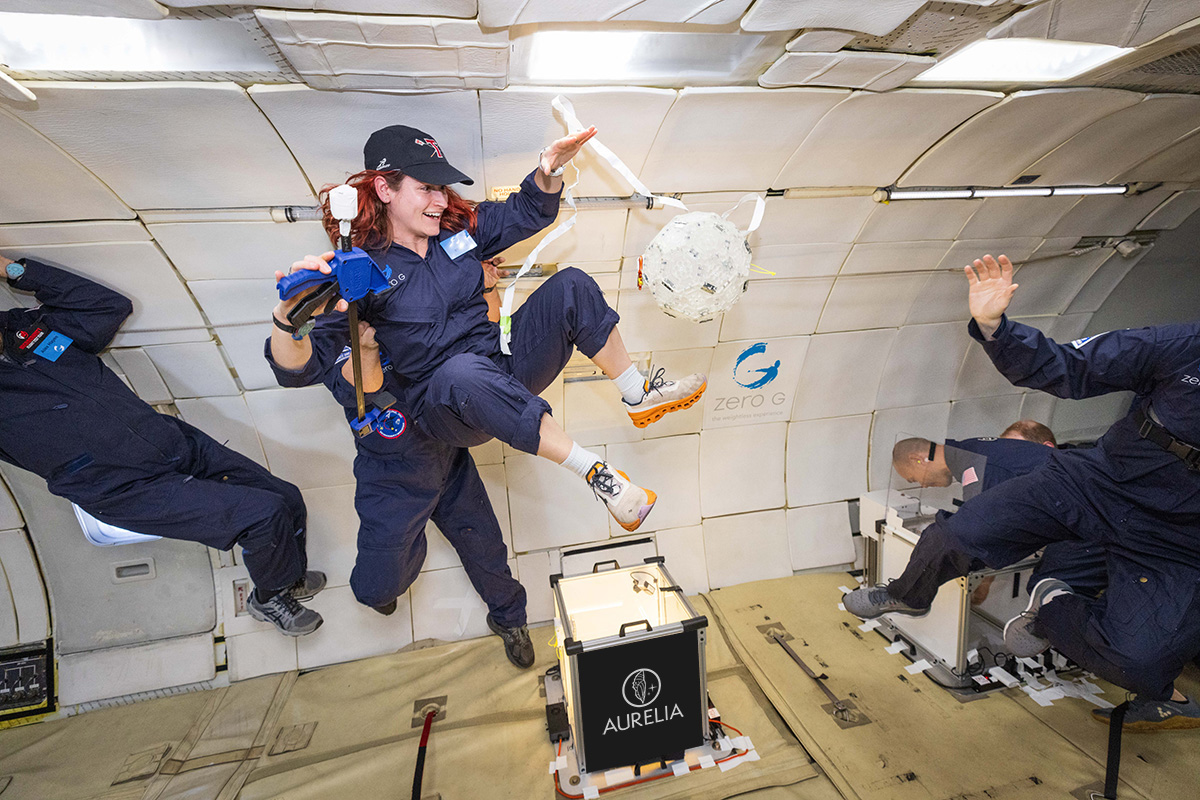
At the heart of the Aurelia Institute’s mission is a commitment to making space accessible to all people. A big part of that work involves annual microgravity flights that Ekblaw says are equal part research missions, workforce training, and inspiration for the next generation of space enthusiasts.

“We’ve done that every year,” Ekblaw says of the flights. “We now have multiple cohorts of students that connect across years. It brings together people from very different backgrounds. We’ve had artists, designers, architects, ethicists, teachers, and others fly with us. In our R&D, we are interested in space infrastructure for the public good. That’s why we’re directing our technology portfolios toward near-term, massive infrastructure projects in low-Earth orbit that benefit life on Earth.”

From the annual flights to the Institute’s self-assembling space architecture technology known as TESSERAE, much of Aurelia’s work is an extension of projects Ekblaw started as a graduate student at MIT.

“My life trajectory changed when I came to MIT,” says Ekblaw, who is still a visiting researcher at MIT. “I am incredibly grateful for the education I got in the Media Lab and the Department of Aeronautics and Astronautics. MIT is what gave me the skill, the technology, and the community to be able to spin out Aurelia and do something important in the space industry at scale.”

“MIT changes lives”

Ekblaw has always been passionate about space. As an undergraduate at Yale University, she took part in a NASA microgravity flight as part of a research project. In the first year of her PhD program at MIT, she led the launch of the Space Exploration Initiative, a cross-Institute effort to drive innovation at the frontiers of space exploration. The ongoing initiative started as a research group but soon raised enough money to conduct microgravity flights and, more recently, conduct missions to the International Space Station and the moon.

“The Media Lab was like magic in the years I was there,” Ekblaw says. “It had this sense of what we used to call ‘anti-disciplinary permission-lessness.’ You could get funding to explore really different and provocative ideas. Our mission was to democratize access to space.”

In 2016, while taking a class taught by Neri Oxman, then a professor in the Media Lab, Ekblaw got the idea for the TESSERAE Project, in which tiles autonomously self-assemble into spherical space structures.

“I was thinking about the future of human flight, and the class was a seeding moment for me,” Ekblaw says. “I realized self-assembly works OK on Earth, it works particularly well at small scales like in biology, but it generally struggles with the force of gravity once you get to larger objects. But microgravity in space was a perfect application for self-assembly.”

That semester, Ekblaw was also taking Professor Neil Gershenfeld’s class MAS.863 (How to Make (Almost) Anything), where she began building prototypes. Over the ensuing years of her PhD, subsequent versions of the TESSERAE system were tested on microgravity flights run by the Space Exploration Initiative, in a suborbital mission with the space company Blue Origin, and as part of a 30-day mission aboard the International Space Station.

“MIT changes lives,” Ekblaw says. “It completely changed my life by giving me access to real spaceflight opportunities. The capstone data for my PhD was from an International Space Station mission.”

After earning her PhD in 2020, Ekblaw decided to ask two researchers from the MIT community and the Space Exploration Initiative, Danielle DeLatte and Sana Sharma, to partner with her to further develop research projects, along with conducting space education and policy efforts. That collaboration turned into Aurelia.

“I wanted to scale the work I was doing with the Space Exploration Initiative, where we bring in students, introduce them to zero-g flights, and then some graduate to sub-orbital, and eventually flights to the International Space Station,” Ekblaw says. “What would it look like to bring that out of MIT and bring that opportunity to other students and mid-career people from all walks of life?”

Every year, Aurelia charters a microgravity flight, bringing about 25 people along to conduct 10 to 15 experiments. To date, nearly 200 people have participated in the flights across the Space Exploration Initiative and Aurelia, and more than 70 percent of those fliers have continued to pursue activities in the space industry post-flight.

Aurelia also offers open-source classes on designing research projects for microgravity environments and contributes to several education and community-building activities across academia, industry, and the arts.

In addition to those education efforts, Aurelia has continued testing and improving the TESSERAE system. In 2022, TESSERAE was brought on the first private mission to the International Space Station, where astronauts conducted tests around the system’s autonomous self-assembly, disassembly, and stability. Aurelia will return to the International Space Station in early 2026 for further testing as part of a recent grant from NASA.

The work led Aurelia to recently spin off the TESSERAE project into a separate, for-profit company. Ekblaw expects there to be more spinoffs out of Aurelia in coming years.

Designing for space, and Earth

The self-assembly work is only one project in Aurelia’s portfolio. Others are focused on designing human-scale pavilions and other habitats, including a space garden and a massive, 20-foot dome depicting the interior of space architectures in the future. This space habitat pavilion was recently deployed as part of a six-month exhibit at the Seattle Museum of Flight.

“The architectural work is asking, ‘How are we going to outfit these systems and actually make the habitats part of a life worth living?’” Ekblaw explains.

With all of its work, Aurelia’s team looks at space as a testbed to bring new technologies and ideas back to our own planet.

“When you design something for the rigors of space, you often hit on really robust technologies for Earth,” she says.

AI shapes autonomous underwater “gliders” | MIT News

0

Marine scientists have long marveled at how animals like fish and seals swim so efficiently despite having different shapes. Their bodies are optimized for efficient, hydrodynamic aquatic navigation so they can exert minimal energy when traveling long distances.

Autonomous vehicles can drift through the ocean in a similar way, collecting data about vast underwater environments. However, the shapes of these gliding machines are less diverse than what we find in marine life — go-to designs often resemble tubes or torpedoes, since they’re fairly hydrodynamic as well. Plus, testing new builds requires lots of real-world trial-and-error.

Researchers from MIT’s Computer Science and Artificial Intelligence Laboratory (CSAIL) and the University of Wisconsin at Madison propose that AI could help us explore uncharted glider designs more conveniently. Their method uses machine learning to test different 3D designs in a physics simulator, then molds them into more hydrodynamic shapes. The resulting model can be fabricated via a 3D printer using significantly less energy than hand-made ones.

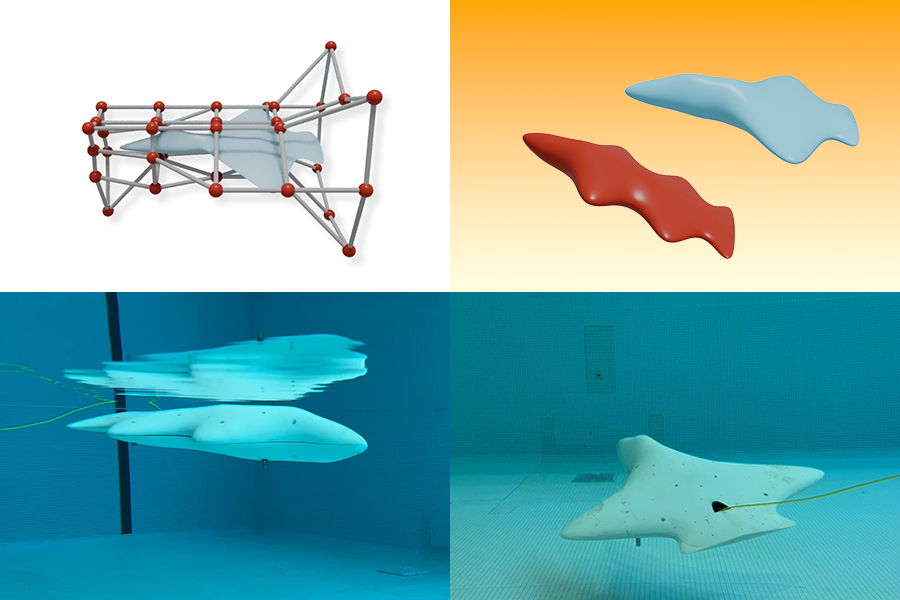
The MIT scientists say that this design pipeline could create new, more efficient machines that help oceanographers measure water temperature and salt levels, gather more detailed insights about currents, and monitor the impacts of climate change. The team demonstrated this potential by producing two gliders roughly the size of a boogie board: a two-winged machine resembling an airplane, and a unique, four-winged object resembling a flat fish with four fins.

Peter Yichen Chen, MIT CSAIL postdoc and co-lead researcher on the project, notes that these designs are just a few of the novel shapes his team’s approach can generate. “We’ve developed a semi-automated process that can help us test unconventional designs that would be very taxing for humans to design,” he says. “This level of shape diversity hasn’t been explored previously, so most of these designs haven’t been tested in the real world.”

But how did AI come up with these ideas in the first place? First, the researchers found 3D models of over 20 conventional sea exploration shapes, such as submarines, whales, manta rays, and sharks. Then, they enclosed these models in “deformation cages” that map out different articulation points that the researchers pulled around to create new shapes.

The CSAIL-led team built a dataset of conventional and deformed shapes before simulating how they would perform at different “angles-of-attack” — the direction a vessel will tilt as it glides through the water. For example, a swimmer may want to dive at a -30 degree angle to retrieve an item from a pool.

These diverse shapes and angles of attack were then used as inputs for a neural network that essentially anticipates how efficiently a glider shape will perform at particular angles and optimizes it as needed.

Giving gliding robots a lift

The team’s neural network simulates how a particular glider would react to underwater physics, aiming to capture how it moves forward and the force that drags against it. The goal: find the best lift-to-drag ratio, representing how much the glider is being held up compared to how much it’s being held back. The higher the ratio, the more efficiently the vehicle travels; the lower it is, the more the glider will slow down during its voyage.

Lift-to-drag ratios are key for flying planes: At takeoff, you want to maximize lift to ensure it can glide well against wind currents, and when landing, you need sufficient force to drag it to a full stop.

Niklas Hagemann, an MIT graduate student in architecture and CSAIL affiliate, notes that this ratio is just as useful if you want a similar gliding motion in the ocean.

“Our pipeline modifies glider shapes to find the best lift-to-drag ratio, optimizing its performance underwater,” says Hagemann, who is also a co-lead author on a paper that was presented at the International Conference on Robotics and Automation in June. “You can then export the top-performing designs so they can be 3D-printed.”

Going for a quick glide

While their AI pipeline seemed realistic, the researchers needed to ensure its predictions about glider performance were accurate by experimenting in more lifelike environments.

They first fabricated their two-wing design as a scaled-down vehicle resembling a paper airplane. This glider was taken to MIT’s Wright Brothers Wind Tunnel, an indoor space with fans that simulate wind flow. Placed at different angles, the glider’s predicted lift-to-drag ratio was only about 5 percent higher on average than the ones recorded in the wind experiments — a small difference between simulation and reality.

A digital evaluation involving a visual, more complex physics simulator also supported the notion that the AI pipeline made fairly accurate predictions about how the gliders would move. It visualized how these machines would descend in 3D.

To truly evaluate these gliders in the real world, though, the team needed to see how their devices would fare underwater. They printed two designs that performed the best at specific points-of-attack for this test: a jet-like device at 9 degrees and the four-wing vehicle at 30 degrees.

Both shapes were fabricated in a 3D printer as hollow shells with small holes that flood when fully submerged. This lightweight design makes the vehicle easier to handle outside of the water and requires less material to be fabricated. The researchers placed a tube-like device inside these shell coverings, which housed a range of hardware, including a pump to change the glider’s buoyancy, a mass shifter (a device that controls the machine’s angle-of-attack), and electronic components.

Each design outperformed a handmade torpedo-shaped glider by moving more efficiently across a pool. With higher lift-to-drag ratios than their counterpart, both AI-driven machines exerted less energy, similar to the effortless ways marine animals navigate the oceans.

As much as the project is an encouraging step forward for glider design, the researchers are looking to narrow the gap between simulation and real-world performance. They are also hoping to develop machines that can react to sudden changes in currents, making the gliders more adaptable to seas and oceans.

Chen adds that the team is looking to explore new types of shapes, particularly thinner glider designs. They intend to make their framework faster, perhaps bolstering it with new features that enable more customization, maneuverability, or even the creation of miniature vehicles.

Chen and Hagemann co-led research on this project with OpenAI researcher Pingchuan Ma SM ’23, PhD ’25. They authored the paper with Wei Wang, a University of Wisconsin at Madison assistant professor and recent CSAIL postdoc; John Romanishin ’12, SM ’18, PhD ’23; and two MIT professors and CSAIL members: lab director Daniela Rus and senior author Wojciech Matusik. Their work was supported, in part, by a Defense Advanced Research Projects Agency (DARPA) grant and the MIT-GIST Program.

Generate single title from this title GFN Thursday: 20 Games Join in July in 100 -150 characters. And it must return only title i dont want any extra information or introductory text with title e.g: ” Here is a single title:”

Write an article about

The forecast this month is showing a 100% chance of epic gaming. Catch the scorching lineup of 20 titles coming to the cloud, which gamers can play whether indoors or on the go.

Six new games are landing on GeForce NOW this week, including launch day titles Figment and Little Nightmares II.

And to make the summer even hotter, the GeForce NOW Summer Sale is in full swing. It’s the last chance to upgrade to a six-month Performance membership for just $29.99 and stream top titles like the recently released classic Borderlands series, DOOM: The Dark Ages, FBC: Firebreak, and more with GeForce RTX power.

Jump Into July

Face your nightmares.

In Figment, a whimsical action-adventure game set in the human mind, players guide Dusty — the grumpy, retired voice of courage — and his upbeat companion Piper on a surreal journey to restore lost bravery after a traumatic event. Blending hand-drawn visuals, clever puzzles and musical boss battles, Figment explores themes of fear, grief and emotional healing in a colorful, dreamlike world filled with humor and song.

In addition, members can look for the following games to stream this week:

Here’s what’s coming in the rest of July:

  • The Ascent (New release on Xbox, PC Game Pass, July 8)
  • Every Day We Fight (New release on Steam, July 10)
  • Mycopunk (New release on Steam, July 10)
  • Brickadia (New release on Steam, July 11)
  • HUNTER×HUNTER NEN×IMPACT (New release on Steam, July 15)
  • Stronghold Crusader: Definitive Edition (New release on Steam, July 15)
  • DREADZONE (New release on Steam, July 17)
  • The Drifter (New release on Steam, July 17)
  • He Is Coming (New release on Steam, July 17)
  • Killing Floor 3 (New release on Steam, July 24)
  • RoboCop: Rogue City – Unfinished Business (New release on Steam, July 17)
  • Wildgate (New release on Steam, July 22)
  • Wuchang: Fallen Feathers (New release on Steam and Epic Games Store, July 23)
  • Battle Brothers (Steam)

June-tastic Games 

In addition to the 25 games announced last month, 11 more joined the GeForce NOW library:

  • Frosthaven Demo (New release on Steam, June 9)
  • Kingdom Two Crowns (New release on Xbox, available on PC Game Pass, June 11)
  • Firefighting Simulator – The Squad (Xbox, available on PC Game Pass)
  • JDM: Japanese Drift Master (Steam)
  • Hellslave (Steam)
  • Date Everything! (New release on Steam, June 17)
  • METAL EDEN Demo (Steam)
  • Torque Drift 2 (Epic Games Store)
  • Broken Age (Steam)
  • Sandwich Simulator (Steam)
  • We Happy Few (Steam)

What are you planning to play this weekend? Let us know on X or in the comments below.

📆 New month, new energy.

What are your cloud gaming goals for July? ☁️🎮

— 🌩️ NVIDIA GeForce NOW (@NVIDIAGFN) July 2, 2025

.Organize the content with appropriate headings and subheadings ( h2, h3, h4, h5, h6). Include conclusion section and FAQs section with Proper questions and answers at the end. do not include the title. it must return only article i dont want any extra information or introductory text with article e.g: ” Here is rewritten article:” or “Here is the rewritten content:”

HR’s Guide to Aligning Culture With Business Strategy

0

Culture can drive performance—or quietly undermine it. Research shows that 65% of portfolio failures are rooted in people and organizational issues, not market conditions or flawed products. The breakdown often starts with culture. When it isn’t aligned with strategy, execution stalls.

Even companies long celebrated for workplace culture have felt the impact. Google’s innovative spirit gave way to red tape and rising disengagement. Starbucks saw its community-centered values diluted by the pressures of speed and scale. These aren’t anomalies. They’re signals.

The organizations succeeding in 2025 share a common strength: organizational culture and business strategy move in lockstep. Culture isn’t a side initiative—it’s a framework for action. When it’s embedded in how decisions get made, clarity improves, engagement deepens, and performance follows. Research shows that aligned cultures can lift employee performance by up to 22%.


This kind of alignment doesn’t happen on its own. It requires deliberate, ongoing leadership. Without active management, culture will be shaped by external pressures, leadership turnover, or the slow drift that comes with growth.

Strategic HR teams are taking the lead—treating culture not as a story to tell, but as a system to power execution.


Why aligning culture and strategy is mission-critical in 2025  

Culture and strategy are no longer parallel priorities. In today’s workplace, their alignment is essential to execution. What was once viewed as an HR initiative now demands the same rigor, visibility, and ownership as any core business strategy.

This shift is being driven by real pressure. Remote and hybrid work have made cultural consistency harder—and more important—than ever. Employees expect purpose, clarity, and alignment between values and action. Leadership changes and rapid growth have left many organizations vulnerable to cultural drift. And the data is clear: only 21% of U.S. employees strongly feel connected to their organization’s culture.

Beneath these trends lies a deeper issue. Execution gaps are emerging across three critical areas—gaps that determine whether culture becomes a driver of performance or a source of friction.


Hardwiring Culture into Daily Decisions 

Culture isn’t what’s written. It’s what’s lived. The biggest disconnect lies in turning values into consistent action. While 83% of leaders believe they’re responsible for shaping culture, only 19% of employees strongly agree that their manager explains how company values relate to their work. This gap between intention and execution creates the perfect storm for cultural drift.


Culture-manager cultural values


“Your core values should be more than just words describing your culture,” says Mikala Friedrich, Chief Human Resources Officer at Scooter’s Coffee. “They must serve as a decision filter, and living by them can’t be optional. They’re the price of admission.”

Organizations that get this right don’t leave culture to chance. They embed it into decisions, communication, recognition, and behavior—every touchpoint that shapes the employee experience. Structures, systems, and environments reinforce what’s expected, creating alignment that scales.


Everyone Must Activate on Culture

Culture only works when everyone takes ownership. But too often, responsibility is fragmented—treated as a top-down message rather than an all-in effort.


Culture-whos responsible


When employees strongly agree that leadership is committed to cultural values, they’re nearly 10 times more likely to rate their culture as excellent. But commitment must go beyond statements. Managers—the frontline translators of culture—frequently lack the tools and clarity to connect big-picture values to everyday decisions.

When ownership is unclear, culture erodes. It turns into corporate wallpaper: visible, but not meaningful. Organizations that build shared accountability at every level turn culture into a performance driver—not a passive backdrop.


Evolving Culture as Business Evolves  

The most strategic cultures are built to adapt. What works for a startup won’t scale to an enterprise. And what resonated five years ago may no longer reflect the realities of today’s workforce or business environment. Organizations that fail to evolve their culture risk more than disengagement—they risk becoming irrelevant.

“As we’ve evolved as a business, we’ve had to adjust our culture,” says Mikala Friedrich, Chief Human Resources Officer at Scooter’s Coffee. “Our core values have gone from defining our culture to calling people to action. It’s how you need to show up and stand behind your words and actions. Our values now bring more clarity to how we operate—not just who we aspire to be.”

Culture isn’t self-sustaining. Left unmanaged, it will be reshaped by external forces—new leadership, shifting markets, or the silent pull of scale. Strategic HR leaders treat culture like any core business system: it demands clear goals, measurable outcomes, and mechanisms for accountability. When culture evolves with intention, it stays aligned with the strategy it’s meant to power.


Culture-key tasks for evolving


The hidden costs of failing at cultural alignment  

The costs of misalignment aren’t abstract—they’re immediate, measurable, and compounding. When culture and strategy drift apart, organizations face a cascade of consequences that weaken execution, erode trust, and damage long-term performance. 


Execution suffers 

When culture and strategy operate in silos, employees receive mixed signals about what matters. Priorities shift, decision-making slows, and accountability blurs. The result is inefficiency across the board—and diminished impact from even the most strategic initiatives. 


Engagement declines 

Employees notice when values ring hollow. When there’s a gap between what’s said and what’s lived, cynicism sets in. Discretionary effort drops. Top performers disengage—or walk. The business absorbs the cost: higher turnover, longer hiring cycles, and lost institutional knowledge.


Cultural drift accelerates

Culture isn’t static. Without deliberate reinforcement, even strong cultures weaken. Growth, leadership changes, and external pressure quietly pull organizations away from their foundation. Small compromises become ingrained behaviors—until misalignment is the norm, not the exception.

The warning signs are consistent: leadership actions contradict stated values, performance systems reward the wrong behaviors, and employee feedback goes unanswered. Culture is either actively managed or slowly undermined.


How elite HR teams master aligning culture and business strategy

High-performing HR teams treat culture–strategy alignment as a core business function—one that requires rigor, ownership, and continuous iteration. They don’t wait for alignment to happen organically. They build the systems that make it inevitable.

These teams start by embedding culture into daily decisions. Not as a statement on a wall—but as a framework for action. From the boardroom to the front lines, values shape how people choose, act, and lead. When culture is a decision filter, it gains credibility—and staying power.

They also institutionalize culture beyond individual leaders. Values aren’t personality-driven; they’re system-driven. These teams integrate culture into hiring, performance reviews, recognition, and feedback loops—so it scales and sustains through leadership transitions and organizational change.


At Scooter’s Coffee, listening drives action. “The biggest driver for change in our organization has been our annual engagement survey,” says Mikala Friedrich, CHRO. “We take it seriously. We follow up with focus groups, communicate back to employees what we’re doing, and bring them in to co-create solutions. That transparency builds trust—and real change.”


Elite HR leaders also recognize that culture looks different at each stage of growth. Early-stage companies focus on defining identity. Scaling organizations hardwire culture into systems that support execution. Mature enterprises stay anchored in purpose while adapting to complexity.

Crucially, they avoid the traps that derail alignment. They don’t treat culture as static. They don’t silo it within HR. And they don’t ignore the gap between stated values and lived experience. Because employees don’t judge culture by intention—they judge it by what actually happens.


5 steps toward aligning culture and strategy 

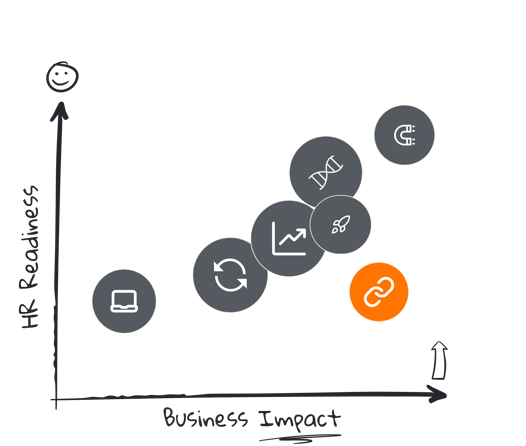
The path to aligning culture and strategy begins with one critical shift: treating culture as a measurable business function—with clear ownership, defined outcomes, and ongoing accountability. The organizations that get this right don’t wait for the perfect moment. They build practical systems that make culture everyone’s responsibility.
Trends-grid-culture


1. Use culture as a decision filter

Start by positioning culture as a lens for leadership decision-making. Create a simple, repeatable framework that requires leaders to evaluate major decisions against both core values and strategic goals. Questions like, “Does this choice reflect our values? Does it advance our long-term strategy? What trade-offs are we making?” help operationalize culture—turning it from a concept into a tool. When culture isn’t factored into decisions, confusion, misalignment, and erosion follow.


2. Measure culture like any other business function 

Conduct a culture audit to assess the gap between values on paper and behaviors in practice. Go beyond engagement scores—look at how decisions are made under pressure, how teams collaborate, and how leaders show up when it counts. Track not just what gets done, but how. Identify moments where actions reinforced or undermined culture. Then define clear metrics and track cultural performance alongside traditional KPIs.


3. Recognize and reward culture in action

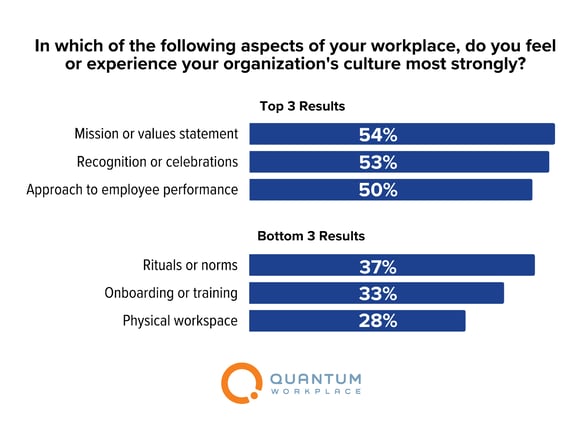
Pinpoint the moments where employees experience culture most directly. Research shows the top three: values and mission statements (54%), recognition and celebrations (53%), and performance management (50%). Choose one and assess alignment. If you start with performance management, ask: Do our coaching conversations reflect our values? Are we rewarding behaviors that support strategic priorities? Visibility matters—when employees see culture reinforced, belief and alignment grow.
 

culture-report_important-aspects-culture_email


Institutionalize culture beyond leadership

Embed values into systems, not just speeches. Ensure they’re reflected in performance reviews, promotion criteria, leadership expectations, and decision-making processes. When cultural alignment is built into how things get done, it outlasts any one leader—and scales with the organization.


Listen—and act—on employee feedback

Monitor how employees perceive cultural leadership. Are leaders demonstrating values? Are managers translating those values into the day-to-day? Use engagement surveys, focus groups, and pulse checks to gather insight—then act on it with transparency and urgency. At Scooter’s Coffee, feedback drives real change. “We follow up with sessions, communicate action plans, and involve employees in solving the issues,” says Friedrich. “It’s how trust is built—and culture evolves.”

Remember Friedrich’s insight about cultural evolution: “As we’ve evolved as a business, we’ve had to adjust our culture. Our core values have gone from defining our culture to calling people to action. It’s how you need to show up and stand behind your words and actions. Our values now bring more clarity to how we operate, not just who we aspire to be.”

Your culture is either propelling strategy forward or silently pulling it off course. Alignment starts with action—and that starts now.


Explore all seven critical workplace trends shaping 2025 in the complete Workplace Trends Report. Discover the data-driven insights and actionable strategies that leading HR teams use to navigate change and drive results.

Read the Report Today >>

SmartThings Blog

0

SmartThings Adds New Apple Watch Capabilities, Routine Creation Assistant, and Dark Mode to iOS

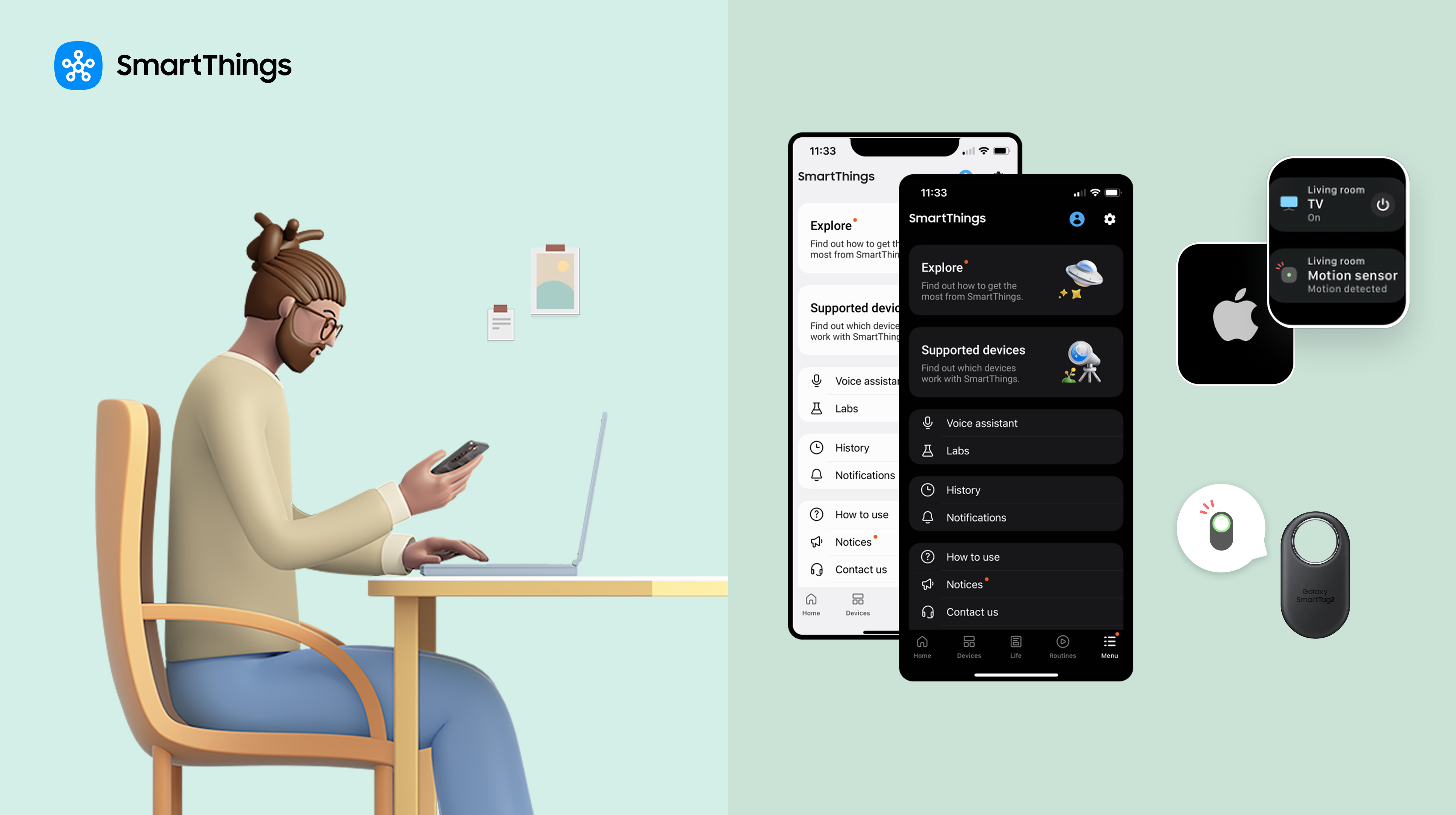
If you’re using SmartThings on iOS, get ready because your smart home experience just leveled up. We’ve rolled out a suite of new features designed to give you more control, more personalization, and more reasons to love your smart home. Whether you have an Apple Watch, are a dark mode enthusiast, or someone just starting with home automation, there’s something new for you.

Let’s break it down.

Control Your Smart Home from Your Apple Watch

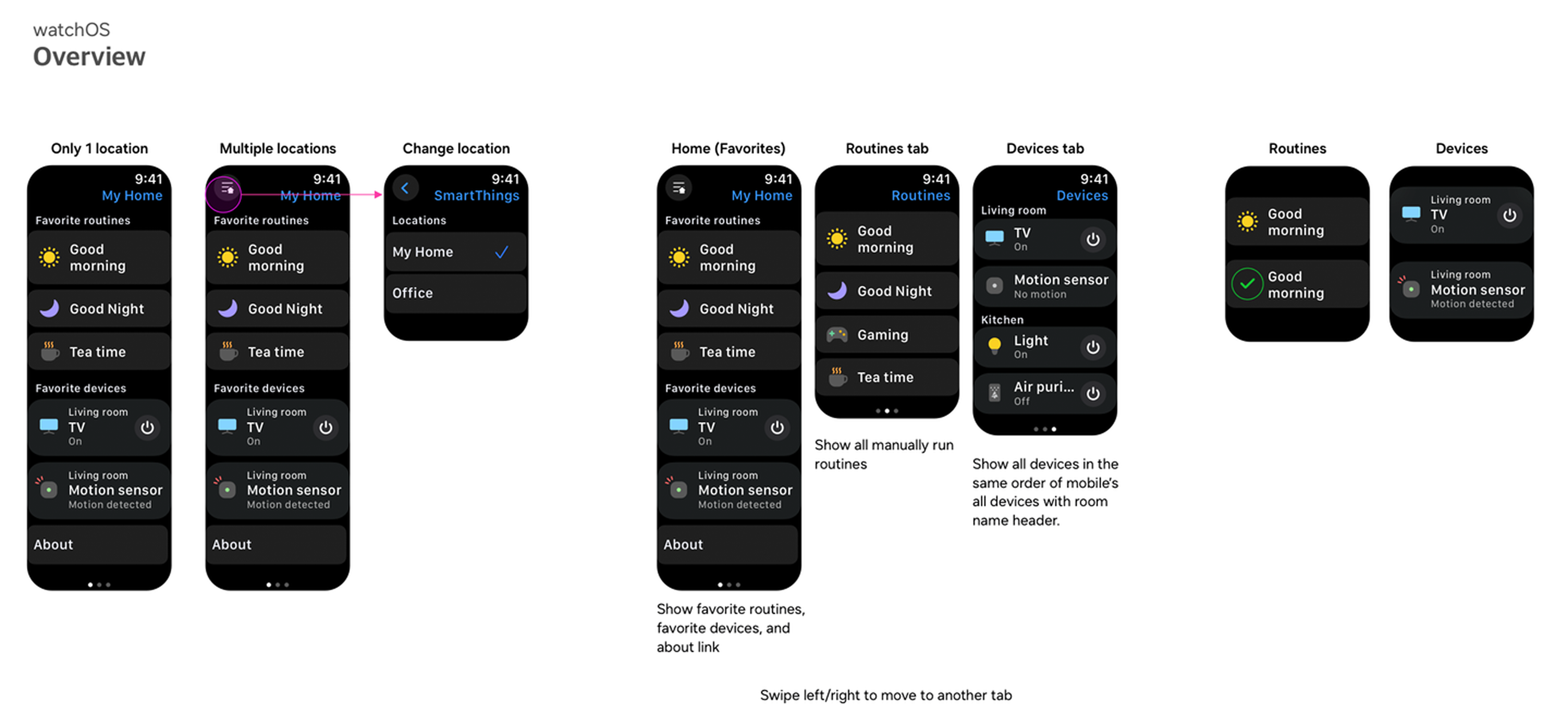
We’ve seriously upgraded the SmartThings Apple Watch app. Until now, you had the capability to run manual routines, but now, you can also switch between locations, control individual devices, and manage your smart home without ever picking up your phone. Imagine unlocking the door and turning on the hallway lights before you even get out of the car. All from your wrist. It’s that easy.

Routine Creation Just Got Way Easier

Ever wish you could just tell your smart home what to do? Now you kinda can.

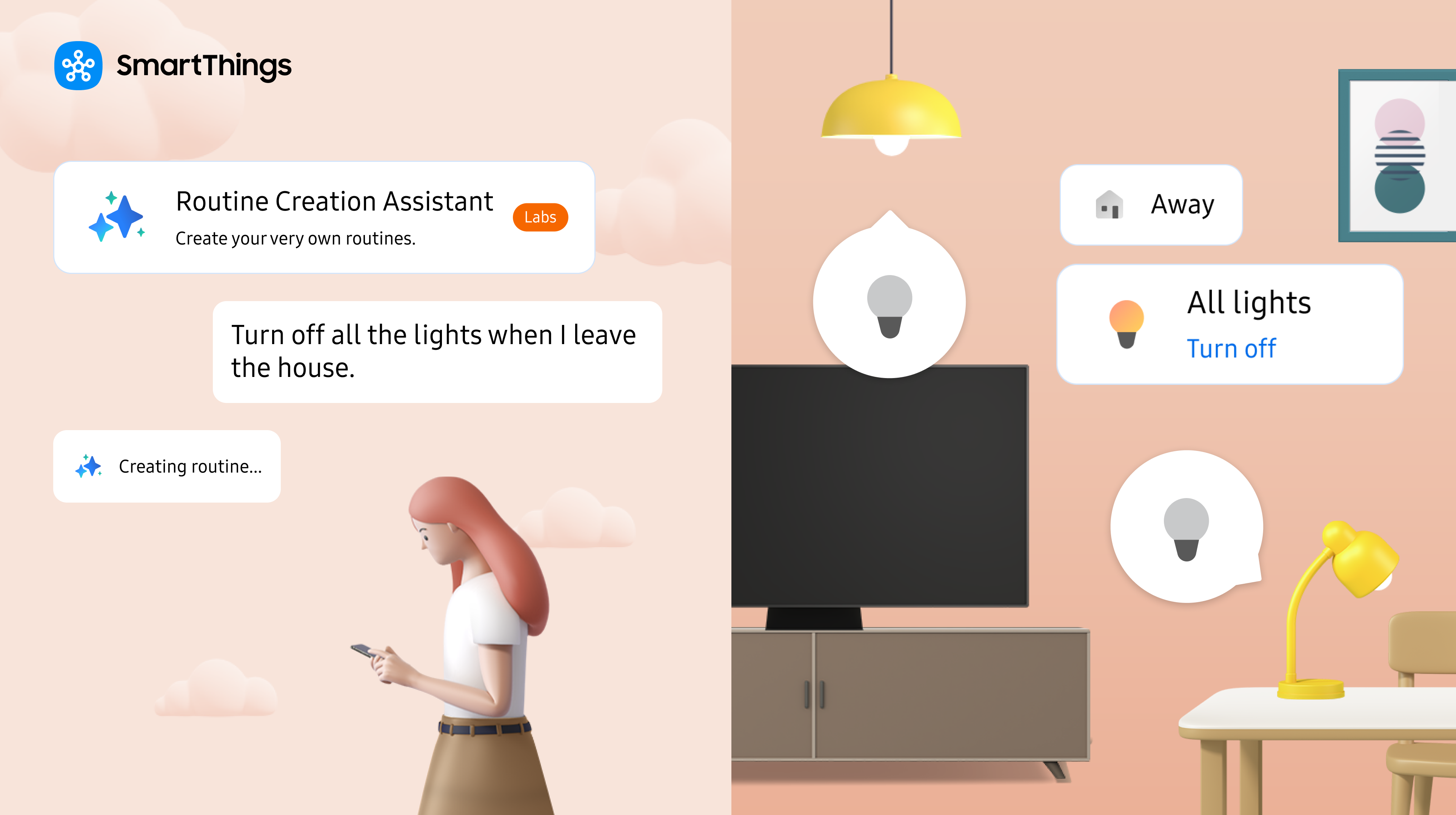
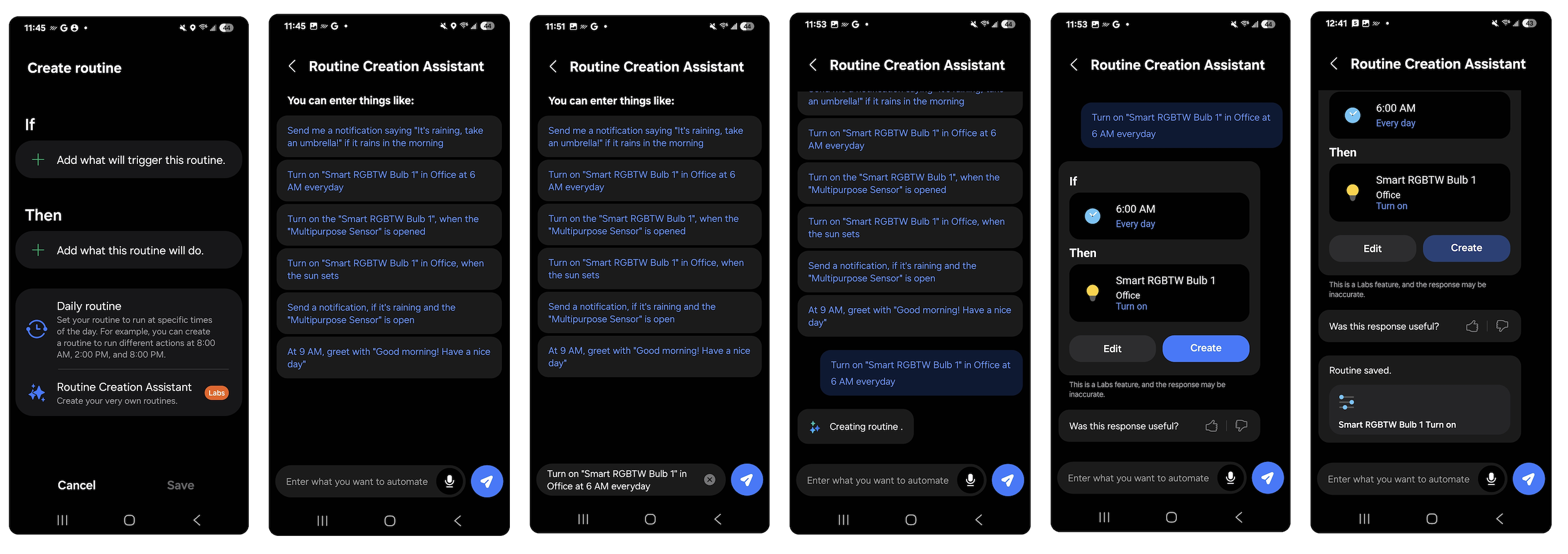
A key highlight of the update is the introduction of the Routine Creation Assistant, an AI-powered feature that allows users to build automations using natural language. By simply typing a phrase such as “Turn off all the lights when I leave the house,” users can generate customized routines without needing to manually configure each device or setting.

Powered by large language model technology, the assistant lowers the barrier to smart home automation, making it approachable for beginners and efficient for experienced users alike.

Hello, Dark Mode

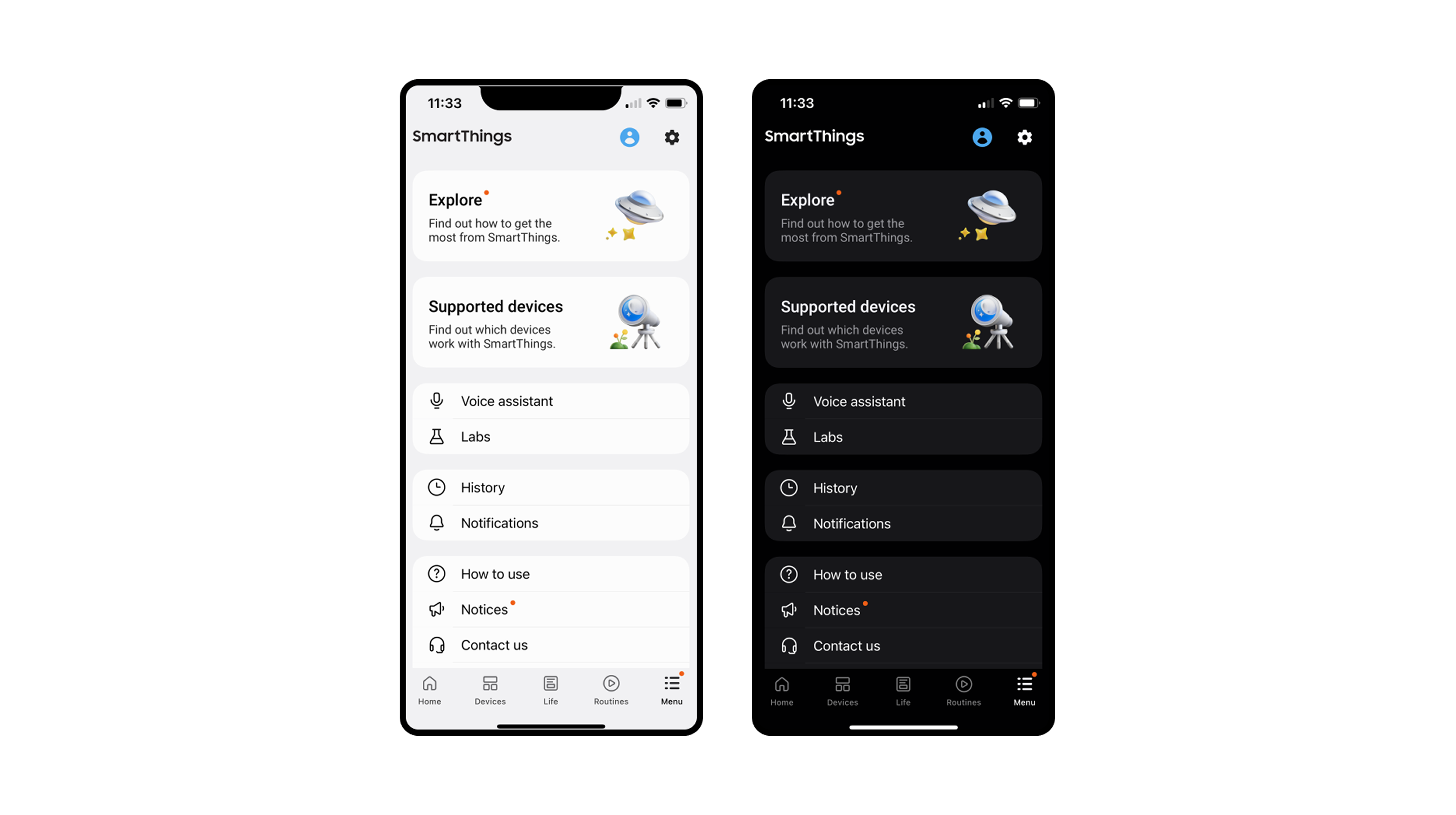
Night owls and low-light lovers can rejoice as Dark Mode has officially landed on SmartThings iOS. It’s sleek, easy on the eyes, and even helps save battery life. Whether you’re adjusting routines late at night or just prefer a more subtle interface, Dark Mode has you covered.

Easier Tracking with SmartThings Find

Losing track of your stuff? SmartThings Find makes life easier, especially if you’re juggling both Galaxy and Apple devices in your household.

Using a Galaxy SmartTag and SmartThings Find, Galaxy users can now share the location of a SmartTag via a link with Apple users who have a Samsung account, making it easier than ever for everyone to help track down missing devices or tagged items. Whether you’re handing off your Galaxy SmartTag to a friend or trying to locate your suitcase from someone else’s phone, cross-platform coordination is now part of the experience.

Try Before you Automate with Virtual Home

Say hello to Virtual Home, a playful, hands-on experience that lets you test out SmartThings features without needing to connect a single device. Whether you’re curious about setting up a routine, adjusting lighting, or just seeing how a smart home could work, Virtual Home gives you a chance to click around and get inspired. With features like Family & Pet Care, users can receive instant notifications of any activity in the home or always have peace of mind with SmartTags on pet collars, which ensure anyone who finds a lost pet has the info they need to locate the owner. Discover SmartThings Energy to monitor power consumption and get an estimate on upcoming energy bills.

Explore, experiment, and imagine what your smart home can do with no commitment required.

And We’re Just Getting Started

These updates join a lineup of iOS favorites you might already be using, like Quick Remote for controlling Samsung devices in seconds, SmartThings Energy for tracking real-time energy use, and QR code sharing, which makes it easy to share routine and device access with other members of your household.

We’re always working to make SmartThings smarter, faster, and more tailored to your life. So explore the new features, build a few routines, and turn your home into the helpful, responsive place it was meant to be. Update your app today!

Generate single title from this title The power of randomness in 100 -150 characters. And it must return only title i dont want any extra information or introductory text with title e.g: ” Here is a single title:”

Write an article about

Stay informed with free updates

The writer is professor of mathematics at the University of Oxford and author of ‘Blueprints: How Mathematics Shapes Creativity’

Our kitchen at home is decorated with a series of coloured tiles. We installed it just after I’d seen Gerhard Richter’s exhibition “4900 Farben”, where he filled 196 canvases with five-by-five grids of coloured squares placed according to chance. Wanting to mimic this, I decided to arrange our tiles using the decimal expansion of pi which starts 3.14159 . . . and then heads off to infinity with a string of numbers that satisfies all the criteria for a random sequence.

However, when my wife reviewed my plan, she was unimpressed because: “You can’t have three red tiles next to each other.” I protested that randomness creates these unexpected clusters, but her artistic eye prevailed. The result is a kitchen that looks random but subtly avoids repeated colours, shaped more by her design than by mathematical chance.

That experience made me wonder whether Richter had similarly intervened in his own work. But my mathematical analysis of his 196 canvases revealed he had truly surrendered to randomness. He’s not alone. Many artists in the 20th and 21st centuries have used chance as a creative tool. The Dada movement famously explored its potential to push art in new directions in the early 20th century. John Cage and Karlheinz Stockhausen used it to compose music. William Burroughs and David Bowie employed randomness to write text.

Why does randomness appeal to artists? Many through the ages have embraced mathematical structures such as the golden ratio, symmetry or hyperbolic geometry as frameworks for creativity. Randomness seems the opposite: an anti-structure. Yet it’s precisely that unpredictability that some find liberating.

Richter used randomness to highlight its fascinating property: it produces apparent patterns and clumpings that tempt the mind to find hidden meaning. “What I like about the patterns are they’re not constructed on the basis of an ideology or religion,” he observed. “The patterns which emerge by coincidence contain all sorts of associations.”

For Dadaists, randomness was political. To them, the first world war was the outcome of rationalism, capitalism, and aesthetic dogma. By embracing chance, they aimed to break from those systems. Jean Arp, a Dada pioneer, saw randomness as a way to bypass the conscious mind — a gateway to new, unfiltered creativity.

Today, artificial intelligence can play a similar role. While debates often focus on AI replacing artists, its real power is as a collaborator, offering fresh perspectives shaped by the artist’s past work. Jazz pianist Bernard Lubat trained an AI model on his own improvisations, and when he jammed with it in concert he found himself in a familiar yet unexplored sound world.

Music has a long history with chance. Even Mozart composed a work in which each bar was chosen by the throw of dice. The skill of the composer was to create music that worked however the dice landed. One motivation was to allow the player to feel part of the creative process. These “dice games” let them help generate the music, resulting in pieces probably never heard before. Often the results sound somewhat mediocre, however — and this echoes the challenge with AI-generated content: much of it is unremarkable. Still, occasionally randomness produces something interesting.

One striking literary example is BS Johnson’s 1969 novel The Unfortunates, which consists of 27 chapters in a box. Apart from fixed opening and closing chapters, the reader assembles the remaining 25 in any order, creating their own narrative path. When I first read it, I was amazed to think that, of the 15 million billion billion possible arrangements, mine might never have existed before. Though the format feels experimental, the book itself is rich in humour and humanity. Its structure perfectly mirrors its theme of memory’s fragmented nature.

Randomness is not just an important new ingredient for the artists of the 20th century. It turns out that chance is at the heart of the science that emerged during the last century. Physics post-Newton had raised the prospect that nothing was truly random, that if you know the equations of motion you can predict the future. The scientists of the early 20th century smashed this idea of determinism. Quantum physics reveals that randomness is at the heart of the way we must do science.

Perhaps it isn’t surprising that this thread emerged in science and art at the same time. As Umberto Eco put it: “In every century, the way that artistic forms are structured reflects the way in which science or contemporary culture views reality.”

.Organize the content with appropriate headings and subheadings ( h2, h3, h4, h5, h6). Include conclusion section and FAQs section with Proper questions and answers at the end. do not include the title. it must return only article i dont want any extra information or introductory text with article e.g: ” Here is rewritten article:” or “Here is the rewritten content:”

SmartThings Blog

0

New tools include AI-powered routine creation, expanded Calm Onboarding, and SmartThings Find link sharing for easier device control and tracking.

Samsung Electronics introduced updates to its global connected living platform SmartThings, bringing enhanced AI-driven automation tools, broader product onboarding support, and improved connectivity features to users worldwide. Designed to make connected living easier and more personalized, the latest updates simplify the smart home experience across both Android and iOS platforms.

AI-Powered Routine Creation Makes Automation Easier Than Ever

A key highlight of the update is the introduction of the Routine Creation Assistant1, an AI-powered feature that allows users to build automations using natural language. By simply typing a phrase such as “Turn off all the lights when I leave the house,” users can generate customized routines without needing to manually configure each device or setting.

Powered by large language model technology, the assistant lowers the barrier to smart home automation, making it approachable for beginners and efficient for experienced users alike.

Smarter Scheduling and Routine Confirmation Options
The new Delay Actions also enable routines to include timed steps. For example, users can now create a “Good Morning” routine that turns on bedroom lights at 7:00 a.m., starts the coffee maker 15 minutes later, and opens curtains while playing music after 30 minutes all within a single routine. Additionally, a new Confirm to Run Actions2 feature gives users the option to confirm whether or not to execute a routine. This helps avoid accidental actions in shared households, such as a security mode that is set to activate upon exit but another family member is still at home.

Calm Onboarding Expands to 58 Countries

Samsung is also expanding its Calm Onboarding3 program, designed to streamline the product setup journey from purchase to use. Once a user purchases an eligible Samsung product via Samsung.com or a Samsung Store, SmartThings can now automatically detect, register, and connect the product to the app.

With this update, support for Calm Onboarding has expanded from 14 to 58 countries and now includes Galaxy wearable devices like Galaxy Watch and Buds. Select partner devices purchased through Samsung.com in Korea and the UK are also eligible for onboarding, with further global expansion planned.

SmartThings Find Adds Sharing for Easier Tracking

The update also enhances SmartThings Find4, Samsung’s global location service with over 67 million users. Galaxy users can now share the location of SmartTags via URL, allowing friends and family, including iOS users, to track tagged items like bags, pets, or luggage more easily.

This update brings added convenience to families and users on the go, making it easier to coordinate and locate shared items.

Enhanced SmartThings Access on iOS Smartwatches

iOS users can now access SmartThings features via a new widget on Apple Watch, making it easier to control lights, air conditioning, and routines directly from the wrist. This improvement brings faster access and convenience to users managing smart home tasks on the go.

“This SmartThings update will help anyone easily create a smart home that fits their lifestyle,” said Mark Benson, Head of SmartThings US. “SmartThings will continue to innovate so users can spend less time managing devices and more meaningful time with their families.”

SmartThings continues to lead in smart home innovation, offering users across the globe a smarter, more personalized, and more intuitive connected living experience. To learn more, visit www.smartthings.com.

1Routine Creation Assistant is available to Samsung account holders in Korea and the U.S. on Android and iOS.

2Check Before Running is available across all Android and iOS local device settings.

3Calm Onboarding is supported for 2025 Samsung appliances, 2024 TVs, air conditioners, air purifiers, vacuum cleaners, ovens, and Family Hub refrigerators. Users must enable “Add My Device Automatically” in the SmartThings app for onboarding to initiate.

4 Tag location sharing is available via a link, and only Galaxy users can create the link. Recipients must log in with a Samsung account to access shared locations.

Robotic system zeroes in on objects most relevant for helping humans | MIT News

0

For a robot, the real world is a lot to take in. Making sense of every data point in a scene can take a huge amount of computational effort and time. Using that information to then decide how to best help a human is an even thornier exercise.

Now, MIT roboticists have a way to cut through the data noise, to help robots focus on the features in a scene that are most relevant for assisting humans.

Their approach, which they aptly dub “Relevance,” enables a robot to use cues in a scene, such as audio and visual information, to determine a human’s objective and then quickly identify the objects that are most likely to be relevant in fulfilling that objective. The robot then carries out a set of maneuvers to safely offer the relevant objects or actions to the human.

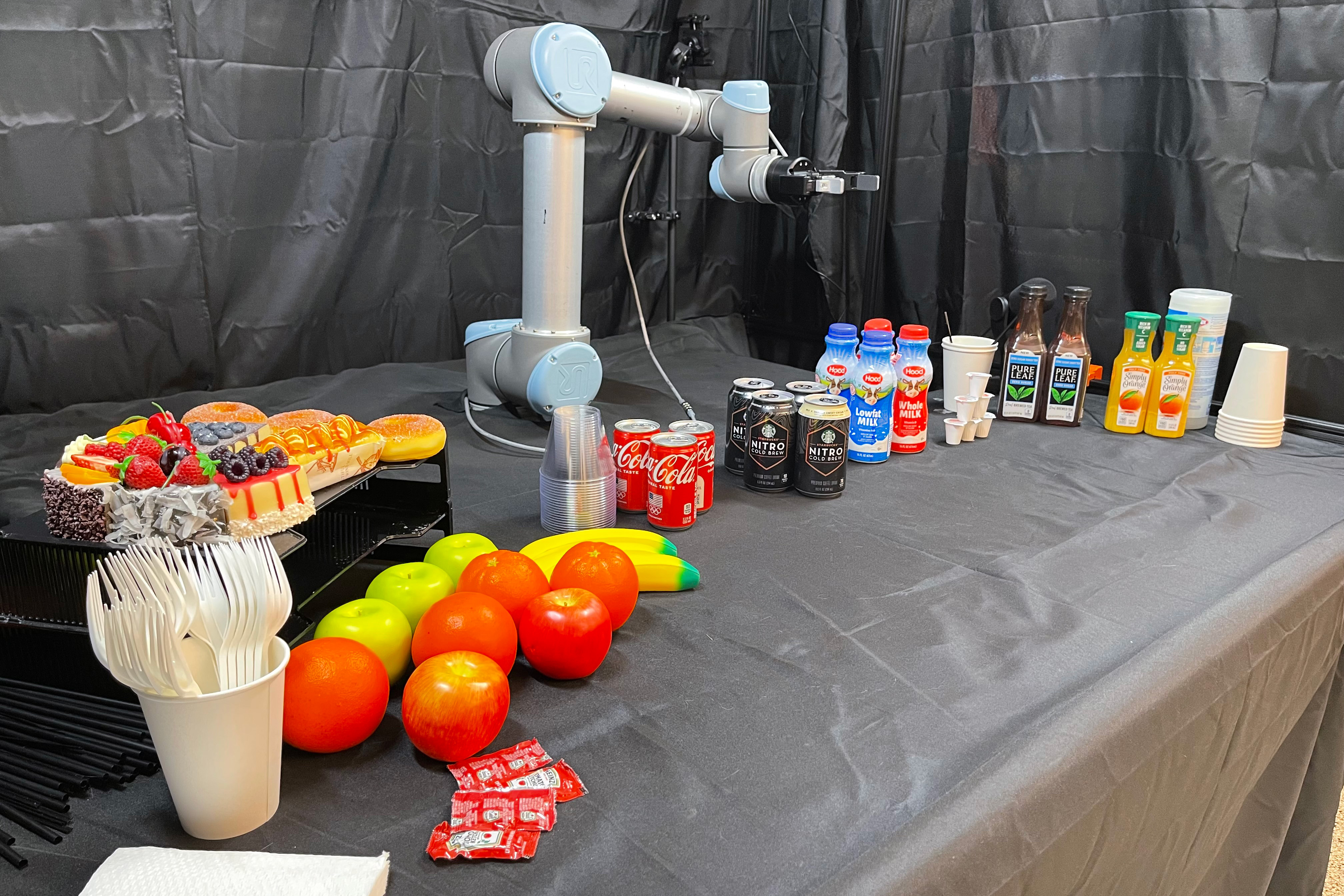
The researchers demonstrated the approach with an experiment that simulated a conference breakfast buffet. They set up a table with various fruits, drinks, snacks, and tableware, along with a robotic arm outfitted with a microphone and camera. Applying the new Relevance approach, they showed that the robot was able to correctly identify a human’s objective and appropriately assist them in different scenarios.

In one case, the robot took in visual cues of a human reaching for a can of prepared coffee, and quickly handed the person milk and a stir stick. In another scenario, the robot picked up on a conversation between two people talking about coffee, and offered them a can of coffee and creamer.

Overall, the robot was able to predict a human’s objective with 90 percent accuracy and to identify relevant objects with 96 percent accuracy. The method also improved a robot’s safety, reducing the number of collisions by more than 60 percent, compared to carrying out the same tasks without applying the new method.

“This approach of enabling relevance could make it much easier for a robot to interact with humans,” says Kamal Youcef-Toumi, professor of mechanical engineering at MIT. “A robot wouldn’t have to ask a human so many questions about what they need. It would just actively take information from the scene to figure out how to help.”

Youcef-Toumi’s group is exploring how robots programmed with Relevance can help in smart manufacturing and warehouse settings, where they envision robots working alongside and intuitively assisting humans.

Youcef-Toumi, along with graduate students Xiaotong Zhang and Dingcheng Huang, will present their new method at the IEEE International Conference on Robotics and Automation (ICRA) in May. The work builds on another paper presented at ICRA the previous year.

Finding focus

The team’s approach is inspired by our own ability to gauge what’s relevant in daily life. Humans can filter out distractions and focus on what’s important, thanks to a region of the brain known as the Reticular Activating System (RAS). The RAS is a bundle of neurons in the brainstem that acts subconsciously to prune away unnecessary stimuli, so that a person can consciously perceive the relevant stimuli. The RAS helps to prevent sensory overload, keeping us, for example, from fixating on every single item on a kitchen counter, and instead helping us to focus on pouring a cup of coffee.

“The amazing thing is, these groups of neurons filter everything that is not important, and then it has the brain focus on what is relevant at the time,” Youcef-Toumi explains. “That’s basically what our proposition is.”

He and his team developed a robotic system that broadly mimics the RAS’s ability to selectively process and filter information. The approach consists of four main phases. The first is a watch-and-learn “perception” stage, during which a robot takes in audio and visual cues, for instance from a microphone and camera, that are continuously fed into an AI “toolkit.” This toolkit can include a large language model (LLM) that processes audio conversations to identify keywords and phrases, and various algorithms that detect and classify objects, humans, physical actions, and task objectives. The AI toolkit is designed to run continuously in the background, similarly to the subconscious filtering that the brain’s RAS performs.

The second stage is a “trigger check” phase, which is a periodic check that the system performs to assess if anything important is happening, such as whether a human is present or not. If a human has stepped into the environment, the system’s third phase will kick in. This phase is the heart of the team’s system, which acts to determine the features in the environment that are most likely relevant to assist the human.

To establish relevance, the researchers developed an algorithm that takes in real-time predictions made by the AI toolkit. For instance, the toolkit’s LLM may pick up the keyword “coffee,” and an action-classifying algorithm may label a person reaching for a cup as having the objective of “making coffee.” The team’s Relevance method would factor in this information to first determine the “class” of objects that have the highest probability of being relevant to the objective of “making coffee.” This might automatically filter out classes such as “fruits” and “snacks,” in favor of “cups” and “creamers.” The algorithm would then further filter within the relevant classes to determine the most relevant “elements.” For instance, based on visual cues of the environment, the system may label a cup closest to a person as more relevant — and helpful — than a cup that is farther away.

In the fourth and final phase, the robot would then take the identified relevant objects and plan a path to physically access and offer the objects to the human.

Helper mode

The researchers tested the new system in experiments that simulate a conference breakfast buffet. They chose this scenario based on the publicly available Breakfast Actions Dataset, which comprises videos and images of typical activities that people perform during breakfast time, such as preparing coffee, cooking pancakes, making cereal, and frying eggs. Actions in each video and image are labeled, along with the overall objective (frying eggs, versus making coffee).

Using this dataset, the team tested various algorithms in their AI toolkit, such that, when receiving actions of a person in a new scene, the algorithms could accurately label and classify the human tasks and objectives, and the associated relevant objects.

In their experiments, they set up a robotic arm and gripper and instructed the system to assist humans as they approached a table filled with various drinks, snacks, and tableware. They found that when no humans were present, the robot’s AI toolkit operated continuously in the background, labeling and classifying objects on the table.

When, during a trigger check, the robot detected a human, it snapped to attention, turning on its Relevance phase and quickly identifying objects in the scene that were most likely to be relevant, based on the human’s objective, which was determined by the AI toolkit.

“Relevance can guide the robot to generate seamless, intelligent, safe, and efficient assistance in a highly dynamic environment,” says co-author Zhang.

Going forward, the team hopes to apply the system to scenarios that resemble workplace and warehouse environments, as well as to other tasks and objectives typically performed in household settings.

“I would want to test this system in my home to see, for instance, if I’m reading the paper, maybe it can bring me coffee. If I’m doing laundry, it can bring me a laundry pod. If I’m doing repair, it can bring me a screwdriver,” Zhang says. “Our vision is to enable human-robot interactions that can be much more natural and fluent.”

This research was made possible by the support and partnership of King Abdulaziz City for Science and Technology (KACST) through the Center for Complex Engineering Systems at MIT and KACST.