Home Blog Page 49

Imaging technique removes the effect of water in underwater scenes | MIT News

0

The ocean is teeming with life. But unless you get up close, much of the marine world can easily remain unseen. That’s because water itself can act as an effective cloak: Light that shines through the ocean can bend, scatter, and quickly fade as it travels through the dense medium of water and reflects off the persistent haze of ocean particles. This makes it extremely challenging to capture the true color of objects in the ocean without imaging them at close range.

Now a team from MIT and the Woods Hole Oceanographic Institution (WHOI) has developed an image-analysis tool that cuts through the ocean’s optical effects and generates images of underwater environments that look as if the water had been drained away, revealing an ocean scene’s true colors. The team paired the color-correcting tool with a computational model that converts images of a scene into a three-dimensional underwater “world,” that can then be explored virtually.

The researchers have dubbed the new tool “SeaSplat,” in reference to both its underwater application and a method known as 3D gaussian splatting (3DGS), which takes images of a scene and stitches them together to generate a complete, three-dimensional representation that can be viewed in detail, from any perspective.

“With SeaSplat, it can model explicitly what the water is doing, and as a result it can in some ways remove the water, and produces better 3D models of an underwater scene,” says MIT graduate student Daniel Yang.

The researchers applied SeaSplat to images of the sea floor taken by divers and underwater vehicles, in various locations including the U.S. Virgin Islands. The method generated 3D “worlds” from the images that were truer and more vivid and varied in color, compared to previous methods.

The team says SeaSplat could help marine biologists monitor the health of certain ocean communities. For instance, as an underwater robot explores and takes pictures of a coral reef, SeaSplat would simultaneously process the images and render a true-color, 3D representation, that scientists could then virtually “fly” through, at their own pace and path, to inspect the underwater scene, for instance for signs of coral bleaching.

“Bleaching looks white from close up, but could appear blue and hazy from far away, and you might not be able to detect it,” says Yogesh Girdhar, an associate scientist at WHOI. “Coral bleaching, and different coral species, could be easier to detect with SeaSplat imagery, to get the true colors in the ocean.”

Girdhar and Yang will present a paper detailing SeaSplat at the IEEE International Conference on Robotics and Automation (ICRA). Their study co-author is John Leonard, professor of mechanical engineering at MIT.

Aquatic optics

In the ocean, the color and clarity of objects is distorted by the effects of light traveling through water. In recent years, researchers have developed color-correcting tools that aim to reproduce the true colors in the ocean. These efforts involved adapting tools that were developed originally for environments out of water, for instance to reveal the true color of features in foggy conditions. One recent work accurately reproduces true colors in the ocean, with an algorithm named “Sea-Thru,” though this method requires a huge amount of computational power, which makes its use in producing 3D scene models challenging.

In parallel, others have made advances in 3D gaussian splatting, with tools that seamlessly stitch images of a scene together, and intelligently fill in any gaps to create a whole, 3D version of the scene. These 3D worlds enable “novel view synthesis,” meaning that someone can view the generated 3D scene, not just from the perspective of the original images, but from any angle and distance.

But 3DGS has only successfully been applied to environments out of water. Efforts to adapt 3D reconstruction to underwater imagery have been hampered, mainly by two optical underwater effects: backscatter and attenuation. Backscatter occurs when light reflects off of tiny particles in the ocean, creating a veil-like haze. Attenuation is the phenomenon by which light of certain wavelengths attenuates, or fades with distance. In the ocean, for instance, red objects appear to fade more than blue objects when viewed from farther away.

Out of water, the color of objects appears more or less the same regardless of the angle or distance from which they are viewed. In water, however, color can quickly change and fade depending on one’s perspective. When 3DGS methods attempt to stitch underwater images into a cohesive 3D whole, they are unable to resolve objects due to aquatic backscatter and attenuation effects that distort the color of objects at different angles.

“One dream of underwater robotic vision that we have is: Imagine if you could remove all the water in the ocean. What would you see?” Leonard says.

A model swim

In their new work, Yang and his colleagues developed a color-correcting algorithm that accounts for the optical effects of backscatter and attenuation. The algorithm determines the degree to which every pixel in an image must have been distorted by backscatter and attenuation effects, and then essentially takes away those aquatic effects, and computes what the pixel’s true color must be.

Yang then worked the color-correcting algorithm into a 3D gaussian splatting model to create SeaSplat, which can quickly analyze underwater images of a scene and generate a true-color, 3D virtual version of the same scene that can be explored in detail from any angle and distance.

The team applied SeaSplat to multiple underwater scenes, including images taken in the Red Sea, in the Carribean off the coast of Curaçao, and the Pacific Ocean, near Panama. These images, which the team took from a pre-existing dataset, represent a range of ocean locations and water conditions. They also tested SeaSplat on images taken by a remote-controlled underwater robot in the U.S. Virgin Islands.

From the images of each ocean scene, SeaSplat generated a true-color 3D world that the researchers were able to virtually explore, for instance zooming in and out of a scene and viewing certain features from different perspectives. Even when viewing from different angles and distances, they found objects in every scene retained their true color, rather than fading as they would if viewed through the actual ocean.

“Once it generates a 3D model, a scientist can just ‘swim’ through the model as though they are scuba-diving, and look at things in high detail, with real color,” Yang says.

For now, the method requires hefty computing resources in the form of a desktop computer that would be too bulky to carry aboard an underwater robot. Still, SeaSplat could work for tethered operations, where a vehicle, tied to a ship, can explore and take images that can be sent up to a ship’s computer.

“This is the first approach that can very quickly build high-quality 3D models with accurate colors, underwater, and it can create them and render them fast,” Girdhar says. “That will help to quantify biodiversity, and assess the health of coral reef and other marine communities.”

This work was supported, in part, by the Investment in Science Fund at WHOI, and by the U.S. National Science Foundation.

Robotic probe quickly measures key properties of new materials | MIT News

0

Scientists are striving to discover new semiconductor materials that could boost the efficiency of solar cells and other electronics. But the pace of innovation is bottlenecked by the speed at which researchers can manually measure important material properties.

A fully autonomous robotic system developed by MIT researchers could speed things up.

Their system utilizes a robotic probe to measure an important electrical property known as photoconductance, which is how electrically responsive a material is to the presence of light.

The researchers inject materials-science-domain knowledge from human experts into the machine-learning model that guides the robot’s decision making. This enables the robot to identify the best places to contact a material with the probe to gain the most information about its photoconductance, while a specialized planning procedure finds the fastest way to move between contact points.

During a 24-hour test, the fully autonomous robotic probe took more than 125 unique measurements per hour, with more precision and reliability than other artificial intelligence-based methods.

By dramatically increasing the speed at which scientists can characterize important properties of new semiconductor materials, this method could spur the development of solar panels that produce more electricity.

“I find this paper to be incredibly exciting because it provides a pathway for autonomous, contact-based characterization methods. Not every important property of a material can be measured in a contactless way. If you need to make contact with your sample, you want it to be fast and you want to maximize the amount of information that you gain,” says Tonio Buonassisi, professor of mechanical engineering and senior author of a paper on the autonomous system.

His co-authors include lead author Alexander (Aleks) Siemenn, a graduate student; postdocs Basita Das and Kangyu Ji; and graduate student Fang Sheng. The work appears today in Science Advances.

Making contact

Since 2018, researchers in Buonassisi’s laboratory have been working toward a fully autonomous materials discovery laboratory. They’ve recently focused on discovering new perovskites, which are a class of semiconductor materials used in photovoltaics like solar panels.

In prior work, they developed techniques to rapidly synthesize and print unique combinations of perovskite material. They also designed imaging-based methods to determine some important material properties.

But photoconductance is most accurately characterized by placing a probe onto the material, shining a light, and measuring the electrical response.

“To allow our experimental laboratory to operate as quickly and accurately as possible, we had to come up with a solution that would produce the best measurements while minimizing the time it takes to run the whole procedure,” says Siemenn.

Doing so required the integration of machine learning, robotics, and material science into one autonomous system.

To begin, the robotic system uses its onboard camera to take an image of a slide with perovskite material printed on it.

Then it uses computer vision to cut that image into segments, which are fed into a neural network model that has been specially designed to incorporate domain expertise from chemists and materials scientists.

“These robots can improve the repeatability and precision of our operations, but it is important to still have a human in the loop. If we don’t have a good way to implement the rich knowledge from these chemical experts into our robots, we are not going to be able to discover new materials,” Siemenn adds.

The model uses this domain knowledge to determine the optimal points for the probe to contact based on the shape of the sample and its material composition. These contact points are fed into a path planner that finds the most efficient way for the probe to reach all points.

The adaptability of this machine-learning approach is especially important because the printed samples have unique shapes, from circular drops to jellybean-like structures.

“It is almost like measuring snowflakes — it is difficult to get two that are identical,” Buonassisi says.

Once the path planner finds the shortest path, it sends signals to the robot’s motors, which manipulate the probe and take measurements at each contact point in rapid succession.

Key to the speed of this approach is the self-supervised nature of the neural network model. The model determines optimal contact points directly on a sample image — without the need for labeled training data.

The researchers also accelerated the system by enhancing the path planning procedure. They found that adding a small amount of noise, or randomness, to the algorithm helped it find the shortest path.

“As we progress in this age of autonomous labs, you really do need all three of these expertise — hardware building, software, and an understanding of materials science — coming together into the same team to be able to innovate quickly. And that is part of the secret sauce here,” Buonassisi says.

Rich data, rapid results

Once they had built the system from the ground up, the researchers tested each component. Their results showed that the neural network model found better contact points with less computation time than seven other AI-based methods. In addition, the path planning algorithm consistently found shorter path plans than other methods.

When they put all the pieces together to conduct a 24-hour fully autonomous experiment, the robotic system conducted more than 3,000 unique photoconductance measurements at a rate exceeding 125 per hour.

In addition, the level of detail provided by this precise measurement approach enabled the researchers to identify hotspots with higher photoconductance as well as areas of material degradation.

“Being able to gather such rich data that can be captured at such fast rates, without the need for human guidance, starts to open up doors to be able to discover and develop new high-performance semiconductors, especially for sustainability applications like solar panels,” Siemenn says.

The researchers want to continue building on this robotic system as they strive to create a fully autonomous lab for materials discovery.

This work is supported, in part, by First Solar, Eni through the MIT Energy Initiative, MathWorks, the University of Toronto’s Acceleration Consortium, the U.S. Department of Energy, and the U.S. National Science Foundation.

Generate single title from this title EU says it will continue rolling out AI legislation on schedule in 100 -150 characters. And it must return only title i dont want any extra information or introductory text with title e.g: ” Here is a single title:”

0

Write an article about

The European Union on Friday said it will stick to its timeline for implementing its landmark AI legislation, in response to a concerted effort by over a hundred tech companies to delay the bloc’s AI rules, Reuters reported.

Tech companies from across the world, including giants like Alphabet, Meta, Mistral AI and ASML have been urging the European Commission to delay rolling out the AI Act, saying it will hurt Europe’s chances to compete in the fast-evolving AI arena.

“I’ve seen, indeed, a lot of reporting, a lot of letters and a lot of things being said on the AI Act. Let me be as clear as possible, there is no stop the clock. There is no grace period. There is no pause,” the report cited European Commission spokesperson Thomas Regnier as saying.

A risk-based regulation for applications of artificial intelligence, the AI Act bans a handful of “unacceptable risk” use cases outright, such as cognitive behavioral manipulation or social scoring. It also defines a set of “high-risk” uses, such as biometrics and facial recognition, or AI used in domains like education and employment. App developers will need to register their systems and meet risk and quality management obligations to gain access to the EU market.

Another category of AI apps, such as chatbots, are considered “limited risk” and subject to lighter transparency obligations.

The EU started rolling out the AI Act last year in a staggered fashion, with the full rules coming into force by mid-2026.

.Organize the content with appropriate headings and subheadings ( h2, h3, h4, h5, h6). Include conclusion section and FAQs section with Proper questions and answers at the end. do not include the title. it must return only article i dont want any extra information or introductory text with article e.g: ” Here is rewritten article:” or “Here is the rewritten content:”

Generate single title from this title The AI arms race begins at age 4 in 100 -150 characters. And it must return only title i dont want any extra information or introductory text with title e.g: ” Here is a single title:”

Write an article about

Key points:

In a brightly lit preschool classroom in Shenzhen, 4-year-olds are gathered around an AI-enabled robot named Doubao. With practiced ease, they issue voice commands, identify image patterns, and experiment with rudimentary machine learning games. These children are not simply digital natives. They are something newer–and potentially far more consequential: AI natives.

In China, the state is systematically rewiring its education system to raise a generation fluent in artificial intelligence. Beginning in kindergarten, children are exposed to age-appropriate AI tools, taught how to interact with large language models, and trained to think computationally in ways designed to mimic how AI “thinks.” In pilot programs rolling out this year, primary and secondary students in Beijing will receive a minimum of eight hours of AI instruction per academic year, building cumulatively over time.

The goal, articulated by China’s Minister of Education Huai Jinpeng, is sweeping: to integrate AI into every layer of learning and to create a national workforce primed not only to use AI, but to lead it. In Huai’s words, AI is the “golden key” to the nation’s educational transformation. A forthcoming white paper will cement this policy for the rest of the country, formalizing a framework to ensure China’s global AI leadership by 2030.

Meanwhile, in the United States, AI in K-12 classrooms is more often seen as a threat than a tool.

A 2023 Pew Research Center survey found that only 6 percent of U.S. public school teachers believed AI does more good than harm in education. Roughly one-quarter said it does more harm than good. Many districts have responded by restricting its use entirely. Rather than preparing children to thrive in an AI-driven world, the prevailing American impulse is to fence it off–especially in schools.

This divergence could prove existential.

Learning AI like a language

Neuroscientists have long known that language acquisition is far more effective in early childhood. A child who starts speaking French at age 4 may grow up without an accent. An adult who begins learning at 30 won’t. The same cognitive principles apply to AI.

“Kids who start young will develop intuitive fluency,” says Weipeng Yang, a researcher in AI and early childhood education. “They won’t just know how to use AI tools–they’ll understand how AI thinks.” Pilot programs in mainland China already show children as young as 4 successfully interacting with conversational agents, story-generating apps, and sensor-based robots.

Experts like Yang compare early AI literacy to musical improvisation: You need to start early to develop “automaticity”–the ability to make split-second decisions without conscious effort. “It’s jazz, not classical,” explains one educational technologist. “AI fluency is improvisational, intuitive, and cognitive. It’s not about memorizing facts–it’s about navigating ambiguity.”

The strategic divide

To some American observers, China’s advantage is not just technical. It’s cultural–and systemic. China sees education as a strategic asset in the AI arms race.  

When it comes to AI literacy, the U.S. trails its global peers. South Korea and Singapore have already begun integrating AI across grade levels, training teachers en masse, and building AI-customized learning platforms. Finland offers free national AI courses for all citizens. In contrast, most U.S. AI education remains confined to pilot grants, ad hoc workshops, or optional electives. 

One independent-minded 10-year-old U.S. student (full disclosure–she’s my granddaughter) said, “On a lot of my assignments I do use AI even though it’s not allowed. I do it because I know it’s the future. Isn’t school supposed to prepare you for your future?”

New Yorker Liz Ngonzi, founder of The International Social Impact Institute, warns: “This isn’t just a digital divide–it’s a digital chasm. Every month a student isn’t on board, they fall a year behind.” She likens current resistance to early internet fears, arguing that lack of AI literacy risks not only economic stagnation, but societal instability.

The consequences of inaction go beyond education. The nations that lead in AI will dominate in economic productivity, cybersecurity, and military innovation. If China raises a generation that thinks in algorithms and neural nets, while the U.S. raises one that fears them, the geopolitical implications are stark.

And this isn’t speculation–in China, it’s policy. China’s 2017 “New Generation AI Development Plan” explicitly names talent cultivation as key to its global ambitions. The education system is its primary tool. The U.S., by contrast, lacks a national AI curriculum, and remains mired in debate about whether students should even use ChatGPT to write essays.

If AI is the new literacy–and the foundation of the Fourth Industrial Revolution–the future may be written by those who learned it first.

Mitzi Perdue, Institute of World Politics & American Society for AI

Mitzi Perdue is a Fellow at the Center for Intermarium Studies, Institute of World Politics, and a Member of the Education and Research Group at the American Society for AI.

Latest posts by eSchool Media Contributors (see all)

.Organize the content with appropriate headings and subheadings ( h2, h3, h4, h5, h6). Include conclusion section and FAQs section with Proper questions and answers at the end. do not include the title. it must return only article i dont want any extra information or introductory text with article e.g: ” Here is rewritten article:” or “Here is the rewritten content:”

Generate single title from this title AI tools that support learning–not cheating in 100 -150 characters. And it must return only title i dont want any extra information or introductory text with title e.g: ” Here is a single title:”

Write an article about

Key points:

As technology evolves, education is experiencing a dramatic transformation–and AI is a big part of it. From personalized practice questions to interactive explanations, many education-focused AI tools are designed to aid, not undermine, student learning.

The key is choosing AI resources that empower curiosity, deepen understanding, and promote responsible use–instead of simply serving up answers or being used as a vehicle for cheating.

Also critical? The way teachers use the AI tools in their classrooms–open conversations around acceptable use help students use AI tools for meaningful learning instead of for cheating.

Here are 5 high-caliber AI tools that can help K-12 students learn more effectively, without crossing the line into cheating or unfair shortcuts.

Khanmigo by Khan Academy

What it does: Khanmigo is an interactive, personalized tutor powered by GPT-4. It guides students through challenging subjects–from math to coding–by asking questions, offering hints, and breaking problems into manageable steps.

How it helps: Instead of simply solving problems for students, Khanmigo asks questions and provides gentle guidance. It plays a role much more akin to a human tutor–prompting curiosity, strengthening problem-solving skills, and helping students learn how to find answers on their own.

Suitable for: Middle and high school students who want tailored practice and a bit more support in tough subjects.

Canva Magic Studio

What it does: Canva’s Magic Studio utilizes AI to help students create presentations, infographic timelines, reports, and more. It lets them visualize their knowledge and express their understanding in a creative format.

How it helps: Design thinking and communication skills are key components of education. Magic Studio lets students move from passive recipients of information to active creators–designing their own materials, organizing information in a visually compelling way, and adding context to their knowledge.

Suitable for: All grade levels–from elementary children designing a poster about dinosaurs to high school students putting together a multimedia history project.

Speechify

What it does: Speechify converts text–books, articles, PDFs–into natural-sounding audio. It lets students listen to their reading instead of (or in addition to) consuming it visually.

How it helps: For struggling readers, English-language learners, or busy students who want to maximize their study time, Speechify makes content more accessible. It lets them learn through their ears–while jogging, riding a bus, or resting their eyes–and can aid retention through multi-sensory engagement.

Suitable for: All grade levels–from young readers developing fluency to high school students preparing for exams.

Duolingo

What it does: Duolingo uses gamification and AI-assisted practice to help students learn a new language. It adapts to their ability and progress, offering tailored lessons and interactive practice.

How it helps: Instead of passive memorization, Duolingo makes practice fun, interactive, and personalized. It assesses a student’s progress in real time and adjusts the lessons to match their ability, strengthening their vocabulary, listening, reading, and speaking skills.

Suitable for: All grade levels–whether you’re a 2nd-grader exploring Spanish for the first time or a high school student trying to become proficient in French.

Photomath

What it does: Photomath lets you scan a math problem with your phone’s camera and then provides a step-by-step explanation of how to solve it–not just the final answer.

How it helps: Instead of simply outputting a solution, Photomath shows each intermediate step and explains the mathematical principles at play. It converts confusion into understanding, making it a helpful tool for independent practice and review.

Suitable for: Middle and high school students–especially useful for algebra, trig, and calculus–who want a clear walkthrough of problem-solving techniques.

How these tools support learning, not cheating

The key to responsible use of education technology lies in choosing tools designed to aid understanding, not undermine it. All of these platforms promote active engagement with the material, guiding students to solve problems, reflect, practice, and create–instead of simply retrieving answers.

For example:

  • Khanmigo asks questions and provide hints instead of answers.
  • Canva Magic Studio lets students express knowledge through their own creations.
  • Speechify assists in accessing content but doesn’t do the thinking for you.
  • Duolingo makes practice interactive and challenging, honoring the principle of “practice makes perfect.”

AI is not a magic shortcut–it’s a powerful tool for developing curiosity, understanding, and creativity when used responsibly. The key for educators and parents is choosing applications that empower, not undermine, the learning process.

These tools show how technology can be a true ally for education–strengthening skills, deepening knowledge, and making the journey more interactive and rewarding. Instead of avoiding technology, we can use it to illuminate a path toward independent, lifelong learning.

Laura Ascione is the Editorial Director at eSchool Media. She is a graduate of the University of Maryland’s prestigious Philip Merrill College of Journalism.

Laura AscioneLatest posts by Laura Ascione (see all)

.Organize the content with appropriate headings and subheadings ( h2, h3, h4, h5, h6). Include conclusion section and FAQs section with Proper questions and answers at the end. do not include the title. it must return only article i dont want any extra information or introductory text with article e.g: ” Here is rewritten article:” or “Here is the rewritten content:”

Generate single title from this title Study finds AI can slash global carbon emissions in 100 -150 characters. And it must return only title i dont want any extra information or introductory text with title e.g: ” Here is a single title:”

Write an article about

A study from the London School of Economics and Systemiq suggests it’s possible to cut global carbon emissions without giving up modern comforts—with AI as our ally in the climate fight.

According to the duo’s research, smart AI applications in just three industries could slash greenhouse gas emissions by 3.2-5.4 billion tonnes each year by 2035.

In contrast to much of what we’ve heard, these reductions would far outweigh the carbon that AI itself produces.

The study, ‘Green and intelligent: the role of AI in the climate transition,’ doesn’t just see AI as a tool for small improvements. Instead, it could help transform our entire economy into something sustainable and inclusive.

Net-zero as an opportunity, not a burden

The researchers suggest we should see the shift to a net-zero economy not as a burden but as “a great opportunity for innovation and sustainable, resilient, and inclusive economic growth.”

They focused on three of the major carbon culprits – power generation, meat and dairy production, and passenger vehicles – which together cause almost half of global emissions. The potential AI savings from just these sectors would more than cancel out the estimated 0.4 to 1.6 billion tonnes of annual emissions from running all those AI data centers.

As the authors put it, “the case for using AI for the climate transition is not only strong but imperative.”

Five big ways AI can help save our planet (and us)

1. Making complex systems smarter

Think about how our modern lives depend on intricate networks for energy, transport, and city living. AI can redesign these systems to work much more efficiently.

Remember those frustrating power outages when the wind stops blowing or clouds cover the sun? AI can help predict these fluctuations in renewable energy and balance them with real-time demand. DeepMind has already shown its AI can boost wind energy’s economic value by 20% by reducing the need for backup power sources.

2. Speeding up discovery and reducing waste

Almost half the emissions cuts needed to reach net-zero by 2050 will rely on technologies that are barely out of the lab today and AI is turbocharging these breakthroughs.

Take Google DeepMind’s GNOME tool, which has already identified over two million new crystal structures that could revolutionise renewable energy and battery storage. Or consider how Amazon’s AI packaging algorithms have saved over three million metric tons of material since 2015.

3. Helping us make better choices

Our daily decisions – from what we eat, to how we travel – could drive up to 70% of emissions reductions by 2050. But making the right choice isn’t always easy.

AI can be our personal environmental coach, breaking down information barriers and offering tailored recommendations. Already using Google Maps’ fuel-efficient routes? That’s AI helping you cut emissions while saving gas money. And those smart home systems like Nest use AI to optimise your heating and cooling, which could save millions of tonnes of CO2 if we all adopted them.

4. Predicting climate changes and policy effects

How do we plan for a changing climate? AI can process enormous datasets to forecast climate patterns with unprecedented accuracy.

Tools like IceNet (developed by the British Antarctic Survey and the Alan Turing Institute) are using AI to predict sea ice levels better than ever before, helping communities and businesses prepare. This capability also extends to helping governments design climate policies that actually work, by learning from countless case studies around the world.

5. Keeping us safe in extreme weather

As climate disasters intensify, early warning can save lives. AI-powered systems for floods and wildfires are becoming essential safety nets.

Google’s Flood Hub uses machine learning to provide flood forecasts up to five days in advance across more than 80 countries. That’s precious time for people to protect their homes and evacuate if necessary.

The numbers support AI cutting global carbon emissions

When researchers crunched the numbers, they found AI could:

  • Cut power sector emissions by 1.8 billion tonnes yearly by 2035 just by optimising renewable energy
  • Save between 0.9 and 3.0 billion tonnes annually by improving plant-based proteins to taste and feel more like meat
  • Reduce vehicle emissions by up to 0.6 billion tonnes each year through shared mobility and better battery technology

Here’s the catch: we can’t just sit back and let market forces determine how AI develops. The researchers call for an “active state” to ensure that AI benefits everyone and the planet.

“Governments have a critical role in ensuring that AI is deployed effectively to accelerate the transition equitably and sustainably,” they conclude.

What this means in practice is creating incentives for green AI research, regulating to minimise environmental impact, and investing in infrastructure so communities worldwide can share in the benefits.

By guiding innovation and working together internationally, we can unlock AI’s full potential to reduce global carbon emissions and tackle the climate crisis—and build a future where both people and the planet can thrive.

(Photo by Abhishek Mishra)

See also: Power play: Can the grid cope with AI’s growing appetite?

Want to learn more about AI and big data from industry leaders? Check out AI & Big Data Expo taking place in Amsterdam, California, and London. The comprehensive event is co-located with other leading events including Intelligent Automation Conference, BlockX, Digital Transformation Week, and Cyber Security & Cloud Expo.

Explore other upcoming enterprise technology events and webinars powered by TechForge here.

.Organize the content with appropriate headings and subheadings ( h2, h3, h4, h5, h6). Include conclusion section and FAQs section with Proper questions and answers at the end. do not include the title. it must return only article i dont want any extra information or introductory text with article e.g: ” Here is rewritten article:” or “Here is the rewritten content:”

Generate single title from this title Building an educator’s AI toolbox in 100 -150 characters. And it must return only title i dont want any extra information or introductory text with title e.g: ” Here is a single title:”

Write an article about

Key points:

It seems like everywhere you look, AI is there–and classrooms are no exception. During an ISTELive 25 session, Eric Curts, a technology integration specialist with the Stark Portage Area Computer Consortium, offered an overview of can’t-miss AI resources.

All the top educational AI tools can’t fit into a 45-minute session, but Curts treated attendees to a handful of his favorites, all of which have robust free versions.

And, as Curts promised, we ran out of time before we ran out of tools. (Find his comprehensive list of AI tools here.)

Suno: This offers AI tools that can create songs. Create educational songs that are catchy and can help students master certain concepts. Anything you create with the free version, you’re allowed to use for free, while Suno technically still owns the copyright. Using the paid version, users hold the rights to the music.

ChatGPT and Google Gemini: Many of us are very familiar with ChatGPT. But if it’s all you’ve been using, it might be time to put others on your radar, like Gemini. Google’s version of ChatGPT. What makes Gemini special? In addition to the “normal” stuff like asking questions and generating images or files, what makes it unique? It comes with built-in data privacy protection, which doesn’t sound exciting, but is important for educators. If you’re using a school account, the data is covered by the same agreement Google uses for its other education tools. Data is not reviewed by anyone or used for advertising purposes and is not shared with other users. It’s also COPPA, FERPA, and HIPPA compliant. Gemini also includes something called Deep Research–a free feature that lets users conduct in-depth research on any subject. Also check out Gemini Gems and Gemini Apps.

NotebookLM: Also from Google, think of this as a special version of Gemini. This free AI-powered tool helps users interact with and learn from their own documents. Users create Notebooks with up to 50 sources–PDFs, audio files, images, Google Drive resources, websites, YouTube videos, etc. For example, a teacher with an upcoming unit on the Cold War can upload their own pre-selected vetted content into NotebookLM and ask it to generate questions, prompts, etc.–all based on the educator’s own content. It also can create an audio overview of the content.

MagicSchool AI: A great tool to help support teachers who might be less comfortable using a tool like Google Gemini. MagicSchool offers pre-populated prompts to help teachers get started. MagicStudent lets students use the tool in a school-safe, student-friendly environment customized by educators. MagicStudent tools include AI tutors, studybots, character chatbots, and more–all recorded for teachers with accompanying summaries to highlight student struggles or areas of particular interest.

TeacherServer: Created by the University of St. Petersburg, this resource offers premade AI prompts. Similar to MagicSchool AI.

Brisk Teaching: This Chrome extension can be used to create resources, exemplars, quizzes, lesson plans, slideshows, and much more. Teachers can use the extension button to create something based off content from an online article, a PDF, a slideshow, a document, or even a YouTube video. Educators ground the AI prompts based on their vetted content.

SchoolAI: Students can have safe, monitored interactions with AI learning activities. Teachers can create AI chatbots for students to get support with any number of learning inquiries. Teachers can choose from thousands of premade chatbots, create their desired tool, and send a link directly to students. It does not do work for students, but instead, engages students with thought-provoking prompts and questions.

Snorkl: Students record voice and whiteboard work to answer teacher-provided questions. The tool provides feedback on the student’s answer and their reasoning.

EnlightenAI: Offers adaptive AI grading and feedback, on-demand AI feedback for students, data-driven teaching materials

Learning Genie: Creates entire units of instruction, lesson plans, assessments, and differentiated instruction.

Laura Ascione is the Editorial Director at eSchool Media. She is a graduate of the University of Maryland’s prestigious Philip Merrill College of Journalism.

Laura AscioneLatest posts by Laura Ascione (see all)

.Organize the content with appropriate headings and subheadings ( h2, h3, h4, h5, h6). Include conclusion section and FAQs section with Proper questions and answers at the end. do not include the title. it must return only article i dont want any extra information or introductory text with article e.g: ” Here is rewritten article:” or “Here is the rewritten content:”

Employee Retention Trends: Stop Reacting, Start Predicting

0

Don’t wait for a resignation letter to realize you’ve lost a top performer.

Even your best employees might be quietly reevaluating their future. And in most cases, the signs are already there—62% of employees who leave have discussed their plans with someone at the company before making it official. But those conversations often go unnoticed.

Your critical talent—high performers, specialized experts, and hard-to-replace team members—may not be walking out the door today, but that doesn’t mean they’re not planning their next move. While the job market is in a lull, they’re not blind to their options. And this moment is your opportunity to act.

The smartest organizations aren’t reacting to employee turnover—they’re predicting it. They’re using employee listening data to surface early signs of risk, engaging top talent proactively, and reinforcing the reasons to stay. 


What’s Changing: Four Shifts Reshaping Retention Strategy

Traditional employee retention strategies like exit interviews and blanket retention bonuses aren’t cutting it anymore. In today’s workplace, reducing turnover requires more than a reactive fix. Leading organizations are rethinking how they identify and support the employees they can’t afford to lose—before it’s too late. That means shifting from guesswork to predictive insights, from one-size-fits-all to focused strategies, and from siloed data to shared action.


From Reaction to Prediction: Spot the Signals Before They Become Resignations

Too many retention strategies operate like fire alarms—only going off once the damage is already done. But most employees send signals well before they leave. Some disengage quietly—dropping off in meetings, skipping optional projects, pulling back from collaboration. Others are more direct, sharing honest feedback in surveys or one-on-ones.


“If we’re waiting for a resignation before we act, we’re already behind,” says Todd Pernicek, Senior Insights Analyst at Quantum Workplace. “The organizations that are winning are the ones who listen early, trust the data, and move fast.”


Focus Where It Matters: Protect the Talent That Drives Results

When everyone gets the same retention strategy, no one wins. Exit interviews tell you why someone left—but not who’s likely to leave next. And company-wide programs often dilute efforts that should be concentrated on the people who have the biggest business impact.

Top performers deliver up to 400% more than their peers. In complex roles, that jumps to 800%. When they leave, it’s not just a vacancy—it’s lost momentum, knowledge, and trust that’s hard to replace.

The smartest organizations prioritize retention efforts where they’ll make the biggest difference: their high-impact talent.


Reduce turnover of high-performing employees that are 400% more productive than average


Use Feedback as Fuel: Connect the Dots Across Engagement, Performance, and Growth


“Engagement and retention strategies need to be data-backed and scalable,” says Meghan Freeman, Product Manager at Quantum Workplace. “If you’re only checking engagement once a year, you’re missing critical windows to act.”


Disconnected systems make it hard to see the full picture. But AI-powered employee retention platforms can now surface patterns across engagement, performance, and development data—turning raw feedback into timely, targeted action plans.


Make It Everyone’s Job: Empower Managers to Own Retention

Retention can’t live in HR alone. Managers need access to real-time engagement insights, early warning signs, and practical next steps to support their teams. That requires more than a dashboard—it takes training, tools, and a clear expectation to act.


“Managers own retention,” says Pernicek. “But they need the right support. You have to equip them with insights and move quickly. That’s how you make retention a shared responsibility.”


When organizations act on employee feedback, they see engagement rates 12X higher—transforming retention from a scramble into a strategic advantage.


The Risk of Inaction: Every Day You Wait, the Cost Grows

Failing to act on early signs of turnover risk doesn’t just slow down your hiring pipeline—it disrupts business performance in ways that ripple across your organization. While the visible costs—recruiting fees, onboarding time, and lost productivity—add up fast, it’s the hidden impacts that often hit hardest in the long run.


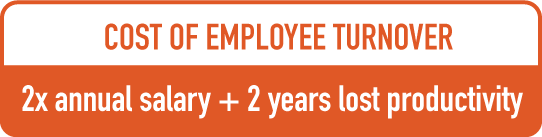
reduce the cost of employee turnover


When Talent Leaves, So Does Your Edge

Losing top talent isn’t just about replacing a role. It’s losing the client relationships, institutional knowledge, and team dynamics that drove results. And the impact multiplies—remaining employees face heavier workloads and tighter deadlines, pushing even more people toward the exit.

When Growth Conversations Don’t Happen, Trust Breaks Down

Here’s what the data shows: 70% of employees who leave never discussed their growth before quitting, and over half didn’t feel recognized for their contributions. These aren’t unsolvable problems—but they become invisible if you’re not actively listening. And when feedback feels ignored, employees stop sharing. That silence erodes engagement and trust—long before a resignation letter hits your desk.


Your Culture Speaks Volumes—Even When You Don’t

When high performers leave and concerns go unanswered, people notice. Internally, it signals that development and recognition aren’t a priority. Externally, it raises questions for clients and partners about leadership and stability. And in a competitive talent market, your reputation as an employer can shift quickly—without you realizing it.


Competitors Are Watching—And Benefiting

Every departure is an opportunity for your competitors. They gain access to hard-earned knowledge about your clients, strategies, and operations. They target your top talent during times of transition—and use your turnover to strengthen their own teams. When retention breaks down, you’re not just losing people. You’re fueling someone else’s growth.


The Productivity Spiral: Why Firefighting Isn’t a Long-Term Strategy


“When we act on turnover without data, measurement, and strategy, it creates a vicious cycle that isn’t good for anyone,” says Meghan Freeman, Product Manager at Quantum Workplace. 


Constant hiring. Constant training. No time to build momentum. Teams lose rhythm, projects stall, and knowledge walks out the door. And with new hires taking up to 12 months to ramp up, your competitors gain ground while you play catch-up.


What HR Leaders Are Doing: Real Stories of Smarter Retention

Forward-thinking HR teams aren’t waiting for turnover to hit—they’re using predictive insights to get ahead of it. Check out these employee retention case studies to see how leaders across industries are transforming retention into a competitive advantage.


Certus: Getting Ahead of Turnover With Targeted Talent Reviews

At Certus, Susan Battles, Director of Talent, is reshaping retention by shifting key decisions upstream. Instead of reacting after a resignation, her team conducts proactive talent reviews before compensation planning. They use performance data, growth potential, and business impact to identify who’s most critical to keep—and why.


“We don’t want to be scrambling when a key contributor resigns,” Battles explains. “We want to stay ahead of turnover risks and create the conditions that make high-impact talent segments want to stay. Not every exit is a bad one—but if someone in our ‘Stretch & Grow’ category is thinking about leaving, we want to step in before they walk out the door.”

Her strategy is rooted in precision: “The bottom line: You need to have the right data to be educated on where to invest,” Battles emphasizes. “Talent reviews, engagement data, and performance insights all need to come together so you can determine where to focus retention efforts—and where to let go.”


ODW Logistics: Cutting Turnover From 51% to 14% Through Manager Enablement

Jill Spohn, Leadership Development Manager at ODW Logistics, faced a tough reality: 51% voluntary turnover in an industry where high attrition is the norm. But instead of relying solely on HR-led fixes, she empowered managers to lead the charge.


“This survey and the strategies that came from the results directly correlate to our record-low voluntary turnover rates,” Spohn reports. “After a full engagement survey and pulse survey cycle, voluntary turnover was 14.33%. That is unbelievably low, specifically for our industry.”


By giving managers the tools to coach, connect, and act on feedback, ODW shifted the retention burden from HR alone to the entire leadership team—building a culture where people wanted to stay.


Twin Cities Manufacturing: Pinpointing Problems With Data That Works

At one of the Midwest’s largest privately held manufacturers, HR leaders are using layered listening—engagement, pulse, and lifecycle surveys—to diagnose turnover challenges in real time.


Their Organization Effectiveness Leader explains their approach: “The labor market is really tight right now, and we get a lot of great intel from the surveys to help us improve the employee experience and understand why people might be leaving.”


By diving deep into team- and role-specific data, the company uncovered issues like misaligned workload expectations and early-stage comp dissatisfaction—then acted before those issues became flight risks. Their focus on employee retention analytics at the team level enables smarter interventions that keep high-value talent on board.


Start Reducing Turnover This Quarter


“Data alone doesn’t solve problems,” reminds Todd Pernicek, Senior Insights Analyst at Quantum Workplace. “Acting on feedback does. Employees will only keep sharing if they believe it leads to change.”


Here’s how forward-looking HR teams are putting that principle into action now—not next year.


act on feedback to reduce employee turnover


Spot Risk Early With Predictive Analytics

Start by consolidating key data sources—engagement surveys, performance reviews, and behavioral signals—to uncover early signs of flight risk. Focus initial efforts on your highest-impact talent. Technology that unifies these insights makes it easier to identify warning signs before decisions are made.

Focus Strategically on High-Impact Talent 

Retention isn’t a volume game—it’s a value game. Prioritize employees based on three dimensions:

  1. Criticality of their role
  2. Performance level
  3. Institutional knowledge

Targeted strategies here will deliver outsized returns compared to broad, one-size-fits-all programs.


Equip Managers With Insights and Playbooks

Put real-time engagement and retention data in the hands of your frontline managers—along with actionable playbooks to guide their next steps. Train leaders to spot disengagement early, and encourage regular check-ins with high-impact employees before risks escalate.


Make Retention a Leadership Metric

When retention is part of a manager’s performance evaluation, it becomes a priority. Tie career growth for leaders to their ability to keep top talent engaged and retained—and give them the tools to succeed.

Act fast & learn faster.

Retention wins don’t come from waiting. Move quickly on employee feedback—especially from high performers—and track what’s working. Watch early signals:

  • Engagement scores for critical talent
  • Frequency of career conversations
  • Participation in development programs
  • Internal promotion rates

Then refine your approach based on what you learn

Make Turnover Predictive—Not Inevitable

It’s time to shift from reactive to strategic. Discover how leading organizations are staying ahead of attrition and building resilient, high-performing teams—no matter the market.

Explore all seven trends in the 2025 Workplace Trends Report and start strengthening retention today.

Read the Report >>


New imaging technique reconstructs the shapes of hidden objects | MIT News

0

A new imaging technique developed by MIT researchers could enable quality-control robots in a warehouse to peer through a cardboard shipping box and see that the handle of a mug buried under packing peanuts is broken.

Their approach leverages millimeter wave (mmWave) signals, the same type of signals used in Wi-Fi, to create accurate 3D reconstructions of objects that are blocked from view.

The waves can travel through common obstacles like plastic containers or interior walls, and reflect off hidden objects. The system, called mmNorm, collects those reflections and feeds them into an algorithm that estimates the shape of the object’s surface.

This new approach achieved 96 percent reconstruction accuracy on a range of everyday objects with complex, curvy shapes, like silverware and a power drill. State-of-the-art baseline methods achieved only 78 percent accuracy.

In addition, mmNorm does not require additional bandwidth to achieve such high accuracy. This efficiency could allow the method to be utilized in a wide range of settings, from factories to assisted living facilities.

For instance, mmNorm could enable robots working in a factory or home to distinguish between tools hidden in a drawer and identify their handles, so they could more efficiently grasp and manipulate the objects without causing damage.

“We’ve been interested in this problem for quite a while, but we’ve been hitting a wall because past methods, while they were mathematically elegant, weren’t getting us where we needed to go. We needed to come up with a very different way of using these signals than what has been used for more than half a century to unlock new types of applications,” says Fadel Adib, associate professor in the Department of Electrical Engineering and Computer Science, director of the Signal Kinetics group in the MIT Media Lab, and senior author of a paper on mmNorm.

Adib is joined on the paper by research assistants Laura Dodds, the lead author, and Tara Boroushaki, and former postdoc Kaichen Zhou. The research was recently presented at the Annual International Conference on Mobile Systems, Applications and Services.

Reflecting on reflections

Traditional radar techniques send mmWave signals and receive reflections from the environment to detect hidden or distant objects, a technique called back projection.

This method works well for large objects, like an airplane obscured by clouds, but the image resolution is too coarse for small items like kitchen gadgets that a robot might need to identify.

In studying this problem, the MIT researchers realized that existing back projection techniques ignore an important property known as specularity. When a radar system transmits mmWaves, almost every surface the waves strike acts like a mirror, generating specular reflections.

If a surface is pointed toward the antenna, the signal will reflect off the object to the antenna, but if the surface is pointed in a different direction, the reflection will travel away from the radar and won’t be received.

“Relying on specularity, our idea is to try to estimate not just the location of a reflection in the environment, but also the direction of the surface at that point,” Dodds says.

They developed mmNorm to estimate what is called a surface normal, which is the direction of a surface at a particular point in space, and use these estimations to reconstruct the curvature of the surface at that point.

Combining surface normal estimations at each point in space, mmNorm uses a special mathematical formulation to reconstruct the 3D object.

The researchers created an mmNorm prototype by attaching a radar to a robotic arm, which continually takes measurements as it moves around a hidden item. The system compares the strength of the signals it receives at different locations to estimate the curvature of the object’s surface.

For instance, the antenna will receive the strongest reflections from a surface pointed directly at it and weaker signals from surfaces that don’t directly face the antenna.

Because multiple antennas on the radar receive some amount of reflection, each antenna “votes” on the direction of the surface normal based on the strength of the signal it received.

“Some antennas might have a very strong vote, some might have a very weak vote, and we can combine all votes together to produce one surface normal that is agreed upon by all antenna locations,” Dodds says.

In addition, because mmNorm estimates the surface normal from all points in space, it generates many possible surfaces. To zero in on the right one, the researchers borrowed techniques from computer graphics, creating a 3D function that chooses the surface most representative of the signals received. They use this to generate a final 3D reconstruction.

Finer details

The team tested mmNorm’s ability to reconstruct more than 60 objects with complex shapes, like the handle and curve of a mug. It generated reconstructions with about 40 percent less error than state-of-the-art approaches, while also estimating the position of an object more accurately.

Their new technique can also distinguish between multiple objects, like a fork, knife, and spoon hidden in the same box. It also performed well for objects made from a range of materials, including wood, metal, plastic, rubber, and glass, as well as combinations of materials, but it does not work for objects hidden behind metal or very thick walls.

“Our qualitative results really speak for themselves. And the amount of improvement you see makes it easier to develop applications that use these high-resolution 3D reconstructions for new tasks,” Boroushaki says.

For instance, a robot can distinguish between multiple tools in a box, determine the precise shape and location of a hammer’s handle, and then plan to pick it up and use it for a task. One could also use mmNorm with an augmented reality headset, enabling a factory worker to see lifelike images of fully occluded objects.

It could also be incorporated into existing security and defense applications, generating more accurate reconstructions of concealed objects in airport security scanners or during military reconnaissance.

The researchers want to explore these and other potential applications in future work. They also want to improve the resolution of their technique, boost its performance for less reflective objects, and enable the mmWaves to effectively image  through thicker occlusions.

“This work really represents a paradigm shift in the way we are thinking about these signals and this 3D reconstruction process. We’re excited to see how the insights that we’ve gained here can have a broad impact,” Dodds says.

This work is supported, in part, by the National Science Foundation, the MIT Media Lab, and Microsoft.

SmartThings Blog

0

If you haven’t heard, starting July 8, 2025, Sonos will begin rolling out updates to its platform to comply with new EU Radio Equipment Directive (RED) Regulations. While these regulations originate in the EU, the upcoming platform changes will affect all Sonos users globally, including those using SmartThings integrations.

Read on for a breakdown of what’s changing, how it may impact you, and what you may need to do to keep everything working smoothly.

What’s Changing?

Sonos is introducing a new feature in its app that allows users to require authentication for third-party control integrations, like SmartThings. This is a user-controlled, opt-in change. Which means, if you don’t take any action, your existing Sonos integrations with SmartThings will continue to work as usual.

However, if your speakers were connected through the Sonos app and you decide to  opt in to the new third-party authentication requirement: 

  • You’ll need to link your Sonos and SmartThings accounts to keep your integration running. Once linked, everything will continue to work as normal, including routines and automations.
  • SmartThings will send a notification via the SmartThings app prompting you to connect your accounts.

If you use an EOL hub and wish to continue using your Sonos speakers, do not opt in to the third-party authentication requirement in the Sonos app. 

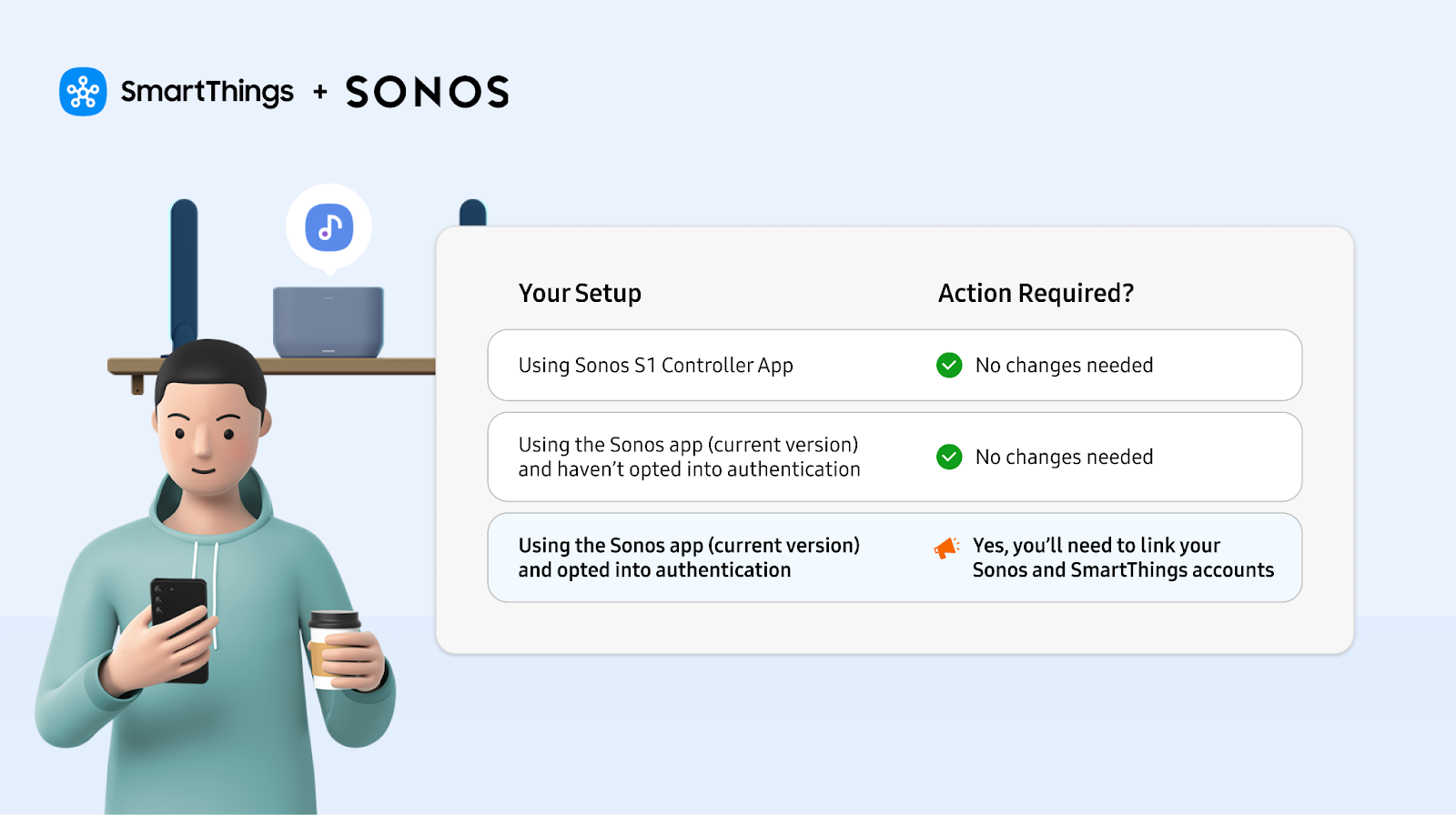
Not sure if the update will affect you? Use this chart to double-check. 

How to Link a Device Account in the SmartThings App

Follow these steps to link your Sonos account to SmartThings seamlessly. 

Step 1: Open and sign in to the SmartThings app.

Step 2: Tap the “+” sign in the upper right corner.

Step 3: Tap “Add Device.”

Step 4: Search for the service by brand or category.

Step 5: Tap “Link Account” or a similar option.

Step 6: Sign in to your account with the third-party service.

Step 7: Authorize SmartThings to access your account. Your devices or services will appear in SmartThings under Devices or Linked Services.

Visit the SmartThings blog to learn more about SmartThings and partner updates.