Home Blog Page 50

The 6 Best Career Pathing Tools for Building a Future-Ready Workforce

0

Career pathing is one of the most effective ways to keep employees engaged, grow your talent from within, and prepare your workforce for what’s next. But for many organizations, it remains a missed opportunity.

Employees don’t see a future in their organizations. Managers aren’t equipped to guide development. And HR teams are left navigating disconnected systems that weren’t built to scale. 

When that happens, growth stalls. Retention suffers. And your top performers start looking elsewhere. 

This guide is built to help you course-correct. We’ve evaluated the top career pathing platforms of 2025—using real feedback from real users—to give you a clear, practical comparison. Whether you’re laying the foundation or optimizing what’s already in place, you’ll walk away with the insight you need to make the right call and act with confidence. 


Why career pathing tools matter

HR leaders today face growing pressure to drive engagement, close skill gaps, and build a workforce that can adapt fast. But between rapid technological change, shifting employee expectations, and the demand for measurable impact, traditional development efforts aren’t enough.

Here’s what’s at stake:

Retention and Engagement Challenges  

Top talent won’t wait around. Employees want to know there’s a future for them at your organization—and they’re more likely to stay when they see clear paths for growth. 

Widening Skills Gaps

AI and automation are evolving faster than most skillsets. HR teams need better ways to identify gaps, prioritize capabilities, and drive meaningful upskilling and reskilling efforts. 

One Workforce, Many Expectations

From Gen Z to Gen X, today’s workforce isn’t one-size-fits-all. People want personalized development, flexible learning, and support that meets them where they are. 

The Push for People-Centric Insights

HR leaders are under growing pressure to prove impact. That means turning development into a measurable, data-informed strategy—not just another program. 

Career pathing tools are built for this moment. They connect employee aspirations to real opportunities, equip managers to lead better conversations, and give HR the visibility to drive meaningful, measurable growth.

And when internal mobility becomes part of the culture, organizations benefit too—employees stay 41% longer when strong internal hiring programs are in place.

Career pathing isn’t a “someday” initiative. It’s a strategic must-have for building a resilient, future-ready workforce—starting now. 

Where most organizations go wrong

Most companies care about employee growth. But without the right foundation, career pathing often falls short. Employees are left confused about their next steps. Managers don’t know how to guide the conversation. And HR ends up trying to connect the dots with systems that don’t scale. Here’s where things tend to break down: 

Lack of context 

Managers often don’t know what their employees want—or what the business needs. That disconnect makes development conversations vague or reactive. Without a clear picture of skills, goals, and company direction, it’s hard to move anyone forward. 

Lack of transparency 

Employees can’t grow toward something they can’t see. When roles, expectations, or paths forward aren’t clearly defined, it creates confusion and erodes trust. Career growth shouldn’t feel like guesswork. It should be easy to understand and act on. 

Lack of structure 

Many organizations want to support development—but lack the structure to make it work. Job roles are fuzzy. Skills and expectations aren’t documented. And career progression is left open to interpretation. That makes it hard for managers to coach effectively and for employees to take the lead on their growth. 

When career pathing lacks clarity, transparency, and structure, employees are left to figure it out alone. That erodes engagement—and accelerates turnover. 

Getting it right takes more than a new career development platform. It requires a shift in how organizations think about growth. Career pathing should be part of the everyday employee experience—built on clear frameworks, backed by the right tools, and led by managers who are equipped to help people move forward. 

What is career pathing software?

Career pathing software helps employees see where they can grow—and how to get there. It connects their strengths, skills, and goals to real opportunities inside your organization.

With personalized development plans and clear visibility into what’s next, employees feel more engaged and invested in their future. 

For HR and managers, career pathing software brings structure and scale to development. It equips leaders with the tools and insights to support growth, track progress, and build a stronger internal talent pipeline. 


When to invest in career pathing software

Career pathing software becomes essential when growth is no longer optional—when retaining talent, preparing future leaders, or closing skill gaps moves to the top of your priority list. 

It’s especially critical during periods of change: rapid growth, leadership transitions, reorganizations, or digital transformation. If employees are unsure how to grow, if managers aren’t having meaningful development conversations, or if HR lacks visibility into skill readiness—it’s time to make a shift. 

Career pathing software turns scattered efforts into a strategic, scalable approach—one that drives retention, readiness, and results. 


Features to look for in career pathing software

Not every career pathing platform drives real growth. It’s not enough to simply map roles or show possible next steps. The right tool should help employees take action, enable managers to lead better conversations, and keep development aligned with your broader talent strategy. 

The best platforms make career growth part of everyday work. They give employees clarity and ownership, help managers coach with purpose, and tie directly into performance, talent reviews, and succession planning. When it all works together, you don’t just support development—you power a future-ready workforce. 

Here’s what to prioritize: 


Career Pathing & Visioning
 

Help employees explore what’s possible—not just promotions, but lateral moves, skill shifts, and new challenges. Look for platforms that offer AI-powered prompts or reflection tools to help employees get started and think bigger. 


Competency Frameworks
 

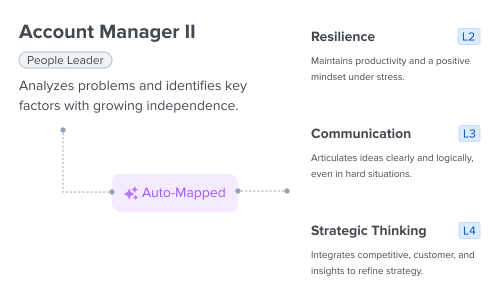
Strong frameworks define what success looks like in each role. Whether custom-built or AI-generated, they connect the dots between roles, skills, and learning—so development is focused and relevant. 
career pathing software quantum workplace


Growth Planning & Action Steps
 

Give employees a clear path forward with structured plans, milestones, and timelines. Bonus points for tools that recommend next steps, coaching tips, or learning resources based on individual goals. 

Manager Visibility & Coaching Tools 

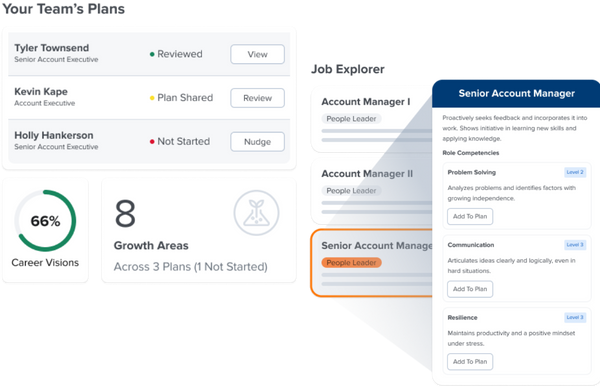
Managers are key to making development stick. Choose a platform that gives them visibility into team aspirations and equips them with guided tools to support career conversations in real time. 
career pathing solutions quantum workplace


Transparent Career Opportunities
 

Put internal mobility front and center. The right platform surfaces open roles, highlights required skills, and shows employees where they stand—so they can aim for what’s next with confidence. 

Workflow Integration 

Development shouldn’t happen in a vacuum. Look for tools that embed into performance reviews, 1-on-1s, and everyday systems. The more seamless the experience, the more likely it is to stick. 

Actionable Analytics 

HR teams need data that goes beyond usage stats. Real-time insights into adoption, progress, and impact help you double down on what’s working—and adjust what’s not. 

With the right tools, career development becomes more than an annual exercise. It becomes a living, evolving part of how people grow—and how organizations move forward. 

Compare the top career pathing tools


Supports continuous career convos?

Dedicated 1-on-1 meetings?

Lives with engagement and performance data?

Lives with succession and talent review data?

quantum-workplace employee growth planning employee development software


Best for:
Rapid deployment, organization-wide scalability, and tailored development—all connected to a cohesive talent management approach 

fuel50 logo

Best for: Skills-based platform for career pathing, upskilling, and internal mobility 

https://www.talentguard.com/


Best for:
Structured career pathing and employee development with workforce intelligence insights 

🚧

imocha logo

Best for: Formal development plans, goal tracking, and internal talent visibility 

growthspace logo


Best for: Basic AI matching for learning needs, without deeper career pathing or mobility support 

zavvy logo


Best for:
Visual career paths without advanced skills intelligence or workforce planning 

🚧

quantum-workplace-logo

Quantum Workplace

Quantum Workplace Growth reimagines career pathing as part of a larger, more strategic approach to employee development. The platform blends AI-guided career visioning, personalized growth plans, and real-time insights—making development a continuous, organization-wide habit, not just a one-time event. 

Employees gain clarity through guided reflections and smart suggestions tailored to their strengths and aspirations. Managers get the visibility and tools to lead better growth conversations. And HR can roll out scalable, competency-based programs with speed and confidence—powered by intelligent insights and built-in structure. 


💻 Key Features

  • AI-powered Career Vision and Growth Plans
  • Personalized, competency-based development 
  • Career Coach with plan suggestions 
  • Job Explorer for internal mobility 
  • Growth integrated into daily work 
  • Learning resources 
  • Manager dashboards and team visibility 


🌱 Get a demo of Quantum Workplace Growth! >>


😁 User Feedback

“We’re excited to implement Quantum Workplace’s Growth platform at our organization. Giving employees the tools and capability to create their own development pathways will bring us leaps and bounds forward in creating a culture of continuous growth and opportunity! We love that the tool empowers employees and their leaders to brainstorm and discuss together.” 

Kelsey Freie 
Organizational Development Specialist at AgriBank 


👍 Why it’s a contender

Quantum Workplace stands out by focusing on development as a shared responsibility—empowering employees, equipping managers, and enabling HR to scale impact. It connects growth to business outcomes and integrates into the flow of work, making it easier for organizations to build a culture of continuous development. 

👎 Where it falls short

For teams looking for deep integrations with external learning management systems (LMS), Quantum Workplace may not yet match the automation capabilities of older, legacy platforms. While learning resources can be linked within the tool, more advanced LMS connectivity may depend on your existing tech stack and specific needs. 

 

fuel50 logo

Fuel50

Fuel50 is a well-established player in the talent marketplace space, offering a robust, skills-based approach to career development. The platform goes beyond simple role matching to create a dynamic internal ecosystem—connecting career pathing, upskilling, and internal mobility into a unified experience. 

By aligning employee aspirations with evolving business needs, Fuel50 helps organizations build a more agile, future-ready workforce. Its deep focus on skills intelligence and marketplace functionality makes it a strong choice for enterprises looking to drive strategic talent movement at scale. 

💻 Key features

  • AI Career Journeys – Personalized, skill-based career paths 
  • Career Path Maps – Visual exploration of roles and paths 
  • Skills Gap Analysis – Shows what’s needed for next-step roles 
  • Role & Project Matching – Connects talent to internal opportunities 
  • Manager Coaching Tools – Supports career conversations 
  • Dynamic Talent Profiles – Real-time skills and goals tracking 
  • Learning Integration – Links growth plans to learning content 

👍 Why it’s a contender

Fuel50 stands out for its user-friendly experience and personalized approach to career development. The platform helps employees map their goals, explore tailored career pathways, and access tools like career assessments and mentoring—all within a single system. Managers benefit from visibility into employee interests and skill gaps, making it easier to guide growth and align development plans with business needs. 


👎 Where it falls short

Some users report that Fuel50’s reporting capabilities are limited—especially when navigating complex org structures or managing dotted-line relationships. Custom reporting often requires time-consuming back-and-forth with support. Additionally, the platform relies on older data transfer methods like SFTP, which can pose challenges around efficiency and integration compared to modern API-based systems.

While Fuel50 was an early innovator in the space, some users feel recent updates haven’t kept pace with expectations, citing a desire for enhanced mentoring features and more advanced AI coaching capabilities. 

 
talenguard logo

TalentGuard

TalentGuard is a workforce intelligence platform designed to strengthen employee development and internal mobility. Its career pathing features help employees create personalized development plans, set clear goals, and access resources that support long-term growth. The platform aims to make career progression more transparent, structured, and aligned to both individual and business needs. 

💻 Key Features

  • AI-Powered Career Pathing – Creates personalized paths based on skills, interests, and goals 
  • Career Canvas – Visualizes career trajectories and required competencies 
  • Career GPS – Guides employees through steps to reach future roles 
  • Talent Marketplace – Surfaces internal opportunities aligned to employee aspirations 
  • Mentor Match – Connects employees with mentors to support career growth 


👍 Why it’s a contender

TalentGuard earns high marks for its focused approach to career development. Users appreciate how clearly the platform outlines role expectations, skill requirements, and potential career paths—giving employees the information they need to take ownership of their growth. Features like multi-path planning and skill gap tracking help make development more actionable and easier to navigate. 

👎 Where it falls short

While TalentGuard offers robust capabilities, some users have noted a learning curve during initial setup, especially in complex org environments. The platform’s flexibility can require hands-on configuration to tailor it effectively. A few users also mention that the interface, while functional, feels dated and could benefit from a more modern design. Integration with HR systems may require technical support, and some customers would like to see more frequent updates to match the pace of evolving talent strategies. 


imocha logo
iMocha

iMocha is a skills intelligence platform built to power a skills-first talent strategy. It enables organizations to assess, manage, and grow workforce capabilities through a comprehensive suite of tools—including robust skills assessments, AI-driven insights, and personalized learning recommendations. The platform supports data-informed decisions across hiring, development, and internal mobility. 

💻 Key Features

  • Skills Assessments – 3,000+ tests across technical, cognitive, and soft skills 
  • Skills Intelligence – AI-powered insights into workforce capabilities 
  • Gap Analysis – Identifies skill gaps and recommends upskilling 
  • Smart Proctoring – Ensures secure, cheat-proof assessments 
  • Integrations – Connects with ATS, LMS, and HR systems seamlessly
     

👍 Why it’s a contender

iMocha is a strong choice for organizations prioritizing a skills-based approach to development. Its expansive assessment library and AI-driven insights make it easy to pinpoint skill gaps, guide upskilling, and align employee development with business goals. Users value the platform’s ability to surface actionable workforce data, supporting smarter internal mobility and succession planning.

👎 Where it falls short

Some users report a steep learning curve during setup, particularly when configuring the platform for complex use cases. While functional, the user interface has been described as less intuitive, which may impact initial adoption. Integration with HR systems is available but may require additional technical support depending on your tech stack. 

 

growthspace logo
GrowthSpace

Growthspace is a precision skill development platform that connects employees with domain experts for targeted learning experiences. Using AI to match individuals with coaches, mentors, and facilitators, Growthspace delivers personalized upskilling through one-on-one sessions, group workshops, and internal mentoring. Its focus on development sprints makes learning fast, focused, and measurable—aligned to both role needs and business goals. 

💻 Key Features

  • Career Pathway Programs – Role-specific development tracks 
  • Development Sprints – Short, focused upskilling sessions 
  • AI Matching – Personalized coach and mentor pairing 
  • Flexible Formats – 1:1, group, and workshop options 
  • Internal Mentoring – Peer and leader guidance 
  • Skills Tracking – Progress tied to role competencies
     

👍 Why it’s a contender

Growthspace offers a scalable, highly personalized approach to employee development. The platform connects employees with the right experts to tackle specific goals—driving relevant growth and stronger performance. Users value the flexibility of format, ease of expert selection, and clear data on outcomes. It’s a strong option for organizations focused on closing skill gaps, boosting internal mobility, and making career growth feel personal and actionable. 
 

👎 Where it falls short

Some users have encountered challenges with coach availability across global time zones, which can complicate scheduling for distributed teams. While AI matching is generally effective, it occasionally takes a few tries to find the right fit. Additionally, the platform’s emphasis on short-term development sprints may not fully support employees looking for more long-range, strategic career planning. 
zavvy logo
Zavvy (now part of Deel)

Zavvy, now part of Deel, is a career development platform designed to bring clarity, structure, and consistency to employee growth. It helps organizations define role expectations, build competency-based frameworks, and support development through visual career paths, AI-generated plans, and structured feedback. The platform empowers employees to take ownership of their growth, while giving HR and managers the tools to guide it with confidence. 


💻 Key Features

  • Career Frameworks – Define roles and competencies 
  • Visual Pathing – Map clear growth trajectories 
  • AI Support – Auto-generate plans and frameworks 
  • 360° Feedback – Support development with structured input 
  • Development Plans – Align learning with career goals 

👍 Why it’s a contender

Zavvy streamlines career development with automation and self-service features that reduce manual lift for HR teams. Employees can explore career paths, receive tailored learning suggestions, and build plans based on role expectations—all within a unified platform. Managers get visibility into employee goals, while HR benefits from a scalable, competency-driven approach to development. 
 

👎 Where it falls short

As a newer platform, Zavvy may lack some of the advanced features and configurability required by large, complex organizations. While it’s well-suited for growing companies, enterprise teams may encounter limitations around deep customization, compliance management, or large-scale integrations. Its integration ecosystem is evolving, but not yet as mature as more established players in the space. 


Getting the most out of your career pathing software

Career pathing software shouldn’t be a static system where plans go to collect dust. To create real value, it needs to be an active part of your talent strategy. 

Start by connecting career conversations to performance discussions. When growth and impact are part of the same dialogue, you build a shared language across your organization. Equip managers to go beyond evaluation—give them visibility into employee goals and simple tools to support development in the flow of work. 

Encourage employees to explore more than just upward moves. Lateral shifts, stretch projects, and skill-building opportunities all play a role in meaningful growth. And make development visible—through integrated workflows, personalized plans, and regular check-ins that keep momentum going. 

When career growth is manager-supported, employee-owned, and aligned to business needs, your platform becomes more than a tool. It becomes a driver of engagement, retention, and future readiness. 


Evaluating career pathing tools

Employee experience

  • Can employees create personalized, skill-based career paths? 
  • Does the tool help employees connect daily work to long-term growth? 
  • Are role expectations and required skills clear and accessible?
  • Are there AI-driven or guided suggestions to help employees take the next step? 
  • Is development embedded throughout the year, not just during review cycles? 
  • Can employees track progress toward their goals and roles in real time? 

Manager enablement

  • Can managers easily see each employee’s career goals and progress? 
  • Are there tools to guide effective career-focused 1-on-1s? 
  • Can managers contribute to growth without owning the whole process? 
  • Are there prompts or nudges to help managers have timely development conversations? 

Coaching, learning, and mentorship

  • Are development actions tied to measurable skill or role progress? 
  • Does the platform integrate coaching, mentoring, or peer learning opportunities? 
  • Are learning resources aligned to employee goals and growth areas? 
  • Can employees track actions, reflect on growth, and adjust plans as needed?  

HR & administrative functionality

  • Can HR quickly build and scale career frameworks across roles and teams? 
  • Are there insights into adoption, engagement, and career progress by group? 
  • Can career pathing data support L&D, performance, and succession strategies? 
  • Is the platform flexible enough to support diverse org structures? 

Scalability, security, and integration

  • Is the platform secure and compliant with enterprise standards? 
  • Can it scale across teams, locations, and role types? 
  • Does it integrate with existing HRIS, performance, and learning tools? 
  • Are reporting and analytics clear, actionable, and strategic? 


Build a future-ready workforce with Quantum Workplace Growth

Career development shouldn’t feel like a burden. It should be clear, guided, and continuous, enabling you to fuel employee growth at scale. 

  • Make employee development plans effortless
  • Personalize employee growth plans for every employee
  • Weave development into the flow of work
  • Show employee transparent career pathing possibilities
  • Equip leaders with insights to drive strategic employee growth

🌱 To see how our career pathing tools can make a difference, schedule a demo.

quantum workplace employee growth plans


Career Pathing Software FAQs 


How do I choose the right career pathing software?

Choose a solution that’s easy for employees and managers to adopt—even without a rigid process already in place. The right career pathing software should support flexible development, scale as your organization grows, and provide visibility into employee progress without adding administrative burden or requiring complex integrations. 

What features should I prioritize in a career pathing platform?

Look for tools that help employees define their career vision, explore growth opportunities, and build personalized paths supported by AI-driven suggestions. Prioritize features like role-based competency frameworks, progress tracking, manager visibility, and actionable analytics that empower HR to drive and evolve development strategies. 

How much do career pathing software cost?

Career pathing software pricing varies by provider, feature set, and organization size. Look for a solution that delivers measurable value quickly—without requiring heavy implementation, a large team, or long lead times. Ease of launch and scalability should factor just as much as cost. 

Is career pathing software customizable?

Yes. Leading platforms allow you to tailor competencies, career models, and development plans to match your company’s structure, culture, and goals. The best tools strike a balance between flexibility and ease of use—so you can configure what you need without a complicated setup process. 

What are the benefits of using career pathing software?

Career pathing software helps employees visualize their future and take actionable steps toward growth. It improves retention, boosts internal mobility, and supports more meaningful development conversations. It also gives managers structure to coach effectively and provides HR with insights to build smarter, data-driven strategies. 

Can career pathing software integrate with other HR software?

Yes—leading platforms offer integrations with HRIS, LMS, and performance management systems, making it easier to embed development into daily workflows. These connections streamline data sharing, reduce duplication, and ensure development plans stay aligned with broader talent strategies and organizational goals. 

What kind of career pathing software do I need and why?

You need a platform that’s intuitive for employees, lightweight for managers, and powerful for HR. The right career pathing software should make it easy to scale personalized growth, connect development to business needs, and turn career conversations into real momentum. It’s not just about software—it’s about building a culture of growth that sticks. 


Note: The information presented on this page is sourced from third party review sites, vendor websites, and user reviews as of June 2025.

While we strive to ensure accuracy, product features, integrations, and capabilities may change over time. We encourage readers to verify details directly with the respective vendors before making a purchase decision.

If you notice any discrepancies or outdated information, please contact us at marketing@quantumworkplace.com so we can update our content accordingly.

 

Generate single title from this title Top 9 AI App Development Companies in the USA 2025 in 100 -150 characters. And it must return only title i dont want any extra information or introductory text with title e.g: ” Here is a single title:”

Write an article about

As companies scramble to incorporate AI into mobile, web, and enterprise applications, the need for AI app development companies is expected to soar in 2025. The USA continues to be a global centre for AI application development services, whether the focus is on developing more intelligent chatbots, automating healthcare processes, or designing personalised experiences.

We have examined the top AI app development companies renowned for their creativity, effectiveness, and client satisfaction to assist you in finding the ideal partner. From generative models and natural language processing to predictive analytics and voice-based platforms, each of these companies provides distinct advantages in AI app development services.


1. LITSLINK – Palo Alto, CA

LITSLINK, a top supplier of AI app development services for startups and businesses, is at the top of the list. Their interdisciplinary teams have successfully introduced hundreds of AI-powered products in sectors like healthcare, education, fintech, and logistics.

LITSLINK offers:

They have collaborated with multinational corporations to develop personalised recommendation engines, fraud detection systems, and chatbots that cater to millions of users in various industries. LITSLINK customises each AI solution to match particular business goals, whether that be improving user experience through intelligent automation or thwarting fraud in real time.

They are the perfect partner for both startups and Fortune 500 companies because of their scalable delivery model, which supports everything from quick MVP development to long-term enterprise growth. LITSLINK has earned its reputation as one of the most reputable names in the industry with a solid portfolio, track record of success, and in-depth knowledge of cutting-edge AI technologies.

LITSLINK has partnered with clients such as Motorola Solutions, Quickpix, My Deal File, Glowbal Restaurant Group, Mainframe Real Estate, BuyBay, and many others. Their reliable communication and prompt responsiveness set them apart as a trusted collaborator. By leveraging LITSLINK’s artificial intelligence app development services, clients have experienced notable growth in their customer base, improved sales conversions, and higher user engagement

Check out AI case studies to explore more.

Ready to Elevate Your Business with a Custom AI App?

Get started today!


2. Biz4Group – Orlando, FL

Biz4Group is known for providing high-impact AI solutions in the fields of healthcare, real estate, and retail. They are a preferred partner for businesses looking for AI app development services with an emphasis on usability and return on investment because of their expertise in creating voice-activated assistants and predictive analytics dashboards.

They are among the best AI app development companies in the USA because of their end-to-end process, which includes strategy, model training, and deployment.


3. Master of Code Global – Chicago, IL

Master of Code Global, a conversational AI specialist, creates sophisticated voice and chat applications that enable smooth, human-like interactions on various digital platforms. Their specialty is creating and implementing intelligent agents that can comprehend natural language and gradually adjust to the actions of users. Their portfolio includes advanced chatbots for customer service, appointment scheduling, and medical diagnosis—solutions that are HIPAA-compliant and customised to meet the unique requirements of telemedicine startups, insurers, and healthcare providers.

In addition to healthcare, they have assisted SaaS and e-commerce businesses in drastically cutting customer support expenses by automating up to 70% of routine questions. Their clever user interfaces are designed to boost conversion rates, improve engagement, and provide real-time personalised experiences. The ability of Master of Code to transform intricate, unstructured datasets into useful insights that drive AI systems that get smarter with each interaction is what makes them unique.


4. Innostax – Atlanta, GA

Deep knowledge of enterprise-level automation, predictive modelling, and machine learning is provided by Innostax Tech LLC. They integrate AI capabilities into backend systems, SaaS tools, and mobile apps for both Fortune 500 companies and startups.

Their data science team helps clients implement solutions using safe, scalable cloud infrastructure, and they are especially skilled in predictive risk scoring and medical AI.


5. Tepia – Costa Mesa, CA

Tepia is a great choice if you’re looking for a team that combines AI and creativity. They create intelligent mobile applications with AI built in for industries like on-demand delivery, real estate, and e-commerce.

Among their projects are facial recognition software, intelligent search functions, and dynamic pricing engines. Tepia’s dedication to rapid MVP delivery and Agile development has aided numerous startups in scaling swiftly and economically.


6. Moveworks – Mountain View, CA

Moveworks’ enterprise AI assistants are its most well-known product. These applications automate HR support and IT help desk tasks on platforms such as Teams, Slack, and ServiceNow. Their AI-powered bots handle routine requests, troubleshoot technical problems, and react instantly to employee enquiries.

When paired with natural language comprehension, this enterprise focus has assisted large corporations in cutting expenses and increasing internal productivity.


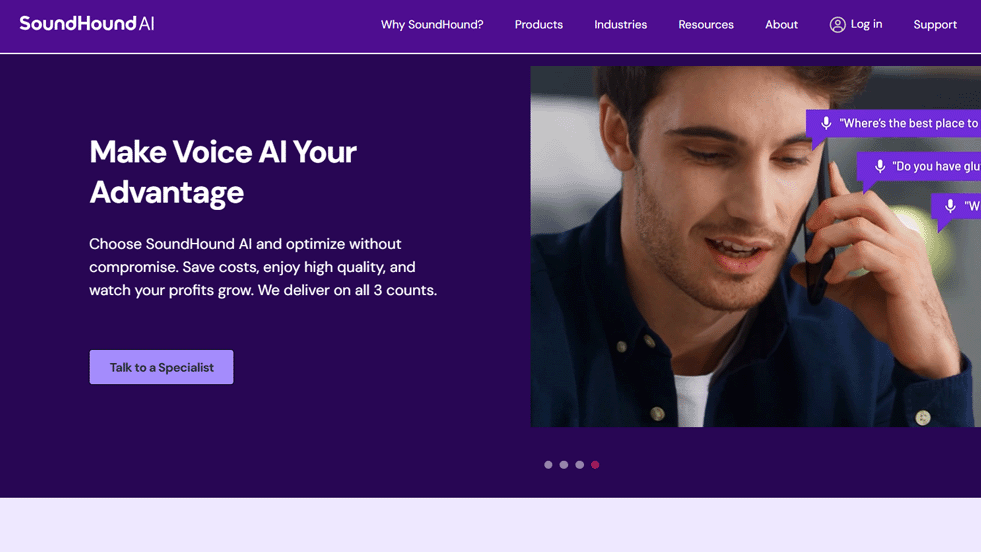
7. SoundHound AI – Santa Clara, CA

SoundHound, a leader in voice-based AI, powers conversational applications in the automotive, hospitality, and healthcare industries. Their patented technology eliminates the need for manual input and visual navigation by enabling users to interact with systems using natural speech.

Conversational AI is becoming crucial in industries that interact with consumers, as evidenced by the widespread adoption of their AI assistant “Amelia” in drive-through ordering platforms and patient intake systems.


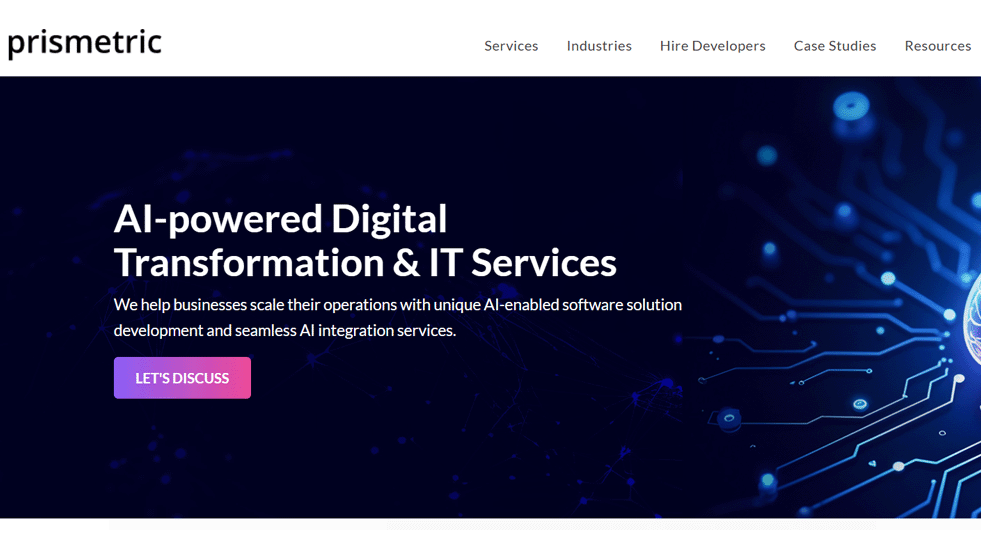
8. Prismetric – New York, NY

For startups wishing to incorporate intelligent features into their digital products, Prismetric offers AI-powered mobile apps. Their knowledge includes fraud detection systems that protect transactions, emotion-aware tools that adjust to user sentiment, and virtual assistants that streamline client communications. Even for sophisticated AI functionalities, these features are smoothly incorporated into elegant, user-friendly designs, guaranteeing a seamless experience.

Prismetric’s ability to strike a balance between speed and innovation is what makes them unique. They are frequently selected by startups due to their quick, Agile development cycles, which transform concepts into solutions that are ready for the market in a flash. They are a dependable option for industries like healthcare, e-commerce, and fintech because of their strong emphasis on UI/UX design and adherence to security best practices. Prismetric is a partner worth considering for any mobile-first company looking to differentiate itself with clever, scalable technology. They are also highlighted in industry reviews for their swift delivery and mobile app development expertise.


9. Runway AI – New York, NY

Runway AI has something unique to offer media and design firms. They are experts in generative AI tools, particularly for creative, image, and video editing. Traditional design workflows have been disrupted by their platform’s in-app AI editing features.

Runway’s sophisticated machine learning infrastructure and smooth cross-platform compatibility make it a popular choice for startups developing social media or creative platforms.

What Makes a Great AI App Development Company?

It’s difficult to choose from the best AI app development companies. Your industry, timeframe, financial constraints, and app objectives will all influence which partner is best for you. However, here are some qualities to search for:

  • Proven experience with similar AI use cases
  • Strong engineering talent across mobile and cloud
  • Clear process for testing and validation of AI models
  • Post-launch support and performance tracking
  • Transparent communication and Agile delivery

Request case studies, tech stack information, and scalability plans before signing a contract. A great company will assist you in developing a product that is ready for the future, not just an app. 

Want to hire top AI developers in the US?

Contact us!

Why the USA Leads in AI App Development

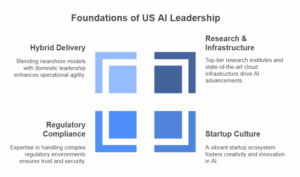
Thanks to a potent combination of top-tier research institutes, state-of-the-art cloud infrastructure, and a vibrant startup culture, the US continues to set the standard for AI innovation. The nation creates an atmosphere where advances in AI are not only feasible but also anticipated, from Silicon Valley to Boston’s biotech corridor. Because of this, American AI app development companies are constantly raising the bar for quality, scalability, and technical complexity worldwide.

Foundations of US AI Leadership

Beyond technical skill, American companies are well-positioned to handle intricate regulatory environments and apply advanced cybersecurity procedures, which is crucial in delicate sectors like healthcare, finance, and legal technology. Enterprise-grade solutions are guaranteed from the start thanks to their knowledge of HIPAA, GDPR, SOC 2, and other compliance standards.

Furthermore, many American businesses can now blend nearshore delivery models with domestic leadership thanks to the growth of hybrid and remote work. U.S. AI companies are innovative, operationally agile, and globally competitive thanks to this approach, which enables round-the-clock development, cost efficiency, and localised support.

Thinking About Building an AI App?

Working with the right AI app development company can have a big impact on your success, whether you’re preparing for a full-scale product launch or planning an MVP. These businesses do more than just write code; they contribute technical know-how, industry-specific knowledge, and strategic insight that help turn undeveloped concepts into intelligent, scalable applications.

AI is now a fundamental force behind innovation and user engagement in today’s competitive environment, not just a “nice-to-have.” AI is changing the way software provides value, from voice-powered interfaces that enable seamless accessibility to intelligent chat features that improve customer support to predictive engines that maximise decision-making. A knowledgeable development partner can help you with model selection, data management, deployment plans, and continuous enhancements to make sure your product doesn’t just launch but instead develops, adapts, and maintains its competitiveness in a digital world that is changing quickly.

Fortunately, we have a lot of experience developing AI apps. We can also do that for you. Let’s begin by getting in touch with us!

Get ahead of your competitors with our
best AI App Development services! 

Get a consultation!

.Organize the content with appropriate headings and subheadings ( h2, h3, h4, h5, h6). Include conclusion section and FAQs section with Proper questions and answers at the end. do not include the title. it must return only article i dont want any extra information or introductory text with article e.g: ” Here is rewritten article:” or “Here is the rewritten content:”

Using generative AI to help robots jump higher and land safely | MIT News

0

Diffusion models like OpenAI’s DALL-E are becoming increasingly useful in helping brainstorm new designs. Humans can prompt these systems to generate an image, create a video, or refine a blueprint, and come back with ideas they hadn’t considered before.

But did you know that generative artificial intelligence (GenAI) models are also making headway in creating working robots? Recent diffusion-based approaches have generated structures and the systems that control them from scratch. With or without a user’s input, these models can make new designs and then evaluate them in simulation before they’re fabricated.

A new approach from MIT’s Computer Science and Artificial Intelligence Laboratory (CSAIL) applies this generative know-how toward improving humans’ robotic designs. Users can draft a 3D model of a robot and specify which parts they’d like to see a diffusion model modify, providing its dimensions beforehand. GenAI then brainstorms the optimal shape for these areas and tests its ideas in simulation. When the system finds the right design, you can save and then fabricate a working, real-world robot with a 3D printer, without requiring additional tweaks.

The researchers used this approach to create a robot that leaps up an average of roughly 2 feet, or 41 percent higher than a similar machine they created on their own. The machines are nearly identical in appearance: They’re both made of a type of plastic called polylactic acid, and while they initially appear flat, they spring up into a diamond shape when a motor pulls on the cord attached to them. So what exactly did AI do differently?

A closer look reveals that the AI-generated linkages are curved, and resemble thick drumsticks (the musical instrument drummers use), whereas the standard robot’s connecting parts are straight and rectangular.

Better and better blobs

The researchers began to refine their jumping robot by sampling 500 potential designs using an initial embedding vector — a numerical representation that captures high-level features to guide the designs generated by the AI model. From these, they selected the top 12 options based on performance in simulation and used them to optimize the embedding vector.

This process was repeated five times, progressively guiding the AI model to generate better designs. The resulting design resembled a blob, so the researchers prompted their system to scale the draft to fit their 3D model. They then fabricated the shape, finding that it indeed improved the robot’s jumping abilities.

The advantage of using diffusion models for this task, according to co-lead author and CSAIL postdoc Byungchul Kim, is that they can find unconventional solutions to refine robots.

“We wanted to make our machine jump higher, so we figured we could just make the links connecting its parts as thin as possible to make them light,” says Kim. “However, such a thin structure can easily break if we just use 3D printed material. Our diffusion model came up with a better idea by suggesting a unique shape that allowed the robot to store more energy before it jumped, without making the links too thin. This creativity helped us learn about the machine’s underlying physics.”

The team then tasked their system with drafting an optimized foot to ensure it landed safely. They repeated the optimization process, eventually choosing the best-performing design to attach to the bottom of their machine. Kim and his colleagues found that their AI-designed machine fell far less often than its baseline, to the tune of an 84 percent improvement.

The diffusion model’s ability to upgrade a robot’s jumping and landing skills suggests it could be useful in enhancing how other machines are designed. For example, a company working on manufacturing or household robots could use a similar approach to improve their prototypes, saving engineers time normally reserved for iterating on those changes.

The balance behind the bounce

To create a robot that could jump high and land stably, the researchers recognized that they needed to strike a balance between both goals. They represented both jumping height and landing success rate as numerical data, and then trained their system to find a sweet spot between both embedding vectors that could help build an optimal 3D structure.

The researchers note that while this AI-assisted robot outperformed its human-designed counterpart, it could soon reach even greater new heights. This iteration involved using materials that were compatible with a 3D printer, but future versions would jump even higher with lighter materials.

Co-lead author and MIT CSAIL PhD student Tsun-Hsuan “Johnson” Wang says the project is a jumping-off point for new robotics designs that generative AI could help with.

“We want to branch out to more flexible goals,” says Wang. “Imagine using natural language to guide a diffusion model to draft a robot that can pick up a mug, or operate an electric drill.”

Kim says that a diffusion model could also help to generate articulation and ideate on how parts connect, potentially improving how high the robot would jump. The team is also exploring the possibility of adding more motors to control which direction the machine jumps and perhaps improve its landing stability.

The researchers’ work was supported, in part, by the National Science Foundation’s Emerging Frontiers in Research and Innovation program, the Singapore-MIT Alliance for Research and Technology’s Mens, Manus and Machina program, and the Gwangju Institute of Science and Technology (GIST)-CSAIL Collaboration. They presented their work at the 2025 International Conference on Robotics and Automation.

Generate single title from this title New partnership trains Michigan teachers for AI innovation in 100 -150 characters. And it must return only title i dont want any extra information or introductory text with title e.g: ” Here is a single title:”

Write an article about

Key points:

A new partnership between Michigan Virtual and the AI Education Project (aiEDU) will position Michigan for successful innovation opportunities within the AI in education space.

This collaboration will accelerate AI literacy and AI readiness across Michigan’s K-12 schools by expanding support for educators and leveraging the state’s existing network of instructional and educational technology coaches.

“Artificial intelligence is reshaping our world–and our classrooms. Michigan has a unique opportunity to lead,” said Jamey Fitzpatrick, President and CEO of Michigan Virtual. “By partnering with aiEDU, we’re not only empowering educators to understand and teach AI, but also building sustainable leadership capacity to scale this knowledge across Michigan.”

This strategic collaboration begins with a Train-the-Trainer initiative–a year-long program running from June 2025 through June 2026, designed to cultivate a core group of 50 Michigan educators as AI education leaders in their regions and districts. These trainers will be equipped to deliver foundational AI literacy training to colleagues, ultimately scaling impact and fostering equitable access to AI education for students statewide.

Participants in the Train-the-Trainer initiative will engage in virtual professional learning sessions, organized into two supportive cohorts. Educators will earn State Continuing Education Clock Hours (SCECHs) while developing hands-on skills and pedagogical strategies to introduce students to the principles and implications of artificial intelligence.

“Educators are the change agents our students need; they’re absolutely critical to building a world where every student can live, work, and thrive in a world where AI is everywhere,” said Alex Kotran, CEO of aiEDU. “This partnership with Michigan Virtual taps into a strong professional ecosystem to ensure every Michigan learner has the opportunity to understand and shape the future of AI.”

“This partnership represents the kind of forward-thinking collaboration our education system needs,” said Tiffany Taylor, board member for both Michigan Virtual and aiEDU. “I’ve seen firsthand how each organization champions innovation and equity in learning. Together, they are equipping educators with the tools and confidence to prepare students for a future shaped by artificial intelligence–ensuring every learner has the opportunity to thrive in an AI-powered world.”

In addition to robust training, Michigan Virtual and aiEDU will provide open-access curricular resources to help teachers across all subject areas integrate AI literacy into their instruction. These materials are designed to be easily accessible, available to all types of learners, and aligned with Michigan Virtual’s AI Framework for Schools as well as national guidance on AI education.

This initiative builds on both organizations’ shared mission to ensure every student, regardless of background or zip code, is prepared to thrive in a rapidly evolving digital world.

To learn more about the Train-the-Trainer program or to access free AI resources, visit: https://michiganvirtual.org/ai/ or aiEDU’s resource hub.

This press release originally appeared online.

eSchool Media staff cover education technology in all its aspects–from legislation and litigation, to best practices, to lessons learned and new products. First published in March of 1998 as a monthly print and digital newspaper, eSchool Media provides the news and information necessary to help K-20 decision-makers successfully use technology and innovation to transform schools and colleges and achieve their educational goals.

eSchool News StaffLatest posts by eSchool News Staff (see all)

.Organize the content with appropriate headings and subheadings ( h2, h3, h4, h5, h6). Include conclusion section and FAQs section with Proper questions and answers at the end. do not include the title. it must return only article i dont want any extra information or introductory text with article e.g: ” Here is rewritten article:” or “Here is the rewritten content:”

Generate single title from this title Build an agentic multimodal AI assistant with Amazon Nova and Amazon Bedrock Data Automation in 100 -150 characters. And it must return only title i dont want any extra information or introductory text with title e.g: ” Here is a single title:”

0

Write an article about
Modern enterprises are rich in data that spans multiple modalities—from text documents and PDFs to presentation slides, images, audio recordings, and more. Imagine asking an AI assistant about your company’s quarterly earnings call: the assistant should not only read the transcript but also “see” the charts in the presentation slides and “hear” the CEO’s remarks. Gartner predicts that by 2027, 40% of generative AI solutions will be multimodal (text, image, audio, video), up from only 1% in 2023. This shift underlines how vital multimodal understanding is becoming for business applications. Achieving this requires a multimodal generative AI assistant—one that can understand and combine text, visuals, and other data types. It also requires an agentic architecture so the AI assistant can actively retrieve information, plan tasks, and make decisions on tool calling, rather than just responding passively to prompts.
In this post, we explore a solution that does exactly that—using Amazon Nova Pro, a multimodal large language model (LLM) from AWS, as the central orchestrator, along with powerful new Amazon Bedrock features like Amazon Bedrock Data Automation for processing multimodal data. We demonstrate how agentic workflow patterns such as Retrieval Augmented Generation (RAG), multi-tool orchestration, and conditional routing with LangGraph enable end-to-end solutions that artificial intelligence and machine learning (AI/ML) developers and enterprise architects can adopt and extend. We walk through an example of a financial management AI assistant that can provide quantitative research and grounded financial advice by analyzing both the earnings call (audio) and the presentation slides (images), along with relevant financial data feeds. We also highlight how you can apply this pattern in industries like finance, healthcare, and manufacturing.
Overview of the agentic workflow
The core of the agentic pattern consists of the following stages:

Reason – The agent (often an LLM) examines the user’s request and the current context or state. It decides what the next step should be—whether that’s providing a direct answer or invoking a tool or sub-task to get more information.
Act – The agent executes that step. This could mean calling a tool or function, such as a search query, a database lookup, or a document analysis using Amazon Bedrock Data Automation.
Observe – The agent observes the result of the action. For instance, it reads the retrieved text or data that came back from the tool.
Loop – With new information in hand, the agent reasons again, deciding if the task is complete or if another step is needed. This loop continues until the agent determines it can produce a final answer for the user.

This iterative decision-making enables the agent to handle complex requests that are impossible to fulfill with a single prompt. However, implementing agentic systems can be challenging. They introduce more complexity in the control flow, and naive agents can be inefficient (making too many tool calls or looping unnecessarily) or hard to manage as they scale. This is where structured frameworks like LangGraph come in. LangGraph makes it possible to define a directed graph (or state machine) of potential actions with well-defined nodes (actions like “Report Writer” or “Query Knowledge Base”) and edges (allowable transitions). Although the agent’s internal reasoning still decides which path to take, LangGraph makes sure the process remains manageable and transparent. This controlled flexibility means the assistant has enough autonomy to handle diverse tasks while making sure the overall workflow is stable and predictable.
Solution overview
This solution is a financial management AI assistant designed to help analysts query portfolios, analyze companies, and generate reports. At its core is Amazon Nova, an LLM that acts as an intelligent LLM for inference. Amazon Nova processes text, images, or documents (like earnings call slides), and dynamically decides which tools to use to fulfill requests. Amazon Nova is optimized for enterprise tasks and supports function calling, so the model can plan actions and call tools in a structured way. With a large context window (up to 300,000 tokens in Amazon Nova Lite and Amazon Nova Pro), it can manage long documents or conversation history when reasoning.
The workflow consists of the following key components:

Knowledge base retrieval – Both the earnings call audio file and PowerPoint file are processed by Amazon Bedrock Data Automation, a managed service that extracts text, transcribes audio and video, and prepares data for analysis. If the user uploads a PowerPoint file, the system converts each slide into an image (PNG) for efficient search and analysis, a technique inspired by generative AI applications like Manus. Amazon Bedrock Data Automation is effectively a multimodal AI pipeline out of the box. In our architecture, Amazon Bedrock Data Automation acts as a bridge between raw data and the agentic workflow. Then Amazon Bedrock Knowledge Bases converts these chunks extracted from Amazon Bedrock Data Automation into vector embeddings using Amazon Titan Text Embeddings V2, and stores these vectors in an Amazon OpenSearch Serverless database.
Router agent – When a user asks a question—for example, “Summarize the key risks in this Q3 earnings report”—Amazon Nova first determines whether the task requires retrieving data, processing a file, or generating a response. It maintains memory of the dialogue, interprets the user’s request, and plans which actions to take to fulfill it. The “Memory & Planning” module in the solution diagram indicates that the router agent can use conversation history and chain-of-thought (CoT) prompting to determine next steps. Crucially, the router agent determines if the query can be answered with internal company data or if it requires external information and tools.
Multimodal RAG agent – For queries related with audio and video information, Amazon Bedrock Data Automation uses a unified API call to extract insights from such multimedia data, and stores the extracted insights in Amazon Bedrock Knowledge Bases. Amazon Nova uses Amazon Bedrock Knowledge Bases to retrieve factual answers using semantic search. This makes sure responses are grounded in real data, minimizing hallucination. If Amazon Nova generates an answer, a secondary hallucination check cross-references the response against trusted sources to catch unsupported claims.
Hallucination check (quality gate) – To further verify reliability, the workflow can include a postprocessing step using a different foundation model (FM) outside of the Amazon Nova family, such as Anthropic’s Claude, Mistral, or Meta’s Llama, to grade the answer’s faithfulness. For example, after Amazon Nova generates a response, a hallucination detector model or function can compare the answer against the retrieved sources or known facts. If a potential hallucination is detected (the answer isn’t supported by the reference data), the agent can choose to do additional retrieval, adjust the answer, or escalate to a human.
Multi-tool collaboration – This multi-tool collaboration allows the AI to not only find information but also take actions before formulating a final answer. This introduces multi-tool options. The supervisor agent might spawn or coordinate multiple tool-specific agents (for example, a web search agent to do a general web search, a stock search agent to get market data, or other specialized agents for company financial metrics or industry news). Each agent performs a focused task (one might call an API or perform a query on the internet) and returns findings to the supervisor agent. Amazon Nova Pro features a strong reasoning ability that allows the supervisor agent to merge these findings. This multi-agent approach follows the principle of dividing complex tasks among specialist agents, improving efficiency and reliability for complex queries.
Report creation agent – Another notable aspect in the architecture is the use of Amazon Nova Canvas for output generation. Amazon Nova Canvas is a specialized image-generation model in the Amazon Nova family, but in this context, we use the concept of a “canvas” more figuratively to mean a structured template or format generated content output. For instance, we could define a template for an “investor report” that the assistant fills out: Section 1: Key Highlights (bullet points), Section 2: Financial Summary (table of figures), Section 3: Notable Quotes, and so on. The agent can guide Amazon Nova to populate such a template by providing it with a system prompt containing the desired format (this is similar to few-shot prompting, where the layout is given). The result is that the assistant not only answers ad-hoc questions, but can also produce comprehensive generated reports that look as if a human analyst prepared them, combining text, image, and references to visuals.

These components are orchestrated in an agentic workflow. Instead of a fixed script, the solution uses a dynamic decision graph (implemented with the open source LangGraph library in the notebook solution) to route between steps. The result is an assistant that feels less like a chatbot and more like a collaborative analyst—one that can parse an earnings call audio recording, critique a slide deck, or draft an investor memo with minimal human intervention.
The following diagram shows the high-level architecture of the agentic AI workflow. Amazon Nova orchestrates various tools—including Bedrock Amazon Data Automation for document and image processing and a knowledge base for retrieval—to fulfill complex user requests. For brevity, we don’t list all the code here; the GitHub repo includes a full working example. Developers can run that to see the agent in action and extend it with their own data.

Example of the multi-tool collaboration workflow
To demonstrate the multi-tool collaboration agent workflow, we explore an example of how a question-answer interaction might flow through our deployed system for multi-tool collaboration:

User prompt – In the chat UI, the end-user asks a question, such as “What is XXX’s stock performance this year, and how does it compare to its rideshare‑industry peers?”
Agent initial response – The agent (Amazon Nova FM orchestrator) receives the question and responds with:

Received your question. Routing to the reasoning engine…

Planning and tool selection – The agent determines that it needs the following:

The ticker symbol for the company (XXX)
Real‑time stock price and YTD changes
Key financial metrics (revenue, net income, price-earnings ratio)
Industry benchmarks (peer YTD performance, average revenue growth)

Planning execution using tool calls – The agent calls tools to perform the following actions:

Look up ticker symbol:

Agent → WebSearchTool.lookupTicker(“XXX Inc”)
WebSearchTool → Agent: returns “XXX”

Fetch real‑time stock performance using the retrieved ticker symbol:

Agent → StockAnalysisTool.getPerformance(
symbol=”XXX”,
period=”YTD”
)
StockAnalysisTool → Agent:
{
currentPrice:
ytdChange:
52wkRange:
volume:
}

Retrieve company financial metrics using the retrieved ticker symbol:

Agent → CompanyFinancialAnalysisTool.getMetrics(“UBER”)
CompanyFinancialAnalysisTool → Agent:
{
revenueQ4_2024: xxx B,
netIncomeQ4_2024: xxx M,
peRatio: xxx
}

Gather industry benchmark data using the retrieved ticker symbol:

Agent → IndustryAnalysisTool.comparePeers(
symbol=”XXX”,
sector=”Rideshare”
)
IndustryAnalysisTool → Agent:
{
avgPeerYTD:
avgRevenueGrowth:
}

Validation loop – The agent runs a validation loop:

Agent: validate()
↳ Are all four data points present?
• Ticker :heavy_check_mark:
• Stock performance :heavy_check_mark:
• Financial metrics :heavy_check_mark:
• Industry benchmark :heavy_check_mark:
↳ All set—no retry needed.

If anything is missing or a tool encountered an error, the FM orchestrator triggers the error handler (up to three retries), then resumes the plan at the failed step.

Synthesis and final answer – The agent uses Amazon Nova Pro to synthesize the data points and generate final answers based on these data points.

The following figure shows a flow diagram of this multi-tool collaboration agent.

Benefits of using Amazon Bedrock for scalable generative AI agent workflows
This solution is built on Amazon Bedrock because AWS provides an integrated ecosystem for building such sophisticated solutions at scale:

Amazon Bedrock delivers top-tier FMs like Amazon Nova, with managed infrastructure—no need for provisioning GPU servers or handling scaling complexities.
Amazon Bedrock Data Automation offers an out-of-the-box solution to process documents, images, audio, and video into actionable data. Amazon Bedrock Data Automation can convert presentation slides to images, convert audio to text, perform OCR, and generate textual summaries or captions that are then indexed in an Amazon Bedrock knowledge bases.
Amazon Bedrock Knowledge Bases can store embeddings from unstructured data and support retrieval operations using similarity search.
In addition to LangGraph (as shown in this solution), you can also use Amazon Bedrock Agents to develop agentic workflows. Amazon Bedrock Agents simplifies the configuration of tool flows and action groups, so you can declaratively manage your agentic workflows.
Applications developed by open source frameworks like LangGraph (an extension of LangChain) can also run and scale with AWS infrastructure such as Amazon Elastic Compute Cloud (Amazon EC2) or Amazon SageMaker instances, so you can define directed graphs for agent orchestration, making it effortless to manage multi-step reasoning and tool chaining.

You don’t need to assemble a dozen disparate systems; AWS provides an integrated network for generative AI workflows.
Considerations and customizations
The architecture demonstrates exceptional flexibility through its modular design principles. At its core, the system uses Amazon Nova FMs, which can be selected based on task complexity. Amazon Nova Micro handles straightforward tasks like classification with minimal latency. Amazon Nova Lite manages moderately complex operations with balanced performance, and Amazon Nova Pro excels at sophisticated tasks requiring advanced reasoning or generating comprehensive responses.
The modular nature of the solution (Amazon Nova, tools, knowledge base, and Amazon Bedrock Data Automation) means each piece can be swapped or adjusted without overhauling the whole system. Solution architects can use this reference architecture as a foundation, implementing customizations as needed. You can seamlessly integrate new capabilities through AWS Lambda functions for specialized operations, and the LangGraph orchestration enables dynamic model selection and sophisticated routing logic. This architectural approach makes sure the system can evolve organically while maintaining operational efficiency and cost-effectiveness.
Bringing it to production requires thoughtful design, but AWS offers scalability, security, and reliability. For instance, you can secure the knowledge base content with encryption and access control, integrate the agent with AWS Identity and Access Management (IAM) to make sure it only performs allowed actions (for example, if an agent can access sensitive financial data, verify it checks user permissions ), and monitor the costs (you can track Amazon Bedrock pricing and tools usage; you might use Provisioned Throughput for consistent high-volume usage). Additionally, with AWS, you can scale from an experiment in a notebook to a full production deployment when you’re ready, using the same building blocks (integrated with proper AWS infrastructure like Amazon API Gateway or Lambda, if deploying as a service).
Vertical industries that can benefit from this solution
The architecture we described is quite general. Let’s briefly look at how this multimodal agentic workflow can drive value in different industries:

Financial services – In the financial sector, the solution integrates multimedia RAG to unify earnings call transcripts, presentation slides (converted to searchable images), and real-time market feeds into a single analytical framework. Multi-agent collaboration enables Amazon Nova to orchestrate tools like Amazon Bedrock Data Automation for slide text extraction, semantic search for regulatory filings, and live data APIs for trend detection. This allows the system to generate actionable insights—such as identifying portfolio risks or recommending sector rebalancing—while automating content creation for investor reports or trade approvals (with human oversight). By mimicking an analyst’s ability to cross-reference data types, the AI assistant transforms fragmented inputs into cohesive strategies.
Healthcare – Healthcare workflows use multimedia RAG to process clinical notes, lab PDFs, and X-rays, grounding responses in peer-reviewed literature and patient audio interview. Multi-agent collaboration excels in scenarios like triage: Amazon Nova interprets symptom descriptions, Amazon Bedrock Data Automation extracts text from scanned documents, and integrated APIs check for drug interactions, all while validating outputs against trusted sources. Content creation ranges from succinct patient summaries (“Severe pneumonia, treated with levofloxacin”) to evidence-based answers for complex queries, such as summarizing diabetes guidelines. The architecture’s strict hallucination checks and source citations support reliability, which is critical for maintaining trust in medical decision-making.
Manufacturing – Industrial teams use multimedia RAG to index equipment manuals, sensor logs, worker audio conversation, and schematic diagrams, enabling rapid troubleshooting. Multi-agent collaboration allows Amazon Nova to correlate sensor anomalies with manual excerpts, and Amazon Bedrock Data Automation highlights faulty parts in technical drawings. The system generates repair guides (for example, “Replace valve Part 4 in schematic”) or contextualizes historical maintenance data, bridging the gap between veteran expertise and new technicians. By unifying text, images, and time series data into actionable content, the assistant reduces downtime and preserves institutional knowledge—proving that even in hardware-centric fields, AI-driven insights can drive efficiency.

These examples highlight a common pattern: the synergy of data automation, powerful multimodal models, and agentic orchestration leads to solutions that closely mimic a human expert’s assistance. The financial AI assistant cross-checks figures and explanations like an analyst would, the clinical AI assistant correlates images and notes like a diligent doctor, and the industrial AI assistant recalls diagrams and logs like a veteran engineer. All of this is made possible by the underlying architecture we’ve built.
Conclusion
The era of siloed AI models that only handle one type of input is drawing to a close. As we’ve discussed, combining multimodal AI with an agentic workflow unlocks a new level of capability for enterprise applications. In this post, we demonstrated how to construct such a workflow using AWS services: we used Amazon Nova as the core AI orchestrator with its multimodal, agent-friendly capabilities, Amazon Bedrock Data Automation to automate the ingestion and indexing of complex data (documents, slides, audio) into Amazon Bedrock Knowledge Bases, and the concept of an agentic workflow graph for reasoning and condition (using LangChain or LangGraph) to orchestrate multi-step reasoning and tool usage. The end result is an AI assistant that operates much like a diligent analyst: researching, cross-checking multiple sources, and delivering insights—but at machine speed and scale.The solution demonstrates that building a sophisticated agentic AI system is no longer an academic dream—it’s practical and achievable with today’s AWS technologies. By using Amazon Nova as a powerful multimodal LLM and Amazon Bedrock Data Automation for multimodal data processing, along with frameworks for tool orchestration like LangGraph (or Amazon Bedrock Agents), developers get a head start. Many challenges (like OCR, document parsing, or conversational orchestration) are handled by these managed services or libraries, so you can focus on the business logic and domain-specific needs.
The solution presented in the BDA_nova_agentic sample notebook is a great starting point to experiment with these ideas. We encourage you to try it out, extend it, and tailor it to your organization’s needs. We’re excited to see what you will build—the techniques discussed here represent only a small portion of what’s possible when you combine modalities and intelligent agents.

About the authors
Julia Hu Julia Hu is a Sr. AI/ML Solutions Architect at Amazon Web Services, currently focused on the Amazon Bedrock team. Her core expertise lies in agentic AI, where she explores the capabilities of foundation models and AI agents to drive productivity in Generative AI applications. With a background in Generative AI, Applied Data Science, and IoT architecture, she partners with customers—from startups to large enterprises—to design and deploy impactful AI solutions.
Rui Cardoso is a partner solutions architect at Amazon Web Services (AWS). He is focusing on AI/ML and IoT. He works with AWS Partners and support them in developing solutions in AWS. When not working, he enjoys cycling, hiking and learning new things.
Jessie-Lee Fry is a Product and Go-to Market (GTM) Strategy executive specializing in Generative AI and Machine Learning, with over 15 years of global leadership experience in Strategy, Product, Customer success, Business Development, Business Transformation and Strategic Partnerships. Jessie has defined and delivered a broad range of products and cross-industry go- to-market strategies driving business growth, while maneuvering market complexities and C-Suite customer groups. In her current role, Jessie and her team focus on helping AWS customers adopt Amazon Bedrock at scale enterprise use cases and adoption frameworks, meeting customers where they are in their Generative AI Journey.

.Organize the content with appropriate headings and subheadings ( h2, h3, h4, h5, h6). Include conclusion section and FAQs section with Proper questions and answers at the end. do not include the title. it must return only article i dont want any extra information or introductory text with article e.g: ” Here is rewritten article:” or “Here is the rewritten content:”

Taking the Guesswork Out of Employee Growth & Development: Expert Q&A

0

Employee development has always been important. But lately, it feels like the stakes have changed.

Skill gaps are growing.
AI is accelerating.
Talent is harder to keep.

And HR teams are under pressure to create employee growth and development strategies that actually work—for employee

s, managers, and the business.  

We recently hosted an AMA (Ask Me Anything) with two of our in-house experts: Meghan Freeman, Product Manager over our Growth tool, and Emily Rodriguez, Insights Analyst.

They dug into the real employee development challenges facing HR today—and how to make development more scalable, personal, and impactful. Here’s what we learned:

📺 Want to watch the full recording? Click here! >> 


Why is employee growth such a hot topic right now? 

Development isn’t a new priority. But the urgency around it is new—and rising. 

“I think what’s shifting now is maybe a greater sense of urgency, especially from the top down,” said Meghan.

“Executive leaders are saying, ‘We’re concerned our people aren’t necessarily prepared to meet the challenges of tomorrow.’” 

That concern isn’t just anecdotal. In recent research, 6 in 10 employees told us their organization doesn’t give them enough opportunity to build new skills. That’s a big deal—especially when coupled with broader workforce trends. 

Meghan pointed to several driving forces: 

  • A wave of Baby Boomer retirements, leaving leadership and expertise gaps
  • Fewer young professionals entering key fields like nursing and accounting
  • The rise of AI and automation, fundamentally changing how work gets done 

“Organizations are realizing they can’t hire their way out of these gaps,” she said. “They have to develop the talent they already have.” 

📕 Read more about what’s shifting in employee development in our 2025 HR Trends Report >> 


What gets in the way of effective employee growth and development? 

Even the best intentions can get bogged down by one fundamental problem: lack of clarity. 

“Employees don’t have a clear picture of what growth actually looks like,” said Emily. “And managers don’t always have the right context to support them.” 

Too often, growth conversations feel vague or disconnected. Employees are told to set career development goals—but not given the frameworks or support to pursue them. Or they’re given static employee development plans that sit untouched in a spreadsheet. 

According to Meghan, clarity doesn’t have to mean prescribing a fixed path. “What are the capabilities or skills needed to move up—or over—in the organization?” she asked.

“It’s not about locking people into steps. It’s about giving them a sense of where to go and how to grow.” 

Emily added that HR can help connect the dots without over-engineering it. “It doesn’t need to be rigid. You don’t need 18 million forms. You just need to make it visible.” 


How do you personalize employee growth and development across a large workforce?
 

It’s the question almost every HR team is grappling with right now. How do you make development and career pathing meaningful at the individual level—but scalable at the organizational level? 

“You just start,” said Emily. “There’s no magic. And sometimes that first step is just getting the conversation going.” 

That can be as simple as adding a development question into existing one-on-ones. It doesn’t need to be a new program or platform right away. It needs to be a habit.  

“What kind of work energizes you?”
“Where do you want to grow?”
“What challenges are you ready for next?”

These are the types of questions that can spark progress and build trust between managers and employees. 

“It doesn’t have to be this massive thing,” said Meghan. “But it does have to be consistent. And it has to evolve. Goals change. Life changes. That’s okay.” 


Can AI actually make employee development more personal? 

When done right, yes. AI can be a powerful way to scale personalization without losing the human touch.  

Meghan offered a simple experiment:

“Try asking ChatGPT to be your career coach. Say, ‘Based on how I’ve interacted with you, what are my strengths and opportunities for growth?’ I was amazed at how accurate—and affirming—it was.” 

At Quantum Workplace, that concept is built directly into our Growth product. Our AI tools help surface personalized suggestions based on the employee’s role, growth goals, and organizational priorities. It also helps managers avoid the “blank page” problem. 

“Managers already have so much on their plates,” said Emily. “AI can help them get started faster—so they can spend more time actually coaching and supporting their team.” 

Meghan added, “We’ve designed Growth to save time for employees, managers, and HR. It’s not about removing the human side of development. It’s about removing the friction.” 

What do you say to people who claim they don’t have time for career development? 

It’s one of the most common challenges HR hears—but it’s also a cultural one. 

“You need a culture where growth is part of the work—not something separate you do after everything else,” said Meghan. 

That doesn’t mean employees need to spend hours a week in training programs. It means building a mindset of continuous learning—finding growth in stretch assignments, peer feedback, and day-to-day problem-solving. 

“It’s okay for HR to be clear about this,” Meghan said. “Growth is employee-led. It’s their responsibility to advocate for themselves. But it’s also manager-supported and HR-enabled.” 

Emily summed it up this way: “Employee-led, manager-managed. That’s the balance.” 


How do you make sure development doesn’t become a check-the-box exercise? 

The key is relevance—and integration. 

“When growth becomes one-size-fits-all, people check the box and move on,” said Emily. “But when it’s personal and useful, it becomes something employees want to do.” 

Too often, development happens in a silo. Employees complete a plan. Managers file it away. HR never sees it again. 

That’s where career development tools like Quantum Workplace Growth make a difference. Growth plans are connected to 1-on-1s, performance reviews, and real-time feedback—so development becomes a living, visible part of the employee experience. 

Emily shared a real-life example: “One customer added a single career question to their company-wide 1-on-1 template. It sparked conversations. And soon, managers were adding their own.” 


What role should senior leaders play in employee development? 

You can’t scale a development culture without leadership buy-in. But you need more than approval—you need modeling. 

 “You need your leaders to be developing their own people—and developing themselves,” said Meghan.“So much is modeled from the top down.” 

 And if leaders don’t see the connection between development and business performance, make it for them.

“There’s plenty of research showing that organizations who invest in growth are more productive, more innovative, and more profitable,” said Meghan. “That’s what speaks to the C-suite.” 

Emily added that development already is happening at the top level—it just isn’t always labeled that way. 

“They’re going to conferences. They’re part of advisory groups. That’s development too,” she said. “It just looks different from what a frontline employee might need.” 


Final advice? 

Start small. Show impact. And make it personal. 

“Even if it feels like no one’s using the tools, find your allies,” said Meghan. “Start with one team. Highlight success. Once people see it working, it’ll catch on.” 

And remember: employees don’t need perfect plans. They need meaningful ones. 

“The best template is the one the employee creates themselves,” said Emily. “One that reflects who they are, where they want to go, and what they want to build next.” 


Want to go deeper? 

🔍 See how our Growth tool works
Purpose-built to scale personalized development that drives retention, performance, and agility. 
 
📥 eBook: Employee Growth Without the Guesswork
Get our actionable guide to building a modern growth culture. 
 
📊 Explore the 2025 Workplace Trends Report
Discover why personalized growth is one of this year’s top five trends. 

📺 Watch the full AMA ⬇️


Generate single title from this title Why math hints matter–and how AI can help in 100 -150 characters. And it must return only title i dont want any extra information or introductory text with title e.g: ” Here is a single title:”

Write an article about

Key points:

Learning math takes effort and can even feel uncomfortable, but moments of struggle and mistakes are part of the process.

Research shows that productive struggle in math leads to better learning. But there’s a fine line between productive and unproductive struggle. When tasks are too difficult, frustration takes over. Without appropriate support, students may disengage, lose confidence, and eventually decide they’re “just not a math person.”

The right hints at the right time can help.

Think about the delicate balance that video games maintain. Good games aren’t designed to be easy. If they’re too easy, players get bored. But if they’re too hard, players quit. A well-designed game makes players think they can win, even when they lose. That’s what’s motivating. “I almost did it! I want to try again!”

That’s the experience we want to create in math classrooms. Well-designed hints can help maintain that balance where students feel they are making progress and want to put in the effort to get to the next level. Hints help students persevere so they stay engaged and challenged but not overwhelmed.

Consider Carter Buhler, a North Carolina student who called math “one of his least favorite subjects.” In the eighth grade, he started working on a math program that uses AI to provide just-in-time feedback and contextual hints. With the hint button at his fingertips, Carter said, “I never felt like I was overwhelmed or didn’t have the right amount of help needed to understand any of my lessons.” Over time, he said he felt “smarter and more confident” and no longer worried about math.

Not all hints, however, are created equal.

Providing too much help can sometimes interfere with learning. This is called the “assistance dilemma.”

Another challenge is that many hints in textbooks and software programs are one-size-fits-all. Suppose a student struggles to add fractions. In that case, a hint might tell them to determine the least common denominator, convert the fractions so they all have the common denominator, and then add the numerators. That general advice might work for some learners, but for others, it’s meaningless jargon. Hints that are more concrete and that use numbers from the specific problem–saying, for example, “Find the common denominator between ½ and ⅔”–can help students connect abstract terms directly to the problem at hand.

A fundamental principle of cognitive science is that knowledge builds on prior knowledge. Every student has a unique background, and their prior knowledge and experiences in math can vary widely.

Scores from the 2024 National Assessment of Educational Progress illustrate some of these differences in alarming detail. Math scores, which are still below pre-pandemic levels, show growing achievement gaps between higher- and lower-performing students. Among students who scored below the national average, the majority–68 percent in grade four and 75 percent in grade eight–are economically disadvantaged.

These data points merely scratch the surface. Teachers work incredibly hard to help students meet grade-level expectations and excel. Still, teachers need support to meet learners where they are in their math journeys. AI can assist with that.

AI can build on what a student knows and present information in a way that makes sense to that individual. It can follow a student’s solution strategies and provide hints relevant to their approach. If one student works through a problem one way, she’ll see one set of hints. If another student works it differently, he’ll see different hints. Those hints will adapt to each student’s thinking and adjust to every action they take.

Useful hints are context-sensitive. They’re based on the specific problem the student is working through and the student’s specific mistake. This makes the content relevant and meaningful.

Having multiple levels of hints is essential, too. Hints start with a gentle nudge and progressively provide more information.

It is important to note that after accessing a hint, students need the opportunity to reflect or engage in self-explanation. Even a hint that shares the answer can be educational if it helps the student think. “Hmm, the answer is 26. Why is that?” When the student is given another chance to demonstrate mastery, they can apply what they learned to the new problem.

Hints can also help students who have a fear of math. Math anxiety can stem from a variety of factors, such as fear of failure, gaps in prior knowledge, negative feedback, or societal stereotypes. Social pressures, too, can interfere with learning and make students reluctant to ask for help because they don’t want to look “dumb” in front of their peers or teachers. With on-demand access to hints, students can move at their own pace and seek help without fear of judgment or ridicule. They can stretch their math skills and plug away at a problem because they know help is just a click away if they get stuck.

Looking ahead, there is much more to explore regarding what AI can do for math education. Right now, AI-generated hints are primarily text-based. Future developments could include personalized videos that address students by name or instant visual representations like interactive graphs.

AI, however, will never replace the teacher. Teachers understand students in a way that AI may never duplicate, and human interaction can be uniquely motivating. AI simply assists the teacher by acting as a one-to-one coach for students who need different types of help at different times. This personalized support can bridge the gap between productive and unproductive struggle. Instead of getting stuck, students get help as they progress toward deeper mathematical understanding.

Over time, this also helps students become more adept at evaluating their understanding. They better recognize when to persist and push through on their own, and when to seek help. This metacognitive awareness is an advantageous skill in and out of school.

By combining cognitive and learning science, research, practical instruction, and the power of AI, we can motivate and show students that every math learner is a mathematician. We can help them embrace and appreciate the struggle. “I know I can solve this! I want to try again!”

Dr. Steve Ritter, Carnegie Learning

Dr. Steve Ritter is the founder and chief scientist at Carnegie Learning. He earned his Ph.D. in cognitive psychology at Carnegie Mellon University, and is the author of numerous papers on the design, architecture, and evaluation of intelligent tutoring systems and other advanced educational technology.

Latest posts by eSchool Media Contributors (see all)

.Organize the content with appropriate headings and subheadings ( h2, h3, h4, h5, h6). Include conclusion section and FAQs section with Proper questions and answers at the end. do not include the title. it must return only article i dont want any extra information or introductory text with article e.g: ” Here is rewritten article:” or “Here is the rewritten content:”

Mark Messina on Anscer Robotics’ expansion, hybrid AMRs, and RaaS

0

In the dynamic world of automation, Anscer Robotics – an autonomous mobile robot solutions provider – is making significant strides, particularly with its expansion into the Americas.

So Robotics and Automation News decided to interview Mark Messina, managing director and CEO of Anscer Robotics Americas, to discuss the company’s vision, solutions, and strategic approach to transforming the manufacturing, logistics, and 3PL industries.

Messina, a veteran in the robotics space with a rich background from his time at Kiva Systems (now Amazon Robotics), Geek+, and Addverb, shares his insights on leading Anscer’s charge into the US market.

In this exclusive Q&A, Messina delves into the immediate priorities for establishing a strong presence, the unique advantages of their hybrid autonomous mobile robots (AMRs), and the impactful role of their Robotics-as-a-Service (RaaS) model.

He also sheds light on how their proprietary Fleet Management System (FMS) is enhancing efficiency and scalability, and offers a glimpse into his five-year vision for Anscer’s influence on the US market.

Q&A with Mark Messina, managing director and CEO, Anscer Robotics Americas

Mark Messina

Robotics and Automation News: Could you elaborate on your immediate priorities for establishing Anscer’s presence in the US market, and how you plan to cater to the specific automation needs of industries like manufacturing, logistics, and 3PLs?

Mark Messina: Our priority focus as we expand into the USA and APAC is simple. Deliver value – “ROI”. Our solutions deliver safety, process improvement, and labor savings, and put simply, that is value from ROI.

When we design products, this is our guiding light, so from the tangible perspective, for example the hardware, our robots are very robust, steel frames and bodies, simple to service with predictive maintenance. We design thinking of a 10-year “cost of ownership” model and over the life of the robot, we really excel in delivering value.

From the intangibles, for example software, we deliver ease of integration, deployment, and real UI utility. For manufacturing, logistics, and 3PLs, these are our foundational elements, and we have systems that address each of these markets very directly. Anscer took this into consideration with respect to our product design.

Historically, robots with this level of functionality and reliability were not economically viable for the majority of companies, so we intentionally aimed at making highly capable and flexible automation available for a much larger proportion of manufacturing and logistics operations.

R&AN: Anscer Robotics highlights its “Hybrid Autonomous Mobile Robots”. Could you delve deeper into how this integration of AMR agility with AGV precision is transforming material handling and warehouse operations, and what unique advantages this offers over other solutions in the market?

MM: You rightly point out that AMRs are agile, while AGVs offer precision. We combine the two, so we have all the goodness of both at our disposal. We can navigate freely – which is required in environments that normally are changing, be that from human presence, and transient items like pallets, goods, tools, and so on.

The world cannot always be a grid, the world is messy. Our robots can navigate the messy real world safely. However, sometimes operations require precision, and this is where we opportunistically leverage the QR code as a precise position locator. The best part is that AMR is infrastructure-free, while AGV requires only a sticker at a location.

So operationally, our hybrid (“sensor fusion”, if you like to be technical) adds virtually no cost, just the cost of the QR stickers. And we know that the real world changes, business process changes, and so on, and so with our hybrid bots, our clients can roll those changes easily, without downtime cost or disruption to their production.

R&AN: The Robotics-as-a-Service (RaaS) model is a key part of Anscer’s strategy. How do you see this subscription-based approach lowering adoption barriers for advanced automation, particularly for small to medium-sized businesses, and what has been the market reception to this model so far?

MM: RaaS has been gaining attention because it shifts capex to opex, giving more freedom to adopt technology, since we aren’t hitting the capex process. Our model is unique, as we can structure our RaaS in ways that are very attractive.

For example, we can set up RaaS so that billing is proportional to the utilization of the system. In plain English what that means is that if production is low, the robot utilization is low, and your RaaS bill is low. Everything is in balance and proportion. Our partners are all over this low-exposure option.

R&AN: Your proprietary Fleet Management System (FMS) is designed to coordinate diverse robotic fleets. Could you explain how this system enhances efficiency, adaptability, and scalability in dynamic warehouse environments, especially as companies look to deploy a varied mix of robotic solutions?

MM: The FMS is the heart of a mobile robot system. Whether 1 or 1000, our FMS ensures the robots are operating logically and at efficient utilization levels. Anscer FMS ensures that you don’t buy too many robots (underutilization) or have too few (over utilized) required to run your operations with the full benefit of the fleet.

From our applications engineering and our FMS we are right sizing the fleet, and with the FMS you get a very intuitive and powerful tool for managing your bots, as well as a rich data dashboard. With this data and power, you, who know your process the best, are empowered to adjust and even further enhance productivity.

R&AN: What is your vision for the company’s impact on the US market in the next five years, particularly regarding new product developments and addressing evolving customer demands in warehouse automation?

MM: I have a clear vision for the US Market, and for Anscer Globally. I am expanding our product offerings, with a focus on low-cost and high-value. I want Anscer automation to be accessible to even small operators.

The market is a broad spectrum, and typically some part of the market sees automation as “out of reach” due to cost or complexity – so they make do and never change. The market, and those players, face pressure. Those who don’t automate won’t survive.

Anscer is bringing quality automation to the broad spectrum of the market. I’ve been in this space since the market was essentially created by Kiva. I see the trajectory of the technology and the ecosystem of commodity components that are in robots, and so on. Iit’s very clear, our new products will align with our goal of being lowest-cost and high value.

Print Friendly, PDF & Email

Accelerating hardware development to improve national security and innovation | MIT News

0

Modern fighter jets contain hundreds or even thousands of sensors. Some of those sensors collect data every second, others every nanosecond. For the engineering teams building and testing those jets, all those data points are hugely valuable — if they can make sense of them.

Nominal is an advanced software platform made for engineers building complex systems ranging from fighter jets to nuclear reactors, satellites, rockets, and robots. Nominal’s flagship product, Nominal Core, helps teams organize, visualize, and securely share data from tests and operations. The company’s other product, Nominal Connect, helps engineers build custom applications for automating and syncing their hardware systems.

“It’s a very technically challenging problem to take the types of data that our customers are generating and get them into a single place where people can collaborate and get insights,” says Nominal co-founder Jason Hoch ’13. “It’s hard because you’re dealing with a lot of different data sources, and you want to be able to correlate those sources and apply mathematical formulas. We do that automatically.”

Hoch started Nominal with Cameron McCord ’13, SM ’14 and Bryce Strauss after the founders had to work with generic data tools or build their own solutions at places like Lockheed Martin and Anduril. Today, Nominal is working with organizations in aerospace, defense, robotics, manufacturing, and energy to accelerate the development of products critical for applications in U.S. national security and beyond.

“We built Nominal to take the best innovations in software and data technology and tailor them to the workflows that engineers go through when building and testing hardware systems,” McCord says. “We want to be the data and software backbone across all of these types of organizations.”

Accelerating hardware development

Hoch and McCord met during their first week at MIT and joined the same fraternity as undergraduates. Hock double majored in mathematics and computer science and engineering, and McCord participated in the Navy Reserve Officers’ Training Corps (NROTC) while majoring in physics and nuclear science and engineering.

“MIT let me flex my technical skills, but I was also interested in the broader implications of technology and national security,” McCord says. “It was an interesting balance where I was learning the hardcore engineering skills, but always having a wider aperture to understand how the technology I was learning about was going to impact the world.”

Following MIT, McCord spent eight years in the Navy before working at the defense technology company Anduril, where he was charged with building the software systems to test different products. Hoch also worked at the intelligence and defense-oriented software company Palantir.

McCord met Strauss, who had worked as an engineer at Lockheed Martin, while the two were at Harvard Business School. The eventual co-founders realized they had each struggled with software during complex hardware development projects, and set out to build the tools they wished they’d had.

At the heart of Nominal’s platform is a unified database that can connect and organize hundreds of data sources in real-time. Nominal’s system allows engineers to search through or visualize that information, helping them spot trends, catch critical events, and investigate anomalies — what Nominal’s team describes as learning the rules governing complex systems.

“We’re trying to get answers to engineers so they understand what’s happening and can keep projects moving forward,” says Strauss. “Testing and validating these systems are fundamental bottlenecks for hardware progress. Our platform helps engineers answer questions like, ‘When we made a 30-degree turn at 16,000 feet, what happened to the engine’s temperature, and how does that compare to what happened yesterday?’”

By automating tasks like data stitching and visualization, Nominal’s platform helps accelerate post-test analysis and development processes for complex systems. And because the platform is cloud-hosted, engineers can easily share visualizations and other dynamic assets with members of their team as opposed to making static reports, allowing more people in an organization to interact directly with the data.

From satellites to drones, robots to rockets

Nominal recently announced a $75 million Series B funding round, led by Sequoia Capital, to accelerate their growth.

“We’ll use the funds to accelerate product roadmaps for our existing products, launch new products across the hardware test stack, and more than double our team,” says McCord.

Today, aerospace customers are using Nominal’s platform to monitor their assets in orbit. Manufacturers are using Nominal to make sure their components work as expected before they’re integrated into larger systems. Nuclear fusion companies are using Nominal to understand when their parts might fail due to heat.

“The products we’ve built are transferrable,” Hoch says. “It doesn’t matter if you’re building a nuclear fusion reactor or a satellite, those teams can benefit from the Nominal tool chain.”

Ultimately the founders believe the platform helps create better products by enabling a data-driven, iterative design process more commonly seen in the software development industry.

“The concept of continuous integration and development in software revolutionized the industry 20 years ago. Before that, it was common to build software in large, slow batches – developing for months, then testing and releasing all at once,” Strauss explains. “We’re bringing continuous testing to hardware. It’s about constantly creating that feedback loop to improve performance. It’s a new paradigm for how hardware is built. We’ve seen companies like SpaceX do this well to move faster and outpace the competition. Now, that approach is available to everyone.”

How to Structure, Deliver, and Maximize Mid-Year Performance Reviews

0

Mid-Year Performance Review

Annual Performance Review 

Focuses on in-the-moment coaching

Summarizes overall performance

Helps calibrate and guide current performance

Assesses final performance with ratings and comments

Allows for goal adjustments and course correction

Evaluates full-year goal progress

More conversational and informal

More structured and formal

Coaching focuses on the next 6 months

Coaching focuses on long-term development and career pathing (when done well)


Both types of reviews should reinforce your organization’s mission, values, and expectations—while empowering employees to succeed and grow.

At Quantum Workplace, we recommend treating the mid-year review as a planning and alignment conversation, helping managers and employees reflect on the past 6 months and adjust course for the future.

Meanwhile, the annual review should be more holistic, capturing the full performance picture and setting a trajectory for long-term growth. Ideally, the annual review devotes 20% of the conversation to past performance and 80% to future development.

Together, these checkpoints support better performance conversations, stronger relationships, and more engaged, goal-aligned teams.


How to Structure a Mid-Year Review

A mid-year performance review doesn’t need to be complex—but it should be intentional. The most effective reviews provide space for reflection, clarity, and realignment. Here’s how to structure the conversation for maximum impact:

1. Review performance expectations and behaviors.

Start with a clear check-in on how the employee is progressing toward their performance objectives. Are they on track? Where do they need support? This is also the right time to revisit how they’re showing up—reinforcing the workplace behaviors and core values your organization prioritizes. When both results and behaviors are part of the conversation, employees gain a better understanding of what good performance looks like in your culture.

2. Revisit and realign goals.

Mid-year reviews are a smart checkpoint to evaluate short- and long-term goals. Are goals still relevant? Do any need to shift based on evolving priorities? This conversation keeps goals top of mind and gives employees a renewed sense of purpose and direction—especially if day-to-day demands have pulled focus.

3. Incorporate multi-source feedback.

When possible, supplement the manager’s perspective with additional input. 360 feedback from peers, cross-functional partners, or even customers can surface new insights and help employees see their impact more clearly. A self-assessment can also add valuable context, helping managers understand how employees view their own progress and contributions.

Mid-year performance review phrase examples

Use the following performance review examples to guide effective, meaningful mid-year feedback. Each phrase is aligned to performance expectations—exceeding, meeting, or not meeting—and reinforces both results and behaviors.

Exceeding Expectations

  • “You’ve consistently delivered above expectations over the past six months. Your dedication, ownership, and leadership set a strong example for the team. Keep up the great work.”

  • “Your progress toward your goals is ahead of schedule and reflects strong initiative. You’ve gone above and beyond in both execution and impact—well done.”

  • “You consistently demonstrate our core values in your work and interactions. Your ability to lead with integrity and collaboration is recognized and appreciated by everyone around you.”

Meeting Expectations

  • “You’re meeting expectations and showing strong consistency in your work. Your focus and work ethic are clear. As you look ahead, I encourage you to stretch toward new opportunities—we’re here to support your growth.”

  • “You’re on track with your goals and showing steady progress. I’m confident you’ll continue to deliver strong results. Let’s continue to look for ways to elevate your impact in the months ahead.”

  • “You’ve shown a clear commitment to our values and have earned positive recognition from peers and customers alike. Keep bringing that same mindset to your daily work and team interactions.”

Below Expectations

  • “Your current performance is below expectations, and I’ve noticed some challenges over the past few months. I want to work with you to understand what’s getting in the way and build a plan to get back on track.”

  • “Goal progress is not where we need it to be at this point in the cycle. I know these are ambitious targets, and I believe you’re capable of reaching them. Let’s meet weekly to focus on what support or adjustments you may need.”

  • “There have been instances where your behaviors haven’t aligned with our core values. Let’s talk through what happened and how we can move forward in a way that supports both you and the team. I’m here to help you succeed.”

Flexible, scalable, and more meaningful performance reviews with Quantum Workplace

Whether your mid-year reviews are structured like a scaled-down annual review or a more informal check-in, Quantum Workplace gives you the tools to make every conversation impactful.

Our flexible performance review software allows you to customize questions, automate workflows, and view goals, feedback, and historical data in one place—making mid-year conversations smoother and more meaningful for everyone involved.

Prefer a more conversational approach? Use our 1-on-1 meeting software to streamline informal mid-year conversations with built-in templates and goal tracking.

Support your managers with the structure they need and give employees a clear sense of where they stand—and where they’re headed.

👉 Ready to make your mid-year reviews more effective and engaging? Learn more about our performance review tools or talk with a Quantum Workplace expert today.