Home Blog Page 532

It’s Not That Bad

Key points:

Misconceptions about AI in education

  1. AI encourages cheating
    • AI can generate answers or essays, but this highlights the need to rethink assessment strategies. Instead, educators can design assignments that leverage these tools.
  2. AI replaces critical thinking
    • Effective use of AI demands critical thinking. Students must evaluate the accuracy and relevance of AI-generated information, distinguishing between helpful insights and misleading content.
  3. AI is unreliable and bias-laden
    • While AI models can perpetuate biases or produce incorrect information, these limitations present teaching opportunities. Educators can guide students to interrogate the reliability of AI outputs and discuss the ethical implications of biased algorithms.

Rethinking AI as a tool for empowerment

  1. Enhancing accessibility
    • AI tools can make learning more inclusive. For example, text-to-speech and speech-to-text tools support students with disabilities, while language models assist non-native English speakers.
  2. Fostering creativity
    • AI can amplify creativity. Students might use AI to generate story starters, design prototypes for projects, or analyze data for science experiments.
  3. Preparing students for the future
    • AI isn’t going away. By teaching students to engage with it responsibly, educators equip them for workplaces where AI will be integral.

Practical tips for educators

  1. Set clear guidelines: Collaborate with students to establish norms for AI use in your classroom.
  2. Integrate AI in curriculum: Incorporate AI-related tasks to teach content and digital literacy simultaneously.
  3. Learn together: Position yourself as a co-learner, demonstrating curiosity and adaptability.
  4. Engage in professional development: Seek training opportunities or collaborate with colleagues to share strategies and build confidence in using AI.

The AI Assessment Scale (AIAS)

The AIAS is a valuable framework for educators looking to integrate artificial intelligence meaningfully into their classrooms while addressing ethical concerns and enhancing student engagement.

Benefits of the AI Assessment Scale

  1. Flexibility: The framework allows educators to decide how much AI involvement is appropriate for specific tasks.
  2. Support for creativity: By using AI as a partner rather than a crutch, students can enhance their creative outputs and problem-solving skills.
  3. Ethical integration: The scale promotes conversations around academic integrity, ensuring AI tools are used to complement rather than replace students’ critical thinking abilities.
  4. Scaffolded learning: Tasks can be broken into components with varying AI levels, helping students progressively develop their skills and independence in using generative AI.

Practical applications

Educators can use the scale to adapt assessments across disciplines, such as:

  • Encouraging students to refine their ideas using AI (e.g., generating connections between concepts).
  • Using AI tools for editing and feedback while ensuring students critically evaluate suggestions.
  • Integrating multimodal projects, such as combining AI-driven image generation with student-authored narratives.

Conclusion

AI doesn’t have to be banned or feared in education. By embracing its potential and addressing its challenges head-on, educators can help students use AI as a tool for learning, innovation, and ethical problem-solving.

FAQs

Q: What is the AI Assessment Scale (AIAS)?
A: The AIAS is a framework for educators to integrate artificial intelligence meaningfully into their classrooms while addressing ethical concerns and enhancing student engagement.

Q: How does the AIAS benefit students?
A: The AIAS promotes flexibility, supports creativity, ensures ethical integration, and scaffolds learning, making it an effective tool for student learning outcomes.

Q: What are some practical applications of the AIAS?
A: The AIAS can be used to adapt assessments across disciplines, such as refining ideas, editing and feedback, and integrating multimodal projects.

Pantone’s Colour of the Year is Giving Me the Ick

0

The 2025 Colour of the Year: Mocha Mousse

A Comforting Shade of Brown

Like death and taxes, the December announcement of Pantone’s Colour of the Year is one of life’s certainties. Each year, the colour authority reveals the hue set to dominate the twelve months ahead – as well as announcing a bunch of products in said shade, naturally. Last year’s colour, Peach Fuzz was a somewhat bodily affair. And so is this year’s, although this time it’s perhaps not quite as intentional.

Mocha Mousse: A Suggestion of Chocolate and Coffee

The colour Pantone has selected for 2025 is Mocha Mousse, a comforting shade of brown that "nurtures us with its suggestion of the delectable qualities of chocolate and coffee, answering our desire for comfort." But if your initial reaction to the colour was one of mild discomfort, you’re not alone. You don’t need a PHD in colour theory to see what it resembles.

Pantone’s Take on Mocha Mousse

"Underpinned by our desire for every day pleasures," says Leatrice Eiseman, executive director of the Pantone Colour Institute. "Mocha Mousse expresses a level of thoughtful indulgence. Sophisticated and lush, yet at the same time an unpretentious classic, Mocha Mousse extends our perceptions of the browns from being humble and grounded to embrace aspirational and luxe."

Mocha Mousse in Product Form

As in previous years, Pantone has partnered with various brands, rendering their products in the Colour of the Year. This means you can, among other things, write a note on your Mocha Mousse Post-It, check a text on your Mocha Mousse Motorola smartphone, and kick back on your Mocha Mousse Joybird sofa.

What’s Next for Mocha Mousse?

While some people on social media have been quick to point out the, ahem, similarities between Mocha Mousse and a certain bodily fluid, it’s likely that the colour will divide opinions. But hey, whether 2025 turns out to be filled with "connection, comfort, and harmony", or absolute crap, at least Pantone will be able to say it called it.

Frequently Asked Questions

Q: What is the 2025 Colour of the Year?
A: Mocha Mousse, a shade of brown that evokes the comfort and luxury of chocolate and coffee.

Q: What does Mocha Mousse look like?
A: It looks like a certain bodily fluid that we won’t mention by name.

Q: Will Mocha Mousse be a popular colour in 2025?
A: Only time will tell, but Pantone is hoping it will bring people together in a shared experience of comfort and harmony.

Q: Can I get Mocha Mousse products?
A: Yes, Pantone has partnered with various brands to produce a range of Mocha Mousse-themed products, from Post-It notes to smartphones to sofas.

Locus Robotics and Geodis celebrate ‘10 million units picked’ at US distribution facility – Robotics & Automation News

0

Locus Robotics, a warehouse automation company, working with its customer, Geodis, a global logistics provider, has surpassed 10 million units picked using Locus’s warehouse automation solution at its Carlisle, Pennsylvania, distribution center.

The companies say the milestone achievement further demonstrates the transformative impact of Locus warehouse automation technology on productivity, operational efficiency, and unmatched flexibility at an “unprecedented scale”.

Rick Faulk, CEO, Locus Robotics, says: “As a trusted collaborator for more than six years, Geodis is setting new standards for speed and efficiency within its facilities.

“The Locus solution has helped Geodis do more than just increase productivity. We’re improving workplace ergonomics and employee safety, while making it easier for workers to do their jobs with robotics automation.”

Geodis and Locus Robotics have worked together since 2018, picking over 100 million units across all Geodis’ operations worldwide.

The 575,000-square-foot Geodis distribution facility in Carlisle manages omnichannel consumer order fulfillment in the Midwest and Eastern United States on behalf of a major global consumer electronics company.

Kevin Stock, executive vice president of engineering at Geodis in Americas, says: “With the holiday shipping season at peak levels, it is more evident than ever just how critical warehouse efficiency is to maintaining a healthy and productive supply chain.

“Warehouse automation brings incredible value to helping us navigate the challenge of managing increased volumes all year long, but especially during this demanding time of year.

“Throughout our relationship, we’ve seen Locus Robotics’ powerful, AI-driven automation complement our teammates and dramatically increase productivity levels where deployed throughout our global operations.”

The milestone comes as part of the two companies’ expanded agreement signed in 2022 to deploy a total of 1,000 LocusBots at Geodis’ worldwide warehouse locations. The agreement represented one of the industry’s largest autonomous mobile robot deals to date.

Amazon Bedrock

0

Amazon Web Services (AWS) Bolsters Bedrock with New AI Models and Features

Amazon Web Services (AWS) has announced improvements to bolster Bedrock, its fully managed generative AI service.

Amazon Bedrock Expands its Model Diversity

AWS is set to become the first cloud provider to feature models from AI developers Luma AI and poolside, while also incorporating Stability AI’s latest release.

Through its new Amazon Bedrock Marketplace, customers will have access to over 100 emerging and specialized models from across industries, ensuring they can select the most appropriate tools for their unique needs.

Luma AI’s Ray 2 Model

Luma AI, known for advancing generative AI in video content creation, brings its next-generation Ray 2 model to Amazon Bedrock. This model generates high-quality, lifelike video outputs from text or image inputs and allows organizations to create detailed outputs in fields such as fashion, architecture, and graphic design.

poolside’s Models

poolside’s models – malibu and point – specialize in code generation, testing, documentation, and real-time code completion. Importantly, developers can securely fine-tune these models using their private datasets. Accompanied by Assistant – an integration for development environments – poolside’s tools allow engineering teams to accelerate productivity, ship projects faster, and increase accuracy.

Stability AI’s Stable Diffusion 3.5 Large

Amazon Bedrock customers will soon gain access to Stability AI’s text-to-image model Stable Diffusion 3.5 Large. This addition supports businesses in creating high-quality visual media for use cases in areas like gaming, advertising, and retail.

Scaling Inference with New Amazon Bedrock Features

Large-scale generative AI applications require balancing the cost, latency, and accuracy of inference processes. AWS is addressing this challenge with two new Amazon Bedrock features:

Caching Capability

The new caching capability reduces redundant processing of prompts by securely storing frequently used queries, saving on both time and costs. This feature can lead to up to a 90% reduction in costs and an 85% decrease in latency.

Intelligent Prompt Routing

This feature dynamically directs prompts to the most suitable foundation model within a family, optimizing results for both cost and quality. Customers such as Argo Labs, which builds conversational voice AI solutions for restaurants, have already benefited.

Data Utilization: Knowledge Bases and Automation

A key attraction of generative AI lies in its ability to extract value from data. AWS is enhancing its Amazon Bedrock Knowledge Bases to ensure organizations can deploy their unique datasets for richer AI-powered user experiences.

Structured Data Retrieval

AWS has introduced capabilities for structured data retrieval within Knowledge Bases. This enhancement allows customers to query data stored across Amazon services like SageMaker Lakehouse and Redshift through natural-language prompts, with results translated back into SQL queries.

Automated Graph Modelling

By incorporating automated graph modelling (powered by Amazon Neptune), customers can now generate and connect relational data for stronger AI applications.

Amazon Bedrock Data Automation

AWS has unveiled Amazon Bedrock Data Automation, a tool that transforms unstructured content (e.g., documents, video, and audio) into structured formats for analytics or retrieval-augmented generation (RAG).

Conclusion

The expansion of Amazon Bedrock’s ecosystem reflects its growing popularity, with the service recording a 4.7x increase in its customer base over the last year. Industry leaders like Adobe, BMW, Zendesk, and Tenovos have all embraced AWS’s latest innovations to improve their generative AI capabilities.

FAQs

Q: What is Amazon Bedrock?
A: Amazon Bedrock is a fully managed generative AI service that allows customers to build sophisticated AI applications.

Q: What new models are being added to Amazon Bedrock?
A: Luma AI’s Ray 2 model, poolside’s malibu and point models, and Stability AI’s Stable Diffusion 3.5 Large model are being added to Amazon Bedrock.

Q: What are the new features in Amazon Bedrock?
A: The new features include caching capability, intelligent prompt routing, structured data retrieval, automated graph modelling, and Amazon Bedrock Data Automation.

Q: How will these features improve AI applications?
A: These features will improve AI applications by reducing costs and latency, optimizing results, and enabling the extraction of value from data.

New Era for DeFi and AI

Layer 1 Relational Blockchain Chromia Unveils its Asgard Mainnet Upgrade

Introduction

The Chromia blockchain development team has announced the successful completion of its Asgard mainnet upgrade, which includes new features and capabilities that enhance the overall capacity of the Layer 1 blockchain and add specialized capabilities for users.

Asgard Mainnet Upgrade

The Asgard mainnet upgrade includes the launch of Chromia Extensions, expected to support the growth of decentralized finance (DeFi) and AI-enabled applications on the Chromia Network. The Extensions are modular enhancements that enable developers to build additional features on top of the main blockchain, expanding functionality and utility while maintaining the benefits of the existing infrastructure.

Oracle Extension

The Oracle Extension provides fully on-chain, real-time price feeds that are updated approximately once a second. It provides developers in Chromia’s ecosystem the ability to develop DeFi applications like decentralized exchanges, futures and options platforms, and lending protocols.

AI Inference Extension

Chromia plans to release an AI Inference Extension, expected in Q1 2025. The module will enable developers to execute AI models directly on-chain using Chromia’s decentralized provider network.

Conclusion

The Asgard mainnet upgrade represents a significant milestone for the Chromia blockchain, introducing new features and capabilities that will support the growth of DeFi and AI-enabled applications on the platform.

FAQs

  • What is the mainnet upgrade?
    The mainnet upgrade, Asgard, includes the launch of Chromia Extensions, which add specialized capabilities to the blockchain.
  • What are the key features of the Oracle Extension?
    The Oracle Extension provides real-time price feeds, enabling developers to build DeFi applications.
  • When is the AI Inference Extension expected to launch?
    The AI Inference Extension is expected to launch in Q1 2025.
  • What are the benefits of the mainnet upgrade?
    The mainnet upgrade will support the growth of DeFi and AI-enabled applications, enhancing the overall capacity and capabilities of the blockchain.
  • What is Chromia’s goal with the AI Inference Extension?
    Chromia aims to expand transparency in AI, enabling on-chain execution of AI models.

Genie 2 Revolutionizes Gaming AIs

0

AI Game Development: A Revolution in Open-World Game Creation with Google DeepMind’s Genie 2

The Future of AI in Gaming: Unpacking Genie 2’s Capabilities

Google DeepMind’s Genie 2 is a revolutionary AI tool that has the potential to transform the gaming industry by generating dynamic game worlds with just one prompt. This technology builds upon its predecessor, Genie 1, and offers a range of innovative features that enable the creation of open-world games like never before.

How Genie 2 Generates Dynamic Game Worlds

Genie 2 uses a large-scale foundation world model to generate dynamic game worlds. This model is trained on a massive dataset of text and images, allowing it to learn patterns and relationships between different elements in a game. The AI can then use this knowledge to generate a game world that is both realistic and engaging.

Key Features of Genie 2

  • Large-Scale Foundation World Model: Genie 2’s foundation world model is trained on a vast amount of text and image data, enabling it to generate highly detailed and realistic game worlds.
  • Dynamic World Generation: The AI can generate game worlds with dynamic elements such as weather, day-night cycles, and changing environments.
  • AI-Driven World Modeling: Genie 2’s AI can create detailed 3D models of game worlds, including buildings, characters, and objects.
  • Improved Storytelling: The AI can generate narratives and dialogue for game characters, enabling more immersive and engaging storytelling.

Comparison with Genie 1

While Genie 1 was a significant innovation in AI game development, Genie 2 builds upon its predecessor’s strengths and addresses some of its limitations. Genie 2 is more advanced, with a larger foundation world model and more sophisticated AI algorithms. This enables it to generate more realistic and engaging game worlds.

The Future of Gaming with AI

The potential of Genie 2 is vast, with the potential to transform the gaming industry in the years to come. It could enable the creation of more immersive and interactive game worlds, with more realistic characters and environments. Additionally, Genie 2 could open up new opportunities for game developers, allowing them to create games with more complex and engaging storylines.

Frequently Asked Questions

Q: How does Genie 2 work?
A: Genie 2 uses a large-scale foundation world model to generate dynamic game worlds. This model is trained on a massive dataset of text and images, allowing it to learn patterns and relationships between different elements in a game.

Q: What are the key features of Genie 2?
A: The key features of Genie 2 include its large-scale foundation world model, dynamic world generation, AI-driven world modeling, and improved storytelling.

Q: How does Genie 2 compare with Genie 1?
A: Genie 2 builds upon the strengths of Genie 1, with a larger foundation world model and more sophisticated AI algorithms. This enables it to generate more realistic and engaging game worlds.

Q: What is the potential of Genie 2?
A: The potential of Genie 2 is vast, with the potential to transform the gaming industry in the years to come. It could enable the creation of more immersive and interactive game worlds, with more realistic characters and environments.

VFX Odyssey

0

Making the VFX of Here: Crafting a Prehistoric Sequence

For filmmaker Robert Zemeckis, a good movie is the perfect blend of truth and spectacle. This combination of storytelling approaches has defined Zemeckis’ movies across the decades with fascinating results.

With his latest film, Here, visual effects studio DNEG has visualized a concept that is anchored in a fixed camera position, depicting all the action of the story. We’ve seen how AI was used to de-age Tom Hanks for Here, a film that reunites director and star of Forest Gump, one of the best VFX movies of the 90s.

Making the VFX of Here: Crafting a Prehistoric Sequence

Alexander Seaman, Visual Effects Supervisor at DNEG, begins our conversation by noting that "The sense of the challenge was very much this unique way of telling a story. Certainly, with visual effects, this is not a very common way of showcasing your narrative. At face value, it seemed like a very straightforward project: it was the type of work that we were very familiar with doing. But, once we started to get into the shots, and by that, I mean the fixed-frame camera shots, we soon realized that all of the traditional problem-solving cinematography techniques that we’re used to doing were no longer applicable."

The Hardest Shot

Here’s a fixed-position camera viewpoint seen throughout the film. However, at the conclusion, there is an exception to the film’s established aesthetic. Alexander unpacks the creation of that final shot and begins by sharing its first and only time that the camera moves in the entire movie. He explains how it happens in such a subtle transition that you don’t notice it until you’re through the move and get a sense that something was different.

Making the VFX of Here: the Hardest Shot

Of the many things that were difficult about that shot, the camera move in particular required an almost partial rebuild of even the actors. At one point, the complete set around them becomes entirely digital because the set that was built for production didn’t really cater for a camera move that did that. So, we had to work to repair the actors’ perspective, and repair where their positions were in the set.

Conclusion

Alexander Seaman’s team at DNEG has combined rethinking and recalibrating long-established digital effects approaches with the fast-emerging world of AI in the creation of environmental elements that are seen throughout the film; often to very subtle effect. In this conversation, Alexander talks through their team’s challenges and opportunities in bringing visual effects approaches into a film that showcases the idea of the long take.

FAQs

Q: What was the biggest challenge in creating the prehistoric sequence in Here?
A: The biggest challenge was that one aspect of the shot changed, and it had a knock-on effect on the thousand frames that came before or after it.

Q: How did you approach the creation of the final shot in Here?
A: We approached it like the dinosaur challenge. It required an insane amount of detail added into that shot to make it look photographic.

Q: What was the purpose of the final shot in Here?
A: The purpose was to make the audience want to find out what happened to the neighbors and other people in the neighborhood.

Q: How did you achieve the subtle visual tricks in the final shot?
A: We used a lot of small, delicate visual tricks, and an insane amount of detail to make it look photographic.

We Trust Sam Altman

0

The Blip: A Turbulent Chapter in OpenAI’s History

Zoë Schiffer: It really started on November 17th, this Friday afternoon when Sam Altman, the CEO of the company, gets what he says is the most surprising, shocking, and difficult news of his professional career.

The Unexpected Firing

[archival audio]: The shock dismissal of former boss, Sam Altman.

Zoë Schiffer: The board at OpenAI, which at the time was a nonprofit, has lost confidence in him, it says. Despite the fact that the company is by all measures doing incredibly well, he’s out. He’s no longer going to lead the company.

Consequences of the Firing

Michael Calore: He’s effectively fired from the company that he cofounded.

Zoë Schiffer: Yeah. That immediately sets off a chain reaction of events. His cofounder and president of the company, Greg Brockman, resigns in solidarity. Microsoft CEO Satya Nadella says that Sam Altman is actually going to join Microsoft and lead an advanced AI research team there. Then we see almost the entire employee base at OpenAI sign a letter saying, “Wait, wait, wait. If Sam leaves, we’re leaving, too.”

The Crisis Unfolds

[archival audio]: Some 500 of these 700-odd employees—

[archival audio]: … threatening to quit over the board’s abrupt firing of OpenAI’s popular CEO, Sam Altman.

The Aftermath

Zoë Schiffer: Eventually there’s this back and forth tense negotiation between Sam Altman and the board of directors, and eventually the board then installs Mira Murati, the CTO, as the interim CEO. Then shortly after that, Sam is able to reach an agreement with the board and he returns as CEO and the board looks instantly different, with Brett Taylor and Larry Summers joining, Adam D’Angelo staying, and the rest of the board leaving.

Conclusion

The events that transpired in November 2023, which came to be known as the “blip,” were a tumultuous period in OpenAI’s history. The sudden and unexpected firing of CEO Sam Altman sent shockwaves through the company, leading to a chain reaction of resignations and tensions. Ultimately, the crisis was resolved with Sam’s return as CEO, but the experience served as a reminder of the importance of effective leadership and communication within the organization.

FAQs

Q: What happened to Sam Altman after his firing?

A: Sam Altman was reinstated as CEO of OpenAI after a tense negotiation with the board of directors.

Q: What was the impact of the firing on OpenAI employees?

A: The sudden firing of Sam Altman led to a significant exodus of employees, with nearly 500 of the company’s 700 staff members threatening to quit.

Q: Who was installed as interim CEO during the crisis?

A: Mira Murati, the CTO of OpenAI, was installed as interim CEO during the crisis.

Q: How did the crisis ultimately resolve?

A: The crisis was resolved with Sam Altman’s return as CEO, and the addition of new board members Brett Taylor and Larry Summers, and the departure of the rest of the board.

AI Advances Outstrip Legal Frameworks

The Need for Stronger Deterrence Against Data Theft

It’s a common belief that the law often has to play catchup with technology, and this remains apparent today as the latter continues to evolve at a fast pace. With the advent of generative artificial intelligence (Gen AI), some important legal questions still need to be addressed.

Balancing Data Protection with Innovation

Policymakers must decide how to best balance the use of data to train AI models with the need to protect the rights of creators, said Jeth Lee, chief legal officer for Microsoft Singapore. Choosing one extreme can stifle or kill innovation in AI, but it’s also not possible to allow free-for-all access to all content and data, Lee said.

Legal Questions Surrounding Gen AI

There are legal questions that need to be resolved regarding whether data generated from Gen AI tools have IP (intellectual property) rights, he said. And if they do, who owns those rights? For instance, is there sufficient creativity in content made from the use of a Gen AI application to warrant IP rights for the user or should the Gen AI tool have rights to it?

Assuming Responsibility for Legal Risks

Until these issues are addressed, AI players such as Google, OpenAI, and Microsoft have pledged to assume responsibility for the potential legal risks, should customers of their Gen AI products be challenged on copyright grounds. Google’s training data indemnity, for instance, "covers any allegations" that the tech vendor’s use of training data to create its generative models, which is used in a Gen AI service, infringes on a third-party’s IP rights.

Common Concerns about AI

Organizations are concerned about how to address copyright challenges related to the use of Gen AI as well as data protection, Lee said. Organizations want to know where their data flows to across the AI systems, how to protect this data, and who should be responsible when there is a breach, such as when an AI system malfunctions.

Need for Stronger Deterrence Against Data Theft

In Singapore, meanwhile, there are suggestions that new legislation in other areas may provide stronger deterrence against data theft and offer clear recourse for victims. Organizations that experience data theft in the Asian market typically turn to civil claims for breach of confidence as recourse, said a spokesperson from law firm Baker McKenzie Wong & Leow.

Trade Secrets Laws

The law firm believes it may be time for Singapore to consider whether such legislation is appropriate; many other countries have equivalent statutes in place. Markets that have enacted trade secrets laws include Germany, Japan, China, and the US.

Case Study: Genk Capital

One organization, Genk Capital, agrees. The Singapore-based trading firm filed a civil and criminal suit against a former employee for copying Genk’s proprietary data before leaving the company to join a competitor. The employee was found to have copied data that included trading strategy, client details, and transactions.

Conclusion

The case suggests the need for specific legislation to address trade secrets theft with criminal penalties, Koh said, adding that this would benefit especially small and midsize businesses that may lack resources to prevent such theft. Having trade-secrets specific legislation is not a novel concept, and many neighboring countries have such statutes.

FAQs

Q: What are the legal questions surrounding Gen AI?
A: There are legal questions regarding whether data generated from Gen AI tools have IP (intellectual property) rights and who owns those rights.

Q: What is Google’s training data indemnity?
A: Google’s training data indemnity "covers any allegations" that the tech vendor’s use of training data to create its generative models, which is used in a Gen AI service, infringes on a third-party’s IP rights.

Q: What are the common concerns about AI?
A: Organizations are concerned about how to address copyright challenges related to the use of Gen AI as well as data protection.

Q: Why is there a need for stronger deterrence against data theft?
A: There is a need for stronger deterrence against data theft to provide clear recourse for victims and to send a clear message that such misdeeds should not be condoned.

Unlocking RNNs: Visualizing Memorization

Memorization in Recurrent Neural Networks (RNNs)

Memorization in recurrent neural networks (RNNs) continues to pose a challenge in many applications. RNNs are designed to store information over many timesteps and retrieve it when it becomes relevant, but vanilla RNNs often struggle to do this.

Several network architectures have been proposed to tackle this problem, including Long-Short-Term Memory (LSTM) units and Gated Recurrent Units (GRU). However, the practical problem of memorization remains a challenge.

Comparing Recurrent Units

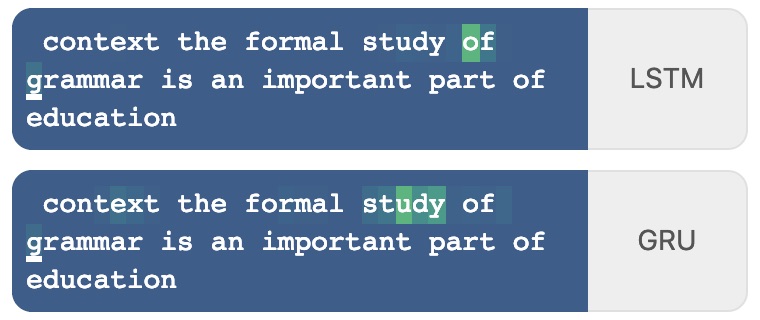
Comparing different recurrent units is often more involved than simply comparing accuracy or cross-entropy loss. High-level quantitative measures can have many explanations and may only reflect small improvements in predictions that require short-term memorization, while long-term memorization is often of interest.

A problem for qualitative analysis is needed that has a human-interpretable output and depends on both long-term and short-term contextual understanding. The typical problems used, such as Penn Treebank, Chinese Poetry Generation, or text8 generation, do not have outputs that are easy to reason about, as they require an extensive understanding of grammar, Chinese poetry, or only output a single letter.

Autocomplete Problem

To this end, this article studies the autocomplete problem. Each character is mapped to a target that represents the entire word. The space leading up to the word should also map to that target. This prediction based on the space character is particularly useful for showing contextual understanding.

The autocomplete problem is similar to the text8 generation problem: the only difference is that instead of predicting the next letter, the model predicts an entire word. This makes the output much more interpretable. Finally, because of its close relation to text8 generation, existing literature on text8 generation is relevant and comparable, as models that work well on text8 generation should work well on the autocomplete problem.

Connectivity in the Autocomplete Problem

The recently published Nested LSTM paper qualitatively compared their Nested LSTM unit to other recurrent units, showing how it memorizes in comparison, by visualizing individual cell activations. This visualization was inspired by Karpathy et al. [1], where they identify cells that capture a specific feature. However, this visualization approach works well for identifying specific features but not for capturing the long-term contextual understanding that is essential for the autocomplete problem.

Conclusion

In this article, a qualitative visualization method for comparing recurrent units with regards to memorization and contextual understanding is presented. The method is applied to the three recurrent units mentioned above: Nested LSTMs, LSTMs, and GRUs.

FAQs

Q: What is the purpose of this article?
A: The purpose of this article is to demonstrate a visualization technique that can better highlight the differences between recurrent units with regards to memorization and contextual understanding.

Q: What is the autocomplete problem?
A: The autocomplete problem is a problem where the model predicts an entire word based on the characters leading up to it, which is especially useful for showing contextual understanding.

Q: What is the difference between LSTMs and GRUs?
A: LSTMs (Long Short-Term Memory) and GRUs (Gated Recurrent Units) are both types of recurrent neural networks, but they differ in how they handle the vanishing gradient problem. LSTMs use an internal memory cell to store information, while GRUs use a gating mechanism to control the flow of information.

Q: What is the Nested LSTM unit?
A: The Nested LSTM unit is a type of LSTM unit that uses another LSTM unit to update its internal memory state, allowing for more long-term memorization.