Home Blog Page 544

This Spider-Man 2 PS5 Game Bundle

0

Today’s Cyber Monday Deal on Marvel’s Spider-Man 2 Collector’s Edition

A Marvelous Bargain

If you’ve been patiently waiting for the right time to buy Marvel’s Spider-Man 2 on the PlayStation 5, then that time is now. The Collector’s Edition of Marvel’s Spider-Man 2 has been reduced from $229.99 to $149.99 directly from PlayStation, making it an amazing deal for Spider-Man fans who also love collectibles.

What’s Included in the Collector’s Edition

The typical retail price for the PS5 exclusive game is $69.99/£69.99, making this deal a steal. If you deduct the game’s price from the bundle, you’re paying only $80 for the 19-inch statue, which is selling for up to $300 alone on eBay. Additionally, you’ll get digital extras, including:

  • 10 unique suits
  • Additional Photo Mode items
  • 5 Skill Points for use within the game
  • Physical SteelBook case

Why This Deal is a Must-Have for Spider-Man Fans

I love the original 2020 Spider-Man PS4 game, and its spin-off, Spider-Man Miles Morales, so I’m immensely tempted by this deal on one of the best PS5 games. The 19-inch statue alone is worth the price, and the digital extras are just the icing on the cake.

Conclusion

Don’t miss out on this incredible Cyber Monday deal. The Collector’s Edition of Marvel’s Spider-Man 2 is a must-have for any Spider-Man fan, and at this price, it’s an absolute steal. Treat yourself or gift it to a fellow fan.

Frequently Asked Questions

Q: What is the typical retail price of the game?
A: The typical retail price for the PS5 exclusive game is $69.99/£69.99.

Q: What’s included in the Collector’s Edition bundle?
A: The bundle includes a 19-inch statue, digital extras, and a physical SteelBook case.

Q: Is this a good deal?
A: Yes, considering the 19-inch statue alone is selling for up to $300 on eBay, and you’re getting digital extras, this is an amazing deal.

Q: Can I get a physical copy of the game?
A: Yes, the Collector’s Edition comes with a physical SteelBook case, making it a great option for those who prefer physical copies of their games.

AI Revolutionizes Forecasting

We are now in an era where large foundation models are transforming fields like computer vision, natural language processing, and, more recently, time-series forecasting.

These models are reshaping time-series forecasting by enabling zero-shot forecasting, allowing predictions on new, unseen data without retraining for each dataset. This breakthrough significantly cuts development time and costs, streamlining the process of creating and fine-tuning models for different tasks.

Timeline of Foundational Forecasting Models

In October 2023, TimeGPT-1, designed to generalize across diverse time-series datasets without requiring specific training for each dataset, was published as one of the first foundation forecasting models. Unlike traditional forecasting methods, foundation forecasting models leverage vast amounts of pre-training data to perform zero-shot forecasting. This breakthrough allows businesses to avoid the lengthy and costly process of training and tuning models for specific tasks, offering a highly adaptable solution for industries dealing with dynamic and evolving data.

Multiple series forecasting with TimeGPT-1 (Credit: TimeGPT-1 paper)

Recent Advances

Then, in February 2024, Lag-Llama was released. It specializes in long-range forecasting by focusing on lagged dependencies, which are temporal correlations between past values and future outcomes in a time series. Lagged dependencies are especially important in domains like finance and energy, where current trends are often heavily influenced by past events over extended periods. By efficiently capturing these dependencies, Lag-Llama improves forecasting accuracy in scenarios where longer time horizons are critical.

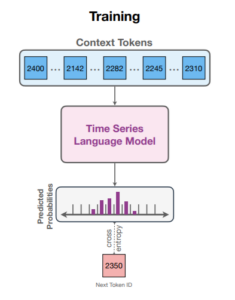
In March 2024, Chronos, a simple yet highly effective framework for pre-trained probabilistic time-series models, was introduced. Chronos tokenizes time series values—converting continuous numerical data into discrete categories—through scaling and quantization. This allows it to apply transformer-based language models, typically used for text generation, to time series data. Transformers excel at identifying patterns in sequences, and by treating time series as a sequence of tokens, Chronos enables these models to predict future values effectively.

Chronos training (Image credit: Chronos: Learning the Language of Time Series)

In May 2024, Salesforce introduced Moirai, an open-source foundation forecasting model designed to support probabilistic zero-shot forecasting and handle exogenous features. Moirai tackles challenges in time series forecasting, such as cross-frequency learning, accommodating multiple variates, and managing varying distributional properties. Built on the Masked Encoder-based Universal Time Series Forecasting Transformer (MOIRAI) architecture, it leverages the Large-Scale Open Time Series Archive (LOTSA), which includes more than 27 billion observations across nine domains. With techniques like Any-Variate Attention and flexible parametric distributions, Moirai delivers scalable, zero-shot forecasting on diverse datasets without requiring task-specific retraining, marking a significant step toward universal time series forecasting.

IBM’s Tiny Time Mixers (TTM), released in June 2024, offer a lightweight alternative to traditional time series foundation models. Instead of using the attention mechanism of transformers, TTM is an MLP-based model that relies on fully connected neural networks. Innovations like adaptive patching and resolution prefix tuning allow TTM to generalize effectively across diverse datasets while handling multivariate forecasting and exogenous variables. Its efficiency makes it ideal for low-latency environments with limited computational resources.

About the author: Anais Dotis-Georgiou is a Developer Advocate for InfluxData with a passion for making data beautiful with the use of Data Analytics, AI, and Machine Learning. She takes the data that she collects, does a mix of research, exploration, and engineering to translate the data into something of function, value, and beauty. When she is not behind a screen, you can find her outside drawing, stretching, boarding, or chasing after a soccer ball.

Conclusion

These foundation models are pushing the boundaries of time series forecasting, and the future holds even more exciting innovations. By combining time series models with language models, we can unlock even better results. The possibilities are endless, from predicting ride demand in real-time to predicting health outcomes based on patient monitoring data. The next frontier is combining traditional sensor data with unstructured text for even better results.

Cyberpunk 2077 Dev’s Unreal Engine 5 Switch

0

CD Projekt Red’s Decision to Ditch REDengine for Unreal Engine 5

A Change in Strategy

CD Projekt Red, the developer of Cyberpunk 2077, made a significant decision to ditch its own REDengine and move to Unreal Engine 5. The move was met with controversy, with many speculating that it was prompted by challenges faced during the development of Cyberpunk 2077. However, according to CD Projekt Red’s Vice President of Technology, Charles Tremblay, there was a different reason for the change.

Not a Reaction to Cyberpunk 2077’s Development Challenges

In an interview with Eurogamer, Tremblay confirmed that the decision to switch to Unreal Engine 5 was not a reaction to the challenges faced during the development of Cyberpunk 2077. Instead, the move was a strategic decision aimed at shifting the company’s approach to game development.

A New Approach to Game Development

CD Projekt Red is looking to change its approach to game development, moving away from a one-game-at-a-time approach to working on multiple projects simultaneously. This change in strategy is driven by the need to have multiple projects on the go at once, with the team currently working on The Witcher 4, a Cyberpunk sequel codenamed Orion, and a new project with the codename of Hadar.

The Benefits of Unreal Engine 5

The move to Unreal Engine 5 allows CD Projekt Red to take advantage of the latest technology and features, enabling the team to work more efficiently and effectively on their projects. The partnership with Epic Games will also provide access to new tools and expertise, helping the team to achieve their vision for their games.

Conclusion

CD Projekt Red’s decision to switch from REDengine to Unreal Engine 5 was a deliberate choice, driven by a desire to change their approach to game development. The move is aimed at enabling the team to work on multiple projects simultaneously, leveraging the latest technology and expertise to create innovative and engaging games.

Frequently Asked Questions

Q: Why did CD Projekt Red switch from REDengine to Unreal Engine 5?
A: The decision was made to allow the team to change their approach to game development, working on multiple projects simultaneously and leveraging the latest technology and expertise.

Q: Was the move prompted by challenges during the development of Cyberpunk 2077?
A: No, the move was not a reaction to the challenges faced during the development of Cyberpunk 2077.

Q: What are the benefits of using Unreal Engine 5?
A: The move to Unreal Engine 5 provides access to the latest technology and features, enabling the team to work more efficiently and effectively on their projects.

How to Improve Company Culture

0

Company culture is a critical element to creating a work environment where your employees can be successful. It not only helps attract and retain the best talent, but it is crucial to engaging employees and driving high performance. 

Employees and candidates want more than a paycheck. They’re looking for a workplace culture that connects with their career goals and work expectations. A positive workplace culture connects employees to the company’s mission, recognizes them for their contributions to the organization’s success, and gives them actionable feedback to help them improve and grow. 

Whether or not you’re intentional about your company culture, it’s always present. The question is, is your company culture working for you or against you? The goal is to create a magnetic effect where your culture is attractive not only to employees, but to candidates who want to join your organization. To do that, you will need to focus on how to improve company culture. 

In this guide, you’ll discover:  

  • What is organizational culture? 
  • What contributes to workplace culture? 
  • Why is workplace culture important? 
  • What makes a great company culture? 
  • What does research tell us about company culture? 
  • How to assess your organization’s culture 
  • How to improve company culture 
  • How to improve a damaged culture 


What is company culture?  

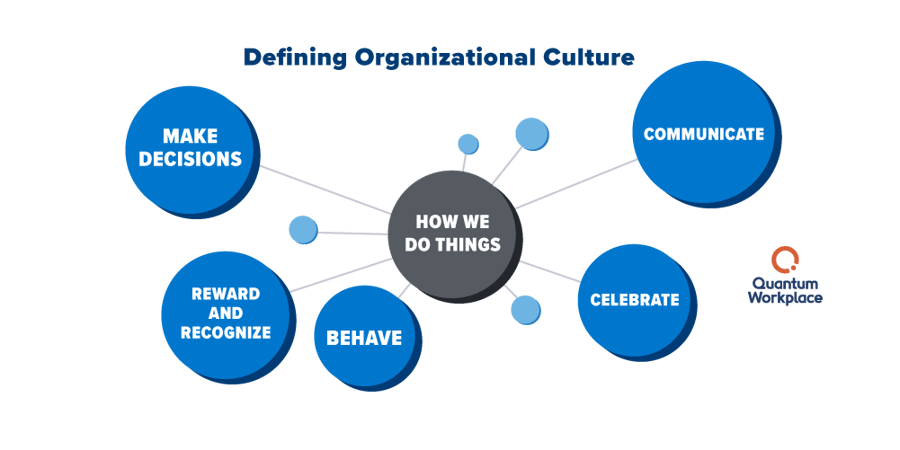
Organizations often struggle to define what workplace culture is. Your company culture isn’t a pizza party or whether you have in-person, hybrid, or remote work. It’s so much more than that. Organizational culture is how work gets done at your organization. It’s the decisions you make, how you communicate with one another, and how you recognize employees for their work. It’s the daily actions, attitudes, and behaviors of employees, teams, and the organization. 


What contributes to organizational culture?  

It’s important to understand how employees experience company culture so you have a starting point for improvement. Quantum Workplace research shows us that employees feel workplace culture through: 

  • Company mission and core values 
  • Employee recognition and celebrations 
  • The organization’s approach to employee performance 


Often, organizations wrongly believe that employees experience organizational culture through certain aspects like being in the office. But research shows employees experience company culture the least through: 

  • Rituals and norms 
  • Onboarding and training 
  • Physical workspace 


Culture doesn’t only exist in the office. Remote and hybrid employees still experience your work culture even if they’ve never visited an office. That’s because they experience organizational culture through other avenues. 

Your company culture isn’t different from your employee engagement and performance initiatives. It’s all part of the employee success equation. The way you engage employees and inspire employee impact is part of your culture. 

As you build a culture that has business impact, it’s important to remember what culture is and how employees experience it, so that you’re aiming your efforts in the right place. 


Why is company culture important?  

Company culture is vital to how you compete with other organizations for top talent. And it’s essential to connect employees with your culture that engages them and inspires performance. It’s part of the sticky factor that keeps them working for you. 

One of the traps that organizations fall for is that they don’t need to focus on retention unless they start losing employees in a competitive job market. But that’s not the case. You always want to make retaining top talent a priority. And you can do that by creating a culture of resiliency.  

That’s why you can’t afford a mediocre culture. A magnetic culture is your competitive advantage. It influences every aspect of your organization every day. It’s either working for you or against you. As the labor market and economy shift, your culture should work to build an engaged culture of high performers today and in the future. Your culture sets the organization up for success regardless of outside influences. 


What is a positive culture?  

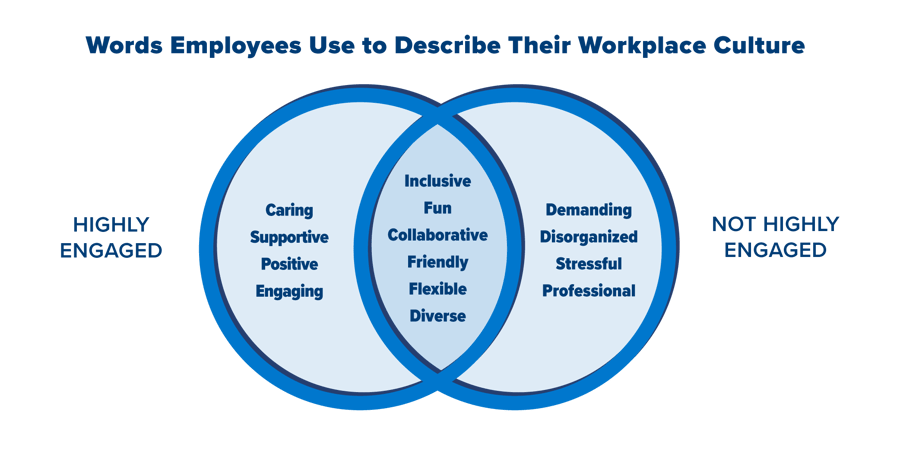
What makes your workplace culture a positive experience? Quantum Workplace asked employees what words they would use to describe their company culture. The words they used depended on if they were engaged or not. 


words-employees-use_magnetism_trends-report 


Engaged employees described their company culture as: 

  • Caring 
  • Supportive 
  • Positive 
  • Engaging


Disengaged employees described their workplace culture as:
 

  • Demanding 
  • Disorganized 
  • Stressful 
  • Professional 


Across the board, employees regardless of their engagement level described their ideal company culture as:
 

  • Inclusive 
  • Fun 
  • Collaborative 
  • Friendly 
  • Flexible 
  • Diverse 

As you strategize how to improve company culture, think about how your employees describe your culture and what you can do so that they use the descriptions for an ideal workplace culture. 


What research tells us about company culture  

A good starting point for how to improve workplace culture is with research. Quantum Workplace asked employees about their company culture. Here’s what they said.
 

How employees define workplace culture 

We’ve said that culture is how work gets done at an organization. That’s how employees describe it. It’s how an organization makes decisions, rewards and recognizes employees, celebrations, behaviors, and how everyone communicates. 


Magnetism_DefiningOrganizationalCulture 


Company culture has a significant impact 

Employees say that culture is a day-by-day, moment-by-moment experience. Two-thirds of employees say that their workplace culture positively impacts their work and behaviors. 


66-percent-of-employees_magnetism_trends-report_2


Engagement affects how employees perceive organizational culture 

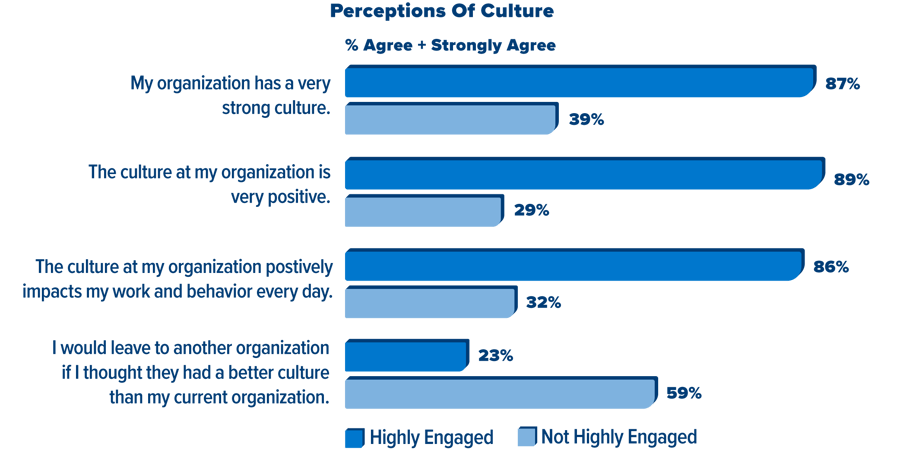
Engaged employees and disengaged employees view culture differently. Engaged employees are more likely to say that their culture impacts their work and behaviors in a positive way. They’re also less likely to depart your organization for a better company culture. But disengaged employees are 2.6X more likely to leave your organization to find a better culture. 


perceptions-of-culture_magnetism_trends-report


Everyone plays a role in shaping a strong corporate culture 

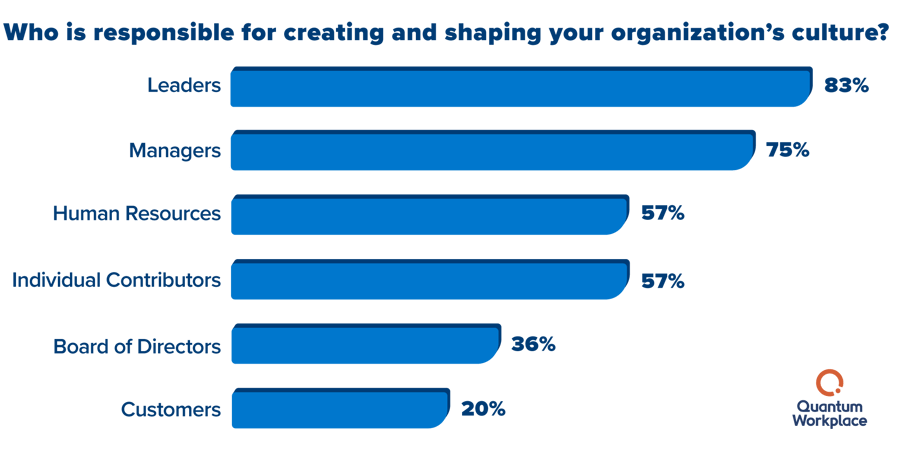
Whether you’re an employee, manager, leader, or in HR, everyone is responsible for creating a strong company culture. 83% of employees say that culture efforts start with your leadership team. 

Now that you have a better understanding of positive company culture, the next step is to measure so that you can determine where you can improve company culture. 

_Magnetism_WhoIsResponsible 


How to assess your company culture  

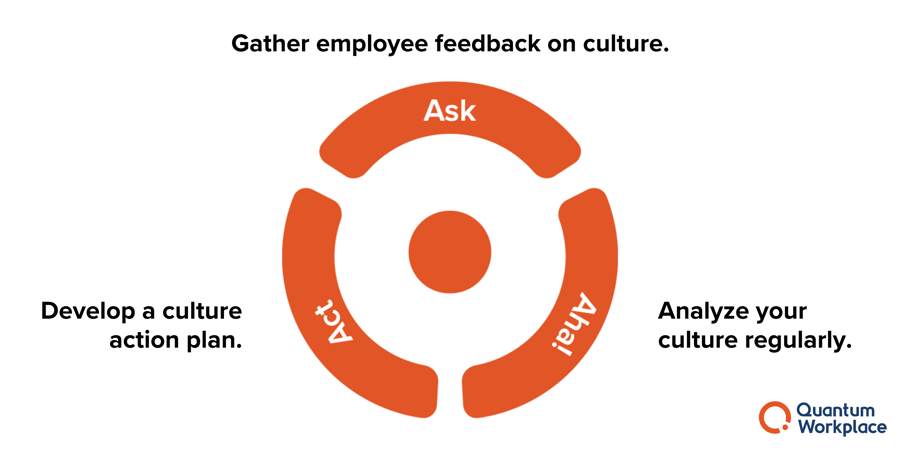
Before you can improve your company culture, you need to fully understand the employee experience. Once you’ve measured and analyzed what is happening, you can make meaningful changes to improve company culture. 

2-2


Ask 

You can’t measure culture with a gut instinct. The best way to determine if your culture is mediocre or magnetic is to ask employees to share their perspectives. They’ll tell you. 

Employee feedback will show you what’s working when it comes to shaping culture and what’s not. Your employee listening strategy will help you take the reins on your organizational culture. Start by asking employees at different moments in their employee journey: 

  • Onboarding 
  • After a big organizational change 
  • When an employee leaves 
  • During your annual engagement survey 

These are pivotal moments in your employees’ personal experiences. And it can help you drill down what’s working and what’s not. 


Analyze 

Take the feedback employees provide and connect it to some of your other metrics. Compare it with turnover data or the number of performance conversations employees have with their managers. This will help you understand if culture is the reason for turnover and how performance plays a role in your culture. Then think about what an engaging culture should look like. Strategize what barriers you can remove and begin developing a plan to act. 


Act 

The survey results mean nothing if you don’t do anything with them. Employees want to see that their feedback contributed to meaningful changes to improve workplace culture. The first place you can start is where employees feel culture the strongest: company mission statement, approach to performance, and recognition. Then look for areas where you can make the most impact. 

Part of acting on employee perceptions is communicating about the changes. Don’t forget to connect the changes back to employee feedback. That way, employees feel valued for their contributions and are more likely to provide feedback in the future. 


How to improve company culture  

The best way to improve company culture is to identify the specific areas where you can improve. But there are also some easy things you can do to start improving your company culture now. 


Aim your efforts at engagement 

Start by focusing on the right things. A positive workplace culture is aimed at engaging employees. Engagement is the sticky factor that keeps employees connected to their organizations. And by aiming your culture improvements at engagement, you’ll help keep top employees and motivate them to do their best work. 

Concentrating on creating an engaging workplace culture will get you a better return on your investment. It’s all part of creating an environment of employee success and building a magnetic organization. 


Take a look at your performance management strategies 

Employees say that the organization’s approach to performance management is a huge component of how they experience company culture. It makes sense that your performance processes should be one of the first places to take action to improve company culture. 

You want your approach to performance to be engaging for employees. The key drivers of a culture built on an engaging performance culture are: 

  • Employee goals aligned to organizational goals 
  • Frequent and effective performance conversations 
  • Recognition of employee contributions to the organization’s success 
  • Empowering employees to do their best work 
  • Making sure performance processes are fair, clear, and transparent 

When you’re evaluating your performance strategies, you don’t have to make a bunch of changes at once. Evolve them over time. Start with Quantum Workplace’s Performance Pathways that can help you engage employees through performance initiatives. 


Build connections 

Help employees feel connected to the organization and one another. One of the ways you can do that is by building trust between employees and leaders. 

Here’s how: 

  • Makes sure leaders are clearly communicating their vision, strategy, and goals 
  • Communicate early and often 
  • Help employees see their leaders as real people 

With dispersed workforces, connection between employees isn’t always easy. Make sure employees have the tools to collaborate and communicate effectively. Designate channels for employees to communicate and connect. For your remote employees, mimic the in-office environment with “water cooler” conversations and opportunities to chat with other employees about more than just work. 

Also, consider connecting workers with common interests, experiences, and backgrounds through employee resource groups or hosting team-building opportunities that are immersive and fun. 


Rethink flexibility and autonomy 

Employees want to feel trusted to do good work. Help managers avoid becoming micromanaging critics and transform them into coaches. Managers are a key driver of performance initiatives. And they’re also your culture champions. When we empower managers to foster a positive work environment where they can express their thoughts and concerns about organizational changes, we help employees be more engaged. 

Part of the autonomy conversation is thinking about flexibility. Flexibility doesn’t always mean remote or hybrid work. It can also mean giving employees the flexibility to determine work hours, worksite, teams they work with, or projects they work on. 


Create a culture of recognition 

At the core of engagement is making sure employees are valued and recognized for their contributions. The best way to do that is by creating a culture of recognition.  

Recognition doesn’t have to be complicated. You can have an impact in a simple way. Acknowledging employees for their contributions to the organization’s success and showing the organization cares by offering work flexibility and growth opportunities are all part of a culture of recognition. 

Think of these aspects when analyzing the role of recognition: 

  • Employee support 
  • Growth and professional development 
  • Celebrating employee success 

 Learn how Bethpage Federal Credit Union created a culture of employee success  >>>


Transforming a toxic culture to a healthy company culture 

Employees want to run from a toxic culture. The same ways you improve your company culture are the same for correcting a culture that doesn’t create an environment where employees can be successful. 

Are employees telling you have a good company culture? Or that your workplace culture could be better? Start with these steps to improve: 

  • Communicate with employees that you want to improve the company culture 
  • Ask employees about their experiences 
  • Analyze the data 
  • Conduct focus groups with employees and brainstorm ideas for how company culture can improve 
  • Take one step to improve workplace culture 
  • Ask employees about the changes and if they improved their experiences 
  • Repeat 


Conclusion 

Improving company culture doesn’t have to be complicated. By aiming your efforts at engaging employees, evaluating your approach to performance management, and recognizing great work, you can take the first steps to transform your workplace culture from mediocre to magnetic. 


button to view the culture strategy scorecard


AI World Labs, Kling Try On, IC-Light ControlNet, Voia AI

0

AI News Update

Recent Developments in AI Technology

AI World Labs

AI World Labs, a leading AI research and development company, has announced a breakthrough in its latest project, focusing on the development of an AI-powered chatbot designed to assist customers with their queries. The chatbot, named "Aira," is capable of understanding and responding to human emotions, making it an innovative solution for customer service.

Kling Try On

Kling, a popular augmented reality (AR) try-on platform, has introduced a new feature allowing users to virtually try on clothes using AI-powered avatars. The feature, named "Try On," uses machine learning algorithms to create a personalized avatar that matches the user’s body type and preferences.

IC-Light ControlNet

IC-Light, a leading provider of lighting control solutions, has launched a new AI-powered lighting control system called ControlNet. The system uses machine learning algorithms to analyze and optimize lighting conditions in various settings, such as offices, homes, and public spaces.

Voia AI

Voia AI, a startup specializing in AI-powered audio processing, has developed an innovative solution for noise reduction and audio enhancement. The company’s AI algorithm can detect and remove background noise, allowing users to focus on the desired audio signal.

Kawai-Kolors

Kawai-Kolors, a Japanese company known for its innovative color recognition technology, has introduced a new AI-powered color recognition system. The system can accurately identify and categorize colors, making it a valuable tool for various industries, such as fashion, design, and marketing.

Conclusion

The latest developments in AI technology are transforming various industries and improving our daily lives. From AI-powered chatbots to innovative lighting control systems, these advancements showcase the potential of AI to solve complex problems and improve efficiency.

FAQs

Q: What is the main purpose of AI World Labs’ latest project?
A: The main purpose of AI World Labs’ latest project is to develop an AI-powered chatbot designed to assist customers with their queries.

Q: What is Kling Try On and how does it work?
A: Kling Try On is an augmented reality try-on platform that allows users to virtually try on clothes using AI-powered avatars. The feature uses machine learning algorithms to create a personalized avatar that matches the user’s body type and preferences.

Q: What is IC-Light ControlNet and what are its benefits?
A: IC-Light ControlNet is an AI-powered lighting control system that uses machine learning algorithms to analyze and optimize lighting conditions in various settings. Its benefits include improved energy efficiency, enhanced user experience, and increased safety.

Q: What is Voia AI and what is its primary function?
A: Voia AI is a startup specializing in AI-powered audio processing, and its primary function is to detect and remove background noise, allowing users to focus on the desired audio signal.

Q: What is Kawai-Kolors and what is its main application?
A: Kawai-Kolors is a Japanese company known for its innovative color recognition technology, and its main application is in industries such as fashion, design, and marketing, where accurate color recognition is essential.

  1. Intel’s Hail Mary Pass
  2. Saving Intel from the Brink
  3. Intel’s Second Chance
  4. CEO Exit, New Opportunities
  5. Intel’s Rebound Plan
  6. After the Fallout, Intel’s Next Move
  7. Intel’s Road to Recovery
  8. From Crisis to Climb

Intel’s Redemption Arc Ends as Gelsinger Exits, Leaving Questions About the Company’s Future

Gelsinger’s Exit Highlights Intel’s Cultural Stagnation

When Pat Gelsinger returned to Intel as CEO in 2021, it was hailed as the start of a redemption arc. With over 30 years of experience at the company, including a tenure as CTO during its golden age, Gelsinger seemed uniquely qualified to tackle Intel’s mounting challenges. His mission: to restore the company to its former glory as a leader in chipmaking and manufacturing.

However, less than four years later, that redemption story has ended. According to sources cited by Bloomberg, Gelsinger was forced out, a stunning turn for one of the industry’s most respected technical minds. His sudden departure raises tough questions: Why couldn’t Gelsinger complete the mission he was seemingly born to lead? And if Intel’s most capable steward couldn’t turn the ship around, what hope does the company have in a market dominated by Nvidia, Qualcomm, and TSMC?

Intel’s Cultural Stagnation

Gelsinger’s ousting is not just about one leader; it’s a symptom of a company that has lost its way. His departure is a wake-up call for Intel to confront its cultural stagnation, address its legacy dependencies, and embrace the transformative changes required to stay relevant in a rapidly evolving industry. Without decisive action, Intel risks becoming a relic of its own storied past.

The Challenge Ahead

Intel’s next CEO must prioritize cultural transformation. This involves empowering engineers, reducing red tape, and fostering a sense of urgency. Consider what Satya Nadella accomplished at Microsoft: he transformed a slow-moving giant into one of the most agile and innovative companies in the world. Intel requires a similar cultural revolution to unlock its full potential.

The Future of x86

x86 has been Intel’s core product for decades, powering PCs, servers, and enterprise systems. However, as the industry shifts toward AI, cloud-native computing, and energy-efficient designs, x86 is beginning to seem outdated. Arm-based processors are now dominant across a range of devices, from smartphones to cloud servers, and Apple’s M-series chips have demonstrated that Arm can surpass x86 in both efficiency and performance.

Intel’s Best Bet – or Biggest Gamble

Intel’s venture into contract chip manufacturing through Intel Foundry Services (IFS) represents one of its most ambitious moves in recent years. The semiconductor industry urgently needs alternatives to TSMC and Samsung, especially given the geopolitical tensions that underscore the dangers of relying heavily on Asia. On paper, Intel is well-positioned to fill this gap.

AI Hardware: Intel’s Missed Opportunity

The future of computing is centered around artificial intelligence (AI), with Nvidia at the forefront. The company’s GPUs are the dominant force in AI training and inference workloads, and its Grace Hopper platform is specifically designed to manage the complex, parallel tasks that AI requires. Apple is also heavily investing in AI through its custom silicon.

Betting Boldly on Arm and RISC-V

Selling its xScale Arm business in 2006 was one of Intel’s biggest strategic mistakes. Arm-based architectures now dominate everything from smartphones to cloud servers, and companies like Apple and Qualcomm have shown that Arm can scale effectively for high-performance computing. Meanwhile, RISC-V is gaining traction as an open-source alternative, particularly in the IoT and edge computing sectors.

Leveraging Geopolitics for Strategic Advantage

Geopolitical tensions have transformed semiconductors into a national security concern, and Intel is uniquely positioned to capitalize on this shift. The CHIPS Act provides billions in funding for domestic semiconductor manufacturing, offering Intel an opportunity to take the lead in this sector.

Leadership: The Key to Intel’s Survival

With Gelsinger no longer at the helm, Intel is facing a leadership void at a crucial time. The company requires a CEO who can inspire confidence, tackle complex challenges, and implement ambitious plans effectively.

Conclusion

Intel’s redemption arc has ended, and the company is facing an uncertain future. The challenges ahead are daunting, but they’re not insurmountable. Whether through cultural transformation, bold pivots to new architectures, or even a strategic sale, Intel must act decisively – and soon. The semiconductor industry isn’t waiting for anyone. Intel has a choice: adapt and lead, or fade into irrelevance.

FAQs

Q: Why was Gelsinger forced out?
A: According to sources cited by Bloomberg, Gelsinger was forced out due to his inability to complete the mission he was given to restore Intel to its former glory.

Q: What are the challenges ahead for Intel?
A: The company must confront its cultural stagnation, address its legacy dependencies, and adapt to the rapidly evolving industry.

Q: How can Intel overcome its challenges?
A: Intel must prioritize cultural transformation, empower engineers, reduce red tape, and foster a sense of urgency. It must also develop a clear and aggressive AI strategy and bet boldly on Arm and RISC-V.

Q: Is selling Intel a viable option?
A: It may seem radical, but selling Intel to a more agile player like Qualcomm could be the only way to preserve its legacy.

Get Up to 50% Off Best 3D Artist Software

0

The Best Cyber Monday Software Deals for 3D Artists

Autodesk Cyber Monday Deals

Cyber Monday deals on creative software are rare, but right now Autodesk is offering 25% off selected software, including AutoCAD, Fusion and Revit LT Suite. This time-limited offer can save you $406 on AutoCAD, for example.

Autodesk is one of the leading developers of 3D software, and its CAD products are used in design, engineering and architecture all over the world. The deals on Autodesk’s website apply to annual subscriptions, making this an ideal time to set yourself up for the year with some of the best pro software around.

What’s Included in the Autodesk Deal?

  • 25% off selected software, including AutoCAD, Fusion and Revit LT Suite
  • Annual subscriptions available
  • Savings of up to $406 on AutoCAD

The Best Cyber Monday Software Deals for 3D Artists

Below you’ll find the best deals and lowest prices on the Autodesk, Reallusion and Adobe Creative Cloud in your region and worldwide, using our clever deals widget updating 24/7.

Frequently Asked Questions

Q: What software is included in the Autodesk deal?
A: The deal includes AutoCAD, Fusion and Revit LT Suite.

Q: Is the deal only for new customers?
A: No, the deal is available for both new and existing customers.

Q: Can I purchase a one-time license instead of a subscription?
A: No, the deal only applies to annual subscriptions.

Conclusion

Autodesk’s Cyber Monday deal is a great opportunity to get your hands on some of the best 3D software available. With savings of up to $406 on AutoCAD, it’s a deal that shouldn’t be missed. Make sure to check out the other software deals available and take advantage of this limited-time offer to upgrade your creative skills.

How to Avoid Common Performance Management Mistakes

0

Leadership priorities have shifted following changes in the labor market and economy. Organizations are buckling down and homing in on performance management, frequently using words like efficiency and effectiveness to describe the shift. 

To improve efficiency and be more effective, organizations have implemented things like task tracking and return-to-office initiatives to track badge scans. But do those activities actually improve performance?  

No. They do not.

To drive performance, organizations must shift their focus from superficial initiatives to research-backed performance management best practices that work. 


The flaws in trending performance management practices 

The trending performance and productivity efforts aren’t aimed at fixing the real problem of improving performance. Organizations say they’re concentrating on performance, but they’re going about it the wrong way. While organizations and managers have good intentions, these efforts may be doing more harm than good. Here are three initiatives we’re seeing in the market and why they’re not effective. 

1. Return to the office 

When the world went remote during the 2020 pandemic, organizations focused their efforts on supporting employees to be productive with increased flexibility.  

When the pandemic ended, many organizations tried to go back to what they knew before. Not because the direction they were going during the pandemic wasn’t working. But because it’s what managers knew, and what organizations were more comfortable with. That has led to measuring things that aren’t necessarily connected to performance. One of those metrics is tracking badge scans to make sure employees are in the office. Which could lead to employees coming into the office for “coffee badging,” or being unproductive while in the office. 

Gartner research on return to office mandates shows that performance and inclusion do not improve with in-office work. Organizations that push employees back to the office may also deal with lower intent to stay. 

That’s not to say that every return to the office mandate is faulty. But it’s aimed at the wrong issue. The bigger focus here may be flexibility. When employees describe flexibility, that’s not always remote work. Flexibility can include work schedule, tasks, or teams. 

During this shift in the workplace, I’ve reflected on my time as an HR practitioner. And I feel like one of the mistakes I’ve made was focusing too much on what other organizations were doing and not what my organization needed for employees and the organization to be successful. 

So, while we see some organizations call employees back to the office, that doesn’t mean that return to the office is a good practice for every organization. 

2. Task tracking 

We talked about focusing on the wrong measurements when it comes to return to office measures. But badge scans aren’t the only metric that doesn’t inspire high performance. 

When we think about measuring performance, we want to make sure that we’re measuring the right things. Tracking tasks and setting goals are different things. Task tracking is more about counting the number of widgets made in a time period, rather than setting a bigger picture goal like improving widget quality or improving customer satisfaction while making widgets. 

Deloitte discusses this in terms of effectiveness, efficiency, and empowerment. By focusing employees on outcomes, challenging the ways we collaborate, and trusting employees to get work done, organizations can improve productivity.  

Some of this is connected back toward return to the office efforts. If we’re tracking attendance, what does that do for the organization? Does attendance equate to productivity? If we ask employees to create 100 widgets, that doesn’t mean that they’re good widgets.  

Goal setting and alignment are crucial to focusing performance conversations. To do this effectively, we need to reframe the focus from outputs to outcomes. For example, professional services organizations may track employees clocking and clocking out. But is that the most important metric? Other metrics like billable hours or relationship management might have a bigger impact. 

Not all hours worked are exactly the same. It’s best to look at the output of the work that’s being done rather than the number of hours someone is clocked in, in the building, or sitting at their desk. 
 

3. Backward-looking performance discussions 

Almost 2 in 3 employees have formal performance conversations annually. The annual performance review itself isn’t a bad thing. The problem occurs when this is a check-the-box, siloed exercise instead of an engaging, connected conversation that helps employees improve performance. 

Performance reviews that only look backward aren’t set up in a way that gives employees what they need to improve. If someone gets all good feedback, that might feel great initially. But it may not help drive their performance forward. When performance reviews are not supported by data and context throughout the year, employees can feel like one wrong move before their annual review can drop their ratings.

Our research shows there’s a big difference between effective and ineffective performance reviews. And when performance reviews are done well, they can not only inspire employee performance, but also drive engagement. An effective performance review: 

  • Discusses performance data 
  • Recognizes employee contributions 
  • Gives actionable advice 
  • Explores career growth 

One organization I coached was getting a lot of pushback with 1-on-1s. They felt time-consuming and managers never knew what to discuss. It felt like a check-the-box exercise or a formal event. We set out to change that.  

The HR team helped employees understand that these weren’t “extra” conversations. They were touch points integrated into the flow of work to discuss goals, opportunities, obstacles, and decisions. Once 1-on-1s were reframed, employees could wrap their heads around the purpose—to make sure that everyone has what they need to do their best work. 

Badge scans, task tracking, and backward-looking performance reviews are band-aids on the real issues behind performance management. The wasted time and resources on initiatives like these don’t drive performance long term or contribute to business success. 

To truly manage performance, whether it’s face-to-face, hybrid, or remote, the organization and managers need to understand what good performance looks like. They need to understand it well enough to measure and assess it. That means going back to what research says will work. 

Research to guide your performance management strategy 

Quantum Workplace research can help guide your efforts to boost productivity and performance. What does an effective performance management strategy look like? Start here. 

2 in 3 employees say that feedback from their manager helps them improve their performance.  

Managers are the most vital part of inspiring impact. They’re involved in almost every aspect an effective performance management framework. 

Part of an effective performance review is giving an employee what they need to continue contributing to the organization. Employees need information to improve their performance, if that’s what is needed. Feedback helps employees understand where they stand. 

Organizations tend to focus a lot on the manager to coach employees. But often, managers themselves don’t always know enough details or aren’t trained well enough to effectively coach employees to higher impact. Organizational leaders and HR need to ensure managers have the information needed to effectively drive performance in a way that will have the most impact on the organization. 


Effective performance reviews are forward-focused. 

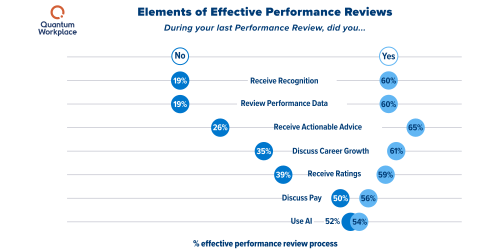
What makes an effective performance review? Employees say it’s more than just reviewing data. Effective performance reviews include actionable advice, career growth discussions, conversations backed by data, and recognition of accomplishments. 

A great performance conversation has the ability to provide understanding and coaching about performance over a period of time. But there is also the opportunity to inspire excitement and engagement around organizational, team, and individual goals heading into the next month, quarter, or year. 

Employees need to know when their outputs aren’t meeting expectations. That’s not all. We need to pair that with coaching on how employees can get to that point. Or if the employee is performing, growth conversations so employees are performing at an even higher level.  
 Trends-Report_PerformanceImpact_Updates_last-performance-review-2


Managers say technology makes them more effective. 

What technology supports managers in driving performance? Performance management software that integrates goals, performance evaluation, recognition, and 1-on-1s. 

Too often, managers are expected to make magic happen. If we expect great management, we need to give managers the tools necessary to do all of the things we expect from them. This means training, technology, and time. Often technology can help free up time so managers can spend time where it matters most. 

Managers need good performance data that can be fodder for performance conversations around what employees contribute, what the expectations are, and what it will take for the employee to reach those expectations. Organizations can do more to empower managers with technology that meets this need.   
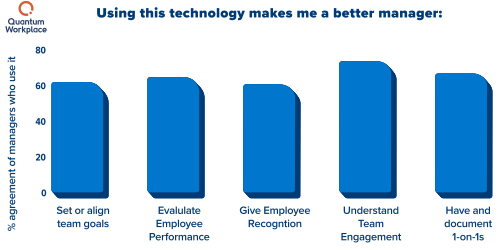
 

Trends-Report_PerformanceImpact_Updates_manager-technology-effectiveness-2 


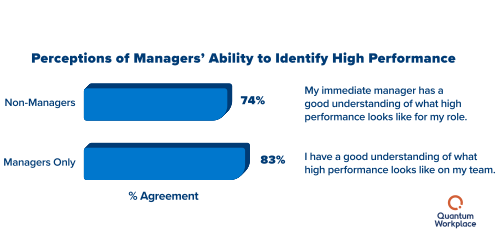
Managers need training to spot high performance. 

When compared to the perceptions of employees, managers tend to overestimate their ability to spot high performance. Training and an understanding of performance expectations can help. 

HR practitioners spend a lot of time and effort putting together strategies and processes to drive performance. But sometimes we neglect to bring our managers along. Managers are the drivers of high performance. So we need to make sure we’re supporting them. They need the training, information, and capacity to manage the performance of their people and do it well.  

Managers may have been hired from outside of the organization or promoted into leadership. In either situation, organizations need to invest in training managers in the tools, processes and expectations of leadership to align with the organization. I’ve seen plenty of examples of managers assuming they know how to handle something because of past experiences as a leader or just as an employee. Manager impact and behavior are too important to assume they know what they’re doing. Train them well and offer them continuous support. 
Trends-Report_PerformanceImpact_Updates_managers-identify-high-performance

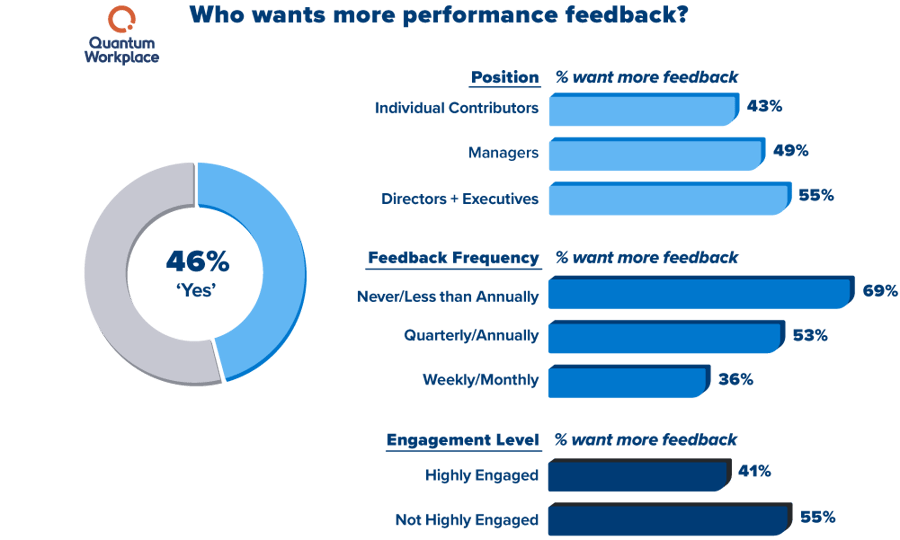
All employees want more performance feedback. 

Almost 70% of employees who only receive feedback twice per year or less say they want more. Managers and senior leadership are more likely to want more feedback. 

Your performance management processes should help employees manage their performance. Sometimes that feedback is that they need to improve. Employees can’t improve if they don’t know there’s an issue. Sometimes employees are doing well, but they can do even better!  

So how do we help them? How do we encourage managers to draw out really great performance in employees? We want employees to continuously improve. And employees, even managers and leaders, can do that with more performance feedback. 

Feedback can feel scary. It can feel intimidating to not know how the receiver will react. Give managers the chance to practice. Ensure they are trained on tactics and methods of delivering feedback, both positive and constructive. 
 

Impact_who-wants-more-feedback V2 V2 

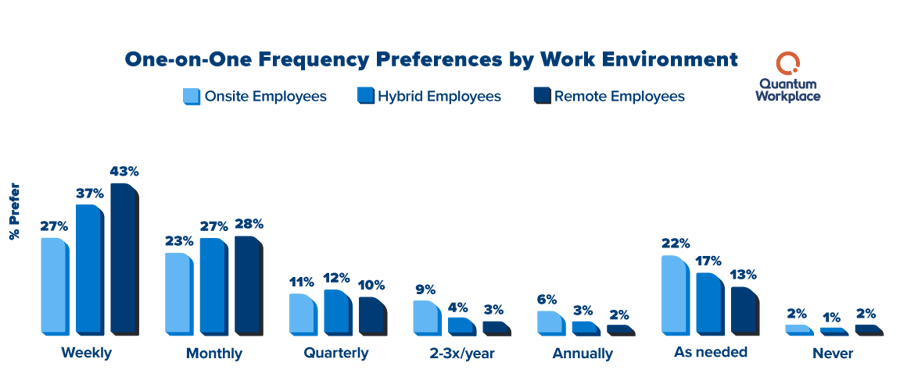
Employees prefer frequent coaching. 

When it comes to coaching cadence, employees prefer weekly conversations with their managers. The frequency also depends on whether employees are in the office, hybrid, or remote. 

Employees need actionable advice for how they improve their performance and how they can grow and perform even better. When we say actionable advice, we mean things like: 

  • How employees can change and improve their habits 
  • How employees can look at things differently 
  • Connections with training or assistance for improvements 

Employees need and want that information from their manager so that they can do something with that information. 

In most cases, employees want to do well and organizations want their employees to do well because employee success leads to organizational success. The cadence may be different depending on the organization’s industry, pace of business, or other factors. That’s why organizations need to do what makes the most sense for their team.  Impact_one-on-one-frequency-preferences V2
 

Employees want goals aligned with the organization’s goals. 

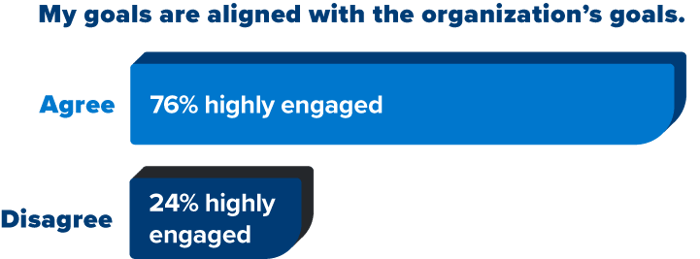
When employees have aligned goals, they’re 3.2X more likely to be engaged. Clear performance goals help employees feel connected to the organization and increases productivity. 

Employees want to know what they should be focusing on. Without aligned goals and feedback discussions between employees and managers about where they stand, we can’t expect employees to be able to improve performance. Aligned goals gives employees focus for what is expected of them. And it helps them see how their work contributes to organizational success. 

Organization-wide strategic goals can feel very abstract to employees. As humans, we have a need for connection and purpose. Many organizations I work with have and AHA moment when they realize that when we create an environment where people understand how their work contributes to the mission of the organization, they are more likely to be engaged. 
 

 goal-types-and-alignment_1.4_impact_trends-report


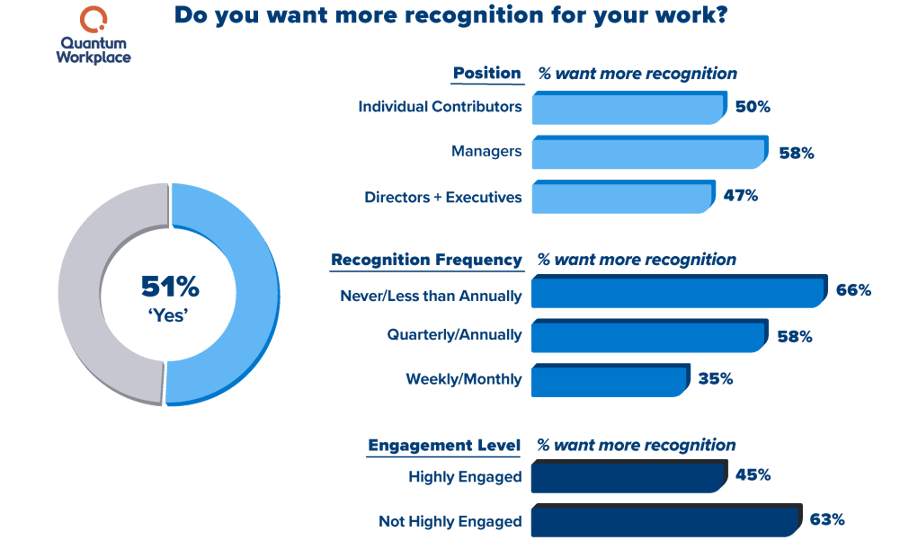
51% of employees want more recognition. 

All employees want more recognition for their work. Managers are most likely to say they want recognition for their contributions. 

Recognition is a huge part of an effective performance review and feedback. It tells employees that their work is valued. And it also communicates to each employee what high performance looks like. 

Recognition signals to employees what is valued in the organization. It can help them understand how their work connects to the broader strategy when done well. That may mean calling out a smaller team for a critical contribution they made that helped the organization meet a goal or saved the organization money. 
 

Impact_employees-want-recognition V2 V2 


How do organizations improve performance? 

To create high performance teams, organizations need to create an environment of employee success. Employees don’t join organizations with the goal of being the worst employee. They want to contribute to the success of the organization. And to do that, organizations need to inspire employees to have an impact.  

Right now, research shows 52% of employees will tell you that their organization’s performance management processes don’t motivate them to improve their performance. 51% of employees say performance management processes are a waste of time.  

But we know that employees are motivated to perform when: 

  • They understand the role they play in the organization’s success.  
  • They see that their work matters and impacts the organization’s goals.  
  • They get actionable feedback.  
  • They are recognized for their contributions.  

What can HR do to inspire employee impact? 

Designing your performance management strategy can be small steps over time. You don’t need a complete overhaul immediately. And just because a process works for another organization, doesn’t mean it’s the right fit for yours. 

I don’t think any leader wants performance management to be strictly punitive. Leaders want performance management to drive high performance. Employees need to feel like the processes they’re involved in help motivate them to improve. 

So, how do you do that? One of the first things you can do is evaluate your processes. You need to understand what your organization needs and what constraints you have. Start by asking yourself these questions: 

  • What is working and what is not working with your current performance management processes? 
  • What does your ideal state look like? 
  • What steps would it take to get from where you are to your ideal state? 
  • What business outcomes do you hope to achieve with your performance management? 
  • How will you determine if your performance management strategy is successful? 
  • Are your managers equipped to coach employee success? 
  • What support do your managers need to inspire employee impact? 


What does a successful performance management strategy look like? 

As you analyze your strategy, you want to make sure you’re connecting it to a research-backed approach. Whether you steer more traditional or more continuous is ok. There are more than two choices to performance management. And your evolving approach can fall somewhere in between traditional and continuous performance management. 

The speed that you evolve your approach also has to make sense for your organization. Just because another organization transitions faster doesn’t mean that your strategy has failed. 
performance-pathways-ebook-listing_featuredA custom approach is important to create a performance management strategy that works for you. You can use one of Quantum Workplace’s Performance Pathways to get started and then adapt the approach to fit your needs. 

These pathways include what employees need to be successful and high performing. With a combination of goals, manager coaching, performance discussions, and recognition, each pathway helps you take steps to improve your strategy. 


Sometimes organizations focus on the wrong solutions when it comes to driving performance. By making sure employees have what they need be impactful, we set them up for success and achieve business results. 

Performance Pathways 2024 - Email Headers


My Cyber Monday Shopping Haul

0

As a tech journalist, I’ve built a wall of steel against impulse purchases, or so I thought. But, like many others, I fell victim to the Black Friday and Cyber Monday deals. Last year, I bought a 3D printer, and this year, I caved in to temptation again.

The 3D printer was a game-changer, and I’ve become an expert in 3D printing, writing tutorials for Creative Bloq and teaching myself to 3D model. However, this year’s purchases were a different story. I bought a Cricut machine, with no experience using one, and had to resist the temptation to buy a Smart Ring and multiple pairs of AR smart glasses for gaming.

If it weren’t for the need to pay my mortgage and save for my wedding, I would have gone all out. Instead, I took a sensible approach, opting for the Honor MagicPad 2 for photo editing, a pair of Loop earplugs, and some Pokémon Lego sets to enjoy building with my fiancé.

The Deals I Bought over Cyber Monday

I couldn’t help but share my purchases with you. Here’s a look at what I actually bought this year:

[Image: The Cyber Monday deals I actually bought this year]

How I Resisted the Temptation

As a tech journalist, I’m supposed to be immune to Black Friday and Cyber Monday deals. But, I’m human, and the temptation was too great. Here are a few tips on how I resisted the urge to buy more:

  • Prioritize: I had to remind myself that I need to pay my mortgage and save for my wedding. These expenses take priority.
  • Set a budget: I allocated a specific amount for Black Friday and Cyber Monday shopping, and I stuck to it.
  • Take a step back: I gave myself 24 hours to think about each purchase before making a decision. This helped me avoid impulsive buying.

Frequently Asked Questions

Q: What’s the Cricut machine, and why did you buy it?
A: The Cricut is a cutting machine that can be used for various projects, such as scrapbooking, crafting, and DIY. I bought it because I’m interested in exploring new hobbies and creative pursuits.

Q: Have you used the Cricut machine yet?
A: Not yet, but I’m looking forward to trying it out soon.

Q: What’s your favorite purchase from Black Friday and Cyber Monday?
A: I’m excited to try out the new Cricut machine, but I think my favorite purchase is the Honor MagicPad 2 for photo editing. It’s a great tool for my work as a tech journalist.

Remote Therapeutic Monitoring Cuts Readmissions

The Problem

Over the past decade, the University of Oklahoma College of Medicine has seen an increase in the number of highly complex infections. This is related to a few different factors. The population of the Sooner State has been trending less healthy in general. Surgeons at the Oklahoma City-based medical school are performing more complex surgeries. And third, there has been a huge increase in immunosuppressive therapeutics for cancers and rheumatological and autoimmune diseases, all of which increase the risks for infection.

The Solution

Remote therapeutic monitoring (RTM) technology has some appealing features in the OPAT setting. It does not require an in-person visit to the patient. Staff can monitor the patient while the patient is home and the clinician is in their hospital/clinic.

Meeting the Challenge

"We designed a clinical trial at the University of Oklahoma to study the impact of RTM technology on patients discharged home on OPAT," said infectious diseases physician Dr. Joseph Sassine. The clinical trial enrolled 95 patients between July 2023 and October 2024; these patients were adults who were admitted to OU Health University of Oklahoma Medical Center, diagnosed with an infection (we included all classes of infection) and were deemed to need at least one intravenous antibiotic to be taken at home after discharge.

Results

The University of Oklahoma College of Medicine did an interim analysis with 64 patients enrolled on RTM and 95 contemporaneous controls. This included patients enrolled until June 15, 2024, who had at least 90 days of follow-up.

Advice for Others

Remote therapeutic monitoring is a major technological breakthrough that will help healthcare advance the quality of care offered to patients when they go home, Sassine stated. "It has the power to change clinical outcomes in a tangible and beneficial way, and now we have the data to support it," he said. "I would certainly advise healthcare organizations and physician practices to evaluate how RTM could be incorporated into their clinical practice and their value-based care models."

Conclusion

The data generated by RTM actually drove the University of Oklahoma College of Medicine to simplify some of the antibiotic regimens for some patients, which subsequently increased their adherence to 100%. The feedback we received from patients enrolled in our trial was also great. They told us they felt supported during their transition of care and throughout their antibiotic course. I believe this helped set them up for success.

Frequently Asked Questions

Q: What is remote therapeutic monitoring (RTM)?
A: RTM is a technology that allows healthcare providers to monitor patients remotely while they are receiving treatment at home.

Q: What are the benefits of RTM?
A: RTM can improve patient outcomes by reducing hospital readmissions and improving adherence to treatment.

Q: How does RTM work?
A: RTM uses a device that attaches to the patient’s IV antibiotic bag and monitors the flow of medication. The data is transmitted to a central system, where it is analyzed and monitored by healthcare providers.

Q: What are the results of the clinical trial?
A: The clinical trial showed a significant reduction in infection-related readmissions in patients who received RTM compared to those who did not.