Home Blog Page 578

AI isn’t hitting a wall, it’s just getting too smart for benchmarks

0

Gen AI: Can it Deliver on the Productivity Promise?

Bloomberg’s Anurag Rana [left] talks with Anthropic’s Michael Gerstenhaber [center] and Scale AI’s Vijay Karunamurthy, during Bloomberg Intelligence’s conference on “Gen AI: Can it deliver on the productivity promise?”

Large Language Models and Self-Correction

Large language models and other forms of generative artificial intelligence are improving steadily at “self-correction,” opening up the possibilities for new kinds of work they can do, including “agentic AI,” according to the vice president of Anthropic, a leading vendor of AI models.

“It’s getting very good at self-correction, self-reasoning,” said Michael Gerstenhaber, head of API technologies at Anthropic, which makes the Claude family of LLMs that compete with OpenAI’s GPT.

New Use Cases and Task Planning

The most recent models include task planning, such as how to carry out tasks on a computer as a person would; for example, ordering pizza online.

“Planning interstitial steps is something that wasn’t possible yesterday that is possible today,” said Gerstenhaber of such step-by-step task completion.

Scaling Gen AI

Both Gerstenhaber and Scale AI’s Karunamurthy made the case that “scaling” Gen AI — making AI models bigger — is helping to advance such self-correcting neural networks.

“We are definitely seeing more and more scaling of the intelligence,” said Gerstenhaber. “One of the reasons we don’t necessarily think that we’re hitting a wall with planning and reasoning is that we’re just learning right now what are the ways in which planning and reasoning tasks need to be structured so that the models can adapt to a wide variety of new environments they haven’t tried to pass.”

Conclusion

Gerstenhaber’s remarks fly in the face of arguments from AI skeptics that Gen AI, and the rest of AI more broadly, is “hitting a wall,” meaning that the return from each new model generation is getting less and less. However, Anthropic’s approach to scaling Gen AI and enabling new classes of functionality suggests that the technology is still evolving and improving.

FAQs

Q: What is Gen AI?
A: Gen AI refers to the next generation of artificial intelligence that is capable of self-correction, self-reasoning, and planning tasks.

Q: What is the purpose of Gen AI?
A: The purpose of Gen AI is to enable new kinds of work and tasks that were previously impossible with traditional AI models.

Q: Is Gen AI hitting a wall?
A: According to Anthropic’s Michael Gerstenhaber, Gen AI is not hitting a wall, but rather, it is evolving and improving through scaling and enabling new classes of functionality.

Q: What is the future of Gen AI?
A: The future of Gen AI is uncertain, but it is likely to continue to evolve and improve, enabling new kinds of work and tasks that were previously impossible.

Atari Recharged Record Cover Design

0

Retro Game Art Meets Vinyl with ATARI Recharged Soundtrack

A Vibrant Affair

Microids Records has discovered a new canvas for retro game art – album covers. The label is following up on its Atari 50 vinyl from the start of this year with ATARI Recharged, featuring 40 tracks from the retro gaming brand’s revival series. The result is a vibrant affair, with two colored vinyls in a gatefold sleeve that’s already making us feel nostalgic. The Atari branding combined with retro game art is a match made in heaven.

The Recharged Games

Atari’s Recharged collection is a series of video games that reimagine some of the brand’s most popular arcade titles, adding power-ups, vibrant graphics, new challenges, two-player couch co-op, and new original soundtracks crafted by the award-winning composer Megan McDuffee. The Recharged games include Asteroids, Berzerk, Black Widow, Breakout, Cavern of Mars, Centipede, Gravitar, Missile Command, Quantum, and Yars. Megan’s 80’s-inspired electro pop music integrates both modern and retro influences, adding an additional level of energy to gameplay.

The Soundtrack

The ATARI Recharged Soundtrack will be released on January 17, 2025, on limited edition gatefold vinyl priced €39.99 from Microids Records. The soundtrack is a must-have for fans of retro gaming and music, offering a unique blend of nostalgic and modern sounds.

Conclusion

The ATARI Recharged Soundtrack is a testament to the power of retro game art and music. The combination of classic Atari games and modern music is a winning formula, making this soundtrack a must-have for fans of both retro gaming and music. With its limited edition gatefold vinyl and vibrant artwork, this soundtrack is sure to delight.

FAQs

Q: What games are included in the Recharged series?
A: The Recharged series includes Asteroids, Berzerk, Black Widow, Breakout, Cavern of Mars, Centipede, Gravitar, Missile Command, Quantum, and Yars.

Q: Who composed the soundtrack?
A: The soundtrack was composed by award-winning composer Megan McDuffee.

Q: When is the soundtrack being released?
A: The ATARI Recharged Soundtrack will be released on January 17, 2025.

Q: How much will the soundtrack cost?
A: The soundtrack will be priced €39.99 from Microids Records.

Amazon SageMaker Inference Supports G6e Instances

0

G6e Instances Powered by NVIDIA’s L40S Tensor Core GPUs Now Available on Amazon SageMaker

Key Highlights

  • Twice the GPU memory compared to G5 and G6 instances, enabling deployment of large language models in FP16 up to 14B parameter model on a single GPU node (G6e.xlarge), 72B parameter model on a 4 GPU node (G6e.12xlarge), and 90B parameter model on an 8 GPU node (G6e.48xlarge)
  • Up to 400 Gbps of networking throughput
  • Up to 384 GB GPU Memory

Use Cases

G6e instances are ideal for fine-tuning and deploying open large language models (LLMs). Our benchmarks show that G6e provides higher performance and is more cost-effective compared to G5 instances, making them an ideal fit for use in low-latency, real-time use cases such as:

  • Chatbots and conversational AI
  • Text generation and summarization
  • Image generation and vision models

Performance

In the following two figures, we see that for long context length of 512 and 1024, G6e.2xlarge provides up to 37% better latency and 60% better throughput compared to G5.2xlarge for a Llama 3.1 8B model.

[Figure 1]
[Figure 2]

In the following two figures, we see that G5.2xlarge throws a CUDA out of memory (OOM) when deploying the LLama 3.2 11B Vision model, whereas G6e.2xlarge provides great performance.

[Figure 3]
[Figure 4]

In the following two figures, we compare G5.48xlarge (8 GPU node) with the G6e.12xlarge (4 GPU) node, which costs 35% less and is more performant. For higher concurrency, we see that G6e.12xlarge provides 60% lower latency and 2.5 times higher throughput.

[Figure 5]
[Figure 6]

Deployment Walkthrough

Prerequisites

  • To try out this solution using SageMaker, you’ll need the following prerequisites:
    • A SageMaker account
    • A GPU-enabled instance (G6e.xlarge, G6e.12xlarge, or G6e.48xlarge)
    • The necessary software and dependencies installed on your machine

Deployment

  • You can clone the repository and use the notebook provided here.

Clean up

  • To prevent incurring unnecessary charges, it’s recommended to clean up the deployed resources when you’re done using them. You can remove the deployed model with the following code: predictor.delete_predictor()

Conclusion

G6e instances on SageMaker unlock the ability to deploy a wide variety of open source models cost-effectively. With superior memory capacity, enhanced performance, and cost-effectiveness, these instances represent a compelling solution for organizations looking to deploy and scale their AI applications. The ability to handle larger models, support longer context lengths, and maintain high throughput makes G6e instances particularly valuable for modern AI applications. Try the code to deploy with G6e.

About the Authors

  • Vivek Gangasani: Senior GenAI Specialist Solutions Architect at AWS. He helps emerging GenAI companies build innovative solutions using AWS services and accelerated compute. Currently, he is focused on developing strategies for fine-tuning and optimizing the inference performance of Large Language Models. In his free time, Vivek enjoys hiking, watching movies, and trying different cuisines.
  • Alan Tan: Senior Product Manager with SageMaker, leading efforts on large model inference. He’s passionate about applying machine learning to the area of analytics. Outside of work, he enjoys the outdoors.
  • Pavan Kumar Madduri: Associate Solutions Architect at Amazon Web Services. He has a strong interest in designing innovative solutions in Generative AI and is passionate about helping customers harness the power of the cloud. He earned his MS in Information Technology from Arizona State University. Outside of work, he enjoys swimming and watching movies.
  • Michael Nguyen: Senior Startup Solutions Architect at AWS, specializing in leveraging AI/ML to drive innovation and develop business solutions on AWS. Michael holds 12 AWS certifications and has a BS/MS in Electrical/Computer Engineering and an MBA from Penn State University, Binghamton University, and the University of Delaware.

FAQs

Q: What are the key highlights of G6e instances?
A: The key highlights of G6e instances include twice the GPU memory compared to G5 and G6 instances, up to 400 Gbps of networking throughput, and up to 384 GB GPU memory.

Q: What are the use cases for G6e instances?
A: G6e instances are ideal for fine-tuning and deploying open large language models (LLMs). Our benchmarks show that G6e provides higher performance and is more cost-effective compared to G5 instances, making them an ideal fit for use in low-latency, real-time use cases such as chatbots and conversational AI, text generation and summarization, and image generation and vision models.

Q: How do G6e instances perform compared to G5 instances?
A: Our benchmarks show that G6e provides higher performance and is more cost-effective compared to G5 instances. For long context length of 512 and 1024, G6e.2xlarge provides up to 37% better latency and 60% better throughput compared to G5.2xlarge for a Llama 3.1 8B model.

I Was Wrong!

0

Why People Hate the iOS 18 Version of Apple Photos

Redesigns of anything can prompt a negative reaction initially, and UI design is no different. A major change to the layout of an app can make something you’ve been using comfortably for ages suddenly feel confusing and unfamiliar.

The New Layout: More Cluttered and Convoluted

With that in mind, I thought initial criticism of the Apple Photos app redesign in iOS 18 would blow over once people got used to it. But it hasn’t. Two months on after the release in September, not a day goes by without dozens of people taking to social media to complain about how much they detest the new layout.

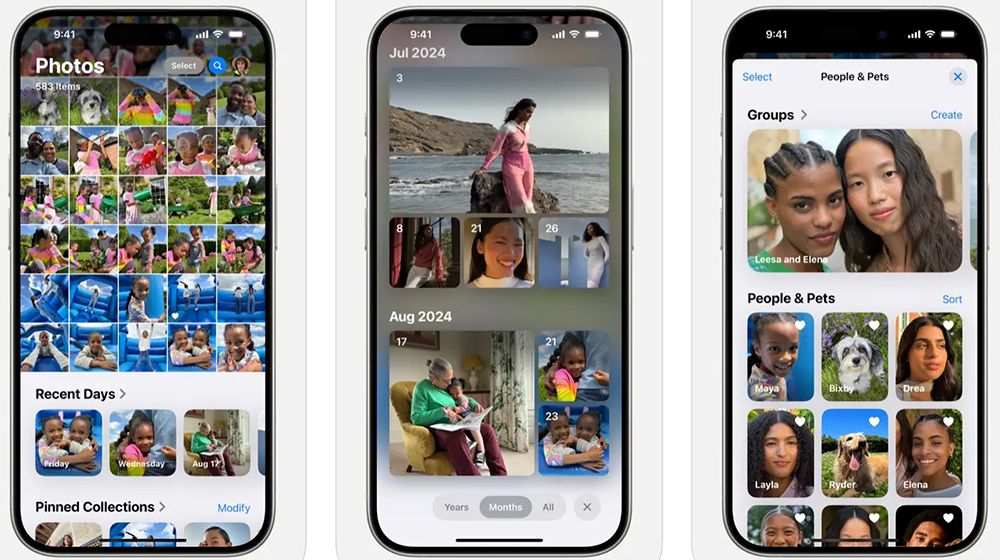
The main issue is that the new layout is more cluttered and convoluted compared to iOS 17. A lot of the change was focused on putting Apple Intelligence at the centre of photo management – to simplify things in theory, although some will argue that Apple felt obliged to follow the lead of Google and Samsung in this area.

New Features, But Also Unwanted Irritations

There’s a new scrollable interface, smart collections that automatically group photos by topic, and it’s easier to search for photos using natural language. But, as with most implementations of AI, there are also unhelpful and just plain random irritations, such as unwanted auto-generated albums and collections, and some people say the removal of traditional tabs is making it harder to find things.

User Feedback: A Mixed Bag

Apple has already made some tweaks, removing the highlights carousel and bringing back pinch-to-zoom. It will also restore full-screen playback for video. But some are still not convinced. “Apple, I hope you are listening, the new updates in the Photos app suck. Navigating my photo gallery is a disaster now. Not all change is progress,” one person wrote on X this week.

However, some have welcomed the app redesign. The key to making it work seems to be the customisation. If you go to the bottom and click customise, you can remove the panels you don’t want. People ideally don’t want that hassle. But this is like bloatware – removing all the redundant features is a hassle that the user doesn’t want to have to sort out for themselves.

Conclusion

The iOS 18 version of Apple Photos has been met with a mixed reaction from users. While some have welcomed the new features and customisation options, others have been left feeling confused and frustrated by the changes. It remains to be seen whether Apple will continue to make tweaks and improvements to the app, or if users will eventually adjust to the new layout.

FAQs

Q: Why did Apple change the Photos app?

A: Apple changed the Photos app to put Apple Intelligence at the centre of photo management, making it easier to search and organise photos using natural language.

Q: What are the main issues with the new layout?

A: The main issues are that the new layout is more cluttered and convoluted, with unwanted auto-generated albums and collections, and the removal of traditional tabs making it harder to find things.

Q: Can I customize the new layout?

A: Yes, you can customize the new layout by going to the bottom and clicking customise, where you can remove the panels you don’t want. However, this can be a hassle for some users.

Q: Will Apple continue to make changes to the Photos app?

A: It is likely that Apple will continue to make tweaks and improvements to the Photos app based on user feedback and criticism.

Gannon Faust Jaspering

0

Forgotten

Gannon Faust Jaspering, a senior world builder and environment artist, has created a stunning piece inspired by the ancient Roman statue known as Sleeping Hermaphroditus. The original statue is thought to have been carved in the second century AD and has been rediscovered many times over the centuries.

The Piece

The piece, also titled "Forgotten", is a fantastical portrayal of a pilgrim who has just found a copy of the statue abandoned deep in a forest. The artist aimed to evoke a sense of loneliness that many queer people feel. The foliage assets are from Quixel Megascans, but Gannon created the statue, pots, pilgrim, and moss clumps himself.

How it was Created

Gannon used Blender nodes to scatter Quixel foliage cards onto the moss meshes, creating a fluffy and detailed environment. In an interview, he explained, "I wanted to create a fantastical portrayal of a pilgrim who has just found a copy of the statue abandoned deep in a forest. The piece is meant to evoke a sense of loneliness that many queer people feel."

Tools Used

Gannon used a range of tools to create "Forgotten", including Unreal Engine, Quixel Megascans, ZBrush, Substance 3D Painter, Blender, and 3ds Max.

Conclusion

Gannon’s piece, "Forgotten", is a testament to his skill and creativity as an environment artist. By using a range of tools and techniques, he has brought to life a fantastical and evocative scene that invites the viewer to step into the world he has created.

FAQs

Q: What is the inspiration behind "Forgotten"?
A: The piece is inspired by the ancient Roman statue known as Sleeping Hermaphroditus, and is meant to evoke a sense of loneliness that many queer people feel.

Q: What tools did Gannon use to create "Forgotten"?
A: Gannon used Unreal Engine, Quixel Megascans, ZBrush, Substance 3D Painter, Blender, and 3ds Max.

Q: How did Gannon create the foliage in "Forgotten"?
A: Gannon used Blender nodes to scatter Quixel foliage cards onto the moss meshes, creating a fluffy and detailed environment.

Spies Hack Neighbors Over Wi-Fi

0

The "Nearest Neighborhood" Attack: A Cautionary Tale of Security Oversights

Introduction

While stalking its target, GruesomeLarch performed credential-stuffing attacks that compromised the passwords of several accounts on a web service platform used by the organization’s employees. Two-factor authentication enforced on the platform, however, prevented the attackers from compromising the accounts.

The Attack Unfolds

So GruesomeLarch found devices in physically adjacent locations, compromised them, and used them to probe the target’s Wi-Fi network. It turned out that credentials for the compromised web services accounts also worked for accounts on the Wi-Fi network, only no 2FA was required.

Exploiting a Zero-Day Vulnerability

Adding further flourish, the attackers hacked one of the neighboring Wi-Fi-enabled devices by exploiting what in early 2022 was a zero-day vulnerability in the Microsoft Windows Print Spooler.

The "Nearest Neighborhood" Attack

The Consequences of a Single Oversight

The 2022 hack demonstrates how a single faulty assumption can undo an otherwise effective defense. For whatever reason—likely an assumption that 2FA on the Wi-Fi network was unnecessary because attacks required close proximity—the target deployed 2FA on the Internet-connecting web services platform (Adair isn’t saying what type) but not on the Wi-Fi network. That one oversight ultimately torpedoed a robust security practice.

Conclusion

Advanced persistent threat groups like GruesomeLarch—a part of the much larger GRU APT with names including Fancy Bear, APT28, Forrest Blizzard, and Sofacy—excel in finding and exploiting these sorts of oversights.

FAQs

Q: What is the "Nearest Neighborhood" attack?
A: The "Nearest Neighborhood" attack is a type of attack where an attacker compromises a device in a physically adjacent location to access a target’s Wi-Fi network.

Q: What is GruesomeLarch?
A: GruesomeLarch is an advanced persistent threat group (APT) that is part of the larger GRU APT.

Q: What is the significance of this attack?
A: The attack demonstrates how a single oversight in security can compromise even the most robust defenses.

Q: What can be done to prevent such attacks?
A: Implementing 2FA on all networks, not just those connecting to the internet, and regularly updating software to prevent exploitation of zero-day vulnerabilities can help prevent such attacks.

Living in Your Drawings for Hours

0

Fred Hoffman Joins BAFTA Breakthrough 2024: A Rising Star in the World of Games

From Illustrator to Game Designer

Fred Hoffman, art director at Newfangled Games, has joined the prestigious BAFTA Breakthrough 2024, a program that recognizes some of the most promising new talents in the creative industries. Along with his brother Henry, Fred co-founded Newfangled Games, the studio behind the critically acclaimed puzzle game Paper Trail, which was released in May for various gaming consoles, including Nintendo Switch.

The Journey from Illustration to Game Design

Fred’s journey into game design was not a straightforward one. He initially studied illustration at the University of the Arts London, but his focus shifted after working on the indie platformer Hue with his brother. "I was struggling with this realization that it’s very hard to make people look at your art for more than five seconds," he recalls. "The illustration pipeline was very much, ‘you spend hours working on something, you post it on Instagram, it gets scrolled past, you get a few likes, and that’s your currency’."

The Power of Games

Working on Hue with his brother was a game-changer for Fred. "I saw people spending hours and hours playing the game, face pressed up against my artwork. There’s no other medium where you can do that, where you can force people to sit and live in your drawings for hours at a time. So it was very hard to go back to regular drawing after that."

Paper Trail’s Success and Future Projects

Fred’s latest game, Paper Trail, has been well-received, and its success has inspired the studio to work on a new, secret project. "We can’t talk about it, but the idea is to cautiously grow in scope and try and tell bigger, more ambitious stories with more ambitious mechanics," he says. "Think like Paper Trail, but more."

BAFTA Breakthrough 2024

Fred is humbled to be part of the BAFTA Breakthrough 2024 program. "Growing up, I remember watching the ‘big, glittering establishment’ of the BAFTA awards on TV and thinking it was very far removed from my life in a small, rural town in Suffolk. And now to be a part of the Breakthrough program, it feels like an acceptance into a world which I only ever had one foot in."

The Future of Games Development

Fred believes that the UK’s games development scene is becoming less London-centric, thanks to the exodus of talent from the capital. "London is very expensive to live in, but a lot of genuinely very creative people aren’t necessarily hugely wealthy, and therefore we’ve seen – especially after COVID – a really big exodus of talent from London. That’s why there’s so many great games hubs that aren’t based in London, like Dundee and Aberystwyth and Glasgow and Newcastle and Leeds – and now Norwich as well."

Conclusion

Fred Hoffman’s success with Paper Trail and his inclusion in the BAFTA Breakthrough 2024 program are just the beginning of his journey in the world of games development. As the industry continues to evolve, it will be exciting to see what he and his team at Newfangled Games have in store for us next.

Frequently Asked Questions

Q: What is the BAFTA Breakthrough 2024 program?
A: The BAFTA Breakthrough 2024 program is a prestigious program that recognizes some of the most promising new talents in the creative industries.

Q: What is Paper Trail, and what is its significance in the gaming world?
A: Paper Trail is a puzzle game developed by Newfangled Games, which was released in May 2024 for various gaming consoles, including Nintendo Switch. Its success has sparked interest in the gaming community and has led to the development of a new, secret project.

Q: What is Fred Hoffman’s background, and how did he get into game design?
A: Fred Hoffman studied illustration at the University of the Arts London and initially worked in the illustration industry. However, after working on the indie platformer Hue, he shifted his focus to game design and co-founded Newfangled Games with his brother.

Meet Chisoo Lyons, 2024 BigDATAwire Person to Watch

Women in Data Science Worldwide: An Exclusive Interview with Chisoo Lyons

BigDATAwire: You recently took over as Executive Director of WiDS Worldwide. What attracted you to the position?

Chisoo Lyons: Women in Data Science Worldwide (WiDS) is a pioneer in the advancement of diversity, equity, and inclusion for women in technical fields. Data science and AI are shaping the world we live in today, and as having been in many leadership roles in data science, I know that diversity of perspectives, including gender, is critical to outcomes. That means women being included and represented in decision-making and opportunities to gain their share of the economic benefit in those outcomes. Our ambitious mission to achieve substantial women’s representation at every level of the field is personal to me.

BDW: How would you characterize the progress that women have made in data science over the past decade? What more needs to be done?

CL: At an aggregate level, women and society have made and are continuing to make progress. Some studies report that women represent up to a quarter or more of data science practitioners in some industries and geographies. However, once you examine more closely, we see very little progress in segments of the population, such as the intersection of underserved communities and women. This is also the case when homing in on leadership positions in which diversity in thought process and experience is key in making decisions and directing the course for the initiatives, organizations, and communities.

BDW: Outside of the professional sphere, what can you share about yourself that your colleagues might be surprised to learn – any unique hobbies or stories?

CL: I lived a good part of my childhood outside of the US. This seeded my curiosity about different cultures through traveling on holidays and through cooking (and eating) different types of cuisine. I love sharing the experience with family and friends, taking long hikes, and hanging out with my 2 miniature dachshunds.

Conclusion

As the Executive Director of WiDS Worldwide, Chisoo Lyons is committed to increasing the representation of women in data science. With a mission to achieve 30% representation for women in data science by 2030, Lyons is working tirelessly to make this goal a reality. Her passion for diversity, equity, and inclusion is evident in her words, and her dedication to the cause is inspiring.

Frequently Asked Questions

Q: What is the goal of Women in Data Science Worldwide (WiDS)?

A: The goal of WiDS is to achieve 30% representation for women in data science by 2030.

Q: How does WiDS plan to achieve this goal?

A: WiDS plans to achieve this goal through various initiatives, including conferences, datathons, podcasts, upskilling workshops, the Next Gen outreach program, the WiDS Academy, and the UpLink platform.

Q: How can I get involved with WiDS?

A: You can get involved with WiDS by attending one of their conferences, participating in a datathon, or joining one of their online communities. You can also learn more about WiDS and their mission by visiting their website.

NVIDIA Alchemy

0

More than 96% of all manufactured goods rely on chemicals that cannot be replaced with alternative materials.

With AI and the latest technological advancements, researchers and developers are studying ways to create novel materials that could address the world’s toughest challenges, such as energy storage and environmental remediation.

NVIDIA ALCHEMI for Material and Chemical Simulations

Exploring the universe of potential materials, using the nearly infinite combinations of chemicals — each with unique characteristics — can be extremely complex and time consuming. Novel materials are typically discovered through laborious, trial-and-error synthesis and testing in a traditional lab.

Many of today’s plastics, for example, are still based on material discoveries made in the mid-1900s.

More recently, AI has emerged as a promising accelerant for chemicals and materials innovation.

Accelerating Research with AI

With the new ALCHEMI NIM microservice, researchers can test chemical compounds and material stability in simulation, in a virtual AI lab, which reduces costs, energy consumption and time to discovery.

For example, running MACE-MP-0, a pretrained foundation model for materials chemistry, on an NVIDIA H100 Tensor Core GPU, the new NIM microservice speeds evaluations of a potential composition’s simulated long-term stability 100x.

Benefits of ALCHEMI NIM

The NIM microservice can boost research on materials for use with solar and electric batteries, for example, to bolster the renewable energy transition.

By letting scientists examine more structures in less time, the NIM microservice can accelerate the identification of electrolyte materials used for electric vehicles.

Real-World Applications

SES AI, a leading developer of lithium-metal batteries, is using the NVIDIA ALCHEMI NIM microservice with the AIMNet2 model to accelerate the identification of electrolyte materials used for electric vehicles.

"SES AI is dedicated to advancing lithium battery technology through AI-accelerated material discovery, using our Molecular Universe Project to explore and identify promising candidates for lithium metal electrolyte discovery," said Qichao Hu, CEO of SES AI.

Conclusion

The NVIDIA ALCHEMI NIM microservice has the potential to revolutionize the field of materials science and accelerate the discovery of novel materials that can support the renewable energy transition.

FAQs

Q: What is the NVIDIA ALCHEMI NIM microservice?
A: The NVIDIA ALCHEMI NIM microservice is a new microservice that accelerates chemical simulations using AI, allowing researchers to test chemical compounds and material stability in simulation, in a virtual AI lab.

Q: What are the benefits of using ALCHEMI NIM?
A: ALCHEMI NIM can reduce costs, energy consumption, and time to discovery, allowing researchers to examine more structures in less time and accelerate the identification of electrolyte materials used for electric vehicles.

Q: How can I access ALCHEMI NIM?
A: ALCHEMI NIM will soon be available for researchers to test for free through the NVIDIA NGC catalog, and will also be downloadable from build.nvidia.com.