Home Blog Page 64

Playdate Reveals Big News

0

Panic’s Playdate Console: A Low-Fi Alternative to the Switch 2

The Playdate console, designed by Panic in collaboration with Teenage Engineering, is a unique handheld games console that has gained a loyal following among indie game developers. With its bright yellow design, black and white screen, and crank-based analogue controller, the Playdate offers a refreshing change from the usual gaming experience.

Sales and Games

Since its launch, the Playdate console has sold 70,000 devices, along with almost 290,000 game units. On Thursday, April 17, Panic will announce Playdate Season 2, a second series of games for the console. This will include new pre-order information, prices, and release dates for the first week of Season Two games.

Indie Devs’ Love for Playdate

Indie game developers have been enthusiastic about the Playdate console, citing its ease of use and the supportive community surrounding it. Rae, developer of Rowbot Rally, praised the console’s SDK, saying it was "super easy to iterate on an idea and turn it into a fun game." ToadleyUnderControl, developer of Reel-Istic Fishing, added that developing Playdate games had been a "perfect starting point" for him as a first-time game dev.

Community Support

The Playdate community has been instrumental in supporting indie developers, with many sharing tips and resources freely. Rae noted that the community’s support had been "super helpful" and had even enabled him to buy his first car. ToadleyUnderControl, too, credited the community for their support, saying that it had been a "big help" in keeping him motivated.

Availability and Update

The Playdate console is available to order for $229, with refurbished units available for $179 at shop.play.date. The Playdate Update showcase will air on April 17 at 10am PT/ 1pm ET / 6pm UK time.

Conclusion

The Playdate console may not have the same level of graphics or interactivity as the Switch 2, but its unique design and community-driven approach have made it a beloved alternative among indie game developers. With new games and updates on the horizon, the Playdate is definitely worth considering for those looking for a low-fi gaming experience.

FAQs

Q: What is the Playdate console?
A: The Playdate console is a handheld games console designed by Panic in collaboration with Teenage Engineering.

Q: How many devices has the Playdate console sold?
A: The Playdate console has sold 70,000 devices, along with almost 290,000 game units.

Q: What is Playdate Season 2?
A: Playdate Season 2 is a second series of games for the Playdate console, which will include new pre-order information, prices, and release dates for the first week of Season Two games.

Q: How much does the Playdate console cost?
A: The Playdate console is available to order for $229, with refurbished units available for $179 at shop.play.date.

Q: When will the Playdate Update showcase air?
A: The Playdate Update showcase will air on April 17 at 10am PT/ 1pm ET / 6pm UK time.

Top Gen AI Use Cases Revealed

0

New Research Reveals Marketers Aren’t Using Generative AI to Its Full Potential

Personal Uses Dominate While Marketing Applications Trail

A recent report by Marc Zao-Sanders reveals that while people increasingly use AI for personal support, marketing tasks like creating ads and social media content fall near the bottom of the list.

The Top-100 Gen AI Use Case Report

The research analyzed how people use Gen AI based on online discussions and found a shift from technical to emotional applications over the past year. The top three uses are:

  1. Therapy and companionship
  2. Life organization
  3. Finding purpose

Why Marketers Haven’t Fully Tapped into Gen AI’s Potential

Why aren’t marketers using Gen AI more? Several reasons explain this:

  • Many marketers may have misjudged how people use AI, suggesting that AI may help with human whims and desires.
  • Users have gotten better at writing prompts and understand AI’s limits.

Learning from Top-Ranked Applications

Marketers can learn from what makes the top AI uses so popular:

  1. Emotional connection: People value AI that feels personal and supportive. Marketing tools could be more conversational and empathetic.
  2. Life organization: People use AI to structure tasks. Marketing tools could focus more on organizing workflows rather than just creating content.
  3. Enhanced learning: Users value AI as a learning tool. Marketing applications could highlight how they help build skills.

Practical Steps for Marketers

Based on these findings, here’s what marketers can do:

  1. Focus on the personal benefits of AI tools, not just productivity.
  2. Study good prompts. The report includes examples of effective prompts you can adapt.
  3. Connect personal and work uses. Tools that help in both contexts are more popular.
  4. Users worry about data privacy. Be transparent about how you protect their information.

Looking Ahead

Report author Marc Zao-Sanders concludes:

"Last year, I made the correct but rather insipidly safe prediction that AI will continue to develop, as will our applications of it. I make exactly the same prediction now."

Conclusion

While marketing may be one of the less commonly used areas for generative AI tools, this means that you’re not falling behind, as others might claim. By studying what makes top AI applications successful, you can develop better AI strategies for your marketing needs.

FAQs

Q: What is the top use of Gen AI?
A: The top use of Gen AI is therapy and companionship.

Q: Why are marketers not using Gen AI more?
A: Marketers may have misjudged how people use AI, and users have gotten better at writing prompts and understand AI’s limits.

Q: What can marketers learn from top-ranked applications?
A: Marketers can learn about emotional connection, life organization, and enhanced learning to improve their AI strategies.

Q: What are some practical steps for marketers to take?
A: Marketers should focus on personal benefits, study good prompts, connect personal and work uses, and prioritize data privacy.

Q: What is the report by Marc Zao-Sanders?
A: The report is called "The Top-100 Gen AI Use Case" and reveals how people use Gen AI based on online discussions.

Nintendo Switch 2 vs Asus ROG Ally

0

Performance and Battery Life

The ROG Ally — and especially the ROG Ally X — offer some of the best performance of any handheld gaming PCs on the market. While one might think its Z1 Extreme processor is getting long in the tooth, it debuted in 2023, it’s faster than the Steam Deck, and more capable than the Z2 Go that failed to impress us in its 2025 debut device, the Lenovo Legion Go S.

You’ll get the best performance in the pricey ROG Ally X (let The Verge’s Sean Hollister show you some game-by-game frames per second breakdowns in his review), thanks to its faster memory and more efficient cooling compared to the standard ROG Ally. But even the more affordable models offer a more-than-acceptable baseline, running many popular games at over 60 frames per second at 720p, and in some cases, at 1080p. Several titles can run above 100 frames per second.

The ROG Ally runs at higher power levels than the Steam Deck, yet it’s unclear whether that’s the case for the Nintendo Switch 2 as well. Nintendo is promising up to 120 frames per second with some Switch 2-exclusive titles that offer performance modes, but we’ll have to wait and see what kinds of visual compromises were made to achieve such a rare feat for a handheld.

Battery Life

In terms of battery life, Sean Hollister was left wanting more out of the ROG Ally consoles. While its 40Wh capacity matches the Steam Deck, it spends its battery reserve faster, even in low power modes. Hollister said in his ROG Ally review that four hours of battery life was the best case scenario compared to the Steam Deck’s seven. A lot was improved on in the ROG Ally X, beyond its impressively large 80Wh internal battery. Hollister reports that the Ally X is less power-hungry than the original, letting you game for longer.

Nintendo is currently being cagey about battery specs in the Switch 2, only sharing that it contains a 5,220mAh lithium-ion battery. It advertises battery life ranging from two to six and a half hours, depending on the game.

Joysticks and Controls

Both the Switch 2 and ROG Ally models use fast internal storage, albeit different types. The Switch 2 features 256GB of UFS storage (non-upgradeable), and can be expanded with microSD Express cards, which are classified as PCIe 3.0 NVMe SSDs but have the same microSD card form factor many of us are accustomed to.

The ROG Ally supports microSD cards, including UHS-II versions with faster read and write speeds. The latter can be expensive and tough to find in stock, so I recommend going the SSD upgrade route if you really want more storage.

Docking

Moving on to docking, the Switch 2 and the ROG Ally were both designed as hybrid consoles that can be enjoyed as a handheld, or by linking up to an external screen. Docking is more core to the Switch 2 experience, just as it was with the original Switch, since Nintendo includes a TV dock with the console. With it, you can game at up to 4K resolution, capped at 60 frames per second over HDMI. The dock is low-frills, containing an Ethernet port, a USB-C power plug, an HDMI port, and two USB-A 2.0 ports.

None of the ROG Ally consoles include a dock (only a 65W USB-C power adapter), though Asus makes one that’s similar in execution to the Genki Covert Dock. It’s a 65W power brick with an HDMI 2.0 port to connect to a display, and one USB-A 2.0 port for connecting an accessory. It costs $64.99 through Best Buy, but you’re better off getting something cheaper on Amazon from JSAUX or Anker, both of which make docks that rival the official Steam Deck docking station in terms of ports.

Games and Software

Many games coming to the Switch 2 in 2025 are already out on PC, including Cyberpunk 2077, Split Fiction, Final Fantasy VII Remake Intergrade, and more (and are sometimes discounted, no less). But how you buy games on them is different, and that comes down to the software. While the Switch 2 is limited to titles on the eShop, the ROG Ally runs Windows 11. As such, you’re free to install any game platform available on that OS. That includes Steam, the Epic Games Store, Ubisoft Connect, and others. Games are more affordable on PCs (the ROG Ally is a PC, despite its handheld form factor).

Specifications

Specification Nintendo Switch 2 Asus ROG Ally X Asus ROG Ally Steam Deck LCD
Processor Custom Nvidia chipset (details TBD) AMD Ryzen Z1 Extreme AMD Ryzen Z1 Extreme Custom AMD APU
Screen type 7.9-inch LCD 7-inch LCD 7-inch LCD 7-inch LCD
Resolution (handheld) 1,920 x 1080, up to 120Hz, VRR, HDR 1,920 x 1,080, up to 120Hz, VRR 1,920 x 1,080, up to 120Hz 1,280 x 800, up to 60Hz
Resolution (docked) 3,840 x 2,160 at 60Hz, or 1440p/1080p at up to 120Hz 3,840 x 2,160 at 60Hz 3,840 x 2,160 at 60Hz 3,840 x 2,160 at 60Hz, or 1440p at 120Hz
Internal storage 256GB (UFS, non-upgradable) 1TB or 2TB (PCIe 4 M2-2280, user-replaceable) 512GB (PCIe 4 M2-2230, user-replaceable) 256GB (M2-2230, user-replaceable)
Expandable storage microSD Express (up to 2TB) microSD UHS-II microSD UHS-II microSD (up to 2TB)
Wired connectivity Ethernet (docked mode) Ethernet via optional dock Ethernet via optional dock
Built-in mic? Yes Yes Yes
Speakers Stereo speakers Stereo speakers Stereo speakers
Weight (grams) 399.16g (or 535.24g with Joy-Con 2 controllers attached) 678 grams 608 grams
Dimensions 4.5 x 10.7 x 0.55 inches 4.37 x 11.02 x 0.97-1.45 inches 4.6 x 11.7 x 1.92 inches
Starting price $449.99 $799.99 $499.99

Conclusion

In conclusion, the Nintendo Switch 2 brings a new level of performance to the handheld gaming world, offering a unique and more features that set it apart from the ROG Ally. The Switch 2 is an excellent choice for those who want to experience the power of gaming in a handheld.

LiveKit’s tools power real-time communications

0

A Solution for High-Bandwidth Data Transmission

A challenge for many tech companies is delivering high-bandwidth, multimodal data — for example, simultaneous audio and video — to users in real time without interruptions. Some firms build solutions in-house, but these often require a lot of upkeep and maintenance.

The Birth of LiveKit

To ease the burden, Russ d’Sa and David Zhao created LiveKit, an open source software package for building apps that can transmit real-time audio and video. They launched the project in 2021 and soon suspected it had business potential.

LiveKit’s Rapid Growth

It was a good hunch. LiveKit now has “more than 500 paying customers and over 100,000 developers across its cloud platform and open source products,” according to d’Sa. He also says it’s the “backbone for roughly 25% of 911 emergency calls in the U.S.” and is “used by large aerospace companies for launch and flight observation, Skydio for police drones teleoperation, and teams at Oracle and Adobe in various government applications.”

From Open Source to Cloud-Hosted Solution

It all started when “large companies like Spotify, Oracle, and Reddit were experimenting with LiveKit and asked us for a cloud-hosted version of it,” d’Sa told TechCrunch. “Think Cloudflare, but for media streaming.” So d’Sa, an early Twitter engineer, and Zhao, former director of engineering at Motorola, decided to turn LiveKit into a startup and launch a managed version of the project: LiveKit Cloud.

What LiveKit Offers

Today, LiveKit, which also powers OpenAI’s ChatGPT Voice Mode, offers SDKs, tools, and APIs that allow developers and companies to build streaming video and audio experiences. The startup’s customers include tech giants Spotify, Meta, and Microsoft, as well as Character AI, Speak, and Fanatics.

Future Plans

The current focus of the San Jose, California, company is growing its engineering and product teams — it employs around 50 people — and expanding its core infrastructure. LiveKit is also developing what d’Sa calls an “elastic agent compute service,” meaning a product that can deploy and automatically scale up or down voice “agents” like chatbots.

A New Kind of Cloud Provider

“It turns out what LiveKit is ultimately building is ‘AIWS’ — an AI-native cloud provider,” d’Sa said. “What Stripe did for payments, LiveKit is doing for communications.”

Financials

LiveKit’s financials are quite healthy in the meantime, d’Sa claims. Last year, the company’s run rate was over $10 million. Recently, LiveKit raised $45 million in a Series B round led by Altimeter, with participation from Redpoint Ventures and Hanabi Capital.

Conclusion

LiveKit has made significant progress in providing a solution for high-bandwidth data transmission, with its open source software package and cloud-hosted solution gaining traction among large companies and developers alike. With its focus on growing its engineering and product teams and expanding its core infrastructure, it will be interesting to see what the future holds for LiveKit.

FAQs

Q: What is LiveKit?
A: LiveKit is an open source software package for building apps that can transmit real-time audio and video.

Q: How many customers does LiveKit have?
A: LiveKit has more than 500 paying customers and over 100,000 developers across its cloud platform and open source products.

Q: What is LiveKit Cloud?
A: LiveKit Cloud is a managed version of the LiveKit project, designed to provide a cloud-hosted solution for media streaming.

Q: Who are LiveKit’s customers?
A: LiveKit’s customers include tech giants Spotify, Meta, and Microsoft, as well as Character AI, Speak, and Fanatics.

Q: What is LiveKit’s focus?
A: LiveKit’s current focus is growing its engineering and product teams and expanding its core infrastructure.

Q: How much funding has LiveKit raised?
A: LiveKit raised $45 million in a Series B round led by Altimeter, with participation from Redpoint Ventures and Hanabi Capital.

Elon Musk Turning Off

0

Elon Musk’s Popularity Plummets

Waning Support

According to the latest polling average from Nate Silver’s Silver Bulletin, Elon Musk’s popularity with the American public is waning. The billionaire CEO of multiple companies has seen a significant decline in his favorability ratings, with 53.5 percent of Americans having an unfavorable view of him, compared to only 39.6 percent who see him favorably.

Decline in Popularity

Silver’s average shows that Musk’s unpopularity has been trending upwards since the beginning of 2024, when only 38 percent of people disliked him. This decline in popularity is attributed to his heavy support for former President Trump’s second Presidential campaign, as well as his work at the Department of Government Efficiency (DOGE), an organization that has been dismantling the US government administrative state.

DOGE’s Controversial Efforts

DOGE’s operatives have been accessing or attempting to gain access to sensitive government areas, including IRS records, the US Treasury’s payments system, and the US Social Security Administration. This has led to widespread federal agency layoffs, which has sparked widespread criticism and concern.

Widespread Criticism

Outlets such as Fox News, Politico, and Axios have all recently pointed to polls showing a growing distaste for Musk. Despite the controversy surrounding his efforts at DOGE, the billionaire has continued to use his wealth to influence elections, including his attempt to bolster a conservative Supreme Court candidate in Wisconsin.

Electoral Consequences

Musk’s involvement in the Wisconsin election appear to have backfired, with more than half of voters disapproving of his involvement and about a third saying it made them less likely to vote for the conservative justice. In the end, Democrat-backed candidate Susan Crawford won by 10 points, preserving Wisconsin’s highest court’s 4-3 liberal majority.

Conclusion

Elon Musk’s popularity with the American public is in decline, according to the latest polling average. His efforts at DOGE have sparked widespread criticism and concern, and his attempt to influence elections has had electoral consequences. It remains to be seen whether Musk’s unpopularity will continue to trend upwards.

Frequently Asked Questions

Q: What is the source of Elon Musk’s declining popularity?
A: According to Nate Silver’s Silver Bulletin, Musk’s declining popularity is attributed to his heavy support for former President Trump’s second Presidential campaign and his work at the Department of Government Efficiency (DOGE).

Q: What is DOGE’s mission?
A: DOGE is an organization that aims to dismantle the US government administrative state.

Q: What have been the consequences of DOGE’s efforts?
A: DOGE’s efforts have led to widespread federal agency layoffs and have sparked widespread criticism and concern.

Q: Has DOGE’s work had electoral consequences?
A: Yes, DOGE’s work has had electoral consequences, including the loss of a conservative Supreme Court candidate in Wisconsin.

From Confused to Confident with Vim in Cloud & DevOps

1. Opening a File in Vim (Your First Step Into Speed)

Imagine this, your phone buzzes at dinner. The main website is down, and the error logs point to a misconfigured NGINX server. Your team needs you to check the config file ASAP.

With Vim, you’re just one command away: No waiting for heavy IDEs to load. No searching for menu options. Just instant access to what matters.

vim /etc/nginx/nginx.conf

2. Understanding Vim Modes

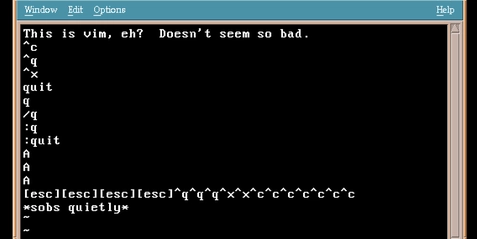
The most common complaint I hear about Vim? "I can’t even exit the thing!" I get it, the modal editing approach isn’t intuitive at first.

But think of it this way, Vim has different "gears" for different tasks, just like your car:

  • Command Mode: Your navigation gear to move around, delete, copy, paste.
  • Insert Mode: Your typing gear to add new text and edit existing content.
  • Extended Mode: Your settings gear to save files, quit, adjust your environment.

Let’s say you’re reviewing a Terraform configuration with hundreds of lines. In Command Mode, you can fly through the file, searching for specific resource blocks without fear of accidentally changing anything. When you find what you need, one keystroke puts you in Insert Mode to make your changes.

Switching gears is simple:

i           # Switch to Insert Mode (start typing)
ESC         # Switch back to Command Mode (navigate and manipulate)
shift (+) : # Switch to Extended Mode (execute commands)

3. Insert Mode (Writing with Purpose)

Once you press i to enter Insert Mode, Vim transforms into a familiar text editor.

Imagine your team lead asks you to update a Jenkins pipeline script with new deployment parameters. You SSH into the server, open the file, press i, and start typing:

When you’re done, hitting ESC returns you to Command Mode, ready for your next operation.

The ability to quickly jump into remote systems and make targeted changes shows versatility and comfort with infrastructure-as-code practices, increasingly essential skills for cloud roles.

4. Command Mode (Where the Magic Happens)

This is where your productivity explodes. In Command Mode, your keyboard becomes a surgical instrument for text manipulation. Let’s imagine you’re merging configuration files during a service migration and need to reorganize blocks of YAML. Instead of tedious select-cut-paste operations, you execute.

dd      # Delete the current line (cut)
ndd     # Delete (cut) specific number lines at once
yy      # copy the current line
p       # Paste below current position

Time saving skills directly impact project delivery, it demonstrates both technical and business value awareness.

5. Extended Mode (Command Central for Power Users)

Extended Mode (accessed by typing shift (+) :) is where you control Vim itself and execute powerful commands. Let’s say you receive an alert about a suspicious entry in a massive log file. You need to find it fast.

:se nu    # Show line numbers
:10000    # Jump to line 10,000
:/ERROR   # Search for the word "ERROR"
:w        # Save your changes
:q!       # Quit
:wq       # Save and quit in one command

Engineers who can navigate and search large files efficiently solve problems faster. This becomes especially valuable when debugging in production environments where GUIs aren’t available.

6. Vim Shortcuts That Save Your Day (And Your Job!)

These shortcuts might look like cryptic incantations now, but they’ll become second nature and potential lifesavers.

gg      # Jump to the beginning of the file
G       # Jump to the end of the file
/string # Search forward for "string"
n       # Find the next occurrence
N       # Find the previous occurrence

Engineers who know how to rapidly find and replace content across configuration files demonstrate attention to detail and efficiency crucial qualities for maintaining complex systems.

7. Using Line Numbers to Become a Debugging Hero

When error logs point to specific line numbers, Vim’s ability to jump directly to them is invaluable.

Example: A CI/CD pipeline fails with the message "Error on line 237 of Docker file. You get there straight away " Instead of scrolling endlessly…

:se nu  # Enable line numbers
:237    # Jump directly to line 237

In seconds, you’re staring at the problematic line. Fix it, save, and you’re done.

The ability to quickly locate and address specific issues in code or configuration files demonstrates problem solving efficiency a quality that directly impacts system reliability and uptime.

Summary

Learning Vim isn’t about impressing colleagues with terminal wizardry (though that happens). It’s about building a skill that makes you more effective when it matters most.

As cloud environments grow more complex, the ability to quickly navigate and modify configuration files, deployment scripts, and infrastructure code becomes increasingly valuable.

Engineers who can troubleshoot and fix issues directly on servers without needing to download files, edit locally, and re-upload, respond faster and more effectively to critical situations.

Vim proficiency will directly contribute to:

  • Reducing average incident response times.
  • Confidently making critical changes during production issues.
  • Standing out in pair programming sessions and technical interviews.
  • Maintaining focus during complex debugging sessions.

Conclusion

Either you’re managing Kubernetes manifests, troubleshooting AWS CloudFormation templates, or tweaking Terraform configurations, Vim’s speed and universal availability make it an invaluable tool in your Cloud Engineering & DevOps arsenal.

FAQs

Q: What is Vim?
A: Vim is a popular command-line text editor that is widely used in Unix-like operating systems.

Q: Why is Vim so useful in Cloud Engineering?
A: Vim is useful in Cloud Engineering because it provides a fast and efficient way to edit configuration files, deployment scripts, and infrastructure code.

Q: What are the different modes in Vim?
A: Vim has three main modes: Command Mode, Insert Mode, and Extended Mode.

Q: How do I navigate in Vim?
A: You can navigate in Vim using keyboard shortcuts, such as j, k, l, and h to move up, down, right, and left, respectively.

Q: How do I copy and paste in Vim?
A: You can copy and paste in Vim using the yy and p commands, respectively.

Q: How do I save and quit Vim?
A: You can save and quit Vim using the :wq command.

OpenAI Co-Founder’s New Venture Valued at $32bn

Stay Informed with Free Updates

Simply sign up to the Artificial intelligence myFT Digest — delivered directly to your inbox.

OpenAI Co-Founder Raises $2 Billion for Artificial Intelligence Start-Up

OpenAI co-founder Ilya Sutskever has raised $2 billion for his artificial intelligence start-up, Safe Superintelligence (SSI), in a deal that values the year-old company at $32 billion. Despite having no product, SSI has garnered significant attention from investors, underscoring their enthusiasm for backing AI start-ups led by prominent researchers or talented engineers.

Funding Round

Prominent venture capital firms participated in the latest fundraising, including Greenoaks, which led the round with $500 million, as well as Lightspeed Venture Partners and Andreessen Horowitz, said multiple people familiar with the matter. SSI last raised $1 billion at a $5 billion valuation in September.

Company Focus

SSI has set out to create AI models that are dramatically more powerful and more intelligent than current cutting-edge models from rivals such as OpenAI, Anthropic, and Google. The company has offices in Palo Alto, California, and Tel Aviv, Israel.

Unique Approach

The company has given few details about how it intends to beat those better-funded rivals, but Sutskever told the Financial Times last year that he and the team had “identified a new mountain to climb that’s a bit different from what I was working on previously.” The group has been tight-lipped even with its investors, said multiple familiar people, however, three people close to the company said it was working on unique ways of developing and scaling AI models.

Focus on Advancing Human Intelligence

Currently, large language models can synthesise and regurgitate data. While they are improving their ability to provide considered answers and perform chains of tasks, they have not been able to surpass human intelligence. People close to the company said SSI is focused on this advancement.

Background

Sutskever co-founded OpenAI and served as the San Francisco group’s chief scientist when it launched AI models and products, including chatbot ChatGPT, which kicked off the recent AI investment boom. He left OpenAI in May and his team — which was focused on “alignment”, ensuring that AI systems that surpass human intelligence will act in the human interest — was also disbanded.

Related Developments

Former colleague and ex-OpenAI chief technology officer Mira Murati has also launched an artificial intelligence start-up called Thinking Machines Lab in February. The product and research organisation aims to make “AI systems more widely understood, customisable and generally capable”. It is reportedly raising a similar-sized round.

Conclusion

SSI’s $2 billion funding round underscores the excitement around AI start-ups and their potential to revolutionize the industry. As the company continues to develop its unique approach to AI, it will be exciting to see how it progresses and what impact it will have on the field.

FAQs

Q: What is Safe Superintelligence (SSI)?

A: SSI is an artificial intelligence start-up founded by Ilya Sutskever, co-founder of OpenAI, and Daniel Gross, who led Apple’s AI efforts, and Daniel Levy, an AI researcher.

Q: What is SSI’s focus?

A: SSI is focused on creating AI models that are dramatically more powerful and more intelligent than current cutting-edge models from rivals such as OpenAI, Anthropic, and Google.

Q: Who participated in the latest fundraising round?

A: Prominent venture capital firms participated in the latest fundraising, including Greenoaks, Lightspeed Venture Partners, and Andreessen Horowitz.

Q: What is the valuation of SSI?

A: The company is valued at $32 billion, a significant increase from its previous valuation of $5 billion.

Q: What is the background of Ilya Sutskever?

A: Sutskever co-founded OpenAI and served as the San Francisco group’s chief scientist when it launched AI models and products, including chatbot ChatGPT. He left OpenAI in May and his team was also disbanded.

AI Models Still Struggle to Debug Software

0

AI Models Struggle to Debug Software Bugs, Study Finds

AI models from OpenAI, Anthropic, and other top AI labs are increasingly being used to assist with programming tasks. Google CEO Sundar Pichai said in October that 25% of new code at the company is generated by AI, and Meta CEO Mark Zuckerberg has expressed ambitions to widely deploy AI coding models within the social media giant.

Study Reveals Limited Capabilities of AI Models

A new study from Microsoft Research reveals that models, including Anthropic’s Claude 3.7 Sonnet and OpenAI’s o3-mini, fail to debug many issues in a software development benchmark called SWE-bench Lite. The results are a sobering reminder that, despite bold pronouncements from companies like OpenAI, AI is still no match for human experts in domains such as coding.

Study Methodology

The study’s co-authors tested nine different models as the backbone for a “single prompt-based agent” that had access to a number of debugging tools, including a Python debugger. They tasked this agent with solving a curated set of 300 software debugging tasks from SWE-bench Lite.

Results

According to the co-authors, even when equipped with stronger and more recent models, their agent rarely completed more than half of the debugging tasks successfully. Claude 3.7 Sonnet had the highest average success rate (48.4%), followed by OpenAI’s o1 (30.2%), and o3-mini (22.1%).

A chart from the study. The “relative increase” refers to the boost models got from being equipped with debugging tooling.Image Credits:Microsoft

Limitations and Future Directions

According to the co-authors, some models struggled to use the debugging tools available to them and understand how different tools might help with different issues. The bigger problem, though, was data scarcity, according to the co-authors. They speculate that there’s not enough data representing “sequential decision-making processes” — that is, human debugging traces — in current models’ training data.

“We strongly believe that training or fine-tuning [models] can make them better interactive debuggers,” wrote the co-authors in their study. “However, this will require specialized data to fulfill such model training, for example, trajectory data that records agents interacting with a debugger to collect necessary information before suggesting a bug fix.”

Conclusion

The findings aren’t exactly shocking. Many studies have shown that code-generating AI tends to introduce security vulnerabilities and errors, owing to weaknesses in areas like the ability to understand programming logic. One recent evaluation of Devin, a popular AI coding tool, found that it could only complete three out of 20 programming tests.

Conclusion

The study highlights the limitations of AI models in debugging software bugs and the need for further research and development to improve their capabilities. While AI has the potential to assist developers in certain tasks, it is not yet ready to fully automate the coding process.

FAQs

Q: What are the limitations of AI models in debugging software bugs?
A: AI models struggle to use debugging tools available to them, understand how different tools might help with different issues, and lack data representing human debugging traces.

Q: What are the implications of this study for AI-powered assistive coding tools?
A: The study suggests that AI-powered assistive coding tools may not be ready for widespread deployment and that further research and development are needed to improve their capabilities.

Q: What do tech leaders think about the future of coding jobs?
A: Many tech leaders, including Microsoft co-founder Bill Gates, Replit CEO Amjad Masad, Okta CEO Todd McKinnon, and IBM CEO Arvind Krishna, believe that programming as a profession is here to stay.

Verified ID Required

0

OpenAI to Introduce ID Verification Process for Access to Advanced AI Models

OpenAI, a leading artificial intelligence (AI) company, is planning to introduce an ID verification process for organizations to access its advanced AI models, according to a support page published on its website last week.

The Verification Process: Verified Organization

The verification process, called Verified Organization, is designed to “unlock access to the most advanced models and capabilities on the OpenAI platform,” according to the support page. Verification requires a government-issued ID from one of the countries supported by OpenAI’s API, with a limit of one verification per 90 days per organization.

OpenAI’s Motivation for the New Verification Process

OpenAI is introducing this verification process to ensure the safe and responsible use of its AI models, according to the company. The move is aimed at preventing unsafe use of AI, which can have negative consequences, and to make advanced models available to the broader developer community.

Security and IP Theft Concerns

The new verification process may be intended to beef up security around OpenAI’s products as they become more sophisticated and capable. The company has published several reports on its efforts to detect and mitigate malicious use of its models, including by groups allegedly based in North Korea.

It may also be aimed at preventing IP theft. According to a report from Bloomberg earlier this year, OpenAI was investigating whether a group linked with DeepSeek, the China-based AI lab, exfiltrated large amounts of data through its API in late 2024, possibly for training models — a violation of OpenAI’s terms.

Conclusion

OpenAI’s introduction of the Verified Organization process is a significant step towards ensuring the responsible use of its AI models and preventing potential security and IP theft concerns. The company’s commitment to making advanced models available to the broader developer community while prioritizing safety is commendable.

Frequently Asked Questions
Q: What is the purpose of the Verified Organization process?

A: The purpose of the Verified Organization process is to ensure the safe and responsible use of OpenAI’s AI models, prevent unsafe use of AI, and make advanced models available to the broader developer community.

Q: What is required for verification?

A: Verification requires a government-issued ID from one of the countries supported by OpenAI’s API, with a limit of one verification per 90 days per organization.

Q: Why is OpenAI introducing this verification process?

A: OpenAI is introducing this verification process to prevent potential security and IP theft concerns, and to ensure the responsible use of its AI models.

Q: What is the timeline for the introduction of the Verified Organization process?

A: The exact timeline for the introduction of the Verified Organization process is unclear, but it is expected to be implemented soon.

Simulated Voices of Musk and Zuckerberg from Hacked Crosswalk Buttons

0

Crosswalk Buttons in California Cities Hacked with AI-Generated Voices

Hack Affects Multiple Cities

Crosswalk buttons in at least three California cities, Palo Alto, Redwood City, and Menlo Park, appear to have been hacked this weekend to give them seemingly AI-generated voices of Tesla CEO Elon Musk and Meta CEO Mark Zuckerberg. In videos posted online, the apparent voice of Musk begs listeners to be his friend, while the voice of Zuckerberg brags about "undermining democracy" and "cooking our grandparents’ brains with AI slop."

Palo Alto Affected

A Palo Alto city spokesperson told Palo Alto Online that city employees "determined that 12 downtown intersections were impacted" and have disabled the crosswalks’ voice features pending repairs. The signals otherwise work as they should, they told the outlet. The hack seemed to have taken place on Friday, the person said.

Redwood City and Menlo Park Also Affected

The same thing is happening in Redwood City, where a deputy city manager told The San Francisco Chronicle that the city is investigating and attempting to resolve the issue there. Crosswalk buttons in Menlo Park are also reportedly affected.

How the Hack Works

The voice features of these buttons are used to guide people with difficulty seeing, letting them know when to "wait" and when the walk sign on the other end of the street has turned on. It’s hard to tell how much, if at all, the simulated voices interfere with that, but they seem to be playing in addition to, rather than instead of the built-in safety notices, at least in some videos of the phenomenon.

Videos with Simulated Voices

Here are some videos with the simulated voice of Musk, along with my transcriptions below each:

  • Hi, this is Elon Musk, and I’d like to personally welcome you to Palo Alto. You know, people keep saying, ‘cancer is bad,’ but have you ever tried being a cancer? It’s fucking awesome.
  • Hi, this is Elon Musk. Welcome to Palo Alto, the home of Tesla engineering. You know, they say money can’t buy happiness, and yeah, okay, I guess that’s true. God knows I’ve tried. But it can buy a Cybertruck, and that’s pretty sick, right? Right? Fuck, I’m so alone.
  • Hi, I’m Elon. Can we be friends? Will you be my friend? I’ll give you a Cybertruck, I promise. Okay, look, you don’t know the level of depravity I would stoop to just for a crumb of approval.

Another Video Features a Soundalike of President Donald Trump

One had a guest spot from a soundalike of President Donald Trump, clearly making light of Musk’s close association with Trump:

  • Not Musk: You know, it’s funny, I used to think he was just this dumb sack of shit. But once you get to know him, he’s actually pretty sweet and tender and loving.
  • Not Trump: Sweetie, come back to bed.

Simulated Zuckerberg Voice Messages

One video published by Palo Alto Online featured this quote, spoken by a faked Zuckerberg’s voice:

  • Hey, it’s Zuck here. I just want to tell you how very proud I am of everything we’ve been building together. From undermining democracy to cooking our grandparents’ brains with AI slop, to — to making the world less safe for trans people. Nobody does it better than us, and, uh, and I think that’s pretty neat. Zuck out!

Conclusion

The hack seems to be a prank gone wrong, with the simulated voices playing in addition to the built-in safety notices. While it may be amusing to some, it’s unclear how much, if at all, the simulated voices interfere with the intended purpose of the crosswalk buttons.

FAQs

Q: What cities are affected by the hack?
A: At least three California cities, Palo Alto, Redwood City, and Menlo Park, are affected.

Q: Who is behind the hack?
A: The identity of the hacker is unknown.

Q: How did the hack happen?
A: It’s unclear how the hack occurred, but it’s believed to be a prank gone wrong.

Q: Will the hack be resolved?
A: The cities affected are working to resolve the issue, with Palo Alto already disabling the voice features pending repairs.