
Value Learning from Different Perspectives
Introduction
In the last few years, reinforcement learning (RL) has made remarkable progress, including beating world-champion Go players, controlling robotic hands, and even painting pictures.
One of the key sub-problems of RL is value estimation – learning the long-term consequences of being in a state. This can be tricky because future returns are generally noisy, affected by many things other than the present state. The further we look into the future, the more this becomes true.
But while difficult, estimating value is also essential to many approaches to RL.
Monte Carlo Value Estimation
The natural way to estimate the value of a state is as the average return you observe from that state. We call this Monte Carlo value estimation.
Sometimes the agent reaches its goal.

Other times it falls off the cliff.

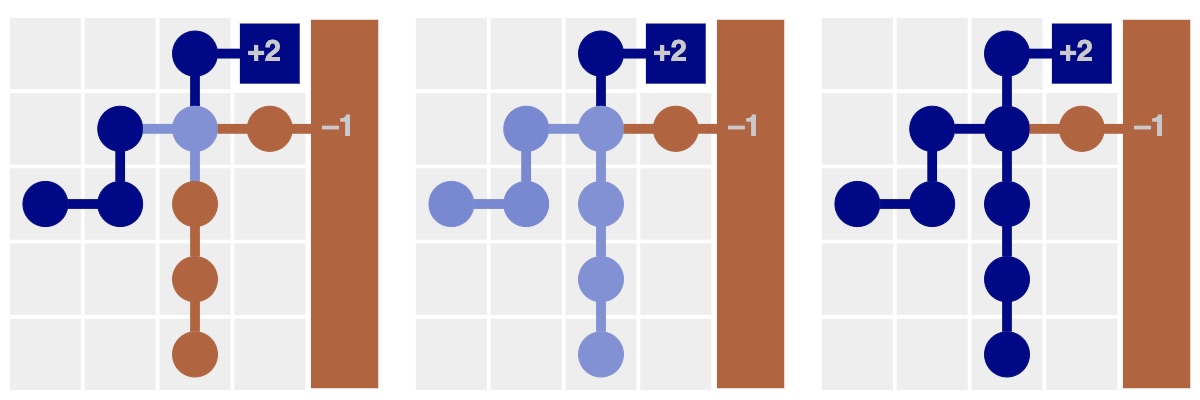
Monte Carlo averages over trajectories where they intersect.
If a state is visited by only one episode, Monte Carlo says its value is the return of that episode. If multiple episodes visit a state, Monte Carlo estimates its value as the average over them.
Update Rules
Let’s write Monte Carlo a bit more formally. In RL, we often describe algorithms with update rules, which tell us how estimates change with one more episode. We’ll use an “updates toward” () operator to keep equations simple.
Conclusion
In this article we introduced a new way to think about TD learning. It helps us see why TD learning can be beneficial, why it can be effective for off-policy learning, and why there can be challenges in combining TD learning with function approximators.
We encourage you to use the playground below to build on these intuitions, or to try an experiment of your own.
Gridworld playground
FAQs
Q: What is the main idea of this article?
A: The main idea of this article is to introduce a new way to think about TD learning and its benefits in reinforcement learning.
Q: What is the purpose of the gridworld example?
A: The purpose of the gridworld example is to illustrate the concept of Monte Carlo value estimation and its limitations.
Q: What are the challenges in combining TD learning with function approximators?
A: The challenges in combining TD learning with function approximators are discussed in the article, including the need to anneal the lambda parameter over the course of training.
Direct with AI

New AI Video Generator: Frames
Frames, a new AI video generator, is capable of producing cinematic results, making you feel like a director of a movie. This tool, developed by AI startup Runway, takes descriptions of scenes on a movie set and turns them into brief cinematic clips.
How Frames Works
Frames is free for basic use, but runs anywhere from $15 a month to $1,500 a year. The free version has a limit of 105 one-time credits to generate videos. If you use up these credits, you’ll need to subscribe to one of the paid plans for a higher allotment of monthly credits, removal of watermarks, greater storage, and access to the Gen-3 Alpha model for the highest fidelity of video generation.
Creating a Video
To use Frames, set up an account and choose your preferred model, including Gen-3 Alpha Turbo, Gen-3 Alpha (for paid users only), or Gen-2. You can describe the video using text, upload an image to base the video on, or combine both methods.
Describing the Video
The tricky part of Frames is describing the video. You’re asked to write a camera shot or angle as if it were for a motion picture or TV show. The guide provided with the Gen-3 Alpha Turbo model helps with this process, offering examples and explaining how to write a prompt.
Customizing the Video
You can specify the shot and angle, such as low angle, high angle, overhead, close-up, or over the shoulder. You can also describe the style of lighting, such as diffused, silhouette, backlit, or lens flare. Other elements to consider adding include movement types, aesthetics, and text style.
Examples and Presets
Try one of the preset prompts or create your own custom presets to use for future videos. The styles available include cinematic dolly out, cinematic drone, close-up dolly in, fast motion, first-person view, or slow motion.
Uploading an Image or Video Clip
You can upload an image or video clip with the scene or person you want to use in your production. You can then choose specific camera movements, such as pan, tilt, and zoom.
Generating the Video
Select the length for your video (4 seconds, 5 seconds, or 10 seconds, depending on the model) and ask Frames to generate your video. The short cinematic masterpiece appears for you to view.
Conclusion
Frames is a cool AI generator that puts you in a virtual director’s chair without requiring film school. While the free version has limitations, it’s a great way to experiment with AI-generated videos. For those who want to use Frames regularly, a paid subscription offers greater flexibility and capabilities.
FAQs
Q: What is the free version of Frames?
A: The free version of Frames is free for basic use, but has a limit of 105 one-time credits to generate videos.
Q: How do I use Frames?
A: Set up an account, choose your preferred model, and describe the video using text, upload an image, or combine both methods.
Q: What are the limitations of the free version?
A: The free version has limitations, including a limited number of credits, watermarks, and storage.
Q: Can I use Frames without a subscription?
A: Yes, but be aware of the limitations of the free version and consider upgrading to a paid plan for more capabilities.
/cdn.vox-cdn.com/uploads/chorus_asset/file/25378905/STK088_SPOTIFY_CVIRGINIA_A.jpg "Google Connects Spotify to Gemini AI Assistant")
Finding the Right Fit for Your Business

Why Rely on Chatbots for Your Business Needs?
Forbes found that the most popular applications of AI chatbots are:
- Customer service (56% of respondents);
- Cybersecurity and fraud management (51%);
- Customer relationship management (46%);
- Digital personal assistants (47%);
- Inventory management (40%);
- Content production (35%).
Why Rely on Chatbots for Your Business Needs?
Chatbots are used to streamline communication and improve customer relations. They do this by ensuring rapid feedback and resolving issues day and night, even without having people involved. Organizations can cut down on expenditure while at the same time resolving problems quicker, whereas individuals can find swift, personalized treatment.
What is an AI Chatbot?
AI chatbots interact with users via written language or speech. They are digital front liners that deal with inquiries, provide information, and direct clients in real time.
What is an AI Virtual Assistant?
AI virtual assistants can be personalized to respond in a specific tone or style, including voice customization for a unique experience. They can also manage and prioritize tasks based on a user’s work patterns, reminders, and deadlines, ensuring a personalized approach to workflow management.
How Businesses Can Benefit from Personalizing Chatbots and Virtual Assistants?
Personalizing chatbots and virtual assistants gives businesses a competitive edge, significantly enhancing customer experiences and operational efficiency. By tailoring AI solutions to individual customer needs, businesses can improve user engagement and satisfaction, leading to increased loyalty and conversions.
Wrapping Up
When choosing between chatbots and AI virtual assistants for your company, you need to consider your particular requirements, your aims and ambitions, and the type of customer experience you aim to create. Chatbots are proficient in straightforward tasks and are good at answering frequently asked questions, making them suitable for those concerned with effectiveness and quick responses in their operations. In contrast, AI virtual assistants will have more sophisticated features like personalized interaction or natural language processing, thus making them better suited for companies seeking higher levels of customer participation alongside human-style communication.
Conclusion
As you navigate the rapidly evolving world of AI, selecting the right solution—whether it’s a chatbot or a virtual assistant—can significantly impact your business. By carefully considering factors like task complexity, budget, scalability, and user experience, you can make an informed decision that enhances your operations and customer interactions.
Frequently Asked Questions
Q: What are the benefits of using chatbots?
A: Chatbots can streamline communication, improve customer relations, and reduce resolution time.
Q: What are the benefits of using AI virtual assistants?
A: AI virtual assistants can provide personalized interaction, natural language processing, and task management.
Q: How do chatbots and virtual assistants differ?
A: Chatbots are suitable for straightforward tasks and answering frequently asked questions, while virtual assistants are better suited for complex tasks and personalized interaction.
Q: How can businesses benefit from personalizing chatbots and virtual assistants?
A: By tailoring AI solutions to individual customer needs, businesses can improve user engagement, satisfaction, and loyalty.
Q: What are the most popular applications of AI chatbots?
A: The most popular applications of AI chatbots include customer service, cybersecurity, customer relationship management, and digital personal assistants.
Reducing Hallucinations in Large Language Models with Custom Intervention using Amazon SageMaker Ground Truth

Hallucinations in Large Language Models and Mitigation Strategies
/cdn.vox-cdn.com/uploads/chorus_asset/file/25333634/openai_sora_screen.png "Artists Protest by Leaking OpenAI’s Sora AI Video Model")

QNAP Firmware Update Locks Out NAS Owners

QNAP NAS Firmware Update Causes Widespread Issues, Company Responds with Swift Action and Mixed Results
Update Causes Chaos and Frustration
A recent firmware update pushed to QNAP network attached storage (NAS) devices has left a number of owners unable to access their storage systems. The company has pulled back the firmware and issued a fixed version, but the company’s response has left some users feeling less confident in the boxes into which they put all their digital stuff.
The Problem
As seen on a QNAP community thread, and as announced by QNAP itself, the QNAP operating system, QTS, received update 5.2.2.2950, build 20241114, at some point around November 19. After QNAP "received feedbacks from some users reporting issues with device functionality after installation," the firm says it withdrew it, "conducted a comprehensive investigation," and re-released a fixed version "within 24 hours."
Wider Impact Than Initially Reported
The community thread sees many more users of different systems having problems than the shortlist ("limited models of TS-x53D series and TS-x51 series") released by QNAP. Issues reported included owners being rejected as an authorized user, devices reporting issues with booting, and claims of Python not being installed to run some apps and services.
QNAP’s Response
QNAP says affected users can either downgrade their devices (presumably to then upgrade once more to the fixed update) or contact support for help. Response from QNAP support, as told by users on forums and social media, has not measured up to the nature of losing access to an entire backup system.
Conclusion
The recent firmware update debacle has left a sour taste in the mouths of many QNAP users. While the company’s swift action in pulling back the update and issuing a fixed version is commendable, its response to affected users has been perceived as lacking. The incident highlights the importance of thorough testing and quality assurance in software development, as well as the need for clear communication and empathy in crisis management.
FAQs
Q: What was the affected firmware update?
A: QTS update 5.2.2.2950, build 20241114.
Q: What were the issues reported by QNAP users?
A: Issues included being rejected as an authorized user, devices reporting issues with booting, and claims of Python not being installed to run some apps and services.
Q: How can affected users recover?
A: QNAP advises affected users to downgrade their devices or contact support for help.
Q: How did QNAP respond to the issue?
A: QNAP pulled back the firmware, conducted a comprehensive investigation, and re-released a fixed version within 24 hours. However, user reports indicate that QNAP support has not been adequately addressing the concerns of affected users.
Yes, That Viral LinkedIn Post You Read Was Probably AI-Generated

AI-Generated Writing on LinkedIn: A New Era for Professional Networking?
The Rise of AI-Generated Content on LinkedIn
Artificial intelligence (AI) has been increasingly used to generate content online, and LinkedIn is no exception. The Microsoft-owned social media platform has been at the forefront of embracing AI, offering its own AI writing tools to help users create and edit their posts, profiles, and direct messages. In fact, a recent analysis by the AI detection startup Originality AI found that over 54% of longer English-language posts on LinkedIn are likely AI-generated.
The Uptick in AI Usage on LinkedIn
The use of AI writing tools on LinkedIn has seen a significant increase, particularly since the launch of ChatGPT in 2023. According to Originality, the number of likely AI-generated posts on the platform has spiked 189%, with the trend leveling off since then.
LinkedIn’s Stance on AI-Generated Content
LinkedIn does not track the number of posts written or edited with AI tools, but the platform is committed to identifying and removing low-quality, duplicate content. In a statement, Adam Walkiewicz, LinkedIn’s head of "feed relevance," emphasized that "AI is a tool that can help with the review of a draft or to beat the blank page problem, but the original thoughts and ideas that our members share are what matter."
The Rise of AI-Generated Content on LinkedIn
The increasing use of AI-generated content on LinkedIn has led to the development of a cottage industry of AI-powered tools and generators. These tools help users create content to attract attention and grow their audiences. For example, there are AI-powered comment and post generators that can help users churn out content to impress potential bosses or customers.
How Users are Using AI-Generated Content on LinkedIn
According to WIRED, users are relying more on general-purpose large language models to create their LinkedIn posts. Content writer Adetayo Sogbesan uses Anthropic’s Claude to spin up rough drafts of posts, which she then edits before publishing.
Conclusion
The rise of AI-generated content on LinkedIn has changed the way users interact with the platform. While it is difficult to distinguish between AI-written and human-penned content, the increasing use of AI tools has led to a new era of professional networking online.
FAQs
Q: How does LinkedIn track AI-generated content?
A: LinkedIn does not track the number of posts written or edited with AI tools.
Q: How does LinkedIn identify and remove low-quality content?
A: LinkedIn uses robust defenses to proactively identify and remove low-quality, duplicate content.
Q: How do users generate content on LinkedIn?
A: Users are increasingly relying on general-purpose large language models to create their LinkedIn posts.
Q: What is the purpose of AI-generated content on LinkedIn?
A: AI-generated content helps users create content to attract attention and grow their audiences.
