Home Blog Page 571

Blind to AI’s Brushstrokes

0

AI Art: Can We Tell the Difference?

Controversial and Grey

AI art, promtography, or whatever you want to call it, remains a topic of debate. Many people hate it – as shown in the reaction to the Coca-Cola AI Christmas ad. But can we really tell the difference?

A Recent Study

A recent study aimed to find out. Some 11,000 participants looked at 50 images and decided whether each one was created by an AI image generator or a real human. They were also asked which image they preferred. The results were surprising.

The Test

The two images above, or those below, for example. Can you tell which is AI?

The Results

The test found that although five participants managed a score of 49/50, people chose wrong 40% of the time. The study also found that participants liked the AI images slightly more than the human-created ones. Six of the ten most-liked images were AI-generated, including the top two.

The Most-Liked Image

The most popular image in the test? Er, that was AI.

Doubts About the Test

As interesting as it is, I have many doubts about the test. It was not scientific, and some of the images seem to have been chosen specifically to make it hard. The AI images didn’t contain obvious giveaways like misshapen hands or nonsense text, and many were made by experienced users of AI image generators.

Alternative Test

A test at DSL put pairs of human/AI images of the same style side by side and participants scored close to 100%. The site’s readership also has an inherent bias since it includes many AI enthusiasts. Nevertheless, some of the example images still look very clearly AI to me. Check out the anime girl and the giant cats below.

Conclusion

In conclusion, the study raises more questions than answers. Can we really tell the difference between AI art and human art? The test may have been flawed, but it’s clear that people have a strong preference for AI art. As the technology improves, we can expect to see more AI-generated art in our daily lives.

FAQs

Q: Can we really tell the difference between AI art and human art?
A: The study suggests that it’s difficult, but not impossible.

Q: What was the result of the study?
A: The study found that participants liked the AI images slightly more than the human-created ones, and that 40% of the time, people chose wrong when distinguishing between AI and human art.

Q: What are the implications of this study?
A: The study raises questions about the future of art and the role of AI in creative industries. As the technology improves, we can expect to see more AI-generated art in our daily lives.

Q: What are the limitations of the study?
A: The study was not scientific, and some of the images may have been chosen specifically to make it hard to distinguish between AI and human art.

Jaguar Rebrand Controversy

0

We’ve Seen Plenty of Unpopular Rebrands, But This Jaguar One Is Something Else

We’ve seen plenty of unpopular and/or controversial rebrands over the last few years, and nothing seems to stir up quite as much debate as a new car logo. From Kia’s ‘unreadable’ wordmark to countless flattened versions of existing logos, vehicular design always evokes an emotional response, perhaps because of the loyalty these brands foster among fans. But in five years of covering rebrands, I’ve never seen anything quite like the response to the new Jaguar branding.

The Controversy Surrounding Jaguar’s Rebrand

It’s rare that a rebrand gets everyone from branding experts to Elon Musk talking, but this one has certainly broken the industry bubble to become a bonafide piece of mainstream news. But while one of the main criticisms of the marketing imagery, with its diversity, colourful outfits and notable absence of a single car, is its apparent woke-baiting, most sides of the cultural and political divide seem to be calling this one a misstep. If anything, then, the whole enterprise has proven somewhat unifying.

The New Jaguar Logo

(Image credit: Jaguar)

Jaguar’s Response to the Backlash

In the latest development, Jaguar itself has waded into the discourse by, as the BBC reports, asking people to ‘trust and reserve judgement’ on the rebrand. Which is pretty unprecedented step – it’s not like a luxury brand to acknowledge the unpopularity of one of its creative decisions, particularly after just a week. But then perhaps the brand was trying to ease the pressure for its poor old social media manager, who has been heroically responding to the avalanche of negative tweets with cryptic responses to the tune of ‘Watch this space,’ and ‘All will be revealed.’

What’s Next for Jaguar?

Which begs the question; what will be revealed? Everyone is now waiting to see what Jaguar will do next – and whether it will actually reveal any cars. In the last few days, the company has teased a few close-up shots of details of an upcoming electric car, due to be revealed in Miami on 2 December. But these shots have done little to quell the backlash, with the angular design compared to that of an air conditioning unit.

A Marketing Hoax?

At this point, it’s looking pretty easy to write this one off as one of the most disastrous rebrands of the decade – the ‘New Coke’ of the 2020s, if you will. But there are some already wondering if maybe, just maybe, there could be more to it. Some have even speculated that, since the rebrand is so apparently out of character, it could all be a joke. Lee Rolston, chief growth officer at BIA-winning agency Jones Knowles Ritchie, shared an optimisitic notion with Creative Bloq. “Let’s hope Jaguar has just pulled off the greatest marketing hoax in history—getting the world talking about its electric future by seemingly discarding the entire equity of the Jaguar brand in one bold stroke. Creating an unprecedented level of brand noise, only to reveal, on December 3rd, the most desirable, beautifully designed, quintessentially Jaguar-esque EV ever. Branded exactly as a Jaguar should be. Mocking the beige, generic electric car brands with a brilliantly executed teaser film. In this scenario, they’d be utter geniuses—saving the brand and sweeping awards season.”

Conclusion

While a ‘gotcha’ might be a little too much to hope for next week, we’re certainly intrigued to see what more Jaguar has to reveal about its new direction on 4 December. And indeed, nobody can argue that Jaguar hasn’t enjoyed (or is that endured?) a ton of brand noise in the last week – more than I think I’ve seen any rebrand generate in the last five years.

Frequently Asked Questions
Q: Why did Jaguar change its logo?

A: Jaguar has not officially explained the reason behind its logo change, but some speculate that it may be part of a larger marketing strategy to revamp its brand image and appeal to a newer audience.

Q: Will Jaguar reveal a new car soon?

A: Yes, Jaguar has announced that it will reveal a new electric car on 2 December, but details about the design and features are still under wraps.

Q: Is Jaguar’s rebrand a joke?

A: Some have speculated that the rebrand could be a marketing hoax, but Jaguar has not confirmed or denied this rumor. We’ll have to wait and see what they have planned for their next move.

Chisoo Lyons: 2024 BigDATAwire Person to Watch

Women in Data Science: Chisoo Lyons’ Quest for Representation

Background

Women make up 15% to 22% of data science professionals, according to research from the Boston Consulting Group. One of the women working to increase this number is Chisoo Lyons, the executive director of Women in Data Science Worldwide (WiDS) and a BigDATAwire 2024 Person to Watch.

WiDS Mission

WiDS started in 2015 with a one-day technical conference at Stanford University to give women a voice in data science. Since then, the group has expanded significantly, and it now touches more than 150,000 participants across 160 countries via conferences, datathons, podcasts, upskilling workshops, its Next Gen outreach program, the WiDS Academy, and the UpLink platform. The group’s goal is to achieve 30% representation for women in data science by 2030, which it refers to as its 30×30 cause.

Interview with Chisoo Lyons

What attracted you to the position of Executive Director of WiDS Worldwide?

Women in Data Science Worldwide (WiDS) is a pioneer in the advancement of diversity, equity, and inclusion for women in technical fields. Data science and AI are shaping the world we live in today, and as having been in many leadership roles in data science, I know that diversity of perspectives, including gender, is critical to outcomes. That means women being included and represented in decision-making and opportunities to gain their share of the economic benefit in those outcomes. Our ambitious mission to achieve substantial women’s representation at every level of the field is personal to me.

How would you characterize the progress that women have made in data science over the past decade? What more needs to be done?

At an aggregate level, women and society have made and are continuing to make progress. Some studies report that women represent up to a quarter or more of data science practitioners in some industries and geographies. However, once you examine more closely, we see very little progress in segments of the population, such as the intersection of underserved communities and women. This is also the case when homing in on leadership positions in which diversity in thought process and experience is key in making decisions and directing the course for the initiatives, organizations, and communities.

Personal Life

Outside of the professional sphere, what can you share about yourself that your colleagues might be surprised to learn – any unique hobbies or stories?

I lived a good part of my childhood outside of the US. This seeded my curiosity about different cultures through traveling on holidays and through cooking (and eating) different types of cuisine. I love sharing the experience with family and friends, taking long hikes, and hanging out with my 2 miniature dachshunds.

Conclusion

Chisoo Lyons’ dedication to increasing representation of women in data science is inspiring. As the Executive Director of WiDS Worldwide, she is working tirelessly to achieve the group’s 30×30 goal. Her passion for diversity, equity, and inclusion is evident, and her unique experiences and hobbies make her a compelling individual.

FAQs

Q: What is the mission of Women in Data Science Worldwide (WiDS)?
A: The mission of WiDS is to advance diversity, equity, and inclusion for women in technical fields, specifically data science.

Q: What is the 30×30 goal of WiDS?
A: The 30×30 goal is to achieve 30% representation for women in data science by 2030.

Q: How can I get involved with WiDS?
A: You can get involved with WiDS by attending conferences, participating in datathons, listening to podcasts, upskilling workshops, or joining the Next Gen outreach program, WiDS Academy, or UpLink platform.

UK Establishes LASR to Counter AI Security Threats

0

UK Establishes Laboratory for AI Security Research to Counter Emerging Threats

The UK government has announced the establishment of the Laboratory for AI Security Research (LASR) to help protect Britain and its allies against emerging threats in the rapidly evolving field of artificial intelligence (AI). The initiative comes as part of a broader strategy to strengthen the UK’s cyber defence capabilities.

Government Funding and Partnerships

The laboratory will receive an initial government funding of £8.22 million and will bring together experts from industry, academia, and government to assess AI’s impact on national security. Key stakeholders in the new lab include GCHQ, the National Cyber Security Centre, the MOD’s Defence Science and Technology Laboratory, and prestigious academic institutions such as the University of Oxford and Queen’s University Belfast.

Addressing the ‘AI Arms Race’

Speaking at the NATO Cyber Defence Conference at Lancaster House, the Chancellor of the Duchy of Lancaster stated that NATO needs to adapt to the world of AI, as the tech evolves, the threat evolves. He warned that cyber war is now a daily reality and that the UK is watching Russia’s activities closely, countering their attacks both publicly and behind the scenes.

Collaboration and Incident Response

The new lab will operate under a ‘catalytic’ model, designed to attract additional investment and collaboration from industry partners. Alongside LASR, the government announced a new £1 million incident response project to enhance collaborative cyber defence capabilities among allies.

Conclusion

The UK’s establishment of the Laboratory for AI Security Research underscores the country’s commitment to staying ahead of emerging cyber threats. By bringing together experts from industry, academia, and government, LASR aims to assess the impact of AI on national security and develop effective strategies to counter threats.

FAQs

Q: What is the purpose of the Laboratory for AI Security Research (LASR)?
A: LASR aims to assess the impact of AI on national security and develop effective strategies to counter emerging threats.

Q: How much funding has the government allocated for LASR?
A: The laboratory will receive an initial government funding of £8.22 million.

Q: Who are the key stakeholders in LASR?
A: Key stakeholders include GCHQ, the National Cyber Security Centre, the MOD’s Defence Science and Technology Laboratory, and prestigious academic institutions such as the University of Oxford and Queen’s University Belfast.

Q: What is the goal of the incident response project announced alongside LASR?
A: The goal is to enhance collaborative cyber defence capabilities among allies and respond to emerging threats in real-time.

Shaping the Future: 3 Things the Design Industry Needs to Improve

0

We Need to Strike a Balance Between Innovation and Empathy

In today’s fast-paced world, innovation is often touted as the key to success. We’re constantly being told that we need to be quicker, faster, and more efficient in order to stay ahead of the curve. But is this relentless pursuit of innovation coming at a cost? Are we sacrificing empathy and compassion in the process?

The Rise of Digital Disconnection

We’re now more connected than ever before, with the ability to communicate with anyone, anywhere in the world, at any time. But despite this increased connectivity, many of us are feeling more isolated and disconnected than ever. We’re spending more time staring at our screens and less time engaging with the world around us.

The Consequences of Digital Disconnection

The consequences of digital disconnection are far-reaching and have significant impacts on our mental and emotional well-being. We’re experiencing increased levels of anxiety, depression, and loneliness, with many of us feeling like we’re just going through the motions of life without any real sense of purpose or fulfillment.

The Importance of Empathy

So, how can we strike a balance between innovation and empathy? The answer lies in cultivating empathy. Empathy is the ability to understand and share the feelings of others. It’s the glue that holds our communities together, and it’s essential for building strong, meaningful relationships.

Practicing Empathy in a Digital World

So, how can we practice empathy in a world that’s increasingly digital? Here are a few tips to get you started:

  • Put down your phone and engage with the world around you.
  • Practice active listening and ask open-ended questions.
  • Show genuine interest in others and ask for feedback.
  • Be present and fully engaged in your interactions with others.

A Call to Action

We need to make a conscious effort to prioritize empathy and compassion in our daily lives. We need to put down our phones and engage with the world around us. We need to show genuine interest in others and be present in our interactions with them. The world is a complex and often overwhelming place, but by cultivating empathy, we can find a sense of purpose and fulfillment.

FAQs

Q: What is empathy?

A: Empathy is the ability to understand and share the feelings of others.

Q: Why is empathy important?

A: Empathy is essential for building strong, meaningful relationships and for creating a sense of community.

Q: How can I practice empathy in a digital world?

A: You can practice empathy by putting down your phone, practicing active listening, showing genuine interest in others, and being present in your interactions with others.

Q: Why is innovation important?

A: Innovation is important for driving progress and improving our lives. However, it’s equally important to balance innovation with empathy and compassion.

Unlocking AI Insights from 546,000 Overviews

0

How Are Common Crawl Data And AI Overviews Related?

Common Crawl inclusion doesn’t affect AIO visibility as much as sheer organic traffic. Common Crawl, a non-profit that crawls the web and provides the data for free, is the largest data source of generative AI training. Some sites, like Blogspot, contribute a lot more pages than others, raising the question of whether that gives them an edge in LLM answers.

Result: I wondered whether sites that provide more pages than others would also see more visibility in AI Overviews. That turned out not to be true. I compared the top 500 domains by page contribution in Common Crawl to the top 30,000 domains in my dataset and found a weak correlation of 0.179. The reason is that Google probably doesn’t rely on Common Crawl to train and inform AI Overviews but its own index.

Image: Image Credit: Kevin Indig

How Does User Intent Change AI Overviews?

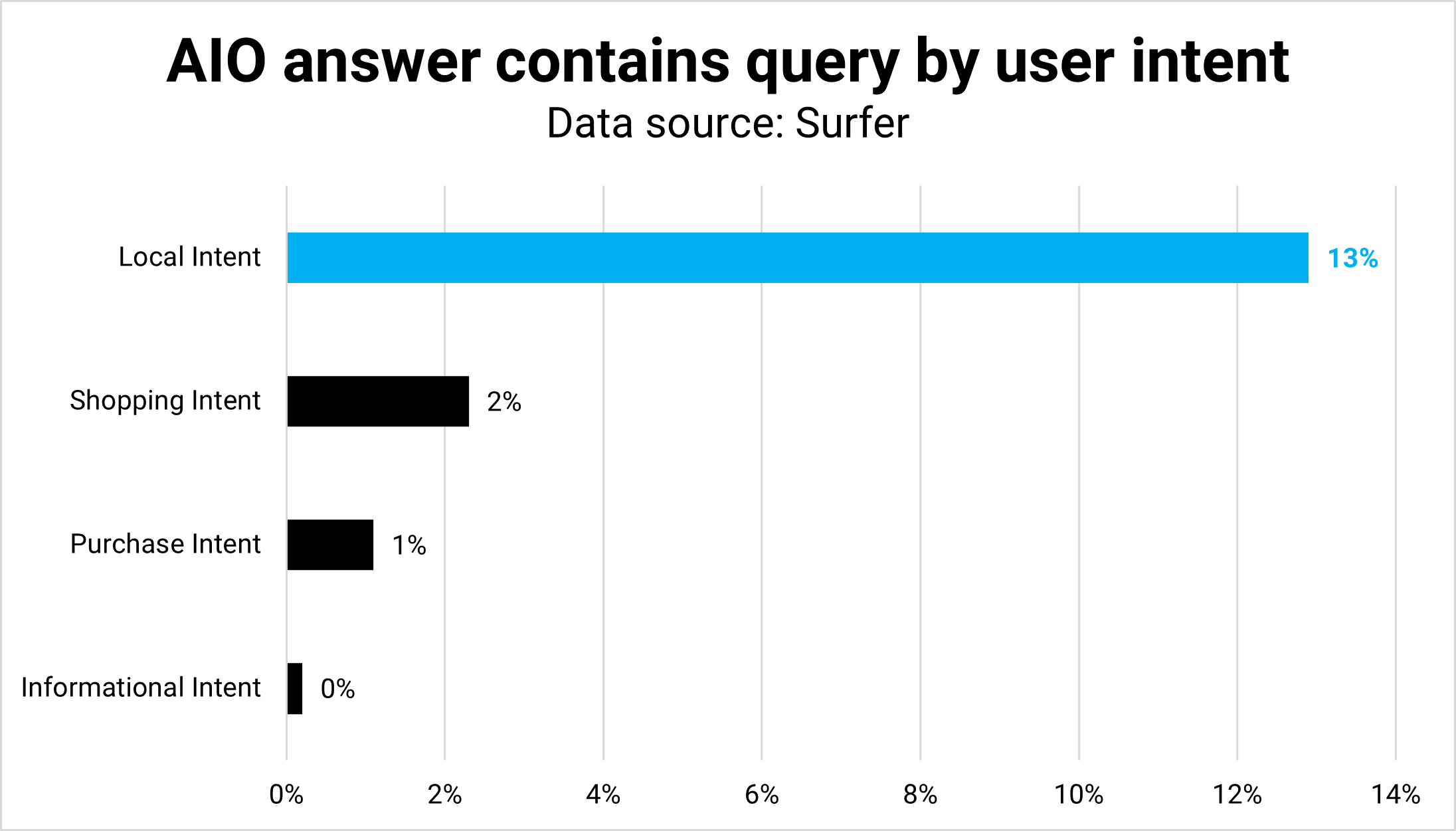
User intent shapes the form and content of AIOs. In my previous analysis, I came to the conclusion that the exact query match barely matters. The data shows that only 6% of AIOs contain the search query. Meeting user intent in the content is much more important than we might have assumed.

Result: I analyzed the relationship between the 3,000 top domains by organic traffic from Semrush and the top 30,000 domains in my dataset and found a strong relationship of 0.714. In other words, domains that get a lot of organic traffic have a high likelihood of being very visible in AI Overviews.

Image: AIO answer contains query by user intentImage Credit: Kevin Indig

How Do The Top 20 Organic Positions Break Down?

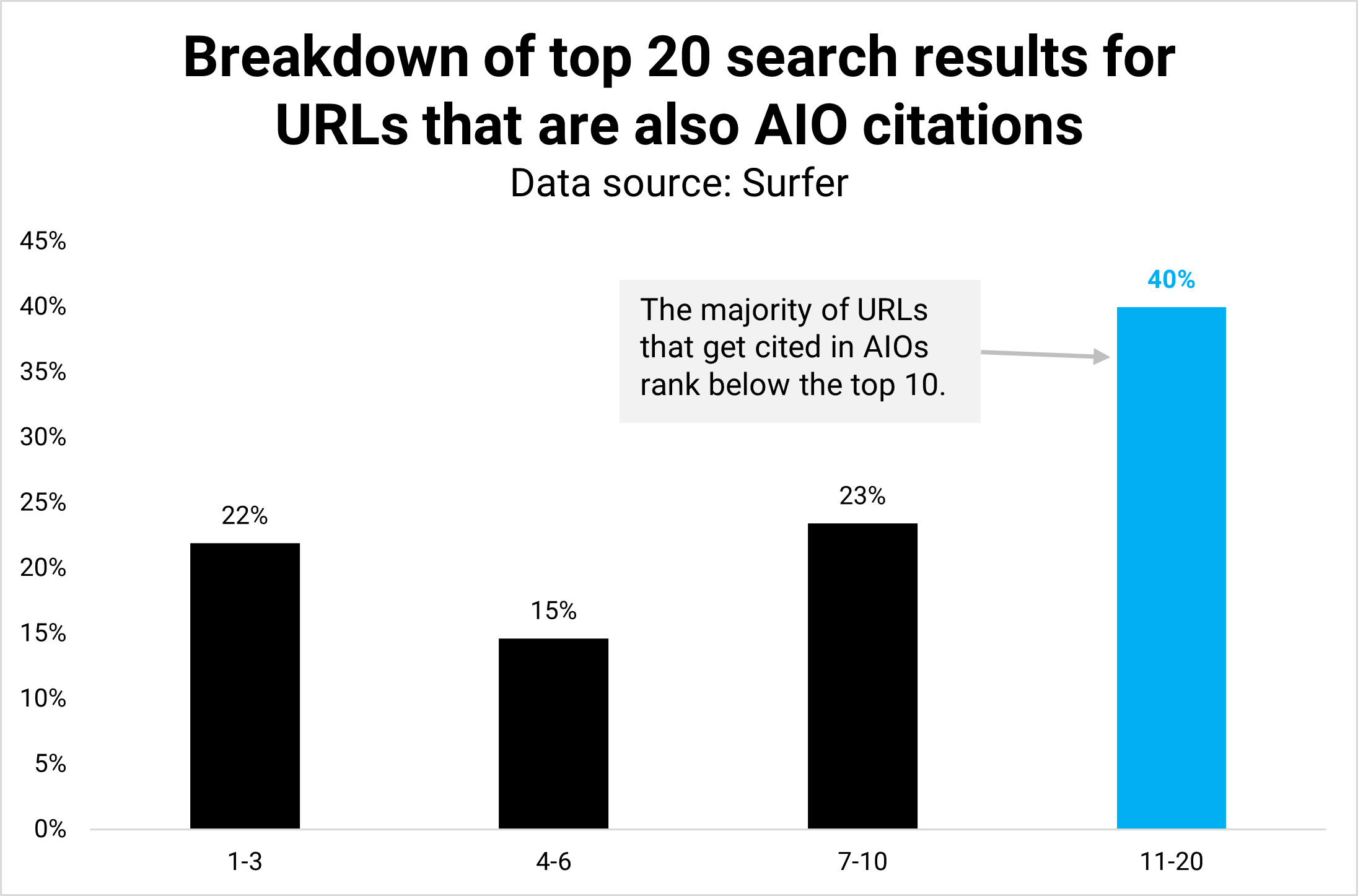
In my last analysis, I found that almost 60% of URLs that appear in AIOs and organic search results rank outside the top 20 positions. For this Memo, I broke the top 20 further down to understand if AIOs are more likely to cite URLs in higher positions or not.

Result: It turns out 40% of URLs in AIOs rank in positions 11-20, and only half (21.9%) rank in the top 3. The majority, 60% of URLs cited in AIOs, still rank on the first page of organic results, reinforcing the point that a higher organic rank tends to lead to a higher chance of being cited in AIOs.

Image: Breakdown of top 20 search results for URLs that are also AIO citationsImage Credit: Kevin Indig

Conclusion:

Understanding how AI Overviews are related to Common Crawl data and user intent can help optimize content and increase visibility. Meeting user intent is crucial, and satisfying user intent for questions is harder but also more important to be visible in AIOs than, for example, Featured Snippets.

FAQs:

Q: How do Common Crawl data and AI Overviews relate?
A: Common Crawl inclusion doesn’t affect AIO visibility as much as sheer organic traffic.

Q: How does user intent change AI Overviews?
A: User intent shapes the form and content of AIOs, and meeting user intent is crucial.

Q: How do the top 20 organic positions break down?
A: 40% of URLs in AIOs rank in positions 11-20, and only half (21.9%) rank in the top 3.

Fanuc launches new ‘heavyweight’ industrial robot – Robotics & Automation News

0

Fanuc, a world leader in industrial robotics and factory automation, has introduced the M-950iA “heavyweight industrial robot”, capable of lifting 500 kg – including automotive components, construction materials and EV battery packs.

Fitting perfectly between Fanuc’s M-900iB and M-1000iA families, the serial-link structured M-950iA/500 offers a much wider range of motion than standard parallel-link robots, offering flexibility that easily adapts to tight workspaces and variable layouts.

A high-rigidity design makes it suited for payloads up to 500 kg and its reach of 2,830 mm is paired with an impressive range of motion on the robot’s J3 axis, allowing it to flip over backwards.

Capable of handling large and heavy work pieces due to its ultra-strong and powerful wrist, the robot is also available with accuracy and stiffness enhancement option to maintain high accuracy even under the external force, making this an ideal solution for friction stir welding, drilling, and riveting applications.

Eric Potter, general manager of Fanuc America’s robot application segment, says: “We’re thrilled to introduce our new robot to the market. It’s design is perfect for rapid and robust performance in heavy part lifting, palletizing, and demanding material handling tasks.

“With its exceptional strength and versatility, the M-950iA is set to become a powerhouse for customers seeking adaptable solutions in challenging industrial environments.”

Features and benefits include:

  • 6 controlled axes
  • 500 kg maximum payload
  • A long 2,830 mm reach
  • Serial link design with a wide J3 axis motion range and ability to flip over backwards
  • High-performance servomotor drive system offering positioning repeatability of ±0.08 mm
  • User-friendly Fanuc iPendant teaching device and R-30iB Plus controller connectivity
  • Accuracy and stiffness enhancement option available for highest precision or where external forces may act on the robot

Future-Proof Your Tech Team in 2025

0

Successful Leadership in the Year Ahead: Balancing AI and Human Creativity

With AI now readily available online and embedded within vendor solutions, there’s a temptation to automate as much work as possible as some experts suggest it’s cheaper and often more reliable than humans.

A Delicate Balance

At the same time, those aspiring to lead technology innovation also need to promote greater human intuition and creativity. That balance means walking a delicate line between automation and human creativity, said Carrie Rasmussen, executive vice president and chief digital officer at Dayforce.

Embracing AI While Preserving Human Skills

Rasmussen emphasized the importance of keeping human and machine intelligence at an equal level, balancing the strengths of each. She noted that creativity that spurs critical thinking and innovation is becoming the most valuable skill for technology and business professionals.

The Risks of Over-Reliance on AI

Rasmussen warned that the biggest risk is that emerging technology leads to an erosion of understanding the logic and reasoning behind the solutions and processes adopted. “We may lose sight of coding skills if we start putting it all in generative AI,” she said.

The Importance of Data Governance

Rasmussen recommended being open to the possibilities of emerging technologies, such as generative AI. However, there’s another element that needs to be closely watched and managed as well — data. “Make sure you have that foundation of data — governed data,” she said.

Purposeful Implementation

Rasmussen emphasized the need for new technology initiatives to be highly focused. “Be purposeful — no peanut butter spreading,” she said. “Be piloting where you’re seeing the value.”

Conclusion

In conclusion, successful leadership in the year ahead requires embracing AI and related solutions while promoting greater human intuition and creativity. By balancing the strengths of both humans and machines, leaders can ensure that their organizations stay ahead of the curve while preserving the skills and values that make them unique.

Frequently Asked Questions

Q: What is the biggest risk of over-reliance on AI?
A: The biggest risk is losing sight of coding skills and the logic and reasoning behind solutions and processes adopted.

Q: How can leaders balance the strengths of humans and machines?
A: By keeping human and machine intelligence at an equal level, balancing the strengths of each, and promoting greater human intuition and creativity.

Q: What is the importance of data governance in AI implementation?
A: Data governance is essential to ensure that AI is used responsibly and that data is protected and used in a way that is transparent and accountable.

Q: What is the right approach to agentic AI?
A: The right approach is incremental, with AI agents working as copilots to humans, who are still needed to oversee and correct the AI’s output.

Spotify’s Latest UI Change Drives Users Crazy

0

Spotify’s New UI Change Sparks Outrage: What’s Behind the Create Button and How to Opt-Out

The Controversy

Spotify, a popular music streaming platform, has introduced a new feature that has sparked widespread criticism and frustration among its users. The company’s decision to replace the "Library" button with a "Create" button has been met with outrage, with many users taking to social media to express their discontent.

What’s the Problem?

The new "Create" button, which allows users to create playlists, has been seen as an unnecessary change by many. It appears that Spotify is trying to push its AI playlist feature, which many users do not use or need. The change has caused frustration, with some users complaining about the button being in the way of their usual navigation to their library.

The Backlash

The reaction to the change has been swift and severe, with many users taking to Twitter to express their disappointment and anger. A tweet by a user, which has gone viral, reads: "spotify stop with the stupid updates first you take away the hearts and now im hitting some fuckass create button instead of my library. count your days." Another user wrote: "hey spotify i promise you there’s not a single person alive who wanted you to add this “create” button, get it out of here."

What’s Behind the Change?

It’s likely that Spotify is testing the feature to see how many users will use it and how many accidental clicks it receives. The company may be collecting data to gauge the success of the new button and to inform future design decisions.

How to Opt-Out

If you’re one of the many users who are unhappy with the new "Create" button, you can easily opt-out by using the following workarounds:

  • Use the "Browse" tab to access your library
  • Use the "Search" bar to find your music
  • Use the "Your Library" shortcut in the Spotify app’s navigation menu

Conclusion

Spotify’s decision to introduce the "Create" button has sparked a backlash among its users. While the company may be trying to push its AI playlist feature, it’s likely that many users will continue to find ways to work around the change. For now, users can opt-out by using the workarounds mentioned above.

FAQs

Q: Why did Spotify introduce the "Create" button?
A: It’s likely that Spotify is trying to push its AI playlist feature and test how many users will use it.

Q: How can I opt-out of the "Create" button?
A: You can use the "Browse" tab, "Search" bar, or "Your Library" shortcut in the Spotify app’s navigation menu.

Q: Is this change permanent?
A: It’s unclear, but it’s likely that Spotify will continue to collect data on the success of the new feature.

Q: What can I do if I’m unhappy with the change?
A: You can express your concerns on social media or contact Spotify’s customer support team.

The Definition of ‘Craft’ is Rapidly Being Redefined

0

Day in the Life: Eri Panasci, Executive Producer at Jelly

Eri Panasci is executive producer and head of US business development at Jelly – an illustration agency and production company with a passion for solving creative challenges. Beginning her career in agency communications, planning and strategy, Eri soon shifted her focus to the business side of the industry, prompting her return to New York City in 2019 to lead Jelly.

Could you walk me through a typical day in your role?

I wake up around 6:45 am, usually to my toddler’s face staring at me over the edge of the bed. I try not to look at my phone immediately, and instead give him my undivided attention for a while, and cuddle him while he still allows it. We like to play the Rolling Stones during breakfast, dance around a bit, and I generally try to gameify getting him ready and out the door as much as possible – lightly tricking him into doing my bidding whilst thinking it was all his idea… it’s the producer in me. I’ll then get some steps in by walking him to school (and picking up no less than 10 sticks and rocks on the way, because I have birthed a fellow “magpie” of a human, who can’t help but pick up anything remotely curious looking or shiny).

Then, most days, I’ll trot down the hill to the train station and head into the Jelly studio in Tribeca. We live about an hour North of the city in a popular hiking hotspot, so I’ll stare out the window at the mountains and Hudson River for the first 20 minutes or so of the train ride and then I switch to catching up on industry news, emails, and morning Slack messages.

Motherhood really reprogrammed my approach to work-life time management

What was your early career like?

I studied Business, specifically ‘International Management & Marketing’ at Boston University, all the while wistfully looking across the street at the ‘College of Communications’ building without the guts to officially change my major to ‘Advertising.’ Instead, I tailored my curriculum and work experience toward Advertising as much as possible, landing at a brilliant boutique agency there called AMP Agency, in an internship which transitioned into a full-time Account Manager position before I even graduated.

I then followed a whim and moved to San Francisco, where I landed at McCann, before moving back to NY a few years later and making the transition to the Production side of the business, to align myself more with my personal passion of collaborating with and empowering creatives.

I recall moments of hesitation throughout my earlier career where I doubted these leaps I was making

I recall moments of hesitation throughout my earlier career where I doubted these leaps I was making, but over time it’s become crystal clear to me that following my passion, and aligning that which gets my blood pumping and my wheels turning as closely as possible with how I make a living would never lead me astray.

Tell me about a tricky work-related challenge and how you approached it

It’s hard to name just one, but generally speaking, once a project is aw…festation of an idea that you can then look back at and think “how the hell did I do that?” Plus… I just love hosting, entertaining, throwing a spontaneous party… all without leaving my own home, which an in-house pub is highly conducive to.

What inspired you to open your plant shop/co-working space WYLD? Should we be rethinking the traditional office environment?

During the pandemic, we all started to look around at our own four walls, out of necessity, and think about how we could create more beautiful, serene, productive enclaves for ourselves in a place that was previously reserved for eating, sleeping, and lounging. And with this shift to remote working, our ways of working also shifted. We’re able to listen to the rhythms of our own creative instincts a bit more and dictate with a higher degree of autonomy how and when we are working, and I think that’s truly brilliant, because we hit our individual peaks of clarity and productivity at different times in the day.

Freedom to meld your work setting to match your current needs and workload is so important

How inclusive is the design industry in 2024?

I do think there’s positive momentum… but we have a considerable way to go. What I absolutely love is that the “traditional” routes into the industry are being blurred and broadened at such a rapid pace. Not only are there part-time crash courses and certificate programs aplenty across a wide variety of specialties now, so that an expensive 4 year degree program isn’t a mandatory requisite, but there are also SO many more open source, free creative cloud tools and resources online now, and this breaks down the previous paywall around some of the fundamental tools that are required to play on a level field.

I’m also pumped on the drive and creativity of the “digital native” youth who are fearless in their content creation, embracing creativity of a timely concept over perfection of execution, relying on humor and candor to land a message, and the speed with which they are churning out new content – often catching the attention of global brands and spurring whole new micro-trends as a result. The definition of “craft” is rapidly being redefined and broadened and its brilliant to see that, as a result, there’s more non-traditional and accessible paths into becoming a creative content maker to be reckoned with.

What do you think the industry needs to improve?

Trust. If you’re vetting a creative partner enough at the forefront, you’ve got to have the ability to hand the reigns over to them during the actual creative process itself, for the best result. We each bring our own niche set of specialist skills to a production, and I think that having the ability to trust the creative integrity of each team member’s input is so hugely important. This is not to say we shouldn’t be questioning things, but allowing space for a bit of uncontrolled, unplanned creative weirdness is the thing that sets apart a